5
Wednesday, November 4, 2015 | Livingwella-z | 5
PRESENTED BY LIVINGWELL A-Z AND THE ALZHEIMER'S ASSOCIATION DESERT SOUTHWEST CHAPTER
UNDERSTANDING ALZHEIMER’S What it is, what it’s not, where to get help
By Paula Hubbs Cohen
T
he most common form of dementia, Alzheimer’s accounts for 60 percent to 80 percent of dementia cases. Symptoms of the disease, which causes significant problems with memory, thinking and behavior, usually develop slowly and get progressively worse. “As symptoms progress into the later stages of the disease, motor function deteriorates and round-the-clock care is necessary,” said James Fitzpatrick, MAS, program and advocacy director for the Alzheimer’s Association, Desert Southwest Chapter. “Currently, with no treatments to cure or delay the disease, Alzheimer’s is fatal.”
What it’s not As important as it is to know what Alzheimer’s is, it is equally important to note what Alzheimer’s is not. To wit: • Alzheimer’s is not a normal part of aging.
• It’s not occasionally forgetting where you put your car keys. • It’s not having a so-called ‘senior moment’. What’s more, Alzheimer’s is not just a disease of old age. In fact, up to 5 percent of people with the disease have younger-onset Alzheimer's (also known as early-onset, not to be confused with early-stage Alzheimer’s) which often appears when someone is in their 40s or 50s. That said, the greatest known risk factor is increasing age and the majority of people with Alzheimer's are 65 and older.
Early diagnosis critical According to Fitzpatrick, fewer than 50 percent of individuals with Alzheimer’s actually get a diagnosis from a physician, therefore, being aware of the signs of Alzheimer’s or other dementia is highly important if a person is worried about their cognitive health.
“Being forgetful, losing track of time, forgetting a word or having vision problems are signs someone with Alzheimer’s may experience. However, someone can also experience these things due to fatigue, depression, lack of sleep, change in eyesight or as a medication side effect,” he said. “It’s the severity of the signs — not just the signs themselves — one needs to look at.” Fitzpatrick added that early diagnosis is critical so that individuals and families can seek out medical and support services immediately, providing the person with Alzheimer’s the opportunity to make financial and legal plans. “This allows the person with the disease the opportunity to make their life their own with the dignity to make personal choices for the present and future,” he said.
Help is available The Desert Southwest Chapter of the Alzheimer’s Association provides
a wealth of free, local services and support to help individuals and families facing a wide range of dementia disorders including but not limited to Alzheimer’s. From support groups to caregivers’ educational classes to research partnerships with some of the country’s most renowned scientists and physicians, the Chapter’s goal is to empower and support individuals, families, care-partners and communities affected by dementia throughout Arizona and southern Nevada. “With the support of a 24/7 Helpline, one-on-one family care consultation and early-stage programming, the Chapter provides a wide array of supportive services,” Fitzpatrick said. “In addition, we work hand-in-hand with researchers conducting a plethora of clinical trials designed to discover better ways to treat, delay and — hopefully — to eventually prevent this debilitating disease.”
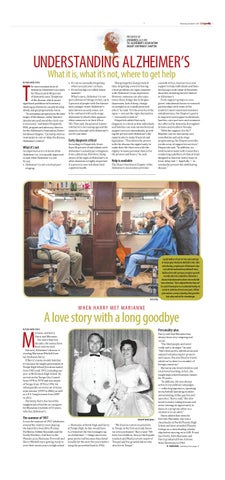
Sandy Wallace of Just For You Salon and Spa in Tempe gives Marianne Mitchell a trim, style and coloring, a regular part of Marianne's day out with her husband Harry Mitchell. Harry had been his wife's primary caregiver up until recently when he realized her Alzheimer's disease had advanced to where she needs fulltime attention. "She's adjusted better than me" he said of moving her to a residential facility. He wants to continue at least some parts of their past routine, so every Saturday, they go to the hair salon and out for a hamburger. Rick D’Elia
WHEN HARRY MET MARIANNE
A love story with a long goodbye By Paula Hubbs Cohen
Personality-plus
M
arianne and Harry. Harry and Marianne. For more than five decades, the names have been intertwined. But now, Alzheimer’s disease is stealing Marianne Mitchell from her husband, Harry. If Harry’s name sounds familiar, it’s because he taught government at Tempe High School (his alma mater) from 1965 until 1992, including one year at McClintock High School. He served on the Tempe City Council from 1970 to 1978 and was mayor of Tempe from 1978 to 1994. He subsequently served as an Arizona state senator (1999 to 2006) as well as a U.S. Congressman from 2007 to 2011. But lately, Harry has faced the toughest job of his life: as caregiver for Marianne, his bride of 53 years, who has Alzheimer’s.
The summer of 1957 It was the summer of 1957. Jukeboxes around the country were playing the latest hits from Elvis Presley, Pat Boone, Debbie Reynolds and the Everly Brothers. And here in the Phoenix area, Marianne Prevratil and Harry Mitchell were getting ready to start their senior years in high school
Mitchell family photo
— Marianne at North High and Harry at Tempe High. As fate would have it, a friend set the two teenagers up on a blind date — things must have gone pretty well because they dated steadily for the next five years before tying the proverbial knot in 1962.
“We lived our entire married life in Tempe in the first and only house we ever purchased,” Harry said. “We have two children, Amy (a third-grade teacher) and Mark (current mayor of Tempe) and five grandchildren who also live in Tempe.”
Harry said that Marianne has always been very outgoing and social. “She liked people and never really met a stranger,” he said. “She’s been pretty adventurous and enjoyed volunteering for projects and causes. She also liked to travel, which we’ve done to a number of foreign countries.” Marianne also loved children and truly loved teaching, in fact, she taught high school business classes for 35 years. “In addition, she was always active in my political campaigns — collecting signatures, speaking on my behalf, knocking on doors and attending rallies, parties and speeches,” Harry said. “She also loved to dance, taking lessons and never missing an opportunity to dance in a program either as a student or as an adult.” Harry added that when he first met Marianne, she was a cheerleader at North Phoenix High School and later attended Phoenix College on a cheerleading scholarship before moving on to ASU. Proud Sun Devils, both Marianne and Harry graduated from Arizona State University in 1962. MARIANNE, continued on page 9