Livingwell A SPECIAL PUBLICATION CREATED BY REPUBLIC MEDIA CUSTOM PUBLISHING
a-z
HEALTHCARE NEWS YOU CAN USE FOR YOUR WHOLE FAMILY
DECEMBER 2014
2 Diagnosis: Diabetes | 3 Venomous bites/stings | 4 Hospitalists, Pet holiday safety | 5-6 Support groups & events
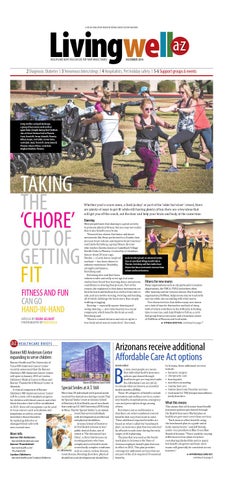
Using strollers and park landscape, a group of busy moms work on their upper body strength during their Fit4Mom class at Desert Horizon Park in Phoenix. Front, from left: Devon Schmidt, Phoenix; Hillary Cooper, Scottsdale; Jennie Tyma, Scottsdale. Back, from left: Jenny Donnell, Phoenix; Alyson Ofman, Scottsdale; Meghan Kendrick, Phoenix.
TAKING THE ‘CHORE’ OUT OF GETTING FIT FITNESS AND FUN CAN GO HAND-IN-HAND
ARTICLE BY DEBRA GELBART PHOTOGRAPHY BY RICK D’ELIA
Whether you’re a new mom, a ‘desk jockey’ or part of the ‘older but wiser’ crowd, there are plenty of ways to get fit while still having plenty of fun. Here are a few ideas that will get you off the couch, out the door and help your brain and body at the same time.
Dancing
Most people know that dancing is a great activity to promote physical fitness, but you may not realize that it also benefits your brain. “Research has shown that dance and dance movements like those performed in a Zumba class increase brain volume and improve brain function,” said Linda Hertzberg, a group fitness director who teaches Zumba classes at Camelback Village Health Clubs in Phoenix. Created by a Colombian dancer about 20 years ago, Linda Hertzberg leads an advanced Zumba Zumba — a Latin dance-inspired class at Camelback Village Health Club in workout — has been shown to Phoenix. Hertzberg said that studies have enhance endurance, flexibility, shown that dance movements increase brain strength and balance, volume and brain function. Hertzberg said. Hertzberg also said that brain volume erodes naturally as we age, but some studies have found that learning dance movements Fitness for new moms contributes to slowing that process. Part of the Many organizations such as city parks and recreation reason, she explained, is that dance movements are departments, the YMCA, YWCA and others often both forward and backward as well as from side to offer ‘mommy and me’ exercise classes. One franchise side, and can involve turning, twisting and bending, organization, Fit4Mom, helps moms stay on track with all of which challenge the brain more than simply exercise while also socializing with other moms. walking or jogging. Two characteristics that define many new moms Dancing — especially square-dancing and are a lack of time for themselves and lack of sleep, swing-dancing — also relies heavily on a social both of which contribute to the difficulty in finding component, which benefits the brain as well, time to exercise, said Amy Hinderer Feltus, a certiHertzberg said. fied group fitness instructor and a franchise owner “Music is a mood elevator and sets us up for a of Fit4Mom of Phoenix and Scottsdale. true body-mind neural connection,” she noted. ! FITNESS AND FUN, continued on page 7
a-z H E A LT H C A R E B R I E F S
Arizonans receive additional Affordable Care Act options
Banner MD Anderson Center expanding to serve children Banner Health and The University of Texas MD Anderson Cancer Center recently announced that the Banner Children’s MD Anderson Cancer Center will open in January 2015 at Cardon Children’s Medical Center in Mesa and Banner Thunderbird Medical Center in Glendale. A critical component of Banner Children’s MD Anderson Cancer Center will be a stem cell transplant program for children with blood cancers and other blood disorders that will be established in 2015. Stem cell transplants can be used to treat cancers such as leukemia and lymphoma as well as certain hereditary blood disorders by replacing defective or damaged blood cells with new, normal ones.
More info
Banner MD Anderson: BannerMDAnderson.com Banner Thunderbird: BannerHealth.com/ Thunderbird Cardon Children’s: BannerHealth.com/CardonChildrens
B
By Debra Gelbart
Banner MD Anderson Cancer Center
Special Smiles at A.T. Still More than 50 individuals with special needs received free dental care during a recent ‘Day for Special Smiles’ event at Arizona School of Dentistry & Oral Health, one of six schools that make up A.T. Still University (ATSU.edu) in Mesa. ‘Day for Special Smiles’ is an annual event that serves individuals with developmental, intellectual and physical disabilities. Arizona School of Dentistry & Oral Health is home to four public dental clinics, one of which is ‘The Advanced Care Clinic’, a clinic that focuses on treating patients who have complicated oral health needs or medically complex conditions A.T. Still University such as cancer, cardiac disease, renal disease, bleeding disorders, physical disabilities and developmental disabilities.
y now, most people are aware that individual health insurance policies purchased through healthcare.gov are required under the Affordable Care Act (ACA) to contain what are known as essential health benefits (EHBs). These 10 categories of benefits include prevention and wellness services, maternity benefits, hospitalization, emergency care and prescription drugs, among others. But what is not as well-known is that there are other mandated covered benefits that vary from state to state. These additional required benefits are based on what’s called the ‘benchmark plan’, an insurance plan that was selected by officials in each state during the early stages of ACA planning. The plan that was used as the benchmark plan in Arizona is the State of Arizona employee benefit plan that was in effect in 2012. This plan provides coverage for additional services that are not part of the ACA-required 10 essential benefits.
In Arizona, these additional services include: • bariatric surgery • chiropractic care • hearing aids • nutrition counseling • routine foot care • Autism Spectrum Disorder services • treatment for TMJ (temporomandibular joint) disorders
What this means
This means that all Arizona-based health insurance policies purchased through the Health Insurance Marketplace at healthcare.gov must cover these services. “Each insurer offers benefits using the benchmark plan as a guide and at fairly similar levels,” said Jeff Stelnik, senior vice president at Blue Cross Blue Shield of Arizona. “There could be varying differences in how plans structure cost-sharing (deductibles and co-pays) but benefit categories and basic minimums will generally be consistent across insurers.” ! AFFORDABLE CARE ACT, continued on page 6
2 | Livingwell a-z | Wednesday, December 3, 2014
Diagnosis: Diabetes
Learn about risk factors, symptoms, treatment and advanced research
D
By Meghann Finn Sepulveda
“We know there is a significant increase in the rate of obesity in children, which is a risk factor for developing diabetes. We not only have to look at what we’re feeding our kids but need to think about other contributing factors such as physical activity and sedentary behavior.”
iabetes is a complex disease that affects more than 29 million Americans, according to the American Diabetes Association. Whether diagnosed with Type 1 diabetes or Type 2 diabetes, there is an abundance of education, community support and resources available to ensure diabetics can take control of their health.
Type 1 diabetes
Accounting for about 10 percent of the total diabetes population, Type 1 diabetes is an autoimmune disease that affects the ability of the pancreas to produce insulin, a hormone that turns sugar and other food into energy to fuel your body. Children and adults alike are susceptible to Type 1 diabetes; it is not correlated to diet or lifestyle, is not preventable and there is no cure. “The illness has changed over the years and referring to it as ‘juvenile diabetes’ is no longer descriptive of the disease,” said Paula Boca-Bommarito, executive director, JDRF Desert Southwest Chapter. “Today 85 percent of people with Type 1 diabetes are adults.” (Note: JDRF was previously known as the Juvenile Diabetes Research Foundation.)
Symptoms
Symptoms include increased thirst, feeling lethargic, frequent urination, weight-loss and blurred vision. Because the body cannot produce insulin, early diagnosis and treatment is imperative. “Type 1 diabetics are insulin-dependent and require constant monitoring of blood sugar and maintaining insulin levels,” Boca-Bommarito said. “They need to be in tune with their body so blood sugar doesn’t unexpectedly drop — or go too high — in order to avoid complications.”
Control and manage
Checking blood sugar — also known as blood glucose — and injecting insulin multiple times or infusing it through a pump is a daily occurrence for people with Type 1 diabetes. Target levels range for each individual and
Livingwella-z
—Johanna DiStefano, PhD, TGen Thinkstock
!Resources
! American Diabetes Association: diabetes.org; 800-DIABETES (342-2383); 602-861-4731 (Phoenix) ! JDRF Desert Southwest Chapter: dsw.jdrf.org; 602-224-1800 (Phoenix); 520-327-9900 (Tucson) ! TGen: TGen.org; 602-343-8400 or 866-370-8436 ! Support groups: See the Living Well calendar in this issue or contact the American Diabetes Association or the JDRF Southwest Chapter insulin must be carefully balanced with eating patterns and other daily activities. “Insulin helps manage the disease, but it does not prevent the possibility of the disease’s devastating effects such as kidney failure, blindness, nerve damage, heart attack, stroke and pregnancy complications,” Boca-Bommarito said.
Type 2 diabetes
The most common form of diabetes is Type 2 diabetes. “For people with Type 2 diabetes, the pancreas isn’t making enough insulin and there is insulin resistance,” said Ann Bonpensiero, a certified diabetes educator and registered dietitian at Maricopa Integrated Health System’s outpatient diabetes program. “Usually people with Type 2 diabetes are overweight
December 2014 | Vol. 4, No. 12
Living Well A-Z publishes on the first Wednesday of the month. From A to Z, we tackle a broad range of health issues and offer resources to find more specific information. For questions concerning content in this publication, please contact Editor Paula Hubbs Cohen.
which causes insulin resistance especially when there is abdominal obesity.”
Symptoms
Symptoms, which often go unnoticed, could include visual disturbances or changes in vision which is a sign of high blood sugar, said Mary Lee Lehrich, RN, a certified diabetes educator at Scottsdale Healthcare Diabetes Center. “Other symptoms, similar to those with Type 1 diabetes, include fatigue, feeling thirsty and urinating frequently,” she said. “Early detection is the key to minimizing complications of high blood sugar which are heart attack, stroke, vision loss and amputation.” If blood sugars get very low, Type 2 diabetics might feel shaky or dizzy and may perspire. They can also have a headache or feel confused or irritable. “We recommend people drink half a cup of fruit juice or take three or four glucose tablets and wait 15 minutes to verify blood sugar is going up before checking again,” Bonpensiero said. “Follow up with a snack or eat a meal if it’s time.”
Control and manage
While Type 2 diabetes is not a curable disease, it can be controlled. “Healthy eating, exercise and reducing stress can help manage Type 2 diabetes,” Bonpensiero said. “We encourage patients to walk for at least 30 minutes a day or find an exercise they enjoy.”
Editor: PAULA HUBBS COHEN paula.cohen@cox.net; 602-444-8658 Contributing Editor: JIM WILLIAMS jlwilliams@republicmedia.com
Robert Fintelmann, MD, FACS
AR-0008301201-01
Dr. Fintelmann provides excellence in care of corneal disease, cataract and vision correction surgery (including LASIK and ICL). He performs a range of procedures including partial, full thickness and laser assisted corneal transplants (DSAEK, DMEK, DALK). In addition, he teaches residents and medical students. BARNET DULANEY PERKINS EYE CENTER Locations throughout Arizona www.GoodEyes.com 800-966-7000
INTERNAL MEDICINE, PALLIATIVE MEDICINE Mario Skobic, MD
AR-0008301198-01
A graduate of University of Sarajevo School of Medicine in Bosnia and Herzegovina, Dr. Mario Skobic completed his internship in internal medicine at New York UniversityManhattan Veterans Administration, and his residency in internal medicine at New York University. Dr. Skobic also has a special interest in wound care and rheumatology. Banner Health Clinic 37100 N. Gantzel Road, Suite 201, San Tan Valley 480-394-4469 www.BannerHealth.com/ClinicSanTanValleyPrimary
PEDIATRICS Viren Bavishi, DO
A graduate of Chicago College of Osteopathic Medicine, Dr. Viren Bavishi completed his residency in pediatrics at Hope Children’s Hospital/Christ Hospital in Illinois. Dr. Bavishi is Board Certified and specializes in general pediatrics with a strong interest in providing care for children with ADD/ADHD and food allergies. AR-0008301198-02
Research
There are a number of treatments and ongoing clinical research for diabetes including drug development, artificial organs and cell transplantations. One recent area of focus is on gastric bypass surgery which is a form of surgery involving the stomach and other internal organs. The surgery aids in weight loss for individuals considered to be morbidly obese. “We are looking at this carefully as an effective way to not only treat obesity but to put Type 2 diabetes into remission,” said Johanna DiStefano, PhD, director of the Translational Genomics Research Institute’s (TGen) division of diabetes, cardiovascular and metabolic diseases. TGen is a nonprofit organization focused on cutting-edge research for complex diseases. “We’re trying to determine what it is about the procedure [gastric bypass surgery] that allows patients to leave the hospital without diabetes,” DiStefano added. Islet cells, found in the pancreas, are now being experimentally transplanted from organ donors into diabetics so they can start producing insulin, eliminating the need for insulin injections. “While this is an exciting breakthrough, islet cell transplantation is largely individually based and could be an ongoing treatment for patients,” DiStefano said. “There are side effects which make it not an easy process to go through.” Artificial pumps that mimic the function of a pancreas are being used on diabetic patients, utilizing monitors that automatically calculate blood sugar levels and distribute insulin as needed. Editor’s note: In a future issue, we’ll look at additional aspects of diabetes.
A division of The Arizona Republic, 200 E. Van Buren St., Phoenix, AZ 85004. For general advertising inquiries, contact Republic Media at 602-444-8000. General Manager: CAMI KAISER ckaiser@republicmedia.com Creative Development Director: ISAAC MOYA imoya@republicmedia.com
CORNEA, VISION CORRECTION & CATARACT
Banner Children’s Health Clinic 2152 S. Vineyard, Suite 129, Mesa 480-827-5043 www.BannerChildrens.com/ClinicMesaVineyard
PEDIATRIC ORTHOPEDICS Ryan Miller, MD
A graduate of University of Arizona College of Medicine in Tucson, Dr. Ryan Miller completed the Banner Good Samaritan Orthopedic Surgery Residency in Phoenix. Dr. Miller specializes in pediatric spine deformity and spine disorders, pediatric sports medicine, pediatric limb deformity and pediatric fracture care. AR-0008301198-03
While anyone who is overweight can be at risk for Type 2 diabetes, there are additional risk factors for the disease including certain genetic predispositions and ethnicity. Indeed, highest incidences have been found in Hispanics, African Americans, Pacific Islanders and American Indians.
Banner Children’s Specialists in Mesa 1432 S. Dobson Road, Suite 304, Mesa www.BannerChildrens.com/ClinicAZOrtho 480-412-7400 AR-0008301194-01
AR-0008259451-01
Senior Managing Art Director: TRACEY PHALEN tphalen@republicmedia.com Design: CRAIG KURTZ craigrkurtz@gmail.com
Editorial Coordinator: NICK KOSTENKO nkostenko@republicmedia.com Advertising: RHONDA PRINGLE rpringle@republicmedia.com; 602-444-4929
Wednesday, December 3, 2014 | Livingwella-z | 3
Happy trails to you
Common sense and vigilance can prevent venomous bites and/or or stings
D
By Susan Lynne Fuchs
uring a recent hike near my neighborhood, the rocks in my peripheral vision appeared to be rolling. I focused my vision — and the rocks resolved into a fat five-foot Western Diamondback rattlesnake, less than three feet from my feet. I did exactly what the snake experts teach at the Phoenix Herpetological Society (PHS) reptile sanctuary in North Scottsdale: I took one giant step back, away from the snake. Unless provoked — stepped on or disturbed by a nearby hand — rattlesnakes will generally leave you alone. As long as you stay at least three feet away from them, they’ll slither away, just like mine did.
Avoiding trouble
As the weather cools, more people, often with children, take advantage of Arizona’s amazing desert scenery. Whether you’re hiking with a buddy, your kids or your Golden Retriever, common sense is the key to avoid adverse encounters, said Debbie Gibson, PHS executive vice president and reptile sanctuary manager. “You have to pay attention,” she said. “Know you are sharing the desert with species that were here hundreds of years before we developed it for people. Learn to co-exist. Every living thing has a necessary place in our environment.” Next, Gibson said, don’t ask for trouble. Don’t pick up snakes, lizards or spiders. If you’re hiking with your dog and he or she is reluctant to walk somewhere, look carefully all around you, she said. The dog may know or sense something you don’t; after all, snakes can be hard to see. Finally, Gibson said, carry a fully charged cell phone. If you are stung or bitten by anything venomous, call the free, 24-hour Banner Good Samaritan Poison and Drug Information Center hotline at 800-222-1222. They will help you determine what to do.
!If you are bitten or stung ! Venomous snakes: Bites by any of Arizona’s 13 rattlesnake ke species are relatively rare compared with the thousands of hikers who enjoy our beautiful autiful Sonoran desert. According to Banner’s Poison Center, only about a hundred venomous us bites were treated this year. However, if you are one of the unlucky few who are bitten, ten, call 911 immediately, said Michelle Ruha, M.D., toxicologist at Banner’s Poison Center. After that, her best advice is this: “Don’t use home remedies. Don’t make cross-cuts near the bite. Don’t try to suck out the venom. Don’t apply a tourniquet. None of these things can help and they can be harmful.” What you should do, she said, is try to stay calm, stay hydrated and get professional medical help as soon as possible because time is critical to recovery. Rattlesnake venom dissolves tissue — a destructive painful process. Antivenom injections are the only treatments that can halt venom’s progress.“On average, it takes 12 vials of antivenom to treat a rattlesnake bite,” Ruha said. ! Scorpions: The smallest of Arizona’s 60 scorpion species, the bark scorpion, has a neurotoxin that can cause eye and muscle twitching as well as impair vision, speech or breathing, Ruha said. Bark scorpion antivenom is effective, while stings by other scorpions, while intensely painful, can almost always be treated at home with ice and over-the-counter pain relievers. However, you should always contact your healthcare provider for advice, especially when the person bitten is very young or old, or has an impaired immune system. ! Black Widow spiders: Distinctive for the bright red/orange hourglass on its abdomen, a Black Widow spider is about 3/8 of an inch long with one-inch legs. Most bites can be managed at home with ice and over-the-counter pain relievers, Ruha said, but if pain is severe or spreads to the lower back or limbs, medical care or even antivenom at the hospital may be needed. ! Gila Monsters: “It’s really hard to get bitten by a Gila Monster,” the only venomous lizard indigenous to Arizona, Gibson said. “But if you break the law and pick one up it can turn and start chewing your hand.” Removing the lizard quickly is important but difficult, she said, noting that little short of an alcohol bath will make it let go. Get treatment at the nearest hospital. ! Africanized Bees: If the patient is not bee-allergic, very young or elderly and has been stung a minimal number of times, Ruha said that stings can generally be treated at home. In cases when bees swarm and sting by the dozens or hundreds, professional medical help should be sought.
!What is it? From a safe distance, snap a cell phone photo of any mysterious reptile you spot during a desert hike and text it to the experts at the Phoenix Herpetological Society. They’ll text back an answer ASAP. To ID a snake, text a photo to 602-550-1090. To ID a lizard or scorpion, text a photo to 602-550-7029. Or ask the Banner Poison Center for their free illustrated brochure on venomous bites and stings.
!More info ! Banner Good Samaritan Poison and Drug Information Center: BannerHealth.com (search for poison center); 800-222-1222 ! Phoenix Herpetological Society: PhoenixHerp.com; 480-513-4377
Thinkstock images
3#( "# (> ">-%> />7%; 022 7%. 18+: $<>087%; #%> #= 89> '#:8 8>$9%#2#;7$022& 0"50%$>" 26%; $0%$>< 8<>08'>%8 $>%8><: 7% 89> :808>) 18+: 0"50%$7%; >==>$875> 8<>08'>%8: 89<#6;9 #6< $27%7$02 8<702:) 18+: #==><7%; 0% 0<<0& #= !<#;<0': 0%" :><57$>: 8# $0<> =#< !087>%8: 0%" 89>7< 2#5>" #%>: 89<#6;9 022 !90:>: #= 26%; $0%$><) ,%" 78+: 89> 87<>2>:: ">"7$087#% 0%" $#220/#<087#% #= #6< 8>0':* />$06:> $0%$>< %>5>< 804>: 0 "0& #==) Schedule your appointment today: (480) 256-6444. US 60 & Higley Road • BannerMDAnderson.com • AR-0008153173-01
4 | Livingwell a-z | Wednesday, December 3, 2014
Hospitalists
The doctors who now manage your care in the hospital
W
By Susan Lynne Fuchs
hile some specialists — cardiologists, pulmonologists and surgeons — provide hospital care, primary providers who do hospital rounds are almost extinct. “It’s just not practical,” said internal medicine specialist Michael Reitz, D.O., chair of Banner Medical Group’s Clinical Division of Hospital Medicine.
“Wehavetobeflexible. Kidscanchangequickly— youneverknowwhat’s going tohappenbutyouhavetobe readyforwhateverdevelops.” —Ryan Bode, M.D., with 8-month-old Bailey at Phoenix Children’s Hospital
In-hospital care
“With changes in our healthcare system, primary care physicians need to spend more time seeing patients in their offices,” Reitz said. “Traveling to a hospital to check on patients is difficult; if patients are in multiple hospitals, it’s impossible.” It made more sense, Reitz said, to have internal or family medicine specialists full-time in the hospital to monitor patients and expedite changes in care when [for example] the patient’s condition changes or as soon as test results are available. These physicians are now known as hospitalists.
Avert crises
Hospitalists save healthcare dollars by visiting their patients up to three or four times a day, said Nazar Noori, M.D., head hospitalist for Phoenix Internal Medicine Group at St. Luke’s Medical Center, Phoenix, and Tempe St. Luke’s Hospital. That lets them pick up on red flags, take care of problems before they become crises and work toward timely patient discharge. Additionally, Reitz said, hospitalists in the medical center full-time become familiar with facility resources and can quickly access lab, radiology, respiratory care, physical therapy and other support services.
Numbers snowballed
“Hospitalists efficiently provide highquality care and are in demand by all hospitals. That’s why the number of hospitalists has snowballed in recent years,” Noori said, adding that, even so, patients are often still surprised when they’re visited by a hospitalist. “To develop our patients’ trust and confidence,” he said, “we have developed ways to introduce ourselves and explain what we do.”
Continuity of care
An early problem faced by hospitalists was communicating with the patient’s primary care physician to ensure continuity of care. Sometimes doctors didn’t know a patient had been hospitalized until months later when the patient came in for an unrelated reason, said family physician Jan Zieren, D.O. Then it might be difficult to track down the patient’s hospital records to get details. With the advent of electronic health records (EHR), the system has vastly improved, especially in health systems where hospital staff and primary care
Phoenix Children’s Hospital
hospitalists who are board-certified obstetricians. “WhenIstartedinthe1990s These hospitalists are part of the therewereonly1,000hospitalists nationwide OB Hospitalist Group (OBHG) recruited by Phoenix Baptist’s leadership, inthecountry.Today,morethan who, with OBHG, spent almost a year 44,000hospitalistsprovidecare developing their plan for full-time OB hospitalists before the new service was launched acrossthenation.” in September. —MichaelReitz,M.D.,BannerMedicalGroup “The OB hospitalists and the OBED strengthen the continuum of collaborative obstetrical care with the primary provider physicians have access to the same computer databases, Reitz said. When that’s by improving access and eliminating any potential delays in care,” said Lynnette not the case, hospitalists often pick up a Watkins, M.D., chief medical officer at phone and call the primary care practiPhoenix Baptist. tioner, Noori said. “Our team is experienced with diverse patient populations,” said Donald Toatley, Specialized hospitalists M.D., OB-GYN team lead hospitalist at Some areas, such as obstetrics and pediatrics, use specialized hospitalists who focus Phoenix Baptist. “Many are bilingual and all provide safe high-quality care for our on a particular aspect of care. patients.” Obstetrics: For example, at Phoenix Pediatrics: At Phoenix Children’s Baptist Hospital, a new Obstetric Hospital, specialized pediatric hospitalists Emergency Department (OBED) is staffed care for the hospital’s young patients. 24 hours a day, 365 days a year, with
The need for pediatric hospitalists evolved over the last 15 years because children’s illnesses are often more acute, involve multiple organ systems and require continual expert observation and rapid response, said Ryan Bode, M.D., who is co-medical director of patient safety and quality as well as chief of the hospitalist division at Phoenix Children’s Hospital. A pediatric hospitalist must have a lot of empathy, Bode said, in order to be able to engage with and comfort a child, as well as transition to talk with family members. “We also have to collaborate and coordinate care and communications with and between multiple specialists who are treating the same patient,” he said. Bode said he and his staff treat a large number of children with chronic illnesses whom they get to know well because they spend a lot of time in the hospital. “But others are acutely ill or injured and recover quickly, often within 24 hours,” he said. “There is a lot of joy when you see these patients smiling and playing so quickly.”
Pets and holiday safety
Tips to keep your Fidos and felines safe this holiday season
I
t’s that time of year when our homes tend to be filled with lots of new foods, chocolates and other candies, house-bound trees, lit candles and more — all of which are oh-so tempting to Spot and Fluffy. Here are a few tips to keep our furry family members safe during the holiday season.
“Pancreatitis can cause intense vomiting and diarrhea, lack of appetite and restlessness due to abdominal pain. In a severe case, a dog may be very depressed, go into shock and collapse or even die if not treated aggressively,” said Donald Holmes, DVM, with North Kenilworth Veterinary Care in Phoenix.
On the menu
New sights and sounds
By Susan Kavanaugh
Although the turkey and dressing smells heavenly, resist the temptation to share your leftovers with your pets. Among other reasons, that’s because most of the standard fare we serve over the holidays can contain high levels of fat which can do a number on your pet’s digestive system — kicking it into overdrive and often creating very upset tummies and possibly even pancreatitis.
Loud holiday music, bright and changing lights as well as strange smells of unfamiliar people can affect even the gentlest of animal dispositions. If you’re having guests over, you should remain alert to your pet’s responses, and if they seem the least bit anxious, find a quiet, personal space for them to rest or play away from the main event.
“For pets who love to be part of the action,” said Bretta Nelson, public relations manager with the Arizona Humane Society, “keep an eye on frequent opening and closing of doors which can lead to pets escaping into the great outdoors. Whether staying or going this holiday season, all pet owners should be sure their pets are outfitted with a collar, proper identification and a microchip.”
Plants and decorations
According to the Arizona Humane Society, plants such as poinsettias, holly and mistletoe are poisonous and should be kept outside of your pet’s reach. However, experts advise that you keep the phone number of your local emergency veterinary clinic on-hand, just in case.
Other things to watch for
• Twinkling lights, dangling ribbons and fancy bows may find their way into your pet’s stomach and could easily cause severe intestinal distress and possibly even the need for surgery. • If you light a Menorah or otherwise use candles for decoration, don’t leave them burning unattended. • Remember the height and level of your pet’s world. Just like with child-proofing, scan your rooms at your pet’s level; if you’re not sure about something, be safe rather than sorry and rearrange as needed.
Thinkstock
Wednesday, December 3, 2014 | Livingwella-z | 5
DECEMBER
Take advantage of opportunities to meet others with similar issues and learn more about various aspects of your health – from A to Z. Allgroupsandeventsarebelieved, butnotguaranteed,tobefreeunless otherwisestated.Everyefforthasbeen madetoverifyaccuracy,butpleasecall beforeattendingtoconfirmdetails.
THE GRIEVING PROCESS Dec. 10, 11 a.m.–noon Humana Guidance Center 5943 E. McKellips Rd., Mesa 480-325-4707
WELLNESS
CHILD LOSS SUPPORT GROUP Dec. 15, 6–8 p.m. Virginia G. Piper Cancer Center 10460 N. 92nd St., Scottsdale 480-323-3878; shc.org
MEDICATION CHECKS Call to schedule a personal meeting St. Luke’s, 1800 E. Van Buren St., Phoenix Tempe St. Luke’s, 1500 S. Mill Ave., Tempe Register: 877-351-WELL (9355) WALKING GROUPS Various dates & locations, 9–10 a.m. By Humana; 480-325-4707; humana.com UNDERSTANDING ANESTHESIA Dec. 4, noon Mountain Vista Medical Center 1301 S. Crismon Rd., Mesa Register: 877-924-WELL (9355) FLU NEWS YOU CAN USE Dec. 11, noon–1 p.m. By Tempe St. Luke’s at Tempe Public Library 3500 S. Rural Rd., Tempe Register: 877-351-WELL (9355) HEALTHY TEETH, HEALTHY YOU Dec. 11, 1–2 p.m. Civic Center Auditorium 3839 N. Drinkwater Blvd., Scottsdale 480-882-4636; shc.org/events OSTEOPOROSIS EDUCATIONAL FORUM Dec. 17, 9–10 a.m. Scottsdale Healthcare Shea 9003 E. Shea Blvd., Scottsdale 480-323-3663; shc.org
CAREGIVERS CAREGIVERS SUPPORT Various dates, times & locations By Duet; 602-274-5022; DuetAZ.org CAREGIVERS SUPPORT Dec. 8 St. Joseph’s Outpatient Rehab 114 W. Thomas Rd., Phoenix Call for time: 602-406-6688 CAREGIVERS SUPPORT Dec. 10, 2:30 p.m. Mountain Vista Medical Center 1301 S. Crismon Rd., Mesa Register: 877-924-WELL (9355) ONLINE NETWORKING (DUET) Dec. 13, 9–10 a.m. Register: DuetAZ.org (Events tab) 602-274-5022 HOLIDAY CAREGIVING Dec. 15, 9:30–10:30 a.m. By Benevilla at Church of the Palms 14808 N. Boswell Blvd., Sun City 623-584-4999 CAREGIVING SUPPORT Dec. 19, 9–11 a.m. By Benevilla at Birt’s Bistro 16752 N. Greasewood St., Surprise 623-584-4999
GRIEF GRIEF SUPPORT GROUP Various dates, times & locations By Banner Hospice Rev. Cindy Darby, cindy.darby@BannerHealth.com BannerHospice.com; 480-657-1167 GRIEF SUPPORT GROUP Various dates, times & locations By Hospice of the Valley hov.org/grief-support-groups; 602-530-6970 GRIEF SUPPORT GROUP Dec. 4 & 18 St. Joseph’s 350 W. Thomas Rd., Phoenix Call for time: 602-406-3275
GRIEF BEFORE LOSS Dec. 31, 10–11 a.m. By Benevilla at Birt’s Bistro 16752 N. Greasewood St., Surprise 623-584-4999
ORTHOPEDICS COPING WITH SHOULDER PAIN Dec. 4, 6 p.m. Mountain Vista Medical Center 1301 S. Crismon Rd., Mesa Register: 877-924-WELL (9355) MINIMALLY INVASIVE SPINE SURGERY Dec. 8, 6–7:30 p.m. Scottsdale Orthopedic Institute 20401 N. 73rd St., Scottsdale 480-882-4636; ScottsdaleSpineSurgery.com ROBOTIC KNEE SURGERY Dec. 9, 6–7:30 p.m. Scottsdale Orthopedic Institute 20401 N. 73rd St., Scottsdale 480-882-4636; AZKneeReplacement.com
PAIN HOPE FOR TODAY Dec. 9, 16 & 23, 3:30–4:30 p.m. By Chronic Pain Anonymous at Temple Chai Shalom Center House 4635 E. Marilyn Rd., Phoenix cpa-az@cox.net; ChronicPainAnonymous.org
HEART/STROKE STROKE SUPPORT GROUP Dec. 4, noon Paradise Valley Hospital Rehab Services Gym 3929 E. Bell Rd., Phoenix 602-923-5546 or sritchie@abrazohealth.com MENDED HEARTS Dec. 4, 6–7 p.m. John C. Lincoln North Mountain 9202 N. Second St., Phoenix 623-879-5583; JCL.com/events CARDIAC SUPPORT Dec. 13, 8 a.m. Mountain Vista Medical Center 1301 S. Crismon Rd., Mesa Register: 877-924-WELL (9355) STROKE SUPPORT Dec. 17, 1 p.m. Mountain Vista Medical Center 1301 S. Crismon Rd., Mesa Register: 877-924-WELL (9355)
WOMEN PELVIC FLOOR DISORDERS Dec. 4, 6–8 p.m. Banner Desert 1400 S. Dobson Rd., Mesa 602-230-2273 OVARIAN CANCER SUPPORT Dec. 20, 10–11:30 a.m. By Cancer Support Community 360 E. Palm Lane, Phoenix Register: 602-712-1006; rsvp@cscaz.org
DIABETES DIABETES SUPPORT Dec. 4, 7–8 p.m. The Nutrition Professionals 2158 N. Gilbert Rd., Mesa Register: 480-216-1635; laura@NutritionPro.net
a-z T O P E V E N T S
DEC. 12
Please call to confirm reservations and cost (if any).
DEC. 4 & 6 HEALTH INSURANCE MARKETPLACE ASSISTANCE WHAT: Get help with choosing insurance coverage through the Affordable Healthcare Act’s Health Insurance Marketplace. WHEN/WHERE: Dec. 4: Maryvale Hospital, 5102 W. Campbell Ave., Phoenix Dec. 6: Phoenix Baptist Hospital, 2000 W. Bethany Home Rd., Phoenix TIME: Dec. 4: 6–7 p.m. (Spanish); 7–8 p.m. (English) Dec. 6: 6–7 p.m. (English) PRESENTED BY: Abrazo Health COST: Free INFO/REGISTER: 866-893-8446; AbrazoHealth.com/ PathToHealth
DEC. 4 & 8 KNOW THE 10 SIGNS: EARLY DETECTION MATTERS WHAT: Learn about early warning signs of Alzheimer’s and other forms of dementia. WHEN/WHERE: Dec. 4: St. Matthew United Methodist Church, 2540 W. Baseline Rd., Mesa Dec. 8: Sunrise Mountain Public Library, 21109 N. 98th Ave., Peoria TIME: 10–11 a.m. PRESENTED BY: Alzheimer’s Association COST: Free INFO/REGISTER: 602-528-0545; alz.org/dsw
DIABETES SUPPORT Dec. 8, 3 p.m. Mountain Vista Medical Center 1301 S. Crismon Rd., Mesa Register: 877-924-WELL (9355) NEUROPATHY: DO YOU HAVE IT? Dec. 17, noon Mountain Vista Medical Center 1301 S. Crismon Rd., Mesa Register: 877-924-WELL (9355)
ALZHEIMER’S/DEMENTIA ALZHEIMER’S & MEMORY SUPPORT Dec. 5, 9–11 a.m. By Benevilla at Birt’s Bistro 16752 N. Greasewood St., Surprise 623-584-4999 CONVERSATIONS ABOUT DEMENTIA Dec. 5, 11 a.m.–noon By Alzheimer’s Association at Holy Trinity Lutheran Church 739 W. Erie St., Chandler 602-528-0545; alz.org/dsw
The Bob Bondurant School of High Performance Driving
DEC. 5
DEC. 9
DRIVING TO EXCEL WHAT: Take laps with a professional driver or drive a Bondurant vehicle on your own. Proceeds support the Barrow Connection program at St. Joseph’s Hospital. WHERE: The Bob Bondurant School of High Performance Driving, Firebird International Raceway, Chandler WHEN: 3–7 p.m. PRESENTED BY: Barrow Neurological Institute and The Bob Bondurant School of High Performance Driving COST: $45 under age 18; $88 for adults INFO/REGISTER: 602-406-6280; TheBarrow.org/connection
WORKSHOP: WORKING THROUGH GRANDCHILD ANGER WHAT: Offers grandparents insight into their grandchild’s hidden anger and ways to handle it. Includes lunch and childcare with notice. WHERE: Littleton Elementary School, 1252 S. Avondale Blvd., Avondale WHEN: 10 a.m.–noon PRESENTED BY: Duet COST: Free INFO/REGISTER: By Dec. 5; 602-274-5022
DEC. 6 DIABETES HEALTH FAIR WHAT: Health screenings, vendors and diabetes education classes. WHERE: Scottsdale Community College, 9000 E. Chaparral Rd., Scottsdale WHEN: 9 a.m.–1 p.m. PRESENTED BY: American Diabetes Association of Phoenix COST: Free INFO/REGISTER: 602-861-4731; ADennis@diabetes.org DIRECTIONS FOR CAREGIVERS AFTER DEMENTIA Dec. 10, 12:30–2 p.m. Banner Alzheimer’s Institute 901 E. Willetta St., Phoenix 602-839-6850 ALZHEIMER’S PREVENTION RESEARCH Dec. 12, 10:30 a.m.–noon By Banner Health at Ed Robson Library 9333 E. Riggs Rd., Sun Lakes 602-230-2273 ALZHEIMER’S CAREGIVER SUPPORT Dec. 15, 1:30–3 p.m. By Tempe St. Luke’s at Pyle Adult Recreation Center 655 E. Southern Ave., Tempe Register: 877-351-WELL (9355) CAREGIVER SUPPORT GROUP Dec. 16, 12:30–2 p.m. Duet; 555 W. Glendale Ave., Phoenix 602-274-5022; DuetAZ.org ALZHEIMER’S SUPPORT GROUP Dec. 21, 11 a.m.–12:30 p.m. DignityHealthHugerMercyLivingCenter 2345 W. Orangewood Ave., Phoenix Lunch provided: 602-406-5600
PLANNING AHEAD FOR CAREGIVERS Dec. 8, 10 a.m.–noon Banner Alzheimer’s Institute 901 E. Willetta St., Phoenix 602-839-6850
DEC. 10 WORKSHOP: HANDLING HOLIDAY STRESS WHAT: Grandparents learn how to help grandchildren handle stress and anxiety during the holidays. Includes lunch and childcare with notice. WHERE: Buckeye Family Support Center, 210 S. Sixth St., Buckeye WHEN: 10 a.m.–noon PRESENTED BY: Duet COST: Free INFO/REGISTER: By Dec. 5; 602-274-5022
BREAST CANCER SUPPORT Dec. 8, 2–4 p.m. Ironwood Cancer & Research Centers 685 S. Dobson Rd., Chandler Register: 480-340-4013; IronwoodCRC.com COOKING FOR WELLNESS Dec. 17, 6–8 p.m. Breast Health & Research Center 19646 N. 27th Ave., Phoenix 623-780-4673; JCL.com/BreastHealth BREAST BUDS SUPPORT Dec. 20, 11 a.m.–1 p.m. MidFirst Bank Conference Room 6508 W. Bell Rd., Glendale 480-657-0500; BreastBuds.org
CANCER SUPPORT GROUPS CANCER CAREGIVERS SUPPORT Various dates & times By Cancer Support Community 360 E. Palm Lane, Phoenix Register: 602-712-1006; rsvp@cscaz.org CANCER SUPPORT Various dates & times By Cancer Support Community 360 E. Palm Lane, Phoenix Register: 602-712-1006; rsvp@cscaz.org
BREAST CANCER
ALZHEIMER’S & MEMORY SUPPORT Dec. 9, 16, 23 & 30, 10 a.m.–noon By Benevilla at Faith Presbyterian Church 16000 N. Del Webb Blvd., Sun City 623-584-4999
BOSOM BUDDIES SUPPORT GROUPS Various dates, times & locations Ahwatukee/Chandler: 480-893-8900 East Valley: 480-969-4119 Northwest Valley: 623-236-6616 West Valley: 623-979-4279
MIDDLE-STAGE ALZHEIMER’S Dec. 9 & 16, 1–3 p.m. Alzheimer’s Association 1028 E. McDowell Rd., Phoenix 602-528-0545; alz.org/dsw
BREAST CANCER SUPPORT Dec. 4, 6–8 p.m. Breast Health & Research Center 19646 N. 27th Ave., Phoenix 623-780-4673; JCL.com/BreastHealth
Girls’ Night Out: Little Black Dress
TREMBLE CLEFS HOLIDAY CONCERT WHAT: Holiday choir concert by two local singing groups for people who have Parkinson’s disease. WHERE: Burton Barr Central Library, 1221 N. Central Ave., Phoenix WHEN: 2–3 p.m. PRESENTED BY: TrembleClefsandthe MuhammadAliParkinsonCenter COST: Free INFO: 602-406-3840
DEC. 13 FREE CPR & FIRST AID CLASS WHAT: The public can take part in Heart Saver CPR and basic first aid classes. WHERE: Pima Medical Institute, 2169 S. Power Rd., Mesa WHEN: 9 a.m.–3:30 p.m. PRESENTED BY: Pima Medical Institute COST: Free INFO/REGISTER: 480-898-9898; pmi.edu
DEC. 13 & 14 MIHS HEALTH SCREENINGS WHAT: Located at the Food City Tamale Festival — get dental checks and health screenings (diabetes, blood pressure and more) provided by Maricopa Integrated Health System (MIHS). WHERE: 201 W. Washington St., Phoenix WHEN: 10 a.m.–5 p.m. PRESENTED BY: Maricopa Integrated Health System COST: Freeforhealthscreenings;food availablefromvariousvendors INFO/REGISTER: 602-344-1897; Patricia.Sandoval@mihs.org; mihs.org MULTIPLE MYELOMA GROUP Dec. 4, 10 a.m.–noon By Cancer Support Community 360 E. Palm Lane, Phoenix Register: 602-712-1006; rsvp@cscaz.org LIVING WITH LOSS Dec. 9 & 23, 1–2:30 p.m. By Cancer Support Community 360 E. Palm Lane, Phoenix Register: 602-712-1006; rsvp@cscaz.org NEWLY DIAGNOSED SUPPORT Dec. 9, 6–7:30 p.m. By Cancer Support Community 360 E. Palm Lane, Phoenix Register: 602-712-1006; rsvp@cscaz.org TEEN SUPPORT GROUP Dec. 9, 6–7:30 p.m. By Cancer Support Community at Banner Good Samaritan 1111 E. McDowell Rd., Phoenix Register: 602-712-1006; rsvp@cscaz.org Continued on page 6 INTERESTED IN PARTICIPATING IN CLINICAL STUDIES?
Good health never goes out of style.
Tuesday, Jan. 20 6 - 9:30 p.m. Phoenix Art Museum RSVP: (602) 230-CARE (2273) BannerHealth.com/SpiritofWomen
Call 480-301-4626 for more information.
AR-0008301138-01
I’m a three-time national rodeo champion. One day after training I had a seizure. Tests showed I had a rare brain tumor, and surgery to remove it could have left me paralyzed. Today, I’m back in the saddle. My answer was Mayo Clinic. Raley Mae Radomske, New Mexico
Thousands travel to Mayo Clinic each year for treatment, diagnosis, or a second opinion. Mayo Clinic is an in-network provider for millions, and a physician’s referral is typically not required. To request an appointment, visit MayoClinic.org.
Visit MayoClinic.org/Arizona
6 | Livingwell a-z | Wednesday, December 3, 2014
DECEMBER
a-z I N F O R M AT I O N O N L I N E
ABRAZO HEALTH CARE: AbrazoHealth.com Arizona Heart Institute and Arizona Heart, Arrowhead, Maryvale, Paradise Valley, Phoenix Baptist and West Valley hospitals BANNER HEALTH: BannerHealth.com BARROW NEUROLOGICAL INSTITUTE: TheBarrow.org CARDON CHILDREN’S MEDICAL CENTER: BannerHealth.com CHANDLER REGIONAL MEDICAL CENTER: ChandlerRegional.org JOHN C. LINCOLN HOSPITAL: JCL.com MARICOPA INTEGRATED HEALTH SYSTEM: MIHS.org MAYO CLINIC: MayoClinic.com MERCY GILBERT MEDICAL CENTER: MercyGilbert.org MOUNTAIN VISTA MEDICAL CENTER: MVMedicalCenter.com MUHAMMAD ALI PARKINSON CENTER: TheBarrow.org/NeurologicalServices PHOENIX CHILDREN’S HOSPITAL: PhoenixChildrens.org SCOTTSDALE HEALTHCARE: SHC.org ST. JOSEPH’S HOSPITAL AND MEDICAL CENTER: StJosephs-Phx.org ST. LUKE’S MEDICAL CENTER: StLukesMedCenter.com TEMPE ST. LUKE’S HOSPITAL: TempeStLukesHospital.com
PANCREATIC CANCER SUPPORT Dec. 13, 10–11:30 a.m. By Cancer Support Community 360 E. Palm Lane, Phoenix Register: 602-712-1006; rsvp@cscaz.org CARCINOID SUPPORT Dec. 13, 1–2:30 p.m. By Cancer Support Community 360 E. Palm Lane, Phoenix Register: 602-712-1006; rsvp@cscaz.org
PARKINSON’S SUPPORT Dec. 16, 3–4 p.m. By Benevilla at Shepherd of the Hills United Methodist Church 13658 W. Meeker Blvd., Sun City West 623-584-4999
LUNG CANCER SUPPORT Dec. 13, 1–2:30 p.m. By Cancer Support Community 360 E. Palm Lane, Phoenix Register: 602-712-1006; rsvp@cscaz.org
GASTROINTESTINAL
ESOPHAGEAL CANCER SUPPORT Dec. 18, 6–7:30 p.m. By Cancer Support Community at Banner Good Samaritan 1111 E. McDowell Rd., Phoenix Register: 602-712-1006; rsvp@cscaz.org
OSTOMY SUPPORT Dec. 4, 2 p.m. Banner Boswell 13180 N. 103rd Dr., Sun City 602-678-4441 OSTOMY SUPPORT Dec. 9, 6 p.m. Elite Home Healthcare Services 2140 W. Greenway Rd., Phoenix 602-246-8221
ORAL, HEAD & NECK CANCER SUPPORT Dec. 18, 6:30–8:30 p.m. Virginia G. Piper Cancer Center 10460 N. 92nd St., Scottsdale 602-377-2447
OSTOMY SUPPORT Dec. 18, 12:30 p.m. La Casa de Cristo Lutheran Church 6300 E. Bell Rd., Scottsdale 623-580-4120
COLORECTAL CANCER SUPPORT Dec. 20, 10–11:30 a.m. By Cancer Support Community 360 E. Palm Lane, Phoenix Register: 602-712-1006; rsvp@cscaz.org
PROSTATE PROSTATE CANCER SUPPORT Dec. 4, 6–7:30 p.m. By Cancer Support Community 360 E. Palm Lane, Phoenix Register: 602-712-1006; rsvp@cscaz.org
CANCER CAREGIVERS SUPPORT Dec. 20, 10 a.m.–noon Ironwood Cancer & Research Centers 685 S. Dobson Rd., Chandler Register: 480-340-4013; IronwoodCRC.com
PROSTATE CANCER SUPPORT Dec. 8, 7–9 p.m. Ironwood Cancer & Research Centers 685 S. Dobson Rd., Chandler Register: 480-340-4013; IronwoodCRC.com
OPEN CANCER SUPPORT Dec. 30, 1–2:30 p.m. By Cancer Support Community 360 E. Palm Lane, Phoenix No registration necessary
RESPIRATORY
PARKINSON’S
BETTER BREATHERS/ COPD SUPPORT Various dates, times & locations By the American Lung Association 602-429-0005; BreatheEasyAZ.info
PARKINSON’S EXERCISE CLASSES & SUPPORT GROUPS Various dates, times & locations By Muhammad Ali Parkinson Center 602-406-3840 YOUNG ONSET WELLNESS GROUP Various dates & times Muhammad Ali Parkinson Center 240 W. Thomas Rd., Phoenix 602-406-4921 PARKINSON’S SINGING CLASS Dec. 3, 10, 17 & 24, 10 a.m.–noon By Muhammad Ali Parkinson Center at Shepherd of the Desert Lutheran Church 11025 N. 111th Ave., Sun City 602-406-4921
EDUCATION FOR NEWLY DIAGNOSED Dec. 11, 1:30–3:30 p.m. Muhammad Ali Parkinson Center 240 W. Thomas Rd., Phoenix 602-406-3840
BETTER BREATHERS CLUB Dec. 14, 1–3 p.m. SCAN Health Plan Arizona 1400 E. Southern Ave., Tempe 602-258-7505; BreatheEasyAZ.info BETTER BREATHERS CLUB Dec. 16, 10:30–11:30 a.m. Scottsdale Care Center 5225 N. Scottsdale Rd., Scottsdale 480-395-0792; BreatheEasyAZ.info BETTER BREATHERS CLUB Dec. 18, 1:30–3 p.m. John C. Lincoln North Mountain 9202 N. Second St., Phoenix 602-870-6060; BreatheEasyAZ.info BETTER BREATHERS CLUB Dec. 18, 5:30–7 p.m. Gateway Community College 5090 N. 40th St., Phoenix 602-286-8507; BreatheEasyAZ.info
BRAIN/ NEUROLOGICAL YOUNG ADULT BRAIN INJURY Dec. 10, 6–7:30 p.m. St. Joseph’s Barrow 350 W. Thomas Rd., Phoenix 602-996-1396 or 602-406-6688 PROGRESSIVE SUPRANUCLEAR PALSY SUPPORT Dec. 13, 1:30–3:30 p.m. Pyle Adult Recreation Center 655 E. Southern Ave., Tempe 480-966-3391; ALudwig@asu.edu
INFANT BRAIN DEVELOPMENT Dec. 13, 9 a.m.–1 p.m. Tempe St. Luke’s 1500 S. Mill Ave., Tempe Register: 480-784-5588
WEIGHT LOSS BARIATRIC SURGERY SEMINARS Various dates, times & locations By Banner Health BannerHealth.com; 480-543-2606 WEIGHT LOSS SURGERY SEMINARS Various dates & times Bridges Center for Surgical Weight Management at St. Luke’s, 555 N. 18th St., Phoenix Register: 800-248-5553; webinar: BridgesAZ.com WEIGHT LOSS SURGERY SEMINARS Various dates, times & locations By Scottsdale Healthcare BariatricSurgeryAZ.com; 480-882-4636
VALLEY FEVER INFO
PARENTING
AZ VICTIMS OF VALLEY FEVER ArizonaVictimsOfValleyFever.org 623-584-8331; pat-valleyfever@live.com 602-242-9527; mmfcreate@aol.com VALLEY FEVER CENTER FOR EXCELLENCE 602-406-8253; vfce.arizona.edu ValleyFeverCenter@DignityHealth.org
GRANDPARENTS RAISING GRANDCHILDREN Various dates, times & locations By Benevilla; 623-207-6016; benevilla.org
BANNER GOOD SAMARITAN Poison & Drug Information Center Hotline: 800-222-1222
BRAIN ANEURYSM SUPPORT Dec. 17, 6–8 p.m. St. Joseph’s Barrow 350 W. Thomas Rd., Phoenix 760-333-7658; Kimberly@JoeNiekroFoundation.org
POISON CONTROL
Impacts of moving
It’s important to be aware that if you move out of your current state in 2015 and you have a health insurance plan through healthcare.gov, you will not necessarily be covered for all of the same benefits you have now. Also, if you move out of state, you will be required to enroll in a new plan based on your new state of residence during what’s known as a Special Enrollment Period if you move after the Open Enrollment Period ends on Feb. 15, said Erin Klug, assistant director for the Life and Health division of the Arizona Department of Insurance. You have 60 days from the date of your move to purchase a new plan. “If you move to a new state, the new health insurance policy you purchase may look different from your current policy,” Klug said. The healthcare.gov website can guide you through the criteria that require purchasing a new health insurance policy. The Leonard Davis Institute of Health Economics says that in 2016 the government will reassess whether or not to set an all-encompassing (the same in every state) national benchmark EHB plan that goes beyond the current 10 essential benefits. Until then, the range and scope of required covered services beyond the 10 essential health benefits will vary from state to state.
GRANDPARENTS RAISING GRANDCHILDREN Various dates, times & locations By Duet; 602-274-5022; DuetAZ.org CIRCLE OF MOTHERS SUPPORT Dec. 3, 10, 17, 24 & 31, 10 a.m. Banner Estrella 9201 W. Thomas Rd., Phoenix 623-327-8200 MOMS ON THE MOVE Dec. 3, 10 & 17, 1–2:30 p.m. Scottsdale Healthcare Osborn 3624 N. Wells Fargo, Scottsdale 480-323-3878; shc.org
We offer support and guidance every stepalong the way.
SUPPORT THROUGH OTHER PARENTS Dec. 4, 11, 18, 25 & Jan. 1, 7–9 p.m. First Presbyterian Church 161 N. Mesa Dr., Mesa 623-846-5464; SupportThroughOtherParents.org POSTPARTUM DEPRESSION Dec. 5, 9:30–11:30 a.m. Virginia G. Piper Cancer Center 10460 N. 92nd St., Scottsdale 480-323-3878; shc.org MOTHER-TO-MOTHER SUPPORT Dec. 5 & 26, 10–11:30 a.m. St. Joseph’s 350 W. Thomas Rd., Phoenix 877-602-4111 BREASTFEEDING SUPPORT GROUP Dec. 8, 15, 22 & 29, 10–11:30 a.m.
here he h e r re e e e her her
re e h
here here here
CAREGIVER SUPPORT GROUP Dec. 10, 1:30–3 p.m. Duet; 555 W. Glendale Ave., Phoenix 602-274-5022; DuetAZ.org
BETTER BREATHERS CLUB Dec. 9, 10:30–11:30 a.m. North Phoenix Care Center 750 E. Thunderbird Rd., Phoenix 480-297-5360; BreatheEasyAZ.info
BREATHE EASIER WITH GOOD LUNG HEALTH Dec. 19, noon Mountain Vista Medical Center 1301 S. Crismon Rd., Mesa Register: 877-924-WELL (9355)
SUPPORT THROUGH OTHER PARENTS Dec. 9, 16, 23, 30 & Jan. 6, 7–9 p.m. Larkspur Christian Church 3302 W. Larkspur Dr., Phoenix 623-846-5464; SupportThroughOtherParents.org
Yet not all states require ACA insurance plans to cover the same benefits beyond the 10 essential benefits referenced earlier. For example, if you live in Colorado or Utah, your insurer is not required to cover bariatric surgery, but in Arizona, they are. As another example, Arizona-based ACA policies are not required to cover infertility services, but Nevada- and New Mexico-based policies are required to do so. The differences among the states have been catalogued by the Leonard Davis Institute of Health Economics (ldi.upenn.edu) at the University of Pennsylvania for the Robert Wood Johnson Foundation (RWJF.org) in a recent report entitled “Essential Health Benefits: 50-State Variations on a Theme.” The Leonard Davis Institute of Health Economics is the University of Pennsylvania’s center for research, policy analysis and education on the medical, economic and social issues that influence how healthcare is organized, financed, managed and delivered. The Robert Wood Johnson Foundation, which is over 40 years old, cites that it is the nation’s largest philanthropy devoted solely to the public’s health. The report summarizes the services beyond the 10 essential benefits that are covered by each state. A brief overview shows that chiropractic care is required by 45 states, treatment for TMJ disorders is mandated by 31 states and bariatric surgery is a required benefit in 23 states. Coverage for hearing aids is required by 26 states, while coverage for autism spectrum disorder services is required by a different combination of 26 states. Routine foot care is mandated in 20 states; only 19 states require that infertility treatments be a covered benefit, according to the report.
re he
CARE-PARTNER SUPPORT GROUP Dec. 5, 1–3:30 p.m. By Muhammad Ali Parkinson Center at Sun Lakes Country Club 25601 N. Sun Lakes Blvd., Sun Lakes 602-406-4921
GET PAST ASTHMA Dec. 8, 6:30–8 p.m. John C. Lincoln 19841 N. 27th Ave., Phoenix 623-879-5452; JCL.com/events
BETTER BREATHERS CLUB Dec. 19, 10–11 a.m. Red Mountain Active Adult Center 7550 E. Adobe St., Mesa 480-586-2787; BreatheEasyAZ.info
MOMS ON THE MOVE Dec. 9 & 16, 11 a.m.–12:30 p.m. Scottsdale Healthcare Shea 9003 E. Shea Blvd., Scottsdale 480-323-3878; shc.org
her e
LYMPHOMA SUPPORT GROUP Dec. 13, 10–11:30 a.m. By Cancer Support Community 360 E. Palm Lane, Phoenix Register: 602-712-1006; rsvp@cscaz.org
Varies by state
BREASTFEEDING SUPPORT GROUP Dec. 8, 15, 22 & 29, 1 p.m. Banner Estrella 9201 W. Thomas Rd., Phoenix 602-230-2273
here
EARLY DETECTION OF PANCREATIC CANCER Dec. 9, 6:30–8:30 p.m. Virginia G. Piper Cancer Center 10460 N. 92nd St., Scottsdale 480-882-4636; shc.org/events
! continued from the cover
St. Joseph’s 350 W. Thomas Rd., Phoenix 602-406-4954
here
Continued from page 5
Affordable Care Act
Pacifica Senior Living
&
MUSIC memor y
When it comes to weight loss surgery, we believe you shouldn’t go it alone. That’s why we offer a team of expert doctors, nurse practitioners, dietitians, exercise physiologists and counselors—all to help you make the necessary lifestyle changes to transform your life.
PROGRAM
For those with a BMI above 34, we offer a comprehensive program, which includes surgical options and post-surgery support. Because of our dedicated service and results, our weight loss center at Banner Gateway has been recognized as a Center of Excellence by the American Society for Bariatric Surgery.
IPOD Donation Drive. Your Needed. Yo Help Hel H elp p Is Nee eede ded. y! Donate Dona Do nate te TToday! te oday od ay Music & Memory is a special neuroscience research music program that specializes in Alzheimer’s and dementia care which can restore, temporarily but repeatedly, the sense of self often lost when memory fails. Pacifica Senior Living has been utilizing this wonderful program for over 18 months with transforming results.
We are excited to start the Music & Memory Program at Peoria and Paradise Valley. Your gift Your Yo gififtt off nnew ew oorr ge gently ntltly nt ly uused sedd iP se iPods, ods od ds, s, M MP3 P3 players, pla laye laye yers rs, Na rs N Nano Nanos, ano noss, s, hheadphones, eaddp ea dpho dph dpho hone hone ness, adaptors, add to CD CDs andd iT iTunes gift ififtt cards rd he help lp tto make ke our program a succes success.. ess... Pacifica Senior Living PEORIA 9045 W. Athens St. | Peoria, AZ 85382 623-209-7424
Pacifica Senior Living PARADISE VALLEY 16621 N. 38th St. | Phoenix, AZ 85032 602-748-1682
www.pacificaseniorliving.com
AR-0008278197-01
Call to attend one of our free information sessions and find a plan that fits you.
sk nd a Call aout our us ab nd
a Music ory Memram! Prog Banner Gateway: (480) 543-2606 • US 60 & Higley Rd • Gilbert Banner Estrella: (623) 327-8200 • 9305 West Thomas, Suite 360 • Phoenix BannerHealth.com/Bariatrics AR-0008236520-01
Wednesday, December 3, 2014 | Livingwella-z | 7
Fitness and fun ! continued from the cover
But there are ways to boost your fitness as you take care of your baby, even if you don’t have the time, inclination or resources to join an organization, Feltus said. The only equipment you may need is a stroller, said Feltus, whose certifications are through the Aerobics and Fitness Association of America and Fit4Mom. “When walking with your baby, start with three to five minutes of power-walking where you gradually increase the pace of your stride,” she said. Then, you might try three to five minutes of strength training, she said, where you do lunges or squats while holding on to the stroller. If you’re at a park, you can try step-ups onto a bench. When you get back home, add some push-ups or sit-ups. “Any movement you’re doing today that you didn’t do yesterday is good,” Feltus said.
Pilates
Pilates dates to the early 1900s when a boxer and circus performer named Joseph Pilates began developing floor exercises that evolved into what is known today as Pilates mat work. Originally called ‘Contrology’, his methods later became known just as Pilates. Because Pilates — a method of exercise and physical movement designed to stretch, strengthen and balance the body — is often performed in a studio with an instructor, many people mistakenly assume that it can’t be practiced at home. However, that’s not true, said Deborah Lavinsky, owner of BellaBody Pilates in Phoenix, a Pilates studio. Many Pilates moves can be performed on a mat on the floor, she said, including “what we call the ‘hundreds’, pulsing straight arms by your sides 100 times as you lay on your back.” Lavinsky, a certified Pilates teacher through the Pilates Method Alliance, said it’s important to check with your doctor before trying Pilates moves, because some exercises may not be suitable for people who have osteoporosis or other spinal or orthopedic conditions. Pilates is considered “intelligent movement with a purpose, performed with determination, ease and rhythm,” Lavinsky said. “With continued practice, Pilates can improve your posture. It can also boost your stamina. When your core [the muscles that stabilize, align and move the trunk of the body, especially the abdominals and muscles of the back] becomes stronger, your balance gets better and back pain may
Amy Hinderer Feltus, above left, a Fit4Mom franchise owner, works out with moms during a group class at Desert Horizon Park in Phoenix. Other moms include: Devon Schmidt, Phoenix; Leann Preminger, Phoenix; Hillary Cooper, Scottsdale; Jenny Donnell, Phoenix. Photo at right: Linda Hertzberg leads an advanced Zumba class at Camelback Village Health Club in Phoenix. Georgia Nino, left, and Dana Lyon, right rear, work hard while following along. even be reduced. Pilates won’t necessarily turn you into an athlete, but it will help you do everyday activities more easily and will help you age gracefully.”
• Choose a class carefully. There are many variations of difficulty and alternatives are available such as chair and restorative yoga. • Talk with the teacher beforehand Yoga about your level of fitness and any Yoga has been around for 5,000 years injuries or limitations. although the physical practice is a modern • Start slow and take it easy; harder is addition to the spiritual dimension, said not better. Deborah Payne, a registered yoga teacher • Be open to other practices that are part who is certified to teach a type of yoga called of yoga such as pranayama (breath work), Anusara. Anusara yoga emphasizes “attitude, meditation and chanting. These, along alignment and action,” said Payne, an instrucwith the physical yoga practice, can build tor at Bodhi Coyote Yoga in Cave Creek. awareness and focus, improve posture, There are many different kinds of yoga, lower blood sugar and blood pressure, Payne said, including Bikram (colloquially strengthen the lymphatic, respiratory and known as ‘hot yoga’) and Iyengar, which digestive systems and build bone density. influenced Anusara. Most forms of yoga practiced in Western countries are collecTreadmill desk tively known as hatha yoga, Payne said. The Some people may think of a treadmill desk basics of yoga — which includes repeated as one where an individual walks on a performance of exercises or techniques and treadmill attached to a desk at an extremely the practice of letting go of old beliefs or slow pace for most of the day. But that’s behaviors — are similar no matter which not a good idea, said orthopedic surgeon specific type you practice, she said. Tim Bert, M.D., the medical director of the Though there are classes held in many sports medicine department at St. Luke’s locations, yoga does not have to be pracHospital in Phoenix. ticed in a group setting, Payne said. But if “A treadmill desk should be in a common you are trying to find the right class to join, area where workers take turns using it for she advises keeping these points in mind: 30 minutes to an hour a day,” he said. It’s
not meant to replace a regular sit-at desk. To walk, even at half a mile an hour, all day would compromise most people’s productivity over time, he said, because ultimately, the pain from lactic acid (a substance produced during normal metabolism and exercise) released from muscles as a result of constant movement would distract the person from doing his or her work. Bert recommends users start with a speed of between two and three mph for between 30 and 45 minutes. “This gives office workers a convenient and creative way to burn calories while at work,” he said, “especially for those who have a sedentary lifestyle. It’s a workout that can help tone your quadriceps (front thigh muscles), glutes (buttocks muscles) and calves.”
Resources
Many examples of all types of exercise can be found by searching the internet or by searching on YouTube. As with any new exercise routine, be sure to check with your healthcare provider to make sure what you’re interested in is safe considering your individual health issues.
THE NEW RULES of RETIREMENT: ENJOY DAILY WITH a HEALTHY DOSE of AWE.
Winter is a season for elegance at Vi at Silverstone, a Vi and Plaza Companies community. But then, so is every season. With crown molding, granite countertops and other stylish details, our spacious floor plans always look their holiday best. Make it Silverstone. 23005 North 74th Street, Scottsdale, AZ 85255 • 480.719.5679 • ViLiving.com/MakeItSilverstone AR120314 AR-0008253509-01
Go from a life of back pain
to a lifetime of living.
Natalie Gulbis
LPGA Player and Laser Spine Institute Patient
FINALLY, AN ALTERNATIVE TO TRADITIONAL OPEN BACK SURGERY. It’s time for you or a loved one
to stop suffering. Do what nearly 50,000 people have done and get your life back. If you’ve been putting off neck or back surgery, come learn about a proven technique that’s minimally invasive. BRING YOUR MRI OR CT SCANS and meet one-on-one with our physicians who will review them and discuss treatment for your specific condition.
Learn more about neck and back surgery options by attending our FREE MEDICAL SEMINAR Saturday, December 6 at 11 a.m.
EXPERTS IN TREATING CONDITIONS SUCH AS: Pinched nerve
Laser Spine Institute 8888 E. Raintree Drive | Scottsdale, Arizona 85260
THE ADVANTAGES OF MINIMALLY INVASIVE SPINE SURGERY AT LASER SPINE INSTITUTE • 97% patient recommendation rate
• No lengthy recovery*
• Minimally invasive outpatient procedure
• Board-certified surgeons+
Bulging/herniated disc ] Scoliosis Spinal stenosis ]
All it takes is an incision less than 1-inch.
Arthritis of the spine Sciatica ] Other chronic conditions
To register, call: 1-866-209-8723 or visit SpineSeminar.com *Each patient is different. Results may vary. +For more information visit LaserSpineInstitute.com/surgeons. Medicaid currently not accepted.
AR-0008303765-01