Livingwell A SPECIAL PUBLICATION CREATED BY REPUBLIC MEDIA CUSTOM PUBLISHING
a-z
HEALTHCARE NEWS YOU CAN USE FOR YOUR WHOLE FAMILY
FEBRUARY 2015
IN THIS ISSUE | 2 Thyroid 101 | 3 Shake the salt habit! | 4 Top events and support groups
Eye resolve
Simple steps can protect your vision for years
W By Debra Gelbart
e asked a local ophthalmic surgeon about the best ways to preserve vision and overall eye health throughout your life. Here is what Robert Fintelmann, M.D., of Barnet Dulaney Perkins Eye Center advises: • WEAR WELLMADE SUNGLASSES whenever you’re exposed to sunlight. Continual unprotected sun exposure, especially in Arizona, can put you at risk for skin cancer in the eye or a pterygium (“teh-RIDGE-ee-um”), a wing-like growth over the cornea that can affect vision. • PUT ON PROTECTIVE EYEWEAR — goggles or sunglasses — when you’re engaging in sports or recreational activities such as tennis, biking, hiking or riding a motorcycle. YO U R “It’s not H E A LT H just your HEAD brain and TO your skull TOE that need protection in the event of an accident on a bike or motorcycle,” Fintelmann said, referring to wearing helmets. “Your eyes need protection, too.” • PAY ATTENTION TO NUTRITION. Eyes benefit especially from the lutein in leafy green vegetables and from omega-3 fatty acids found in some fish, including salmon. • GET A PROFESSIONAL EYE EXAM at least once every two years. “Certain eye conditions, such as glaucoma, cataracts and macular degeneration, may not manifest right now but could be discovered during an exam and can be managed to prevent them from becoming a bigger problem down the road,” he said. • SOME CHANGES IN THE EYE ARE NORMAL as we age, including eyes that tire easily when reading and a feeling of dry eye. Three helpful remedies: (1) increasing intake of omega-3 fatty acids, (2) using lubricating eye drops and (3) performing a blinking exercise every 20 minutes while engaging in any visually demanding task. The blinking exercise simply involves closing your eyes for two seconds, opening them for two seconds and then closing them again and gently squeezing the lids for another two seconds to promote lubrication of the eyes. • WORSENING VISION IS NOT NORMAL as we age. “Don’t accept diminished sight as just a part of growing old,” Fintelmann said. “Many times there are things doctors can do to improve vision. Impaired vision is never normal and puts you at risk for falls or accidents.”
In this series
Watch for upcoming articles on the following topics as we provide information on your health — from head to toe. MARCH: Ears APRIL: Dental MAY: Glands JUNE: Pulmonary JULY: Colon
AUGUST: Ovaries SEPTEMBER: Prostate OCTOBER: Circulatory NOVEMBER: Feet DECEMBER: Skin
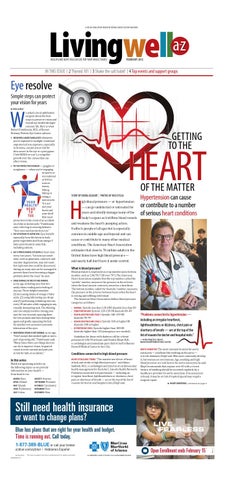
GETTING TO THE
Thinkstock
H
STORY BY DEBRA GELBART | PHOTOS BY RICK D’ELIA
HEART
igh blood pressure — or hypertension
— can go undetected or untreated for years and silently damage many of the
body’s organs as it stiffens blood vessels
OF THE MATTER
Hypertension can cause or contribute to a number of serious heart conditions
and weakens the heart’s pumping action.
It affects people of all ages but is especially common in middle-age and beyond and can
cause or contribute to many other medical conditions. The American Heart Association estimates that close to 78 million adults in the United States have high blood pressure — and nearly half don’t have it under control.
What is blood pressure?
Blood pressure is expressed as a top number and a bottom number, such as 130/70 (“130 over 70”). The American Heart Association explains that the top number, called the ‘systolic’ number, measures the pressure in the arteries when the heart muscle contracts, sensed as a heartbeat. The bottom number, called the ‘diastolic’ number, measures the pressure in the arteries between beats when the heart is resting and refilling with blood. The American Heart Association defines blood pressure categories as follows: • NORMAL: Systolic less than 120 AND diastolic less than 80 • PREHYPERTENSION: Systolic 120–139 OR diastolic 80–89 • HIGH BLOOD PRESSURE STAGE 1: Systolic 140–159 OR diastolic 90–99 • HIGH BLOOD PRESSURE STAGE 2: Systolic 160 or higher OR diastolic 100 or higher • HYPERTENSIVE CRISIS: Systolic higher than 180 OR diastolic higher than 110 (emergency care needed) Guidelines for those with diabetes call for a blood pressure of 120/70 or lower, said Fredric Klopf, M.D., a cardiologist and immediate past chief of staff at Banner Boswell Medical Center in Sun City.
Conditions connected to high blood pressure HEART ATTACK AND STROKE: “The number one driver of heart attack and stroke is high blood pressure,” said Adam Sabbath, M.D., a cardiologist and director of cardiovascular health management for the John C. Lincoln Health Network. Problems connected to hypertension — including an irregular heartbeat, lightheadedness or dizziness, chest pain or shortness of breath — are at the top of the list of reasons for doctor and hospital visits, Klopf said.
“Problems connected to hypertension — including an irregular heartbeat, lightheadedness or dizziness, chest pain or shortness of breath — are at the top of the list of reasons for doctor and hospital visits.” —Fredric Klopf, M.D. (above), Banner Boswell Medical Center, Sun City
AORTIC ANEURYSM: The most common location for aortic aneurysm — a balloon-like swelling on the aorta — is in the abdomen, Klopf said. Men more commonly develop it, but women are not immune. Age, smoking and high blood pressure are risk factors for aortic aneurysm, he said. Klopf recommends that anyone over 65 with a recent history of smoking should be screened regularly by a healthcare provider for aortic aneurysm. If an aneurysm is found, it may be at risk of rupturing and may require surgical repair. HEART CONDITIONS, continued on page 5
Still need health insurance
or want to change plans? 1-877-389-BLUE or call your broker azblue.com/azblue | Hablamos Español
D12121 02/15 AR-0008337571-01
*This does not apply if you have a qualifying event for special enrollment.
Open Enrollment ends February 15
*
108614-14
Blue has plans that are right for your health and budget. Time is running out. Call today.
2 | Livingwell a-z | Wednesday, February 4, 2015
Thyroid 101
Prevalence and impact of thyroid disease More than 12 percent of the U.S. population will develop a thyroid condition during their lifetime. An estimated 20 million Americans have some form of thyroid disease. Up to 60 percent of those with thyroid disease are unaware of their condition. Women are five to eight times more likely than men to have thyroid problems. One woman in eight will develop a thyroid disorder during her lifetime. Most thyroid cancers respond to treatment although a small percentage can be very aggressive. The causes of thyroid problems are largely unknown. Undiagnosed thyroid disease may put patients at risk for serious conditions such as cardiovascular diseases, osteoporosis and infertility. Pregnant women with undiagnosed or inadequately treated hypothyroidism have an increased risk of miscarriage, preterm delivery and severe developmental problems in their children. Most thyroid diseases are life-long conditions that can be managed with medical attention.
It’s a tiny gland that can cause big problems
A
By Susan Lynne Fuchs
small butterfly-shaped gland that is located in the middle of the lower neck, your thyroid is relatively small — but can cause big problems. That’s because it produces a hormone that influences everything from growth and development to metabolism and body temperature, so when things go wrong, many systems in the body can be affected. Indeed, problems can develop when the thyroid secretes too much (called hyperthyroidism) or too little (called hypothyroidism) hormone, said Amir Harari, M.D., a board-certified endocrinologist with Endocrinology Associates in Scottsdale.
“Thyroid hormones regulate the central nervous system that, among other things, controls your breathing.” —Mandeep Brar, M.D., Abrazo Diabetes Care Centers
Too little: hypothyroidism
The most common thyroid problems occur when there is too little hormone secreted, Harari said. Not enough thyroid hormone can lead to fatigue, feeling cold, dry skin or hair, constipation or changes in periods for women who are menstruating, he said. It can also affect mental health, causing problems with concentration and depression. Severe lack of thyroid hormones can lead to high cholesterol and blood pressure issues. Hypothyroidism can also cause altered sleep patterns, waking several times during the night and difficulty falling back asleep, said Mandeep Brar, M.D., a board-certified endocrinologist who is medical director for the Abrazo Diabetes Care Centers. “It can cause puffiness in the skin and the feeling of sluggishness or lack of initiative to do anything.” Ignoring symptoms of low thyroid can put you at risk for a respiratory problem called myxedema coma, Harari said. “Your breathing decreases, your carbon dioxide levels build up and you will probably need to be hospitalized on a ventilator while the condition is treated,” he said. Both doctors said that low thyroid hormone production gets a bum rap when it is blamed for excessive weight gain.
Livingwella-z
Source: American Thyroid Association, thyroid.org Thinkstock
“Not enough thyroid hormones can l ead to small weight gains,” Harari said, emphasizing ‘small’ — defined as approximately five pounds. “People who say their bad thyroid has caused them to gain 40 or 50 pounds usually have something else affecting their weight.”
they can almost always be successfully treated with surgery and radiation.”
Overlapping symptoms
“People need to understand that thyroid symptoms overlap with a lot of other health problems,” Brar said. “If blood tests Thyroid enlargement show that the thyroid is not the problem, Thyroid enlargement — traditionally called patients should be willing to look for other Too much: hyperthyroidism goiter — is common in parts of the world An overabundance of thyroid hormones diagnoses. Just because it’s not a thyroid often produces symptoms such as nervous- where certain nutrients are missing from problem doesn’t mean the symptoms ness, weight loss, dry or gritty eyes, feeling the diet. In the United States, where salt is are not real. They’re just symptoms of fortified with iodine, it is rare and usually warm and a racing heartbeat, Harari said. something else.” due to other causes. “The heart has receptors for thyroid Harari agreed, adding that thyroid-like The most common cause of thyroid hormones,” Brar said. “If there’s too much symptoms should be checked out with a enlargement in the U.S. is nodules, of which physician visit and blood tests, because hormone for prolonged periods of time, it causes different parts of the heart muscle to about 95 percent are benign and require they could indicate a serious problem. no treatment, Harari said. “The remaining contract at different rates and at different “Trust the results of the blood tests,” Harari 5 percent may be cancerous,” he said, “but times. This is known as atrial fibrillation said. “That’s the definitive diagnostic procethyroid cancer is very slow-growing, so and it can lead to stroke.” dure to identify a thyroid problem.”
February 2015 | Vol. 5, No. 2
Living Well A-Z publishes on the first Wednesday of the month. From A to Z, we tackle a broad range of health issues and offer resources to find more specific information. For questions concerning content in this publication, please contact Editor Paula Hubbs Cohen.
Hyperthyroidism can lead to permanent heart damage, Harari said. When too much thyroid hormone is ignored over time it can lead to a serious illness called thyroid storm, involving hospitalization for high fever, rapid pulse and delirium.
A division of The Arizona Republic, 200 E. Van Buren St., Phoenix, AZ 85004. For general advertising inquiries, contact Republic Media at 602-444-8000. General Manager: CAMI KAISER ckaiser@republicmedia.com Creative Development Director: ISAAC MOYA imoya@republicmedia.com
Editor: PAULA HUBBS COHEN paula.cohen@cox.net; 602-444-8658 Contributing Editor: JIM WILLIAMS jlwilliams@republicmedia.com
LOW-COST SCREENING 1 in 3 adult deaths each year are caused by heart disease and stroke.
Are you at risk? Find out by scheduling your $20 heart health assessment. Remember to also schedule your annual physical. Make your appointment today.
LowerYourHeartRisk.org
AR-0008342333-01
Senior Managing Art Director: TRACEY PHALEN tphalen@republicmedia.com Design: CRAIG KURTZ craigrkurtz@gmail.com
Editorial Coordinator: NICK KOSTENKO nkostenko@republicmedia.com Advertising: RHONDA PRINGLE rpringle@republicmedia.com; 602-444-4929
Wednesday, February 4, 2015 | Livingwella-z | 3
Shake the salt habit!
Regulating salt intake is important to your heart-health
A
By Gremlyn Bradley-Waddell
lthough shaking the salt habit may seem difficult, it can be done, said Carol Johnston, Ph.D., R.D., professor and associate director of the nutrition program at the School of Nutrition and Health Promotion at Arizona State University’s downtown Phoenix campus. “You really have to read labels,” said Johnston, who’s just conducted a sodiumrelated study focused on a cell phone app. “Sodium is a problem, but I think people can and will change what they buy — or order when dining out — when they know what’s in their food.”
Too much of a good thing
The truth is that sodium chloride — NaCl on the periodic table of the elements, if you recall science class — is not altogether a bad thing. “It’s just that we get way too much of it,” said Michelle Berman, M.S., R.D.N., C.D.E., owner of The Nutrition Professionals in Mesa. Salt is, in fact, the main mineral in the fluid between our cells and it helps regulate muscle and heart contractions, assists with fluid balance and helps maintain healthy cells, she said. When you increase your salt intake, however, your body draws more fluid into the bloodstream. As a result, your heart has to work harder to push fluid through the arteries, and as the amount of fluid increases, your blood pressure builds inside the arteries — and that can damage the elasticity of the artery lining. Pieces of cholesterol or fat that are floating by can catch on a ragged lining and get stuck. In a nutshell, that’s how an artery becomes clogged, Berman said. “If you decrease salt, you decrease the fluid and blood pressure and your heart doesn’t have to work so hard,” she said, meaning you’re less likely to suffer from hypertension and your arteries are less likely to become clogged.
Daily recommendations
Consider this: The average American consumes 3,000 to 5,000 milligrams of sodium each day, according to Johnston. Now consider this: Currently, the Centers for Disease Control and Prevention (CDC)
recommends just 2,300 milligrams — about a teaspoon — or less per day for healthy adults age 50 or younger who do not have heart disease or high blood pressure. The CDC further stipulates that anyone with ‘salt sensitivity,’ such as someone with high blood pressure, diabetes or chronic kidney disease, or anyone who’s 51 or older and/or is African-American, should consume no more than 1,500 milligrams — about two-thirds of a teaspoon — or less per day, Berman said. There’s also a push right now to make 1,500 milligrams or less the target number for all adults, she added.
Requirements vary
That said, individual sodium requirements can vary, depending upon factors such as lifestyle and health characteristics. A marathon runner who excretes salt through sweat is going to need more salt than a sedentary person, Johnston explained, and Phoenix residents may need a little extra sodium in their diets than, say, those in Oregon because the desert climate prompts sweat glands to work harder and more frequently.
Salt is the main mineral in the fluid between our cells and it helps regulate muscle and heart contractions, assists with fluid balance and helps maintain healthy cells. “It’s just that we get way too much of it.” — Michelle Berman, M.S., R.D.N., C.D.E., The Nutrition Professionals, Mesa
The human body has good mechanisms to conserve salt which was advantageous for our hunter-gatherer ancestors since most natural foods contain very little salt, Johnston said. But now that our bodies don’t need to conserve salt, the excess sodium we consume unfortunately contributes to health problems.
Buy and cook fresh
Luckily, there are simple fixes to address the sodium situation, said Janet Little, director of nutrition for Sprouts Farmers Markets in Phoenix. Her top tip? “Buy and cook fresh,” she said, when it comes to produce and meat. “If your overall diet is fresh, you’re going to stay within the
3#( "# (> ">-%> />7%; 022 7%. 18+: $<>087%; #%> #= 89> '#:8 8>$9%#2#;7$022& 0"50%$>" 26%; $0%$>< 8<>08'>%8 $>%8><: 7% 89> :808>) 18+: 0"50%$7%; >==>$875> 8<>08'>%8: 89<#6;9 #6< $27%7$02 8<702:) 18+: #==><7%; 0% 0<<0& #= !<#;<0': 0%" :><57$>: 8# $0<> =#< !087>%8: 0%" 89>7< 2#5>" #%>: 89<#6;9 022 !90:>: #= 26%; $0%$><) ,%" 78+: 89> 87<>2>:: ">"7$087#% 0%" $#220/#<087#% #= #6< 8>0':* />$06:> $0%$>< %>5>< 804>: 0 "0& #==) Schedule your appointment today: (480) 256-6444. US 60 & Higley Road • BannerMDAnderson.com • AR-0008339098-01
Thinkstock
healthy guidelines for sodium intake. When you start layering on all those extra intakes of sodium, that’s when you get into trouble.”
Surprising sodium sources
Along with buying fresh produce and meats, try to buy and cook foods in their simplest form. For example, make your own rice instead of buying it in a box, Johnston said, or buy fresh beans and steam them instead of buying the canned version, which is probably going to have added salt. As for foods to be wary of, fast food — in particular, processed chicken products “which people often eat when dining out because they think it’s a healthy option,” Berman said — is one of the top contributors of sodium to Americans’ diets. She said consumers also might be surprised at how much sodium is in soup and cheese, while Little said salad dressings, condiments and pasta sauces are other foods that often are loaded with a shocking amount of salt.
What’s the takeaway?
Read the fine print. That is, be sure to read the label on any boxed or canned food before you drop it into your shopping cart. Because while salt by itself is a good thing, too much of it is definitely not good for your health.
4 | Livingwell a-z | Wednesday, February 4, 2015
FEBRUARY
Take advantage of opportunities to meet others with similar issues and learn more about various aspects of your health – from A to Z. GRIEF SUPPORT GROUP Feb. 10 & 24, 3–4:30 p.m. Virginia G. Piper Cancer Center 10460 N. 92nd St., Scottsdale 480-323-1321; shc.org GRIEF SUPPORT GROUP Feb. 12 & 26 St. Joseph’s (for time: 602-406-3275) 350 W. Thomas Rd., Phoenix CHILD LOSS SUPPORT Feb. 16, 6–8 p.m. Virginia G. Piper Cancer Center 10460 N. 92nd St., Scottsdale 480-323-3878; shc.org
Allgroupsandeventsarebelieved, butnotguaranteed,tobefreeunless otherwisestated.Everyefforthasbeen madetoverifyaccuracy,butpleasecall beforeattendingtoconfirmdetails.
HEALTHCARE COVERAGE HEALTH INSURANCE MARKETPLACE HELP By Abrazo Health; 866-893-8446 AbrazoHealth.com/PathToHealth • Feb. 5, 6–7 p.m., Paradise Valley Hospital • Feb. 7, 6–7 p.m. (Spanish); 7–8 p.m. (English), Maryvale Hospital
PAIN
UNDERSTANDING HEALTH COVERAGE ByMaricopaIntegratedHealthSystem MIHS.org/flc • Feb. 10, 2–3:30 p.m., Family Learning Center, Phoenix; 602-344-1352 • Feb. 17, 1:30–3 p.m., Chandler Family Learning Center; 480-344-6460 • Feb. 19, 9–10:30 a.m., South Central Family Center, Phoenix; 480-344-6165 • Feb. 20, 9–10:30 a.m., Maryvale Family Center, Phoenix; 623-344-6955
INTRO TO FIBROMYALGIA Feb. 4, 11, 18 & 25, 5:30–6:30 p.m. Fibromyalgia Wellness Center 8300 N. Hayden Rd., Scottsdale 480-948-4955 FibroWellnessCenter.com CHRONIC PAIN SUPPORT Feb. 5 & 19, 6–7:30 p.m. Freedom Pain Hospital 17500 N. Perimeter Dr., Scottsdale 480-586-2300 FreedomPainHospital.com HOPE FOR TODAY Feb. 10, 17 & 24, 3:30–4:30 p.m. By Chronic Pain Anonymous at Temple Chai Shalom Center House 4635 E. Marilyn Rd., Phoenix cpa-az@cox.net ChronicPainAnonymous.org CHRONIC PAIN SUPPORT Feb. 11, 6:30–8 p.m. Scottsdale Senior Center 10440 E. Via Linda, Scottsdale 480-314-2330; theacpa.org
CAREGIVERS CAREGIVERS SUPPORT Various dates, times & locations By Duet; 602-274-5022; DuetAZ.org CAREGIVERS SUPPORT GROUP Feb. 9 (for time: 602-406-6688) St. Joseph’s Outpatient Rehab 114 W. Thomas Rd., Phoenix
HEART/STROKE
CAREGIVER RESOURCES Feb. 11, noon Mountain Vista Medical Center 1301 S. Crismon Rd., Mesa Register: 877-924-WELL (9355)
STROKE SUPPORT GROUP Feb. 5, noon Paradise Valley Hospital 3929 E. Bell Rd., Phoenix 602-923-5546 PREVENTING HEART DISEASE Feb. 12, noon Mountain Vista Medical Center 1301 S. Crismon Rd., Mesa Register: 877-924-WELL (9355) STROKE SURVIVOR SUPPORT Feb. 12, 2:30–4 p.m. Chandler Regional Medical Center 1955 W. Frye Rd., Chandler 480-728-5414 STROKE SUPPORT GROUP Feb. 18, 1 p.m. Mountain Vista Medical Center 1301 S. Crismon Rd., Mesa Register: 877-924-WELL (9355) STROKE PREVENTION Feb. 26, noon Mountain Vista Medical Center 1301 S. Crismon Rd., Mesa Register: 877-924-WELL (9355) STROKE SURVIVOR SUPPORT Feb. 26, 2:30–3:30 p.m. Gilbert Medical Center 3555 S. Val Vista Dr., Gilbert 480-728-5414
CAREGIVERS SUPPORT GROUP Feb. 11, 2:30 p.m. Mountain Vista Medical Center 1301 S. Crismon Rd., Mesa Register: 877-924-WELL (9355) ONLINE NETWORKING (DUET) Feb. 14, 9–10 a.m.; Feb. 24, 7–8 p.m. DuetAZ.org; 602-274-5022 CAREGIVER SUPPORT GROUP Feb. 20, 9–11 a.m. Benevilla Birt’s Bistro 16752 N. Greasewood St., Surprise 623-584-4999
GRIEF GRIEF SUPPORT GROUP Various dates, times & locations By Banner Hospice Rev. Cindy Darby cindy.darby@BannerHealth.com BannerHospice.com; 480-657-1167 GRIEF SUPPORT GROUP Various dates, times & locations By Hospice of the Valley hov.org/grief-support-groups 602-530-6970 GRIEF BEFORE LOSS Feb. 4, 11, 18 & 25, 2–3 p.m. Benevilla; 623-584-4999 16752 N. Greasewood St., Surprise
WOMEN
PREGNANCY & INFANT LOSS Feb. 5, 6–8 p.m. Virginia G. Piper Cancer Center 10460 N. 92nd St., Scottsdale 480-323-3878; shc.org
Awakening Libido and Desire in Women Saturday, February 21 • 12-2 p.m. JW Marriott Desert Ridge Grand Canyon Ballroom Salon 4-5
www.BannerHealth.com/BMGGoodSamWomens
AR-0008339102-01
Participants will learn ways to rejuvenate that spark and discover what’s holding you back.
GYNECOLOGICAL CANCER SUPPORT Feb. 11, 6–7:15 p.m. Ironwood Cancer & Research Centers 685 S. Dobson Rd., Chandler 480-728-5657 OSTEOPOROSIS SUPPORT Feb. 18, 9–10 a.m. Scottsdale Healthcare Shea 9003 E. Shea Blvd., Scottsdale 480-323-3663; shc.org OVARIAN CANCER SUPPORT Feb. 21, 10–11:30 a.m. Cancer Support Community 360 E. Palm Lane, Phoenix 602-712-1006; rsvp@cscaz.org WOMEN WITH MULTIPLE SCLEROSIS Feb. 28, 10 a.m. St. Joseph’s Barrow 350 W. Thomas Rd., Phoenix 480-829-6563
a-z T O P E V E N T S Please call to confirm reservations and cost (if any).
FEB. 7
FEB. 28
MOUNTAIN VISTA HEART-HEALTHY FAIR WHAT: Free health screenings (appointments required), heart-healthy cooking demos, tours of the cardiac catheterizationlab(“cathlab”). WHERE: Mountain Vista Medical Center, 1301 S. Crismon Road, Mesa WHEN: 8 a.m.–noon PRESENTED BY: Mountain Vista Medical Center COST: Free INFO/REGISTER: 877-924-WELL
CLIMB TO CONQUER CANCER WHAT: Mountain hike fundraising event to support the fight against cancer. WHERE: South Mountain Park, 10919 S. Central Ave., Phoenix WHEN: 7 a.m.–noon PRESENTED BY: American Cancer Society COST: $40 until Feb. 25; $50 after INFO/REGISTER: 602-952-7552; PhoenixClimb.com
DIABETES MANAGING TYPE 2 DIABETES Various dates, times & locations By Dignity Health; 480-728-3535 MANAGING DIABETES Various dates, times & topics Center for Diabetes Management 1760 E. Pecos Rd., Gilbert 480-728-3535 DIABETES SUPPORT Feb. 5, 7–8 p.m. The Nutrition Professionals 2158 N. Gilbert Rd., Mesa 480-216-1635 Michelle@NutritionPro.net DIABETES SUPPORT Feb. 9, 3 p.m. Mountain Vista Medical Center 1301 S. Crismon Rd., Mesa Register: 877-924-WELL (9355)
ALZHEIMER’S/DEMENTIA ALZHEIMER’S CAREGIVER SUPPORT; EARLY-STAGE DEMENTIA SUPPORT Various dates, times & locations Alzheimer’s Association — Desert Southwest Chapter 602-528-0545; alz.org/dsw ALZHEIMER’S & MEMORY SUPPORT Feb. 6, 9–11 a.m. Benevilla Birt’s Bistro 16752 N. Greasewood St., Surprise 623-584-4999 ALZHEIMER’S & MEMORY SUPPORT Feb. 10, 17 & 24, 10 a.m.–noon Faith Presbyterian Church 16000 N. Del Webb Blvd., Sun City 623-584-4999 ALZHEIMER’S SUPPORT Feb. 15, 11 a.m.–12:30 p.m. Dignity Health Huger Mercy Living Center 2345 W. Orangewood Ave., Phoenix Lunch provided: 602-406-5600 ALZHEIMER’S CAREGIVER SUPPORT Feb. 23, 1:30–3 p.m. By Tempe St. Luke’s at Pyle Adult Recreation Center 655 E. Southern Ave., Tempe Register: 877-351-WELL (9355) ALZHEIMER’S 101 Feb. 25, noon Mountain Vista Medical Center 1301 S. Crismon Rd., Mesa Register: 877-924-WELL (9355) LEWY BODY DEMENTIA CAREGIVER SUPPORT Feb. 26, 12:30–3 p.m. Arbor Rose Senior Living 6063 E. Arbor Ave., Mesa 480-641-2531; 480-985-1925
BREAST CANCER BOSOMBUDDIESSUPPORTGROUPS Various dates, times & locations Ahwatukee/Chandler: 480-893-8900 East Valley: 480-969-4119 Northwest Valley: 623-236-6616 West Valley: 623-979-4279 BREAST CANCER SUPPORT Feb. 9, 2–4 p.m. Ironwood Cancer & Research Centers 685 S. Dobson Rd., Chandler 480-728-5657
Looking for Arizona Find the best Doctors at TopDoctors.Azcentral.com
BREAST CANCER SUPPORT Feb. 12 & 26, 6–8 p.m. John C. Lincoln Deer Valley 19841 N. 27th Ave., Phoenix 623-780-4673 JCL.com/BreastHealth BREAST CANCER SUPPORT Feb. 14, 10 a.m.–noon Virginia G. Piper Cancer Center 10460 N. 92nd St., Scottsdale 480-323-1321; shc.org BREAST BUDS SUPPORT Feb. 21, 11 a.m.–1 p.m. MidFirst Bank Conference Room 6508 W. Bell Rd., Glendale 480-657-0500; BreastBuds.org
CANCER SUPPORT GROUPS CANCER SUPPORT COMMUNITY 360 E. Palm Lane, Phoenix (Full list of support groups: 602-712-1006; cscaz.org) • CANCER CAREGIVERS SUPPORT Various dates & times • PROSTATE CANCER SUPPORT Feb. 5, 6–7:30 p.m. • TEEN CANCER SUPPORT Feb. 10, 6–7:30 p.m. • MEDICAL EXPENSES & TAXES Feb. 12, noon–1:30 p.m. • LYMPHOMA SUPPORT Feb. 14, 10–11:30 a.m. • PANCREATIC CANCER SUPPORT Feb. 14, 10–11:30 a.m. • CARCINOID SUPPORT Feb. 14, 1–2:30 p.m. • LUNG CANCER SUPPORT Feb. 14, 1–2:30 p.m. • COLORECTAL CANCER SUPPORT Feb. 21, 10–11:30 a.m. IRONWOOD CANCER & RESEARCH CENTERS 685 S. Dobson Rd., Chandler (Full list of support groups: 480-728-5657; IronwoodCRC.com) • PROSTATE CANCER SUPPORT Feb. 16, 4–5:30 p.m. • LEUKEMIA, LYMPHOMA & MULTIPLE MYELOMA SUPPORT Feb. 18, 3–4:30 p.m. • COLON CANCER SUPPORT Feb. 19, 6–7 p.m. • CAREGIVER SUPPORT Feb. 21, 10 a.m.–noon • METASTATIC CANCER SUPPORT Feb. 25, 3–4:30 p.m. 480-340-4013 VIRGINIA G. PIPER CANCER CENTER 10460 N. 92nd St., Scottsdale (Full list of support groups: 480-323-1321; shc.org) • PANCREATIC CANCER SUPPORT Feb. 10, 4–5:30 p.m. • NON-HODGKIN’S LYMPHOMA Feb. 12, 6–8 p.m. • NEWLY DIAGNOSED SUPPORT Feb. 16, 6:30–7:30 p.m. • CAREGIVER & FAMILY SUPPORT Feb. 18, 6:30–7:30 p.m. • ORAL, HEAD & NECK CANCER Feb. 19, 6:30–8:30 p.m. • LIVING WITH LYMPHEDEMA Feb. 23, 6:30–8:30 p.m. MULTIPLE MYELOMA SUPPORT Feb. 5, 10 a.m.–noon By Cancer Support Community at Desert Botanical Garden 1201 N. Galvin Pkwy., Phoenix 602-712-1006; rsvp@cscaz.org
NEWLY DIAGNOSED SUPPORT Feb. 10, 6–7:30 p.m. By Cancer Support Community at Banner Good Samaritan 1111 E. McDowell Rd., Phoenix 602-712-1006; rsvp@cscaz.org ESOPHAGEAL CANCER SUPPORT Feb. 16, 6–7:30 p.m. By Cancer Support Community at Banner Good Samaritan 1111 E. McDowell Rd., Phoenix 602-712-1006; rsvp@cscaz.org CANCER CAREGIVERS SUPPORT Feb. 18, 5:30–7:30 p.m. Cancer Treatment Centers of America 14200 W. Fillmore St., Goodyear 623-388-6837 AZMyelomaNetwork.org CANCER SUPPORT GROUP Feb. 19, 6–7:30 p.m. Discussion: esophageal & lung cancer Bink’s Midtown 2320 E. Osborn Rd., Phoenix Register: 602-527-3776
PARKINSON’S PARKINSON’S EDUCATION, EXERCISE & SUPPORT GROUPS Various dates, times & locations By Muhammad Ali Parkinson Center 602-406-3840; 602-406-4921 PARKINSON’S SUPPORT GROUP Feb. 17, 3–4 p.m. Shepherd Hills Methodist Church 13658 Meeker Blvd., Sun City West 623-584-4999
GASTROINTESTINAL OSTOMY SUPPORT Feb. 5, 2 p.m. Banner Boswell 13180 N. 103rd Dr., Sun City 602-678-4441 OSTOMY SUPPORT Feb. 10, 6 p.m. Elite Home Healthcare Services 2140 W. Greenway Rd., Phoenix 602-246-8221 OSTOMY SUPPORT Feb. 15, 2–4 p.m. Fellowship Hall 161 N. Mesa Dr., Mesa 480-812-0324 OSTOMY SUPPORT Feb. 19, 12:30 p.m. Casa de Cristo Church 6300 E. Bell Rd., Scottsdale 623-580-4120
RESPIRATORY BETTER BREATHERS/ COPD SUPPORT Various dates, times & locations By the American Lung Association 602-429-0005; BreatheEasyAZ.info
BRAIN/NEUROLOGICAL YOUNG ADULT BRAIN INJURY Feb. 11, 6–7:30 p.m. St. Joseph’s Barrow 350 W. Thomas Rd., Phoenix 602-996-1396; 602-406-6688 PROGRESSIVE SUPRANUCLEAR PALSY SUPPORT Feb. 14, 1:30–3:30 p.m. Pyle Adult Recreation Center 655 E. Southern Ave., Tempe 480-966-3391; aludwig@asu.edu BRAIN ANEURYSM SUPPORT Feb. 18, 6–8 p.m. St. Joseph’s Barrow 350 W. Thomas Rd., Phoenix 760-333-7658 Kimberly@JoeNiekroFoundation.org BRAIN TUMOR SUPPORT Feb. 24, 6–8 p.m. St. Joseph’s Barrow 350 W. Thomas Rd., Phoenix 623-205-6446
602-652-3000; HearingLoss.org; ReggieFaith@gmail.com HEARING LOSS SUPPORT Feb. 19, 1:30–3:30 p.m. By Hearing Loss Association at Sun City Branch Library 16828 N. 99th Ave., Sun City 301-657-2248; HearingLoss.org; melanie.orourke@gmail.com HEARING LOSS SUPPORT Feb. 25, 1:30–3:30 p.m. By Hearing Loss Association at Fountain Hills Community Center 13001 N. LaMontana Dr., Fountain Hills 301-657-2248; HearingLoss.org; KFonville@fhfh.az.gov
PARENTING GRANDPARENTS RAISING GRANDCHILDREN Various dates, times & locations By Benevilla; 623-207-6016; benevilla.org By Duet; 602-274-5022; DuetAZ.org BREASTFEEDING SUPPORT Various dates, times & locations By Dignity Health; 480-728-5414 CIRCLE OF MOTHERS SUPPORT Feb. 4, 11, 18 & 25, 10 a.m.–noon Banner Estrella; 602-230-2273 9201 W. Thomas Rd., Phoenix MOMS ON THE MOVE Feb.4,11,18&25,11a.m.–12:30p.m. Scottsdale Healthcare Shea 9003 E. Shea Blvd., Scottsdale 480-323-3878; shc.org POSTPARTUM DEPRESSION Feb. 4, 11, 18 & 25, 1–2:30 p.m. Chandler Regional; 480-728-5414 1875 W. Frye Rd., Chandler T.E.E.N.S. 4 TEENS SUPPORT Feb. 5, 12, 19 & 26, 6–7 p.m. Chandler Regional; 480-728-5414 1875 W. Frye Rd., Chandler SUPPORT THROUGH OTHER PARENTS Feb. 5 & 19, 7–9 p.m. Faith Presbyterian Church 161 N. Mesa Dr., Mesa 623-846-5464 SupportThroughOtherParents.org POSTPARTUM DEPRESSION Feb. 6, 9:30–11:30 a.m. Virginia G. Piper Cancer Center 10460 N. 92nd St., Scottsdale 480-323-3878; shc.org MOTHER-TO-MOTHER SUPPORT Feb. 6 & 27, 10–11:30 a.m. St. Joseph’s; 877-602-4111 350 W. Thomas Rd., Phoenix GRANDPARENTS.COM AT DESERTFEST Feb. 7, 11 a.m.–3 p.m. PebbleCreek Resort Community 16262 Clubhouse Dr., Goodyear 480-895-4506 DesertFestAZ.com/PebbleCreek BREASTFEEDING SUPPORT Feb. 9, 16 & 23, 10–11:30 a.m. St. Joseph’s; 602-406-4954 350 W. Thomas Rd., Phoenix BREASTFEEDING SUPPORT Feb. 9, 16 & 23, 1:30 p.m. Banner Estrella; 602-230-2273 9201 W. Thomas Rd., Phoenix MOMS ON THE MOVE Feb. 10, 17 & 24, 1–2:30 p.m. Scottsdale Healthcare Osborn 3624 N. Wells Fargo, Scottsdale 480-323-3878; shc.org GRANDCHILD GUARDIANSHIP CLINIC Feb. 13, 3–5 p.m. Duet; 555 W. Glendale Ave., Phoenix RSVP: 602-274-5022
BRAIN INJURY SUPPORT Feb. 26, 6–7:30 p.m. St. Joseph’s Barrow 350 W. Thomas Rd., Phoenix 602-508-8024; 602-406-6688
SUPPORT THROUGH OTHER PARENTS Feb. 17 & March 3, 7–9 p.m. Larkspur Christian Church 3302 W. Larkspur Dr., Phoenix 623-846-5464 SupportThroughOtherParents.org
HEARING
SENIORS
HEARING LOSS SUPPORT Feb. 12, 12:45–2:30 p.m. By Hearing Loss Association at Ed Robson Library 9330 E. Riggs Rd., Sun Lakes
FALL PREVENTION Feb. 16, noon Mountain Vista Medical Center 1301 S. Crismon Rd., Mesa Register: 877-924-WELL (9355)
a-z I N F O R M AT I O N O N L I N E ABRAZO HEALTH CARE: AbrazoHealth.com; 602-674-1400 Arizona Heart Hospital, Arizona Heart Institute and Arrowhead, Maryvale, Paradise Valley, Phoenix Baptist and West Valley hospitals BANNER GOOD SAMARITAN POISON CENTER: Hotline: 800-222-1222 BANNER HEALTH: BannerHealth.com; 602-747-4000, Numerous hospitals and medical centers BANNER CHILDREN’S - CARDON CHILDREN’S: BannerChildrens.com; 480-412-KIDS (5437) BARROW NEUROLOGICAL INSTITUTE: TheBarrow.org; 602-406-6281 CHANDLER REGIONAL MEDICAL CENTER: DignityHealth.org/ChandlerRegional; 480-728-3000 JOHN C. LINCOLN DEER VALLEY: JCL.com; 623-879-6100 JOHNC.LINCOLNNORTHMOUNTAINHOSPITAL:JCL.com;602-943-2381 MARICOPA INTEGRATED HEALTH SYSTEM: MIHS.org; 602-344-5011 MAYO CLINIC: MayoClinic.com; 480-515-6296 MERCY GILBERT MEDICAL CENTER: DignityHealth.org/MercyGilbert; 480-728-8000 MOUNTAINVISTAMEDICALCENTER:MVMedicalCenter.com;480-358-6100 MUHAMMAD ALI PARKINSON CENTER: TheBarrow.org; 602-406-6262 PHOENIX CHILDREN’S HOSPITAL: PhoenixChildrens.org; 602-933-1000 SCOTTSDALE HEALTHCARE: SHC.org; 480-882-4000 Scottsdale Healthcare Osborn, Scottsdale Healthcare Shea, Scottsdale Healthcare Thompson Peak ST. JOSEPH’S HOSPITAL AND MEDICAL CENTER: DignityHealth.org/StJosephs; 602-406-3000 ST. JOSEPH’S WESTGATE MEDICAL CENTER: DignityHealth.org/Westgate; 602-406-0000 ST. LUKE’S MEDICAL CENTER: StLukesMedCenter.com; 602-251-8100 TEMPE ST. LUKE’S HOSPITAL: TempeStLukesHospital.com; 480-784-5500 VALLEY FEVER CENTER FOR EXCELLENCE: vfce.arizona.edu; 602-406-8253
In the United States, approximately 78 million adults (one out of every three adults) have high blood pressure — and nearly half don’t have it under control. —Source: American Heart Association
Heart conditions
CORNEA, VISION CORRECTION & CATARACT Robert Fintelmann, MD, FACS
Dr. Fintelmann provides excellence in care of corneal disease, cataract and vision correction surgery (including LASIK and ICL). He performs a range of procedures including partial, full thickness and laser assisted corneal transplants (DSAEK, DMEK, DALK). In addition, he teaches residents and medical students.
continued from the cover
Harmeet Singh Narula, MD
AR-0008339109-02
A graduate of the Maulana Azad Medical College in India, Dr Narula completed his Internal Medicine residency and a fellowship in Endocrinology at Stony Brook University Hospital in New York. Dr. Narula is Board Certified and specializes in the treatment of osteoporosis, diseases of the thyroid, parathyroid, adrenal and pituitary glands, male and female gonadal/reproductive health and diabetes. Banner Health Center 14416 W. Meeker Blvd., Sun City West www.BannerHealth.com/HealthCenterNWEndo 623-876-6960
“One in five Americans over age 40 is at risk of developing heart failure in his or her lifetime.”
FAMILY MEDICINE Andrea Darby-Stewart, MD
A graduate of University of California in Los Angeles, Dr. Andrea Darby-Stewart completed her residency at Mayo Clinic Arizona Family Medicine Residency Program. Dr. Darby-Stewart is Board Certified and specializes in pediatrics and women’s health, wellness and chronic disease management.
it can be managed by physician monitoring, through medications or with surgery to repair or replace the faulty valve. TRANSIENT ISCHEMIC ATTACK: Transient ischemic attack (TIA), commonly referred to as a “mini-stroke,” lasts minutes to hours and can be a precursor to a more significant stroke, Sabbath said. TIA symptoms can include a minor speech deficit — where for perhaps only minutes you can’t express the word you’re thinking of — and numbness or loss of movement in one arm, one leg or the face. If you experience any of these symptoms, medical attention is needed right away. High blood pressure, high cholesterol, diabetes, smoking and older age are risk factors for a TIA, Sabbath said. The standard of care treatment in the aftermath of a TIA focuses on a blood-thinning medicine, a cholesterol-lowering medication (regardless of cholesterol level) and a blood pressure-lowering medication if systolic blood pressure (the top number) is 140 or above, Sabbath said.
AR-0008339109-03
—Anantharam Kalya, M.D. (above), Center for Heart Failure, St. Joseph’s Hospital and Medical Center, Phoenix
Heather Lesmes, DO
A graduate of the University of Arizona in Tucson, Dr. Heather Lesmes completed her internship and residency at Banner Good Samaritan Medical Center in Phoenix. Dr. Lesmes specializes in gynecology, obstetrical care and well women exams. Banner Health Center 13995 W. Statler Blvd., Surprise www.BannerHealth.com/HealthCenterSurprise 623-478-3100
Adam M. Sabbath, MD, FACC, FASE, MHS
A graduate of the University of Nevada School of Medicine, Dr. Sabbath completed his residency in cardiovascular disease at the University of Arizona in Tucson. Dr. Sabbath is board certified in internal medicine, adult echocardiography and nuclear cardiology. He specializes in the acute chronic management of cardiovascular disease, preventive cardiology, diagnostic cardiac catheterization and stress testing.
Prevention methods
“All over the world,” Heuser said, “studies have shown that the incidence of coronary artery disease can be dramatically reduced if people do three things: stop smoking, bring down their overall cholesterol level and lower their blood pressure. High blood pressure is a serious problem that contributes to too many cardiac conditions.”
Banner Health Clinic 4400 N. 32nd Street, Suite 200, Phoenix www.BannerHealth.com/ClinicPhx32StFamily 602-839-0444
GYNECOLOGY, OBSTETRICS
AR-0008339109-01
HEART MURMUR: A heart murmur is simply the sound of blood flowing through your vessels. Under completely normal circumstances, blood flow shouldn’t produce a sound, but a faulty heart valve can disrupt blood flow, as can any condition that makes the heart beat faster — including high blood pressure, overactive thyroid and fever. “A murmur can be linked to an anatomical variance in a heart valve that’s insignificant and doesn’t affect the functional status of the heart at all,” said Michael Caskey, M.D., a cardiovascular and thoracic surgeon and director of the new Heart Murmur Clinic at Arrowhead Hospital in Glendale. A type of murmur can be caused by mitral valve prolapse, an anatomical abnormality that prevents the mitral valve of the heart — located between the heart’s left upper chamber (the left atrium) and the lower left chamber (the left ventricle) — from closing properly. The condition often causes no problems for the patient, said Richard Heuser, M.D., chief cardiologist at St. Luke’s Medical Center in Phoenix. “This is something we’ll typically follow with periodic echocardiograms and ultrasound,” Heuser said. Depending on the severity of any type of heart murmur, Caskey and Heuser said,
BARNET DULANEY PERKINS EYE CENTER Locations throughout Arizona 800-966-7000 www.GoodEyes.com
ENDOCRINOLOGY
AR-0008336752-01
HEART FAILURE: Heart failure is another common condition associated with high blood pressure, said Anantharam Kalya, M.D., the medical director for the Center for Heart Failure at St. Joseph’s Hospital and Medical Center in Phoenix. With heart failure, the heart “has difficulty pumping blood forward due to weakness of the heart muscle or has difficulty relaxing to accept blood due to stiffening of the heart muscle,” Kalya said. The term “congestive heart failure” means there is excess fluid accumulation in the body, especially the lungs, abdomen and legs, as a result of abnormal heart pump function, Kalya said. Fatigue, shortness of breath, swelling, chest pain, dizziness and heart palpitations can be symptoms of heart failure. Treatment includes medications “to help relieve congestion and counter some of the ill effects of hormones released in heart failure,” Kalya said, noting that some patients with severe heart failure may benefit from an artificial heart pump called a left ventricular assist device (LVAD) or heart transplantation.
AR-0008342340-01
ATRIAL FIBRILLATION, OR AFIB: A chief cause of an abnormal heart rhythm called atrial fibrillation is high blood pressure, Sabbath said. Other causes of atrial fibrillation, said Klopf, include blockages in the arteries, infections, thyroid disease, leakage or narrowing of the valves of the heart, or disease of the heart muscle, called cardiomyopathy. “A-fib is a very common heart rhythm abnormality that increases in frequency as we get older,” Klopf said, adding that it can be treated with medications or with what’s called “electrical cardioversion,” an electrical current delivered through paddles or patches attached to the chest wall and used to reset the heart’s rhythm back to its regular pattern. A-fib should not be confused with ventricular fibrillation (“v-fib”), a life-threatening abnormal heartbeat, Klopf said, or with tachycardia, a rapid heartbeat.
JOHN C. LINCOLN HEART INSTITUTE AT TATUM 8404 N. Tatum Blvd., Suite 201, Phoenix JCL.com/heartinstitute 602-861-1168
More info
AMERICAN HEART ASSOCIATION
heart.org; 800-242-8721
AMERICAN STROKE ASSOCIATION
StrokeAssociation.org; 888-478-7653
NATIONAL HEART, LUNG AND BLOOD INSTITUTE
nhlbi.nih.gov; 301-592-8573
We are a “cottage-style” community with lush green walking paths and secure large courtyards where our residents can go for a shady walk or visit their neighbors.
CALL TO SCHEDULE A TOUR TODAY!
I T ’ S A N E W D A Y- A N D I T ’ S Y O U R S ! Ask about our New Year Move In Special!
Log on to our website below for our community video.
Pacifica Senior Living | PEORIA
9045 W. Athens St. | Peoria, AZ 85382 | 623-209-7424 | www.PacificaPeoria.com
Pacifica Senior Living | PARADISE VALLEY
Stay healthy and live well! Make an appointment today to visit any one of these quality health experts.
16621 N. 38th St. | Phoenix, AZ 85032 | 602-748-1682 | www.PacificaParadiseValley.com
AR-AT140721_130108
AR-0008321304-01
AR-0008335962-01
Go from a life of back pain
to a lifetime of living.
Natalie Gulbis
LPGA Player and Laser Spine Institute Patient
FINALLY, AN ALTERNATIVE TO TRADITIONAL OPEN BACK SURGERY. It’s time for you or a loved one
to stop suffering. Do what more than 50,000 patients have done and get your life back. If you’ve been putting off neck or back surgery, come learn about a proven technique that’s minimally invasive. BRING YOUR MRI OR CT SCANS and meet one-on-one with our physicians who will review them and discuss treatment for your specific condition.
Learn more about neck and back surgery options by attending our FREE MEDICAL SEMINAR Saturday, February 21, at 11 a.m.
Laser Spine Institute 8888 E. Raintree Drive | Scottsdale, AZ 85260
THE ADVANTAGES OF MINIMALLY INVASIVE SPINE SURGERY AT LASER SPINE INSTITUTE
GET RELIEF FROM: Pinched nerve Bulging/herniated disc Scoliosis Spinal stenosis Arthritis of the spine Sciatica Other chronic conditions
• 97% patient recommendation rate
• No lengthy recovery*
• Minimally invasive outpatient procedure
• Board-certified surgeons†
All it takes is an incision less than 1-inch.
To register, call: 1-855-333-7854 or visit SpineSeminar.com *Each patient is different. Results may vary. For more information, visit LaserSpineInstitute.com/surgeons. Medicaid currently not accepted.
†
AR-0008338949-01