Get Heart Smart During HEART AWARENESS MONTH!
FEBRUARY IS HEART AWARENESS MONTH!
See back page for details.
Athletic shoes...yes, it’s rocket science! LW2 ‘Lifestyle’ Calendar LW4 Get the skinny — Eating for life LW6
Only one heart. Only one you.
Healthcare N e w s Yo u Can Use Special Advertising Section Created By Republic Media Content Marketing
Trending now:
Knowing your numbers can save your life.
The Arizona Republic
February 2017
The role of genetics, diet and lifestyle, and tips to lower your risk of heart disease
Healthy news just for you KIDS AND TEENS:
Crib advertising and SIDS (Sudden Infant Death Syndrome) THE MESSAGE: Parents and caregivers are advised to be aware of crib and sleeping accessories (bumper pads, loose bedding, soft objects, etc.) that might look great in an advertisement or display, but are not recommended by the American Academy of Pediatrics (AAP). THE SCOOP: Although most pediatricians counsel parents on safe sleep practices, the total amount of time spent with a healthcare provider during a well-child visit is brief compared with the amount of time parents are exposed to advertising for infant products.
Screening S i E Events!! ARE YOU AT RISK FOR HEART DISEASE? FIND OUT! Join us at our Embrace Your Heart event which includes: • Cholesterol screenings* • Glucose testing* • Blood pressure checks • Body mass index (BMI) testing • Heart healthy information • Simple tips for a heart-healthy lifestyle • Medical professionals will be available to help you understand your test results • And more! *It is recommended that you fast for 6-8 hours prior to these tests. We recommend that you drink water and are well hydrated for the screening.
JOIN AN EVENT NEAR YOU Register Today!
LOCATIONS
All Events 8 am - 11 am
Wednesday, February 15 Arcadia Towne Center 4750 E Indian School Road Phoenix, 85018
Saturday, February 18 20205 N 67th Avenue Glendale, 85308
Wednesday, February 22 Palm Valley Marketplace 14175 W Indian School Road Goodyear, 85395
Saturday, February 25 4747 E Greenway Road Phoenix, 85032
OTHER LOCATIONS Saturday, February 11 10 am - 1 pm
SCHEDULE YOUR APPOINTMENT Visit AbrazoHealth.com/HeartEvent
or call 866-631-6572 WALK-UPS WELCOME
SOURCE: American Academy of Pediatrics pediatrics.aappublications.org
19North Street Fair 8301 N 19th Avenue Phoenix, 85021
Wednesday, March 8 8 am - 11 am
Pebble Creek Community Eagles Nest Clubhouse, Parking Lot 3645 Clubhouse Drive Goodyear, 85395
GETTY
FREE
Embrace Your Heart
THE BOTTOM LINE: Parents should be sure to ask their healthcare provider about good sleep practices, while healthcare providers should continue sleep-related educational efforts aimed at parents and the general public, but should also expand their efforts to include retailers, manufacturers and advertising professionals.
It’s hard to think about your cholesterol when you’re in your 20s. But it’s important create a profile as you age. 20s:
Cholesterol and you THE MESSAGE: Many experts advise that everyone age 20 and older should have their cholesterol measured at least once every five years. A blood test called a “lipoprotein profile” is used to test for total cholesterol. THE SCOOP: LDL (often referred to as the “bad” cholesterol) is the main source of cholesterol buildup and blockage in the arteries. HDL (often referred to as the “good” cholesterol) helps keep cholesterol from building up in the arteries. THE BOTTOM LINE: Cholesterol levels are measured in milligrams (mg) of cholesterol per deciliter (dL) of blood. Generally, a total cholesterol level of less than 200 mg/dL is considered desirable. LDL of less than 100 mg/dL is considered optimal, while for HDL higher numbers are better. Indeed, an HDL level less than 40 mg/dL is generally considered low and increases your risk for developing heart disease. Your healthcare provider can advise you on what your individual numbers mean based on your family and personal history. SOURCE: National Institutes of Health-National Heart, Lung and Blood Institute nhlbi.nih.gov TRENDING, continued on page 2
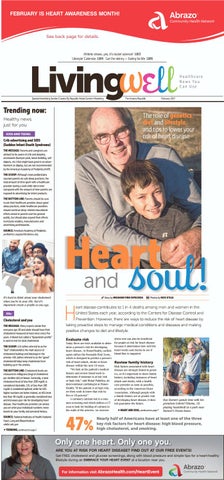
Heart and soul! " Story by MEGHANN FINN SEPULVEDA
! Photos by RICK D’ELIA
H
eart disease contributes to 1 in 4 deaths among men and women in the United States each year, according to the Centers for Disease Control and Prevention. However, there are ways to reduce the risk of heart disease by taking proactive steps to manage medical conditions and diseases and making positive changes to diet and lifestyle. stress test can also be beneficial Today there are tests available to deter- for people at risk for heart disease because it determines how well the mine a person’s risk for developing heart disease. At HonorHealth, cardiol- heart works and checks to see if ogists utilize the Reynolds Risk Score, blood flow is impaired. which is designed to predict a person’s risk of heart attack, stroke or heart Review family history disease within the next 10 years. Risk factors associated with heart “We look at the patient’s medical disease are strongly linked to genethistory and review blood work to ics, so it’s important to share family determine if someone is at low risk history, including instances of heart or high risk,” said Bimal Padaliya, an attack and stroke, with a health interventional cardiologist at Honorcare provider as soon as possible, Health. “If the patient is at high risk, according to the American Heart we then work to lower that risk by Association. Although people with five or 10 percent.” a family history are at greater risk A coronary calcium test is a comof developing heart disease, it does mon screening tool which utilizes a CT not guarantee the future. scan to look for buildup of calcium in the walls of the arteries. An exercise HEART AND SOUL, continued on page 7
Evaluate risk
47%
Ray Bornert spends time with his grandson Gabriel Vidamo, 10, playing basketball at a park near Bornert’s Peoria home.
Nearly half of Americans have at least one of the three key risk factors for heart disease: high blood pressure, high cholesterol, and smoking.
Only one heart. Only one you. ARE YOU AT RISK FOR HEART DISEASE? FIND OUT AT OUR FREE EVENTS! Abrazo Community Health Network Abrazo Arizona Heart Hospital | Abrazo Arrowhead Campus | Abrazo Central Campus Abrazo Maryvale Campus | Abrazo Scottsdale Campus | Abrazo West Campus
Get FREE cholesterol and glucose screenings, along with blood pressure and simple tips for a heart-healthy lifestyle during an EMBRACE YOUR HEART EVENT at a location near you.
For information visit AbrazoHealth.com/HeartEvent
2 | Livingwell | February 2017
TRENDING, continued from the cover 30 to 40s:
If the
Testing, testing, 1-2-3… THE MESSAGE: For men and women ages 30 to 39, several tests for certain cancers are recommended. THE SCOOP: If you’re at higher risk because of family history, genetics or other factors, both men and women in this age range should be tested for colon cancer. For women at higher than average risk for breast cancer, now’s the time to get tested via a mammogram or other screening tests. Starting at age 30, women at average risk for cervical cancer should get a Pap test and HPV test every five years or can continue to get only a Pap test every three years.
shoe fits
Athletic footwear available in many new styles
THE BOTTOM LINE: Discuss your personal history with your healthcare provider and follow his/her recommendations for cancer screenings. Early detection saves lives! SOURCE: American Cancer Society cancer.org 50 PLUS: NIKE
Attention-Deficit/Hyperactivity Disorder (ADHD) in older adults THE MESSAGE: Although ADHD affects a relatively small portion of the elderly population, it presents a unique challenge for physicians when evaluating patients.
By Debra Gelbart
A
thletic shoes are undergoing a revolution of sorts. “The last few years have certainly seen some dramatic new introductions in footwear, such as knit uppers and brand-new foam and cushioning platforms,” said Bill McInnis, who has the intriguingly forward-facing title of “head of future” at Reebok, the shoe manufacturer based in Canton, Massachusetts. “The athletic shoe industry also differs from other industries such as automotive or high tech in that footwear has a retro category as well,” McInnis said. In fact, he pointed out, some of the most popular shoes currently on the market are bring-backs and re-issues of classic technology shoes from the 1990s such as Reebok’s “Pump.”
THE SCOOP: Older adults might be prone to misdiagnosis given that they and their clinicians might be more concerned about the possibility of a neurodegenerative disorder, including various types of dementia. What’s more, symptoms could be misinterpreted as deficits in other cognitive domains, such as memory. THE BOTTOM LINE: A thorough developmental history should help with an accurate diagnosis by identifying whether or not cognitive symptoms were present in childhood. Appropriate treatment might improve functional outcomes for patients including those with co-morbid dementia. SOURCE: Clinical Psychiatry News mdedge.com/clinicalpsychiatrynews
ADHD in adults is more common than you think. More than 3 million cases are diagnosed each year.
February | Vol. 7, No. 2 Living Well A-Z usually publishes on the first Wednesday of the month. From A to Z, we tackle a broad range of health issues and offer resources to find more specific information.
A division of The Arizona Republic, 200 E. Van Buren St., Phoenix, AZ 85004. For general advertising inquiries, contact Republic Media at 602-444-8000. General Manager: CAMI KAISER, CKaiser@RepublicMedia.com Creative Development Director: ISAAC MOYA, IMoya@RepublicMedia.com Editor: JIM WILLIAMS, JLWilliams@RepublicMedia.com Project Manager: NICK KOSTENKO, NKostenko@RepublicMedia.com Design: TP Creative Design, LLC
Experimenting with shoe features
Streamlining shoe manufacturing
Keep your feet’s best interest top of mind
To figure out which innovations in athletic shoe wear might work best, Nike established a research lab in 1980 in Exeter, New Hampshire to understand runners’ needs, allowing the manufacturer to make the best products for athletes, according to the Nike website. On Nike’s site, Matthew Nurse, the senior director of the Nike Explore Team Sport Research Lab is quoted as saying, “We quantify athletes’ movements, the environments they play in and the products they use. Then we analyze the results and … use that knowledge to make really unbelievable product.” Nike’s sport research lab is a destination for athletes when they visit the company’s Beaverton, Oregon campus, he added. “We might solve a problem they have or help with a performance issue, but the really cool thing is making them part of the process. They contribute performance insights through testing and data, and provide verbal feedback that actually drives our product forward. Generally, what we learn from working with elite athletes can be used to make better product for everybody.” One example of the innovation that can come from the lab is the Nike VaporMax Air unit. According to the Nike website, where previous Air units had to be insulated by a secondary rubber layer for protection and durability, new innovation allows designers to incorporate the Air and exterior layer into a single VaporMax Air unit. “And where previous units needed to be shaped with inflexible structural areas, the new unit can independently maintain its given form, with elasticity.”
“What’s really intriguing to us is how the entire industry is re-looking at the way it makes shoes: the process,” McInnis said. “Making shoes on one side of the world and selling them on the other …adds a lot of time and money to the process. So things like 3D printing (to eliminate molds and change the labor equation) and more local manufacturing (to reduce shipping and get faster to the market) are on everyone’s radar screen.” One of Reebok’s newest inventions is “Liquid Factory,” he said. “The Liquid Factory process uses state-of-the-art so_ware and robotics to literally draw shoes in three dimensions.” The new technique leverages what the company calls “3D Drawing”—a hack of 3D printing that’s much faster, less expensive and uses materials that are right for footwear—where a proprietary liquid material, created especially for Reebok by BASF, is used to draw shoe cushioning and traction cleanly, precisely and in three-dimensional layers. This proprietary layering technique is used to create totally unique footwear, without the use of traditional molds. This opens up brand new possibilities both for what we can create, and the speed with which we can create it.”
With all of these innovations enticing consumers, it’s important to know which features in an athletic shoe will help you maintain your foot health and fitness, said Valley podiatrist Therese Losi, D.P.M. But it can be difficult to know which shoe styles are best for your feet, she said. So she recommends asking a foot specialist which shoe brands and styles incorporate the features an individual might need most—“whether that’s motion-control, stability or cushioning.” She explained that for people with flat feet or for those who weigh more than 180 pounds, a motion-control shoe—which holds the foot firmly in place—may be needed to reduce pronation (feet rolling inward) and to reduce the potential for overuse injury. Stability shoes help those with a normal arch decrease mild pronation, she explained, while proper cushioning in a shoe can protect your metatarsal bones and other structures in your feet.
GETTY
GETTY
—Reported by Paula Hubbs Cohen
The Nike VaporMax Air shoe features an air-cushing technology that allows lightweight durability and elasticity.
“Your aunt Dot is tossed!”
Have you been told that you are just going to have to live with pain?
START LIVING YOUR LIFE AGAIN!
STOP
NEUROPATHY Get The Relief You Deserve! PAIN and
o You Suffer From: Have You Tried Do Non-Traditional Treatments Such As:
✓ Burning B pain or d discomfort? ✓ Numbness N or unusual s sensations? ✓ Prickly P feelings in t the hands or feet? ✓ Loss L of balance or i instability? ✓ Difficulty D sleeping?
✓ Anodyne Light Therapy? ✓ The Rebuilder? Tens Units? ✓ Topical Creams? ✓ Laser Therapy? ✓ Acupuncture? ✓ Spinal Adjustments?
Covered by Medicare and Most Major Insurances
NO Pills • NO Side-Effects • NO Surgery Skip the misunderstandings, not the moment. With a captioned phone, you can hear and read your phone calls on a bright, easy-to-read screen. No asking to repeat. No “can you speak up?” Just the simple joy of conversation.
CALL FOR AN EVALUATION TODAY!
602-428-0002 | www.oxhn.com We Are Now Servicing Lake Havasu City
AR-0008622054-01
Locations in Phoenix, Mesa, Sun City West, & Tucson
LEARN MORE ABOUT FREE CAPTIONED PHONE SERVICES AT AZRELAY.ORG
TIPS FORYOURTOTALLY-WORTH-IT LIFESTYLE BROUGHT TO YOU BY
KEEPING ON TRACK Physical therapist, Dr. Dean Kolstad from Banner Health says fitness devices are indeed a motivator for their owners to lead more active lives. Below are some tips from Banner CORE Center for Orthopedics to make sure you are getting the most out of your fitness tracker.
TIPS FOR USING YOUR
FITNESS TRACKER Establish a fitness and activity baseline Do not change your normal daily routine. Allow the device to catch a glimpse of how much or how little you are moving around on any given day. Calculate your maximum heart rate by subtracting your age from 220
If you’re starting a new program, target the moderate exercise heart rates, which range from 50 to 69 percent of your maximum, first.
Stay in a “fat-burning zone” Review the American Heart Association guidelines for finding an appropriate target heart rate. Then, use the tracker to help you stay in a “fat-burning zone” to maximize weight loss.
Banner CORE Center for Orthopedics offers a full range of orthopedic care in Arizona. It’s care, simplified.
To find an Orthopedic Doctor near you, call 602.346.9827 or visit www.bannercorecenter.com/makeanappointment
4 | Livingwell | February 2017
February SUNDAY
MONDAY
Take advantage of opportunities for you to meet others with similar issues and learn more about various aspects of your health — from A to Z. All groups and events are believed, but not guaranteed, to be free unless otherwise stated. Every effort has been made to verify accuracy, but please call before attending to confirm details.
218
WELLNESS & MORE
WALKING GROUP Various dates & locations By Humana; 480-325-4707
KIDNEY HEALTH Feb. 8, 9:30–11 a.m. Humana Guidance Center 5943 E. McKellips Rd., Mesa RSVP: 480-325-4707 HEALTHY EATING Feb. 9, 10:15 a.m. Banner Del E. Webb 14502 W. Meeker Blvd., Sun City West 602-230-2273 PERIPHERAL VASCULAR DISEASE Feb. 9, 1–2 p.m. Civic Center Library 3839 N. Drinkwater Blvd., Scottsdale RSVP: 623-580-5800; HonorHealth.com VARICOSE VEINS Feb. 21, 5:30–6:30 p.m. Scottsdale Shea Medical Center 9003 E. Shea Blvd., Scottsdale RSVP: 623-580-5800; HonorHealth.com HEALTHY COOKING Feb. 22, 12:30–1:30 p.m. Humana Guidance Center 5943 E. McKellips Rd., Mesa 480-325-4707
Go online for more info: LivingWell@azcentral.com TUESDAY
WEDNESDAY
THURSDAY
FRIDAY
1926
GET OUT AND PLAY Pack 64 Great Outdoors 5K Trail Run Feb. 11, 9 a.m. Estrella Mountain Regional Park Goodyear, AZ runsignup.com/pack645k
Run for Rare Disease Research 5K and 1 Mile Feb. 26, 9 a.m. Fun Run/Walk Arizona Falls, 56th Street and Indian School, Phoenix
Chinese New Year 5K Year Of The Rooster Feb. 12, 9 a.m., 5K Run, 5K Walk, 50 yard Free Kids Dash 8 & under Fun Run/Walk Papago Park Ramadas 9 & 10 Phoenix, AZ 480-220-2019
Your Next Step is the Cure Feb. 26, 9 a.m. Fun Run/Walk Kiwanis Park, Tempe 650-598-2857
Arizona Marathon Feb. 19, 8 a.m. Marathon Run, Relay Marathon Run, Half Marathon Run, 2 Mile Fun Run/Walk Verrado Town Square, Buckeye, AZ Active.com (search for specific event)
CANCER SUPPORT GROUPS CIRCLE OF HELP ADVANCED BREAST CANCER Meets as needed Info: Becky Chase, 623-236-6616 or Teresa Hill, AdvancedBreastCancer@gmail.com CANCER SUPPORT COMMUNITY SUPPORT GROUPS 360 E. Palm Lane, Phoenix Info: 602-712-1006; rsvp@cscaz.org • PROSTATE CANCER Feb. 9, 6–7:30 p.m. • LYMPHOMA Feb. 11, 10–11:30 a.m. • PANCREATIC CANCER Feb. 11, 10–11:30 a.m. • BREAST CANCER Feb. 11, 10–11:30 a.m. • OVARIAN CANCER Feb. 11, 10–11:30 a.m. • LUNG CANCER Feb. 11, 12:30–2 p.m. • CARCINOID Feb. 11, 12:30–2:30 p.m. • SURVIVING & THRIVING Feb. 14 & 28, 1–2:30 p.m. • SPANISH SUPPORT Feb. 14, 6–7:30 p.m.
SATURDAY
IRONWOOD CANCER & RESEARCH CENTER SUPPORT GROUPS Ironwood Cancer & Research Centers 8880 E. Desert Cove Ave., Scottsdale Register: 602-588-4367; IronwoodCRC.com • CAREGIVERS Feb. 18, 10 a.m.–noon • HEAD & NECK CANCER Feb. 21, 3–4:30 p.m.
HONORHEALTH SUPPORT GROUPS Virginia G. Piper Cancer Center 10460 N. 92nd St., Scottsdale RSVP: 480-323-1321; HonorHealth.com/cancer • COLO-RECTAL CANCER Feb. 9, 4–5:30 p.m. • PANCREATIC CANCER Feb. 13, 4–5:30 p.m. • GYNECOLOGICAL CANCER Feb. 21, 4–5:30 p.m.
27 11
BRAIN BRAIN HEALTH Feb. 21, 11:30–2 p.m. Humana Guidance Center 5943 E. McKellips Rd., Mesa RSVP: 480-325-4707
PAIN SHOULDER PAIN Feb. 9, 5:30–7 p.m. HonorHealth Orthopedic Institute 20401 N. 73rd St., Scottsdale RSVP: 623-580-5800; HonorHealth.com
ALZHEIMER’S/DEMENTIA ALZHEIMER’S CAREGIVERS SUPPORT Various dates, times & locations By Alzheimer’s Association Desert Southwest Chapter 602-528-0545; ALZ.org/DSW
OSTEOPOROSIS SUPPORT Feb. 15, 9–10 a.m. Scottsdale Shea Medical Center 9003 E. Shea Blvd., Scottsdale 623-580-5800; HonorHealth.com
EMOTIONAL CHANGES Feb. 16, 10 a.m.–11:30 a.m. 901 E. Willetta St., Phoenix 602-839-6850
WOMEN’S HEALTH
AVOIDING ARGUMENTS Feb. 27, 4–5:30 p.m. Banner Alzheimer’s Institute 901 E. Willetta St., Phoenix 602-839-6850
WOMEN & HEART DISEASE Feb. 14, 9:30–10:30 a.m. Banner Boswell Medical Center 13180 N. 103rd Dr., Sun City 623-230-2273
Join the
MOVEMENT!
A comprehensive array of treatments from the medical and holistic worlds for better health – naturally
29
$ We Treat the Following Conditions:
First Visit
Includes Exam, X-Rays and Consultation
Allergies
Hand and Wrist Pain
Chronic Injuries
Back and Neck Pain
Middle and Lower Back Pain
Sleep Disorders
Sciatica or Leg Pain
Fibromyalgia
Ankle and Foot Pain
Arthritis
Hip Conditions
Bursitis
Head Conditions
And Much More
Shoulder Pain Elbow Pain Knee Pain Headaches and Migraines
High Blood Pressure
Most Insurance Accepted • Same-day appointments available NOW 8 LOCATIONS VALLEY WIDE AR-0008624734-01
PHOENIX • DESERT RIDGE • MESA • GILBERT • PEORIA • FOUNTAIN HILLS • SAN TAN VALLEY
AR-0008647947-01
NEW LOCATION In Tempe Opening March!
480-269-8978 www.AFCchiropractic.net
HEARING LOSS IN AMERICA That Equates to
1in5
48.1M Americans
Americans have some form of hearing loss
Hearing aids can...
DID YOU KNOW? Hearing loss can...
5–7 The average delay between the onset of hearing loss and seeking a professional is 5 -7 years!
contribute to sleep disorders
reduce the effects of Alzheimer’s and dementia
triple your risk of falling
Source: Hearing Loss Association of America
CAUSES OF HEARING LOSS
Exposure to loud noise
Illness
CALL NOW AND RECEIVE:
Heredity
Save on one of our smallest custom digital hearing aids!
• FREE Complete Electronic Hearing Test
• FREE Video Otoscope Ear Inspection
BUY 1 GET 1 * Save on our full line of digital hearing solutions.
This show-all picture of your ear canal is displayed on a color TV monitor, so you’ll see exactly what we see.
Valid on model AudiotonePro CIC
• FREE Package of Hearing Aid Batteries
If you now wear a hearing aid, you will receive one free package of hearing aid batteries. If we test your hearing you will receive another free package.
Valid at participating Miracle-Ear locations only. Limit one coupon per purchase. May not be combined with other offers and does not apply to prior sales or purchase. Cash value 1/20 cent. Offer expires 2/28/17.
~OR~
Good only from participating Miracle-Ear® representatives. One coupon per purchase. No other offers or discounts apply. Discount does not apply to prior sales. Offer valid on ME-1, ME-2, ME-3 Solutions. Cannot combine with any other offers. Cash value 1/20 cent. Offer expires 2/28/17.
FREE CHARGER WITH PURCHASE Keep your hearing aids charged all day with no need to keep buying batteries.
• FREE In-Office Repairs All in-office hearing aid repairs shall be free... and factory repairs, regardless of make or model shall be 50% off.
Free charger with the purchase of any Miracle-Ear® ME-1 or ME-2 Hearing Solution (2 aids) with rechargeable battery option. Not valid with any other discount or offer. Does not apply to prior purchases. Offer expires 2/28/17.
TY
Visit www.Miracle-Ear-PHX.com
A
N
LIM
ED
Another Great Way to Save Make your appointment today!
995 50% Off
$
This Audiometric evaluation will precisely show what you’ve been missing.
IT
Only
Natural Aging
W ARR
Call a Location Near You to Schedule Your FREE Hearing Test** Sun City
10001 W Bell Rd
623.565.9186 Prescott 1027 Fair St
928.227.3088
Surprise
14545 W Grand Ave
623.242.0377 Yuma
182 E 16th St
928.328.8198
East Mesa
1155 S Power Rd
Mesa
1863 N Stapley Dr
West Phoenix East Phoenix 4212 W. Cactus Rd
480.389.3482
480.389.3493
Flagstaff
Show Low
Casa Grande
928.225.3020
928.251.4599
520.366.8400
602.635.4944
2700 Woodlands Village Blvd 5401 S White Mountain Rd 317 E Cottonwood Ln
Chandler
4727 E Bell Rd
1900 W Chandler Blvd
Payson
Cottonwood
928.478.8707
928.202.4075
602.910.2902 1107 S Beeline Hwy
480.389.3466 703 S Main St
Scottsdale
7904 E Chaparral
480.389.2413 Safford
1124 W Thatcher Blvd
928.792.4133
*AudiotonePro not included. ** Our hearing evaluation and video otoscopic inspection are always free. Hearing evaluation is an audiometric test to determine proper amplification needs only. These are not medical exams or diagnoses nor are they intended to replace a physician’s care. If you suspect a medical problem, please seek treatment from your doctor. 3-year limited warranty on most hearing aids. See store for details. © 2017 Miracle-Ear, Inc.
AR-0008647753-01
6 | Livingwell | February 2017
Get the skinny: Eating for Life
Eating on the go
Even when rushed, there’s always time to eat healthy will always be a better choice than any fast food restaurant,” said Bales, who, with Turner, is a cardiac rehabilitation dietitian at Honorusy schedules mean eating on the Health Shea Medical Center in Scottsdale. go—instead of seated comfortably at If you have a cooler you can use, Turner a table—is becoming more and more suggests fat-free Greek yogurt plus “your own commonplace. So whether you eat a meal or fresh additions carried separately, like any fresh a snack in your vehicle, at your desk or while berry, chopped or sliced unsalted nuts, or a waiting for an appointment, you can make high-fiber cereal without sugar like the original healthy food choices that will contribute to Fiber One. If you need something more substanyour overall well-being. tial try a turkey sandwich on whole grain bread, First, advise registered dietitians Eileen light mayonnaise and reduced-sodium turkey Bales, R.D. and Jan Turner, R.D., pack your from the deli. Don’t forget to include raw own meals or snacks whenever possible vegetables like carrots, radishes, sugar snap rather than buy fast food. “Packed lunches peas and a piece of in-season fresh fruit.”
If you need to delay or skip a meal, consider liquid nutrition supplement like low-sugar Boost, Ensure or Core Power, Bales said. Natural peanut butter on whole grain or graham crackers could also replace a meal, she added. A bottle of water or unsweetened sun tea makes a great beverage, Bales said. Try to avoid the sweets and chips, Bales said, “but if you need additional calories, try animal crackers or unsalted air-popped popcorn.” If you’re not able to carry a cooler with ice, consider natural almond butter on graham crackers, or unsalted mixed nuts with a small amount of dried fruit. you must rely on fast food, stick And if yo grilled chicken sandwich with to the gri mayo on the side and lots of lettuce and tomato, Turner said. Avoid the pickles. Try the side salad with vinegar and oil dressing instead of chips, fries, cookies dressin or ice ccream. A few places may have entrée salad with grilled chicken, an entr which would also be an acceptable choice, Turner said. For beverages, choice stick tto water or unsweetened ice tea.
By Debra Gelbart
B
es it B y g r e n E e k a No B Ingredients:
d oats + 1/2 cup 1 cup old fashione y milk powder 2/3 cup not fat dr anut butter ned almond or pe 1/2 cup old fashio ax seed 1/2 cup ground fl uts, unsalted almonds or pean d pe op 1/2 cup ch 1/3 cup honey s 1 Tbsp. chia seed lla ni 2 tsp. va ce -added applesau 1/2 cup no-sugar
nth
o Recipe of the M
t aside. ilk, & flax seed. Se chia seeds, dry m ts, nu th wdered. wi po t ts no oa 1. Mix 1 cup of til crumbly, but un r so es oc pr . oats in food r, honey, & vanilla 2. Process 1/2 c. esauce, nut butte pl ap ix r, 30 minutes. m to ra wl ge bo 3. In separate r & chill in refri ve Co ts. ien ed gr the dry in 4. Stir liquids into . ll into 1-inch balls roll in loose oats. ro d, If balls are sticky 5. When chille e. at pl a on ts oa opped of r up to 2 weeks. 6. Spread 1/2 c. ch in refrigerator fo er ain nt co ht tig les 7. Store in air Source: Eileen Ba d. zen if made ahea fro be ay M Yield = 36 bites
Directions:
Smart snacking Smar
Serving: 1 bite Calories: 74 6 gms Carbohydrate: s gm 2 n: ei Prot Fat: 3.5 gms le Sat. Fat: negligib 0 l: ro te es ol Ch Sodium: 7 mgs Fiber: 1.5 gms
trition Approximate Nu th almonds) Analysis (done wi
!
will assume that no refrigerator “We w available and that you must keep is ava food in your desk,” Bales said. the fo The healthiest choices would be unsalted almonds or pistachios in unsa small amounts—one to two tablesma spoons, she said. Other possibilspoo ities include reduced-salt fat-free itie crackers like oyster crackers, crac skinny popped corn without ski salt or dried fruit like raisins or apricots in small quantities. apri
Helping your heart Dietitians recommend these small dietary changes over time to improve and maintain heart health as you age: • Consume less red meat (beef, pork, lamb and veal)—ideally less than three times a week. • Eat more fish and white meat poultry that has not been fried—ideally four or more meals a week. • Try to replace three meat meals a week with a plant protein like beans. • Decrease use of added animal fats like butter, cheese, and meat gravy. • Increase consumption of olive and canola oils, unsalted nuts and avocado. • Focus on water as a beverage. Drink onehalf fluid ounce per pound of your body weight. Don’t count alcoholic beverages as part of your fluid. People generally lose the ability to feel thirst as they age. • Eat only whole grain products labeled with three grams of dietary fiber per serving. Everyone needs 20 to 35 grams of fiber daily. • Women should limit added sugar to six teaspoons or 24 grams daily. Men should limit added sugar to nine teaspoons or 36 grams daily. • Try to avoid processed meats that have been smoked or cured even if they’re made from poultry. • Limit foods that contain more than 250 mg. of sodium to two choices a day. • Make it a rule to avoid using the salt shaker, especially in a restaurant.
Be proactive when it comes to your heart HEART AND SOUL, continued from the cover “Family history is the most complex risk factor to assess because not everyone makes the same lifestyle choices,” said Todd Hurst, M.D., cardiologist and director of the Heart Health and Performance Program at Mayo Clinic. “It’s important to remember that genes are not your fate.” At Mayo Clinic, patients can schedule a one-day appointment and meet with a team of medical professionals including an exercise physiologist, registered dietitian, nurse practitioner and cardiologist who will work together to provide a comprehensive cardiac evaluation and screening to determine risk and develop a personalized plan to prevent heart disease and improve overall health.
Modify diet, lifestyle
Small changes, big results Small changes can lead to big results, which is especially true for 79-year-old Peoria resident Ray Bornert, who suffered a massive heart attack last July. Following emergency treatment and two stent placements to reduce blockages in his coronary arteries at Abrazo Arizona Heart Hospital, Bornert has made significant changes to his diet, which no longer includes sugary treats and fatty foods. “I didn’t realize the possible dangers of my choices,” Bornert said. “I’ve made crucial modifications to my diet and keep track of what I eat.” In addition to adhering to a healthy diet, it’s important to stop smoking and incorporate aerobic activity to improve physical fitness, lower bad cholesterol, increase good cholesterol levels, control high blood pressure and help with weight loss. Bornert, who maintains an active lifestyle, now enjoys playing basketball with his 10-year-old grandson at the park.
Ray Bornert, here with his grandson Gabriel, has modified his diet and added exercise to his lifestyle since his heart attack last July.
RICK D’ELIA
A heart-healthy lifestyle can significantly lower the risk of heart disease, according to the National Heart, Lung and Blood Institute. This includes a diet that is rich in fruits and vegetables, whole grains and lean protein and limits sodium, saturated fat and trans-fat, added sugar and alcohol. Ranked as the best diet for seven consecutive years by U.S. News & World Report, the DASH diet, which was originally designed to lower blood pressure, consists of a flexible and balanced eating plan with daily and weekly goals based on a 2,000-calorie intake. “If a person can make positive changes to their diet, he or she can ultimately reduce or even remove their blood pressure or cholesterol profile and diagnoses,” said Martha Gulati, M.D., cardiologist and division chief of cardiology at Banner University Medical Center and American Heart Association board member.
Steps to get heart healthy! Kris Vijay, M.D., a cardiologist and director of Abrazo Arizona Heart Hospital’s Institute of Congestive Heart Failure, provides simple tips to achieve a heart-healthy lifestyle: • Get regular health screenings, especially if heart disease runs in your family. • Eat more fruits and vegetables. Replace red meat, whole milk, cheeses and other foods high in saturated fat with fruits, vegetables, chicken and fish. • Eat less. Use teaspoons, salad forks and smaller plates to help reduce your portion size.
• Eat slowly. It takes 20 minutes for your stomach to send a signal to your brain that you are full. • Listen to music instead of watching TV while eating. People tend to eat more while watching TV.
• Find ways to relax. Try deep breathing exercises or listening to your favorite music. • Pamper yourself. Get lost in a book, take a long bath or meditate. • Be happy. Don’t sweat the small stuff.
• Increase your daily activity. Ramp up your exercise to 30 minutes, five days a week.
Manage diseases People who have high blood pressure, high cholesterol or diabetes can reduce their risk for developing heart disease with effective treatment. Those diagnosed with high cholesterol should get their cholesterol levels checked at least once every five years, or more frequently if there is a history of the condition, according to the CDC. In some circumstances, medication may be recommended. “Statins are a type of medication that are extremely effective in lowering cholesterol and decreasing inflammation and plaque
buildup in the arteries,” Padaliya said. People with high blood pressure should also discuss proper management techniques with their physician, which may include diet modifications. “An annual physical exam is important because it’s an opportunity to review health history and discuss symptoms,” Padaliya said. Diabetics should monitor their blood sugar levels carefully and may need to make lifestyle changes to reduce their risk of heart disease, according to the CDC.
Abrazo is offering free heart health screenings from 8 to 11 a.m. on the following dates: 19 North Street Fair (Note: Screenings will be offered from 10 a.m. to 1 p.m.) 8301 N. 19th Ave., Phoenix Feb. 15 Safeway Arcadia Towne Center 4750 E. Indian School Road, Phoenix Feb. 18 Safeway 20205 N. 67th Ave.,Glendale Feb. 22 Safeway Palm Valley Marketplace 14175 W. Indian School Road, Goodyear Feb. 25 Safeway 4857 E. Greenway Road, Scottsdale March 8 Pebble Creek Community 3003 N. 164th Ave., Goodyear Feb. 11
Know the warning signs The symptoms of heart disease differ between men and women, according to The National Heart, Lung and Blood Institute. During a heart attack, only half of all women experience chest pain and sometimes there are no symptoms. “The classic symptoms of a heart attack include chest pain, shortness of breath, arm pain, jaw pain, nausea and extreme fatigue,” Gulati said. “If you or someone you know is experiencing these symptoms, call 911.”
February 2017 | Livingwell | 7 GETTY
Independent Living
Starting at $2,525
Assisted Living
Hello body… nice to you meet you What your body shape tells you, the role of genetics, and how diet and exercise can help trim and tone By Meghann Finn Sepulveda
Starting at $3,895 Includes Personalized Service & 24 hour care
Memory Care
Starting at $5,499
C
urvy or thin. Muscular or petite. Pear-shaped or apple-shaped. These are just some of the ways to describe the many different body types among men and women. The body’s shape and
appearance can mostly be attributed to genetics, but it can also be a result of diet and exercise. Sometimes, a person’s body shape can increase their risk of developing a serious medical disease like diabetes or high blood pressure. Fortunately, developing good eating habits and incorporating regular exercise into daily routines can keep our bodies healthy. Body types, shapes
Diet, exercise
Body types are largely dependent upon genetics. While there isn’t an ideal body type, the most common are apple shapes and pear shapes, which are indicative of where fat is stored. “Men are more typically apple shaped, meaning they carry extra weight in their stomachs and waists,” said Robin Blackstone, M.D., director of the Center for Diabetes and Bariatrics at Banner University Medical Center. “We most commonly see women classified as pear shaped, with wider hips and thighs.” While those with apple shapes can usually see significant results from weight loss efforts, they are also at a higher risk of developing type 2 diabetes, high blood pressure and high cholesterol because of increased abdominal fat, which could lead to sleep apnea and depression. Pear shapes struggle more with weight loss because this body type does not respond as well to diet and exercise. “The number of fat cells in our body was determined at puberty,” Blackstone said. “However, we can be successful at increasing or decreasing the size of those fat cells by changing the quality and quantity of the food that we eat.”
Most experts will argue that although a person cannot necessarily change their body type, there are effective ways to improve body appearance with proper nutrition and regular exercise. At Orangetheory Fitness, with 23 studio locations in the Valley, highly qualified coaches lead 60-minute endurance and full body group workouts consisting of cardiovascular and strength training exercises to motivate and inspire participants to reach their goals, utilizing treadmills, rowing machines, TRX suspension and free weights. “This program is based on heart rate interval training,” said Jennifer Ayala, head trainer at Orangetheory Fitness Downtown Phoenix. “It is an extremely effective total body workout that burns between 400 and 700 calories and continues to stimulate metabolism for another 24 to 36 hours.” Physical activity can help maintain weight, according to the Centers for Disease Control and Prevention, but reducing the number of calories a person eats can result in weight loss. “It’s important to view food as fuel,” Ayala said. “Clean eating not only pinpoints fat reduction but also builds muscle.”
Body Shapes: What body shape are you?
RECTANGLE
INVERTED TRIANGLE
HOURGLASS
ROUNDED APPLE
TRIANGLE PEAR
DIAMOND
LIVE A VIBRANT LIFE
ASSISTED LIVING AND MEMORY CARE EXPANSION NOW OPEN! Call To Schedule Your Tour Today! Independent and Assisted Living Community and Memory Care. 1 & 2 bedroom apartment homes ranging from 641-1264 square feet. Lifestyle Package covers rent, meals, utilities, weekly housekeeping services, room service, chauffeur service, many resident activities and so much more.
Cataract & Glaucoma Surgeon Neil J. Atodaria, MD
Dr. Atodaria specializes in the diagnosis and treatment of glaucoma and advanced technology cataract surgery. He serves patients in our Phoenix, Mesa, Sun City and Surprise locations. In addition to providing care at Barnet Dulaney Perkins Eye Center, Dr. Atodaria enjoys volunteering his time and expertise for the benefit of those who are less fortunate. BARNET DULANEY PERKINS EYE CENTER Locations throughout Arizona www.GoodEyes.com (602) 955-1000
AR-0008647994-01
9508 E RIGGS RD, SUN LAKES
480-516-0668
RENAISSANCERETIREMENT.COM THE HOUSING AT RENAISSANCE IS INTENDED FOR OCCUPANCY BY AT LEAST ONE PERSON 55 YEARS OF AGE OR OLDER PER UNIT. NO ONE IN PERMANENT RESIDENT UNDER 19 YEARS OF AGE. THE DEVELOPER OF THE PROJECT AND THE SELLER OF HOMES IS AN AFFILIATE OF ROBSON COMMUNITIES, INC. INFORMATION SUBJECT TO CHANGE WITHOUT NOTICE. SUN LAKES CONSTRUCTION CO. INC ROC AR-0008641113-01 LICENSE 191426 & ROC 192909 ®2010 ROBSON COMMUNITIES INC 10/10ARC684
Get Heart Smart During HEART AWARENESS MONTH!
FEBRUARY IS HEART AWARENESS MONTH!
See back page for details.
Athletic shoes...yes, it’s rocket science! LW2 ‘Lifestyle’ Calendar LW4 Get the skinny — Eating for life LW6
Only one heart. Only one you.
Healthcare N e w s Yo u Can Use Special Advertising Section Created By Republic Media Content Marketing
Trending now:
Knowing your numbers can save your life.
The Arizona Republic
February 2017
The role of genetics, diet and lifestyle, and tips to lower your risk of heart disease
Healthy news just for you KIDS AND TEENS:
Crib advertising and SIDS (Sudden Infant Death Syndrome) THE MESSAGE: Parents and caregivers are advised to be aware of crib and sleeping accessories (bumper pads, loose bedding, soft objects, etc.) that might look great in an advertisement or display, but are not recommended by the American Academy of Pediatrics (AAP). THE SCOOP: Although most pediatricians counsel parents on safe sleep practices, the total amount of time spent with a healthcare provider during a well-child visit is brief compared with the amount of time parents are exposed to advertising for infant products.
Screening S i E Events!! ARE YOU AT RISK FOR HEART DISEASE? FIND OUT! Join us at our Embrace Your Heart event which includes: • Cholesterol screenings* • Glucose testing* • Blood pressure checks • Body mass index (BMI) testing • Heart healthy information • Simple tips for a heart-healthy lifestyle • Medical professionals will be available to help you understand your test results • And more! *It is recommended that you fast for 6-8 hours prior to these tests. We recommend that you drink water and are well hydrated for the screening.
JOIN AN EVENT NEAR YOU Register Today!
LOCATIONS
All Events 8 am - 11 am
Wednesday, February 15 Arcadia Towne Center 4750 E Indian School Road Phoenix, 85018
Saturday, February 18 20205 N 67th Avenue Glendale, 85308
Wednesday, February 22 Palm Valley Marketplace 14175 W Indian School Road Goodyear, 85395
Saturday, February 25 4747 E Greenway Road Phoenix, 85032
OTHER LOCATIONS Saturday, February 11 10 am - 1 pm
SCHEDULE YOUR APPOINTMENT Visit AbrazoHealth.com/HeartEvent
or call 866-631-6572 WALK-UPS WELCOME
SOURCE: American Academy of Pediatrics pediatrics.aappublications.org
19North Street Fair 8301 N 19th Avenue Phoenix, 85021
Wednesday, March 8 8 am - 11 am
Pebble Creek Community Eagles Nest Clubhouse, Parking Lot 3645 Clubhouse Drive Goodyear, 85395
GETTY
FREE
Embrace Your Heart
THE BOTTOM LINE: Parents should be sure to ask their healthcare provider about good sleep practices, while healthcare providers should continue sleep-related educational efforts aimed at parents and the general public, but should also expand their efforts to include retailers, manufacturers and advertising professionals.
It’s hard to think about your cholesterol when you’re in your 20s. But it’s important create a profile as you age. 20s:
Cholesterol and you THE MESSAGE: Many experts advise that everyone age 20 and older should have their cholesterol measured at least once every five years. A blood test called a “lipoprotein profile” is used to test for total cholesterol. THE SCOOP: LDL (often referred to as the “bad” cholesterol) is the main source of cholesterol buildup and blockage in the arteries. HDL (often referred to as the “good” cholesterol) helps keep cholesterol from building up in the arteries. THE BOTTOM LINE: Cholesterol levels are measured in milligrams (mg) of cholesterol per deciliter (dL) of blood. Generally, a total cholesterol level of less than 200 mg/dL is considered desirable. LDL of less than 100 mg/dL is considered optimal, while for HDL higher numbers are better. Indeed, an HDL level less than 40 mg/dL is generally considered low and increases your risk for developing heart disease. Your healthcare provider can advise you on what your individual numbers mean based on your family and personal history. SOURCE: National Institutes of Health-National Heart, Lung and Blood Institute nhlbi.nih.gov TRENDING, continued on page 2
Heart and soul! " Story by MEGHANN FINN SEPULVEDA
! Photos by RICK D’ELIA
H
eart disease contributes to 1 in 4 deaths among men and women in the United States each year, according to the Centers for Disease Control and Prevention. However, there are ways to reduce the risk of heart disease by taking proactive steps to manage medical conditions and diseases and making positive changes to diet and lifestyle. stress test can also be beneficial Today there are tests available to deter- for people at risk for heart disease because it determines how well the mine a person’s risk for developing heart disease. At HonorHealth, cardiol- heart works and checks to see if ogists utilize the Reynolds Risk Score, blood flow is impaired. which is designed to predict a person’s risk of heart attack, stroke or heart Review family history disease within the next 10 years. Risk factors associated with heart “We look at the patient’s medical disease are strongly linked to genethistory and review blood work to ics, so it’s important to share family determine if someone is at low risk history, including instances of heart or high risk,” said Bimal Padaliya, an attack and stroke, with a health interventional cardiologist at Honorcare provider as soon as possible, Health. “If the patient is at high risk, according to the American Heart we then work to lower that risk by Association. Although people with five or 10 percent.” a family history are at greater risk A coronary calcium test is a comof developing heart disease, it does mon screening tool which utilizes a CT not guarantee the future. scan to look for buildup of calcium in the walls of the arteries. An exercise HEART AND SOUL, continued on page 7
Evaluate risk
47%
Ray Bornert spends time with his grandson Gabriel Vidamo, 10, playing basketball at a park near Bornert’s Peoria home.
Nearly half of Americans have at least one of the three key risk factors for heart disease: high blood pressure, high cholesterol, and smoking.
Only one heart. Only one you. ARE YOU AT RISK FOR HEART DISEASE? FIND OUT AT OUR FREE EVENTS! Abrazo Community Health Network Abrazo Arizona Heart Hospital | Abrazo Arrowhead Campus | Abrazo Central Campus Abrazo Maryvale Campus | Abrazo Scottsdale Campus | Abrazo West Campus
Get FREE cholesterol and glucose screenings, along with blood pressure and simple tips for a heart-healthy lifestyle during an EMBRACE YOUR HEART EVENT at a location near you.
For information visit AbrazoHealth.com/HeartEvent