FALL 2014
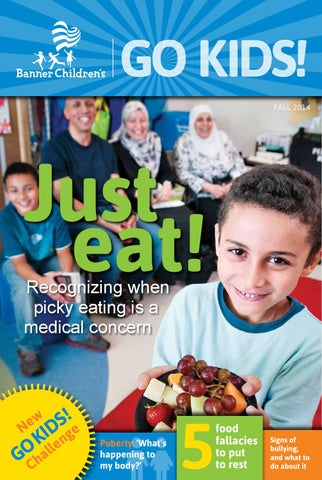
Just eat!
Recognizing when picky eating is a medical concern
w e N
K
! S ID ge
GOCha
n ll e
Puberty: ‘What’s happening to my body?’
5
food fallacies to put to rest
Signs of bullying, and what to do about it
STAYING ACTIVE
IS STAYING AWESOME.
GOKIDS!
MEMBERSHIP IS FREE AND ALWAYS FUN! Are you ready for some F-U-N for the whole family? Then it’s time to sign your kids up for Banner Children’s GO KIDS! Why? GO KIDS! members get free stuff to help them stay active and healthy. They get to show off on the court, or the field, to win cool prizes. And there are lots of chances to fill their noggins and bellies with healthy bites and tasty information. Ready? Set…GO KIDS! Where moms who know, get in the know. #GOKIDS! BannerChildrens.com/GOKIDS • Connect with us:
EDITOR'S LETTER
When cookies attack
Dad, can I have a cookie? Dad, can I have some potato chips? Dad, can I break into mom’s secret stash of chocolate that she thinks is securely hidden in the back of the freezer?
It’s a constant battle, this eating healthy thing. Granted, as a parent of three wonderful children, I count myself very fortunate (except on Sundays when I find myself watching the SpongeBob marathon instead of the Arizona Cardinal game, sigh). However, my kids are healthy, they’re active and they do love to eat…just not always as nutritiously as we’d like. If we make the effort to provide them with healthy options they’ll eat, but not without some challenges. For instance, I find it most interesting that my daughter bites the tops off her broccoli florets and discards the stems; and it’s slightly annoying that my son has to seemingly change the cellular structure of his carrot sticks by completely submerging them in ranch dressing. The way we see it, at least they’re
What’s inside!
4
5 6 8
GO MOM GO KIDS! blogger Nicole Cottrell offers 7 (sneaky) ways to get your kids to eat healthier. Pre-teens and diets Should parents be concerned if their teen wants to diet? Eating for life Recognizing when picky eating is an indicator of something more serious. 5 food fallacies Banner expert sets the record straight about some common food myths.
Volume 1 Number 2 | Fall 2014
trying. But for some parents, picky eating goes beyond headless broccoli and drowning carrots. In this issue of GO KIDS!, experts from Banner Children’s sort out when to know if picky eating is an indication of something more serious. Also, Go Mom blogger Nicole Cottrell offers seven (sneaky and fun) ways to get your kids to eat healthy. Try as we might, our kids do grow up. On page 9, Banner Children’s pediatrician Pauline Mills helps parents understand the physical and emotional changes in a child’s life as puberty approaches. Finally, on page 10, Banner Children's Injury Prevention coordinator and outreach manager Tracey Fejt pulls back the curtain on the serious topic of bullying, and how it might affect you. Check out all this and much more in this issue of GO KIDS! Want more info? Go to BannerChildrens.com/GOKIDS. Be sure to download the interactive GO KIDS! iPad app. It’s free!
Jim Williams, Editor and father
9
‘What’s happening to my body?’ Understanding the physical and emotional changes in a child’s life.
10 12
Signs of Bullying Why it’s important to stop bullying early, and how to talk about it. GO KIDS! Food Challenge Help your child learn about the importance of exercise and nutrition.
13 14
“What we wish parents knew” Banner doctors offer helpful advice. Kids activity page How does your garden grow? Time to get your kids diggin’ in the dirt.
CREATED BY REPUBLIC MEDIA CUSTOM PUBLISHING FOR BANNER CHILDREN'S VOLUME 1 NUMBER 2 FALL 2014
Publication of Republic Media Custom Publishing.
A division of Republic Media, 200 E. Van Buren St., Phoenix, AZ 85004 602-444-1000
General Manager Cami Kaiser/ckaiser@republicmedia.com; Creative Development Director Isaac Moya/imoya@republicmedia.com; Editor Jim Williams/JLWilliams@republicmedia.com; Senior Managing Art Director Tracey Phalen/tphalen@republicmedia.com; Art Director Miles Abernethy; Editorial Coordinator Nick Kostenko; Contributors Rick D’Elia, Gremlyn Bradley-Waddell, Tracy Harvil, Nicole Rolfes, Sebastian Sroka. GO KIDS! magazine is published as a service to our friends and neighbors by Republic Media Custom Publishing for Banner Children's. Material in GO KIDS! is obtained from a wide range of medical experts and health-care authorities. If you have any concerns about specific items that appear in GO KIDS!, consult your personal physician.
We exist to make a difference in people’s lives through excellent patient care.
If you no longer wish to receive GO KIDS! magazine, please notify us through email at gokids@republicmedia.com or by phone at 602-444-2235. Be sure to include your full name, address, city and zip code as it appears on the mailing label of the publication.
Cover Photo: Hassan El Nemr, 7, at Cardon Children's Medical Center. Photo by Rick D'Elia.
BannerChildrens.com/gokids
For information, call 602-230-CARE (2273) or visit www.BannerChildrens.com.
GO KIDS!
3
Pediatricprepared ERs
Your child deserves the best, especially when it comes to emergency care. Banner Children’s feels the same way, which is why many of our Valley emergency rooms (ER)are not only designed with kids in mind, but also certified by the Pediatric-Prepared Emergency Care program of the Arizona Chapter of the American Academy of Pediatrics (AzAAP). This voluntary program recognizes hospitals that meet specific criteria for personnel training, equipment and facilities that support optimal care for ill or injured infants,
children and teens. Our pediatric-prepared ERs include Banner Baywood, Banner Boswell, Banner Del E. Webb, Banner Estrella, Banner Gateway and Banner Ironwood Medical Centers. In addition, Banner Thunderbird and Cardon Children’s Medical Centers are recognized as providers of Prepared Advanced Care, AzAAP’s highest certification, offering pediatric emergency physicians and experts in more than 30 pediatric specialties. Visit BannerChildrens.com/ER.
Pre-teens and diets I'm a parent of a pre-teen who's interested in losing weight and wants to go on a diet. How should I respond?
I'd say you first need to ask, "Why do you want to lose weight?” It's important to determine if this is a child who needs to lose weight or wants to lose it. If your child has a normal body mass index (BMI), your family may want to explore body image issues, self esteem or determine if there are any relationship issues with friends or classmates. BMI is measured annually on children over age 2, but if you're unsure of your child's BMI, see your health care provider. Now, if your pre-teen has an unhealthy BMI and truly needs to lose weight, I'd recommend asking your child what might motivate him or her to lose weight. It might be to keep up with other kids at school, to feel better or to avoid being teased. Asking for your child's input is an important starting point because it gets you talking with your child and gives you the opportunity to provide support and explore aspects of your kid's life about which you may not be aware. At the least, schedule an appointment with your provider to discuss this topic more in-depth. There are many unhealthy diets out there, and a provider can help you and your child learn to make healthy food choices and incorporate exercise into your lifestyle so that you'll have good habits that last a lifetime.
Dawn M. Sorenson, MD, pediatrician at Banner Health Center, Maricopa
Q AND A
Headaches in kids My child sometimes complains of headaches. What can I do to offer some relief?
Helping your child feel better first requires determining if anything triggered the headache. Triggers include not getting regular sleep, skipping meals, lack of exercise, inadequate water intake, caffeine use and stress. Eyestrain and poor posture from excessive exposure to electronics (computers, TVs, phones, tablets and video games) can contribute to head and neck pain. Certain medications, hormonal changes or environmental issues can also trigger headaches, as can illnesses such as the common cold, sore throat, and urinary tract or ear infections. A child with a headache should rest in a cool, dark room, use a cold compress, and take deep, relaxing breaths. You can offer an over-the-counter pain reliever like acetaminophen or ibuprofen, but not more than two times a week, as this frequency can also cause a headache. Make sure your child is well hydrated, avoids caffeine, eats regular meals, exercises, sleeps regularly, and reduces stress to avoid future bouts. If your child has frequent, unexplained headaches or the pain is significant, call your pediatrician for further evaluation.
Eric Hastriter, MD, Banner Children's neurologist, Cardon Children’s Medical Center
EATING FOR LIFE Recognizing when picky eating is a concern
BY GREMLYN BRADLEY-WADDELL
Forrest T. Gnagi, MD, pediatrician, Banner Health Center, Surprise
Hassan El Nemr 7, works with Banner Children’s occupational therapist Michelle Satterthwaite on food issues at Cardon Children’s Medical Center. Some children are picky eaters because they have sensory processing issues that influence their experiences of taste and texture.
6
GO KIDS!
Your child turns her nose up at dinner and refuses to try a morsel, leaving you to wonder: Is this normal behavior or an indicator of something more serious? In most cases, it's normal, says Forrest T. Gnagi, MD, a pediatrician at the Banner Health Center in Surprise. “Picky eating is a very normal stage of childhood development. The vast majority of the time, a picky eater is just a toddler being a toddler and developing his taste preferences.”
Super tasters While it seems like pickiness could be an indicator of an under-
lying concern, such as a food allergy or sensory processing difficulty related to eating, Dr. Gnagi said that’s rarely the case. That said, there is a small part of the population recognized as “super tasters.” These individuals have more taste buds than most people and find bitter flavors to be very potent. Some super tasters adapt to their situation, but others have a lifelong difficulty eating bitter-tasting foods. The vast majority of children, however, don’t face such eating issues, and Gnagi said statistics show about a third of children have strong food preferences and Fall 2014
switch them as often as day to day. So, that’s why the apple slices your toddler detests on Monday may not be so bad to him the next week. What’s more, parents need to remember youngsters may have markedly different eating habits than themselves. “On any given day, 52 percent of toddlers aren’t hungry at typical mealtimes,” Gnagi said, which may help explain why about 42 percent of children try to stop eating after just a few bites. And insisting that an active youngster stay at the dinner table longer than 15 to 20 minutes “probably isn’t realistic,” he added.
How much is enough Parental
expectations of how much a child should eat are also often exaggerated, he said. Well-meaning parents often serve adult-size portions and then worry their children aren’t eating enough. In most instances, kids’ growth charts are normal — in other words, they’re getting plenty of nutritional food — and that prompts a gentle reminder from Dr. Gnagi as to what constitutes a child-size serving. For example, a serving of protein like a chicken breast should be no larger than the size of a child’s palm. As for parents who fret about their vegetarian-leaning offspring, they really don’t need to worry, as long as the child is getting sufficient iron in the form of green, leafy vegetables and protein in the form of tofu, quinoa or beans, lentils and peas. “As long as your child is getting a wellrounded meal, with appropriate nutrients, there’s some leeway,” he said.
Excited about food When his
Egyptian classmates ask what he did during his summer in the United States, Hassan El Nemr can list a bunch of cool things: drank vanillaflavored milk, tried nectarines and ate his first Subway sandwich. “I ate it with lettuce, turkey and cheese inside,” recalled the 7-year-old. “It was nice.” This was high praise for Hassan, who has sensory processing difficulties related to eating, according Michelle Satterthwaite, a Banner Children’s
BannerChildrens.com/gokids
occupational therapist at Cardon Children’s Medical Center in Mesa. Satterthwaite began working with Hassan to develop his fine motor skills. She soon learned he had foodrelated issues and suggested food therapy. Not only does Hassan dislike foods with a wet or slippery texture — nectarines, for example — but he also doesn’t like mixed textures or for foods to touch on his plate. “He was refusing food a lot and only eating bread, potato chips or white pasta,” said Dina Abulfotuh, Hassan’s mother. “It was beyond being a finicky eater.” Indeed, Hassan’s eyes would water, and he’d look “like he was about to throw up,” Abulfotuh said, when asked to try food he didn’t want. Mealtimes became stressful for all, including Hassan’s brother, Ibrahim, 12, and his father, Waleed El Nemr. “It’s horrible because, as moms, our drive is to feed our children,” Satterthwaite noted.
Getting help Over summer,
Abulfotuh arranged several visits to Cardon Children’s outpatient rehab with Satterthwaite, hoping to make serious headway on Hassan’s eating. Thanks to their determination, the family — including grandmother, Salwa Ashoor, who provides Hassan’s afterschool care — saw significant progress within weeks. “The biggest thing I did was change the family’s mealtime,” said Satterthwaite, adding Hassan initially had too much say. “Kids should not be in control because they don’t know what’s best for them.” Hassan can still choose whether or not to eat and how much he wants to eat, but he’s also encouraged to have positive interactions with foods he doesn’t like through “food play.” He doesn’t have to put the food in his mouth, but he needs to touch it, describe it and watch other people try it. Abulfotuh said she and her husband also “retrained” themselves in terms of their
Tips for the Table Have a “selective eater” in your house? Lynell Greer, a Banner Children’s registered dietitian at Banner Thunderbird Medical Center in Glendale, Arizona, offers some tips for getting kids to try new foods:
1
Add a dose of fun to fruits and veggies with a dip. Hummus or low-fat salad dressing is great with veggies while low-fat vanilla yogurt pairs well with fruit.
2
Strong flavors and different textures can be off-putting, so cook a vegetable for one meal and then have your child try it raw during another meal.
3
Be persistent, as it may take numerous attempts before a child starts to like a particular food. “Repetition is key,” Greer said. “Keep putting the food out there and eating it yourself. Offer it about 10 times in a six-month period before giving that food a break.”
4
Kids like small objects, so keep food pint-sized as well. Offer baby or petite carrots, cherry or grape tomatoes, melon balls or even apple slices instead of a whole apple.
5
Keep mealtime distractions to a minimum.
GO KIDS!
7
Finding a nutritional balance “A big part of
this was Hassan, but a big part was us,” she said, noting his health has been good, thanks in part to daily vitamins. “Now we say, ‘Here’s what we have to eat, and you don’t have to like it.’” And Satterthwaite said Hassan now eats mostly the same food as his family.
It’s hard to keep up with what’s good for you and what’s not, and common food myths confuse matters even more. Janae Richey, a Banner Children’s registered dietitian, said there are some myths she’d like to put to rest: 1. “Carbs are bad for you.” "All carbohydrates are not bad for you," Richey said. “We need carbs because our brain functions on sugar, which comes from carbs, and a lot of the B vitamins come from carbohydrate foods like pasta and cereals, and those are important for metabolism. You can really cut your metabolism when you cut carbs, and that can result in headaches or irritability because your brain doesn’t function as well without sugar.” Aim to get carbs from whole-grain foods such as oatmeal, whole wheat bread, bran cereals, whole-wheat pasta and brown rice. 2. “Low-fat means healthy.” Low-fat foods aren’t always the best choice because fat is important for the developing brain, especially in young children; fat is what builds the brain. There are, however, good fats and bad fats, and reducing saturated fats and trans fats is a wise thing to do, but it’s not good to reduce all fat. “The best rule of thumb to tell the difference between which fat is good and which is bad is to determine if a food is liquid at room temperature or when it’s cold.
8
GO KIDS!
“He may pick it apart but he’ll try it, and he may not like something but he’ll tell you why,” she said. “He’s made so much progress because his family followed through.” Abulfotuh said Hassan’s progress has nourished his self-esteem, but she knows there there’s still room for improvement. Vanilla-flavored milk, after all, has extra sugar. But she’s still amazed her son now drinks milk. “It’s a big step forward,” she said.
Food Fallacies If it is, it’s a good fat. Whereas food that’s solid at room temperature or when cold, like butter, cheese, bacon fat or fat on a steak, is bad.” Keep in mind that products labeled as “low fat” may be swapping out fat for sugar, and that’s not a good swap. 3. “Gluten free is better.” Gluten is a protein found in wheat, barley and rye, and the people with celiac disease experience an autoimmune response to the protein, causing their body to attack the gastrointestinal system. While many folks have adapted to a gluten-free diet, Richey said there is no research that supports any benefits from eating a gluten-free diet unless you have celiac disease or are sensitive to gluten. “Most people who follow gluten-free diets really don’t need it,” she said, adding that sometimes people use the gluten-free diet to lose weight, not realizing many gluten-free products contain higher amounts of sugar or carbohydrates. “Gluten-free products often aren’t ‘healthier.’”
4. “My kid needs to eat more protein.” Richey said the typical American diet meets and exceeds recommended protein requirements. “A child ages 9 to 13 only needs 34 grams of protein, and a threeounce hamburger patty is about 21 grams, more than half of what they need for the whole day,” she said. “Add a glass of milk and that’s eight grams of protein. So it’s super easy to meet their needs with regular food.” It’s not necessarily bad to go “over” the recommended amount of protein, but keep in mind that those are extra calories; any protein your body doesn’t use is stored as fat. 5. “Going on a diet is the best way to lose weight.” No, making changes in your lifestyle is the best way to lose weight. “We think of a diet as this extreme thing that we’re going to do for a month and drop 10 pounds,” she said. “But then you creep back into old habits, on purpose or through inattention. So you lose 10 pounds, but then you gain 15 back. It’s a yo-yo effect, and it’s hard on your body.” Instead, cut high-fat and highcalorie foods (French fries and double bacon cheeseburgers, for example) and sugary beverages (cola and juice), then increase fruits and vegetables and exercise an hour daily.
Fall 2014
RICK D'ELIA
responsibilities as parents. She said she probably offered too many options at mealtimes and became too emotional when Hassan refused food. Now, no one caters to Hassan, and she’s more matter-offact at mealtimes.
Ah, puberty. That thrilling time in young men’s or young women’s lives when they’re constantly wondering, “What in the world is happening to my body?” and “Is this normal?” • While they may act like they don’t want to discuss all the physical and emotional changes they’re experiencing, most kids really do want to know more about this process of sexual maturation, said Pauline Mills, M.D., a Banner Children’s pediatrician in Gilbert. For some families, talking about puberty can be a good time to bond and assure their child that everything is “normal,” while others may prefer to lean on a physician, who can cover all the details during a child’s annual well check or other appointment. • Either way, it doesn’t hurt to review the basics, starting with aspects of puberty that affect boys and girls.
‘WHAT’S HAPPENING
TO MY BODY?’
Understanding the physical and emotional changes in a child’s life
Young Men
General
Young Women
For young men, puberty typically brings about the following changes:
Varying duration Puberty can start as early as age eight in girls and last until age 17 or 18 in boys. For most girls, however, it lasts from about age 10 to 14; for most boys, it lasts from about age 11 ½ to 15 or 16. This wide range of ages also means some kids will look more grown up, or younger, than their friends of the same age.
In general, young women mature earlier than young men. Some of the physical changes girls can expect include:
Enlargement of testicles The testicles and scrotum grow and downy pubic hair appears at about age 11 ½; AfricanAmerican boys generally begin maturing a year earlier. Hair growth At about age 13 to 14, boys develop underarm hair (and body odor) and hair elsewhere on the body. Facial hair comes later. Growth of penis Around age 12 ½ to 13, a boy’s penis develops in size; changes in the voice usually happen about two years later. Growth spurt Boys’ growth spurts usually start around age 13 or 14. Enlarged breasts Around age 13 or 14, it’s common for boys’ breasts to enlarge, especially in overweight individuals. Although this hormone-driven situation freaks boys out, Mills said, the issue usually resolves itself without intervention.
BannerChildrens.com/gokids
Changes in voice The larynx (voicebox) grows in both boys and girls, but the results are more dramatic in boys. Acne Most kids experience some form of this hormone-driven skin problem. Growth spurts Wonder why kids can look so gangly during this period of bodily growth? The feet and hands grow first, then the limbs, then the body. Mood swings Kids going through puberty may isolate themselves a bit more, spend less time talking with their parents and experience mood swings, in which they “can love their parents one moment and think they know absolutely nothing the next,” Mills quipped. This behavior is pretty normal. If, however, your child feels sad most days for more than a few weeks, consult a doctor to make sure there are no other underlying concerns.
Breast “buds” These lumps under the nipples can be painful and usually form around age 10 or 11; African-American girls generally develop buds a year earlier. Girls’ hips also widen. Hair growth Pubic hair and underarm hair (and body odor) develop around age 12 or 13. Growth spurt Girls start growing taller about one year before they get their first period. They can continue to grow between one and four years afterward. Menstruation About two years after breast buds appear, usually around 11 ½ to 12 years, a girl can expect her first menstrual period.
Find a Banner Children's pediatrician to help answer questions about your child's growth and development: call 602-230-CARE or go to BannerHealth.com/230CARE
GO KIDS!
9
SIGNS OF BULLYING Important to stop it early, talk it out
What to do if your child is the bully It’s terrible to have a child who’s bullied, but what about having a child who is a bully? No one wishes for that, either, but the fact is many parents find themselves in that position. While no advice is guaranteed to stop a child from bullying,
10
GO KIDS!
there are two important components of character development — a healthy amount of self-esteem and healthy boundaries — that may be lacking in kids who bully, according to Michael Weinberg, Ph.D., Licensed Professional Counselor, Senior Manager of Behavioral Health at Banner Thunderbird Medical Center. “If a child’s self-esteem or sense of worth is external and primarily comes from outside of himself — it’s based,
for example, on how others look at him and value him or the possessions he has versus an internal self-esteem, one that tells him he is precious and valued and worthy of a good life — he has to get that esteem from somewhere,” he said. And that can lead to bullying. Bullies will try to get “worth” from those around them, he said, and that works when everyone is compliant. When someone’s not compliant, a bully amps Fall 2014
S
ometimes, the outward signs of bullying are obvious.
An outgoing teen doesn’t want to talk anymore, or turns reclusive. Maybe there’s a change in his core group of friends, or maybe there aren’t even friends around anymore.
resulted from it. Bullying affects the entire family, and the results can be long-term and devastating, Fejt said.
• Do they make fun of you all of the time and on purpose?
“Bullying takes all your self-esteem away, and a lot of kids totally withdraw,” she said. “So a child who was athletic and outgoing and could have done all this stuff with his life is now a recluse.”
• Do they threaten you or send mean messages or cyber bully you?
Other times, some signs of bullying — like depression, headaches and stomachaches or problems eating or sleeping — aren’t as obvious, said Tracey Fejt, RN., Injury Prevention coordinator and outreach manager for Cardon Children’s Medical Center in Mesa. That’s why it’s so important for parents and caregivers to talk candidly and often with their kids, so they have an idea of what’s going on in their lives. That’s the first piece of advice she gives parents of school-age kids: to get a two-way conversation going, even if it means your child wants to talk with another trusted adult, someone besides you.
In an effort to reach out to young people facing bullying, Fejt and Banner Children’s recently helped create two short comic-style books on the topic. Both books encourage young readers to talk with their parents, a teacher or another adult if they’re facing a problem with a bully. “Proud to be Me” is aimed at the elementary school crowd and focuses on a young soccer player who’s being bullied by a fellow student. “Be Strong, Speak Out” is aimed at teenagers and touches on some heavy topics, including the death of a young man who took his own life after being bullied and a young woman who deals with the pain of being bullied by cutting herself.
“Open lines of communication can be the difference between kids who get help and kids who might not get the help they need because they don’t have anywhere to turn,” she said, adding that October is national Bullying Prevention Awareness Month.
Along with tips on how to deal with a bully, the books help readers identify exactly what bullying is and what it isn’t, Fejt said. For example readers learn that if they can say yes to one or more of the following questions, what they’re experiencing is bullying:
The key, after all, is to stop any form of bullying early on and then treat any problems that have
• Does it make you very uncomfortable to be around them all the time?
things up a notch and can become aggressive. And that touches on the other important component of character development: healthy boundaries. Parents need to teach their children boundaries, such as “It’s not all right to hurt others just so you can get what you want,” he said. So, what can a parent do to instill a child with a sense of worth and boundaries? • Communicate with your child and BannerChildrens.com/gokids
encourage him to share the details of his daily life. In a word, listen. “Parents are often good at talking, but not at listening. Stop talking and start listening,” Weinberg said. • Let your child know he is worthy of a good life and happiness and teach him that self-esteem comes from within, not from an object like a trophy or a cell phone. “Toys are icing on the cake, but they’re not our sense of self-worth,” he said.
• Do they take your things or often hit or bump into you?
Like the characters in the books, readers who answer yes to those signs of bullying are encouraged to make an adult aware of their situation. Fejt said the books also advise readers on how to deal with a bully using the following advice: • Walk away and avoid being in a one-on-one situation with the bully. • Stand up for yourself. • Keep your head up when walking past the bully. • Don’t show your feelings. • Sit in the front of the school bus, if possible.
To read or print Banner Children's Anti-Bullying comic books, go to Banner Childrens.com /antibully.
• Talk with a friend. Fejt said many schools have antibullying peer groups; and if yours does not, see what can be done to start one, because there really is strength in numbers. “If kids stand up for themselves, ignore bullies and get other kids to rally around them, it does make a huge difference,” she said.
• Teach your child how to compromise. Getting your way, or “winning,” isn’t the key to happiness. • Look at yourself and your household and be sure you’re modeling those two components of character development. “If you don’t get what you want, are you more aggressive until you get it?” Weinberg asked. Remember: your child is watching.
GO KIDS!
11
GO KIDS! FOOD CHALLENGE
Don’t have time to run the kids to one more class, but want a fun and friendly way for them to learn about the importance of exercise and nutrition? Banner Children’s GO KIDS! challenges are ideal ways to do just that, and they’re effective because families hold themselves accountable, said Rachel Calendo, N.P., co-manager of the GO KIDS! program. The most recent GO KIDS! Summer Challenge had many kids participate, and Calendo said the families had a great time learning about healthy living — and putting what they learned into practice. • The next GO KIDS! challenge will be all about the food! “The Banner Children’s Food Challenge give families a goal to work towards and offer activities that are easy to incorporate into their daily lives, such as picking up different types of foods at the store while out grocery shopping,” she said. “The goal is to not make this ‘work,’ but fun!” Want to join the club? • After all, she said, research shows positive health habits have to be a Register your child for Banner family affair. That means everyone gets involved, even the grown-ups. Children’s GO KIDS! online at Especially the grown-ups. • “Parents have to be the role models, BannerChildrens.com/GOKIDS. because they’re the ones bringing the food home and cooking it,” she said.
November 1 – December 12
Calling all hungry kids! The Banner Children’s GO KIDS! Food Challenge is cooking up some fun. From candy swaps to meal makeovers, this six-week challenge is designed to help kids and families eat healthier and feel better. Ready to sink your teeth into it? Sign up to become a GO KIDS! member and learn more about the challenge at BannerChildrens.com/GOKIDS. Week 1 Candy exchange: Bring your Halloween candy (20 piece from your trick-or-treating bag) to the GO KIDS! Festival on November 1 and trade it out for an awesome prize. Week 2 Nutrition label facts: Complete a worksheet based on the information you find on a nutrition label in your kitchen. Week 3 Recipe: A Banner Children’s registered dietitian will provide you with three recipes that
12
GO KIDS!
will fuel and fill you. Pick one to make with your parents. Week 4 Substitutions: Learn about healthy alternatives for some common high-calorie foods. Swap out one this week. Week 5 Beverages: Learn about what drinks are best for growing boys and girls. Drink eight glasses of water a day for one week straight. Week 6 Daily menu plan: It’s your turn to show us everything you learned throughout the sixweek Food Challenge. Create a daily menu plan for your family. Ask your parents for help if the dishes require the use of a stovetop, oven or grill. Sign up to become a GO KIDS! member today. Download the resources for this challenge. Go to BannerChildrens.com/GOKIDS
Fall 2014
FOR PARENTS
GO KIDS! Festival! Celebrate the fall season (and downsize some of the Halloween candy stash) with Banner Children’s GO KIDS! Festival, 9 a.m.-1 p.m. Saturday, Nov. 1 at Mesa Community College, 1833 W. Southern Ave., Mesa. Admission is free to this event, which besides providing family fitness information, will celebrate the fifth anniversary of Cardon Children’s Medical Center. Activities will include live entertainment, games, inflatables, Banner Children’s health exhibits and prize giveaways, fitness and sports stations, healthy snacks and a bike rodeo. Want to participate in the Food Challenge? Step 1 Register for the program (BannerChildrens.com/GOKIDS). Step 2 Bring your bag of Halloween candy to the GO KIDS! Festival on Nov. 1 and swap it out for a cool giveaway!
What do pediatricians, nurses and nutritionists wish parents knew? That kids need help and support to lighten their sugar intake. The truth is that too much sugar and not enough exercise is leading to an increasing number of overweight and unhealthy kids. Lightening a child’s sugar intake isn’t an easy thing to do, either, especially when everything from cereal to drinks to so-called healthy snacks contains the sweet stuff. Sugar even masquerades under a variety of names, such as: corn syrup, high-fructose corn syrup, fruit juice concentrate, maltose, dextrose, sucrose, honey and maple syrup, according to the Food and Drug Administration (FDA).
Lynell Greer, registered dietitian, Banner Thunderbird Medical Center.
The agency advises anyone concerned about their intake of sugars to look for the names of added sugars and ensure they are not listed as one of the first few ingredients in a food. So parents need to take it up on themselves to look at labels and, if necessary, look for options. That said, remember that some foods like fruit and milk contain natural sugar, added Lynell Greer, a nutritionist with Banner Thunderbird Medical Center. Food labels include those sugars as well as added sugars. Now, as if scouring ingredient lists weren’t enough of a chore, parents also need to keep an eye on foods that might seem alright, like those with healthy- or natural-sounding names. According to the WebMD website, many foods that well-meaning parents would probably feel comfortable offering their children have quite a bit more sugar lurking inside than one would imagine. Below is just a sampling of the sugar in some familiar products. Don’t worry — tasty, less-sweetened fare is out there. You just need to be on the lookout for it!
How sweet it is! A peek at the hidden sugars in popular kid's foods
Teaspoonfuls of Sugar 0 1 2 3 4 5 6 7 8 9
Marinara pasta sauce Dried cranberries, Craisins, 1 pouch Tomato soup, Heinz classic
To learn even more facts about sugar, check out our infographic at gokids. BannerChildrens. com/sugar.
Applesauce, Mott’s, 1 cup Orange juice, 1 cup Fruit-flavored yogurt, 6 oz. Hazelnut spread, Nutella, 2 tbsp. Ketchup, 1/2 cup
Sources TLC Parentables (parentables.howstuffworks.com/ health-wellness/kids-consuming-twice-much-sugar-theyshould.html) and Business Insider (businessinsider.com/ foods-surprisingly-high-insugar-2014-2) BannerChildrens.com/gokids
Chicken nuggets, 3 pcs. Pre-packaged muffin Whole wheat bread, 1 slice Boxed mac & cheese, 1 cup
GO KIDS!
13
KID'S
ACTIVITIES
How does your garden grow? Time to get your kids diggin’ in the dirt
So,
Parents Ruby Covarubio and Chrissy Magelssen are teaching their kids valuable life lessons at their shared community garden.
your teen thinks he can pluck grapes off a tree? Or your toddler is talking about growing a carrot vine?
involved to get produce from the earth to the dinner It’s time to get those kids digging in a garden, be it one in the table or the grocery store. Preparing soil and planting backyard or a community space like the one blossoming on seeds also teaches patience and, when all goes just over half an acre at Lizard Run Park in Surprise under well, the pleasures of reaping what you sow. Kids the leadership of Benevilla, a nonprofit social services might even learn that they really enjoy a food organization. A collaboration between the city, Rio Salado they thought they didn’t, Hoyt said. He recently College, the Dysart saw that happen with a trio of youngsters who Read more about Unified School District help their mom with a garden plot. community gardens and Benevilla, the in Nicole Cottrell’s Surprise Community “Her kids would never eat vegetables, and GO MOM blog, which can Garden is one of now that’s all they crave,” he said. be found at Banner several urban Of course, a community gardens is nurturChildrens.com/GOKIDS gardens around Take a few tips from the folks ing in more than just the nutritional sense; the Valley where involved with the Surprise they’re ideal gathering spots for all genresidents can learn about food and nutrition and Community Garden to get your erations to work, play and bond together. grow edibles for their own use or donate them kids excited about gardening: At the Surprise garden, for instance, it’s to those in need. not unusual to see children gardening Plant fast-growing plants And what’s great about gardening is that alongside their parents or grandparents. to give youngsters almost-instant nearly all ages can take part. Plenty of And the garden goes far beyond just gratification. Radishes and kids are involved with the Surprise garden, being an educational component. carrots are good bets. which offers first-come, first-served leases “The garden’s social in nature, and it Make a seed strip so little fingers on about 34 plots; some come with their helps develop a sense of community,” have an easier time planting seeds. families, others work with service groups. said Benevilla president and CEO Squeeze 3-5 dots of household glue “We have some kids who are just three onto a small strip of paper; place one seed Michelle Dionisio. “It goes beyond being or four years old, and they’ll emulate an educational component.” (or a few, if they’re really small) on each their parents with a chore such moving glue dot to adhere to the paper. Vicki White, an executive assistant at soil from a pile into the beds with a Cover the paper strip with soil and water. Benevilla and a self-described Iowa plastic shovel,” said Dan Hoyt, Enjoy what sprouts! farm girl, said she loves nothing more a gardener and area resident who than to see kids harvesting whatever With adult supervision, even young kids helped bring the Surprise garden they’ve grown in the garden. can help do garden chores, like picking small to fruition. Gardening not only rocks and stones from the garden “There’s this sense of pride teaches kids about particular beds and pulling weeds. about what they can produce foods — the Surprise garden, for themselves, and you see the example, brims with cabbage, Have your kids experiment with the joy on their faces,” she said. brussel sprouts, carrots, radishgarden’s bounty. Try onions and green “They have enthusiasm, they’re es, squash, garlic and onions — peppers raw one night, then try them excited; it’s an accomplishment but it also teaches them about grilled the next. and something they’re proud to where food comes from and gets have been a part of.” them thinking about the work
Ready to get growing?
1 2 3 4
14
GO KIDS!
Fall 2014
WHEN YOU HAVE A
PEDIATRICIAN FOR YOUR KID, YOU HAVE A
HEALTHIER KID.
FIND A TRUSTED BANNER CHILDREN’S PEDIATRICIAN. Banner Children’s pediatricians provide trusted, comprehensive care to help keep your family healthy. Whether it’s for sick visits or checkups, Banner Children’s pediatricians focus on open communication between parents, children and practitioners. From babies to teens, we’re dedicated to maintaining a strong community of healthy families. Go to BannerChildrens.com or call (602) 230- CARE to find a pediatrician now. Connect with us:
BANNER HEALTH 1441 N. 12th STREET PHOENIX, AZ 85006-2887
NONPROFIT ORG U.S. POSTAGE PAID LONG BEACH, CA PERMIT NO.1677
DOWNLOAD THE NEWEST EDITION OF THE GO KIDS! iPAD APP FREE
AT GOKIDS.BANNERCHILDRENS.COM This interactive magazine includes videos, photo galleries, kids games and recipes to help parents raise healthy kids. In this issue you will find:
• Details on the Go Kids! Food Challenge • 5 food fallacies to put to rest • Signs of bullying
DOWNLOAD IT TODAY!
GOKIDS.BANNERCHILDRENS.COM
READY, SET