FALL 2015
Busy bodies!
Eat right. Feel better. Win!
Kick off fall with food, fun and family
Grand Prize: Holiday staycation at the Fairmont Scottsdale Princess
CHALLENGE EEK PR W OV 4-
I
IPS AND RES LS, T O U OO RC ST ES DE
he e t t Ge on th ! dish IDS K od O G Fo lenge l Cha
6-step
GO MOM back-to-school fridge makeover
Living the ‘new normal’ Active teen adapts to a new way of life with diabetes
A parent’s guide to fast, and healthy, food
HEALTHY FOOD,
GOOD MOOD.
GO KIDS! Win a Holiday Staycat
ion at
Fairmont Scottsdale Princess. READY TO DIG IN TO THIS CHALLENGE? The Banner Children’s GO KIDS! Food Challenge is cooking up some fun. This four-week challenge, beginning November 9th and ending December 6th, is designed to help kids and families eat healthier and feel better. All kids that complete the challenge will receive a cool GO KIDS! infuser water bottle and FREE kids meal courtesy of Chipotle®. Ready to sink your teeth into it? Sign up to become a GO KIDS! member and learn more about the challenge at BannerChildrens.com/GOKIDS. Where moms who know, get in the know. #GOKIDS! Connect with us:
EDITOR'S LETTER I’m not talking about how I put straws up my nose in school, or that I once owned, and proudly donned, a leisure suit. (Yes, a true fashion derailment.)
Volume 1 Number 5 | Fall 2015
Are you one who can’t pass a McDonald’s without getting the shakes? Never fear! In recent years, fast food restaurants are starting to offer more nutritious menu options. Looking for foods that pack a mighty nutritional punch? Banner Children’s physicians offer advice to introduce superfoods! into your family’s diet.
Confessions from a snack-eating parent
No, it’s about the Reuben-flavored potato chips I keep in the back of the cupboard, behind the cream of wheat. Or there’s the ice cream drumsticks buried under the frozen peas. Don’t get me started on the exhaustive measures I take to hide my treasured Peanut M&Ms.
I was amazed and inspired by a feature, which centers on 15-year-old Jakob Zuraw, who was recently diagnosed with type 1 diabetes. It’s been challenging for the Mesa teen, but an active lifestyle and healthy diet has Jakob feeling great!
Sweet, salty, spicy...I’m sure there are other snack ‘s’ adjectives I’m leaving out. Point is, I’m a chronic junk food eater. Luckily, my kids haven’t inherited my snacking addiction. In fact, they are set to take the GO KIDS! Food Challenge. Read on!
Check out these many more stories in this issue. Be sure to sign up for the GO KIDS! program and participate in the Food Challenge. Go to BannerChildrens.com/GOKIDS for more details.
This issue of GO KIDS! is exactly what the doctor ordered when it comes to making smart nutrition decisions for my family. For instance, GO MOM blogger Nicole Cottrell offers a “6 step back-toschool fridge makeover,” which converts your kitchen mainstay into a haven for healthy eating.
Jim Williams, Editor and father of three
What’s inside!
4 5 6 8
GO MOM Blogger Nicole Cottrell shares 6 tips for back to school fridge makeover Q&A Asthma: Medication cost options, treatment
The 'new normal' Teen adapts to a new way of life with type 1 diabetes Portion control Controlling portions key to keeping weight in check
9 10
“What we wish parents knew” Superfoods! GO KIDS! Food Challenge Motivating kids to eat healthy, feel better
12
Fast…and healthy, too Tips to help your child eat right at fast-food restaurants
14
GO KIDS! Activity Nutrition label facts
CREATED BY REPUBLIC MEDIA CUSTOM PUBLISHING FOR BANNER CHILDREN'S VOLUME 1 NUMBER 5 FALL 2015
Publication of Republic Media Custom Publishing
A division of Republic Media, 200 E. Van Buren St., Phoenix, AZ 85004 602-444-1000
General Manager Cami Kaiser/ckaiser@ republicmedia.com; Creative Development Director Isaac Moya/imoya@ republicmedia.com; Editor Jim Williams/JLWilliams@ republicmedia.com; Senior Managing Art Director Tracey Phalen/tphalen@ republicmedia.com; Art Director Miles Abernethy; Editorial Coordinator Nick Kostenko; Contributors Rick D’Elia, Kristine Burnett, Meghann Finn Sepulvada, Brian Sodoma, Dolores Tropiano GO KIDS! magazine is published as a service to our friends and neighbors by Republic Media Custom Publishing for Banner Children’s. Material in GO KIDS! is obtained from a wide range of medical experts and health-care authorities. If you have any concerns about specific items that appear in GO KIDS!, consult your personal physician. If you no longer wish to receive GO KIDS! magazine, please notify us through email at gokids @ republicmedia.com or by phone at 602-444-2235. Be sure to include your full name, address, city and zip code as it appears on the mailing label of the publication.
BannerChildrens.com/GOKIDS
We exist to make a difference in people’s lives through excellent patient care. For information, call 602-230-CARE (2273) or visit BannerChildrens.com. Cover Photo: Rick D'Elia
GO KIDS!
3
GO MOM BY NICOLE COTTRELL
step back-toschool fridge makeover
Eye level Ditch the designated produce bins and place your fruits and veggies at eye level in easy to access containers. This will help remind you and your kids to eat an apple (or blueberries, or carrots) a day.
H2O
With kids back in school and the days filled with school activities, soccer practice and homework, it’s easy for your family to lapse into mindless snacking. One easy way to make sure everyone is eating healthier throughout the school year is to give your fridge a quick facelift. Our refrigerators, like so many other parts of our house can easily become cluttered, crowded, and unorganized. But, a well prepped and organized fridge can actually help encourage healthier eating in the home.
Here are a few tips on how to give your refrigerator a makeover for healthier eating:
Be contained
In a jar
Investing in a few refrigerator organizing bins can really help the space stay and feel more organized.
Jar meals are all the rage right now and for good reason. With an hour of weekend prep, you can store oatmeal, chia pudding, salads, and much more in large mason jars.
1
Dips please 5
2
3
We know we need to drink lots of water, so keeping the fridge full of cold water bottles (try reusable bottles too) helps make sure your family is staying hydrated. Want more helpful advice on food, fitness and fun? Check out Nicole Cottrell’s GO MOM blog online every Tuesday and Thursday at BannerChildrens.com/GOMOM
4
GO KIDS!
4
6
Nothing makes fruits and veggies more fun to eat than a good dip. I like to keep a few on hand and in my fridge at all times. Try hummus, peanut butter, almond butter with honey, organic ranch, or yogurt.
Prep time That being said, coming home and washing all your fruits and veggies right away helps encourage you to grab good-for-you-snacks. If you have to stop, wash, and chop a bell pepper versus just grabbing a few strips when hunger strikes, you’re more likely to choose the healthier option. Same goes for your kids. With a little organization and some inspiration, you can turn your fridge into a one-stop healthy eating spot. And hey, everybody loves a good makeover. Fall 2015
For additional support, or to meet other families living with asthma, join the Banner Children’s Asthma Support Group at Cardon Children’s by calling 480-412-7902. Read more about asthma and kids at BannerChildrens.com GOKIDS —search “asthma.”
Cost options for families It is difficult for us to afford my child's asthma medicine— what options are there for my family?
The easiest website to search for any medication assistance is called The Partnership for Prescription Assistance (pparx.org). This site helps qualifying patients without prescription drug coverage get the medicines they need for free or at a very low cost.
If you have prescription coverage, I recommend the site for helping to reduce costs for each type of inhaler. Drug companies will often have printable coupons and/or co-pay assistance cards to help lower your co-pay. If you are uninsured and cannot afford medication, each drug company has a drug assistance program.
Kimberly Byrne, RN, Banner Children’s pediatric asthma program manager
Q AND A
You can also ask your primary care provider or pulmonologist if he or she has samples for that extra inhaler at school or other places you frequent. You must take controller medication daily to prevent asthma attacks and you also need to have a rescue inhaler on you at all times in case an asthma attacks occurs unexpectedly.
Taking medicine Why is it important for my child to regularly take asthma medicine? Asthma usually has two parts. There are the symptoms that you feel, which is what your quick-relieving medicines are for—but underneath that is the inflammation in your lungs that causes your symptoms to be triggered.
Michael Daines, MD, Banner Children’s pulmonologist at Diamond Children’s Medical Center
The daily medicines your doctor prescribes are a safe, effective way to control this inflammation and prevent asthma symptoms; but because that inflammation is always there, you need to continuously take the medicine. Hopefully, regular use of asthma controller medicine results in excellent control of both the inflammation and the symptoms it triggers. BannerChildrens.com/GOKIDS
GO KIDS!
5
D
BY KRISTINE BURNETT
iabetes doesn’t discriminate. Jakob Zuraw of East Mesa learned that lesson in January 2014, when he was diagnosed with type 1 diabetes. With no choice but to adapt to the autoimmune disease for which there is no known cause and no cure, he lives as normal a teenage life as possible. Going to school, playing competitive volleyball and monitoring his blood sugars at every turn. “Jakob broke his hand and when we went to get it checked out, he mentioned to the doctor that he had been drinking a lot of water,” said Christine Zuraw, Jakob’s mother. On a hunch, Jakob’s doctor tested the then eighth grader for type 1. The results set in motion a new way of life for the now 15-year-old. “It quickly went from a casual doctor’s visit to an emergent situation with the doctor basically telling us, ‘Don’t go home, go straight to the endocrinologist,’” Christine remembered. After an evaluation and an immediate dose of insulin at the endocrinologist’s office, Jakob was sent to Banner Children’s at Cardon Children’s Medical Center in Mesa. For the next three days, he and his parents learned the ins and outs of managing a condition they never saw coming.
“Type 1 diabetes occurs when the immune system attacks cells in the pancreas that make insulin,” explained Rachel Calendo, pediatric diabetes program manager at Banner Children’s. “It is not a lifestyle disease, which is often the case with type 2 diabetes. With type 1, the person didn’t do anything wrong and there isn’t a cure. Luckily, we have a treatment, albeit a difficult one.”
Healthy eating a must Difficult may be an understatement. Managing type 1 diabetes requires strict adherence to healthy eating, constant monitoring and a lifelong commitment to taking insulin, either via injections or a sophisticated insulin pump. Carried by the person and connected by the patient to a temporary site on the body, which is changed every two to three days, the pump helps automate the process. For Jakob, who gave himself shots up to six times a day every day for the first three months, it simplifies an otherwise complicated treatment process. Rather than giving himself injections each time he eats, Jakob now administers his insulin via the pump by entering the number of carbohydrates he plans to consume into the small electronic device. He tests his blood sugar levels by way of a finger prick and glucose meter an average of 10 to 15 times a day.
“I didn’t realize I wasn’t feeling 100 percent, but with the insulin I immediately felt better,” Jakob said. “At the hospital, they taught us how to give shots, what to watch for and what to do when my blood sugars are high or low.”
Looking for clues At the same time, Christine searched for a clue as to how her son, a 6-foot3-inch, 140-pound athlete, developed the disease. “We don’t have it anywhere in our family, but doctors think there may be a genetic aspect of type 1 that gets triggered by environmental or viral factors,” Christine commented.
Teen with diabetes adapts to a new way of life
This suspicion, however, is just that— a suspicion. Unfortunately, there is no definitive explanation for why, when or how type 1 diabetes develops. Equally as unsettling is the fact that disease triggers remain unknown and, therefore, there is no prevention. At a time when the correlation between childhood obesity and diabetes dominates most discussions about children’s health, the differences between types 1 and 2 diabetes are murky for most.
6
GO KIDS!
“It forces a person to mature,” said Christine. “In the beginning you think ‘how will we ever do this,’ but you do it. Jakob can do everything he did before, he just has to prep and take supplies wherever he goes. We call it a new normal.”
Creating a plan And for this otherwise normal teenage boy, living with diabetes is just part of what he does. Fall 2015
Diabetes: The symptoms Type 1 diabetes • Increased thirst and urination • Weight loss • Lack of energy/lethargy • Diagnosis can occur at any age, but usually before age 30
Type 2 diabetes • Increased thirst and urination • Acanthosis nigricans, a skin condition featuring dark, velvety areas of discoloration in body folds and creases such as the armpits, neck, knuckles and knees • Diagnosis can occur at any age, but usually after age 30. In children, it occurs most often during puberty
BannerChildrens.com/GOKIDS
GO KIDS!
7
“Things aren’t exactly the way they were before [being diagnosed], but it’s close to the same—now there’s just extra steps,” Jakob said. Those extra steps include thoughtful factoring of carbohydrates, which directly impact glucose levels, at every meal. “Dinner used to take so long because we would measure everything, but I no longer have to look up how many carbs are in a cup of rice or pasta,” Christine said. Since carbohydrates create glucose, insulin is needed to counter the glucose so it can be used for energy. The amount of insulin needed can vary greatly, depending on the person, the meal and even the time of day.
Spreading the word Christine’s prep work also includes educating Jakob’s teachers and coaches on the condition, signs and symptoms of glucose imbalance, and what to do in an emergency.
Support groups and resources Banner Children’s at Cardon Children’s and Banner Thunderbird medical centers offer teen and family support groups aimed at educating participants on the condition— whether type 1 or type 2 diabetes—and helping them engage, network and interact with others living with the disease. Upon referral from a primary care physician, outpatient nutrition education and counseling can help families better understand and manage the dietary factors associated with diabetes. Register for support groups on online at BannerChildrens.com or by calling 480-412-4557 (East Valley) or 602-224-1811 (West Valley). To learn more about nutrition counseling with a Banner Children’s registered dietitian, call 480-684-7500. Find more information about Banner Children’s diabetes programs, services and one-on-one sessions with experts at BannerChildrens.com under the Diabetes/ Endocrinology section.
“I put packets together for his teachers with supplies and make sure they understand what we’re facing,” she said. “It’s a 24/7 disease that never rests.” Christine doesn’t get much rest either.
BY BRIAN SODOMA
Portion control is critical for maintaining an ideal weight, but fast-food outlets are known for their up-sized offerings. Lynell Greer, a registered dietitian at Banner Thunderbird Medical Center, offers some portion control tips for fast-food menus.
Start right Greer recommends parents visit the USDA’s choosemyplate.gov website to better understand their children’s daily calorie and nutritional needs. “It’s a good place to meal plan for any child, from toddler to a growing teenage boy.”
Restaurant guides Once you know how much your child should be eating, use the restaurant’s
8
GO KIDS!
“We have to check on him and prick his finger in the middle of the night,” she explained. “When his blood sugars are low, we feed him. When they’re high, we give him insulin.” Grateful for the support she and her family received from Banner Children’s, Christine said, “They train you to keep your child alive using medication that, if you don’t do it right, could kill him. That’s a difficult job.” Calendo says managing diabetes is more of an art than a science, requiring continuous effort from patients and their caregivers. In addition to the risk of death from severely high or low blood sugars, she cites eye disease, kidney disease and heart disease as long-term health risks.
Not willing to let the condition keep him from doing what he loves, Jakob can usually be found on the volleyball court. Cheering him on, Christine sits in the stands watching for signs that her son’s blood sugars aren’t in check. “It’s constant harassment from my mom after each game,” Jakob joked. “The first thing she does is hand me food and ask about my [blood sugar] levels.”
Sized right Controlling portions key to keeping weight in check
nutrition guides to plan the meal. Nutrition fact sheets can also be found on fast-food websites, and most are smart-phone friendly, too. A la cart smart It may be more expensive at times, but ordering a la cart can help you control meal size. “Don’t give kids the choice of the entire menu. If they want a big meal, share it, cut it in half,” Greer added. Dine in If possible, dine in and skip the drive thru. This move allows for a better look at the nutritional value of foods instead of the limited calorie figures found on drive thru menu boards. It’s also easier to spot healthy options like fruit, salads, veggies and whole grains. Fall 2015
GO PARENTS
Find two yummy and easy to make blueberry recipes online at BannerChildrens.com/GOKIDS.
What we wish parents knew:
Superfoods! Salmon A superfood every kid should try
(at least once) is salmon! Not only is salmon packed with protein, it is also a great source of omega-3 fatty acids, especially EPA and DHA which are very important in brain development. A way to sneak it into kids diets is to use it as a patty and make salmon burgers! For a great tasting superfood snack, try blueberries. These little fruits are packed with antioxidants and are great for on the go kids or mixed into yogurt.
Lucille Cooke, registered dietitian at Banner – University Medical Center in Tucson
Blueberries I recommend blueberries as a
superfood. They are packed with anthocyanins, antioxidants which make the blueberry blue! Antioxidants help with keeping your mind and body healthy. Specifically the antioxidants may help with memory and prevention of certain chronic diseases. Blueberries are low in calories and can satisfy your sweet tooth in a healthy way. Blueberries also are a good source of vitamin C and Fiber.
Kale
This food is low in saturated fat, very low in cholesterol. It is a good course of dietary fiber, protein, thiamin, riboflavin, folate, iron, magnesium and phosphorus. It is a great source of vitamin, A/C/K/B6, Calcium Potassium, Copper and Manganese. It can be eaten raw, boiled, steamed, fried, chopped into your favorite guacamole, salsa. It can be used in a creamy pasta sauce, added to your favorite juice. If you are super creative, it could be used in a a dessert form as well.
Kale Kale is often called a “superfood.” the word however, is meant to mean those food choices that are high in nutrients. Kale is wonderful food choice that most, if not all, kids should consume. It is readily available and organic options can be easily found in many grocery stores, which removes worries about pesticides.
A dark green leafy vegetable, kale is a big punch of nutrition in a small bite. Kale is high in vitamin A, which is good for vision. Kale is high in vitamin C, so it helps boosting immune system to fight off colds. If you’ve got a picky eater, then sneaking some kale into a fruit smoothie is an easy way to enhance your child’s diet. BannerChildrens.com/GOKIDS
Julie Simpson, MS, Banner Children’s registered dietitian at Cardon Children’s Medical Center
Tina Liao, MD, FAAP, Banner Children’s pediatrician at Banner Health Center in Gilbert
Eric Hastriter, MD, Banner Children’s neurologist at Cardon Children’s Medical Center
GO KIDS!
9
I
BY MEGHANN FINN SEPULVEDA
f you’re looking for mo-
tivation to get your kids to eat a well-balanced diet, consider joining the Banner GO KIDS! Food Challenge,taking place from November 9 to December 6. This free wellness program provides members with access to valuable tips from health experts, informational resources, interactive tools, prize packs and even regular drawings to win cool prizes, in an effort to inspire kids to make healthy food and beverage choices.
Program details To start the challenge, kids (or parents) must sign up to become a Banner GO KIDS! member. All members receive a prize pack in the mail, a quarterly magazine, an e-newsletter, and access to health experts and other interactive challenges and events. “Our goal is to engage each participant and help families recognize that being healthy can be fun,” said Ryan Polosky, Banner GO KIDS! program manager. “The challenge is a great way to educate kids about proper nutrition by providing helpful tools and resources so kids can eat healthier and feel better.” School-aged kids who participate will be entered into weekly drawings for free giveaway items such as meals, activities and entertainment. All kids who complete the four-week challenge will receive a GO KIDS! infuser water bottle and be eligible to win a holiday staycation at the Fairmont Scottsdale Princess. Learn more about the Banner GO KIDS! Food Challenge at BannerChildrens.com/GOKIDS
Food Challenge encourages kids to eat Week 1: Water consumption
Week 2: Try a new vegetable
Experts recommend that children consume at least eight glasses of water each day. During this week of the challenge, an online tracking system will be available to help kids monitor daily water consumption.
Providing an excellent source of vitamins, minerals and nutrients, vegetables are an important part of a child’s diet.
If your child doesn’t like to drink water, there are tips that might make water more appealing. “Try squeezing lemon or infusing citrus into water,” said Julie Simpson, a Banner Children’s registered dietitian at Cardon Children’s Medical Center. “Sliced cucumbers can also enhance the flavor.” Other ideas include adding fruit to ice cubes or choosing food with high water concentration such as watermelon, crisp lettuce, grapefruit, broccoli and low-fat milk or yogurt.
10
GO KIDS!
In week 2, participants are asked to add a new vegetable into a daily meal. On average, a child should aim for a combined 4-5 servings of fruit and vegetables a day. “One of the easiest ways to get your child to eat a vegetable is to incorporate it into a favorite dish,” Simpson said. “Throw spinach or carrots into spaghetti or add dark greens like kale to a smoothie.” Preparing vegetables raw instead of cooked or disguising vegetable as something else, such as mashed cauliflower instead of mashed potatoes, may also help.
Fall 2015
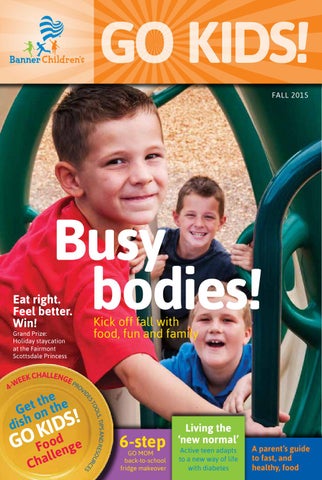
Meet our GO KIDS! cover family
A
ctive families like the Johnsons, who graced our cover this issue, are excited to explore creative ways to fuel their three busy boys by participating in the Banner GO KIDS! Food Challenge. The boys: Daniel, 9, Cooper, 7 and Travis, 6, spend their afternoons playing football, basketball and soccer and practicing karate. To encourage a healthy and well-balanced diet and maintain good hydration, the Johnsons will track food and water intake online and monitor their progress during the four-week challenge.
“The Banner GO KIDS! challenges are very straight forward and the weekly prizes are great extra incentive,” said
Stacy Johnson. “Our family and friends are inspired to sign up for the challenges when they see us participating and having fun.” Stacy, a virtual fitness coach, insists her boys take two bites of everything on their plates—including vegetables—before deciding they don’t like it. She has found that roasting green beans instead of steaming green beans, for instance, are more appealing to her boys. “Sometimes it’s a simple change in the presentation that will encourage a child to try a new vegetable and like it,” she added. Each week the Johnsons receive a produce basket filled with a variety of local fruit and vegetables which are then incorporated into every meal. “We get the kids interested in the basket by playing silly guessing games to see who can figure out the name of the fruit or vegetable,” Stacy said.
Be our next cover family! Sign up for the GO KIDS! program and share photos of your family eating and preparing healthy meals with #GOKIDS.
challenge aims to provide tools, healthy, feel better Four-week tips and resources to improve overall diet Week 3: Healthy holiday substitutions
Week 4: Plan a meal with your family
During the holidays, most dishes are packed with fat, sugar and calories. This week as families gather around the table, consider substituting a healthy alternative to a favorite dish.
Get kids interested in the meal planning process this week by discussing menus, creating shopping lists and taking trips to the grocery store together.
“Instead of apple pie, bake apples sprinkled with cinnamon and top with vanilla frozen yogurt,” Simpson said.
“It’s important that kids are excited about meal preparation,” Simpson said. “Let your child decide what vegetables to pick or determine how a dish will be prepared.”
Steam green beans instead of preparing a high calorie casserole or add a variety of vegetables into stuffing to make holiday substitutions healthy and delicious.
BannerChildrens.com/GOKIDS
During this final week of the challenge, participants will create personal menus for breakfast, lunch and dinner using tools learned throughout the challenge.
GO KIDS!
11
Tips to help your child eat right at fast-food restaurants Kelly Kolp, Banner Children’s registered dietitian at Cardon Children’s Medical Center
BY BRIAN SODOMA
bread. But while there has been considerable progress when it comes to finding healthy options at fast-food restaurants, there are still plenty of pitfalls to watch for. no secret that the consumer’s drive to eat right, even when on the go, has caught the attention of the fast-food industry. McDonald’s, for example, has been tinkering with lighter menu options for years to shun its old burger joint image, and its competitors have all found ways to add salads, yogurt and fruits to their menus too. Touting fresh ingredients is another image shifter for fastfood restaurants. Chipotle has used hormone-free meats for years. Panera Bread recently announced a drive to eliminate artificial ingredients from its entire menu and even Subway has done away with additives in its
12
GO KIDS!
As parents juggle their kids’ busy fall schedule, the drivethru or fast food stop is sometimes unavoidable. Whether you’re scratching your head at a burger stop or scanning salad options at Panera, Kelly Kolp, a Banner Children’s registered dietitian at Cardon Children’s Medical Center, offers some tips to empower parents and kids to make the best choices possible.
Fries the limit, calorie guides Ordering that burger is not a terrible decision, Kolp emphasizes. While many hamburgers are high in fat, they are also high in protein.
That said, if you can swap out the fries or onion rings for fresh fruit, a salad, apple slices or other vegetable or fruit options, you’ll be better off. “We try not to be too restrictive with kids by telling them certain foods are 100 percent off limits,” Kolp explained. “You just want to help them make good choices like fruits and vegetables and have
Fall 2015
educate the consumer. Seeing how many calories are cut when replacing mayonnaise with mustard and removing bacon from a burger is great knowledge any restaurant patron can apply to future situations.
Bag it, drink smart Portion control is critical to healthy eating, and it’s no secret that many fast-food menu items pack enough calories for two meals. Kolp encourages getting a to-go box or bag before even starting a meal.
them minimize the chips, cookies and processed foods.” Kolp’s team emphasizes the myplate.gov model, which encourages half of a meal to be made up of fruits or vegetables. The diet pro also says many restaurants reveal calorie counts for menu items. This can be a starting point to trim calories and
BannerChildrens.com/GOKIDS
She uses the example of Chipotle burritos; some can easily exceed 1,000 calories with certain toppings. Cut one in half before you start eating and put away the other half for later. And getting it right on the food front means nothing if you’re choosing high-calorie drinks with a meal, Kolp noted. “So many people will drink a lot of their calories. Stay away from those high-sugar drinks and just get that bottle of water instead,” she said.
Dress right Some don’t want to play the game of trimming that Whopper down to a Whopper Jr. and have no interest in swapping out beef with a turkey burger patty. The good news is that many fast-food restaurants have a lot of tasty salads available—but watch the dressing and condiments. Think: bacon bits or cheese, not both; lean meats are fine, but watch the croutons, and dressing is a common trip up. Stick to light or low-calorie options, Kolp suggested. “It’s about balancing. Some of these toppings can add a few hundred calories,” she added. For more information about healthy fun activities, nutrition and lifestyle tips, visit BannerChildrens.com/GOKIDS. For nutritional counseling services, contact the outpatient nutritional counseling program at Cardon Children’s Medical Center at 480-684-7500.
GO KIDS!
13
GO KIDS! ACTIVITIES
Nutrition label facts Complete this worksheet based on the information you find on a nutrition facts label in your kitchen. Any item in your pantry or refrigerator is fair game as long as it lists the nutrition facts!
Information you need to make healthy choices throughout your day
Found on all packaged foods and beverages
Use to compare foods! Choose the foods that are high in nutrients to get more of, and low in nutrients to get less of.
If you consume more calories than you burn, you gain weight. 400 calories or more per serving is high; 100 calories per serving is moderate.
Nutrients to get more of Get 100% DV of these: • Calcium • Dietary Fiber • Iron • Vitamins A & C
Check the serving size on food packages. The information listed on the Nutrition Facts Label is based on one serving. Servings are shown in common measurements like cups, ounces, or pieces.
Nutrients to get less of Get less than 100% DV of these: • Cholesterol • Saturated Fat • Sodium
To meet these goals, eat a variety of foods, including: fruits and vegetables, whole grains, fat-free or low-fat milk/milk products, lean meats and poultry, eggs, seafood, beans and peas, soy products, unsalted nuts and seeds
One package may contain more than one serving! If you eat multiple servings—you’re getting “multiples” on calories and nutrients, too.
Use %DV when comparing nutrients in foods. %DV* = Percent Daily Value
2SERVINGS=CALORIESX2
Food name ____________________________________________ Serving size _________________________________________ get a measuring cup to view serving size portion
Does this food include any of the following nutrients?
Calcium Dietary Fiber Iron Vitamin A Vitamin C
Does this food include any of the following?
circle those that apply
Cholesterol Saturated Fat Sodium Sugar Trans Fat
circle those that apply
Are the Daily Value percentages for these nutrients below 20%?
Yes
No
Based on these findings, is this food a smart food choice?
Yes
No
14
GO KIDS!
*%DV is based on “Daily Values”—the amounts of nutrients recommended for Americans aged 4 and older to eat every day.
Fall 2015
f o k c i p e we’re th
E R O M S T N E PAR ! Y A R O H O Hospitals • Pediatricians • Specialists Cardon Children’s Medical Center Phoenix
Banner Thunderbird Medical Center Glendale
Diamond Children’s Medical Center Tucson
bannerchildrens.com
BANNER HEALTH 1441 N. 12th STREET PHOENIX, AZ 85006-2887
NONPROFIT ORG U.S. POSTAGE PAID LONG BEACH, CA PERMIT NO. 2297
NO TIME FOR SCREEN TIME.
GOKIDS! MEMBERSHIP IS FREE AND ALWAYS FUN! Are you ready for some F-U-N for the whole family? Then it’s time to sign your kids up for Banner Children’s GO KIDS! Why? GO KIDS! members get free stuff to help them stay active and healthy. They get to show off on the court, or the field, to win cool prizes. And there are lots of chances to fill their noggins and bellies with healthy bites and tasty information. Ready? Set…GO KIDS! Where moms who know, get in the know. BannerChildrens.com/GOKIDS • Connect with us: