INK
SUMMER 2015
A P U B L I C A T I O N O F T H E C O R E I N S T I T U T E
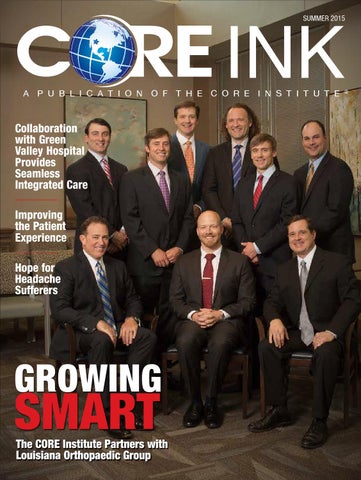
Collaboration with Green Valley Hospital Provides Seamless Integrated Care Improving the Patient Experience Hope for Headache Sufferers
GROWING
SMART
The CORE Institute Partners with Louisiana Orthopaedic Group
速
WELCOME VOLUME 6, ISSUE 2 SUMMER 2015
FROM THE CHAIRMAN
FROM THE MARKET PRESIDENT Patient-Centered Approach with Proven Surgical Outcomes.
Creating a better tomorrow, today.
Since the last edition of this magazine, you may have heard the news of the expansion into Louisiana. I can’t help but reflect on 2013 when the Michigan Market started its journey with The CORE Institute. In the last two years, we have successfully expanded not only geographically, but with our provider team. It is an honor to be part of an organization who is innovative and continues to deliver best-in-class orthopedic and neurological care in Arizona, Michigan and now in Louisiana. In this issue of CORE Ink, we showcase how patients can live pain-free with the advancements in hip replacement surgery. I also share a letter received from one of my patients, Kristin Ellerholz, who underwent a hip replacement in January 2014. She shares her experience and how she is living pain free today. As The CORE Institute continues to be at the cusp of national orthopedic news, help lead musculoskeletal healthcare reform and strategies, and grow our comprehensive services, the CORE Ink publication will keep you and our valued patients and fellow medical providers, informed of these changes. Our advances in healthcare are your advances in health.
It’s hard to believe we are already half way through 2015. We continue to transform the delivery of healthcare across Arizona, Michigan and, now, Louisiana. Our investment in the communities in which we serve will ultimately shape their local healthcare, and continue to distinguish The CORE Institute as the leader in musculoskeletal and neurological care delivery across the country. We will continue to take the necessary steps to bring our proven quality and clinical outcomes to those in need, no matter the distance. In this edition of CORE Ink, we will introduce our new partners in Louisiana. Expert Neurologist, Dr. Eric Eross shares hope for headache sufferers, Dr. Mark Campbell discusses knee replacement with MAKOplasty, we introduce our new integrated model for care with The CORE Institute Specialty Hospital and we showcase the MORE Foundation’s expanded trauma research program. In the coming months, you can expect the news of additional internationally known physicians joining our practice in Arizona and Michigan. In addition, trust you will see further development and expansion of our Department of Neurology to provide best-in-class neurological care in Arizona. On behalf of all of our physicians, providers, and staff, The CORE Institute appreciates your continued support.
Keep life in motion!
Keep Life in Motion!® David C. Markel, MD Market President, Michigan David J. Jacofsky, MD Chairman & CEO
A P U B L I C A T I O N O F T H E C O R E I N S T I T U T E
CREATED BY REPUBLIC MEDIA CUSTOM PUBLISHING FOR THE CORE INSTITUTE
®
General Manager: Cami Kaiser/ cami.kaiser@pni.com Creative Development Director: Isaac Moya/ imoya@republicmedia.com
Editor: Jim Williams/JLWilliams@republicmedia.com Editorial Coordinator: Nick Kostenko/nkostenko@republicmedia.com Sr. Managing Art Director: Tracey Phalen/tphalen@republicmedia.com Design: Rachel Tullio Photography: Advertising Coordinator: Dominick Galluzzo/dgalluzzo@republicmedia.com
Contents FEATURES Strategic Growth: New Practice Partnership in Louisiana
COVER STORY: The CORE Institute Partners with Large, Dynamic Orthopedic Group. See page 14.
12
New Hospital Collaboration for Orthopedic Services Expands to Southern Arizona
o-Management Agreement Provides C Seamless, Integrated Orthopedic Care See page 12.
The CORE Institute Specialty Hospital Unveils New National Model for Care
PATI E NT C A RE
PAIN-FREE LIVING Advancements in Hip Replacement Surgery Have Patients Walking. See page 18.
Partnership Focuses on Enhanced Quality Care, Reduced Costs for Patients. See page 13.
D E PART ME N TS
8 connect with us 1.866.974.2673
Ask the Expert
Research
8 Dr. Eric Eross Says There is Hope for Headache Sufferers with New Treatments.
20 MORE Foundation Makes Strides in Trauma, Bone Health, Cutting-Edge Treatments.
Specialty Spotlight
CORE Candid
10 Kneed to Know: Robot-Assisted Partical Knee Surgery.
21 Employees at The CORE Institute are “Keeping Life in Motion.”
What’s New?
Community Relations
11 Introducing The CORE Institute’s newest physicians.
22 Continuing to raise the bar for community commitment and involvement.
www.thecoreinstitute.com
7
ASK THE EXPERT
Hope for Headache Suffers By Eric Eross, DO
Q: How prevalent are debilitating headaches? Migraines affect approximately 12 percent of the population, which means more than 36 million Americans suffer from them. These headaches are the most common neurological condition that brings people to the emergency department (ED) and the third most common reason overall for an ED visit. More than 15 million suffer from chronic daily headaches, which are defined as having a debilitating headache more than 15 days each month, longer than three months.
Q: What causes migraines? Don’t confuse cause and triggers. For migraines, the cause is a genetic vulnerability that leads to a hyper-excitable brain, which results in headache and other neurological symptoms. Triggers are the events that provoke the hyper-excitable brain such as monsoon weather, wine or a strong odor from perfume.
Q: What are the treatments for migraines? Once we exclude secondary causes for headaches (i.e. tumors, infection, stroke, alterations in pressure inside the head, etc.), we use a combination of therapies to find what works best for that individual. We try and reduce exposure to triggers. We work on keeping the brain from becoming overly excited. And, if a headache begins, we stop it as quickly as possible.
what a wonderful outcome they can achieve. But, there are some common pitfalls to managing migraines: • Misdiagnosis – millions of Americans are treating their headaches as if they were sinus or tension headaches when actually they’re suffering from migraines • Inadequate/inaccurate medical advice – migraine treatment is a neurological sub-specialty requiring in-depth diagnosis and treatment techniques • Medication Overuse Headache – often seen with over- the-counter products but taking too much prescribed medications also can cause “rebound” headaches • Impatience – finding the right program and then allowing the medications to fully take effect can take from one to five months • Lack of Understanding – patients need to be educated so they understand their treatment is a process they must be a part of to achieve success
Q: Are there new treatments available? We are continually researching new ways to treat and prevent migraines. A few
Q: Are chronic headaches difficult to treat? Patients can be surprised at how simple controlling their headaches can be and
8
ERIC EROSS, DO
recent developments include: • Botox – FDA-approved injections every 12 weeks resulted in approximately half the patients experiencing greater than a 50 percent reduction of headache days • Gliacin – used in treating a broad range of headache conditions; clinical trials and in my practice the results are that it is not only effective treating migraines but at least 10 other headache conditions; it is a well-tolerated oral medication and you don’t need a prescription • Injections – nerve blocking or nerve stimulating treatments are being used as well as new methods to administer medications • Transcranial Magnetic Stimulation – a brief pulse of TMS energy from a small device may interrupt the progression of a migraine.
Q: What advice do you offer? Often, the first time I meet patients, they say, “You are my last hope.” I urge people who are not finding relief from debilitating headaches to seek out a neurologist with a headache specialty. Don’t give up. The expertise is here to help you.
Dr. Eric Eross is a fellowship-trained neurologist specializing exclusively in headache medicine. Director of The CORE Institute Center for Headache Medicine, he has successfully treated more than 15,000 patients suffering from an array of headache-related disorders. He is among an elite group of specialists completing a two-year headache medicine fellowship at the world-renowned Mayo Clinic, where he also was an associate neurology consultant, headache medicine specialist and clinical instructor at the Mayo Clinic College of Medicine.
www.thecoreinstitute.com
CORE CANDID
SPECIALTY SPOTLIGHT
Kneed to Know Robot-Assisted Partial Knee Replacement Surgery Can Get You Back On Your Feet By Stephanie Conner Your knees work hard, and a lifetime of wear and tear can leave you with osteoarthritis — and potentially, a lot of pain. For some people, the answer to a healthier, happier knee lies in MAKOplasty partial knee replacement, an outpatient procedure offered at The CORE Institute. WHAT IT IS The procedure, also referred to as “knee resurfacing” is an alternative to total joint replacement. “It’s far less invasive,” explains Mark Campbell, MD, a fellowship-trained orthopedic surgeon at The CORE Institute who subspecializes in knee, foot and ankle surgery. “You’re just replacing the part of the joint that’s bad. And that means you’re sparing a lot of healthy bone and ligaments around the joint.” As both partial and total knee replacement surgeries become more common, Dr. Campbell notes, it’s important for Mark Campbell, MD patients to be aware of their options. “There are a lot of doctors who don’t do partial knee replacements, and there’s an old sigma that partial knee replacements don’t work, but that’s based on older data,” he says. “If you look at more recent studies comparing the procedures head to head, the new data clearly supports partial knee replacements and shows they are less risky in many ways.” By focusing on just the arthritic part of the knee, a surgeon can preserve healthy tissue, and the less invasive nature of the procedure typically means a faster recovery and shorter hospital stay. IS SURGERY THE RIGHT CHOICE? So, how do you know if surgery is right for you? “The first thing I tell my patients is that the decision is theirs,” Dr. Campbell says. “They have to weigh the amount of pain they’re having and how it’s affecting their lifestyle.”
10
Dr. Campbell and other orthopedic experts advise beginning with more conservative treatment. Some people find relief from physical therapy, pain medications or steroid injections. For patients who aren’t finding the results they desire, knee surgery may be an option. However, not everyone is a candidate for partial knee replacement, Dr. Campbell says. “You have to properly evaluate a patient,” he notes. For example, if arthritis is throughout the entire joint, a partial replacement isn’t an option. Through a physical exam, patient medical history and imaging scans, a clinician can determine if someone would benefit from partial (or total) knee replacement surgery. ADVANCED TECHNOLOGY AT THE CORE INSTITUTE At The CORE Institute, Dr. Campbell and his colleagues are using MAKOplasty, a robot-assisted approach to partial knee replacement. The MAKOplasty robot, Dr. Campbell explains, provides three-dimensional pre-operative planning. After feeding a patient’s CT scan data into the robot, the surgeon receives useful feedback to ensure optimal positioning. The robot also helps prevents unnecessary damage to other areas of the joint. “The robot is only as good as the information we give it,” Dr. Campbell says. “But it allows us to place the knee components in an optimal position.” Shortly after surgery, patients are helped to stand and walk a short distance before going home that day. Most begin physical therapy within a few days and continue for four to six weeks. For many people, this procedure can get them back to an active lifestyle without pain, or as The CORE Institute likes to put it, “keep life in motion.” “The vast majority of people do fantastic,” Dr. Campbell says.
www.thecoreinstitute.com
WHAT’S NEW NEW PROVIDERS
The CORE Institute is pleased to announce the addition of new physicians to our provider team.
MICHAEL J. SORSCHER, MD is a board certified and fellowship-trained orthopedic surgeon specializing in primary and revision joint arthroplasty of the hip and knee. Dr. Sorscher MICHIGAN received his fellowship training at Grant Medical Center in Columbus, Ohio and cares for patients at The CORE Institute – Grand Blanc clinic.
FREDERICK C. SCHREIBER, DO is a board certified orthopedic surgeon with more than 30 years of clinical experience. He has expertise in general orthopedic practice including adult and MICHIGAN pediatric fracture care, sports medicine and arthroscopy, and joint reconstruction surgery. Dr. Schreiber cares for patients at The CORE Institute – Grand Blanc.
DAVID M. JACKSON, MD is a board certified and fellowship-trained orthopedic spine surgeon. He subscribes to a multidisciplinary approach to the treatment of conditions of the spine. Dr. Jackson ARIZONA previously cared for patients in Northern California and cares for patients at The CORE Institute – West Phoenix clinic.
CLIFFORD B. JONES, MD is a board certified and fellowship-trained orthopedic surgeon. He specializes in trauma, adult and pediatric fracture care, infections, osteomyelitis, amputations, nonunions, malARIZ-MICH unions, pelvic fractures, acetabular fractures, periarticular fractures, spine problems, and foot and ankle trauma. He cares for patients for patients in both Arizona and Michigan clinics.
ALEX R. VERHOOGEN, MD is a board certified orthopedic surgeon with more than 32 years of clinical experience. He has expertise in general orthopedic practice including adult and ARIZONA pediatric fracture care, sports medicine and arthroscopy, and joint reconstruction surgery. Dr. Verhoogen cares for patients at The CORE Institute – Green Valley clinic.
ARIZONA
NATHAN T. MOORE, DO is a fellowshiptrained orthopedic surgeon specializing in primary and revision joint arthroplasty of the hip and knee. He cares for patients at The CORE Institute – West Phoenix clinic.
FEATURE STORY
New Hospital Collaboration for Orthopedic Services Expands to Southern Arizona o-Management Agreement Provides C Seamless, Integrated Orthopedic Care By Meghann Finn Sepulveda ON APRIL 1 THE CORE INSTITUTE ENTERED INTO AN ORTHOPEDIC service line co-management agreement with Green Valley Hospital, a 50-bed, general acute care full-service hospital located 20 miles south of Tucson, Ariz. The unique partnership arrangement – one of eight already in place across the country – was developed so that The CORE Institute could help lead the hospital’s orthopedic program, provide a continuum of care in a world-class environment and create a positive experience for patients. IDENTIFYING THE NEED Comprised of more than 50,000 residents, the Green Valley area is a large active adult community. Until now, there was not a hospital that directly served the community, requiring patients to drive to Tucson or Phoenix for comprehensive medical and orthopedic care. “Based on the population, we felt this was an ideal location for The CORE Institute to expand into Green Valley to meet the needs of the community,” said DeLyle Manwaring, Senior Vice President of Health System Integration at The CORE Institute. “It’s incredibly exciting to take our services into yet another hospital and community to ensure physicians and hospital leaders are working together to provide better coordinated care for patients.” As part of the co-management agreement with Green Valley Hospital, The CORE Institute will develop and manage all aspects of the integrated orthopedic service line.
12
COMBINED APPROACH Delivering outcomes-based care is a top priority for The CORE Institute. “We have found much greater outcomes are a result of maintaining good relationships with the hospital through the co-management tool that allows us to develop, collaborate and coordinate service line visibility and influence,” said Jason Scalise, MD, Orthopedic Surgeon and Vice Chairman and Director of National Physician Integration for The CORE Institute. “We love to be embedded in the community and provide services, programs, research and outcomesbased care which create inter-woven and tight knit relationships.” The CORE Institute is proud of its longstanding history and national reputation. “Our confidence in quality is extremely high,” Dr. Scalise said. “There is no compromise.” CONTINUUM OF CARE Orthopedic patients in Green Valley, and
Tucson, will benefit from this new partnership from the first moment he or she enters the clinic. Physicians at The CORE Institute will be involved in every facet of care from patient education, scheduling, surgery, post-operative visits, rehabilitation and physical therapy. “Through this unique partnership, we are bridging the gap between the hospital and physicians, and are providing a seamless experience for patients,” Manwaring said. “It ultimately results in much better patient satisfaction and greater clinical outcomes.” QUALITY AND CONVENIENCE As the service line grows, The CORE Institute is committed to offering comprehensive services in all areas of musculoskeletal care and neurological services in Green Valley and across Southern Arizona. “We will provide full-service orthopedic care,” Dr. Scalise said. “And will continue to expand our facilities across Southern Arizona.” Currently there are three full-time providers at Green Valley Hospital, but The CORE Institute will rotate physicians as the need arises. “Our patients should not have to drive far for an appointment or surgery,” Dr. Scalise said. “Our goal is to provide patient-centric, world class orthopedic care directly in this community, our new home.”
www.thecoreinstitute.com
The CORE Institute Specialty Hospital Unveils New National Model for Care Partnership Focuses on Enhanced Quality Care, Reduced Costs for Patients By Dolores Tropiano & Meghann Sepulveda The CORE Institute, leaders in orthopedic and neurological care, announced another innovative partnership on March 9. Together with Surgical Care Affiliates and six local independent physicians, The CORE Institute Specialty Hospital –– was introduced, offering an evidencebased and integrated approach to musculoskeletal and neurological care. NATIONAL PARTNERSHIP FOR WORLD-CLASS CARE The CORE Institute Specialty Hospital, formerly Specialty Hospital of Phoenix is one of the latest and most exciting endeavors dedicated to providing advanced orthopedic services at costs that are significantly below industry standards in an effort to improve the patient experience. “The two national companies coming together has formed a unique product that transforms the way surgical services are delivered,” said Eric Tomlon, serving Interim Chief Executive Officer of The CORE Institute Specialty Hospital. Tomlon said the partnership between The CORE Institute and SCA, a prominent surgical solutions and specialty surgical services provider, is very progressive. “The CORE Institute Specialty Hospital offers a unique setting for patients to receive high-end, specialty specific, quality care - validated through The CORE Institute’s well-proven surgical outcomes,” Tomlon said. DISTINCT PATIENT ENVIRONMENT The hospital is staffed with the Valley’s
reliable care path,” Tomlon said. “That top orthopedic surgeons - recognized requires fewer supplies and reduces risk experts in hip, shoulder, and knee for mistakes and medical errors.” replacement, spine, foot and ankle, The CORE Institute’s and other orthopedic innovative approaches surgical specialties. have allayed an ailing “The CORE Institute healthcare system. The Specialty Hospital is a CORE Institute has been place where patients, a leader in working with physicians and employhealthcare legislation ees can expect the to provide affordable very best in top-tier, options that make medical orthopedic services,” care more available to a Tomlon said. “The larger segment of the community will bensuffering population. efit tremendously from “With the Affordable this partnership and Care Act there is an the incredible patient Eric Tomlon incredible opportunity for care our physicians physicians to work with employers and and employees will proudly deliver. Our insurance companies to bend the cost staff at the hospital is incredibly proud curves,” Tomlon said. and deserving of the accolades they have achieved in top patient satisfaction FOCUSED GROWTH across the State of Arizona.” The CORE Institute plans an extensive The CORE Institute has built a national upgrade of the facility, which was reputation for performing routine and originally built in the 1960s, making it a complex orthopedic surgeries, delivering national model for specialty centers in excellent patient care and maintaining the future. Expansions are also planned quality outcomes. in the coming year in Michigan and in two additional states. REDUCING COSTS But despite the rapid expansions, This new opportunity improves efficiency The CORE Institute will continue to due to a focused approach in providing maintain its commitment to a strategy surgical services thereby lowering costs. that provides superior services and Without the overhead of maintaining large hospitals, redundant staffing, drugs successful outcomes. “When you define standards up front, and generic order sets, costs are cut and build systems to maintain those even further. Elective admissions focusing exclusively on orthopedic procedures standards with great people, you can achieve optimal outcomes,” Tomlon simplifies the business strategy on explained. “It is our endeavor to deliver several levels. reliable, evidenced-based surgical care “All of the physicians and nurses have combined with an outstanding patient the same order sets and pathways so experience.” patients go along a very predictable and
13
STRATEGIC GROWTH New practice partnership in Louisiana
B Y M E G H A N N F I N N S E P U LV E D A
The CORE Institute partners with large, dynamic orthopedic group
14
www.thecoreinstitute.com
COVER STORY
natural alignment. This unique practice model fits with The CORE Institute’s organic growth goals to develop a strong platform throughout the major regions of the U.S. in which musculoskeletal care is provided.
The CORE Institute expanded its services into a new region of the country following the acquisition of Louisiana Orthopaedic Specialists, LLC — a comprehensive musculoskeletal orthopedic practice — in May. The multi-specialty Lafayettebased orthopedic practice was identified for its excellent reputation, strong hospital relationships and quality outcomes that led to a
STRATEGIC FOCUS The CORE Institute has built a national reputation for quality outcomes and evidence-based medicine and engages partners who demonstrate a similar approach to patient care. “We felt this group provided us with a strong multi-specialty service line in the Southeast, with an excellent reputation for quality outcomes, a data driven platform and the ability to adopt our best practices,” said Peter Slate, Chief Business Development Officer for The CORE Institute. The CORE Institute brings practice growth to partners with an expectation to expand the musculoskeletal service line footprint in the region. “Based on the practice and regional opportunity, we anticipate we will increase patient volume and significantly grow the practice,” Slate said. “Currently there are nine
physicians on staff but we plan to rapidly add more and focus on other opportunities for new business development.” Louisiana was chosen because like most states, physicians and hospitals are trying to make sense of the changing environment of healthcare to develop strategies and navigate the new landscape. “The CORE Institute provides considerable value to a private orthopedic practice by offering shared management services with a team of experienced professionals,” said Michael Prejean, Chief Executive Officer at Louisiana Orthopaedic Specialists, LLC. “By joining The CORE Institute, our practice is better prepared to meet the upcoming challenges we all face in this industry while maintaining a private practice mentality.” One of the initial areas of focus is to create a co-management orthopedic service line agreement with a nearby hospital to drive physician alignment and manage the continuum of care. “This practice already has an established reputation with hospitals in the area,” Slate said. “We have started evaluating these potential hospital partners and expect to develop a co-management agreement in the very near future.” COORDINATED CARE As part of the co-management agreement, orthopedic patients can expect high quality care and improved safety. Physicians have oversight in all areas of patient care such as testing, surgery, postoperative care and rehabilitation.
15
COVER STORY “As opposed to the traditional model of medicine where physicians and hospitals practice individually, the comanagement agreement gives physicians the ability to control patient care from beginning to end,” said Bryan Wall, MD, Orthopedic Shoulder Surgeon and Vice Chair for National Operational Optimization for The CORE Institute. “It drives alignment and leaves less room for medical errors.” This approach positively holds physicians and hospital administrators accountable for the care of each patient, creates synergy and encourages teamwork. “It’s absolutely critical to find hospital partners who believe in this method of care,” Dr. Wall said. “It creates a framework for the physicians and provides better outcomes.” Patients will also notice increased efficiency in the clinic. “There will be shorter wait times and
improved processes with checkin and check out,” Prejean said. “Patients can take comfort in the notion that our physicians will adhere to standardized protocols proven to generate better outcomes while lowering the overall cost of care.” EVIDENCE-BASED MEDICINE The CORE Institute also grants new practices access to its wholly owned subsidiary software development system VIRT2 Health, LLC, used to track and coordinate surgery experience and outcomes and overall patient care by providing tools for more effective decision-making. “VIRT2 Health has developed exceptionally unique analytics tools that give a competitive advantage to our business model and partners,” Slate said. The software also provides complications-focused analytics and gives physi-
cians access to data for orthopedic care across the country. “Through the software tools developed by VIRT2 Health, The CORE Institute will continue to decrease the overall cost of musculoskeletal care, create better outcome decisions and position us as a leader in providing high quality care,” Slate said.
PATIENT CARE
Pain-Free Living
Advancements in Hip Replacement Surgery Have Patients Walking
18
Decembe
r 31, 2014
r me. I am ve done fo hat you ha ement you did for w r fo k an to th press replac you a note versary for my hip y. No words can ex . d to send ni en Just wante brate my 1-year an s been a year alread e has been since th it’ le lif about to ce 4, so hard to believe w life changing my /1 ho w bad me on 1/2 ve done for me and realized ho rgery. and never su in is what you ha pa th h ch throug e with su any years at the thought to go nfidence. You told m ound for m ed bucks e and co n nc io I walked ar ly was. I was terrifi ill ra m su a as el like lt your tual d I would fe my hip ac et you, I fe anging an oment I m From the m at it would be life-ch th ep, pointblank t done with me. of every st go tal control . All the follow up to ok when you to u, perience spital, yo ry, aff, the ho was an amazing ex ior and post-surge on, your st It pr From then to do was show up. I would need to do 5-star service. d as ng and all I ha intments, everythi ed in the hospital w po iv ged due they did, ap and the care I rece it has chan ing, en my spir ence. ev d an , was amaz the differ limp is gone gone, my I just cannot believe ing pain is s. ve All my burn in 24/7 pain for year hat you ha g enough w to not bein ot express ably have to get the nn ca ds t. ob wor a gift, and e-changing. I will pr r doctor I would wan do is truly lif What you has been ere would be no othe ly al re it e; th have done done for m ne eventually, and r what you do my heart fo ing your gift. other one of om tt ar bo e r sh you from th or and thank you fo d to thank ct I just wante e a very special do u ar for me. Yo
Dear Dr. M
arkel,
By Brian Sodoma Hip replacement surgery is not what it once was. Gone are the days where new hips were cemented into place and dislocation and blood clot rates were high. In fact, thanks to better technology, surgical techniques and post-operative care, more and more patients are seeking relief from arthritic hip pain by getting replacements at an earlier age. More than 330,000 people elected for hip replacements last year, according to the Centers for Disease Control and Prevention (CDC), and some research suggests that figure will approach 600,000 annually by 2030. Michigan-based surgeon, Dr. David Markel is proud to be a player in the major advancements seen in hip replacement surgeries. With more than 20 years of experience with the procedure, Dr. Markel recalls the long recoveries and mixed results of yesterday. “I think, then, if you would’ve told me that we’d eventually be sending a patient home in a day or two and have them walking on the day of surgery, I’d say you were crazy,” Dr. Markel said.
a spongy, porous material that contains calcium like compounds that entice bones to effectively s, Kind regard grow into them. New hips are also shaped more precisely and better than in the past. “People can get up on them right away,” Dr. Markel noted, “and the vast majority now last 20 years or more.” Dr. Markel has also seen surgical techniques evolve. Today, the goal is to disturb as little tissue, muscle or bone as possible when conducting a surgery, he explained. And each patient’s case is carefully scrutinized to make sure that the incision is placed in the best spot. Many incisions are not much larger than the full length of a Band-Aid, Dr. Markel added. “As a surgeon, you have to make sure the incision is exactly where you want [in order] to accomplish your goals. … You don’t take down any muscle and tissue if you don’t have to,” he added.
BETTER HIPS, BETTER TECHNIQUES Dr. Markel said today’s new hip technologies are better than ever. Most are made of titanium, but perhaps even more important, the hips are coated with
EARLY STEPS The CORE Institute’s philosophy of using evidence-based research and best practices also extends to post-operative care. With today’s technology and surgery techniques greatly reducing the likeli-
hood for a dislocation or other problems, patients are moving soon after surgery to help regain their previous – but now pain-free – range of motion. For this to happen, physicians also have a head start on pain and nausea monitoring. Dr. Markel avoids narcotic pain medicine delivered through IV’s or catheters, if possible, and uses shortaction anesthesia. Long-acting pain medicine is given prior to surgery with the hopes of a patient waking will little, if any, pain beyond some discomfort associated with the incision. Dr. Markel prefers to perform surgeries in the mornings and likes to see patients on their feet as much as possible throughout the afternoon. “All my patients have physical therapy the day after surgery,” he said. “The majority of patients are walking the same or next day and it moves very fast after that…We want them to walk as much as they can.”
www.thecoreinstitute.com
R ES E A RCH
MORE Foundation Makes Strides on Research Impacting Trauma, Bone Health, Cutting-Edge Treatments By Gremlyn Bradley-Waddell It should come as no surprise that the aptly named MORE Foundation wants to take on, well, more. And that’s exactly what the research- oriented, non-profit partner of The CORE Institute is doing. As of this summer, it has expanded its trauma research program, a move that will benefit all trauma patients throughout the metropolitan Phoenix area, according to Marc Jacofsky, PhD, the Foundation’s Research Director and The CORE Institute’s Chief Scientific Officer. MORE (MusculoskeletalOrthopedic Research and Education) will be participating in multiple nationally enrolling studies, including two focused on hip fractures, funded by the National Institutes of Health. These studies will dovetail closely with the new bone health program at The CORE Institute, designed to ensure optimum health, nutrition and procedures for individuals suffering from broken bones.
“What’s very exciting is that as The CORE Institute and the MORE Foundation grows and matures, we are able to attract more renowned physicians and are able to integrate them and their research programs into ours,” Dr. Jacofsky said, adding that three doctors and seven researchers have already been hired. ATTRACTING TOP TALENT One of those is nationally renowned researcher and Orthopedic Trauma Surgeon Clifford Jones, MD, who recently joined The CORE Institute in Phoenix and will treat patients both in Arizona as well as care for his Michigan patients in their Michigan locations. Dr. Jones not only brings his skill and expertise to the Valley, but also a generous seed grant that will go toward paying researchers’ salaries for a few years. Dr. Jones said he has been impressed by the strides the Foundation is making and that they “may mean you’re going to get cutting-edge treatment here quicker than you would anywhere else in the United States.” Drs. Jacofsky and Jones have something of a soft spot reserved for trauma research, as both point out that the victims of such injuries — which can come about as a result of a car, bicycle or a motorcycle accident or a fall or even an unfortunate run-in with a table saw — are truly thrown into the overwhelming world of healthcare, often under the worst of circumstances. Because of the often dramatic, violent and painful nature of their injuries, trauma patients are also extremely difficult to study, which is just one more reason why this realm of research has been so overlooked for so long, Dr. Jacofsky said. TRAUMA RESEARCH “In trauma research, you don’t have the luxury of planning ahead and gathering preliminary data about the patient,” he explained. “Another obstacle can be obtaining informed consent. When patients are enrolled in a study, they must give researchers consent to treat them, s after it’ s explained to them what will be done. They have time to think about the risks versus the benefits. But in a traumatic situation, we are coming into the emergency room an hour before surgery and asking, ‘Hey, we would like to enroll you in a study?’ So, no, patients might not appreciate that. They just want to be fixed.” And that’s why the Foundation has made sure the trauma research team not only includes physicians and researchers but also orthopedists, who can be “on call” when emergencies occur. This kind of trauma research will also go a long way toward helping soldiers who have been wounded, another arena of medicine that’s important to both Drs. Jacofsky and Jones, who years ago was a Distinguished Visiting Professor at Germany’s Landstuhl Regional Medical Center, which is operated by the U.S. Army. “Our goal is simply to improve outcomes for all kinds of patients,” Dr. Jacofsky said, “and now we are going to be able to do that better than ever.”
CORE CANDID What Does ‘Keeping Life in Motion’ Mean to You
MARIBEL VARELA
I Keep Life in Motion 24/7. Whether it’s hiking, running, or working out at the gym. I enjoy the outdoors and love to try new adventures as much as possible. My latest accomplishment was going on a nine mile hike for my 41st birthday. My husband and I drove up to Fossil Creek near Payson, AZ. We hiked up for 4.5 miles until we reached our destination that was filled with beautiful scenery, waterfalls, and a gorgeous creek. I look forward to my next adventure. Until next time ... Keep Life in Motion!
HALEY WESTFALL BROOKE LOGSDON
I love to Keep Life in Motion by spending time with my horses, Tucker (left) and Nina (right). One of our favorite things to do is to go out on trail rides up to the Superstition Mountains for a new adventure. We also have fun in the arena by working some cattle, lunging exercises, or play around with other horses. These two know how to keep things bright, energetic and fun.
I Keep Life in Motion by going to CrossFit in the West Valley 4-5 days a week. It helps me to maintain a healthy lifestyle while doing something that I absolutely love and getting stronger day after day! It’s also the best stress reliever out there and I couldn’t imagine my life without it!
Musculoskeletal and neurological conditions, affecting everything from shoulders and hips, spines and knees, and nervous system including the brain and spinal cord are a leading cause of disability and chronic pain for patients around the world.
At the Musculoskeletal Orthopedic Research and Education Foundation
We are dedicated to changing that. The MORE Foundation envisions a world full of active people. Our mission is to empower individuals to Keep Life in Motion® through innovative research, community education, and charitable assistance. Consider contributing your time, your skills or your financial assistance. Please visit more-foundation.org to learn how to be a part of the MORE Foundation!
623.241.8724 The MORE Foundation is a 501(c)3 non-profit corporation. Federal ID #27-0170045.
MoreFoundationAdCoreInk_03052015.indd 1
4/28/15 9:17 AM
CORE CANDID
CO M M U N I T Y
The CORE Institute Teams Up with the MORE Foundation for #redshirtfriday The CORE Institute and the MORE Foundation are collaborating to showcase our support throughout our clinics benefitting the MORE Foundation’s Charitable Assistance Program Serving Veterans. The MORE Foundation is a non-profit empowering individuals to Keep Life in Motion® through innovative research, education and charitable assistance to the community. For this campaign, The CORE Institute and the MORE Foundation have collaborated to honor our men and women serving in our military. By wearing red, our staff is silently screaming that we are grateful to our soldiers for their
bravery and sacrifice. The CORE Institute employees participate by donating to the MORE Foundation’s Charitable Assistance Program Serving Veterans and subsequently proudly wear their provided red t-shirt on designated Friday’s throughout the year.
DOING MORE For more information, or if you are interested in getting involved or making a donation please visit www.more-foundation.org.