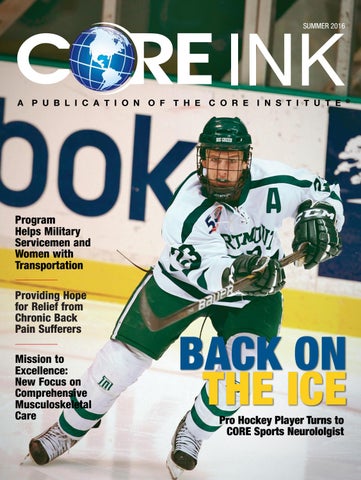
INK
SUMMER 2016
A P U B L I C A T I O N O F T H E C O R E I N S T I T U T E
ÂŽ
Program Helps Military Servicemen and Women with Transportation Providing Hope for Relief from Chronic Back Pain Sufferers Mission to Excellence: New Focus on Comprehensive Musculoskeletal Care
BACK ON THE ICE Pro Hockey Player Turns to CORE Sports Neurololgist
WELCOME VOLUME 7, ISSUE 1 – SUMMER 2016
FROM THE CHAIRMAN
Delivering Best-in-Class Care More than 11 years ago, The CORE Institute entered a marketplace with a disruptive patient-centric, outcomes driven, value-based delivery model for musculoskeletal healthcare. We were told we would never be successful at changing the delivery of healthcare. We were told our dreams were too big, and what we sought to do was impossible. Although it hasn’t been easy, it has been worth it. Today, our physicians provide world-class specialized care in the areas of surgical, non-surgical and rehabilitative hip, knee, shoulder, and hand, wrist, elbow and ankle procedures. We offer joint replacement, sports medicine, arthroscopy, fracture management, orthopedic traumatology, complex articular cartilage restoration, musculoskeletal oncology, comprehensive spine care, pain management, clinical neurophysiology, epilepsy, headache and facial pain, spine and peripheral nerve disease, clinical neuroimmunology, multiple sclerosis, and general neurology care. We care for patients from around the globe. In this edition of CORE Ink, we share our recent expansion into new service lines, such as chiropractic, sports neurology, cosmetic medicine, and we feature our acupuncture program. Sports neurology is a growing specialty, and specifically dedicated the brain health of athletes. We share a story from professional hockey player, Adam Estoclet, who was concussed during a game and suffered for months until he found Dr. Jeffrey Kutcher at The Sports Neurology Clinic at The CORE Institute™. In addition, you will learn a little more about our Chiropractic Wellness program, led by Dr. GS Arora. We share articles about chronic back pain, chiropractic treatment options for pregnant women, information about ICD-10 and what it means to you, and how the MORE Foundation is helping military servicemen and women with their transportation needs. The comprehensive programs that are now offered at The CORE Institute are unique and evidence-based solutions. It is your journey as a treasured patient that continues to drive us … to be better … and to continue to deliver best-in-class patient care. We will never stop improving and continuing to care for you, your family, and our community. Keep Life in Motion!®
David J. Jacofsky, MD Chairman & CEO
A P U B L I C A T I O N O F T H E C O R E I N S T I T U T E
CREATED BY REPUBLIC MEDIA CUSTOM PUBLISHING FOR THE CORE INSTITUTE
General Manager: Cami Kaiser/ cami.kaiser@pni.com Creative Development Director: Isaac Moya/ imoya@republicmedia.com
Editor: Jim Williams/JLWilliams@republicmedia.com Project Manager: Nick Kostenko/nkostenko@republicmedia.com Design: Rachel Tullio Advertising Coordinator: Arash Parsi/aparsi@gannett.com
®
Contents
FEATURES The CORE Institute: Mission to Excellence
16 Photo by Mark Washburn
PATI E NT C A RE
COVER STORY: The CORE Institute sets the bar high, from complementary medicine to highly specialized programs. See page 14.
Change for the Future
Getting Back on the Ice Pro hockey player turns to CORE Sports Neurololgist to get back on the ice. See page 16.
ow ICD-10 Can Improve Healthcare. H See page 13.
D E PART ME N TS
12 connect with us 1.866.974.2673 Cover Photo by Dave Silverman
Ask the Expert
Giving Back
8 Dr. Kevin Lasseigne, interventional spine physician, provides hope for patients suffering from chronic back pain.
12 The MORE Foundation program helps military servicemen and women with transportation.
Specialty Spotlight
CORE Candid
10 Growing Pains: Chiropractic care for pregnant women
22 Employees at The CORE Institute are “Keeping Life in Motion.”
What’s New? 11 The CORE Institute is pleased to introduce new physicians to the CORE team.
www.thecoreinstitute.com
7
ASK THE EXPERT
Is There Hope for Relief from Chronic Back Pain? By Joan Westlake Physically exhausting and life disrupting, back pain is one of the most common reasons for a visit to the family doctor. Too often, the condition only gets worse as constant pain takes an emotional toll. Whether through a referral by a physician, a recommendation from friends or being sent by a member of The CORE Institute medical team, when someone suffering from back-related issues visits interventional spine physician Dr. Kevin Lasseigne, Jr., they find themselves setting out on a road with the goal of stopping the pain. “When people come in to our offices with chronic back pain, they are often very discouraged and even fearful that they could end up being disabled,” Dr. Lasseigne said. “I know that as part of the medical treatment, they need reassurance and peace of mind. We devote the time it takes to give them the necessary one-on-one attention. When they leave, they have a diagnosis, they feel reassured about the diagnosis and they can take comfort in the treatment plan we have worked out with them.” BEGINNING THE HEALING PROCESS That first visit includes a detailed history and discussion of their daily lives along with a thorough physical exam. Dr. Lasseigne added that he also observes body language because often it reveals areas and levels of pain that some are too stoic to admit. Reviewing X-rays and other imaging is an opportunity to bring the patient into healing process. “To empower patients, we review the
8
X-rays with them,” Dr. Lasseigne said. “Often they get a better grasp of their condition when they can see what might be causing it, for instance, that the disc is losing space or there is a bone spur or signs of arthritis. We write down the diagnosis so they are able to further research the condition and feel even more a part of the process.” METHODS AND TREATMENTS As an interventional spine physician, Dr. Lasseigne uses an arsenal of nonsurgical pain management approaches, diagnostic methods and treatments. In many cases, interventional spine treatments offer minimally invasive alternatives to more complex surgery. Because pain can be the result of a combination of factors, a range of lifestyle recommendations, ergonomic considerations, physical therapies and medical treatments might be included in the healing plan. Each patient progresses from the initial visit depending on his or her condition. Some might find relief with physical therapy and lifestyle changes, such as not sitting at a computer screen for hours or adopting proper body positioning when walking, lifting and other repetitive motions. Further investigative imaging or
KEVIN LASSEIGNE, JR., MD
more intensive approaches could be the next steps for other patients. “A real advantage is that we know The CORE Institute’s physical therapists and are very good at matching patients with the ones that best fit their personalities,” said Dr. Lasseigne. “And, we are known for our detailed therapy plans.” INNOVATIVE APPROACH If the initial treatments do not reach the pain relief goals desired or if the first visit indicates pain is at a level that needs immediate intervention, the next step might be an epidural steroid or pain medication injection in the lower back. This sends medication directly to the nerve root that’s inflamed. Another intervention that is very effective is radiofrequency rhizotomy. Using X-ray guidance and a needle with an electrode at the tip that gets heated, this procedure turns off a nerve’s ability to send pain messages to your brain for up to a year. These are just a few of the innovative treatments and approaches available to The CORE Institute’s medical team. “Our goal is that our patients leave here reassured and feeling empowered with the least invasive and most innovative plan to relieve their pain,” said Dr. Lasseigne.
Kevin Lasseigne, Jr., MD is a fellowship-trained physician specializing in interventional spine treatments as well as physical medicine and rehabilitation. He focuses on nonsurgical management and treatment of musculoskeletal injuries with a primary emphasis on spine-related pain. Dr. Lasseigne is experienced in electrodiagnostic medicine, performing nerve conduction studies for common nerve-related injuries as well as the treatment of chronic migraine headaches.
www.thecoreinstitute.com
SPECIALTY SPOTLIGHT
HELPFUL GUIDELINES
Chiropractic Care for Pregnant Women
Growing Pains By G.S. Arora Some of the basic contributing factors to all of the grief during pregnancy include hormonal changes, extra weight in the front of the body and muscle imbalance, which leads to spinal and pelvic misalignment. This is really a woman’s body’s way of preparing for the birth process. Pregnant women secrete a hormone called relaxin, which allows ligaments to expand. Unfortunately, this increased flexibility of ligaments dramatically reduces the support of your back and pelvic joints. The abdominal muscles are excellent low back stabilizers. With the increased weight up front, the stretching of the abdominal muscles and the forces of gravity, the low back, pelvis and sacrum are under a great deal of strain. LACK OF SUPPORT Add all of this up and you have a body that is gaining weight and size, and losing proper biomechanical and structural support. This lack of support is what allows for muscle imbalance as well as spine, pelvic and sacral misalignment. The good news is there are solutions. Low back pain and all of the related symptoms, as well as joint dysfunction in mothers-to-be, do have options for relief when chiropractic care is involved in the
10
prenatal phase. Low back pain, sciatica (pain, numbness and/or burning into the legs) and/or stiff joints tend to affect a great deal of women as they approach their second and third trimesters. There is a safe, effective and drug-free way of correcting and many times preventing these problems. CHIROPRACTIC OPTIONS Regular chiropractic care may be utilized as an integral part of both the prenatal and postpartum healthcare plan. This helps the mother’s body feeling and functioning at its best and assists in coping with the physical stresses of an everchanging body.1 Women who met the criteria for SI/sacroiliac (low back) misalignment and were treated with adjustments/manipulations of the sacroiliac joints, were involved in a study: After manipulative therapy, 91 percent of the women had relief of pain and no longer exhibited signs of sacroiliac misalignment.2 A composite of 84 percent of patients receiving spinal manipulative therapy reported relief of back pain during pregnancy. There was significantlyless likelihood of back labor when spinal manipulative therapy was administered during pregnancy.3
The following are a list of guidelines that the International Chiropractors Association recommends to minimize low back pain during pregnancy: »» Avoid prolonged sitting, especially with legs crossed. Sit in chairs with proper low back support. »» Try to avoid any lifting and twisting, especially at the same time. Avoid fast jerking motions. »» Sleep on your side with knees bent. Place a pillow between your knees to help the ligaments and muscles relax. »» Follow a moderate exercise program recommended by your chiropractic physician. Exercise three times per week to keep the muscles strong and supportive, which will help during the labor process.
In one study conducted by Irvin Hendryson, M.D., a member of the American Medical Association board of trustees, it was shown that received chiropractic adjustments in their third trimester of pregnancy were able to carry and deliver children with more comfort (or less discomfort).4 Well-known orthopedist Per Freitag, M.D., conducted a hospital study that incorporated chiropractic adjustments during the patient’s pregnancy. He found that the need for painkillers during delivery was reduced by half.5 1 1 ProfessionalPlanets.com- 1999. 2 Daly JM, Frame PS, Rapoza PA. Sacroiliac subluxation: a common treatable cause of low back pain in pregnancy. Fam Prac Res J 1991; 11(2): 149-159/Medline ID: 91281476. 3 Diakow PR, Gadsby JB, Gleddie JG, Leprich DJ, Scales AM. Back pain during pregnancy and labor. J Manipulative Physiol Ther 1991; 14(2): 116-8/Medline ID: 91210683. 4 American Medical Association records released in 1987 during trial in U.S. District Court Northern Illinois Eastern Division, No. 76 C 3777. 5 Frietag, Per: Expert testimony of Per Frietag, M.D., Ph.D., comparing the results of two neighboring hospitals, U.S. District Court, Northern Illinois Eastern Division, No. 76 C 3777, May 1987.
www.thecoreinstitute.com
WHAT’S NEW NEW PROVIDERS
The CORE Institute is pleased to announce these additions to our provider team. MICHIGAN JEFFREY S. KUTCHER, MD is a Sports Neurologist, specializing in sports concussion management and treatment, as well as management of common neurological disorders in athletes for The Sports Neurology Clinic at The CORE Institute™. He is a team physician for the University of Michigan as well as the US Ski and Snowboard Association, Director of the NBA’s concussion program, and a consultant for the NFL Players’ Association and NHL Players’ Association. MICHIGAN SEAN ROSE, MD is a Sports Neurologist, specializing in sports concussion evaluation and treatment, as well as management of neurological disorders in athletes for The Sports Neurology Clinic at The CORE Institute™.
ARIZONA JAMES R. RINGLER, MD is a board certified and fellowship-trained orthopedic trauma surgeon. He specializes in adult and pediatric trauma and fracture care, infections, osteomyelitis, amputations, nonunions, malunions, pelvic fractures, acetabular fractures, periarticular fractures, spine problems, and foot and ankle trauma.
ARIZONA THARESH UDUPA, DPM is a board certified foot and ankle physician specializes in treating foot and ankle injuries, bunions, calluses and corns, neuromas, running injuries, ingrown toenails, toe deformities and non-surgical pediatric foot and ankle issues.
LOUISIANA STEPHANIE ALDRET, DO is a fellowship-trained and board certified specialist in nonsurgical orthopedic sports medicine. She is highly skilled in nonoperative treatment options for many musculoskeletal conditions and injuries.
ARIZONA G.S. ARORA, DC is a licensed Chiropractor specializing in several adjusting techniques. His background enables him to care for many injuries and design a rehabilitation program consisting of neuromuscular re-education, therapeutic exercises and stretching to meet a patient’s particular needs.
G IV I NG BACK
Assisting Veterans Program Helps Military Servicemen and Women with Transportation By Debra Gelbart In less than a year, the non-profit MORE (Musculoskeletal Research and Education) Foundation has helped about 200 local military veterans with transportation to their medical appointments through the Veterans Transportation Assistance Program (V-TAP). The MORE Foundation launched V-TAP in June 2015 to respond to vets’ challenges with finding a way to travel to and from medical settings. “Many vets have mobility issues and there aren’t enough local providers of specially equipped vehicles to transport them to their doctor or other medically related appointments,” said Marc Jacofsky, Ph.D., Executive Director of Research and Education for the MORE Foundation and Chief Scientific Officer for The CORE Institute. In fact, Dr. Jacofsky said, of the 220 transports completed (at press time) since inception of the program, 80 percent of the vets are in wheelchairs, 15 percent require stretchers or gurneys and 60 percent depend on supplemental oxygen. “Only six of the vets have been able to walk unassisted when getting into the vehicle transporting them,” he said.
Vets needing the services of V-TAP should call 602-371-1000. You may be asked to provide proof of your military service.
12
GOING THE EXTRA MILE One vet who has used the service is Donald Hansen, who is blind and has diabetes. “Because I don’t see, getting to my medical appointments isn’t easy,” he said. “It’s nice they put the extra foot out there to help you.” The MORE Foundation, established in 2009 as a 501(c)(3) organization by the founders of The CORE Institute to focus on community education, research and charitable assistance, contracts with a company called Quality Transport Services (QTS) for the transportation, Dr. Jacofsky said. QTS provides specially equipped vans and certified drivers, he said. The vets aren’t limited to just doctor or hospital appointments, Dr. Jacofsky pointed out. “The drivers can use their discretion,” he said, adding that vets have been driven to pick up prescriptions, eyeglasses and even to a government office for help with housing benefit questions. “One vet was transported to see a loved one in hospice care,” he said. “We’re transporting these vets wherever they need to go throughout the Greater Phoenix area, from Anthem to Maricopa, Peoria to Apache Junction and all points in between.”
The vets typically are asked to pay $10 per ride for the service, Dr. Jacofsky said, but even that can be waived under certain financial hardship conditions. SHOW OF SUPPORT Currently, the program can fund up to 100 individual rides per quarter, but Dr. Jacofsky and his team would like to be able to provide more. Members of the community can donate to the program or purchase a specially designed R.E.D. (Remember Everyone Deployed) t-shirt as a show of support. The CORE Institute’s 850 employees wear the shirts on designated Fridays to demonstrate appreciation for actively deployed troops. “By wearing these shirts, employees of The CORE Institute also are showing support for the MORE Foundation and V-TAP,” Dr. Jacofsky said. To donate to the program or purchase a R.E.D. t-shirt, visit more-foundation.org/. Dr. Jacofsky said that 100 percent of the proceeds from t-shirt sales go to the V-TAP program. “Before this service, rides were unreliable and they left me sitting for long periods of time,” Hansen said. “It’s nice to be able to depend on somebody.”
www.thecoreinstitute.com
FEATURE STORY
Change for the Future How ICD-10 Can Improve Healthcare By Brian Sodoma The International Classification of Diseases (ICD) is not something many healthcare consumers know of or care about; however, that could change. With its recent revisions — known as the ICD-10 — it could become an important tool for improving future treatment for many types of health concerns. The ICD disease codes a doctor enters into his or her records are the same ones used by insurance companies. These codes can be seen as a universal language for physician billing and insurance payment. But the new codes under the ICD-10, rolled out nationally on October 1, 2015, now allow physicians to diagnose a disease state or injury more precisely, with added patient historical health factors and other causes as well. This more detailed data may then lead to a more telling picture for how to best treat certain conditions in the future. It has been more than 20 years since the ICD was first implemented, and this updated version increased the number of codes from 14,000 to 69,000. “You really can only imagine the classification changes you’ll see after 20 years,” said Bryan Wall, MD, a Shoulder Surgeon and Vice Chairman at The CORE Institute. HOW ICD CHANGES MEDICINE Amy Goodson, Senior Vice president of Revenue Cycle for The CORE Institute, sees the code updates as an important opportunity for physicians to gather higher quality health information about patients. Goodson gives the example of a hip osteoarthritis diagnosis. A patient may have a primary osteoarthritis, secondary osteoarthritis or post-traumatic osteoarthritis diagnosis as well as indication for unilateral or bilateral. Many other specifics can now be tied to the condition, expanding the number of codes, but also the level of detail brought to a diagnosis. “ICD-10 is extremely specific. Rather than lumping disease conditions into general catch-all diseases, it is very precise in how it is organized,” Dr. Wall said. “In the long term, this could help us have a better understanding of population health and offer more precise information about, for example, how different injuries occur.”
IMPLEMENTING ICD-10 ICD-10 implementation, however, came with several years of delays. Physicians’ offices scrambled to get a handle on electronic medical records requirements, and adding code changes made compliance even more difficult. Insurers also had their share of challenges with creating systems to accommodate new coding. The market was flooded with technology firms who offered “solutions,” Dr. Wall said. But many lacked a true understanding for how to create a system best suited for physicians, he added. At The CORE Institute, several computer programmers were tasked with not only creating software that would make it easier for physicians to find the right code, but also a system that would best intuit a physician’s thought process. “It had to be physician-driven,” Dr. Wall added. “The search engine needed to speak a language the physicians understood. This needed to be done by programmers who know how physicians think about the disease process and injuries.” NAVIGATING THE CODE The CORE Institute began writing software and developing systems in spring 2015. The system now in place uses a search tool that produces a narrower number of results for physicians to allow them to quickly navigate code lists. The billing portion of The CORE Institute’s program was also tested with insurance company systems before going live. “We’re pleased to report we have had a successful ICD-10 implementation… Our preparation certainly paid off,” Goodson said. Dr. Wall said The CORE Institute enjoyed the luxury of a dedicated inhouse IT team with years of healthcare knowledge under its belt, something many smaller practices may not have. “I feel like we here at The CORE Institute dodged a bullet. We were prepared for it. There were a lot of smaller offices that really suffered,” he said. Now, with the help of ICD-10, The CORE Institute physicians can maintain their focus on better health outcomes.
13
COVER STORY
MISSION TO
Excellence New Focus on Comprehensive Musculoskeletal Care, From Complementary Medicine to Highly Specialized Programs
B Y M E G H A N N F I N N S E P U LV E D A
At The CORE Institute, the mission is simple: To continually define the standard of patient care through a commitment to excellence, innovation, and learning. It’s that mission that is the driving force behind the organization, which recently introduced new service lines, now offering both nontraditional and highly specialized approaches to musculoskeletal care to meet the needs of every patient.
CHIROPRACTIC CARE For those seeking complementary medicine, Chiropractic care can serve as an alternative approach to wellness. “Sometimes patients at The CORE Institute have a significant medical issue that doesn’t include a surgical need or require medication,” said Jason Scalise, MD, Vice Chairman and Director of National Physician Integration at The CORE Institute. “Chiropractic care
14
is an opportunity for us to be truly comprehensive in our approach.” Earlier this year, The CORE Institute introduced a chiropractic program under the direction of Gagandeep Arora, DC, a licensed chiropractic physician specializing in several conservative, non-invasive adjusting techniques for spinal care, sports injuries, pain management, fibromyalgia, carpal tunnel syndrome and headache relief. “The goal is to adjust and manipulate the spine, back, neck or shoulders into proper alignment,” said Dr. Arora. “This gives patients another option pre-surgery or postoperative.” Pain can sometimes cause other areas of the body to compensate, which often leads to secondary pain that can usually be alleviated with chiropractic care. Dr. Arora carefully examines every patient, completes a history check, and may even require an X-ray or other imaging test to rule out any serious concerns, injuries, fractures, or ruptured ligaments, prior to performing chiropractic care.
ACUPUNCTURE The ancient practice of traditional eastern medicine known as acupuncture is another alternative approach to musculoskeletal care now available at The CORE Institute. “Acupuncture has been shown to help a large amount of patients with pain, tension, and nausea from surgical care to anesthesia and chemotherapy,” Dr. Scalise said. With the addition of David Ben-Aviv, MD, an acupuncturist focusing on musculoskeletal pain and division director of inpatient rehabilitation services at The CORE Institute, the acupuncture program offers complementary care and
www.thecoreinstitute.com
individualized. Patients are encouraged to discuss the benefits of acupuncture with their physician to determine if it is the most effective and appropriate form of treatment.
ALL OF US AT THE CORE INSTITUTE WORK COLLECTIVELY TO UPHOLD THE SAME QUALITY OUTCOMES FOR OUR PATIENTS.” — ANDREW BLOUNT, MD
COSMETIC MEDICINE
is often utilized by patients who wish to reduce pain medication or when other services may have failed. “We see a 50 percent reduction in pain levels from the beginning to the end of each session,” Dr. Ben-Aviv said. “Our goal is to help patients better tolerate therapy and get back to their normal daily activities.” Acupuncturists like Dr. Ben-Aviv utilize small needles that are placed in various parts of the body in an effort to move energy around as a result of injury or inflammation. “We want to get stagnant blood to disperse, which can alleviate the area of blockage,” Dr. Ben-Aviv added. “This has proven to be a safe, adjunct to pain control as opposed to medication.” Performed in a peaceful and calm environment, acupuncture sessions last approximately 45 minutes and are highly
Patients at The CORE Institute can also benefit from the care provided by cosmetic reconstructive and hand surgeon Andrew Blount, MD. Dr. Blount offers comprehensive services to treat clinical problems of the hand including trauma, nerve compression, arthritis, wrist injuries and fractures. He also performs surgery for benign and malignant skin lesions and soft tissue tumors, breast reduction and reconstruction, facial reconstruction, and body contouring after massive weight loss. “Cosmetic surgery has a significant influence on body image and treating the overall well-being of the patient,” Dr. Scalise said. As a fellowship-trained surgeon specializing in hand and upper extremity surgery, Dr. Blount is committed to providing top notch care. “All of us at The CORE Institute work collectively to uphold the same quality outcomes for our patients,” Dr. Blount said.
SPORTS NEUROLOGY As a rapidly growing sub-specialty of neurology that is dedicated to the neurological health of athletes, sports neurology focuses on neurological injuries and the effects of playing sports and the longterm brain health of athletes. “Sports neurologists are able to diag-
nose and manage the spectrum of neurological disorders, including migraine headaches, epilepsy, stroke, and multiple sclerosis when these diagnoses occur in athletes,” said Jeffry Kutcher, MD, a Sports Neurologist and National Division Chief for The Sports Neurology Clinic at The CORE Institute™. “Sports neurology is also a field that it is directly involved with understanding and promoting the positive effects of directed exercise programs in treating patients with chronic neurological diseases such as Parkinson’s disease, Alzheimer’s, and ALS, and the extremely dynamic area of neurological performance.” Sports neurologists like Dr. Kutcher treat any and all neurological issues in athletes, including, concussion, postconcussion syndrome, overall athlete brain health, migraine headache, ADHD, peripheral nerve injuries, sleep disorders, and mood disorders. “The Sports Neurology Clinic is dedicated to improving the neurological health of all athletes, and former athletes, through a comprehensive, neurologically focused approach,” Dr. Kutcher said. “This is a unique program that offers our patients the best possible care.” With the addition of Dr. Kutcher and the sports neurology program, The CORE Institute is shedding light on this revolutionizing new approach to neurological care. “There is a tremendous need across the entire population for the services we provide,” Dr. Kutcher said. “From the simplest concussion to the most complex case of post-concussion syndrome, our approach brings together a comprehensive team of experts for the benefit of our patients.”
15
PATIENT CARE After taking an accidental hit to the jaw from a teammate, professional hockey player Adam Estoclet sought the help of Jeffrey Kutcher, MD, the National Division Chief for The Sports Neurology Clinic at The CORE Instituteâ„¢.
Hockey Player Turns to CORE Sports Neurologist for Help
Photo by Doug Austin
GETTING BACK ON THE ICE
PATIENT CARE
B Y G R E M LY N B R A D L E Y- WA D D E L L
Professional hockey player Adam Estoclet has conquered plenty of opponents on the ice over the years, and he’s now on his way to overcoming his latest adversary: a brain injury. Ever the team player, though, Estoclet isn’t going it alone. He’s enlisted the help of Jeffrey Kutcher, MD, a board-certified sports neurologist in Michigan who specializes in sports concussion management and treatment. Dr. Kutcher, in fact, is the National Division Chief for The Sports Neurology Clinic at The CORE Institute™. The two met after Estoclet, a forward in Sweden’s Allsvenskan League, took an accidental hit to the jaw by a fellow BIK Karlskoga teammate during training camp.
FEELING OUT OF SORTS “It wasn’t actually that big of a hit,” Estoclet recalled, but the young player felt out of sorts immediately afterward and had a ringing sound in his ears. The next day, the ringing was still there and he felt tired and was experiencing tunnel vision. “I actually
played a game the next day, which, looking back, that probably wasn’t very smart.” Other symptoms, including sensitivity to noise and light along with memory issues, arose as well but Estoclet figured he could battle through it. After all, the Dartmouth graduate reasoned, he’d played before
PATIENT CARE
The Centers for Disease Control and Prevention estimates that 1.63.8 million sportsand recreationrelated concussions occur in the United States each year.
with a broken jaw, a broken nose and an assortment of other injuries. Plus, as stated in “The Darkness,” an online essay published on The Players’ Tribune, which publishes first-person stories by athletes, he was in the “dream destination” for a North American athlete playing hockey in Europe. “There was just no way I was going to risk losing my spot,” he wrote.
email in response about 20 minutes later. Since then, the two have been working diligently to getting Estoclet back to his former self, by “slowly rehabilitating my brain — by building its systems back up from scratch,” Estoclet wrote in “The Darkness.” ‘I CAN AND WILL GET BETTER’ The Sports Neurology Clinic at The CORE Institute’s™ rehab program for Estoclet has the athlete doing any number of brain challenges and physical exercises, from playing ping pong to balancing on an electronic surfboard or even doing on-ice hockey drills with his doctor, who laces up as well. For athletes who’ve been injured playing their sport, there’s really no better way to help them recover their skills than to have them back in the sporting environment with which they are
comfortable, Dr. Kutcher said. “One of the things that we have found over the years when it comes to dealing with athletes specifically is that the sport matters to them in ways that’s more than just, it’s a hobby they do or, you know, it’s something that takes up their time,” he added. “It really is part of them.” Estoclet noted in “The Darkness” that he’s not yet 100 percent, but he’s also “out of an extremely dark hole because of the help of Dr. Kutcher and his team.” And, what’s more, he’s confident in his rehab. “Confident that I can and will get better.” For more information about Dr. Kutcher or The Sports Neurology Clinic at The CORE Institute™, go online to www.thesportsneurologyclinic.com.
ENOUGH SUFFERING After a week, however, Estoclet had suffered enough. He told his coach all that had happened and was advised to rest. The young player retreated to his apartment in Sweden for a month and tried to go back to playing but after months Jeffrey Kutcher, MD had passed and he still didn’t feel better in spite of visits to numerous doctors and endless online research on concussions, he decided he needed to take a more proactive approach to his post-concussion recovery. He needed someone to tell him how to fix the problem. That’s when a doctor from his Dartmouth days recommended that he contact Dr. Kutcher, who has a reputation for getting injured athletes back to playing form. Estoclet, in fact, was floored by Dr. Kutcher even before meeting him. He distinctly recalled emailing him after hours on a Friday evening and getting an
18
www.thecoreinstitute.com
CORE CANDID What Does ‘Keeping Life in Motion’ Mean to You
DR. JOHN KEARNEY
We keep life in motion by enjoying the beautiful Arizona lakes. The Kearney family enjoys a fringe sport called wakesurfing, or surfing behind a boat. Who says you can’t surf in the desert?
PHYSICIAN ASSISTANTS
JUSTIN PINEGAR
I keep life in motion by staying active by finding creative ways to explore national parks and public lands.
Physician assistants are often helping our patients keep life in motion, however when they have time, they are able to get outside and enjoy a hike with each other!
Together we can transform orthopaedics. Every day, hospitals across the world are transforming orthopaedics with Mako Robotic-Arm Assisted Surgery. Isn’t it time you meet Mako? A surgeon must always rely on his or her own professional clinical judgment when deciding whether to use a particular product when treating a particular patient. Stryker does not dispense medical advice and recommends that surgeons be trained in the use of any particular product before using it in surgery. The information presented is intended to demonstrate the breadth of Stryker’s product offerings. A surgeon must always refer to the package insert, product label and/or instructions for use before using any of Stryker’s products. The products depicted are CE marked according to the Medical Device Directive 93/42/EEC. Products may not be available in all markets because product availability is subject to the regulatory and/or medical practices in individual markets. Please contact your sales representative if you have questions about the availability of products in your area. Stryker Corporation or its divisions or other corporate affiliated entities own, use or have applied for the following trademarks or service marks: Mako, Stryker. All other trademarks are trademarks of their respective owners or holders. MKORIO-AD-8 04/16