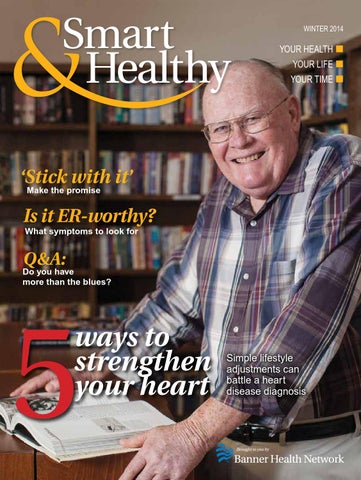
Smart Healthy
WINTER 2014
YOUR HEALTH YOUR LIFE YOUR TIME
‘Stick with it’ Make the promise
Is it ER-worthy? What symptoms to look for
Q&A:
Do you have more than the blues?
5
ways to strengthen your heart
Simple lifestyle adjustments can battle a heart disease diagnosis
Brought to you by
Free classes for a healthier lifestyle
Manage your life, manage your health Eat Healthy, Be Active Series of six interactive workshops. Learn to attain and maintain a healthy weight, reduce risk of chronic disease and live a healthy, active lifestyle.
Living Well with COPD Two-part series. Learn about lung disease, better breathing skills, symptom management and preventing complications.
Living Well with Diabetes Four-part series. Learn self-management skills including monitoring, medications, nutrition and meal planning, exercise and preventing complications.
Living Well with Heart Disease Three-part series. Learn heart-healthy lifestyle tips, how to manage risk factors, how to identify warning signs of heart attack and stroke, and what to do in an emergency.
Know Your Health Numbers A two-hour class to learn about basic lab tests, what the numbers mean for your health and steps you can take to improve your results. Topics include: blood glucose and A1C, cholesterol and lipids, blood pressure, weight and BMI and more.
Classes are offered at Banner facilities Valley-wide. Dates and times vary by location. For information and registration, call 602-230-CARE (2273) or 480-684-5090.
2 | bannerhealthnetwork.com
Winter 2014 / contents
n C OV E R S TO RY
8 5 ways to strengthen your heart eart disease affects millions each year, H but simple lifestyle changes can help
4 Click your way to better health MyBanner online tool makes managing your health more convenient
5 What’s ER worthy? Determining what symptoms are worth a trip to the emergency room
6 Don’t feel like exercising? Get your ‘daily dose’ without planning, scheduling or procrastinating
8
7 ‘Stick with it’ Small steps lead to get big wins
11 Heart of the matter
CO providers give patients a support A system for their health-care needs
12 Nutrition Tune your diet for optimal heart health
13 Q&A
Do you have more than the blues?
14 Ask the Expert Advance directives empower with compassion
15 Puzzling?
13
4 CREATED BY REPUBLIC MEDIA CUSTOM PUBLISHING A division of The Arizona Republic 200 E. Van Buren St., Phoenix AZ 85004
The Smart & Healthy Crossword
16 H ealthy living events and activities
General Manager: CAMI KAISER Creative Development Director: ISAAC MOYA Editor: JIM WILLIAMS Sr. Managing Art Director: TRACEY PHALEN Editorial Coordinator: NICK KOSTENKO Design: RACHEL TULLIO
Cover Photography: EMILY PIRAINO
bannerhealthnetwork.com |
3
your HEALTH / Smart & Healthy
Just what the doctor ordered ‘MyBanner’ online tool makes managing health care more convenient By Kristine Burnett
M
odern technology has changed the ways in which we communicate, conduct business and keep track of just about every aspect of our lives. Thanks to a new online health resource known as MyBanner, patients across Banner Health now have easier access to their personal health information … all with just a few clicks of the mouse. This secure online health portal enables patients to review a summary of their health information following a visit to a Banner Health primary care provider or hospital, access hospital discharge and follow-up care instructions, request copies of their medical records and even schedule their own appointments at Banner Health Centers and Clinics. Richard Bartosch, a participant in MyBanner, knows firsthand just how helpful the handy tool can be. His wife, Elizabeth, suffers from osteoarthritis and has monthly checkups at her neighborhood
ENROLL TODAY! To start using MyBanner, request a personal identification number (PIN) in the Registration department or medical records office of your nearest Banner Health hospital, or at the front office of your local Banner Health Center or Clinic. Then enroll online at www.BannerHealth.com/MyBanner. To get help enrolling, contact the MyBanner help line at (480) 684-6000; toll-free (855) 355-6500.
4 | bannerhealthnetwork.com
Banner Health Clinic in Litchfield Park as part of an ongoing pain management plan. With MyBanner, Richard says coordinating his wife’s appointments is now a breeze. “We used to be limited to booking appointments 30 days out, so we would schedule her next visit every time we went to the clinic,” he says. “That became difficult, especially when planning future trips and coordinating other activities. With MyBanner, we are able to book appointments ahead considerably.” In addition to scheduling appointments with Banner Health physicians, patients enrolled in MyBanner can more easily review their health information. This feature is particularly beneficial for those with multiple hospitalizations or clinic visits due to chronic diseases or multiple health conditions. Also, the opportunity to request copies of their medical records online saves patients the time and hassle of making multiple trips to the hospital to obtain medical records. Enrolling in MyBanner is simple and requires giving very little personal information. “My only complaint is that I now have another user ID and password to remember,” Richard says. Ask if your physician participates in MyBanner and, if so, sign up today!
Smart & Healthy / your HEALTH
Is it an emergency? Determining what symptoms are ER-worthy By Gremlyn Bradley-Waddell
Y
ou’re in pain, but does it warrant a trip to the emergency room, an urgent care facility or can it wait for a doctor’s appointment? That can be a tough call, but Amandeep Sodhi, MD, a Banner-affiliated physician in the West Valley, says there are guidelines to help determine the right treatment.
Levels of care First, he says it’s important to understand the levels of care available. The emergency room (ER) is for patients with serious or potentially life-threatening medical issues requiring immediate medical attention, including: a fall that causes pain, chest pain, stroke-like symptoms (which may include weakness on either side of the body and difficulty with speech), blood in one’s urine or bleeding from the rectum. Urgent care facilities are for less serious medical concerns, like treatment for a sprain or cut that may need stitches, flu symptoms or fever that occur after regular office hours or over the weekend. Your primary care physician should be your first consideration when you are not feeling well. He or she is also your source for routine care and wellness exams,
and can help with referrals to specialists if needed.
What to look for Sodhi says patients should not rely on diagnosing medical concerns by looking at information online or talking to friends or neighbors. Answering “yes” to any of these questions about their symptoms calls for a trip to the ER: • Is it persistent? • Is it new and of an urgent nature? • Is it causing serious pain?
Make the call If it’s reasonable to do so before seeking assistance — you’re not seriously ill and your physician’s office is open — it’s wise to call your physician, Sodhi says. Services often vary at facilities,
so your doctor’s office or even the nearest urgent care facility might advise you to go to the nearest ER instead. “Some urgent care facilities, for example, don’t treat dehydration or may not be able to provide X-rays,” he notes. If an emergency occurs during regular office hours and you decide to call your physician, he adds, talk to someone; do not leave a voicemail message. Lastly, knowing when to call 9-1-1 can be perplexing, but Sodhi says it’s essential to do in any situation in which you don’t feel safe or are experiencing symptoms that are severe and persistent. If you think you may be having a stroke or heart attack, call 9-1-1 immediately. bannerhealthnetwork.com |
5
your TIME / Smart & Healthy
Exercise that’s not exercise How to get your daily dose without planning, scheduling — or procrastinating By Paula Hubbs Cohen
E
xercise: we all know we should get more of it, but there’s always something that seems to get in the way — whether it’s the grandkids’ soccer games, laundry, work or a longscheduled dentist appointment. So what’s a person to do to ensure they get a healthy dose of exercise without calendaring a trip to the gym? We spoke with Jennifer Sundling, a Banner Health Wellness specialist, and she offers a wealth of easy, fun-filled ways to get stretching and moving without feeling saddled with yet another obligation.
Find something fun Sundling, who taught elementary PE for 12 years and has also worked as a personal trainer, believes that exercising should be something fun, and not a chore. One of her secrets is that you need to find an activity you enjoy.
6 | bannerhealthnetwork.com
“Adults who are involved in a low-impact exercise program can improve their balance and quality of life. Stretching improves flexibility, helps decrease the risk of injuries and improves blood flow.”
“That’s because if you like what you’re doing, you’re more likely to stick with it,” she says. “Some of the most fun ways to get some exercise without even realizing it include dancing, gardening, taking the dog for a walk and playing active video games such as Wii and Xbox Connect.”
—Jennifer Sundling, MS, NASM-CPT, CES, Wellness Specialist, Banner Health
Adding movement
BENEFITS OF MOVEMENT 99Maintain/lose weight 99Achieve more restful sleep 99Gain strength and flexibility 99Boost your energy and mood 99 Improve your creativity and brain function 99 Clear your mind and minimize stress
Sundling adds that some easy ways to incorporate exercise into your daily routine include doing squats while brushing your teeth, doing lunges while walking around the house and doing push-ups and sit-ups during commercial breaks on TV. “You can also bring resistance bands to work,” she says. “And when you get there, be sure to park farther away from the office than you usually do — and then take the stairs instead of the elevator.”
Smart & Healthy / your LIFE
Stick with it!
YOU CAN DO IT!
Easy lifestyle changes you can maintain
%
By Kerry Hamilton
For the next 30 days, I promise to stick with (check one):
❏❏ Adding one 30-minute walk each week. ❏❏ Taking the salt shaker off the table and seasoning my food with herbs or salt substitute instead. ❏❏ Replacing meat or poultry with fish for one meal a week. ❏❏ Using a salad plate in place of a dinner plate to reduce portions. ❏❏ Filling half my plate with green salad or steamed vegetables.
Baby steps
❏❏ Substituting water for at least one soda or sugary beverage each day. ❏❏ Incorporating a fresh fruit or vegetable into every meal. ❏❏ Flossing my teeth daily. ❏❏ Wearing a pedometer to track my daily steps. ❏❏ Reducing my daily time in front of the television or computer by one hour.
%
We don’t have to make huge changes to be healthier. In fact, studies suggest that a small shift, as long as we stick to it, can pay substantial health dividends over time. When we successfully maintain one lifestyle change for at least 30 days, we gain the confidence to tackle another goal and then another. It’s this cumulative effect that really serves to promote overall wellness. Ready to make a change you can stick with? Choose just one healthy activity from our “Stick with It” list. Commit to that activity for 30 days by signing your name to the contract. Stick the list in a prominent place in your home — on the bathroom mirror or the refrigerator door — as a daily reminder of the promise you’ve made to improve your health.
–“STICK WITH IT ” PROMISE–
%
W
e are constantly reminded of the health benefits of certain lifestyle choices, like getting regular exercise, eating a balanced and heart-healthy diet, and avoiding tobacco. Statistics are reported on the news, health care providers give us advice, and even loved ones share their views. However, the idea of embarking on a fullscale exercise plan or making dramatic dietary changes can be overwhelming, and understandably so, as these changes can represent an enormous adjustment to daily life.
❏❏ A healthy activity of my choosing: _____________________________ _____________________________ _____________________________
SIGNATURE
DATE
% bannerhealthnetwork.com |
7
Bob Campbell
5
ways to strengthen your heart
Simple lifestyle adjustments can battle a heart disease diagnosis Story by Elise Riley | Photos by Emily Piraino
8 | bannerhealthnetwork.com
IT WAS SUPPOSED TO BE AN UNEVENTFUL ANNUAL PHYSICAL FOR BOB CAMPBELL IN 2007. BUT WHEN HIS STRESS TEST CAME BACK INCONCLUSIVE, HE KNEW HIS LIFE WAS ABOUT TO CHANGE. “They sent me in for a catheterization and saw some blockage,” Campbell says. “They said I needed surgery the next morning.” In a moment, Campbell became a heart patient. He had triple bypass surgery at Banner Desert Medical Center in Mesa on Aug. 3, 2007. Today at age 76, Campbell says living with heart disease is a matter of making the right choices with the right attitude. Campbell isn’t alone. According to the Centers for Disease Control and Prevention, more than 11 percent of American adults have heart disease. For many of those 11 percent, the diagnosis comes after a heart attack. Campbell was fortunate to have routine annual physicals, and caught the blockage before it caused an attack. “Heart disease can mean a lot of different things,” says Dr. Mark Starling, a cardiologist and chief medical officer at Banner Heart Hospital. “The No. 1 thing we worry about is a progressive narrowing or inclusion of our coronary arteries.” Treating heart disease isn’t just about surgery or medication. Patients who make significant life-
style changes can not only reverse the effects of heart disease, but also control or prevent diabetes and high blood pressure. Here are the five ways you can strengthen your heart, just as Bob Campbell has since his diagnosis:
1
LIMIT YOUR SALT INTAKE Work to eat no more than 2,000 milligrams of sodium daily. “You have to be careful about ingesting salt,” Starling says. “If you have heart disease or some other impairment of heart function, you have a predilection to accumulate salt.”
2
EAT MORE FISH Choosing fish over red meat can help with cholesterol, as well as introduce heart-wise elements into your body. “You should have some fish a couple of times a week at least,” Starling says. He recommends saltwater fish, such as
Three questions you should ask your doctor about heart disease
salmon, mahi-mahi, cod or halibut. “They’re very light, and they’re very healthy for you.”
3
AVOID PROCESSED FOODS Dr. Starling recommends staying away from all processed foods — even down to bread and rolls at restaurants. “I’d avoid processed foods at all costs,” he said. Those crackers, canned veggies and preprepared frozen dinners often have loads of sodium, preservatives and other additives that harm not only the heart, but also increase the risk of developing diabetes. Having a hard time knowing what to buy at the store? Here’s one tip — shop on the outer ring of the grocery store, where all the fresh food is. Avoid anything in a box.
4
EAT MORE FRUITS AND VEGETABLES Fortify your meals and snacks with fruits and vegetables. It sounds so simple, but Starling says that the simple things often make the most sense. “There’s an art to shopping the right way,” he says. “You stay out of the canned aisle, and you go to fresh produce. Make your dessert fruit, not cake.”
99What is my blood pressure? 99What is my cholesterol profile? 99Do I have any other contributing factors that put me at risk for heart disease?
bannerhealthnetwork.com |
9
Tips for Better Heart Health According to the National Center for Health Statistics at the Centers for Disease Control and Prevention, 26.5 million American adults have heart disease. Below are more steps you can take to improve your heart health:
5
MOVE YOUR BODY Exercise isn’t necessarily about joining a gym and hiring a personal trainer. Instead, it’s about moving your body and getting your heart to work. Walking 30 or more minutes routinely — four to five times a week — can have a dramatic impact on your heart health. The key, Starling says, is maintaining a consistent pace. Window-shopping at the mall doesn’t work. “You’ve got to walk consistently for 30 to 40 minutes,” he said. “It trains your muscles to be more efficient and makes your heart stronger. I’m not saying it has to be a power walk. Just walk around the neighborhood. Take the dog for a walk for 30 minutes in the evening.” Both Starling and Campbell practice many of these behaviors. Campbell chooses parking spots that are farther away from a store’s entrance so he can walk more. He also does all the household chores so he’s frequently moving. Starling
10 | bannerhealthnetwork.com
gets up each morning and walks on a treadmill for an hour. These behaviors also have a cumulative effect. Weight drops. So does blood pressure. Cholesterol numbers improve. Gradually, a person’s overall health improves. “If you make these changes you realize that you can manage heart disease,” Starling says. “We have a whole program to help patients get to a point where they understand their problem and how to manage it. We give them independence and their outlook becomes, ‘I can do this.’” Campbell participated in cardiac rehab after his triple bypass. It taught him the behaviors he uses today to keep his heart healthy. “I’m big on vegetables, I don’t drink and I don’t smoke,” he says. “It’s everything in moderation. You’ve got to have a good attitude, get check-ups and stay moving.”
♥
EAT THE RIGHT STUFF: Focus on eating highfiber, low-cholesterol foods, and plenty of fruits and veggies. A better diet improves overall heart health.
♥
VISIT THE DOCTOR: Symptoms of heart disease are often different in women. Routine and preventive care can often spot these symptoms early on.
♥
WATCH THE SCALES: The more you weigh, the greater strain on your heart and the greater the risk of developing diabetes. Keeping the weight off makes for a healthier heart.
♥
STOP SMOKING: While it’s easy to relate smoking with breathing problems, it also affects heart health. The risk of heart attack increases significantly with each cigarette a person smokes.
♥
GET A DOG: A statement released in 2013 by the American Heart Association linked heart health with dog ownership. Research found that dog owners are more likely to take regular and longer, walks — which directly benefits heart health.
Smart & Healthy / your HEALTH
Heart of the matter Help is available to manage cardiac disease By Debra Gelbart
B
eing diagnosed with heart disease can be a scary experience. You may be wondering how to best manage this new challenge and how your overall health will be affected long-term. The reassuring news is that you don’t have to feel like you’re on your own between doctor visits. The Banner Health Network Pioneer Accountable Care Organization (ACO) is available to help you take care of yourself so that, as much as possible, you can continue all of the activities that are important to you. “If you’ve been in the hospital,” says Donna Siemons, case management senior director for Banner Health Network, “the case manager assigned to you makes sure that you see your doctor within seven days of being discharged, so that any problems can be addressed right away.” In fact, your case manager may accompany you to your doctor visit, she said. If your diagnosis is congestive heart failure, coronary artery disease or any other heart-related issue and doesn’t involve a hospital stay, you can expect to hear from a case manager by phone almost every week, Siemons says. “The case managers work with patients
to help them build goals and develop a plan that includes diet and exercise so they can self-manage their cardiac condition.”
move the blood properly through the system or that the kidneys aren’t working at full function.”
Patient-focused care The best advice When case managers monitor and assess heart patients, depression — a frequent issue for patients with chronic illness — may be detected. In that situation, Siemons says, “case managers make sure patients get the additional help they may need.” Case managers also make sure patients are taking prescribed medications in all the right doses and encourage patients to check their blood pressure and weight regularly at home, she says. “We advise patients with heart failure to weigh themselves every day,” Siemons says. “We’re not concerned with what you weigh but whether your weight has changed to reflect more than a pound or two since the day before. A gain of two to five pounds in a week, for example, could indicate water retention caused by the heart not pumping enough to
“Part of the mission of Banner Health Network’s ACO is to help patients navigate the complexities of the health care system and support them in accomplishing the goals they’ve set for themselves,” says Robert Groves, M.D., Vice President of Health Management at Banner Health. “That’s difficult for patients to do unless they understand their own health. We’ve refocused our efforts on giving patients what they need to improve their lives, when they need it. The real promise of health care is to give the patient knowledge and control in their health and recovery. And to be sure they have access to the care and resources they need.” The goal for ACO health care providers, Dr. Groves says, “is to surround patients with a support system that is integrated and coordinated so there are no missed opportunities in care for any patient.” bannerhealthnetwork.com |
11
your LIFE / Smart & Healthy your NUTRITION
Vital Vittles
Fine-tune your diet for optimal heart health By Debra Gelbart
P
atients who have a heart condition already know that diet is important in successfully managing their wellbeing. They may not know, however, what to eat to maintain or improve their health status. That’s where registered dietitians like Banner Health Network’s Margaret O’Brien come to the rescue. O’Brien, also a certified diabetic educator, helps patients fine-tune their diets through one-on-one phone conversations and patient education classes, including “Living well with heart disease” and “Eat healthy, be active.” These opportunities guide heart patients to understand that often they don’t have to make major changes in their diet to bring about major changes in their health.
Start little “Small changes can significantly impact overall wellness and your lab values,” O’Brien says. “You don’t have to give up dairy, or even red meat,” she says. “You may need only to make a few adjustments.” With dairy foods, for example, it’s simple to substitute low-fat or no-fat products for high-fat or saturated fat choices. “We encourage heart patients
12 | bannerhealthnetwork.com
RECIPE
Peach Salsa Pork Chops Pork Chops
1 pound boneless pork loin chops (4 pork chops) 1/4 teaspoon ground black pepper 1/2 teaspoon garlic powder 1 teaspoon dried oregano
Peach Salsa
2 peaches, peeled, cored and diced 1/2 green pepper, finely diced 1/3 cup red onion, finely diced 1 tablespoon rice wine vinegar 1 teaspoon olive oil 4 teaspoon fresh cilantro, chopped 1 packet sugar substitute Prepare an indoor or outdoor grill. Season pork chops with pepper, garlic powder and oregano. Grill pork chops over medium heat for 3-4 minues per side or until done. In a small bowl, mix together salsa ingredients. Top each cooked pork chop with about 1/4 cup salsa mixture and serve.
to eat less red meat and to substitute leaner cuts for the higher-fat parts of the animal.” Anything with the word “loin” in it, for example, means you’re choosing a lower-fat cut of meat than if your choice doesn’t have the word “loin” in it, she says.
Lose the fats She added that as important as it is to minimize consumption of saturated fat — the kind found in whole milk, butter and marbled red meat that can stick to arteries — it’s just as critical to reduce sodium intake. “Reducing salt consumption is especially important for congestive heart failure patients,” she says. The good news is that you don’t have to cut out salt intake entirely, she said. Start by taking the salt shaker off the table, she suggested, and seasoning foods with other spices and herbs. If you can substitute fish or pork loin for red meat once or more a week, that’s great, too, she said. “All fish, even shellfish, can be good choices, as long as you don’t prepare it with butter or bread crumbs,” she says. “We encourage simple food substitutions,” she says. “Improving your diet is easier than you think.”
Smart & Healthy / your LIFE
Q:
DO I HAVE MORE THAN THE BLUES
Ask the Expert with Daniel M. Pacheco, MD By Stephanie Conner
A:
As we get older, some things become more common — things like gray hairs and creaky joints. You hear less about, however, the increased risk for depression. And while the occasional down day is not cause for concern, clinical depression is a health condition that should be treated so you can live your life to the fullest. “It’s important to understand that depression is not a normal part of aging,” says Daniel M. Pacheco, MD, Chief Medical Officer for Banner Behavioral Health Hospital. “That’s why as we talk about the importance of taking care of our physiDaniel M. Pacheco, MD cal health, we also must take care of our mental health.” Dr. Pacheco answers a few questions about depression.
Q: What are the common causes of depression in older adults? A: Some of the most common causes as we age include health
issues, such as chronic illness, disability, chronic pain and decreased physical abilities. In addition, medications can add to feelings of depression, and social issues — a decreasing social circle, isolation or retirement — can contribute as well. Many older adults also experience psychological/emotional issues, such as a reduced sense of purpose, anxiety over finances or the loss of loved ones.
Q: What signs of depression should people be aware of? A: Signs of depression include: • Lack of motivation • Decreased energy • Feelings of hopelessness • Increased irritability • Loss of interest in hobbies • Increased isolation • Increased memory problems • Decreased appetite • Difficulties sleeping or sleeping too much
Q: How can we distinguish between “the blues” and clinical depression? A: If symptoms are occurring more days than not, or if you are having thoughts of harming yourself, you should seek help immediately. If symptoms interfere with your day-to-day life and/or last more than two weeks, you should also seek help. Q: What treatment options are available for people experiencing depression? A: Your primary care doctor can make sure a medical cause like thyroid disease or a medication isn’t causing your depression. Then, the next step is seeing a mental health professional (therapist/counselor or psychiatrist). Some people do well with talk therapy, while others may require medication in conjunction with therapy. bannerhealthnetwork.com |
13
your LIFE / Smart & Healthy Ask the Expert with Janice M. Dinner, Associate General Counsel, Banner Health
Planning ahead
Advance Directives empower with compassion By Joan Westlake
O
ften referred to as a Living Will, an Advance Directive gives you the power to make decisions about your future medical care. If the time comes when you are not able to communicate your wishes, this simple document is your voice. There are forms to document your wishes and assistance to guide you as you consider your options. “Forms are easy to prepare and do not require a lawyer,” says Janice M. Dinner, Associate General Counsel at Banner Health. “Directives should include a Health Care Power of Attorney in which you identify an individual (known as a Surrogate) who can make decisions for you, if you are no longer able.”
Free forms Advance Directives and other Life Care Planning documents are available from a variety of sources. Download forms at BannerHealth.com keyword: Advance Directives, or call the office of the Arizona Attorney General at 602-542-2123.
Compassionate gift It may never be needed, but if it is, the Advance Directive is a compassionate gift to family members struggling to make decisions. With an Advance Directive, your family and friends will know and can carry out your plan. No one has to carry the burden of being challenged during a time of grief, when emotions run high, or the guilt of declining further care without knowing your wishes. Elements of the plan may include care choices at end of life, appointing someone as your decisionmaker if you can’t make decisions and preferences about autopsy and organ donation.
14 | bannerhealthnetwork.com
Form distribution Copies of Living Wills and the Health Care Powers of Attorney should be given to your physicians, to the hospital to which you would likely be admitted, to family members and close friends. Speak with loved ones about your preferences and your Advance Directives.
Go to BannerHealth.com, keyword: Advance Directives to download forms.
CROSSWORD / puzzling? by Frank A. Longo
PUZZLE ANSWERS ONLINE AT:
BannerHealth Network.com/ SmartandHealthy Crossword
bannerhealthnetwork.com |
15
BANNER HEALTH 1441 N. 12th SREET PHOENIX, AZ 85006-2887
NONPROFIT ORG U.S. POSTAGE PAID LONG BEACH, CA PERMIT NO.1677
your LIFE / Healthy Living Events MORE SEMINARS AND CLASSES TAKING CARE OF YOUR HEART Banner Boswell Medical Center Tuesday mornings. Call 602-230-CARE (2273) for times, rooms and monthly topics. SUCCESS OVER (HEART) FAILURE Banner Boswell Medical Center Monday/Wednesday/Friday at 10 a.m. Call 623-832-5650 for more information.
OFFERED BY BANNER HEALTH NETWORK The following classes are offered at Banner facilities Valley-wide. Dates and times vary by location. For information and registration, call 602-230-CARE (2273) or 480-684-5090. All classes are free. EAT HEALTHY, BE ACTIVE Series of six interactive workshops. Learn to attain and maintain a healthy weight, reduce risk of chronic disease and live a healthy, active lifestyle. LIVING WELL WITH DIABETES Four-part series. Learn selfmanagement skills including monitoring, medications, nutrition and meal planning, exercise and preventing complications. LIVING WELL WITH COPD Two-part series. Learn about lung disease, better breathing skills, symptom management and preventing complications.
KNOW YOUR HEALTH NUMBERS A two-hour class to learn about basic lab tests, what the numbers mean for your health and steps you can take to improve your results. Topics include: blood glucose and A1C, cholesterol and lipids, blood pressure, weight and BMI, and more. LIVING WELL WITH HEART DISEASE Three-part series. Learn hearthealthy lifestyle tips, how to manage risk factors, how to identify warning signs of heart attack and stroke, and what to do in an emergency.
COPING WITH CANCER SUPPORT GROUP Banner Thunderbird Medical Center second and fourth Wednesdays of each month, 6:30 to 8 p.m. (Feb. 26; March 12 and 26; April 9 and 23). Call 602-865-5450 for more information. CANCER PREVENTION SERIES Banner MD Anderson Cancer Center Feb. 12, March 12 and April 9. Call 602-230CARE (2273) for times, location and topics. STROKE SUPPORT GROUP Banner Good Samaritan Medical Center First Thursday of each month at 5:30 p.m. Call 602-839-3667 for more information. STROKE SUPPORT GROUP Banner Baywood Medical Center Second Thursday of each month at 1:30 p.m. Call 480-321-3848 for more information. THE ALZHEIMER’S PREVENTION DIET Banner Alzheimer’s Institute Featuring dementia specialist, Dr. Marwan Sabbagh sharing the latest information on the role of diet and supplements to slow or prevent Alzheimer’s disease. Call 602-230-CARE (2273) for times and locations in February, March and April.