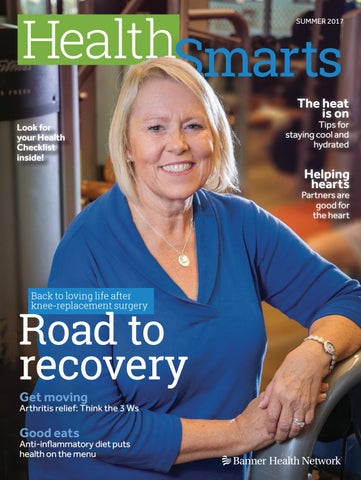
SUMMER 2017
Smarts Look for your Health Checklist inside!
The heat is on
Tips for staying cool and hydrated
Helping hearts
Partners are good for the heart
Back to loving life after knee-replacement surgery
Road to recovery Get moving
Arthritis relief: Think the 3 Ws
Good eats
Anti-inflammatory diet puts health on the menu
Welcome LETTER
Let’s stay healthy! Welcome to the summer 2017 issue of Health Smarts magazine. This publication is for the Medicare beneficiaries like you whose doctor participates in the Medicare Shared Savings Program Accountable Care Organization through Banner Health Network. The Medicare Shared Saving Program requires no sign up and does not change your Medicare benefits. The Health Smarts magazine is included as an added bonus, providing you with valuable information on the latest health care trends, and how you can keep track of your health. Included in this edition, you’ll find an annual care checklist – a new tool to keep track of medications, past screening tests, and other important information to discuss with your doctor during your annual wellness visit. If you have had Medicare Part B for longer than a year and have not had a wellness visit this year, we encourage you to take advantage of that service, which is included in your Medicare benefits. This visit will help prevent disease and disability based on your current health and risk factors. On the following pages, we’ll give tips on how orthopedic patients can recover safely after knee replacement surgery, and the importance of hydration, including a recipe to make your water more refreshing. In addition, we’ll talk about how some doctor’s offices may have services available at the touch of your fingers, where patients can check test results or even make appointments through their computers, cell phones or tablets. We’ll also offer tips on how to manage the aches and pains of osteoarthritis, and learn the benefits of an anti-inflammatory diet. Also to keep your mind sharp, you can have fun with our crossword puzzle! Our goal is to help you achieve your best personal health, and we’re honored to provide you with these valuable resources so you can make the best health care decisions. If you have questions about this program, please call us toll free at (855) 874-2400. To your health,
Robert Groves, MD Medical Director
2 | Health Smarts
Summer 2017 CONTENTS
COVER STORY
8 Road to recovery
Patient back to loving life after knee-replacement surgery
4 Doc Talk
What do you wish your patients would tell you
5 Helping hearts
Partnerships are good for the heart
6 Annual wellness visits
8
Taking stock of your health
10 Health Smart
Patient website offers 24/7 access
11 Get Moving
Arthritis relief: Think the 3 Ws
12 From the Pharmacy
RX check up
13 Be Well
The heat is on, stay cool and hydrated
14 Good Eats
Anti-inflammatory diet puts health on the menu NEED TO CONTACT MEDICARE?
800-MEDICARE (800-633-4227) www.Medicare.gov
CREATED BY REPUBLIC MEDIA CUSTOM PUBLISHING A division of The Arizona Republic 200 E. Van Buren St., Phoenix AZ 85004
14
15 Crossword 16 Calendar
Healthy living events and activities
General Manager: Cami Kaiser Creative Development Director: Isaac Moya Editor: Jim Williams Project Manager: Nick Kostenko Design: Rachel Tullio Cover Photo: Rick D’elia
NOTICE OF NONDISCRIMINATION Discrimination is Against the Law: Banner Health complies with applicable federal civil rights laws and does not discriminate on the basis of race, color, national origin, age, disability, or sex. Banner Health does not exclude people or treat them differently because of race, color, national origin, age, disability, or sex.
Banner Health provides free language services to people whose primary language is not English, such as: • Qualified interpreters • Information written in other languages
Banner Health provides free aids and services to people with disabilities to communicate effectively with us, such as: • Qualified sign language interpreters • Written information in other formats (large print, audio, accessible electronic formats, other formats)
If you believe that Banner Health has failed to provide these services or discriminated in another way on the basis of race, color, national origin, age, disability, or sex, you can file a grievance with the Banner Patient Relations Services Center Director, P.O. Box 16423, Mesa, AZ 85211-6423, or call 602-747-6880, fax 480-
If you need these services, contact Banner staff.
If you no longer wish to receive this magazine: Please notify us at healthsmarts@ republicmedia.com or 602-444-2235. Be sure to include your full name, address, city and zip code as it appears on the mailing label of the publication. 684-6325 or email bannerhealthpatientrelations@bannerhealth. com. You can file a grievance in person, or by mail, fax, or email. If you need help filing a grievance, the Banner Patient Relations Services Center Director is available to help you. You can also file a civil rights complaint with the U.S. Department of Health and Human Services, Office for Civil Rights, electronically through the Office for Civil Rights Complaint Portal, available at ocrportal.hhs.gov, or by mail or phone at: U.S. Department of Health and Human Services, 200 Independence Avenue SW, Room 509F, HHH Building, Washington, D.C. 20201 800-8681019, 800-537-7697 (TDD). Complaint forms are available at hhs. gov/ocr/office/file.
bannerhealthnetwork.com |
3
Doc TALK
What I wish my patients would tell me
I wish my patients would tell me how they can best be served by our relationship and my medical expertise. I would like my patients to inquire about how they can best be involved in our collaborative effort to maintain their wellbeing. Julaiha Ariff, MD Internal Medicine Sunrise Medical Associates
There tends to be a social component to many of the things we see in the emergency department. I would really appreciate a candid discussion about each patient’s social situation, and how that is impacting their mental and physical health at the time of their visit. Devin Minior, MD Chief Medical Officer Banner Urgent Care
4 | Health Smarts
I wish my patients would share any difficulties they have in taking their prescribed medications, such as prohibitive costs, forgetting to take their medicines or any side effects. I also wish my patients would share any new symptoms that have become evident since their last check-up. Jesse Bracamonte, DO Division Medical Director, Arizona West Banner Medical Group
Please don’t be afraid to partner with me and communicate your needs and wants. If there is something you like or don’t like or want to do or don’t want to do, let me know so that we can make a treatment plan that works for us both!
I would like my patients to remember to speak as if you know I respect your intelligence. Speak with the knowledge I observe strict confidentiality. Speak knowing I have your best interest at heart. Tell me anything.
As an ER (emergency room) physician, I wish my patients were able to tell me all of their medical history and medications they take, including dosages. While that may be difficult for some to do, it would be wonderful if they would just bring in an up-to-date list for me to see. That way, if they needed treatment in the ER, I would be aware of any potential side effects or contraindications that could jeopardize their safety.
Christopher Stalberg, MD Internal Medicine
Betty A. Hinderks Davis, MD Dermatology Banner Medical Group
Ann Marie Sun, MD Emergency Medicine Banner Health Network
For additional resources & events, contact the Area Agency on Aging, visit www.aaaphx.org or call (602) 264-2255 or (888) 783-7500
It takes two
“The emotional support provided by partners promotes psychological well-being.” — Div Verma, MD
■■Reducing stress ■■Stop smoking
■■Help with household chores ■■Driving for a short while
■■ Updating family and friends on
Partners are good for the heart
HELPING HEARTS
By Julie Maurer You’ve heard that two heads are better than one, but scientists are now saying that may also be the same with hearts. A study presented at the British Cardiovascular Society (BCS) Conference in Manchester revealed that married people were 14-percent less likely to die from a heart attack than single people. The research also shows that married patients spend on average two fewer days in the hospital. According to Div Verma, MD, a cardiologist at the Banner – Univer-
sity Medicine Heart Institute, having a partner can indeed help with a recovery.
It’s all about daily support
“Recovery from heart attack requires a lot of education, new medications and major lifestyle modifications to prevent subsequent development of heart failure and recurrent heart attack,” Dr. Verma said. “Having a (partner) is crucial during this phase.” He said that a partner can take the lead in: ■■Managing lifestyle changes ■■Medication compliance
progress “There is a positive impact of having a partner in modifying health risk factors for heart disease such as cigarette smoking, high blood pressure, high blood cholesterol, obesity, diet and physical inactivity,” Dr. Verma said. “The emotional support provided by partners promotes psychological well-being.”
Heart disease, party of one
If you don’t have a significant other at the moment, friends and family are also beneficial to healing, according to Tiffany Green, behavioral health senior manager at Banner Behavioral Health Hospital in Scottsdale. She recommends taking the following steps to help with healing: ■■Seek counseling whether spiritual, clinical, or both. ■■Develop a healthly sleeping, eating, and physician-approved vitamin regimen. ■■Create a calming environment for resting. ■■Pray, if spiritual. “Contact your support system let them know what you’re facing,” she said. bannerhealthnetwork.com |
5
TAKING STOCK OF YOUR
health Understanding the importance of an Annual Wellness Visit By Debra Gelbart
Y
our Annual Wellness Visit (AWV) with your health care provider is your opportunity to ask questions about basic, important measures of good health, including blood pressure, blood sugar, weight and diet. These visits should provide you with the best advice from your doctor about staying healthy or improving your health profile.
The most ideal aspect for the patient of an annual wellness exam may be that it doesn’t cost you anything; it’s part of your Medicare benefits. The Annual Wellness Visit has been offered by Medicare since January 2011 after passage of the Affordable Care Act, said Mary Ellen Dirlam, MD, Ph.D., the medical director for Accountable Care/ Population Health at Banner Medical Group, Arizona.
6 | Health Smarts
What to know before your visit
The AWV’s entire focus is a discussion about the patient’s wellbeing — taking a look at how up to date you are on your immunizations and health screenings; whether or not you’re at risk for depression or falling; how safe you are in your home; whether you have any hearing or vision impairment; and a host of other health-related concerns. “We encourage patients to bring a list of their medications to
their annual wellness visit,” said Christopher Stalberg, MD, whose internal medicine practice is based in Sun City. That way, he said, he can determine whether any medications might be negatively interacting with each other. “The AWV is also your opportunity to sit down with your doctor and say, ‘This is what I’ve been struggling with,’” said Kathleen Harris, senior director of government operations for Banner Health Network. “The enclosed Health Checklist is a starting point for the conversation with your doctor.” “Perhaps you’re having an issue with your balance, for example,” she
DON’T MISS YOUR YEARLY VISIT
The Annual Wellness Visit is an opportunity to create a personalized, proactive health plan with your doctor, based on your current health conditions or future risks. Best of all, it doesn’t cost you anything; it’s part of your Medicare benefits.
said. “Your primary care doctor can help you find a solution to that, or he or she can determine from your annual wellness visit whether you should be referred to a specialist, such as a neurologist.”
A coordinated effort
Simply because of where you live in Maricopa County, and because your physician is part of Banner Health Network, you are a beneficiary of the BHN Accountable Care Organization (ACO) and its commitment to the Medicare Shared Savings Program (MSSP). BHN facilitates coordination among doctors to improve the
quality of care for Medicare Fee-ForService beneficiaries and reduce unnecessary costs. The ACO and Medicare both want to maximize the value of the Annual Wellness Visit. The ACO includes prompts in a patient’s electronic medical record to let primary care physicians know what issues they may want to emphasize with specific patients at the annual wellness visit, Dr. Stalberg explained. “The ACO might remind me that a particular patient’s AWV is coming up and suggest that I talk to him or her about an eye exam or a colonoscopy or another screening exam,” he
said. “It’s a helpful tool to make the most of the Annual Wellness Visit.” The AWV “is an opportunity for the patient and the provider to co-create a personalized proactive health plan to maintain or improve the patient’s health and well-being based on current health conditions and future health risks,” Dr. Dirlam said. “The benefits for the patient include development of a plan to keep the individual healthy, safe and independent for as long as possible. It is a map for health that focuses on preventing disease and is updated annually as the patient’s needs and conditions change.”
bannerhealthnetwork.com |
7
NAVIGATING
THE ROAD TO RECOVERY Tips to heal quickly, more smoothly after joint replacement surgery By Meghann Finn Sepulveda
J
oint replacement is becoming more and more routine, accounting for more than 1 million Americans who have a hip or knee replaced each year, according to the National Institute of Arthritis and Musculoskeletal and Skin Diseases. To ensure a successful outcome, patients must participate in the healing process to restore joint function and return to normal, daily activities. Set expectations
Following joint replacement surgery at Banner CORE Center for Orthopedics, patients are moved to a recovery room and, within a few hours, begin to walk using an assistive device like a walker, a cane or crutches. When retired nurse and Goodyear resident Jane (Stevenson) Lynn, 66, had her right knee replaced at Banner Estrella Medical Center in October 2016, she was surprised to learn she could put weight on her knee so soon after surgery. “It wasn’t as bad as I thought it would be,” she said. “I was able to move around and did some exercises.” While the length of the hospital stay varies, most patients can expect to go home within 24-48 hours. “Prior to discharge, patients need
8 | Health Smarts
to accomplish several goals and meet their daily needs like standing up on their own and using the bathroom to make sure they are strong enough to go home,” said Nathan Moore, DO, orthopedic surgeon at The CORE Institute and participating with Banner CORE Center for Orthopedics.
Manage pain
One of the first steps in the healing process is to get pain under control. “Patients should take pain medication as directed by their physician and shouldn’t try to tough it out, which can slow the recovery process,” Dr. Moore said. In the first few weeks at home, Jane relied on medication to manage her pain. “It was painful in the beginning,
but it helped to stay on a schedule,” she said. “After the first two weeks, the pain gradually got better.”
Regain mobility
Patients will receive instructions for exercises that can be done at home. Exercise is especially important for those who have had knee replace-
Group effort
“Having a good support group that you can call upon in a time of need is paramount,” — Nathan Moore, DO
was replaced, Jane had her left knee replaced. “I knew what to expect the second time,” she said. “Although it took my knee a little longer to respond, I kept a good attitude because I was committed to getting rid of knee pain for good.”
Be prepared
ment surgery because it increases circulation and prevents blood clots. It can also help strengthen muscles and improve knee movement, according to the American Academy of Orthopaedic Surgeons. “We don’t want patients to sit at home and be too sedentary or complacent,” Dr. Moore said. “This will increase pain and cause the body to become stiff.” In the early weeks of recovery, Jane slept in a recliner because she couldn’t get comfortable in bed. “My knee was swollen but I managed to do home exercises and started physical therapy two days after I left the hospital,” she said. If they’ve had surgery, it’s recommended that orthopedic patients complete outpatient
physical therapy, two to three times per week, for approximately six to 12 weeks. The goal is to help the patient regain the mobility in the affected joint and be able to resume a normal way of life. “We anticipate the joint will be 90percent better after three months and we expect to see daily activities get easier,” Dr. Moore said. Four months after her right knee
Identify a family member or friend who can assist with recovery at home. “Having a good support group that you can call upon in a time of need is paramount,” Dr. Moore said. After her second knee replacement surgery, Jane and her husband, Ferris, knew the equipment she needed – a cane, walker and raised toilet seat– to aid in her recovery. Another key to recovery: good nutrition. “Our bodies use food as fuel,” Dr. Moore said. “After surgery, it’s really important to incorporate protein into daily diets.” Today, Jane spends three to four days a week riding a stationary bike or working out alongside her husband at the fitness center in her Pebble Creek community. This summer, the couple is planning a hiking trip to the Grand Canyon. “I can walk without pain now,” she said. “It’s wonderful!” Learn more at bannercorecenter.com
bannerhealthnetwork.com |
9
Health SMARTS View test results
Following an appointment, you can log on to MyBanner HealtheLife and view your recorded health record – information like your current blood pressure, allergies, medications you are taking, and immunizations should be available to you. “Lab work and imaging exam results will also be available on the portal,” Dr. Payne added. “Most are posted in real time.”
Message your physician
Manage your health care online, anytime 24/7 access to medical records, test results By Meghann Finn Sepulveda
Electronic health records and the internet have made it easier to communicate with your health care providers. Did you know that many doctor offices offer patients the convenience of confidential online services so you can access your test results and health records, and also schedule appointments and ask questions? For Banner Medical Group patients, you can now quickly and easily gain access to your personal health information via MyBanner HealtheLife. The new and improved online service allows you to view your electronic health records, including test results, lab work and imaging exams, read hospital discharge instructions and message your physician if you have questions, or if you need to have a prescription refilled.
10 | Health Smarts
Getting started
Signing up for MyBanner HealtheLife is quick and easy. You will only need a current email address, and once you sign up, you will receive an email that will have an electronic link to click and complete the process. “If you do not have a personal email address but wish to use your medical power of attorney’s email address, you can do that too,” said Sarah Payne, MD, gerontologist at Banner Medical Group. “However, be aware that this person will have access to your medical record.” MyBanner HealtheLife can also be accessed from any mobile device like your cell phone or an iPad. “This is a great way for patients to be their own personal advocate and proactively manage their individual health and wellness,” Dr. Payne said. “Patients can let their providers know if something needs to be added, updated or changed.”
Instead of calling the doctor’s office, MyBanner HealtheLife allows you to can send a secure message to your doctor 24 hours a day, 7 days a week. “This is a great advantage for non-emergent questions, routine test results and medication refills,” Dr. Payne said. “Physicians can communicate directly with their patients instead of having their office staff relay a message.”
Schedule an appointment
Patients who wish to make an appointment to see their doctor, can do so through MyBanner HealtheLife. Some medical issues may require a shorter appointment, while others may require a longer appointment. “Short appointments are typically used for only one medical issue,” Dr. Payne said. “Long appointments are ideal for wellness visits, patients who have multiple medical concerns, or prior to a surgical procedure.” If you like the convenience of scheduling your doctor’s appointments, or accessing your medical records through your computer, be sure to ask your doctor if they offer these services during your next visit with them.
GET MOVING
PRESERVE YOUR JOINTS
Arthritis relief: Think the 3 Ws
You crawl out of bed. Your joints are stiff and you ache all over. How can you feel better? Think “the 3 Ws” — weight, water and walking. All three play essential roles in controlling arthritis. THINK WEIGHT
“Weight loss takes a significant load off joints and can help reduce pain associated with osteoarthritis,” said Banner Health Orthopedic Surgeon Mark Allen, DO. “Stretching and simple range of motion exercises can often alleviate stiffness associated with osteoarthritis. Weight loss can significantly help people feel much better and contribute to overall health and increased energy levels.” Losing as little as 11 pounds can make a difference, according to the Arthritis Foundation.
Common suffering
Today, about one third of Americans, 70 million people, have some form of arthritis—osteoarthritis, rheumatoid arthritis, psoriatic arthritis, fibromyalgia or gout. Thirty million suffer
by Pat Whitney
from osteoarthritis, often referred to as “wear and tear” arthritis or degenerative joint disease. Arthritis can occur in any joint of the body, but it is most common in the knees, hips, spine, fingers and the base of the thumb. Common risk factors include: age, obesity, previous joint injury, joint overuse, weak muscles and genetics.
Helpful advice
For relief of symptoms, the Arthritis Foundation suggests: ■■Using hot and cold therapies ■■ Strengthening muscles around the joint for added support ■■ Using assistive devices (canes, walkers) ■■ Taking over-the-counter pain relievers or anti-inflammatory medicines THINK WATER
Drinking water throughout the day lubricates joints for maximum and pain-free movement. Fruits and vegetables with a high water content can also be beneficial. Watermelon,
■■ Look for flexible, supportive shoes with rubber soles for cushioning. ■■Eat lots of leafy green vegetables that are high in calcium, like kale, spinach and broccoli. ■■Keep moving during the day and avoid long periods of standing or sitting. ■■Warm up muscles before exercise. ■■Take vitamin C to help slow the progression of osteoarthritis. ■■Try yoga, or other forms of gentle stretching like Pilates or Tai Chi to strengthen the mind/body connection. ■■Use your largest, strongest joints and muscles when lifting heavy objects.
grapefruit, oranges and strawberries, as well as celery, tomatoes, carrots and cucumbers are significant water sources. Water aerobics and aqua therapy provide a good workout without significant body weight on painful joints. Water exercises: ■■ Promote greater mobility and flexibility of joints ■■Improve endurance and fitness ■■ Ease stiff joints and relax sore muscles ■■Reduce pain and fatigue THINK WALKING
“Exercises that keep joints limber and strong are essential to providing relief from osteoarthritis,” adds Dr. Allen. “These include low impact aerobic exercises (elliptical, recumbent bike), pool exercises, aerobic exercise classes, water aerobics, walking in the neighborhood and low impact hiking. Dedicated physical therapy can be very beneficial to help strengthen muscles supporting arthritic joints.” bannerhealthnetwork.com |
11
From the PHARMACY Have questions about your medications? Call the BHN Nurse On-Call at (602) 747-7990 or (800) 747-7990
RX check up How to avoid harmful drug interactions
By Susie Steckner You eat right, exercise and take medications as prescribed, right? But you’re still not feeling your best. Unintended drug interactions could be to blame. “There are so many drug interactions these days,” said Cindy Boxerman, population health clinical pharmacist with Banner Health. “We keep finding more and more with all the new drugs coming on the market.” Food, alcohol and other drugs are the most common culprits for drug interactions. Here are five ways to reduce your risk and keep living your best life. Consistency counts: Try to
12 | Health Smarts
use the same pharmacy to fill all prescriptions. Your regular pharmacy will have your complete profile and pharmacists can more quickly and easily identify potential issues with new medications. Talk it out: Always talk to your doctor or pharmacist before starting a new medication to ensure that medications are all working in your favor. Don’t forget, this includes over-the-counter drugs. Overthe-counter medications may have the same active ingredients as a prescription drug you are taking, which can increase side effects and risks. Supplements can cause interactions too, so make sure to disclose these as well. Food and alcohol: Certain foods and alcohol can impact how a medication is supposed to work,
which can increase side effects and reduce the effectiveness of the medication. Grapefruit is known to impact some blood pressure and cholesterol medications, while dairy products can affect some antibiotics. Green leafy vegetables and foods high in vitamin K can also affect an anticoagulant like warfarin. While you don’t need to avoid green leafy vegetables and foods containing vitamin K, it is important to stay consistent with your day-to-day vitamin K intake and report any changes in what you are eating to your doctor or pharmacist, Boxerman said. Make a list: Carry a current medication list with you at all times. You’ll be glad to have this quick reference if you see multiple doctors. Be sure to keep it current when your medications change. Change: You’ve been taking the same medication forever so there’s no need to do anything differently, right? Wrong. As we age, our bodies change and those changes can affect the medications we take, Boxerman said. Our kidneys and liver process drugs differently over time, which can affect medications. In general, our muscle mass decreases while our percentage of body fat increases as we age — this can also affect how drugs work in our bodies. The bottom line for reducing the risk of drug interactions? “If there is a concern or you are unclear about anything, definitely ask your doctor or pharmacist,” Boxerman said.
Be WELL
However, those 55 and older are at greater risk for developing nonexertional heat stroke. Certain risk factors that can lead to this illness, include medications that can cause dehydration, obesity or not having access to air conditioning.
Cooling down
The heat is on Tips for ensuring that you stay cool and hydrated
By Nicole Cottrell Each year, millions of people are exposed to the dangers of extreme heat. Devin Minior, MD, emergency physician and Chief Medical Officer for Banner Urgent Care Services, has seen his fair share of heat related illnesses over his career.” In simple terms, heat stroke is the body’s inability to respond to heat,” he said. “People over 55 are at greater risk for complications.”
Watch for symptoms
While the explanation may seem simple, the results can be life threatening. In fact, according to Dr. Minior, “Heat stroke is a spectrum of heatrelated symptoms,” those symptoms include swelling of the extremities, heat rash, itchy skin, sweating excessively, and heat cramps in the arms and legs. In the initial phase, individuals may be suffering from what is often referred to as heat exhaustion. As the symptoms progress,
patients may develop neurological problems, including confusion, trouble walking, or passing out. This may be further accompanied by fast breathing and heart rate, vomiting, diarrhea, muscle cramping, and headaches. Very often, heat stroke refers to what Dr. Minior defines as exertional heat stroke. This includes athletes in the summer when their temperature rises and the body is not able to effectively regulate its temperature.
QUICK TIPS
■■Take breaks: Go indoors, cool off,
and replenish with fluids. ■■More than water: Don’t just sip water, but add juice and sports drinks to stay hydrated. ■■Exercise: Opt to work out in the morning, not the afternoon. Even the evening may be too hot for some. ■■Clothing: Wear loose clothing and sandals to allow the body to cool itself more effectively.
To avoid these symptoms, Dr. Minior recommends, “People should dress appropriately for the environment with loose fit clothing and sandals, keeping your feet and head exposed.” Likewise, he encourages patients to to drink plenty of fluids. “You should be drinking fluids throughout the day, not just when you’re thirsty,” he said. “You should not get to the point of thirst.” Instead, take frequent breaks if working in the garden or tinkering in the garage, returning to the indoors to both cool off and replenish any lost fluids. Dr. Minior also suggests not just drinking water, but adding in juices or sports drinks to aid in lost minerals and vitamins. He said that “This practice is important as a precaution for those taking medications, especially diuretics.” For those who desire to exercise in the summer, he advises patients to work out in the early morning, when the heat is at its lowest. Avoid any exercise during the midday, when heat is at its highest. Finally, Dr. Minior instructs patients to take advantage of evaporative cooling. Sweating is the body’s natural way of doing this. But any moisture on the skin, such as from a dip in a pool or water from a mister, effectively cools the body when the water evaporates off the skin. bannerhealthnetwork.com |
13
Good EATS
Health on the menu
Healing with an anti-inflammatory diet By Joan Westlake Food as medicine is part of an evolving holistic approach to health care that explores lifestyle treatments, not strictly medication or surgical options, according to Neta Faynboym, MD, senior medical director at Banner Health Network. As Dr. Faynboym explains, treating chronic pain might include working with traditional medications in tandem with acupuncture, exercise, diet and supplements such as Omega3, turmeric and ginger. From this holistic concept has emerged what is known as the anti-inflammatory diet. Dr. Faynboym said that inflammation is the body’s way to remove harmful stimuli, including damaged cells or pathogens. But, research shows the process can negatively affect the body, contributing to illnesses like asthma, arthritis and Crohn’s disease — a type of inflammatory bowel disease. There is increasing evidence that Alzheimer’s disease, cancer, cardiovascular disease, diabetes, high blood pressure, high cholesterol levels and Parkinson’s disease may be related to chronic inflammation. When her patients were placed on this eating plan, the doctor said,
14 | Health Smarts
TEMPTING WATER TIPS ■■ ■■ ■■ ■■ ■■ ■■ ■■
■■ ■■
Use a glass pitcher because plastic can interact with juices and herbs Water should be pure and cool or room temperature Choose organic fruits, vegetables, herbs and wash well Crush herbs, cut fruits and vegetables Place herbs in cheese cloth or strain as you serve Peel citrus before you infuse, or remove after four hours, the rind can be bitter Be adventurous with combos like oranges and ginger; cucumber and mint; lemons and lavender; mango and cinnamon sticks; lime and basil; pineapple and fennel Refrigerate after two hours sitting at room temperature Keep adding water as you consume, but strain the second day
“There was definitely a perceived increase in energy and well-being as well as a decrease in chronic pain.”
Anti-Inflammatory Eating
Similar to the popular Mediterranean diet, here are basics of the antiinflammatory diet: ■■Real food, not processed that contains additives and chemicals ■■Lots of fruits and green, leafy vegetables; organic if possible ■■Whole grains and pasta al dente ■■Lean protein from fish and plant sources like nuts, beans and legumes — less red meats and animal proteins ■■No refined carbohydrates such as pastries, white bread ■■Healthy oils such as olive ■■ Baked, grilled or steamed, not fried ■■No high sugar beverages like sodas, sweet tea or fruit juices ■■Lots of water Margaret O’Brien is a registered dietitian, certified diabetes educator and has been a nutritionist in the Banner Health Network for more
than three decades. “It can be difficult to make major changes but you can start by cutting back. Switch to an olive oil spread that doesn’t contain trans fats. Reduce added sugars and sweets. The amount of sugar that regular sodas contribute to your caloric intake is unbelievable.” O’Brien emphasizes that water is vital, especially with the extreme Arizona heat, because your body doesn’t function properly without it. She adds that many foods can also keep you hydrated including cucumbers, iceberg lettuce, baby carrots, spinach, watermelon, strawberries, celery, green peppers and oranges. If you don’t like drinking plain water, enhance it by adding fruits, vegetables, edible flowers and herbs. “This is not a diet, it is a healthy way of eating,” said Dr. Faynboym. “It is fine to indulge occasionally in a glass of wine or some dark chocolate. Listen to your body.”
Crossword PUZZLE “PUNCH LINES”
ACROSS 1 First flight “souvenir” 7 Fish groups 14 Yasser of Egypt 20 Actress Mumford 21 Fine-meshed
nylon cap
22 Go to the polls again 23 Certain room
decor adhesive
25 Gives a heads-up 26 Baseball’s
“Georgia Peach”
27 Hindu mystic 29 Mobster’s gun 30 Spot’s sound 33 Ending for
plug or play 34 It may be worn under a tennis shoe 38 Hitchcock film of 1940 41 Clichés 42 Trickster of Norse myth 43 Ramones’ debut single 45 In the — of (during) 46 “— So Shy” (80s hit) 47 Bluish-black sour fruit 48 Check casher, say 51 — boom 54 Hurt 55 Slimy pest in a flower bed 60 Does some needlework 62 Penniless people 64 Pop singer Turner 65 Fracas 66 Lead-in to mo or pitch 67 Blackjack call that’s apt for this puzzle’s theme? 68 “— the ramparts ...” 70 Roker and Pacino 71 Nevada city 73 Trouser lines 75 Hand-held seizing tool 77 Sleeve feature with a link
79 Transaction in
71-Across
80 Wants badly,
with “for”
81 Eddie — (clothing
chain)
82 Above 84 Luau bowlful 85 End in — (go
unresolved)
88 Innate sense
of time
94 Pieces of pizza? 95 Actor Tatum 98 Acorn maker 99 Solar system
component
101 He cried “I pity
the fool!” 102 Little guy 103 Luau accessory 104 Perfect thing 105 Smaller river craft 108 Messing up 110 Ability to influence a campaign, perhaps 117 Loath (to) 118 Not in time 119 Come out 120 One hunting 121 Appalachian range 122 Get canines DOWN 1 Handful of 2 Irritating 3 “My mama
done — me ...”
4 Buoyant tune 5 Kids’ guessing game 6 Tail-fanning birds 7 Brands of cat food 8 Low- — meal 9 In vogue 10 Man-mouse middle 11 Put- — (hoaxes) 12 Disclose
Accidentally
13 Plastered 14 Pal of Athos
and Porthos
15 Antique 16 “— Maria” 17 Permanently
Crossword by Frank A. Longo
18 Tears into 19 Aid in self-diagnosis 24 Like icecaps 28 Eroded 30 Hedge fund whiz 31 Roman Cath. e.g. 32 DOJ agcy. 34 Jason’s ship
57 Fibbing sorts 58 Not aflame 59 Breathes in quickly 61 Yale of Yale
88 F lowering 89 Hanoi-to-
Beijing dir.
90 Major vessel 91 Moon, e.g. 92 Co. leader 93 B minor, e.g. 95 Coot 96 Go in haste 97 Makes fit 100 Light wash 101 Middle Ages
University 62 Singer Edith 63 It spits out bills, briefly 67 Pajama-clad of myth mag founder 35 “It wasn’t meant —” 68 Latch again, as a door 36 Managed care gp. 72 Like some safe 37 Most furtive runners 39 Set of values weapon 74 South, in Spanish 40 Bmo natives 105 Nosh 75 — diagram 41 Tolling thing (math image) 106 Highest point 44 Sister/wife of Osiris 76 Remorse 107 “—’s Gold” (Peter 45 Guys 78 Raven sound Fonda film) 48 Lead-in to 52-Down 79 Tennis champ Björn 109 Bug a lot 82 Electric co., e.g. 49 Clever 111 Brit’s john 83 Bottled (up) 50 “Pro” replies 112 Sort 84 Blood part 51 Neck wrap 113 Mai — 52 Get via Amazon, e.g. 85 Funnel-shaped 114 Leftover bit flowers 53 Not a single person 115 “Blech!” 86 Merit 54 Pronto 87 Career completer 116 Informal shirt 55 Supporters PUZZLE ANSWERS ONLINE of canines At BannerHealthNetwork.com/members/ 56 Oafish sort healthsmarts bannerhealthnetwork.com |
15
BANNER HEALTH 1441 N. 12th STREET PHOENIX, AZ 85006-2887
NONPROFIT ORG U.S. POSTAGE PAID LONG BEACH, CA PERMIT NO. 2297
Healthy Living CALENDAR Activities: Filling the Day with Meaning and Purpose This class will teach caregivers how to adapt activities to keep people with dementia engaged and mentally stimulated. Free, but registration is required. To register, call 602-839-6850
Monday, June 26; 1 – 2:30 p.m. Banner Alzheimer’s Institute 901 E. Willetta St., Phoenix
Heart Healthy Eating Let experts from Banner Heart Hospital help you navigate toward
To find more classes near you, visit BannerHealth.com/calendar.
heart healthy eating as part of a wholesome lifestyle. Free but registration is required. To register, call 602-230-CARE (2273) or 800-230-CARE (2273)
Health Program, you will create an individualized action plan toward improved brain health. You will also receive a Brain Health Program Self Evaluation form to complete and bring to class. Free, but registration Tuesday, July 18; 11 a.m. – Noon Banner Heart Hospital, Mariposa Room is required. Call 602-230-CARE (2273) or 800-230-CARE (2273) 6750 E. Baywood Ave., Mesa Banner Brain Health Program Experts from Banner Alzheimer’s institute will present information about the different domains of your brain, such as cognition, attention and memory. At the end of the Brain
Monday, July 24; 9:30 a.m. – Noon Banner Sun Health Research Institute 10515 W Santa Fe Drive, Sun City Wednesday, July 26; 9:30 a.m. – Noon Banner Alzheimer’s Institute 901 E. Willetta St., Phoenix
For life’s potential emergencies
We have all wondered, is this an emergency? If you aren’t sure if this is an emergency, or you need a nurse’s advice about where to get care, call us. We are here to help, 24 hours a day.
Banner Health Nurse On-Call: 602.747.7990 or 888.747.7990 May need urgent care, or to be seen by your physician: ■ Coughs, sore throats, ear infections and sinus infections ■ Minor burns and injuries ■ Urinary tract infections ■ Allergic reactions (non-life threatening) and skin rashes ■ Low-grade fever or flu-like symptoms ■ Mild asthma ■ Sprains, strains, and minor broken bones
Requires emergency care:
■ Chest pain, or sudden onset of sharp severe pain like headache ■ Heavy or uncontrolled bleeding ■ Loss of consciousness ■ Severe reaction to food or medication ■ Numbness/weakness on one side of the body, or sudden loss of vision ■ Serious or unexplained difficulty breathing ■ Broken bones that break the skin