
Original version prepared for Inner West Council by Atlas Economics.
Published by Inner West Council
Email: council@innerwest.nsw.gov.au http://www.innerwest.nsw.gov.au/
Copyright © Inner West Council 2026
ALL RIGHTS RESERVED
No part of this publication may be reproduced, stored in a retrieval system, or transmitted in any form by any means electronic, mechanical, photocopying, recording or otherwise without the prior consent of the publishers.
The original version of this document was adopted by Council on xxx
A revised version of this document was adopted by Council on xxx.
This version supersedes all other policies addressing Affordable Housing of Inner West Council, former Ashfield Council, Leichhardt Council and Marrickville Council.
Document [Insert Title] Policy
Custodian [Insert Relevant Council Officer]
Adopted By Council
UncontrolledCopyWhenPrinted
Version # Version X
ECM Document # xxxxxxxx
Next Review Date [Insert date no later than 3 years post adoption e.g. August 2025]
The below history of the document must be updated and must be accurate, all owners of Policies are to ensure that all previously adopted versions of the policy are included in the below table and that all previous versions have been appropriately removed from circulation to ensure staff are utilising the right document.
Amended by
Changes made
Date Adopted [Council Department] [Describe reason for major changes] Day Month, Year
E.g. Governance & Risk
E.g. Part 6: Value of token gifts and benefits raised to $100 17 August 2022
Terms used in the Policy are defined in Table 1.
Table 1: Terms and Definitions
Term Definition
Affordable Housing Housing for Very Low, Low and Moderate income households, being such households as are prescribed by the regulations or are provided for in an environmental planning instrument, as defined by the Environmental Planning and Assessment Act 1979.
The State Environmental Planning Policy (Housing) 2021 (Housing SEPP) further defines Very Low, Low and Moderate income households into those who either pay no more than 30% of gross income in rent, or those eligible under the National Rental Affordability Scheme (NRAS) and pay no more rent than would be charged under NRAS.
Note: Affordable housing is not the same as social housing. It is open to a broader range of household incomes than social housing. Households do not have to be eligible for social housing to apply for Affordable Housing, though people who are eligible for social housing may also be eligible for Affordable Housing
Affordable Housing Guidelines Referred to in the Environmental Planning and Assessment Regulation 2021 The Guidelines apply to Affordable Housing that is delivered under the Housing SEPP. The Guidelines are also known as the NSW Ministerial Guidelines on Affordable Housing.
Community Housing Provider (CHP)
A Community Housing Provider (CHP) is an organisation who delivers social housing and/or Affordable Housing and related services to people on Very Low, Low or Moderate incomes.
Note: In NSW, the Registrar of Community Housing administers the National Regulatory System for Community Housing (NRSCH) and assesses/monitors registered CHPs according to the level of risk associated with the scale and scope of their community housing activities.
In NSW, registered CHPs could be for-profit or not-for-profit (NfP) entities. NfP CHPs are charities whose purpose is the development and/ or management of subsidised housing. They enjoy tax concessional status (Federal and State).
Contribution in-kind Contribution of a completed dwelling or land that is dedicated (gifted) to Council.
Contribution Rate (%) The percentage contribution rate that is used in the calculation of a contribution requirement.
Creative workers (specifically artists and cultural creators)
There is no Australian statutory definition. Creative Australia groups ‘creative work’ into two broad groups:
• Creative services (advertising and marketing, architecture and design, software and digital content)
Term Definition
• Cultural production (film, TV and radio, music and performing arts, publishing, visual arts)
Under this framework, creative workers can include:
• Artists and cultural creators
• Creative professionals
• Technical and production roles
Only Artists and cultural creators are listed here. These include:
• Musicians and singers
• Actors and performers
• Writers and poets
• Visual artists
For the purposes of eligibility for Affordable Housing, the specified income bands (Very Low, Low and Moderate incomes) additionally apply.
Equivalent contribution rate ($)
Environmental Planning Instrument (EPI)
Equivalent monetary contribution
The dollar contribution rate that is used to calculate an equivalent monetary contribution in lieu of a contribution in-kind.
Environmental Planning Instruments are Local Environmental Plans (LEPs) and State Environmental Planning Policies (SEPPs) that are made under the Environmental Planning and Assessment Act 1979.
The monetary contribution payable in lieu of a contribution in-kind. The equivalent monetary contribution applies the contribution rate (%), the equivalent contribution rate ($) and the development capacity of a development (GFA).
Gross floor area (GFA)
Key workers
As defined in the Inner West Local Environmental Plan 2022 and the Standard Instrument template.
There is no Australian statutory definition. The following list of sectors (and example occupations) are loosely based on the UK definition of “key workers”people whose jobs are critical to public services and national infrastructure (UK Government, 2021).
• Health and social care
o Doctors, nurses and midwives
o Care workers including aged care
o Pharmacists and healthcare support staff
• Education and childcare
o Teachers and teaching assistants
o Nursery and childcare staff
• Public safety and national security
o Police
o Firefighters
o Prison staff
o Armed forces
• Transport
o Rail, aviation and public transport workers
o Logistics and delivery drivers
Term Definition
• Utilities and communications
o Electricity, gas and water workers
o Telecommunications staff
o Postal workers
• Food and necessary goods
o Food production and processing
o Supermarket and food retail workers
o Supply chain and distribution
• Government and critical services
o Some civil servants
o Justice system staff
For the purposes of eligibility for Affordable Housing, the specified income bands (Very Low, Low and Moderate incomes) additionally apply.
Low Income
Moderate Income
National Rental Affordability Scheme
National Regulatory System for Community Housing
Nominated CHP
Households whose gross incomes are 50% or more but less than 80% of the median household income for Greater Sydney, as applicable, as reported by Australian Bureau of Statistics.
Households whose gross incomes are 80% to 120% of the median household income for Greater Sydney, as applicable, as reported by Australian Bureau of Statistics.
The National Rental Affordability Scheme (NRAS) is a 2008 Australian Government initiative designed to increase affordable rental housing by offering tax/cash incentives to providers who rent new dwellings 20% below market rates.
A regulatory system for providers delivering community housing and related services.
Registered not-for-profit community housing provider classified as Tier 1 under the National Regulatory Code for the National Regulatory System for Community Housing that is nominated by Council to receive, administer and manage contributions received under this Scheme.
Public Benefit
Social Housing
Subsidised (nonmarket) Housing
Shortened term for ‘material public benefit’ where work undertaken (e.g. park, public open space, roads, community facilities) deliver public infrastructure for public use.
Social housing is government subsidised, long-term rental housing for people on very low incomes. It includes public, community and Aboriginal housing.
Public housing is managed by NSW Government while community housing is managed by non-government organisations (community housing providers).
Collectively term that refers to rental housing that available to eligible households at subsidised rents. Includes social housing and Affordable Housing
Very Low Income Households whose gross incomes are less than 50% of the median household income for Greater Sydney, as applicable, as reported by Australian Bureau of Statistics.
Purpose
The Inner West Affordable Housing Policy (the Policy) aims to increase the provision of Affordable Housing in the Inner West local government area (LGA).
The Policy provides the background for and sets out where and how much contributions toward Affordable Housing are required where proposals seek to enable or increase the residential capacity of land in the Inner West LGA. Additionally, the Policy details how Affordable Housing should be managed and operated in the LGA.
The Policy sets out:
• Inner West Council (Council) objectives for Affordable Housing in the LGA.
• How Council will facilitate the delivery of Affordable Housing
• Council’s requirements for Affordable Housing
• What Council will do with Affordable Housing contributions received.
The Policy guides Council’s approach to providing Affordable Housing for the community and defines Council’s role in advocating for Affordable Housing outcomes. Council is committed to increasing the type and supply of Affordable Housing to meet the needs of its community. The Policy outlines Council’s guiding principles and approach for Affordable Housing, identifies target tenant cohorts and outlines a consistent and transparent process for the receipt and governance of contributions from development.
The objectives of the Policy are to:
1. Recognise the need for affordable rental housing to support sustainable and diverse communities.
2. Enhance economic productivity and support the sustainability of local businesses in the Inner West LGA.
3. Improve access to Affordable Housing for Very Low, Low and Moderate income households, or a combination.
4. Ensure there are opportunities for Very Low to Moderate income workers to live in the community in which they are employed.
5. Facilitate opportunities for Government and community housing providers (CHPs) to supply affordable rental housing in the LGA.
6. Outline the requirements for making a contribution for Affordable Housing in addition to the infrastructure needs of the local community, in accordance with a local environmental plan (LEP) or other environmental planning instrument (EPI).
The Policy sets the overarching policy direction for the LGA and is reflected in the following documents:
• Affordable Housing Contribution Scheme (AHCS) required to insert a clause into the Inner West Local Environmental Plan 2022 (IWLEP), allowing collection of Affordable Housing contributions from development on identified (mapped) land.
• Governance and Distribution Framework (the Framework) which will detail how Council will administer Affordable Housing contributions (cash, land or housing stock).
The Framework details the process Council will undertake to define how it deals with Affordable Housing stock, cash and land and the terms on which it will form strategic partnerships with the community housing sector and NSW Government. Following a nomination process of a partner community housing provider and execution of a funding agreement, the distribution of Affordable Housing contributions can occur.
Figure 1 illustrates the suite of documents, their relationship and process, and respective decision makers responsible.
Sets out the policy position for affordable housing in the Inner West.
Final decision maker - Council endorsed and adopted Process - draft, engagement, adoption.
Required to incorporate the levying and collection of affordable housing contributions through Inner West Local Environmental Plan 2022
Final decision maker - DPHI Process - Planning Proposal pathway
This product will be prepared should Council elect to distribute Affordable Housing Contributions to a third party for delivery and management of contributions and assets.
Figure 1: Suite of Affordable Housing Documents
Final decision maker - Council endorsed and adopted Process - Likely to include EOI, selection, contractural arrangements preparation of Framework.
The Policy is consistent with the Inner West Local Strategic Planning Statement (2020) and Inner West Housing Strategy (2020). The Policy replaces the Inner West Affordable Housing Policy (2022).
The Policy was adopted by Council on xxx and came into effect on xxx, replacing Inner West Affordable Housing Policy (May 2022).
The Policy applies to all land within the Inner West LGA including:
• Establishing and collecting Affordable Housing contributions for developments, with contributions required as a condition of consent a result of a clause in the IWLEP and an AHCS being in place.
• Ensuring that proposals that seek to enable or increase the residential capacity of land include an appropriate quantum of Affordable Housing contributions.
The Affordable Housing contributions requirements in this Policy do not apply to the following types of residential development that may be enabled by a proposal:
• Social and affordable housing (excluding those delivered under initiatives of the Housing SEPP), including boarding houses (as defined by the Housing SEPP).
• Group homes and hostels.
• Superlot subdivision that does not result in the creation of a residential lot (e.g. subdivision for the purposes of further subdivision, subdivision for a public purpose or a residue lot).
• Subdivision that does not result in the creation of an additional lot (e.g. boundary adjustment).
Section 1 describes the objectives and principles of the Policy, application of the Policy and the rationale and need for Affordable Housing. It also lists Council’s priorities and actions.
Section 2 details when and how much Affordable Housing contributions are required in circumstances of proponent-led proposals and how an Affordable Housing contribution requirement can be satisfied.
Section 3 details the administration matters that arise from implementation of the Policy. This includes how contributions are indexed, used and managed and how the Policy will be monitored.
The Policy is guided by affordable rental housing principles informed by the Housing SEPP. The affordable rental housing principles are:
• Affordable Housing aims to create mixed and balanced communities.
• Affordable Housing is provided and managed so that a socially diverse residential population representative of all income groups is developed and maintained.
• Affordable Housing is made available to Very Low, Low and Moderate income households, or a combination.
• Affordable Housing is rented to a mix of eligible tenants at an appropriate rate (%) of gross household income.
• Land provided for Affordable Housing must be used for the purposes of the provision of Affordable Housing
• Provision for Affordable Housing is a long-term commitment and buildings must be managed so as to maintain their continued use for affordable rental housing.
• Affordable Housing must consist of dwellings constructed to a standard that, in Council’s opinion, is consistent with other dwellings in the area.
The Affordable Housing Guidelines (the Guidelines) (or the NSW Ministerial Guidelines on Affordable Housing) additionally provide guidance on tenancy management and financial management which aim to ensure the financial viability of the community housing sector whilst balancing affordable outcomes for tenants.
Income eligibility limits by household type are contained in the Guidelines and listed in Table 2 based on applicable percentages of the Greater Sydney median income. The income eligibility limits are updated and published each financial year.
Table 2: Income Eligibility Limits, Greater Sydney (2025-26)
Source: NSW Government (refer to income eligibility limits for affordable housing) *households denoted with “+1” and “+2” indicate households with dependents under 18 years
Council is committed to protecting and increasing the supply of housing stock that can be affordably rented by Very Low, Low and Moderate income households, including target groups identified as having particular housing needs in the Inner West. Council will seek to assist all groups identified below, where practicable, rather than giving preference to one or more groups over others.
• Key workers* and employees working shifts.
• Older people, including older women and long-term residents of the LGA.
• Young people, including those with a social, cultural or economic association with the LGA.
• Certain family cohorts, including sole parent families, and women and their children escaping domestic violence.
• Aboriginal and Torres Strait Islander peoples.
• People with special housing or access needs, including people with a disability, those at risk of homelessness, and people from culturally and linguistically diverse communities.
• Artists and cultural creators**.
*there is no Australian statutory definition for a “key worker”, however it is widely understood to represent workers who provide important services to a community. These are often lowerto moderate-income workers and those jobs must be done in person. Common examples include teachers and childcare workers, nurses and allied health staff, police and emergency services, aged care and disability support workers, cleaners, hospitality workers and retail service workers. Refer to the definitions table (Table 1) for guidance on key workers and occupations.
A “key worker” can be distinguished from an “essential worker”. There is also no Australian statutory definition for an “essential worker”, however it is generally understood to represent workers whom society cannot function without. For example, the workers who were critical to keeping society functioning during the COVID-19 pandemic (e.g. healthcare workers, police, fire and emergency services, supermarket workers, utility workers and transport and logistics workers. “Essential workers” could be thought of as a subset to “key workers”.
**there is no statutory definition for a “creative worker”. A creative worker is generally someone who produces, performs, designs or supports cultural or creative content within the creative industries or in creative occupations. Refer to the definitions table (Table 2) for guidance on creative workers (in particular artists and cultural creators).
All the above tenant cohorts must satisfy the income requirements of Affordable Housing, i.e. they must fall within the Very Low, Low or Moderate income bands.
Affordable Housing contributions made must satisfy the Affordable Housing Principles in accordance with the following requirements:
• Affordable Housing dwellings are dedicated free of cost:
o the location, size and quality of Affordable Housing dwellings must be to the satisfaction of Council and its nominated CHP. If not to the satisfaction of both parties, Council may require that the contribution is made by way of a monetary contribution.
o constructed to the standard of other dwellings, not externally distinguishable from other housing.
o provided to Council in perpetuity, to be maintained in continued use as Affordable Housing.
o owned by Government or a nominated CHP, or as otherwise provided for in the Governance and Distribution Framework adopted by Council.
o rented to Very Low, Low and Moderate income households in target tenant cohort groups at no more than 30% of gross income.
• Monetary contributions are:
o pooled and distributed to Council’s nominated CHP, or as otherwise provided for in the Governance and Distribution Framework adopted by Council.
o used to build Affordable Housing in the Inner West LGA or adjoining area.
• Residual (surplus) rent is to be used for improving, replacing, maintaining and providing additional Affordable Housing in the LGA.
Below are examples of households who could be eligible for Affordable Housing in the LGA under the Policy.
Example 1
Sam is a university lecturer and single parent with a 10-year-old son. His gross salary is $110,000 per annum. Based on the income eligibility thresholds (2025-26), Sam and his son are considered to be a Moderate income household. As a sole parent family, Sam and his son are one of the target tenant cohorts of the Policy.
If Sam and his son were housed as Affordable Housing tenants in the Inner West, they would pay rent of no more than $635 per week. This represents 30% of Sam’s gross income.
Mary is an aged care trainee worker who lives on her own. Her gross salary is $55,000 per annum. Based on the income eligibility thresholds (2025-26), Mary is considered to be a Low income single household. As a health and social care worker, Mary is one of the target tenant cohorts of the Policy.
If Mary were housed as an Affordable Housing tenant in the Inner West, she would pay rent of no more than $317 per week. This represents 30% of Mary’s gross income.
Council considers Affordable Housing as a critical part of the Inner West’s social and economic wellbeing. There is also national and community-wide acknowledgement that more affordable housing is needed.
While the responsibility for the provision of subsidised housing (mostly social housing) has primarily rested with the State Government and to a lesser extent Federal Government, Council acknowledges that local governments also have an important part to play in enabling the provision of Affordable Housing.
Council recognises that a multi-pronged approach is needed to achieve the policy objective of increasing the provision of Affordable Housing in the Inner West LGA. The following actions are proposed:
• An Affordable Housing Contribution Scheme (AHCS) will apply to land where the IWLEP is amended by a Council or state-led process to enable or increase the residential development capacity. Further areas will be included in the AHCS as development standards, zone and/ or land uses are amended via a Council of stateled process.
• Requirement for land that is subject to proponent-initiated proposals to increase or enable residential capacity to contribute to Affordable Housing (as detailed in this Policy).
• Strategic partnerships with the community housing sector, in recognition of missionaligned objectives, their specialist expertise and structural tax advantages in developing and managing Affordable Housing dwellings.
• A Governance and Distribution Framework will outline the distribution of Affordable Housing (cash, dwellings, land) to the community housing sector (and a nominated CHP) to enable the ‘multiplier effect’, i.e. assets that are on the CHP’s balance sheet can be leveraged to grow more stock.
• Identification of Council-owned land that is surplus to requirements or with the potential to be repurposed for Affordable Housing to be investigated in partnership with the community housing sector.
• Advocacy to State Government for an increase in subsidised housing (including Affordable Housing) in the Inner West LGA, and at the minimum for no net loss of Affordable Housing following redevelopment.
The Policy does not preclude the nominated CHP from divesting dwellings to improve management, maintenance or renewal of its housing portfolio, however there must be reinvestment in the LGA to ensure no net loss of dwellings. This will be secured through a funding agreement with the CHP and a covenant/ interest registered on title.
Council’s Affordable Housing priorities are consistent with the NSW Department of Planning, Housing and Infrastructure (DPHI) – Office of Local Government’s Guide for Council-led Affordable Housing on Operational Land in NSW (NSW DPHI – OLG, 2026).
Council will advocate for a minimum target of 30% of new dwellings on government owned land to be designated as subsidised housing (affordable and/ or social housing) in perpetuity and managed by a CHP. Council will work with Property NSW (a division of Department of Finance, Services and Innovation) for securing under-utilised or surplus government land suitable to contribute to affordable housing supply and supporting social infrastructure.
The primary responsibility of ensuring the adequate supply of both social and Affordable Housing to meet the community’s housing needs remains with the State and Federal governments.
At the State level, Council will continue to collaborate with other councils and actively lobby relevant State Government ministers and agencies to encourage a more comprehensive approach to the provision of Affordable Housing.
Council will also advocate for cash contributions paid in lieu of a loss of low-rental housing under the Housing SEPP (Chapter 2, Part 3) within the Inner West LGA to be retained by Council. Currently cash contributions paid by developers in lieu of a loss of low-rental housing under the Housing SEPP provisions are transferred to the NSW Government with no requirement that the funds be used to provide Affordable Housing within Inner West LGA.
1.5
Housing is generally considered to be ‘affordable’ when households that are renting or purchasing can meet their housing costs and still have sufficient income to pay for other basic needs such as food, clothing, transport, medical care and education.
What is Affordable Housing?
“Affordable housing” (also referred to as Affordable Housing, in capitalised letters “A” and “H”) has a statutory definition under the NSW planning system. Affordable Housing is defined in the Environmental Planning and Assessment Act 1979 (EP&A Act) and Housing SEPP as being rental housing for certain eligible households.
In the context of the Inner West local government area (LGA), households eligible for Affordable Housing are:
• on a Very Low income, earning less than 50% of the Greater Sydney median household income.
• on a Low income, earning 50% to less than 80% of the Greater Sydney median household income.
• on a Moderate income, earning 80% to less than 120% of the Greater Sydney median household income.
• Eligible for rental accommodation under the National Rental Affordability Scheme (NRAS). The NRAS program is ending in mid-2026.
As a commonly used rule of thumb, housing is considered to be affordable where households pay no more than 30% of their gross household income on rent or mortgage payments. This is often regarded as the point at which such households are at risk of having insufficient income to meet other living costs and deemed to be in ‘housing stress’. Those paying more than 50% of gross income are regarded as being in ‘severe housing stress’.
Under the Housing SEPP, Affordable Housing is to be charged as follows:
• For Very Low, Low and Moderate income households - at rents of no more than 30% of gross household income.
• For NRAS-eligible households - at rents that would have been charged under NRAS.
Affordable Housing is different to social housing. Social housing is secure and affordable rental housing for people on very low incomes, often with special needs or for priority housing-need households. It includes public housing (managed by State Government), community housing (managed by a CHP) and Aboriginal housing (managed by the Aboriginal Housing Office). Social housing is allocated through the NSW social housing eligibility system which is managed by NSW Government.
Many current and future residents of the LGA are likely to fall outside the eligibility criteria for social housing but need to spend more than 30% of their gross household income on rent or mortgage payments to live in the LGA. This includes a young person seeking to live near where they grew up, a recently separated or divorced person with children for whom conventional home ownership may no longer be economically viable, households dependent on one (or even two) low or median waged worker, or an older person on a reduced retirement income.
A lack of affordable housing affects the quality of life of individual families by requiring them to sacrifice basic necessities to pay for their housing. It also has a serious impact on employment growth and economic development in an area through the loss of young families and workers in lower paid essential service jobs which can adversely affect local economies and contributes to labour shortages in some areas of metropolitan Sydney.
A lack of Affordable Housing can contribute to a lack of labour supply among very low to moderate income earners who are essential in providing various services including childcare, aged services, health care, tourism, hospitality and emergency services, but whose wage increasingly does not allow them to access housing close to where they work. Affordably priced housing is thus an important form of community infrastructure that supports community wellbeing and social and economic sustainability, including a diverse labour market and economy, and strong and inclusive communities.
The location of affordable housing is a key issue in terms of social equity and sustainability. Providing for a mix of Affordable Housing for different target groups in well-located areas provides for social mix and reduces the potential stigma that can be associated with such accommodation. Locating such housing close to transport and services also provides for the needs of key groups including those with a disability and the frail aged by reducing car dependency and the cost of transport, which can be a significant impost on households and on the environment.
The NSW planning system has various delivery pathways for Affordable Housing.
• The EP&A Act (section 7.32) enables developer contributions for Affordable Housing to be required as a condition of consent if authorised by an Environmental Planning Instrument (EPI) in accordance with a contributions scheme.
o Developer contributions can take the form of land, completed dwellings or a cash (monetary) contribution. They can also be referred to as ‘outright contributions’. These contributions are received by the consent authority (or local council) and are to be applied for the purposes of Affordable Housing in the area, or adjoining area. These contributions can be managed by the consent authority or more commonly distributed to the community housing sector for delivering Affordable Housing.
o Affordable Housing contributions received under the EP&A Act (as authorised by an EPI such as an LEP) can be distributed to a CHP to deliver Affordable Housing. If the contributions are in the form of completed dwellings, they can also be distributed to a CHP to manage and leverage to grow further stock.
• The Housing SEPP has initiatives that require or incentivise certain residential development proposals to provide a quantum of floorspace for Affordable Housing.
o Under the infill incentive provisions (Chapter 2, Part 2, Division 1), a floor space ratio bonus or height bonus of up to 30% is available to a residential flat building or shop top housing proposal, if 15% of the gross floor area (GFA) is to be used as Affordable Housing for a period of 15 years.
o Under the Transport Oriented Development (TOD) provisions (Chapter 5), residential flat buildings or shop top housing on land within 400 metres of a nominated train or metro station is permitted with higher densities. At least 2% of the GFA is to be used for Affordable Housing “in perpetuity” (forever).
Affordable Housing that is delivered under the Housing SEPP is not an ‘outright contribution’ like it is under the EP&A Act. Here the Affordable Housing remains in private ownership (and can be traded), and is managed by a registered CHP for the duration of the period:
• 15 years in the case of the infill incentive provisions; and
• In perpetuity in the case of the TOD provisions.
The community housing sector plays an important role in the delivery and management of affordable rental housing. In NSW the community housing sector is comprised of notfor-profit (NfP) and for-profit CHPs.
• NfP CHPs are charities whose purpose is the development and/or management of subsidised housing. They enjoy tax concessional status (Federal and State) and are exempt from local fees and charges.
• For-profit CHPs could be real estate agencies who manage Affordable Housing which they own, or manage housing through a fee-for-service arrangement on behalf of private sector landlords, including Affordable Housing delivered through the Housing SEPP
CHPs do not receive regular or recurrent funding and rely on Government capital grants, funding subsidy programs and developer contributions to fund delivery of Affordable Housing.
The National Regulatory System for Community Housing (NRSCH) is the national system for the regulation of CHPs across NSW, QLD, SA, TAS, ACT and NT. The NRSCH is intended to support growth and development of the community housing sector. The NRSCH is a voluntary registration system. CHPs are not obliged to register but registration may be a precondition of funding or assistance from policy and funding agencies.
There are three categories of NRSCH registration:
• Tier 1 CHPs undertake development at scale and have the greatest capacity for property management.
• Tier 2 CHPs undertake smaller-scale development (ongoing or one-off) and also manage housing tenancies.
• Tier 3 CHPs do not generally undertake development activities and primarily perform a management role.
Tier 1 and 2 CHPs have a large balance sheet (from their housing asset base) and the ability to leverage their balance sheet to secure debt finance for development. This is subject to the capacity to service the debt - generally from operating surpluses (the amount that rental income exceeds management expenses) in the business.
NfP CHPs have expertise in the design of purpose-built Affordable Housing and bring structural tax advantages (i.e. they enjoy Federal, State and local tax concessions) and have access to cheaper debt finance (through Housing Australia). Accordingly, they can build housing more cost-effectively than the private sector or Government can. Importantly, they can leverage assets on their balance sheet to grow more housing stock.
If developer contributions (cash or stock) received under the EP&A Act are distributed to a NfP CHP, they can leverage their balance sheet to grow housing stock, while simultaneously using their tax advantages to build the housing cost-effectively. There is consequently a ‘multiplier effect’ when Affordable Housing contributions are distributed to the community housing sector.
Where a proposal seeks to amend the IWLEP or other EPI to enable or increase the residential capacity of the land, Council will seek a proportion of the proposed residential floorspace as an Affordable Housing contribution. This could be in circumstances where additional residential floorspace is sought on land where the AHCS applies, or on land where no AHCS applies.
The Affordable Housing contributions will be required in the process of proposals that seek to amend development standard or zone or uses of land. This could be in:
• a planning agreement wherein a landowner may offer to enter into a planning agreement with Council to make an Affordable Housing contribution wherein Council’s Voluntary Planning Agreements Policy would apply; or
• stated in some other EPI.
This chapter provides guidance on how the Affordable Housing contribution requirement is applied.
Affordable Housing contribution rates are required in addition to other statutory fees and charges, including local infrastructure contributions (section 7.11 or section 7.12 of the EP&A Act), state and regional infrastructure contributions and water and sewerage infrastructure charges.
Applicable contribution rates will be given effect by amendment of this document by Council resolution.
A contribution requirement will be calculated based on the specified contribution rate applicable to a proposed development, subject to its location.
The contribution rate (%) by proposal type on full implementation of the Policy are in Table 3
Table 3: Contribution Rate (%) by Proposal Type
Proposal Type Contribution Rate (%)
Residential uses are permitted in the land use zone
Proposal seeks to increase residential development capacity through:
• Increase to Floorspace ratio (FSR)
• increase to Height of building
Residential uses are not permitted in the land use zone
Proposal seeks to enable residential development capacity through:
• Insertion of Additional permitted use
• Change of land use zone
10% of additional residential GFA
“Additional residential GFA” refers to the residential GFA that is enabled by the proposal above that currently permitted on the site
10% of residential GFA
As residential uses are not currently permitted, any residential GFA would be additional
Table 4 lists equivalent monetary contribution rates by location. These represent the market value of new apartments, at the time of writing.
The achievable sale prices of new apartments depend on a range of factors, including but not limited to location, aspect, quality of finishes and communal facilities. The grouping of Inner West suburbs into five areas reflects the comparability of residential pricing levels which is underpinned by location and amenity (transport accessibility, retail and urban amenity, proximity to Sydney CBD).
Table 4: Equivalent Monetary Contribution Rate ($) by Location Grouping
$15,000/sqm GFA
Annandale
Camperdown
Leichhardt
Stanmore
$13,000/sqm GFA $12,000/sqm GFA
Dulwich Hill
Lewisham
Marrickville
Petersham
$11,000/sqm GFA
$17,000/sqm GFA
Enmore
Ashfield
Croydon
Summer Hill Ashbury
Croydon Park
Hurlstone Park
Newtown
St Peters
Sydenham
Tempe
Balmain
Balmain East
Birchgrove
Haberfield
Lilyfield
Rozelle
The equivalent monetary contribution would be calculated by multiplying the percentage (%) contribution rate in Table 3 with the dollar ($) contribution rate in Table 4.
Note: Table 8 sets out the formula for the indexation of equivalent contribution rates as at 1 July of each financial year.
Figure 2 illustrates the suburbs within the location grouping.
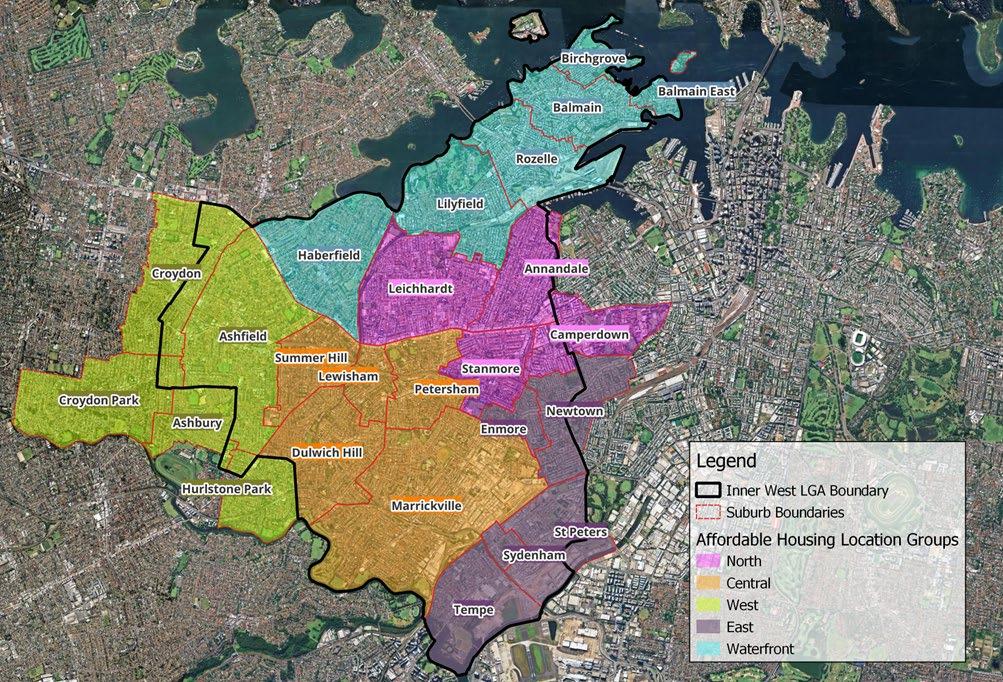
Source: Atlas Economics
Council prefers Affordable Housing contributions in the form of equivalent monetary contributions (refer to section 2.3.1). In some instances, Council may agree to receive Affordable Housing contributions in the form of:
• Dedication of completed dwellings (refer to section 2.3.2).
• Dedication of land (refer to section 2.3.3).
The method of contribution must be acceptable to Council and its nominated CHP. A draft Voluntary Planning Agreement (VPA) letter of offer should indicate the method of contributions, i.e. contribution in-kind (dwellings or land) or equivalent monetary contribution.
Where a monetary contribution is made, Council requires evidence that the condition of consent has been satisfied prior to the granting of a Construction Certificate. Where dedication of completed dwellings is made, the contribution is satisfied when title to the dwellings is transferred to Council following registration with the Land Registry Services.
Where dedication of land is made, the contribution is satisfied when title is transferred to Council at issuance of the Subdivision Certificate.
Where an offer to make a contribution in-kind (completed dwellings/ land) is not accepted by Council, an equivalent monetary contribution will be required instead. The equivalent monetary contribution is calculated by multiplying the contribution rate (%) by the equivalent contribution rate ($) by the applicable residential floorspace (GFA).
The example shows calculation of an equivalent monetary contribution with reference to contribution rates (%) in Table 3 and equivalent monetary contribution rates ($) in Table 4.
Example
Land with an area of 1,400sqm in Petersham is zoned MU1 Mixed Use, with an FSR control of 3:1. It is currently subject to a contribution requirement of 2% (as provided for in the IWLEP). The existing controls would permit a mixed use development (shop top housing) of 700sqm commercial GFA and 3,500sqm residential GFA.
A proponent proposes a higher FSR of 4:1. This would enable 700sqm commercial GFA and 4,900sqm residential GFA. The proposal enables an increase to residential capacity of 1,400sqm GFA.
The Affordable Housing contribution is calculated as:
Additional Residential GFA x 10% = 1,400sqm GFA x 10% = 140sqm
An equivalent monetary contribution is calculated as.
Additional Residential GFA x 10% x contribution rate* ($) = (1,400sqm GFA x 10% x $13,000/sqm) = $1,820,000
The Affordable Housing contribution on the base FSR 3:1 is calculated as:
Residential GFA x 3% = 3,500sqm GFA x 2% = 70sqm
An equivalent monetary contribution is calculated as.
Residential GFA x 2% x contribution rate ($) = (3,500sqm GFA x 2% x $13,000/sqm*) = $910,000
The total Affordable Housing monetary contribution is therefore $2,730,000.
* as per Table 4 Equivalent Monetary Contribution Rate
2.3.2
The Affordable Housing contribution requirement may be satisfied through the dedication of completed dwellings free of cost and to the satisfaction of Council. The completed dwellings must meet the following requirements:
• Align with the Affordable Housing Principles in section 1.2.
• Be in a location, and of a size and quality of dwelling that is to the satisfaction of Council and its nominated CHP and generally to the standard of new housing in the locality.
• Not be distinguishable from market housing within the development, i.e. it is ‘tenure blind’.
• Total gross floor area (GFA) exceeds 50sqm. If the GFA is less than 50sqm, a monetary contribution will be required instead.
The requirements that underpin the suitability of the dedication of dwellings is further detailed in Schedule 1
Where a slightly larger dwelling than required is dedicated, there will be no refund or offset of other contributions. Where only part of the contribution is satisfied through dedication of completed dwellings, any remaining requirement is to be paid as an equivalent monetary contribution with reference to rates in Table 4
If an offer of completed dwellings is not to Council’s satisfaction, it will require an equivalent monetary contribution.
The example shows calculation of the relevant requirement with reference to contribution rates (%) in Table 3 and equivalent monetary contribution rates ($) in Table 4 (if applicable)
Table 6: Calculating a Contribution Requirement
Example
Land with an area of 1,400sqm in Dulwich Hill is zoned MU1 Mixed Use, with an FSR control of 3:1 and is subject to an Affordable Housing contribution requirement of 2% (as provided for in the LEP). The existing controls would permit a mixed use development (shop top housing) of 700sqm commercial GFA and 3,500sqm residential GFA.
A proponent proposes a higher FSR of 4:1. This would enable 700sqm commercial GFA and 4,900sqm residential GFA. The proposal enables an increase to residential capacity of 1,400sqm GFA.
The Affordable Housing contribution is calculated as:
Additional Residential GFA x 10% = 1,400sqm GFA x 10% = 140sqm
The Affordable Housing contribution on the base FSR 3:1 is calculated as:
Residential GFA x 3% = 3,500sqm GFA x 2% = 70sqm
The total Affordable Housing dedication requirement is therefore 210sqm GFA. If 180sqm GFA is dedicated, the remaining contribution (30sqm GFA) can be satisfied through an equivalent monetary contribution. A monetary contribution is calculated as:
30sqm GFA x $13,000/sqm = $390,000
The acceptability of land for dedication is subject to Council’s discretion in consultation with its nominated CHP.
The value of the dedicated land should be equivalent to the monetary contribution calculated under the Policy. An independent valuation of the land to be dedicated should be obtained by the proponent. Council may choose to engage its own valuation (at the proponent’s cost) to review the proponent’s valuation provided.
If an Affordable Housing contribution is made via the dedication of land, it must meet the following requirements:
• Align with the Affordable Housing Principles in section 1.2
• Have a minimum land area of 800sqm.
• Not be:
o contaminated land requiring remediation,
o subject to flood planning area or tidal inundation constraints,
o subject to heritage affectations under IWLEP Schedule 5 or the State Heritage Register,
o subject to high aircraft noise (Sydney Airport ANEF 25+ noise contours), or otherwise satisfied for acoustic treatment in accordance with the Australian Standards or
o within 200m of a relevant pipeline with the meaning of State Environmental Planning Policy (Transport and Infrastructure) 2021, section 2.77.
• Have access, locational and site characteristics comparable to the proposed development.
If the assessed land value is less than the equivalent monetary contribution, any remaining requirement is to be satisfied as a monetary contribution. If the assessed land value is higher, no offset or refund is applicable.
The example shows where a contribution is made through part dedication of land/ part monetary contribution with reference to the equivalent contribution rates ($) in.
Land with an area of 3,000sqm in Camperdown is zoned E4 General Industrial. An R4 High Density Residential zone and FSR 2:1 is proposed to permit a residential flat building development at 6,000sqm GFA.
The Affordable Housing contribution is calculated as:
Residential GFA x 10% = 6,000sqm GFA x 10% = 600sqm
An equivalent monetary contribution is calculated as:
Residential GFA x 10% x contribution rate ($) = (6,000sqm GFA x 10% x $15,000/sqm) = $9,000,000
If contribution through land dedication is proposed, consideration should be given to whether the floorspace associated with the dedicated land can be transferred and developed elsewhere on the site. If the floorspace potential (GFA) is foregone with the land that is dedicated, the calculation would be different.
The two scenarios are illustrated as follows:
Scenario 1 - GFA cannot be transferred/ developed elsewhere
o If the land proposed for dedication is valued at $9,200,000, its value is more than the equivalent monetary contribution of $9,000,000 required. If accepted, no offset or refund is applicable.
o If the land proposed for dedication is valued at $7,500,000, its value is less than the equivalent monetary contribution of $9,000,000 required. A monetary contribution of $1,500,000 is required.
Scenario 2 - GFA can be transferred/ developed elsewhere
o The land should be transferred to Council at a nominal cost ($200/sqm).
o If the land proposed for dedication measures 800sqm, a monetary contribution of $8,840,000 is to be made, calculated:
Equivalent monetary contribution - nominal cost of $160,000 (800sqm x $200/sqm) = $9,000,000 - $160,000 = $8,840,000
Note the examples are simplified with no exemptions available.
The requirement for Affordable Housing contributions could be waived or reduced at Council’s sole and absolute discretion where a proponent has made an offer to enter into a voluntary planning agreement to provide other agreed material public benefits of a commensurate scale and value.
Where a proposal seeks to amend a development standard or zone or uses of land to enable or increase the residential capacity of the land, and also seeks to make an Affordable Housing contribution that is lower than the contributions as required under the Policy, an open book validation approach could be taken.
The proponent should provide a feasibility analysis that includes:
• Development parameters, cost and revenue assumptions and target hurdle rates.
• Supporting documentary evidence (including contract of sale for land, cost plan, valuation report).
Council would commission a peer review of the feasibility analysis at the cost of the proponent.
In the alternative, Council would commission (at the cost of the proponent):
• A feasibility analysis by an appropriately qualified land economist.
• A cost plan by an appropriately qualified quantity surveyor.
The proponent agrees to provide all information requested by Council’s engaged consultants.
3.1 Introduction
This section details the administration matters that arise from implementation of the Policy. This includes Council’s housing priorities and advocacy agenda. The section additionally details how contributions are indexed, used and managed and how the Policy will be monitored.
Affordable Housing contributions received under this Policy could be in the following circumstances:
• Required as a condition of consent.
• Offered, accepted and executed via a planning agreement.
Affordable Housing contributions executed via a planning agreement are subject to Council’s VPA Policy. The ordinary process of VPAs would apply. This would culminate in the planning agreement being registered on the land title and added to Council’s voluntary planning agreements website register and State Government website (as required).
Following the making of the IWLEP amendments, contribution payments will be required:
• Monetary contribution - at the Construction Certificate stage.
• Dedication of completed dwellings - at the issue of Occupation Certificate (or as otherwise legally permitted).
• Dedication of land - at the Subdivision Certificate stage.
The contributions will need to be updated at the time of payment to the most recent indexed values, in accordance with the indexation formula set out in this section.
The equivalent contribution rates ($) will be adjusted annually by Council within one week of the first business day after 1 July or within one week of the issue of the Quarterly Rent and Sales Report, whichever occurs last. Rates will be adjusted to movement in the median price of strata dwellings in the Inner West LGA. This is published quarterly in the NSW Government Rent and Sales Report, Table 3. Sale Prices - NSW LGAs
The indexation calculation is as follows, applicable as at 1 July of each financial year for the ensuing 12 months:
New equivalent contribution rates ($) = equivalent contribution rates x (updated median price/ former median price)
All equivalent monetary contributions should be indexed at the time of payment to ensure they are reflective of these adjustments. Affordable Housing contributions required as part of a condition of consent will be indexed at the time of consent.
• If the proponent is unable to make payment at the time required, Council must be provided with evidence to this effect. In such cases, a deferred payment can be arranged via a bank guarantee where:
• The bank guarantee is furnished by an Australian bank for the total or outstanding contribution amount plus interest.
• The bank guarantee requires the bank to unconditionally pay the guaranteed sum to Council at the time specified in the agreement or within any further time period advised by Council where a variation to the original agreement has been approved.
• The proponent will be required to pay all costs incurred in the establishment, operation, administration or discharge of the bank guarantee.
• The bank’s obligations are discharged when payment to Council is made in accordance with the bank guarantee, or when Council notifies the bank in writing that the bank guarantee is no longer required (and arrangements are made for its return to the bank), or if the related consent lapses.
The decision to accept a deferred payment is at the sole and absolute discretion of Council.
How Contributions are to be Used
Contributions of Affordable Housing dwellings are to be gifted/ dedicated free of cost to Council for transfer to its nominated CHP, or as otherwise provided for in the Governance and Distribution Framework adopted by Council.
Contributed dwellings are to remain Affordable Housing in perpetuity, or until replaced with Affordable Housing dwellings in the Inner West LGA and are to be owned and managed in accordance with the Affordable Housing Principles under the Policy. Monetary contributions will be paid to, received, pooled and managed by Council in its sole and absolute discretion. As sufficient funding becomes available, Council will consult with its nominated CHP on the opportunity to combine contributions received by Council under the Scheme, with the CHP’s own resources and/ or with the resources of agencies such as Homes NSW, Housing Australia, Landcom, etc.
The management of monetary contributions will give consideration to:
• Immediate use of contribution funds for purchase of dwellings for Affordable Housing in the Inner West LGA.
• The aggregation of contribution funds for Affordable Housing development in the Inner West LGA.
• Land and funding packages, where land is made available by supplementary sources for developing Affordable Housing dwellings.
• How the funding will be leveraged to maximise the quantum of Affordable Housing dwellings.
Priority will be given to NfP CHPs registered as Tier 1 under the National Regulatory Code, and who have appropriate experience in the LGA. Council will nominate a NfP CHP to receive Affordable Housing contributions received. The appointment will last for a term of at least five years, after which a new tender will be issued for the next term.
The nominated CHP will take ownership and management responsibilities for any monetary or in-kind contributions gained during their term. Affordable Housing contributions so transferred to the nominated CHP will be done so on the condition that they will be retained for the purpose of Affordable Housing in the Inner West LGA, in perpetuity. Any withdrawal of Affordable Housing dwellings must be replaced with an equivalent dwelling and be subject to Council’s agreement.
A Governance and Distribution Framework will be prepared that will outline how funds received or dwellings procured/ delivered will be used and the requirements for reporting and transparency. This will be secured through a funding agreement executed with the nominated CHP and a covenant/ interest registered on title.
Council may provide direction on the CHP’s procurement in relation to target tenant cohorts or locations for Affordable Housing. This direction will take into account planning pathways and policies
Management of Affordable Housing that is delivered under the EP&A Act (from developer contributions) will be undertaken by Council’s nominated CHP.
Management of Affordable Housing that is delivered under various initiatives of the Housing SEPP will be managed by a registered CHP (Tier 1, 2 or 3 under NRSCH).
Management of Affordable Housing must be in line with the definition of Affordable Housing and the Guidelines which provides guidance on a range of tenant management matters.
The Policy aims to ensure that Affordable Housing is available:
• That meet the requirements of Very Low, Low and Moderate income households.
• At rents of no more than 30% of a household’s gross income.
• In a manner that NfP CHPs can meet associated finance and other operating costs and be financially sustainable.
Council acknowledges that rents set must ensure tenants pay an amount they can afford. Council also acknowledges the importance of the NfP CHP being financially sustainable.
The Policy will be reviewed a minimum of once every term of Council, or more frequently as required. The review will consider:
• Dollar contribution rates against market sales activity.
• Quantum of Affordable Housing contributions received, including type, quality and locational characteristics of contributions in-kind (dwellings, land) received.
• Total amount of monetary contributions received, pooled and awaiting pooling.
• Allocation of funds for the purchase of dwellings for Affordable Housing.
• Allocation of funds to Council’s nominated CHP and Affordable Housing delivery outcomes.
• Council’s policy advocacy initiatives and agenda.
• Maintenance and management issues.
Creative Australia (2023a). The Creative Economy in Australia What Census 2021 tells us.
Briefing Paper 1. Accessible at: https://creative.gov.au/sites/creativeaustralia/files/documents/2025-03/The-Creative-Economy-in-Australia-briefingpaper-1.pdf
Creative Australia (2023b). The Creative Economy in Australia What Census 2021 tells us.
Briefing Paper 2: Embedded Creative Employment and Creative Incomes. Accessible at: https://creative.gov.au/sites/creative-australia/files/documents/2025-03/TheCreative-Economy-in-Australia-briefing-paper-2.pdf
Department of Planning, Housing and Infrastructure and Office of Local Government (2026). Council-led Affordable Housing on Operational Land in NSW. February 2026. Accessible at: chromeextension://efaidnbmnnnibpcajpcglclefindmkaj/https://www.nsw.gov.au/sites/default/f iles/noindex/2026-02/guide-for-council-led-affordable-housing-on-operationalland.pdf
NSW Government (2025-26). NSW Affordable Housing Ministerial Guidelines. Income eligibility limits for affordable housing. Accessible at: https://www.nsw.gov.au/departments-and-agencies/homes-nsw/social-housingresources/nsw-affordable-housing-ministerial-guidelines/income-eligibility-limits-foraffordable-housing
UK Government. Coronavirus and Key Workers in the UK. Accessible at: https://www.ons.gov.uk/employmentandlabourmarket/peopleinwork/earningsandwork inghours/articles/coronavirusandkeyworkersintheuk/2020-05-15
Council will consult with its nominated CHP on the acceptability of dwellings for dedication to Council free of cost. This schedule provides the guiding principles and standards on the suitability of dedicated dwellings.
Long-term Management
Affordable Housing dwellings are to be owned and managed in accordance with the Affordable Housing Principles of the Policy.
Strata Arrangements
Dwellings in a separate stratum are preferable where those dwellings are not subject to strata management fees. Dwellings in a separate building stratum or separate building do not incur high strata management fees and allow the nominated CHP to have operational control over management and maintenance.
The mix of dwellings (number of bedrooms) is to be appropriate to the housing need, as determined by the nominated CHP.
The parking and servicing arrangements are to be appropriate to the dwellings and overall need, as determined by the nominated CHP.
The design and external appearance of the Affordable Housing dwellings is to be equivalent in design quality to the rest of the development.
Where possible, the Affordable Housing dwellings are to be designed for reduced operating costs and utility costs (heating and cooling). For example, if passive ventilation and cooling methods (ceiling fans, window blinds) is maximised, the need for air-conditioning could be avoided.
Early input from the nominated CHP at the design stage will inform construction design and material choice. This addresses the long-term management intent of Affordable Housing, thereby ensuring:
• Internal and external finishes are robust and durable.
• Materials selected are of low maintenance and easily replaceable.
The guiding principles and standards apply to Affordable Housing dwellings dedicated pursuant to the EP&A Act (section 7.32) as well as Affordable Housing delivered under the Housing SEPP or other planning mechanisms.