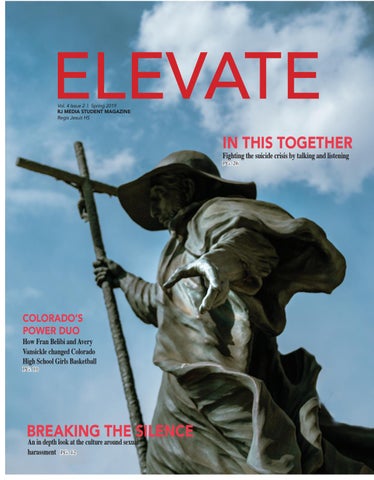
ELEVATE Vol. 4 Issue 2 | Spring 2019 RJ MEDIA STUDENT MAGAZINE Regis Jesuit HS
IN THIS TOGETHER Fighting the suicide crisis by talking and listening PG. 26
COLORADO’S POWER DUO
How Fran Belibi and Avery Vansickle changed Colorado High School Girls Basketball PG. 10
BREAKING THE SILENCE An in depth look at the culture around sexual harassment
PG. 12
1
LEADING OFF Photo By: Armando Maldanado ‘21
Seniors Luke Dosen, left, Colin Walsh, middle, and Shane Gaustche, right, celebrate one of Walsh’s two goals in the CHSAA State Championship. The Raiders beat Dakota Ridge 5-2 to win back to back state titles, their third title in four years.
Elevate 4.2
3
Contents
IN THIS ISSUE feature
VOL 4.1
26
Fighting a crisis by talking and listening.
12
A look at sexual harassment and the culture that surrounds it.
10 6 18
feature
sports
How Fran Belibi and Avery Vansickle changed Colorado High School Girls Basketball
RJ life
The history of JUG at Regis Jesuit and how it’s changed.
news
What Catholic teaching tells us about how to look at immigrants
news
Unpacking the most recent U.S. Government shutdown and the history of shutdowns in this country.
entertainment
A look back at the 2019 Oscars.
people of RJ
8
Mr. Goldsmith reflects and his career and his path that has lead him to where he is today.
24
Four senior girls recount their service project experiences, from working with the elderly to the Belize Immersion trip
20
people of RJ op-ed
Opinion commentary from within the Regis Jesuit community. Elevate 4.2
7
30
staff
EDITORS-IN-CHIEF Maxine Fuselier ‘19 & Leo McCabe ’19
NEWS EDITORS
Chris Faber ‘20 & Hannah Smith ‘20
FEATURE EDITOR Hunter Sullivan ‘20
SPORTS EDITOR Sam Stern ‘20
LIFESTYLE EDITOR Sophia Marcinek ‘20
CULTURE EDITOR Olivia Bachmann ‘20
ENTERTAINMENT EDITORS
The staff aims to balance what the audience wants with what it needs, and strives to make solid judgments with regards to news value and news awareness. The publications will serve as a medium for student opinions and ideas. RJ Media strives to produce objective, well-balanced and accurate reporting and content that features a range of students, their interests and their viewpoints. The staff is dedicated to being fair, accurate, balanced, truthful and responsible. The staff will seek the truth and report it, minimize harm and act independently. We promise to be transparent, accountable and open. The staff also upholds Ignation values with regard to social justice and openness to growth. The staff prides itself on using the Ignation Pedagogical Paradigm to help make decisions: context, experience, reflection, action, and evaluation. The student Editorial Board will have final say in the content of the publications. School officials, administration or faculty and staff shall not practice prior review or the have the ability to censor any student publication, with the exception of material deemed to be legally obscene, libelous, substantially and materially disruptive, or coverage on any one of the following three topics, wherein coverage will be worked through with the president and principals: Obituaries, employee termination, and crimes or cases in the court of law.
EDITORIAL POLICIES
ELEVATE EDITORS
RJ Media [Elevate Magazine, rjmedianow.com, RJTV and RJTV Sports Network] operates as a limited-open forum for student free expression. The publications are for the students, by the students.
The views of columnists are not necessarily those of the newspaper staff. Opinions will be published on designated pages or otherwise marked. All material published by RJ Media is copyrighted to RJ Media, year and date of original publishing. RJ Media will not publish any material that is a violation of copyright. We take our own photos and produce our own content. We sometimes use photos with express written permission, but only if we absolutely have to. Those will be credited to the photographer with attribution specified by the permission of use. Read our full editorial policies at rjmedianow.com/policy Read our full Editorial Policies at rjmedianow.com/about
Mariano Adame ‘20 & JP Pak ‘20
Cam Collins ‘20 & Maddie Munger ‘19
OP-ED EDITORS
Maddie Proctor ‘21 & Will Munro ‘20
PHOTOGRAPHY EDITORS
Jose Orenday ‘21 & Armando Maldonado ‘21
BACKPAGE/RABBLE Alex Britti ‘19
COPY EDITOR
Matthew Bornhorst ‘19
RJMEDIANOW.COM EDITOR-IN-CHIEF Alex Zoellner ‘19 Cover: Photo by Matthew Bornhorst ‘19
Being a part of RJ Media has never been just about journalism; it’s never been just about writing stories and then publishing them. From freshman year and our first interviews to late nights sending magazines to print, the learning hasn’t stopped. We learned how to use the rule of thirds, how to look at a computer screen for hours, how not to use comic sans, and, most importantly, how to tell powerful stories. So now, after countless interviews, much collaboration, nitro coffee cold brews, and eight magazines later, we depart with much gratitude. It’s been hard work at times and we’ve made some mistakes, but we’re are proud of what we’ve made and thankful for the experiences. The opportunities that RJ has given us are one of a kind, and we are excited to see what’s next for us in our careers as journalists. With much tenderness we hand off Elevate to the next generation of great journalists. We can’t wait to see what happens next for RJ Media. - Leo McCabe and Maxine Fuselier ‘19
LETTER FROM THE EDITORS
PEOPLE OF RJ EDITORS
5
“YOKE or BURDEN”
The Untold Story of JUG
H
Story by Sean Donavan ‘19
Photo By: Alex Britti ‘19 and Sean Donovan ‘19
andling a greasy pizza box in a crowd of students during your lunch period certainly isn’t the most extravagant way to spend your break, but perhaps you don’t know what JUG used to be. Not long ago JUG was very different at Regis Jesuit, and the gift of time has mellowed the punishment to something much tamer.
“We have a progressive system, the more jugs you get, the more tailored it’s going to be. It’s always under the guide of restorative justice. A specific act to a specific consequence, and we have this system where guys who get multiple jugs have specific tasks.” “Students who are suspended actually spend the day with the grounds crew, and they work out in the cold all day, I make sure they are prepared, but these consequences are to deter [students] from breaking the rules.” -Dean Doherty
Elevate 4.2
The story of JUG goes back to the original time of the Jesuits and many of us know it to mean Justice or Judgment Under God, but the real term JUG actually has a deeper Latin meaning of “Yoke or Burden,” – something that must be carried and recognized by others. In the Roman legions,when an army was conquered, the captives would be forced to walk under a symbolic yoke to show the reign of the Roman Empire. This drove home the message that now they were subjugated under the “yoke” of Rome. Of course, Regis Jesuit doesn’t force utter humiliation upon its students like the Roman Legions did to their enemies. Instead, Regis Jesuit is dedicated to promote restorative justice for students who choose to break the rules. However, Dean Doherty, working with students for over 30 years, has found that each JUG assignment must be fair and serve justice to the community. Under the Jesuits, students have always been expected to serve their communities and JUG has been used as the main form of reformative justice for over 140 years. The word JUG was widely used and could be a punishment for even minor incidents. Instead of missing your lunch period, a JUG 50 years ago would put you back an hour after school doing a variety of tasks. These tasks were assigned due to the severity of the JUG received. The first is writing assignments. This is where students would sit in a classroom and would have to copy pages from the dictionary nonstop for an hour, or writing numbers to their highest digits (e.g 1+1=2, 2+2=4, 3+3=6 and so on) until their hour period ends. The other tasks that students may be assigned is community service on the school grounds: shoveling snow in the winter time, raking leaves in the fall and picking weeds in the spring. Picking up trash during lunch would be an honor compared to what students went through years ago. Though Regis Jesuit has changed so much, and it has, we have kept some of the tradition. Dean Doherty, long ago implemented a progressive justice system, where each JUG is tailored to the student. For students who have never received a JUG and are serving their first often do not have as hard of a task as the students who get JUGs regularly. Being a progressive system, restorative justice can take place to ensure our students learn from their actions. Regis Jesuit unlike some schools takes disciplinary action very seriously. With the values of Cura Personalis, each Regis employee is insistent on helping each student achieve their full potential. They do so by understanding every circumstance is different and take the time to care for each student on a deeper level. This is what Regis is dedicated to. Instead of having detention, students learn to serve others in our community, ensuring we see our campus as a second home. So next time you get JUG be thankful that you are picking up trash around campus, because you could have been copying down the dictionary after school on your time.
By Alex Zoellner ‘19
UNPACKING THE GOVERNMENT SHUTDOWN By Alex Zoellner ‘19
On Saturday, December 22, the Federal Government initiated what is known as a “government shutdown.” What does it entail? According to Mr. Chris Walsweer, “A government shutdown is the impasse by which a budget cannot be agreed upon by both Congress and the President.” So, what else should one know about government shutdowns? A government shutdown in other countries, such as Belgium and the UK, can also occur when no single political party is in control of the government, and said nation does not return to the polls to establish such things. In the U.S, there have been a total 22 funding gaps in the federal budget, but only ten of these have resulted in federal employees being furloughed. Such shutdowns and the subsequent actions, can also occur on the state, territorial, and local levels of government. Regardless of the tier of government at which the shutdown occurs, there is no definitive limit to the amount of time said shutdown can last. This is where the real power of a government shutdown can exist. From the perspective of a politician responsible for a government shutdown, it is very bad for one’s reputation to be voluntarily furloughing and/or making federal employees work for delayed pay. Conversely, as a federal employee, one has very little idea as to how they will be affected by a government shutdown, as the extent to which the government shutdown occurs is largely circumstantial.
With this most recent shutdown, the longest in U.S. history at 35 days, 380,000 federal employees were furloughed and another 420,000 were required to work with delayed pay till the end of the shutdown. In reality, these 800,000 federal employees totaled only about 38 percent of the 2.1 million civilian non-postal federal employees. As such, the effects of this most recent shutdown weren’t fully felt by non-federal employees. The federal employees that were fully affected by the shutdown include: TSA staff, Border Patrol, and National Park Service staff, and more. The severity of this shutdown was largely due to: the vast controversy surrounding the President, the length of the shutdown relative to the backpay (which was guaranteed) for federal employees, and certain departments being largely furloughed without actually closing those departments and/ or areas. One such example of this would be the United States Department of the Interior, especially the National Park Service (NPS). During the 2018-2019 government shutdown, almost all NPS employees were furloughed but the majority of the national parks across the country were open. Thousands continued to visit the parks. But, what would happen if there was no one to collect and dispose of the garbage and natural waste in the parks? What would happen if there was no one to monitor the monuments and areas of strict conservation? What would happen if there were minimal to no search and rescue workers in the national parks? Well, garbage and human waste piled up endlessly posing both a health and environmental
hazard. A substantial amount of new graffiti appeared along with the destruction of conservation efforts both environmentally and historically. And several people died. But not everyone goes to the national parks. How did it affect the workers and then, by association, the rest of society? Mrs. Heidi Kabadi says that “When you’re thinking so, it’s 800,000 employees. We’re a country of 330 million people. So in the grand scheme of things, it was a small slice. I honestly didn’t know anybody personally, that was even impacted by it, other than us as citizens not being able to access services that we should be able to. For example, to file tax returns. I needed to apply for passports for my family, the passports offices were shut down. So things like that, as citizens, impacts us more.” Ultimately, on January 25th, the 20182019 government shutdown came to an end with Congress unanimously voting to end the shutdown through February 15, after Trump agreed to re-open federal agencies with no guarantee for funding towards the wall. However, the purpose of this ceasefire was to allow for a House-Senate conference committee to finalize a security plan for the Mexican border. Which legitimizes the reality of yet another shutdown but, with the passage of time, this reality dwindles.
Graphic Illustration By Joey Paolucci ‘22 7
Behind The Big Screen
The ever-changing cultural impact of The Oscars When viewers from decades past tuned in to the Academy Awards every year, they all shared a common reason for spending three to four hours in front of a television: a love for cinema. Since the first Oscars ceremony in 1929, the spectacle of the night has remained the same. Bright lights still shine down on Hollywood’s most talked about celebrities. The Dolby Theatre still glistens with gold trimmings and colorful outfits. The same awards are given out every year, followed by the passionate acceptance speeches that inspire the next great generation of filmmakers. The Oscars manage to retain the same spectacular appearance and showmanship every year. Consequently, everything about this year’s show is identical to the show in 1929 except for one thing - the role of the media. In our hypersensitive socio-political climate, everything has the potential for drama. This year’s 29.5 million viewers (the second lowest viewership in history) didn’t all tune in for the same reasons. Many watched out of a passion for film like in years past. However, the Oscars are becoming increasingly criticized every year as national tension grows. Now, possibly for the first time ever, viewers are watching the Oscars for the wrong reasons. Possibly in response to the backlash that the Academy has received in recent years, this year’s awards show is full of “steps in the right direction” for the organization. The awards show brought about many “firsts” that the media applauded as the night went on. Spike Lee, the risk-taking, controversial director won for his adapted screenplay of “BlacKKKlansman”. Despite how long he has been in the industry, the acknowledgment marked his very first Oscars win, with many calling the film his best movie yet. Both Olivia Colman and Rami Malek won Best Actress / Actor respectively in not just their first Oscars wins, but their first ever nominations in the category. Although the package deal came as a shock initially to most of the audience, the general consensus was that both completely deserved their acclaim. Perhaps the most exciting “first” of the night won many of the Academy’s harshest critics back. “Black Panther”, the Marvel film with an almost completely African American cast, became the first adaptation from a graphic novel to earn a Best Picture nomination. Although the film was beat out by “Green Book” in a controversial turn of events (Spike Lee attempted to leave the building after it was announced), the nomination marks a legitimate cultural impact made by none other than the Academy.
Elevate 4.2
By JP Pak ‘20
BEST PICTURE NOMINEES
‘ROMA’
Cleo is a maid employed by a middle class white doctor, playing a large role in the family she serves. Amidst the political tension of Mexico City in the early 1970s, she finds herself the responsibility to care for children that she grows increasingly close to. Complications arise when the father of the family runs off with another woman and Cleo becomes pregnant.
‘VICE’ Told through the eyes of Dick Cheney, Vice is the story of the 2000 presidential election. Cheney’s slow rise to power is showcased in many different settings until his presidential campaign with George W. Bush takes off. After a journeyman’s path to Vice President, Cheney seeks more than just his assistant role to the man in charge.
‘A STAR IS BORN’ Cleo is a maid employed by a middle class white doctor, playing a large role in the family she serves. Amidst the political tension of Mexico City in the early 1970s, she finds herself the responsibility to care for children that she grows increasingly close to. Complications arise when the father of the family runs off with another woman and Cleo becomes pregnant.
‘BLACKKKLANSMAN’
Taking place not too far from Regis in Colorado Springs, Ron Stallworth becomes the local police department’s first African American officer. In an attempt to expose the Colorado sect of the Ku Klux Klan, Stallworth recruits Jewish officer Flip Zimmerman and lands the police department at the heart of the organization. Directed by legendary writer Spike Lee.
‘THE FAVOURITE’ Towards the conclusion of her reign over 1700’s Great Britain, Queen Anne turns to her aide Lady Sarah as her health begins to falter. In the midst of Britain’s war with France, Sarah keeps her order intact until her cousin Abigail begins to cause problems.
‘BOHEMIAN RHAPSODY’ Rami Malek plays Freddie Mercury, the unorthodox and colorful lead singer of the rock band Queen. In pursuit of a life in performance, he unites the group of misfits that shocked the world from the 1970’s and beyond. Malek’s Best Actor performance is nothing short of thrilling, playing a critical role in the picture’s homage to the life of a star.
‘GREEN BOOK’ (WINNER) Dr. Donald Shirley, a well respected African American pianist, hires driver Tony Lip to offer him protection throughout his tour of the Deep South. As polar opposites, both work through their differences and find friendship in a journey that pushes American social boundaries. Vigo Mortensen and Mahershala Ali tactfully illustrate the story and their respective characters, with Ali winning Best Supporting actor. His take on Dr. Shirley is nothing short of fantastic. Mortensen, on the other hand, is funny yet well-rounded, emblematic of Hollywood’s evolving character development. While Green Book’s Best Picture win was unexpected, it does not come as a surprise.
‘BLACK PANTHER’ Marking the first adapted graphic novel to ever receive a best picture nomination, Black Panther’s recognition by the Academy is evidence of the organization’s progressive mindset and future goals. After his father’s death, Prince T’Challa takes the throne of Wakanda, a nation in Africa that hides its wealth from the rest of the world. After the country’s true identity is exposed to the public, T’Challa is forced to take the form of the superhero Black Panther in order to defend his people against impending danger. Although Black Panther did not win Best Picture like cinema progressivists envisioned, it’s cultural impact is nothing short of impressive.
9
SPORTS
Colorado’s Power Duo
How Fran Belibi and Avery Vansickle changed Colorado High School Girls Basketball By Sam Stern and Will Barbera ‘20
Regis Jesuit senior Francesca Belibi has gone viral over the past couple of years, and has become one of the top female high school basketball players and athletes in the country. Belibi and sophomore guard Avery Vansickle led the Raiders into the final four and filled the record books along the way. Belibi and Vansickle made the remarkable season even more ridiculous when they teamed up for an alley-oop dunk against Heritage High School. Vansickle said they “practiced the lob three times in warm ups.” “Once we got a steal and Grace [Weigand, ‘21] passed it to me at the perfect time, I just knew Fran was going to be there when I threw it up,” Vansickle said. Receiving attention and recognition from all over, including from 2-time NBA MVP and 3-time NBA Champion Steph Curry, Belibi and Vansickle have proved to the world they are one of the best duos in the history of high school basketball. Showing their friendship on and off the court, they speak about each other with nothing but high praise. “It’s really fun to play with her,” says Vansickle, “she does a great job setting up her teammates for success.” “I wouldn’t want to have any other captains than them [Sydney Weigand ‘19 and Belibi],” says Vansickle. Starting out the season with a huge revenge win over last year’s state champions, the Grandview Wolves, 79-55, Fran threw down another one of her famously vicious dunks. “After losing to them last year the way we did,” Belibi said, “the game against them this year was definitely a statement game.” Changing the game and standards of womens basketball is exactly what Belibi strives to do. “Hopefully we get more girls
Elevate 4.2
Avery ‘21 and Fran ‘19 honing in on their jumpshots against Holy Family High School (photos by Armando Maldonado ‘21).
“
It’s so different than any team I’ve ever played on.
”
doing alley-oop dunks, or just dunking in general,” Belibi said. Easier said than done. However, with all the fame and recognition that Belibi has received, there is no doubt that she can make her presence and voice heard. She put up huge numbers this season. The 6’1’’ highlight-reel dunker had 18 double-doubles and one triple-double during the season. She put up 40 points, 10 rebounds, and 10 steals against Douglas County in an 8538 throttling, completing her first career triple-double. Looking to deepen her education and continue her basketball career this fall, Belibi will attend Stanford University. She will join a team with one of the top recruiting classes of 2019 and Belibi and her fellow teammates are looking to have a tremendous year. “Honestly, I am just happy to be there and to be able to learn from the coaches and the girls on my team,” says Belibi, “so I will take all I get to just try to improve my game.” Flying high and scoring baskets is not all Belibi aims to do at Stanford. Planning to follow in the footsteps of her parents, Belibi has her eyes set on being a doctor and going into medical school following her graduation. Obviously, everyone, including Coach Carl Mattei, believes that she is capable of being a lottery pick type of
player in the WNBA. Fran’s resume is stacked, and she has plenty more in store as well. She is already an Olympic gold medalist, McDonald’s All-American, All-Conference Player, and a highlight reel dunker. Could you ask for anything more as a senior in high school? Vansickle is now looking to lead her team next year alongside Jada Moore, and build on the success she had this year. She made the A-Town All Star team after a season where she averaged 13.3 points, 3.6 assists, 3.0 rebounds and 1.8 steals. She nailed 75 3-pointers on the season, which was tied for first in 5A. And in that pivotal early season matchup versus Grandview? She produced 26 points, 3 assists, 3 steals. Dedication. Power. Drive. Excellence. The future is bright for both members of this dynamite power duo. As far as Belibi, don’t blink, she might be dunking any day, any place, anytime. Look for Vansickle stringing together 3-pointers, and driving to the basket with consistency for the Raiders next season.
December 12, 2018
March 7, 2019
The Raiders make an appearance in their second straight Final Four game.
Fran Belibi throws down her first dunk of the season in a huge win against Grandview, 79-55.
January 12, 2019
Fran and Avery connect on the first ever alley-oop dunk in a girls High School Basketball game in a dominating win against Heritage, 90-14.
February 26, 2019
Fran slams another ferocious dunk in a playoff win against East, 72-15.
January 23, 2019
Fran completes her first triple-double of her career with 40 points, 10 rebounds, and 10 steals in a win against Douglass County, 85-38.
Francesca Belibi ‘19 and Avery Vansickle ‘21 made history when they teamed up for an alley-oop dunk against Heritage. Photo by: Will Barbera ‘20 11
BREAKING THE SILENCE
Sexual harassment and sexual assault are ongoing problems and Regis Jesuit is not exempt
By: Hunter Sullivan ‘20, Maxine Fuselier ‘19, and Leo McCabe ‘19 Graphic Design by: Ms. Meyerose’s Graphic Design class
Elevate 4.2
A party. A school dance. A restaurant. A football game. Snapchat. It happens. Within families, within peer groups, and with complete strangers. It happens in homes, churches, gyms, the workplace, and it happens at Regis Jesuit. Sexual assault can happen anywhere, at any time, and at any age. For one Regis Jesuit student who asked to remain anonymous (let’s call him T), it was in the back of his girlfriend’s car late at night after the 2017 Regis Jesuit homecoming dance. It is hard for him to talk about what happened, and you can still hear the pain in his voice when he speaks about it. His hands shake, his face turns a pale shade of red, and he turns away before he begins to speak. What hurt him most was that the girl who sexually assaulted him was someone he thought could never hurt him. “I was completely frozen, I could never imagine someone I trusted doing something like this to me.” For T, this event changed him forever. “I was broken for quite some time,” he said. “I struggled to go to sleep because every time I closed my eyes I would get brought back to that night.” He described how every time he drove by the parking lot he was assaulted in, he would feel an immense pain in his stomach and feels sick to the point where he sometimes had to pull over to the side of the road and collect himself. He did not tell anyone for months after his assault. He was embarrassed; scared that his friends would see him as less of a person, as less of a man. He was worried that his parents would never let him go out again and scared that nothing would be the same. As weeks turned into months, the pain kept growing until he finally reached out and talked to his mother. She was shaken when he told her. She felt sick and “immediately collapsed onto the floor of their kitchen.” She couldn’t believe that her son, who she thought she could be able to protect from everything, had gone through this. High school students are at a point in their lives where a lot of things seem uncertain. “As an adolescent you’re just now starting to figure out who you are and are coming into your own physical development and maturation,” says Regis Jesuit therapist, Ms. Celeste Siade, “And then something like this [sexual assault] happens.”
“
I just get so scared to say ‘no’ now because I was stripped of that right. This is sexual assault. It’s an experience that can rattle anyone. It can leave victims with feelings of fear and regret for what happened before and during the incident. These feelings can sometimes last a lifetime. Mental health issues like depression, anxiety, and PTSD often follow the victims after an attempted or completed sexual assault. The mental and physical effects of an assault can be extremely isolating, affecting both romantic and friend
relationships. T describes his relationships with others saying, “after I was assaulted, I pushed all my friends away because I thought I only needed myself, but once I let them in they helped take the pain away from me.” Over a year later, there is still pain. His family still sees his struggle to come to school everyday and his closest friends know that some days are worse than others. For most survivors, the damage will fade but never completely go away. Although he has found some peace of mind and support after rebuilding his connections and reaching out to others, he still feels that, “she broke me and I’m still picking up the pieces.” Another Regis Jesuit student who asked to remain anonymous (let’s call her S), had a similar experience after being assaulted in a car her freshman year. “I completely isolated myself from all things high school and all things Regis. I stopped going to games and events and I pretty much stopped going to school. I distanced myself from most of my friends,” she says. S is still working through the damage the assault caused to her life and her relationship with boys. “I just get so scared to say ‘no’ now because I was stripped of that right.” Her assault still affects her in smaller ways as well, causing her to approach everyday situations with an added level of anxiety. “In public if I see men looking at me I get really nervous and I always walk with my pepper spray and my car keys in hand” she explains. After years of pain, she hopes for healing in the future. “I just hope that I can have the confidence to say ‘no’ and stand up for myself more and figure out ways to. I want to have control over my body again.” Both of these students described that they had their self-confidence and self-worth shattered after these sexual assaults tore through their lives.
IMPACT OF SOCIAL MEDIA
Regis Jesuit Boys Division counselor Mrs. Kathryn Ames believes that the solution to these issues can be teaching respect. Survivors must find self-respect in order to help them on their road to recovery, while everyone needs to learn that respect for others is essential in preventing abuse. She believes that on the forefront of change is, “teaching respect: self-respect, respect toward others, respect towards your body.” These are the key building blocks to establishing a healthier environment for everyone. However, social media limits face-to-face contact and can hinder these principles that are trying to be established. Social media can be used as a positive tool but it is also a way for people to harass someone without having to face them in person. “I think people hide behind their screens and push the boundaries more because they rationalize that it is not ‘actually assaulting someone,” Ames says. Mrs. Ames also thinks that sometimes social media fuels gender debates and makes men feel like they are often in the wrong. “I think sometimes the way the media reports things, it drums up fear and it drums up men versus women,” Mrs. Ames says, “if we take out the divide of politics out of these discussions, I think we can all agree that all people should feel safe, loved, and respected.” “I don’t think that we’ve done enough today talking about these issues in terms of relationships and respect,” she says.
13
Ames advocates that everyone needs to do everything they can to help stop sexual assault and harassment. This heated topic has a stigma around it and a lot of people who haven’t experienced it, or don’t know anyone who has, treat it as something they don’t want to be a part of. But change is needed, and needed quickly. Everybody needs to be educated about the damage sexual assault brings and the pain it inflicts so there are no more people having their lives shattered.
WHAT IS SEXUAL ASSAULT AND HARASSMENT?
The definitions of assault and harassment, and the difference between the two, are often taken out of context. With the dramatic increase media coverage of sexual harassment and assault through the #MeToo movement and #WhyIDidntReport, understanding the lines and when they are crossed is more difficult than ever. Under Title VII of the Civil Rights Act of 1964, sexual harassment is considered to be a form of sex discrimination, and the Equal Employment Opportunity Commission defines it as “Unwelcome sexual advances, requests for sexual favors, and other verbal or physical conduct of a sexual nature.” Sexual assault is an umbrella term and can be used to describe anything from cat-calling to violent assault. “Any time a person is forced to engage in a sexual act, they have experienced sexual assault. This includes being coerced, threatened or unfairly pressured,” says The Blue Bench, a sexual assault prevention center and care center for survivors (thebluebench.org).
1 in 9 girls and 1 in 53 boys under the age of 18 experience sexual abuse or assault at the hands of an adult. #METOO MOVEMENT
Last year American actress Alyssa Milano started a Twitter trend using the hashtag MeToo, a phrase coined by social activist and community organizer Tarana Burke. Over 300,000 people tweeted the hashtag in the first day alone, confessing that they too have experienced sexual harassment and/or assault. #MeToo has since been tweeted roughly 19 million times since and spread to all other social media platforms. This worldwide exposure of the magnitude of the issue kickstarted the chain reaction which led to people in power like Harvey Weinstein to undergo due process for their crimes. TIME Magazine reporter Haley Sweetland Edwards, who wrote the TIME Person of the Year: The Silence Breakers article in December of 2017, describes the #MeToo movement in an email interview with RJ Media as, “a reckoning where women and men who have been dealing with sexual harassment and sexual assault in the workplace and outside of it for decades finally
Elevate 4.2
just rose up and let the dam break.” Many famous celebrities, actors, musicians, politicians, and just everyday people were fired from jobs, knocked out of positions of power, or exposed to the public. Survivors came forward and used the courage from other testimonies to find the strength to share their own stories. A movement that started on social media spread like wildfire across the United States and around the globe. This movement was a catalyst for change and brought the issue of sexual assault to the attention of the general public. An issue that had been heavily stigmatized and ignored finally had found footing now that there was momentum. Justice has been served for the most part in the court of public opinion, but there are still issues around the fact that a lot of the people accused have not been persecuted and reporting of sexual assault is still heavily stigmatized. The National Sexual Violence Resource Center estimates that 63 percent of sexual assault cases go unreported to the police. Although some will never completely heal, found some comfort in knowing that people would finally listen. Although the surge of the initial movement is fading away, the impact hasn’t. There has been an unchangeable culture shift in society that has propelled survivors to talk about their experiences. TIME Magazine reporter Edwards thinks that, “now that we have a language, a vocabulary to discuss this thing you can’t just hear, that’s a cultural moment that you won’t be able to undo.” People are still coming forward to try to find justice, regardless of if the movement is still as prevalent as it was at its peak. In September of 2018, President Donald Trump tweeted in response to accusations by Christine Blasey Ford against then Supreme Court nominee Brett Kavanaugh, saying that if Ford’s accusation of sexual assault against Kavanaugh was “as bad as she says,” then she would have reported it to the authorities when it happened over thirty years ago. Survivors of sexual harassment and sexual assault came forward quickly, rallying around a new hashtag, #WhyIDidntReport, to shed light on the fear, embarrassment, and challenges of being a survivor. Some survivors feel ashamed, some don’t want the people who love them to know, and some are worried about their careers. In hotels, restaurants, businesses, and schools, men and women are being harassed or assaulted and don’t speak up because they are worried about losing their careers. According to Education Week Research Center, “one in four women educators reported being sexually harassed or assaulted at work.” Over half of these women choose not to report because of fear of losing their jobs. Women dominate teaching jobs in the education industry, but men still hold the most positions of power. According to a survey conducted by Education Week, women make up 76% of teachers, hold 52% of principal positions and account for 78% of central-office administrators. This is a positive sign, but the most glaring issue is that women account for less than a quarter of all superintendents, according to a survey conducted this summer by the AASA, the School Superintendents Association. If a woman doesn’t want to lose her career, she may take the pain, go to work each morning, and usually
see her assailant every single day at work. This leads to an issue, because a lot of people who assault or harass others are getting away with it, meaning that they could become repeat offenders.
82% of all victims under 18 are female. PLACES FOR HELP When someone experiences any form of sexual violence, they have places to go and people to talk to in order to help them through the post-assault trauma. Blue Bench, a Denver based sexual assault care and prevention center, that helps victims of sexual violence. “We [Blue Bench] do a scientifically supported prevention programming that is about how every person has the opportunity to be apart of preventing sexual violence, and can support a survivor, and can really change the culture around sexual violence,” said Susie Roman, direction of prevention and education at Blue Bench. Blue Bench works with community organizations and businesses, from middle schools to bars, to help educate the community about the dynamics of sexual violence and how each member of a community can help combat sexual violence. One of their presentations, called “Bringing In The Bystander,” is an evidence-based program that originated at the college level, but has been adapted to a high school level. It focuses on the core values of Blue Bench, educating people to help prevent sexual violence before it happens. For Roman, her job is not always easy. “It can be hard to know just how much people are experiencing,” she says. “And I see that as an opportunity to educate the community around those survivors, so that they’re getting the kind of support they need.” Blue Bench is also working to change the culture around sexual violence. “We do scientifically supported prevention programming that is about how every person has the opportunity to be a part of preventing sexual violence,” said Roman, “and can support a survivor, and can really change the culture around sexual violence.” Boys Division counselor Mrs. Kathryn Ames says that in order to find a solution, everyone needs to be involved. “You need the village. We need society to take better stands,” she says. “We need families. We need priests. We need all the players to be a part of the solution.” In addition to Blue Bench, there are a variety of hotlines that can be called to talk to professionals who are available every hour of the day. There are also opportunities to talk with therapists or counselors, but Regis Jesuit counselors are mandatory reporters and would be required to say something if an experience of sexual abuse is shared with them. Sexual violence is a problem that can never be fully solved. Laws have been improved and justice has
has been served more and more lately. However, there are still steps to take. As seen with the #MeToo movement, sexual assault can be talked about in an empowering way. Survivors are a lot more likely to find healing when they reach out for help and they will not reach out until they feel that they will be heard. In a TIME Magazine poll, they found that women were 49 percent more likely to speak out about their assaults or harassment since the #MeToo movement swept the world. However, it is important to remember that sexual assault happens to everyone and not just women. While it is more common with women, it happens to men too. Age also does not matter, older people and adolescents still experience assault, as does every age in between. Mrs. Ames was part of a group when she went to college for victims of sexual assault. One of the people that came in for support was a large, male football player, showing that assault can happen to anyone, regardless of any stereotypes. Ames says, “there’s got to be a lot of players involved and people willing to take ownership and responsibility.”
Females ages 16-19 are 4 times more likely than the general population to be victims of rape, attempted rape, or sexual assault.
HOW REGIS JESUIT IS WORKING TOWARDS CHANGE
Regis Jesuit has put together a committee of teachers and administrators to implement more education in the theology curriculum as well as in counseling. “The spiritual and religious aspects of sexual ethics based on Catholic Anthropology work in concert with the psychological and social facets of relationships. All of God’s creation is good. Relationships are messy. And it’s through relationships that we are invited to work towards becoming more fully human in all dimensions of our life, including our sexuality,” said Cassidy-Cernanec. “Sexual assault and harassment is always morally wrong. These violent acts are often a result of power over others. The psychological rationalization perpetrators use to twist and distort the purpose of sex draws one further from opportunities to cooperate with God’s grace. We know sexual harassment and assault often happens by people that we know and that we are in relationship with. A better understanding of right relationship can make us feel confident in calling out violations of the dignity of the human person.” The curriculum this committee is looking at is called “The Real Essentials Advanced,” an education on healthy relationship created by a Colorado based organization called the Center for Relationship Education. These lesson plans are expected to be taught starting fall of 2019. Cassidy-Cernanec says their hope by the end of the semester is “to come to greater clarity, greater intentionality, and greater dialogue on a comprehensive and integrated approach to sexual morality, healthy relationships, and sexual health in a Catholic Jesuit context both interdepartmental and intradepartmentally.”
15
Looking Back
PIN KING Sophomore Antonio Segura took down the favorite to win a state title at the Pepsi Center. Photo By: Armando Maldonado ‘21
FLYING HIGH Senior Fran Belibi attempts a layup during the Raider’s Great Eight match-up at the Denver Coliseum.
Photo By: Armando Maldonado ‘21
IN ON THE ACT Senior Eli Harvey and the ensemble of Sister
Act perform the main number to a packed house in the Z Theater.
Photo By: Armando Maldonado ‘21
PEN PAL Boys Division Head Mrs. Karen Wuertz talks to RJ Media reporters about her experience writing letters to inmates on death row. See the video on our RJTV YouTube channel. Photo By: Maxine Fuselier ‘19
FAITH TRADITIONS Fr. Tom Rochford, SJ ‘64 celebrates mass alongside altar servers for the student body on the green. Photo By: Kylie Pendleton ‘21
Elevate 4.2
DYNASTY The Regis Jesuit Hockey team rushes towards their own net to celebrate the Raider’s third state title in four years, and their second in a row. Photo By: Armando Maldonado ‘21
ROLE MODEL Olympic gold medalist, and 2013 grad Missy Franklin talks to the student body about winning gold medals, her personal experiences struggling with depression, and learning that “asking for help is the bravest thing you can do.” Photo By: Armando Maldonado ‘21
UNIFIED CHAMPS The RJ Unified team took home the state title in Fort Collins. Photo By: Armando Maldonado ‘21
PEACE & QUIET Deer crest the hill high above the retreat center in Sedalia, Colo. where seniors go out into the wilderness to find peace in silence on the senior silent retreat. Photo By: Matthew Bornhorst ‘19
ON THE BLOCK Kylar Cronin and the girls swim team swam their way to a third place finish at state. Photo By: Ally Pfieffer ‘19 17
IMMIGRATION: NOT JUST By Cara Williams '21 and Ruth Woldemedhine '21
Catholic teaching about immigration calls us to think about immigration, and the people involved, as more than just statistics.
K
STATISTICS
edge of their humanity. Catholic social teaching has called for comprehensive immigration reform, one of these prominent figures risthina Gullen immigrated from Santa Elena, being Father Thomas Betz, who spoke of the call of Catholics Usulután, El Salvador when she was 17 years in an email interview. old into the United States. When Gullen made “Catholic social teaching says that everyone has the decision to enter the country in 2004, she a right to the goods of the earth. God made the world for all was unable to qualify for a Visa because she of us and no one has a superior right to food, safety, shelter. didn’t have a savings account with enough We Americans have no more rights before God than Latin money in it. Gullen chose then to migrate to the U.S. by legally Americans. We are all equal in God's sight,” Betz says. crossing the Guatemalan border with a guide. Gullen further expanded on this point by express Gullen was afraid to continue her travels to the United ing the importance of the freedoms provided in America by States because she could not legally enter the country, so she saying, “I believe that we are fortunate that we have freedom hired a new guide to help her cross the Mexican border. in this country, and no matter where you come from you can still have a contribution to [America], the land which has She described her experience in an email interview as, become home. ” "Difficult." She said "the most awful thing was crossing the des Recently, disagreements on the best solution relating ert of Arizona. [she] spent four days and three nights walking to the issue of border security and immigration into the Unitacross this dangerous desert." ed States have constantly made front page headlines. From "Stone Cold Criminal," "Animal," "Rapist," Drug Dealheated debates to a record-breaking government shutdown, er." All of these words have been used to describe undocumentthe controversial policies and proposed plans to address the ed immigrants, however in reality, many immigrants are people issue have garnered large amounts of attention, both by the like Gullen. press and by citizens. The stories of immigrants are seldom told, as their These debates generally ignore the fact that behind stories are usually overshadowed and turned into statistics, and everything in relation to politics, there are real people being by doing this, society has dehumanized the story of the immiaffected by this. Children torn from their parents, families grant. A different portrait of an American can be painted with ripped apart, sick people waiting for months in inhumane the story of an immigrant. conditions to receive an asylum date. According to the Center for Migration Studies of New Despite these disagreements, the number of unauYork, research found that just between 2016-2017, 62 percent thorized immigrants in the U.S. fell to its lowest level in more of newly undocumented immigrants had overstayed their visa, than a decade, according to Pew Research Center. while only 38 percent illegally crossed the Although in 2018, the most apprehensions since border. at least 2016 on U.S.-Mexico border occurred, The need for comprehensive imaccording to the U.S .Customs and Border Pro"God made the world migration reform is clear, but oftentimes it tection. is overshadowed by party politics and danfor all of us and no one Catholic social teaching tells us that the gerous rhetoric. Presidencies under Demohas a superior right to people at the center of this controversy, rather crats and Republicans have failed to properly than the controversy itself, should be the focus food, safety, shelter. " address and provide adequate reform. of our attention. Behind the dramatization, The main concept that Catholic -Fr. Thomas Betz there are people who have come in search of social teaching on immigration encouragrefuge and in hope for opportunity. es is compassion. These people are at their Many families fleeing the border leave their most vulnerable state, many are migrants and home countries because of the collapse of the refugees leaving almost all of their possessions unauthorized labor influx incentivized smugglers to find new at home and traveling thousands of miles on a grueling trip in markets. And they had some ready, new markets in the peosearch of a better life. The call from Catholic leaders is to think ple of the Northern Triangle of Central America (El Salvador, of immigrant in a humanized perspective through the knowlGuatemala, and Honduras), who are desperate to leave gang
Elevate 4.2
found that many of those fleeing the Northern Triangle Of Central American cite violence, forced gang recruitment, and extortion, as well as poverty and a lack of opportunity as their reasons for leaving. Extortion is rampant, as seen through a report done by La Prensa, a Honduran newspaper, that found that Hondurans pay around $650 million in yearly extortion fees to organized crime groups. Fr. Betz expresses the call to help the poor and needy by using an analogy about Jesus. “God asks us to love the poor, to help those who are in danger. The duty to love our neighbor is basic tveo the message of Jesus. Jesus tells us that we will be judged on how we treat the poorest, the neediest, people. Jesus is disguised in the poor, the immigrant. Since Jesus shows himself to us in the poor immigrant, how are we treating "Our immigration system is Jesus?” The Ignation Solidarity Network broken and needs a held a virtual teach-in on March comprehensive overhaul. In 2nd of this year, and the executive that way, it’s like a broken director of the network, Christopher pipe. You can keep taping it Kerr, called Catholics to support together." undocumented immigrants in any Fr. Thomas Greene, SJ way possible. The Ignation Solidarity Network has a mission to network, educate, and form advocates relating to social justice, inspired by the Jesuits that were killed in the Jesuit Massacre in El Salvador. The organization focuses on educating people so that they can understand and advocate for social justice issues, including immigration. ISN is one of many organizations which work in partnership with Jesuit organizations to change public opinion, and possibly even policies relating to immigration, in order to promote compassion. “Viewing the situation with a perspective of compassion asks us to consider 'why would the [migrants] make that choice, and what would be so bad in their home country that they would leave everything and take their children on a 1500 mile journey through all kinds of challenging environments, with still no guarantee to have a better opportunity by seeking asylum?'” Kerr said. Kerr related the call of Catholics to look at the situation of immigration with compassion not only because of what immigrants have endured, but also because Jesus’ ancestors, the Israelites, also experienced having to look for a home without anywhere to go, in Exodus. “Catholic teaching about human dignity and the right to migrate are important motivations for my work with migrants and refugees. But I also have been taught many things about generosity, kindness, and perseverance by them,” explained Father Thomas Greene, SJ in an email interview. Father Greene is a delegate from the Central and Southern Province for the Society of Jesus' General Congregation 36 and holds a JD. He has worked as a lawyer to defend children seeking asylum, and tells about how Catholic teaching and the Jesuit mission have influenced how he defends his cases for asylum. Greene, having personally seen the effects of our immigration policies on those who are most vulnerable says, “Our immigration system is broken and needs a comprehensive overhaul. In that way, it’s like a broken pipe. You can keep taping it together in the short term, but eventually the best repair is a comprehensive one that
puts in a new pipe.” According the Catholic social teaching, the policies that are created in regards to immigration must reflect this compassionate ideology. Pope Francis expresses, “Thousands of persons are led to travel north in search of a better life for themselves and for their loved ones, in search of greater opportunities. Is this not what we want for our own children? We must not be taken aback by their numbers, but rather view them as persons, seeing their faces and listening to their stories, trying to respond as best we can to their situation. To respond in a way which is always humane, just and fraternal.” These compassionate and humane immigration policies are able to “create a process for undocumented immigrants to earn citizenship; keep families together; and respect the rights of workers; protect those most vulnerable, especially women and children," according to the United States Catholic Bishops and U.S. Jesuit Provincials. Christopher Kerr reminds Catholics that, “We have to think not only of what do we do at our border and within our country, but also how are we a neighbor to other countries. What are we doing to support their livelihood, so the people don’t have to make those horrible choices of leaving their homes. That there are viable options for them to meet their needs, to live more fully where they are.”
"Thousands of persons are led to travel north in search of a better life for themselves and for their loved ones, in search of greater opportunities. Is this not what we want for our own children? We must not be taken aback by their numbers, but rather view them as persons, seeing their faces and listening to their stories, trying to respond as best we can to their situation. To respond in a way which is always humane, just and fraternal." -POPE FRANCIS
“We have to think not only of what do we do at our border and within our country, but also how are we a neighbor to other countries. What are we doing to support their livelihood, so the people don’t have to make those horrible choices of leaving their homes. That there are viable options for them to meet their needs, to live more fully where they are.” -CHRISTOPHER KERR, IGNATION SOLIDARITY NETWORK 19
SERVICE WITH AND FOR OTHERS
E
very year, junior and senior halls grow quiet as the upperclassmen leave to go serve the greater community for two weeks. For upwards of sixty hours, these students play with kindergärtners, serve the homeless, converse with the elderly, build houses, and, above all, build everlasting bonds. In this time the role of student becomes secondary to the important role of servant, learning what it means to be with and for others and take time to fall in love with service. The Grad at Grad outlines what a Regis Jesuit student should be as the cross the stage at graduation. The curriculum pushes students to become more loving, committed to doing justice, and open, all while helping students grow in their faith. Here are some of their stories of students who went to different corners of the city, country, and world. By: Abby Gonzales ‘19, Amelia Froehlich ‘19, Eli Harvey ‘19, Erin Bailey ‘19, and Jaden Daher ’19
Elevate 4.2
Photo by: Erin Bailey ‘19
Working with the Elderly, Abby Gonzales ‘19
Shalom Park Nursing Home provides round-the-clock care to people 65 years and older. I wanted to be at this site because the elderly tend to be pushed to the margins of society because they are quickly labeled as useless or “broken,” and I know Jesus calls us to go to those margins, challenge our comfort zones, listen to others’ stories, and see every person with dignity and love. Every morning, a group of residents called “The Magnificent 3” sat with me over breakfast. We had meaningful conversations that challenged me and helped build a friendship. All the residents remind me of my own friend group, and I have seen God in all of the residents I served when they smile or get a little sparkle in their eyes. There was a very slow pace of life compared to my typical school schedule. I have grown in several ways from my time at Shalom Park. I have especially strengthened a habit of mine to just ask how people are doing. This has helped me really focus on the present and all the beautiful people in front of me. I realized that I get very tired at home, but I make more of an effort now to ask how my siblings day was or how they are doing. I have also become more comfortable and confident speaking with the elderly population. I now understand how to keep a conversation going and I know what they enjoy. This is important because I feel that my relationships with my grandparents will now flourish more
Virginia, a third floor resident at Shalom Park, grows fond of one of the service dogs (Sally) wandering the halls. Photo by: Abby Gonzales ‘19 than they ever have. Finally, I have become more open to growth. Before going into service, I was very nervous because I was not very comfortable interacting with the elderly especially due to the language barrier, yet I developed strong relationships with all of the residents I served. It is an honor to know and hear all of the stories of the residents. Everyone has a story to tell and being able to hear the wise words of these people and being able to share my life with them is truly a blessing.
days” Yakely says, to the days filled with laughter and love. These might even fall on the same day. And through all, the paras are there. Walking through those public school doors filled These teachers spend time in class to form deep bonds with students (both boys and girls) was overwhelming. I with their students and believe in the success of each of them. They was anxious not knowing what exactly what my day would help with independent classwork and teach life skills such as text look like, anxious about working with kids my age, and conversations and restaurant manners. anxious about how to deal with the disabilities I was about I often forgot that I was there to “help” them. The sources to face. But I quickly learned that there was nothing to be of love stemming from the teachers, the paras, the student body, anxious about. and the ILC students themselves creates such a strong community. The ILC program at Grandview High School has This community helped Katubig find “tons of patience”, Yakely the purest love I have ever experienced, a feeling I will never found a deep respect, and I found love and understanding, all be able to let go of. This program is not just about going to things that will help us for life. Despite these students’ disabilities, school; it is about finding each other and loving limitlessthey still have the power to fully love, and what is more God-like ly. This acceptance and love runs on a school wide level. than that? The power remains in love. The Grandview student body left Emma Katubig ‘19 “very surprised at how unified the entire school was with the ILC program.” From learning ASL for some of students that use it, to high attendance at unified sports, to simply eating lunch with these students, the Grandview students are there with open hearts. Each class is a mix of all grades, levels of learning, and degrees of cognitive abilities. But no one takes notice to that. What they do notice though, is the human dignity that shines so brightly. Colin Yakely ‘19 reflects on this love that was also shown through the teachers and the paras. “The most surprising aspect was probably how much work those teachers do,” Yakely recalls, “I learned the gain of respect I had for those teachers and what they do.” The paras, or paraeducaThe Grandview ILC students and the RJ girls get together for a silly tors who support the students with different abilities and photo right before service projects came to an end. Photo by: Jaden their teachers, are there through the “craziness of some
Working with High School Students, Jaden Daher ‘19
Daher ‘19
21
Working at Preschool, Eli Harvey ‘19
the students and so I put my all in the tasks given to me by the teachers. I at times had a hard time connecting with the students. To summarize in a sentence: working with children is Service sites and service opportunities vary from person to pertiring. son. Senior Matthew Bornhorst ‘19 served at the same elementary school I went to Creative Options South Ironton for my service he attended and called it a “ very strange experience” to be back there projects, and it was the most tiring two weeks of my life. There’s a again but also one of awe and understanding. He was inspired by how lot that goes into this work. The kids are all wily and unruly, but much each of the kids overcome individually, stating that , “[even though you have to make sure to treat them as individuals and not as a they] were hard of hearing or had a learning disability…they all still liked group without favoring one kid above the others, and yet still keep coming to school and interacting with everyone.” an eye on them all. You have to do so many things at once and still Bornhorst’s advice, which rings true across all service projects, is maintain a cheery attitude. Service projects now meant I was now that “...you don’t know how you are going to work with the people at your working two jobs, one of Wednesdays and Fridays, and one on site until you start working with them. You might think you hate working Thursdays and Saturdays. For four days a week, I was leaving my with kids or hate kids in general, but until you start working with them service site to go to my coaching job or to get behind the counter and seeing the joy in their faces… [it’s] priceless.” and work in a fast food restaurant. Needless to say, everyday I would walk in unable to emote in a proper way, and trying to keep my own irritability in check. Yet I loved my time at Creative Options. Even though I was tired and so desperately needed a long nap for about two days, I knew that my purpose at this site was to help the teachers and
Working in New Orleans, Erin Bailey ‘19
from our construction manager Ken and our new found German friends, Max, Yannik, Sophia, and Eva Maria, we slowly learned how to correctly As the Regis Jesuit girls New Orleans delegation and I mud, sand, paint, and prime the walls and ceilings as well as butter, space, landed at the Louis Armstrong International Airport in New Orlay, and grout tile. They all modeled so much patience as they had to teach leans, we instantly began to learn a lot about the forgotten people us all how to do these jobs around the house. With so many people left and places that lie hidden within the United States and immersed without a home after Katrina, we always kept in our minds the deserving ourselves in the lively and rich culture of Southern Louisiana. family that would soon make good use of the home as we tediously mudWe were immediately welcomed to the city with classic southern ded the walls and grouted the floors. We arrived at the house, located by hospitality at Camp Restore, a Lutheran Volunteer Organization Xavier University Louisiana, dressed in our old tee shirts, sweat pants, and where we stayed. We stayed in the building that used to house the Good-will jeans and returned home covered in paint and cement. Prince of Peace Lutheran School in the 7th ward of New Orleans. Across town, we made our ways to various sites including a I was born in inner-city Denver, one city block away from Colfax, Mardi Gras bead sorting location, an elementary school, various food so I was not unfamiliar with poverty and homelessness, but I had pantries, and Ms. Gloria’s Garden. At the Bead Factory we sorted left-over never seen it to the extent that I did within New Orleans. In Denbeads found on the streets and gutters to be re-sold by the Arc of New ver, already increasingly gentrified, poverty is often being pushed Orleans to fund their programs for adults with physical and mental disto the side as many city officials seek to drive out much of the abilities. The tens of thousands of beads that are passed out during Mardi homeless population from the street. Gras season pollute and block the city’s sewers and pose an environmental In New Orleans, it is much more visible. After Hurricane threat. In order to combat this, the Arc employs adults with disabilities, Katrina hit Southern Louisiana in 2005, New Orleans was left in many of whom have been seemingly forgotten, to sort the beads to later devastation as 1,836 people died. A third of the lower 9th ward be resold. We sorted the beads alongside the employees who taught us died from drowning alone and many more passed from other how to distinguish between the many different types of beads. issues caused by the storm. People fled the city and moved on to make a new lives for themselves elsewhere. Thousands were left with uninhabitable homes and did not have sufficient funds to rebuild. Many homes in deeply affected areas such as the lower 9th ward are still haunted with markings from FEMA indicating when rescue occurred and how many bodies were found within the premise. With many survivors leaving the city, it hurts and continues to affect the local economy leaving thousands below the poverty line. Brody Elliot ‘19 summarized the issue, commenting that “the area has struggled ever since Hurricane Katrina and many homes still lay abandoned, much like the house we worked on. I was struck by that fact, fourteen years on and yet no significant progress had been made in these neighborhood.” Needless to say Katrina has left a lasting mark on the city of New Orleans.. During the 10 days we spent in New Orleans, we worked at Camp Restore where we were divided into two groups. Every day, one group went to the house that we were working on and the other half going to various other service sites across the greater New Orleans area. Although most of us arrived in New Orleans Erin Bailey ‘19 paints a wall in the house that the delegation is buildwith essentially nonexistent construction skills, we brought with us a desire to learn and help the people of New Orleans. With help ing. Photo by: Grace Zielinski ‘19
Elevate 4.2
Working in Belize, Amelia Froehlich ‘19
A group of eighteen girls and three teachers go to a foreign country together to work at St. Peter Clavers School. Here we learned life long lessons that will stay with us for our lives. This is my own experience. On our first day at the St. Peter Claver School, the Vice Principal reminded the us to be grateful for all that we have. She told us to thank our parents for washing our clothes and feeding us and be grateful that we have clean running water and electricity. The situation that the people in Punta Gorda, Belize, are in, like many places, is all about perspective. What seems dire to us is privileged to others. They know that there are people in villages outside of PG who have much less. All the girls on the winter delegation to Belize realized the many opportunities we have just because we have access to medical treatment. The kids that we worked with were very appreciative of what they had, but we realized that they are missing a lot that we take for granted like, glasses and ADHD of ADD diagnoses and assistance. Some of these kids will never go past high school because they struggle so much in academics without having resources to help with their attention deficit, some of them have never gone to the dentist or the doctors because there is more limited access to them. Despite the differences between our lives and theirs we found what that we could bond over. I found that I worked best with the kids who needed more help in class. I could sit down with each kid and help them write notes or do class work, allowing the teacher to focus on the rest of the class. This
Amelia Froehlich ‘19 and a student from St. Peter Clavers School on her last day at the school, saying a bitter goodbye. Photo by: Kenzie Devening ‘19
gave me the time to bond with these kids and give them the attention that they need in class. At the end of the school week, the kids that I saw everyday would hold my hand and play with me after school or read with them in the library. When I came back from Belize, I did not have a profound change in my life, but I had a new appreciation and outlook on my lifestyle. I was able to appreciate the glasses that I always hated, my heated showers, and the availability of doctors for an annual checkup.
The Belize Delegation upon their arrival to Punta Gorda, ready for the weeks to come. Photo by: Amelia Froehlich ‘19
23
The Story of My Life
Jeff Goldsmith Story and Photo By: JP Pak ‘20
Right before my interview with Mr. Goldsmith, the powerful force of reality confronted me. “I’m retiring at the end of the semester,” he said. As the words slipped out of his mouth, my heart sunk. I was in his 2RW class for both semesters last year and came to know a man externally simple yet incredibly complex on the inside. And now I was forced to let him go. While he is notorious for his individualistic personality and annually unchanged curriculum, my picture of him is not that of a dull presence but a rather colorful one. Beneath his seemingly monotonous lectures and lesson plans are a series of events, people, and catalysts that have crafted the Mr. Goldsmith we know today. Ask any of his former students and you’ll know - he is anything but monotone. Whether you’re close to him, far from him, or even unaware of his presence, he will inevitably be missed by the Regis Jesuit community. Upon his entrusting of me with his plans for next year, I learned I would be illustrating Mr. Goldsmith’s impact on the world around us, not an intermittent periodical on “just another theology teacher.” If you haven’t had Mr. Goldsmith in class, it’s important to understand his past as well as his current vocation. As he has taught Theology for 20 years, his faith is a good place to start. Born in Pittsburgh, Pennsylvania, his early experiences in a small, Catholic family are not high on his list of faith-based influences. He describes his early spiritual education as “pretty much memorization, very much of fear driven and a lot of rules and regulations.” As he elaborates, however, it is made clear to me that his outlook changed. “I have to say that until I ran into the right people my whole religious life
Elevate 4.2
was pretty dull,” he claims, his arms resting calmly on the sides of his chair. “It wasn’t anything like what it became. And I literally had to start over again.” As high-schooler students at a catholic school, I believe most of his students understand his grappling with faith from a young age. It’s something he tends to mention a lot in class. His coining of the term “a love based faith” made its initial appearance in the first lesson of our New Testament studies. While Mr. Goldsmith’s early faith was driven by fear, the introduction of Jesus to his spiritual conscience began a long train of development in a new concept: love. This newfound love, spoken to him through catholic figures in his life as well as new aspects of scripture, compelled him to major in religion at Denison University. His junior year of college, spent with the Jesuits at Loyola University Chicago’s Rome program, played a very influential role in his early life. “It was very influential in moving me along in my faith,” he claims. “That really helped.” Despite his excitement about potentially furthering his career in religion, a harsh reality met Mr. Goldsmith at the beginning of his graduate experience. “I started in the graduate theology program at Vanderbilt, but I found pretty quickly that I didn’t have enough money and there were no jobs,” he says. “So in the mid 1970s, people who had degrees in the humanities went to law school. It was the logical place to go.” After graduating from Ohio State in 1979 with a degree in law, Mr. Goldsmith had an incredibly successful career doing legal work in multiple mediums and parts of the country. “I enjoyed the challenge, and it fit me really well for a long time - for
20 years,” he says. Although this area of his life is known by few, he is very comfortable talking about it. However, I found very quickly that his transition to Regis from law wasn’t all surface. In his search for a new legal job, Mr. Goldsmith famously applied to an ad for teachers at Regis Jesuit “sort of for fun.” He claims it was the hand of God that put the ad in front of him. “I had the degree, I had the background to be able to teach but I just never thought that they would do it,” he says. “And at that point, I pretty much had done what I need wanted to do as an attorney. I was really tired of the court system and people fighting over money. And this gave me an opportunity to do what my original plan was which, was to teach theology.” His decision to come to Regis and leave a stable job in law is hard to understand. It’s indicative of much more than a love for teaching, and a greater force than the random ad he stumbled across. The question becomes clear, however, when the element of “love driven faith” is set in context. As the interview comes to a close, I ask if there’s something that specifically draws him to teaching theology. Coming from a long road of apprehension and rolling hills in faith, I await what I expect to be a long and drawn out answer. Instead, he calmly leans back in his chair and lets out a chuckle. “Yeah,” he says. “Jesus.”
“And at that point, I pretty much had done what I need wanted to do as an attorney. I was really tired of the court system and people fighting over money. And this gave me an opportunity to do what my original plan was which, was to teach theology.�
25
S I H R T E IN ETH G O T IS S I CR G E ID ENIN C I T U S S I L HE ND T I N GI N G A 19 T ST ‘ H R K O G H ORN FI TAL WB E H ATT BY &M ‘19 BY
TI
IT X BR ALE
T
here’s a crisis going on in America, specifically Colorado. The crisis is teenage
causes that contribute to the rise in social/emotion-
suicide. Colorado consistently ranks
al concerns right now.”
amongst the top ten states with the highest suicide
Mental health issues have been on the rise,
rates. More Coloradans commit suicide than Colora-
and its connection to suicide is clear. Teenagers in
dans killed by homicide, vehicle accidents, breast
Colorado and across the country are reporting higher
cancer, and diabetes combined. A large amount of
rates of stress, anxiety, and loneliness with those
those suicides are committed by teenagers, so much
who attempted or completed suicide citing those as
so that it’s the second leading cause of death among
reasons.
10-24 year olds nationwide, but in Colorado it is the leading cause of death. But why? What is the driving force that drives so
When it comes to solutions there are some barriers to suicide prevention efforts. Some problems stem from a lack of funding in public schools
many people to make the decision to end their lives?
to implement effective programs to help students.
Why does this problem seem to be growing? And
Communities with more mental health resources in
what can we do as Regis Jesuit students to stop it?
funding lack in properly trained providers that can
“It’s a hard time to be a kid right now,” says Kathryn Ames, head Boy Division Counselor. Ms. Ames sees about 40 students every week in her
Elevate 4.2
more underlying issues. “There are many underlying
work with youth because most providers only accept adults. Stigma is another problem that acts as a barrier
office. Most of them come to see her about academ-
to prevention. People who are at risk are afraid to
ics but she says that those meetings usually lead to
ask for help. They think they’ll be viewed as weak;
that they’ll shatter their estab-
St. Raphael Counseling, “And so
not give as much attention to
lished relationships by doing so.
people will turn to social media
suicides. This can, however, put
Others just don’t think that peo-
which can definitely be a good
a school district or community
ple can’t help them, that in their
thing. There’s a lot of positive
into a tough spot on whether they
minds suicide is the only viable
stuff with social media but when
address the suicide and risk caus-
option.
people use social media as their
ing more harm or try and cover it
only real human contact it’s just
as minimally as possible and run
not enough.”
the risk of being called out for not
But all of this can be beaten. As students, it might not seem like we can do much but
The rise of social media has
addressing the issue up front.
in reality, we are the ones who
been a double-edged sword. On
have to lead the charge to beat
the one hand, it has provided a
in newsrooms and on school
it. Resources such as Safe2Tell
vast platform for people of all
boards all over the country and
save lives with its ability to allow
backgrounds to interact regard-
isn’t helped by mainstream enter-
students to anonymously report
less of distance and build stronger
tainment that uses this kind of
classmates who may be at risk,
relationships with those around
sensa-
and extracurriculars give students
them. But it can also be one
tional
community by playing on a team
of the most stressful parts of a
content
or being part of the crew.
teen’s life.
to get
“As a mental health commu-
With Instagram followers and
This balance is being weighed
“We are laying the groundwork to be
more
nity we have been traditionally
likes being metrics for popular-
views and
more reactive but I think we are
ity, and other people’s highly
likes.
laying the groundwork to be bet-
curated lives on display it can be
ter at being more proactive,” says
incredibly tough to maintain high
like 13
Beth Valdez, a counselor in the
self-esteem. When so much of our
Reasons
Girls Division.
lives, now, take place in another
Why or
reality.
music from Billie Eilish or others
It’s also up to us, the students, to look out for each other. To
“I think part of what we’re
better at being more
Shows
proactive.”
glorify suicide to some degree,
be caring and understanding of
seeing is that kids brains are
and, although the debate con-
others. And to not be afraid to ask
being wired differently than they
tinues whether its effects are
for help.
were 10 years ago. With tech-
positive or negative, it has a clear
nology, there are shortcuts but
effect on the minds of impres-
rounding this sort of tragedy often
learning how to think and prob-
sionable teens.
the causes get lost in the mix.
lem solve are key components to
What would push someone to such
working through struggles in life.
ican Medical Association in the
an extreme action?
It’s not healthy nor effective to go
wake of the release of 13 Rea-
from 0 to 100. We need to teach
sons Why on Netflix, searches for
tuous especially for teenagers,
kids how to process and work
suicide were up 19 percent for
with the advent of social media
through things better,” says Ms.
three weeks after the release
and increased pressures from
Ames.
date with most of those searches
From all of the stigma sur-
The world today is very tumul-
school, the teenager today is
There is a danger in covering a
In a 2017 study by the Amer-
being related to suicidal ideation.
faced with many more issues than
story like this. Although spreading
Although this study only showed
someone even from two decades
these stories can create these
online searches, other studies
ago.
communities of strength, they
have correlated that with
can also conversely lead to more
suicide attempts, thus it
suicides.
is still something to be
“You know just like everyone else the pressure can just go up to the point where it’s unbear-
We have seen many news out-
able,” says Dr. Jim Langley, a
lets reduce coverage of suicides,
licensed clinical psychologist at
and, especially school districts,
looked at. The study goes on
27
to say that by abiding by World Health Organization guidelines of avoiding graphic depiction of suicide and to avoid glorifying suicide as a “solution” among other things.
“I’ve asked department chairs to consider incor-
and listen to each other” and remember that “no one thing
porating mental health as one of the themes in the
defines who you are.”
curriculum. So mental health isn’t just something that we talk about once or twice a year it’s some-
Principal Jimmy Tricco says, “Sometimes I’m not sure students are confident enough or maybe don’t recognize the need to
And guidelines like these
seek help. So we’re trying
can be a useful tool not only for
to get the information out
media organizations and Netflix
there to let students know
shows but also for everyone.
to please come at least
Because the most important
ask questions. Come to
way to combat mental health
introduce yourself.”
“A smile can change someone’s day.”
issues is to talk about them says
It is this sentiment that is
Regis Jesuit school therapist Mrs.
shared throughout the state and
Celeste Siade.
at Regis Jesuit. Across Colorado,
“Talking about suicide
thing that’s ingrained in the curriculum that our students are engaging in each and every day.” And finally, the onus also lays on us. To be an ally. To be a friend. To be compas-
sionate. “Say hello to people you know. Those little interactions can do a world of good,” says Ames. “A smile can change someone’s day,” says senior
counties that have been ravaged
Carolynn Felling, founder of the Joy Committee here
does not make it happen,” Siade-
by suicide have taken new pro-
at RJ. Born from the loss of many of her friends, she
says. “Research tells us that over
active steps to try and curb it in
tried to bring a little joy back to daily life.
90 percent of people who die by
their communities.
suicide have a diagnosable mental health illness. Therefore, it is more important than ever that we
That is echoed here at Regis Jesuit as well. “Our message is always
The one common thread throughout all of this is that everything we do has an effect. Whether that’s saying hello to friends or following up with a friend who has had a bad week. All of these small actions
are able to talk about and address
reaching out if you need us. You
will start to curb the stigma and make suicide less
mental health in our lives.”
can always come down our doors
and less of a reality in our world today.
What can we do to help? The
are open and ask,” says Ames.
“We need to make sure teens are connected
burden of mental health strug-
The counseling department has a
enough to each other, to family, and to others in
gles should not fall solely on the
unique opportunity to help stu-
their commuities so that those at risk can be rec-
person. It is our responsibility
dents –with small caseloads and
ognized and given the care and support the need,”
to create an environment that
a supportive administration, the
Siade says.
fosters growth and change.
counselors are more than willing
There is so much stigma
Although it might seem like an impossible task,
to help any student who walks
mental illness can be overcome, but it takes a vil-
surrounding mental health that
through their doors. But as with
lage. If you are hurting or dealing with something,
it can be incredibly difficult for
most programs, the problem lies
reach out. Even if it doesn’t affect you individually,
someone who is struggling to
with getting kids to utilize the
look around and spread joy.
find the help they need. And
programs.
mental health and depression
Principal Jimmy Tricco has
don’t always look the same for
taken steps to “meet kids where
everyone. This was the message
they are.”
Olympic gold medalist and class
“You know the earlier we
of 2013 graduate Missy Franklin
can support kids the better. We
was spreading when she came to
can address those mental health
talk to the student body in April.
issues earlier on so they don’t
Franklin told students that
become something that balloons,”
when you’re feeling overwhelmed
Tricco says on a strategy called
or depressed, asking for help “is
upstream deterrence.
the bravest thing you can do.” She encouraged students to “love
Elevate 4.2
But this continues into the classroom as well, Tricco says.
Suicide Prevention Resources:
National Suicide Prevention Lifeline: 1-800-273-TALK(8255) Colorado Crisis Services: 1-844493-TALK(8255) or text TALK to 38255 Safe2Tell Colorado: 1-877-542-7233
RJMEDIANOW.COM YOUR HOME FOR STUDENT MEDIA
29
THE WRONG MESSAGE By: Leo McCabe ‘19 I’ve grown up in a big, loving, Catholic family. They have taught me how to love and be open to others and to accept others as the people they are. It has been my understanding that this was the teaching of the Catholic Church as well. During a weekend in January, the Archbishop of Denver, Samuel Aquila, hosted a conference with Desert Stream Ministries at the JPII Center, the home of the Archdiocese, that went against the teachings of love the Catholic Church preaches. Desert Stream Ministries promotes the practice of converting homosexual people to heterosexuals, known as conversion therapy. According to their website they pray for “healing to restore broken areas of life so that people can ‘love well’ as God intended.” Both Archbishop Aquila and Archbishop Joseph Neumann of Kansas City are supporters of Desert Stream Ministries and their founder, Andrew Cominsky. Both archbishops appear on the group’s website in a video. This is not being loving. This is not the Catholic Church I grew up in. “Conversion therapy has been discredited by almost all reputable psychiatrists and psychologists who recognize that a person does not choose, and cannot change, his or her orientation,” said Fr. James Martin SJ, author of Building a Bridge, a book about bridging the gap between the LGBTQ+ community and the Church. The practice of conversion therapy is inherently wrong. This practice is going against Genesis 1:27, in which the Bible says “And God created man in His own image, in the image of God.” It is saying that God intentionally creates everyone on this earth to be like Him. Those who claim to believe in all that the Bible teaches seem to forget this verse. Cominsky, and others who practice and promote conversion therapy, are denying this ever-important verse of the Bible, in which a large portion of Christian theology is hinged upon. Those who support conversion therapy, including Archbishop Aquila, are implying that the God who created them, the God who supposedly loves them, thinks they are “broken.” This is just wrong. A bill banning conversion therapy on minors passed in the Denver City Council with a unanimous vote, and now the practice of conversion therapy on minors is banned in the city of Denver. HB 1129, which also recently passed the Colorado State Legislature, now bans the practice on minors statewide. Not only is conversion therapy illegal for minors, conversion therapy is wrong. It is not loving. It is not being open to others, and it is not accepting of others. Conversion camps are not caring. They are trying to alter a person’s being. According to Fr. James Martin SJ, the Church’s message to the LGBTQ+ community should be that God loves them, and their church does too. He also believes that Church should be careful about this issue. “No one in the Church should be promoting conversion therapy: it’s based on poor science, misguided in its goals and is psychologically dangerous,” says Martin. Conversion therapy is not the message we should be sending to our LGBTQ+ peers anywhere, especially in the Church. We should be sending a message of love and acceptance, not hatred. They have accepted us for who we are, so we should do the same for them.
OPINION A MODERN RENAISSANCE: WHY FASHION MATTERS By: JP Pak ‘20
On June 20th, 2018, Louis Vuitton held its annual Spring / Summer runway show. The event is held in Paris almost every year, featuring the same runway models and the same, conventional monogram. Although collections from previous years change slightly, everything has remained the same for the past century or so. This year’s show, however, felt different. Virgil Abloh, an African-American designer, DJ, and multi-faceted artist, took over as Louis Vuitton’s artistic director this past March after a year that redefined fashion. The success of his label Off-White, a “new breed” of a brand that blends streetwear and Avant-Garde design principles, gained him traction in the foreign landscape of hi-fashion. A year ago, an American streetwear icon would have considered the European fashion circle (with Louis Vuitton at the top of the food chain) “foreign territory”. Abloh, however, saw the untouchable landscape as a sea of uncharted waters that he was ready to explore. The word “orthodox” is not in his vocabulary. Subsequently, his first fashion show with the dominant fashion house was anything but orthodox. He held the event outside at the Palais-Royale, designing a long, colorful strip of runway in a rainbow of bright tones, emblematic of the collection’s title “Colour Theory.” While the audience still seated the European fashion critics and gentility of seasons past, many of Abloh’s American friends, colleagues, and fellow influencers were in attendance as well. Kanye West and Kim Kardashian, arguably the royal couple of western pop culture, sat front and center. In contrast, revered designers such as Kim Jones and Takashi Murakami sat only a few feet away. It was the greatest diversity Louis Vuitton had seen at a show, but they knew exactly what they were getting into upon Abloh’s hire. Although the audience and those behind the collection represented many different circles of fashion, it didn’t feel like there was any division among those in attendance. Rather, the group seemed to orchestrate, observe, and appreciate the show as one. Models walked the rainbow with a multi-genre tracklist in the background, placing trap music and classical music in the same, cohesive group. Virgil Abloh, and his vision for cultural reformation, went against the tradition of one of history’s most orthodox societies - and it worked. The strong sense of unity defied the authoritarian identity that Louis Vuitton worked for centuries to establish. This cultural blend, pioneered by progressives like Abloh, points to a larger global process that’s happening as we speak. The commencement of universal media, taking place only in the last decade or so, has led to a vibrant blend of revivals. As outlandish as it sounds, a SoundCloud rapper that shows off his gucci collection is part of a romantic modernist movement sweeping our world. Abloh’s unification of American streetwear and European luxury shows that fashion and, more importantly, expression, isn’t just for the upper class of Great Britain anymore. The event in Paris was streamed online, and for the first time, thousands of American teenagers watched a Louis Vuitton runway show unfold overseas. This is what brings the concepts home and back to every inch of western culture. This is why it matters.
OUR DOORS ARE ALWAYS OPEN COMMENTS, QUESTIONS, IDEAS?
COME AND SEE US IN THE RJ MEDIA LAB! OR EMAIL
Elevate 4.2
RJMEDIA@REGISJESUIT.COM
L
From ASAP Rocky’s Dior ads to Jonah Hill’s relationship with Palace Skateboards, fashion finds a way to move through celebrities and influencers to the kids that can’t afford it. The modern self made individual is inspired by those successful enough to wear a new Stone Island top every day. The process of inspiration is simple – Drake’s 51.9 million Instagram followers see it every time he posts. Universalized influence enables high-end designers in Paris and Tokyo to inspire the next great American generation. On top of embodying democracy, fashion is universal. Everyone wears clothes, and in a world that grows larger everyday, it becomes increasingly harder to develop a sense of self. Furthermore, humankind has spent the large majority of the last century focusing on innovation and furthering society in concrete ways. With this being said, it makes sense that a Renaissance would happen at this point in time. While the Italian Renaissance built foundation on classical works, modern America has the emotional, politically charged lyrics of contemporary music. Florence made the printing press, we made Instagram and Twitter. In times lacking diversity and light, whether it’s a political or cultural crisis, history shows us that humans turns to art in an attempt to alter their perception of the world at large. With America being as divided and chaotic as it is, fashion and expression as a whole matters now more than ever. An understanding of one another is nothing without an understanding of oneself, and things as simple as the clothing we wear and the music we listen to allows us to tap into that. Uniformity is a stagnant eddy in the moving stream of human progress. If everyone wore the same shirt and pants until the end of time, there would be no slate on which to build. Virgil Abloh and his influential peers show us that different, although it may seem risky, is good.
YOU ARE MORE THAN JUST A NUMBER By: Grace Varga ‘20 In the classrooms of Regis Jesuit, the alphabet has a different meaning. As are Bs, Bs are Cs, and Cs are Fs. Here at Regis Jesuit, good grades are at the focal point of everyday life. But what is a good grade? Why do we, as students, see a ‘B’ as the end of the world when it is average? Regis Jesuit students struggle with the idea of normality and “average.” We are never going to be perfect, yet we strive for a perfect report card makes us fall into a rabbit hole. We feel dumb and inferior when we get a grade that is below our standards. Our grades do not define us, and the sooner we realize this, the sooner we can live our best lives. We need to realize that good grades mean something different to everyone, and straight As are not the only way to demonstrate your strengths. Intelligent students walk these halls feeling inferior to their friends because they got a B. This is toxic. We are seeing our value through our grades. And last time I checked, humans are a little more complex than that. A letter grade can never determine the worth of a living, breathing, beautiful human being. We need to stop the toxic trend of calling Bs terrible grades. We need to start seeing our classes and ourselves as more than just a grade and a GPA. Everything we do is intricate and beautiful. We need to stop allowing ourselves to get caught up in the numbers and start engrossing ourselves in the things we love. We are more than mere numbers.
THE TRUTH ABOUT STANDARDIZED TESTS By: Alexis Berry ‘19 For many Saturdays each year, hundreds of thousands of students in the United States flock to a national testing center to fill in scantron bubbles for more than three hours. Anxious about their performances on the exam, many students worry if their score will allow them to attend their college of choice. However, for some students, the ACT provides worries about more than just college admissions. “The first time I took the ACT it absolutely destroyed my confidence and belief in myself,” explains senior Lila Smith. As a student who struggles with dyslexia, Lila is not alone in her difficulties in taking college admissions tests because of a learning difference. Although students with learning differences are often allotted extended time on said admissions tests, the test is still more challenging for students with learning differences than students without. Girls Division Learning Services Director Ms. Oliver also agrees that even students with accommodations are at a disadvantage on high stakes tests like the ACT and SAT. “These tests can be blind to the many abilities students possess that support them in compensating and tapping into skills that are not easily measured,” Oliver said. Students with learning disorders are not the only individuals at a disadvantage for college admissions exams. Success on the SAT and ACT also has a high correlation to socioeconomic status. According to many studies, the ACT and SAT favor wealthy students. From the expense of test preparation materials and books to costly tutors, more affluent students perform higher on average than lower income students. Girls Division theology teacher, Mr. Patrick Smith adds that in his experience as a teacher at lower income school Jesuit school in Atlanta that the presence of implicit biases in the language the test uses, also provides challenges for students. He mentions that though the test is coachable, it still is not the best indicator of students’ intelligence—especially for his Cristo Rey students in Atlanta and other low-income students. “The way some test questions are worded allows for a window of failure for these students,” Smith said. The obstacles that the ACT provides students is just one of the many reasons why tests like the ACT and SAT are flawed exams. With something as high-stakes as college admissions, it is imperative that the ACT is not weighed as heavily as it currently is in the admissions process. Although some may argue that a standardized test is the only way to judge students from all over the country on a scale, does this scale hold up when some students are at a significant disadvantage due to this exam? This test provides many challenges to lower income students who cannot afford an SAT tutor. Likewise, a student with a learning difference who does not qualify for extended time is also at a significant disadvantage. For university systems that claim to admit intellectually curious, diverse, and unique students, this exam is not working. Not only does this exam discourage creativity, which contradicts many college admissions’ claims of looking for applicants that will make our world better, it also encourages an exclusion of said student groups from more elite schools. A complete abolishment of the ACT and SAT test is not likely at this point with college admissions becoming more competitive than they have ever been in the past, but this test ought to be weighed less in the admissions process.
OPINION31
Elevate 4.2