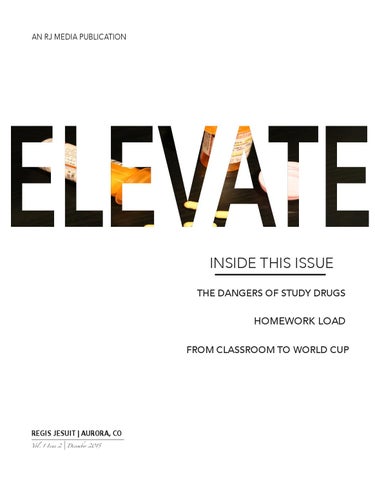
AN RJ MEDIA PUBLICATION
INSIDE THIS ISSUE THE DANGERS OF STUDY DRUGS
HOMEWORK LOAD FROM CLASSROOM TO WORLD CUP
REGIS JESUIT | AURORA, CO Vol. 1 Issue 2 | December 2015
1
TABLE OF CONTENTS
I
II
III
IV
V
I.
III.
Meet the Creator pg. 7
Army Strong - Kaylie Breslin Profile pg. 10-11
V.
II.
IV.
VI.
Michael Khaki’s Double Life pg. 8-9 2 December 2015| Issue 2
From Air Force to Physics pg. 14-15
Pope of the People pg. 18
Q&A With Jess Lewis pg. 19
VI
VII
VIII
IX
VII.
IX.
VIII.
X.
Family Traditions: Fall Edition pg. 24-25
7,410 Miles Away from Home pg. 26-27
From Teacher to Rugby Player pg. 28-29
X
XI XI.
Homework: Is It Doing More Harm Than Good? pg. 38-40
The Underground Study Drug pg. 34-37 3
RJ MEDIA
STAFF
The staff aims to balance what the audience wants with what it needs, and strives to make solid judgments with regards to news value and news awareness.
ELEVATE MAGAZINE Colin Byrne ‘16 & Maddie Merritt ‘16...............Editors In Chief Fiona Murphy ’16 & Cole Ancell ‘16..................Copy Editors Sam Russell ‘16..............................................Photography
Maria Ojile, Charlotte Visser, Madi Emerson, Katie Ernst, Stephanie Llorente, Erika Rasmussen, Avery Anderson, Caitlyn Burke, Natalie Christiansen, Rachel Craig, Kenzie Devening, Christina Finch, Elizabeth Hensley, Ellie Hill, Katherine Lemkau, Sarah Ratliff, Katie Shanahan, Meriel Upton, Julia Weis, Mikaela West, Julie Bradley, Lilly Butsch, Mia Costa, Juliana Davis, Lauren Morphew, Georgia Ray, Reagan Shea, Afton Tanner, Emily Wrede, Reilly Frasier, Claire Hummel, Katie Maxfield, Cole Ancell, Tyler Ballinger, Ron Fishleigh, Connor Lyford, Xavier Ribota, Ben Steyaert, Nick Sangalis, Nathan Shutts, Mark Reininger ........ Staff
RJTODAY.ORG & SOCIAL MEDIA
The publications will serve as a medium for student opinions and ideas. RJ Media strives to produce objective, well-balanced and accurate reporting and content that features a range of students, their interests and their viewpoints. The staff is dedicated to being fair, accurate, balanced, truthful and responsible. The staff will seek the truth and report it, minimize harm and act independently. We promise to be transparent, accountable and open. The staff also upholds Ignation values with regard to social justice and openness to growth. The staff prides itself on using the Ignation Pedagogical Paradigm to help make decisions: context, experience, reflection, action, and evaluation. The student Editorial Board will have final say in the content of the publications. School officials, administration or faculty and staff shall not practice prior review or the have the ability to censor any student publication, with the exception of material deemed to be legally obscene, libelous, substantially and materially disruptive, or coverage on any one of the following three topics, wherein coverage will be worked through with the president and principals: Obituaries, employee termination, and crimes or cases in the court of law. The views of columnists are not necessarily those of the newspaper staff. Opinions will be published on designated pages or otherwise marked.
Anastasia Conley ‘18............... Web Editor Patrick Britti ‘17 ..................... Social Media editor Mason Stragey ‘16 ..................Web Editor Sarah Darley ‘17 ......................Social Media Editor
All material published by RJ Media is copyrighted to RJ Media, year and date of original publishing. RJ Media will not publish any material that is a violation of copyright. We take our own photos and produce our own content. We sometimes use photos with express written permission, but only if we absolutely have to. Those will be credited to the photographer with attribution specified by the permission of use. Read our full editorial policies at rjtoday.org/policy
RJTV & RJ RADIO Patrick Britti ‘17 ..................... Producer Jack Diaz-Doherty ‘16...............Radio Host Fiona Murphy ‘16.....................Radio Host Tyler Ballinger ‘16.....................RJTV Sports Network Max Zahringer ‘17.....................Special Events Coverage
RJTV SPORTS NETWORK Tyler Ballinger ‘16..................Executive Producer and Lead Commentator Nick Sangalis ‘18 .................... Commentator and Producer Kyle Schwulst ‘18 ..................Commentator Tierrah McQueen ‘18......................Commentator CarlySchwulst ‘18 ..................Producer Matt Bornhorst ‘19......................Producer and Commentator
Read our ful Editorial Policies at rjtoday.org/about
LETTERS TO THE EDITOR - WE WANT TO HEAR FROM YOU! Letters to the editor are welcome and encouraged, but will only be published if they are accompanied by a name and signature. Letters should be short and free of “bashing” or obscenity. Letters to the editor do not reflect the views of the RJ Media staff and will be marked on pages designated as such. The staff reserves the right to edit letters for potentially libelous material and length. The staff will not edit letters for punctuation, grammar and usage. Letters with issues will be returned to the submitter for further review. Contact the RJ Media Editorial Board at rjmedianetwork@gmail.com or in the RJ Media Lab (PAC-102). You can also find us on Twitter @RJ_Media
COME WORK FOR YOUR STUDENT MEDIA VISIT THE RJ MEDIA LAB Mondays at Academic Support: RJTV SPORTS NETWORK BROADCASTING Tuesdays at Lunch: YEARBOOK Tuesdays after school: RJ MEDIA, MAGAZINE, WEB & RJTV STUDIO SHOW Wednesdays at Lunch: IMPRESSIONS- CREATIVE WRITING, ART, PHOTOGRAPHY Thursdays at Lunch: RJ FILM MAKERS CLUB 4 December 2015| Issue 2
EDITORIAL POLICIES
RJ Media [Elevate Magazine, rjtoday.org, RJTV and RJTV Sports Network] operates as a limited-open forum for student free expression. The publications are for the students, by the students.
WELL, HI AGAIN. Look down at this magazine that you are holding. Look at the pages; read the stories. These are all done by your own classmates and speak to the power of the student media. We are all here for you; It is our job after all. We love what we do, and we hope that our magazine reflects the dedication that we have towards telling the stories that are important for the Regis Jesuit community to hear. Included in this issue and on our website rjtoday.org, where we publish regularly, are sometimes stories about relatively hard topics to hear. As student journalists, we take it upon ourselves to get you the facts, and to tell those hard stories. What you do with this information is up to you - it is our hope that it changes you for the better. For what would journalism be if not inspiring? Enjoy this magazine, friends. It’s for you, by students just like you.
YOUR EDITORS,
MADDIE MERRITT AND COLIN BYRNE ‘16
5
OUT OF SPACE Parking lot issues push students to outside lots. By: Xavier Ribota ‘18
Due to overcrowding in the student parking lots, some student drivers have been directed to park in an offsite lot. Regis Jesuit has partnered with Fellowship Community Church across Parker Road to provide extra parking for students who have not been able to get parking spaces. Students are then shuttled to campus. Dean Doherty advises the students on looking for alternative parking first, but space is limited. “The students who have a parking pass have their own designated area to park, but for the students that don’t, often times there are vacant spaces next to Laber Field. There may also be spots available down by the tennis courts,” Doherty said. And parking across the street in the shopping center is not an option for students. “We’ve had meetings about it,” Doherty says, “and
although it resolves the problem at school, most students are having their cars towed from the stores’ parking lots.” On campus, when students with passes don’t park in their designated spots, or those without passes take a marked space, additional issues are created. “I am constantly told that a student has taken another’s parking space, and I have made announcements about the reoccurring problem, but almost no one actually acts upon the announcement,” said Doherty. The school has encouraged students to carpool and to communicate about parking spaces being used incorrectly. “I think that everyone should get the opportunity to drive,” new driver sophomore Will Blunk said. “I’m happy to have gotten my license, and I believe that others will be too, but there isn’t enough space for us to park at school, so it’s tough.”
PROJECT UNIFY ASSEMBLY Photos by: Jack Dunn ‘16
6 December 2015| Issue 2
MEET THE
Sophomore Connor Side creates first ever RJ geofilter. By: Ron Fishleigh ‘17
One billion Snapchat videos and photos are viewed on stories everyday. Sophomore Connor Side is one of the 32 percent of U.S. teens who use Snapchat. On his way to the Girls Division one day, Connor saw the beautiful chapel steeple towering over the campus. It was here where he got the idea to create a geofilter for his school. A geofilter is a small graphic that you can swipe on and off after taking a Snapchat picture. The geofilter displays location, sometimes a fact or two, and can also represent an event. Connor created the geofilter after many years of experience. “I opened up my own shop online so I made money off of that all through middle school,” Side said. He has created many designs for YouTubers which included backgrounds, profile pictures, and desktop wallpapers. Connor felt as though the geofilter would be a great way to show our school spirit.
C R E A T O R
7
MICHAEL KHAKI’S DOUBLE LIFE By: Juliana Davis ‘18 and Julianna Bradley ‘18
PODCAST EXTRA! Juliana Davis & Juliana Bradley sit down with Michael Khaki Check out rjtoday.org for more.
8 December 2015| Issue 2
Jake Granader and his journey from daily life to recording artist. Junior Jake Granader leads a double life. By day a student at Regis Jesuit, by night a beast in the booth. Jake released an album on Soundcloud named "White Bread," along with various other singles. His album was released his freshman year. Michael Khaki, Jake’s alter ego, explains life through his eyes. His fixation on rap started as a way to rebel against his parents, who adored country music. However, it goes further than just rebelling against his parents. Jake liked rap because it‘s cool and he liked the sound of it. Over time, it quickly began to mean more to him. Music has always been a safe place for Jake. "It was an outlet; a way for me to explain what I was feeling," Jake says as he sits in the grass. He was first inspired by big artists like Eminem, Tupac, and Biggie. He started rapping when he was 14. He started first with poems that he hid in his notebooks, filling page after page with whatever lyrics came to mind. As he grew up, so did his taste in music. He moved towards other local artists, like Machine Gun Kelly, Klassic, and bigger artists like Earl Sweatshirt, which was inspiration for Jake’s stage name Michael Khaki. As with all art forms, rapping takes time to master, and Jake practices writing and rapping everyday. "I will write something down and think it's good for about five minutes, and then read it again and throw it away," Jake says. However, he continues to write and to build a foundation. Just getting his name out there is the most important goal at the moment. He gets the money for his expensive projects by working five nights a week. Jake says, "I don't ask my parents for anything. I do this by myself." He pays for everything himself, including beats, equipment and studio time. His album titled, "White Bread," has eight songs on it, including a skit. He came up with the name for the album with friends. His reasoning behind it was if people were going to laugh at him, he was going to give them something to laugh at. This goes hand in hand with his stage name, Michael Khaki, which was chosen because "it was the ‘whitest’ name I could think of. I want to prove to people that I am more than what they think I am." His favorite song on the album is "Everything I Am,” which is the intro to the album and has received the most plays on his Soundcloud account. Jake is currently working on a new project. On November 6th he flew out to Indianapolis to record in a studio, where he met with the producer of Mike Posner. Like everything else, he payed for this trip himself. He will continue to build his foundation and get his name out.
9
ARMY STRONG Senior Kaylie Breslin commits to West Point By: Stephanie Llorente ‘16 and Erika Rasmussen ‘16
56.18 seconds. What can a person do in that amount of time? Senior Kaylie Breslin could give anyone a run for their money. She can swim 100 yards butterfly in only 56.18 seconds. This time, spanning less than a minute, took over a decade to achieve. On October 25th, after 12 years of hard work and dedication both in and out of the swimming pool, Breslin committed to swim at West Point Academy, a Division 1 school. “I’d always hoped I could swim in college,” says Breslin. “I knew that it was going to help me figure out which college I want to go to from there.” Breslin also knew she wanted to be in the military. She considered three of the four academies: Army, Navy, and Air Force. “My uncle actually went to the Naval Academy, so it was the first place I went to see because I had family influence,” Breslin said. Next, the Air Force. She visited and watched their meets, which was just down the road in Colorado Springs. In the end, however, West Point took the cake. “I’m so happy to be part of this community. They’re all so close, and they’re all going through the same experiences that other college students don’t go through,” Breslin said. At West Point, she’ll be more than a student; more than an athlete; more than ordinary. “I always knew I wanted to go into the military. To learn to be a pilot while going to school is something I’m really excited for,” Breslin said. Years of long hours, countless swim meets, and rigorous training have definitely paid off. “I am so fortunate to be where I am today,” Breslin said, and she knows she couldn’t have done it alone. “It wouldn’t have happened without the two people that support me the most. My mom and my grandma.” Her grandmother hasn’t missed a single meet other than a couple out of state she couldn’t make it to. Talk about support. Breslins’ teammates are also very proud of her. Senior Lindsay Painton, who has swam with Breslin since they were ten years old, admires her dedication and accomplishment. “I am so proud of her. She has always been a hard worker,” said Painton. “To see her dream of becoming a collegiate swimmer become a reality, and her hard work pay off, is truly something special. West Point is lucky to have her.” Kaylie Breslin has a very bright future in store for her, both in the water and on land. 10 December 2015| Issue 2
11
IMPRESSIONS MAGAZINE TAKES PHOTOGRAPHY, at Rjtoday.org/impressions or ART & WRITING Submit visit the RJ Media Lab during lunch on SUBMISSIONS. Wednesdays. THE RJ FILM FESTIVAL, IN PARTNERSHIP WITH THE POETRY SLAM AND IMPRESSIONS MAGAZINE RELEASE IN APRIL, IS ALSO LOOKING FOR ORIGINAL SUBMISSIONS. SUBMIT YOUR FILMS TO THE RJ FILM MAKERS CLUB IN THE RJ MEDIA LAB ON THURSDAYS. SUBMIT BEFORE SPRING BREAK. Categories include short documentary, comedy, drama, horror/thriller, PSA, broadcast short. Awards for Best Actor/ Actress, Best Director, Best Screenplay, Cinematography, Editing, and more.
12 December 2015| Issue 2
Photo: Jason Lewis ‘17 13
FROM AIR FORCE TO PHYSICS SCIENCE TEACHER MR. MIKE MCLAUGHLIN BRINGS MILITARY EXPERIENCE TO THE CLASSROOM By: Georgia Ray ‘17 and Katie Maxfield ‘17
Mike McLaughlin wasn’t always a physics teacher. There was a time when he reached career heights in the military that not many have ever accomplished. He has watched the supreme allied commander, Europe read the words he had written as a speech writer at the infamous and prestigious Chatham house, which is the Royal Institute of National Affairs in London. McLaughlin says of the experience, “Europe was speaking to a large audience of academic and military people from all over, and he was reading a speech that we had written; it was a cool feeling to sit and watch. That’s something I will never forget.” McLaughlin was born in California but grew up in Naperville, Illinois, right outside of Chicago. From an early age he was infatuated with the physical world and “the way things work,” as he puts it. The hours he spent playing with erector sets was only one of the many indications of his math and science based career that was to come. In college, he studied electrical engineering at the University of Illinois, a choice that was again hinged upon his love for math and science as well as his admiration for his older sister. McLaughlin attributes his decision to her. “My older sister is very bright in both math, science, and she went on to study engineering, so I believe that had an influence in my choosing to study engineering as well,” he said. “But, I’ve always loved learning about how things work and building things, so I believe that was a big part of it too.” After college, McLaughlin joined the Air Force. His career lasted 27 years, 16 of which were spent in an exchange program in Belgium. He describes this experience as a unique opportunity and considers himself lucky to have been able to live in various different states and even countries. His military career has left him with a unique set of skills including the ability to speak French and conversational Dutch. “We were studying alongside military officers from fifteen or twenty different countries. It was a great opportunity to hear a variety of perspectives,” he said of the experience. McLaughlin spent the initial years of his military career flying airplanes for the Air Force, and later moved up to be an instructor pilot. McLaughlin says that this opportunity to help people learn to fly is when he knew that he wanted to become a teacher at some point in his life. Ultimately, he says, “teachers have an opportunity to be a positive influence on the lives of hundreds of students each year. It is a great opportunity to try to make a difference.” McLaughlin’s later career was very different from his early career, but rewarding nonetheless. “Obviously when I was a younger military guy, flying airplanes was pretty neat, but I have to say as my career wound up, my job as a military attaché job was pretty neat as well because we were part of the diplomatic corps in Brussels, Belgium working alongside civilian and military diplomats from all over the world.”
14 December 2015| Issue 2
As a military attaché, McLaughlin worked with and learned from the world’s top military leaders, and was an integral part of maintaining the military relationship between the U.S. and Belgium. A military attaché is like an ambassador, but on the military level it is an honor for McLaughlin to have worked as one. This is not the extent of his prestigious positions either, as he additionally wrote the speeches for NATO Supreme Allied Command, Europe during this time. When McLaughlin retired, he and his family moved to Colorado. During his time in the Air Force in 2002, McLaughlin was assigned to live in Colorado Springs. His family loved the state and knew that they would come back some day. He said that it was hard having a family while also being in the Air Force, but it was also very rewarding. His kids got the opportunity, just like he did, to live all over the world, but it wasn’t without it’s challenges. “One of the things almost all Air Force officers do in their careers is what it calls an unaccompanied remote tour, which is a euphemism for ‘we’re sending you somewhere you don’t want to go and you can’t bring your family. So for one year of my military career I was stationed in Turkey and my family was not with me.” In the end, however, it’s all about the opportunities. “There’s great opportunities, so I don’t think any of us have any regrets,” he said. Now his wife works as an architect in Denver, his 19 year old daughter attends CU Boulder, and his 17 year old son attends Heritage High School. McLaughlin took to teaching because he likes “getting up and explaining things and helping people understand difficult concepts.” “I love physics. That’s the bottom line - maybe a little too much in fact. I think it’s because it’s the study of how things work in the world and at its at the heart of engineering.” And although in high school geometry didn’t come easily to him, he’s realized that it is really in line with his other likes “probably because it’s a really hands-on math class,” he says. “It’s about shapes, and solids, and learning to reason logically.” One of his physics students, Catherine Stevinson says that he is the only reason she is surviving the class and also cites his humor as a welcome presence. “He’s hilarious, Stevinson said. “He couldn’t get the smart board to work one time and he goes ‘you doofus!’ Gets me every time.” McLaughlin is excited to help his students going forward. He always wants to push them to excellence. McLaughlin’s long stint in the military hasn’t made him into the stereotypical ex-Air Force veteran that people tend to think, but it has made a lasting impression on his beliefs. “The Air Force has three core values that all members share - integrity first, service before self, and excellence in all we do,” McLaughlin said. “I say this to students all the time: if you strive for excellence in all you do, you start to get good at being excellent, and when you are good at being excellent, you are prepared for whatever challenge may come your way.”
15
HOP ON OVER TO RJTODAY.ORG WE PUBLISH DAILY.
SNEAKERHEAD SUNDAYS - TEACHER TUESDAYS - WORKER WEDNESDAYS, STUDENTS WITH JOBS - FRESHMAN FRIDAYS - ARTIST OF THE WEEK - STUDENTS & THEIR CARS - MUSIC MONDAYS
POPE WATCH: WEEKLY FRANCIS STORIES - QUIN COTTON SIGNS WITH GCU - SPEECH & DEBATE STORIES - RJ STUDENTS HELP HOMELESS - ART IN THE HEART - BACKSTAGE WITH CONOR KELLY ‘11
BEHIND THE SCENES FALL PLAY - BREAKFAST & BOOKS - ALUM SPEAKER SERIES - W.I.S.H. CLUB SPEAKERS - STUDENTS INSPIRED BY IGNATION FAMILY TEACH-IN - TYLER ZHANG PROFILE
GIRLS SWIM & DIVE COVERAGE - DAIRY OF A SENIOR - CLASSROOM PROJECTORS- TOOL OR TOY? - HUNGER GAMES REVIEW SERIES- RJTV SPORTS NETWORK LIVE AND ARCHIVED GAMES RJ RADIO PODCAST SERIES -
WEEKLY GAME PREVIEWS & RECAPS - MOCK TRIAL PROVIDENCE CUP - STEPHANIE LLORENTE: ADVOCATE - INVESTMENT CLUB FIRST PLACE WIN - HOW TO BE FASHIONABLE WITHIN DRESS CODE - SERVICE PROJECT STORIES
16 December 2015| Issue 2
FOLLOW US.
YOUR NEWS. DAILY. RJTODAY.ORG 17
POPE OF THE PEOPLE
Regis Jesuit heads to Philadelphia for the Pope’s first ever visit to the United States. By: Katherine Lemkau ‘19 and Kenzie Devening ‘19
Six students, two teachers, one city, one Pope. On September 25, 2015, six Regis Jesuit senior students and two teachers traveled to Philadelphia to see the world renowned Pope Francis. Chibueze Agwu, Elly Fangman, Davis Handler, Hector Peralta, Cassidy Roderick, Erin Whitaker, Mrs. Weis and Mr. Ptolemy got to experience how universal the Church really is. Francis became the 266th Pope in 2013 and the first Jesuit Pope. The last Pope to visit America was Pope Benedict XVI in 2008. During Pope Francis’s visit, people from all around the world gathered to hear him speak. Born and raised in Buenos Aires, Argentina, Pope Francis has always had a strong faith and a caring heart for all peoples. “It was in Philadelphia but at the same time I met people from Vietnam, Mexico and I met people from Africa,” senior Davis Handler said of the gathering of a truly world wide Church. “We walked and walked,” says Mrs. Weis, “it was a real pilgrimage.” As they stood in the anxious crowd waiting for the Pope, they shared something special with everyone. “We were surrounded by so many Catholics who were similar in their faith, but all together in different points of their spiritual journey,” Erin
Whitaker said. There were hundreds of thousands of people waiting to see Pope Francis. The crowd was full of joy and had a contagious energy. Everyone was exhilarated when the Pope arrived “Oh my gosh, it was so exciting, you could feel the wave of people’s screams,” said senior Cassidy Roderick. “When the Pope finally rolled around there was a huge uproar and you could hear the high pitched yells,” senior Chibueze Agwu said. Each person has a different perspective, but one of the main themes that stood out to all of the students and teachers was being joyful. “He has a lot of hopeful messages,” said Mrs. Weis. This trip was also a good time of reflection. “The Pope really helped me think about relationships,” Whitaker said. “It inspired me to foster relationships that are really important to me and know that it is okay to let unhealthy relationships go.” Some of the main points that Pope Francis talked about was reserving freedom of religion, hope, renewal, and for people everywhere to stop striving for wealth and power, and to always remember the poor. When the Regis Jesuit students and teachers were not listening to the Pope, they were attending workshops and presentations.
St. Joe’s Prep, located in inner city Philadelphia, welcomed them into their school. This is where they stayed. This all boys Jesuit school was very hospitable to the students and teachers. “I think the most rewarding part of the trip was seeing all Jesuit schools there,” Hander said. “Seeing Regis outside of Regis, seeing that there’s people who think the same way and act the same way but they live in different cities around the world.” Jesuit high school students and teaches gathered at the school to talk about Pope Francis and his message of encounter. “When he said words like encounter it made me think of how blessed I am to go to a school that values such diverse thoughts with a Catholic Jesuit identity,” said Handler. When asked about the overall impact, the students were collectively inspired. Cassidy Roderick said, “It was awesome! I honestly miss it so much already, it’s so sad that we can’t go back.” “Seeing how thousands of people are impacted by one man, it’s not like he’s Jesus or some eternal guy, he’s a regular human being, and so many people are impacted by him, it was really inspiring,” Agwu said. “Seeing the Pope was so rewarding,” said Hector Peralta, “just realizing that we saw this person that has such an impact and such a presence in the world. It’s crazy to think that we were just feet away from him.” Peralta continued, “It was such a strange experience, it was awesome. I teared up a little bit and I have no idea why, it was just amazing.”
Mrs. Weis, Chibueze Agwu, Cassidy Roderick, Erin Whitaker, Elly Fangman, Hector Peralta, Davis Handler, and Mr. Ptolemy ‘07 proudly display the RJHS banner during their visit to Philadelphia in September to see Pope Francis.
18 December 2015| Issue 2
Q&A By: Bradshaw Willis ‘19
RJ MEDIA: What can students do to get a step ahead of the admissions process? JESS LEWIS: The admission
process is quite long, so the biggest suggestion is to start early. It is never too soon to start getting involved or researching the school. There are programs here like SLE (Summer Leadership Experience) where high schoolers come for two weeks in the summer to experience in a small way what it is like to be a cadet here.
RJ MEDIA: Do you think more kids need to apply to a military academy? JESS LEWIS: I think military academies provide amazing opportunities and more people should look into them. It’s not for everyone, though, and students need to consider the commitment they are making by deciding to come here. It’s a completely different experience than normal college. I just happen to love that, but it can be challenging for many people. Overall, if you want to make that commitment, the opportunities here are endless.
ALUM JESS LEWIS ‘15 ON HER JOURNEY TO WEST POINT ACADEMY
RJ MEDIA: What drew you to attend
West Point?
JESS LEWIS: Originally, I became interested in the school because I was recruited for basketball. As I learned more about West Point, though, I realized just how special this place was and how perfect it would be for me. I’ve always been big on leadership and West Point is the greatest leadership development program out there. I also would be receiving a very high valued education from one of the best universities in the country. Eventually, playing basketball here became just a cherry on top. RJ MEDIA: What helped you get into
West Point?
JESS LEWIS: I had quite a few things
help me get here. Of course basketball played a role. More importantly though, I took advantage of all the opportunities at Regis Jesuit. I did well academically, took on l leadership roles within the school, did as much service as I could. I set myself up to be successful by being well-balanced.
RJ MEDIA: What are West Point’s strengths and weaknesses? JESS LEWIS: In my opinion,
West Point’s biggest strength is the people. The Army is a people’s business, where interaction between peers, superiors, or subordinates means everything. The relationships that I have built in the last few months of being here are incredible. I’ve found that someone is always trying to look out for you and wants you to succeed in the end. The biggest weakness here is efficiency. It seems that in the Army, they try to make everything inefficient and not make sense. It teaches us to adapt and survive though, so honestly it’ll help us in the future.
RJ MEDIA: Is it hard to get into a military academy? JESS LEWIS: It is very difficult to get into a military academy. I know it’s less than a 10% acceptance rate because each class here has about 1200 kids.
19
CHOPPIN’ WOOD AND SLICIN’ LUMBER Scene Shop offers new opportunities By: Xavier Ribota ‘18
Blades spinning. The smell of burnt wood fills the air. Countless hours are spent on a single set. "I get a sense of enjoyment when I'm working in the shop with the students. It brings me joy to see them working as an overall team," Mr. Carroll, head of the scene shop says. Located in the back of the Steele Center offstage of the Z Theater, the scene shop is a place based on creativity and hard work. Students arrive at the scene shop ready to work efficiently. Mr. Carroll instructs the manager on the plan for the day. The manager, sophomore Curtis Reisenhaur, directs the scene shop crew on the projects that need to be accomplished. Curtis is new to the theatre
scene, but he has had past building experience, making him a great manager. "I’ve had past experience with the build crew so I know the basics. With help from the other leaders and students I know what to do as my role of the manager," said Reisenhaur. "The scene shop is a very loving and fun place to be working. The environment helps students express their creative side in ways they may not have in the classrooms, so this is a great place for creativity and a sense of support." The tools are a great advantage, and help the crew build sets faster than before. "The power tools came with the Steele Center so there was no need to purchase anything," says
Mr. Carroll. "In the show ‘How To Succeed In Business (Without Really Trying)’ the set is a lot simpler than past years so we can build it faster; even faster now with the tools. We built the backdrop in two days,"Carroll added. From building the sets and otherwise helping the Robotics crew, technical theater and other campus projects, the Scene Shop is an overall helping hand and asset to not only the theater program, but to the whole of Regis Jesuit. In order to create an outstanding performance, it takes a team effort. “Working as a team is the most rewarding part,” Reisenhaur says.
SOPHOMORE CURTIS RIESENHAUER CUTS A 2X4 FOR THE SET OF ‘HOW TO SUCCEED IN BUSINESS WITHOUT REALLY TRYING.’
20 December 2015| Issue 2
FROM THE ARCHIVES
RAIDER REVIEW 1983 Each issue we take a look back to previous student written articles. This article highlights the $76,000 raised by LARK in 1983. Last year RJ raised close to one million dollars at the annual event.
Our old mascot and an idea for a “Regis Festival” can also be seen here.
21
MORE COVERAGE. MORE CONSISTENCY. MORE RJ SPORTS LIVE ONLINE. RJTODAY.ORG/RJTVSPORTS 22 December 2015| Issue 2
Meet The Golf Championship Team Bennet Rogers, Cal McCoy, Tyler Zhang, and Andrew McCormick proudly display the 5A Golf State Championship Trophy. They defeated Lakewood and Coronado on October 6 in Fort Collins.
By: Ben Steyaert ‘16
Even the pros miss shots, but on this hole, Senior Andrew McCormick cannot afford to miss. The atmosphere in Fort Collins, Colorado is as tense as a high school golf tournament can get. This shot that the Regis Jesuit golf captain is about to stroke is the difference between winning the state championship or taking second place for the second year in a row. McCormick takes into account the slope on the green, takes a deep breath and putts Regis Jesuit to a state championship. Although Regis Jesuit Golf has a history of winning, that remains a side dish to the main course that Coach Rogers preaches to his team. Rogers says that his method of coaching golf does not prioritize championship, but the ability to be selfless and to stay within yourself on and off the course. “My biggest hope for these guys is that they can conquer their own selfishness through golf,” says Rogers. Regis Jesuit golf teams in the
past have been successful using the same philosophy that Rogers has taught this year’s team. The golf team this year has maintained a selfless mentality that has allowed them to experience this recent success. The seniors have been able to teach some of the younger golfers improved knowledge, while the younger golfers have been able to bring in new experiences to share with the upperclassmen. Even though McCormick was the one to sink the match winning putt, there was so much effort and teamwork that led up to that final put. “We’ve won five of the last seven state championships, and on some of those teams I felt like we did not have the best talent. Golf requires mental toughness and soundness,” says Rogers. The Regis Jesuit golf team was as mentally tough as they come this year.
Working out and working on different aspects of the game, the golf team remains humble and at peace with themselves. Senior Captain Bennett Rogers, who was one of the four golfers selected to represent RJ in Fort Collins, knows that his team shows the qualities that a winning team is trained to have. “I think every guy on this team represents what we want our players to be,” Rogers said. “Even the guys that didn’t make it to state. You could tell they wanted to play, but you could also tell that they wanted us to bring our A game and bring back a championship for our school.” Regis Jesuit Golf is the perfect example of the cliché that there is no I in team. The selflessness and teamwork that Regis Jesuit Golf practices has led to a program that knows what it takes to be a regular state championship contender year in and year out.
23
FAMILY TRADITIONS: FALL EDITION By: Lauren Morphew ‘17 and Claire Hummel ‘17
That exciting time of the year when the leaves change colors, the spooky and occasionally corny Halloween costumes are dug out of the closet, and, most importantly, the aroma of fall family recipes fills the air of homes everywhere.
Fall is food. Fall is delicious, gooey, Sticky Buns.
Fall is the smell of the Vera family Bacon and Brussel Sprouts meal. For Junior Lou Vera, some of the happiest times of the year revolve around his dad cooking up the delicious Bacon and Brussel sprouts meal. He says, “It’s honestly the best thing to have. We make it all the time. It’s a weird combo, but it works really well.” The Vera family usually eats it with a steak dinner and fresh baked bread. The very first time the dish was made resulted out of a few mistakes while making a different recipe, but according to Lou, “it actually turned out to taste really good and we have been making it ever since.” Lou and his family lived in the Philippines for a few years prior to him coming to Regis Jesuit, and his favorite part of having the meal each year is that it brings back old memories of when he lived there. Fall means never letting go of special memories. The fall season is not only a time of colorful leaves and candy, but also a time where families come together and enjoy delicious food. The importance behind the recipes goes much deeper than simply what specific ingredients there are to add; for many, the recipes represent valuable traditions, timeless memories, and of course, love that can travel across countless number of generations.
Fall is Spicy Posole Soup and Homemade Tamales. For junior Taylor Bush, fall means straying from tradition and enjoying her family’s famous tamales and Posole soup. Bush states, “Tamales are not the easiest things to make, but the soup is pretty easy...,” she smiles and continues, “This food always reminds me of when I was younger watching my aunts make it in the kitchen and I would be complaining that it was taking too long.” Coming from a Hispanic background, Taylor and her family like to stray from tradition for Thanksgiving, and prepare completely different foods for the holiday. “We do have the ham of course,” she said. This special dish requires lots of preparation for the fall season. “My aunts and grandma make it the day before Thanksgiving because there are so many people who come over,” Taylor says. Taylor Bush’s favorite part of enjoying the Posole soup and homemade tamales is that the foods bring her giant family together so that they can catch up and laugh at old memories. Fall means relaxation, and not having any stresses for a day during Thanksgiving. 24 December 2015| Issue 2
For junior Rebecca Krempasky, one of the highlights of the arrival of fall is her grandma’s famous Sticky Buns. “They are sweet and rich and perfect on a cold fall morning,” she says. The Sticky Buns do take a little time, but according to Krempasky, “It’s totally worth it.” The recipe has now been passed down from Krempasky’s grandmother, and making the beloved treat is becoming an inter-generational tradition. “My grandma used to make it a lot, but since she stopped baking as much, I have definitely been making it more,” Krempasky says. ”The Sticky Buns are not only a delicious treat, but they are also an important symbol for family. Since my immediate family travels a lot, my grandma will send them to us on our trips so that we still have a piece of family with us... When I eat this food I feel at peace no matter what is going on in my life.” Fall means family sticking together, and remembering that no matter how far away you are from one another, there is always love.
Ta -
In cl m T an Si w o
Taylor Bush’s Posole Soup Recipe - 3 cups cooked pork cut into bite sized cubes - 2 tablespoons lard or 2 tablespoons bacon fat - 1 large onion, chopped - 2 cloves garlic, peeled and diced - 1 teaspoon black pepper - 4 ounces diced green chili peppers - 15 ounces white hominy, drained and rinsed - 1 1/2 cups cooked pinto beans (optional) - 1 quart pork stock or chicken stock - 1/2 cup chopped cilantro In a large pan, sautÊ onions in lard or bacon drippings until clear. Add garlic and spices and cook for another two minutes. Add meat, green chili, rinsed hominy and beans, The beans are not traditional but we like them. Cook for another two minutes. Pour stock over all. Add salt for taste. Simmer, covered, for about 1 hour. Pass cilantro and lime wedges for those who like a pinch of cilantro and a squeeze of lime over their soup.
25
7,410 MILES AWAY FROM HOME A mom’s love persists through the hardships of war and sacrifice. By Ellie Hill '19 and Natalie Christiansen '19
Your home. A place of comfort, love, memories, and safety. Every item in your home has some sort of value to you. Your house tells a story. But what if you had to leave every two years? What if you had to start all over? In a new town, in a new school, with brand new people. For freshman Nick Zeh, these experiences are very familiar, as he has relived them 11 times. “If I told you that, I would have to kill you,” Nick Zeh’s mom, Gianna, tells him when he makes the weekly phone call to Afghanistan. Nick’s mom has been deployed in Afghanistan working as a hospital administrator. For two hours, they catch up and talk about their weeks. That may seem like a regular routine, but he never knows when he will be able to talk to his mom next. “Right now I have a mom, but I don’t get to have regular conversations with her,” explains Zeh. This 365 day long deployment is the longest time she has ever been away from home, and her time away has hit Nick the hardest. Nick’s parents have both been in service for the U.S. Airforce. His dad retired four years ago after 28 years of service as a HR personnel, and his mom has continued to serve in the military for 22 years. “You never know what the next day is going to be like because something could happen, and then your parents are gone,” said Zeh. This statement is all too real for Nick when he hears about the regular rocket attacks that his mom’s building gets. Zeh explains that his brother and him have had to become more flexible and open to change because of the risks that his mom takes everyday. “We are a little more mobile and a little more flexible.” Flexibility and always being on the move comes with a price. Zeh often has to sacrifice having close relationships with peers, as his family makes a fresh start every two to three years. He has moved 11 different times and has lived in nine different houses. Throughout the years, Nick has developed friendships with people from all over the world that speak different languages. A frequent place for run-ins with his friends is at the airport. He tries his best to keep up with 26 December 2015| Issue 2
Freshman Nick Zeh talks about living in a military family. friends over email or text, but it is hard to maintain a deep relationship with them. Through all of the sacrifices that his parents have had to make, Nick has learned some valuable lessons about how to live his life. Integrity first, service before self, and excellence in all that one does. These are three values that you have to swear by when you are inducted into the armed forces. Zeh talks about the impact that his parents have on him, saying “knowing that they do not care about themselves; they just go out into the world and do whatever it takes.” Through the risks, fresh starts, and phone calls, Zeh wants people to know that he is just like other families in that he loves making friends. His experiences just might be a little different than yours.
27
28 December 2015| Issue 2
FROM CLASSROOM TO WORLD CUP By: Nick Hillenbrand ‘16
When Zach Fenoglio first started playing rugby in 2005, he never knew he would one day be starting for the USA World Cup Team. Regis Jesuit Chemistry teacher, Fengolio never settled with his everyday life of teaching, coaching, and playing professional rugby here in Colorado. He wanted more. So he set out to improve his game and began to a play at a new level. He played the best rugby he has in his lifetime for the USA Eagles, the developmental national team. His efforts didn’t go unnoticed. Fenoglio was selected to play for the full national team. He would receive the opportunity to play for his country in the World Cup. “I never thought I would be this fortunate to achieve what I have in Rugby,” said Fenoglio. As the starting hooker, Fenoglio played his first World Cup game in an unfortunate loss against Samoa, in Japan. The World Cup outcome wasn’t what the team had hoped for, but they improved and are now on the map. Fenoglio, like several other players on the USA team, attended a Jesuit high school and college. “It naturally fits the Jesuit brotherhood aspect,” Fenoglio says of rugby. “Many of the same values and traditions can be found in both.”
RJ MEDIA: How and when were you introduced to Rugby? FENOGLIO: I was introduced to rugby in high school at Regis Jesuit my sophomore year. A number of my friends played their freshman year and encouraged me to come out and play sophomore year. RJ MEDIA: Did you ever think that you would be playing at this level? Was there a moment where you discovered you had what it takes? FENOGLIO: I never thought I would have been so fortunate to achieve what I have in rugby. I was fortunate to get on some select sides in high school and that led to invites to junior national team camps. I’ve followed the pipeline all along from the junior national team, to collegiate All-American, to the national developmental team, and now finally to the full national team. Each one has been a blessing and a gift along the way. RJ MEDIA: What do you see for the future of this sport? FENOGLIO: I think it is continuing to grow and flourish not only in the states but also throughout the world. It’s still a relatively young sport in the professional world, only going fully pro less than 20 years ago, so there is still so much room to grow. And now that there are continued growing concerns with concussions and head injuries in football I think rugby will continue to gain exposure and growth. RJ MEDIA: How do you see yourself involved in the growth of Rugby, the fastest growing sport in America? FENOGLIO: One of my best friends I’ve made through playing rugby on the national team, Shawn Pittman, once told me that the knowledge we’ve been fortunate to receive is only as valuable as who we pass it on to. I’ve really made it my goal to pass my experiences and knowledge on to as many as I can to help pass on a sport that has been so good to me.
RJ MEDIA: What are some emotional experiences you endured as a USA Rugby Player? What are a few challenges you had to overcome? Or have yet to overcome? FENOGLIO: On both sides of emotional experiences, the biggest obstacle to overcome was definitely when I was dropped from the national team and was going to be on the outside looking in for the World Cup selection. I wasn’t picked for three national team camps, and it was definitely a hard time for my career but I was fortunate to keep working hard and take advantage of my opportunities when they presented themselves. By far the most emotional or highest honor has definitely been receiving the official word that I had made the USA World Cup team. I’m grateful. It’s been an honor. A humble honor. RJ MEDIA: What are some of the best moments you’ve had as a USA Rugby player? FENOGLIO: Receiving my first cap and first test win against Russia, playing the NZ Maori all blacks in Philadelphia with the U.S. fans chanting USA during the Haka have definitely been some high notes. RJ MEDIA: Take me through the moment or the day you found out made team. What was that like? FENOGLIO: It definitely was surreal when coach Tolkin brought us all into the meeting room and announced the World Cup squad. It definitely was crazy to see something I had set my heart on five years ago come to fruition. RJ MEDIA: How does it feel to be playing with and against the highest competition in the world? What does it mean to represent USA? FENOGLIO: There is no greater honor, in my mind, to get to represent your country at any time. I have so many people I’ve been blessed to have in my life and support me along the way. To represent and honor them with wearing the USA jersey is truly something special.
29
THE GREAT
4 Runners vs. J
I Drive a 4runner because... “I drive a 4runner because they will last forever and get me anywhere while hauling around people in comfort. Toyotas don’t break.” - David Todd ‘16 “I drive a 4runner because they are all around awesome cars. I love my 4runner because it is unique and does an awesome job on the trails.” - Andrew Cohlmia ‘17 30 December 2015| Issue 2
“I have a Trail Edition (4runner) so it has great handling in the snow.” -Hayden Smith ‘16 “I drive a 4runner because it’s an awesome all-around high school car. It is big enough to hold all of my sports gear. It is also a very customizable car, and allows me to change things to my liking.” - Erich Nuss ‘17
AT DEBATE
s. Jeeps
.
Photo by Sam Russell‘16
I Drive a Jeep because... “The number one reason I drive a Jeep is because it is made in America. There’s also so many things you can do with them. You can put on and take off almost everything and customize it to your liking. And you can’t buy a new 4runner in stick.” - Ryan Vottiero ‘16 “I drive a Jeep because I love to go without a roof or doors in the summer.” -Jack Wilson ‘17
“I drive a Jeep because I feel safe driving it, they look good, and they are fun to drive.” -Vinny Mullen ‘18 “I drive a Jeep because Jeeps have been a part of my life since I was little. I always worked on Jeeps in the garage with my dad as a little kid and it became a passion for me as I got old enough to have my own.” - Nathan Shutts ‘16
31
tre
bu
The weight drops. The ropes tighten. The pumpkin gets airborne, then crushes against the ground into several pumpkin chunks. This is the thrill that two sophomore World History classes got to participate in while competing for first place in the annual Pumpkin Chukin’ contest. Some pumpkins flew forward, others backward. With this wide range of shots, the competition was a nail biter up until Joe Martin, Michael Gaessler, Tony Steiess, Conner Side, and TJ Miller’s trebuchet launched a pumpkin over 40 yards. First place was theirs. Photos By: Sam Russel ‘16
32 December 2015| Issue 2
che
T E A M
t
VIDEO EXTRA!
Go behind the scenes with CJ Wilson & Michael Schmidt from RJTV Check out rjtoday.org for more.
THE
E
33
THE UDERGROUND STUDY DRUG
34 December 2015| Issue 2
ILLICIT PRESCRIPTION DRUG USE POSES DANGER TO HEALTH By: Jack Diaz-Doherty ‘16
Wake up, take a pill, and go to school. For one out of ten people ages 4-17, this is a standard morning. ADHD has become much more prominent in recent years, leading to a various selection of prescribed mediations. For people living with this learning disorder, the pills do an assortment of things that make school seem like less of a hill to climb. Whether it is by relaxing someone with the hyper active trait of the disorder, or helping someone focus, the pills work by releasing extra dopamine into the brain. For forgetfulness, short attention span, or mood swings, the pills assist in controlling these problems. The biggest misconception about these pills is that they make anyone smarter while taking them. This misconception has captured the attention of many high school students who use the drugs without a prescription to cram for finals. “Study drugs” as they have now become known,
are used by students trying to find another shortcut to academic success. While the medication is a prescription drug, it is easier to get than most others, simply because of the amount of students who have access to it. “It’s pretty easy to get, it seems like every other kid either has ADD the or has access to the pills, so it doesn’t take you very long to find them, just ask,” an RJ senior who asked to remain anonymous, said. “It’s definitely happening in both divisions, especially around final exam time. It’s clearly a problem,” another senior said. While taking a pill that will turn you into a studying machine sounds amazing, it’s far from true. "Why take it if it doesn't work? There have been instances during studies when they will give
35
someone a sugar pill, say it will make them run faster or jump higher, and sometimes I think if you believe something is affecting you then you will perform better," Dean Doherty said. There is no proof that these drugs actually help someone without ADHD. For the people who don't have a disorder, there are risks when taking these drugs. Depression, dizziness, blunted appetite, aching, and even death in extreme cases. The same senior who told us how easy it is to get the medication, explained why he sees these pills as a helpful way to study. "When finals come around I don't really know what else to do, I'll study and study but that only helps so much," he said. A report from a survey taken by the Partnership for Drug-Free Kids found that one in five college students admit to regularly taking cognitive enhancing drugs like Adderall or Ritalin. According to the "Monitoring the Future" survey, 6.8 percent of high schoolers admit to using a form
of cognitive enhancing drug and 1.8 percent of high school seniors across the country have admitted to using the drugs as well. Students believe these drugs help them, but for most kids, the drug doesn't actually affect the chemicals in their brain that help them to focus or study. The drugs are just spiking the parts of the brain that any stimulant does. While under the influence of these drugs without a prescription is bad for students, it has the potential to ruin their futures as well. Taking these drugs or distributing them is highly illegal. "We are always looking for it, but what's more important is that these kids know its dangerous, so after the suspension and legal action, its more important to make sure they get the counseling they need to know the dangers of this medication," said Dean Doherty. School punishment is one thing, but state laws are something much more daunting. Having one or
two pills can potentially land someone in prison for up to two years, and even a 10,000 dollar fine. Everyone may have some small personal version of ADD, but if they aren't prescribed, it brings more harm than good. When a student buys a pill from a friend, they don't know how large the dosage can be. Pill dosage can range anywhere from 18 milligrams up to 60 and even higher in certain cases. If someone takes a dosage that high with no prescription, it can kill them. If someone is struggling in school and thinks it is more than just a rough patch or the class is difficult, they should talk to a doctor or counselor. The wrong decision is taking a pill they don't know anything about, hoping it turns them into a smarter version of themselves. School is stressful, finals are stressful, and in a world of shortcuts, students are always looking for the next one. The only problem with this so called “shortcut,” is that it isn’t real.
RUMOR HAS IT THE TRUTH ABOUT STUDY DRUGS
1.
RUMOR- These drugs are safe. TRUTH- Taking prescription stimulants without a physician’s supervision carries health risks to the non medical user because of the possibility of unknown interactions with other drugs, risk for dependence, and adverse health consequences.
2.
RUMOR- Drugs like Ritalin and Adderall can make you smarter. TRUTH- These drugs will not make you smarter, and don’t possess the power to make you smarter. They may help you focus, or they may have the reverse effect - each person’s body is effected differently.
36 December 2015| Issue 2
3.
RUMOR- Most students who use prescription
stimulants without a prescription do well academically. TRUTH- Non medical use is actually concentrated among students who have lower GPAs. Moreover, non medical users often have a history of heavy drinking and other drug involvement, especially with marijuana.
4.
RUMOR- If somebody gives you prescription drugs and you don’t pay for them, you can’t get in trouble for having them. TRUTH- Just being in possession of prescription drugs not prescribed to you by your doctor can result in a hefty fine, prosecution, and even jail time. If you’re distributing them, the legal ramifications could be life-altering.
e.
MEET THE FACTS 6 out of 10 Students are offered a study drug by the time they reach graduation in college.
23.7%
3 YEARS The max amount of time in jail someone caught with any amount of prescription drugs can be sentenced to, according to the National Institute on Drug Abuse. More for distribution.
Of twelfth graders have used illicit drugs within the last 30 days, according to the National Institute on Drug Abuse.
Graphic Illustration By: Andrea Gaccetta‘16
37
HOMEWORK: IS IT DOING MORE HARM THAN GOOD? By: Fiona Murphy ‘16 and Cole Ancell ‘16
B
A A D C F B B F F D A C A F A C D C C A C
Every student knows that unnerving feeling of coming home to a pile of homework, but has that feeling actually started to hinder students more than help them? Studies have been conducted throughout the country and some of the results are truly overwhelming. According to a survey conducted by The Washington Post, less than one percent of the students they asked said that homework was not a stressor for them, and fifty-six percent of the students they questioned said that homework was their primary stressor. This is a very shocking statistic. Although this study was done in other parts of the country, that feeling of stress and anxiety over homework is mutual here at Regis Jesuit. According to a survey we conducted and received close to 800 responses from the student body for, over ninety percent of students say that homework is their primary stressor. “Teachers often don’t realize
38 December 2015| Issue 2
D
how much homework a student has across all seven classes,”said Mrs. Kristen Hayton, Learning Services specialist in the Boys Division.“ Many students here at Regis have three to four hours of homework to complete in an evening and unfortunately this is happening on a regular basis.” For students, the feelings are mixed, but most are receiving, according to the survey, between 3-5 hours a night. “More times than not I feel homework is beneficial, but sometimes it just feels like an unnecessary obstacle,” says senior Frank Cahill. Homework can definitely have a beneficial side to it, but it all comes down to the amount. If students are overloaded on assignments it is most likely that they won’t learn a lot from the material and just get it done for the grade. Research has also been done by the Healthy Kids Colorado Survey. According to their results, homework should be assigned based off of grade level. Students should get ten minutes
of homework depending on their grade level. So, if you are in tenth grade you should expect to have a maximum of one hundred minutes of homework per night. This is including projects, studying, and reviewing. Of course, for certain classes the homework might be more extensive in terms of the work load, but none of it should be enough to be considered counterproductive. “I think if the teachers would work together and keep it at two hours or less in total a night, then that gives students time to be with friends or just have some free time,” said Hayton. “It is so common now for kids to quit sports or clubs because of the work load. That is really unfortunate because you need that extra activity in your life.” It is also important to take into account that we go to a private, college-prep school, and we should expect more work, but not to such an
B
extent that it is forcing us to just get the work done for the sake of our grade. We should be learning in the process. “Some homework helps me, like math, but sometimes it just feels like busy work thats purpose is to stress me out,” said senior Isabella Pichler. Often times we put such an emphasis on how hard college is and how we need to be prepared, but in reality college in a lot of ways is actually easier than high school. “College is definitely hard, but I think in a lot of ways high school can be more challenging. In college you typically go to fewer classes in a
students with time at Academic Support solely for the means to talk with teachers about what you don’t understand and need help with. This isn’t just a problem for the teachers to solve; it is also reliant on the students across the country. “If the students, teachers, and administration talk together, we can find a good solution. It definitely needs to be a collaborative effort between everyone, but until someone says that this is a concern and we start talking about it, nothing will change,” said Hayton. Throughout the midst of this growing issue in the education system, it is good to keep
day; they are spread out over the week. You have to manage your time wisely and there is plenty of work. It isn’t easy, but you are provided with more time to do work,” said Hayton. “In high school it’s also not just the homework that stresses kids out. The social factor, the way we grade, and how we construct our curriculum all matter.” We also have to take into account that some students might be more knowledgeable in certain subjects more than others. Every student is different in terms of what best helps them learn and that is really the main overarching crutch of this whole issue. “Some students might be awesome at AP history class which takes some kids an hour to read and it might take that particular group of students only twenty minutes,” said Mrs. Dana Bauer, Learning Services specialist and Counseling Department chair in the Boys Division. That is also the whole purpose of why the administration of Regis Jesuit provides
in mind that the faculty of Regis Jesuit and schools around the country are making a conscious effort to fix the problem in the most organized and beneficial way possible. “This shouldn’t be a
punishment based thing, but instead our focus should be on what we can do to best help and support you to learn,” said Bauer. “We need to make sure that what we are doing is affecting our students in a positive manor.” Hayton says it’s about balance. “You need a passion and time to pursue it. We don’t want students to purely focus on school work and nothing else,” she says. “I think we may find students are more engaged in their learning if they are more balanced, get a good night’s sleep, and have time for things that refresh them.”
CHECK OUT THE REST OF OUR HOMEWORK LOAD SURVEY ON THE FOLLOWING PAGE
39
We conducted an email survey of the entire student body about homework load and received 790 responses.
Here’s what you said.
40 December 2015| Issue 2
HERE’S A LOOK AT WHAT WE ARE WORKING ON FOR OUR NEXT ISSUE. WHERE IS THIS STATUE? WHAT’S THE DEAL?
THE STEM CENTER POLITICS, ANYONE?
RJ HOCKEY PROGRAM SPECIAL SECTION: THE HOLIDAY ADDITION
AVIATION CLUB WINTER AT RJ: A SEASON FOR OTHERS
THE DANGERS OF TEXTING AND DRIVING
IDEAS?
SEND THEM TO US ON SOCIAL MEDIA USING HASHTAG #RJMEDIASTORIES OR STOP BY THE RJ MEDIA LAB ANYTIME. EMAIL? YEAH, THAT WORKS TOO. RJMEDIA@REGISJESUIT.COM 41
By: Maddie Munger ‘19 and Afton Tanner ‘19
Stress: the body’s reaction to any change that requires an adjustment or response. The body reacts to these changes with physical, mental, and emotional responses. Throughout the course of high school, all students experience stress. The top 5 stresses of students are homework, tests/ quizzes, sports/ extra curricular activities, performances, and social. Stress can be positive, keeping us alert and ready to avoid danger but becomes negative when a person faces continuous challenges without relief or relaxation between challenges.
Homework: "I tend to procrastinate often but I try to get all of my homework done over the weekend for assignments that are due on Monday and Tuesday," explains Julia Johnson '17. Homework can take anywhere from 30 minutes to 5 hours to complete. It causes major stress and it can take away from sleep.
Social: "Friend groups change a lot...you want to keep talking to them and not ruin the relationship, but sometimes, attempting to bridge that gap can negatively effect you both,"continues Johnson. Social media and friends can cause stress as well as school work.
Tests: "I definitely have more stress during tests because they are a large part of my grade," explained Evan Benke '17. Tests are defined as a procedure intended to establish the quality, performance, and reliability of something/ someone. Classes often have tests once every two weeks and quizzes every week.
Health Issues: As a result of a continuous pattern of over-working and stress-relayed tension builds and this can lead to physical symptoms such as distress, asthma, diabetes, Alzheimer's, accelerating aging, and/or heart disease. It can even bring up or worsen symptoms or diseases like headaches, upset stomach, elevated blood pressure, chest pain and problems sleeping.
Sports/Extracurricular Activities: "They take up a lot of time
after school that could be spent doing homework, which then causes stress," Benke says. Sports and extra curricular activities include a large variety of physical activities such as individual sports, team sports, plays, music, etc. These activities often take up a fair amount of time after school and prevent from getting to bed at a decent time and delay when you finish your assignments.
42 December 2015| Issue 2
Management: In
order to keep your stress levels low, you’ll have to balance all of this. For tests/ quizzes, you could form a study group and get together to study before the upcoming test/ quiz. Perhaps most important, however, is making sure you eat right and get enough sleep.
THE LIBRARY CORNER By: Elizabeth Hensley ‘19 and Rachael Craig ‘19
Recommend by the Girls Division Librarians: Top Ten New Books This Year
1: Go Set a Watchman by Deckle Edge 2: IQ 84 by Haruki Murakanii 3: Beautiful Chaos by R.M. Drake 4: Belzhar by Meg Wolitzer 5: Library of Souls by Ransom Riggs 6: It’s Your World: Get Informed, Get Inspired, and Get Going by Chelsea Clinton 7: The Opposite of Loneliness by Marina Keegan 8: Prison Island: A Graphic Memoir by Collen Frakes 9: Untwine by Edwidge Danticat 10: You’re Never Weird on the Internet(Almost): A Memoir by Felicia Day
PODCAST EXTRA!
BOOKS, BOOKS, AND MORE BOOKS! Listen to Elizabeth Hensley and Rachel Craig’s weekly podcast on rjtoday.org
BOOK REVIEWS Rick Riordan has done it again! He made a great and heart-wrenching story about Percy Jackson and Greek mythology, Sadie and Carter and Egyptian mythology, and combined Greek and Roman mythology for a fast-paced, page-turner series. Now, he makes everyday problems seem like nothing in multiple ways. Without giving anything away, Magnus Chase is a homeless boy who has some innocent seeming friends who are actually extraordinary. His family has always been fascinated with mythology. He thinks they’re crazy, until he has to get involved to save his life. With a visit from his two uncles and his cousin he hasn’t seen in awhile, his entire life changes. Is it for the good? Or does I his life just get a hundred times worse than before? Read it and find out. - Elizabeth Hensley ‘19  The Sword of Summer by Rick Riordan is a good book but a little slow. In this book you follow the story of Magnus Chase, a sixteen year old homeless kid living on the streets of Boston. His mother was killed in an apartment fire two years ago. He then meets his strange old uncle, pulls a sword out of river fights, a Norse fire giant, and dies. The book still has the same humor and sarcasm as his old books, but because Magnus’ sword does all the fighting it makes the story a bit dull. While you see them travel throughout the nine worlds there is not much action and a quarter of the story is trying to find the sword. You do see friendships being formed and Magnus learning about his einherji powers. I have high hopes for the next book as this one seemed to be setting the stage for the rest of the series. - Rachel Craig ‘19
Untwine is a great book for teaching a lesson. Most books aimed at young adults today are about forbidden love, hardships within love, and doing all you can to get the perfect love. The thing with that is, it doesn’t always happen like that. Sometimes, love is forbidden for safety, and doing anything to get that love could hurt you tons more than just letting go at the beginning. Untwine is just the opposite. It is a survival story about a twin after a car crash. It is about a sister who won’t let go of her best friend since their birth. It is about a family that has to stick together for the sake of hope and comfort. It is a story to remind people that nothing is permanent and anything can happen whenever. - Elizabeth Hensley ‘19 If I was to describe Untwine in one word, it would be depressing. The story was extremely well written and the author understood how grief affects a person, but it was very hard to get through as it was depressing. It was painfully slow to read. I would not recommend it. - Rachel Craig ‘19
43
BEING
In
By: Sarah Ratliff ‘16, Mark Reininger ‘16 and Charlotte Visser ‘17
The percentage of adults ages eighteen or older who describe themselves as Christians has dropped by eight percent in the last seven years. According to Pew Research, the percentage of Americans who are religiously unaffiliated has increased by nearly seven percent in the same amount of time. Among U.S. adults who were raised Catholic, fifty two percent have left the Church at some point in their life. Four in ten people who were raised Catholic now do not identify as Catholic. But as the number of Catholics in the United States drops, the approval ratings for Pope Francis are soaring, reaching up to ninety percent among Catholics. Pope Francis also has high approval ratings among non-Catholics. While asking Catholics to be more accepting, Pope Francis has also challenged them to be more humble in giving to the poor, refusing to live in the Apostolic Palace and ride around in a Mercedes limousine. “The Pope is calling us to challenge people’s views on capitalism and those that are blatantly consumerist, and this challenges Catholics in America,” said Mr. Broderick-King, Regis Jesuit’s Ignation Spirituality and Identity Coordinator. But a renewed effort to give to the poor isn’t the only thing American Catholics are struggling with. Many Catholics today are choosing to believe in only some parts of Church doctrine. Some Catholics express a frustration with the Church’s views on homsexuality, divorce, and women’s rights, feeling that the environment is too conservative. Others have contemplated the teachings and rejected them or simply felt uninspired by the faith. According to Pew Research, the percentage of college graduates who identify with Christianity in general has declined by nine percent since 2007 and fifty percent of graduates are
Q&A
WITH MR. JIM BRODERICK-KING ‘87
44 December 2015| Issue 2
religious skeptics. But skepticism and questioning is all part of one’s journey to understanding faith and religion, Broderick-King says. It’s nothing new. “That’s the story of my life,” he says. “It’s pretty normal and it is common for American youth.” In fact, Broderick-King says, “some people criticize how Regis Jesuit encourages students to question their religion.” The school’s mission is fostered by the Ignatian Method, which stresses the individual student to make the most of their faith and apply it to everyday life. This form of education implements the practices of St. Ignatius – like the daily Examen – into the classroom. Broderick-King says that for Catholic students and non-Catholic students alike, the curriculum is made to deepen the students’ relationship with God and the community by challenging their fundamental beliefs rather than preaching from a single religious perspective. “We try to evangelize, but not in a popular sense,” Broderick-King clarifies. “What we’re looking at is appreciating deeper prayer life, individual relationship with God, spirituality that engages the world, that sees God active in the world, and being very distinctly concerned about social justice,” he says of the school’s mission. In a student survey we conducted over email in November, out 517 responders, 93 percent said they felt comfortable expressing their religious beliefs at At Regis Jesuit and 81 percent said that Regis Jesuit has allowed them to grow in their faith. Additionally, 53 percent said they felt Regis Jesuit has challenged their religious beliefs. Fr. Bob Sullivan, SJ says, “we all have to question the values we hold true and questioning values is important.” We are challenged, Fr. Sullivan says, “to ask questions
Q. Should you agree with
everything in the Catholic doctrine if you are Catholic?
A. We should. However, we need to recognize
that there are tensions we need to solve. When it comes to teaching on capital punishment and abortion, many people are torn but the Catholic Church gives us an absolute, which is a respect for life.
Q.
old incl nat Ho Can “go tee abo
because our secular society challenges us far more than it did in the past. Kids have to be strong enough to hold onto the values from their parents.” At the same time, Fr. Sullivan says, you have to stay true to your own values and follow your own intuition, something he sees Regis Jesuit students do very well. “I went to Regis Jesuit 60 years ago,” Fr. Sullivan says, “and the kids were not as open and as tolerant as you are now. Kids have wonderful Christian points of view today.” For freshman Hunter Thompson, the Catholic faith drives him to be a better person and develop a more meaningful relationship with God. He came to Regis to become better educated about his faith. “I go to Mass every Sunday, I pray several times daily, I keep God close in my thoughts, words, and actions,” Thompson said. “IT IS Upon entry, 65-70% of RJ students describe themselves as Catholic on their applications. As EASIER one of these Catholic students, Thompson tries TO BE to integrate his Catholic faith into every part of his life. SCIENTIF In the same way, sophomore Emma IC AND Goldsmith keeps her faith alive by practicing a religious outlook. UNEMO “I practice my faith by seeing God in everyTIONAL one and everything. I see Him in nature, in the THAN community, my family and friends,” Goldsmith says. IT IS TO Because she recognizes God’s presence EXPLAIN around her, she strives daily to integrate God into her life. For Goldsmith, it is important to THE MYShave tremendous respect for God and all of His TERY OF creations. “When you have this mindset, you find GOD.” beauty and peace in everything around you,” Goldsmith reflects. “God becomes a more - DANIELLE prevalent character in your life and it is a lot CARR ‘18 easier to find Him and draw closer to Him, which is ultimately my goal.” And that individual relationship is sometimes harder for young people to work on and to build. Questioning is easy, Fr. Sullivan says, answers are not. “If you start questioning everything you will find difficult things in the world that are hard to answer with Christianity,” said Sullivan. “Life is messy, and we must address issues within the context of faith and love and hope and they can start to make sense.” “It is easier to be scientific and unemotional than it is to explain the mystery of God,” says sophomore Danielle Carr. “Society is telling us that being religious is uncool, Check out our but society also tells Religious us that getting drunk identity at Regis and having onenight stands is cool. Jesuit survey We don’t always on the next page.
Q. Young adults are more accepting than older Americans of homosexuality, more inclined to see evolution as the best explanation of human life and less prone to see Hollywood as threatening to moral values. Can a person have these views and still be a “good” Catholic? Could this generation of teenagers and young adults change anything about Catholic doctrine?
listen to society.” The presence of a more secular society makes staying true to one’s values ever more challenging. Negative societal influences can come from Hollywood and from a general culture of self-centeredness and cynicism. Broderick-King stresses that it is up to the students to apply what Regis Jesuit teaches them to their outlook on life. “We’re willing to get right to the heart of why we believe what we believe in the Catechism, to question OF RJ STUDENTS it in order to understand it more fully,” CURRENTLY Broderick-King says. PRACTICE And, in the end, it is the hope CATHOLICISM that a personal relationship with God ACCORDING TO transcends backgrounds and unites young people to stand up against a OUR SURVEY secular world. Senior Yash Sinha, a practicing Hindu at Regis Jesuit, appreciates that RJ works to “involve everyone in the community, regardless of their background” and provide a place for all to work on their faith. “The retreats, service projects, and the diversity club that I’m a part of [Diversity Action Group] show Regis’ mission. Because Regis stresses spiritual growth, I would say that I have become a better person by going here,” said Sinha. Fr. Sullivan says that all of the questioning, all of the skepticism, and all of our differences will always come back to love. “Faith is about love,” he says, “and that will be a model for young people that they will want to follow. We all do.” Sullivan continued, “When I lived in Central America I knew a lot of kids who liked to play basketball. But it wasn’t until they could start watching the professional teams that they really got good at it and dedicated to it. I think faith is a lot like this; we have to continue to be professional models of love and acceptance for each other.”
58.7%
A. The Hollywood perspective is a very fickle one, which is something to be suspicious of and we
shouldn’t find identity in this. A hundred years ago, the Catholic Church was strictly against evolution and now Pope Francis, in a consistent line with previous popes, is saying that it is not. The Pope asks us to be merciful towards homosexuals. Change in the Church is very slow. A while back, a Jesuit saw beauty in the theory of evolution and expressed this but was silenced by the Church and it took many years of change for the Church to realize it was wrong. The Church’s reluctance to accept homosexuals is not permanent, and there will be adaptations to views in the future even if the doctrine does not change. I think what’s great about the youth asking these questions is that we can get to thinking about what really troubles us about simple humanity. They are forcing us to ask more meaningful questions.
45
We conducted an email survey to the entire student body about religious identities at Regis Jesuit. We received 516 responses. Here’s what you said.
46 December 2015| Issue 2
BEST OF THE WEB VISIT RJTODAY.ORG FOR BREAKING NEWS AND IN DEPTH COVERAGE
Snow Day or Snow Delay? How the decision is made. By: Cole Ancell ‘16 To students, the decision between a cancellation and a delay due to weather conditions seems just like a spur of the moment decision, but really a lot of thought and effort is put into the final choice. The main focus for the administration is to make sure that the students are safe. “The process really involves two key decision makers which is myself and Ms. Kessler in the Girls Division,” said Mr. Alan Carruthers, principal of the Boys Division. “We are usually up and on the phone with each other around four-thirty in the morning so that we can make the call by five for the students who live further out.” The main challenge that comes with making this decision so early in the morning is that in Colorado the weather is so unpredictable you never really know how it is going to turn out by the time school would normally begin. However, Kessler and Carruthers are always on top of how extreme the conditions are across the state. “We are both always on the CDOT website which provides us with speeds, surface conditions in areas, and we particularly look at some of the major passes such as Monument Pass from Castle Rock because that is a very crucial one due to the amount of students we have commuting from that area,” said Carruthers. Another factor that they take into account when making this decision is other local school closures. Obviously RJ is different in the sense that we have such a diverse student body coming from all over the state, but they do pay attention to how other schools are treating the weather. Also, on days where snow is expected to fall in large quantities the grounds crew members always head to school earlier than usual to get a head start on clearing the parking lot and Carruthers is on the phone with them discussing how the road conditions are. “We take all of this compiled information and then proceed to make the call of what is the safety reality for our students,” said Carruthers. “Knowing that we have about eight-hundred student drivers on campus we have to think through what is the safest option.” A lot of thought goes into the process of making these decisions, but whether it is a delay or a cancellation it is made in the best interest of the student body and faculty.
Review: How To Succeed In Business Without Really Trying By: Fiona Murphy ‘16 ‘Without Really Trying’ is one of the best high school performances I have ever seen. The production began on the weekend of the 7th of November, running through two weekends, ending the 15th. Kate Anderson ’16 was the female lead, Rosemary, and prepared tirelessly for the musical since early September. “It can get stressful, putting that much energy in, but in the end, it was all so worth it,” Anderson says. The effort immensely payed off. From the clever set pieces to the incredible acting and professional sounding music from the student pit band, the musical held the audience’s attention throughout. “The actor who played Finch [Ethan Clock] was my favorite,” senior Ali Elio says. “I didn’t think kids could act like that.” Ethan Clock’s performance was a major highlight of the show. His clever body lanVIDEO EXTRA! guage and Behind the scenes documentary by Quinn Ritzdorf, Danh Nguyen, Jorge Paredes - seamless line Check out rjtoday.org for more. recital made his character, J. Pierpont Finch, come to life. The audience was on Finch’s side throughout his adventure through the business world due to his convincing and witty performance. Adding to the genuineness of the actors’ performances were the costumes. The business casual dress costumes created an atmosphere of the elite, and demonstrated some characters’ mutual yearning to be the elite. “The business part of the show definitely directed the costumes in that we looked for nice clean lines and tailored silhouettes,” Lainey Peltier ’16 head costume designer says. “If the Steele Center keeps plays like this up, I’ll be front row for every show,” says Maddie Ridder ’16. I couldn’t agree more. Congratulations to all who worked on this extraordinary musical. The Regis Jesuit community will be back for more next season.
47
EDITORIALS Changing Modern Media By: Maddie Merritt ‘16
I believe humans are inherently good. Although there is violence, destruction, and suffering in the world, humans also possess a capacity for love, empathy, and compassion. These positive qualities make it possible for me to believe in the inherent dignity of humanity. Because of my belief, I make the decision on a daily basis to challenge the idea that humanity is a malevolent entity. I am committed to dispelling the idea that humanity is corrupt by the beauty I see in this world everyday. When I see the compassion teachers have for the maturation of their students, my conviction deepens. When I see children cooperating with one another no matter their race, ethnicity, or financial background, my love grows. When I see droves of people come together after a national tragedy, my hope is restored. Whoever said that only grand gestures of greatness can defeat the darkness had never encountered people who embody the epitome of human strength. The young boy giving his mother a hug after a demanding day at work; an impoverished woman giving all the money she made that day to a homeless man with a mentally disabled daughter; the teenager battling cancer who still manages to volunteer at the local animal shelter. As the wise J.R.R. Tolkein wrote, “It is these deeds of ordinary people that keep the darkness at bay”. If one really thinks about it, more good goes on in a day than destruction. Too often do we choose to look for the bad in life - it is all over the headlines. But I’m striving to change that. My love for journalism started because of my determination to change the cynical stories that are prevalent in the media, and my goal is to publish articles with positive headlines instead of negative ones; optimistic articles that uncover the stories of “ordinary” people. My goal is to challenge the modern media that focuses on the bad instead of the good; to go against the cliché form of journalism and instead pursue justice in a positive way by focusing on the small acts of ordinary people. For that is what most of the world consists of: ordinary people with good intentions. They are who should be showing up in headlines.
48 December 2015| Issue 2
CRITICIZED FOR QUICKNESS By: Colin Byrne ‘16
They say we spend too much time on our phones. They say we can’t socialize face to face. They say that we feel an undeniable need for our phones. They say we can’t read. Well, I say this is all foolish. As the first generation that has been given the tools to receive and send data at the speed of light, we take a lot of hate for it. Almost everyday I hear people say, “get off your phones.” This common phrase is thrown around over and over. Social media, cell phones, and a vast network to immediate answers have set Generation Z up for success. Cell phones have been able to give us immediate answers, directions, connections to people, and ultimately, a faster way to do simple tasks. Without these tools, almost every event would be handled differently. For example, a simple snow-day would require a student to get out of bed and check the website. Cell phones have created a much quicker way of communication. Another event that would look incredibly different is GPS, how often do you pull out a map? Or even own a map of a city? Of course, some people have become addicted to these tools and I can agree that all the connection can create an overwhelming world. But, cell phones have created different ways to read, instead of picking up a book or paper, we have started to use screens. These tools have given global connections to the world and created quick interactions. As a generation, we have been given the tools to do simple tasks in mere seconds and with the great power of cell phones it comes with some issues that just need to be worked through. Students should not be boxed in, as a generation we are the first ones to have the ability to get instant information.
Different, But Not Less. Living with an Autistic sibling By Maria Ojile ‘16
If you ask my brother what his favorite movie is, he will tell you exactly when the movie came out, who was in it, and who the “bad guys” were. He remembers little details about your life that you might not even remember, and if you tell him what year you were born, he can tell you how old you are in a matter of seconds. My brother David is one of the most brilliant and amazing people I have ever met, but some people fail to realize how incredible he actually is. They see him as different because his brain doesn’t work like theirs does. David has autism. Autism Spectrum Disorder affects about 1% of the worlds population. Roughly 3.5 million Americans live with some type of autism. Nobody is quite sure what causes autism, but the disorder is very often seen in identical twins. My older brothers David and Dominic are identical twins, but only one of them was officially diagnosed with an autism spectrum disorder. David has been living with autism ever since he was born, and his life proves to be more difficult than others who are neurotically. On the autism spectrum, David is considered to have “mild autism” and is “high functioning”, meaning that he is autistic, but he has skills that people with more severe autism might not have. He is able to fully communicate with us, but he has challenges with things that most of us would consider second nature. Growing up with an older brother who needs more special attention than I do has been an interesting experience. I feel like I have a lot of responsibility as a sister. I need to be willing to help my brother, even if I don’t want to,
because I understand that things are harder for him than they are for me. When I was younger, I didn’t understand autism as much as I do now. I would question why he acted the way he did, I didn’t get that he couldn’t help the way he acted. I hated it when people would ask why he did certain things, and I didn’t want to have to explain why he was different. I hated feeling like I had to apologize for my brother’s actions. Now, I have a different perspective. I don’t feel like I have to make up excuses as to why my brother is who he is. I don’t have to apologize to the people who don’t understand his differences. I realize that his autism does not define him, it’s just a small part of the incredible person that he is. David has showed me a whole new way to look at life. He is the happiest and most loving person that I have ever met. He rarely isn’t smiling and he goes out of his way to make other people smile. He spends his free time sitting on a corner in our neighborhood, waving and smiling at everyone who drives by. The world doubts people like David. He might not be able to tie his shoes or button up his shirt, but he can do anything he sets his mind to. We tend to fear what we don’t understand. But understanding is the key to acceptance; we need to understand that people all have their own special needs and special talents. Understand that having a disability does not make a person inferior. We all have special needs, but some people need extra help, extra attention, and a little extra love.
The Co-Divisional Model
By Sarah Ratliff ‘16
Sitting in class, surrounded by people of the same gender, I listen, learn, and ask questions. After almost four years of being in this environment, I’ve accepted this way of education. However, just a few years ago my defiance towards this system was much greater. The co-divisional model of Regis Jesuit raises certain concerns and opinions. Some believe that due to this structure, student behavior could change and lead to disadvantages when entering the real world. I did not want to come to Regis Jesuit High School. I really feared the co-divisional model. I feared that I would not find any friends and that the structure of keeping genders separate would make me socially awkward. I am not the only one who felt this way. Mrs. Cassidy-Cernanec, a Girls Division theology teacher, says that students have told her that they feel socially awkward and they fear that it will negatively affect their interactions with the opposite gender when they go to college. To my surprise, everything is going well; however, there were doubts and difficulties. There are definitely set backs to social development with this model. It is important to understand that not everyone will have the same experience at RJ. Allison Foxhoven ‘16 says that it is not just a simple question and answer of if the co- divisional model is good or not. “There are definite positives and negatives to both experiences (co-divisional and coed),” Foxhoven says. Even with this understanding, it is probably safe to say that at least half of the RJ student body ends up having a good overall high school experience. This co-divisional environment allows there to be higher scores within classrooms due to lack of distractions. However, it does not completely separate the sexes. It allows there to be mingle during breaks and sporting events. It is the best of both worlds. I shifted through a few friend groups freshman and sophomore year. But I eventually found my “soul friends.” These are forever friends, my brides maids, my go-to girls. I can always count on them when I feel weak. I even found a few male friends who became “soul friends” in RJ and out. Regis Jesuit High School is unique. The students are truly blessed with both an opportunity to learn without distractions but also the opportunity to have friends and socialize with both genders.
49
SHOULD REGIS JESUIT AGAINST ARMING By Patrick Britti ‘17
To preface this argument, let’s get something straight: Guns, technologically, are incredible. That said, they can, and often do, rain carnage upon innocents. Too often, schools and other public places are transformed into war-zones. To counter this, some believe that the more guns that are out there, the more people can defend themselves. Applying this weaponized-utopian vision to society in general may be plausible, but inside schools it is both unreasonable and dangerous, and the resources it consumes could be better used elsewhere. In the United States, firearm possession is legal and protected under the Constitution. As a private institution, though, Regis Jesuit is free to restrict weapons however tightly the school may want. In an article published by RJ Media last year on the debate, sources said that the school has been involved in discussions on whether or not to hire armed guards for the campus. Boys Division Principal Alan Carruthers said, “Why would we arm? Well, because we are fearful of something. And we would be sending a message about or willingness to live in fear.” The Jesuit mission of our school is one of love and non-violence and compassion. Decisions on the scale of arming employees come from the school's board or the Jesuit's USA Central and Southern Provincial leaders. “Do I think the dialogue here is over, No I don’t think so,” Carruthers told RJ Media last year. “But the Jesuits and the Jesuit community are not in a position right now where they are ready to arm employees of Regis Jesuit.” Arming ourselves would be giving into a world of doubt and fear of our fellow man. At Regis Jesuit, though, there are security guards. While these guards are certainly not solely intended as a line of defense against potential attacks, this purpose is a large part of their job. By simply putting them in place, outside threats may be dissuaded from targeting the school, as they would face, at the bare minimum, these guards.
EDITORIALS 50 December 2015| Issue 2
And leaving them unarmed does not negate their capabilities. In the Arapahoe High School shooting, guards who had no weapons acted quickly and heroically and managed to prevent the situation from escalating. This demonstrates that guns are not needed to stop a violent act. Schools can increase safety by focusing more on security measures – some that were not present at schools that attacks occurred – such as increasing the number of exterior security cameras and locking doors. Anlongside tighter security, shcools train, drill, educate and raise awareness about reporting and reacting to suspicious activity, threats and attacks. But, on a more important note, schools must acknowledge that attacks can be stopped through better counseling, community and kindness in general. In many cases, the perpetrator of the attack was a known threat. Any prepared response to a violent action should not be considered a Plan A, but a last-ditch attempt at preventing an escalation. Addressing mental health is key to saving our communities. Alongside these reasons, guns should not be considered a simple fix. Any employee who would be authorized to carry weapons on school grounds would likely require large amount of training. Not only that, they would be forced to carry the same responsibility of police officer. Staff would be viscerally thrown into a new power dynamic, one where the reality of a student-teacher confrontation could become something more dangerous far too easily. Also, guns that belong to employees could be stolen or misplaced, instigating an entirely preventable but extremely threatening situation. In a place of education, no student or staff should fear for their safety. But bringing guns into our school is npt only against our Jesuit values, but also presents opportunity for further dangers and fails to address the underlying causes of attacks against schools.
HAVE ARMED SECURITY? FOR ARMING
By Sarah Darley ‘17
Not a single person on the Regis Jesuit campus carries a gun. Not one security guard, staff, or faculty member is armed. With such a large campus and over 1700 students it would not be difficult for someone to enter our school with the intent to harm our community. A school shooting happens roughly every 5 weeks in the United States and with over 50 million students enrolled in schools nationwide, why are we not questioning current policies? The Second Amendment has been a controversial issue in the United States for years. Over a third of all American households has a gun and though families who own guns is one issue, guns in our schools is an entirely different topic. Parents send their children to school everyday and into the protection of their teachers, administrators, and fellow students. This comes with inherent risks and safety concerns, so why not protect students to the best of our abilities? The 2012 shooting in Newtown Connecticut where 20 students and 6 staff members were killed was a wake up call for many. Since then, eight states, including Texas, Colorado, and Oklahoma, have passed laws allowing certain personnel the ability to carry weapons on school premises. This allows teachers to become “marshals” who have access to guns that are kept locked inside of a school, but this requires 80 hours of classroom training, a psychological examination, and 50 hours of gun training on a shooting range. While many schools passed up the opportunity to train teachers to defend students, 78 school districts in Texas have adopted the policy. But why? That is the question many concerned parents and citizens
are asking. The statistics speak for themselves. Since 1950, there have been two mass shootings (four or more people shot) that happened in locations where citizens were allowed to be armed. These two incidences were the Carson City shooting in September 2011 and the Gabbie Giffords shooting in January 2011. Every other mass shooting has occurred in a place where citizens were unable to defend themselves. This includes public schools, college campuses, and a place Colorado is very familiar with, movie theaters. This blatantly shows that people who are looking to shoot at the general public, targeted places where they would be able to do so without being stopped. And what about the school shootings that never were allowed to take place? A school shooting never mentioned is the Pearl High School shooting. Luke Woodham, a 16 year old at the time, walked into the high school commons in 1997 and opened fire with a .30 rifle. Principal Roy Balentine heard the shots fired and ran to his car to retrieve his .45 caliber automatic pistol. He was able to detain Woodham until the police arrived and due to his actions, only 2 fatalities occurred instead of the 55 people Woodham would have been able to kill with the ammunition he brought. To put it simply, this gun carrying citizen saved lives. Places likes these are ideal examples that gun control in its current form is ineffective. Criminals are criminals because they break the law. They are not inclined to follow the rules so what makes anyone think that laws establishing gun free zones are stopping criminals from entering schools and killing innocent and
defenseless citizens? As evidenced, they are not stopping anyone. However, we can effectively control who has access to guns. Background checks are few and far between depending on where a gun is purchased. Just last week, a man was arrested in Chicago after buying 43 guns with the intent of distributing them on the streets. People such as this man should not be permitted to own guns but those who pass background checks, psychological exams, and range training should be the civilians allowed to operate these deadly weapons. We cannot prevent criminals already in possession of guns from having them, but we can prevent them from getting their hands on more harm causing weapons. In the past, Regis Jesuit has considered adding armed security but decided against it. Both principals weighed in on the issue last year and agreed that while this topic needs to be discussed, they just weren’t quite ready to arm the employees of Regis. While they may not want to arm employees, neighboring schools such as Smoky Hill, Grandview, and Cherry Creek all have Security Resource Officers; sheriffs stationed on campus who are armed and ready to defend the student body. Regis Jesuit also does not have SRO’s. We bring in police officers for games and dances, but school shootings don’t happen at these events, they happen during the middle of a normal school day. Arming employees may be a long ways away, but if we can prevent the harm of students in any way possible, why don’t we?
51
WE TALK ABOUT MUSIC. http://rjtoday.org/fiona-and-jack-radio/
52 December 2015| Issue 2