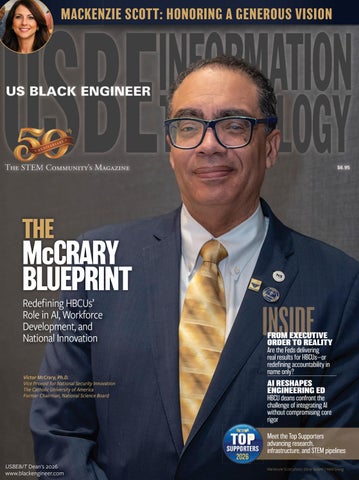
MACKENZIE SCOTT: HONORING A GENEROUS VISION
THE
McCRARY BLUEPRINT Redefining HBCUs’ Role in AI, Workforce Development, and National Innovation
Victor McCrary, Ph.D. Vice Provost for National Security Innovation The Catholic University of America Former Chairman, National Science Board
INSIDE
FROM EXECUTIVE ORDER TO REALITY Are the Feds delivering real results for HBCUs—or redefining accountability in name only?
AI RESHAPES ENGINEERING ED
HBCU deans confront the challenge of integrating AI without compromising core rigor Meet the Top Supporters advancing research, infrastructure, and STEM pipelines
USBE&IT Dean's 2026 www.blackengineer.com
Mackenzie Scott photo: Elena Seibert / Yield Giving
T H E
2 0 2 6
STEMSHIP AI TRAINING PROGRAM
OCTOBER 2-7, 2026 Sailing from New York City to Bermuda
INNOVATING LEADERSHIP. EMPOWERING CHANGE. AT SEA.
ADULTS-ONLY ALL-INCLUSIVE EXPERIENCE PRICES STARTING AT ONLY
$845 PER SAILOR
SET SAIL FOR A SMARTER FUTURE. WELCOME ABOARD THE STEMSHIP: AI & TECH LEADERSHIP CRUISE—a transformative, adults-only 5-day luxury voyage to Bermuda blending professional development with the unmatched experience of sailing aboard Virgin Voyages. Whether you’re a STEM leader, tech innovator, educator, or entrepreneur, this is your passport to mastering the tools, insights, and strategies that define leadership in the age of AI.
WHAT'S INCLUDED
CONFERENCE REGISTRATION & CERTIFICATION
• • • •
Participation in all AI training programs, leadership sessions, and workshops requires a separate conference registration.
• • • • •
5 nights aboard Virgin Voyages' Valiant Lady $1,000+ in value included 20+ curated dining venues Fitness classes, wellness activities, & live entertainment Unlimited Wi-Fi, all tips, basic drinks included Networking events and mixers with STEM, business, & academic leaders AI Certification seminars available Two days in Bermuda with a closing sunset reception Adults-only atmosphere, ages 18+
Early Bird Rate: $395 (if registered by July 1, 2026) Standard Rate: $595 (after July 1, 2026)
This fee includes: • Access to all professional development sessions • Daily conference materials and tech tools • Certification of completion for up to 20 hours of training • Invitation to private networking mixers and leadership roundtables
READY TO SET SAIL? Visit www.stemcitytravel.squarespace.com or email djackson@ccgmag.com Register now. Early bird AI certification rate of $395 ends July 1, 2026! Deposit 20% at booking. Rates based on double occupancy. Payment plans available, Cabins and early bird rates are subject to availability.
U S
B L A C K
E N G I N E E R
&
I N F O R M A T I O N
CONTENTS
T E C H N O L O G Y
BRINGING TECHNOLOGY HOME TO THE BLACK COMMUNITY
VOLUME 50 NUMBER 2
FEATURES
DEPARTMENTS
COVER STORY - THE McCRARY BLUEPRINT
28
Victor McCrary on public policy, research, and why HBCUs must lead in AI and workforce strategy.
EXPANDING RESEARCH AMID CONSTRAINTS 42 HBCUs grow research capacity through new programs despite tighter funding.
MEASURING REAL FEDERAL SUPPORT 44 A scorecard evaluates whether funding, access, and outcomes align for impact.
2026 TOP SUPPORTERS OF HBCU ENGINEERING 48
Organizations making the most meaningful, measurable impact—per HBCU deans.
42 FEDERAL COMMITMENTS FACE A TEST 34 Will shifting policy and funding pressures yield lasting impact for HBCUs?
FOLLOW USBE DIGITAL! Just because the presses have stopped does not mean the story has ended. The digital edition of this issue continues to evolve, featuring the most upto-date information. Follow the digital version here!
4
THE HBCU ENGINEERING DIRECTORY 52 A comprehensive guide to institutions and leaders in HBCU engineering.
MILLIONS IN MOTION
MacKenzie Scott’s transformative gifts redefine the future of higher education.
BUILT TO LAST—HBCU ENGINEERING LEGACY 38 How HBCUs have shaped— and continue to influence America’s engineering workforce.
USBE & Information Technology | DEANS 2026 | Celebrating 50 Years
62
44
PEOPLE & EVENTS
8
ON CAMPUS
12
WASHINGTON WATCH
14
EDUCATION
18
FIRST STEPS
22
CAREER VOICES
24
STEM Momentum Builds Leaders and initiatives shape education and workforce. Howard Hosts 2026 AMIE HBCU students showcase innovation and partnerships. Policy Shift Reshapes Recruiting - Federal changes alter outreach to STEM talent.
AI Pivot in HBCU Engineering - Leaders integrate AI without losing academic rigor. Federal Pathways Persist Internships remain key despite hiring slowdowns. Research to Federal Opportunity - Institutions turn research into federal pathways.
COLLEGE MARKETPLACE 60
Navigating Federal Funding - A closer look at the funding opportunities, compliance hurdles, and federal expectations reshaping HBCU support..
www.blackengineer.com | collinai.com
Victor McCrary delivering his acceptance speech as the 2011 BEYA Scientist of the Year
COVER Victor McCrary on public policy, research, and why HBCUs must lead in AI and workforce strategy.
28
NOW THE MOST READ BLACK TECHNOLOGY MAGAZINE REACHING OVER 100,000 READERS IN THE UNITED STATES, UK, AND SOUTH AFRICA
www.blackengineer.com | collinai.com
USBE & Information Technology | DEANS 2026 | Celebrating 50 Years
5
PUBLISHER’S PAGE PUBLISHER'S NOTE In every generation, there comes a moment when vision must give way to accountability—when ideas must become action. This issue of US Black Engineer & Information Technology arrives at exactly that moment. As you move through these pages, you will see a clear through line: opportunity exists, but consistency and follow-through are still catching up. We take a close look at how federal agencies are engaging with historically Black colleges and universities, where investments are being made, and where gaps still remain. The question is simple: Are we building something lasting, or are we repeating familiar promises? HBCUs have never needed validation. Their impact is already proven. For generations, these institutions have produced engineers, scientists, and leaders who move industries forward. They have done it with fewer resources, but with unmatched commitment. What we are seeing now, particularly in areas like artificial intelligence, cyber security, and emerging learning environments, is what happens when even a portion of the right support is put in place. Still, potential alone is not enough. This next chapter requires alignment. Federal agencies, industry partners, and academic leaders must move with shared purpose. That means real investment, clear pathways for students, and accountability tied to outcomes. Not just access, but advancement. At Career Communications Group, we have always believed that exposure opens the door, but sustained support determines what happens next. That belief is reflected throughout this issue. The future of innovation in this country will depend on how seriously we invest in the talent coming out of HBCUs. The capability is already there. The question is whether we are prepared to match it with commitment.
Tyrone D. Taborn Publisher
EXECUTIVE OFFICE Tyrone D. Taborn, CEO and Publisher Jean Hamilton, CFO, President Kwan Hurst, COO, Operations Eric Price, V.P., Human Resources EDITORIAL AND CONTRIBUTING EDITORS Rayondon Kennedy, Director, Digital and Print Operations Lango Deen, Technology Editor Michael Fletcher, Contributing Editor Gale Horton Gay, Contributing Editor Garland L. Thompson, Contributing Editor Roger Witherspoon, Contributing Editor GRAPHIC & DIGITAL DESIGN Beverly Wladkowski, Creative and UX Director Bryan Davis, Digital Director DIGITAL PLATFORM AND DEVELOPMENT Terrence Fooks, Metaverse Platform Program Manager & Client Relations Specialist CORPORATE AND ALUMNI RELATIONS Dr. Gwendolyn Boyd, CCG Alumni Committee Chair and President Dr. Eugene DeLoatch, Chairman, BEYA Alumni Group Vice Admiral Andy L. Winns, USN (Ret) National Chair, BEYA Military Alumni Oliver “Bo” Leslie, Retired Program Manager, Historically Black Colleges and Universities/Minority Institutions, The Boeing Company Monica E. Emerson, Women of Color STEM Conference National Chair Matt Bowman, CCG Military Program Manager Stars and Stripes Committee Executive Director/Chief of Staff for VADM Walt Davis, USN (Ret.) SALES AND MARKETING Kameron Nelson, Account Executive De'Ontae Jackson, Account Executive Lucille Kennedy, Sales Support Assistant Jay Albritton, Social Media Account Manager JOBMATCH AND STUDENT DEVELOPMENT PROGRAMS Rod Carter, Recruitment Specialist, College Relations CONFERENCE AND EVENTS Jennifer Roberts, V.P., Partner Experience Brandon Newby, Customer Service Associate ADVERTISING SALES OFFICE Career Communications Group, Inc. 729 E. Pratt Street, Suite 504 Baltimore, MD 21202 Phone: (410) 244-7101 / Fax: (410) 752-1837
Follow us online www.blackengineer.com Like us on Facebook: facebook.com/BEYASTEM
Follow us on X: @BlackEngineer
US Black Engineer & Information Technology (ISSN 1088-3444) is a publication devoted to engineering, science, and technology and to promoting opportunities in those fields. US Black Engineer & Information Technology cannot be responsible for unsolicited art or editorial material. This publication is bulk-mailed to colleges and universities nationwide. Subscriptions are $26/year. Please write to US Black Engineer & Information Technology, Subscriptions, 729 E. Pratt St., Suite 504, Baltimore, MD 21202. Copyright © 2026 by Career Communications Group, Inc. All rights reserved. Printed in the U.S.A 6
USBE & Information Technology | DEANS 2026 | Celebrating 50 Years
www.blackengineer.com | collinai.com
AMIE is the premier organization that develops industry, government and
AD
university partnerships to achieve a robust engineering workforce.
ASK ABOUT AMIE.
Building a better Engineering Ecosystem through Partnerships executive_director@amiepartnerships.org www.amiepartnerships.org
U
S
B
E
D
E
P
A
R
T
M
E
N
T
S
by CCG Editors editors@ccgmag.com
PEOPLE & EVENTS
LEADERS, INNOVATORS, AND INSTITUTIONS DRIVE MOMENTUM ACROSS STEM
PEOPLE & EVENTS especially digital natives skilled in automation and analytics, since almost half of the current energy workforce will retire in the next decade. With programs like the "Fueling Futures" event, Southern Star is helping high school students get ready for careers in the changing energy industry and encouraging them to help build resilient, innovative systems. Dr. Melvin Greer was named one of the “Most Admired Leaders to Watch in 2025” by CIO World for his work in artificial intelligence, data science, and analytics. He has led advances in cloud computing and edge sensors, and his commitment to mentoring has helped shape the next generation of tech professionals. His research has also contributed to global standards in agile software development and business analytics, keeping him at the leading edge of technology. MIT recently appointed Paula Hammond, an institute professor and alumna, as dean of the School of Engineering. She previously led the
Charles Crews and his family pose with his 2026 BEYA President's Award.
“THIS INITIATIVE HELPS STUDENTS AND VETERANS TRANSITION INTO CAREERS, CONNECTING EMPLOYERS, THE MILITARY, COLLEGES, AND TRAINING PROVIDERS.”
BEYA Stars & Stripes has launched a national pipeline for students and veterans, supporting workforce priorities by building STEM career awareness from high school onward. This initiative helps both students and veterans transition into careers, connecting employers, the military, colleges, and training providers to broaden access to advanced career paths. Charles Crews, executive vice president and COO at Southern Star, received the President’s Award at BEYA. During a recent event at the company, he stressed the need to prepare the next generation, Charles Johnson-Bey received BEYA's 2018 Career Achievement in Industry Award.
8
USBE & Information Technology | DEANS 2026 | Celebrating 50 Years
www.blackengineer.com | collinai.com
Jair Clarke is an IBM Corporate Honorary Speaker and an honorary speaker for the National Symposium.
Department of Chemical Engineering and served as vice provost for faculty, showing her strong impact on academic leadership. This marks an important milestone for both MIT and engineering education. At the 40th BEYA STEM Conference, Kerron Duncan, cofounder of Career Factory 360, praised the readiness and drive of early-career STEM professionals. Now an executive and AI catalyst at GE Aerospace Defense & Systems, Duncan is focused on using AI to solve engineering problems. His career, which started at Northrop Grumman and includes work in electrical systems, power architecture, and radar design, highlights the value of mentorship and ongoing learning in STEM. Dr. Charles Jonson-Bey, a Project Lead The Way Board member, recently revisited his alma mater, Baltimore Polytechnic Institute, which helped set him on the path to the National Academy of Engineering. He also attended Wheaton High School to honor Mrs. Cruz, the 2026 National PLTW Kern Teacher of the Year, emphasizing the importance of committed educators and strong academic foundations in shaping students’ futures. Roderick McLean was promoted to vice president for sustainment operations at Lockheed Martin Aeronautics after more than 30 years of leading major aviation programs, including the C-130 Hercules and F-35 Lightning II. His story shows how strong academic training can lead to leadership and success in the industry. Jair Clarke, founder and CEO of Laigic, has taken on a special advisory role to the chairman of World Wide Technology. Clarke’s path, from national football champion to tech roles at www.blackengineer.com | collinai.com
Lockheed Martin and Microsoft and advising on federal tech projects, shows the range and influence of STEM professionals. Working with the BEYA Conference and STEM City USA, he helped launch a privacy-focused, multilingual social platform that supports microcommunities and encourages inclusivity online. South Carolina State University marked a milestone when Omar Shaheed III became the first graduate of its new mechatronics engineering program. Shaheed moved from electrical engineering technology and completed
internships at Boeing South Carolina, which led to a full-time job. His story shows the career paths that new academic programs can create. USBE
“MENTORSHIP, INNOVATION, AND STRONG ACADEMIC FOUNDATIONS CONTINUE TO SHAPE THE NEXT GENERATION OF STEM LEADERS.”
Memorials and Tributes Career Communications Group honored the lasting impact of J.T. (Ted) Childs, Jr., through work with Collin AI, STEM City USA, and magazine archives. Texas Southern University and the George W. Bush Presidential Center also recognized Dr. Roderick “Rod” Paige for his influence on education and youth empowerment.
To stay up to date and all news and events, Visit our webpage www.BlackEngineer.com
The 30th annual WOC STEM Conference honored former IBM execs. USBE & Information Technology | DEANS 2026 | Celebrating 50 Years
9
THANK Y A
H
E
A
R
T
F
E
L
T
WE WOULD LIKE TO THANK THE DONORS TO
THE FEDI FOUNDATION AND STEM CITY USA WHO HAVE MADE OUR WORK POSSIBLE
AD
ORGANIZATIONS / FOUNDATIONS / CORPORATIONS Major Donor Support ($50,000+)
The Foundation for Educational Development, Inc. (FEDI) and STEM City USA are proud to be supported by a distinguished group of corporate, foundation, and individual donors whose leadership-level contributions have made a transformative impact on our mission. At the $100,000+ level, we are deeply grateful for the support of leading corporations and foundations including ADP, Google, and Lockheed Martin Corporation, as well as the World Wide Technology Foundation, Steward Family Foundation, and General Motors Foundation. Their investments have been instrumental in advancing large-scale workforce development initiatives, STEM programming, and the expansion of immersive learning platforms such as STEM City USA. At the $50,000–$99,999 level, we recognize the significant contributions of the General Electric Foundation, Bank of America Foundation, JPMorgan Chase Foundation, and 3RAM Group LLC, along with individual leaders Rodney Adkins, Linda Gooden, David Steward. These donors have played a critical role in sustaining program delivery, expanding access to underserved communities, and supporting the continued growth of our national STEM pipeline. Together, these major donors represent a powerful network of partners committed to innovation, equity, and opportunity. Their support enables FEDI and STEM City USA to deliver cutting-edge programs in artificial intelligence, quantum computing, cybersecurity, and workforce readiness— ensuring that underrepresented students and communities are prepared to lead in the future economy.
ADP Amazon AT&T BAE Systems Bank of America Baltimore County Boston Scientific Career Communications Group Citizens for John Cullerton Express Scripts Ford Motor Company Ford Motor Company Fund – STEM France-Merrick Foundation, Inc. General Electric Foundation General Motors Foundation Google Home Depot JPMorgan Chase Foundation Leidos Lockheed Martin Corporation MECU Foundation Microsoft National Bar Association National Minority Health Association Network for Good PSEG Foundation Rokel Zone LLC STEM City USA T. Rowe Price Foundation University of Maryland Verizon Communications World Wide Technology Foundation
YOU AD
INDIVIDUALS (ALL LEVELS COMBINED) A. Wheeler Consulting Abigail Fey Al Rutherford Angela Wheeler Angelique Hart Anthony Metoyer Anthony Watson Anthony Winns B-J Logan Barbara Anderson Bryan Scott Cassandra Jackson Cecil Haney Chance Glenn Chineta Davis Chris Krehmeyer Christina Schrier Cindy Malawy Colin Parris Craig Saddler Curtis Simmons Cynthia Miller Daniel Guerin Daniel Owens Dana Hammer Daphne Reed Darrell Warner Darryl Stokes David Cade David May David Steward David Williamson Delores Alexander Denise Russell Fleming Denise Wilkerson Dixie Garr Donnie Cochran Edna Tello Erica E. Watson
Erin Builta Erroll Davis Evelyn Banks Fanee Harrison Ferne Rabsatt Freeman Hrabowski Garland Williamson Gen William and Joyce L. Ward Genean Haynes Genise Kiehl Geoffrey Evans Gilena Monroe Harry Williams Hayward Henderson Helen Chilton Honora Whitfield Irene Hernandez Roberts Isiah Leggett Jacklyn Wynn James O’Neill James Wigfall Jem Pagan Jerry & Ella Hudlin John Doe John T. Childs Jr. Johnnie Wilson Joseph Weaver Joyce Ward Kameron Nelson Kathleen Gainey Kay Grabanski Kelly Martin Kenneth Washington Kim Memeger Lango Fitzjohn LaShoine Melton Leanne Caret Leo Brooks Linda Gooden
Linda McClelland Lisa Crego Lisa Hall Lisa Smith Lydia W. Thomas Maggie A. Burnette Manson Brown Marilyn Bagel Marilyn Robinson Marisa Schalhamer Mark Harrison Matthew Bowman Megan Davies Melvin G. Williams Michael Ford Michael Sussman Michelle Davis Michelle Gourdine Mosetta Whitaker Nicholas Donofrio Nonnie Lyketsos Oliver Leslie Pamela Carter Paul Caldwell Jr. Patricia Heidbrink Rayondon Kennedy Richard Alo Robert Gower Robert Ingram Robert Neall Robin Rhodes Rodney Adkins Ronald L. Johnson Rose Hatley Sandra Evers-Manly Sara Snider Satonya Fair Scott Drach Shajan John
Sharon Bagent Sonya Sepahban Sonya Waters Sonia Henry Sonia Suber Sorie Sankoh Stephanie C. Hill Stephanie Hooks Stephen McNeal Stephen Rochon Steve Rempe Steven Sibel Susan Colegrove Susan Pergrem Talia Fox Tamie Lindsey Tara McCray Ted Childs Terrence Head Theodore Colbert III Thomas Bostick Thomas Cole Thomas Fradette Tim Noonan Timothy Hanifen Ty Oliver Taborn Tyrone Taborn Valori Bring Vatanna Gaines Velma Richardson Virgil Griffin W. M. Austin Willa Ricks-Averette William Albright William Brown Yunho Sikora Yvonne Johnson-Jones
U
S
B
E
D
E
P
A
R
T
M
E
N
T
ON CAMPUS
S
engineering students.
by CCG Editors editors@ccgmag.com
ON CAMPUS
HOWARD UNIVERSITY TO HOST 2026 AMIE CONFERENCE— HBCU STUDENTS SHOWCASE INNOVATION
Design Challenge highlights student-led solutions, industry partnerships, and a growing pipeline of diverse engineering talent February. Students from HBCU engineering schools developed solutions to societal and industry challenges, including AI bias and community resilience. The first, second, and third-place winners of the 2026 AMIE Design Challenge will present their projects at the upcoming AMIE Conference. More than 100 students from 15 institutions participated in the challenge.
Veronica L. Nelson, chief executive officer of AMIE, Inc., announced that Howard University will host the 2026 AMIE Annual Conference in Washington, D.C., from Sept. 20–22.
THE PROGRAM UNDERSCORES THE STRENGTH OF AMIE’S PARTNERSHIPS AND THE INNOVATION OF HBCU ENGINEERING STUDENTS.
Advancing Minorities’ Interest in Engineering (AMIE) is a nonprofit coalition that partners with 17 ABETaccredited HBCU schools of engineering to increase minority representation in engineering and computer science.
Tuskegee University earned first place, Jackson State University took second, and North Carolina A&T State University and Norfolk State University tied for third. Nelson said the program underscores the strength of AMIE’s partnerships and the innovation of HBCU
Ahead of the competition, 15 students attended the AbbVie IP Academy at Southern University Law Center in January 2026, where they learned how to protect intellectual property through patents, trademarks, and copyrights. In collaboration with E4 Power Consulting and General Motors, AMIE also submitted provisional patent applications for nine HBCU teams before the Design Challenge. Jeneel Farrell, a computer science major at Howard University, said she was grateful for the opportunity to attend AbbVie’s IP Academy and compete in the Design Challenge. She gained practical experience in intellectual property law, including drafting patent applications; analyzing enforcement and infringement; and studying trademarks, copyrights, inventorship, biopharmaceutical patent law and the impact of AI on intellectual property. Farrell also received the IP Academy Badge of Completion from Southern University Law Center. Madison Harper, a computer engineering student at Tuskegee University, credited her teammates’ dedication during the Design Challenge
One of its signature programs, the AMIE Design Challenge, held its ninth annual competition during the 40th BEYA STEM Conference in Jackson State took home second place in this year's AMIE Design Challenge.
12
USBE & Information Technology | DEANS 2026 | Celebrating 50 Years
www.blackengineer.com | collinai.com
Tuskeegee University earned first place in the 2026 AMIE Design Challenge.
and thanked technical adviser Myron Fletcher, along with Nelson and Avalyn Pace, for their support.
Norfolk State University tied for third in this year's AMIE Design Challenge
Marlen Jones, a mechanical engineering major at Tennessee State University, said she was proud to support her classmates competing in the AMIE Design Challenge. Leonard Jones, a computer engineering major at Hampton University, helped develop a wildfire-prediction web application using Arduino hardware, C programming, and real-time sensor data. He said the project strengthened his skills in embedded systems, web applications, and teamwork and led to a provisional patent application. He described the event as both challenging and rewarding, offering valuable lessons in engineering and technical communication under tight deadlines. Emmanuel Baskerville, a junior electrical engineering student at Hampton University, said he valued the experience of preparing and presenting a design, earning a provisional patent for “FireLine AI” and presenting to more than 250 attendees, even though his team did not place. Yassir Abdel Razig, a professor and associate dean at the FAMU-FSU College of Engineering, represented the www.blackengineer.com | collinai.com
North Carolina A&T State University tied for third in the 2026 AMIE Design Challenge.
college at the HBCU Deans Council and highlighted the excitement of seeing FAMU students compete. Fletcher, a senior program manager at Boeing, said he appreciated serving as technical adviser to Tuskegee University, especially after the team’s first-place finish. Kirsten Hill, an electrical engineering student and robotics club president at Tuskegee, led her team to the university’s first first-place finish in the AMIE Design Challenge.
As a third-year team leader, Hill said she focused on technical excellence and team development. She also was recognized as the university’s outstanding student at the Dean’s Breakfast. As she approaches graduation, Hill said she is proud to end her AMIE experience with this achievement and grateful to her team, advisers, and supporters. She now plans to pursue graduate studies. USBE
TUSKEGEE'S WINNING DESIGN IS A ROBOTIC SYSTEM THAT HELPS FARMERS SUPPORT CROP EFFICIENCY AND YIELD.
USBE & Information Technology | DEANS 2026 | Celebrating 50 Years
13
U
S
B
E
D
E
P
A
R
T
M
E
N
T
WASHINGTON WATCH
S
by CCG Editors editors@ccgmag.com
RECRUITING POLICY SHIFT
New orders move away from DEI, raising questions about future STEM engagement.
O
n Jan. 20, 2025, the White House issued an executive order directing federal agencies to end diversity, equity, and inclusion programs across the federal government. A day later, the administration issued a second order aimed at ending what it called
questions about recruiting, outreach, and engagement with underrepresented communities. A NEW POLICY DIRECTION The Jan. 20 order directed agencies to shut down diversity, equity, and inclusion programs and diversity, equity,
accessibility offices on leave where appropriate, cancel diversity, equity, inclusion, and accessibility employees' training, and terminate diversity, equity, inclusion, and accessibility-related contracts, while withdrawing plans created under a 2021 Biden-era workforce order. Later Justice Department guidance framed the administration’s approach as eliminating unlawful raceand sex-based preferences in federal operations. In practical terms, the policy shift signaled several major changes: • Ending DEI programs: Agencies were told to eliminate diversity, equity, inclusion- and diversity, equity, inclusion, and accessibility-related offices, roles, and initiatives, including efforts previously grouped under equity frameworks.
“THE ACTIONS MARKED A SHARP BREAK FROM THE FEDERAL GOVERNMENT’S PREVIOUS APPROACH TO DIVERSITY, EQUITY, AND INCLUSION.” • Revising employment practices: Federal hiring, promotion, and training were redirected toward what the administration described as merit-based standards rather than diversity-focused goals or preferences.
The Jan. 20 order directed agencies to shut down diversity, equity, and inclusion programs and diversity, equity, inclusion, and accessibility offices, end related initiatives, and review spending tied to those efforts.
14
“illegal discrimination” and restoring merit-based opportunity. Together, the actions marked a sharp break from the federal government’s previous approach to diversity, equity, and inclusion and raised immediate
USBE & Information Technology | DEANS 2026 | Celebrating 50 Years
inclusion, and accessibility offices, end related initiatives, and review spending tied to those efforts. Follow-up guidance from the U.S. Office of Personnel Management instructed agencies to place employees in diversity, equity, inclusion, and
• Reporting and compliance: Agencies were required to identify diversity, equity, inclusion, and accessibilityrelated programs, contracts, and expenditures and report steps taken to comply with the new directives. • Broader enforcement: By March 2025, the Justice Department had issued government-wide guidance
www.blackengineer.com | collinai.com
The White House and Justice Department have repeatedly described the new policy as a return to individual merit and civil rights enforcement. on implementing the orders, and by March 2026, the White House had extended its anti-DEI push to federal contractors as well. WHAT THIS COULD MEAN FOR FEDERAL RECRUITING For US Black Engineer readers, the most pressing question is what these orders mean for federal recruiting and engagement with communities that have historically been underrepresented in STEM. For decades, federal agencies have recruited at HBCUs, HSIs, TCUs, professional development conferences, and career fairs. They also have partnered with affinity organizations, community groups, and specialized media to broaden awareness of internships, fellowships, and technical careers. The new policy direction has raised concerns that some of those efforts could be narrowed, rebranded, or reviewed through a legalrisk lens if they are seen as preference-based rather than open-access recruitment. That could reshape, though not necessarily eliminate, longstanding outreach pipelines. That distinction matters. The administration has argued that it is targeting unlawful preferences, not lawful recruiting. And in a notable example of that nuance, President Donald Trump reestablished the White House Initiative on HBCUs in April 2025, signaling continued federal interest in HBCU engagement even as DEI structures were being dismantled elsewhere in government.
www.blackengineer.com | collinai.com
Still, uncertainty remains. Programs built specifically to increase representation, especially those tied to identity-based language or metrics, may face heightened scrutiny. Internships, fellowships, and outreach efforts designed to strengthen diverse talent pipelines could be revised to fit the administration’s merit-based framework. SUPPORT AND CRITICISM Supporters of the orders say the changes restore fairness by removing programs they view as discriminatory and by reaffirming equal treatment under the law. The White House and Justice Department have repeatedly described the policy as a return to individual merit and civil rights enforcement. Critics see something different: a rollback of infrastructure that helped agencies broaden access, build trust, and compete for talent in communities long overlooked by mainstream recruiting. They argue that reducing targeted outreach could weaken the federal government’s ability to reach the full breadth of America’s STEM talent. That concern is especially significant for readers who see HBCUs, professional organizations, and community networks as critical gateways into technical careers. A LARGER NATIONAL DEBATE The dispute is no longer just about internal government policy. It is part of a larger national argument over how
institutions should pursue fairness, opportunity, and representation in education and employment. The administration’s later actions, including its March 2026 order addressing DEI discrimination by federal contractors, suggest that this debate will continue well beyond federal agencies themselves. LOOKING AHEAD The long-term impact will depend on how agencies interpret the orders and how courts, regulators, and agency leaders draw the line between unlawful preference and lawful outreach. What is already clear is that the federal government has changed course. For students, young professionals, and seasoned engineers watching Washington, the key question is no longer whether the old diversity, equity, and inclusion framework is being dismantled. It is how the next generation of recruiting, retention, and engagement will be defined. USBE
“THE KEY QUESTION NOW IS HOW THE NEXT GENERATION OF RECRUITING, RETENTION, AND ENGAGEMENT WILL BE DEFINED.”
DIGITAL CONNECTION READ MORE! For more information on this story scan above or follow Digital Connection: https://www. blackengineer.com/business/inclusion/ what-the-new-executive-order-meansfor-diversity-and-federal/
USBE & Information Technology | DEANS 2026 | Celebrating 50 Years
15
Tomorrow’s STEM Leaders AD Start Here. Partner with CCG to connect talent with opportunity.
Join Our College Recruiting Network
From career fairs to digital recruiting, CCG builds pathways linking top colleges, students, and employers in STEM.
7 2 9
E .
P R A T T S T . S U I T E 5 0 4 • B A L T I M O R E 4 1 0 2 4 4 7 1 0 1 • C C G M A G . C O M
M D
2 1 2 0 2
AD
U
S
B
E
D
E
P
A
R
T
M
E
N
T
EDUCATION
S
by CCG Editors editors@ccgmag.com
HBCU ENGINEERING AI PIVOT
Academic leaders detail how institutions are adapting teaching, research, and workforce pipelines in real time
D
uring the recent HBCU Engineering Deans Roundtable at the BEYA STEM Conference, the panel’s message was clear: artificial intelligence (AI) is no longer a side conversation in higher education. It is already reshaping teaching, research, policy, infrastructure, and workforce preparation across HBCU engineering schools. The session brought together leaders from ABET-accredited HBCU engineering programs to discuss what their institutions are doing, what challenges remain, and how they are preparing students for a future in which AI literacy will matter across every sector. The roundtable theme, “Excellence and Innovation, Advancing AI as a Technological Literacy,” set the tone for a conversation that was both practical and forward-looking. Early in the discussion, one dean framed the issue in broad terms, arguing that the traditional literacies of reading, writing, and mathematics have to include technological literacy, human literacy, and data literacy. He cited surveys showing enthusiasm for AI in higher education, but also substantial concern about misinformation, misuse of data, and the potential erosion of independent thinking if institutions do not establish sound policies, assessment methods, and faculty preparation. 18
USBE & Information Technology | DEANS 2026 | Celebrating 50 Years
That tension between urgency and caution defined much of the conversation. One of the strongest themes to emerge was that HBCU engineering schools are not treating AI as a passing trend. One dean said directly that AI is “not a fad” but a transformational movement, comparing it to the early days of the internet, when many people did not yet understand how deeply it would shape work and daily life. In that view, engineering schools have to adapt quickly, not only to teach students how to use AI tools but also to prepare them to conduct research and solve problems in a world where AI is becoming part of nearly every field. That adaptation is already taking many forms. At one institution, leaders launched an initiative centered on what they call “AI for engineering and engineering for AI.” The phrase captures a distinction that matters. AI can help improve engineering design, simulation, and optimization. But the rise of AI also depends on engineers building the systems that support it—everything from chips and sensors to data centers and the cooling systems they require. In that sense, AI is not just a computer science issue. It has implications for civil, mechanical, electrical, and other engineering disciplines as well.
That same institution is developing a fully online master’s degree in AI in engineering, built largely on courses it already offers in data science, machine learning, and deep learning, with a small number of new courses being added. The goal is not to start from scratch, but to align existing strengths with emerging demand. Other campuses are moving in similar directions, though with different emphases. One university described a new strategy focused on entrepreneurship, creativity, innovation, and practice-based learning, with AI as a major part of that effort. Its approach centers on ethical AI, fairness, transparency, accountability, data governance, and cyber security. The institution is working through universitywide guidelines on issues such
“THE CHALLENGE IS NOT WHETHER AI MATTERS—IT IS HOW TO INTEGRATE IT WITHOUT CROWDING OUT CORE ENGINEERING KNOWLEDGE.” as academic integrity, research compliance, privacy, bias evaluation, and public trust, while also creating microcredentials and building AIrelated concepts into research and operations. Another institution described policy and a set of guidelines for what its dean called “responsible experimentation.” That university does not treat AI as either a threat or an unchecked shortcut. Instead, it frames AI as a tool that can enhance academic excellence, student success, and operational effectiveness, provided it is used within clear ethical and instructional boundaries. Faculty has a
www.blackengineer.com | collinai.com
One dean said that his institution has made the executive decision to implement AI across all curricula, including general education courses.
three-tier framework for classroom use—unconditional use, conditional use, and no use—so expectations are clear. Students, in turn, may be required to verify AI-generated information, disclose or cite AI use, critically evaluate outputs, and take responsibility for the work they submit. Across the roundtable, it was evident that governance matters as much as enthusiasm. Several deans said their campuses are establishing AI task forces, governance committees, or formal policy structures. Some are building institution-wide frameworks. Others are embedding AI into academic affairs and information technology policies. A few noted that state-level directives or university system requirements are also shaping campus policy, especially around secure, transparent, and ethical use. What tied these efforts together was the belief that AI should be
www.blackengineer.com | collinai.com
integrated intentionally, not casually. Curriculum change was another major focus. At some institutions, AI is being introduced through new courses in computer science and engineering. At others, AI is being pushed across the curriculum, with the expectation that it will appear not only in technical courses but in general education and other fields as well. One dean said plainly that his institution has made the executive decision to implement AI across all curricula, including general education courses. Another described a campuswide certificate available to students from any discipline, built around AI tools, ethical use, and a third disciplinespecific course that could reflect a student’s major area of study. But the deans also acknowledged that curricular change is not simple.
One of the most candid comments came from a dean who described the challenge of curriculum overload. Engineering programs already have fixed degree requirements and tight credit structures. Adding machine learning, programming, or AI-specific content without overloading students is difficult. The issue is not whether AI matters. The issue is how to insert it thoughtfully without crowding out the core engineering knowledge students still need. He also noted that many of the most trusted engineering software tools with AI capabilities are expensive, raising real questions about access and institutional resources. That practical concern surfaced in other ways as well. One dean pointed out that enterprise-level AI tools are expensive, especially when campuses want to make them broadly available to faculty or students. Still, some universities have committed to
“AI IS NOT A FAD BUT A TRANSFORMATIONAL MOVEMENT RESHAPING ENGINEERING EDUCATION AND THE WORKFORCE.”
USBE & Information Technology | DEANS 2026 | Celebrating 50 Years
19
U
S
B
E
D
E
P
A
R
T
M
E
N
T
EDUCATION
S
One dean spoke directly about the need to understand what companies expect graduates to know when they arrive on the job. At his institution, all first-year students are required to complete an AI-focused unit through an IBM skills program as part of a freshman seminar, with credentialing built into the process and internship pathways available for some students. The dean said AI literacy should be treated as seriously as other core competencies students need to thrive in the modern workforce.
“AI HAS BEEN A DISRUPTOR IN HIGHER EDUCATION, AND INSTITUTIONS ARE NOW PIVOTING INTENTIONALLY. FACULTY GOVERNANCE MATTERS. TRAINING MATTERS. STUDENT READINESS MATTERS. CURRICULUM OWNERSHIP MATTERS. AND ALL OF IT MUST CONNECT BACK TO THE LONG-TERM GOAL OF PREPARING STUDENTS NOT JUST FOR THE NEXT FEW YEARS, BUT FOR DECADES AHEAD.”
doing exactly that, providing pro-level access to AI platforms so faculty can learn how the tools work and decide how to use them responsibly in teaching and research. Faculty training was therefore a recurring theme. The deans were clear that students are often using AI more quickly and more casually than faculty. That makes faculty preparation essential. Several schools have opened workshops, AI fellow cohorts, accelerator programs, or campuswide training initiatives. One institution reported that 13 faculty members had been selected for an inaugural AI fellows cohort. Others described partnerships with IBM, Google, or industrysupported education programs to help faculty and students build AI fluency and careerrelevant skills. The workforce implications were never far from the surface.
20
USBE & Information Technology | DEANS 2026 | Celebrating 50 Years
A similar emphasis appeared elsewhere, with schools using first-year success courses, certificates, and credentials to prepare students for ethical AI workplaces and improve employability. The idea is not simply to expose students to AI. It is to produce graduates who know how to use it responsibly and effectively in real professional settings. Research was another major part of the conversation. The roundtable included examples of AI applications in cyber security, power systems, image processing, energy, autonomous systems, machine learning, and tactical autonomy. One university described a center focused on big military data, data intelligence, AI, and machine learning. Another discussed AI-enabled power systems research with Texas A&M and Sandia National Laboratories. Others referenced tactical autonomy projects, explainable AI, facial recognition bias, and work in materials science and defense-related applications. The common thread was that AI research is no longer peripheral. It is becoming central to how these institutions are positioning themselves in engineering and technology research.
Even so, the conversation remained cautiously optimistic. The panel returned repeatedly to issues of ethics, accountability, and proper use. One dean said his institution is trying to answer a basic question: Are they doing STEM education for AI, or AI for STEM education? Another asked whether AI could eventually displace key engineering skill sets if institutions are not careful about how it is introduced. Those concerns did not translate into resistance. But they did underscore that the deans see AI as something that must be integrated with judgment, not simply adopted because it is new. Near the end of the session, one of the deans offered a concise summary of what the panel had revealed. AI, he said, has been a disruptor in higher education, and institutions are now pivoting intentionally. Faculty governance matters. Training matters. Student readiness matters. Curriculum ownership matters. And all of it must connect back to the long-term goal of preparing students not just for the next few years, but for decades ahead. That may be the clearest takeaway from the roundtable. HBCU engineering schools are not standing still while AI reshapes STEM education. They are building policies, revising curricula, training faculty, creating credentials, expanding research, and rethinking workforce preparation in real time. The challenge now is not whether they see the future coming. It is whether institutions, partners, and funders will provide the resources needed to help them scale what they have already begun. USBE
www.blackengineer.com | collinai.com
AD
U
S
B
E
D
E
P
A
R
T
M
E
N
T
FIRST STEPS
S
by CCG Editors editors@ccgmag.com
FEDERAL PATHWAYS REMAIN
Internships and early-career programs are key entry points, even as hiring freezes reshape federal opportunities
V
ictor McCrary, former chair of the National Science Board, recognized the participation of the Catholic University of America (CUA) in the BEYA Conference Career Fair. As CUA's vice provost for national security and innovation, Dr. McCrary noted
Applied Physics Laboratory, Lockheed Martin, and other national security organizations. Federal agencies continue to provide opportunities for engineering students through internships, fellowships, co-op programs, and early-
Fellows (PMF). President Donald Trump signed Executive Order 14217 on Feb. 19, 2025, terminating the PMF Program. While the internship and recent graduates portions of the Pathways Program remained, overall federal hiring dropped by nearly 70 percent during the freeze (U.S. Government Accountability Office). Agencies such as the Department of State, Federal Highway Administration, Centers for Disease Control and Prevention, NASA, Department of the Treasury, Department of Defense, and U.S. Fish and Wildlife Service offer internships for students at various educational levels. However, a government-wide hiring freeze instituted on Jan. 20, 2025, significantly impacted federal internship hiring. Total federal hires, including temporary staff,
“FEDERAL AGENCIES CONTINUE TO PROVIDE OPPORTUNITIES THROUGH INTERNSHIPS, FELLOWSHIPS, AND EARLY-CAREER HIRING PATHWAYS.” were reported at 66,000 to 68,000, but specific intern numbers were not provided (U.S. Government Accountability Office).
Effective September 2025, federal resumes are expected to be one to two pages in length.
22
the importance of these events to provide opportunities for students through internships, fellowships, co-op programs, and early-career hiring. Exhibitors included the U.S. Navy, Army National Guard, Johns Hopkins
USBE & Information Technology | DEANS 2026 | Celebrating 50 Years
career hiring pathways. The U.S. Office of Personnel Management directs students and recent graduates to the Pathways Program on USAJOBS, which includes the Internship Program, Recent Graduates Program, and Presidential Management
Many students lost their summer 2025 federal internships due to the 90-day freeze, which halted civilian hiring in the executive branch. The U.S. Department of State's Foreign Service Internship Program canceled placements for 40 selectees in its summer 2025 cohort. In 2026, the Federal Pathways Programs continue to offer
www.blackengineer.com | collinai.com
In 2026, the Federal Pathways Programs continue to offer structured routes into federal careers, featuring paid internships, developmental roles, and mentorship. Candidates can apply for these roles via USAJOBS.
structured routes into federal careers, featuring paid internships, developmental roles, and mentorship. Candidates can apply for these roles via USAJOBS. The Internship Program offers paid positions for current students that may lead to permanent employment. The Recent Graduates Program is a two-year career development opportunity for those who completed a qualifying degree or certificate within the last two years (up www.blackengineer.com | collinai.com
to six years for veterans). Applicants should use the USAJOBS Pathways portal to filter for internships and recent graduate positions and the USAJOBS Resume Builder to ensure their federal resume includes all required information. Effective September 2025, federal resumes are expected to be one to two pages in length. Agencies such as the Department of Defense and the Department of the Treasury actively hire through
these pathways for various roles. Applicants must be U.S. citizens or working toward citizenship and have graduated from a qualifying educational institution. These programs often lead to permanent, full-time federal employment with training and mentorship opportunities. In 2026, there is a strong emphasis on technology, data analytics, and security skills. USBE
“MANY STUDENTS LOST THEIR SUMMER 2025 FEDERAL INTERNSHIPS DUE TO THE GOVERNMENT-WIDE HIRING FREEZE.”
USBE & Information Technology | DEANS 2026 | Celebrating 50 Years
23
U
S
B
E
D
E
P
A
R
T
M
E
N
T
CAREER VOICES
S
by CCG Editors editors@ccgmag.com
FROM RESEARCH TO DEFENSE How institutions can better align research, partnerships, and strategy to access emerging pathways into defense innovation
relevant technologies, understanding policy, approaching agencies, and using new acquisition pathways to move ideas closer to opportunity. What emerged was a clear message: The question is no longer whether institutions have the talent to serve national priorities, but whether they are positioned to move that talent into pathways that lead to federal partnerships and sustained participation in the defense ecosystem.
“THE QUESTION IS NO LONGER WHETHER INSTITUTIONS HAVE THE TALENT—BUT WHETHER THEY ARE POSITIONED TO MOVE THAT TALENT INTO FEDERAL PATHWAYS.” One of the clearest themes was that many institutions underestimate how relevant their work already is. A speaker with federal experience noted that colleges often hear “national security” and assume the work must center only on drones, satellites, or highly visible defense systems. But she emphasized that the mission should be understood more broadly as serving the warfighter holistically, pointing to agricultural defense as one example that fits within the national security frame.
Faculty and research leaders must think more intentionally about how to translate campus work into language federal agencies recognize as mission-aligned.
24
F
or many colleges and universities, the path to federal defense work can be difficult to navigate. The opportunities exist, but the language is dense, the systems are layered, and the process can seem built for institutions with deeper administrative benches and longer federal track records.
USBE & Information Technology | DEANS 2026 | Celebrating 50 Years
That challenge was at the center of the BEYA seminar “Collaborating with the Department of War,” which brought together speakers from government, industry, and academia to outline a clearer path from campus research to federal engagement. The discussion walked through identifying
That perspective matters. Engineering, computing, data science, cyber security, systems design, materials research, and applied research all have federal relevance. The seminar encouraged institutions to stop assuming that defense-related opportunity belongs only to campuses already fluent in federal systems. Many existing strengths already align with
www.blackengineer.com | collinai.com
agency needs—if they are framed correctly and carried through the right channels. The panel also challenged the instinct to self-eliminate. One speaker said institutions often count themselves out before they begin, assuming they lack the tools, staffing, or scale to compete. They may believe that if they cannot solve an entire problem alone, they should not pursue the opportunity. The seminar pushed back on that thinking and described new pathways that allow institutions to test ideas, receive feedback, and participate without carrying the full burden of the traditional process up front. That shift reflects a broader policy change. Speakers said federal policy now emphasizes speed, innovation, and what one panelist described as translational research— moving work from the basic level toward direct application. The goal is not simply to fund discovery, but to connect research to practical use. In this environment, institutions are expected to explain not only what they are studying, but where that work can go. Research must be framed in terms of application and relevance. Faculty and research leaders must think more intentionally about how to translate campus work into language federal agencies recognize as mission-aligned. To support that effort, the seminar highlighted outreach initiatives such as DARPA Connect and SciTech Connect, designed to create a more accessible “front door” to agencies. These programs offer online modules, regional events, webinars, office hours, and one-on-one coaching to help institutions understand the process, identify fit, and engage more effectively. This support addresses a
www.blackengineer.com | collinai.com
long-standing challenge. Many universities have had to piece together federal strategy from fragmented information— websites, announcements, and informal networks. Even when guidance exists, it is not always easy to translate into action. Connect programs aim to shorten that gap by providing clearer entry points and ongoing engagement. The panel also focused on newer marketplace models that are changing how institutions engage with federal opportunities. In these environments, applicants may submit short video pitches instead of lengthy proposals. These submissions can represent early-stage ideas or more developed solutions, but the emphasis is on clarity, technical merit, and alignment—not administrative volume. These models reduce the upfront burden and create opportunities for feedback. If a submission is not ready, applicants can revise and return. This approach is intended to replace the traditional experience where proposals are submitted with little visibility into decisionmaking. Instead, institutions can learn, adjust, and improve through repeated engagement. At the same time, the seminar acknowledged the realities facing many campuses. Institutions with fewer resources do not have the same margin for error as larger organizations and must be more deliberate in selecting opportunities and aligning capabilities with agency priorities. That is why strategy remains central. Speakers emphasized understanding agency priorities, learning how federal offices describe their needs, and engaging the right decision-makers. It is not enough to present a
capability—institutions must clearly explain where their work fits and why it matters within a federal mission. Persistence was another key theme. Speakers encouraged participants to seek feedback after submissions rather than treating rejection as final. Continued engagement— through revised proposals, coaching, and connect programs—can strengthen future efforts. Success often comes after institutions refine their approach and respond to earlier feedback.
“FEDERAL DEFENSE WORK IS COMPLEX, BUT IT IS NOT UNKNOWABLE—AND THE PATHWAY IS BECOMING MORE NAVIGABLE.”
The seminar also reinforced the importance of collaboration. Institutions do not need to solve every problem independently to participate. Partnerships allow campuses to contribute their expertise within larger efforts, building credibility and relationships that lead to future opportunities. Federal engagement is not immediate, and it is rarely simple. But the pathway is becoming more navigable for institutions willing to learn the system, use available tools, and refine how they present their work. In the end, the message was clear: Federal defense work is complex, but it is not unknowable. Agencies are working to move faster. Policy is emphasizing application and impact. New engagement models are reducing barriers. Institutions that understand these pathways, align their strengths, and stay engaged will be better positioned to move from campus research to federal opportunity. USBE
WATCH FULL VIDEO HERE
https://vimeo.com/1165508970
USBE & Information Technology | DEANS 2026 | Celebrating 50 Years
25
This is how we power your future
AD
Energy is the force driving everything we do. So how can energy work harder? Exelon, the nation’s largest family of energy companies, offers rewarding and diverse career opportunities such as Engineering, Information Technology, Finance and many more that help us shape an accessible, equitable and clean energy future. We are committed to creating a culture of inclusion and excellence where you can grow your skills and make a positive impact. It is our mission to support our communities, foster innovation and advance clean energy solutions. This is how we are delivering a better tomorrow for more than 10.5 million customers. This is Exelon. This is energy at its best.
Learn More
Energy at its best
NATIONALGUARD.COM
MAKE AD MORNING CLASS AND A LIVING. Get two steps ahead of your peers by specializing as a part-time protector. Your local Army National Guard will pay you to train one weekend a month. In return, you’ll become a part of a tight-knit community dedicated to protecting what matters most: your state.
VISIT BOOTH #504
Programs and Benefits Subject to Change
How a national science leader is redefining the role of HBCUs in AI, workforce development, and innovation
THE
MCCRARY BLUEPRINT
by editors@ccgmag.com
editor's note At press time, USBE magazine learned that the 24 members of the National Science Board received notice from the Presidential Personnel Office that their positions had been terminated. Below is the note USBE editors received from Dr. Vic McCrary, this issue's cover feature. Dr. McCrary is a multi-award winner, the 2011 BEYA Scientist of the Year, and has served as a moderator for several conference seminars. He has also contributed to many articles and STEM initiatives led by Career Communications Group. “As the former Chair of the National Science Board, I am proud of the work my colleagues past and present on Board for their service to the Nation. We advocated for ‘Blue Collar STEM’—the skilled technical workforce, updated the merit review process to emphasize both intellectual merit and societal benefits, focused on National Science Foundation’s (NSF) role in national security, talent development at HBCUs/MIs, and campaigned for the restoration of NSF’s FY2026 operating budget. The National Science Board has been a difference maker as the voice for science and engineering for the benefit of the American people! Victor "One final thought: I am humbled and honored to have been the first National Science Board Chair who graduated from both an HBCU and Catholic research institutions."
28
USBE & Information Technology | DEANS 2026 | Celebrating 50 Years
www.blackengineer.com | collinai.com
As
chair of the National Science Board (NSB), Victor McCrary operated at the highest levels of public policy— where decisions about research, talent, and innovation shape the future of the United States. The NSB serves as both the governing body of the National Science Foundation (NSF) and an advisor to the president and Congress, with a mission to promote the progress of science; advance national health, prosperity, and welfare; and secure the nation’s defense through science and engineering leadership. It is a mission that aligns closely with McCrary’s life’s work.
Life Shaped by Discipline and Direction McCrary’s foundation was forged in a military household. Both his mother and father served in the United States Army, and their influence established a framework that would guide him throughout his life. In their home, expectations were clear and high. Discipline and hard work was not situational— it was expected. Accountability, respect, and preparedness were daily standards. And creativity, pride in your history/roots, and sense of purpose to the community was nurtured. While McCrary himself did not serve in the military, the structure and values instilled by his parents and relatives set the stage. At a critical stage in his development, those influences helped anchor him, providing the discipline and direction that shaped his trajectory. His
Victor McCrary, Ph.D. Vice Provost for National Security Innovation The Catholic University of America former Chairman, National Science Board BEYA 1990 Most Promising Engineer Award winner
www.blackengineer.com | collinai.com
USBE & Information Technology | DEANS 2026 | Celebrating 50 Years
29
parents and their releative working class backgrounds, instilled a sense of pride and admiration for those domestics, laborers, , and tradesman who worked every day to put food on the table and pave the way for a promising future for their children. In that sense, the U.S. Army—through his parents— played a life-altering role, reinforcing the importance of structure, responsibility, giving back, and purpose.
“Artificial intelligence is not simply a technological evolution—it is a workforce transformation tied to national competitiveness and security.”
That experience continues to inform his leadership philosophy: that access to disciplined systems and clear expectations can transform lives.
Scholar, Scientist, and National Leader
His appointment comes as Catholic University obtained R1 status in 2025—placing it among the top 5 percent of research institutions nationwide—and launches a new Institute for Artificial Intelligence and Emerging Technologies.
The AI Moment—and the HBCU Challenge McCrary’s national perspective is informed by a clear reality: Artificial intelligence is not simply a technological evolution— it is a workforce transformation tied directly to national competitiveness, economic growth, and national security—the very priorities embedded in the mission of the National Science Board. And HBCUs must be central to that transformation. For decades, HBCUs have produced a disproportionate share of Black engineers, scientists, and technical professionals. They remain one of the most effective pipelines of domestic, diverse talent in the country. Yet AI is redefining the requirements of that pipeline. The issue is not talent—it is alignment and access.
A native of the Washington, D.C. region, McCrary’s academic journey reflects both rigor and breadth. He earned his bachelor’s degree in chemistry from The Catholic University of America in 1978, followed by a Ph.D. in chemistry from Howard University, and later an executive master’s in engineering from the University of Pennsylvania.
AI requires a convergence of disciplines: data science, engineering, cyber security, ethics, and systems integration. At the same time, it depends on physical infrastructure—data centers, energy systems, telecommunications networks, cloud storage, and advanced manufacturing. This creates a dual demand for digital expertise and blue-collar STEM.
His career spans some of the nation’s most influential scientific and research institutions. He started his career as a research scientist at AT&T Bell Laboratories in Murray Hill, NJ. In 1990, Bell Labs nominated him and he received the Most Promising Engineer of the Year Award for his pioneering work in the chemical vapor deposition of II-V semiconductors. At the National Institute of Standards and Technology (NIST), he served as the first chief of the Convergent Information Systems Division, where he received the 2000 Departmment of Commercie Gold Medal for the development of the first industry electronic book standards. He also held positions at The Johns Hopkins University Applied Physics Laboratory, contributing to applied science and national innovation efforts.
McCrary has consistently emphasized that both are essential.
In higher education, McCrary has consistently built research capacity and institutional strength. At Morgan State University, he served as the first vice president for research and economic development, developing a university-wide research ecosystem that increased external funding, fostered innovation, and led to the institution’s R2 Carnegie research designation. At the University of the District of Columbia, he established the Office of University Research and led initiatives that resulted in its designation as a Carnegie-classified Research College & University in 2025. During his tenure at both historically Black colleges and universities (HBCUs), he stood at a critical intersection—helping define how HBCUs meet the dual challenge of artificial intelligence and the evolving demand for technical and trade skills. Now, he returns to his alma mater as vice provost for national security innovation at The Catholic University of America. “My new role is to develop, coordinate, and advocate for the University's efforts in national security from research, talent development, and strategic partnerships,” McCrary said. “It’s an exciting time to be at The Catholic University of America.” 30
USBE & Information Technology | DEANS 2026 | Celebrating 50 Years
The future workforce will not be built solely on software. It will require professionals who understand both advanced technologies and the infrastructure that enables them. For HBCUs, this presents an opportunity to expand their role—from talent producers to integrated workforce development engines aligned with national priorities; e.g. the Department of War’s Critical Technology Areas.
Building Leadership Across the Pipeline A defining element of McCrary’s work is his focus on leadership— not just talent, but leadership at every level. Organizations are not only struggling to find skilled professionals; they are struggling to develop leaders who can translate technical capability into organizational impact. Engineers must become managers. Managers must become strategists. Executives must lead transformation. That requires a continuum: • Early-career professionals with emerging leadership potential • Mid-level leaders driving teams and measurable outcomes • Senior executives shaping strategy and enterprise-wide adoption This layered approach reflects how real systems function. Leadership is cultivated over time, across levels, and through experience. And one key element is, “People don’t care at first how much you know, until they know how much you care.” Leadership is not about power or control—it is about serving with a purpose to make a positive difference for others.
Repositioning HBCUs for the Future McCrary’s work reflects a broader strategic imperative: ensuring
www.blackengineer.com | collinai.com
that HBCUs are not reacting to change, but shaping it. That means aligning academic programs with industry needs, strengthening partnerships, and embedding workforce readiness into education. It also means expanding STEM preparation to include both AI and the skilled trades (“blue-collar STEM”) that sustain technological infrastructure. HBCUs are not just institutions of access—they are institutions of innovation. The challenge now is to ensure that their graduates are positioned at the forefront of AI-driven industries and national innovation efforts.
A Leadership Philosophy Rooted in Experience What distinguishes McCrary’s leadership is its coherence. From a military household, his Catholic education, agency and faith, to national science leadership, his journey reflects a consistent belief: Systems matter. Structure matters. Opportunity matters. Beliefs matter! When aligned, they can transform lives—and institutions.
Looking Ahead The transition to an AI-driven economy is accelerating. The demand for skilled, adaptable, and diverse domestic talent will only increase.
“HBCUs are not just institutions of access—they are institutions of capability.”
Victor McCrary’s work—through his leadership of the National Science Board and his role in higher education—is focused on ensuring that the nation’s talent pipeline is prepared to meet that moment. Developing plumbers to Ph.D.s! Everyone is valued and needed for the road ahead! It is a mission rooted in science, aligned with national priorities, and driven by a lifelong commitment to expanding opportunity for all. And it is far from complete. USBE
www.blackengineer.com | collinai.com
USBE & Information Technology | DEANS 2026 | Celebrating 50 Years
31
AD www.mystemcity.com
SUBSCRIBE ONLINE! Career Women In Technology & Business
ENTS OF DEANS ISSUE COMPLIM
AD leads the way as STEM City’s Top Sponsor
RESET TO RISE: DAY IT’S A NEonW 2020 as 3 engineering deans reflect ! they set their sights on the future T. Shirazi, D.Sc., PE L-R: Deans Dr. Pamela H. Obomion, Dr. Robin N. Coger,
and Joyce
INSIDE:
Is quantum computing the next big thing? 15 ABET-accredited HBCU engineering school profiles 2021 HBCU Deans’ Roundtable: Here’s what they dicsussed
USBE&IT Deans Issue 2021 www.blackengineer.com
Like us on Facebook facebook.com/BEYASTEM Follow us on X @BlackEngineer
Career Communications Group, Inc. 729 East Pratt Street, Suite 504 Baltimore, MD 21202 (410) 244-7101 www.ccgmag.com
Federal Commitments to HBCUs Face a Defining Test by editors@ccgmag.com
34
USBE & Information Technology | DEANS 2026 | Celebrating 50 Years
www.blackengineer.com | collinai.com
An analysis of federal data, agency reports, and policy shifts examines whether recent gains will translate into lasting impact
A
n analysis by US Black Engineer & Information Technology of the evolving relationship between historically Black colleges and universities (HBCUs) and the federal government highlights major policy shifts, agency strategies, and their impact on HBCU research, education, and workforce opportunities as of early 2026.
program aimed at strengthening HBCU research capacity in areas such as artificial intelligence and quantum science.
Drawing on publicly available federal data, agency strategic plans, and annual reports, the analysis reveals a complex picture: reduced federal investment, the dismantling of key pipeline initiatives, and ongoing administrative challenges threaten to undermine hard-won progress. The ability of agencies to balance new mandates for excellence and innovation with the fiscal realities of a shrinking bureaucracy will ultimately determine whether current momentum is sustainable.
Agencies including NASA, the Nuclear Regulatory Commission, the Department of the , and the General Services Administration have also outlined clear strategies for HBCU engagement—spanning research funding, faculty development, procurement, and workforce recruitment.
Public statements across agency reports consistently affirm that HBCUs remain vital to American economic strength and global competitiveness. Yet the path forward remains uncertain.
U.S. Department of Agriculture The USDA remains a leading federal partner for HBCUs, particularly through its long-standing relationship with the 1890 land-grant institutions established under the Second Morrill Act.
“The ability of agencies to balance innovation with shrinking budgets will determine whether current momentum is sustainable.”
Programs such as the USDA 1890 National Scholars Program, capacity-building grants, and targeted recruitment efforts have provided scholarships, internships, and career pathways for hundreds of students. Testimonies from scholars such as Anthony “AJ” Jackson underscore the program’s impact. That partnership was further reinforced in March 2026, when a new memorandum of understanding was signed to expand collaboration in workforce development, research, and outreach.
Across Federal Agencies: A Coordinated Push Other agencies have also expanded efforts to engage HBCUs. The Department of the Treasury has emphasized inclusion through targeted outreach, infrastructure investment, and workforce development. The Bureau of Engraving and Printing and the Internal Revenue Service have expanded internship and recruitment programs, while a cooperative agreement with Howard University supports undergraduate economic training. The Department of Defense has launched a $50 million pilot www.blackengineer.com | collinai.com
Similarly, the Department of Health and Human Services has established ambitious funding targets through the National Institutes of Health and the Health Resources and Services Administration.
Mounting Challenges Despite these advances, the analysis identifies significant challenges tied to shifting federal priorities. The creation of the Department of Government Efficiency, along with a series of executive orders eliminating diversity, equity and inclusion frameworks, has disrupted long-standing support structures for HBCUs.
The National Science Foundation’s termination of more than 400 active grants—including $233 million tied to DEI-related initiatives—alongside proposed budget reductions at agencies such as NIH, CDC, and NASA, threatens to erode research infrastructure built over decades. New financial constraints, including caps on indirect cost reimbursements, have added further pressure on researchintensive institutions. At the same time, compliance requirements, complex procurement systems, and competition with the private sector continue to limit access to federal opportunities.
Resilience and Measurable Gains Even amid these challenges, HBCUs continue to demonstrate measurable success. North Carolina A&T State University reported a record $96.2 million in research contracts in fiscal year 2025, maintaining leadership in emerging technology fields. Clark Atlanta University was named a Fulbright HBCU Institutional Leader for the first time, while Howard University continues to operate premier professional development programs as the nation’s only federally chartered HBCU. Bowie State University’s cybersecurity programs have also earned renewed
USBE & Information Technology | DEANS 2026 | Celebrating 50 Years
35
A Policy Shift at the Highest Level In April 2025, the White House issued an executive order that significantly restructured the federal approach to HBCU support. The White House Initiative on HBCUs was moved from the Department of Education to the Executive Office of the President, signaling a shift in national priority. The move was reinforced by the HBCU PARTNERS Act, which requires federal agencies to develop annual engagement plans aligned with HBCU missions and submit detailed progress reports. The order also revoked its predecessor, marking a transition away from a framework centered on “advancing educational equity” toward one emphasizing “excellence and innovation.” Private-sector partnerships, institutional development, and workforce preparation in high-growth industries— including artificial intelligence, aerospace, and biomanufacturing— are now central to that strategy.
national recognition.
“The central question is whether policy changes will lead to lasting institutional advancement — or remain administrative in nature.”
Workforce pathways are also evolving. Updates to the federal Pathways Programs Final Rule have lowered barriers to entry by reducing required work hours for permanent employment conversion and increasing starting salaries for recent graduates. Agencies including NOAA, the Department of Justice, and GSA have introduced pilot programs aimed at streamlining recruitment and procurement processes.
A Defining Moment
The analysis suggests that while federal agencies have taken notable steps to elevate HBCUs, long-term success will depend on sustained investment, adaptive strategies, and meaningful partnerships.
What is clear is this: HBCUs continue to demonstrate resilience, securing record funding and national recognition despite structural headwinds. The next phase will determine whether recent progress represents a durable shift or a temporary moment. USBE
As the 2026 reporting cycle unfolds, a central question remains: Will these policy shifts translate into lasting institutional advancement for HBCUs—or remain largely administrative? 36
USBE & Information Technology | DEANS 2026 | Celebrating 50 Years
www.blackengineer.com | collinai.com
Join the AI Workforce AD Revolution! Be part of the movement shaping the next generation of STEM leaders The CCG AI Workforce Development Committee connects professionals, educators, and innovators to prepare America’s workforce for the future of artificial intelli ence.
7 2 9
E .
Volunteer today! Scan to learn more
P R A T T S T . S U I T E 5 0 4 • B A L T I M O R E 4 1 0 2 4 4 7 1 0 1 • C C G M A G . C O M
M D
2 1 2 0 2
by editors@ccgmag.com
BUILT TO LAST How HBCUs Shaped America’s Engineering Workforce
There is a specific kind of resolve that
develops under conditions of exclusion. It is not rhetorical. It is not symbolic. It is practiced. It is repeated. It is tested over time in environments where access is uncertain and expectations are unevenly distributed. It emerges when individuals recognize, often early, that the systems they are entering were not designed with their presence in mind—and yet they proceed with intention. They learn the material. They master the discipline. They demonstrate competence in spaces where competence alone has not always been sufficient. And then, having secured their place, they alter the conditions of entry for those who follow. That pattern is not isolated. It is institutional. It exists, with consistency and continuity, across the campuses of historically Black colleges and universities. These institutions have functioned, for more than a century and a half, as sites of both technical training and structural intervention. They have produced engineers not only capable of solving complex problems, but capable of navigating and reshaping the systems in which those problems arise. HBCUs have not simply participated in the development of the American engineering workforce—they have redefined its composition. For more than 150 years, they have taken students who were excluded from traditional pathways into engineering and prepared them to operate at the highest levels of the profession. This work
38
USBE & Information Technology | DEANS 2026 | Celebrating 50 Years
has been carried out systematically, across generations, and often under conditions of limited resources. The outcome is visible in the breadth of roles their graduates occupy: scientists, engineers, military leaders, policy advisers, and educators—individuals whose work shapes both national infrastructure and global technological advancement. This is not a story of exception. It is a story of production. It is also a story of continuity. The Foundations: Institutional Design Under Constraint In 1881, Booker T. Washington arrived in Tuskegee, AL, with minimal physical resources and a mandate that was both practical and expansive. The institution he developed was structured around a clear premise: Education must produce function. Knowledge must be applied. Tuskegee’s early engineering and technical programs were established within a broader context of exclusion. Black Americans were systematically denied access to most professional schools. In response, Tuskegee did not wait for inclusion—it constructed an alternative. Students were trained in applied science, agriculture, and engineering disciplines that emphasized both theoretical understanding and practical execution. This dual emphasis created a model that would be replicated across other HBCUs in the decades that followed.
www.blackengineer.com | collinai.com
A legacy of discipline, innovation, and leadership continues to produce engineers who transform industries, institutions, and national capacity
By the mid-20th century, the effectiveness of this model had become undeniable. The Tuskegee Airmen, trained through the university’s aviation program, operated within one of the most technically demanding environments of their time. Their performance in World War II directly challenged prevailing assumptions about capability and competence. Their success was not anomalous. It was the result of a system intentionally designed to produce it. That system expanded. Institutions such as North Carolina A&T State University, Florida A&M University, Howard University, Prairie View A&M University, Hampton University, Morgan State University, and Tennessee State University developed engineering programs that maintained similar standards of rigor and application. When ABET accreditation was later extended to these programs, it formalized recognition of an existing reality. These institutions had already demonstrated their capacity to produce engineers capable of meeting—and often exceeding—national standards. The pipeline was established. The output was consistent.
“HBCUs have not simply participated in the development of the American engineering workforce—they have redefined its composition.” www.blackengineer.com | collinai.com
Precision Under Pressure: Engineering as Practice At NASA’s Stennis Space Center, Dr. Howard Conyers operates within a domain where precision is nonnegotiable. The RS-25 engine, central to NASA’s Space Launch System, functions under extreme thermal and mechanical conditions. The tolerance for error is effectively zero. As a mechanical design lead, Conyers is responsible for ensuring that each component performs as intended under these conditions. This responsibility is not theoretical—it is operational. It requires a level of technical competence that is both exacting and sustained. That competence was developed over time, beginning at North Carolina A&T State University. The institution provided not only foundational knowledge but also a framework for applying that knowledge under pressure. HBCU engineering programs emphasize this integration of theory and application. Students are trained not only to understand systems, but also to operate within them. Conyers’ work outside NASA provides additional insight into this training. Through his exploration of Southern foodways on PBS, he applies scientific reasoning to cultural practice. The same analytical processes that govern his engineering work are evident in his examination of cooking techniques and traditions. This is not a departure from engineering. It is an extension of it. It demonstrates that the skills developed within these programs are transferable. They are not confined to a single domain—they USBE & Information Technology | DEANS 2026 | Celebrating 50 Years
39
enable individuals to engage with complex systems across multiple contexts. From Research to Policy: Expanding the Scope of Engineering Influence Dr. Aprille Ericsson-Jackson’s career illustrates the expansion of engineering influence into policy and national leadership. Her academic trajectory includes both MIT and Howard University, where she completed her doctoral work in mechanical engineering. She became the first Black woman to earn a Ph.D. in engineering from Howard and the first to do so at NASA’s Goddard Space Flight Center. Her work at NASA spans several of the most consequential scientific missions of the past three decades, including the James Webb Space Telescope, the Lunar Reconnaissance Orbiter, and ICESat-2. Each project contributes to a broader understanding of space, climate systems, and planetary science. Her confirmation as assistant secretary of defense for science and technology extended this influence into national policy. In this role, she oversaw research and development efforts that will shape the future of defense and technological innovation.
40
USBE & Information Technology | DEANS 2026 | Celebrating 50 Years
Her trajectory underscores a critical point: HBCU engineering programs do not produce individuals confined to technical roles. They produce leaders capable of operating at the intersection of science, policy, and governance. Systems Thinking: Engineering Beyond the Laboratory Engineering, as practiced within HBCU contexts, is not limited to physical structures or mechanical systems. It includes the design and management of complex networks. Dr. Erick C. Jones Sr., a graduate of Prairie View A&M University, exemplifies this broader application. His work in industrial engineering and RFID technology focuses on supply chain systems that underpin global commerce. These systems are often invisible, yet essential. They determine how goods move, how information is tracked, and how efficiency is maintained across large-scale operations. Jones’ transition into a role with the U.S. Department of State reflects the adaptability of engineering expertise. As a senior science adviser, he applies technical knowledge to diplomatic contexts, using engineering as a framework for international collaboration and problem-solving.
www.blackengineer.com | collinai.com
Institutional Continuity: Tennessee State and the Production of Excellence Tennessee State University provides an example of sustained institutional output. Its engineering programs have produced graduates who achieve recognition at both the state and national levels. Individuals such as Mario Beddingfield, John Brew, and Samba Fall represent different points along the professional trajectory, from early career recognition to established expertise. Their achievements are not isolated. They reflect a broader institutional culture that emphasizes rigor, mentorship, and practical application. This continuity is central to the HBCU model. It ensures that the production of engineers is not episodic, but ongoing. The Future Pipeline: Expanding Participation and Advancing Fields The future of HBCU engineering is evident in the current generation of students and scholars. Crystal A. Green’s work in nuclear engineering positions her within a field critical to energy, security and medical applications. Dr. Sylvia Thomas’ contributions to electrical engineering and innovation extend into both research and mentorship. Their work highlights the increasing participation of women— particularly women of color—in fields where they have been historically underrepresented.
“They have built more than pathways—they have built systems of production, expertise, and continuity.”
HBCUs play a critical role in supporting this participation. They provide environments where students can develop expertise while also navigating the structural challenges that persist within broader professional contexts. Reframing the Argument: Capacity, Not Just Equity Discussions of HBCU engineering programs often emphasize equity. This emphasis is valid, but incomplete.
This reflects a defining characteristic of HBCU engineering education: It prepares individuals to understand systems holistically and apply that understanding across sectors. Aviation and Accountability: Performance at Altitude In aviation, performance is immediately measurable. There is no abstraction at altitude. Decisions must be made in real time, and those decisions have direct consequences. Capt. Gabrielle Harding, a graduate of Hampton University’s aviation program, operates within this environment as a captain for United Airlines. Her role as a line check pilot further extends her responsibilities—she evaluates other pilots, ensuring that standards are consistently met. Her position carries both technical and symbolic significance. It reflects the presence of HBCU-trained professionals in fields where representation has historically been limited. It also reinforces the importance of visibility. Representation functions not as a superficial metric, but as a mechanism that expands the range of perceived possibilities for future entrants into the field.
www.blackengineer.com | collinai.com
A more comprehensive understanding recognizes that these programs contribute directly to national capacity. They expand the pool of individuals capable of addressing complex technical challenges and introduce perspectives that enhance problemsolving. Exclusion limits innovation. Inclusion expands it. The work of HBCUs demonstrates this principle consistently. Their graduates operate across a range of fields, contributing to advancements in science, engineering, policy, and infrastructure. From Tuskegee’s early programs to NASA’s launch systems. From university classrooms to the Department of Defense. From aviation cockpits to global supply chains. These institutions have built more than pathways. They have built systems of production. They have built expertise. They have built continuity. And that continuity ensures that the next generation of engineers—currently in classrooms across HBCU campuses—will enter the field prepared not only to participate, but to lead. USBE
USBE & Information Technology | DEANS 2026 | Celebrating 50 Years
41
by editors@ccgmag.com
HBCUs
Advance Research Capacity Amid Funding Pressures New NSF-backed programs highlight innovation, partnerships, and workforce development despite tightening federal research budgets
A
labama A&M University and Florida A&M University recently secured National Science Foundation grants that underscore the importance of research capacity and innovation at HBCUs. Their progress comes at a moment of uncertainty for U.S. science, as federal agencies and research institutions adjust to a tighter funding climate and mounting concern about America’s long-term research edge. Federal research funding has become a growing point of concern across the scientific community. Recent NIH data show a sharp decline in competing R01-equivalent awards in fiscal 2025, and NIH reported lower support for early-stage investigators as budget pressures and multiyear funding practices reduced the number of new awards. At the same time, the administration’s FY 2026 NSF budget request proposed a much smaller agency budget, reinforcing concerns about the pace of public investment in research and development.
“FEDERAL RESEARCH FUNDING HAS BECOME A GROWING POINT OF CONCERN ACROSS THE SCIENTIFIC COMMUNITY.” Even so, universities continue to build programs that prepare students and faculty to compete in a demanding research environment. Alabama A&M is part of a $2.8 million NSF-supported effort to create an undergraduate curriculum in research administration and management. The three-year project brings together more than 40 universities in the United States, South Africa, and Namibia. Its goal is to develop a credit-bearing program that prepares students for careers in research administration, an area that plays a critical role in helping institutions manage grants, compliance, and innovation. Alabama A&M will collaborate with the University of South Alabama, Miami University in Ohio, the University of Illinois Urbana-Champaign, the University of California San Diego, and New Mexico State University to design core coursework. The curriculum will include grant management, budgeting, intellectual property, legal issues in sponsored research, and 42
USBE & Information Technology | DEANS 2026 | Celebrating 50 Years
federal compliance. The broader aim is to build a pipeline of future research administrators who can support scholarship and innovation across disciplines. At the FAMU-FSU College of Engineering, researchers have launched the next phase of a major NSF investment in advanced materials. The college received a $7.5 million NSF CREST Phase II grant through Florida A&M University to expand work on novel materials, their properties, and the manufacturing of useful structures and devices. The program builds on an earlier phase and is tied to Florida A&M’s larger push to strengthen its research profile. The CREST Phase II program blends research and education. Students will participate in research, collaborate with national laboratories, and take specialized coursework. The program expects to graduate more than 30 Ph.D. students, engage 50 undergraduates, and broaden participation through research partnerships. The effort is also expected to strengthen FAMU’s research infrastructure, help recruit faculty, and expand future funding opportunities. Researchers are studying how complex building blocks, including polymers and proteins, can be assembled into advanced materials for a range of applications. The team is using advanced characterization tools and machine learning to design materials with targeted properties. Industry and national-lab partnerships remain central to that work. CREST partners include ExxonMobil, Dow, and the National Renewable Energy Laboratory, along with nScrypt, a 3D-printing company serving defense and NASA-related sectors. The team also collaborates with scientists at Sandia, Brookhaven, and Oak Ridge National Laboratories to develop new approaches to studying and manufacturing materials. At the University of Delaware, the team works with professor Thomas Epps, a specialist in polymers and composites, to advance materials research tied to batteries, fuel cells, and solar technologies. Taken together, these efforts show that even in a constrained funding environment, HBCU-centered research partnerships continue to produce talent, infrastructure, and innovation with national impact. USBE
www.blackengineer.com | collinai.com
“EVEN IN A CONSTRAINED FUNDING ENVIRONMENT, HBCU-CENTERED RESEARCH PARTNERSHIPS CONTINUE TO PRODUCE TALENT, INFRASTRUCTURE, AND INNOVATION.”
DIGITAL CONNECTION
https://www.blackengineer. com/news-2/on-campusresearch-and-innovation/ www.blackengineer.com | collinai.com
USBE & Information Technology | DEANS 2026 | Celebrating 50 Years
43
Answering the Call: Measuring Real Federal Support
44
USBE & Information Technology | DEANS 2026 | Celebrating 50 Years
www.blackengineer.com | collinai.com
ard scoreerc nsh ips
u pport 1 Int ty research s l s 1 Facu r Fellowsh ip e m e nt 1 Sum ngag em E t c e h rch 1 Dir Researc puting Resea ce ic s a B ie n 1 om e of Sc ntific C 1 Scie th e DOE Offic w 1 Kno l Media nt ia 1 Soc ct E ngag eme e 1 In dir
by editors@ccgmag.com
A new scorecard examines how funding alignment, access, and outcomes shape institutional success in federal research
The
University of California System consistently leads in U.S. utility patents, often followed by top-tier research institutions like MIT, Stanford, and the University of Texas System. The National Academy of Inventors ranks universities annually by utility patents, highlighting the top patent-producing research institutions. Top patent-producing institutions receive significant federal investment. For many colleges and universities that don’t have high patent volume coupled with high federal funding, the question is how are opportunities structured, communicated, and accessed in practice? That was the focus of a recent BEYA Conference seminar on federal research funding, where representatives from the Department of the Navy, the Department of Energy, and the Defense Logistics Agency discussed the programs they manage, the pathways they offer, and the challenges institutions still face in navigating the federal system. In a first-of-its-kind USBE editorial scorecard, we provide a useful framework for understanding what the panel revealed and what readers should be watching next. The scorecard is built around five measures: funding alignment, accessibility, transparency, inclusion, and outcomes. We use the seminar to surface barriers to access, the complexity of federal processes, the need for clearer communication, and the gap between opportunity and execution. Those categories provide a useful framework for understanding what the panel revealed and what readers should be watching next.
its work to operational needs. For colleges and universities seeking deeper federal partnerships, that means understanding the difference between simply having strong research ideas and showing how those ideas fit a mission-driven environment. The Department of Energy representative offered a different picture. He explained that DOE’s Office of Science stewards 10 national laboratories and operates with an annual budget of just over $8 billion, all devoted to basic research. He also said the office is the largest funder of basic research in the physical sciences and that his own office supports scientific computing research with a budget of more than $1 billion annually. That scale is important because it shows the size of the opportunity ecosystem available to institutions that know how to engage it. Just as important, he acknowledged that many people know the national labs by name but do not know the Office of Science itself. That small detail says a lot about accessibility. Opportunity can exist at scale and remain underused if institutions are
“The most important question is whether federal opportunities lead to measurable outcomes for institutions.”
The Navy representative described a program designed to create multiple entry points for minority institutions. These opportunities include internships, faculty research support, and summer fellowships that place faculty at warfare centers and labs. He also emphasized that faculty should engage directly with program officers and program managers so their research can be understood in terms of Navy values. In his words, the major focus going forward is whether a proposed project is “Navy-relevant” and whether it can benefit sailors or Marines within a useful timeframe. That matters because it says something specific about funding alignment. At least in the Navy context, support is tied not just to research quality, but to how clearly an institution can connect www.blackengineer.com | collinai.com
unfamiliar with where decisions are made, how programs are organized, or where to begin. The seminar repeatedly returned to that point: Access is not only about whether a program exists but whether institutions can find it, understand it, and enter it with a realistic chance to compete. One of the clearest examples came during an audience question about how faculty can connect with DOE in advanced research areas such as quantum and high-performance computing. The question itself reflected a practical concern: Those fields require specialized skills and significant resources, and many institutions are still building capacity. In response, the DOE speaker pointed to Oak Ridge National Laboratory’s Leadership Computing Facility, noting that its website offers webinars and hackathons to help people get engaged. He also said DOE offers graduate fellowships, and there is no cost to use its supercomputers for research if a researcher writes a proposal. At the same time, he was clear that using those systems requires training, preparation, and effort. The panel described federal program managers as available, but
USBE & Information Technology | DEANS 2026 | Celebrating 50 Years
45
ard scorec formed about
in s 1 Stay ral prog ram e d fe rs on webina so u rces d n e t 1 At ing an d re arch fu n d us rese p m a c su e 1 Pu r rtu nities p op o h ips interns r o f y l te 1 App g radua r o f y l 1 App owsh ips fell in icipate 1 Part ath ons hack ial s a soc a e g a 1 E ng influ e ncer media
access is often dependent on institutional awareness, technical readiness, and the ability to take advantage of training and support structures. That distinction belongs at the center of any serious scorecard on accessibility. Transparency emerged in equally practical terms. During the discussion, the Navy speaker advised participants to read past funding opportunity announcements, even when they are closed, because those documents show what the agency is looking for. He also recommended using those announcements to identify program officers and their topic areas, then reaching out directly. He encouraged faculty not to stop at the first rejection or silence and said persistence matters because program officers are often managing many demands. That guidance does not solve every structural problem, but it does tell institutions something concrete about how the system currently works.
work was strong enough that his office is now implementing two blockchain projects under his portfolio based on that study. He also said the Defense Civilian Training Corps program currently brings in many students from predominantly white institutions and should be opened more intentionally. That brings the scorecard to outcomes. The most important question is not whether agencies can point to a seminar, partnership meeting, or funding announcement. It is whether those activities produce direct and measurable results: research participation, funded projects, faculty fellowships, internships, student pathways, and sustained institutional relationships. The
“Access is not only about whether a program exists, but whether institutions can find it, understand it, and compete.”
Inclusion was another major theme. During the seminar, the moderator referenced the April 2025 executive order and described HBCUs as national security assets, then asked how institutions could move beyond being seen primarily as a source of students and instead lead more directly in federal research and development efforts. That question framed a central concern of USBE’s education issue: whether colleges and universities are fully involved in federal science and technology work, not just as talent suppliers. The Defense Logistics Agency discussion offered one of the most concrete examples. A speaker said his agency already has strong relationships and agreements with institutions such as Penn State and Johns Hopkins but added that more needed to be done to bring in other colleges and universities. He described a blockchain study conducted with professors at Morgan State University in partnership with a smaller company. According to the speaker, the 46
USBE & Information Technology | DEANS 2026 | Celebrating 50 Years
seminar provided examples of each of those categories, but it also made clear why the assignment calls for a benchmark approach. There is still no single standardized way to compare agencies across funding alignment, accessibility, transparency, inclusion, and outcomes. What does real federal support look like? Based on this seminar, agencies offer entry points, visible opportunities, mission-relevant funding pathways, training support, and communication. There is evidence that colleges and universities are moving from the margins of engagement into the center of research, workforce, and innovation systems. The opportunities described at BEYA are real. The challenge now is to measure how often they become outcomes—and for whom. USBE
www.blackengineer.com | collinai.com
AD
2026 Top Supporters of HBCU Engineering Schools INDUSTRY, GOVERNMENT, AND NONPROFIT LEADERS CONTINUE TO STRENGTHEN THE HBCU ENGINEERING PIPELINE For more than two decades, historically Black colleges and universities (HBCUs) have played a critical role in producing a significant share of the nation’s Black engineers, scientists, and technical leaders. Despite operating with fewer resources than many of their peer institutions, HBCU engineering programs continue to deliver outsized impact—driven in large part by strong partnerships with industry, government agencies, and nonprofit organizations. Each year, US Black Engineer & Information Technology (USBE) magazine, in collaboration with the Advancing Minorities’ Interest in Engineering (AMIE) alliance, surveys the deans of ABET-accredited HBCU engineering schools to identify the organizations that provide the most meaningful support to their programs. These supporters are recognized not simply for visibility, but for measurable contributions that strengthen institutional capacity and student success. In evaluating top supporters, deans consider a wide range of engagement, including research collaboration, infrastructure investment, faculty development, scholarships, internships, co-op programs, and direct pathways to employment in science, technology, engineering, and math (STEM) fields. The resulting list reflects organizations that are not only investing in talent pipelines, but also helping to sustain and advance the mission of HBCUs.
* 2026 AMIE partner. Asterisk indicates partnership status only and does not change vote totals.
48
USBE & Information Technology | DEANS 2026 | Celebrating 50 Years
The 2026 Top Supporters list highlights both long-standing champions and emerging partners. Organizations marked with an asterisk (*) are 2026 AMIE partners and are included in recognition of their ongoing commitment to HBCU engineering programs, whether they appear through survey votes, automatic partner inclusion, or both. The asterisk denotes AMIE partnership status only and does not affect vote totals. USBE
www.blackengineer.com | collinai.com
TOP 15 INDUSTRY SUPPORTERS 1. The Boeing Company* 2. Lockheed Martin Corporation* 3. Turner Construction 4. Amazon 5. RTX 6. Apple* 7. Northrop Grumman Corporation* 8. IBM 9. Honda 10. Leidos 11. Google 12. Siemens 13. Abbott* 14. General Motors* 15. Johns Hopkins Applied Physics Laboratory ADDITIONAL INDUSTRY SUPPORTERS (ALPHABETICAL) • AT&T • Baltimore Gas and Electric Company • Boston Scientific* • Career Communications Group* • Chevron • Collins Aerospace • Corning Incorporated* • Cummins • DTE • Dell Technologies • Deloitte • DigiFlight* • Dominion Energy • Dow • Entergy • Exelon • ExxonMobil • Fluor • General Dynamics Information Technology* • General Electric • HCA Healthcare • Intel • Jacobs* • KBR* • Keysight Technologies • Micron • Microsoft* • Netflix • NextEra/FP&L • Nissan • Oracle • Procter & Gamble • Shell • Southern Company • Stellar Solutions* • Texas Instruments • Verizon • Whiting-Turner Construction Company
www.blackengineer.com | collinai.com
TOP 15 GOVERNMENT/ NONPROFIT SUPPORTERS 1. U.S. Department of Defense (DoD) 2. National Aeronautics and Space Administration (NASA)* 3. National Science Foundation (NSF) 4. U.S. Department of Energy (DOE) 5. Advancing Minorities' Interest in Engineering (AMIE) 6. U.S. Department of Education 7. Sandia National Laboratory* 8. National Institutes of Health (NIH) 9. Thurgood Marshall College Fund (TMCF) 10. National Security Agency (NSA) 11. Naval Sea Systems Command (NAVSEA) 12. Oak Ridge National Laboratory (ORNL) 13. United Negro College Fund (UNCF) 14. U.S. Department of Agriculture (USDA) 15. Federal Highway Administration (FHWA) ADDITIONAL GOVERNMENT/ NONPROFIT SUPPORTERS (ALPHABETICAL) • Air Force Research Institute for Tactical Autonomy UARC • Air Force Research Laboratory (AFRL)* • Baltimore City Department of Public Works • Baltimore County Government • City of Baltimore • Federal Aviation Administration (FAA) • Federal Railroad Administration (FRA) • Harford County Government • Idaho National Laboratory* • Johns Hopkins Applied Physics Laboratory • LA Department of Water and Power* • Lawrence Livermore National Laboratory • Maryland Department of Transportation (MDOT) • Purdue University* • The Aerospace Corporation* • U.S. Army • U.S. Department of Commerce • U.S. Department of Housing and Urban Development (HUD) • U.S. Department of Transportation • U.S. Army Combat Capabilities Development Command (DEVCOM)* • U.S. Army Corps of Engineers*
USBE & Information Technology | DEANS 2026 | Celebrating 50 Years
49
GET CERTIFIED. GET AHEAD. AD Advance your career with CCG’s AI and Digital Skills Certification Programs. From foundational courses to advanced applied AI, our certifications help students and professionals upskill for the future of work.
7 2 9
E .
ENROLL today! Scan to Begin
P R A T T S T . S U I T E 5 0 4 • B A L T I M O R E 4 1 0 2 4 4 7 1 0 1 • C C G M A G . C O M
M D
2 1 2 0 2
AD
2026
the HBCU
directory
ABET-accredited schools leading the nation in talent development, research, and innovation For generations, historically Black colleges and universities have played an outsized role in producing engineers, innovators, and problem-solvers for this nation. Long before the country began talking seriously about talent pipelines, workforce gaps, and global competitiveness, HBCUs were already doing the work—preparing students to lead in classrooms, laboratories, corporate boardrooms, government agencies, and research institutions across America. That legacy continues today through the engineering schools and leaders featured in these pages. The deans, presidents, and academic innovators guiding these institutions understand that engineering education is not just about coursework and credentials. It is about building capacity, creating opportunity, and preparing students to meet the demands of a world being reshaped by artificial intelligence, cyber security, infrastructure renewal, energy transformation, and advanced manufacturing.
52
USBE & Information Technology | DEANS 2026 | Celebrating 50 Years
These schools remain essential because they do more than confer degrees. They cultivate discipline, ambition, technical excellence, and vision. They create spaces where students are encouraged to rise, compete, and contribute. And they do so with a clear sense of mission—developing talent that is ready to solve real problems and make a lasting impact. It is important that we continue to tell the story of these institutions and the leaders behind them. Their work strengthens the nation’s STEM enterprise and helps ensure that the future of engineering includes the full range of talent, perspective, and excellence needed to move America forward. As you read on, I hope you see more than academic profiles. I hope you see leadership in action. I hope you see institutions that continue to carry a great responsibility—and meet it with purpose, resilience, and results.
www.blackengineer.com | collinai.com
and faculty for engineering and technology programs within the college.
the HBCU engineering directory
ALABAMA A&M UNIVERSITY College of Engineering, Technology, and Physical Sciences Meet the Dean: DR. ZHENGTAO (Z.T.) DENG
CONTACT Interim Dean 1400 Brush Row Road, P.O. Box 1004 Wilberforce, OH 45384 Email: RKandiah@centralstate.edu Phone: (937) 376-6260 Website: https://www.centralstate.edu/academics/science Official source links: https://www.centralstate.edu/academics/ science | https://www.centralstate.edu/academics/science/ engineering-technology/faculty | https://www.centralstate.edu/ office-president
COLLEGE/SCHOOL OVERVIEW Alabama A&M's College of Engineering, Technology, and Physical Sciences organizes its academic work through mechanical and civil engineering, electrical engineering and computer science, technology, and the physical sciences. Current college materials emphasize challenging undergraduate and graduate study, handson instruction, and state-of-the-art laboratories that support engineering, computing, and applied science education.
FLORIDA A&M UNIVERSITY/FLORIDA STATE UNIVERSITY FAMU-FSU College of Engineering Meet the Dean: DR. SUVRANU DE
CONTACT Dean and Professor Arthur J. Bond Hall (ETB), Room 226 Normal, AL 35762 Email: zhengtao.deng@aamu.edu Phone: (256) 372-5560 Website: https://www.aamu.edu/academics/colleges/engineeringtechnology-physical-sciences/ Official source links: https://www.aamu.edu/academics/colleges/ engineering-technology-physical-sciences/ | https://www.aamu. edu/academics/colleges/engineering-technology-physical-sciences/ about-college/meet-the-dean.html
CENTRAL STATE UNIVERSITY John W. Garland College of Engineering, Science, Technology, and Agriculture Meet the Dean: DR. RAMANI KANDIAH
COLLEGE/SCHOOL OVERVIEW The FAMU-FSU College of Engineering remains the nation's only joint college of engineering, with students from both universities studying and conducting research together at the shared engineering campus in Tallahassee, FL. Current academic pages show undergraduate and graduate pathways across biomedical, chemical, civil, computer, electrical, environmental, industrial, materials, and mechanical engineering, supported by major research activity in computation, communication, quantum engineering, energy resilience, and advanced materials. CONTACT Google Endowed Dean and Professor 2525 Pottsdamer Street Tallahassee, FL 32310-6046 Email: sde@eng.famu.fsu.edu Phone: (850) 410-6161 Website: https://eng.famu.fsu.edu/ Official source links: https://eng.famu.fsu.edu/about/engineeringdean-suvranu-de | https://eng.famu.fsu.edu/academics | https://eng. famu.fsu.edu/research
COLLEGE/SCHOOL OVERVIEW Central State's John W. Garland College of Engineering, Science, Technology, and Agriculture brings together agriculture and life sciences, engineering and technology, mathematics and computer science, and military science. The university's current college pages highlight hands-on, career-focused study and list leadership www.blackengineer.com | collinai.com
USBE & Information Technology | DEANS 2026 | Celebrating 50 Years
53
the HBCU engineering directory HAMPTON UNIVERSITY School of Engineering, Architecture, and Aviation Meet the Dean: DR. JOYCE T. SHIRAZI
Howard University Transportation Research Center, and the NSF ERC for electro-thermal systems. CONTACT Dean 2300 Sixth Street, NW Washington, DC 20059 Email: kljones@howard.edu Phone: (202) 806-6565 Website: https://cea.howard.edu/ Official source links: https://cea.howard.edu/ | https://profiles. howard.edu/kimberly-jones | https://thedig.howard.edu/allstories/kimberly-l-jones-named-howard-university-dean-collegeengineering-and-architecture
COLLEGE/SCHOOL OVERVIEW Hampton University's School of Engineering, Architecture, and Aviation currently features programs and student activity across engineering, architecture, aviation management, and flight education. Official school pages emphasize student preparation for technical careers, faculty support, and a learning environment that connects engineering and technology study with creativity, innovation, and professional development.
JACKSON STATE UNIVERSITY College of Science, Engineering, and Technology Meet the Dean: DR. WILBUR WALTERS
CONTACT Dean Olin Engineering Building, Suite 318 Hampton, VA 23668 Email: joyce.shirazi@hamptonu.edu Phone: (757) 728-6970 Website: https://home.hamptonu.edu/engineering/ Official source links: https://home.hamptonu.edu/engineering/ | https://home.hamptonu.edu/engineering/deans-page/ | https:// home.hamptonu.edu/engineering/chemical-faculty-staff/dr-joycet-shirazi/
HOWARD UNIVERSITY College of Engineering and Architecture Meet the Dean: DR. KIMBERLY L. JONES
COLLEGE/SCHOOL OVERVIEW Jackson State's College of Science, Engineering, and Technology describes its mission as advancing excellence in education, research, and service across STEM fields. Current college materials emphasize innovative and interdisciplinary learning, with engineering and technology study anchored by departments such as Civil and Environmental Engineering and Industrial Systems and Technology, and Electrical and Computer Engineering. CONTACT Dean CSET, P.O. Box 18750 Jackson, MS 39217-1050 Email: wilbur.l.walters@jsums.edu Phone: (601) 979-2153 Website: https://www.jsums.edu/cset2/ Official source links: https://www.jsums.edu/ofcdean/ | https:// www.jsums.edu/cset2/ | https://www.jsums.edu/cset2/deanswelcome/
COLLEGE/SCHOOL OVERVIEW Howard's College of Engineering and Architecture offers undergraduate and graduate study in architecture, chemical engineering, civil and environmental engineering, computer engineering, computer science, electrical engineering, and mechanical engineering. Current college pages also spotlight research and partnership assets including the DOD Center of Excellence in Artificial Intelligence and Machine Learning, the 54
USBE & Information Technology | DEANS 2026 | Celebrating 50 Years
“These institutions do more than confer degrees—they build capacity, create opportunity, and prepare students to solve real-world problems.”
www.blackengineer.com | collinai.com
COLLEGE/SCHOOL OVERVIEW Morgan State's Mitchell School of Engineering highlights ABETaccredited undergraduate programs alongside graduate study and research capability across multiple engineering disciplines. Current school materials emphasize research engagement, student support services, and preparation in areas that connect engineering education to workforce needs and applied problem-solving.
CONTACT Dean 700 Park Avenue Norfolk, VA 23504 Email: mokeeve@nsu.edu Phone: (757) 823-8180 Website: https://www.nsu.edu/Academics/Faculty-and-AcademicDivisions/Schools-and-Colleges/College-of-Science-Engineeringand-Technology Official source links: https://www.nsu.edu/Academics/Faculty-andAcademic-Divisions/Schools-and-Colleges/College-of-ScienceEngineering-and-Technology | https://www.nsu.edu/Academics/ Faculty-and-Academic-Divisions/Schools-and-Colleges/College-ofScience-Engineering-and-Technology/Contact-Us | https://www. nsu.edu/cset/engineering/index
NORTH CAROLINA A&T STATE UNIVERSITY College of Engineering Meet the Dean: DR. STEPHANIE LUSTER-TEASLEY PASS
CONTACT Dean Mitchell Engineering Building, Suite 118 5200 Perring Parkway, Baltimore, MD 21251 Email: oscar.barton@morgan.edu Phone: (443) 885-3231 Website: https://www.morgan.edu/soe Official source links: https://www.morgan.edu/soe | https://www. morgan.edu/school-of-engineering/about/deans-office-leadershipand-staff/dr-oscar-barton
NORFOLK STATE UNIVERSITY College of Science, Engineering, and Technology Meet the Dean: DR. MICHAEL O. KEEVE
COLLEGE/SCHOOL OVERVIEW North Carolina A&T's College of Engineering states that it is committed to excellence in engineering and computer science through education and research that address evolving societal and economic challenges. Current college materials list departments in chemical, biological and bioengineering; civil, architectural, and environmental engineering; computer science; electrical and computer engineering; industrial and systems engineering; mechanical engineering; and computational data science and engineering, with undergraduate, master's, and doctoral offerings. CONTACT Dean Martin Engineering Research and Innovation Complex Greensboro, NC 27411
COLLEGE/SCHOOL OVERVIEW Norfolk State's College of Science, Engineering, and Technology serves more than 2,000 students across eight departments, including engineering and computer science. Official pages point to undergraduate and graduate study supported by research in bioengineering, micro- and nano-sensing and fabrication, RF and wireless systems, power electronics, renewable energy, and space technology.
www.blackengineer.com | collinai.com
Email: luster@ncat.edu Phone: (336) 285-2640 Website: https://www.ncat.edu/coe/ Official source links: https://www.ncat.edu/coe/ | https://www.ncat. edu/coe/deans-letter.php | https://www.ncat.edu/coe/contact-us. php | https://ncat.edu/coe/departments/index.php
USBE & Information Technology | DEANS 2026 | Celebrating 50 Years
55
the HBCU engineering directory
MORGAN STATE UNIVERSITY Clarence M. Mitchell, Jr. School of Engineering Meet the Dean: DR. OSCAR BARTON, JR.
the HBCU engineering directory PRAIRIE VIEW A&M UNIVERSITY Roy G. Perry College of Engineering Meet the Dean: DR. PAMELA HOLLAND OBIOMON
CONTACT Dean P.B.S. Pinchback Engineering Building, Room 206 Baton Rouge, LA 70813 Email: lealon.martin@sus.edu Phone: (225) 771-5290 Website: https://www.subr.edu/page/977 Official source links: https://www.subr.edu/page/977 | https:// www.subr.edu/news/southern-university-breaks-ground-on-new68-million-stem-complex-building | https://www.subr.edu/news/ southern-university-receives-5m-investment-from-shell
COLLEGE/SCHOOL OVERVIEW Prairie View A&M's Roy G. Perry College of Engineering continues to describe itself as a community focused on producing productive people through strong engineering and computer science education. Current college pages highlight six undergraduate degree programs, graduate study, active research, and a student experience designed to connect classroom learning with discovery, professional growth, and applied problem-solving.
TENNESSEE STATE UNIVERSITY College of Engineering Meet the Dean: DR. LIN LI
CONTACT Dean and Professor P.O. Box 519, Mail Stop 2500 Prairie View, TX 77446 Email: phobiomon@pvamu.edu Phone: (936) 261-9900 Website: https://www.pvamu.edu/engineering/ Official source links: https://www.pvamu.edu/engineering/ | https://www.pvamu.edu/engineering/about/welcome/ | https:// www.pvamu.edu/engineering/about-dr-obiomon/
SOUTHERN UNIVERSITY AND A&M COLLEGE College of Sciences and Engineering Meet the Dean: DR. LEALON L. MARTIN
COLLEGE/SCHOOL OVERVIEW Tennessee State University's College of Engineering emphasizes industry-driven curricula in engineering, technology, and computer science while building on a long tradition of technical education. Current college materials highlight programs in civil and architectural engineering, electrical and computer engineering, mechanical and manufacturing engineering, applied and industrial technologies, and computer science, along with graduate research opportunities including the Ph.D. in engineering and computational sciences. CONTACT Dean 3500 John A. Merritt Blvd. Nashville, TN 37209 Email: lli1@tnstate.edu Phone: (615) 963-5401 Website: https://www.tnstate.edu/engineering/ Official source links: https://www.tnstate.edu/engineering/ | https://www.tnstate.edu/engineering/dean.aspx | https://www. tnstate.edu/engineering/contact.aspx | https://www.tnstate.edu/ engineering/degrees.aspx
COLLEGE/SCHOOL OVERVIEW Southern University's College of Sciences and Engineering supports engineering, computer science, mathematics, and natural science education while also advancing research and student opportunity in STEM. Recent official university materials connect the college to student-focused growth in innovation and to major new infrastructure investment through Southern's STEM complex project. 56
USBE & Information Technology | DEANS 2026 | Celebrating 50 Years
www.blackengineer.com | collinai.com
“HBCUs have long been preparing students to lead in classrooms, laboratories, corporate boardrooms, and government agencies across America.” CONTACT Dean Luther Foster Hall, Suite 200 1200 W. Montgomery Road, Tuskegee, AL 36088
COLLEGE/SCHOOL OVERVIEW Texas Southern's College of Science, Engineering, and Technology houses programs in engineering, transportation, computer science, mathematics, physics, environmental and interdisciplinary sciences, and biology. Current college pages emphasize academic excellence, departmental breadth, and student support while presenting engineering and technology study within the broader COSET research and teaching environment. CONTACT Dean Leonard H. O. Spearman Technology Building, Room 408 3100 Cleburne Ave, Houston, TX 77004 Email: mark.weatherspoon@tsu.edu Phone: (713) 313-7008 Website: https://coset.tsu.edu/ Official source links: https://coset.tsu.edu/ | https://coset.tsu.edu/ deans-welcome/ | https://coset.tsu.edu/administration/ | https:// coset.tsu.edu/people/mark-weatherspoon/
Email: haglan@tuskegee.edu Phone: (334) 727-8355 Website: https://www.tuskegee.edu/academics/colleges-schools/ coe/index.html Official source links: https://www.tuskegee.edu/academics/ colleges-schools/coe/index.html | https://catalog.tuskegee.edu/ content.php?catoid=15&navoid=842 | https://www.tuskegee.edu/ news/Engineering-and-Business-Students-Get-in-the-GameTogether-to-Take-Learning-and-Leadership-Out-of-the-Classroom. html
UNIVERSITY OF THE DISTRICT OF COLUMBIA School of Engineering and Applied Sciences Meet the Dean: DR. DEVDAS SHETTY
TUSKEGEE UNIVERSITY College of Engineering Meet the Dean: DR. HESHMAT A. AGLAN COLLEGE/SCHOOL OVERVIEW UDC's School of Engineering and Applied Sciences offers pathways from associate study to a doctorate in computer science and several engineering disciplines. Current SEAS materials emphasize student support, professional preparation, and research strength in areas such as mechanical engineering, mechatronics, robotics, advanced manufacturing, and energy-related work.
COLLEGE/SCHOOL OVERVIEW Tuskegee's College of Engineering continues to build on one of the most historically important engineering traditions in Black higher education. Current university materials present the college as home to accredited engineering study, active leadership engagement, and a mission that links technical training, research, and professional preparation to service and innovation.
www.blackengineer.com | collinai.com
CONTACT Dean and Distinguished Energy Chair Building 42, Suite 212 4200 Connecticut Ave. NW, Washington, DC 20008 Email: devdas.shetty@udc.edu Phone: (202) 274-5033 Website: https://www.udc.edu/seas/ Official source links: https://www.udc.edu/seas/ | https://www.udc. edu/seas/welcome | https://www.udc.edu/directory/profiles/seas/ devdas-shetty
USBE & Information Technology | DEANS 2026 | Celebrating 50 Years
57
the HBCU engineering directory
TEXAS SOUTHERN UNIVERSITY College of Science, Engineering, and Technology Meet the Dean: DR. MARK H. WEATHERSPOON
the HBCU engineering directory UNIVERSITY OF MARYLAND EASTERN SHORE School of Business, Engineering, Applied Sciences, Technology, and Tourism Management Meet the Dean: DR. DERREK B. DUNN
VIRGINIA STATE UNIVERSITY College of Engineering and Technology Meet the Dean: DR. DAWIT HAILE
COLLEGE/SCHOOL OVERVIEW UMES now houses its engineering-related programs in the School of Business, Engineering, Applied Sciences, Technology, and Tourism Management. Current school pages identify engineering, applied sciences, technology, and tourism within a single academic unit and show leadership and faculty support in the Engineering Aviation and Science Complex.
COLLEGE/SCHOOL OVERVIEW Virginia State's College of Engineering and Technology states that its mission is to provide quality undergraduate and graduate education in engineering, engineering technology, mathematics, computer science, industrial technology, economics, and education. Current college materials emphasize student service, faculty commitment, and the use of teaching and research to support career readiness, entrepreneurship, and regional economic development.
CONTACT Dean and Professor Engineering Aviation and Science Complex, Room 3088 30925 College Backbone Road, Princess Anne, MD 21853
CONTACT Dean P.O. Box 9392 Virginia State University, VA 23806
Email: ddunn@umes.edu Phone: (410) 651-6348 Website: https://wwwcp.umes.edu/sbt/ Official source links: https://wwwcp.umes.edu/sbt/ | https:// wwwcp.umes.edu/sbt/faculty-and-staff/ | https://wwwcp.umes.edu/ academic/deans/ | https://wwwcp.umes.edu/cset/faculty-members/
Email: dhaile@vsu.edu Phone: (804) 524-1141 Website: https://www.vsu.edu/cet/ Official source links: https://www.vsu.edu/cet/ | https://www.vsu. edu/cet/message-from-the-dean.php USBE
58
USBE & Information Technology | DEANS 2026 | Celebrating 50 Years
www.blackengineer.com | collinai.com
Our Purpose To deliver on the promise of technology and human ingenuity We empower the federal government to solve challenges, achieve greater outcomes, and build a digital core that is agile, smart, and secure. Our 15,5000 people are united in a shared purpose to advance our clients’ mission-critical priorities that make the nation stronger and safer, and life better for people. Together, we help clients create lasting value for their workforce, customers, and partners and make a difference for the country and our communities.
AD
Accenture Federal Services is a wholly owned subsidiary of Accenture with over 40 years of experience serving the federal government at every cabinet-level department and 30 of the largest federal organizations.
Key Roles Strategy & Consulting
Data Scientists
ServiceNow Developers
Java/Full Stack Developers
ERP Technical/Functional Analysts
Designers
Test Automation Engineers Cybersecurity Professionals Scrum Master/Lean Agile Managers
Connect with our recruiters
Search more open roles here: Accenturefederal.com/SearchCareers
Earn up to
$20K for a successful referral Tap your network and get paid. Our referral program offers outstanding rewards for successful referrals.
Learn more and browse Hot Jobs: Accenturefederal.com/JobReferrals
U
S
B
E
D
E
P
A
R
T
M
E
N
T
COLLEGE MARKETPLACE
S
by CCG Editors editors@ccgmag.com
FEDERAL SUPPORT FOR HBCUs Advancements, Partnerships, and Ongoing Challenges
I
n March 2026, a bipartisan moment signaled renewed national attention to Historically Black Colleges and Universities. Senators Reverend Raphael Warnock (D-GA) and Katie Britt (RAL) convened more than 30 HBCU presidents to introduce the HBCU Research Capacity Act, a forward-looking bill
Higher Education Act of 1965, the bill directs the Secretary of Education to coordinate across agencies to create not only a funding portal, but also a repository of best practices for building sustainable research capacity. The approach reflects a broader shift toward clarity, coordination, and equity in federal engagement.
results. Howard University’s elevation to R1 Carnegie Classification stands as both a milestone and a signal of what is possible when federal policy, institutional leadership, and sustained investment align. What distinguishes this moment is not a single bill or funding stream. It is the emergence of a coordinated federal ecosystem. Across more than twenty agencies, HBCUs are being engaged as research partners, workforce pipelines, cultural stewards, and global ambassadors. A Whole-of-Government Approach At the center of this ecosystem is a shared recognition. HBCUs are not peripheral institutions. They are essential to national competitiveness. The U.S. Department of Agriculture exemplifies
HBCUs ARE NOT CATCHING UP. THEY ARE LEADING THE WAY FORWARD. this through its deep partnership with the 1890 land-grant HBCUs, advancing research in food systems, climate resilience, and rural development while creating structured pathways from education to federal careers.
Senator Warnock, Dr Harry L. Williams, President and CEO of Thurgood Marshall College Fund (TMCF), and Senator Britt. (Photo courtesy The Office of Senator Katie Britt.)
60
designed to streamline how these institutions access federal research funding. At its core, the legislation proposes a centralized federal website to consolidate STEM research and development opportunities for HBCUs. By amending Title III of the
USBE & Information Technology | DEANS 2026 | Celebrating 50 Years
This legislative momentum builds on earlier efforts. In 2023, Senator Warnock introduced the Increase America’s Research Capacity Act, calling for deeper analysis of how HBCUs can achieve Research One (R1) status. That vision has already produced
The Department of Transportation complements this by investing in University Transportation Centers and workforce pipelines that position HBCUs at the forefront of infrastructure innovation. The Department of Health and Human Services, supported by the National Institutes of Health, is expanding research funding, training programs, and institutional capacity to address health disparities and strengthen the biomedical workforce. NASA’s strategy reflects
www.blackengineer.com | collinai.com
a long-term vision of inclusive discovery. Through internships, faculty collaborations, and research initiatives, the agency is ensuring that HBCU students and scholars are contributing to the future of space exploration. The Department of Energy extends this work into clean energy, advanced materials, and national laboratories, while the Nuclear Regulatory Commission opens pathways into nuclear science and safety. Together, these agencies are not only funding participation. They are building capacity. Agency Profiles: Expanding the Federal Landscape National Aeronautics and Space Administration NASA positions HBCUs as essential contributors to the future of exploration. Through its Office of STEM Engagement, the agency provides internships, research partnerships, and missionaligned career pathways. Its investments strengthen both student access and institutional competitiveness, ensuring HBCUs play a central role in aeronautics, Earth science, and space innovation. Federal Deposit Insurance Corporation FDIC focuses on financial empowerment and workforce inclusion. By promoting financial literacy, expanding internships, and building relationships between HBCUs and financial institutions, the agency connects students to careers that shape national economic stability. Department of Housing and Urban Development HUD aligns HBCU partnerships with community impact. Through research collaborations and workforce programs, the agency connects students to housing policy, urban planning, and
www.blackengineer.com | collinai.com
community development, reinforcing HBCUs as anchors of regional transformation. Appalachian Regional Commission ARC emphasizes economic development. By funding infrastructure, workforce training, and entrepreneurship initiatives, the agency positions HBCUs as drivers of regional growth and innovation in underserved communities. General Services Administration GSA expands access to federal procurement and technology ecosystems. By increasing HBCU participation in contracting and digital transformation initiatives, the agency creates new pathways for institutional growth and innovation. National Endowment for the Humanities NEH supports HBCUs as stewards of cultural memory. Through grants and research funding, the agency strengthens archives, scholarship, and public humanities programs that preserve and elevate African American narratives. National Endowment for the Arts NEA invests in creative economies and community engagement. Its support enables HBCUs to integrate arts programming with education, economic development, and cultural resilience. Workforce, Innovation, and National Security Department of Homeland Security DHS integrates HBCUs into its national security strategy through internships, fellowships, and research partnerships. The agency builds pipelines into cybersecurity, emergency management, and intelligence,
reinforcing mission readiness through diversity. Department of Energy DOE advances research capacity and workforce development in clean energy and advanced technologies. Through partnerships with national laboratories, HBCUs help solve critical energy challenges. Department of Health and Human Services HHS strengthens healthcare pipelines and research funding. By partnering with HBCUs, the agency expands community-based research and improves health outcomes in underserved populations. Minority Business Development Agency, Department of Commerce MBDA positions HBCUs as engines of entrepreneurship. By connecting institutions to capital, markets, and business development resources, the agency supports innovation and wealth creation. Department of State The State Department expands global leadership pathways. Through fellowships and exchanges, HBCU students gain access to careers in diplomacy and international affairs. U.S. Agency for International Development USAID engages HBCUs in global problem-solving. Through research and fieldwork opportunities, students contribute to international development efforts addressing health, climate, and economic growth. Peace Corps The Peace Corps connects HBCUs to global service. Its programs prepare students for cross-cultural leadership while advancing education, health, and economic initiatives worldwide.
AT THE CENTER OF THIS ECOSYSTEM IS A SHARED RECOGNITION. HBCUs ARE NOT PERIPHERAL INSTITUTIONS. THEY ARE ESSENTIAL TO NATIONAL COMPETITIVENESS.
Systems of Access and Accountability USBE & Information Technology | DEANS 2026 | Celebrating 50 Years
61
U
S
B
E
D
E
P
A
R
T
M
E
N
T
Equal Employment Opportunity Commission EEOC reinforces equitable workforce practices. Through outreach, internships, and contracting opportunities, the agency ensures HBCUs are integrated into federal employment systems. Department of the Interior DOI connects HBCUs to environmental stewardship and cultural preservation. Students engage in conservation, climate science, and heritage protection initiatives.
DEPARTMENT
S
Administration SBA positions HBCUs as entrepreneurship hubs. Through access to capital and mentorship, the agency supports business creation and economic mobility. Social Security Administration SSA focuses on workforce engagement and institutional partnerships. Its outreach and recruitment initiatives connect HBCU students to public service careers. Economic Leadership and National Infrastructure Department of the Treasury The Treasury integrates HBCUs into financial systems and policy development. Through outreach, storytelling, and workforce initiatives, the agency strengthens representation in economic leadership. U.S. Department of Agriculture USDA’s partnership with 1890 institutions remains a cornerstone of federal engagement, supporting research, extension, and workforce pipelines that address food security and rural development.
Senator Britt and several Alabama HBCU Presidents. (Photo courtesy The Office of Senator Katie Britt.)
National Oceanic and Atmospheric Administration NOAA builds capacity in climate and environmental science. Through scholarships and research funding, the agency prepares HBCU students to lead in sustainability and data-driven environmental solutions. Office of Personnel Management OPM modernizes federal hiring pathways. By streamlining recruitment and expanding outreach, the agency increases HBCU representation across government. Small Business
62
USBE & Information Technology | DEANS 2026 | Celebrating 50 Years
Department of Transportation USDOT expands access to infrastructure research and careers, ensuring HBCUs play a central role in shaping transportation systems. U.S. Agency for Global Media USAGM amplifies diverse voices through global storytelling. Its internships connect HBCU students to careers in journalism and international communications. Nuclear Regulatory Commission NRC builds pathways into nuclear science and safety. Through scholarships and research partnerships, the agency expands participation in a critical technical field.
Measuring Impact and Looking Ahead The collective impact of these efforts is profound. Although HBCUs represent just 3 percent of U.S. colleges, their graduates are significantly more likely to achieve upward socioeconomic mobility. Federal agencies are recognizing this impact and aligning their strategies accordingly. The United Negro College Fund has praised recent legislative and agency actions, noting that centralized access to funding and expanded partnerships will help remove longstanding barriers. At the same time, it emphasizes that all HBCUs must be included, regardless of research classification. Challenges remain. Proposed budget reductions, grant cancellations, and workforce shifts introduce uncertainty. Yet the overarching trend is one of intentional alignment. Federal agencies are moving beyond isolated programs toward integrated strategies that emphasize partnership, capacity, and long-term impact. A Defining Moment Answering the call is no longer symbolic. It is structural. Across government, HBCUs are being positioned as cocreators of the nation’s future. They are shaping research agendas, strengthening communities, driving economic growth, and representing the United States on the global stage. For Career Communications Group’s USBE magazine and its global audience, the message is clear. This is not simply about support. It is about recognition. HBCUs are not catching up. They are leading the way forward. USBE www.blackengineer.com | collinai.com
Step Inside AD STEM City USA
Your Virtual Gateway to Innovation and Opportunity.
Enter STEM City USA! Scan or Visit Online
7 2 9
E .
Join a vibrant community where STEM professionals, students, and educators meet to connect, learn, and share ideas. Explore virtual experiences, career tools, and content creation opportunities.
P R A T T S T . S U I T E 5 0 4 • B A L T I M O R E 4 1 0 2 4 4 7 1 0 1 • C C G M A G . C O M
M D
2 1 2 0 2
Millions in Motion
MacKenzie Scott’s Transformative Gifts Redefine the Future of Higher Education
L
ast fall, USBE Online reported that philanthropist MacKenzie Scott donated over $400 million to Historically Black Colleges and Universities, significantly expanding educational opportunities.
During back-to-school week in fall 2025, Clark Atlanta University announced a $70 million gift from Scott. Distributed through the United Negro College Fund Members Pooled Endowment Fund, the donation aims to strengthen the financial health of 37 private HBCUs. Each institution will receive $5 million, enhancing endowments and providing long-term stability for students. Clark Atlanta's President, George T. French Jr., called it a game-changer for their schools. Clark Atlanta University also received a separate $38 million gift from Scott, adding to her previous $15 million donation and bringing her total support to $53 million, the largest private gift in the university’s history.
In 2020, MacKenzie Scott gave a then-record $40 million to Norfolk State University. In 2025, the university announced a new $50 million gift from Scott, its largest ever. This gift will support scholarships, faculty research, athletics, and strategic initiatives, advancing the university’s mission. Prairie View A&M University announced a new $63 million gift from MacKenzie Scott, bringing her total investment to $113 million. Her support strengthens student success, advances faculty research, expands scholarship access, and grows the university's endowment.
In total, HBCUs and over 350 organizations benefited from $4.15 billion in Scott's donations.
In October 2025, Morgan State University, a public research institution in Maryland, announced a second major unrestricted gift from MacKenzie Scott in five years. The new $63 million gift brings her total investment to $103 million and will significantly support students, research, and strategic goals.
In November 2025, Howard University announced an $80 million unrestricted gift from MacKenzie Scott to advance access and excellence. President Emeritus Wayne Frederick shared that $63 million will support the university overall, with $17 million dedicated to the College of Medicine. In late 2025, Virginia State University announced a $50 million gift from MacKenzie Scott, the largest in its history. The donation will expand student opportunities, strengthen academic 64
innovation, and enhance research, community engagement, and student success.
USBE & Information Technology | DEANS 2026 | Celebrating 50 Years
In fall 2025, Winston-Salem State University received a $50 million gift from MacKenzie Scott, exceeding her $30 million donation in 2020. Chancellor Bonita J. Brown described the gift as "life-changing for our students and our community." FORTUNE magazine published a feature on Mackenzie Scott's philanthropy, highlighting her belief in the transformative power of support during formative years.
In her 2025 essay, "We Are the Ones We've Been Waiting For" on Yield Giving, Scott reflected on pivotal moments, such as a local dentist providing free dental care during college and a roommate who loaned her a thousand dollars, enabling her to stay in school. Scott described the ripple effect of generosity. Inspired by her roommate's support, she later founded a company offering loans to low-income students without a co-signer. "And how quickly did I jump at the opportunity to support her dream of helping students just as she had once helped me?" Scott writes.
www.blackengineer.com | collinai.com
by Lango Deen
The United Negro College Fund said Scott’s gift will support their $1 billion capital campaign, launched in 2021. According to UNCF, the gift will be invested in the UNCF Members Pooled Endowment Fund, which is designed to strengthen the long-term financial health of our 37 member institutions. Studies show that HBCU endowments are at least 70% smaller than those of predominantly white institutions. To maximize Scott's gift, UNCF urged member institutions to launch matching $5 million campaigns. The pooled funds will be managed in perpetuity, distributing 4% annually to provide long-term financial stability. Scott's donation brings UNCF closer to its $370 million pooled endowment goal, part of a broader $1 billion campaign. In 2020, Scott gave $10 million to UNCF's emergency reserve. UNCF continues to raise funds for scholarships, operating endowments, and technology, supporting over 11,000 scholarships annually for students at more than 600 colleges, including 37 HBCUs. Scott continued her philanthropy with a $50 million gift to Bowie State University and a $63 million investment in North Carolina Agricultural and Technical State University, supporting research and innovation. Prairie View A&M University noted that her multimillion-dollar contributions to HBCUs began in 2020, with PVAMU receiving $63 million. The University of Maryland Eastern Shore received $38 million to accelerate student success and research, while Spelman College in Atlanta received $38 million to expand access and advance technology.
encouraging us to act now and make a difference. Each act of kindness can create a brighter future, and with leaders like Mackenzie Scott, we can be optimistic about the impact of generosity in our communities. Black Press USA described Scott’s philanthropy in a 2025 commentary, “MacKenzie Scott’s Billion-Dollar Defiance of America’s War on Diversity”: '"Her most recent gifts to historically Black colleges and universities surpass $400 million this year alone. These are not gestures. They are declarations. They say that the education of Black students is not optional, not expendable, and not dependent on the approval of those who fear what an educated Black citizenry represents." In 2022, philanthropist Mackenzie Scott fulfilled her pledge to give most of her wealth back to society. "To do it thoughtfully, to get started soon, and to keep at it until the safe is empty," she said. Among the organizations selected for their transformative work were several HBCUs, including Howard University, Morehouse College, Spelman College, Tuskegee University, and Xavier University of Louisiana. Scott later announced in a Medium post, "384 Ways to Help," that her advisors helped accelerate her giving to support those affected by the pandemic.
In spring 2019, Scott reflected on the Giving Pledge and shared an insight from Annie Dillard's The Writing Life that resonated with her:
Among the nonprofits, HBCUs such as Alcorn State University, Bowie State University, Claflin University, Clark Atlanta University, and others received support. In total, HBCUs and over 350 organizations benefited from $4.15 billion in Scott's donations.
“Do not hoard what seems good for a later place in the book, or for another book… The impulse to save something good for a better place later is the signal to spend it now. Something more will arise for later, something better… Anything you do not give freely and abundantly becomes lost to you. You open your safe and find ashes.”
“We're grateful to Ms. Scott for recognizing the great work we do at the University of Maryland Eastern Shore, especially with firstgeneration college students and underrepresented minorities,” President Heidi M. Anderson said in the statement. USBE
This sentiment reflects the generosity Scott embodies,
www.blackengineer.com | collinai.com
USBE & Information Technology | DEANS 2026 | Celebrating 50 Years
65
COLLEGE MARKETPLACE
Become a Morgan Engineer! #BeIngenious
Programs offered off ffe ff fered through g the Clarence M. Mitchell, Jr. gh School of Engineering support academic excellence, innovation and professional profe f ssional opportunities. fe Graduates are well-prepared to enter industry or advance their education with post graduate studies.
Bachelor's Programs Civil Engineering Sustainable Urban Environmental Engineering Electrical Engineering Industrial Engineering Mechatronics Engineering Transportation Systems Transportation Systems Engineering
AD
Master's Programs Urban Transportation Electrical Engineering Master of Engineering
Doctoral Programs Sustainable & Resilient Infrastructure Infr f astructure Engineering fr Computer and Electrical Systems Engineering Transportation and Urban Infrastructure Infr f astructure Systems fr Industrial Engineering Secure Embedded Systems Doctor of Engineering
For more information info f rmation fo about your future f ture at fu Morgan, scan here! morgan e u soe
COLLEGE MARKETPLACE
AD
COLLEGE MARKETPLACE
AD We see your greatest potential and your motivation to achieve. We see you at Norfolk State University. Bachelor of Science - Biology - Chemistry - Computer Science - Nursing and Allied Health - Mathematics - Physics - Engineering (Electrical and Optical) - Engineering Technology
Master of Science - Computer Science - Cybersecurity - Electronics Engineering - Healthcare Administration - Materials Science Ph.D. - Materials Science and Engineering
College of Science, Engineering and Technology Office of the Dean 700 Park Avenue | Norfolk, Virginia 23504 (757) 823-8180 | www.nsu.edu/cset
COLLEGE MARKETPLACE
AD
COLLEGE MARKETPLACE
Tennessee State University College of Engineering
Request Information
The College of Engineering strives to educate and inspire every student to think critically, engage in lifelong learning, and contribute to the advancement of the profession and community.
What You Can Gain Our Programs
AD
As a prospective student you will: • Unleash your potential under the guidance of dedicated faculty. • Connect with leading industry partners in the dynamic engineering landscape of Nashville. • Engage in nationally funded research opportunities while making a real impact through hands-on community engagements.
Why Choose Us Research Programs • • • • • • •
Advanced Materials and Manufacturing Aerodynamics AI/Machine Learning Cybersecurity Infrastructure Systems Renewable Energy Robotics
Engineering Chapters/Organizations • • • •
Aeronautical and Industrial Technologies
•
BS in Applied and Industrial Technologies with concentrations: Aviation Management / Flight Training
Architectural/Civil Engineering
• • • • • •
BS in Architectural Engineering BS in Civil Engineering Minor in Construction Management Minor in Mining Engineering MS of Civil Engineering/Environmental Engineering PhD of Engineering & Computational Sciences
Computer Science • • • • • •
BS in Computer Science Minor in Computer Science MS of Computer Science MS of Data Science (online) MS of AI Concentration in CS and DS PhD of Engineering & Computational Sciences
National Society of Black Engineers Mechanical/Manufacturing Engineering American Society of Civil Engineers Society of Women Engineers • BS in Mechanical Engineering Institute of Electrical and Electronic • MS of Mechanical Engineering Engineers • MS of Manufacturing Engineering American Society of Mechanical Engineers • Minor in Material Science and Engineering Architectural Engineering Institute • PhD of Engineering & Computational Sciences
• •
Scholarships • • • •
Industrial Partnership Scholarships General COE Scholarship Blue/White Freshmen Scholarship TSU Merit Scholarship
Electrical/Computer Engineering • • • •
BS in Electrical Engineering MS of Electrical Engineering/Biomedical Engineering MS of CISE PhD of Engineering & Computational Sciences
Contact us: 615-963-5389, 615-963-5401; ddaventp@tnstate.edu; lli1@tnstate.edu
COLLEGE MARKETPLACE THE SCHOOL OF
BUSINESS, ENGINEERING, APPLIED SCIENCES, TECHNOLOGY, AND TOURISM MANAGEMENT INSTITUTION University of Maryland Eastern Shore (UMES), the state’s historically black, 1890 landgrant institution, emphasizes baccalaureate and graduate programs in the liberal arts, health professions, sciences and teacher education. In keeping with its land-grant mandate, the university’s purpose and uniqueness are grounded in distinctive learning, discovery and engagement opportunities in agriculture, marine and environmental sciences, technology, engineering and aviation sciences, health professions and hospitality and tourism management. Degrees are offered at the bachelors, masters and doctoral levels. OVERVIEW The School of Business, Engineering, Applied Sciences, Technology, and Tourism Management (S-BEASTTM) is comprised of six academic departments: Aviation Sciences; The Built Environment; Business, Management, and Accounting; Computer Science and Engineering Technology; Engineering; and Hospitality and Tourism Management, which includes the PGA Golf Management program. The school’s faculty members are actively engaged in funded research and educational projects, many of which involve undergraduate programs. Affirming the University of Maryland Eastern Shores’ role as the State’s 1890 land-grant institution by providing to citizens opportunities and access that will enhance their lives and enable them to develop intellectually, economically, socially, and culturally.
AD
UNDERGRADUATE
• • • • • • • •
Accounting Aviation Maintenance Management Aviation Science Biomedical Engineering Business Administration Computer Science Construction Management Technology Engineering
• • • • • • •
Engineering Technology Finance Gaming & Software Engineering Hospitality and Tourism Management Marketing PGA Golf Management Technology and Engineering Education
GRADUATE • Master of Science in Applied Computer Science • Master of Education in Career and Technology Education • Master of Science in Cybersecurity Engineering Technology • Master of Science in Data Science and Analytics Engineering • Master of Science in Electrical and Mechatronics Engineering • Doctor of Philosophy (Ph.D.) in Applied Computing and Engineering
RESEARCH AREAS Aerial Imaging and Remote Sensing for Precision Agriculture; Biofuels, Sustainability and Geospatial Information Technologies; Renewable Energy; Sparsity Aware Adaptive Radar Sensor Imaging; Structural Health Monitoring; Air-propelled Instrumental Robotic Sensory Platform Design and Development; Signal Processing for Detection and Monitoring of Electrical Power Signals; On-chip Optical Interconnected Computer Architecture.
FOR MORE INFORMATION: Dr. Derrek B. Dunn, Dean School of Business, Engineering, Applied Sciences, Technology & Tourism Management 30925 College Backbone Road | Princess Anne, MD 21853 Phone: 410-651-6067 Fax: 410-651-7829 ddunn@umes.edu | www.umes.edu/sbt/
Aerospace is proud to support the
40 TH BEYA STEM DTX CONFERENCE
EXPLORE. LEARN. APPLY aerospace.org/careers
AD
U.S. Citizenship is required for technical positions
JOIN AN AWARD WINNING TEAM!
ie
Where Technology Meets Creativity From space exploration and cybersecurity to missile defense, intelligence, and more, we work on the cutting edge of innovation. Learn more about us and apply for jobs at jhuapl.edu/careers
, Modern-Day Technology Leader T. Adrian Hill, Modern-Day Technology Leader
AD save the date
FEBRUARY 18-20, 2027
For more information, call us at 410-244-7101 Like us on Facebook: facebook.com/BEYASTEM Follow us on X: @BlackEngineer
www.beya.org
AD Advancing diversity propels us all forward At Actalent, we understand that advancing diversity in engineering ensures that challenges are approached with more inclusive and holistic thinking. And when solutions are designed by teams with different perspectives and backgrounds, they better serve the world.
Actalent is a global leader in engineering and sciences services and talent solutions. We help visionary companies advance their engineering and science initiatives through access to specialized experts who drive scale, innovation, and speed to market. With a network of almost 30,000 consultants and more than 4,500 clients across the U.S., Canada, Asia, and Europe, Actalent serves many of the Fortune 500.
actalentservices.com
Our workforce inspires, builds and delivers business results from idea to outcome. Congratulations to BEYA on their 40th year anniversary, and to our 2026 Modern-Day Technology Leaders:
AD
Ava Clay
Chandi Thiel
Charanya Chandrasekaran
Dylan Aupetit
Kate Collins
Kendra Mack
Nabil Jbour
Rachael Platt
Reginald Moore
Sanil Mhatre
Sheldon Fogarty
Wes Henderson
William Treadway
Zaima Mazumdar
Together, let’s make a new world happen.
wwt.com/careers
AD