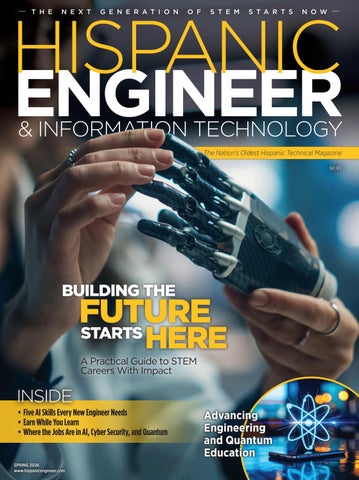
T H E
N E X T
G E N E R A T I O N
O F
S T E M
S T A R T S
N O W
$6.95
BUILDING THE
FUTURE STARTS
HERE
A Practical Guide to STEM Careers With Impact
INSIDE • Five AI Skills Every New Engineer Needs • Earn While You Learn • Where the Jobs Are in AI, Cyber Security, and Quantum
SPRING 2026 www.hispanicengineer.com
Advancing Engineering and Quantum Education
FEATURES
CONTENTS
COVER STORY 28
Building the Future Starts Here. Dr. Victor McCrary calls it the “right now future.” Service to Nation shows students where it's already taking shape—and how AI, cyber security, quantum computing, and apprenticeships can launch careers.
FOLLOW HE DIGITAL! Just because the presses have stopped does not mean the story has ended. The digital edition of this issue continues to evolve, featuring the most up-todate information. Follow the digital version here!
4
32
INSIDE
FROM QUANTUM TO COUNTRY: DARÍO GIL’S STEM MANDATE: Step inside Dr. Darío Gil’s federal science portfolio and see how
national labs, AI, quantum computing, fusion, and public service are opening new routes for Hispanic engineers.
38
BUILD THE CAREER TOOLKIT BEFORE YOU NEED IT:
Before the first interview, students need proof of what they can do. This guide shows how a resume, LinkedIn profile, and GitHub portfolio can make early skills visible.
HISPANIC ENGINEER & Information Technology | SPRING 2026
www.hispanicengineer.com | collinai.com
PUBLISHER'S PAGE VOLUME 41 | NUMBER 1
DEPARTMENTS
Building the Future Starts Here
News & Events .................... 8
This issue of Hispanic Engineer & Information Technology magazine begins with a message that is both urgent and hopeful: The future is already being built, and our readers have a place in it.
A look at a STEM trailblazer’s legacy, plus scholarship opportunities and upcoming events shaping the community.
Education .......................... 10
As Generation Z questions what AI means for entry-level careers, this story looks at the literacy, judgment, and support young workers need to turn anxiety into readiness.
By the Numbers ................12 New Latino Donor Collaborative data show Latino engineering enrollment, degree attainment, and labor force growth rising fast, even as corporate leadership still has ground to make up.
Job Tools .......................... 16 AI can speed up work, but it cannot replace judgment. Learn the five habits students need to verify results, protect data, and keep their own skills sharp.
Blue Collar STEM ............ 20 Apprenticeships are moving beyond traditional trades, giving students paid, hands-on routes into technology, infrastructure, healthcare, public safety, and skilled careers.
Industry Spotlight ...........24
From engineering retention at UC Santa Barbara to quantum education at IBM and FAMU-FSU, educators and researchers are expanding access to fields shaping the future.
Our cover story, “Building the Future Starts Here,” grows out of Service to Nation, a national virtual job fair and AI training program produced by Career Communications Group and hosted live on STEM City USA. The program connected students, veterans, military spouses, educators, and career seekers with pathways in artificial intelligence, cyber security, quantum computing, energy, healthcare, digital commerce, government, education, and other fields shaping America’s competitiveness and work force future. The outlook is clear. Technology is moving quickly, but opportunity is moving with it. AI is changing how decisions are made and how work gets done. Cyber security is becoming essential to every organization that depends on data, networks, and connected systems. Quantum computing is opening new questions in research, security, and innovation. Energy, healthcare, and digital commerce are creating career pathways that require technical skill, critical thinking, communication, and the ability to keep learning. For students, the message is not to be overwhelmed by change. It is to become part of it. Service to Nation challenged us to think differently about service. Service can mean wearing a uniform. It can also mean writing code, protecting networks, powering the grid, improving healthcare operations, strengthening public agencies, or helping organizations use technology responsibly. That broader definition matters because the careers shaping the country’s future will not always follow old categories. This issue also makes clear that there is no single pathway into meaningful STEM work. A four-year degree remains powerful, but so do community college programs, apprenticeships, certifications, military experience, internships, research opportunities, and employer-based training. For many students, the answer may not be college or work. It may be both. As publisher, I see this edition as a call to readiness. Readiness is more than knowing the newest tool. It is knowing how to think, verify information, communicate ideas, protect data, build skills, and seek mentors. It is understanding that AI should enhance performance, not replace critical thinking. Career Communications Group is a professional development organization focused on building inclusiveness in STEM communities. That mission guides this issue. Our goal is to help readers see not only where the opportunities are, but where they belong. The next mission belongs to you.
Career Outlook ................43
• Industry Overview: AI, cyber
security, and quantum computing are converging across industries. This overview explains what is changing, why it matters, and where students can begin.
• Job Horizons: Emerging roles in
AI, cyber security, and quantum reward candidates who can show real projects, ethical judgment, and a plan to keep learning.
www.hispanicengineer.com | collinai.com
Tyrone D. Taborn Publisher and Chief Content Officer
HISPANIC ENGINEER & Information Technology | FALL 2025
5
DEPARTMENT
SUBSCRIBE Online by CCG Editors editors@ccgmag.com
ADA MANZON IS 2018 NATIONAL VOLUME 40 | NUMBER 2 WEATHERPERSON OF THE YEAR EXECUTIVE OFFICE Tyrone D. Taborn, CEO and Publisher
man-made disasters. Jean Hamilton, CFO, President
Ada Monzón followed Hurricane Irma as it passed through the Caribbean and then helped Puerto Rico prepare for Hurricane Maria—one of the deadliest and costliest natural disasters on record.
A
da is the chief meteorologist at WIPR-TV, Noticias 24/7, and Univision Radio (WKAQ 580 AM). Her extraordinary service to Puerto Rico in 2017 and throughout her 30-year career was recognized ahead of National Weatherperson’s Day on February 5. “Ada is a strong advocate of hurricane preparedness and mitigation and has dedicated her career to public education, awareness, and safety,” said Federal Alliance for Safe Homes President and CEO Leslie ChapmanHenderson. “Her commitment during Hurricanes Irma and Maria brought not only essential weather information but much-needed calm as Puerto Rico braced for the worst. We are honored to name her as 2018 National Weatherperson of the Year.” The Federal Alliance for Safe Homes is the country’s leading consumer advocate for strengthening homes and safeguarding families from natural and
6
Kwan Hurst, COO, Operations After earning her master’s degree in Eric Price, V.P., Human Resources
energy experts, and emerging leaders for high-level discussions and networking.
meteorology at Florida State University, EDITORIAL AND CONTRIBUTING EDITORS Ada joined the U.S. National Weather “We are grateful to the members Rayondon Kennedy, Director, Digital and Print Operations Service Forecast Office San Juan of Congress in attendance for their LangoinDeen, Technology Editorin Michael Fletcher, Contributing 1989 as Forecaster and Warning andEditor insights and advocacy. Members in Gale Horton Gay, Contributing Editor Preparedness Meteorologist. attendance included Representative Garland L. Thompson, Contributing Editor Tony Cárdenas, Representative Roger Witherspoon, Contributing Editor She is the only professional Bill Flores, Representative Gene meteorologist with a GRAPHIC master’s°ree DIGITAL DESIGN Beverly Creative and UX Director Green, Representative Scott in tropical meteorology inWladkowski, the news Bryan Davis, Digital Director Peters, Representative Raul Ruiz, media of Puerto Rico. Ada is the first Representative Bobby Rush, DIGITAL PLATFORM AND DEVELOPMENT female American Meteorological Terrence Fooks, Metaverse Platform Program Manager & Client Relations Specialist Darren Soto, and Representative Society Fellow and Certified Broadcast Representative Nydia M. Velázquez,” CORPORATE AND ALUMNI RELATIONS Meteorologist in Puerto Rico. Dr. Gwendolyn Boyd, CCG Alumni Committee ChairCHCI and President said in a statement. Dr. Eugene From 1997 to 2002 she wasDeLoatch, the Chairman, BEYA Alumni Group CHCI holds industry summits to Vice Admiral Andy L. Winns, USN (Ret) National Chair, BEYA Military Alumni weather anchor for WIPR-TV, and Oliver “Bo” Leslie, Retired Program Manager, Historically Black Colleges and Universities/Minority Institutions, The Boeing and convene diverse thought leaders from 2003 to 2014 she Company was the Chief to address policy issues affecting the Monica E. Emerson, Women of Color STEM Conference National Chair Meteorologist of Univision P. R. (WLIILatino community. All CHCI events Matt Bowman, CCG Military Program Manager Stars and Stripes Committee Executive Director/Chief of Staff for VADM Walt TV). Davis, USN (Ret.) advance CHCI’s mission to develop She is a board member of the leadership pipelines that include Latino SALES AND MARKETING Caribbean Regional Association forExecutive Kameron Nelson, Account and diverse talent across sectors. De'OntaeSystems Jackson, Accountand Executive Coastal Ocean Observing Lucille Kennedy, Sales Support Assistant a member of the American of Manager In an interview with HE magazine, Jay Albritton,Alliance Social Media Account Dennis Arriola, Sempra Energy Museums, National Science Teacher JOBMATCH AND STUDENT DEVELOPMENT PROGRAMS Executive Vice President of Corporate Association, and American Rod Carter, Association Recruitment Specialist, College Relations Strategy and External Affairs, who for the Advancement of Science. CONFERENCE AND EVENTS gave a keynote at the event, said, Roberts, V.P., Partner Experience Ada is the recipient ofJennifer many awards, “I’m proud of the leadership that Brandon Newby, Customer Service Associate including the AMS Award for Sempra Energy has demonstrated in SALES OFFICE Excellence in ScienceADVERTISING Reporting by regards to diversity, but there is always Career Communications Group, Inc. a Broadcast Meteorologist, the AMS room to improve, with the ultimate 729 E. Pratt Street, Suite 504 Joanne Simpson Mentorship the Baltimore, MDAward, 21202 goal of having an industry that is Phone: (410) 244-7101 / Fax: Silver Medal of the U.S. Department of(410) 752-1837 reflective of our society as a whole. Commerce, and Distinguished Alumni I’m excited to see the next generation of the Faculty of Natural Sciences of of Hispanics contribute to new ideas the University of Puerto Rico. and technology in energy. We’re in a period of transformation, and we need the best and brightest in our future Sempra Energy’s EVP on workforce.” the 2018 CHCI Energy
Summit
www.hispanicengineer.com eMerge Americas, a Tech Event Connecting Latin On March 14 the Congressional Hispanic Caucus Institute (CHCI) America, North America, EngineerSummit & Information Technology (ISSN 10883452) is a publication devoted to science and technology hosted the 2018 CHCIHispanic Energy and promoting STEM opportunities for Hispanicand Americans. This publication is bulk mailed to universities and colleges Europe at the Newseum in Washington, DC. nationwide and in Puerto Rico. The editors invite editorial submissions directed toward the goals of Hispanic Engineer ike us on Facebook: L facebook.com/HEITMAG
Information Technology. In particular, this magazine wishes toAmericas, present ideas, currentaevents, personality profiles of The day-long summit&convened over eMerge techandevent Hispanic Americans and related business pursuits. Fully developed articles may be sent, 200 guests, includingsuccessful members of in science, technology, connecting Latin America, North but queries are strongly encouraged. Articles and letters should be sent to Hispanic Engineer & Information Technology, Congress, Fortune 500 executives, has announced Editorial Department, 729 E. Pratt Street, Suite America, 504, Baltimore, MDand 21202.Europe, No manuscript will be returned unless
HISPANIC ENGINEER & Information Technology | SPRING 2026
accompanied by a stamped, self-addressed envelope. Hispanic Engineer & Information Technology cannot be responsible for unsolicited material. Copyright ©2026 by Career Communications Group, Inc. All rights reserved. Printed in the U.S.A.
www.hispanicengineer.com | collinai.com
GET CERTIFIED. AD GET AHEAD. Advance your career with CCG’s AI and Digital Skills Certification Programs. From foundational courses to advanced applied AI, our certifications help students and professionals upskill for the future of work.
7 2 9
E .
ENROLL today! Scan to Begin
P R A T T S T . S U I T E 5 0 4 • B A L T I M O R E 4 1 0 2 4 4 7 1 0 1 • C C G M A G . C O M
M D
2 1 2 0 2
NEWS &EVENTS
Honoring Richard A. Tapia: A Trailblazer in STEM Education
C
areer Communications Group’s Hispanic Engineer magazine joined others nationwide in honoring the legacy of Richard A. Tapia (March 1939–May 2026). In 2005, Tapia was named University Professor at Rice University, the institution's highest academic title, in acknowledgment of his national achievements in research, teaching, and service. He held the MaxfieldOshman Chair in Engineering as well. Tapia started his career at Rice as an assistant professor in 1970, was promoted to full professor in 1976, and was the department chair between 1978 and 1983. In 1992, he became the first U.S.-born Hispanic elected to the National Academy of Engineering and later served on the National Science Board from 1996 to 2002. He also
8
chaired the National Research Council's Board on Higher Education and the Workforce from 2001 to 2004. In April 2024, Rice University recognized Dr. Tapia for five decades of national leadership in advancing women and minorities in STEM fields. His honors include the National Science Foundation's inaugural Presidential Award for Excellence in Science, Mathematics, and Engineering Mentoring (1996), the Lifetime Mentor Award from the American Association for the Advancement of Science (1998), the National Medal of Science (2011), the College-level Promotion of Education Award from the Council of Historically Black Colleges and Universities Engineering Deans (2016), and the Distinguished Scientist Award from the Society for Advancement of Chicanos/Native Americans in Science. He was named one of the 50 most
HISPANIC ENGINEER & Information Technology | SPRING 2026
by Lango Deen ldeen@ccgmag.com
important Hispanics in STEM by Hispanic Engineer magazine in 2005. On March 20, 2026, Houston’s Ship Channel Bridge was renamed the Richard A. Tapia Bridge, honoring his lasting impact on his community and field. According to his obituary in Communications of the ACM, ACM fellows Eugene H. Spafford and Simson L. Garfinkel note that Tapia found fulfillment as a Chicano, Tejano, mathematician, and car enthusiast. He and his late twin brother began drag racing at a young age and set a world record in fuel dragster racing. For decades, he integrated his passions for mathematics and drag-racing folklore into university lectures and mathematics-awareness events. After high school, while working at a muffler factory, a co-worker encouraged him to attend college. He earned a bachelor's degree in
www.hispanicengineer.com | collinai.com
SAVE THEDATE Center for Minorities and People with Disabilities in Information (CMD-IT) and ACM Richard Tapia Conference Sept. 16–18 Atlanta, GA
AI NextGen America Conference and Futurist Awards Oct. 9–10 Baltimore, MD
AISES 2026 National Conference Oct. 15–17 Portland, OR
SHPE 2026 National Convention Oct. 28–31 Indianapolis, IN
SACNAS 2026 Conference Oct. 29–31 Long Beach, CA
HACU 40th Annual Conference Oct. 31–Nov. 2 Chula Vista, CA
2027 BEYA STEM Conference Feb. 18–20 Baltimore, MD
2027 AAAS Annual Meeting Feb. 18–20 Chicago, IL
Scholarships The U.S. Department of Energy reports that the industry must hire and train 81,000 electricians each decade and anticipates shortages of 320,000 welders by 2029 and 376,000 nuclear workers by 2050. Over 70 percent of employers report difficulty finding qualified talent, underscoring the urgent need for a skilled trades workforce in the utility sector. Please review the following energy-related scholarship opportunities. • The American Nuclear Society Scholarship Policy and Coordination Committee scholarships • BluEarth Renewables Scholarship • The Everlight Solar Clean Energy Scholarship • American Public Power Association's Demonstration of Energy & Efficiency Developments (DEED) scholarships • The Education for Sustainable Energy Development scholarship program • The Georgia Energy and Industrial Construction Consortium Scholarship • The Ernest F. Hollings Scholarship program • IEEE PES Scholarship Plus Initiative
For decades, he integrated his passions for mathematics and dragracing folklore into university lectures and mathematicsawareness events. www.hispanicengineer.com | collinai.com
• The José E. Serrano Educational Partnership Program (EPP) with Minority Serving Institutions • The Los Alamos National Laboratory Foundation scholarships • The Renewable Energy Scholarship Foundation scholarships • The Midwest Renewable Energy Association scholarships • TC Energy Corporation scholarships and fellowships
mathematics in 1961 and contributed to a Navy grant defining ship hull surfaces. During graduate studies, he worked part-time at IBM, earning his master's in 1966 and Ph.D. in 1967. He worked as an assistant professor at the University of Wisconsin-Madison before joining Rice University in 1970. Tapia was married for 63 years before his wife, Jean Rodriguez Tapia, passed away in November 2022. HE
View these stories, and others like them, online at www.hispanicengineer.com
HISPANIC ENGINEER & Information Technology | SPRING 2026
9
EDUCATION by CCG Editors editors@ccgmag.com
PREPARING THE WORKFORCE FOR THE AI ERA As Generation Z reports growing anxiety about artificial intelligence, federal officials, industry leaders, and STEM convenings press for a national AI literacy push.
A
recent LinkedIn report, "Why Gen Z Is Less Confident in AI Than Their Grandparents," found that Generation Z (born 1997– 2012) holds more negative attitudes toward artificial intelligence than millennials (1981–1996), Generation X (1965–1980), and baby boomers (1946–1964). The survey examined perceptions of AI's impact on workplace efficiency, career growth, motivation to acquire new AI skills within six months, and the extent of organizational support for developing AI competencies. Job seekers across all age groups reported reduced confidence in securing employment, with Generation Z consistently expressing the lowest confidence.. LinkedIn's The Work Shift said the confidence gap should prompt employers to evaluate how organizational support for younger workers during the AI transition may determine whether AI becomes an opportunity or a barrier to advancement. A widely supported comment on the LinkedIn study attributed Generation Z's lower confidence to skepticism about the failure paradox. According to a health
10
services president and CEO, Generation Z's extensive, direct experience with technology has heightened awareness of its flaws, biases, and potential to displace jobs. While older generations often view AI as an innovative tool, the executive noted, Generation Z perceives it as a threat to career entry, creative autonomy, and cognitive development. As new entrants to the workforce, Generation Z fears AI may replace entry-level positions or render their skills obsolete, with 53 percent of young adults reporting anxiety about the technology. Many Generation Z
HISPANIC ENGINEER & Information Technology | SPRING 2026
respondents also expressed concern that excessive reliance on AI impedes critical thinking, creativity, and intellectual growth, with 49 percent saying it undermines their capacity for deep thought. Having grown up with social media, Generation Z is acutely aware of algorithmic bias and the downsides of technology, which contribute to skepticism about AI's reliability and ethical application. For younger generations, AI represents both a tool and a potential substitute for acquiring foundational skills, whereas older generations with established careers tend to view AI primarily as an efficiency enhancer.
www.hispanicengineer.com | collinai.com
EDUCATION
“AI should enhance performance but not replace critical thinking.” ethics and security. The framework also outlines seven principles for effective teaching: firsthand learning, realworld context, development of human skills such as judgment and creativity, ensuring digital literacy and internet access, supporting ongoing learning, preparing managers and counselors, and maintaining flexibility as AI evolves.
At BEYA
Federal Response In mid-February, the U.S. Department of Labor introduced an AI Literacy Framework to prepare the workforce for future demands. The framework targets leaders in career and technical education, community and tribal colleges, apprenticeship programs, workforce agencies, administrators, and job centers. It highlights five key areas: understanding AI basics, exploring AI tools, providing clear instructions to AI, verifying AI results for accuracy, and using AI responsibly with attention to
www.hispanicengineer.com | collinai.com
Artificial intelligence was a central topic at the recent BEYA STEM Conference, which attracted thousands of attendees, including 2,500 students. During the conference, an Amazon Web Services (AWS) authorized instructor led a session on enterprise AI adoption, featuring a panel of high school seniors, college students, and STEM professionals. The conference also included the Workforce Development BEYA Alumni Committee through STEM City USA, a digital platform created by Career Communications Group (CCG) that leverages machine learning and AI to provide real-time learning, mentoring, and networking opportunities. A seminar on collaborations between historically Black colleges and universities (HBCUs) and the Department of War convened leaders from policy, government, and academia to discuss research, talent, and technology opportunities. A biophysics expert led a session on the contributions of HBCUs and African
-American institutions to AI for national security and global collaboration. An MBA student praised a BEYA seminar on leveraging AI for business goals, which addressed AI capabilities, efficiencies, and the risks of using AI without clear guidelines, particularly regarding confidentiality and integrity. AI should enhance performance but not replace critical thinking, the student said, underscoring the need to balance innovation with risk management. Other experts advised integrating AI into all projects, emphasizing AI-specific features, planning for uncertainty, prioritizing user experience, and adapting rapidly as the field evolves.
A Literacy Roadmap Comprehensive AI literacy should include foundational knowledge of machine learning, large language models, prompt engineering, and responsible use. Essential programming competencies include Python for AI and machine learning, JavaScript or TypeScript, fundamental data structures and algorithms, and version control using Git and GitHub. The AI domain spans agentic AI with memory and planning, generative AI built on large language models, deep learning and neural networks, machine learning techniques such as regression and clustering, and traditional AI focused on reasoning and planning. For effective AI learning, individuals should begin with accessible assistants and chatbots such as ChatGPT, Claude, and Gemini; advance to integration tools and platforms such as Make, Zapier, and n8n; and then explore LangChain, CrewAI, and AutoGen. At each stage, it is important to develop skills in prompt writing, reasoning, orchestration, and automation. HE
HISPANIC ENGINEER & Information Technology | SPRING 2026
11
BY THE NUMBERS by CCG Editors editors@ccgmag.com
THE LATINO ENGINEERING PIPELINE ACCELERATES New LDC data show record gains in degrees, enrollment, and workforce share—but corporate leadership still lags.
T
he Latino footprint in U.S. engineering and technology is expanding at a pace few segments can match, and the latest data make the case in unambiguous terms. According to the 2025 LDC U.S. Latino Handbook, a guide to the demographics, impact, and economic power of U.S. Latinos, Latino undergraduate enrollment in engineering programs climbed 38.6 percent between 2012 and 2022, rising from 11.4 percent to 15.8 percent of all engineering students. The Latino Donor Collaborative and the Latino Data Collaborative Think Tank found that over the same decade, the number of Latinos earning bachelor’s degrees in engineering jumped 56.7 percent, the largest increase of any ethnic group tracked. Graduate-level gains are equally striking. Master’s degrees in engineering awarded to Latinos rose 37% from 2012 to 2022, while doctoral degrees climbed 85.4 percent, signaling deeper participation at the highest tiers of STEM research and leadership. The timing matters. The U.S. Bureau of Labor Statistics projects 11.8 million
12
STEM job openings by 2033, and the handbook identifies Latinos as strategically positioned to meet that demand. Latinos already post the highest labor force participation rate in the country at 66.9 percent, and they are projected to account for 78 percent of net new workers entering the U.S. labor market between 2020 and 2030. Ana Valdez, president and CEO of the Latino Donor Collaborative, frames the trend as a market reality rather than a diversity statistic. “Understanding the U.S. Latino cohort is not an exercise in DEI,” Valdez writes in the handbook’s opening letter. “It is a matter of profit and loss.” With a $4 trillion GDP in 2023, U.S. Latinos would rank as the fifth-largest economy worldwide if measured as a standalone nation. The educational momentum behind the workforce numbers is decades in the making. Between 2000 and 2021, Latinos holding advanced degrees more than tripled, climbing from 710,000 to 2.5 million. The growth rate was steepest among Latinas, whose ranks with advanced degrees rose 291 percent, compared with 199 percent for Latino men. More recent figures show that bachelor’s degree attainment among Latinos climbed 4.6 percent between 2022 and 2023 alone, driven by younger generations completing higher education. Latino youth are central to that story. The handbook reports that Latinos make up about 27 percent of the U.S. youth population, with 94 percent U.S.-born. The Census Bureau projects the share will reach 31.9 percent by 2060. Challenges remain along the pipeline. Financial barriers, housing insecurity, and uneven access to mentorship continue to slow progress for Latino students pursuing engineering and technology credentials. The Society
HISPANIC ENGINEER & Information Technology | SPRING 2026
Latino doctoral degrees in engineering climbed 85.4 percent from 2012 to 2022— the steepest gain of any group tracked. of Hispanic Professional Engineers (SHPE), an LDC research partner, has awarded more than $6 million in scholarships since 2018 to address those gaps, and the organization continues to expand programming aimed at retention and persistence in STEM majors. Representation in corporate leadership has not kept pace with the talent pipeline. Latinos hold just 5.6 percent of Fortune 500 board seats and about 5 percent of executive positions in surveyed corporations, according to the handbook. Latinas hold only 1.7 percent of Fortune 500 board seats, one of the lowest rates of any demographic group in corporate America. For employers, the message in the data is direct. The handbook notes that companies failing to engage Latino talent and consumers risk forfeiting growth to competitors who do. With Latinos already accounting for one in five Americans and one in four young people, the engineering pipeline they are building is not a future workforce. It is the workforce. HE
www.hispanicengineer.com | collinai.com
BY THE NUMBERS
THE 2025 LDC U.S. LATINO HANDBOOK
TM
AMERICA'S GROWTH ENGINE: U.S. LATINOS—YOUTH, WORKFORCE, CIVIC LEADERS, AND ENTREPRENEURS SHAPING TODAY AND TOMORROW
WHO WE ARE
20% of population 71% growth (2022–2023)
EDUCATION & INNOVATION +291% women, +199% men with advanced
degrees since 2000
of new net workers (2020–2030) will be Latino
Engineering enrollment +38.6%, +56.7% in a decade
Latinos drive
24% of ticket sales, 29% of mobile viewership
We only hold
5.1% of the lead roles in TV shows and films.
Fixing the gap adds
$12–$18B yearly to entertainment
Latino, 94% U.S.-born or naturalized
9 in 10
U.S. Latinos
are U.S. citizens or lawful residents
$4.0 trillion GDP (2023)—5th largest in the world $4.1 trillion in purchasing power, growing 2.4x faster than non-Latinos 66.9% labor participation, highest in the nation 78% of new workers (2020–2030) will be Latino ENTREPRENEURSHIP & BUSINESS $945 billion annual output +44% growth (2018–2023) vs. –3% for White-owned businesses
11.8 million STEM by 2033
CULTURE, MEDIA & REPRESENTATION
of U.S. youth are
68 million
5.7 million Latino-owned businesses,
Bachelor’s degrees up 4.6% in one year
26%
78%
of U.S. population
THE ECONOMIC ENGINE
27% of youth
America’s Growth Engine: U.S. Latinos at a glance in the 2025 LDC U.S. Latino Handbook™ captures the demographic, economic, educational, and civic indicators driving U.S. Latino momentum, from a $4 trillion GDP and 66.9 percent labor force participation to a 38.6 percent rise in engineering enrollment over the past decade.
LATINAS: THE POWER WITHIN 69% labor participation, among the
highest in the country
86% of household purchasing, decisions led by Latinas
6.3% annual business growth,
fastest in the nation
THE DECIDING VOTE
36.2 million Latinos are eligible voters— 1.4 million new voters each year—the nation’s second-largest electorate.
For more information and details on the report, please email us at info@latinocollaborative.org. www.LatinoDonorCollaborative.org
X: @LDCLatino Facebook: @Latino Donor Collaborative Instagram: @LatinoDonorCollaborative LinkedIn: Latino Donor Collaborative
Source: Latino Donor Collaborative. (2025). The 2025 LDC U.S. Latino Handbook™. Reprinted with permission. LatinoDonorCollaborative.org Full citation (for references/endnotes): Latino Donor Collaborative. (2025). The 2025 LDC U.S. Latino Handbook™. Retrieved from https://latinodonorcollaborative.org/original-research/
www.hispanicengineer.com | collinai.com
To read more informative stories like this, visit www. hispanicengineer.com
HISPANIC ENGINEER & Information Technology | SPRING 2026
13
JOB TOOLS by CCG Editors editors@ccgmag.com
AI LITERACY: FIVE SKILLS TO BUILD BEFORE YOUR FIRST JOB traditional machine learning.
A field guide for STEM students preparing to walk into an AI-driven workplace
Y
ou cannot scroll a job board these days without tripping over the word “AI.” Companies are racing to adopt it. Hiring managers expect candidates to know it. AI literacy is no longer a bonus on a resume. The good news for engineering students and computer science graduates is that “AI literacy” does not mean training the next large language model (LLM). It means using the tools, knowing where they fail, and protecting yourself and your employer when something goes wrong. At a recent BEYA seminar on generative AI in business, a panel of AI adoption leads, corporate technology executives, and research engineers laid out what entry-level workers should know. Their advice points to five concrete skills worth building now.
1. Know what AI is—and what it is not. Generative AI is having its moment, but it is not the whole field, and it is not the tool for every job. One panelist compared it to a hammer: useful, but useless if what you need is a bucket of water. Generative AI exists to generate ideas, text, images, and voice. Use it for brainstorming, drafting, and summarizing. Do not use it to predict ticket prices, run financial models, or answer questions with a single correct answer. Those problems belong to
16
Knowing the difference is a skill. One company on the panel described five levels of AI adoption inside their organization, ranging from personal productivity to building custom agents. A new hire who can speak intelligently about where generative AI ends and machine learning, computer vision, or natural language processing (NLP) begins is already ahead of the curve.
2. Verify everything before you put your name on it. Hallucinations happen when AI generates an incorrect answer. It’s a pitfall of these tools, not a bug about to be patched. One panelist put it bluntly: Any model claiming it does not hallucinate is just refusing to answer when it is unsure. When you put your name on a deliverable, nobody cares whether you used ChatGPT, Gemini, or anything else. You own the work. That means factchecking dates, numbers, and citations against the source every time. A team on the panel caught a hallucinated statistic in an AI-generated research summary by spending an extra five seconds searching each line. That habit is what separates someone who uses AI well from someone about to embarrass themselves in a meeting.
3. Treat data—yours and your employer’s—like it matters. This is where new graduates get into trouble fast. Most consumer AI tools train on the data users feed them. Panelists shared cautionary tales, including proprietary intellectual property that ended up on the internet after a recent hire pasted it into a public
HISPANIC ENGINEER & Information Technology | SPRING 2026
chatbot. Three good habits will keep you off that list: • Check your account settings and turn off model training on your conversations. • Never paste confidential code, client information, or unreleased designs into a tool your company has not approved. • When in doubt, ask the security or legal team. Panelists agreed the security and legal team should be brought into AI conversations early, not after something breaks.
“Skills are a muscle. If AI does the work and you stop practicing the underlying craft, the muscle weakens.” 4. Keep your foundational skills sharp. Wide-scale AI adoption causes what one panelist called “skill atrophy.” Skills are muscles. If AI does the work and you stop practicing the underlying craft, the muscle weakens. A research study referenced during the panel found that people who drafted essays with AI could not even recite what they had submitted. They had no real ownership of the work. For engineering students, that means
www.hispanicengineer.com | collinai.com
JOB TOOLS
“AI literacy is no longer a bonus on a resume. It is the floor.”
staying current. Write code by hand when you can. Work through math. Build a basic neural network from scratch in PyTorch before you start chaining together pre-built models. When the AI breaks—and it will—the person who can open the code and figure out why is the person who keeps the job. Critical thinking, judgment, and collaboration belong in this category too. Panelists called critical thinking the single most important skill in the AI era, because a good model will happily give a polished answer to a poor question. Talk to the people around you. Find out what they are good at. The best implementations come from teams where humans bring complementary strengths to the tool.
www.hispanicengineer.com | collinai.com
5. Show your AI literacy in the interview.
source models and free compute are available to anyone willing to download and experiment.
Do not tell a recruiter you “use ChatGPT.” That sentence tells them nothing. Talk about how you scope a problem before prompting, how you verify outputs, how you protect data, and how you decide when AI is the wrong tool. Walk through a specific project, even a class assignment, where AI saved you time, and explain how you checked the result.
Stay flexible. One panelist with an electrical engineering degree ended up running software development for a technology company. The advice was direct: Get hired based on your capabilities, leverage AI to increase efficiency in the role, and let the career shape itself from there.
Mention the free resources you have used to learn. DataCamp, Hugging Face, Google Colab, and the PyTorch documentation all came up by name during the seminar, alongside frameworks such as TensorFlow or the natural language program. Open-
Another panelist put it this way: Lifelong learning is not negotiable. The tools will keep changing. The companies that hire you will keep changing. Build the habit now of testing, verifying, and learning aloud, and you will spend your career staying ahead of the curve instead of chasing it. HE
HISPANIC ENGINEER & Information Technology | SPRING 2026
17
BLUE COLLAR STEM by CCG Editors editors@ccgmag.com
EARN WHILE YOU LEARN Apprenticeships are expanding beyond the trades, giving students paid pathways into technology, infrastructure, healthcare, public safety, and the future workforce.
G
et paid to learn. Skip the debt. Walk into a job. That’s not a loophole—it’s apprenticeship, and it’s exactly what Victor McCrary asked a room of high school students to consider at the Service to Nation summit on STEM City USA, held during National Apprenticeship Week. The chemist, researcher, and administrator challenged students worried about the burden of college debt to learn indemand skills, get paid while they train, and move into a job without thousands of dollars owed. “This is not a fantasy,” McCrary told the audience. “This is apprenticeship.”
While apprenticeships are sometimes overlooked, they offer the most practical pathways in the workforce, with earn-as-you-learn programs, career credentials, mentorship, and opportunity. The Service to Nation session outlined the benefits of registered apprenticeships in artificial intelligence (AI), cyber security, cloud computing, advanced manufacturing, banking, healthcare, and other growing fields. It also emphasized that some employers are hiring apprentices straight out of high school and that Victor McCrary, Ph.D., Vice Provost for National Security Innovation at The Catholic University of America, addresses the audience at the Service to Nation Summit.
20
HISPANIC ENGINEER & Information Technology | SPRING 2026
veterans can use their GI Bill benefits for certain apprenticeship programs. Apprenticeships and certifications are just as valuable as a four-year college degree.
‘Real results in a meaningful time frame’ Tyrone D. Taborn, founding chairman and CEO of Career Communications Group and STEM City USA, continued Dr. McCrary’s message by connecting apprenticeships to the larger mission of Service to Nation and the workforce development effort designed to offer information on jobs and skills to students, teachers, and military veterans.
www.hispanicengineer.com | collinai.com
BLUE COLLAR STEM
“Apprenticeship is not a backup plan. It can be a first step toward independence, financial security, and leadership.” economics. Those classes introduced students to the kinds of jobs that keep the nation running. Service to Nation, he explained, is working to reintroduce students to shop classes while showing how they connect to AI, quantum, cyber security, and other emerging technologies.
Blue-collar STEM is a real career map. McCray notes that a student may begin with an apprenticeship and then add certifications in safety, automation, cyber security, project management, or another technical area.
Taborn emphasized that education must be realigned around “real results in a meaningful time frame.” Apprenticeships offer pathways for those who learn best by doing or want to work sooner, avoid immediate debt, and support their families. Taborn also connected the discussion to a broader shift in education. When he was in school, he said, many students had access to “shop classes” such as print, auto, metal, and home
www.hispanicengineer.com | collinai.com
Blue-collar jobs in STEM, also known as the skilled technical workforce, are reshaping perceptions of STEM careers. These careers span IT, engineering, and energy, and involve tasks such as installing, maintaining systems, and programming. While some STEM careers require advanced degrees, more than half of STEM jobs are accessible without a traditional four-year college education, emphasizing the value of alternative training pathways. At the National Science Board, McCrary highlighted the importance of these roles, which require technical skills and specialized training beyond high school but less than a four-year degree. McCrary helped focus national discussions on addressing the decline of non-college tracks in high schools and finding ways
to fill these essential jobs through apprenticeships and internships. During the Service to Nation session, Maryland state Sen. Cory McCray, author of The Apprenticeship That Saved My Life, listed apprenticeship opportunities for electricians, carpenters, roofers, painters, welders, plumbers, steamfitters, and ironworkers. But McCray also made it clear that the model is expanding. “Let’s start navigating the tech,” McCray said, noting that many young people do not want to spend four or five years trying to figure out their future when they start working full-time in 18 months, two years, or three years. He pointed to tech apprenticeships, public safety, government, and healthcare as areas where apprenticeship models are growing. He also noted that the federal government and state governments are investing in apprenticeships. That expansion matters because the definition of hands-on work is changing.
Stackable certifications and the power of exposure Today, infrastructure does not only mean roads, bridges, and buildings. It also means networks, data systems, cloud platforms, automated equipment, advanced manufacturing systems, secure facilities, and digital tools that keep businesses and communities running. Taborn added that the future will also require stackable certifications and the ability to integrate innovative technologies into traditional trades. A student may begin with an apprenticeship and then add certifications in safety, automation, cyber security, project management, or another technical area. Over time, that pathway can lead to more technical work, entrepreneurship, or leadership.
HISPANIC ENGINEER & Information Technology | SPRING 2026
21
BLUE COLLAR STEM by CCG Editors editors@ccgmag.com
McCray said that when school troubles and juvenile justice almost deferred his dreams, his mother, Renee, contacted the Maryland Department of Labor and asked for information on apprenticeships. That information packet led him to an opportunity that changed his life.
Career Communications Group's Tyrone Taborn (left) with Maryland Sen. Cory McCray (right).
McCray said the apprenticeship gave him structure, discipline, mentorship, and skills. Over five years, he learned a trade, built confidence, and began to see a future. His story resonated with the session’s theme about the power of apprenticeships and why exposure matters. McCray said he never pictured himself as an electrician because he did not know anyone in the trade.
22
HISPANIC ENGINEER & Information Technology | SPRING 2026
www.hispanicengineer.com | collinai.com
BLUE COLLAR STEM
“College is not the only path to success, but lifelong learning is.” That is why McCray conducts apprenticeship tours. Students tour colleges and universities all the time, he said, so why not tour apprenticeship programs? For seven years, he has helped connect young people with training sites where they can see plumbers, steamfitters, operating engineers, electricians, and carpenters in action. Students need to visit training centers, meet apprentices, ask questions, and see young people already enrolled in programs. The Service to Nation session also offered practical tips.
HERE ARE 8 QUESTIONS STUDENTS SHOULD ASK BEFORE ENROLLING: 1.
Registered apprenticeship programs also require a high school diploma, GED, and a driver’s license. McCray described how students helped advocate for driver’s education funding in Maryland after one young person explained that lack of a driver’s license could affect access to apprenticeship opportunities. For first-generation students, veterans, and young people balancing ambition with practical concerns about money, transportation, family obligations, and timing, that kind of information can be life-changing. The broader Service to Nation message was that serving the nation can mean wearing a uniform, securing a network, wiring a building, supporting a hospital, maintaining infrastructure, managing logistics, or building the next generation of technology. For students looking at their next step, the answer may not be college or work. It may be both. An apprenticeship is not a backup plan. For many students, it may be the first step toward a career, a credential, and a future they can own.
What skill will I learn?
2. Is the program registered or connected to a recognized employer? 3. Will I earn wages while I train? 4. What credentials will I receive when I finish? 5. How long does the program take? 6. What are the entry requirements? 7. Does it lead to a real job? 8. Who will mentor me?
www.hispanicengineer.com | collinai.com
Wage premiums adjusted for education in bluecollar STEM roles are typically 10 percent higher than those in non-STEM jobs, with an average salary of $53,000. In certain parts of the country, these wages can be 50 percent greater than non-STEM salaries. According to Harvard Business Review, individuals who complete apprenticeship
programs earn about $250,000 more over their lifetimes. Electricians and plumbers have average earnings of approximately $57,000, while HVAC technicians make around $50,000 on average. Blue-collar STEM positions are more common than STEM roles requiring higher education, which are usually concentrated in urban areas. This presents a positive opportunity for students across the country seeking better-paying employment. The growth of blue-collar STEM careers is expected to continue alongside the overall expansion of STEM fields. As you consider the future, remember to: Earn while you learn. Build while you grow. Ask better questions. Find real mentors. Choose a pathway that leads to real skills, real wages, and real opportunity. HE
Watch more Service to Nation career conversations and explore emerging STEM pathways at www. HispanicEngineer.com.
HISPANIC ENGINEER & Information Technology | SPRING 2026
23
INDUSTRY SPOTLIGHT by CCG Editors editors@ccgmag.com
ADVANCING ENGINEERING AND QUANTUM EDUCATION Universities, industry leaders, and global organizations are expanding engineering retention efforts and accelerating quantum science education initiatives
I
n April 2026, the University of California, Santa Barbara, announced a novel approach to help engineering majors stay on track. Nationally, 50 percent of students who begin engineering majors switch disciplines before graduating. “Engineering is hard, but it’s also an incredibly rewarding field,” said Professor Elizabeth Belding, who earned a doctorate in electrical and computer engineering from UCSB, in 2000. Supported by the National Science Foundation and cocreated by Belding, UCSB’s Integrated Networking, Scholarship, and Peer Interaction for First-Year Engineers (INSPIRE) program offers seminars that introduce students to the university, potential careers, and peers, along with ongoing mentoring. Building on such efforts, the American Society for Engineering Education hosted a webinar on May 19 focused on aligning engineering education with workforce needs. The ASEE discussion highlighted practical strategies for matching coursework with industry requirements and strengthening
24
partnerships between schools and businesses.
As engineering evolves, attention is also shifting to the emerging field of quantum science education. IBM Quantum announced that the retrospective from the International Year of Quantum Science and Technology is available for download. Drawing on the 2025 “Global Survey on Quantum Research and Infrastructure,” UNESCO, the Unitary Foundation and IBM presented a global overview of quantum research and highlighted significant gaps in quantum computing accessibility across demographics and regions. IBM Quantum emphasized that the future of quantum computing depends on broader, more inclusive access. The survey recommended a distributed, science-led approach to increase global engagement, invest in education, expand access to infrastructure, and promote responsible governance. On May 21, Olivia Lanes, global lead for IBM Quantum Learning + Education, announced that May 28 would be IBM Quantum Education Day. IBM said the event would bring together educators, researchers, and quantum professionals to explore how quantum computing is transforming classroom experiences. The event will feature professors integrating quantum computing into their courses and introduce a new free educational method. In parallel with educational advances, IBM recently announced that researchers from Basque Quantum and the National Institute of Standards and Technology achieved one of the largest and most advanced demonstrations of a “time crystal” using an IBM Quantum
HISPANIC ENGINEER & Information Technology | SPRING 2026
Heron processor. Natural crystals such as snowflakes, diamonds, and salt have repeating patterns in space, but time crystals repeat in time. When energy is added to a time crystal, its quantum state cycles in a regular pattern while maintaining a memory of its original structure. This
www.hispanicengineer.com | collinai.com
INDUSTRY SPOTLIGHT
“The future of quantum computing depends on broader, more inclusive access.” mathematical models and belief-based calculations. Researchers said the breakthrough could lead to innovative studies involving higher-dimensional time crystals and applications in areas such as single-molecule magnets and nanoscale semiconductors. Meanwhile, the FAMU-FSU College of Engineering partnered with Florida Agricultural and Mechanical University to establish the Center for Quantum Science and Engineering, which debuted in spring 2026. Located in the Engineering Village at Innovation Park in Tallahassee, FL, the center will serve as a hub for interdisciplinary research and workforce training in one of the fastest-growing areas of science and technology.
makes it a rare example of quantum information resisting disorder. The research team used IBM’s Heron R2 quantum processor and specialized computational methods to create a group of 144 quantum bits arranged in a flat, two-layered system with specific magnet-like patterns like those found in real materials. Because quantum bits
www.hispanicengineer.com | collinai.com
are quantum objects, researchers are not simply running a computer model of a time crystal. They are creating one using quantum bits as the fundamental building blocks. The team studied the time crystal’s behavior using classical methods to correct errors, including simplified
The center’s facilities will include laboratories for building nanoscale materials, conducting low-temperature testing, designing specialized quantum chips, and assembling miniature electronics. The effort is supported by an IBM quantum computer and additional business partners. By improving quantum computing tools, the center also aims to strengthen FAMU’s research reputation as a leading institution and historically Black university pursuing the highest level of research status. HE
HISPANIC ENGINEER & Information Technology | SPRING 2026
25
BUILDING THE
FUTURE STARTS
HERE
A Practical Guide to STEM Careers
by editors@ccgmag.com
For students, veterans, and career changers looking for direction, the question is no longer whether technology fields like AI, cyber security, and quantum computing offer a path forward. The question is which path to take, who can help guide it, and how soon to begin.
helped students see energy as the foundation beneath every other technology conversation.
• AI cannot run without data centers.
• Data centers cannot run without power.
• Phones, hospitals, schools,
transportation systems, and smart cities all depend on a reliable grid.
The sector includes engineers, line workers, technicians, accountants, attorneys, human resources staff, commercial drivers, and data specialists. For students interested in careers that combine technology with impact, energy offers a direct way to help keep communities running.
T
hat was the central message of Service to Nation, a national virtual job fair and AI training program produced by Career Communications Group and hosted live on STEM City USA. The program was designed to connect students, veterans, military spouses, educators and career seekers with technology fields that are shaping America’s competitiveness and future. The event invited students to see careers in AI, cyber security, and quantum computing not as abstract concepts, but as real opportunities connected to employers, colleges, military branches, and training programs. The opening message framed the day with urgency and purpose. Dr. Victor McCrary, chemist, researcher, and administrator, said the future is not the kind we see in science fiction, but the “right now future” being built in labs, data centers, classrooms, utilities, hospitals, government agencies, and digital marketplaces. He challenged students to understand public and military service can mean wearing a uniform, writing code, designing systems, protecting networks, improving healthcare operations, supporting the energy grid, or helping businesses use technology more responsibly. The first session at Service to Nation focused on retail and digital commerce, led by Christine Burkette, an entrepreneur, IT consultant, and tech influencer. Her message was clear: Retail is no longer just storefronts, cashiers, and inventory shelves. It is
powered by AI-driven recommendation engines, fraud protection, customer data, augmented reality, robotics, and digital marketing. Everyday experiences such as shopping online, using social media storefronts, or interacting with chatbots are also windows into future careers. She urged students to recognize that every digital action has a workforce behind it. Jobs include:
Education and workforce development became a central bridge between inspiration and action. Dr. Talitha Washington of Howard University explained how data science and AI connect to mathematics, statistics, modeling, and critical thinking. She reminded students that AI is built through human choices, data, models, and probability. Because of that, students must learn not only how to use AI, but also how to question it.
• Designing the customer experience
• Protecting the payment system • Studying the data • Building the website • Managing the brand • Automating the warehouse • Analyzing shopping trends She also emphasized professional skills that matter across industries: communication, problem-solving, teamwork, creativity, technology literacy, adaptability, and professionalism. Moving into apprenticeships, Service to Nation noted nationwide opportunities in Registered apprenticeships in fields such as AI, cyber security, cloud computing, advanced manufacturing, banking, and healthcare. These programs can allow students and career changers to earn while they learn, build skills without taking on heavy debt, and enter industries that need talent now. Energy and utilities were another major focus. Cornell Johnson of the Center for Energy Workforce Development
“THE CLEAREST MESSAGE FOR STUDENTS WAS THIS: YOU ARE NOT BEHIND. YOU ARE RIGHT ON TIME—BUT THE NEXT STEP BELONGS TO YOU.” Washington’s advice was practical. Students should:
• Keep their resumes updated • Build LinkedIn profiles • Use GitHub to showcase data, AI, and coding projects
She also pointed to beginner credentials and learning opportunities, including AI fundamentals and digital training programs. Her larger message was that students do not need to know
everything at once. They need to stay flexible, keep learning, and build proof of their skills over time. Government and defense expanded the meaning of national service. Tyrone Smith, a strategist in the defense workforce, described national security as a field that depends on AI, cyber defense, intelligence analysis, software engineering, data systems, counterterrorism, and foreign policy. Students were encouraged to see that defense careers can place young professionals close to some of the most advanced technology challenges in the country.
“SERVICE TODAY IS NOT LIMITED
HERE’S A 6-POINT TAKEAWAY FROM SERVICE TO NATION. 1.
2. BUILD A SKILLS PROFILE. A resume is important, but students also need evidence. That can include a GitHub project, a LinkedIn profile, a digital portfolio, a certification, a volunteer project, a class presentation, or a student organization role.
3. PRACTICE COMMUNICATION. Every speaker returned to the same point: Technical skills matter, but they are not enough. Students must be able to explain ideas, ask questions, work in teams, and present themselves professionally.
4. USE FREE AND LOW-COST TRAINING. Service to Nation
pointed students toward resources through STEM City USA, AI curriculum, workbook materials, and IBM Skills Build access. These tools can help students begin learning before they apply for internships, apprenticeships, or jobs.
TO WEARING A UNIFORM. IT ALSO MEANS WRITING THE
5. IDENTIFY MENTORS AND COMMUNITIES. The event itself
modeled the importance of exposure. Students heard from leaders across industries who had taken different routes into STEM. Some began with degrees. Some built businesses. Some pivoted across fields. The common thread was not perfection. It was persistence, preparation, and connection.
CODE, SECURING THE NETWORK, POWERING THE GRID, AND
CHOOSE ONE FIELD TO EXPLORE. AI, cyber security, quantum, education, government, healthcare, energy, and digital commerce are connected, but students should begin with one area that genuinely interests them. Interest creates momentum.
6. THINK OF SERVICE AS IMPACT. An engineering or technology
student does not have to wait until graduation to contribute. Service can begin with learning responsibly, helping classmates understand AI, joining a cyber security club, exploring energy careers, asking better questions about healthcare systems, or building a small project that solves a real problem.
BUILDING THE SYSTEMS THE COUNTRY NEEDS.”
Service to Nation ended with a challenge: Do not waste the opportunity. Register, learn, build, connect, and take the next mission. The Service to Nation session also made cyber security feel immediate. Protecting networks is not just about military systems. It includes infrastructure, energy, transportation, public agencies, and businesses. For students, cyber security can begin with curiosity about how systems fail, how data moves, how threats appear, and how people can be protected. The discussion came back to healthcare. Marissa Kelly, senior manager of customer operations at Adaptive Biotechnologies, discussed the systems supporting medical innovations. AI-assisted imaging, algorithms, wearables, genomic sequencing, immunotherapy, and biotech operations are revolutionizing 30
For students at the beginning of their STEM journey, this may be the most important takeaway of all. The future is already being built, and there is room for students ready to serve, lead, and create.
the healthcare industry. However, Kelly emphasized that healthcare careers extend beyond becoming a doctor. Roles in operations, project management, process improvement, data analysis, and customer experience all play a part in ensuring that transformative technology is delivered to patients effectively. HE
HISPANIC ENGINEER & Information Technology | SPRING 2026
Digital Connection: To watch the full Summit online, Watch Here: https://youtu.be/OK2H5ml9Pk?si=RCNsXtN9Yn1BO4uJ
www.hispanicengineer.com | collinai.com
HISPANIC
ENGINEER & INFORMATION TECHNOLOGY
Now Available on ISSUU Subscribe now!
https://checkout.subscriptiongenius.com/ ccgmag.com/
www.ccgmag.com
AD
by editors@ccgmag.com
QUANTUM COUNTRY: FROM
TO
DARÍO GIL'S STEM MANDATE His path from Spanish exchange student to Senate-confirmed federal scientist is a map for the next generation of engineers. When Dr. Darío Gil walks into a national laboratory today, he does so as the principal science adviser to the U.S. Department of Energy. For engineering students reading this magazine, his portfolio is more than a resume. It is a map. Gil is under secretary for science at the U.S. Department of Energy. He was confirmed by the U.S. Senate on Sept. 18, 2025, in a 51-to-47 en bloc vote, according to public reporting by the American Institute of Physics and U.S. Senate roll-call records. In November 2025, he was also named director of the Genesis Mission, a new DOE-led national initiative on artificial intelligence, quantum computing, and high-performance computing, according to his Nov. 28, 2025, letter to the DOE community. From those offices, Gil oversees what the DOE describes as the nation's largest federal sponsor of basic research in the physical sciences, including all 17 U.S. National Laboratories and programs spanning advanced computing, fusion energy, nuclear and high-energy particle physics, basic energy sciences, and biological and environmental research.
32
For students weighing whether their next move should be a Master of Science degree, a national lab internship, or industry, the message embedded in Gil's portfolio is direct: The federal science enterprise is hiring the future, and the technologies it is building—artificial intelligence, quantum computing, fusion energy, and advanced semiconductors—are the same ones reshaping industry. FROM EXCHANGE STUDENT TO FEDERAL SCIENTIST Gil's path into U.S. science is itself a story worth telling to engineering students. “I came to the U.S. as an exchange student from Spain during my senior year of high school,” he wrote in his Nov. 28, 2025, DOE letter. “The experience changed the direction of my life.” That exchange year took him to Los Altos High School in California and, ultimately, to a Ph.D. in electrical engineering and computer science from MIT, according to his official DOE biography. Before joining DOE, Gil served as IBM senior vice president and director of research, leading one of the largest corporate research laboratories in the world. Under his leadership, IBM
HISPANIC ENGINEER & Information Technology | SPRING 2026
became the first company in the world to build programmable quantum computers and make them universally available through the cloud. Gil notes in his DOE letter that the first cloudaccessible quantum computer launched in May 2016—a moment he describes as quantum computing's first step toward becoming an industry. He was elected to the National Academy of Engineering for his contributions to artificial intelligence and quantum computing, according to DOE. He helped create the International Science Reserve, the AI Alliance, the MIT–IBM Watson AI Lab, and the COVID-19 High Performance Computing Consortium—collaborations that pooled federal, academic, and industry computing power for public benefit. Gil served on the President's Council of Advisors on Science and Technology during the first Trump administration, where he led the Industries of the Future working group focused on semiconductors, AI, and quantum, according to his DOE letter. He served five years on the National Science Board, where he was the first member from industry to be elected chairman in 30 years, according to DOE.
www.hispanicengineer.com | collinai.com
“I CAME TO THE U.S. AS AN EXCHANGE STUDENT FROM SPAIN DURING MY SENIOR YEAR OF HIGH SCHOOL. THE EXPERIENCE CHANGED THE DIRECTION OF MY LIFE.” — Dr. Darío Gil,
Dr. Darío Gil serves as U.S. under secretary for science at the
Department of Energy and director of the Genesis Mission, overseeing all 17 National Laboratories and federal programs in AI, quantum computing, and fusion energy.
Photo: U.S. Department of Energy.
www.hispanicengineer.com | collinai.com
HISPANIC ENGINEER & Information Technology | SPRING 2026
33
AI, QUANTUM, AND FUSION PATHWAYS Where to Look First:
• DOE Internships &
Fellowships: energy.gov/ internships-fellowships — central directory of paid undergraduate and graduate research opportunities across the National Laboratories.
• DOE Apprenticeships &
Workforce Development: energy.gov/apprenticeshipsworkforce-development — non-degree and skilledtrades pathways into the federal energy and science workforce.
• Office of Science: energy. gov/science — research program descriptions, funding announcements, and lab-affiliated student programs.
• Work at DOE: energy.gov/
work-us-department-energy — federal job postings across DOE offices and the National Laboratories.
• National Laboratories
directory: energy.gov/ us-department-energynational-laboratories — entry point to all 17 labs, each with its own internship, postdoctoral, and staff hiring pages.
Degrees that map to these pathways: B.S., M.S., or Ph.D. in
• Electrical engineering • Computer science • Mechanical engineering, • Materials science • Applied physics • Nuclear engineering • Applied math • Cyber security
WHY THE DOE PORTFOLIO MATTERS TO STUDENTS Ask an undergraduate where AI careers live and the answer usually involves a handful of private companies. Gil's office tells a different story. The Office of the Under Secretary for Science directs federal funding into long-horizon research that powers next-generation industry: highperformance computing systems used by climate scientists and drug designers, particle accelerators that train future physicists and electrical engineers, fusion energy experiments that need plasma physicists and control-systems engineers, and quantum information science programs that draw on computer science, materials science, and applied math.
“THE NATION'S LARGEST FEDERAL SPONSOR OF BASIC RESEARCH IN THE PHYSICAL SCIENCES” — DR. DARÍO GIL'S OFFICE OVERSEES ALL 17 U.S. NATIONAL LABORATORIES. (Source: energy.gov)
In his November 28, 2025 letter to the community, Gil described AI, quantum, and high-performance computing as key to the nation's scientific future, stating that the Genesis Mission will revolutionize the practice of science and technology, similar to the impact of the Manhattan Project and the Apollo programs. He wrote, "The Genesis Mission will bring together DOE’s 17 National Laboratories, industry, and academia to create an integrated science and security platform that links the world’s top supercomputers, AI systems, and next-generation quantum computers with the nation’s most advanced scientific instruments. Once completed, it will be the most intricate and powerful scientific instrument ever constructed." For a junior or senior engineering
34
HISPANIC ENGINEER & Information Technology | SPRING 2026
student, this matters in concrete terms. A Bachelor of Science degree in electrical engineering, computer science, mechanical engineering, materials science, or applied physics is a qualifying credential for entrylevel positions and internships across the national lab system. A master's degree or Ph.D. opens staff scientist and engineer roles. National labs hire software developers, cyber security analysts, data engineers, and instrumentation technicians alongside research scientists. PUBLIC SERVICE AS A STEM PATHWAY Gil's appointment places a scientist with deep industry research experience at the top of the federal basic-science enterprise during a period when that enterprise is recruiting heavily for AI, quantum, and computing talent. Students who have not considered public service as a STEM career should weigh three points. First, mission. National lab work is tied directly to U.S. competitiveness in computing, energy, and national security. The work product—a fusion experiment, a quantum processor, a climate model—is published, cited, and used. Second, scale. A single national laboratory can operate computing systems, beamlines, and test facilities that no private employer can match. Early-career engineers gain access to instrumentation that would otherwise take a decade to reach. Third, mobility. The federal-to-industry pathway is well-traveled. Researchers move from labs to startups, to faculty positions, and back. Gil's own path from IBM research leadership into federal service is one example of that fluidity. SKILLS TO BUILD NOW Gil's public record points to a consistent skill stack for students who want to compete for national lab, federal, and industry roles in AI, quantum, and advanced computing.
• Mathematical foundations.
Linear algebra, probability, and differential equations remain the language of AI and quantum information science.
www.hispanicengineer.com | collinai.com
• Programming fluency. Python
is the working language of modern scientific computing. Familiarity with C++, parallel computing frameworks, and version control is expected for high-performance computing work.
• Domain depth. Quantum roles
favor backgrounds in physics, electrical engineering, or computer science. Fusion roles draw on plasma physics, materials science, and mechanical and electrical engineering.
• Communication. National lab
and federal work is collaborative and cross-disciplinary. The ability to write clearly and present technical findings to nonspecialists is repeatedly cited in DOE workforce materials.
turning information into usable knowledge. Gil's appointment is, for engineering students, exactly that kind of information. It is evidence that the path from a high school exchange-student visa to a corporate research laboratory to a Senate-confirmed federal science post is open and walkable. It is also a reminder that inclusive practices in STEM—the building of communities where students from every background can compete on the merits—are what produce leaders capable of running a portfolio the size of the DOE science enterprise.
• Security awareness. Cyber
For a student finishing a B.S. this spring, the next step may be an internship application. For a graduate student, it may be a fellowship. For a young professional, it may be a national lab job posting. The doors Gil now helps oversee are doors students can walk through. HE
BUILDING AN INCLUSIVE PIPELINE
***Editor's note: This biography was compiled from public and verified sources, including the DOE official biography of Darío Gil, “Under Secretary Gil's Letter to the Community,” DOE Office of Science, Nov. 28, 2025, and AIP FYI coverage of the Sept. 18, 2025, Senate confirmation, U.S. Senate roll-call vote 119-1-00526.
security is listed by DOE among its core mission areas. Students who pair an engineering or computer science degree with security coursework expand their options across the federal landscape.
Hispanic Engineer & Information Technology magazine's professional development mission centers on
www.hispanicengineer.com | collinai.com
Building strong mathematical foundations is essential for careers in AI, quantum, and advanced computing.
Digital Connection: Explore more STEM career pathways at www. HispanicEngineer.com.
HISPANIC ENGINEER & Information Technology | SPRING 2026
35
by editors@ccgmag.com
Build the Career Toolkit Before You Need It A resume, LinkedIn profile, and GitHub portfolio can help students show employers what they know, what they are learning, and how they think.
F
or students entering data, AI, coding, cyber security, or other technical fields, the first job search can feel like a puzzle with missing pieces. You may not have years of experience. You may not have an extensive list of internships. You may not even be sure which job title fits the skills you are building. That does not mean you have nothing to show.
Dr. Talitha Washington
During a Service to Nation presentation on data, AI, and career opportunities, Dr. Talitha Washington offered students a practical starting point: Treat career preparation as something you build before graduation, not something you rush to assemble after your spring, fall, or winter commencement. Her advice centered on three tools that
38
HISPANIC ENGINEER & Information Technology | SPRING 2026
can help students show employers what they know, what they are learning, and how they think:
• A resume • LinkedIn profile • GitHub profile She called the three “the triad for entering the market at the moment.” For students trying to break into technical careers, that triad can be the difference between saying “I’m interested in AI” and showing straightforward evidence that you are already learning, building, and preparing. A first resume does not have to look like that of someone who’s been in the workforce for 10 years. In fact, it should not. Students should think of it as a living document. Washington told students to make sure their resume is updated and optimized, even if they do not feel they have much experience. That point matters. Many students delay creating a resume because they think they need a formal job title before they have anything worth listing. Experience counts.
• Tutoring • Internships • Summer jobs www.hispanicengineer.com | collinai.com
For a technical resume, students should include:
• Campus leadership • Research • Class projects • Volunteer work • Technical training All of these can help tell the story of how a student works, learns, solves problems, and follows through. Washington’s own story reinforced that idea. As an undergraduate, she worked multiple jobs, including tutoring in math, serving as a resident assistant, participating in summer programs, and completing internships. Some of those roles were not glamorous. Some were not directly connected to her eventual career as a mathematician and data science leader. But they helped build experience, discipline, and confidence. That is a lesson for students: Your first resume is not only a list of jobs. It is a record of effort. www.hispanicengineer.com | collinai.com
• Coursework • Certifications, tool proficiency • Programming languages • Data projects • Research experience • Internships • Campus roles, and any work that shows communication or problem-solving ability
sharing vacation photos and more about showing professional direction. A student profile does not need to be perfect. It needs to be clear. Start with a professional photo, a simple headline, and a summary:
The Value of Being Linked In
“The goal is not to inflate experience. The goal is to make learning visible.”
Washington also emphasized LinkedIn as part of the professional toolkit. She noted that many business and industry connections happen in the online community, and that students arriving at college are increasingly expected to have a professional profile. For students, this can feel awkward at first. LinkedIn is different from other social media platforms. It is less about
Explain what you are studying, what fields interest you, and what skills you are building. A student interested in AI might mention data science, machine learning, coding, ethics, analytics, or applied mathematics. A student interested in cyber security might
If a class project involves analyzing data, writing code, creating a model, building a presentation, or explaining technical results, it can be shaped into a resume entry. The goal is not to inflate experience. The goal is to make learning visible.
HISPANIC ENGINEER & Information Technology | SPRING 2026
39
“Your first resume is not only a list of jobs. It is a record of effort.” data, analyze trends, or automate a task. mention network security, risk, systems, or certifications in progress. LinkedIn can also be used to post learning milestones: Washington pointed out that students can complete beginner AI credentials through companies such as Microsoft, Google, Amazon, Anthropic, and Cisco, and then post those accomplishments on LinkedIn or include them on a resume. She also mentioned the Department of Labor’s AI literacy framework and training program. The message was not that one certificate automatically gets a job. It was that students should keep learning and show that learning in places employers already look. A LinkedIn profile can also help students connect with classmates, professors, internship supervisors, speakers, alumni, and professionals. Those connections matter. Technical careers are built on skills, but opportunities often move through people. For students interested in data, AI, or coding, GitHub can function as a public portfolio. Washington described it as a personal profile to showcase data projects, AI projects, code, and related work. That is important because GitHub can answer a question a resume cannot fully answer: What have you built? Students do not need to wait for a major internship to begin. 1. A GitHub profile can include class assignments, personal projects, data visualizations, coding exercises, models, documentation, and experiments. 2. A student learning Python can post small projects that clean 40
3. A student exploring AI can show notebooks, prompts, model comparisons, or responsible AI reflections. 4. A student learning web development can post a simple app or site. A strong GitHub project should explain what it does, why it matters, which tools were used, and what the student learned. Even a beginner project can stand out if the documentation is clear and honest. The best projects are not always the most complicated. They are the ones that show clear thinking. That matters because Washington reminded students that AI is powered by math, statistics, data, and human judgment. Students do not need to pretend to know everything. They need to show they are building the habits that technical work requires: curiosity, clarity, persistence, and ethical judgment. One of Washington’s strongest messages was that careers are not built in straight lines. She shared that she started college in pre-calculus 2 while many of her peers started in calculus 1 or higher. She also withdrew from a difficult class, returned to it later, and earned an A. The point for students is simple: Struggle is not the end of the story. Employers in fast-moving fields know that no one knows everything. AI, cyber security, data science, and quantum computing are changing quickly. Washington told students that it is important to remain flexible, adapt, and reskill. She also said critical thinking will be paramount.
HISPANIC ENGINEER & Information Technology | SPRING 2026
Digital Connection: Watch the full Service to Nation seminar and find more career stories at www. HispanicEngineer.com or view the session with Dr. Washington at https://youtu.be/OK2H5ml9Pk.
That means students can show readiness even before they have formal job experience. They can complete online credentials. They can build small projects. They can tutor. They can join campus organizations. They can document what they are learning. They can practice communication, which Washington called a perishable skill. They can ask whether technology is being used responsibly and ethically. In tech fields, what you know matters. But how you learn may matter just as much. The resume, LinkedIn profile, and GitHub profile are not just job-search chores. They are career-building tools. Together, they help students show a fuller picture: what they have done, who they are becoming, and how they are preparing for the future of work. Washington closed her presentation by reminding students to have fun, avoid judging themselves or others, and never give up. That advice may sound simple, but it fits the moment. AI is changing the workforce. New roles are emerging. Old assumptions are being challenged. Students do not have to have the whole map figured out today. They do need to start building the evidence that they are ready to learn, ready to contribute, and ready to keep going. HE
www.hispanicengineer.com | collinai.com
Tomorrow’s STEM Leaders AD Start Here. Partner with CCG to connect talent with opportunity.
Join Our College Recruiting Network
From career fairs to digital recruiting, CCG builds pathways linking top colleges, students, and employers in STEM.
7 2 9
E .
P R A T T S T . S U I T E 5 0 4 • B A L T I M O R E 4 1 0 2 4 4 7 1 0 1 • C C G M A G . C O M
M D
2 1 2 0 2
Step Inside AD STEM City USA Enter STEM City USA! Scan or Visit Online
7 2 9
E .
Your Virtual Gateway to Innovation and Opportunity.
Join a vibrant community where STEM professionals, students, and educators meet to connect, learn, and share ideas. Explore virtual experiences, career tools, and content creation opportunities.
P R A T T S T . S U I T E 5 0 4 • B A L T I M O R E 4 1 0 2 4 4 7 1 0 1 • C C G M A G . C O M
M D
2 1 2 0 2
AI
CYBER SECURITY
QUANTUM COMPUTING
CAREER OUTLOOK
INSIDE Artificial intelligence, cyber security and quantum computing are transforming how organizations operate and redefining the future of work. In this edition of Career Outlook, we explore these rapidly evolving fields, highlighting emerging career opportunities, in-demand skills, and educational pathways. Whether you're considering college, certifications, apprenticeships, or internships, this section offers practical guidance for preparing for tomorrow's technology-driven workforce.
www.hispanicengineer.com | collinai.com
> The Technologies
Reshaping the STEM Workforce
> Where the Jobs Are in
AI, Cyber security, and Quantum
HISPANIC ENGINEER & Information Technology | SPRING 2026
43
CAREER OUTLOOK
by editors@ccgmag.com
the
TECHNOLOGIES RESHAPING the STEM WORKFORCE Artificial intelligence, cyber security, and quantum computing are changing how industries operate, how people work, and how students should think about the future of STEM careers.
A
rtificial intelligence (AI), cyber security, and quantum computing are often discussed as separate fields. In the real world, they are part of the technology shift that is changing how organizations operate, compete, and serve the public.
• AI helps companies analyze data,
automate routine tasks, support decision-making, improve customer service, and accelerate research.
• Cyber security protects the systems, networks, devices, and data that make that digital work possible.
• Quantum computing, still an
emerging field, is pushing scientists, engineers, and national security leaders to rethink a future where problems may be solved in ways classical computers cannot match.
Together, these fields are reshaping the STEM workforce. Preparing students for this shift means introducing them early to AI, cyber security, data science, cloud computing, quantum computing, programming, and other technologies that are shaping the future of work—training aligned to real-world workforce demands, emerging technologies, and national priorities. That broad approach matters because the industry is not moving in one 44
direction. It is moving across sectors. AI is showing up in healthcare, education, manufacturing, finance, transportation, agriculture, government services, defense, and entertainment. Cyber security is now a concern for school districts, hospitals, utilities, banks, small businesses, national laboratories, and federal agencies. Quantum computing is being explored for medicine, energy, cryptography, optimization, and advanced research. For students, the key point is this: These are not just technology jobs. They are industrychanging tools.
ARTIFICIAL INTELLIGENCE At its core, AI is computer software that learns patterns from large amounts of examples and uses those patterns to make decisions or predictions. The process rests on four basic elements: data, algorithm, model, and output. Data provides the examples. The algorithm studies the data. The model is the result of that learning. The output is what the system produces when given a new question, task, image, document, or problem. That simple framework helps explain why AI is becoming so influential. AI systems can move quickly, work at large scale, and support tasks that once took people hours or days. They can help summarize
HISPANIC ENGINEER & Information Technology | SPRING 2026
information, recognize patterns, translate language, caption video, recommend products, detect fraud, assist research, and support design. But the same curriculum also warns students that AI should not be treated as magic or as automatically correct. AI outputs can be wrong, incomplete, outdated, or biased because models are only as strong as the data used to train them. That is why AI is not only changing
“AI IS NOT ONLY CHANGING WHAT WORKERS DO. IT IS CHANGING HOW DECISIONS ARE MADE.” what workers do. It is changing how decisions are made. When AI is used in hiring, education, banking, healthcare, policing, or public services, people need to understand how the system was built, what data it used, what it may miss, and who is responsible when it produces a flawed result. The labor market already reflects the demand for AI-related skills. The U.S. www.hispanicengineer.com | collinai.com
INDUSTRY OVERVIEW
www.hispanicengineer.com | collinai.com
HISPANIC ENGINEER & Information Technology | SPRING 2026
45
CAREER OUTLOOK
problems.
Bureau of Labor Statistics reports that software developers earned a median annual wage of $133,080 in May 2024, and employment for software developers, quality assurance analysts, and testers is projected to grow 15 percent from 2024 to 2034. Data scientists earned a median annual wage of $112,590 in May 2024, with employment projected to grow 34 percent over the same period.
“CYBER SECURITY IS BECOMING A BASIC REQUIREMENT FOR EVERY ORGANIZATION THAT DEPENDS ON DATA, NETWORKS, SOFTWARE, OR CONNECTED SYSTEMS.” CYBER SECURITY Cyber security is the second major force shaping this workforce. Every AI tool, cloud platform, database, mobile app, connected device, payment system, and digital service creates risk. Organizations need workers who can understand threats, protect information, respond to incidents, and help leaders make smart decisions before a breach occurs. Students entering the field typically learn cyber security through cryptography, ciphers, keys, hacker tactics, malware, sensitive data, defense challenges, and the ethical rules for understanding how attacks work in order to defend systems legally and responsibly. That foundation reflects a larger industry reality: Cyber security is not just a technical specialty. It is a trust issue. When a hospital is attacked, patient care can be affected. When a bank is breached, personal financial information 46
That makes quantum computing a future-facing industry to watch. It may influence drug discovery, materials science, logistics, energy research, financial modeling, and encryption. It also raises important security questions because advances in quantum computing could affect some forms of today’s cryptography.
may be exposed. When a school district is targeted, student and employee records can be put at risk. When a utility or public agency is disrupted, the impact can reach an entire community. Cyber security is becoming a basic requirement for every organization that depends on data, networks, software, or connected systems. The workforce outlook is strong. BLS reports that information security analysts earned a median annual wage of $124,910 in May 2024. Employment in the field is projected to grow 29 percent from 2024 to 2034, much faster than the average for all occupations. Salaries vary by location, employer, education, certification, experience, and job function, but the growth signals a long-term need for cyber talent.
QUANTUM COMPUTING Quantum computing represents a different kind of opportunity. It is less mature than AI or cyber security, but its potential is significant. Quantum computing is a computing model based on the behavior of very small particles. Its foundations include qubits, superposition, entanglement, and applications in medicine, cryptography, and optimization. One important distinction: Quantum computers will not replace laptops. They are specialist machines designed for certain hard
HISPANIC ENGINEER & Information Technology | SPRING 2026
BLS does not maintain a single occupational category for quantum computing, so students should look at related fields, including computer and information research science, physics, electrical engineering, mathematics, and computer engineering. Computer and information research scientists earned a median annual wage of $140,910 in May 2024, and employment is projected to grow 20 percent from 2024 to 2034. BLS notes that these scientists design innovative uses for new and existing computing technology and solve complex problems in business, science, medicine, and other fields. Over the next five to 10 years, these fields will continue to overlap. AI will make cyber security faster, but it may also give attackers new tools. Cyber security will become essential to responsible AI adoption. Quantum computing may create new research breakthroughs while forcing organizations to rethink encryption and data protection. For students, the opportunity is not only to enter a fast-growing field. It is to understand the systems that will shape modern life. The industries behind AI, cyber security, and quantum computing will need coders, engineers, researchers, analysts, technicians, ethicists, communicators, managers, and policy thinkers. The students who begin building that understanding now will be better prepared for the careers—and the responsibilities—that come next. HE
www.hispanicengineer.com | collinai.com
GET CERTIFIED. AD GET AHEAD. Advance your career with CCG’s AI and Digital Skills Certification Programs. From foundational courses to advanced applied AI, our certifications help students and professionals upskill for the future of work.
7 2 9
E .
ENROLL today! Scan to Begin
P R A T T S T . S U I T E 5 0 4 • B A L T I M O R E 4 1 0 2 4 4 7 1 0 1 • C C G M A G . C O M
M D
2 1 2 0 2
CAREER
By editors@ccgmag.com
OUTLOOK
WHERE THE JOBS ARE
AI CYBER SECURITY QUANTUM IN
&
Students who build technical skills, hands-on experience, ethical judgment, and a clear career plan will be better positioned for emerging opportunities across the technology workforce.
FOR
students ready to move from interest to action, the question is no longer whether artificial intelligence, cyber security, and quantum computing will create opportunities. The question is which roles are growing, what employers expect, and how early-career candidates can prove they are ready. Employers are looking for people who can understand data, protect systems, write code, evaluate risk, communicate clearly, and keep learning as tools change. These fields may sound specialized, but students do not need to know everything before they begin. They need a strong foundation, hands-on experience, and a plan for building skills over time. Workforce development programs are giving students an entry point by connecting classroom learning to real workforce needs—introducing artificial 48
intelligence, cyber security, data science, cloud computing, programming, quantum computing, and other emerging technologies through lessons, vocabulary, hands-on labs, and reflection tied to future careers. That structure mirrors what employers want to see: not just awareness of technology, but the ability to use it, question it, test it, and explain it. In AI, students should watch roles such as: 1. Machine learning engineer 2. Data scientist 3. AI product specialist 4. Software developer 5. AI prompt engineer 6. AI governance analyst 7. Data analyst 8. Automation specialist 9. User experience (UX) researcher
HISPANIC ENGINEER & Information Technology | SPRING 2026
These jobs may appear in technology companies, health systems, banks, universities, government agencies, defense contractors, manufacturers, startups, and consulting firms. Students preparing for AI careers should strengthen skills in:
• Math • Statistics • Computer science • Writing • Critical thinking Practice Python. Learn how datasets are built, understand how algorithms and models work, and become comfortable evaluating AI output. At its foundation, AI is software that learns patterns from data and uses those patterns to make predictions or decisions. That means data quality matters. A model trained on incomplete, www.hispanicengineer.com | collinai.com
INDUSTRY OVERVIEW
“THE STRONGEST CANDIDATES WILL BE ABLE TO SHOW WHAT THEY HAVE BUILT, TESTED, ANALYZED, PROTECTED, OR IMPROVED.” outdated, or biased data can produce weak or unfair results. That lesson is directly connected to the workplace. Employers need people who can ask smart questions: Is the data accurate? Who is represented in the data? What does the model miss? How was the output checked? Is this tool appropriate for the audience or decision being made? Students can begin building evidence of AI readiness through small but www.hispanicengineer.com | collinai.com
meaningful projects. They might compare outputs from different AI tools, test prompts for accuracy, analyze a public dataset, document bias risks, create a chatbot prototype, or write a short case study on how AI could improve a process in healthcare, education, transportation, or finance. In cyber security, the strongest opportunities will be for candidates who can: 1. Protect systems 2. Investigate threats 3. Explain risk before damage is done Entry-level and early-career roles include:
• Cyber security analyst • Security operations center analyst • Cloud security associate • Vulnerability management analyst • Identity and access management
specialist
• Penetration testing associate • Digital forensics technician • Cyber compliance analyst • Network security technician Cyber security is one of the clearest fields for multiple pathways. A student may enter through a four-year degree in computer science, information systems, cyber security, engineering, or mathematics. Another may begin through a community college program, military training, an apprenticeship, career and technical education, help desk experience, or industry certification. Certifications can help signal readiness, especially when paired with projects and troubleshooting experience. Students may explore credentials such as CompTIA Security+, Network+, Cisco certifications, cloud security credentials, or vendor-specific training aligned with
HISPANIC ENGINEER & Information Technology | SPRING 2026
49
CAREER OUTLOOK
their career goals. But certificates alone are not enough. Employers want to know whether candidates can recognize a problem, explain the risk, recommend a fix, and work responsibly with sensitive information.
“A STRONG RESUME SHOULD NOT JUST SAY A STUDENT IS INTERESTED IN AI, CYBER SECURITY, OR QUANTUM COMPUTING. IT SHOULD PROVE READINESS THROUGH PROJECTS, LABS, RESEARCH, AND RESULTS.”
Students entering the field should build fluency in encryption, ciphers, keys, firewalls, threats, vulnerabilities, exploits, breaches, authentication, and multifactor login—and practice identifying vulnerabilities and recommending fixes. That is the kind of thinking students should practice before applying for internships or entry-level jobs. A strong cyber security portfolio might include:
• Home lab screenshots • Network diagrams • Capture-the-flag participation • Incident response exercises • Writeups from ethical hacking labs • Risk assessments, or short
explanations of how a student secured a device, account, or small network
The goal is to show judgment as well as technical ability. Quantum computing is a longer horizon, but students should not ignore it. The field is still emerging, and many roles will require advanced study, but the career ecosystem is expanding. Students should watch roles such as:
• Quantum software engineer • Quantum algorithm researcher • Quantum hardware engineer • Quantum-safe cryptography
specialist • Photonics technician • Cryogenic systems engineer • Research scientist • Lab technician • Quantum applications specialist Quantum preparation begins with math and science. Students interested in this path should take linear algebra, probability, physics, computer science, and programming seriously. They should look for undergraduate research, national laboratory internships, university quantum programs, summer research experiences, and employersponsored learning opportunities. Some quantum careers will require a 50
master’s degree or doctorate in physics, mathematics, electrical engineering, computer science, materials science, or a related field. Other roles may grow in supporting technologies, including cloud access to quantum systems, cyber security, lab operations, technical sales, hardware maintenance, and research support. Across all three fields, employers may include technology companies, federal agencies, defense contractors, national laboratories, universities, financial institutions, hospitals, utilities, manufacturers, startups, and nonprofits. CCG’s Service to Nation initiative also reflects the broader workforce picture by connecting students, veterans, educators, industry leaders, and government partners through AI training, mentorship, virtual engagement, and career exploration. The best candidates will not wait until senior year to prepare. They will build evidence of skill early. A student resume should highlight tools used, problems solved, and outcomes achieved. Instead of writing “interested in AI,” a stronger bullet might say: “Tested three AI tools for accuracy on a classroom research task and documented errors, bias risks, and improved prompts.” Interview preparation should follow the same pattern. Employers want to hear how candidates think. Be ready to explain a project, describe a challenge, name the tools used, and discuss what you would improve next time. For cyber security roles, expect questions about risk, teamwork, and judgment. For AI roles, expect questions about data
HISPANIC ENGINEER & Information Technology | SPRING 2026
quality, evaluation, and responsible use. For quantum roles, expect questions about math preparation, research interest, and comfort with complex systems. Students should also build networks before they need jobs. 1. Attend campus career fairs 2. Join professional associations 3. Participate in hackathons 4. Visit employer booths at conferences 5. Ask professors about research openings 6. Use LinkedIn to follow companies and recruiters in target fields Veterans and military-connected students should translate mission experience, security awareness, technical discipline, and leadership into civilian workforce language. The strongest candidates will be able to show what they have built, tested, analyzed, protected, or improved. That starts now—with curiosity, practice, mentorship, and a plan. HE
Looking for more career pathways? Visit www.HispanicEngineer.com for STEM career stories, interviews, and workforce development resources. www.hispanicengineer.com | collinai.com
AMIE is the premier organization that
AD
develops industry, government and university partnerships to achieve a robust engineering workforce.
ASK ABOUT AMIE.
Building a better Engineering Ecosystem through Partnerships executive_director@amiepartnerships.org www.amiepartnerships.org
AD AD www.mystemcity.com