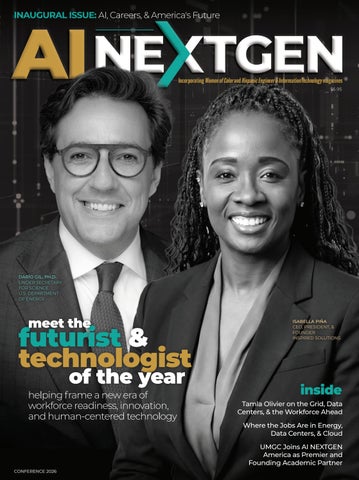
INAUGURAL ISSUE: AI, Careers, & America's Future
$6.95
DARÍO GIL, PH.D. UNDER SECRETARY FOR SCIENCE U.S. DEPARTMENT OF ENERGY
meet the
futurist & technologist of the year
helping frame a new era of workforce readiness, innovation, and human-centered technology
ISABELLA PIÑA CEO, PRESIDENT, & FOUNDER INSPIRED SOLUTIONS
inside Tamla Olivier on the Grid, Data Centers, & the Workforce Ahead Where the Jobs Are in Energy, Data Centers, & Cloud UMGC Joins AI NEXTGEN America as Premier and Founding Academic Partner
CONFERENCE 2026
Step Inside AD STEM City USA Enter STEM City USA! Scan or Visit Online
7 2 9
E .
Your Virtual Gateway to Innovation and Opportunity.
Join a vibrant community where STEM professionals, students, and educators meet to connect, learn, and share ideas. Explore virtual experiences, career tools, and content creation opportunities.
P R A T T S T . S U I T E 5 0 4 • B A L T I M O R E 4 1 0 2 4 4 7 1 0 1 • C C G M A G . C O M
M D
2 1 2 0 2
Our workforce inspires, builds and delivers business results from idea to outcome. Congratulations to our 2026 Technology Rising Stars and Technology All-Stars:
AD Angela Brandt
Ashley Schrage
Cherise Yau
Giang Mullins
Jennie Sagadraca
Jenny Lind
Kiarya Glover
Kizzy Dunton
Leah Salzman
Nicole Francis
Silvia Neuman
Virginia Sparks
Together, let’s make a new world happen.
wwt.com/careers
contents VOLUME 41 NUMBER 2 | CONFERENCE 2026
feature 36 Building America’s AI Workforce Starts in Maryland Tyrone D. Taborn makes the case for demand-driven education, employer alignment, and Maryland’s role in preparing talent for the AI economy.
4
AI NEXTGEN | CONFERENCE 2026
incorporating the Women of Color and Hispanic Engineer & Information Technology magazines
incorporating the Women of Color and Hispanic Engineer & Information Technology magazines
D E P A R T M E N T S
F E A T U R E S
8
16
AI Explained AI Literacy and Education: Colleges and universities are teaching students not only how to use AI, but how to question, evaluate, and understand it.
10
Career Lab Five Skills to Build Before Your First Job: A practical guide to AI literacy, responsible tool use, data protection, critical thinking, and interview readiness for students and new professionals.
12
Workforce Strategy Hire Education: A new workforce development model calls for education systems that respond faster to employer demand and changing technology.
14
Workforce Training Ascend: CCG’s on-demand learning model connects AI skills, career readiness, professional credentials, STEM City USA, and workforce opportunity.
49 Career Outlook Industry Overview: The Physical Backbone of the Digital Age AI may live in the cloud, but the digital economy runs on power plants, data centers, transmission lines, and skilled workers. Job Horizon: Where the Jobs Are: Energy Infrastructure, Data Centers, and Cloud Operations From lineworkers and electricians to cloud administrators and cyber security analysts, the powered digital economy creates multiple career paths.
Cover Story: Isabella Piña: Technologist of the Year AI NEXTGEN America’s Technologist of the Year and her work at the intersection of technology, leadership, and future-focused innovation.
20 Cover Story: Darío Gil, Ph.D.: Futurist of the Year AI NEXTGEN America’s Futurist of the Year and his role in shaping the future of science, technology, and workforce readiness.
22 Awards Recognition: AI NEXTGEN America Futurist Honorees Meet the 2026 honorees whose work reflects the future of AI, technology, workforce development, education, infrastructure, and human-centered innovation.
34 Awards Recognition: OAA Honorees A recognition section honoring this year’s Outstanding Achievement Award recipients and their contributions to technology, leadership, and opportunity.
38 The Grid Is Growing. The Workforce Must Grow with It BGE President and CEO Tamla Olivier connects data-center growth, energy infrastructure, and the people Maryland will need to power what comes next.
42 Data Centers, AI, and the Urgent Need for Skilled Trades The AI economy depends on far more than software. It also needs electricians, technicians, welders, and construction workers to build the physical backbone.
46 UMGC Joins AI NEXTGEN America as Premier and Founding Academic Partner University of Maryland Global Campus joins AI NEXTGEN America to explore links among training, continuing education, credentials, and long-term career pathways.
38
incorporating the Women of Color and Hispanic Engineer & Information Technology magazines
AI NEXTGEN | CONFERENCE 2026
5
P U B L I S H E R ' S
P A G E
AI NEXTGEN Inaugural Issue For nearly 50 years, Career Communications Group has worked to connect talent with opportunity. We have celebrated achievement because achievement inspires the next generation. We have convened employers, educators, professionals, students, and leaders because opportunity becomes more powerful when people can see it, prepare for it, and step into it. AI NEXTGEN America continues that mission for a new era. Artificial intelligence is changing how America works, learns, builds, and competes. It is reshaping health care, manufacturing, energy, education, defense, cyber security, digital infrastructure, and nearly every field connected to the modern economy. But the future of AI will not be determined by technology alone. It will be determined by people. That is why this inaugural issue is built around a simple idea: AI NEXTGEN America is a work force platform, not just a conference. The question before us is not only what artificial intelligence can do. The question is whether we are preparing people for the opportunities it will create. Employers need talent. Students need direction. Working professionals need new skills. Veterans and career changers need clear pathways. Educators need stronger connections to the industries being transformed in real time. This publication reflects that larger conversation. Inside, we examine Maryland’s opportunity to help build a demand-driven AI work force. We look at the energy systems, data centers, skilled trades, cloud operations, and cyber security roles that form the physical backbone of the digital economy. We explore AI literacy, career readiness, ASCEND, STEM City USA, and the UMGC partnership as part of a broader effort to connect training, credentials, continuing education, and employment. We also recognize leaders whose work points toward what comes next. The AI NEXTGEN America Futurist Awards are organized around values that matter: Jobs and Opportunity, Knowledge, Productivity, and Human Flourishing. Those pillars remind us that technology should expand human potential, not leave people behind. This inaugural issue is a starting point. It is a call to employers, educators, government, innovators, and communities to work together with greater urgency and purpose. The future is hiring. Our responsibility is to make sure people are ready.
Tyrone D. Taborn Publisher
6
AI NEXTGEN | CONFERENCE 2026
VOL 41, NO 2 | CONFERENCE 2026 EXECUTIVE OFFICE Tyrone D. Taborn, CEO and Publisher Jean Hamilton, CFO, President Kwan Hurst, COO, Operations Eric Price, V.P., Human Resources, Conference Manager Jennifer Roberts, V.P., Strategic Marketing, Sales, and Partner Experience EDITORIAL AND CONTRIBUTING EDITORS Dr. Ken Washington, Special AI Technology Correspondent Rayondon Kennedy, Director, Digital and Print Operations Lango Deen, Technology Editor Michael Fletcher, Contributing Editor Gale Horton Gay, Contributing Editor Garland L. Thompson, Contributing Editor Roger Witherspoon, Contributing Editor GRAPHIC & DIGITAL DESIGN Beverly Wladkowski, Creative and UX Director Bryan Davis, Digital Director DIGITAL PLATFORM AND DEVELOPMENT Terrence Fooks, Metaverse Platform Program Manager & Client Relations Specialist CORPORATE AND ALUMNI RELATIONS Dr. Gwendolyn Boyd, CCG Alumni Committee Chair and President Dr. Eugene DeLoatch, Chairman, BEYA Alumni Group Vice Admiral Andy L. Winns, USN (Ret) National Chair, BEYA Military Alumni Oliver “Bo” Leslie, Retired Program Manager, Historically Black Colleges and Universities/Minority Institutions, The Boeing Company Monica E. Emerson, Women of Color STEM Conference National Chair Matt Bowman, CCG Military Program Manager Stars and Stripes Committee Executive Director/Chief of Staff for VADM Walt Davis, USN (Ret.) SALES AND MARKETING Kameron Nelson, Account Executive De'Ontae Jackson, Account Executive Lucille Kennedy, Sales Support Assistant Jay Albritton, Social Media Account Manager JOBMATCH AND STUDENT DEVELOPMENT PROGRAMS Rod Carter, Recruitment Specialist, College Relations CONFERENCE AND EVENTS Brandon Newby, Customer Service Associate ADVERTISING SALES OFFICE Career Communications Group, Inc. 729 E. Pratt Street, Suite 504 Baltimore, MD 21202 Phone: (410) 244-7101 / Fax: (410) 752-1837
ike us on Facebook: L facebook.com/HEITMAG facebook.com/WOCITC
Hispanic Engineer & Information Technology (ISSN 10883452) is a publication devoted to science and technology and promoting STEM opportunities for Hispanic Americans. This publication is bulk mailed to universities and colleges nationwide and in Puerto Rico. The editors invite editorial submissions directed toward the goals of Hispanic Engineer & Information Technology. In particular, this magazine wishes to present ideas, current events, and personality profiles of successful Hispanic Americans in science, technology, and related business pursuits. Fully developed articles may be sent, but queries are strongly encouraged. Articles and letters should be sent to Hispanic Engineer & Information Technology, Editorial Department, 729 E. Pratt Street, Suite 504, Baltimore, MD 21202. No manuscript will be returned unless accompanied by a stamped, self-addressed envelope. Hispanic Engineer & Information Technology cannot be responsible for unsolicited material. Copyright ©2026 by Career Communications Group, Inc. All rights reserved. Printed in the U.S.A.
incorporating the Women of Color and Hispanic Engineer & Information Technology magazines
ADthe date save
FEBRUARY 18-20, 2027
www.beya.org
For more information, call us at 410-244-7101 Like us on Facebook: facebook.com/BEYASTEM Follow us on X: @BlackEngineer
A I
E X P L A I N E D by CCG Editors editors@ccgmag.com
Teaching Students to Think With AI Universities are teaching students not just to use AI, but to question, evaluate, and understand it.
A
rtificial iintelligence is rapidly changing not only how students learn but also what colleges and universities believe students need to know before entering the workforce. Across the country, institutions are experimenting with AI tutors, developing courses on AI literacy, studying how students use generative AI, and examining the ethical questions surrounding the technology. At Georgia Tech, those conversations are already taking place at significant scale. In August, the College of Computing published a back-to-school interview with David Joyner, the university's interim provost in charge of AI in education. Joyner said nearly 15,000 Georgia Tech students are majoring or minoring in fields related to artificial intelligence, including computer science.
“AI literacy is becoming less of a specialized technical skill and more of a foundational competency.” He also described how professors are beginning to incorporate AI into their courses. Some, he told CBS News, are creating their own AI agents to serve as tutors. AI can give students tools to complete tasks more efficiently, generate ideas more quickly, and assist with software development. But the larger educational question is how students learn to use those tools without surrendering the thinking that education is intended to
8
AI NEXTGEN | CONFERENCE 2026
develop. One neuroscientist specializing in education, who has discussed the issue on LinkedIn, argued that AI can be most useful when it becomes part of an iterative feedback process rather than a substitute for learning. The recommendation was to establish guardrails that allow AI to interact with learners while preserving the higherlevel cognitive work required to connect concepts, evaluate information, and solve problems. That distinction—between using AI and understanding how to use it effectively—is becoming a central issue in higher education. Beyond Bigger Models
At the University of California, Berkeley, the conversation has expanded from classroom use to the future of agentic AI. In August, the College of Engineering highlighted Dr. Dawn Song, a professor in the Department of Electrical Engineering and Computer Sciences and co-director of the Berkeley Center for Responsible, Decentralized Intelligence, following the Agentic AI Summit. According to the university, about 5,000 people attended the summit in person, with thousands more participating online. The event focused on the current state and future of agentic AI. In an interview with UC Berkeley News, Song discussed safety concerns surrounding autonomous AI systems, the direction of the field, and efforts to make AI education more widely accessible through programs such as Berkeley's open online course series on agentic AI. At the summit, she emphasized safety, reliability, and broad access as important considerations in AI development. In a university Q&A, Song argued that the next major advances in AI will not come simply from making models larger. Progress, she said, will also depend on making AI systems more reliable, trustworthy, and aligned with human goals.
For universities, that raises an increasingly important educational challenge: Students must understand not only what AI can do but also where it can fail. Teaching Students to Evaluate AI
James Madison University has also been examining AI through the lens of student readiness. In summer 2025, the university's Research, Economic Development and Innovation division published observations about the growing role of artificial intelligence in college life. Philip Frana, a professor who teaches AI literacy and the ethical implications of artificial intelligence, argued that universities must do more than teach students how to operate AI tools. They must also help faculty members use those tools responsibly. Frana, a coauthor of the Encyclopedia of Artificial Intelligence, said the rise of AI makes the traditional goals of a university education—including critical thinking and reasoning—even more important. Research involving James Madison University and Auburn University has reinforced that concern. In 2026, researchers from the two universities published a study in Research & Practice in Assessment examining generative AI literacy among incoming college students. The study, “Generative AI Literacy of Incoming American College Students: Assessing the Need for Formal AI Literacy Training at Two Institutions,” evaluated 3,037 incoming students at James Madison University and 3,709 at Auburn University using the 20-item Generative AI Literacy Assessment Test. Average scores were low at both institutions. Auburn students answered 63 percent of the questions correctly, while James Madison students averaged 54 percent correct. Across the two institutions, the average score was 59 percent.
incorporating the Women of Color and Hispanic Engineer & Information Technology magazines
Researchers also found only small differences between STEM and nonSTEM students. At James Madison, STEM students averaged 11.06 correct answers out of 20, compared with 10.69 for non-STEM students. At Auburn, STEM students averaged 12.88, compared with 12.43 for non-STEM students. The findings suggest that gaps in AI literacy are not confined to students in particular majors. The study also found that incoming students were already interacting with AI tools while their understanding of how the systems function and how to evaluate their output remained limited. The implication is significant: Familiarity with an AI tool is not the same as understanding it. Students may know how to enter a prompt, generate text, or ask a chatbot for assistance. AI literacy requires more: understanding limitations, evaluating responses, recognizing potential errors, considering ethical implications, and determining when AI should—or should not—be used. Ethics, Agency, and Human Judgment
Morgan State University has approached the subject through questions of ethics, responsibility, and human interaction. At the end of July, the university's Center for Equitable Artificial Intelligence and Machine Learning Systems hosted the annual National Symposium on Effective and Ethical AI. The event brought together technologists, researchers, and policymakers to examine the past, present, and future of artificial intelligence, with an emphasis on
making the technology useful, safe, and beneficial. Presentations examined human-AI interaction across real-world applications and considered different forms of agency, including human, AI, and collaborative models.
fields, universities face a broader question: What does every student need to understand about AI, regardless of major?
Discussions also addressed areas such as authorship, originality, copyright, robotics, therapy, cyberpsychology, and culture. These subjects underscore why AI literacy increasingly extends beyond technical knowledge.
The answer increasingly involves more than technical proficiency. Students need to know how to question AI-generated information, test assumptions, recognize limitations, understand ethical considerations, and determine when human judgment must take precedence.
Students entering an AI-enabled workforce may need to understand not only how systems function but also how those systems affect decision-making, authorship, responsibility, privacy, and human relationships.
Faculty members face a parallel challenge. They must decide how AI fits into assignments, assessment, research, and instruction while still preserving the intellectual work students need to perform themselves.
Building AI Literacy Across an Institution
Universities including Georgia Tech, UC Berkeley, James Madison University, Auburn University, Morgan State University, and North Carolina Central University are approaching the issue in different ways. Some are experimenting with AI tutors and agents. Others are creating courses, conducting research, convening experts, or building institution-wide programs.
North Carolina Central University held the HBCU Innovation Summit in September, bringing together students, faculty members, leaders, and partners to examine how AI literacy can examine leadership, innovation and impact across the HBCU community. Google recently provided $1 million to the university's Institute for Artificial Intelligence and Emerging Research. According to the supplied material, the funding has helped support a university-wide AI initiative, new academic programs, conferences, external partnerships, and research opportunities. Such institutional approaches suggest that AI literacy is moving beyond individual computer science departments. As artificial intelligence becomes embedded across health care, finance, engineering, communications, manufacturing, education, and other
incorporating the Women of Color and Hispanic Engineer & Information Technology magazines
Together, their efforts point toward a larger change in education. AI literacy is becoming less of a specialized technical skill and more of a foundational competency. Preparing students for the future will therefore require more than teaching them how to use artificial intelligence. It will require teaching them how to think critically about it. AI
AI NEXTGEN | CONFERENCE 2026
9
C A R E E R
L A B
by CCG Editors editors@ccgmag.com
5 Skills to Build Before Your First Job A field guide for STEM students preparing to enter an AI-driven workplace.
Y
ou cannot scroll a job board these days without tripping over the word “AI.” Companies are racing to adopt it, and hiring managers expect candidates to know it. AI literacy is no longer a bonus on a resume. It is the floor. The good news for engineering students and computer science graduates is that “AI literacy” does not mean training the next large language model. It means using the tools, knowing where they fail, and protecting yourself and your employer when something goes wrong. At a recent BEYA seminar on generative AI in business, a panel of AI adoption leads, corporate technology executives, and research engineers laid out what entry-level workers should know. Their advice points to five concrete skills worth building now.
“Lifelong learning is not negotiable. The tools will keep changing. The companies that hire you will keep changing.” 1. Know what AI is—and what it is not.
Generative AI is having its moment, but it is not the whole field, and it is not the tool for every job. One panelist compared it to a hammer: useful, but useless if what you need is a bucket of water. Generative AI exists to generate ideas, text, images, and voice. Use it for brainstorming, drafting, and summarizing. Do not use it to predict ticket prices, run financial models, or answer questions with a single correct
10
AI NEXTGEN | CONFERENCE 2026
answer. Those problems belong to traditional machine learning. Knowing the difference is a skill. One company represented on the panel described five levels of AI adoption within its organization, ranging from personal productivity to building custom agents. A new hire who can speak intelligently about where generative AI ends and machine learning, computer vision, or natural language processing begins is already ahead of the curve. 2. Verify everything before you put your name on it.
Hallucinations happen when AI generates an incorrect answer. They are a pitfall of these tools, not simply a bug waiting to be patched. One panelist put it bluntly: Any model claiming it does not hallucinate is just refusing to answer when it is unsure. When you put your name on a deliverable, nobody cares whether you used ChatGPT, Gemini, or anything else. You own the work. That means factchecking dates, numbers, and citations against the source every time. A team represented on the panel caught a hallucinated statistic in an AI-generated
incorporating the Women of Color and Hispanic Engineer & Information Technology magazines
C A R E E R
chatbot. Three good habits can help protect you and your employer: • Check your account settings and turn off model training on your conversations. • Never paste confidential code, client information, or unreleased designs into a tool your company has not approved. • When in doubt, ask the security or legal team. Panelists agreed that security and legal teams should be brought into AI conversations early, not after something breaks. 4. Keep your foundational skills sharp.
Widespread AI adoption can cause what one panelist called “skill atrophy.” Skills are muscles. If AI does the work and you stop practicing the underlying craft, those muscles weaken. A research study referenced during the panel found that people who drafted essays with AI could not even recite what they had submitted. They had no real ownership of the work.
research summary by spending an extra five seconds searching each line. That habit can separate someone who uses AI responsibly from someone who walks into a meeting with inaccurate information. 3. Treat data—yours and your employer’s—like it matters.
This is where new graduates can get into trouble fast. Most consumer AI tools train on the data users feed them. Panelists shared cautionary tales, including proprietary intellectual property that ended up on the internet after a recent hire pasted it into a public
For engineering students, that means staying current while continuing to practice the fundamentals. Write code by hand when you can. Work through math. Build a basic neural network from scratch in PyTorch before you start chaining together prebuilt models. When the AI breaks—and it will—the person who can open the code and figure out why brings an important skill to the team. Critical thinking, judgment, and collaboration belong in this category too. Panelists called critical thinking the single most important skill in the AI era because a good model will happily give a polished answer to a poor question. Talk to the people around you and find out what they are good at. The best
incorporating the Women of Color and Hispanic Engineer & Information Technology magazines
L A B
“AI literacy is no longer a bonus on a resume. It is the floor.” implementations come from teams where humans bring complementary strengths to the tool. 5. Show your AI literacy in the interview.
Do not tell a recruiter you “use ChatGPT.” That sentence tells them nothing. Talk about how you scope a problem before prompting, how you verify outputs, how you protect data, and how you decide when AI is the wrong tool. Walk through a specific project—even a class assignment— where AI saved you time, and explain how you checked the result. Mention the resources you have used to learn. DataCamp, Hugging Face, Google Colab, and PyTorch documentation all came up by name during the seminar, alongside frameworks such as TensorFlow. Open-source models and free computing resources are available to anyone willing to download and experiment. Stay flexible. One panelist with an electrical engineering degree ended up running software development for a technology company. The advice was direct: Get hired based on your capabilities, leverage AI to increase efficiency in the role, and let your career develop from there. Another panelist put it this way: Lifelong learning is not negotiable. The tools will keep changing. The companies that hire you will keep changing. Build the habit now of testing, verifying, and learning aloud, and you can spend your career adapting to what comes next instead of chasing it. AI
AI NEXTGEN | CONFERENCE 2026
11
W O R K F O R C E
S T R A T E G Y
by Tyrone D. Taborn editors@ccgmag.com
Hire Education for the AI Era Why workforce development must move faster and respond more directly to employer demand
F
or generations, education operated on a predictable timeline. Universities developed curricula, schools adopted them, students completed degrees, and employers hired graduates whose skills generally matched the marketplace. That model served America well during the Industrial Age and much of the Information Age. The AI economy has changed that equation. Today, a new technology can emerge, become an industry standard, and fundamentally reshape job requirements 12
AI NEXTGEN | CONFERENCE 2026
The STEM City USA Workforce Development Platform is a place where employers can build learning experiences, educators can adapt them, learners can develop new competencies, and communities can prepare people for careers that may not yet exist.
in less time than it takes many educational institutions to approve a new course. Entire categories of work are evolving while educators are still teaching yesterday’s methods. Employers are investing billions of dollars in artificial intelligence while simultaneously searching for workers with skills that often did not exist a year ago.
Across higher education and workforce development, there is growing recognition that AI is accelerating the need for more responsive education and stronger alignment between learning and employment. That is why I believe the future of workforce development begins with a simple idea: hire education. Those two words represent a different
incorporating the Women of Color and Hispanic Engineer & Information Technology magazines
W O R K F O R C E
philosophy about how education should be designed. The objective is no longer simply to teach. The objective is to prepare people for meaningful employment in an economy that refuses to stand still. Hire education begins with the employer. Instead of asking employers to adapt to educational systems that may update every three to five years, we should build educational systems capable of responding to employers every three to five weeks. Employers understand where technology is moving because they are deploying it every day. They know which skills are becoming obsolete and which new competencies are emerging. That knowledge should not remain inside corporate walls. It should become part of America’s educational infrastructure. For decades, we have spoken about partnerships between education and industry. Most have involved advisory boards, internships, and periodic curriculum reviews. Those relationships remain important, but artificial intelligence demands something more dynamic. Industry must become a continuous contributor to education. That philosophy is the foundation of the STEM City USA Workforce Development Platform, powered by AI NEXTGEN America. Rather than functioning solely as a traditional learning management system, the platform is designed as a workforce development ecosystem. Organizations can build academies, learning tracks, courses, and lessons that reflect their expertise while deciding whether to keep that content private or share it with schools, colleges, workforce agencies, community
organizations, or other employers. In practical terms, a company introducing a new AI workflow could transform its internal knowledge into structured learning experiences. A government agency implementing new cyber security protocols could distribute updated training without waiting for new textbooks. A university could incorporate current industry practices into academic programs. A workforce board could respond more rapidly to changing regional labor demands. That is more than digital learning. It is a model for making workforce knowledge more broadly accessible. Knowledge has traditionally flowed primarily in one direction—from academia to industry. Artificial intelligence creates an opportunity for that knowledge to flow both ways. Employers can contribute directly to preparing the workforce they will eventually hire. This is especially important for engineers, technologists, and the next generation of innovators. Career opportunities are increasingly determined not only by what someone learned five years ago but by how quickly that person continues learning today. Lifelong learning is no longer merely a professional advantage. It is becoming an economic necessity. America’s competitiveness will depend on our ability to build educational systems that evolve continuously instead of periodically. Maryland has an opportunity to help demonstrate what that approach can look like. With its concentration of federal agencies, research universities, defense contractors, biotechnology companies, cyber security organizations, advanced manufacturers, and technology innovators, Maryland has many of the components needed to develop a more responsive AI workforce ecosystem. Through collaboration among education, industry, government, and workforce organizations, the state has
incorporating the Women of Color and Hispanic Engineer & Information Technology magazines
S T R A T E G Y
an opportunity to demonstrate how learning can respond more directly to changing employer needs. But no single conference, course, or institution can transform the workforce by itself. Sustainable systems are required. The STEM City USA Workforce Development Platform is designed to support that kind of system—a place where employers can build learning experiences, educators can adapt them, learners can develop new competencies, and communities can prepare people for careers that may not yet exist.
“The objective is no longer simply to teach. The objective is to prepare people for meaningful employment in an economy that refuses to stand still.” Artificial intelligence is changing the way we work. It should also change the way we learn. The future will belong to educational systems that can move more closely with the speed of innovation. That future begins with hire education. AI
AI NEXTGEN | CONFERENCE 2026
13
W O R K F O R C E
T R A I N I N G
by CCG Editors editors@ccgmag.com
Ascend Into the AI Economy CCG’s on-demand model connects AI skills, credentials, career readiness, and workforce opportunity
T
he workplace is changing faster than the traditional training calendar.
Artificial intelligence is moving into offices, classrooms, data centers, and manufacturing environments. Employers need ways to train people without waiting for the next semester or scheduled classroom session. Career Communications Group is building Ascend around a simple idea: What if learning could arrive when the workforce actually needs it? Ascend, delivered through STEM City USA, is CCG’s on-demand workforce training model. The current STEM City USA AI NEXTGEN America enrollment site describes it as a fully online platform serving students, veterans, working professionals, educators, and organizations, with 10 academies, 87 courses, and three credential levels.
“Ascend’s larger proposition is that career learning should be available when a person realizes, ‘I need to know this next.’” Ascend’s larger proposition is that career learning should be available when a person realizes, “I need to know this next.” Learning at the Speed of Work
The white paper behind Ascend distinguishes between traditional higher education and what CCG calls “demand learning.” College and university programs provide deep education over semesters and years; Ascend is
14
AI NEXTGEN | CONFERENCE 2026
designed to address an immediate skills requirement. Demand learning begins by asking what a learner or employer needs now—understanding generative AI or translating military experience into a civilian career. The approach is meant to complement—not replace—universities, community colleges, apprenticeships, and employer training. More Than an AI Course
Ascend’s pathways include AI literacy, applied generative AI, career preparation, cyber security and digital trust, data center operations, and veteran career transition. A learner does not have to start as a programmer. AI Career Readiness is designed to help participants assess their skills, identify changing job requirements, and create a continuing learning plan. AI Productivity for the Modern Workplace covers prompting, AI-assisted communication, and research and data analysis. B26TEC-402: Introduction to Artificial Intelligence for Workplace Adoption, a self-paced course, moves from basic AI concepts into machine learning, responsible use, and the creation of an AI adoption framework. The practical message: AI learning can begin with using the technology more intelligently in the job you already have. A Pathway for Educators Too
The AI Literacy Instructor Certification program is designed for teachers, workforce trainers, community leaders, and nonprofit organizations that want to introduce AI literacy in schools, libraries, and community organizations. According to Ascend’s catalog, the program was developed by CCG in partnership with the Maryland Department of Labor and requires no prior AI experience. Teach one learner, and one person gains a skill. Prepare an instructor to teach that skill, and the knowledge can travel much farther.
From AI to Data Centers
A data center operations pathway introduces learners to the physical infrastructure behind the digital economy, including servers, networks, and power and cooling systems. The model links instruction with the question a learner will eventually ask: What can I do with this knowledge? Career preparation courses address resumes, job-search strategy, interviews, and negotiation. Veteran-focused courses are designed to help service members translate military experience into civilian terminology. Ascend is not positioning learning as the finish line. It is positioning learning as part of the route to the next opportunity. The STEM City USA Difference
CCG’s white paper describes STEM City USA as the larger digital environment surrounding Ascend—one in which training can connect with career exploration, employer information, mentoring, career fairs, and other workforce resources. The model is also hybrid by design, combining ondemand lessons, live virtual sessions, hands-on work at local laboratories and employer sites, and AI assistants for navigation and reinforcement. Credentials That Can Build
The public site describes three credential levels: a Certificate of Participation, a Micro-Certification associated with completing a full track and capstone project, and Professional Certification at the highest level. Credentials can be verified online, according to the site. A learner may need only one skill today; later, that course could become part of a larger pathway. Careers rarely move in straight lines anymore, and sometimes the most valuable question is not, “What degree should I begin?” but, “What do I need to learn next?”
incorporating the Women of Color and Hispanic Engineer & Information Technology magazines
W O R K F O R C E
T R A I N I N G
“Ascend is not positioning learning as the finish line. It is positioning learning as part of the route to the next opportunity.” Where Do You Begin?
The enrollment site tells prospective learners to choose an academy aligned with a career goal, complete courses at their own pace, and build toward a credential. No prior technology experience is required, the site states. For a student, the first step might be discovering a technology career never previously considered. For a veteran, it might be discovering that military experience already contains transferable skills. For an employer, it might be transforming knowledge already inside the organization into training for the next generation. Ascend reduces the enormous question of the future of work to a manageable one: Top: Veteran-focused courses are designed to help servicemembers translate military experience into civilian terminology. Bottom: Ascend’s pathways include AI literacy, applied generative AI, career preparation, cyber security and digital trust, data center operations, and veteran career transition, with courses like "Creating a Culture of Self-Accountability and Ownership.”
A Platform Built for More Than Individuals
The white paper describes a multi-tenant architecture in which corporations, government agencies, universities, and other organizations can operate branded academies within STEM City USA, with their own cohorts,
What do you want to learn next? From there, the pathway begins. AI
catalogs, and credential tracking. The paper summarizes the ambition in its title: moving “from hundreds to tens of thousands.” It also says success should be measured by more than registrations, including certifications, apprenticeship referrals, job matches, and promotions.
incorporating the Women of Color and Hispanic Engineer & Information Technology magazines
AI NEXTGEN | CONFERENCE 2026
15
technologist of the year
purpose THE POWER OF
Isabella Piña’s Journey From Soldier to Technology Entrepreneur
Her path spans military medicine, federal technology, workforce development, and business leadership—but a commitment to serving people connects it all. by CCG Editors editors@ccgmag.com
2026
AI NEXTGEN Technologist of the Year Isabella Piña has spent three decades putting technology to work for people, first in an Army operating room and now across the networks federal agencies depend on. Isabella Piña grew up in a village in Dominica with no running water and no electricity. The grandmother who raised her had no wealth to pass down. She had one conviction: Education was the only road out of poverty, and Piña was going to walk it out. "My grandmother believed in me before I believed in myself," Piña said. "Everything I have built started with a woman who was sure that education would change my life," and it did. The road ran through a U.S. Army recruiting station. Piña enlisted at age 20, before she had become a U.S. citizen, and earned her citizenship while in uniform. She served as an automated logistical specialist in Korea and Texas, was promoted to sergeant at Fort Hood, and deployed to Bosnia-Herzegovina soon after. The Army then selected her for its Enlisted Commissioning Program. She earned a Bachelor of Science in nursing from the University of Mary Hardin-Baylor and returned to active duty as an officer in the Army Nurse Corps. Her 21 years of service, nine as an enlisted logistician and 12 as an Army nurse, included a deployment to Iraq and ended at the leading edge of military medicine.
16
AI NEXTGEN | CONFERENCE 2026
While stationed at Madigan Army Medical Center in Washington state, Piña was selected to serve as one of the Army's first robotic surgery nurses. She later served as robotic surgery coordinator and officer-in-charge of the robotic surgery department at Fort Belvoir Community Hospital, now the Alexander T. Augusta Military Medical Center. At the time, it was the most advanced robotic surgery department in the Military. She was charged with leading the department, training its teams, and coordinating robotic surgical procedures with excellence and at scale. "Robotic surgery taught me that the machine is never the point," Piña said. "A platform is only as good as the team trained to use it and the patients that trust us on the other side of it." She carried that lesson out of the operating room. In 2015, the year she retired from the Army, Piña founded Inspired Solutions, Inc. at her kitchen table. Today she is the company's founder and chief executive officer. The federal information technology firm is headquartered in Manassas, VA, with a second office in Clayton, MO. The business has grown with her. Inspired Solutions has won more than $189 million in contracts since its founding. Its work spans federal IT modernization, network infrastructure, wireless and telecommunications systems, workforce training, and vendor-managed inventory. Its customers include the Department of
incorporating the Women of Color and Hispanic Engineer & Information Technology magazines
2026
C O N F E R E N C E
Across her expanisive record, one pattern is consistent: She has built systems around people and measurable results.
A N D
F U T U R I S T
A W A R D S
Isabella Piña CEO, President, and Founder Inspired Solutions, Inc. 2026 Technologist of the Year
incorporating the Women of Color and Hispanic Engineer & Information Technology magazines
AI NEXTGEN | CONFERENCE 2026
17
technologist of the year Veterans Affairs, the National GeospatialIntelligence Agency, the U.S. Army, and the U.S. Air Force, along with commercial customers and partners such as AT&T and World Wide Technology.
"I wrote ASPIRE because I wanted a company that holds people accountable and takes care of them at the same time," Isabella said. "I hold the team to those values, but I hold myself to them first."
The company's federal credentials have grown as well. Inspired Solutions holds the Small Business Administration's 8(a) certification, is a certified ServiceDisabled Veteran-Owned Small Business and Economically Disadvantaged Women-Owned Small Business, and holds a General Services Administration Multiple Award Schedule contract. In June 2026, NASA awarded Inspired Solutions two Solutions for Enterprise-Wide Procurement VI (SEWP) contracts, one for IT products and one for IT services. SEWP is among the federal government's largest vehicles for buying technology, and ordering opens in November 2026. Inside the company, she measures leadership by how people are treated. Piña wrote Inspired Solutions' A.S.P.I.R.E values framework herself: Accountability, Service, People-Centric, Integrity, Risk Management, and Empowerment. The company has earned Great Place to Work Certification three years running, from 2024 through 2026, and recorded a 94 percent Trust Index score in February 2026. "I wrote ASPIRE because I wanted a company that holds people accountable
18
AI NEXTGEN | CONFERENCE 2026
and takes care of them at the same time," Piña said. "I hold the team to those values, but I hold myself to them first." As a result, recognition has followed. Inspired Solutions received a 2026 Bronze Stevie Award for Veteran-Owned Business of the Year and was named among the National Minority Supplier Development Council's Top 100 Minority Business Enterprises in 2025. Piña was named to the 2026 Enterprising Women of the Year, the 2026 WOMEN who mean BUSINESS by the Washington Business Journal, and recognized in 2024 as an Entrepreneurial Woman of Impact. In 2023, World Wide Technology named Inspired Solutions its Supplier Diversity Partner of the Year, and the company appeared on the JPMorgan Chase and Women Presidents Organization list of 50 Fastest Growing Women-Owned and Led Companies. Her service outside the company mirrors the culture she has built inside it. Isabella and her husband, Rick Piña, co-founded Rick and Isabella Piña Ministries, a faithbased nonprofit, in 2007, while both were still serving on active duty in the U.S. Army. The ministry founded the Thelma Steward Grace Destiny Academy in the Dominican Republic, along with Grace Destiny Church. At the school, more than 230 students from pre-K through 10th grade receive a Christ-centered education and a daily hot meal. She also serves on the board of directors of World Pediatrics. Since 2019, Inspired Solutions and the ministry together have logged more than 3,200 community service hours and directed more than $800,000 in charitable donations. She is still walking her grandmother's road; education is key! Piña holds a Master of Science in healthcare management from Trident University and is a doctoral candidate at Regent University, pursuing a Doctor of Business Administration with a concentration in executive leadership. Her 2025 published paper examined how social media algorithms, social proof, and emotional triggers shape consumer decisions.
Engine and supported virtual desktop infrastructure on U.S. Air Force networks, and delivered Voice over Internet Protocol (VoIP) telecommunications for U.S. forces in the Pacific. Its teams have operated on both unclassified and classified networks for the Department of War. The company completed a large power infrastructure project, alongside one of the top-tier service providers in the United States, at the Army's Joint Readiness Training Center (JRTC) on Fort Polk. As a valueadded reseller and integrator, it has delivered technology to the Space Force, the U.S. Army Corps of Engineers, the Department of Energy, the National Oceanic and Atmospheric Administration, the Defense Health Agency, the General Services Administration, and many other federal agencies. The commercial record is just as specific. For Fortune 500 companies, the firm has migrated F5 application delivery platforms, including a move to Microsoft Azure, and built a software license management program for a global pharmaceutical research organization. Its vendor-managed inventory program for a large technology integrator now uses AIdriven analysis of inventory, throughput, and supplier data to flag anomalies and stockout risk before they reach the customer. The AI NEXTGEN Futurist Awards define Technologist of the Year around measurable technical impact and realworld workforce and industry results. Piña's record runs from a robotic surgery suite in the Army, to a federal IT firm built at a kitchen table that now secures military networks and puts AI to work on a customer's supply chain, to research on how algorithms move human decisions. The thread is the same in all three. The technology is never the point. The people it serves are. AI
The technology record behind the award is concrete. Inspired Solutions engineers have deployed Cisco Identity Services
incorporating the Women of Color and Hispanic Engineer & Information Technology magazines
GET CERTIFIED. AD GET AHEAD. Advance your career with CCG’s AI and Digital Skills Certification Programs. From foundational courses to advanced applied AI, our certifications help students and professionals upskill for the future of work.
7 2 9
E .
ENROLL today! Scan to Begin
P R A T T S T . S U I T E 5 0 4 • B A L T I M O R E 4 1 0 2 4 4 7 1 0 1 • C C G M A G . C O M
M D
2 1 2 0 2
futurist of the year
discovery T H E
Darío Gil Is Building a New Scientific Frontier
The scientist and futurist is working to connect AI, quantum computing, national laboratories, universities, and industry in an ambitious new model for American research. by CCG Editors editors@ccgmag.com
F U T U R E
F
uturists like Darío Gil, Ph.D., analyze trends and anticipate shifts in technology, economics, and society, helping organizations and nations prepare for what is next. By championing talent development, collaboration, and innovation, Gil exemplifies the futurist’s role: shaping a future that is not just imagined but actively built. A visionary scientist and recognized futurist, Gil was recently named to TIME magazine's TIME100 AI 2026 list. For over two decades, Gil has led the field of artificial intelligence and quantum computing, shaping the future of science and technology. He is currently director of the Genesis Mission, a national initiative mobilizing the Department of Energy’s National Laboratories in partnership with industry, academia, federal agencies, international partners, and philanthropy, to build the world’s most powerful and versatile scientific platform, connecting high-performance computing, artificial intelligence, quantum technologies, and experimental facilities into a unified discovery architecture. Gil believes that new scientific instruments, from telescopes to AI supercomputers, expand humanity’s ability to ask and answer deeper questions. Yet, he recognizes that many researchers lack access to advanced tools. This platform will fundamentally change how science and engineering are conducted. The aim: to double the productivity of U.S. research and dramatically speed up scientific discovery, from healthcare to energy and beyond.
O F
pediatric cancer, and autonomous laboratories. A collaborative effort, the Genesis Mission’s bold goals also include training 100,000 AI-capable scientists and engineers over the next decade, building a 100–200 qubit quantum computer, and automating scientific workflows for faster, more reliable results. Gil’s background reflects the futurist mindset. Gil also played a key role in releasing the U.S. Department of Energy's Fusion Science and Technology Roadmap, aligning national research goals with the Genesis Mission. As a futurist, Gil is passionate about building a foundation for discovery that empowers scientists and accelerates progress. He often speaks about AI's promise to cure disease, unlock limitless energy, and expand humanity’s reach— visions he shares with new generations of scientists and engineers. Gil urges collaboration, responsibility, and the pursuit of knowledge as guiding principles in this new era. Before his federal government appointment, Gil was IBM senior vice president and director of research, overseeing strategies in AI, quantum computing, and exploratory science. He has been honored by the National Academy of Engineering, chaired the National Science Board, and helped create partnerships like the International Science Reserve and the MIT-IBM Watson AI Lab. Gil’s forward-thinking approach has made him a trusted advisor on science and technology at the highest levels. AI
The Genesis platform is designed to accelerate breakthroughs and aims to tackle 33 national science and technology challenges—including in fusion energy,
20 AI NEXTGEN | CONFERENCE 2026
incorporating the Women of Color and Hispanic Engineer & Information Technology magazines
2026
C O N F E R E N C E
A N D
F U T U R I S T
A W A R D S
Gil urges collaboration, ethical responsibility, and the pursuit of knowledge as guiding principles in this new era. Darío Gil, Ph.D. Under Secretary for Science and Genesis Mission Director U.S. Department of Energy 2026 Futurist of the Year
incorporating the Women of Color and Hispanic Engineer & Information Technology magazines
AI NEXTGEN | CONFERENCE 2026
21
honorees
2026 A I
N E X T G E N
A M E R I C A
F
F U T U R I S T AWA R D S
Artificial intelligence is rapidly reshaping how we work, learn, build, create, and solve some of society’s most complex challenges. The 2026 AI NEXTGEN Futurist Awards recognize the people and organizations helping define what comes next—not only through technological achievement, but through the ways they apply innovation to industry, education, workforce development, and community
This year’s honorees represent a wide spectrum of leadership across artificial intelligence, advanced manufacturing, digital infrastructure, energy, defense, research, education, and emerging technology. Some are developing new AI systems and governance models. Others are modernizing manufacturing, strengthening the future workforce, expanding access to STEM education or applying technology to real-world problems in health, sustainability, and public service. Together, their work reflects the growing reach of AI and related technologies across nearly every sector. AI NEXTGEN celebrates those who are not simply responding to technological change, but helping shape its direction. Their ideas, leadership, and accomplishments offer a view of the talent and vision driving the next generation of innovation.
impact.
22 AI NEXTGEN | CONFERENCE 2026
incorporating the Women of Color and Hispanic Engineer & Information Technology magazines
2026
C O N F E R E N C E
M E E T
T H E
2 0 2 6
F U T U R I S T
A N D
F U T U R I S T
A W A R D S
A W A R D S
H O N O R E E S
FUTURIST OF THE YEAR Darío Gil, Ph.D.
HEALTHCARE TECHNOLOGY LEADER Betsy Butler, RBP, CPBCA
FUTURE WORKFORCE EMPLOYER Tamika King
Under Secretary for Science
Program Manager
Site Facility Manager
U.S. Department of Energy
Tanaq Health
Leadec
Qian Zhang, Ph.D.
Andrea Lewis-Allen
Research Scientist IV
Senior Manager
UL Research Institutes
The Boeing Company
TECHNOLOGIST OF THE YEAR Isabella Piña CEO, President, and Founder Inspired Solutions, Inc.
ADVANCED MANUFACTURING LEADER Charlisha Greene Vice President, Global Supply Chain & Integration – Air Dominance The Boeing Company
Christopher Johnston Contracting Officer
MARITIME & DEFENSE INNOVATOR Juan M. K. Henderson Acting PEG Chief Air Force Materiel Command AFNWC/NIZ Engineer
AI GOVERNANCE LEADER The Catholic University of America
Army Contracting Command - Detroit Arsenal
Ryan McManus
Jay Lee, Sc.D.
techtonic.io
Director of Industrial Artificial Intelligence Center University of Maryland
AI INNOVATOR Jeannice Fairrer Samani, Ph.D. CEO and Managing Director Fairrer Samani Group, LLC
Daniel Sierra-Sosa, Ph.D. Assistant Professor The Catholic University of America
DIGITAL INFRASTRUCTURE LEADER Lucia Chung Vice President and Chief Information Officer, Engineering, Manufacturing & Product Support The Boeing Company
Robert Slone, Ph.D. Chief Scientist UL Solutions
ENERGY PIONEER Anthony Kinslow II, Ph.D. CEO and Founder Gemini Energy Solutions
Founder
AI THOUGHT LEADER Center for Responsible AI at Virginia State University David Shrier Professor of Practice, AI and Innovation Imperial College London Business School
COMMUNITY WORKFORCE IMPACT LEADER Kara Branch Founder and CEO Black Girls Do Engineer
Christine Burkette CEO and Founder Promising Integrations Consulting Firm
Rozlyn Chambliss, Ph.D. Program Integrator The Boeing Company
CREATIVE TECHNOLOGY INNOVATOR Audapt, LLC INTERACTIVE MEDIA INNOVATOR Tennessee State University, SMART Center Valeria Palacios Cruz Student Ceulver/TecNM University
SPECIAL RECOGNITION Kemal Badur Assistant Vice President and Chief Technology Officer University of Chicago
Branville Bard Jr., D.P.A. Vice President for Public Safety Johns Hopkins University
Stephan LaVel Daniels Product Quality Manager Apple, Inc.
Donald “Doni” Glover Founder and Publisher BMORE News
Corteva Agriscience
Corteva Agriscience
Kim Lewis, Ph.D.
Army Contracting Command - Detroit Arsenal
WORKFORCE DEVELOPMENT LEADER University of Maryland Global Campus
Global Corporate and Community Investment
UL Research Institutes
Chief of the Intelligence and Security Command and the Ground Vehicle Systems Center
ExecutiveAI
Tammie Jones-Jefferson
EDUCATOR OF THE FUTURE Agentic FuturePath AI
FINANCIAL TECHNOLOGY LEADER Thomas Phillips
CEO
CORPORATE RESPONSIBILITY LEADER Heidi Spahn
Principal Research Scientist
Migo Szeman Ng, Ph.D.
Sol Rashidi
Vice President for Research and Chief Research Officer Howard University
Global Regulatory and Stewardship Leader
Aleksandra Przegalińska Professor and Vice Rector for Innovations and AI Kozminski University
Amy Webb CEO and Founder Future Today Strategy Group
Becki Rowan-White
COMMUNITY DEVELOPMENT LEADER Rev. Dr. Alvin C. Hathaway Sr.
Senior Manager, Education Programs
President and CEO
ULRI - Institute for Research Experiences & Education
Beloved Community Services Corporation
incorporating the Women of Color and Hispanic Engineer & Information Technology magazines
AI NEXTGEN | CONFERENCE 2026
23
honorees ADVANCED MANUFACTURING LEADER
Charlisha Greene Vice President, Global Supply Chain & Integration – Air Dominance The Boeing Company
Charlisha “Charli” Greene leads supply chain strategy and execution for Boeing Defense, Space & Security’s Air Dominance portfolio. She manages approximately 400 supply chain professionals responsible for billions of dollars in procurement spend and oversees the full supply chain value stream, from customer proposals and contract negotiations through supplier performance and delivery. Her Boeing career spans procurement, contracting, materials management, and supply chain operations across multiple defense programs and sites. Greene also serves as Boeing’s executive focal for Florida A&M University, leading recruitment, funding, and development initiatives. In 2025, Supply Chain Digital ranked her No. 12 on its Top 100 Women in Supply Chain list. Her large-scale supply chain leadership and responsibility for delivering materials and services supporting aerospace and defense programs directly connect her work to advanced manufacturing. • Undergraduate: University of MissouriColumbia – Bachelor of Science in Business Administration, Management • Postgraduate: Webster University – Master of Business Administration
ADVANCED MANUFACTURING LEADER
Christopher Johnston Contracting Officer Army Contracting Command – Detroit Arsenal
Christopher Johnston is being recognized for leadership in modernizing U.S.
24 AI NEXTGEN | CONFERENCE 2026
industrial manufacturing through automation, robotics, and supply chain innovation. He led development of a $79.4 million “Factory of the Future” program designed to transform a legacy production facility into a flexible, automated manufacturing hub. The initiative integrates robotics, precision machining, battery production, additive manufacturing, and automated design ingestion. Johnston also championed an open-architecture software platform and secured data rights intended to support future replication across facilities. His workforce strategy pairs automation with hands-on training and certification pathways for robotics operators, CNC specialists, additive manufacturing technicians, and digital-engineering professionals. He also helped shift the program to a contractor-funded capital model that reduced government equipment costs and tied payments to fixed-price milestones.
ADVANCED MANUFACTURING LEADER
Jay Lee, D.Sc. Director of Industrial Artificial Intelligence Center University of Maryland, College Park
Jay Lee, D.Sc., leads the Industrial Artificial Intelligence Center in the University of Maryland’s Department of Mechanical Engineering. His research focuses on industrial AI and smart manufacturing, including transfer learning, domain adaptation, digital twins, industrial large knowledge models, and AI applications for physical assets. Lee also leads the Data Foundry, which contains more than 100 industrial datasets spanning semiconductor manufacturing, jet engines, wind turbines, electric vehicles, robotics, and other applications. He is spearheading an AI factory initiative designed to prepare industry-ready industrial AI engineers. Previously, Lee founded and directed the NSF Industry/ University Cooperative Research Center on Intelligent Maintenance Systems and served as vice chairman and board member of Foxconn Technology Group, where he led industrial internet and industrial AI-enabled manufacturing initiatives.
George Washington University – Doctor of Science in Mechanical Engineering
AI INNOVATOR
Jeannice Fairrer Samani, Ph.D. CEO and Managing Director Fairrer Samani Group, LLC
Jeannice Fairrer Samani, Ph.D., advises organizations, governments, and institutions on artificial intelligence, digital transformation, intelligent infrastructure, and responsible innovation. Her work centers on turning AI capability into governed, measurable outcomes. She created the SMART Intelligence Layer™, which connects data, analytics, governance, infrastructure, and human outcomes, and CARE Loop AI™, a health care AI governance and implementation framework built around Capture, Analyze, Respond, and Evaluate. Samani is also the author of When Algorithms Go Blind, which examines algorithmic bias, explainability, human oversight, regulatory responsibility, equity, and patient-centered accountability. Her work spans 41 countries, including AI governance, smart cities, workforce development, and education. She has also served as an NSF I-Corps instructor, U.S. Department of State TechWomen founding mentor, and Fulbright Professional. • Postgraduate: Degrees listed as Ph.D. and M.B.A.; institutions and fields of study not provided
• Undergraduate: Tamkang University, Taiwan – Mechanical Engineering • Postgraduate: University of Wisconsin– Madison – Mechanical Engineering; Stony Brook University – Industrial Management;
incorporating the Women of Color and Hispanic Engineer & Information Technology magazines
2026
C O N F E R E N C E
AI INNOVATOR
Daniel Sierra-Sosa, Ph.D. Assistant Professor The Catholic University of America
Daniel Sierra-Sosa, Ph.D., is an assistant professor in computer science, with a secondary appointment in electrical and computer engineering at The Catholic University of America. His research spans quantum computing, machine learning, health care data processing, image processing, and data analytics. Sierra-Sosa focuses on quantum machine learning, including variational quantum circuits, quantum state preparation, and hybrid classical-quantum computing. His work examines when quantum algorithms may offer practical advantages over classical machine learning methods and how those approaches can be applied to real-world datasets. He has also explored quantum machine learning applications in health care, including medical image analysis, disease prediction, clinical data classification, and decision support. Sierra-Sosa is a Qiskit advocate and a certified instructor in quantum computing, data science, and artificial intelligence.
engineering; manufacturing and quality; and product and customer support. She leads a global organization of more than 1,000 Boeing teammates. Chung is directing major technology transformations, including cloud modernization, Product Lifecycle Management and Manufacturing Operations Management modernization, and the early deployment of AIassisted tools, alongside responsibilities supporting cybersecurity, regulatory compliance, and strategic supplier relationships. An engineer by training, Chung built her career at the intersection of engineering, operations, and technology, an alignment now central to the digital enablement of how Boeing designs, builds, and supports its products.
A N D
F U T U R I S T
A W A R D S
environments. He is listed as an inventor on 22 patents and has published 25 works across multiple technical disciplines. Slone also serves on the International Electrotechnical Commission Market Strategy Board, the Forbes Technology Council, and the executive board of the International Science Reserve. His work also includes clean energy, energy storage, microgrids, and safer, more sustainable product practices.
ENERGY PIONEER
Anthony Kinslow II, Ph.D., CEM CEO and Founder Gemini Energy Solutions
• Undergraduate: Princeton University – Bachelor of Science in Engineering, Civil Engineering and Operations Research • Postgraduate: Massachusetts Institute of Technology — Master of Science in Civil Engineering; M.B.A., Sloan School of Management. Leaders for Global Operations (LGO) Fellow
DIGITAL INFRASTRUCTURE LEADER
Robert Slone, Ph.D. DIGITAL INFRASTRUCTURE LEADER
Lucia Chung
Chief Scientist UL Solutions
Update to Vice President and Chief Information Officer, Engineering, Manufacturing & Product Support The Boeing Company
Lucia Chung leads Boeing's enterprise information technology portfolio for Engineering, Manufacturing, and Product Support, supporting nearly 60,000 engineers along with factory operations across commercial, government, and services programs. Her scope spans the digital capabilities that power
Robert Slone, Ph.D., guides UL Solutions’ scientific innovation and technical expertise across safety, security, and sustainability. He has nearly 30 years of experience leading teams in product development, intellectual property, open innovation, and research and development for multinational corporations. At UL Solutions, Slone helps safeguard impartiality and trust in testing, inspection, and certification while leading teams that address emerging safety risks across industrial and regulatory
incorporating the Women of Color and Hispanic Engineer & Information Technology magazines
Anthony Kinslow II, Ph.D., founded Gemini Energy Solutions to bring equitable and sustainable energy solutions to underserved communities. His work focuses on clean energy access, energy efficiency, resilience, and economic empowerment. As founder and CEO, he oversees energy assessment projects, product development, and research aimed at advancing the energy industry. Kinslow also serves as an adjunct lecturer at Stanford University, where he teaches courses on racial equity in energy and an inclusive clean energy economy. His previous consulting work includes developing strategies for San Francisco International Airport’s Net-Zero Energy Master Plan and analyzing energy use across more than 70 buildings and four terminals. His honors include the Southeast Energy Efficiency Alliance Peak Award for Excellence in Leadership and recognition in Grist 50 for science and technology. • Undergraduate: North Carolina Agricultural and Technical State University – B.S. in Civil Engineering • Postgraduate: Stanford University – M.S.
AI NEXTGEN | CONFERENCE 2026
25
honorees in Civil and Environmental Engineering, Sustainable Design and Construction; Ph.D. in Civil and Environmental Engineering, Energy Efficiency Analytics
ENERGY PIONEER
Migo Szeman Ng, Ph.D. Principal Research Scientist UL Research Institutes
Thomas Phillips created FAST TRACK, an AI-enabled evaluation tool designed to modernize how the Army reviews contractor proposals. He originated the concept, designed its functional architecture, secured leadership support, and led development from prototype to enterprise capability within six months. FAST TRACK automates document cross-referencing and data retrieval while keeping human evaluators in control of final decisions. During a 30day test window, the tool was validated across complex service procurements ranging from $25 million to $300 million and was used for programs including ArmyIgnitED and VOLTS. Phillips also serves as the Army-wide train-the-trainer lead, supporting broader adoption and demonstrating the tool to senior leaders across the Army, Air Force, and Navy.
Agent environments. She has also contributed to biosafety and laboratory training programs at the Centers for Disease Control and Prevention and serves as president-elect of the South Eastern Biological Safety Association. • Undergraduate: Johnson C. Smith University – B.S. in Biology
ENVIRONMENTAL TECHNOLOGY LEADER
Qian Zhang, Ph.D. Research Scientist IV UL Research Institutes
HEALTHCARE TECHNOLOGY LEADER
Betsy Butler, RBP, CPBCA Migo Szeman Ng, Ph.D., conducts and leads research in battery safety, recycling, and advanced energy storage technologies at UL Research Institutes’ Electrochemical Safety Research Institute. Her work includes lithiumion battery recycling, critical materials recovery, magnesium-ion and sodiumion batteries, redox flow batteries, and solid-state battery technologies. Ng has led research on hydrometallurgical and direct recycling methods, including microwave-assisted recycling of cathodes from retired electric vehicles. She has also helped establish battery fabrication and testing infrastructure, supported collaborative research with universities and national laboratories, and contributed to safety assessments for emerging battery chemistries. Her work extends to mentoring scientists and interns and public education on safe battery recycling practices. • Undergraduate: University of California, Los Angeles – B.S. in Chemistry • Postgraduate: University of California, Irvine – Ph.D. in Inorganic Chemistry
FINANCIAL TECHNOLOGY LEADER
Thomas Phillips Chief of the Intelligence and Security Command and the Ground Vehicle Systems Center Army Contracting Command – Detroit Arsenal
26 AI NEXTGEN | CONFERENCE 2026
Program Manager Tanaq Health
Betsy Butler brings more than 20 years of experience in biosafety, laboratory research, regulatory compliance, and federal laboratory services. As a program manager, she oversees large-scale federal laboratory services contracts supporting public health, research, and diagnostic laboratories and leads multidisciplinary teams of more than 35 scientific, technical, and analytical personnel. Previously, as senior biosafety officer and alternate responsible official at Georgia State University, Butler held institutionwide responsibility for biological research activities across six campuses and approximately 420 laboratories. Her experience includes oversight involving BSL-2 through BSL-4 and Tier 1 Select
Qian Zhang, Ph.D., designs and leads environmental health and safety research focused on emissions, exposure, and risk from consumer products and emerging technologies. Her work has examined particle and chemical emissions from 3D printers, vaping devices, and indoor environments, with an emphasis on potential human health impacts and exposure reduction. Zhang helped launch Chemical Insights’ research on 3D printing emissions and led development of the organization’s 3D printing standard addressing chemicals and particles. Her technical contributions also supported guidance documents and communication efforts related to vaping and wildfire emissions. She has published 20 peerreviewed journal articles, contributed to 10 conference proceedings, and delivered more than 48 scientific presentations. • Undergraduate: University of Science and Technology Beijing – B.Eng. in Environmental Engineering • Postgraduate: University of Science and Technology Beijing – M.Eng. in Environmental Science and Engineering; Georgia Institute of Technology – Ph.D. in Environmental Engineering
incorporating the Women of Color and Hispanic Engineer & Information Technology magazines
2026
C O N F E R E N C E
MARITIME & DEFENSE INNOVATOR
AI GOVERNANCE LEADER
Juan M. K. Henderson
Ryan McManus
Acting PEG Chief Air Force Materiel Command (AFMC), AFNWC/NIZ Engineer
Founder techtonic.io
Juan M. K. Henderson has led highvisibility defense work while coordinating across Air Force, interagency and international partners. During a period of staffing constraints, he served as acting program execution group (PEG) chief, sustaining operational demands while establishing mentoring sessions and team meetings focused on communication, development, and resilience. Henderson facilitated weekly coordination with execution directorates and co-led SAF/ AQPN PEG Team meetings to strengthen alignment across organizations. His work on the U.K.-U.S. Joint Technical Demonstration included engagement with the U.K. Ministry of Defence, AWE, NASA, U.S. Space Force organizations and Air Force stakeholders to resolve a complex funding barrier and establish a pathway for U.K.-funded test execution at a NASA facility.
AI GOVERNANCE LEADER
The Catholic University of America The Catholic University of America advances artificial intelligence and emerging technologies through its Leonum Institute for AI and Emerging Technologies, established in 2025. The institute approaches emerging technology through Catholic humanism and focuses its mission on research, formation, and innovation. Leonum co-convened AI and the Future of Work with the U.S. Embassy to the Holy See, Georgetown, and the Catholic Institute of Technology, examining human rightsbased global AI governance and the value of human work. It also participated in a conference on corporate social responsibility in Big Tech addressing worker safeguards, modern slavery, and social justice. Leonum further established an international partnership with Pázmány Péter Catholic University spanning health care, education, law, war and peace, and the economy.
Ryan McManus advises boards, CEOs, and private equity investors on strategy, governance, operating models, and AI-enabled transformation. As founder of techtonic.io, he focuses on translating emerging technologies into enterprise value, stronger governance, and improved execution. McManus serves on the board of Nortech Systems, where he is founding chair of the Science and Technology Committee, and is president of the National Association of Corporate Directors New York Chapter. He also founded NACD’s National Technology & Governance Advisory Board. Previously, he served as chief operating officer of Accenture Strategy’s global business and founded Accenture’s Digital Transformation practice, scaling it into a $1 billion global business. In 2023, NACD named him among the Top 100 Most Influential Corporate Directors in the United States. • Postgraduate: University of Chicago Booth School of Business – M.B.A.
AI THOUGHT LEADER
Center for Responsible AI Virginia State University
incorporating the Women of Color and Hispanic Engineer & Information Technology magazines
A N D
F U T U R I S T
A W A R D S
Virginia State University’s Center for Responsible AI advances research, innovation, and policy focused on the responsible development and application of artificial intelligence. Established in fall 2025, the center brings together faculty, researchers, practitioners, and policymakers to address real-world challenges through interdisciplinary AI research. Its areas of focus include AI and machine learning, cyber security, health care, human-AI interaction, sustainable and climate-resilient AI, and quantum computing integration. The center also provides science-based guidance on AI governance, digital equity, data privacy, and security. Among its initiatives is the Forum for Real-World AI Measurement and Evaluation, or FRAME, which develops methods for evaluating how AI systems perform in real-world use and translates those findings into decisionready evidence.
AI THOUGHT LEADER
David Shrier Professor of Practice, AI and Innovation Imperial College London Business School
David Shrier focuses on sovereign AI, trusted artificial intelligence, and technology-enabled innovation. At Imperial College London, he serves as professor of practice in AI and innovation and is founding director of the Trusted AI Alliance, a multi-university collaboration of more than 3,000 AI researchers focused on responsible and trustworthy AI. Shrier has also advised governments and public bodies on AI and emerging technology, including the European Parliament’s Centre for AI and Luxembourg’s Ministry of Finance. Earlier in his academic career, he taught fintech, health tech, global, and AI for impact at MIT and developed technology programs at the University of Oxford. His work spans AI commercialization, digital assets, governance, and enterprise transformation. • Undergraduate: Brown University – Sc.B. in Biology and Theatre Arts
AI NEXTGEN | CONFERENCE 2026 27
honorees COMMUNITY WORKFORCE IMPACT LEADER
Kara Branch Founder and CEO Black Girls Do Engineer
Kara Branch is a chemical engineer, , and STEM education leader focused on expanding access to engineering and technology opportunities for under-represented youth. She founded Black Girls Do Engineer, a nonprofit that has provided hands-on STEM learning experiences to thousands of students nationwide. In 2026, Branch launched STEMXUS™, an educational technology platform designed to prepare K–12 students for careers in artificial intelligence, robotics, cyber security, data science, quantum computing, biotechnology, and sustainable energy. The platform combines digital learning, project-based experiences, career pathways, certifications, and workforce readiness resources. Under her leadership, Black Girls Do Engineer expanded beyond Houston into multiple cities and regions while building partnerships with corporations, universities, government agencies, and community organizations.
using technology to strengthen organizations and communities. As CEO and chief innovation officer of Promising Integrations Consulting Firm, Inc., she helps organizations apply artificial intelligence, information technology, digital transformation, cyber security and work force development strategies. Previously, Burkette served as chief information officer for Detroit Public Schools Community District and as Detroit’s director of digital equity and inclusion, where she developed the city’s first interactive digital-equity map and advanced Certified Tech Hubs. She also founded Michigan Youth STEM, Tech & Aeronautics and is advancing STEMCity Michigan, an initiative using immersive learning, artificial intelligence and virtual environments to prepare students for emerging careers.
COMMUNITY WORKFORCE IMPACT LEADER
Rozlyn Chambliss, Ph.D. Program Integrator The Boeing Company
• Undergraduate: Prairie View A&M University – Chemical Engineering • Postgraduate: Prairie View A&M University – Executive M.B.A.
COMMUNITY WORKFORCE IMPACT LEADER
Christine Burkette CEO and Founder Promising Integrations Consulting Firm
Christine Burkette is a technology executive, educator and entrepreneur with more than 20 years of experience
28 AI NEXTGEN | CONFERENCE 2026
Rozlyn Chambliss, Ph.D., serves as a program integrator at Boeing, where
her work spans program planning, schedule integration, risk management and coordination across engineering, finance, supply chain, test, and production teams. Earlier in her Boeing career, she worked in materials, process, and physics engineering and advanced manufacturing, including research in adhesives, bonding, and composite technologies. Chambliss also has an extensive record of STEM outreach and workforce development. She leads the Boeing-Tuskegee To Infinity and Beyond K–16 initiative, which includes more than 200 student participants and 23 Boeing volunteers each year, and she has mentored students through NSBE, FIRST Robotics, the Thurgood Marshall College Fund, and Boeing pipeline programs. • Undergraduate: Tuskegee University – B.S. in Chemistry • Postgraduate: Tuskegee University – M.S. in Chemistry; Ph.D. in Materials Science and Engineering; Stevens Institute of Technology – M.S. in Enterprise Project Management
CORPORATE RESPONSIBILITY LEADER
Heidi Spahn Global Corporate and Community Investment Leader Corteva Agriscience
Heidi Spahn leads Corteva Agriscience’s global corporate responsibility and community investment strategy and serves as president of the Corteva Agriscience Foundation. Her work includes philanthropic giving, employee engagement, food security, youth , and workforce development. Spahn helped institutionalize a global paid volunteer time off policy providing up to 16 hours annually per employee. In 2025, nearly 6,600 employees participated in volunteer activities, contributing almost 48,000 hours. She also conceived and led the inaugural Indiana Statewide Hunger Summit, which brought together more than 250 nonprofit, corporate, and community leaders to address food insecurity through coordinated strategies. Spahn also serves as board chair of the National FFA Foundation Board of Trustees and on the boards of the Indiana 4-H Foundation and Global Child Nutrition Foundation. • Undergraduate: Ball State University – B.S. in Public Relations; minor in Marketing
incorporating the Women of Color and Hispanic Engineer & Information Technology magazines
2026
C O N F E R E N C E
EDUCATOR OF THE FUTURE
Agentic FuturePath AI AI-Powered Pathway Planning Platform Agentic FuturePath AI LLC
Agentic FuturePath AI is a familyfounded decision intelligence company that helps students and families make informed decisions about education, careers, finances, and long-term goals. Its Pathway Intelligence Engine combines self-discovery, real-world research, financial planning, comparison tools, and agentic guidance to help users evaluate college, technical education, military service, employment, entrepreneurship, and other pathways. In 2026, the company reached 330 students and young adults through pilots, workshops, camps, youth organizations, private education communities, and family pathway experiences. Among 228 postprogram survey respondents, 96 percent reported greater clarity about their future and 97 percent identified at least one practical next step.
A N D
F U T U R I S T
A W A R D S
for research, graduate programs, and natural sciences, where she launched the college’s inaugural Grants Academy and supported interdisciplinary teams pursuing federally funded research. Her scientific work spans quantum transport in nanoscale systems, molecular electronics, and applications at the intersection of physics, engineering, and biological systems. She also mentors undergraduate and graduate researchers and has supported student research experiences abroad.
battalion chief. Her work connects STEM education with public safety, engineering, and community resilience.
• Undergraduate: Dillard University – B.S. in Physics
Site Facility Manager Leadec
• Undergraduate: St. Cloud State University – B.S. in Elementary Education; minor in Psychology • Postgraduate: St. Mary’s University – M.Ed. in Teaching and Learning
FUTURE WORKFORCE EMPLOYER
Tamika King
• Postgraduate: University of Michigan – M.S. in Electrical Engineering; Ph.D. in Applied Physics
EDUCATOR OF THE FUTURE
Becki Rowan-White Senior Manager, Education Programs ULRI - Institute for Research Experiences & Education
EDUCATOR OF THE FUTURE
Kim Lewis, Ph.D. Vice President for Research and Chief Research Officer Howard University
Kim Lewis, Ph.D., provides universitywide leadership for Howard University’s research enterprise while maintaining an active research program in physics. Her work supports interdisciplinary research, graduate education, and faculty development, and she oversees the Research Institute for Tactical Autonomy, a U.S. Air Force-supported initiative focused on trustworthy human-machine teaming, autonomous systems, and artificial intelligence. Lewis previously served as Howard’s associate dean
Becki Rowan-White leads national safety science education programs at UL Research Institutes, overseeing strategy, curriculum design, digital learning, staffing, and partnerships. Her work includes Xplorlabs, a research-aligned STEM learning platform that translates safety science into classroom-ready experiences for K–12 students. She also supports the Xplorlabs Educator Fellowship, which equips teachers to bring safety science, engineering practices, and data-driven inquiry into their classrooms. The nomination package states that educators trained through the fellowship have reached more than 20,000 students over the past three years. Rowan-White’s career also includes classroom teaching, instructional design, and more than two decades of fire service experience, including service as a
incorporating the Women of Color and Hispanic Engineer & Information Technology magazines
Tamika King is a site facility manager at Leadec, where she leads a multidisciplinary team of 88 employees across maintenance, reliability, machining, and facilities operations. Her responsibilities include workforce planning, performance management, safety, quality, delivery, cost, and customer alignment. King joined Leadec in 2020 and advanced from maintenance technician to supervisor, site manager, and site facility manager. Her leadership emphasizes coaching, accountability, and employee development, alongside Lean Six Sigma and continuous improvement methods. The nomination package states that her approach has strengthened retention, capability, and team performance, and that in 2026 she will take on additional responsibility mentoring new facility managers in her region. Her career spans more than 25 years in manufacturing, engineering, and facility management. • Undergraduate: University of South Carolina Upstate – B.S. in Engineering Technology Management; minor in Business Administration • Additional: Piedmont Technical College – A.A.S. in Electronic Engineering Technology
AI NEXTGEN | CONFERENCE 2026 29
honorees FUTURE WORKFORCE EMPLOYER
management courses. Since launch, the initiative has awarded more than 96,000 undergraduate credits to nearly 20,000 military-affiliated learners, with an estimated $24.2 million in educational cost savings.
Andrea Lewis-Allen Senior Manager The Boeing Company
CREATIVE TECHNOLOGY INNOVATOR
Audapt, LLC
Andrea Lewis-Allen upports business performance and execution within Boeing Defense, Space & Security’s Global Supply Chain. She leads executive integration at the senior vice president level, aligning priorities, operating rhythms, performance reporting and crossfunctional actions. Her current scope also includes performance and capability management and direct-material affordability initiatives. Her career spans human resources, employee development, program management, business operations and supply-chain leadership. Previously, she managed Boeing’s Technical Fellowship Program, using workforce data and key performance indicators to inform workforce planning, retention and diversity efforts. Beyond her formal roles, Lewis-Allen has led STEM outreach and talent-engagement initiatives. As Boeing’s K–12 focal for Women of Color, she developed workshops that introduced students to STEM careers and continues mentoring emerging leaders. • Undergraduate: DeVry University – B.S. in Technical Management • Postgraduate: Keller Graduate School of Management, DeVry University – Master of Project Management; Master of Information Systems Management
FUTURE WORKFORCE EMPLOYER
Sol Rashidi CEO ExecutiveAI
Sol Rashidi has worked in artificial intelligence since 2011 and has led more than 200 AI deployments. Appointed
30 AI NEXTGEN | CONFERENCE 2026
the world’s first chief AI officer in 2016, she has served in C-suite roles at Sony, Merck, Estée Lauder, and Royal Caribbean and later served as Amazon’s head of technology for North America for its Startups division. Rashidi developed the Human Amplification Index™, designed to measure how effectively organizations strengthen their businesses and workforces through AI deployment, and Intellectual Atrophy™ education, which focuses on preserving critical thinking as tasks are increasingly automated. She also serves as a public educator and thought leader on AI, business transformation, and future workforce preparation.
WORKFORCE DEVELOPMENT LEADER
University of Maryland Global Campus Credit for Military Rank Initiative University of Maryland Global Campus
University of Maryland Global Campus launched its AI-powered Credit for Military Rank initiative in fall 2024 to improve how military experience is evaluated for academic credit. The university used artificial intelligence and data science to analyze the knowledge, skills, and competencies associated with enlisted military ranks E-5 through E-9 and map them to academic learning outcomes. Faculty members and military subject matter experts then validated the AI-generated recommendations. Eligible servicemembers and veterans can receive up to 12 undergraduate credits toward select business, management, leadership, and human resource
Audapt, short for “Autism Adapting,” is a brand inspired by the founders’ son, MJ. The company produces ultra-cozy socks designed to promote learning in the neurodivergent community. Its product design incorporates visual cues intended to support skills such as direction, motor development, and color recognition while helping users learn how to put on socks independently. Audapt also operates a “We Sell A Pair = We Donate A Pair” model, connecting its products with a give-back component. Through the combination of comfort, learning-oriented design, and community impact, Audapt uses an everyday product as a tool for engagement and skill building.
INTERACTIVE MEDIA INNOVATOR
Tennessee State University SMART Innovation Technology Center Tennessee State University
Tennessee State University’s SMART Innovation Technology Center promotes digital literacy, connected innovation, and education technology across disciplines and learners from kindergarten through lifelong learning. Its programs include interactive video instruction, online and distance learning, technology training, and collaborative workspaces designed to support teaching, research, and workforce preparation. The center also provides artificial intelligence training and resources for students, faculty, staff, community members, and local employers. Students can build skills through AI tools, data science and machine learning courses, certificates, and hands-on projects addressing realworld problems, while faculty receive professional development on integrating AI into teaching and research. The center also houses an AI lab and supports workforce reskilling through AI-focused nanodegrees and badges.
incorporating the Women of Color and Hispanic Engineer & Information Technology magazines
2026
C O N F E R E N C E
INTERACTIVE MEDIA INNOVATOR
A N D
F U T U R I S T
A W A R D S
SPECIAL RECOGNITION
Valeria Palacios Cruz
Stephan Daniels
Student Ceulver/TecNM University
Product Quality Manager Apple Inc.
25 years in higher education technology, including 22 years at the University of Minnesota. He holds graduate training in economics from Boğaziçi University and the University of Minnesota. Valeria Palacios Cruz develops projects that combine artificial intelligence, robotics, and drones to address environmental and social challenges. Her initiatives include Clean Water Drone, designed to remove floating waste; Drones for Reforestation, which plants seeds in damaged areas; and Project Manta Ray, a rescue drone used in emergency response. She also created CONIA, a service robot designed to support older adults by recognizing medications, reading printed materials, and detecting medical emergencies. Palacios was selected as the student recipient of a 2025 World Education Medal and became the first Mexican to receive the medal in any category. Her work reflects an applied approach to emerging technology focused on education, environmental response, and public benefit. • Undergraduate: Ceulver/TecNM
UNIVERSITY SPECIAL RECOGNITION
Kemal Badur Assistant Vice President and Chief Technology Officer University of Chicago
Kemal Badur s Chief Technology Officer, and Head of AI Initiatives at the University of Chicago. As CTO, he leads IT Services' technology organization, covering infrastructure, operations, and enterprise platforms. As Head of AI Initiatives he directs the University's enterprise AI strategy, reporting to the President and Provost, and manages the deployment of enterprise AI solution for the organization. He has spent more than
• Undergraduate: Boğaziçi University – B.A. in Economics • Postgraduate: University of MinnesotaTwin Cities – M.A. in Economics
SPECIAL RECOGNITION
Branville G. Bard Jr., D.P.A. Vice President for Public Safety Johns Hopkins University & Medicine
Branville G. Bard Jr., D.P.A., leads public safety for Johns Hopkins University and Johns Hopkins Medicine campuses and facilities worldwide, except the Applied Physics Laboratory. With more than 28 years in law enforcement and public safety, he directs policies, procedures, training, and operations designed to address safety and security risks. Before joining Johns Hopkins, Bard served as police commissioner for the City of Cambridge, MA, and previously spent more than two decades with the Philadelphia Police Department, retiring as a police inspector. He later became chief of police and director of public safety for the Philadelphia Housing Authority. His career has included leading reform initiatives and building partnerships among police and residential, business, and religious communities. • Undergraduate: Alvernia College – B.A. in Criminal Justice • Postgraduate: M.S. in Public Safety Management; M.S. in Criminal Justice; Valdosta State University – Doctorate in Public Administration, emphasis in Criminal Justice Policy
incorporating the Women of Color and Hispanic Engineer & Information Technology magazines
Stephan Daniels ombines technical leadership with sustained community investment in STEM education and access. As a product quality manager at Apple, he has introduced AI-based models into manufacturing quality workflows and used tools including Bayesian Risk Quality Control and Early Yield Failure Analysis to improve testing and defect detection. Outside his professional role, Daniels provides students with handson technology experiences, product teardowns, engineering exposure, and career pathways through Black@ Apple. He also teaches robotics to children through the African American Community Service Agency. In 2021, Daniels established the self-funded Lift as We Climb Scholarship Fund, which has awarded more than $30,000 to high school seniors and undergraduate students of color pursuing STEM degrees. • Undergraduate: San Jose State University – Industrial Technology Engineering
SPECIAL RECOGNITION
Donald “Doni” Glover Founder and Publisher BMORE News
Donald “Doni” Glover is a journalist, digital media , and publisher whose career spans more than three decades across journalism, technology, civic engagement, and economic opportunity. He founded BMORENews.com in 2002 and BlackUSA. News in 2020, using digital publishing, video, livestreams, newsletters, podcasts, and social media to expand the reach of independent journalism. BMORENews. com has produced more than 8,300
AI NEXTGEN | CONFERENCE 2026
31
honorees
videos and covered more than 70 White House events. Glover also founded the Joe Manns Black Wall Street Awards, which have recognized more than 3,000 entrepreneurs, executives, and community leaders. As a doctoral candidate at the University of Maryland’s Robert H. Smith School of Business, his research examines how artificial intelligence and algorithms affect visibility and economic outcomes for independent and Black-owned media. • Undergraduate: Coppin State University – B.A. in English/Media Arts • Postgraduate: Morgan State University – M.S. in Interdisciplinary Journalism; University of Maryland, Robert H. Smith School of Business – Doctor of Business Administration candidate
SPECIAL RECOGNITION
Tammie Jones-Jefferson Regulatory and Stewardship (RAS) Leader Corteva Agriscience
Her work has included developing regulatory strategies for agricultural products, leading cross-functional stewardship efforts, and engaging with government agencies on emerging regulatory requirements. Jones-Jefferson also holds three patents related to spray drift systems and methods and has led scientific reviews, registrations, and continued access efforts for more than 100 agricultural solutions. Beyond her technical and regulatory work, she mentors students and emerging professionals and supports scholarships and educational opportunities. Her career also includes leadership in Six Sigma initiatives, where she completed projects producing significant documented savings. • Undergraduate: Jackson State University – B.S. in Chemistry; minor in Mathematics
SPECIAL RECOGNITION
Aleksandra Przegalińska Professor and Vice Rector for Innovations and AI Kozminski University
Aleksandra Przegalińska works at the intersection of artificial intelligence, management and the future of work. At Kozminski University, she serves as vice rector for innovations and AI and as an associate professor. She also leads EUonAIr, a European university alliance involving 10 universities focused on responsible AI integration in education, interdisciplinary innovation, and collaborative research. At Harvard’s Center for Labor and a Just Economy, her research examines the future of work with AI and the automation of knowledge work in the context of generative AI. Earlier, she conducted postdoctoral research at MIT Sloan School of Management on wearable technologies, cognitive science, and human-computer interaction. Her academic work also includes books on AI, technology, society, and business. • Undergraduate: University of Warsaw – M.A. in Philosophy
Tammie Jones-Jefferson leads regulatory and stewardship strategy at Corteva Agriscience, drawing on a career that spans chemistry, information technology, process improvement, product stewardship, and regulatory leadership.
32 AI NEXTGEN | CONFERENCE 2026
• Postgraduate: The New School – M.A. in Sociology; The New School for Social Research – master’s degree in Sociology and Media; University of Warsaw – Ph.D. in Artificial Intelligence
SPECIAL RECOGNITION
Amy Webb CEO and Founder Future Today Strategy Group
Amy Webb is a quantitative futurist whose work focuses on strategic foresight, technology, business, and long-term planning. She and her team advise Fortune 100 companies, while her public-sector work has included advising three White House administrations, U.S. federal agencies, Congress, and heads of state across four continents. Webb is the author of four books, including The Big Nine and The Genesis Machine. She has taught strategic foresight at New York University’s Stern School of Business for the past decade and is a visiting fellow at Oxford University’s Saïd School of Business. Her previous fellowships include the Nieman Fellowship at Harvard University and a Foresight Fellowship with the U.S. Government Accountability Office Center for Strategic Foresight.
COMMUNITY DEVELOPMENT LEADER
Rev. Dr. Alvin C. Hathaway Sr. President and CEO Beloved Community Services Corporation
Rev. Dr. Alvin C. Hathaway Sr. has spent more than four decades combining ministry, community development and neighborhood revitalization. As president and CEO of Beloved Community Services Corporation, which he founded in 2008, Hathaway has led investments in historic preservation, affordable housing and community economic development in Baltimore. His work includes redevelopment of the former P.S. 103 into the Justice Thurgood Marshall Center, envisioned as a community hub for education, justice and neighborhood renewal. Beloved Community Services Corporation also supports STEM City USA, robotics clubs and Girls Who Code, while the Marshall Center’s programming includes artificial intelligence, simulators and robotics. A pastor emeritus of Union Baptist Church, Hathaway continues to preach, teach, mentor and serve. • Education: Ecumenical Institute of St. Mary’s Seminary and University; United Theological Seminary; Summer Leadership Institute at Harvard Divinity School • Additional recognition: Inducted into the Morehouse College of Preachers
AI
incorporating the Women of Color and Hispanic Engineer & Information Technology magazines
Empower the AD Next Generation of Innovators Enroll your student in the Thurgood Marshall AI Training Certificate Program
Sign Up Now! Scan for Details
Give your child a head start in artificial intelligence, coding, and digital innovation. This program helps young learners build realworld STEM skills for the future.
7 2 9
E .
P R A T T S T . S U I T E 5 0 4 • B A L T I M O R E 4 1 0 2 4 4 7 1 0 1 • C C G M A G . C O M
M D
2 1 2 0 2
oaa awards 2026 A I
N E X T G E N
A M E R I C A
OUTSTANDING ACHIEVEMENT A W A R D S
INNOVATION does not happen in a single laboratory, company, or discipline. It advances because people at every stage of their careers bring new ideas, technical expertise, and leadership to the challenges in front of them.
The 2026 AI NEXTGEN America Outstanding Achievement Awards recognize professionals and emerging leaders whose work reflects that breadth of talent. This year’s candidates span engineering, research, manufacturing, software, digital transformation, analytics, security, project management, and finance, representing organizations across industry, academia, and technology. The Technology Rising Stars represent professionals helping shape the future of technology early in their careers, while the Technology All-Stars recognize accomplished professionals whose workplace and community contributions demonstrate sustained excellence. The Top Leader in Finance recognition highlights leadership in a field increasingly connected to technology-driven decision-making and innovation. Together, these candidates illustrate an important part of the AI NEXTGEN story: The future will be built not only by those creating new technologies, but also by the people who engineer, manage, analyze, implement, and strengthen the systems that allow innovation to move forward.
M E E T
T H E
2 0 2 6
O U T S T A N D I N G
TECHNOLOGY RISING STARS Brandy Fuller Scientist Corning Incorporated Adaugo Emerson Technician Assistant Dankmeyer Prosthetics & Orthotics Yunzhi Xu, Ph.D. Senior Researcher General Motors Maria Rossana Ruiz Castillo Manufacturing Engineer Independent Contractor Alyson Jones Morgan State ASME Student Section Founder Morgan State University
34 AI NEXTGEN | CONFERENCE 2026
A C H I E V E M E N T
A W A R D
C A N D I D A T E S
Ankur Khare Senior Solution Advisor SAP America Inc
Matthew Fracchia Structural Analysis Manager The Boeing Company
Treyonna Alston Project Management Specialist The Boeing Company
Arulmani Gnanasekaran Systems Engineer The Boeing Company
Amrutha Narayana Anegundi Lead Electrical Manufacturing Engineer The Boeing Company
Jada Green Billing Analyst The Boeing Company
Glaucia Balvedi Senior Research Engineer The Boeing Company
Kasmonique Jackson Senior Software Engineering Manager The Boeing Company
Michelle Brazel Propulsion Engineer The Boeing Company
Hariraj Kandasamy Manufacturing Engineer The Boeing Company
Natikki Dawkins Senior Occupational Safety & Health Specialist The Boeing Company
Karishma Khathija Senior Systems Engineer The Boeing Company
incorporating the Women of Color and Hispanic Engineer & Information Technology magazines
2026
C O N F E R E N C E
Parvathi KK Digital Engineering The Boeing Company
Asra Hassan, Ph.D. Lead Research Scientist UL Research Institutes
Aashi Lahori Systems Engineer -PLM The Boeing Company
Nicolas Pollard Student Virginia State University
Carrie LaPonza Structural Analysis Engineer The Boeing Company
Giang Mullins Lead Immigration Specialist Word Wide Technology
Keyarria Mack Systems Engineer The Boeing Company
Cherise Yau Senior Manager for Global Resource Management, Strategic Resourcing Word Wide Technology
Ashima Malhotra Mechanical & Structural Engineering Manager The Boeing Company
A N D
F U T U R I S T
A W A R D S
Jennifer Nale Program Manager, Engineering and Manufacturing Corning Incorporated Olga Stridiron Monell Senior Quality Manager Corning Incorporated Lindsay R. Watson Co-Founder & President FIA NOW Employment Solutions Joahn Poole Senior Enterprise Transformation Leader IBM
Kizzy Dunton Production Manager World Wide Technology
Nicole Francis Director, Sales Training & Enablement Softchoice
Sowjanya Peddada Engineering Manager The Boeing Company
Kiarya Glover Manager, Production World Wide Technology
Vivian Dang, Ph.D. Product Development Senior Manager The Boeing Company
Daianne Pereira Senior Project Management Specialist The Boeing Company
Jenny Lind Manager, Digital Marketing and Operations World Wide Technology
Katia Govindin Technical Fellow - Systems Engineering The Boeing Company
Saranya Sakthivel Mech Systems Design & Analysis Engineer The Boeing Company
Silvia Neuman Lead Analyst World Wide Technology
Hannah Higgins Senior Production Engineering Manager The Boeing Company
Matthew Shellen Structural Analysis Engineer The Boeing Company
Jennifer Sagadraca Strategic Engagement Manager, Team Lead World Wide Technology
Teo Masri Mechanical Systems Engineer The Boeing Company
Kaydee Smith Product Data Management Engineer The Boeing Company Divya Sree Sreedhar Experienced Systems Engineer The Boeing Company Daya Sri Srinivasan Manufacturing Engineer The Boeing Company Pushpavalli Thanikiti Pandurangan Structure & Payload Design Engineer (Payload Systems Design) The Boeing Company Abhirama Sundari Thiyagarajan Equipment & Tool Engineer (Asset Stress & Structural Engineer) The Boeing Company Neha Tiwari Experienced Systems Engineer The Boeing Company Taylor Black Executive Director of the Leonum Institute for AI and Emerging Technologies The Catholic University of America Justin Finesilver Program Operations Manager UL Research Institutes
Leah Salzman Manager, Advanced Technology Center World Wide Technology
Kumuthavalli Muniaswamy Sivagamasundari Senior Manager The Boeing Company
Ashley Schrage Manager, Sales Development World Wide Technology
Sampoornam Ramasamy Senior Manager The Boeing Company
Virginia Sparks Senior Data Analyst, Business Architecture & Analytics World Wide Technology
Sheethal Ramesh Senior Manager- HR, India The Boeing Company
TECHNOLOGY ALL-STARS
Giordana Rodrigues Expert System Engineer The Boeing Company
Nathaniel Crews, Ph.D. Professor CalTech
Kristen Santos Systems Engineer - Sustainability The Boeing Company
Lana Feng, Ph.D. Co-Founder & CEO Cogzia
Angela Brandt Senior Director, Security Consulting World Wide Technology
Naila Howell Facilities Engineering Project Manager Corning Incorporated
TOP LEADER IN FINANCE
Candice Jackson Supervisor, Global Automation Project Management Corning Incorporated
incorporating the Women of Color and Hispanic Engineer & Information Technology magazines
Shalini Grover CFO Boeing India (subsidiary of The Boeing Company) The Boeing Company AI
AI NEXTGEN | CONFERENCE 2026
35
By Tyrone D. Taborn
BUILDING AMERICA’S AI WORKFORCE STARTS IN
Maryland A demanddriven education and workforce strategy to prepare talent for AI-era jobs agencies are adopting AI to improve public services. Energy companies, defense contractors, logistics providers, and educational institutions are all rethinking how work will be performed during the next decade. Everywhere I travel, however, I hear the same concern: Where will the workforce come from?
E
very generation inherits a defining challenge that helps determine its economic future. The Industrial Revolution transformed the economy through manufacturing. The electrical age created new industries. The computer revolution redefined business. The internet connected the world in ways once unimaginable. Today, artificial intelligence stands poised to reshape nearly every aspect of our economy with a speed and scale unlike previous technological transformations. The conversation surrounding artificial intelligence has focused largely on algorithms, computing power, and investment. Those are important discussions, but they miss the larger issue. Artificial intelligence is ultimately about
36 AI NEXTGEN | CONFERENCE 2026
people. Every breakthrough in AI still depends on individuals who can imagine it, design it, build it, deploy it, secure it, regulate it, and use it responsibly. Technology may accelerate innovation, but people remain the engine of economic growth. That reality presents America with both an extraordinary opportunity and an urgent challenge. Employers across virtually every sector of the economy are investing heavily in artificial intelligence. Health care providers are integrating AI into diagnosis and patient care. Manufacturers are modernizing production through intelligent automation. Financial institutions are transforming decision-making with predictive analytics. Government
This is no longer simply a hiring question. It is a question of national competitiveness. The organizations that succeed during the AI era will not necessarily be those with access to the most advanced technology. They will be those that develop the most capable workforce. For generations, education has largely operated from the supply side. Colleges, universities, and training organizations developed programs based on academic disciplines, graduated students, and then relied on employers to absorb that talent. That model helped build the world’s strongest economy, but artificial intelligence is changing the pace of workforce development. New occupations are emerging faster than traditional educational systems can redesign curricula. Skills that were highly valued
incorporating the Women of Color and Hispanic Engineer & Information Technology magazines
only a few years ago are evolving, while entirely new competencies are becoming essential. The future demands a different approach. Education must become more responsive to employer demand, and workforce development must become more agile. Industry and education can no longer operate as parallel systems that occasionally intersect. They must become strategic partners working toward a common objective: preparing people for opportunities already taking shape across the American economy. That is why I believe Maryland is uniquely positioned to lead this transformation. Few states possess the combination of assets Maryland enjoys. Within its borders are research universities; health care systems; federal laboratories; cyber security innovators; biotechnology companies; aerospace organizations; advanced manufacturers; defense contractors; and a significant population of scientists, engineers, and technology professionals. Maryland has spent decades building an innovation economy. The next step is ensuring that innovation is matched by an equally dynamic workforce strategy. Institutions such as Johns Hopkins University, Morgan State University, the University System of Maryland, UMBC, Towson University, Bowie State University, Coppin State University, and Maryland’s community colleges already educate talent that supports many industries. Working alongside employers, workforce organizations, and government, these institutions can help demonstrate what demand-driven education looks like in practice—an educational ecosystem that responds continuously to changing workforce requirements rather than reacting after the fact. That vision inspired the creation of AI NEXTGEN America. For nearly 50 years, Career Communications Group has worked to connect talent with opportunity. Through our publications; conferences; career fairs; awards programs; and partnerships with industry government, and higher education, we have helped professionals advance their careers while assisting employers in identifying talent. We have celebrated achievement because achievement inspires the next generation. We have connected employers with professionals because opportunity changes lives.
NEXTGEN America represents the next evolution of Career Communications Group’s commitment to workforce development. It is more than a conference. It is envisioned as a national workforce platform that begins with employer demand and works backward to prepare talent for jobs being created across the AI economy. We begin by asking employers the questions that matter most: What occupations are emerging? Which skills are becoming essential? Where are the shortages? What certifications are most valuable? How should education and workforce development respond? Those answers can become the foundation for collaboration among employers, universities, community colleges, workforce organizations, government agencies, and learners at every stage of their careers.
Building America’s AI workforce is not the responsibility of government alone, industry alone, or education alone. It is a shared national responsibility. This demand-driven model reflects an important shift in how we think about workforce development. Success can no longer be measured only by the number of people trained. It also must be measured by how effectively training aligns with employment, how quickly educational systems respond to changing industry requirements, and how successfully individuals transition into meaningful careers. That conversation is at the center of the inaugural AI NEXTGEN America Conference & Futurist Awards, held Oct. 9–10, 2026, at the Baltimore Convention Center. Here in Baltimore, leaders from industry, government, education, workforce development, and the technology community are coming together around one of the defining questions of our time: How does America prepare its workforce for an economy increasingly shaped by artificial intelligence?
The conference examines workforce strategy, AI implementation, cyber security, advanced manufacturing, energy, health care, digital infrastructure, quantum technologies, robotics, and other emerging fields reshaping the nation’s economy. It provides a forum for employers, educators, policymakers, technology leaders, students, and professionals to examine changing workforce requirements and America’s competitive position. The AI NEXTGEN America Futurist Awards extend that conversation by recognizing individuals and organizations whose leadership reflects the innovation, workforce development, and forward thinking the emerging AI economy demands. But this gathering is not an endpoint. It is a starting point. Artificial intelligence will influence nearly every profession during the coming decades. Whether that transformation expands opportunity or widens inequality depends largely on the decisions we make today. We can allow technology to outpace our workforce systems, or we can build stronger partnerships among employers, educators, government, and communities to prepare people for the future of work. I have always believed that America’s strength lies in its ability to educate, innovate, and create opportunity. That belief guided the founding of Career Communications Group nearly 50 years ago, and it continues to guide our work today. AI NEXTGEN America is an extension of that mission. It reflects our conviction that technological progress and workforce development must advance together and that every community should have an opportunity to participate in the AI economy. The work begins in Maryland because Maryland has the capacity to demonstrate what demand-driven workforce development can achieve. The impact, however, is intended for every state, every industry, and every community across our nation. Building America’s AI workforce is not the responsibility of government alone, industry alone, or education alone. It is a shared national responsibility. AI
Today, our mission is expanding. AI incorporating the Women of Color and Hispanic Engineer & Information Technology magazines
AI NEXTGEN | CONFERENCE 2026 37
by CCG Editors editors@ccgmag.com
the GRID is
GROWING.
The Workforce Must Grow With It
BGE PRESIDENT AND CEO TAMLA OLIVIER LINKS MARYLAND’S DATA CENTER GROWTH TO THE POWER AND WORKFORCE NEEDED TO SUPPORT IT.
BGE President and CEO Tamla Olivier says Maryland’s response to data centers cannot stop at attracting investment. The state must secure the power and prepare the people needed to support what comes next. Tamla Olivier has a quick way to explain one of Maryland’s most familiar but often misunderstood companies. “Consider us like DoorDash,” she told interviewer Doni Glover. “We just bring it to your door.” The comparison is simple. The business behind it is not. Olivier is president and CEO of Baltimore Gas and Electric Company, the nation’s first gas utility and Maryland’s largest electric and natural gas utility. BGE serves more than 1.3 million electric customers and 700,000 gas customers across central Maryland. But BGE does not own the power plants that generate the electricity it delivers. That distinction matters as Maryland confronts rising demand, higher energy costs, and a growing debate over how the state will power its next wave of development, especially as the conversation turns to data centers. Data centers are becoming one of the largest sources of new electricity demand across the PJM Interconnection region. PJM, the regional grid operator serving Maryland and parts of 12 other states and the District of Columbia, said data center growth accounted for nearly
38 AI NEXTGEN | CONFERENCE 2026
5,100 megawatts of the increase in its projected peak demand for the 2027–28 delivery year. PJM has also warned that electricity demand is rising faster than new generation is being built. For Olivier, that makes the data center discussion much larger than a technology story. It is about energy, infrastructure, economic development, and, ultimately, the people who will be needed to support all of it.
TAKER OR MAKER
Maryland already relies heavily on the regional grid. According to the U.S. Energy Information Administration, Maryland generated about 35.4 million megawatt-hours of electricity in 2024, while retail electricity sales in the state totaled about 59 million megawatt-hours. In-state generation, in other words, was equivalent to roughly 60 percent of the electricity sold to customers that year. Olivier has a more direct way of describing the situation. “From a power production perspective, Maryland is a taker, not a maker,” she said. That phrase gets to the heart of her concern. States that can support new electricity demand are in a stronger position to compete for large projects, she argues. Maryland could put itself at a disadvantage if companies looking to expand are uncertain whether sufficient power and infrastructure will be available when they need it.
incorporating the Women of Color and Hispanic Engineer & Information Technology magazines
“I think we do need to own our energy destiny,” Olivier said. Her support for data center development is not unconditional. Olivier argues that large users should have a realistic plan for the amount of electricity they require. Rate structures should account for the infrastructure needed to serve them, environmental requirements have to be addressed, and large customers may need to provide additional flexibility when the regional grid is under significant strain. “You have to do it right,” she said. That qualification matters.
“From a power production perspective, Maryland is a taker, not a maker.” The goal is not growth at any cost. It is economic development that does not leave existing customers carrying an unfair share of the expense or risk. For Maryland, that means the energy conversation has to begin before the ribbon cutting.
THE CLOCK IS ALREADY RUNNING
There is another problem: Energy infrastructure takes time.
Olivier said conventional generation projects can take five to seven years to develop. PJM has made the same broader point from a regional perspective, warning that electricity demand, driven heavily by data centers, is increasing more quickly than many new generation resources can be built. A new data center may be developed in a few years, but the power system required
to serve it can take considerably longer. The same is true of the workforce. A lineworker, engineer, welder, gas worker, or technician cannot be produced on demand when an employer suddenly needs hundreds of people. That is where Olivier’s argument moves beyond utility policy and into career development. Energy demand may be measured in megawatts, but meeting it requires people.
THE JOBS BEHIND THE GRID
The data center boom is usually presented as a technology story. Olivier sees a workforce story inside it. Someone has to build the substations, extend and reinforce transmission and distribution systems, inspect equipment, manage load, maintain infrastructure, and keep the system operating safely. Those careers do not all begin in the same place. Some require engineering degrees;
incorporating the Women of Color and Hispanic Engineer & Information Technology magazines
Tamla Olivier speaking with workers on an installation project on Gough Street in Baltimore, MD.
others begin with technical education, apprenticeships, specialized training, or community-based workforce programs. The BGE Workforce Collaborative recently marked its 500th graduate. The program, conducted with Civic Works and employer partners, provides intensive training designed to connect unemployed and underemployed residents with careers in utility infrastructure and related industries. BGE reports an 86 percent job placement rate and an 80 percent two-year retention rate for the program. Olivier said participants have moved into opportunities with BGE and contractor partners in areas including line work, welding, gas work, and engineering. The company is also working to reach AI NEXTGEN | CONFERENCE 2026 39
Tamla Olivier speaking with college interns.
“Whatever room we’re in, we deserve to be in that room.” students much earlier. Olivier said BGE introduces young people to STEM and technical careers; offers high school and college internships; and supports scholarships, grants, and school-based STEM programs. The point is exposure before students decide a field is not meant for them. “If you don’t have the access and opportunity and exposure, you might not even be able to dream as big as you should be dreaming,” Olivier told Marsha Jews. Olivier understands that hesitation personally. During her Technologist of the Year acceptance speech at the Waves of Change STEM Awards, she recalled convincing herself when she was younger that she was not good at math and could not be good at science. A science teacher challenged that idea and pushed her toward STEM instead of away from it. Years later, another moment tested her confidence. When Olivier was offered the chief operating officer role at Pepco
40 AI NEXTGEN | CONFERENCE 2026
Holdings, she told the audience that she appeared composed on the outside while, internally, she wanted to run. She accepted the job anyway. The role stretched her, she said, and helped prepare her for the position she holds today. “If you told me 25 years ago that I would be leading a utility company ... I probably would’ve laughed,” Olivier said.
TAKING THE SEAT
Olivier became BGE’s first woman president and CEO in 2025. Before taking the job, she served as chief operating officer of Pepco Holdings, overseeing operations for Atlantic City Electric, Delmarva Power, and Pepco. She talks about leadership less as an arrival than as a responsibility. In her acceptance speech, Olivier credited the women engineers, mathematicians, and other trailblazers who pushed through barriers before her. Her responsibility now, she said, is to keep opening doors, create them where they do not exist, and sometimes kick them down. That belief shapes the advice she gives younger professionals: Do not disappear into the back of the room. Use your voice. Take the seat. “Whatever room we’re in, we deserve to be in that room,” Olivier told Glover. “Whatever table we’re at, we deserve to
be at that table.” For engineers and technologists, the growth of data centers and rising demand for energy infrastructure are signals worth watching. The opportunities will not exist only inside data centers. They will also be found in the work surrounding them, including engineering, construction, transmission, operations, skilled trades, grid modernization, and the technologies required to keep an increasingly complex energy system working. Olivier believes Maryland already has much of the talent it needs. “We have the best and brightest locally,” she said. “So why wouldn’t we want to showcase that talent and make sure people have a really clean path to middle class and beyond?” That may be the most important connection in the energy debate. Maryland’s challenge is not simply whether it produces enough electricity or attracts enough investment. It is whether the state prepares enough people to participate in what comes next. Infrastructure takes time to build. So do careers. “I want us all to continue to be bold and purposeful in directing our youth to STEM,” Olivier said, “because without them we will not win.” AI
incorporating the Women of Color and Hispanic Engineer & Information Technology magazines
AMIE is the premier organization that
AD
develops industry, government and university partnerships to achieve a robust engineering workforce.
ASK ABOUT AMIE.
Building a better Engineering Ecosystem through Partnerships executive_director@amiepartnerships.org www.amiepartnerships.org
AI
The Skilled Trades Behind
DATA CENTERS AND AI INFRASTRUCTURE NEED ELECTRICIANS, TECHNICIANS, WELDERS, AND SKILLED WORKERS.
In
summer 2025, McKinsey published a report examining how U.S. states can communicate the economic benefits of data centers while addressing community concerns about potential strains on power supplies, water resources, land, equipment, and labor. Among the challenges identified was a shortage of trained workers needed to build and maintain data centers and their associated power infrastructure, particularly as electricians, technicians, and other skilled professionals are also in demand for other electrical and mechanical installation projects. McKinsey projected that companies will invest nearly $7 trillion in data center infrastructure by 2030, with more than 40 percent of that investment occurring in the United States. That spending could create significant employment opportunities. According to the report, construction of a typical large data center can employ as many as 1,500 workers, many of whom may earn more than $100,000 annually. Those jobs include site developers, equipment operators, construction workers, electricians, and technicians. Once a facility is operating, positions can include facility managers, engineers, technicians, and maintenance staff. McKinsey also estimated that each job inside a data center can generate an additional 3.5 jobs in the surrounding economy. At the same time, the substantial power requirements of data centers are increasing interest in energy technologies and infrastructure, including renewable power, fuel cells, solar power, and small modular reactors. The report describes data centers as essential infrastructure supporting digital services used by individuals, businesses, and governments. As artificial intelligence
42 AI NEXTGEN | CONFERENCE 2026
expands, the connection among data centers, energy infrastructure, advanced computing, and the skilled workforce needed to build them is becoming increasingly important.
AI Is More Than Software
During a World Economic Forum discussion, Nvidia CEO Jensen Huang and BlackRock co-founder, chairman, and CEO Larry Fink discussed the evolving artificial intelligence economy. Huang argued that AI should be viewed not simply as a collection of software models but as an industrial system with five layers: energy resources, chips and computing infrastructure, cloud services, AI models, and AI applications. Energy forms the foundation because AI systems require substantial computing capacity to process and generate information in real time. Chips and computing infrastructure support that processing, followed by cloud services and AI models. At the top are applications across industries such as financial services, health care, and manufacturing. Huang said he expects the application layer to produce some of AI's greatest economic benefits. Meanwhile, the rapid expansion of AI infrastructure is driving growth in the energy and semiconductor sectors. Companies such as TSMC manufacture advanced chips, while firms including Foxconn and Quanta assemble technology used in consumer products, server racks, and data infrastructure. Huang also pointed to increased construction of chip, computer, and AI facilities around the world and investment in AI-focused companies working in health care, robotics, manufacturing, and financial services. He cited the evolution of large language models into agentic AI systems and the emergence of open models that organizations can adapt to
specific needs. AI's ability to process highly complex information is also opening possibilities in science and manufacturing. Huang discussed applications involving proteins, chemicals, physics, fluid dynamics, and particle physics, including work in pharmaceutical research. In October 2025, Eli Lilly announced that it had deployed what the company described as biopharma's most powerful AI factory, built around an Nvidia DGX SuperPOD with DGX B300 systems and more than 1,000 Nvidia Blackwell Ultra GPUs. Those developments reinforce a point that can be lost amid attention to AI software: Building an AI economy requires an enormous physical infrastructure. And physical infrastructure requires people.
The Skilled Trades Behind the AI Economy
While Fink raised concerns about the human implications of technological change, Huang emphasized that the energy, chip, and infrastructure layers of the AI economy are also creating employment opportunities. Many of those opportunities are in the skilled trades. Electricians, plumbers, construction workers, steelworkers, network technicians, and equipment installers are among the workers needed to construct, operate, and maintain the physical infrastructure supporting AI. That assessment is consistent with McKinsey's findings on data center development. The challenge is that employers are competing for workers whose skills are already in high demand. Technology companies have begun investing directly in that talent pipeline. In June 2026, Google announced a $50
incorporating the Women of Color and Hispanic Engineer & Information Technology magazines
“That makes the skilled trades part of the AI workforce.” million commitment to skilled-trades training programs intended to prepare more than 300,000 American workers across more than 20 states. The funding supports training experts serving 14 labor unions and four trade and contractor associations. The effort includes occupations such as electrical work, welding, pipefitting, ironworking, and sheet metal work.
as infrastructure investment grows. Developing the physical systems required for an expanding digital economy will depend on growing that workforce nationwide. Addressing the shortage will require coordination among employers, labor organizations, educators, government, and other workforce development partners.
The investment builds on Google's earlier support for the Electrical Training Alliance to expand electrical apprenticeship training and for the Manufacturing Institute to provide workers with skills for increasingly technology-driven manufacturing environments.
Data Centers Become Local Workforce Engines
Google CEO Sundar Pichai has emphasized that America's digital economy depends not only on software and computing systems but also on the physical infrastructure—and the skilled workers—needed to build and maintain it.
In October 2025, Google announced a $4 billion investment in Arkansas through 2027, including the company's first data center in the state, located in West Memphis. The facility is expected to create thousands of construction jobs and hundreds of operational jobs.
The goal is to help workers obtain the advanced skills and credentials required to enter skilled-trades careers
The connection between AI infrastructure and local economic development is already visible.
Google also announced a $25 million Energy Impact Fund intended to support
energy-efficiency and affordability initiatives for residents of Crittenden County and the surrounding area. The first recipients of the fund were announced in April 2026, with programs designed to support home repairs, weatherization, heating and cooling upgrades, and other efforts intended to reduce household energy costs. For communities such as West Memphis, data centers therefore represent more than technology investments. They can also become catalysts for construction jobs, skilled-trades careers, education programs, and broader workforce development.
Energy Needs Workers Too The same workforce pressures extend beyond data centers. During the 12th annual National Apprenticeship Week, held April 26–May 2, 2026, Career Communications Group's STEM City hosted seminars and a virtual job fair focused on apprenticeship and workforce opportunities.
“Building an AI economy requires an enormous physical infrastructure. And physical infrastructure requires people.”
incorporating the Women of Color and Hispanic Engineer & Information Technology magazines
AI NEXTGEN | CONFERENCE 2026 43
“Automation is changing some traditional occupations, but it does not eliminate the need for skilled workers.”
Speakers included Maryland state Sen. Cory McCray, a graduate of the Joint Apprenticeship and Training Center, Local No. 24, International Brotherhood of Electrical Workers, and Cornell Johnson, representing the Center for Energy Workforce Development. The Center for Energy Workforce Development works with energy companies, contractors, trade associations, educators, and other organizations to promote career awareness, prehire training, workforce policy, and solutions to emerging industry challenges. During the STEM City event, Johnson discussed the range of educational pathways into the energy sector. Opportunities span occupations requiring credentials ranging from a GED to a Ph.D. Across natural gas, nuclear, hydroelectric, geothermal, wind, solar, and other energy sources, careers include engineers, technicians, line workers, accountants, attorneys, and many others. The electric vehicle industry adds another segment to the energy workforce. The scale of the sector is significant. According to the U.S. Department of Energy's 2025 U.S. Energy and Employment Report, the energy sector employed approximately 8.5 million workers and accounted for 5.4 percent of all U.S. jobs. The report put the median wage for overall energy employment at $58,810— 18.8 percent higher than the national median wage of $49,500. Energyproduction jobs had a median wage of $62,340, while energy-use occupations had a median wage of $56,420. Veterans also have a significant presence
44 AI NEXTGEN | CONFERENCE 2026
in the industry. The Department of Energy reported that veterans represented 9 percent of the U.S. energy workforce, compared with about 5 percent of the overall U.S. workforce. The challenge is maintaining and expanding that talent pipeline. The Center for Energy Workforce Development reports that the nation will need to hire and train approximately 81,000 electricians every year for a decade. It also cites a projected shortfall of 320,000 welders by 2029 and a projected need for 376,000 nuclear workers by 2050. Those numbers illustrate that the workforce challenge extends well beyond software development and engineering. Employers need people who can build, operate, repair, and modernize increasingly sophisticated infrastructure. Automation is changing some traditional occupations, but it does not eliminate the need for skilled workers. Instead, it changes the skills workers need as advanced equipment, digital technologies, and AI tools become part of daily operations. Hiring pressures extend across the broader economy. ManpowerGroup's 2026 U.S. Talent Shortage survey found that 69 percent of employers reported difficulty finding the skilled talent they need, with manufacturing reporting one of the highest shortages at 75 percent. Johnson encouraged young people to explore employment opportunities with local utilities and other energy employers and to consider career pathways beyond traditional four-year degree programs. Apprenticeship remains one of those
pathways. On May 27, 2026, Baltimore City held a graduation ceremony for participants in its Joint Apprenticeship Program. The program was established in 1971 by Baltimore City and AFSCME Local No. 44 to train workers for skilled occupations through a combination of paid, on-thejob experience and technical classroom instruction. That means the partnership has now been developing skilled workers for 55 years.
Building the Physical Side of AI The AI economy is often described through algorithms, models, chips, and software. But none of those systems operates without electricity, buildings, cooling systems, networks, equipment, and the workers who install and maintain them. That makes the skilled trades part of the AI workforce. As investment in data centers, energy systems, semiconductor manufacturing, and other digital infrastructure accelerates, workforce development will need to keep pace. Preparing that workforce means expanding apprenticeships, technical training, industry partnerships, and pathways into occupations that do not necessarily require a four-year degree. America's ability to build the next generation of AI infrastructure may ultimately depend as much on electricians, technicians, welders, pipefitters, equipment operators, and construction workers as it does on software engineers and data scientists. AI
incorporating the Women of Color and Hispanic Engineer & Information Technology magazines
Tomorrow’s STEM Leaders AD Start Here. Partner with CCG to connect talent with opportunity.
Join Our College Recruiting Network
From career fairs to digital recruiting, CCG builds pathways linking top colleges, students, and employers in STEM.
7 2 9
E .
P R A T T S T . S U I T E 5 0 4 • B A L T I M O R E 4 1 0 2 4 4 7 1 0 1 • C C G M A G . C O M
M D
2 1 2 0 2
UMGC Joins AI NEXTGEN AMERICA as Premier and Founding Academic Partner
“The challenge is creating trusted pathways that connect what employers need, what people need to learn, and where that learning can take them next.”
46 AI NEXTGEN | CONFERENCE 2026
incorporating the Women of Color and Hispanic Engineer & Information Technology magazines
The collaboration will explore connections among workforce training, continuing education, and career pathways in artificial intelligence and other emerging technologies.
AS
AI NEXTGEN AMERICA prepares to bring employers, educators, government agencies, veterans, students, and industry professionals together in Baltimore this fall, University of Maryland Global Campus will have a significant role in the new conference. AI NEXTGEN AMERICA, sponsored by Career Communications Group (CCG) and the Foundation for Educational Development, Inc. (FEDI), has named University of Maryland Global Campus (UMGC) its Premier and Founding Academic Partner. The partnership supports the conference’s focus on workforce development and emerging technologies, including artificial intelligence, cyber security, and quantum computing. The collaboration is intended to explore how workforce training opportunities can connect with continuing education and longer-term career advancement pathways.
AI NEXTGEN AMERICA will be held Oct. 9–10, 2026, at the Baltimore Convention Center in Baltimore. The event will examine how artificial intelligence and other emerging technologies are reshaping the workforce and what those changes mean for employers, educators, students, veterans, and working professionals. Through the partnership, CCG and UMGC will explore opportunities to align short-term workforce learning with continuing education pathways. The organizations also may collaborate on workforce credentialing, educator and trainer development, military and veteran workforce initiatives, and research into emerging workforce needs. Another focus will be identifying ways to connect learners with educational opportunities that support long-term professional growth while responding to
changing employer demands. “The challenge is creating trusted pathways that connect what employers need, what people need to learn, and where that learning can take them next,” said Tyrone D. Taborn, chairman and CEO of Career Communications Group. “Having UMGC involved from the beginning helps strengthen that connection between workforce development and higher education.” UMGC brings experience serving working adults and military-affiliated learners to the partnership. “UMGC has a long history of serving working adults, military-affiliated learners, and professionals seeking to advance their careers,” said Dr. Calvin Nobles, portfolio vice president and dean of the School of Cybersecurity and Information Technology at UMGC. “We are pleased to explore opportunities that align education with workforce
needs and help learners prepare for the rapidly evolving opportunities created by artificial intelligence and other emerging technologies.” The collaboration brings together CCG’s workforce development network and UMGC’s experience serving working adults, military-affiliated learners, veterans, and learners around the world. For AI NEXTGEN AMERICA, the connection between education and workforce preparation will be part of a larger conversation during the inaugural conference: how people can prepare for emerging technologies not simply by understanding what is changing, but by identifying pathways for continuing to learn as occupations and employer needs evolve.
Dr. Calvin Nobles Portfolio vice president and dean of the School of Cybersecurity and Information Technology, UMGC
“We are pleased to explore opportunities that align education with workforce needs and help learners prepare for the rapidly evolving opportunities created by artificial intelligence and other emerging technologies.”
Communications Group and the Foundation for Educational Development, Inc. The inaugural conference will take place Oct. 9–10 at the Baltimore Convention Center. University of Maryland Global Campus was founded more than 75 years ago to serve the higher education needs of working adults and military service members. Today, UMGC offers online and hybrid courses, more than 100 degrees and certificates, and more than 175 classroom and service locations worldwide. For conference attendees, the new partnership introduces one of the central questions AI NEXTGEN AMERICA is designed to explore: As technology changes the workforce, how can training, education, and career development work together to help people prepare for what comes next? AI
AI NEXTGEN AMERICA is a workforce development and emerging-technology conference sponsored by Career
incorporating the Women of Color and Hispanic Engineer & Information Technology magazines
AI NEXTGEN | CONFERENCE 2026 47
Join the AI Workforce AD Revolution! Be part of the movement shaping the next generation of STEM leaders The CCG AI Workforce Development Committee connects professionals, educators, and innovators to prepare America’s workforce for the future of artificial intelligence.
7 2 9
E .
Volunteer today! Scan to learn more
P R A T T S T . S U I T E 5 0 4 • B A L T I M O R E 4 1 0 2 4 4 7 1 0 1 • C C G M A G . C O M
M D
2 1 2 0 2
career OUTLOOK
powering the digital future
T
he digital economy may be defined by artificial intelligence, cloud computing, and constant connectivity, but its future depends on something far more tangible: people, power, and infrastructure.
Across the country, rising electricity demand, expanding data centers, and continued investment in the power grid are creating opportunities well beyond traditional technology careers. Engineers, electricians, lineworkers, technicians, cyber security professionals, construction specialists, and cloud experts are helping build, operate, and protect the systems behind the digital age. In this edition of Career Outlook, we explore the industries powering this transformation and, more importantly, where you can fit into it. From understanding the massive physical infrastructure supporting AI to identifying career paths, credentials, apprenticeships, and hands-on training opportunities, these stories offer a roadmap for students, veterans, career changers, and professionals preparing for what comes next. The future may be digital—but someone still has to build it.
incorporating the Women of Color and Hispanic Engineer & Information Technology magazines
inside > The Physical
Backbone of the Digital Age
> Where the Jobs Are: Energy Infrastructure, Data Centers, and Cloud Operations
AI NEXTGEN | CONFERENCE 2026 49
career OUTLOOK
The Physical Backbone of the Digital Age THE DIGITAL ECONOMY DEPENDS ON POWER, DATA CENTERS, EQUIPMENT, AND THE PEOPLE WHO KEEP THEM RUNNING.
ASK
most people where artificial intelligence lives, and they will point to a phone or the cloud. The more accurate answer is a windowless building the size of several football fields, packed with servers, wrapped in cooling systems, and fed by high-voltage power lines that trace back to generating stations dozens of miles away. The future of computing may be digital, but the infrastructure that makes it possible is intensely physical—poured in concrete, pulled in copper, and switched through transformers that can take more than two years to arrive. That paradox is reshaping the American workforce, and it is why a story about AI is also a story about electricians, engineers, lineworkers, technicians, and construction crews.
The Digital Economy Has a Physical Foundation
For nearly two decades, U.S. electricity demand was essentially flat as efficiency gains offset population and economic growth. That era is over. The U.S. Energy Information Administration reported that total electricity consumption is rising again, climbing from a record 4,097 billion kilowatt-hours in 2024 toward higher
50 AI NEXTGEN | CONFERENCE 2026
levels in 2025 and 2026. Much of that growth is concentrated in the commercial sector, where EIA projects sales increases driven by data centers, and in the industrial sector, which includes manufacturing.
HOW THE DIGITAL ECONOMY GETS POWERED Energy Generation
Power plant operators; nuclear, mechanical, and electrical engineers; plant technicians
Transmission & Grid
Data centers are a large piece of the story, but not the whole story. A 2024 report produced by Lawrence Berkeley National Laboratory for the U.S. Department of Energy found that data centers consumed about 4.4 percent of total U.S. electricity in 2023 and could account for 6.7 percent to 12 percent by 2028. The report attributes rising demand to several forces, including data center expansion and AI, domestic manufacturing growth, and the electrification of transportation and heating.
Lineworkers; substation and relay technicians; electrical engineers
Grid operators are seeing the same pressures. PJM Interconnection, which coordinates the grid across 13 states, including Maryland, has cited electrification, a resurgence in manufacturing, and large new loads such as data centers as drivers of rising demand.
Software developers; data and AI professionals; cyber security professionals
Why Energy Matters to Computing
The connection between AI and the power grid becomes clear when you
Data Center Facilities
Electricians; HVAC, mechanical, and cooling technicians; facilities and operations managers
Networks & Cloud
Fiber and telecommunications line technicians; network engineers; cloud professionals
AI & Digital Services
Each stage draws on different educational paths—from apprenticeships, career and technical education, and military experience to associate and bachelor’s degrees—showing that the build-out needs many talent pipelines, not one.
incorporating the Women of Color and Hispanic Engineer & Information Technology magazines
I N D U S T R Y
follow the chain. A digital service—a search, a model, a stream—runs on servers. Those servers sit in a data center that requires uninterrupted power and constant cooling. The facility draws electricity from distribution lines connected to high-voltage transmission, which, in turn, connects to generation. Every link in that chain is built and maintained by people with different technical backgrounds. Physical constraints can slow expansion. According to Wood Mackenzie’s secondquarter 2025 transformer supply survey, standard power transformers averaged about 128 weeks for delivery, while generator step-up transformers averaged about 144 weeks. Some orders stretched as long as four years.
“The more durable opportunity may lie less in any one finished building than in the sustained wave of construction, electrical work, equipment manufacturing, and grid modernization that the broader trend requires.” career families, each requiring different education and training. Electrical, mechanical, and civil engineers typically enter with bachelor’s or graduate degrees, as do many data, AI, network, and cloud professionals. Cyber security is one fast-growing example. The U.S. Bureau of Labor Statistics reported that information security analysts earned a median annual wage of $124,910 in May 2024 and projected 29 percent employment growth from 2024 to 2034.
That shortage affects more than data centers. Utilities, factories, and renewable-energy projects compete for many of the same components. For prospective workers, the lesson is clear: Some of the hardest limits on the digital economy are physical, and addressing those limits requires skilled tradespeople, technicians, and engineers.
Many jobs supporting infrastructure construction, however, do not require a four-year degree. Skilled tradespeople, technicians, facilities and operations professionals, and construction workers can enter through apprenticeships, community colleges, career and technical education, military experience, or employer training.
An Ecosystem of Industries
Electricians offer one example. BLS reported a median annual wage of $62,350 in May 2024 and projected 9 percent employment growth from 2024 to 2034. It also projected about 81,000 electrician openings each year, on average, over the decade.
Industries that once operated more independently are increasingly converging. Utilities and power producers generate and move electricity. Grid operators balance supply and demand. Data center developers build and operate facilities. Technology companies fill them with computing infrastructure. Engineering and construction firms design and erect them. Manufacturers supply transformers, switchgear, and cabling. Telecommunications companies install fiber, while cyber security professionals protect the systems. When one sector expands, it pulls on the others. A decision to build a large data center can become a utility transmission project, an equipment manufacturer’s order, and a contractor’s hiring surge. Growth, however, is not guaranteed to occur on schedule. The supplied reporting cites delayed and canceled projects as well as private forecasts suggesting that some planned data center capacity will arrive later than expected. The larger trend remains significant, but development can be uneven as companies contend with equipment shortages, power availability, permitting, costs, and changing market conditions.
The Workforce Behind the Machines
This ecosystem supports several distinct
O V E R V I E W
The broader energy sector provides another large employment base. The Department of Energy’s 2025 U.S. Energy & Employment Report counted about 8.5 million energy jobs in 2024. It also found that 9 percent of the energy workforce had served in the military, compared with 5 percent of the national workforce. There is an important qualification. A data center may require thousands of workers during construction but employ only dozens or a few hundred people once operational. The more durable opportunity may lie less in any one finished building than in the sustained wave of construction, electrical work, equipment manufacturing, and grid modernization that the broader trend requires.
Maryland Shows the Pressures
Maryland provides a useful example of how these forces intersect. The state has long imported a significant portion of the electricity it uses while also experiencing plant retirements and growing demand.
data center projects are moving through different stages of development. The supplied reporting points to the proposed Piedmont Reliability Project and development at the Quantum Frederick campus as examples of the infrastructure questions emerging as computing demand grows. The dynamics are national. Northern Virginia remains a major data center market, while states including Texas, Georgia, and Ohio are experiencing growth. Wherever new computing loads are built, they can create demand for engineers, tradespeople, technicians, construction workers, and utility employees.
What the Next Decade Could Bring
The outlook is one of sustained but uncertain growth. Government projections point to rising electricity demand and growth in occupations such as electrical work and cyber security. Private forecasts also identify equipment shortages, multiyear construction timelines, interconnection backlogs, ratepayer concerns, permitting disputes, and environmental pressures that could affect the pace of development. For students, veterans, and career changers, the takeaway is not that everyone needs an AI degree. The larger lesson is that the digital economy sits on a physical foundation that many kinds of workers build and keep running. Historically Black colleges and universities are part of that pipeline. The supplied material identifies North Carolina A&T State University as a leading producer of Black engineering graduates. Utility partnerships with community organizations and training providers are also widening entry points. In Maryland, the BGE Workforce Collaborative, operated with Civic Works, provides training for unemployed and underemployed adults interested in utility-industry careers and had celebrated its 500th graduate by mid2026. Understanding why these jobs exist is the first step. Where you fit, and how you prepare, is the next question—and the subject of Job Horizon. AI
At the same time, new transmission and
incorporating the Women of Color and Hispanic Engineer & Information Technology magazines
AI NEXTGEN | CONFERENCE 2026
51
career OUTLOOK
WHERE THE JOBS ARE: ENERGY INFRASTRUCTURE, DATA CENTERS, AND CLOUD OPERATIONS
W
hen people hear that artificial intelligence and cloud computing are reshaping the economy, they often picture a single job: a coder in a hoodie. The reality is far broader. The build-out of data centers, the electricity needed to run them, and the digital networks that connect them create an interconnected workforce stretching from power generation and the electrical trades to facilities operations, engineering, networking, cloud operations, automation, and cyber security. For students, veterans, apprentices, and early-career professionals, the important news is that many of these pathways do not require a four-year engineering or computer science degree. The U.S. Department of Energy’s 2025 U.S. Energy & Employment Report found that energy employment grew from 8.35 million jobs in 2023 to 8.5 million in 2024. At the same time, data centers and other large electrical loads are contributing to rising demand for power. What follows is a practical map of where those jobs are and how candidates can prepare for them. POWER AND UTILITY OPERATIONS Every server rack begins with generation, transmission, substations, and control rooms. Power plant operators, distributors, and dispatchers control systems that generate and route electricity. The U.S. Bureau of Labor Statistics reports a median annual wage of $105,080 for these workers in May 2025. A high school diploma typically is the entry-level education, followed by extensive onthe-job training. Nuclear power reactor operators also must be licensed. Although employment in the occupation is projected to decline, BLS still projects
52 AI NEXTGEN | CONFERENCE 2026
thousands of openings each year as workers transfer to other occupations or leave the workforce. The stronger growth story is in moving power. Electrical power-line installers and repairers—the lineworkers who build and repair the grid—earned a median annual wage of $95,320 in May 2025. Employment is projected to grow 10 percent from 2025 to 2035. A practical first step is to research lineworker apprenticeships and entrylevel utility operations programs. For certain grid-control positions, candidates also should become familiar with North American Electric Reliability Corp. System Operator Certification.
“A CERTIFICATION BECOMES MORE VALUABLE WHEN IT IS PAIRED WITH A PROJECT, LAB, APPRENTICESHIP RECORD, INTERNSHIP, OR OTHER DEMONSTRABLE EXPERIENCE.” ELECTRICAL AND SKILLED TRADES Few trades are more central to the infrastructure build-out than electrical work. Electricians install, maintain, and repair electrical power, communications, lighting, and control systems. BLS reports a median annual wage of $63,190 in May 2025 and projects 9 percent employment growth from 2025 to 2035. Most electricians learn through apprenticeships, although some begin at technical schools, and most states require electricians to be licensed. Other trades contribute throughout construction and operations. Welders, industrial machinery mechanics, maintenance workers, and millwrights all support the physical systems behind energy and data infrastructure. These occupations illustrate one of
the most accessible aspects of the infrastructure economy: Candidates can build careers through technical education, registered apprenticeships, industry credentials, and hands-on experience without following a traditional four-year college path. DATA CENTER FACILITIES AND OPERATIONS A data center must be powered, cooled, secured, monitored, and maintained around the clock. That makes facilities professionals essential. Heating, air conditioning, and refrigeration mechanics and installers maintain the cooling systems that keep critical equipment operating. BLS reports a median annual wage of $61,010 in May 2025 and projects 11 percent employment growth from 2025 to 2035. HVACR workers typically need a postsecondary nondegree credential or related training. Federal law also requires technicians who work with regulated refrigerants to obtain U.S. Environmental Protection Agency Section 608 certification. Technical roles also extend onto the operations floor. Data center and critical-facilities technicians monitor electrical systems, cooling, hardware, and other infrastructure. The supplied reporting identifies Amazon’s Technical Apprenticeship and Microsoft’s Datacenter Academy as examples of industry-supported routes into technical careers, although the programs operate differently. CLOUD, NETWORK, AND DIGITAL INFRASTRUCTURE Data also has to move. Network and computer systems administrators install, configure, and maintain networks and systems. BLS lists a 2025 median wage of $99,130.
incorporating the Women of Color and Hispanic Engineer & Information Technology magazines
J O B
H O R I Z O N
From lineworkers and electricians to cloud administrators and cyber security analysts, the infrastructure behind AI creates multiple career paths—and not all require a four-year degree.
incorporating the Women of Color and Hispanic Engineer & Information Technology magazines
AI NEXTGEN | CONFERENCE 2026
53
career OUTLOOK
PATHWAYS INTO THE POWERED DIGITAL ECONOMY Telecommunications technicians, who install and maintain communications infrastructure, had a median wage of $66,200. Certifications can help candidates demonstrate foundational skills. Credentials to explore include CompTIA Network+ and Cisco’s CCNA, along with cloud certifications offered by AWS, Microsoft Azure, and Google Cloud. Candidates should treat certifications as evidence of specific skills, not substitutes for experience. A stronger résumé combines a credential with labs, projects, internships, technical work, or other demonstrated experience. CYBER SECURITY Every powered, connected facility also must be protected. Information security analysts plan and carry out measures to protect computer networks and systems. BLS reports a median annual wage of $129,180 in May 2025 and projects 21 percent employment growth from 2025 to 2035. A bachelor’s degree and related work experience are typical, although BLS notes that some workers enter through industry training and certifications. CompTIA Security+ can support entrylevel preparation, while more advanced certifications are available through organizations such as GIAC and ISC2. Operational-technology security is another area to watch. Utilities, industrial facilities, and data centers rely on connected control systems as well as conventional IT networks, creating demand for professionals who understand both digital security and physical operations. ENGINEERING, CONSTRUCTION, AND CONTROLS Degree-holding engineers remain central to the build-out. Electrical and electronics engineers design and test electrical systems, while mechanical engineers work with systems involving equipment, cooling, and thermal performance. Construction managers coordinate schedules, budgets, staffing, and project execution. For students pursuing these careers, experience can matter alongside the degree. Internships, cooperative education, undergraduate research, and
54 AI NEXTGEN | CONFERENCE 2026
CAREER AREA
SAMPLE OCCUPATIONS
TYPICAL ENTRY ROUTE
SKILLS/CREDENTIALS TO EXPLORE
POWER & UTILITY OPERATIONS
Power plant operators; lineworkers; system operators
High school diploma + longterm on-the-job training or apprenticeship
NERC System Operator Certification
ELECTRICAL & SKILLED TRADES
Electricians; welders; industrial mechanics
Registered apprenticeship; career and technical education
State electrician license; welding credentials
DATA CENTER FACILITIES
HVACR mechanics; data center/critical-facilities technicians
Postsecondary nondegree program; technical training
EPA Section 608
CLOUD & NETWORK
Systems/network administrators; telecommunications technicians
Degree, technical education, or certification, depending on role
CompTIA Network+; Cisco CCNA; cloud credentials
CYBER SECURITY
Information security analysts
Degree, experience, and/or relevant technical training
CompTIA Security+; GIAC; ISC2
ENGINEERING & CONSTRUCTION
Electrical/mechanical engineers; construction managers
Bachelor’s degree + internship/co-op
DOE SULI and other internships
national laboratory programs can help translate classroom knowledge into demonstrated ability. The Department of Energy’s Science Undergraduate Laboratory Internships program is one example. Automation and AI are also changing many of these jobs, but that does not mean every worker needs to become an AI researcher. Operators increasingly use sensor data and computerized controls. Technicians troubleshoot automated systems. Engineers work with digital modeling tools. Security professionals use automation to identify threats. The practical skill is learning how software, data, and controls interact with physical equipment. MULTIPLE PATHWAYS IN There is no single door into this workforce. Registered apprenticeships allow candidates to earn while they learn. Community colleges and career and technical education programs prepare technicians and skilled-trades workers. Industry certifications can validate specific skills, while internships and cooperative education provide experience for degree-seeking students. Veterans have another potential route. The Department of Defense SkillBridge program allows eligible servicemembers to participate in approved civilian employment-training opportunities during their final 180 days of service. Military experience in power generation, electrical systems, communications, cyber security, construction, and related
technical fields may provide transferable skills for civilian infrastructure careers. YOUR NEXT MOVE Pick a career lane and identify one credential or training path that supports it. That might mean EPA Section 608 certification for HVACR, Network+ or Security+ for IT and cyber security, or a registered electrical or lineworker apprenticeship. Then seek hands-on experience. Look for paid internships, apprenticeships, cooperative-education programs, entry-level technical roles, or laboratory opportunities. Build evidence of what you can do. A certification becomes more valuable when it is paired with a project, lab, apprenticeship record, internship, or other demonstrable experience. Veterans should translate military occupational specialties, ratings, equipment experience, and responsibilities into civilian terminology employers can recognize. Finally, target the organizations actually building and operating the infrastructure: utilities, data center operators, engineering and construction firms, equipment manufacturers, telecommunications providers, cloud companies, and contractors. The opportunity is larger than a single data center job. It is an interconnected economy that needs workers who can build, power, cool, connect, operate, and protect the infrastructure behind the digital age. AI
incorporating the Women of Color and Hispanic Engineer & Information Technology magazines
Corning is vital to progress. Learn more at www.corning.com.
Corning plays an essential role in society, from life-changing inventions to lifesaving technologies. We draw on a combination of materials science leadership, manufacturing processes we pioneered, and industry expertise to make contributions that are vital to shaping the world we inhabit.
AD
Congratulations to all of this year’s AI NEXTGEN America Futurist Award winners
Brandy Fuller
Naila Howell
Jen Nale
Olga Stridiron Monell
Technology Rising Star Award
Technology All Star Award
Technology All Star Award
Candice Jackson
Technology All Star Award
Technology All Star Award
© 2026 Corning Incorporated. All Rights Reserved.
TURN YOUR MILITARY RANK
AD INTO
COLLEGE CREDIT
SAVE TIME & MONEY ON AN ONLINE DEGREE At University of Maryland Global Campus (UMGC), you can get college credit for the stripes you’ve earned. Eligible enlisted servicemembers and previously enlisted veterans may be able to receive up to 12 credits for select undergraduate courses based on their rank and up to 90 credits in total for prior learning, military experience and training. UMGC offers • Online & hybrid courses from an accredited state university • No-cost digital materials in place of textbooks for most courses • Reduced tuition for eligible servicemembers & their families
CLASSES START SOON
UMGC.EDU/RANK
© 2026 University of Maryland Global Campus