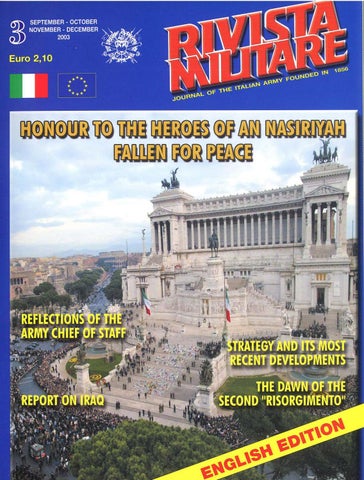
Just when we were about to go to press, we were struck by the dramatic news of the terrorist attack of Nasiriyah. The Fallen Soldiers are colleagues, friends, comrades, treacherously hit by assassins who vilely want to destroy the projects of peace and hope for Iraq. All Italians joined the families of the victims, surrounding them with their affection, spontaneously expressed also through the telephone exchanges of Headquarters and Commands. The servicemen who offered their life to give others a Jonged,,for serenity are our modem heroes. Heroism is a universal good, which does not change according to the times. It remains unaltered and shines forever, since its aim is to do good, in spite of those who have darkness in their hands and in their hearts. Those brave soldiers had gone there to bring peace/ but the enemies of peace have decided to carry them away, not knowing that by doing so the have made them immortal, because their sacrifice will generate a better world. May God receive those heroes of our time, we are sure that He will Jove them forever. Down here they have had veiy little time for being loved
Capitano Massimo Ficuciello Sottotenente Giovanni Cavallaro Sottotenente Enzo Fregosi Sottotenente Filippo Merlino Sottotenente Alfonso Trincone Maresciallo Aiutante Massimiliano Bruno Maresciallo Aiutante Alfio Kagazzi Maresciallo Capo Daniele Ghione Maresciallo Capo Silvio Olla Brigadiere Giuseppe Coletta 1
I
I 1
I
Brigadiere Ivan Ghitti Vice Brigadiere Domenico Intravaia Appuntato Horatio Maiorana Appuntato Andrea Filippa Caporal Maggiore Capo Scelto Emanuele Ferraro l O Caporal Maggiore Alessandro Carrisi Caporal Maggiore Pietro Petrucci Dottor Stefano Rolla Dottor Marco Beci
f,
REFLECTIONS OF THE ARMY CHIEF OF STAFF At the beginning of this year, on opening the first number of "Rivista Militare", I noticed the fine initiative of giving space to the "voiced reflections" of the Chief of Staff of our Service. At that moment it would have been difficult for me to anticipate that, soon after, I would be the author of these few but significant lines. Therefore, also because I am aware of the large readership enjoyed by this magazine, it is not without emotion that I set about following in the wake of this fine tradition. Although only a few weeks have gone by since I took up my new office, I have had the opportunity to begin a cycle of visits to Commands, Organizations, Institutes and Units of the Army, both in Italy and abroad; this will allow me to comprehend, fully and personally, the "state of fitness" of the Service. I have already made some "sorties", among which the very profitable ones in the Afghan and Iraqi Theatres, from which I have been able to draw some precious initial information, including the pleasant discovery of gratifying sectorial and "niche" realities that unequivocally attest to a full activism, a growing participation and an absolute objective-sharing, even at the lowest levels. This is the right encouragement to continue on our course of growth, reorganization and modernization required by the new role of the military instrument. It is precisely in order to play this role that the Italian Army is changing from a 4efensive war-tool - built on the principle of deterrence - into an active security instrument, rapidly employable and ready to contribute to the implementation of the decisions taken by the Political Authorities in the sector of national security. We are not facing a simple transformation, but rather a real and radical change, a professional and cultural growth, both on the organizational and on the individual plane. Our final objective is an Army characterized by great flexibility and versatility, fully integrable in joint and international environments, capable of expressing assets entirely interoperable with those of the allied and friendly armies, and in a position to participate, as a protagonist, in the realization of the European security and defence capabilities, as well as in the reinforcement of the United Nations' system of international security and cooperation. These are ambitious and demanding goals which cannot be missed, under penalty of loss of credibility for the whole Country.
I
The concept of integrability 1mds its justification in today's challenges to security, which are so complex that they require ever more structured instruments of prevention and contrast, which can be effective and incisive only if they originate in a joint or combined ambit. But the possibility of obtaining a correct int egration is strictly connected with interoperability, i.e. the ability of several systems - Commands, Organizations, Units - to operate together. Both qualities - integrability and interoperability - can be obtained only through the strict observance of the fundamental principle of standardization. A principle that must he applied in every sector, from doctrine to materials, from procedures to training. What is needed is therefore the growth and maturity that I have just mentioned, which must lead us to develop new operational capabilities and to ensure a high performance in joint and combined environments. Consequently the Italian Army is the protagonist of an unprecedented change, with a non-stop process of reorganization which, considering the extent of the reform, is proceeding very rapidly. In this constant activity of rationalization it is necessary to continue ensuring the capabilities of operation and intervention which, between the end of 1999 and the first months of 2000, permitted the simultaneous employment of up to 10,000 servicemen in operations outside the national territory, from nearby Kosovo to faraway East Timor. It is an exacting, continuous and resolute effort, which involves every component of the Service and, day after day, demonstrates that the Army can, promptly and efficiently, meet all the requests of the Country, always doing its utmost with unquestioned skill, deserving constant appreciation and raising the international prestige of our Nation. Nevertheless we must not forget that we would not have reached these gratifying results without the loyal, generous and unselfish dedication of our personnel. As a matter of fact, the essence of our Institution is Man, the fundamental element of the "soldier system", where top-level physical, professional and moral capabilities must blend with the opportunities offered by the new technologies. The process of development, therefore, cannot prescind from the exploitation of this strategic resource. A utilization which must unfold in all directions: education, training, equipment and legal-economic treatment and, above all, quality of life. As regards this latter objective, and despite the evident scarcity of funds, we are earnestly and firmly committed to get as much as possible near the essential standards of living which are the necessary prerequisite for the serene activity of our Men and Women These few lines, therefore, summarize the ambitious reformative project in which we are engaged. But we must not delude ourselves: we still have a lon g way to go, and the route will certainly be characterized by difficult moments and "pauses for reflection" But, confirming what I said on undertaking my new position, I cannot but guarantee my full and total commitment to direct this evolution on a path as smooth as possible. The premise for a positive and brilliant result in this exacting challenge is represented by the excellent impression I had during my first visits. Seeing our units operate as equals with those of the United States on the impervious Afghan terrain, and with the British ones on the insidious sands of Iraq, and being appreciated and explicitly requested for their special operational capabilities and for the values that our servicemen are able to express, is the concrete confirmation of the validity of the decisions that we have taken up to now. I cannot hide that, as Commander of the Italian Army, I am proud and honoured to represent you, and I am sure that during my mandate I shall be able to rely on your best energies and capabilities, in the loyal and unreserved service of our Count ry. Good work to you all!
Lieutenant General Giulio Fraticelli
II
CONTENTS
t~:: _ ~~ /4',' . p
•
.
Number Three 2003 September - October
'[),
.
~ovember - December
Rivista Militare aims at broadeni ng and updating the techni cal and vocational training of the Army personnel. It is thus a means of propagating the military way of thinking and a forum of study and debate. Through the p ublication of articles of technical and scientific interest, Rivista Militare also aims at informing the general public on the Army and on m ilitary issues.
I Reflections of the Anny Chief of Staff (Lt.Gen. Giulio Fraiicelli)
Politics, Economics and Strategy FOUR-MONTHLY Supp lement to num bers 5 and 6 of Rivista M ilitare Italian Editio n
Editor in Chief: Giuseppe Maria Giovanni TRICARICO Management a nd Edit orial Office 8, Via d i S. Marco 00186 Rome Phone 0039 0647357373 Advertising Care of the Secretariat of Rivista M ilitare Phone 0039 0647358139 Printer Stilgrafica - Rome Photoprocessing Stud io Lodoli Sud - Aprilia (Ll) Subscription and f orwa rd ing By mail Law 662/96, art. 2, para 20/c Condit ions for 2004: One number: Euro 2,1O One back number: Euru 4,20 Subscription rates Italy: Euro 11 ,40 a year Abroad: Euru 15,50 a year Payment must be made on postal account No. 22521009 - SME Centro Pubblicistica dell'Esercito 123/A, Via XX Settembre - Rome Residents abroad may remit payment through bank c heque or international postal order Authorized by the Court of Rome under No . 944 of the Registry by Decree 7-6- 1949
2 Report on Iraq (Giuseppe Cucchi) 16 Strategy and Its Most Recent Developments ( Ferruccio Boll i) 28 A Very Advanced Recruitment (Angelo Lunardo) 40 Humanitarian La\v: An Asset for All Societies (Auuro Afarcheggiarw) 50 Red-hot Lakes (Serena Sartini)
Science, Technology and Training 62 Investments and Objectives of the Army (Salvatore Farina)
History SPECIAL REPORT ON THE 60T" ANNIVERSARY OF THE WAR OF LIBERATION 69 The Dawn of the Second "Risorgimento" (Luigi Poli and Giorgio Donati) 118 Sommario - Swnmary - Sommaire -
In.halt - Resumen - Sumario
2003 © Copyright by Rivista Militqre
@
ASSOCIATED TO USPI UNIONE STAMPA PERIODICA ITALIANA
The prod uction of this magazine has been supervised by Omero Rampa
Instructions for Contributors: Anyone may contribute. To guarantee the highest objectivity or information, Rivista Militare leaves contributors ampl e freedom, though it does not necessarily share their opinions. The Author is thus solely
responsible for the articles which, published unedited and without ed itorial ties, exclusively reflect his personal ideas. Articles must be original in thought and should not exceed ten typewritten pages. Once the Author receives his fee, he loses all exclusive rights. Rivista Militare may then pass the article on to other publications and EMPA (European Military Press Association) periodicals. Articles should be accompanied by suitable photographs, illustrations, explanatory tables, together with a photograph of the Author, a brief «curriculum vitae» and a ten-line typewritten summary. Rivista Militare reserves the right to change the title of articles and choose the typeface deemed most suitable. Rivista Militare is equipped with a computerized system for phototypesetting and videopaging. In order to make the production of t he articles more expeditious, it is desirable that the Authors provide, besides the text on paper, also the diskette with the text files of the artic le. Any system and type of computer can be used.
. . . _ _....j
ow that the war is over, now that Saddam Hussein's regime has been destroyed by the U.S. with an impeccable demonstration of force and military technique, and the problems linked to the war give way to those of the reconstruction, one cannot avoid asking oneself what could be the questions and problems that will have to be faced in the future in the Mesopotamian and MiddleEastern contexts. Contexts that, up to now, at least from a military point of view, we
have just faced as spectators and not as protagonists. It is a logic desire, considered that our Country has been politically involved in the war against terrorism since its beginning, when all the NATO Countries agreed to fight against it less than 24 hours after the attack to the Twin Towers. However it must b e underlined that, on that occasion, we probably did not realize how much commitment would be necessary in the future to fulfill our choice and we did
N
• ,. ~
,. ~ 1' .. I•
•
..
, . r•..t,; f- , .
·;
.) · 1. •
--t~, •.
,, - •
I
_.
: ~~ - •......-C,l~ ~ ~.....ci• ~ -
.., ~ ~·
•
~:ft"
~
·-i
., . . . ,,
'
..
,iii.,
•
not take into consideration the possible differences of opinion with our best and oldest allies, those with whom we were sitting together both in the European Union and in NATO . Our political commitment was immediately followed by military action. First in the limited context of the air-sea actions conducted by NATO in the framework of Operation "Enduring Freedom", then with a wellweighed crescendo in the Afghan area of operations, in Kabul with ISAF and in Kost,
Strategy is a science that was wrongly considered static and immutable. This is how it changed after the great crises of the 20t1 century 1
STRATEGY AND ITS MOST DEVELOPMENT The enemies of peace tend to hit cruelly and by any means in order to affect the morale of fighters and civilians, causing uncertainty and fear The masses are no longer mobilized for conflicts, but it is mostly specialists who are employed in distant Operations Theatres. "Strategy consists in conceiving and planning the main lines of the use¡ of force, in order to attain politic goals in conflict situations. This implies choosing among different options and setting priorities". No one knows if this definition is destined to succeed. 16
owadays, Lhreats, dangers and doubts are a leitmoli.v of our lives. According to the White Paper of Defence 2002, the rerrorisl alfacks of September 11 have upset rhe geo-slrategic balance still further [. . .]. The traditional threat does not exist anym.ore; there are area dangers which bc1se their capability nor only o n armaments, but also on diversified and state-ofth.e-arl instruments [. ..] Terrorism is the catalyst and mull iplier facror of these risks. Security and defence policies, today, cannor be confined to the traditional sphere o{ mere war capability, they have indeed to face a transversal, ofi.en devious and sometimes immaterial enemy.
N
We ,.vonder what theoretical repercussions may come out o[ thi s extremely variegated and complex picture, that complicates the process of differentiation and division into compartments of lhe subject, which is th e essential premise for defining concepts and stating their mean ings and contents. For¡ example the White Paper discusses security and defence policies and, further on, states that the new con(i'guration. of the world picture calls for a continuous and careful reassessm.enl, political fi.rst and then strategic, of the defence priorities directed towards the organization of 1w1v m.ilitary capabilities ... But, in th is new context, what are the meaning and the contents of old
terms s uch as SecuriLy Policy, Defence Policy and Strategy? The proper meaning of each Lerrn can be obtained by its difference from the oLhers. Therefore we s hould ask ourselves what differences there arc at present bct¡ween Strategy (and global Strategy), Sec u ri ly Policy and Defence Policy. As far as ,ve know these differences have not been slucl iecl ye t. Today each author- gives the meaning he pleases to Lh esc terrns. Anyvvay it wou ld be inaccuraLe to define each te rm separately. If there ar¡e close links between pol itics and stralegy, as is generally acknowledged, their respective meanings and theoretical conlents have to be 17
Officer of the "Cavalleggeri di Fog{?,ia" Regiment, 1864.
defined concomitantly and, as we said before, by difference. In order to do so, the best method seems to be that of a great expert in political affairs such as Raymond Aron and of a great writer and naval strategist like Adrniral Romeo Bernott.i: lo examine the present circumstances in the light of the past, so as to identify and pinpoint the really new facts that otherwise, without a histor.ical basis, would appear distorted and without terms of reference or com parison. Changes concern mostly Strategy: polities has always 18
retained the same meaning, i.e. theory and practice 1,vhich have as their object the organization and rule of the State; the whole of the goals a State aims at, and the means used to achieve them. (Garzanti Dictionary). Since the Armed Forces have always been a State's primary instrument of power, it goes without saying that the armed component is not separated from politics, being more precisely one of its parts, and therefore everything re.lated to it is but one of the many specialist fields of the organ ization and activity of a
State. So, Strategy vvas born at the end of XVIll century precisely in order to enable the Stale to better organize and supervise the military activity, linking together politics and tactics, which was, and still is, the art and science of conducting battles and fights against the enemy. To be more accurate: strategy was born as a theoretical branch of the Art of ¡wa,~ because the attempt to direct the clashes with the enemy towards the political aims of the war has always existed (Clausewitz), and has led the troops to fight the enemy under the best conditions. This is so true that, for instance, Edward Luttwak has just written a book about the "Great Strategy of the Roman Empire". Napoleon's campaigns did definitively sanction the birth of the new theoretical discipline, with short wars and decisive battles, from which generations of military chiefs and writers drew their inspiration. All through the XIX century and until the beginning of the First World War, therefore, nothing changed in the concept of Strategy: a concept, which was still essentially a military one and of Napoleonic ongm, and consisted in setting the main lines of conduct during the war, in order to defeat (with minimum effort and maximum results) the enemy, in the course of few decisive battles. But after the first bloody and inconclusive fights of the 1914-1918 War~ the picture changed dramatically. For a number of reasons (and not only because of the tactical superiority of the defence provided bv the famous combination of machine-gun and barbed-wire fence), the short and decisive Napoleonic war was no longer possible. Up to 1917-1918, in Europe, armed masses almost
··'
/
., ·,,..
..
,·
-: .:-.i .....~
..._,.
~-· ·'!!:/
Arrival of newspapers to the front in 1917.
e qu a l in strenglh faced each other; and in order to have moral and material effic ie ncy it was necessary t o mo bil i:r.e the resources of the entire nation. The fall of Germany and Austria occurred, in tl1e first place, because such resources had become insufficienL During the Great ·war, th e Generals had the collaboration of businessmen. vVar became industrial and lotal at the same time, because it also involved and mobilized civilians as producing and feed ing force s. In order to remedy this firsl great crisis of Strategy, eno ugh to involve the General Staffs credibility, during the twent ies and the thirties of the XX century an attempt was made Lo avoid the massacres of trench warfare, wh ich had left a deep mark on people. Wrongfully blaming Clausew itz' theories for the blood shed during the war,
the English military expert Basil H. Liddell Hart introduced lhe "indirect Strategy", consisting in the use of other means, besides the military ones , in order to defeat the enemy withou t many losses, attacking all their weak points ( 1). Another Englishman, General John Frederick Charles Fuller; proposed mechanized war. The Italian Giulio Douhet theori7.ed the use of masses of heavy bombers, lo hit the enemy demogrnphic and induslr ial centres from the a ir, in order to cause the material and morale collapse of the opponent nation in a [ev,1 days. In the twenl.ies the French bu ilt t he fortified , expe nsive a nd powerful Maginot line, with the purpose of dis suading Germany from lryi ng to get revenge and, in any case, bloc.king any possible German attack and suffer few casualties by keeping their troops sheltered by a ,vall of iron and cement. In 1939, the then Lieute nant Colonel Andre Beaufre, who in the post-war period was to be the
father of the French n uclear Force de frappe , wrote an article in wh ich he described a preview of a cold war and its characterislics, in order to prevent the devastations of another war and face Hitler's aggress ive policy without bloodshed. He therefore spoke of political war; diplomatic war and economic ,.var. All in vain! At first the 19391941 German blitzkrieg seemed to r·et urn its \,vings to the Napoleonic quick and dec is ive war. But soon, desp ite the new means, the 1914-1 918 long war of aLLrit ion came back, mobilizing the same amount of ind ustrial and human resources, suffering less losses among the figh ters, bu t with one element that made things worse: deliberate a nd massive bombings of civilians, lo dispirit them and interrupt. the (low of sup pi ies to t he Armed Forces, destroying all production so urces . Moreover guerrilla warfare, unknO\vn in 191 4- 19 18, revived . War and Strategy, once total, became general, because 19
lVar against Turkey: one of the many battles at 1he wells o( Ru-Melian.a (Tripoli).
as a matter of fact - also civilians turned into fighters and therefor¡e prone to war offence . Bul this is not enough. At the end of the war the atomic bomb dropped on the Japanese densely populated cities of Hirosh i ma and Nagasaki ca used a second unprecedented crisis of the strategic concepts. The logic of the cold war is well known. vVar never disappeared : it was fought , using conventional weapons, outside Europe, where the two coa lit ions faced each other in indirect ways and thro ugl1 third parties . The Western arm ies had to cope with guerrilla warfare, terrorism and the ambitions of independence of their colonies, and they mostly got lhe worst of it. In Europe , p eace has been kept by threatening mutua l nuclear 20
destruction . As a result, Strategy d id not consist in trying to find a vvay to infl ic t heavy losses on the enemy, but rather in avoiding to i:esort to "hot war", by persuading the antagonist that in this case he vvou.ld have the worst of it. In the subsequent massive and expensive arms race between the two superpowers , lhe USSR, economically \veaker and technologically less a d vanced , was overcome . Born with bayonets, the communist system collapsed O\ving to the economic implosion caused by the new bayonets, i.e. lhe arms race which it cou ld not afford any longer. Let us now turn to the present, ,vhen - obviously - bo th the cold war S t rategy and the old Napo leonic Strntegy are worth less . In the light of historical experience then, what has Strategy ceased to he, and what is it today? Besides, how d oes technology in fluence Strategy? First of all we have to
admit that - as convincingly stated by the 2002 White Paper there are still a security policy, a military po licy and a defence policy. In this respect, h ut with cons iderab le changes, the d efinitions given in 1989 b y Genera l Carlo Jean seem to be valid . S till referring to cold \Vat~ he wrote: security policy includes defence policy, which encloses rnilitary policy. Security policy is the answer of a State to all external challenges, which are not only military. On the contrary defence policy and its twu milirary and civil constituents refer only lo rnilitary threats . In the end, military policy regards the concepts, the strategic planning and the general issues the Arrnecl Forces. The S ecurity and Defence policies evidently concern t he government and its global decisions . T he Mi litary policy regards primar ily - though not exclusively - the M i n ister of
or
Defence. But, unlike the previous definition, loclay the security policy concerns both the external and internal threats. AL present the challenges, more than purely military (that is, pertaining only to regular formations) are often armed, i.e . lhey come from irregular organizations, and their on ly aim is Lo exert violence using different means, bu t generally excluding the kinds of action typical of regular troops and referable to classic strategy and tactics. Also the Defence Policy today refers to generically armed threats, and not only Lo military ones . Mor eover, it can react (not necessarily using arms) to different and n.ol a lways armed threats (illegal immigration and other unlavvful activities, such as arms and drugs trafficking, etc) . If this is Lhe way matters stand, now we have to iden Li fy, delimit and def.i ne the sector Lhat remains entrusted Lo strategy. During the cold ,,v ar, the daily confrontation of the tv,;o superpowers influenced and oriented politics, dip lomacy, economy, rnass-media activities, and what we could call the home front lhrough a real psychological warfare. Th is somehovv led to a supremacy of strategy over politics, sancL ioned by the concepl of "global strategy", which was given Lhe meaning o[ science or arl that uses political, economic, psychological and military forces, to guarantee the best support t.o political action both in peacerime and in wartinw. In its turn, global Strategy has been d ivided into different types, one of which is the military one. At this point , we have to acknowledge that Lhis theoretical conte nL of global Strategy collides ,vit.h lhe abovesa id concepts of Security, Defence and Milita ry Polic ies : Strategy becorn es much more sim ilar to politics and politics in its turn comes nearer to Stralegy, with a mutual loss of specificity. Such
superimposil ion, or rather con fu sion of meanings, docs not fit with Lhe present ¡ strategic picture, obviously very different from lhat of the cold wa.-. War has become asymmetric : it is not a matter of nations, industrially developed, confronting each other, where classica.1 lerms like front, zone be h ind the lines, contact line, jusL to mention some, slit! meant something. The present problem, [or the \,\iestern societies, is that of consolidating their security structures, without much impact on everyday li(e, but seeking, on lhe contrary,
the cold ,,var - but only a reduced number of volunteers. As a result the prevailing idea is that, whi le small groups of volu nteers and special isls are engaged in far-off wars somewhere in the world, national life has to carry on as usual, more or less like during the pre-Napoleonic cabinet war¡s of the XVIII century or; more recently, in Kosovo. During Lh is conflict, the military operations concerned a few hundred pi lots and a few thousand specialists in charge of the aircraft, which mostly took off from Italian bases, while for the rest of the citizens it
economic developme nt: without mobilil.ing neither industry nor economy. The military instru menl, today, calls more and rnorc for a long-requested q uality: flexibil ity. I t has to be able to conduct , with the same effi c iency, both classic operat ions (as in Iraq) and the so -called peace missions. In short, il rnust be able to give an immediate and d ivers ified answer to any lypc of threat and ris k and, in order to do so, it must develop iLs o,vn self-protective capability. Finally, arm ies do not rnobili1.e masses anymore - as was the case unti l
The column in rescue of Lhe Saati garrison, commanded hy Lieutenant Colonel De Criswf'oris, 500 rnen, was attacked and des1royed at Dogali by about ./0,000 Ahvssinians led b_v Ras A.lula, on January 26, I 887.
was a TV or a live show, since, on Sundays, crowds of spectators watched the airplanes taking off from our bases. In such a con text, it seems possibl e to give back to pol itics and strategy what pertains to each oC lhem . If we acknowledge Lhat the terms Security, Defence 21
and Military Policies are s till applicable, we can only bring back strategy to a narrower path and, considering the past, make a distinction betvveen what it cannot be anymore and then determine more precisely what it will have lo be. At the root of the issue there is the fact thal strategy and politics cannot be confused. These fields are wi d ely interconnected, but distinct. Strategy cannot be summed up
22
generically as the use of force. Politics, too, is the use of force . We talk about strong or weak government depending on the support given to it by the Nation; we talk a bout the strength of a party, of a parliarnentary group, of a lobby. The same thing happens with e conornic and industrial activities where, in the end, the everyday cornpetilion re,.vards the strongest. Strategy can not become militarized once again, as it was
in Na poleonic times, nor can it spread abnormally as in the cold war. But it must a lways have its reference and basis in.. the use of the armed force (not military force, which would limit its application to regular milita1¡y forces). In parlicular, nowadays, it is the synthesis of different compo nents. But, although with differences in measure and roles, the armed force still has a significant role. The use of the ar-rned fo rce may b e partial,
diplomatic. strategy) in itself does not mean its demilitarization, as some claim; it only bears witness to the success and the efficacy of carried ouL and the necessary such a term (e.g.: the expression "industrial strategy" accounts for means. The recent war against Saddan, the main lines of action \.vhich an Hussein undoubtedly shows that industry wants to follow in order very little has changed: for the to expand, pursuing certain basic Superpower, as Clausewitz used goals) . Even the expression to say, war is, as usual, the "Board of Directors" has an continuation of poliLics by other ancient military or路igin and is still means. Strategy outlines the in use, although the Boards of Directors of the Regiments have proc.edur路es for bringing about a successful (political) conclusion disappeared: but this does not of a war, a conflict, a crisis. It mean that the economic and operates both in peacetirne and induslrial life are militarized. The expression "military in wartime. The strategic element is what weighs heavily on the strategy" and "operational solution of a conflict or a crisis; strategy" could be pleonastic . on the olher hand, what affects Stra tegy wit.hou t adjectives the solution of a battle, a fight or should always be military and a single ep isode of a ,var, is a operalional; this qua.lily must be retained. Instead, and with an tactical factor. If - as Clausewitz writes - 1-va1路路 areal r eference , nothing can is a chameleon, Lhen straregy is a prevent us from speaking of cham.eleon, too. Especially today, general strategy or, even better, of national strategy, theatre strategy, it can take the most varied forms, on the sole condition that it may zone strategy (especially in the Superpower's perspective, attain its political goal. Stra legy cannot be, as some different from that of regional arg ue, the mere imposition of powers). Th e levels of respo nsibility somebody's will. For two reasons: Lhe first is that the strategic aim singled out in the conduct of any can also coincide with the strategic operation are always: pursui t of an agreement or a politico-strategic, responsible for compromise between two the definition of the goals to be opposing ,vills, in which eac h attained, the formulation of the party waives some of its initial mandate, and tbe allocation of goals. The second reason is that resources; operational., responwe always have to cons ider hovv sible for turning the political and by what means this will is mandate into technical military enforced. Obviously by force: but goals and leading the operations w.hat kind of force? Generally, ii through an organic vision; is economic. power (san ctions) tactical, responsible for coand sheer force. But even in this nducting tlie operations by single case the armed component is components or sectors of responsibil i Ly. crucial. Without the backup of a So, the Security and Military credible military force, eco nomic meas ures are ineffectual and ii De fence policies are usually may be impossible even to apply placed at the first level. AL the second (operational) level there is t.hem . The political goa l is pre- national strategy and possibly (as erninent, but there cannot be bad regards Ttaly) zone strategy. At the third (tacLical) level we .h ave politics and good stralegy. The use of the word "strategy" the conduct of single actions or ,vhic.h musl be in various fields (including the battles, political one: political strategy, coordina ted by national strategy. A popular propaganda prinL, celebrating the Italian vic1ory in Libya.
pole.ntial, dissuas ive, concrele , but strategy cannot exisl without an anned or military basis. In its innermost nature, strategy has always been operational, being the art and science of action. It concerns the planning and conduct of actions, of operations airning al a political result . Som e hovv it represe nts the anned wing of poli t ics and, mainly in this respect, differs from politics, which assigns the task to be
23
Left and facing page. Co vers of "La Domenica del Corriere" mar;azine, illus1ra1inr; two enr;a{!,emenls
on the Aust1¡ia11 front during WWJ.
lt should be underlined that t he competence of each of those bod ies is not exclusive , bu t p revalent. T he highest military authorities and , in particular, the Chief of Staff of Defence contribute to the formulation of the Se curity, Military and Defence Policies, for which the Government is responsible. The nat ional strategy req uires the constant invol ve ment of tl1e Min is try of Defence. The tactical level is controlled by the strategic one. I n s horL , the re is an interpenetration, a downward and upward current, which pays
24
off only when there are understanding, harmony and permeability among the d ifferent leve ls, withou t rigid an d a prioristic dichotomies. After all, if we want to 1--cspect the sphere or competence of the Security, Mi litary and Defence policies, strategy can be defined as fo ll ows : formulation and planning of the m.ain charac t e ristics of the use of force (variouslv armed and of any kind) and irs porential and concrete use in order Lo achieve political aims, in a situario11 of conflicr. fr entails choices arnong differeni options
and indication of prioriiies. With this definition we und erline that the significant factor of strategy is the use of force, \,vhich is the rramevvork of tb e remaining activities. Without it, strategy can eas ily co in c ide with politics in genera l. Ano th er relevant element is - and has bee n s ince its origin - action. Politics prepares, organ izes a nd di rects, while strategy acts and manoeuvres fo 1¡ccs and mean s, whatever they may be. Obviously, in s uch a definition there is no room for the peculiar stra tegics of an Armed Fo rce (land, air, nava l, space), since it encompasses them all. The1¡eforc we can correctly talk about air, na val, land con1ponents of slrnlegy, ,vithou t a scribing a priori the decisive character to one of lhem . Each siluation needs a whole body of forces variously composed, exclusively influenced by task, time, natural envi ronrn en t : elements which determine the tactical order of the forces. The main thing is lhat each unit of force carry out their mission as best as they can, so as to achieve the common goal. We sLi ll have Lo decide in ,vhat way such an id ea of s trategy could inl.erael wilh Lhe two topics of the clay: terrorism and advanced technologies. Terrorism is a constant fa ctor that we have to reckon w ith a t a.ny lime. First of all it requires the combination of the efforts o r all cornponeni.s, b eginning wi th information (which ofte n pre vails over th e others, and this is some th ing new). As it was a lready pointed out, t he regu lar Armed Forces have to adopt an o rganizatio n ,.vhich could be called "t o talazi m u th" , i n that i t great ly emphasizes the characteristics of
flexibility and self-protection, in order to be ab le to give an immediaLe and effective answer to any type or lhrcat. Ob\:iously, this also concerns the logistic units and the infrastructure. In the final analysis, il is a rnatter of making Lbe proper use or old requirements and old characteristics. For example, the most important weapon of terrorism is surprise: well, here we have to mention Napo leon ·who, when asked why, in any circumstance, he had in store the right decision, answered : because whatever happens, I had already foreseen it at some other time of my life, and l had thought how I would behave if it happened. In sl10rt, the increase of terrorisn1 after September 11 has not turned into significant changes in the strategic theory: it only accentuated some modalities o r action, which got the regular forces on the rope, and which the great commanders of the past have faced in the best possible way. Secondly, the very recent war in Iraq proves an old truth, which the charm o[ the latest technical inventions tends Lo make us forget: what counts is always "man" and, in particular, the soldier, whom technology can help hut not entirely replace. The technological supremacy or the West must be fu lly exploited, but without attributing it possibilities and capabilities that it cannot have. In short, despile the imposing array or technology and fire fielded by the United States, in Iraq tlie continuing importance of infantry was very clear, both in quantity and qual ity. Those long lin es of marching rnari nes, carrying heavy r uc ksacks on their shoulders, cou Id have been part of some war of the past. The unsurpassed American organi,.ation of fire, technology and logistics made their task easier and limited the dangers on the battlefield: but only to a cerLain extent, until the so ldiers found
n- . . ~·.·. ~:~:·:.:~.::··r·-···-~ :.~.~'~: l- LL~~,::~:'".:.:.:.:~
s~ r:-;t,~;;.~~~-~;·on·; t;;~n:;~ln . . .
~
.
. AnflO
•v • -
r1·
h
~~-I~~
~,.,: :.~!.if~;~~::~ !'Ii:~
u ff Supplemcoto illuslrnlo lie! •( Corriere- ~enn Scrn ..., .......,,............ Mti.A N O • ,.__ .....,. ... .....,.,.., .- ....-·~·-······ .. ····-············---............. . ,,.,.... ,.,........ , •.,, ' "'" ' ~ II 11rol<toll o O l 11• 1ra ..1cu 1J 4 r l• orvau. h p r ot1l' l 1>1a Jo uo r a ri • G al' ll •1h>II , • ooun.ic I• IO!/'J I o • •r •U•U 1.. ,0, ..... . ...... 11. xx. - N\.llll,- 2·a: · ~ - - - - - - 30 Giu'g"no . •, LuP.110 19 18. --- - CenteS11n;- u) ·11·r~n,om. 4
~·11 , ,,,.(J :,lJli 7• in! " ' l;i11t,1...trJ 116I w,11,r.-. /1(;• r , •;.•1:t 11l ltJl (O ,•.,. ,, ,: ,;, fmJ. 11 , tru .. !11J 1·11u" ' l i,>r .'.i:, .-nr ,,u,J H,v, i, i "f'J" ' "'r •1 ,ii 111+111!r 11 111)1,r i1 ,11, ' 1111 /1'11 fh•"••, 111, '111 111ttJ JO ,!, 1 r , 111. t11 ,-,ffli:Jlrrt , (, ,ut >", •TWIIJJI" n,: ,1, I n 1;1,' I >'11r,, .,. ' .. ,fl I i •l •I• ~ ,,, •'t \ I:. It,.,.,-.
;\ l! T I(, 1. 1 f" " ' , : I f ,, H 'r t )ii U L C O l.l, f! MOSCJI JN, , . ..., . r 11, k •1/l i) r ('
, , . ,m,.,1111 ,..
, ! , i ..
themse lves fa cing the enerny in the old ,vay, and in the old way they had to fight, relying on lhe ir courage and tale.nLs, on their unit and on their commanders. Therefore, as Sandro Veronesi recently ,vrote, tec.hnology should not become the strength of the weak and the wealth of the poor. According to Veronesi, in tbe Vietnam war, in order to shovv that their military and "gr imly moral" strength was superior to any technology and lo any sophisticated weapon, t he Vietcong were so wicked as to cut the arms of the cb ildren who had
just been vaccinated by the Americans, and then heap the little arms at the centre o r the vi llage, sustaining the inde scribable .h orror of thal deed: a gesture that no Western supertechnological army would have h ad (and \vou ld have) Lhe strenglb and the cruelly to make. And this means s imply one thing: that frorn now on, il w ill be on this unment io nable terrain, where we are weak, Lhat the enemies of the developed West are going to fight us: not being able to confront the weapons, they w ill try to disarm and 25
demoralize, by any means, those who should use tl1ose weapons. For one thing, the most reassuring result obtained by technology in Iraq is perhaps tl1is: the (relative) limitation of losses and devastations on boLh sides. In Iraq, the American staff Officers have managed to perform well an extremely difficull Lask: to conquer the Iraqi centres of pO\.ver~ reducing to a rnin in,.um their own losses, the number of civilian victims and the desLruclions. So we can say that, owing to its precision to the possibil ity of selecting LargeLs, technology succeeded in making conflicts less bloody. If we th ink of the great number of casualties among civilians and soldiers, and of the devastations of the past ·wars, we have but Lo rejoice at such a result, in which, perhaps, we can see Lhe true progress of strategy, a progress which we can symbo lically set against the thousands of victims in just one battle of Lhe First Wodci' War~ or against the victims and casualties of Stalingrad or Dresden during the Second World War. To ta lk about progress or regress in the field of military art is inaccurate. The facL is U1at even after the shocking events of the beginning of lhe XXl century, ·war - and therefore also strategy - remains thaL which was described at the end of the X I X century by Capta i n Domenico Guerrini, an infantry Officer and editor of "Rivisla di Fanteria": "rhe science of war Lhat deserves contempt, and therefore is nor worthy of the glorious name of science, is thal which wirhdraws into rhe peltiness of a na,,,,o·w- minded idea, and proclairns empirical posiulates: it is not science of 1.var that which today says that war is a quest.ion of fire , and yesterday said that war vvas a moral question, and that the day before yesterday had said that war was a question of legs, and still remembers having said, a short
26
Russian fiw¡zl: a machine-gun enzplacemeni at Ryko1,vo.
iime ago, that war was a marter of a full stomach. lVar is a. mauer which includes all these things and many others, and ihe real science of war is rhe one which, after having sharply examined all the different factors of the fight, is courageously able LO rise ro a bold synthesis, in which it gathers them all and sets each in its place, pulling them in a right proportion ,,v ith the others. This is a severe \varn ing for the lovers of dogmatic assertions, absolute truths and aprioristic strategic conceptions, or for the fans of this or that decisive ,.v ea pon. To d etect something new, wi thout taking sides and not necessarily making it coincide with the progress of technologies or of a given means, is the real challenge that today awaits the high authorities in charge of security. The real problern that confronts the Western military for-ces is not technological progress, still necessary, but the ability to cope effectively with challenges such as suicide attacks , terrorism and other methods of violence, aberrant or impracticable for us, remaining consistent with the unsuppressable moral legacy of our centuries -old culture and civilization.
D ''Colonel (ret)
NOTE (1) ln the late Twenties, Liddell Hart pointed at the indirect strategy practised by Scip io African u s in Spain and Africa. an alterna tive model lo Clausewil/s strategy of the opponent's debellatio, defining the Rornan com mander a man greater than Napoleo n (see Basi l Liddell Uar L, "A man greater than Napoleon: Scipio Africanus").
27
The Army Inspectorate for Recruitment and Completion Forces is the hinge of the fundamental sector tasked with the acquisition and best employment of Volunteers
THE ARMY'S RECRUITMENT IS IN THE FOREFRONJ The Inspectorate uses the latest technological and scientific kno1-vledge in order to have the Army attain the strength of 112,000 effectives by the end of 2006 uring the last fifteen years the world ,vitnessed some very important events which significantly changed all previous requirements o( the internationa l scenario and compelled all the ma in Na.lions to review tl1eir foreign and mil itary policy. As a matter of fact, the fall of the Berlin Wall, the Yugoslav traged y (wh ich later spread to the whole Balkans), the Gulf War and the numerous local conflicts, caused mainly by ethnic , religious and territorial reasons (which used to be contro ll ed by the two superpowers) forced the most irnportant vVestern Countries to envisage instruments capable of defending their national interests, not only within the ir own borders, b u t also outside them. After that, spurred by continuous international crises, a substantial transformation in the Armed Forces started to take place all over the wodcl, in order Lo readjust them according to the requests of interve ntion of multinational contingents, under UN, NATO or EU aegis.
D
28
Also our Country answered the cal l of the International Orga nizations to h elp restore conditions of peace and survival in territories where conflicts had already caused thousands of innocent victims. Italy's response was imme <.liate, but the dispatch abroad of units consisting most ly of
The Inspectorate is a top sector of the Service and, among other things, is in charge of Conscription, Recruitment and Completion Forces. It manages the relations between media and society, ea ¡ g out all the legal activities connected with the employment of personnel, including logistics, infrastructure and training of the soldiers who join the recruit Regiments. Furthermore, its responsibilities include the security of every area of employment , with the exception of the operational ones. The Army Inspectorate is well aware that human resources are the most precious ones.
1
conscripts (even if they expressed Lheir willingness to participate in the spec ifi c missions), who in the past were employed in the prioriLy mission of defending the north-easlern
giving a substant.ial contribution to out -of-area operalions, especially to peacekeepii:ig ones. As a first step, and rollcrwing politico-mililary directives, Lhe Service started a tho rough
torate for Recruitment and Completion Forces (RFC), one of the top Areas of the Service (the other Areas are: the Operationa.l Land Force Command; the Logislic Inspectorate; lhe Inspectorate for Schools/Training and the Inspec t orate for Infrastruclu re). STRUCTURE AND TASKS OF THE INSPECTORATE
As we sha ll see later, the objective that the Army must achieve by the end of 2006 is a force of 1 J 2,000 men, all profess ionals. This is, in short, the task or the Inspectorate and or the Commands and Bodies within it. lt is certa inly an ambitious goal, because it is a matter of re cruiting Officers, NC Os and Soldiers who, voluntarily and with strong motivations, decide to go in for military life, for a certain p er iod of time or
bo rders , started to pose a number of problems . In p r actic e, the prevailing pu bi ic and polilical opinion, having overcome the atavistic mistrust towa r¡cls fully professiona l Armed Forces , started to believe that the new security requirements could better be met by rnaking recourse to volunteers and w ith the introduction of financ ial measures aimed at reducing and eventually abolish ing conscr.ip lion, also because conscientious objection was ga1111ng an evergrovving number of converts. Those years marked the historica.l beginning of the Italian Armed Forces' professiona lization . Of the Arm y, in particular, which was already
overhaul ing process, bearing in rn ind the princip le of prevalence of quality over quantity. Within this process, in compliance ¡with a Decree Lavv of June 2000, on January 1, 2002, the Centra l Military Region Command in Florence was transfo rm ed into ll1e ln spec -
definitively. This is a very d ifficult task: suffice it to think that young people often prefer jobs which do not take them far from their farnilies, not risky, and well paid. These a re aspects Lhat the Army cannot guarantee, at least at the present moment. In addition, at least at the b eg inning , many
29
Left.
Physical trainin[!, o{Volunteers.
Below. Solemn Swearing-in cerem.ony at the 1s 1 Regiment "Sa11. Giusto". Facing page. Recruilment Promotion: A Re[!,imental INFO POINT.
divided into subordinate Commands on three different organizational levels. The Inspectorate consists of four Modules or Offices ( Coordination, Management, Development and Security, subordinate to a Coordinating young are ,villing to join the Police Forces, because Lbey are attracted by the "signalling disk", wh ich gives power Lo those who are in contact with the public. Therefore, the question is to find motivated personnel and convince the undecided to join the Army. The objective is to involve a high nurnber of young candidates , both male and female, in order to make an accurate selection of personnel who are suitable, first of all, but also willing and deeply interested in the activities of the Service. Until a short time ago, the Army did not have to worry about the "man" aspect, which \Nas amply provided by consc1¡iption; today, the recruitment: of human resources is the main factor. Actually, any sophisticated and technologically advanced weapon-system is worthless if there is no man capable of using it. Tbese are the reasons which prodded the Army to acquire a Body in charge of Recruitment and Completion forces, in a posit ion lo ensure a human reservoir from ,vhich to dra,v Cadres and soldiers with a proper culture and a psycho attitudinal "profile" adequate to the tasks and, after specific training, professionally capab le 30
of working in efficient and reliable units. The RFC Inspectorate was born with this ambitious assignment and, besides the specific duties that will be detailed later on, is also entrusted with garrison, territorial and security tasks. Let us now have a quick survey of the RFC organization, which is
General) and of the Admini strative Service, directly su bordinate to the Inspector. In short, one can say that the Inspectorate performs tasks in the sec tors of Conscription, Recruitment and Completion; manages relations with the massmedia and promotional activities; provides data-processing, finan -
I
cial and coordination s u pport; supervises importanl ceremonies; deals w ith a ll legal activit ies connected w ith the employment of personnel ; takes care or the logi stic , infrastructure and training issues concerning all servicemen arriving ar lhc Recruit Regiment.; finally, it is responsibl e for th e security of every area of cmploymenl, with the exceplton of the operational areas. Under the RFC Inspector Lhcre are: the Dep uty R FC Inspector and Co mmander of the Recruit Training Group (78 th Regt "Lupi di Toscana in Florence; 123 rd Regt "Chicti" in Chie ti; 157Lh Regt "Liguria" in Albcnga; 231 s t
Regl "Avellin o in Avellino and the 1st Regl "S. Giusto" in Trieste); the Coordin at ing General, vvho regulates the activ ity of the Modules and controls the HQ and General S upport Unit, wh ich meets the li ving requirements of the Inspectorate, th e "Toscana" Re g ional Corn mand, the "Florence" i'Vl ili tary District and
o ther organi za tions s tationed in the same city; three Interregional RFC Commands: in Turin (North); Cap ital 's Military Command in Rom e (Cent1¡e ); Sici ly's Aut o nom ous Military Comrnand in Pale rmo (S outh) which , in their tu,-n, are in charge of the R egiona l RFC Commands (o n e fo r each Administrative Region); Sardinia Autonomous Milita ry Command ( Sard inia Autonomo u s RFC Command) in Cagli ari; the Army's National Selection and Recruitment Centre in Foligno. This is to he considered a real fi lte r for the e ntire Service. In fact, a ll operation s c onn ecte d with the applications for all types of rccruiLm ent arc carried o uL within Lhese slructures. The Regional RFC Commands preside over the Military Distri c ts : fourteen of them are complete-function Districts, i.e. they perform a ll operations of Call-up, Se lection, Recruitrnent, Records and Registration, while the ru nctions of the other ten a re Ii mited to the last two activi Lies. In order to economize, when the Military Distr.icts are .located with the Regiona l Corn mands, the administrative services, perso nne.l offices and Support Un its are unified within the la tter.
As regards Conscription, the relevant responsibilities, which used Lo be assigned Lo the nowa bo lished Consc ri ptio n Com mands, are att ributed Lo the In tcrreg ion al Commands , to whicl, Lhe Military Di stricts are actually and directly su bordinate. In this pi c ture, the Tn terreg iona I Com mand s ke ep a technical and func ti onal co nn ec t.ion w ith the G eneral Directorate for Conscription (LEVADIFE). This means that the Reg ional RFC Commands have no respo nsibi lity in that sec tor. But, for accuracy's sake, we sho uld explain that the Interregional RFCs ensure also the management of the ranges, museums , sports installations a nd Log is tic-Train ing Base s existing on their territory. At the sa m e lime, these Commands provide logi stic support to the local Bodies that do not belong to the RFC e mployment ,.ll'cas, such as : Military Jud ic iar¡y, l nfrasl ructure Commands/Units and Administrative Centres \,vh ich, as t hey do n ol ha ve their ow n logistic-administrative organs and con trnl personnel, must have recourse to the asse ts of the RFC Arca. Having ou tlined th e st ructure, let u s now ta ke a lo ok al the 3l
.
Inspectorate's responsibilities and act ivi Lies in the sectors of Conscription, R ecru i trnenL, Complet ion forces and Prornotion.
CALL UP AND RECRUITMENT OF CONSCRIPTS
At the rnornent, conscription is - and will be for some years - the main ac tiv ity of the M.ihLary Districts; i t will be officia ll y suspended on .J anuary 1, 2007. but th ere is a plan, already su bmi tt.ed to rn inisterial consiclen.,tion - and we shall see a bou t it later - wh ich aims at anticipating the closing date by December 31, 2004. Conscription , together with Recruitment and Selection, operates in the following manner·. T he Con s cription Offices , in agre ement with the munici palities, proceed to the com pilation of the "conscription lists" of the young men to be examined by the Selection Groups and then enlisted b y th e Conscription Councils. The Districts, through
32
\
\ \ \ '\.
·~
\.
the Recruitment Offices, are responsible for the conscripts up to their incorporation in the units. Al l these structures also deal with conscientious obj ection . The Military Districts' organi zat ion .is therefore very important for ach ieving the object ive pursued by the Inspectorate, i .e. reach ing the level or volunteers envisaged for the Service. \Ve could say that these Organizations are tl1e "visiting cards" of the Army vis-a.vis the civilian world. Therefore, the "publi c relations" organizat ion must take care of the smallest detai ls, with no improvisation or disorganization, sine this would create a negative image o( the efficiency and reliability of the Service. In a number of cases, in fact, reporting to the Mili tary District is the fi rst contact of the yo ung man, or woman, with the Army. This is ,,vby these Bodies must be well organized and employ pe r·so n nel with a good com munication capabilities, in order to have a good relation ,vitl1 the
123 rd Regi1nen1 "Chieti": Sole11111 S wearing-in of Volunteers.
public . Actually, the first approach to the military world is a very useful occasion to inform on Lhe opportunities offered by the Army; the conLact must be a positive one., in order to persuade the young conscript to choose a mi litary career. Within this frarnework, the Dislr.icts, last February, received from the i nspectorate specific directions on how to attract the conscripts' interest for military !ife. The Districts, together wit h the call -u p notice for the examination, send a lso a letter describing the advantages and opportunities offered hy vo luntar·y serv ice . The same in formation is r epeated hy specialized teams at the time of selecLion . These contacts arc particularly valuab.le considering that one of the offers (one-year volunteer·, wh ich we shall describe later) is very convenient for the conscr i pls, since il guarantees them a salary and the
possibilily of serving in a city a nd a Unit of Lheir c.ho ice. THE RECRUITMENT OF VOLUNTEERS
With the approval of Law 985/86, which perm iLted to enroll a n umb er equa l to 19% of lh e Sergeanl s, Corpora ls a nd Enlisted Men in service in 1987, Lhe Armed Forces were give n the poss ibility of recruil ing 60,000 Volunlee rs, willin g to serve for lwo or th ree years. Bul th e recru itm e nl did n o l turn ou l well, cons ide ring thal in 1991 , in the Lhree Services, there were n o more than 15,000 Volunteers, most of the m in the Navy, owing to the ir passion ro r the sea. I n ge neral , Lh e yo ung soldiers en listed not so much for ideal reasons, but rather to find a n initi al jo b . B es ides s carce motivations and low sa laries, the causes or lhe law's failure can be fo und also in the a lmost nonexislent prospecls of employment at the end of the tern, and to Lhe very lilllc possibililies of transfer into the regu lar force. In 1995, after th e approval of the Financial Law of 19 94, recru itments were encouraged b:v envisaging, for the first time, tha t the Volunteers, al the end of their se rvice , co uld join t he Po .li ce Forces, th e Fire Deparlrnent or the Foresters Corps. Prompted by the International Organi zat ions' more and m o re press ing req uests to the Western Nation s for forces to he employed in multination al miss ion s a imed a l re s toring peace and o r der in severa l operationa l thealres, such as Bosnia and Kosovo, the Italian Parliam e nL app rove d Lh ree important Laws : no . 350 o n Women's Military Service , no.
33 1, on Pro fess iona l Mi li La ry Service, and Decree no. 201 S, on the progressive transformation of the m ili tary organization into a professional insLrumenl. Th e ri rs t prov is ion ga ve the possibility 1.0 th e Italian women to participate, on a volu ntary bas is, in the competitions fo r the recruitm ent o r regular Officers, NCO s and voluntary en listed personnel. The seco nd Lavv regu lated the progr¡essive trans formation of the rn ili ta ry in s t r um ent from conscription Lo professional , and the suspension of conscription, ,.vhi c h co uld be restored o nly in case of war, according to article 78 of the Constitution. The Decree issued the norms for th e g radu a l replace ment o f consc1-ipts with vol unteers and , besides fixing the suspension of conscription by Janua1y 1, 2007, also es tablishes the strength o[ the Armed Forces o n thal da te ( 190,000 ), 11 2,000 of whom for the Armv, including 12, 000 O ffi ce rs, 24,000 NCO s a nd regu la r; short-te rm and r ee nlisted volunteers. The fi rst objective is therefore to reach and keep the authori zed leve ls of force and, at the same time, p,-ovide th e new sold iers -
excludin g Officers a nd NCO s, who h a ve a lways b ee n pro[ess ionals - with the train ing needed for carrying out Lhe tasks a nd specia l assig nrn e n ts e nvisage d by the orga nization tab le s, through a pp1-opr ia te training and school prngrammes gauged lo the Volu nleer's term of service. Goin g into d etai l, it can be pointed o ut that, with particular re feren ce to the leng th of the term of service and the refore Lo the training and e mployn, e nt parameters that can be achieved, various types of Volunteers have eve ntually bee n introduced. The Regular Vo lunteers (VSP) organized in a special roll, can follow a career up to 60 years of age. They can enter Lh is roll only through that or th e short-te rm Volunteers and can c:an y out any activity, in I taly and abrnad, in h igh- and medium -i nten s ity open., tiona l environme nLs. Short-te rm Volunteers (VFB) serve for three years, extendable to five: can be employed ah road in any type or mission. O ne -year Volunt ee rs (VFA) serve for 12 months, as an alternati ve to conscription. They earn about _ 450 pe r month a nd ca n also be e mployed abroad in
florence: St Ccuerina Palace, seal u( the l nspector{lfe for Recru i1111e11t and Completio11 Forces.
33
One-year Volunteers on training.
low-intensity rni.s.sions. The recruitment or Volunteers takes place as follows : th e Inspectorate, the Directorate for the Defence Personnel and the Army Staff participate in drafting the competition calls and in setting up the examining bodies; the Military Districts receive the candidates' applications for the various types of service; the Army Selection and Recruitment Centre carries oul the necessary pre-selective cultural and medical examinations, aimed at ascertaining the candidates' physical and psychic fitness. Wha t is the real number of volunteers now presen L in the Army? I believe that we s hould refer to the data expounded by the Chief of Staff to the Senate 34
Defence Corn mittee on January 15. He stated that the es ta blished .strength envisages 12 ,300 Officers, 25,800 NCO.s and 74,500 enlisted men .. .Right now there are 18,000 short-term Volunteers and 20,500 regu lar Volunteers, for a total or 38,500 men, about one half of what is required. At present the shortage is offset by 22,500 one -year Volunteers and 13,500 conscripts. The annual average need of prefixed -term Volunteers is 7000 men. If we make a few calcu.lations, ,,ve can see that, if the present annual trend continues, at the beginning of 2007 there would be approximately 58,000 Volunteers who, compared with the 76,000 envisaged, show a defi cit of about 18,000. On the other hand, if the suspension of the drnf Lwas put forward to January 1, 2005, the shortage of professional enlisted men would be decidedly higher.
What did we do, and what are we doing, to prevent and make up for these .shortages? Tn the past years, we tried Lo face the scarcity of Volunteers through special competitions but, nevertheless, it was impossible to bridge the gap between requi rements and availabilities.
A BILL TO MAKE UP FOR THE EARLY SUSPENSION OF CONSCRIPTION In order to accomplish the progressive transformation of the military instrument into a professiona.l one, a Decree Law will anticipate the suspension of conscription to January I, 2005 and regulate the r¡ecruitment procedures in order to offset the lack of conscripts through the introduction of: pre-fixed Lenn Volunteers (VFP), who will serve for one year, with the possibi lity of extension of a second yea1~ in
•
v I s rr A oILE vA E
replacerncnt of VFA s; fo ur-year VFPs, who can extend the ir term for two further two-year stints, in replacement of VFBs. Furtherm ore, th e Decree considers the one-year· VFP service a necessary prerequisite for adm iltance to Lhc initial ca reers in the An ne d rorces, Poli ce Forces and fire Department.
PRO.MOTION AND PUBLIC INFORMATION
On January I , 2002, the institution of the RFC lnspectoraLc started an a ppropriate and strong campaign of promotion and information on recruitments, a imed al s heddi ng the prope r li g ht on the typi ca l e l ements which c haracterize I he life or the military. As we said, after the suspern; ion of conscription the young soldiers wil l nol joi n the units as conscripts, but \\'ill hm·e to make a
cho ice after being informed on the possibility of being enlisted for the position, or task, most convenient For them and accordin g to the attractiveness of the choice. Therefore, the Inspectorate has an enormous responsibility, because it must p resent and exp la in the relevant aspec ts of the Service in order to attract tbe ~ 1oung lo the military profession. Therefore i L is necessary to proceed foll ow in g two precise gu idelines: one directed to avoid a distorted view of the Army and enhance its image through press campaigns that point ou L th e positive aspec ts of the mi lita ry (out-of-area missions, assistance Lo the populations in case of disaster·s), the other must. a rouse the interest of the young people through the ill ustration of the Service's goals, life in the Units, the ir own possible functions and the future job o pporLuniti es . In these sectors some important progress has been made working
Padua 1\tlili.ta.ry District: 1h.e lnforma.tion and Propaganda omce.
together with the Army General Staff. Th e resul ts arc good, as proved by the trend of the applications submitted during Lh e first ha lf of th.is year compared with those of the same period of 2002. The Army General St aff o ul.lined the cont e nts of the messages a nd the re cruitm en t strategics, vvhilc the RFC Organization worked on the field t h ro u gh the Re giona l Commands, gelling directly in touc h wiLh the :voung in several ways. In panicular, Lhe various messages were mostly sent through the mass media but also w ilh d irect co ntacts, a certainly costlier S)'Stem in terms of time, but probab ly more grntifying in terms of quality. Tn short , every R egional RFC Command established an
35
Agency for Public Information and RecruitmenL Promotion which , during importanl events in lhe vario us Tlalian cities where l he Service m ust give a univocal response - holds a dia log u e with journalists through its Officer-spokesman and supporLs the Commander of lhe Unit \Nhere the event takes place, in accordance w i lh lhe in tentions of the Army Staff and the Inspeclorate. T he O fficer, who must have frequenl contacts with televis ion and press, attends a preliminary five-week course, held by civilian corr1munication experts, in order to get accustomed to dealing wiLb j ournalists, coping adroitly with 36
their questions. The same Agency is responsible for lhe pro mot ional acl ivity in its Acl m in is traiive Region . In particular, each Agency lakes care of the re laL ions wit h t he local publications and makes a note of the contacts that can be u tilized when it is necessary to kindle the interes t of the informat ion world, especially at local level. The local press has in fac t an am p le readership and is held in hig h esteem . The inforrnal ion and promo tion aclivity is a lso ca rried o u t through school conferences. These are the modal i ties through which the mi li ta rv intera~ L with the world of th~
young. As a rnatter of fact, on the occasion of exhibitions or shows of clear interest for young peop le, th e vario u s RFC Commands organize, on the entire national terr i Lory, the so -ca ll eel RAP CAMPS (F ield Recru itme nt Promolional Activity) or simple promo tional stands , where the personnel establish a fi rs t contact and give useful information to the young visitors. The RAP Teams , made up of male and female Volu n teers are trained, by civ il ian advisers and un i versity teac h e r s, on the techniq ues of approach to the prospeclive candida tes . In this way, there is a useful exchange of information and, after a certain
Facing page. Padua Milita1y District: organizalion of the windows /i.Jr the public. Right. The Army Selection and Recniitment Centre.
initial mistrust, youngsters corne to discover new realities which had oflen been d istorted or ignored . The RAP Teams, especially d uring the s ummer, hold itinerant manifestaLions, with shows of mate.rials and equip men t as \vell as spec t acular tactical actions w hich strike the imagination of the onlookers. The only pu r pose of all Lhe se activities is to lend visibility lo the Army and bring it near to the youth-world, trying Lo offset Lhe fonner inad equ acy of m ilitary communication. The cooperat ion between the Service and the sc.h ool world is also rather important. Many lectures are delivered to the students attending the last years of high sc hool, with the purpose of making them familiar with the distinct ive features o f a nevv profession an d , fi rst of all, to start a constructive confrontation between the military and the civilian world.
THE ARMY ENLISTMENTS IN THE FIRST HALF OF 2003 By comparing t he follow in g data, one can notice an increase in the number of applications, by both men and women , for the admission to Modena Mili tary Academy, ViLerbo NCO Schoo l and to the competitions for short-term Vol unteers. In eve1·y case we have seen not only an increase in the number or cand idates (macrnsco pi c for VFBs) but also a rise in the number o f those who ac tuall y turned up for selection . Jus LLo give a significant datum, suffice it say that, this yeat~ there were 14,170 candidates as
compared v,:ith 4720 in 2002. Thi s result was achieved also beca u se all candida tes, after submission of their application, received a letter thal invited them to participate and reminded them of the .reporting date at the Army Se lection Cent.re in Foligno.
THE PROJECTS FOR FUTURE JOB OPENINGS Tn the past, the Service tried to make the competitions for Volunteers more attrac ti ve by increasing the nurnber of those who, having served w ithout demerit, could be assigned to the regular service .
It musl be pointe d out tbal a si ,,a ble numbe r of Volun teers ,v h o do not want to join the Arrnecl Forces or the Po lice, or consider that their experience in the n1ilita ry is finished, d o not enjoy any preference and have no g u arantee o r a decorous con ti nuat ion of their working acti vity in the Na tio n's soc ioindustrial organization. Tn those cases , therefore, promoting this aspect becomes necessarily a real priority. Considering that, at least in the present perception of public opin ion, the allractiveness or the competition ·is closely con nected witJi the certain ty of a job, the Inspectorate , rogethe 1· with the 37
Conscription Directorate, has started a number of contacts aim e d al finding stable job opportunities for the Volunleers. These ideas led to constitute, within the Directorate, an Agency for the employment of Volunteers al Lhe end of their service. In fact, for a young Volunteer, who wants to serve as p ro[essiona.l for a lim ited period of time, the prospect of a sure job, not only in a public Administration branch, is a strong argument in favour of his enlistment. In view of this, an agreernenl of July 3 of lasl year, reached with CONFINDUSTRIA, CONFAPI and CONFCOMMERCIO, gives th e discharged Volunteers the opport u n ity Lo find a job in medium and small enter路prises or in the service sector. This year tl1e LEVADIFE Agency signed two agreements with the National Vigilance Un ion (UNIV) and with CONFAGRICOLTURA. A thi rd one with CONFARTIGIANATO will follow shortly. The purpose of these accords is to secure job offers and match them vvith the requesls o f the Volunteers who leave the Armed Forces. The Agency avails itself of the Regional RFC Commands for the stipulation of local protocols with the Regions, the Trad e Associations and other Organizations, in order to draw a "map" of possible jobs after the Volunteers' experience in un irorm. It must be stressed tha t the agreements introduce important e lements of interest for the entrepreneurial world, since the Armed Forces offer yo ung people who are very valuable, both for their specialization and for the ex perience matured a b road in peace missions. In any case, the agreements m us t be developed thro u gh executive rneasu r路es. At this point, the PT.PR Agencies of the Regional RFC Commands come into the picture : they rn u st develop the cooperation with the
38
d ifferent partners at all levels. They are the actua l agencies in charge of em ployment. The whole activity's aim is to create two data banks : one for job requests (Volunteers at the end of the ir路 service) and one for offers made by the free market to the discharged servicemen. It is easy to understand that the tasks of the Inspectorate will go well beyond promotion and selection . In practice , the RFC structure, together with LEVADlFE, will follow the young Volunteer in his transit ion Crom the m ilitary lo Lhe civilian world and subsequently in his r路eernployment in the labour market.
THE COMPLETION FORCES
After this amp le survey of Recruitment and of the Inspectorate's wide-ranging funct ions, it seems convenient to mention the Army's Completion Forces. The s ubject has already been discussed in no. 2/2002 of "Rivisla Militare" . These forces arc employed for the Army's ope r ational requ irements, both at hon:i e and abroad. Tn particular, the volunteer Completion Forces consist of personnel who freely offer their professionalism to the Service. The potentiality of this new form of recru itment was clear from th e very beginning, b ut it needed to be promoted in order to make il known to the public al large. This important project was r ighlly entrusted to the Inspectorate which, tanks to its w idespread presence on the territory, co ul d irnrnediately publicize this new typ e o r enlistment. Adhesions have been p le ntiful and so were the recalls issued by the Army. This is so tru e that, at present, it is very easy to sec recalled servicemen empl oyed in the units or in missions abroad. Bu i. Lhe Inspectorate's work in this sector is not l.irniled to the
promotion phase. lt has acLually has set up a data bank with tl1e names of all recallable personnel and has taken charge to constantly update it. Furthermore , t h rough its subordinate bodies (Interreg ional and Regiona l Commands, Military Districts), the Inspectorate keeps in dire ct contacts with the reservists, whose app lications are received by the Military Districts, which also gi ve t he necess ary inforrnal..ion. It is important to underline that the Army strongly believes in the Completion Forces, especially in a mo1nent of transition such as the present one. They can help in offsell ing the shortage deriving
The S elecli011 Room of a M.ilitciry Dis1ric1.
Inspectorate mak es inces sa nt efforts in motivat in g its personnel. Tn an y case, it is important to stress the fact that al l servi ce men a re veh icl es of inforrn at ion . Probably, without rea lizing i l, we a l I produ c e information and , therefore, promotion. All the efforts made by Lhe Service m ust be aimed at improvin g its own image , in order to get the a ppro va l o f public opinion . Approval means a lso social recognition (or those who are a lready professiona ls in o ur Institution. Probably, when one refers LO a Serv ice, the fir s t elem en t c onsidere d is its oper at iona l compon ent. Tod ay, n ever before, we need to recruit men and ,vomen, in order lo put this co mpone nt in th e best poss ib le operational co nditions. In short, it is a q uesti on of n1anagin g a complex syst e m wh ich d eals w ith young people in d i rrerent but equally important ways and intends to reach a s ingle vita l obj ec tive: the recrni Lment of Volu nteers. Man is in himself a n irreplaceable weapon sys tem, w ith hi s ability Lo emplo y clifferen L co mpon en ts : rn i ncl, c haracter, in Le lligence, learning, force, sh,-ewdness: but there is a difference between h im and the mos t tec hno logicall y advance d and real weapo n sys t.erns: only he can use them. The Army's (uture, but also that of the other Services, is therefore correlated lo the co ncrete capability of introducing professional personnel into the Units. The Inspectorate and its components a re d eeply com m i Lled to the achievernent of th is goal.
as
fro m I.he su spension of conscripti on, they represent the future and must be regarded as a very prec io us asset for the entire Service.
CONCLUSIONS As we sa id, t h e Ins pectorate takes ea re of a II types of rec 1-u irmenl., starting with th e "approach -learning" phase, when the you n g persons ge t to know the opportunities a fforded by the Army. This is the promotional phase, prohably the most diffi cult one, s ince iL c hanges in time . TL becomes clear, therefore, tbat the Serv ice's promotional message
m ust be su ited to th e type of public to which it is di rected and must necessarily have hold over this public, so as to induce them to ask for more informa t ion. Clearly the type an d conte nts of the message fall under the entire competence o[ the Army Staff, but e qually c lear is that the diffus ion of Lhe me ssage is a prerogative of the Inspectorate. It is a stimulating and complex act iv ity because , albeit it gives abu ndant room to ini tiative, it is gove rned by binding ru les . Well train ed persons are esse ntial: partia l or inaccurate answe rs can compromis e ind ivi du a l aspirat ions or discourag e a candidate. For this reason, the
D ¡:,Lieu.renant General, lnspect01; Army Recrui1111e11t and Co111ple1io11 Forces 39
ilh the raLification of an international convenlion, a Sla te no t on ly transforms its lexl in a nalional law, but forma llv undertakes lo make i I known a'nd respecled on its terri tnry and w herevC I' i 1.s Armed Fo rces operate , in rhe seclors en l.-usted LO lhe Nation's responsibility by the I nternational Con1111unity. In genera l, th e inrcrnalio nal conventions concern ing armed conflicts, and therefore military professionalism, impose that the ratifyin g Stat es spread the co nventions' conten ts not on ly among the "war professionals"
W
the .res pon s ibi lities of the military profession. We in Lend to verify i r the rules dicta ted by the international convent ions dealing with war arc adequately included in the military -i ns t ruction programmes; we want, moreover, to give an accou nt o f a re cent Au s trian experien ce on thi s proble m and make concrete prnposals.
PROCEDURES OF DIFFUSION T]1e second Convention o r The Hague (1899), rat ified by Italy in 1900 and still in force (ident ical to the 4 t h Convention of The Hague of 1907), on the laws and p ra ctices or lan d ,.va r, at a r t. l states : The High Contracting Parties shall give their Land armed forces instructions in conform.ity with the Reg ulations concerning
----------------.....- --,
b u t, i [ poss ible, also among the civilian population , inc luding them in school programmes . Whi le the knowledge about convent ions is fairly d i rfused among the mi ] i Lary, the same cannot be said ,vhen il comes to civilians. A large number o f comp uls ory-education students do not know very well the organs of the State, the citizen's rights and duties and the Na tion's international engagemen Ls. The pur pose of this article is Lo exam i ne the free l y-assumed interna tiona l commitments, a L least for ,vhat concerns the law on armed co n rlicts falling ,vi thin
International Conventions are so important 1 , for the signatory Countries that some specific : 1 clauses deal precisely with the procedures of : : diffusion within these Nations. The military, : 1 for professional reasons, have long known 1 ~ their importance, owing to the intense and~ ~ well-established training programmes, which { : are the necessary prerequisites for their : 1employment in out-of-area missions. 1 : For their formative value, these principles : : deserve the largest diffusion in every social : : sector, for they contribute to a better~ ~ understanding of the human values of ~ : tolerance and solidarity. :
~-~-------~----------~~---~ 41
In ou1-ofarea interventions, our servicemen have always shown high professionalism. and a 11w.1ked lwmanitarian sense. )
the laws and practices o{ land war auached tu the present convention. This provision was confirn1ed in the convention of The Hague of 1907, al article 1, similar to
42
I
that of 1899, which had already been ratified by Jraly. Onl y the protocol of 1925 ("Proh ibition of employment in war of asphyxiating, poisonous and similar gases and bacteria-
logical weapons) did not include mandatory rules fo r its diffusion arnong the m ili tary; on the contrary, the norms were includ e d in the Geneva conventions of 1929 which are no more in force ( 1) . These norms on compulsory diffusion are confirrned in t he four Ge neva conventions of 1949. As a n-rntter of fact, art.47 of the Convention regarding "the wounded and s ick of the fighting forces ( 1st Geneva Convention)" states: The Hig h Contractin g Parties undertake to di-ffuse, in the widest possible way, in peacetime and wartim.e, the text of the p resent Convention in their respective Countrie s and, in particular, to include its study in the programm.es of m.ilitary and, if possible, civil instruction, so that
The opera rio11al capabiliiy of our unit s a roused unanim ous international appreciation, both i11 Bosnic1. (above) and Kosovo (le(,).
its pri11ciples are made knov1111 to Lhe whole po pu la.t ion and especially Lo the armed forces, the medic al perso nnel and the m iii ta ry chap la in s . Si rn i l a r provisions are included in art..48 or the 2nd Convention of 1949 on " the wo u nded , sic k and castaways"; and in art.144 of the 4 th Convent ion of 1949 on "c ivili an populations". The last t wo sho u ld be mad e known Lo the military authoriti es a nd also to civilian officials, Police, or other au thorities w h o could be called to assume respo nsib il ities ror prisoners or war or c ivilians.
Th e knowledge of the Conve ntion s would also contribute to th e citiz e ns' maturity and make them aware of the i r righ ts and duties in wartime. Un fortunately, we must admit that this diffus ion among th e po pu lation and in sch oo ls do es n ot lake p l ace , and is c ul pab ly left in th e hand s of more or less qualified instrnctors of the llalian R ed Cross . Also completely d isregarded are the orde,-s of diffusion issued by the Convent ion on the "Safeguard of human rights a nd rundame ntal liberties" ( Rome Convention or 1950). Article 2S of the Convention o[ Th e Hagu e ( 1954) on Lhe "Protection or artistic an<l cultural assets in case of armed conflict" (2) says th a t. Lhe High
Co11tracri11g Parties undertake to 43
diffuse in the widest possible way, in peacetime and wartime, the text of the convention and its executive rules in their respective Countries. They especially undertake to include the study of the norms in the program.mes of military and, if possihle, of civil instruction, so that their principles are made known to the whole population, in particular to the Armed Forces and the personnel in charge of cultural assets. The Convention is \Nell known and irnplemented by our Arrnecl Forces, but the same cannot be said of the personnel in charge o[ cultural assets. l n this regard we can say tJ1at also the Protocol of The Hague 44
Above. 1\ checkpoint at an irnporrnnt inler-
sec1ion on the Sarajevo-Pale road in Bosnia. Right. Controlling the territory in Kosovo, Opposite
in. the area of the old port of i\llogw.lishu, Sornalia.
1\ patrol
(1999) (not yet ratified by Italy but already applied, by order of the Chief of Staff of Defence, by our Armed Forces engaged in peace missions abroad) includes a paragraph (3) on diffu sion, which declares : The Parties shall
endeavour Lo find appropriate sys re1ns, especially educational and informative programnws, apt to make 1he en.L ire pop ulation better appreciate and respect their cultural assets. Th e Part ies s hall \\lide ly c i rc ula te 1h e prese nt prorocol both in peacetime and during armed con{licls . The 111ilitarv or c ivil autlzoriries 1vho 11wv be re sponsible for th e app licati o n o( thi s protoco l during an ar1J1ed co11flict 111ill have lo be perfectly acqua inted 1v iLh its t ex t . To thi s e11d rh e Pa rties, if th ey deem ii appropria1e, should: i11clude in
45
A "Bersaglieri" checkpoint in Albania.
their military regulations , information and instructions about the prorection of cultural assets; work oul and implem.enr, already in peacetim.e, together wilh UNESCO and the appropriate GOs and NGOs, theoretical and practical pro gramm.es; inform. each othel'~ through the Direcror General, about the laws, administrative instructions and rneasures taken in order to irnplemenl the abovesaid programmes; infonn. each other, as rapidly as possible, through the Director General, on the la¡ws and administrative provisions they intend to adopt in order to ensure the implemen tation of the present protocol. We can add, moreover, that today rapid communications and email a1¡e very common and easy. The additional protocols of 1977 to the Geneva Conventions of 1949 (ratified by Italy in 1985), do not mention d iffusion, si nce they follow the articles of the four Geneva Convent ions discussed before, but they include all the norms concerning especially civil protection and civ'll defence. However, the second protocol, dealing with non-int ernational armed conflicts, prescribes "the widest possible diffusion" . So far vve have sufficienlly expounded the commitments of the various States to diffuse the internationa l conventions on war and human rights, at least for what concerns the Con ventions listed in the "Man ual of Human Rights Laws (G-014)" published by the De fe nee General Staff in 1992 and now in force . THE SITUATION IN ITALY
In Italy the situation can be considered optimal, especially as 46
regards the Armed Forces . After the bipolar era of rnassive or flexible response with nuclear weapons, and in view of the new conventiona l operational scenarios, Lhe Arrny set abouL di ffusing the teaching of th e armed conflicts Jaws. Th is eventually developed in all di rections . Starting rrom the most qualifi ed Army Cadres
(War College) down to Academy Cadets, Application Schools students and reserve Officers, NCOs and en.li sted men engaged in peace missions a b road . Finally, it became a general knowledge . This wealth of inforrnalion, also acqu ired by the Navy and Air Force, was greatly developed during the Gulf War. In this sector, our Armed Forces
are today the m osl k n ov.1 ledgeable among those operaLing wi thin Lhc in te rnation a l Com muni ty. The d iffusion or the norms is e nLrusted lo th e Red Cr-oss and is suffi c ie nt for informin g th e c iv ilian pop ul ation of Lhcir right s and duti es bul , c onsid ering Ita ly's in creas in g e ngagemen ts in i n t ernat ional
act1v1ucs, possi bly these m1tia tivcs should be prom oted m o re thoroug hly. A RECENT INTERNATIONAL EXPERIENCE As Internat io nal Pres ident or the N a tio nal Soc ieti es for th e Protec Lion or Cultura l Assets in
a rmed con [li cts and p u b i ic disasters, the writer of this article took part in a se minar on "Protec ti o n of Cul t ur al Asse ts a n d Educat ion of the Citizen" whi c h Look pla ce in Lin z (Au slria) fro m 12 to 14 Octo be r 2002. The meeting was orga nized b y the M in ist ri es of Equa l Opporlu ni ties, Education, Science and Culture.
47
Left. Control of a built-up area in Kosovo. Below. ltalian soldiers on surveillance duty in Albania.
Opposite One of the main characteristics of our soldiers engaged in out-of-area missions is their capabilirv o{cooperaLing in multinalicmal environments.
or more of them are involved. The Ministry of Defence could have a coordi1~aling func tio n, s im ilar Lo the one performed by the Ministry of the InLe ri or for Civ il
The Sem in ar d iscussed the International Convenli ons of 195 4 on t he pro t ection of cultural assets d uring conJli cls and also the Par¡is Convention of 1972 on the Patrimony of the Peop les, w h ich celebrated also its thirtieth anniversary (bot h Conventions had been ratified by Italy and Austria), as \ve il as the obliga t ions tha t the
48
Conven t ions imply for¡ the ratifying States . In practice we tried lo fin d a way Lo incl ude the safeguard of cultural assets in a school su bj ect si rni lar to w ha t we call ,;civic education". A logica.1solu tion would req uire a coordination at Prime Minister Office's leve l, and a pre c ise defi nition of the responsibilities of each Ministry, also w hen t'wo
Protection and publi c disaster!::i. The various levels of the Mini stry of Educal ion should moreove r train tea c hers . and prepare suitable sludy programmes', wilh lhc concurren t advice of the Ministry of Heal lh and lhe Ministry.of Culture.
CONCLUSIONS Italy is increasingly engaged in meeting l hc internaliona l commitments it has freely und ertaken . This is nol only guaranteed by the Armed forces but a lso ensured by the State's civ il Inslitutions. The right way seems to be Lhal of a closer coordination am ong the differenl Ministries, in orde r lo avoid dispersions a nd overlappings. Preparing lhe population lo face exl r e me siluations and pub ] ic disasters, impartin g certain p 1·inciples, such as human sol idarit y an d voluntarism , caring for· protection and Civil Defence, being informed or the State's organization and traditions a nd pro Lid of be in g I ta lians, knowing one's rights and duties: these are the fund amentals on \-vhich tomorrow's citizens w ill grow. This is a rat he r difficult task which be longs to both State and · family but iLs resL1lts would be soc ially rewarding and farreaching.
0 \ :.
\
, ..
' -
1, '~ . ~~' "':·•
.
"'-,
...,
S·'" · ,:
,..
..,.
''Major General {ret)
·"'
........ .
~OTES
'
,
,/~
( I) T he ve rsion n ow in force is the third draft or the 1949 Convention, amended and ratified by ltal _v in 1951 . The 1929 ver!:iion was the second d ral"t. after that of 1864. (2) Ratified bv Ttaly in 1958. (3) Article 30.
49
EDLA Do you accept the New Constil uLion? This is the q uestion to
which millions of Rwandan people have been called to answer in the referendum on t he New Constilution, Lhal took place on last May, 26. The referendum was he ld Lo approve the New Constitutional Charter, the fifth since the African Co un t ry oblained independence from Belgium in I 962, and too k place in a regular and peaceful way, calling to the polls a large flow o f people. The New Constitutional Charter, that has become effective after the signature by President Paul Kagame and the approval of the Supreme Court, consists of 203 a rt ic les. It presents some significant novelties: for the first time after the genocide of I 994 , the election based on
u ni versal suffrage has been introduced, li mited to o nl y one branch of Parliament, which will be bicameral, unlike Lhe prese nt one, co m posed of j ust one Cha m ber. Nevertheless the suffrage will not be extended to the Senate. The President will be elected with a mandate f"or a seven -year term, renewa b le only once. The new Constitutional Charter ¡will be drawn up in Kinyarwanda (the local language), French and English, and w ill envisage a multiparty system, freedom of express ion and measures to guarantee the imiolable rights of man. 50
The European Countries are doing their utmost to give a concrete hope to the territories that have long been the theatre of genocides caused by tribal revenges. The Council of the European Union, in fact,has approved the dispatch of a temporary military mission to Congo, to which France, Great Britain, Belgium, Sweden and Italy have agreed. As regards Congo, Rwanda and Burundi, there is a new hope for a better future. However, this malaise sinks its roots in times and events almost forgotten by the West. The crisi s of the Great Lakes has been "one of Lhe greatest and mosL complex human itarian crisis of modern times" . This emergency, known as "the catastrophe of Africa's Balkans", which has at first arfectecl Rwanda \.vith the genocide or 1994, and then moved to Burundi and ended in Congo, has not yet [ound a solution to the complex reality still existing in that region. Considering the complexity and the entity of tb e humani tarian catastrophe, it is necessary to make a time-space demarcation. The analys is will mainly deal with the two more involved Countr ies - Rwanda and th e Democratic Republic of Congo taking as initial point of Lhe crisis the conventional date of April 6, 1994, the clay on wh ich the airplane on which the PresidenLs or Bu rundi and Rwanda were
travelling was shot down. This day also marks the beginning of the genocide of more t.-han one million TuLs is in Rwanda . fL is very difficult lo identify the reasons that have caused the 1994 genocide. Social, ethnic, economic and political motivations have intert\.vined, triggering a war that has invo lved more and more civilian victims and has become a real African crisis. The interpretation of this tragic event can he found in compelition and hatred between the two ethnic groups living in the same territory: the Hutus and the Tutsis . Ethnic and social rnatters interlace with economic and political reasons, giving rise to an explosive mixtu re very hard to control.
THE TENSION BETWEEN TUTSIS AND HUTUS At the origin of the political disp u te bet\.veen Rvvancla and Burundi there is an ethnic tens ion associated with an u nequal relat ion between the Tuts i minority and th e Hutu majority. A confrontation comes on top of the whole historical and poliLi cal si tuation and becomes a sparking cau se, albeit not the on ly one, of the Grea t Lakes'
catastrophe . The distinct ion be Lween Hutus and Tutsis has influenced and still influences Lh e po litical stability or ins ta b ili Ly between the two coun tries . The rirst inhabitants of Rvvanda were the Twa s , or Pyg mies, who Iived on hunting and on what they gathered from the land. Through migrations from the North and the East, farmers and breeders arrived in the country The forme r¡ were called Hutus, while the breeders were identified as Tutsis . As time 51
passed, the idea lhal L}1e Tutsis were superior to the Hutus gained more and rnore grou nd: the former were tall, \Vith aquil ine features, the Jaller were short, \.Vith rather marked features . When the Belg ian colonizers arrived in 1916, the tension between the two ethnic groups increased. The Hutus and the Tutsis were eve n iss u e d distinct identity cards, and the latter were considered a supffior· race, vvith the total approval of the Tutsis themselves, w ho for the following twenty years did the most grat ify i ng jobs and obtained better education opportunities if compared Lo wlrnl their Hutu "enemies" could get. Many violent episodes took place against the Hutu farmers: their only alternat ive was Lo save enough money to buy a herd, so as to join th e Tutsi ar-istocrncy, for whom the discriminating element was represented hy wealth and not so much by race. The Hutus couldn't accept such an unfavourable situation and so, at the end of the '50s , the first reactions began. In 1959 more than 20.000 Tutsis were killed and many of them fled to neighbouring Countries (Burnn -
52
THE OUTBREAK OF TH E
di, Tanzania and Uganda). Bu L with independence, in 1962, the s i.Lual.ion Lurn e d over, and the Hutus gained a dominant pos ition. As tirne passed, th e economic conditions transformed also the social cffclct- and the Tutsis became again the leading race. The same happened in Buntndi, ·where the Tu tsi minority were able lo maintain their power also after independence, reached i.n 1962. A great number of massacres were
LeL us gel to the cause that has led to the crisis . The attack on th e Rwandan Presi de nt Habyarimana and on the President of Bun1nd i, Ntaryamira, occu rTed on April 6, 1994. The air plane, that from Dar es Salaam (cap ital of Tanzania) was returning to Kigali (cap ital of Rwanda) w ith the two politicians on board, was shot clown. The two Presidents
perpetrated against the Hutus. They mostly ran off to Rwanda and \Vere to be among the most ccuel murderers in the slaughters of 1994. At present the \Vords Hutu and Tutsi have also a new meaning, re lated to the atrocities com mitted in Rwanda and Burundi. Today, to be a Tutsi, means to belong to the comm unity that was massacred by a genocide. On lhe contrary, Lo be a Hutu means to belong to the ethnic gro u p who was slaughtered in Burundi in 1972, 1988, 1990 and 199 1, in the north of Rwanda b etween 1990 and 1994, and, subsequently and consequ ently, in Easlern Zaire.
had been to a meeting \Vith other African leaders, to discuss the way to stop the ethnic conflicts in the two Afri can r eg ions. Th e specific reasons for the assault are un known, and a lso unknown are the attackers. That was the beginning of the "nightmare period" for the Tutsi mino r· ity and for the Hutu moderates . The Hutu extremisl faction started a systematic action of ethnic cleansing, an unpre cedented slaughtering operat ion. The ethnic extermination caused, according to the present esti mates, more than one million deaths in just two months. Nevertheless, ethnic tension was not the only cause of th e
CATASTROPHE AND THE
RWANDAN CRISIS
genocide . The mucder of Pres iden t Habyarimana was the las t straw. The intermingled politi cal an d economic factors which set off the rnassacre were the President's loss of popu lar ity and the fact that the Tutsis, who had taken refuge in Uganda, had set u p the "R wan dan Patriotic Fron t," w ith the p u r pose of overthrowing Habyarimana a nd return lo their co untry. Most Hutus par t icipat e d in the genoc ide . Even the c lergy were indicted for c r imes against hun 1anity. Also a llutu radio station, "Radio des Mille CoJlines", operating in Kinya randa, u r ge d the Hu lus to complete the physical elimination of the Tu lsis st ar te d in 19 59. Eve ryth ing began on Ap r il 7 , 1994, when the Tlnsis, accused of havin g attacked Habyarimana, started being systemalically killed. On April 8 abou t 8000 people left Rwa nda for Tanzania. From Ap ril 6 to Ap r il 26 there were about 100 ,0 00 dead, mostly women, childre n and old people. Besides, about 30,000 r¡efugees fled to neighbouring nations, and Burund i was one of them . ¡while the dead were mainly Tu tsis, the refugees were so uthe rn H u tus who, o nce they heard the news that th e rebels were advancing, decided to leave the country, for fear or massacres a nd ,--evenges. The number o r dead continued to increase : the hurnanitarian operators s tarte d to ta lk of genocide. On May 17 the Resolution no. 918 o r the U.N. Security Council ex tend e d th e mand ate of the peace-keeping operation Lo UNAMIR. Ten Belgian servicemen from Lhe UNAMIR Blue Helmets were killed by the rebels. The U.N. withdrew its mandate, because the situation had become dangerous a lso ror the peacekeeping force . Nevertheless, a nevv reso]ulion of the Security Co unc il, no . 929 , authorized a peacekeeping operation conducted by France. The interesl was clear: to support
the forces st ill loyal to President Habyarimana. On .l u n e 23 Operation "Turq uoise'' bega n . Resolution no. 929 authorized the deployment of a multinational miliLary force uncle !' French command, w ith the pur pose of assist ing th e population. The operation .lasted for two monLhs. A " Humanitarian Security Zone" was created, lo protect the refugees from the reb els ' violence. The objective \,vas achieved, buL the 'T~ll"quoise" mission was very soon going to be recorded among the fa iltffes of the U.N. peacekeeping operations, because , later, t he "Sec u r ity Area" a llowed the slaughLerers to cross the boundary and pass off as refugees . At the
same Lime, between lhe 17 t h and 21 st of June, the WElJ Council met to discuss lhe Rwanda si tua tion, and agreed on the possibility to set up a hun1anitarian open.Hion. On Ju ly 4, 1994, the Rwandan Patriotic Front (RPF) occupied the capital, Kigali, proclaim ing victory and declaring a "cease fire." The comi ng into power of the Front (dominated by Tu Ls is ), led by General Kagame, put an end to the genoc ide. On July 17 the RPF con qu ered Gisenyi , Lh e last strongho ld of the Rwandan Governmen l. The nex L clay, Kagarne declared a "cease fire" and form ed a new mu ] l ie t hnic Government, headed by Presiden t Pasteur B i1.imu ngu, or Hu tu
53
0
TANZANIA
0 0
ongm, but supported, in the Government, by the majority the Tu tsis in the Rwandan Patriotic Front. The International Court for the crimes commilled in Rwanda was instituted on November 8, 1994.
54
THE QUESTION OF THE REFUGEES The ge nocide had come to an end, but the crisis continu e d . One of th e mo r e complex problems that the international
20 Milos
20 Kilo me te 1s
comm unity had Lo face was the qu e stion of the refugees. Th e vveek from 11 LO 20 July was one of the most dramatic periods, also from the humanitarian point of view: the rebels were going towards the border ,,vith Uganda and Zaire . Hundreds of thousands of Hutus were compelled to take refuge in Zaire, that in one week received about two million people. A human itarian operator talked about a real "human wa ll" walking Lovvards Zaire. T he refugee camps of Gorna, Bukavu, by the Kivu and Tanganika lakes, were invaded by Hulus who were looking for refuge in the nearby Country. The h u rnani tarian organ iza tions were on the ale 1¡t, also because some areas with a big concentration of refugees were not suitable for se lling up a refugee camp. As, for instance, the volcanic area surrounding Gorna, which is completel y inappropriate. About 200 Non¡ Gove rnmental Organizations (NGO ) came to th e rescue, but
the humanitarian problems were difficult to solve. Above all, there was the complex situation of distributing victuals and medicines and it was difficult to ensure medical assistance. The authors of the genocide had also infiltrated among the refugees. For these inriltrntors, the Zaire refugee camps becam e the ideal place where to plan their military strategy. The Country becarne the main element of the whole crisis of the Great Lakes. At that time Zaire was ruled by President Mobutu, an old and loyal friend of the Rwandan Presid e nt Habyarimana. The ethnic link was one of the reasons on vvhich their new relationship was based. It was Mobutu himself \vho gave refuge to the Hutu R wanclan masses who asked for s upport to the neighbouring nation. The s ituation remained critical for about two years , during
which the guerrilla warfare went on along the border areas. During this period the Congolese Government started another campaign of persecution against the Congolese Tutsis, known as Banyamulenge. The UNHCR (the main organization called Lo find a solution to the refugee problem) asked the international community to cooperate not only with financial rneans but a lso with technical resources. Airlifts \Vere organized, together witb a cell to monitor the air s ituation and mechanisms to control the distribution of essential goods. At the e ncl of July 1995, many UNHCR operators promoted the return of the Rwandan to Zaire. The difficult conditions of the refugee camps, the promise of the ne\v Rwandan Government that it wouldn't take revenge on tlie Hutus, and th e necessity of coming back to
normality and to daily life, constituted its preconditions. But lots of people were still threatened by the representatives of the o ld regime and the refugee camps appeared t o be the only safe hiding places. The forced expulsion of the refugees started on August 19 and was justified by public- security r¡easons. The operation failed because of the intimidating campaigns conducted by Hutu extremists ins ide the refugee camps. The situation in the Great Lakes' Region continued lo be critical a.lso the follow ing year, and it came to a head in October 1996, ¡when Rwanda occupied the Zairian terrirory, destroying the refugee camps. Jt was the beginning o( the first civil war in Zaire. The s.iluation became unbearable. Many people couldn'l even get assistance from the human itarian organ izations. Th e 55
-Forces fo r th e liberation o f Congo-Zaire (AFDL), I. eel b v Laurent Kabil a, congu ere ~I Kisangani, considered th e stronghold of the Zairian-arrn y cou n Leroffensive . T he AFD L entered the rdugee camps bv fo r路ce and , within Novembe路r 1996 and January 1997, more that one million of ref-ugees went back to Rwanda. In their figh t against the Mobutu regime, the R\.vandan rebels were helped by Rwanda and Uganda . The forrner mainly provided them with arms and troops (the Rwandan army is among the strongest or the African cont inent) . The latte r ensured them technica l and strategic assistance. The civil war in Congo continued for about r路efugee camp at Mugunga, to the north of lake Kivu, took in twice the expected people. Similarly, i L was difficult to get food supplies to Goma, because of the skirmishes along the roads. The UNHCR and the other humanitar ian organizations dec ided to interrupt the supp.ly of food and w ithdrew their staff. Some humanitarian convoys tried to reach the Mugunga camp, bu t were attacked by 1J-1e rebels . On November 4, the Banyamulenge declared a unilateral "cease fire" for three weeks, to allow the refugees Lo go back hom e. After about two weeks of exile in Zaire, 500,000 Rwandan Hutus went back to their Country. The humanitarian organizations tried to assist them in the difficult operation of restoring tolerable living cond it ions. Nevertheles s their return was not easy. When they got home, lots of Hutus found their houses and their land occupied by Tutsis. The image or the massacres was still alive in everybody's memory. ln Decem ber 17, after four months of absence, President Mobutu came back to Zaire. Th e Government ,vas in a very difficult situat ion and ivlo bu tu was the only
56
remain ing possibility of reestablishing the institutional stability. Throughout 1997 the si Luation remai ned critical. On Jan uary 18, the Hutu Rwandan militia killed thr路ee Spanish humanitarian operators and wounded an American in the Ruhengeri area, in northern Rwanda. The events in Zaire followe d one another very quickly. The rebels of the All iance of Democratic
eight months, during which Rwanda, Burundi, Uganda and Angola joined together against the Congolese Government. All the factions opposing Mobutu met in Kinshasa to support Kabila, a person Lhey trusted . But Mobut.u's army melted away like snow in the sun, and the Pres ident. himself was obliged to relinquish his power. On May 16, 1997 Lau rent Kab ila, leader of Lhe rebe ls, proc la ime d himself
Pres ident and changed Lhe name of the Co untry rrom Zai re to Dem ocrati c Republi c of Congo . Besides, he promi sed Lo hold elect ions w ithi n Lwo years, during which he wo uld d evote himself to Lhe recom;Lruction or a Lerritory ruined by Lhe refugees' permanence and seve n mon lhs of civ il war. .Nevertheless, once he assumed power, the Congo lese lea d er changed c om ple Le ly his att itude towards Lhe Coun tr ies that had hel p e d him . Kabila ask ed R wa nda, J3u rundi a nd Uganda lo leave th e Co ngo lese te rritorv, thus sett in g off Lhc second ci\'il war in Congo.
THE SECOND CIVIL WAR IN CONGO The civil war in the Democratic R epub lic of Congo started on Au gust 2, 1998 . It was soon to assume a contine ntal dim ens ion, invo lving a s ma n y a s se ven CounLries. The relations belween Kabila and the Tutsi leaders of Uganda and Rwanda W<.H¡sened very qu ic kly. T he Con g olese P resident enco u raged the reorgani7.ation of the rebel moveme nts in those Countries, a rnong which there ,vere also the perpet rators or the genoc ide of 1994, i. e. the old Rwandan Ar-
med Forces (former fA R) and the l nterh.am111e, ("Le t's fight toge ther", in Swahili). After th e umptee nth act o f' prnvocalion by Kabila - t he a ssau lt to the Kinshasa barracks, where the Co ngo lese Tutsi soldiers or the Banyarnulenge tribe w ere quartered - Rwanda a nd Uga nda started a s pec tacular military op eration that, in a few d ays , brought their f'o rces to the gales or Kinshasa . Aclu a lly, Rv, an da joined forces \\'ith rhe rebels who we re trying to remove Kabila and thwart the idea of the Co ngole~e President: to expel Crom Zaire Lhe Hutu extremist militia. Therefore, 1
:57
clashes in 1999 and 2000 and the Ugandan forces succumbed. After m any episodes o[ violence, th e situation became stable.
THE PEACE AGREEMENTS Thus the phase of the peace agree rnenls between the Rwandan- Ug andan b loc and th e Congolese bloc was reached. The Lusaka agree m ents were signed in the capital of Zambia in July 1999 by s ix African Countries (Congo, Zimbabwe, Ango la, Namibia, Rwanda and Uga nda), with th e a im of ending the civil war in the RDC.
the Rwand an forces joined the Congolese Tu ts is of th e Banya rnulenge tribes, and together gave birth to the Congolese Committee for Democracy (Rasse mblernenl congolais pour la dernocmtie - RDC). The a ttack on Kins hasa was stopped thanks to the timelv constitution of a large African f{-ont in favour of Kab il a, with the part icipation o f Angola, w h ich wanted to mainta in in Kinshasa a govern ment adverse to UNITA (pol it ical r easons), Na m i bi a, which had been a trust\vorthy a lly of the Congolese Gove rn rnent (historical reasons), Mugabe's Zimbabwe, for reasons co nnected with geopoliti cal influences and control of the Congo lese na tural resources (economic reasons). Mo r·eover, Kabi la inte nsi fied his support to all the irreg u lar militias of Hutu o rigin , wl1ere the executors o r the 1994 genocide we r·e active, as well as Lo other Ugandan re bel groups hostile to Pres ident Museveni . .A [ter a short
58
Lime there was a rnilitary d ead lock, with the p ro government forces holding the s o uth -western pa rt of Congo, while the north -eastern regio n was under the contro l of the Rwanda n -Ugandan block . In these te rritories , separate adn1inistrations ·were soon instituted, con trol l ed by the Congolese politica l movements supported by Kampa la (Uga nda) and K iga li (Rvvanda) . They \Vere , res pect ively, th e Move ment fo r t h e Liberation of Congo (Afouveme11t p our la liberation du Congo MLD ) and the Co ngolese Com mittee for Democracy (Ra ssernblem.ent Congolais pour la Democratie - RCD). No s ingle "rebel" admin is tration was instit u ted because of the contrasts that had soon ar·isen also between Uganda and Rwanda for reasons not completely c lea1~ but probably connected with t he differ·ent occupation po licy pursued by the two Countries in Congo . Such co n tras ts turn ed in to armed
The peace agreements included three sections. The first referred to the lntc r·Congolese Agreement, which provi ded that the parties (the Kins h asa Governm e nt and the rebe l forces) should initiate a n egotiat ion, ca ll ed pre cisely "I n te r·-Co ngolese cl ialo g u c", a im e d at defin ing th e insti -
tutional ro undations of the Country. The second was about tl1 e "vithdrawal of all foreign armies from the Congolese soil arid was mon itored by an a d-hoe peacekeeping force, created by the United Nations an d known as MONUC - Un ited Nations Organization Mission in the Demo cratic Republ ic of Congo. The third was centred on Lh e disarmament and demobili zation of the forces that the agreements called "n ega ti ve" , i. e . th e irregular militias that fm· a long Lime bad represented a fundamental support for Kinshasa, as well as a consta nt threat for the bordering
stares. These threats included all the anti-Rwandan, ant.i-Ugandan and anti-Burundian forces, as well as the groups of Hutu origin opposed to t he government of Kigali and largely made u p of the executors of the genocide of 1994. The Lusaka agreernents ·were a 1·eal capitulation for Kabila, w ho, in fact , did all that was in h is
powe r to hinder the p e a ce process. According to the Lusaka agreements, Kabila was forced to negot iate ,Nith th e Congol ese movements that opposed h im (MLC pro -Ugandan, and R CD pro- R,vandan), wi th out ma king any dis tin c tion between the "good" and "evi l" armi es that were on th e Congolese soil: all,
,,vithout exception, had to leave the RCD. Kabila was paying the consequ e nces of Mobut u's mistakes . The Kinshasa leadersh ip, at the end, was in a situation of serious political weakness, emphasi.,,.ed by the inefficiency of the armed forces. The Congolese leader strongly opposed the application of the Lusaka Agt·eements. The dictator even refused the mediation of the former President o f Botswana, Masire , representativ e of the Organization of African Unity, ·who offered to direct the interCongolese dialogue and put an end to tlie clashes in tbe RDC. As regards the second pillar, Kab ila did not accept any intervention of the United Nations peacekeep ing force and thwar ted the national d ia logue aimed at establishing a period or transition in Congo. The aversion of the Congolese dic ta tor ror the Lusaka Agreeme nts prompted the reaction of the international con-1n1unity, and eve n that of the bloc once allied to Kabi la's action. In January 2000, the Presidents of Congo, Uganda, Rwanda, Zambia, Zimbabwe , Angola and Mozarnbigue dec ided to impl emen t the Lusaka Agree ments, declaring that tbe ir action wou ld fai l w ithout the intervention of the peacekeeping force of the Un ited
59
dialogue, accepting the w i Lhdrawal of his own Arrned forces and allowing the deployment of MONUC between the ar·rnies of the two factions . Joseph Kabi la also visited France, Belgiu m and the United States, proving that he was the ideal man for dialogue. As regards internal policy, Kabila opted for a government reshuffle, gett ing rid of the closest collaborators of his fathe r·'s and open ing Lo Lhe multiparty system and to the safeguard of hun-urn r ights. Thus, the rise to power of Joseph Ka bi la unblocked the situation or a ll three pillars of the Lusaka agreements. Nations. The Security Council promised to take action as soon as possible, auth01izing a mission of military observers . Bes ides, Lhe Secretary General Kofi Annan recommended the institution or a force or 5000 men in support of the 500 non-military observers. Consequently, on February 24, the Security Counci l authorized an observer force of 5537 men. Nevertheless the political situation in Rwanda was in ferment. President Bizim ungu, of Hutu orig in, accused the Parliarnent of harassing the politicians of his ethnic group ,vith anti-corruption investigations. The situation wor-sened and the Ministers members of the Rwandan Parliament ousted Bizimungu and elected Paul Kagame new Presi dent of Rwanda. The Lusaka Agrcen1ents remained a dead letter for about one year and a half, till .J anuary 2001, an ex trernely important date that marked the beginn ing of a further pbase of developrnent of the peace process . President Laurent Kabila ,vas killed. The reasons for t he murder we r·e never known and u nknown remain the killers and the masterminds. Probably, it was a matt.er inside the Congolese armed forces. Certainly, all the States involved in the crisis, both allies and enemies of
60
Kab ila, welcomed w ith satisfaction the exit of a man who had become an obstacle not only to the application of the Lusaka Agreements, but also to the normalization of the area. Then Kabila's son, Joseph Kabila, ,vas elected President of the Democratic Republic o f Congo; he inaugurated a dynam ic and pragmat ic po litical line, aware that mediation was what Congo needed Lo get out of the deadlock. Joseph Kabila met the mediator; Masire, recognizing his authority in the inter-Congolese
THE DIFFICULT PRESENT SITUATION
The further efforts towards a conclusion of the cris is resulted in lhe signature, on June 17, 2002, of the Pretor ia Accord, fixing the criteria for the formation of the transitory Gove rnment. The accord en visages a qui te fa ir d ivi~ion among the different political factions that have taken part in the dialogue: the pro-Rwandan and pro - Ugandan oppos it ion, t he unarmed opposition, the
K inshasa Governrnent and civil society. .As for¡ the withdrawal of foreign troops, two significant dates were J uly 30 of last year, day of the signature or the Pretoria Accords, between the RDC and Rwanda, and Sep Lem bcr 6, day of the Luanda Accords beLween the RDC and Uganda, \vhich provided for Lhe withdrawal of the troops in exchange for the demilitarisation or the Congolese "negative forces". On Octob er 5, Lhe Pretoria Accord was officially irnple -
mented: Rwanda was to comp lete the phase of retreat of a ll its troops from the RDC. South Africa and the special represent,:ll ive of Secretary G e nernl of the U. N . for the Region of the Gre a t Lakes, Moustafa N iass e, decided to establish the so-called ".Mediator", a mechanism created for monitoring the application or the Pretoria Accords. Finally, the Council of the Eu ropean Union has recently approved a Common Action for sending a temporary military
mission to Congo, led by the European Un ion, within the framevvork of Resolution 1484 of last May 30. France provides the Cornnrnnd or the ope ra.Lions and bas already sent a first contingent to Bun i a. Bes ides, Belgium, Grea t Britain and Sweden, as we ll as our Country, announced their willingness to take part in LJ-1e operation.
D ~, Scholar of History of Civi/iz{lfions
61
'I
Professionalism and technology are necessary in order to maintain the land instrument at the highest operational levels and to cooperate as best as possible in joint and international environments Accurate planning studies have permitted to prefigure the evolution of the Italian Army also in a long-term perspective, i.e. up to 2025. This was made possible by defining three key-elements: completion of the capabilities through Force Packages geared to the mission, gradual and balanced modernization of the forces, programme burden of the objectives as equal as possible for all Services. 62
-
,,.
,
-.
--. _. v,,
i lliin the ini ti al iv.es taken by the Army Genera l Staff in the area of lnvestment Planning, the Army's development and programming ac ti vities have been recent ly investigated. These objectives have been expre!:ised only in terms of comp le te capabilities to be acquired, thus integraLing and turn in g to account the old method based only 011 the definition o f single programmes. The results of the study have been collected in the "ForceiCapability Packages and Operatio-
W
nal/Programmatic Objectives of the I talian Army", a document providing the basic elements of the Service's contribution lo the investment -planning process concerning th e highest level of the Defence organi,.ation.
THE IMPORTANCE OF PLANNING
Medium and long-term planning are essential components of any organization having to deal with very long acquisition Limes and wi t h bu dget limit ations .
AILhough these characteristics have always been typical of the Defence sector and therefore the requirernent is not a novelty, only recently the .radical politico strategic changes have imposed a new ap p roach , much more effeclive and aLLentive to t.he process of integrated planning. Moreover, undoub ted ly a rnoclern an d credible rnilitary ins trument must possess com plete capabi lities in every segmen l, expressible in t he prefigured operational context and employable in join t and mu lti national environments. 63
Kosovo. Transporl of' riflemen by helicopter.
ln a number of instances, even very "blazoned" armies have had to give up employing cenain assets or units , owing lo shortages ensuing from delays in the acquisition of modules for ensuring protection, effectiveness or any other runction of vital importance for the operat ions. The introduclion of the emerging techno logies and their su d den evolution further emphasizes t.be need to acquire a "packagesystem" capable of guaranteeing the desired effects, wit.b synchronous times of introduction for all components of the systern. Therefore the planning or investments for the rnodernization of t.h e Armed Forces should not be limited to the acquisition of assets or weapon systems in the basic sense of the term. H we rerer to the Army
64
Seg.m ent, the introduction of a line of mechani1.ed or armoured vehicles, the relevant plann ing \.viii have to cons ider not only all poss.ible versions (basic veh icle, antitank, mortar carrier~ etc.) but also the internal and external fittings, such as Command-and Contro l, RISTA and all that is necessary to ach ieve the desired outcome (at p latoon, con1pany, Regiment and Brigade level) .
THE PRESENT SITUATION With reference to the standards of the weapon systems now in service, the Army is capable of expressing good levels of effectiveness and efficiency for PSO/CRO operat ions (peace support and crisis managen1ent). On the contrary, the effectiveness in high-i ntensity combat contexts ('where high degrees of pro tection , engagement, command and control mob ility are neces-
sary) are barely s u fficient and limited to a small nurn ber of units. What is more, the expressible operational level in most cases refers to weapon systems Lhat ace to be considered a "legacy}!, i.e. not equipped with modern C4I and navigation systems. For this reason, o ur land instrument is not in point of (act in line with the mai n European Countr¡ies'. The critical elements which weighed on the process of acquisition of assets and systems for the Army are t,.vofold . One is the "dragging forward" of program mes which, for different technical/financial reasons, were not completed in due time. As a matter of fact, they lost their initia l operational value , since they were either technologically and fu nctionally o b solete or replaceable w.ith more effective and cheaper new systems. The second factor is the clisharmonic balance between programmes, in
REQUIREMENTS The requiremenls lhe Anny is called upon to meel are practically included within three main areas: • defence of the State, which is by far the most important commjtment, for which the Senice obviously envisages the employment of e very availa ble force, a ppropriate ly developed and organized to this end; • defence of the E uro-Atlantic s paces, which includes: •• NATO e ngagem e nts, within the level e nvisaged by the Alliance; this is, in fact, the heaviest load of requirements; •• contribution to the crealion of a common European de fence, fixed within the Headline Helsinki Catalogue. It musl be noted that the contribution made available for the EU d epends on the assets made available for NATO, in order to avoid redundancies (double sets of forces which, on the other hand, could not be afforded); • contribution to the realization of international peace and security, consisting in the participation, within the management of international crises, in out-of-the-borde r c1isis-prevention and crisis-management operations, with lhe aim of ensuring p eace, security and stability; • contributions for specific tasks in cases of extraordinary necessity or urgency. In this context, the offer of forces to NATO is the guiding beacon in the seJection of the requirements to be met, as well as a reference for the organizational development of the capabilities of the land instrument.
Lerms or allocations a nd returns : also beca use of the rap id change in the reference scenarios, we have seen Lhe introduction or systems who se c h aracte r·i st ics were devised for the e mblerna t.i c situalion of bipol ar confrontation. On the other hand, Lhe1·c was an evi d e nt l ac k of pro grammes a imed a l developing Lhe capabilities Lyp ical of the projection forces (openuional mobilit~,, man oeu vre, in te gra Lecl C4 J, s upport LO depl oy ment and ad he1·cn ce l og i stics). In thi s picture one should also situaLe a numbe r oF r es trai nts deriving fro m the long-term co mmitrne nLs in progress an d the inclusion or new programmes, financ i ally s ignific ant b u t no t of fundamental value for i mplemen li n g the most important capabilities. As a rinal synthesis of the present situat ion, espec ially refe rred to material s a nd \.veapon systems, the image of' the servi ce appears li ke a mosaic lacking some tesserae which do not pe rmi t Lo obtain the final r·esult e nvisaged by the p roject. If one wants Lo go lo the extremes and make a com p a 1·iso n w ith the N a vy, it would be like - in a p rogramrne of acq ui s ition of an a ircraft carrier and owing to technical-
f in ancia l im p li ca tion s - deli b era t e ly for go ing som ~ ve r y important capabilities, such as approach systems, air-control racla1·s, missile-defence or commu n icaLion systems, consi dering on ly hu ll , propulsion svsterns and ai 1·c raft, and then wailing, in vain, f'or the acqu is it ion of the oth e r modu les necessary for a full operational capability. \l\lhat has been outlined so far substan Lially imp lies the absol ute need to concentrate on complete packages based o n fixed priorities. Possible reshaping processes due Lo changes in the financial siLuat io n slioulcl nol be made by amend ing the single progra mmes but by g i ving up the ent i re specific capability.
FORCE PACKAGES AND PRIORITIES Th e c ompl e Li o n and modernization of the Force Pac kages depend on the requirements to he m er. They can b asically b e ascrib ed to the defence or the S late, the . ATO com rnitments, the cooperation for establishing a common European defence and, fina ll y, to the s upport o l' peace and internat ional secur itv (see box).
Taking the offer o r forces Lo NATO a s a guid e for the orga nizational developmenL of the lancl-instrnment capabilities, we c an ou tline Lhree F orce Packages. The first package is the NATO Hi gh R eadiness Force (L) HQ (HRF) i.e. a land high-readiness, rap id -reac tion fo rce at Co rps l evel , supported by a Force Package hinged on a Division I IQ and 4 Manoeuvre Brigad es, in addition LO the norm al, s pec ia list, laclical and logistic supports a l. the various levels . This package incl udes also the Spec ial Force~ and those for Spec ia l Operat ions, p lu s a number or unit s a l. reinforced-Brigade level, for the establ ishmenL of an "In iLial En try' Capability" and in a position to prov id e also Lhe n a tional contribution Lo the "NATO Response Force" (:-.JRF) with a very short reaction Li me . The seco nd P ac kage a lso belongs to the H R F catego i-y and consists of a Division HQ, rour Brigades, plus th e s pec iali st. tac tical a nd logistic s uppor ts o f the Briti sh -l e d ACE R apid Reaction Corps. The thi rd F Mce .Package includes a Division I IQ, several rnano e uvre Brigades a nd some Combat Support (C S ) and
65
i
''I l I I
XX
D CS &CSS UNITS
~--------~~~~~~~~~~~~~~~,-------2 PACKAGE I
1
.
~
nd
I
D
1
l2.J
~
XX
I
I I
~@ CS &CSS UNITS
I
I
I
------------------------J ,------------------------~ 1 pt PACKAGE
I
I
IFOSI
~ ~
~D~~b3
1
I
:
RE-EQUIPMENT WITH A NEW SYSTEM OF COMBAT «FUTURE COMBAT SYSTEM»
i
I ·~~ I 1 , CS &CSS UNITS 1..... ...... .. - · ~ - ........... - - .., _ ... ...,, ...........,.., ..- .. "9',.. ..
!
20 6
Combat Service Support (CSS) units, in a pool or lov-1-readiness forces (i.e. with a reaction time longer than 180 days). Obviously, because or the repeated fi11ancial adjustments and owing to the restraints deriving from programmes already contracted or under way, it will be impossible to promptly remodel the whole planning in order to give a complete capability lo every Package. Tb erefore, taking into account the international operational comrn itments, it was necessary to space out the capabilities still to be completed or upgraded, giving the highest priority to th e first Package,
66
20QS,
2 1.0
201:2
followed by the second and the third. THE OPERATIONAL AND PROGRAMMATIC OBJECTIVES
The recent provisions issued by the "Internal Control Service" (SECIN) for defining the degree of achievement of the objectives set by the Ministry of Defence, point out a logical and sequential route for attaining strategic and operational goals and impl e mental programmes. The strategic objectives are established by the Defence Chief of Staff according to the political
2014.
priorities decided by the Minister on the basis of the geostrategic reference scenario. Th e Service's operational targets configure, at programmatic and instrumental level, the capabilities necessary for the land component, and must be consistent with the strategic objectives. The implemental programmes arc instead composing and concreting cornponen ts of the operational objectives, and provide elements about '\vhat" must acquired and the relevant Lim es, phases and procedures. ln terms of programmes, this system permits to harmonize the process of objective-achievernent
with the r es ource s mad e availabl e, through care ful and periodic reviews and updates of the congruen ce of t h e raLi o between r equiremenLs · and possibilities. A prog ram rnatic p aper ha s been drafLecl on tbe basis of the SE CIN direc tives . Th e docum ent, ti tled "Operational and P rogrammatic Objec tives or the Army" (OBOE ), a sse mbles in a single texl the main present and future operat ion al requireme nts of the Service, dividing them in Lo a who le of ma c roobjectives (sec Table), comparabl e Lo th e co ncept of "Bri gade system or systems", which can be likened to as many "Ship sysLems" . As we said, eac h Programmatic-Operational objective, in its turn, con s is ts o[ a w hol e of assets that can be acqui red t hrou g h impl e mental programmes a nd mus L b e introduced in service synchronica lly, arLer m o d e rnizat ion or recapita lization. Failing this, th e objective might not b e achieved al the appointed time. The inLrocluction of OBO ES noL only does not change, but indeed strengthens the conceptu al route direct ed towards the ful l implem e ntatio n of comp rehensive capabiliLi es; nevertheless it should not be regarded as a list of pri orities. THE ADVANTAGES OF THE NEW APPROACH
T he OBOES are a clear and unambiguous gu ide for se lecting the rnain sysLems necessa ry for the achievement of the future des.ired ca pabilities . T he a doption o[ this m e thod h as al so pos i ti ve impli ca tion s for t h e ent ire Defence organi zation. firs L of all, for the tec hnical operational area, an d ror the Army in parlicular, it guarantees the graviLation of resources on certain macro-o bjectives (com parable lo o ne or more Brigade
INDIVIDUAL EQUIPMENT -- FUTURE-SOLDIER SYSTEM COMPLETION, MODERNIZATION AND RENEWAL OF PROJECTABLEHEAD DARTERS COMPLETION, MODERNIZATION AND RENEWAL OF SPECIAL FORCES & SPECIAL OPERATION FORCES COMPLETION AND MODERNIZATIO~ OF 3 "LIGHT" BRIGADES COMPLETION AND MODERNIZATION OF 3 "MEDIUM" BRIGADES COMPLETION AND MODERNIZATION OF 3 "HEAVY" BRIGADES CONSTITUTION OF RISTA-EW BRIGADE COMPLETION, MODERNIZATION AND RENEWAL OF "FRIULI" AIRMOBILE BRIGADE & AIR-CAVALRY GROUP IN SUPPORT OF Affi MOBILITY COMPLETION OF CAPABILITIES OF PROJECTION LOGISTIC-BRIGADE COMPLETION OF CAPABILITIES OF ENG BRIGADE AND ESTABLISHMENT OF OPS-COMMUNICATIONS REGT & CJMICUNIT COMPLETION AND ADAPTATION OF CAPABILITIES OF A/A ARTY BRIGADES, ARTY BRIGADE JN GENERAL SUPPORT & NBC DEFENCE COMPLETION AND ADAPTATION OF C4IEW COMMAND CAPABILITIES ADAPTATION AND MODERNlZATION OF THE ARMY INFRASTRUCTURE ADA PTA TI ON AND MODERNIZATION OF COMPUTERJZATION OF THE SERVICE BODIES, UNITS & HQS ... OTHER OBJECTIVES OF THE FUNCTIONAL SECTOR system s) sp ace d ou t in tim e, beginn ing with those or the First Force-Package. In this way, the haph azard inc re ment.a l effect on all Ar my u nits, whi c h usuall y requ ires long periods o f time, would be annu lle d and on e cou ld procee d to the complete modernization, in the shortmedium-term, of every sector concern ing the abovesaid objective: from col lective weapons lo indi v idual equ ipm ent, from corn bat vehicl es to co1T1p uterized systems, from a larm systems to protect io n asse ts , etc . T h is \Vould not imp ly \Vea kening or free z ing tb e ot her pac ka ge s , si n ce thev already ha ve
1 2 3
4 5 6
7 8
9
10
11
12 13 14
15
opera tional ca pabil'iti es su ited to th eir employment i n medium an d lovv - int e ns iLy confl icts. Actua lly, fo r som e of thes e capa biliti es, variou s progra m mes of partia l m odern izati on and reca pi ta lizati on have a lready been starred, according to previous p lans. As re gard s OBO ES no l imrn c cliately c ons id ered h y the inves tmen L p lans, it wil l be necessary to appropriate some of the budgetary resources in order to mai ntai n Lhe in s trurn e n t's functionality at hi g h leve l. E qually important is the fact tha I. , shou Id the finan c ial situ a tion c hange dur in g the 67
u nderlaking, lhe modernizatio n of that specific "Brigade system" should be given u p enlirely. Finally, it would be convenient for lbe ¡Technical-Admin istrative a rea to consider - as is already the case (or naval procurernents, which are handled excl usively by the General Direclorate for l\aval Armaments - t he necessity to entrus t a General Directo rate ( for example, t he G en era l Di rectorate (o,- Land Armarnents) \Vith the full responsibility for achiev ing the capa b ility objectives, an d therefore the ag g rega t ion of tl1e var io u s pro grammes, o n the bas is o f the priorities fixed by Lhe operational a rea . CONCLUSION S
In t h e lig ht of the above descri ption, we c an s ingle o ut
68
t hre e m ain e lements tha t characterize the prop osed method: completi o n of the capabilities wilh Force Packages suitable for th e missi ons ; h om ogeneous and ba lan ced u pgrad in g of th e forc es ; equa l p rogramm at ic weight o f t he Army objectives vis-a-vis those of the other Services. Only by referring to these three guidelines it w ill be possi ble, also in a long-term perspec tive (2025), Lo ac h ieve Pac kages o f one or m ore Brigades, modern and cornplete, in a pos ition to be full y in tegrated in a joint envir on rne n t an d wit h t he mos t ad vanced a llied Armies , in k eeping wit h th e e m ergin g model of the so-called "Future Com bat Systerns". l n anot her arti cle \Ve sha ll poss ibly deal w ith the evol ution o f th e Service in the mediu m long-ler m, bu t at present we can
Paratroopers in Easl Timor.
say Lhal the aggrega t io n of complex capabilities into Brigade Pac kages and i.n Di vis ion an d Corp s Pa ckages, is the most s ui ta b le way for reac h ing t he final goal of a renovation aimed at c. ,-eat i ng hom ogene ous an d co m p lete comb at forces, optim ised fo r hi gh - inten sity conflicts and fit for employment in any type of operation . This approac h also helps an d suppo r ts the a cti vit ie s o f the Defence General S taff, in tha t, by compar¡ing the resources ¡w it h the desir ed capabilities, it facili tales th e S t a ff's eva lu at ions and decisions .
D -., Colonel, Chief, Plans Office, Army General StafT
On September 8, 1943, with the War of Liberation, the Italian redemption began
The sacrifice of many soldiers led to the rebirth of the new Italian Armed Forces: the whole Country reconquered her dignity, fighting bravely side by side with the Allies, against the occupying forces. Now we relive those days of grief and glory, sacrifices and hopes, directly through the accounts of two veterans, who participated ~s protagonists in those events. 69
ta ly, hav ing achi e ved the goa ls of the "Risorgimento", co nqu e red its u nity and independ ence on Novembe r¡ 4, 191 8, at the end of v\TWI. Unfortunately, 25 years later, in 1943 , the objectives o f the "Risorgi menw" ,vere wiped our and our territory was militarily occupi ed
I
by th e Germ a ns who, a fter th e fall of Fascism on J ulv 25 , were distrustful of our loy;lty to th e alliance. At the same time, our forces in the Balkans and in Greece became direc tly subordinate to the German military Command s . Fa ce d by the s u dde n
Ja nuwy .1 944. Positioning an anillery piece of the Italian Corps of Liberation.
and p a ra lysi ng Ger ma n occupaLion, I taly was hes itant an d e ngage d in se cret n eg o71
i\farc h 31, I 944. Alpini of 1he "Piem on1e " battalion occupy Monte Marrone.
tia tions wi th the Allies, hoping (or believing) that Lhe Germans \.vould not notice it. An armistice ¡was the signed at Cassibile, in Sic ily, and on Sep72
tember 8 Italy unco nditionally surrendered to the Ang lo-Am er icans. \.Ve h ad conquered o u r unity \vilh the First "R isorgimento" in 191 8 buL, alas, 25 ears la ter we fou nd ourselves w ith two thirds of Italy occupied by the Germans and tw o third s o f ou r for c es o verseas, under d irect German control.
DOWNFALL AND REDEMPTION These were the resu lts of the imperial policy of Fascism and of the a lliance w ith the Na:tis. Inevitably, on September 8 the entire Nati on fell apar t and the institutions coll apsed . But from the ashes of September 8, like a phoenix (the myt hological bird
that resurrected from its ashes) a new "Risorgirne nto" was born , no less importa nt than the first and c haracterize d by 20 months of resistance inten se ly wa n ted by the Italian people. In September J943, about 3000 soldiers were killed in combat in I taly, Corsica , Greece and Yugoslavia. I mmecliately after the arm istice, the "Lancieri di Montebello" Regl (8"'), the "Granatieri di Sardegna" and the "Carabinieri" engaged in the first combats in the Cap ital, al Porta San Pa olo . The "Acqui " Di vision, in Cephalonia,
l taliall Corps of Liherc11 io 11. J\ 11111/e train carr\'i11g supplies i11 the Valle di Me:::.:::.o.
resisted and was \Viped out by the Wehrmac ht. Those heroes did not fight only because they wa nted to defend Rom e and Cephalonia, they fought for our Flag and their miLita1-y honour. At th is poin t we mus t remember the most significant data a nd historical events of ou r s econd "Riso rg imento", w h ich c harac te ri zed I he Ita lian res istance in its three components: the War of Liberati o n conducted by th e regu la r Armed Forces . (527,000 men. - 4 13,000 of whom from the Army, 83,000 from the Ka vy and 31 ,000 from the Air Force), Partisan Warfare ((80,000 figh l ing men) and the resistance of the internees in the concentration camps (590,000 servicemen).
These num bers show the size of the Lh rce com po ne n t s a nd a rc engraved as a memento on the marb le of the monument e rected al Porta San Paol o in Rome .
THEY DID THEIR DUTY TO THE BITTER END
'Ne must remember, in part ic ular, the 87,000 soldi ers k ill e d in ac tion an d tb e 299 he roes who were awa rde d lh e Gold Medal for Milita1-y Valour in lhe War of Liberation . The reaction against the Nazis by the many so ldi ers who, a l'ter the armistice, ha d not go ne home, wa immediate.
.• 1 . ~.. /t -~ ,,.. : .. > \ ,. ~ 'U
73
November 1943. An infa.11try111.w 1and a "Bersaglieri " NCO showing a "Beretta" a uto m atic rifle to a n American se1geant.
The first Gold Medal for Mi litary Valour was emb lemati c: it w as awarded to General Ferran te Gonzaga d e] Vod ice , exec uted on the evening of September 8 fo r h is r efusal lo surrender the arms o f his Division to the Germa ns.
THE RECOGNITION OF THE ITALIAN VALOUR The Ar¡my was rapidly enga g ed o n th e si de o f th e An gl oAme rican Alli es, thu s grad ually vvid ening the scope o f ils cobelligere ncy. Initially with a B r igade -size fo rce , t he 1'' Mo torized G rou p , which was im mediately la unched into the fu rn ace o f t h-e battle of the Gaiigliano, in December 1943. 74
La ter, 1n th e summer of 1944, a Co rps wa s em p loy e d w hi ch c onsisted of two D ivisions a nd sup porting u nits - the "Jtali an Corps of Liberation" - a nd was to free Ce nt ral Italy u p to t h e M elau .-c> rive r a nd th e Go th ic Line o n the Apennines. Th en i t w a s t h e turn o f an Army of six Divisions (Co mbat Grou ps) in th e ,,vi nter o f 1944 a nd the spr ing of 194 5, on the G oth ic Li ne an d in t he fin al b attle . A D iv isio n, t he " Ga ri baldi" , d id not su n-ender to the Ger mans in Yugoslavia an d continued to fi gh t its own guerrilla warfare. E igh t "A ux ili ary Di visions" , thrnughOLtt the w hole campa ign p erfo rmed im p or ta nt lo gi stic fu nctions, in v,rhich the "CombaL M ule Trains" an d th e "Combat E ng ineers" especially d is tin gu ished them selves. The Navy a n d the Air F orc e o perate d u n de r th e Ita li an
Tricolo ur, si de by si de w ith th e Allies, on a ll fro nts.
LET'S NOT FORGET THOSE HEROES On the 60 h Anniversary o [ the b egi nnin g o f t he Wa r o f Liberation, the Liberation Army, the Army va nis hed fro m t h e me mory o f the Italians of today~ mu st be rightfu lly evo ked from the lost pa ths o f history. Th is his to rical reali ty lo ud ly belies the two com m onplaces o f "death of the Mothe rla nd" a n d "e ve rybody home!" w hich, at the e nd o f th e W ar o f Lib era tion , g a ine d grou n d a m on g the Italia ns. 1
D *General, Senator of the Republic, {onn er Chief of StafT of the Army
SIXTY YEARS LATER A TESTIMONY ON THE KOLE OF OUR ARMED FORCES IN t¡HE CREATION OF THE NEW UNITARY AND DEMOCRATIC STATE
--
by L\iigi PQl,4 *
. . ,,..
....
.. POLITICO-HISTORICAL INTRODUCTION
To celebrale the 60th anniversary of the War of Liberalion means to look at those events serenely, wiL.ho ut the strong emotions which are gradually assuaged by time. Bul this passing of time must not
remove Lhe proofs of heroic courage given during twenty months of hard sacrifices that showed the firm determination of the Italian fighters to consolidate the pcecious paLrimony consti tuted by Olff "Risorgimento" and our national independence. Now that the great appointments of the 60'" anniversary are approa-
An infa.ntiy patrol from the "Cremona" Com.bat Group on 1he right ba.nlc o{ the Reno. The Combat Groups were armed and equipped with British ma.1erials.
ching with the inexorable rhythm of Lirne, this is why we must undertake lo give a morn complete tesLimony of Lhe "Second Risor-
75
..,_
g irnen lo" and of the rebirth of the I ta lian Armed Forces after the lost wa r, keeping t hem at high historical, cultural a nd mi lita ry level. The ba ptism o f fire o f the new I tali a n Army, o n D ecem ber 8, 1943 , mus t be a fundament al celeb rati on o[ the "Second Risor gime nto", which w as realized by the Arrned Forces and coincides w ith t h e consolidation of t he u nity of Lhe S tale. These are the reaso ns of the celebratio ns of the 6 0'i. a nn iv ersar y; p articularly those of September a nd Dece mber w ill have to be held together with those o f the Armed Forces,
76
symb ol a nd g u ardi ans of t he n ati o na l u nity w hi ch was re conquered w ith great sacrifices. We certai nl y do noL want lo a dd m ore pages t o the already a bu ndan t, if no t ah,vays o bjec tive, b ib li og ra p hy on the g re at opportu nity lost by llaly on July 25, when Fascism fell, but rather describe the tragedy experienced by the Armed Forces during the last months of 1943: abandoned in the storm, sent to certain defeat, they rose from their ashes like the legendary phoenix. T he H istory De p art m en t of th e A i- my Staff ha s al re a dy
On April JO, 194.5, unils of the "Leg11a.no " Co1J1ba1 Group conquered Ifill 459, 11ear Bologna.
p ublis hed a n u mber of volumes o n th e subject, and Lhe e nt hus ias m of associations a nd vet eran s p ro du ced s o many books and stud ies lha l w ould suffice to fill a library. We know eve cy thi ng abou l single e pisod es: M ontelu ng o, Mo n te Marrone , F ilo LL ra no, Jesi, Alfonsine, Bologna, Grizzano, Poggio R usco. During the las t m on th s of 194 3, th ro ug h t he sacri fice of t hose so ld iers, sa ilors a nd ai r me n , p rot ago ni sts of the "S econd Risorg imento" and of the rebirth of the Armed Forces, l taly regained i ts d ignity a s a great Nati on. A dignity th at our Cou ntry has m aintained despi te its serio us m oral an d p oli ti ca l inLernal vicissitudes. To celebrate the 60'1' anniversary o f the War or Lib era t io n, therefore , is to reconstruct, in a global historical vision, lhe epic of the rebirth of the Arm ed Forces. We shou ld analyse, critically a nd in de p th , the his t or ic al m o me n ts t ha l prece de d and fo llow e d th e armi sti ce , a da r¡k page o f ou r history, which u p ro 11 0\v has be e n ign o red by lh e major i ty Lha L refused to rem e mb e r the sa d ev e nt s of Septembe1- 8. This \vould help the historians to make a clearer a nd ,vell-balanced evaluation of these events. Let's try then, after 60 years, to exa mine a n d as se ss t ho se eve nts, wh ich are by no,v history ra ther than chronicle, by d ividi ng th e m i nto two dea rly d istinct periods: rupture and rebirth.
THE BREAK WITH THE NAZI AND FASCIST TOTALITARIAN REGThlES The break was marked by e rrors a n d h eroi c de ed s,
especially in September 1943, bu t the o fficia l bibliography on the subject has not always been impa rtial, rnostly because of the frag mentary na tu re of the official sources . Tn substance, what ha s been missing so far was a global and non -ep isodic kno,,vledge of the events, bu L only this bas ic avvareness can produce a wellbalanced hisLorical evaluat ion, even ,,vhe n it is tragic and cruel. Also for this reason, the appoin tmen Ls of t he 60'" a nn iversary should be above a ll an incentive to s h e d a nevv li gh t on this obscu re period of our history. What were, for exa mple, the causes and consequences or the Ita lian delays? What were the dama ges produced by th e an nouncement - unprepared a nd th erefore untime ly - of the arn1 is tice? B u t, above all, what caused so much confusion?
The longest four weeks Th e weeks are those between August 10 and September 8. The first official contact with the Allies Look place o n August 10, and was fo ll owed by lon g discussion s . The incon1pr¡ehension and misunderstandings which marked these negotiations, wh.ich las ted about a month, were essentially clue to the fa ct that Badoglio \.vantecl to play the role of "partner" of the All ies and tbought to d eal with them as an equal, Lhrnw ing on the scale-pan tbe advantages of the Ita lian cobelligerency. The Allies' pos ition was quite different and is summarized in U1is evaluation rnacle before J uly 25: "Fur Italy, the on ly hope of survival is an honourable capitulation to the ovenvhelm.ing m igh t o{ rhe military Forces o{ rhe UniLed Na.ti uns ... All your interests and traditions have been betrayed by the German Nazis and hy your corrupr leade rs . By destroying both, a reconstituted I taly can hope to have a respected place in the family o{ the United Nations" .
Box I
THE OU EBEC DOCUME NT (Suggested ac tio n on llalia n peace feelers ) The conditio ns of the armis tice do not visualize the ac tive assistance of Italy in righting the Ge rm ans, The extent to which Lh e terms will be modified in favour of Ttaly will de pend on how far the Italia n Government and people do, in fact, aid the United Na ti o ns again st Germany du r ing th e rest o r the war . The Unite d Nations, howeve r, s ta te w ilhou L reserva tions that wherever Ita lia n Forces o r llalians figh t Germans, o r d es t roy Ge rm an property, o r h a mper German movemen t, they will be given a ll possible su pport of th e Fo1-ces ol Lhe United Na tions. 1vlea nw hile, pi-ovided information about the enemy is immed ia tely and regularly supplied, Allied bo mbing will so far as possible be d irected upon targets wh ich a ffect the m ovement an d operatio ns of German Forces. T he cessation of hostilities between the Un ited Na ti ons and Ita ly will take e ffect from a da te and hour to b e not ified by General Eise nhower . Th e Italia n Go ve r n m ent rnusL und e rt a ke to pr o c la im the arm is tice immediately it is announced by General Eisenhower, and to order the ir forces and pe ople from tha l hour to collaborate with Lhe Alli es ,:1nd to res is t the Ge rmans. Th e Italian Govern m e nt m us t, at th e ho ur o f the Armis tice, o rder tha t a ll U nited Nalions prisoners in danger of cap t ure b y th e -Germa n s shall be im med iate ly released. The llalian Government m ust, at the ho ur of the Arm istice, Ol'der the l La lian Fleet a nd as much o f their merchant shi pping as possi ble to put to sea for a llied ports, As many military a ircraft as possible shall fly to a llied bases. Any ships or aircraft in danger of capture by the Germa ns m us t be destroyed. Mea nwh ile there is a good dea l tha t Marsha l Badoglio can do wi th out the Germa ns becoming aware o f wha t is afoot. The precise character and exte nt o f h is ac tion must he lcl"t LO his ju dge me n t; but the fo llowing gen era l li nes are suggested: I . General passive resis tance throughout the Cou n try if this order can be co nveyed to local author ities wi tho ut the Germans knowing. 2. Minor sabotage throughout th e Co un tr y, particularly of communicalions a nd airfields used by the Germans. 3. Safeguard of allied prisoners o f wa r. l f German pressure LO hand them ove r becomes too gr eat, they should be released. 4. No I t a l ia n W ars h ips t o be allowe d lo foll into Ge rma n hands. Arrangcmenls w be made to insure that all these ships can sa il t o ports designate d by Ge neral E isenho wer im m ediate ly he gi ve s th e o r de r. Italian submar ines should no l be wi Lhdraw n from p a tr o l as t h is would re veal our common purpose to the enem y. 5. No mercham s hipping to be a llowed to !all into Ge rman ha nds . Merchant shipping in nott hern ports should, if possible, be sailed lo ports So uth o l the line Venice-Leghorn, In the last resort the_v should be scuuled . All ships m ust be ready to sail for ports designated by Ge ne ral E isenho wer. 6. Germans m ust no t be a llowed to take over Italian Coa st Ddences. 7 . Make a rrange men ts to be p ut in Force a l t be proper Li m e for Italian lorrna tions in the Balkans lo march lo the coast, wi th a view to th eir being taken to Ttaly by the United 1':ations.
Bo l h pos1t10ns r¡emain e d distant and firm also after Ju ly 25. In lhis climale, c ertainly unfa voura bl e to any accord, when Fascism fe ll - but the Germans were sl ill in Italy - l he four long \,v eeks of negot iations began. Th e atti tude or the Allies lowarcls Italy was made clear at
the very beginning, during the f i rst c ontac ts that G en eral Castellano had on the evening of Au gust 19 , when b e was handed o ver a long message (approved also by Stalin) w hich Presiden t Roosevelt and Prime Minister Ch urchill had se nt from Queb ec (box 1). In pa r t icu lar the docum e nt's 77
011 April /6, /945, u nits of the "Fri11li" Combat Group crossed Lhe S illaro torrent.
p reamble said: "Th e conditions of the arm istice do not envisage the active assistan ce of Italy in fighting the Germans". "The rn.ea su re in w hich t he conditions ca n be m odified w ill de pend on the exten t o f t he contribution given by the Italian Government a nd the Italian people to th e Un ited N ations agains t Gennanv during the re st o f t he i,var". "However, the Uni £ed N a tions declare w ith o ut reservations that whenever Italian Forces or Italian individuals will fight aga ins t the Ge nnans, des troy Ge nna n properties or hi nder Germ an
78
m ovements, they will recei ve a ll possible help by the Forces of !he United Nations ... " The fa int hope of the Italians st arted her e an d , fro m here, Marsh al Badoglio's typical and constructive Pie dm ontese stu bbornness took us, step by step, to cobelligerency. After 10 more days of feverish and u nco ordina ted act ivi ties , Gen . Castellano and Gen . Zanussi met the ALiied ,-epresentatives al Cassibile. D uring the m eeti ng , the I ta lia n envoys were in fo rmed about the possible seq uence o ( the m iIi tary operations:
At the tim e deci ded b y the Allied Co mm.and, the fo lio 1vi11g operations will be carried out: • secondmy landings in Calabria of 5 or 6 Di vis ion s fi'om the British 8'h Annv (Op era tio n Bav zone); • a[Eer a short time, about t1Vo week s : m a in landing at Salerno ( so uth of Ro me) o f th e 5"' US Army (Opera£ion Avalanche); • air-lan ding of a para tro oper Division in the vicinity of Rome. The arm istice was going to be announced by Eisenhower before the m ain lan di ng; the I_talia n Governm ent w as LO fo llow im mediat e ly w ith a si milar announcem.ent. Therefor·e, since on August 31 th e sc en ario was known and fo res e ea b le , w h y w ere t he necessary m easures not taken in con te mpo ra neity w ith the negotiations with Lhe Allies, a nd with th e same secrecy? ·were the Ita lia n High Corn mands not t.rus tecP Was the scen ar io presented by t he Allies considered un realistic? It was necessary to risk. On the o lher hand, also the Germans were taking the ir measures and no t even in a n excessively secret way. Nothing justifies the chaos in w hich the Arme d Forc es were thrO'v\'n wit h t h e s ibylline message of September 8. Th e ac tu al fa cts co nfirmed tv,.10 thirds of th e scena rio: the secondary land ings took place on September 3 and the m ai n o ne on th e 9'\ within the indicated time limits ( l -2 weeks). Wha t d id not take place was the a ir-landing of the 82"'1 Ai rborne Division, clue both to lack of tn.1s t in the Italian cooperatio n an d to the exp licit and repeated negati ve opinio n expresse d by Gen . Carb oni to G en . Taylor. Kevert he less , t he "Ariete" Armoured Divis.i on and
another 5 Inrantry Divisions were in Ro me and there would have been enoug h ti me to call othe r troops (for example, the "Lupi di Tosca na " Di vis ion, whi c h· had jus t returne d from. France and wa s stati o ned in Flore nce). Therefore, there was no shortage of forces.
The armistice On September 3, al 5:30 p.m. , Gene ral Cas tella no si gned th e "short "annistice" a t Cassibi.le. At the s ame t im e, after the si gnature, according to Castellano, Gene ral Bedell Smith de livered the ad dit io na l cla uses or the smTcnder. As in th e new tex t th e conditi o ns or the armist ice were dee ply changed a nd Castellano protested, Bedell Smith wrote on the docume nt, in his own hand, fo r Marshal Bad oglio , tha t the addit io nal clauses would have a relative value H ltaly coll a borated in the war aga inst the Ge rmans (1) . What Smith w rote below the docume nt actually occurred, and als o the All ied la ndin gs were mad e at the appointed times, as announced in the memorandum handed ove r to Cas tellano on August 3 .1 (\.vith the exception of th e la ndin g of th e Ai rb orn e Divis ion near Rome). Thus , o n Au g ust 3 1 and Se p tembet· 3 a ll was clear and agreed upon, and this makes ou r earlier ques tions resurface: what were t he cau ses and con s equ enc es or the I talian delays? Th e onl y exp lanation em erg in g from th is hi st orical inves tigati o n is th e uncertainty about the landing of t he 82 "" Airborne Division near Rome. In view of this, the solution was to orga nize the defence of Rom e wit hin a de termined tim e with th e tro op s availa bl e. Bu t Badogli o was unwilling to do eve n this a nd continued to bea t around the bush for anothe r very prec ious five days.
Box 2 TELEG RAM FROM EISE NHOWER TO BADOGLlO ON SEPTEM BER 8 Point one. T intend to broadcast the acceptance of the armistice at the appointed time. l you or any p ar t of yo ur Armed Forces fail lO cooperate as previo usly agreed, I shall have tlie details o f this affa ir publ is hed all ove r the world ... Point two. J d o not accept your message of t his mo rning postponi ng the a rmistice. Your a ccredited representative signed an agreement with me, and the only hope for Italy depends on your adhesion to this accord ... Point three. Our plans have been made with the conviction that you were acting in good faith and we a re ready to p1·oceed with military o perations on these bases. An y deficie ncy on your part to meet the obligatio ns deriving from the s igned agreement could have very serious conseq uences for yom· Country. RADIO MESSAGE BY EISENHOWER AT 6:30 P.M. ON SEPTEMBER 8 T his is Gen. Dwight D. Eisenhower, Commander in Chief of the Allied Forces. The ltalian Governmen t has su1-.-cnde1·ed its Armed Forces unconditionallv. As Allied Com ma nder in Chief, T have granted a military armistice, the tcrr;1s of whic h have been approved by the Governments of the United Kingdom, the United S tates and the Union of Soviet Socialist Repu blics. Thus J a m acting in the interest of the United Natio ns. The l.talian Governme nt has bound itself to a bide by these te rms withou t reser va tion. The ar mist ice was s ig n e d b y m y r epresen ta tive and t he representative of Marshal Badoglio ,lnd it becomes effective t his instant. Hos tiliLies be tween the armed forces of the Un ited Nations and those of Italy terminate al once. All Italians who now act to help eject the German aggressor from Italian soil will ha ve t he ass.i stance and the suppo rt of the United Na tions. PROCLAMATION BY MARSHAL BADOGLIO AT 7: 19 P.M. ON SEPTEMBER 8
The llalian Gove rnmcnL. recog nizing the impossibili ty of continui ng the uneq ual s truggle against the overwhe lming power o f (he enemy, with t he object of a voidi ng further and more grievous har m to t he nation, has requested a n armis tice from Gene ral Eisenhower. Commande r in Chie f of the Anglo-Ame rican Allied Forces. This request has been granted. The Italian f,'orces will there fore cease a ll acts of hostility against the Anglo-American Forces wherever they may be met. They will, however, o ppose a tcack from a ny othe r q uarter.
All this justifies the harshness of th e mess age s en L by Eise n hower to Badoglio a t 4:30 p.m. of September 8: its text .is certainly unequivocal (box 2). The successi ve events, a lbei t well kno\vn, are Loo impo rtant not to be mentioned through the offi c ial text of E isenhower and Badoglio's messages, broadcast on September 8, at 6:30 and 7:J 9 p.m . respectively. Did we really have to end up with such an absurd epilogue? Cerlainly n o t! What was th e damage caused by the unprepared and therefore untimely announcement of the armistice? Destruction of all Army garrisons abroad and in northem/cenlral Italy.
The confusion of the Italians The armistice could have been announced a l the right time, bul this did not happen; moreove r, its wording, worthy of the Cu maean Sibyl, was certainly not the most suitable for giving orders to the m il itary. Als o Me morandum OP44, issued by the Army Staff between t he e nd or Au g us t and the beginning o f Sep te mber, which gave preve ntive instructions for rep e ll i ng a p ossible Ge rman atta c k and logic a lly did not mention the facL that negotiati ons we re in progress for an imminent ar mist ic e with the Allies, was extremely ambiguous.
79
Box 3 SUPREME COMMAND O Pf>kATT0:-JS D JVJSI0 N
M. Pos t 21. , Sep te mber 11, 1943
No IOI 5iC.S. Subject: Employment of Lhe Armed Forces.
To H. E. the Chief of Staff, R . Army To H . E. the Chief of Staff, R. Navy To H . E. the Chief of Staff, R. Air Force 1° - The Germa ns have opened hostilities agains t us; as a consequence they are to be conside;·ecl enemies and the Armed Forces m us! figh t them resolutely. 2° - The German u ni ts are occupying Northern and Cen tral Italy in strength; some formations are s till in Southern Italy a nd Sardinia. lL is there fore necessa1·y to assemble the forces at o ur disposal, in order to: - oppose the possible further spreading o f the enemy forces; - pr oceed, in cooperation w.ith the Anglo-American Forces, to the offensive action for the liberation of the entire national territory. 3° - In the present situa tion it is particularly importan t to prolecl _the seat of the Govern ment from possible s udden a \lacks. 4° - Your Excellencies are requested 10 inform rne of the co nseq uen t general 01·ders lhal will be issued in th is regard. AMBROSIO Chief of the General Staff
The memorandum was to becom e operati.onal only "upon precise instructions by the Army S taff", or on the ini tiative of the Commanders on Lhe s pot, according Lo the actual situation. I believe that this point is of the u tmosl importance considering that, when the second alternative was adopted, th e cases of immediate disbandment, which regrettably took place in many areas of our Country, d id not occur. On the evening o[ September 8, 1943, many Italians listened to Bacloglio's radio m essage . He, as we said, after announcing the conclusion of the arm istice vvith the Anglo-Amer·ican Forces, said: "Consequently, any act of hostility against t he Anglo-American Forces by the Italian Forces v,,,ill have Lo cease in all places. But the Italian Forces will r·eact to any allack coming from any other source ." In these two documents there is the great misunden,Lancling: to imple.rnent OP44, and repel o n
80
one's own initiative any threa L of German aggress ion , or wai t for the aL Lack, thus giving the Germans, who undoubtedly had precise orders, the possibility of deploying on the positions most suitable for the attack? This tragic dilemma goes againsl any mi litary de.ontology, wh ic h prescribes to follow precise orders. At the same tirne it permitted the German troops to deploy in the best way, be ing sure that, if nol at tack ed, the Italians would not react. Th is idle wai ting, full of interrogatives, allowed a few, well placed and resolute Germans, w ho made clear the ir intentions only al the moment of action , to elim inate the many confused and doubLful Italians, already a ttracted by the vision of an armistice that Lo them meant "end of the war" and "peace". Some maintain that at first also the Germans were confused and vvithout orders; I believe that this can be exc lud ed , having noticed, after July 25, a conti-
nuous transit or troops enter ing Italy through the Brenner pass, and having seen these troops in action already on September 8 in Bari, in the deep South. Had the Italian troo ps attac ke d th e Germans before September 8, as was confusedly env isage d by OP44, instead of only o bserving their movements, many massa cres would have been avoided . This is the k e y for un derstanding this historical period . The episodes that fo llowed could no t bu L have the commo n background of un lucky heroism: Cephalonia clocet. The c onsequ e nce s were immediate and irreparable and o nly when, after sorn e days, on Se ptember 11 the General Staff became aware of the m, the Chief of Staff, Gen . Ambrosio, at last issued a clear order, and not an in tentionally ambigu o us one (box 3). But at the moment very little could be done: the tragedy of tbe Italian Armed Forces, left alone in Lh e storm, h ad al ready occurred. The dead were approximate ly 3000 in the first two clays. Later on, about 300 Officers out of 525 and 9 250 enlisted men out of 11,500 we re slain in Cephalon ia; 1256 sailors sank wi Lh the "Roma".
THE DEMOCRATIC REBIRTH A rapid recovery
The stages of the recovery were immediate and fast: • S eptember 11: fi r sl clear directive for the e mployment of the Arn1ed Forces, issued by Gen . Ambrosio, Chief o r the General S taff (box 3); • September 14: Grst directive on the coUaboration with the Allied troops and prov is ions against suqxises (box 4 ); • Se ptember 15: reconstruction of a Major Un it (1 " Motorized Group) , signed by the Chief o f the Ge neral Staff;
• October 13: ltaly declares war on Germany. The historical reasons for this altitude, so much different frnm tha t ma intained until September 8, could probably be found in the political and military situation. On the political plane, Badoglio and the members of his staff, who ,vere no t politi c ians , b efo re Sep tember 8 were perplexed by the fact that their inte rl o cutors, ig nori ng tha t the Italians had a sense of honour and loved to bargain, were obstinately asking them to kn eel down and accept the unconditional surrend e r. Aft e r Sep tem ber 8, both honour and possible discu s::; ions found th eir rig ht setting, conside ring t hat n e ither s ide rea lly wanted a simple surrender or an irritated Italian neutra li ty. But the acco rd s were played on th e p oli t ical plane , in a difficult di scuss io n be tween t.wo part ies which were sti ll subjugated by th e ir ow n pro paganda . It was "unconditional surrender" for the Allies, "the war continues" for Badogli o. Later, after the crucial test of fire, the accords went on more expedi tiously. On t he military plan e, th e reconstitution of several ope rati o nal units after Septern ber 8 could see m a mirac le, bu t miracles belong to a faith in the transcendental a nd no t LO history. As a matter of fact, it was not a miracle, because on September 8 th e Ita lian Force s were 1101. completely wrecked: many units re mained operational in Southern Italv, in Sardin ia and Corsica, and wcr:e under control of the ILalian General Staff. \A/c should analyse, critically and in detail , the historica l moments wh ich imme(.liately rollowcd the a rmistice: an obscure page of o ur history, which until now has been ig nored by a majo rity inclined to rorget, togethe r· with that page, the sad events of September 8. The a bove reflections will help historians to make a clearer a more bal a nced evaluation of that period.
Box4
SUPREME COJ\111\-lAND O J'l' RATI0NS J)1 v rSION
No, 1104/C.S./4
M. Post 2 1, Sep tem ber 14, 1943
Subject: Collaboration with the Allied troops. ,vlcasures to avoid surprise attacks. To H . E. the Chief of Sta ff, R. Armv To H. E. the Chief of Staff, R . N,n-y To H . E. the Chief of Staff, R. Air Force IO - It can be expected that in the near fi.1ture some of Olli" Majo1- Units, for ope ra tional reasons , will come in to comac t with similar British units. In these cases, our Commander:~ should imrnediatcl_v get in touch w ith th t:: Com ma nders or the British units, in order to reach the necessar.\ agreements with the purpose of workin g on a pla ne of active eol)ahorat ion. During these co ntacts it shou ld be avoide d to d we ll to o muc h o n our insufficiencies since, apan from any other co nsid eration, t his woul d automatically d iminish th e value of our contribution. We s hall do w hat we ca n. We must meet our deficien cies csse ntiall_v w ith rnakeshifl so lutions suggested by our will, and with the energy deriving from our inne1-mosl and fi1m belief that the possible be tt er te rms offe red to our· Coun try when peace is signed will largely depend on the exten t of our coUahoration. For the moment we should avoid suggesting that Allied Majo1· lJnits opernt e unde r our o rders . 2° - To facilita le the accords with the Br itish , il is ad visable t hat all troops in the area and those which will arrive from Calabria be placed under a single command. T he Com mand will immediately gel in to uch w ilh the HO of the B ritish V Corps, which is soo n goi ng to l~1;d in Pugli a, in order t o ac hieve a full coord inat io n of e fforts. The 7'' Army will make a s imilar contact but - unless th ere are orders lo the con trary - the British V Corps w ill 11ot be subord inate to the Army HQ. 3° - Our will to fight would be inexorably thwa rted by t he shortage, or worse, by t he d e p iction o f' ammuni tio n . It is I hc re fore necessary to ruke up all th e munitions whereve1· they a1·e and store lhem in well organized and cm11rolled depots. In o ther words, it is necessary to economize on this precious material to avo id findi ng ourse lves w ith empty magaz ines afler a few days o[ co mbat. Another \·ery important clement on which I call your a ucntion is the situation of footwear at th e units designated for operations. In order to ensure a sufficient availability of t hese items , l decide that a ll the e nlis ted pe rsonnel o f the R. Navy and R. Air Force be equipped wi th only one pair o f shoes. Those in excess mu st be put immediately at the disposal of the units of th e R. Army. 4° - IL is necessary to prear range to th e utmost degree a ll provisions suitable for preventing surp rise attacks in the cit~, of Brindisi. To this end , dracon ian measu res must be adopted: an armed picket must always be kept on the ready in all barracks . The m.1intenance of public orde r in the wh ole area und er ou r control is entrusted 10 the R. Army Staff. rn pa ra llel wi rh the above m ens ures, it is necessary to instil in everyone a spi rit of prompt reaction lo eve1·y su1-prise a ttemp t. r-eprcssing in anv wny th e pheno men on of nc.irly general psychosis diffused in the units, \\ hich leads to wa tc h idly the raid s of a fe v, indi vid uals wbo extorL money Frorn the population and steal food and ve hicles. 5° - T shall be pleased to be informed about the consequent instructions issued by Yo ur Excellenc ies.
AMBROSlO Chie,f o( the General Staff
Co-belligerency and alliance Towards the end of September the s ituation was stabili1ed a nd
free part of ltaly, wh ere th e lawful Government had moved, had at its disposal about 420,000 men, i.e. the 7'" Army stat ioned in
Lhe
81
April 19, 1945. The "Nembo" baualion f igh1ing for t he co nques1 of Ca se Grizzano, near Bologna.
Soulher:n Italy and lhe Forces of Sardinia and Corsica, pi us several Air Force uni ls in various locations and the fleet, almosl intact in Malta or other AngloAmerican ports. At this point another problem comes up: the cooperation o[ the Italian and the Allied Armed Forces. "The problem of the Italian cohelligerency - says Historian Norm.an Kogan - who in J 944 was a se,vicem.an in Naples - is closely connected with thar of the alliance. The King'.) government, already since the first days after September 8, had been urging the British and American Govern -
82
1nenls lo accept the parr of llaly not occupied by the Germans as an ally in the fi.ght against NaziFascism.. The most persistent in these requests was the King himself; Victor Emanuel III, very impatient to return. to Renne al the Allies' side. The allied Governments were opposed. One of the main reasons for this negative response (reason put forward by the American Government) was that first of all the Italian Governnwnt had Lo becmne m.ore representative, and that the parties included in the National Liberation Committees should participate in the Government .
The British Government was even rnore radically opposed. Churchill and many of his close collaborators insisted that if Italv was granted a n ally standing, dt the end of the war it would be m.uch more difficult ro impose to the Italians the type of peace treaty that the British Government had in mind". The unpublished docurnents of lhe State Archives in Londo n clarify Kogan's thesis . After his vis.it to Badoglio al the Suevia n Castle in Brindisi on Septern ber 15, the British Minisler Plenipotentiary, Harold Mc Millan, \vrote: the Prime Minister (Winsto n Churchill) has sent tne th e sanction of the War Cabin.et w hich actually approves our suggestions. There is a general agreement 0 11 the cobelligerency (and not for the alliance) provided that the clauses of the long armistice are signed and the authority of the Allied Control Commission for Italy is recognized. The Allied Govern ments will transfer to the Italian administration larger areas o f liberated national territory i11 exchange fo r operational bases . The Prime Minister concludes by saying tha t the Allied aUitude towards the llalians must in any case follow the principle of paying a reward in exchange for concrete results. One week a(Ler this repor t (September 29), Badoglio rn ee Ls Eisenhower in Malta and signs the clauses of the so-called "long armistice". The document, "Norms (or the surrender of llaly'' begins with Lhe expression "The Italian land, sea and air Forces, wherever¡ thev are, musl surrender without c~nclitions". Badoglio's protests for the very hard wording and for the general spirit of the long armis t ice convince EisenhO\.ver to send to Washington the official proposal
On March 24, J 945, units of 1he "Friu li" Combat Group conquered Hill 106, in the vicinity of Bologna.
of considering the !La l ian Government as a cobelligerent of the Allied Governments. Eisenhower d ec ides to take t his s tep especially b ecau se he fears the negative reactions on the morale of lhe yo u nger Officers of t he Italian Army in the liberated parl of lLaly and on that of the sailors and Officers or the Italian fleet, which had handed itself en b loc to the Allies. But b efore obta i n i ng t he recogn ition of its cobelligerency, the Italian Government was to declare war on Nazi Germany. Here the first s t umbling blocks come up. The King ref-uses to sign the declaralion of ,var in Br in d is i. He wants to do il in Rome, at his des k at the Qu irinale Palace. "President Roosevelt'.'> proposal - according to the Foreign Office experts on Ita li an affairs - to recognise the Italian Government as a cobelligerent seems to be seriously endangered, because it is diffi.cult for the King to declare war on Germ.any before his authority is reswred over a. large part o( the Italian territory. We will very pro bably have to postpone any decision on the subject . Besides, Badoglio does not seem too agreeable to our suggestion to form a government with a large antifascist basis". The Americans would like to accelerate our cobelligerency, not so the British. As for the Italian m ihtar}', they already fee l on the battle front, al Lhe ¡w inners' side. Already since the first days after S eptember 8, (September 14) Genernl Amb rosio, Chief of the General Staff, wit h a good dose of optimism, has been urging the Chiefs of Slaff of the three Services to cooperate wiL h the Allied troops, spec ifying that, for t h e m o m e n t , it w a s ... '' n o t . advisable to propose t ha t Allied
Major Units o p erate under o u r orders" (box 4). People's Army or regul ar Army? In Naples , the anlifascist polit ical circles insist on the constitution of a "Peop le's Army" mad e up of (and led by) "people with clean hands - as staled in a document of the Action Party whose conscience is noL burdened by tremendous political and military responsibilities and did nol participate in the rnilitarv, cliplornaric and propagandistic conducL o{Lhe Axis' war". Also the clandestine National LiberaLion Committee broadcasts
from Rome iLs appeal for the War of Liberation, defined as "the first task and supreme necessity of the nation.al redemption" which m u st be carried out side by side with the Un i ted Nation s and "not by the present Government con stitui.ed by the King and Badoglio, but by a. neiv governrnent, formed by the forces which have constantly foughL against the Fascist dictaLOrsh ip". When lh is appeal, p ublished on ''L'ltalia del Pop olo ", arrives on Badogli o's d esk at Br in disi's S u evia n Castle , the war on G ermany has a l read y b een declared by Badoglio hi mse l f,
83
i11fa11trymen of 1he "Legnano" regiment carrying ammunition to 1he Mo11 if' Lungo ji-oniline.
and for a sure success . The experiment must have a very good oufcom.e, otherwise the fi,1ture will be endangered. Before year's end, the Division can have its baptism off1.re" . Meanwhile, already o n September 26, the orde r¡ ror th e establishment of the l '' Motorized Group lrnd been issued . The focus had heen centred on motorization in order not to be inferior Lo the Allies, while th e need of the rnornent required (as Gen. Taylor said) 'Nell -equipped "Alpini", infantrymen used to trench warfare and a large number of mules willing to have their backs well loaded; on the contrary motori1.alion proved indispensable, for it gave ou r units freedom of movement in a destroyed Country. The Armed Forces of the Liberation
who has read the clocurnenL before a small group of war correspondenls and received an energetic handshake by General Taylor. The King had given in, and signed the declaration of war in Brindisi and not at Lh e Quir-ina.le. Bacloglio, after the strong handshake of General Taylor, can rightly call himself protagonist o[ the creation of Lhe new Liberation Army. Thus any initiative ahoul people's volunteers is abandoned: "Lhe Army will see to it", as Badogl io writes in his own hand. But, once the war is declared, the "green light" to cobe lligerency is
84
la te in corning; Badoglio urges Gen. Castellano (detached to Algiers, at Eisenhower's Supreme Comrnand) to inform him about the Allies' decisions. On October 30, at last, Catellano answers: "It is clear that the Supreme Cornm.and does not have any confidence in the (tghting spirit of our troops and had no inrention of employing thern. But eventually, through the good offices of General Smith, who is certainly a good fi-iend of ours, General l:iisenhc)'l,ver has agreed lo the constitution of a Division, to be employed in the best conditions
Some maintain - and have authoritatively done so also on the pages of this rnagaz.ine on the occasion o[ the thini e Lh anniversary of the \.\!ar of Liberation - Lhat the old ltalian Army gave a further p roof of continuity, patriotism and loyally to th e institutions. This is in short the idea of the supporter¡s of Badoglio and of the "royalist Army", ,vhich fought only to remain loyal to it s oath. But those who liv ed through that page of history do not like this thesis: they did not accept it then and even less today, after sixty years. It is a re ductive thesis which conveys into the river of "accom plished duty" ,.vhat was instead a rational act of breaking with a past \.Vhose inheritance they cl id not ,vant to accept. l t was an outburst of willpower in a Country Lhal was subjugated and resigned after so many tragedies.
A roya li s t Army was Bado glio's dream. ACter the signature of the armistice, he wa s another man, deterrnined lo realize the rebirth of the Armed 'F orces rather than the rebirth of democracy in a liberated Italy. This is the thesis of those who want to legitimate an Army loya.l to .i ts oath vis-a-vis another Army, that of the Italian Socia l Repub lic (RSI), fai thful to the alliance with Germany. B ut we were not "Badoglites" and probably not even very royalist, at least many o f us were not, and were not fighting for the King or Badoglio, but to liberate Italy from a fo reign occupat io n and therefore ,ve were close to the All ies and to our nearest Commande r s: Dapino, Ulili. Morigi, Boschetti; certainly not to the King, B a doglio or Lhe Prince of Piedmont. There is no continuity between th e Armed Forces of S eptember 8 and the liben.ll ion forces; those ,vho have seen the Jlalian solcl ie r·s who fought with enthusiasm, only three months a fter· the arm istice, with the units of t h e 1" Motorized Group on De cember 8 , and th e 57 university students who died heroically on the slopes of Monte L ungo, do not need to st ud y tho se pages of history to acknowledge that it was ano ther arrny, very diffe rent from the army of Sep tember 8, which was tired and only w ishi ng to put an end to it all. Le i u s pay our tribute to the Fa llen of Ce p halo nia and hon o u r th e Fallen of Monte Lungo but, at the same time, lel us distinguish, i n the h eroism that they have in common, the differen ce in their motivations .
The War of LiberationDecember 8, 1943 - May 1945 I hope lha L the history of units, combats and heroic deeds vvhich characterize the events of the War of Liberation will find an
Fig.1
MILITARY OPERATIONS IN ITALY (Jtily 10, 1943 - May 8, 1945)
.- ' •,
I)
cJ ·····..
Scale 1 :2,500,000
x::=={'-- ADVANCE OF THE ALLIED ARMIES
::a:.---4•~ ADVANCE OF THE ITALIAN LIBERATION ARMY antple coverage i n other \.-vritings on t he 60 'h anniversary; as for rnysel[ T only wan t Lo remind, as T have tried to do in this article, that these facts deserve cul t and reflect ion rather than just reme mbrance . A few data suffice to outline these facts w ith a spare but lapidary language (fig. l ): • One Brigad e - the 1" Motorized G rou p - in the furnace of the battle of the Garigliano rive r; in December 1943; • One Corps, consisting or two Divisions plus support units - the "Italian Corps of Liherntion" - in the summer of 194 4, for the
liberation of Central Italy up to the Met.aura river and the Gothic Line o n the Apenn ines; • One Army of six Divisions - lhe "Combat Groups" - in the winter of 1944 and the spring of .l 945 on the "Goth ic" Line and in the final battle; • Eight Auxiliary Divisions, that carried ou t important logisti c functions th rou gh the whole campaign; the "Combat Mu le Tra in s" and the "Com b at Engineers" dese r·ve a part icular mention; • Navy and Air Force, in all seas and skies, to contrast the German Forces; 85
April 10, 1945. Un iL s o( 1he "Friuli " Combat Group fighting (or th e conquest of i\bbazia.
• 600,000 servicemen deported to Germany; they did not surrender and suffered the hunger, hardships and sacrifices of the lagers rather than disown their oath of allegiance to their distant Motherland. Much b lood of Italian soldiers was shed for liberty: 86,000 killed in combat against the Germans; 40,000 dead in concentration carnps; 365 Gold Medals for Military Valour. Th is fight, these sacrifices merged with the fight and
86
sacrifices of the Partisan Brigades and lbe anguish of the population. Never before, in Italian history, Army and people \Vere bound in a common destiny and in a common hope as in the War of Liberation. THE DAY OF RECKONING 60 YEARS LATER
Bul do the Italians of today care about all this? What do the young people know about the
second "Risorgimento"? ll is true that, in the history of all peoples and all Countries, when war is over the though t of the fightin g men is rapidly removed frorn the memory of the ir fellow-citizens, together with the reasons Lh.a t caused the war. But the War of Liberation is another thing. I t vvas nol a war- of imposition towards the exterior and even less a civ il war, but a .sponta neous movement of I iberation and nationaJ independence. The great tribute of heroism is the holocaust of 86,000 young lives, offered in the nineteen months o[ hard fighting for the liberation of Italy, together with the sacrifice of the lives of 32,000 partisans, 10,000 civi.l ians and 40,000 dead in the concentration camps scattered all over Europe, is an inestimable price for an inestimable good : liberty. Sixty years of peace and freedom are the primary goals achieved bul the results are not complete; we must remember this, in these celebrations. The Republic needs constitutional and social reforms ; peace and freedom must extend to Europe and to the world. 1t is our duty to promo te it in our cele bra tions, al our meetings, in our documents dealing with Lhe 60"' anniversary. We cannot possibly forget the tragedy which s,,v ept away the young lives of our brothers, the sufferings , the humiliations of the prisoners, together with the temptation to ignore the sacrifice . of one's lifc and the steps of death coming every day. We cannot forget! There is a great longing for September 8 and for December 8, but the distress of the sons cannot be remedied only through the courage of the fathers. The post-war reconstruction was not
On April 19, I 945, th e "Aquila " baltalion conquered the iuwn of San Chierico, near Bolog11a.
a miracle but a p roof of w i I lpovver after the heroism. Let us pass on a message of firm ness and coherence to the ma ny honest peop le who s Lill exist. Rather than remem bering the past and being anxious about our present, we should openly decide to let egoism die and solidariL,v prevail; if we choose to tear up falsehood, intrigue and underhand a ct io ns , in o rder to li ve with the truth and s incNity of our choi ces and pos itions , we shall overcome also this September 8, sixty years later.
D -:,General, Senaror of Lhe Republic, form er Chief of Staff of the Army
NOTE (1 )-Gen. Cigliana, "RivisLa .MiliLare" no.1-2, 1985: "The most controversial
five weeks in the Italian War".
The colou r plaLes of this article are by Amleto Fiore.
LieuLenanl General Luigi Poli was born in T urin on August 24, 1923. He attended lbe Salcsian Colleges of S<1n Giovanni a nd Valsalice in Turin; Look part in the Wa r o f Liberation ( 1943- 1945) w ith the l '' MoLOri zcd Group at Monte Lu ngo and Monte Marrone, with the llal ian Liberation Corps from Guar<liagrele to Urbino, a nd wi t h t he "Legn an o" Comb at Group on the Bologna front. He has been awarded two Crosses for \.\/a r Merit, t he decorati on of Kni l!hL Grand Cross of the Repu blic of l1.a ly, and t h at of Co m mander of 1. he Fren ch Order of Me rit for hi s participation in the War of
Liberat io n with Marshal Jui n's Fren ch Corps ; Grand Cross w it h S tar of the Federal Repub lic of Germa nv, Cross of Merit of t he United States, fl'ench deco ration of "Grand Officier d e l'Orclre f\ a tional du Merite". Ge n. Poli has a lways commanded units o f Alpine troops : 31 '', 33,J a.nd 33'" mo un ta in-a rti ll ery bat \cr ies, "Son d rio'' m o unta in artill ery batt a lion of the "Orobica " Alpi ne Brigade, 6' h mountain artille ry Regt, "Taurinense" Alpine Brigade a nd 4' h Alpi ne Corp s. He ha s b ee n t he Commander of the Tuscan-Emilian Military Region, Chairman of the
lligher Arme d Forces' Cou nc i I, Deputy Chief of Staff of Defence a nd Army Chier of Staff. Elected Senaw1as a n inde pe ndent in the list of the Chr istia n De mocracy Party, he has been a me mber of the 4,1, Defen ce Committee and of the North Atlan tic Committee; President of Lhe Assoc iation of Vete rans or the Regular Armed Fo rces in the War of Liberation. Gen era l Poli is an hono rary c itizen of t\llignanoMontelungo, Rocchetta al Volturno. Cingoli a;cl Polverigi for his merits d uring the War o f Liberation . He is a lso hon orary c i tize n of Mont tt, Porlo Azzurro and Bracc.;iano.
87
,\ \
\
\ . ).
WAR OF LIBERATION
The Frontie¡r of Liberty by Giorgio Donati "'
Septeniber 8, 1943
~ dly: in that period, we all had to make sudden decisions and overcome traumatic moments, with an emotional concentration wh ich was probab ly excessive if compared to our maturity (I was the youngest with my nineteen years, and you were not much older!) .
89
The first and strangest alternative was o ur "switch" from a llies to "neutrals" and , immediately after, to "enemies" of the Germans. Do you remember the torrid roadblocks on Road 16, north of Bari, on the first days of September, and the many northbound German sold iers from the " Herm an n Goerin g" Division wh o were controlled by us? We were surprised at these small fast squads , led by an NCO o r a corporal, rap id ly retreati ng to assemb ly areas h und reds of kilometres away. It was a proof of efficiency. But already in your talks there had been surfacing memories about fathers and grandfathers, and of hard figh ts on the crags of the Dolomites and on the Carso. On September 8, in Bari, as soon as you heard that the Germans wanted to blow up the harbour installations, you took your "mod .91" rifle and voluntarily ran to the port , almost urged by an ancest ra l impulse, sensing that it was a gesture that, albeit not very important, would be t he first c ontrib uti on to the "revaluation of the Italian soldier" by the Allies. The first tiny tessera in a mosaic destined to become larger and brighter with the successive lum ino us goals of Monte Lu nge , Monte Marrone, Filottrano, Musone, Santa Maria Nuova, until the Allies' decision, in 1944, to reconstitute as many as five Italian Combat Groups (corresponding to five Divisions). Together wi th t he cha nge in "stat us " v is -a -v is th e Germans , there was an opposite change visa-vis the new Allies, towards whom you immediately demonstrated that you d id not have any inferi o rity c om plex. Do you remember the great punch-ups in, Bari's cinemas and taverns, with those who dared smirk at your alpine hat? And what about the subsequent vigorous and Solomonic - interventions of the Military Police? Hard and difficu lt was the period between the armistice of September 8 and the departure for the front. The "Piemonte" Alpine Battalion left in March 1944, after a period of total separation from our fam ilies w ho had rem ained in Northern It al y,
90
October 1943. Strange uniforms .. . but very high spirits!
divided by a front firm ly stabilized from Cassino t o Ort ona (the "Gustav" Line), with no possibility of sending or receiving news. It w as a time mark ed by acu te nostalg ia, always present in our chats, songs and thoughts, with a remarkable psychological weight on our "push northwards" and on our wi sh to adva nc e along the Penins ula and co ntri bute to th e liberat ion of ou r dear ones, our homes .. . at all costs! It was a slow but o bst inate maturation, from moral disarmament to sense of duty, from disbandment to desire of asserting the dignity of men who did not fear to face mortal risks in order to show to themselves and everyone that after falling into the gutter one must get up and do it quickly. The enviro nment around us was certainly not th e best for " moral recove ry" : arou nd us th ere was poverty, destruction, prostitution, b lac k m arke t, c rime, open and s ne ak ing def eatis m . Do you remember that evening at Cisternino when, at the entrance of a tavern, we met a "good for nothing" who hissed in the ear of an Alpine, who was rather unsteady on his legs: "Kill your officers and desert .. ." He had ru n away after dodg ing my awkward slap, but after a few hours you caught him and took him to the
March 1944. The "tough guys" carrying the "bold piece" up Monte Marrone by sheer force.
battalion Headq uarters, because "the subversive malingerer deserved a lesson". I fo und an old little book w ere I used to jot down some significant dates, im pressions and remarks , that a transcribe word for word: Salary August 1943: 1530 lire. On August 15 report to the Depot of the 1" mountain artillery Regt at Alpignano - departure for Montenegro (Good-bye, sweetheart. .. !) Stop at Mestre; we cannot go on because of the Slav partisans. I am sent to Bari (bombing, and changing at TermolO for the embarkation; we are almost sure of becoming fish feed because the British are sinking most of the convoys. Infernal heat, sw eat and curses at the 8"' Muster HQ. Everyday we go out and dig "anti-landing" ditches south of Bari. September 8, 1943: ARMISTICE! General bewilderment - Very short skirmish with the Germans at the port: first emotion. Communications to the North completely
cut (what about my family? When shall I see them again?) Just a week ago I'd have considered unthinkable to stroll undisturbed among Brit ish , Australian and New Zealander soldiers. We really have to see all sorts of things! September 19 - Leaving for Lecce with a company. On to Galatone ... 1 ask to be assigned to the 1" Motorized Group (I want to do somet hing, go north).Transferred to -Lecce again with some thirty hotheads. I'm given the command of a battery. I insist unheeded - to go to the 1" Group: I want to leave here, go north. October 3 - At Salice Salent ino with my unit ; th e new Commander arri ves, and I become deputy Commander of the battery. October 16 - at Zollino, Marshal Badoglio illustrates to the Officers the tragedy of Italy and the Italians: it is easy to convince those who are already convinced. I ask again to join, as volunteer, the "Umberto di Savoia" Group, wh ich w ill enter Rome after its liberation from the Germans. November 1 - I leave for the V Artillery Battalion (Francavilla Fontana) - I go on to Locorotondo (the "trulli" are very strange!). Assigned to Ro ggero' s bat t ery on November 24, at Cisternino, to set up an alpine battery. - Exhausting work - Morale is low. Christmas sad and awful. At the battery, enormous difficulties; great discontent, little res pect and scarce discipline, also as consequence of a spreading defeatist and pro-Bolshevik poisonous propaganda. We are all the time among the men: listening, talking and convincing. Good-by, ideals! It is better to start thinking about a change of profession when all this is over. There is the possibility to join the Carabinieri: I'd like to continue my career in the "Benemerita" (as they are called), where my father served "with loyalty and honour" for over thirty years. January 1944 - Usual life of full work, between hopes and disappointments, ups and downs, but things are going better. We are in "high read iness" and training is intense. It rains all the time, lots of mud, but we are stronger and more prepared. The Allies are 40 kilometres from Rome: what are we wait ing fo r? A long Allied column arrives. Hurrah, we go! At the battery there is unrest: nerves are tense but morale is firm. The good-byes and the journey are exciting. The Apulian girls, some in tears, ask: "Were are you going?" - To Rome! t he "Alpini" answer proudly. We feel long shivers running down our spine. March, 18 - After passing through Puglia, Molise and Campania, we reach FornelliColli Volturno. Roll call: we are all here!
I quoted some part s of my "l ittle d iary " because they are t he expression of the state of mind of that time. They were written neither for posterity nor for history (I regret not hav ing not ed in m ore deta il names, facts and dates). They are genuine drops, naive at times, and come from a nineteen year old boy,
reserve Off icers and reca ll ed servicemen who and had already go ne t hro ugh t he war on t he western Alps, in Greece and in the Balkans. Then you left for the War of Li beration , wit h an " inner thrust" difficult to understand by someone who had not lived through those feverish days of late 1943: An inner
March 1944. The "tough guys" on Monte Marrone.
Marc h 1944. From the emplacements of Monte Marrone towards Monte Mare.
engulfed by an incredible situation of chaos and war. At times I feel like saying something to the nineteen-year-old youths of today, who complain for so much less, then I hold my tongue because they would probably not understand me. Even if I am convinced that the exper iences of o ur generat ion dese rve to be t old and handed down. But you certainly understand , my dear " Mountaineers" . You have been simp le, wo nderf ul and resolute, you grumbled a lot but did not give in, even in very sad times! When combat started in March 1944 you were all there, everyone of you. And to think that just two months before, you were saying, insistently and monot o nous ly: "We are not going to fight anymore". I was a regular Officer and I was doing my duty: you were not regulars but
urge wh ich had t he frag rance of d istant fam ili es and intense nost alg ia, an impu lse vivified by sense of duty and military honou r, strengthened by the desire of being me n in front of the enemy of yest erday and today, by esprit de cor ps and by the pr ide of contri buting to the liberation of the Motherland, which was occupied, destroyed, scorned and outraged every day by foreign Armies of every colour and race! I am sure that none of you , who have so much experience and common sense, sings the praises of un ilat eral and in d iscr imin ate d isarmament: you have had fi rsthand proof that peoples who do not want to bear arms to ensure their freedom, sooner or later will have to b ear bitter humili ations. You returned to fight on the front-li ne , 91
riski ng your lif e to g ive Italy the dign ity of an hon ourable retu rn among the free Nations. "Where are you going, "Alpini"? To Rome, mother". And the nostalgic 'Tango of Turin " that we used to si ng with tears in our eyes at the end of March, after the action of Monte Marrone and o ur res istance to th e Ge rman counterattacks, which had attracted a great deal of Allied interest on "the It ali an m ou ntai n soldiers", had become a proud "Tango of Monte Marrone" which - translated from the Piedmontese dialect - went as fo llows: "They (the Germ ans) thought they would find short pastry, but th ey met w it h a well stu ck feather"(1).
youthful and enthusiastic, with loads of hope for a better fut ure for our unfortunate Country. A new frontier had opened in the Motherland, after more than th ree
March 1944 - Taking a bite during a break in sh elter- digging.
March 1 944 - T he "bold-pi ece" on the f ron tli ne of M on te Marrone wi th t he " A lpini" .
that of the Resistance, in the Italian regions occupied by the Germans. After sixty years, the combatants of th e War of Liberat ion and of Resistance, even consid ering the diffi cu lti es of t he pre se nt ti m e, look ing b ac k o n th e road t hey travelled , separately at first and then together, must acknowledge that from 1943 to 2003, apart from the period of uninterrupted peace it has enjoyed , Ital y has tu rned from a heap of debris into one of the most industrialized Countries of the world. Certai nly there are st ill enormous problems, but we are the ones who once more, as in 1943, must point out the new frontier to our youth: the frontier of liberation from the buboes afflicting our society. We have the right and duty to point out to them the frontier of moral fortification of the national community. NOTE
(1 ) The "Alpini" w ear a feather on their hat.
But this maturation, this progressive awareness, did not concern only the "Al pini " . It was a new spi rit of "Risorgimento" wh ich inspired all the soldiers of the Italian Corps of Liberation: old w eapons, patchedup uni forms , but t he sp iri t was
92
years of bloody engagements of our troops i n France, the Balk ans, Greece and Russia: the Frontier of Liberty. A part of the Italian youth, certainl y the best part, rush ed to reconquer this liberty, just as the partisans rushed to another frontier,
WAROFLIBERATION '
The Frontier of Liberty WITH THE ITALIAN CORPS OF LIBERATION IN 1944
Chorus of the Fallen My colour was only that of war my song always desperate my hope raised to sacrifice My short life an assiduous courtship to death, as you can see, my brother. l
For you who live I remain unknown, only in God's immense arms I am recognized. Filippo Canci
••••••••••••••••
May 1944 - The "Piemonte" battery occupying its position at Balzo d i Conca (Abruzzi National Park).
In t he article pub Ii s hed on no.6/83 of "Rivista Militare", Italian Ed it ion , I attempt ed to describe the "trauma" of September 8 and how exhaust ing and s low had been t he reconstruct ion o f an operational "Alpini" battalion out of an assorted mass of morally and physically broken-up men . Here is w hat Gen . Umberto Utili, the legendary Commander of the Italian Corps of Libe ration , wrote in his touch ing book "The Standing Boys - The Recovery of the Italian Army after September 8" about a visit, in Puglia, at the end of 1943, t o t he " Piemont e" bat ta lion, which was be i ng reconstituted: All the "Alpini" from the "Taurinense" Division that we had been able to get back were assembled in the battalion; some of them had escaped from the eastern Adriatic ports where the Division, stationed in Montenegro, had its logistic bases, others were caught by the armistice in the ports of Puglia, where they were ei ther waiting to embark or in transit going on leave. On the whole, since their nor mal organizational links had ceased to exist, they were a rabble without cohesion; besides, the "Alpini" are difficult people, and the Piedmontese ones even more so.
93
March 1944 - " Piemonte" alpine battery. Carrying by hand 75mm guns to the top of Montecastelnuovo.
In Nardo they had done all sorts of mischief, the local p opulation had p rotested and even the press had been involved. As a consequence, the bat talion was transferred to Cisternino, where they seemed to be more quiet. I let him know my p lans. - "For the moment it is better if you don't show up " ans w ered Maj or Briatore, "don't alarm them". And w ent on: " See that th e special allowance is granted to the Group. It is as much as forty lire, and they w ill certainly not give them up, even if it means going back to war. Then, let me have shoes, because they ar e bar efoo t, and let m e improve the food ration. They will regain their good spirits and the rest will com e by i tself". Briatore was right, and exactly two months later the "Piemonte" reached me in perfect order". Th is pic tu re corres p onds t o reality: my "diary" reports: March 18, 1944 - A fter going through Puglia, Molise and Camp ania we reach Formel/i and Colli Volturno. Roll ea/I: we are all here! Thus the " Pie m onte " alp i ne battalion joined the Italian Corps of
94
April 1944 - The observatory of Monte Marrone, facing the German positions on Monte Mare, where Lt Guerriera d ied like a hero (Gold Medal for Military Valour).
Liberat ion at the sources of th e Voltu rn o. The Corps w as th e forme r mot or ized group t hat already in Dece m ber 1943 had been fighting at Monte Lungo. After the repeated and useless offensive efforts of the autumn of 1943 against Cass ino, in March 1944 the Allies and the Germans w ere fac ing eac h othe r on t he "Gustav" Line, from the Tyrrhenian to the Adriatic. A l ittle t o t he north of th e sources of th e Vo lturno , at San Vincenzo, the US 5th Army and the Britis h 81h Army w ere getti ng in c ontact t hrough the respective internal wings, i.e. Marshal Juin's French Expeditionary Corps (CEF) and Gen. Anders' Polish Corps. The Itali an Li berat ion Cor ps took its position between the two Corps and became the right wing of t he US 5'h Arm y, w ith o ne Infan try Regi ment (3 battalio ns), one "Be rs aglier i" Reg i men t (2 battalions) , one " Alpini" battalion w ith a 75/13 battery, 1 Paratroop b atta l ion, a n assault u n it, an Arti llery Regt (4 battalions) , one Engineer battalio n, service units and Military Police.
The occupation and defence of Monte Marrone. The spring offensive in the Abruzzi National Park {from the diary of a second lieutenant) We arrive at Colli di Volturno and go on to Fornelli, "to get used to the frontline" . We are encamped, bad weather, bitter cold. After some days of reconnaissance (foul w eat her!) we deplo y our b attery at Castelnuovo (1 km from the frontline). We prepare three different deployments, in order to support the "Alpini" in their action against Mon te Marrone (an overhanging rocky bulwark: just right for the "Alpini"!).
March 31 - At 3:30 a.m. I leave, as leader of an observation & liaison patrol, with the 3'" company, ready to attack Monte Marrone. We climb impervious gorges, through difficult passages well organized by the scouts. Pitch dark, snow, ice; we are loaded like mules. At 7:00 we reach the top. Surprise is successful. No reaction from the Germans. We are in a thick wood, scarce visibility. Very rapid consolidation:- mines entrenchments - shelters. Our "bold gun" is on the ridge with the "Alpini" emplacements. Accossato, the gun commander, is a strong man and so are the gunners! Night visits by German patrols: skirmishes, a few prisoners. The companies take turns, I stay here. The snow is melting.
WAR OF LIBERATION ?.9-
April 9, 1944 - Easter night (a real pandemonium!). In the afternoon choruses and toasts. Explosion of two mines, followed by raging bursts from German machine guns. The attack is in full development, with penetrations in some emplacements. The scouts of the 3'" company counterattack. Rockets of all colours, salvoes: our artillery bursts out on the barrages; petards, mortar fire, shrieks, smoke. I go up to the stronghold of the 1" company, followed by the reserves; the situation is by now settled. The artillery pounds the attacking German formation (2 companies?) now withdrawing towards Monte Altare. Germans dead, wounded, prisoners, booty. We suffer only a few losses, but how painful! The Officers, NCOs and "Alpini" of the 1•• company have been really fantastic. If they had given way up there, behind us we'd have had only the abyss! But no one can pass here! This is not Puglia: here on this mountain we all feel like lions!
9'..?, ?.9-
The Frontier of Liberty
May, 26 - I return to the battery, limping but healthy; great celebrations. Just in time to leave again as observer and liaison officer with the "Alpini": the spring offensive is about to start. At last we come out in front of Monte Marrone: Selletta Altare, Balzo della Cicogna, Balzo di Conca (several crosses on mounds: we too have caused losses), Val di Canneto. Shoot out at Madonna di Canneto. The National Park of the Abruzzi is a wild and wonderful place. Val di Canneto is narrow, wooded and insidious, we can't see anything: occasional bursts of machine-gun fire cause losses, insecurity and fear. Funny sensation: the broken twigs falling on your back while you are laying on the ground "at lion skin", i.e. flattened as a sheet of paper! Order to stop, we change front and go back, protected by the scouts: the machine gun fire continues. "Lieutenant, you call this an offensive? They are always glued to our ass, these krauts!" comments Montarzino, the radio operator. Return to Castelnuovo, we are going towards the Adriatic. And we wanted to go to Rome!
we hear a distinct shout: "Don't shoot, we are Italians! Our blood freezes: poor Italy! We stop firing (1). April 22 - A hail of shells! Thirteen wounded, I am one of them. Very long descent downhill, to the 266'" fie ld hospital. I am pampered like a half hero, but when I think of my friends who are still on the summit of Monte Marrone, which I clearly see through a small window, I feel like a traitor. The shell fragments were smart: doctor says that I'll be up and about in a few weeks! May 11 - Lieutenant Enrico Guerriera dies like a hero on Monte Mare. He was with the 3'" gun, having replaced Lieutenant Tandoj, who had been wounded with me. In the stronghold he spent hours and hours watching the German positions through a binocular. He had something in his mind, but never spoke about it. He went up to Monte Mare with a patrol of "Bersaglieri"; they occupied the terrible peak 2021, but had to endure a violent German counterattack: wounded, he continued firing to protect the retreat of the "Bersaglieri". His wife and four children are awaiting him, in vain, in Milano.
April 15 - The Germans have not come close but they regale us with artillery and mortars every day. It is very difficult to hide emplacements and trenches from the direct observation from Monte Mare. The Germans are building entrenchments on the eastern slopes of Monte Mare: they are at less than 1 kilometre as the crow flies. Every now and then our artillery fires on the earthworks. One night
?s
(1) Later we learned that they were Italian civilians, forced to work on the frontline.
THE ITALIAN CORPS OF LIBERATION AND ITS OPERATIONS REGULAR UNITS OF THE ITALIAN ARMY IN THE WAR OF LIBERATION
MILITARY OPERATIONS IN ITALY (July 1943 - April 1945)
1" MOTOnlZEO GROlJ P ($1:lptcimbc r 28, 1943-April 18, 19'1·~1
67·· Roog1mcntO F3n, e,,a Legnano 11 .. Rcoounen10 An.g1ter,a U B.111aghone 8orsag11-011 V 8a1taghono Conlr<>C.'lirn, cannon, <fa 4113<° l l Balli>ghone M,sto Gen,? ITALIAN CORF>S OF LIOERATION (CJ.L.)
(.Apfil 18, 194·l - Se1)tem~ r 24, Hl44)
D,v,s,one • Nomt:>o , 18.)-· Regg,mento Fantor1a Noml>O 184" Aooo•monto F.-nten.;, N11mt>0 CLXXX.IV Oall:tghone Guastator• 184·· R&Qg1mento Ar11-gtiou.1;1. I 8r1gfll)
4"
Aegg,monto Oorsagt11H1 lbattagllon, )O(tX o XXXIII)
3'· R09gimetHo Alp1n, lballaghono P,omonre e M . G1aneroI C l XXXV 8a1tag11ono P.tracad.uhtu, II 8ngi1t1,.
68'· Rogg,mt,nto Fanlerta t..•gnano 8attaglione delta Manna ' 811fffo IX Repatto d'ass~llo te• t • 8.tttaghone Ard11,1 COM OAT GROUPS
(S.a-pten1ber24, 1044-M:ry8, 1945) Gruppo di Combatr,monto • C1emona , : 2t" R~g,m~nto Fanterta Cromona 22'· Regg1mento Fantori• Crfmot>• 7·· Reggimonto Anlgllerla CXLIV 8attnglione MiSIO Gonlo GrvplJQ di Combawmenlo • FIJul1 ,: 87" RoGQimento Fan1er1a F11uli ('°" duo ~t1agt1on1 di 1an1ott• d1 1,nea o un b&nagllone d i orana11erc) 13&· Roggl men10 Fantena FriuJ, (con due battagtioni d• t f .nte,,a di l ino~ e un ballagliono d i gr• naoen> 3!r AOQglmento Art1glieriJ CXX 88Hagltono MistO Gen10
-~ .. . .
' - - - Winter line (Bernard) - - - - Forward margin of the "Gothic" Line .. Starti ng line of the spring offensive :::::::::> Advance of the Allied Armies ~ Advance of the Italian Army
.
•
Grvppo d J Combautni8ntO ; Folr,o,• ,: Aeogunento Paro,ctdutl$l'i Ne1nbo Rc.,g.oimentO MD~l:na $. Mateo lb.1uaglion1 8amo . Grado · C•orlot 184" AegQlmentci Arti~ io.ri~ CUO(XIV Batcagl~no M lsto Gen10
Gruppo di CombaWmonro , Legneno, 69 · Roggirn-ento· Fant&r1a L6Qn•no tt>altaglioni Pole1mo • Hov•,,, . battaghone d'uoft<> Col
MO$Chtn
• t,i< IX Reparto d'a$$.illo1 Aegglmento $5)0(.iate L6gnano (t>auogliooe bor$• gllerl G~to · ba11ag1,on1 alplr11 P1em<>11re o L'Aqu11a1 ,, .. Roggirriento An.lglieria LI B anagllone M1sto G~io Grupf>O di Comb•trimon10 • Msntova • · 7&· Roggitnento Fanterla N •pcf1 114- Regglmento Fanteri• Mifltov11 1~ Roogimo.nto Attlgllerie CIV 8att,oi.one . M t&IO G·c;,nio
95
THE SPRING OFFENSIVE ON THE ADRIATIC FRONT
At the end of May 1944 , the Italian Corps of Liberation (C .I.L.), assi gn ed to t he 8 th Army, w as transferred from the upper Volturno to the Adriatic sector, in view of the spring offensive. Wit h t he st rength of abo ut 15 ,00 0 m en, th e C o rp s w as reorgani zed on tw o Brigades (the "N em bo " Div is ion) an Artille ry Comm and and log istic supports. Aft er th e rece nt successes , t he m oral e w as good and the units , particularly the "special ones" were very reactive and motivated. Thus started the "Garibald ian " phase of t he War of Liberat ion, a bu sy an d d yn ami c p has e: o d d uniforms, sometimes in tatters, but with very h igh spi rits, very motivated, with the subt le taste of adventure, of a romantic epic of the "Risorgimento". The Italian Corps of Liberation (C .I.L.) moves to the front, in the sector of Lanciano, on June 8 and oc cup ies Orsagna and Gu ardi agrele, overcoming insidious min efields and t he vigorous and dynamic acti on s of the enem y de lay in g elements, equipped with automatic weapons and mortars. On Ju ne 9 the paratroopers rush into Chiet i, crushing the German rearguard and preventing the planned destruction of public works. By the way, Chieti was outside the C. I.L. sector, but was an objective of the Poles, who were bewildered and thanked us. And then forward ! Paratroopers, "Bersaglieri", "Alpini" and infantrymen, in a sp lend id emulatio n, ford t he sw ol len Peascara river and reach Sulmona on June 11, L'Aquila on the 13", Teramo on the 15", and go north, side by side with the Polish Corps. The C.I.L. trudges on foo t, but keeps pace d es pite th e t err ib le
Above: April 1944 - The small tent of the O.C. patrol, w ith an R.F. 2, o n the reverse si de of M onte Marrone.(2'~ Lt. Donati, c pl. Montarsino). Right: M ay 1944 - Mule trains fol lo w ing the "Piemonte" toward s Val d i Ca nneto (Abruzzi National Park).
96
r
THE ADVANCE OF THE C.I.L. (MAY - AU~ U5_T 1944)
Citta di Ca$t'.
•
\ 10
·~
----++ L
0
"
97
lTAl,IAN CORPS OF LIBERATION
Headquarters
"Nembo" Div.
I Brigade
ll Brigade
11 th Arty Regt
183" lnf Regt
H ri. Command 4th "'Bersaglicri" Regt
68t h lnf Rcgt
XXIX "Bersaglieri" Bn
I lnfBn
XX.Xlll "Bersaglieri" Bn
II lnfBn
I 105mm Bn
XVInf Bn
Carabinie.r i Sec XVI lnfBn
ll l00mmBn
184"' lnf Regi
Ill 75mm Bn
XIII ln f Bo.
3 rd "Alpini" Re.gt
"Bafilc" Navy Ball.alfon
IV 75mmBn
IX Assault Unit
57mmNf Battalion
XJV lnfBn
"Piemontc" 184"' Arty Regt
I 75mmBn
AJpioi Rn
"l\-t. Grana)"'()''
Alpini Rn
V 75mm pack-mule.
363"' 20mm battery
Battalion
II 100mm Bn 184"' 20n1m Btry
184
1h
moton:ycle coy
185 1h "Ncmbo" assault paratrooper Unit
IV 75mm l)ilck.-mule Battalioi:a
th
184
81mm mortar company
CLXXXIV Sapper Battalion
l84tti pioneer/miner company
1841h S ig·nal coy
Services Div svcs
LI mxd Eog Battalion
1
51 ' pioneer cotnJH•ny
secmed sec
51 ' 1 commissariat section
Amno dely post
CCL mxd motor-pool
Field Hospital 244"' 35th hakcr squad
Engdely 11ost
CCL pack-mule unit
51..t Signal c(n11pany
J
149mm Arty Bn
---1,..____
98
__,
J7th. Signal workshop
291.1, radiologic.al ambulance
Mil 11o~t-office
difficulties of the logistic support. Most bridges are destroyed, the few motor vehicles cannot stand the unrelenting pace. June 18: Ascoli; June 22: we are again in contact with the Germans, who have stiffened their defence on the Chienti river. Mace rata and Tolentino are taken. Then comes the epic of the "Nembo" paratroopers in the attack, and then the defence, of the very strong position of Filottrano on June 8 and 9. It was a Garibaldian combat, wrote General Util i, made of impetus and passion, swift and unconventional: in the evening there was not a single reserve left. And then forward again, with the bloody fording of the Musone and the conquest of Jesi by the "Alpini", while the Poles, on July 18, reach Ancona. The units are overtaking each other, from position to position. Faced with the progressive stiffening of the dynamic contrast carried out by the Germans as the Allies are approaching the "Gothic" Line, the "San Marco" sailors assail Belvedere, the IX Assault Unit make an attack on Collina, the 68 th Infantry Regiment on San Marcello, the XXX III "Bersaglieri" battalion on Montesecco while the Poles, on the left, repeatedly try to conquer Ostra. After a brief respite, on July 26 the C.I.L. leaps forward agai n, beyond the Misa and the Nevala, towards Ostra Vetere-Corinaldo on the right, and Barbara-Castelleone di Suasa on the left: several clashes w ith t he obstinate resistance of very strong and resolute delaying German units. Villa Mei, Vaccari le, Acquasanta , Serra dei Conti, Montecarotto , Castelleone di Suasa, Corinaldo. Many a time the soldiers of the C. I. L. must curb and repe l dangerous local counteroffe nsive returns of the Germans, while mines cause painfu l losses, insecurity and tension in every unit. Meanwhile we had been hearing t hat the Germans were installing ramps for launching deadly missiles in the Po Valley. The secret weapon? There was apprehension and fear. On August 12 , while there were ¡ in sist en t r umours abou t o ur
WAR OF LIBERATION
The Frontier of Liberty withd rawa l from the front for a deserved period of rest, we received an orde r from the Pol ish HQ: the C. I.L. was to change sector and go to an area between Sassoferrat o and Gub bio, from t he hills, gently sloping down to t he sea, to the Apennines, were t he road network had been seriously damaged by the German sappers and only t he "motorized on foot" could possibly succeed. Thus the C.I.L. became the left wing of t he Polish Corps, in
" loose" contact, to the west, wit h the British X Corps and with the support of the Maiella partisans. Our object ives were Cagli and the Candigliano river. Immediately after assuming the responsibility for the new sector, the C. I. L. sp r ings towards Monte Torrino, Col Ventoso , Bellisio. And here, while, at last, half of the C.I.L men rece ive orders to go to Macerat a for reorganization and rest, the II Brigade, with t he "Bafile",
July 1944 - Tolentino. "Chief White Feather", Major Alberto Briatore, with a group of officers.
99
"Grado" , "Mo nt e Gra nero" bat talio ns , the II Assault Un it , t wo pack-mule artillery battalions and one A/ T battal ion, continues the actio n wi th the su pp ort of fo ur battalions of the 11 " Artillery Regt and reaches the Foglia valley, Monte Marcell o, Mo nte Sa n Lorenzo , Monte Savino , Acqua lagna, San Marino dei Muri and San Gervasio. Then, on August 25, the C. I.L. is separated from the Polish Corps and
attached to the 4:11 Indian Division of the British V Corps. And they called it reorganization and rest! The soldiers, tired and worn out, set their teet h and go on: Monte Pietralata, Piobbico, Urbino, Urbania. On August 31, rest for everybody! The C.1. L. will be disbanded, in order to esta bli sh t wo Co mba t Groups, "Legnano" and " Folgore" for the successive attack on the "Gothic" Line and the final battle.
Thus, on September 25, 1944, at Piedimonte di Alice, ended a glorious and romantic epos, full of deeply-felt hopes. On the blood-stained roads of the Frontier of Liberty we had left 400 dead and about 1000 wounded, and spread the seed of moral and spiritual redemption wh ich will have dete rm inant effects on the reconstruction of the Italian Armed Forces.
The "Garibaldian" phase along the Adriatic road (from the diary of a second lieutenant)
Fording the Musone river with the 3'" company - losses in the artillery and mortar units. The German artillery gives no respite: luckily they do not have many munitions, but their precision is no joke! Attack on Santa Maria Nuova, we occupy it at dawn. The danger of mines is deadly: it ¡ affects our morale. I choose a ru ined house as my observation post: Jesi is just below us! I hear someone calling me by name from the outside. I go out of the house to check, there is no one; at the same moment, four cannonshots destroy the house completely. When I recount it, nobody will believe me (except my mother, perhaps).
Casa Primo Monte-Santa Lucia. From the rise of the Bella Luce cemetery, the Germans, defeated, respond with frequent salvoes. Motor column to Leccia: we change front! We have some painful desertions: the men expected to go on leave. They are tired and worn out. There are strange rumors about German secret weapons. We replace the Poles in t he sector of Acqualagna. We occupy Paravento. Some tasty geese and good wine consol e us for t he hails of gunshots that for some days have kept us "rewed up": this is a clear sign that we are approaching the new German defensive line, which will bar the access to the Po Valley.
Goodbye, mountains of the Abruzzi and Molisel Monte Marrone, goodbye! We arrive at a rest-camp at Treglio, on the Adriatic, with a very long British column (we even manage to take a couple of baths!) June 7 - The offensive on the Adriatic front begins. The "Piedmont" is in the second echelon. We enter Guardiagrele, a heap of ru ins. We reach Rapino (mothers we eping, .youngsters merrily praising the "liberators", we have often tears in our eyes). Casalincontrada, Fara Filiorum Petri (what names, what towns!) At Casalincontrada I am with ... (hooray for the lost chances!). Very risky fording of a swollen Pescara river (the Germans did not leave a single bridge intact}. Exhausted, we arrive at Nocciano, under the sweltering June sun, in the dust , with bleeding feet, but firmly determined to follow at the heels of the Germans in retreat. From Nocciano on to Torre dei Passeri, Popoli, Barisciano, 70 kilometres in 24 hours; men and mules are worn out but the morale is sky-high. Triumphant entrance into Aquila on J une 13 under a shower of flowers, accompanied by music, songs and dances. "They are Italians" - shouts the crowd - "they are Alpini, long live Italy!" . Indescribable emotions. But we leave right away. On to San Pelino (crazy night!), Amatrice, Tufo, Comunanza del Littorio. To accept every invitation and offer we should stay at least a month in each village!... We go down along the beautiful valley of the Tronto: it reminds me of my valley, and I feel very nostalgic. We are drawing near the Germans, who have started fighting again to delay the advance of the Allies. Samano, Tolentino (another wild night!), Pollenza, Appignano. At Filottrano, the ¡paratroopers of the " Nembo" have been fighting hard and well - many losses - we are drawn in again; the Germans are holding out. July 10 - On patrol duty (observation and liaison) with the 2"' company - Colle della Saltregna.- stronghold of Cervidone - S. lgnazio.
100
July 19 - Attack on Casa Girolimini with the 2nd company. Mamma mia, what a hail of artillery and mortar whacks! Luckily, only a few losses. We assail the Tower of Jesi. " Bersaglier i" and " San Marco" are deci mated. Only the very responsible employment of the 3rd "Alpini" Regiment prevents the "Piemonte" from paying a very high price. The 1" company attacks Villa Guglielmi: my radio, the only one working, saves the situation (what a satisfaction!). July 20 - The " Piemonte" occupies Jesi. A triumphal and touching welcome. I look for Andrea Marasca: he gives me a warm and wonderful hospitality. A short moment of domestic paradise: I think of my loved ones. July 22 - We move with the battery to Montecarotto, Casa Antonelli, Hill 221. How many near misses and how many chickens! We ford the Misa and occupy Barbara. I replace Eraldo at the observation post. At night, while we are going to the 1" company, someone calls us from a villa: we approach it with caution and find thre e " gentlewomen" from the north who have decided to cross the frontline. Immediate decision: no stops. I report the presence of suspicious persons to the Military Police. We leave right away, we are...on duty. The three gunners who are with me keep on grumbling for a couple of days. On observation and liaison patrol wi th the "old boys" of the "Monte Granero" alpine battalion. After fording the Nevala we enter Castelleone di Suasa. At S. Onofrio a German attack is crushed by our battery.
August 6 - We reach Corridonia (Villa B., with a magnificent park}. At last, the battery can rest and reorganize, together with the whole " Piemonte" battalion. It is odd not to hear the "noise of the front" . At times, too m uch silence is disturbing. We learn to find pleasure in little things: a shower, a conversation with "civilized people", a game of bowls with fri ends, a picnic with the girls under the chestnut-trees. Also the gunners are serene and relaxed. We feel the "northern wind " approaching. August 10 - I leave on a motorbike with Eraldo for Riccione, which has j ust been occupied by the Poles. Incredible vicissitudes en route. At Cattolica, we leave the motorcycle (seized up) and continue on foot. Eraldo cannot meet his family. They left months ago for Trieste. I am more fortunate and find my godmother and her husband; in Rimini we hear cannons again. My godmother has a letter from my family (I had not heard from them since last September}, they are fairly well. I feel better. September 17 - Goodbye, leisures of Corridonia. We leave for Piedimonte d'Alife: we are going to get British weapons and equipment. The Italian Corps of Liberation is disbanded. Goodbye to the mules and the 75mm guns. All the battery gunners are asked: do you want to continue the war with the 11"' field-artillery Regiment, or stay with the "Piemonte" as "Alpini" in the "covering fire" company? Very rapid consultation and unanimous answer: with the " Piemonte", towards Piedmont.
SOME CONSIDERATIONS OF A FIGHTER IN THE C.I.L. OPERATIONS IN 1944
• After the heroic cycle of the 1s' Motorized Group at Montelungo in 1943 , the cycle of 1944 , almost completely characterized by the Italian Corps of Liberat ion, acquires a more technical character, where planning, training, coordinated employment and inter-service cooperation begin to play their role satisfactorily. What the C.I.L. lacked was the continuity of log istic support: desp ite incred ible efforts, C.I.L. logistics was a handicap for the Corps' movements and heavil y affected its mobility and operational efficiency. • In situations of serious i nterruption s in the road system , only units trained to move on foot and make continuous efforts for long periods of time can survive, provided they have an adequate logis tic autonomy and the capability of using at best the local resources. In this picture, even in a dynamic phase more suitable for motorized units, the Alpine units confirmed their operational and logistic high reliability. • A few men, well trained and resolute , can achieve tenfold greater results-- as compared with heavier and larger, but methodical and slow, units,-- operating mainly by surprise and from unexpected directions. Few but good ones, at night and in foggy weather, and from the less expected side, their success is assured. • We have always been commanded "with the heart rather than by t he rank". Major Alberto Briatore, whose bark was worse than his bite, promised his "Alpini", before leaving for Cisternino , that he would do his utmost to take home all of them: he kept his promise. We left for the front only when the battalion reached a satisfactory degree of training: even
WAR OF LIBERA T/ON
The Frontier of Liberty
August 1944 - Officers of the "Piemonte" battalion in Jesi.
the shortest anticipation would have found us still psychologically immature and scarcely prepared. The battalion has always bee~ employed "after due consideration"; no rash actions, no thought lessness, no action without the necessary and accurate organization. Puglia's "more sweat, less blood" has been fruitful. • It is always necessary to tell the truth to the fighting men; one should never make promises is there is no certa inty of keep ing them. To promise someone a replacement to get some rest, and then send him to another hot sector, is like striking a tender sapling w ith a bill-hook. Defeatism and psychological warfare have an easy grip on a tired and demoralized person: a man falls a prey to pa nic when faced by obscure forces and unknown
weapons. Any "rumour" must be immed iately confuted and neutralized. Mines are a looming and obsessive threat which at times can become very conditioning. The same goes for the employment of chemical agents. • Superficial or skin-deep training is not enough: training must be intense, repetitive and aimed at perfection, in order to have a reasonable guarantee of average behaviours even in situations of complete operational chaos. Better trained ind ividua ls (motivat ion s being equal) hold out longer (and sometimes, five minutes longer than the enemy, is enough}. The ultimate purpose of a good tactical training is to teach how to operate when and where others are panic-stricken. 101
no,
~
~
c .au El$.
YIN CIW~
c8J . ... c 1.•,,11, ....
,.,
G] . .
OCCUPATION OF MONTE MARRONE
• The operational cycle of 1944 shaped men trained by the most terrible and unfortunately realistic "opposing-parties" exercise: war against German units consisting of veterans, well armed, dynamic and extremely mobile. In 1945, the men of the "Legnano" and "Folgore" Combat Groups were going to demonstrate very w ell that they were worthy keepers of the traditions of the "magni ficent and prest igiou s" Italian Corps of Liberation .
FORTY YEARS LATER, IN 1984...
On March 31 t hey we re on t he slopes of Monte Marrone, to meet again and to remember.
102
They are bound together by a real a brotherly friendship, resistant to the assaults of time and distance. The were all over sixty. Thin hair, and white. A g lance , a few words, a han dshake and a hug , some tears, the memory of the Fallen or of those who "went ahead" , the nostalgia for young age, the melancholy of time going by. They are bou nd by many little memories and they talk about them with simplicity and modesty. They look with fatherly pride at the "bocia", the young boys in arms of the "Ju lia", who have travelled again over the attack lines followed by the "Piemonte" forty years ago. These youngsters are l iving a better life also thanks to them, the "veci", the old ones.
I C Al&
A ll are proud and genuinely satisfied for having done somethi ng worth doi ng and for th e certainty of having contributed, in different moments, to the spiritual recovery of their Motherland. For these simple and strong men, the words "Country, Duty, Solidarity" still have a meaning.
The Frontier of Liberty WITH THE ITALIAN CORPS OF LIBERATION IN 1944
..
• \
.
~' ,.
. I
•.·<(\.'
.,,
"' .J,/ l
\
..
~<.i . ·
WAR OF LIBERATrON'
The Frontier.of Liberty WITH THE "LEGNANO" COMBAT GROUP IN 1945
THE ITALIAN COMBAT GROUPS OF 1945 IN THE WAKE OF THE l51 MOTORIZED GROUP OF 1943 AND OF THE ITALIAN CORPS OF LIBERATION OF 1944
Left. February 6, 1945. A pictori al image of infan.1 rym e n. of the "Cremona" 2/-'' Regiment in a combal ac1ion.
Above. The ''Ber:;aglieri" ofthe "Legnan.o" Combat Gmup enter Bologna.
ln 1944, after obstinate requests and laborious discussions with the Allies, aimed at increasing the Italian contribution to the liberation of Italy from the Germans, our military autborities at last succeeded in obtaining the "green light" for the establisbment of six Combat Groups. They were real Division-level Units, agile and well organized, equipped by the Allies \,vith the same weapons, vehicles and mate1ials of the British Divisions. Two of th ese groups, "Mantova" and "Piceno", came in too late for taking an active part in the battle. The "Cremona", "Friuli", "Folgore" and "Legnano" completed a short but intense period of training and, between January and March, were deployed with the Allied units: the first three with the British 8'1i Army, between the Senio river and the last slopes of the Apennines which descended gradually towards the Senio and the Santerno ; the fourth Group joined the US 5'" Army, in the upper valley of the Idice. The 105
foll owing April, when the Allied offensive against the German Armies in Italy resumed, our Combat Groups fought the final battle \vith decision and detennination, against an enemy vvhich, although wo rn-out an d inferior in forces and equipment, was anything bu l willing to surrender. The "Cremona" shattered the enemy defen ces on the Seni o and the Santerno, overcame the o bstacles which the enemy and the terrain opposed to its advance, and reached Mestre and Venice; the "Friul i", "Folgore" and "Legnano", competing with each other in enthusiasm and valour, converged on Bologna and, after freein g the city, poured out north of the Po ri ver, for the liberation of a ll No rthern Ita ly, together with the force s of the Resistance, until the end of the operations in Italy. Described like this, in a few lines, everything seems simple and smooth, but at the root of the constitution of the six Combat Groups there was an indescribable toil, with discussions, hopes, bitterness and disappo intments, in a sea of objective a nd psychologic a l difficult ies. >lo Divisions \Vere envisaged (like the All ies') but Combat Gro ups. The Groups were to be subordinate to the Allied Corps and not to one or two Italian Corp s. And no a rmoured formations in the Groups!
We woul d have liked to get something more and better. But did it really matter? \Ale wa nted to be on the fro nt, at the Allies' side, to reaffirm the Italian presence in the War of Liberation, started by the glorious 1" Motorized Group and the bold Corps of Liberation. After a long and very ha rd war which was lost eve n if honourably fought, we wanted to express the will of redemption and active commitment of the Italian Army, till Lhe complete liberation of the n ational territory and as a p rem ise o f the Na tion's fut ure reconstmction. All Combat Groups worked \-vith en thusiasm a nd high sp irit of sacrifice, and were greatly appreciated by the Allies. In particular, in this article l propose to recall my ovm expe1ience wi th t he "Legnano", one of the Com bat Groups which, after an organizational transformation, \Vere bo rn of the Italian Corps of Liberation
FROM THE ITALIAN CORPS OF LIBERATION TO THE "LEGNAi'JO" COMBAT GROUP On September 2 4, 1944, the Italian Corps of Liberation which had
travelled up tl1e Italian peninsula with enthusiasm an d determinati on, alo ngs ide the Poles of Ge neral Anders, was disbanded and its units were transformed into the "Folgore" and "Legnano" Combat Groups. The C. I. L. had fou ght with ho nour, performing its tasks at the cost of painful losses and had deserved the appreciation and praise of lhe Allied High Commanders, who initially had not been very tender towards their fo rmer enemies. The men of the C.I.L. had reaffirmed their will to fig ht, in order to contribute to the liberation of the Italian territory. I m ust underline that, after eighl months on uninterrupted operations, this Major Unit, without reserves, wi th no equipment and \vith very few vehicles, was really worn out: at the en d of the offensive againsl the "Gothic" Li ne the men were dead beat. Therefore the provision that sent us to the rear-lines for the units' reconstruction was prm,i denlial: new weapons, new equipment, Bri tish uniforms, and those strange helmets that for years had been called "fr.Ying pans" by a propaganda which had shov.m them worn, tilted rakishly to one side, by long-fac ed and wild looking ''Tommies". Everything was certainly stimulating and attractive: most of all Lhe idea that we vvere going to get good weapons a nd, above all, munitions "without limitations."
Two moments of the liberation of Bologna by the "Legnano" Combat Group. On April 21, 1945, at 9:30 a.m., Llze "Bersaglieri" of the "Goito" battalion and the "Arditi" of the IX Assault Un¡it entered the city, welcomed with enthusiastic manifestations of joy.
106
WAR OF LIBERATION
Behind the lines for the reconstruction of the units (from the diary of a second lieutenant) September 16 - Corridonia Zone. Back from the mule walk we find the news thaL Lornorrow we go south - some grumblin g - the few days in Conidonia have invigorated us - che population has been wonderful and generous - we feel rea lly al home - we work late for the preparations - we say nostalgic goodbyes to frie nds (a nd girl路 friends) Lill vet)' lme - some tears are s hed.
The Frontier of Liberty "Legrumo" -infantrymen fra ternizing with the population.
September 17 - On mo tor column fro m Corridonia co Piedimonte d'Alife, on chc slopes of the Matese range - it is pouring - we pitch OtU' two -men tents in a sea of mud , miss ing th e comfons of Corridon.ia. Sep tem ber 19 - The g un ne rs o l' chc "Picmonte" b:;ttery a re faced by a dilemma: LO the 11"' Artillery Regiment without feather or to the "Piemonte" covering-ar ms company with the feather? Vet)' s hort plenum: unanimous ly, with the "Piemonte", towards Piedmonl. S e ptember 20-Octobe r 2 0 - Wea th er conditions extremelv bad - alternation of rain and snow, with an icv \Vind com ing from the Mate;;e intense training \vith the new \veapons; it's tiring, we are always wet. Despite ever)~hing spirits are high. Our mules depai路L: in Monte. Marrone and Castclnuovo they have done incrnd ible th ings: during our advance on the Ad1iatic front we have neve r been shorL in ammuni tion and food, and more than once we have appeased the hunger of motorized comrad es awa i ting fo r su p p lies. Goodbye, dear friends, and tha nks ' Alvbe and Eraldo leave: they are reserve officers and are discharged at thei;. own requesL. We, the regular officers , wi.11 contin ue ou r march towards che Nonh! Eraldo leaves me a letter for his fam ily, who are in a critical situation up l\orth. "Fab", a stou t. and likeable lad from Abruzzi, arrives as reinforcement: be is going to command the coveri ng-a rms platoon. l will co mmand the 76mm morta r pl atoon . I a ttended a short bu t intense course at a British u nit and came first: they make it hard for us, with a training which is s imple, essemial, diabolically repetitive bu t vet)' effec ti ve. The gun is pla in and sturdy, the 1mrnitions are powerfu l and servicing the piece is easy. We arc astonished at the number of vehicles assigned to the company: motorcycles, jccps, light a nd medium trnc.ks, tracked ca!1'iers; gasoline in floods . We all become expen drivers. We s tart seeine wi th our own eves Lh e "wa r wit hout s pa r i;1g" conducted by the All ies, wit h superabun d ance of logis tic support and organization. OcLOber 20-November 14 - Tra ining continues very intense but stirnu lal.ing - we fire wi th all porta ble. ind iv id u a l and collec tive, weapons: the men arc excited and resoluce. 1 am pleased with my platoon: with "with ten rapidfire shots" we gel a Lerrifying convergence of fi re. The Boss says that Tcan be happy tha t my calibre has increased by 1 mm (from 75 to .. .76). November 15-16 - ln Rome lo hand in the old matetial; goodbye, old 7.'i/1 .3, I leave you for "force majcu re": now T am a mortar-man. A quick plunge in to the Roman "life" with Carlo T.; ballerinas a t the Sis tina theatre, d inners a t the Hosiaria dell'Orso. In Rome very few people La lk abou t the war, no one knows tha t Italian un its are fighting al the front, which seems to be far away in time and space. I return to Piedimonte embittered.
November 17-18 - A trip w Naples: same impression as in Rome, but twice as s trong. But now and then a d istraction is all riaht. A chaotic but fascinati ng city. November 19 - December 6. Incredible: in two months, we have changed from a mule-pack batccry with 140 mu les and four 75mm howitzers into a company with I Bren tracked platoon, l tracked platoon wit h fou r 76mm mortars, I platoon of 61b Af l' guns, I HQ platoon and I Svc Placoon, completely mot01izcd. The best d t路ivers of tracked vehicles are two bovs from Val cl' Aost.a, Dia lley and Daine, who hacl never seen an el1!!ine before! The Allied Officers who come Lo ob~erve our combac training leave saying: "A.lp ini very good soldiers". Advance notice of transfer to Manziana - Bracciano, north of Rome. We have no regrets about leaving this swamp! We .leave again. resu ming out路 marc h; we are carrying British weapons but our spi1it and our "feather" are Italian. Dece mber 7. I leave for Ilracciano. as leader of a n advance pan y. Let's hope we don't ,iu rnp out ol' the h)'ing pen i.nto I.he fire. Canton men t very poor: but a med iocre cantonment is better than a good camp. There is snow on the ground and it goes on snowing. Strong and cold wind a ll the time. We colllin ue our intense traininl.! together wiLh the alpine companies. Between "panse lu ng he" ( lo ng be lli es ) and "c u n ici" (rabbits) there is always a perfect understanding. 'Ne make some shon trips LO Rome, but in the evening we return tired and demoralized. This is our second sad Christmas awav from our families: we busy ourselves a lot (but th is war never ends!). We spend Christmas all together in Bracciano, with some nostalgic singing. Our bauery is a big family where we have been living for more than a year, suffering, fighti ng and rejoicing together. Risks and hardships arc a very effective cement. New Year 1945 and Epiphany: at B.'s home and great hall at the Ita lia n Alpine Club. Pleasant d iversions. Janua ry 8 . I le ave for Chianti (e n tici ng name) as leader of an advance-party (Iloss says J
am an expert now). The "Piemonte" is assigned the area of Radda , Vagliagli, Castellina. The batccry (for me it is sti ll a bauery, no mauer what the new batta lion Commander, Maj. Rossell i who has replaced the old "Chief White Feather" Briatore - may say) settles at Scopeto, a beautiful Tuscan coun try villa su r rou nded hy r ura l build ings. Good accommodation. Intense tactical trai ning. F iring and camou0age training with British instructors; the Bti ti~h training method is sys tema tic and stern; the i nstructo r may he a simp le coq10ral, hut he is like a Czar, and before him all jump li ke springs. The Chiallli area is wonderfu l; we visit villas a nd cast les and are co rdially invited by Ba ron Ricaso li a nd his fam ily. T he Chi a n ti people are genuine a nd extrove11: thcv welcome us into their farms like sons or brothers. l n the evening these pattia rchal families gather around the. fireplace and the head of the family tcUs very brilliant and saucy stories using the appropriate words: we th ink we are listen ing to Boccaccio or Sac.chelti. Oftentimcs some "naughty" words come up and everybody laughs lo u dly , children i ncl ud ed . Fo r us Picdmontese this is a differem and cozy world, which soothes our wonics about the lack of news from the No n h, where things arc goi ng rather badly, betwee n bom h ings a nd roundups . We hear thac llalian troops (A lpinP) fighting with the Gennans have auacked in upper Ga1fagnarm, rou ting the Brazilia ns who where in charge of Lhal sector; I am not sor ry abou t Lh is e pisode (what a chauvinisL!), but the n T think that we could find them before us when we go lo the fron t, goodness k nows where: Italians against 11.a lians, w ha t a tragcdy t Our land lords at Scopcto are ex tremely hospitable and generous: we s ing, dance and are very serene. Chia nti is maki ng us fall into bad habits. Some short trips to Siena : it's a pea rl! But we sme ll a scent of depanurc: we are ahou t Lo go to the front. We feel in good form and properly trained. Morale is high. But, unlike a year ago, in these las t six mon ths the men have "heard" and "seen" that south o f Florence nobodv cares abou t the war and the I ta li a n Cornbac Gro up s wh ic h are preparing to fight: in short, we would like to feel the support of a stronger nationa l consensus.
107
THE "LEGNANO" RETURNS TO THE FRONT LINE
Between Se ptember 1944 and Fe brua ry 1945, th e " Legnan o", under the energetic command of Genera l Umberto Uti li, became a combat-ready operational unit and moved from Piedimonte d'Alife to the Manziana-Bracciano-Triolo area and later to Radda and Castellina in Chianti . F rom the log ist ic and tactical point of ,,iew, the Group was subordinate to the British 8th Army. On Febmary 13, the "Legnano" is placed u nder the opera tio nal command of the US S'h Army, with the notice of future employment by March 15, in a moun tain and hj([y area and wi th defensive ta sks . Target practice, tactical and motor column exercises put the fi nish ing touch to the Group's training. The Italian Combat Gro ups are al ready on the Gothic Li n e : the "Cremona" (since January), "Friuli" (si nce February) and "Folgo re" employed at the beginning of March. T he "Legnano" is organized as follows: - H ead quarters (with 2 "Carabi nieri" m ixed sections); - 68'h Infantry Regiment, with 2 In fan lry ba ttalions and 1 assa ult ba ttalion (Col 1\iloschin) , 176mm mortar company and one 616 A!T company; - Special Infantry Regiment, with 2 "Alpini" battalions ("Piemonte" and "Aquila"), 1 "Bersaglieri" battalion ("Goito"), one 76mm mortar company and one 6lb cannon company; - 11 1" Artillery Regiment, with four 2 51 6 b a ttalions, one A/T 1716 b a ttal ion, 1 A/A 4 0mm light battalion; - LI mixed Engineer battalion; - Services (1 Medical Section and 2 Field Hospitals,l transport and supply company, RR unit, workshops). On March 15 th e "Legnano" moves from Chianti to the assembly area, n o rth of the Appe ni ne watershed (Piancaldoli, La Marti na, Tre Pogg io li). On March 17 the Group joins the US TI Corps and deploys in the !dice sector, between the Indian 10' h Division and the 108
Br¡itish 8'h Army lo the right and the US 91 '' Division to the left. Thus the "Legnano" is deployed exactly on the sensitive area of connectio n between the US 5,b Army and the British 8 th Army. The movemen t takes p lace vvi th "remarkable regularity and order" (lhe Germans will notice it only after several days) and ends on Ma rch 23. T he form ation of the "Legna no", about 10 km wi de, coincides with the line reached by t he All ies w ith the offensive operations of the preceding year: The ad vanced positions were al together un favoura b le, either because they were dominated and observed by th e German strongholds or because they ,vere exposed an d ve ry close to the enemy positions. They were neither significant for a valid defence nor as bases for re -launching an offensive. T he defence was based on strongholds, with large intervals which were mined and covered by fire. The Ita lian in[antry units were in close contact with the Germans', especially al Pizzano; Casa Collina, Poggio: all the advanced area was wi thin the range of the Germ an mac hine-guns w h ich opened fire only w hen th ey c onsi dere d i l conven ient, al the longest possible ran ge of the wea pon s (with co nsi derab le effects a lso psychological). T he German 305'" Infant ry Di vision ,vas deployed oppos i Le th e "Legna no", with a main defensive line o f strongholds going from 500 m to 1 km behind th e lin e o f the outposts . S o me German strongholds were so close to our advanced positions that large concentrations o f artille1-y fire were i mpossible fo r ob vious safe ty reasons. T he German observation was perfec tly organ ized and so were their field fortifications (some of them made of concrete), as we were going to fi nd out during the fin al advance. There were many m inefie lds and expl os ive traps. T heir mortar emplacements were excellen t. F reque nt cou nter-slope fire centres . In short, a perfectly organized and difficult terrain. The enemy's \.vea k po in ts were : low
m oral e, i ncomplete units, scarce munitions, air and land in fe.riority. (W ha t a di fference fr o m th eir dynamism and fig h ti ng spirit on the Gustav Line and in the delaying manoeuvre between the "Gustav" and "Gothic" Lines!). Our pat rols start a vigorous activity already on the first night; the first skirmishes take place in front of the German positions of Parrocchia di Vignale and Ca' di Razzone: we cou ld smell the spring offensive approaching. The "Alpini", on the fro n t line from the ve ry beginning, are im med iately heavily engaged by an enemy who, albeit strategically on the defensive, operates wi th highly d yna mic tact ical concep ts: the Germa ns' i ntense offe nsive patrolling is tenaciously opposed by the "Alpini" and , as the days go by, loses its b ite and rh e "bl ack feathers" gain fu ll control o f nom an's-land. During one of th ese pa trols, th e Commander of the "Aquila" battalion, Major Auguslo De Cobelli is killed . He ,vill be awarded a posthumous Gold Medal for i\ililitary Valour. General lili li, Co mm ander of the "Legnano", wrote : "I than k hi m fo r h av ing scal e d wi th his blood the traditional place of honour of the llalian Officers".
THE SPRING OFFENSIVE AGAINST THE "GOTHIC" LINE AND THE CON QUEST OF BOLOGNA
On March 25 the whole artillery started its concert, \vi th a "gradual increase in the number of targets". Th ese poun ding ac tio ns las ted un til April 7, w ith an e norm ous e mployment of ammuniti on; starting fro m that dale, every night - always at different times - there was an ou t-an d -ou t artill erv p reparation , to get he r w i th sim ulated infa ntrv attacks (made by reinforced com-~Jany-level u nits) aimed at d eceiv in g the enemy about the possible D-day and H hom:
WAR OF LIBERATION
The Frontier of Liberty "LEGNANO" COMBAT GROUP '"""'--
THE OFFENSIVE ACTION FROM 18 TO 21 APRIL 1945
LEGEND ~
·······> --•
·-·~
Operations of April 18
"
" " "
"
"
"
"
"
19
20 21
109
"LEGNANO" COMBAT GROUP DEPLOYMENT ON MARCH 23, 1945
-· l
ClloflOh;,-;;;;,
•
~ " 1,
~
I; ~
•• C.,t!wr,<&/1,o
.?). , .f,.,.~ -.., ( •~s C.Jrig, o •.
· C..1'1<111,0.J
ea~u(\"
._o .. $-"
I "\ : C./J/4/ro/,-111.rotr.
~~~1N«lloh~,:,~~
110
On D-day the US II Corps' task was to aLLack with four infantry Divisions, and the "Legnano" in the first echelon, keeping asLride Road 65 on its way to Bologna, and develop its action from west to east. Within this operational picture, Lhe "Legnano" was inilially to contribute with its fire to the action of the US 34'" Division (which was on the Group's left, having replaced the 82 nd Division), protect the left flank of the II Corps and provide a junction between the US S'h Army and the British 8'" Army. Later, the "Legnano" was to take Hill 363 and continue, protecting the right flank of the 11 Corps with successive adjustments of the "Contact front". Within this framework, on April 10, the 68 1" Infantry Regiment successfully launched two simulated attacks on Parrocchia di Vignale and Hill 459 with 2 companies of "Arditi" from the "Col Moschin" battalion; the support fire from artillery, mortars and tanks was very impressive. The whole action deserved the appreciation of General Keyers, Commander of the US II Corps. On April 16, at 3 a.m., the US 34,h Division attacked Poggio dei Mori and Mt Amigo, which was taken on the 18th \ViLh the fire support of the "Legnano"; at the same time, the "Aquila" battalion made raids on Ca' Merla, and the 68'h Regt did the same against Hill 459. We were informed that the British 8' h Army was advancing in the plain of Romagna and that the "Cremona", "Friuli" and "Folgore" Combat Groups, deployed in that sector, had been very successful. Also the US 5,1, Army, with a gradual offensive from west to east with the 91 ", 8811' and 34'h Divisions, had succeeded in "breaking the crust" and hade made good progress . Now the "Legnano" comes into play and General Utili gives the goahead on April 19: the first to depart are the "Alpini" of the "Piemonte", who launch an epic assault on hill 363, which is conquered in a bound with hand grenades and bayonets,
WAR OF LIBERATION
The Frontier-of Liberty April 21, 1945. The "Legn.a.n.o" enters Bologna, merrily welcomed by the population..
while the stronghold is still enve loped in the smoke caused by the bursts of the last massive concentration of fire, which has surprised many Germans still inside the shelters. The "Aquila" moves towards C. dcl Fiume and San Chierico; the 681h attacks Roccioni di Pizzano and hill 459, wh ich are defended with clenched teeth by the German garrison. And Lhen, [orward: the order is to continue exerting the most vigorous pressure on the enemy, without losing contact . Forward, "Bersgalieri" of the "Goito". forward, "Arditi" of the IX battalion! To Bologna! Poggio Scanno and Casola Canina fall in the hands of the "Bersaglieri", "Monte Gradizzo" is taken by Lhe "Arditi", while the "Aquila" moves towards Mercatale and the 68th heads for hill 377 . In the evening of the 20'", our advanced patrols take up positions on the hills overlooking the longed-for city of Bologna, which had been abandoned by Lhe German units during the night.
Forward, men of the "Legnano" Special Regiment! On April 2, at 9:30 a.m., the "Bersaglieri" of the "Goito" and the "Arditi" of the IX assault un it enter Bologna. The city, anxious about its liberation, has spent a passionate vigil at arms and welcomes with wholehearted enthusiasm our .soldiers and the Allied Forces. Immediately after, also the "Alpini" of the "Piemonte" enter the city; they had been overtaken on hill 363, and then launched in a hectic motorized gaJlop towards the final objective . The "Aquila'' battalion arrives in the afternoon, after an ex ha usting march. All the other units of the "Legnano" converge on Bologna, wh.ile the Germans, defeated, ,vithdraw beyond the Po river, pursued and attacked by the men of the Resistance who, since the 23''\ date of the general insurrection, had been in action to hasten the liberation of Northern Italy. On April 23, the "Legnano" (which was ready to move north behind the US 91¡' and 88'" Divisions)
lll
is re.leased fro m t he 11 Corps and j oin s th e US 5'" Army, with th e temporary responsibilily of maintaining publ ic order in Bologna. The stop is very short: on April 27 , the Gro up begi ns to move towa rds B resci a , u nd er lh e o pe rational command of the US IV Corps. Brescia is liberated on Apr il 29 by a tactical Group ("Goito", 1'' bn of lhe 68'11 Regt, IX Assault unit, 1 US tank company), with support of lwo artillery battalions. "Goi to" and "Aqui la" occ upy Bergam o o n April 30 , w h ile one company of the IX u ni l, toget her with parlisans and Americans, wipes out a barricaded German company at Ponti sul Mincio. On May 1, the 143 rd company of the "Aquila" and the 91" US cavalry squadron head for Pavia to elimi nate a large group of Germans, and then goes on lo Alessan dria, Asti and Tor in o , which is reached in the afternoon of May 2, jusl a few hours a ft er t he 4' h Company of the "Piemonte" which converged from i\t1ilano, Kovara and Vercelli. Ski rmishes and rou nd -ups are conducted by company-level units al Co mo, Edolo, Passo d el Ton alc, Sarnico, Val Sabbia (last encounter: l\fay 2). In the short (40 days) operational cycle the "Legnano" Group, albeit not engage d in de ci si ve acti ons (certainly it did not have the strength for conducting major break-through operations), operated wit h profes sion a l ism and dete rminat ion, earn ing t he Allied Commanders' praise and a ppreciation. General Clark, Commander of the XV Army Group, closed with these words a letter of congratu lati o ns addressed to General Utili "... It was a privilege lo have you \.vith us in the XV Arm y Gro u p . My he arlfelt thanks .. .". In those forly days, the "Legi1ano" Com bat Group inherited t he legacy of the 1" .i\fotor ized Group and the Italian Corps of Liberation - a legacy of sac rifices, valo ur a n d painful los ses - taking the banne r o f liberation up to the borders o f our Motherland. I J2
On the Boloma frontline and beyond ( from the diary
Ap ril 11. As of tonight we join the "g,·ea t night concerto": the offensive is approaching.
of a second lieutenant) .\fan:b I 3, 1945. Advance party, as usual. Good-bye, gent le hills of Ch ianti, generous, willv a nd hospitable people . .Back LO fig hting. From Florence to t he Apenni nes - ru m and Raticosa Passes - t hen~ are heaps of m unitions, materia.ls, fuel, Lracked ,·chicles. Pia ncaldo, Val del Selene (assembly area) . \-Ve are in the Po basi n: we arc all a little ex<.: ited; we can hear, far away, the grumbli ng of the artille,y. :\farch 15-16. Nig ht reconnaissance in Valle Idice - we are going to replace some America n uniis - we ma ke arrangements and accords (bu t it is so d ifficult LO u ndersta nd eac h other!). March 17. On the front line with rn y rnor1.a r platoon a 1 Case Croce - wday is my· twentyfirs t birt hdav - t he so ld iers u ncork the "spumante", I -·a m moved. The Germans send us some time-she lls: after six mon ths in the deep rear lines we had lost the habit. l\.farch 20. Everything is organized. We arc well entre nched and co ncea led. Abo ve ihe ho1iwn we ca n spot San Luca, above Bologna. - we tnast to a rapid occupa tion of the city, to the end of 1he war, to our re turn home: we feel spring in the air. Before us. in Val Zena, 1here are no in fantrymen: we are frondi ne mortarmen! I'll send night patrols.
Ap ril l 2 . Five American ta nks appeared at the edge behind our filing-line. lo take pan in the great concert. After ri rim?. they left. and we got-~ couple of an sweri ng ~~ah·oes form the Germ an s : wha t a nice scr \'ice! A small ammu nition depot caught fire, but the gunners intervened immediately with great de<l icaiion. April 15. A1Tival or about ten 75mm Gcrma11 shells whi ch scatter prop aganda leaflets in Englis h, extolling the victory of Na:.:isrn. Thev reallv must be neadv fi n ish ed' Th ere a,·e rnmo'urs about V2 latinc h ing pads in the Po Valley: we talk ahoui t hem , but t hey don't scare us a m·more. Apr il 16. At 3 a .m. the Arnericans or the 34" Division, on our left, attacked in a hell of fire. J follo wed f ro rn t he observ a torv the a ttack agai nst t he Ce meterv of Go;!!o!!n an o: a c~pybook job! First a·rtillery a~d-mo nars , followed by tank fire at close d istance up to ihe last m inute, then t he infa ntry j umped in: a very !!ood a c ti on; a nd with vc rv few losses, I believe. · April 18. At Casa Marche lli, Feder ico Gasca, who re placed Ta ndoj al Lhe ca nnon platoon is hit o n the head hy a fragment. I hope it is not se,·ious Hard figh ting s till going on in the · Ameri ca n sec to r . We a lso i nlerve ne , both during the day and al night -time.
M arc h 24. A visi t by Co l Scarpa, Commander of the Specia l Regiment. O n his wa~· u p to Casa Croce. the Germans shot a l him w it.h mach ine-guns; he talks lo us in a movi ng way . A great Com mander!
April 19. The "Alpini" made a r,~ging attack against Hill 363, and conquered ii. Wonderfu l as usua l! Also the monar-rnen ha\e done wel l. We leave, on to Bol ogna. Nn food, no sleep. The a nxie tv about the great event absorbs all thoughts, a'n energy. -
.\-larch 25. Todav we s tart "ra pi d fire'' lo deceive the Germa i1s abou t t he beginn ing of the o ffe nsi,·e: a ll guns at the same time ror 10 minutes, at max i~m1m speed: a dra matic bu t fasci nat ing pe rformance. T he s ky is lit by hund red s of fl a shes, it is like a terribl e thunde rstorm. I would not like to be on the other si de. It w ill go on li ke th is u nt il 1hc begi nning of the genera l o ffensive . The last days a lso ai1·p la nes, mo rtars and tanks will intervene .
April 21. At 12 o'clock we enter a de lirious but s till incredu lous Bologna . Feelings, scenes, episodes, faces, tears, em braces, shouts, kisses . confus ion: there a re no wo rds ca pable o f descri bi ng 1he entrance of the Allies and of us Itali ans in Bologna ' And the days we spent in the c ity'
April 10. The Val Zena pa trol has found in no-man' s -land a s mall dep ots of Am erican tinned food (w it h cigaret tes ): we have established a permanent advanced garr ison! In twen tv d avs we fi red a lmost 70 00 mona r shells 1.The gunners could fire blind fold !
CONCLUSION After the end of the war in Italy, we looked back on the road covei·ed since Septe mber 8, 1943 when at Bari's Halting Co mma nd, we were convulsively reached by the news of the armistice: in the space o r a few days \Ve had witnessed the material
April 27 -May 2. After a short d ut.y t rip to C hia nti. we leave for .Brescia w ith the "Piemonie" battalion. and proceed to Bergamo. On May 2, the 4'1' com pany is de tached w Torino - we a rrive at Piazza Castello al 5:30 p.m. I had left Torino a1 the end of August 1943. I meet mv familv, after twenl\'·One mo nths of absence: ,;o com~1ents. The w;r in frnly is o,·er1 Now we must "pu ll up our breeches" and start the reconstmction o f our Count!}·.
and spiritual collapse of Italy and its Armed Forces; a [all so dramatic that it seemed com plete and h opeless. But ou r peop le's capa bil ity of endurance and recovery re-emerged , at firs t i n an i nco herent and dispersed way, and later wi th a greater aggregative force. And while a certain propaganda was saying that
I
WAR OF LIBERATION
the very thought of having Italian units fight at the Allies' side was pure folly, in December 1943 the boys of the l " Motori,.ed Group were dying on the slopes of Monte Lungo¡ for the redemption of the Motherland, and in 1944 the contribution increased month after month thanks to the llalian Corps o[ Liberation . Four Combat Groups followed, and in April and May 1945 they stormed into the Po Valley w it h the Allied Di visions , raising the Italian Tricolour on the passes of the alpine watershed , w hi le the s hips of the Italian Navy ploughed again Lhrough the waves of the Mediterranean and the Italian aircraft controlled the national space. Twenty months do n ot seem much, if seen through the rearwindow m irror of man's mernory, nevertheless "we found it long" - as they say in Pied mont - to us it was an etern ity. Perhaps mostly because of the long separatio n fro m our families, with no possibility of exchanging news. For a psychologist it would be easy to describe this phenomenon w ith technical words. We only knew that the individual and collective barometer of mood usually read black. Act to avoid thinking, that was our remedy. How many things d id we learn during those twenty months! The fi rst thing was Lhat an individual or a community should never give in: even the most dramatic situation can always be reversed if yo u don 't give up. As our Piedmontese artillerymen used to say in the most difficu lt moments :"Let's pull up our breeches, lads !". The second was that the heroic and ro mantic war belonged to the past: we immediately realized Lhat war is planning and programming, superabundance of everything and not scarci Ly, organizaLion and industrial effort, cooperation at every level and in any form, and also a common wi ll to achieve the goal. We immediately verified that modern weapons, ammunition and equ ipme nt are a formida bl e multiplier of grit and drive. We soon u n derstood that the operational
The Frontier of Liberty effectiveness is the reciprocal interaction of five fundamenta l factors : first: physically and spiritually prepared men who enjoy the consent of the comm u nity th ey have to defend; second: collective and individual Lraining, always in cooperation and in an environrnent as rea listic as possible; third: armament and equipment which must he functional, simple, s trong and modern; fourth: trained reserves and logistic stocks, to give continuity to the combat effori.; fifth: reliable and redundant command-and-control capability. We also understood that neglecting even only one of these five factors could jeopardize, if not totally annul, the entire operational effici ency. The third was t hat war evolves towards increasingly fractioned and episodic forms, w here the task is easier for the platoon, company or battalion Commanders w ho have indeed organizational capabilities, but must also be able to interpret the directi ves they get and to operate w ith the "technique of the task", with initiative an d independence, in an operational picture ever more flui d, rapid and complicaLed . [n view of this, Lo conclude, we go back for a moment to the attack of Hill 363. "We come to the spring offensive of 1945 and, in the comprehensive p icture of the action, t he "special Regiment" is entrusted with the task of conquering the famous Hill 363, a summit dominating t he Idice and Zena va ll eys, transformed by the Germans into a frigh tening stronghold, a junction between the 14'11 and the 10 Armv. The "Goito" battalion is chosen for conquering the hill, but on April 19 the play of Lhe u nexpected events that always dominates a battle suddenly assigns the difficult task to the "Alpini" of the
"Piemonte", who for a month have been faci ng the dominant positions of the "363", enduring the intense fire of automatic weapons. The 2"d company of the "Piemonte" moves, attacks, breaks in, stops in a storm of fire. Everybody is on edge: what's happening? All of a sudden, the "Drake" (that is the moniker the Alpini had given to their Com mander) asks for ten minutes more of rapid fire and then the immediate lengthening of its range. After as many minutes, ,vhich are like years, a lacon ic communication arrives : "stronghold taken". The action on Hill 363 has been an example of timeliness and synchronism, o f capability, initiative and decision. \Nhile the fragments of the last volleys were still rumbling in the air; the Alpini stonned the position with hand grenades, surprising the bulk of the defe nders inside L.he shelters; short but fi erce hand -to-hand s truggles followed, made with such vehemence that the enemies, resolute as they were, were forced to surrender. A lightning breakthrough deep inside the position, which nipped in t he bud any attempt to counterattack. Seventy prisoners (including the Commander of the stronghold). The way towards t he plain is open". Thank vo u, Men of the War of Liberat io1; . Your sacrifices of vesterdav substantiate and nourish ~ur pres~nt mission, and give us the force to envision with optimism the future of our Country. This is -w hat we believe we have learnt, and this is what we would like to hand down to our successors, together with Lhe idea that the front ier of liberty is still open and must be defended with the commitment of yesterday, in order to give our children, and to the children o f our children, a long, free and secure peace.
¡:,ueutenaHt General, former Cmnrnander, LANDSOU1H 113
UNITS OF THE 1sT MOTORIZED GROUP, THE ITALIAN CO DECORATED FOR MILITARY VALOUR GOLD MEDAL 67™ ''LEG_'.I.IANO" MOTORIZED INFANTRY REGIMENT "First Italian Combat Flag in the War of Libera1ion, it waved in the bloody fight for the conquest of Mollte Lwzgo, among memorable deeds of heroism and sacr(fice againsl a very strong enemy and on a d ifficult te rrain. A symbol of supreme devotion to the resurrec1ion of the Motherland, tt flu ttered, victorious, with 1he A llied vangua rds on the way to Rome. - Monte Lungo, December 8, 1943 - Rome, June
5. 1944".
SILVER MEDAL 68rn''LEGNANO" INFANTRY REGIMENT A.t'lD "LEG_'.I.IANO" COMBAT GROUP "The only infanfly regiment with the difficult ami honorific task of representing the Italian infantry in the ranks of the Allied armies during the entire cycle of the war for the liberation of Italy Very tough in defence and veheme/11 in atrack, in. fou11een montl~s of very hard war-operations. it definitely dominated the enemy 1:1 all battlefield5. paying a generous blood tnbute to redeem Italy s destim: ft c1m'hed the obstinaJe enemy resistance on !he Musone river ~vith overwhelming force, gi ving a decisive conlribution to the battle f or the encirclement of the defences of Ancona. After hard operations on the central Apennines. it took its flag to the liberated city of Bologna and, wilh indomiwhle ardow; ii pursued the German J\nnv bewmd the Po rive,; routing the enemy from the last pockets of r;sistance. It re-consecrated, against the ~ge-old enemy of Italy, the glory of the Piave and once more luminously demonsirated how generous a re the impulses which drive the Italian people when they fight for the strength of an idea. - m ,r for the Liberation of Italy, February 1944 - May 1945".
SILVER MEDAL "NEYIBO'' PARATROOPER REGL\iIENT "Jn the course of a hard campaign, the Regiment stood up LO a rwhless enemy who, owing to his atavistic warlike qualities and 1he sense of desperation fo r the inel'illlble end, was particular/r obstinate and firm. Many patrol actions and surprise attacks, conducted with unequalled boldness at the heart of vet)' strong enemy posirions, had the imprint ofthe generous and ove1whelming ardour of its men. In a very tough offensive action against enemy paratrooper units it conquered, in a violent bayonet and handgrenade _fighting. a st1vngly organi,.ed inhabited area, eh/ended to the end by a determined enem); overcome only by the 1rres1sttble valour cJf' the Regiment 's men Jn a ve,y brilliant and risk)' action conducted by paratroopers launched on the enemy rear-lines, i i spread panic and term,; capturing more than I300 prisone,_-s and large amount qf war mcuerial A real synthesis of the best vmues of the Italian paratroopers, it linked its name to the most refulgellf glories of the Para/mopers. - Tossignano, 1\tfarch - April 1945 - C. Grizzano, April 19, 1945 - Poggio Rusco, April 23, 1945 ".
a
"BERSAGLIERI" REGIMENT, FOR THE "GOITO'' BATTALION
3Ru
"ft assembled the men from all the ''Bersaglieri" Regimems, thus represen1ing the feats of eve1y ''Crimson Badge" in the War of' Liberation: the 51'. ba11alion of the ]" Motorized Group, with ti1e heroic holocaust of the reserve cadets at Monte Lungo; 29" and J(J'' battalion and 1st motorcycle company of the C.i.L, which valiamlv defended i'vlonte lvfarrone and the lv!ainarde, and sprang on Mo,;te Mare with a lion-like jump, who fo ught valiantly at Monte Grannle di Iesi, chased the enemy like ligh1ning at Urbino and Urbcmia; "Coiro " battalion of the "Legnano" Group, which sacrificed its fea rless vanguwds on Poggio Scanno. From Cassino to Bologna, always equal LO the Corps' prestigious tradit~ons, with vehement ardour and generous, winged boldness. L1berat1011 Campaign, December 6, 1943 -April 30, 1945".
IX ASSAUI.;fUNIT
4rn"ALPTI\l" REGIMENT, FOR THE ''PIEMONTE" BATTALION
"During several months of war it ga ve constant prord' of combativeness and audacity. In the course of an offensive action launched against an exposed f lank, it developed its manoeuvre with swiftness, decision and energy, succeeding in surprising and disarranging the Germanfonnation. Suddenly called to cany oul another important task, the unit entered the battle with a splendid dash and, when the outcome of the battle was still uncertain, impetuously broke the enemy deployment and, after an audacious and fragm ented close-contact fight, at night occupied all r_he objectives. Later, it chased the enemy units, giving them no respite. An excellent inslrwnent fo r war, flexible, /ough, very prmul and generous, worthy of the legacy of the ref11lgen1 traditions linked to its name. - Colli a Volturno - Guardiagrele - Ci11goli - M11Sone Esino, Februa,y 1 I - July 25, 1944 ".
"Constituted with the members of the "7aurinense " Alpine Division which, from the Adriatic porls of the Balkans succeeded in adventurously reaching Puglia after the armistice, it took part 111 the whole war of liberation, always reconfirming the fea rless .character of its mountaineers. To the perennial glmy <4" our Arn1~d Forces it offered two unequalled examples ofpe1fectf11sion of sk1II, valour and fo rtune: ji1-st at Monte Marrone, whose steep face was climbed by surprise mu/ heroicolly defended on the edge of the ra vine at the back; then 0 11 Hill 363 of Valle !dice, which wos seized from the enemy with a darting and lightning-swift thrust, breaking the h inge of the two German Armies in Italy and ove,jlowing toward~ Bologna. - Liberation Campaign, March 18, 1944 - .A/fay 8, 1945 ".
114
i OF LIBERATION AND THE "LEGNANO" COMBAT GROUP fHE WAR OF LffiERATION (1943 -1945) SILVER i\lEDAL grn"ALPINI" REGllVIENT, FOT THE "AQUILA" BAT1ALIO~ "Revived by a generous impulse of the pmud people of 1he Abruzzi, it mixed intrepid ve1erans and young fe rvent recruits, and took part in the fin al phase of!he war of liberation. renewing its radiallt laurels. Unsll'erving in 1he defence of an important, rough and exposed secto1; it took moral advantage over the enemy in a relentless and wearing close-contacl trench wa1fare, and sprang to the attack with a superb dash, routing the enemy and inexorably pressing 1hem up 1he borders of the Country. Valle !dice - Bologna - Bo/zano, March 20 - May 3, l 945 ".
IX ASSAULT UNIT "A veteran unit of the war of libera1io11, it took part with inexhaustible ardou r in The breaking -through ba1tle on the Bologlla Apennines, giving a decisive contribution 10 the city 's liberation. With heroic vehemence i1 bent, smashed and crushed 1he f ana1ic resistance of tough German units, deserving the admiration of The Allied units fighting at its side. - War for the liberation ofllaly, March 20 - April 30, 1945".
f'
BRONZE i\-IEDAL "\10NTE GRANERO" ALPINI BATTALION DEPOT, 3Rll ALPINI REGIMENT - MOBILIZATION CENTRE, "PINEROLO" BATTALION " Jn the d ramatic situation prevailing with ihe conclusion of the armistice, it engaged without hesita1ion the new hut traditional enemy and, 10gether with other units, attacked an enemy g arrison, fo rcing it to surrender afte r a short but violent strugg le. Although constituled by m en f rom older contingen ts who, af1er the liberation of Sou1hern Italy, had the right to be discharged, it accepted to j oin the Ita lian Co rps of Libera /ion a nd to ok p ar! in the pursuit of the enemy, from A bruzzi to the Gothic Line, distinguishing itself for its reliability and serene determination. 7he unit stood out fo r i1s a udacity and co urage in o ve rwhelming the successive enemy defe nces and for i1s steadfa stness in repelling all their counteroffensives. - Quenza ( Corsica), Seplember 15, J943 - A bruzzi - Ma rche, June - Septem ber 1944 ".
CROSS FOR \HLITARY VALOUR
11r11 "LEGNA,'l'O" ARTILLERY REGINIENT
184TJ-1 "NEMBO" PARATROOPER REGIMENT
"Es1ablished immediately after the armistice, ii was the Ollly unit which had the superb privilege of participa1ing, without imerruption, in the whole war of liberation, from Monte umgo to the succesJful conclusion of the struggle. Jn a period characterized by the strain qf disconcerting anxiety, qf hard and protrac,ed opera1ional effort and a daily overcomillg of all kinds of ma1erial diffic11t1ies, 1he Regimelli main1ained an exempla,y intangible fo rm al li ne. a religiou s sense of duty and an exceptional cohesion. Wi1h the technical pe1Jection of its procedures and the daring manoeuvres of its units, guided by audacity of impulse and fi rmness of hear/, ii offered, always and everywhere, m1 unequalled con1ribution, in auack al!d defence, to 1he success of the infantry uni1s. Libe ra,ion Ca mpaign, December 6. 1943 - April 30, 1945".
"Competing in combativeness and cons10ncy with the other Regiment of the Division, engaged in a hard and decisive attack, it contributed to the action together with a reserve battalion and with another unit origi,w/ly destined to engage the enemy at the back. With the forme1; it took part in a succession qf attacks and counterattacks and developed the action of the latter with a daring dash, knowing 1ha1 ifs effort could not be suppor/ed in any wa)~ and trusling only in the motto of the Italian paratroopers: "Our heart is our reserve". The enemy was COJ~fi,1sed, and the paratroopers' vigilant patrols were the first to hoist the Tricolour on the hard-woll objective when the enem)~ in order to escape from a hopeless grip. under cover of darkness decided /0 break contact a11d give up the fighl. Thus a glorious day for the Italian arms and the Italian paratroopers was sanctioned by a brilliant a,ul tangible success. - Filottrano, July 8- 9, /944".
ENGI1\fÂŁER CORPS, FOR THE ENGINEER BATTALION OF THE "LEGNANO" DIVISION "The only engineer battalion with 1he honour of represenling its Corps .from lvfonte Lungo to Bologna,from 1he first to the last day of the war of li/Jera1ion. Hard-working, ardent and firm in pe1forming all its tasks, the /Jattalion launched its sapper patrols, before the infimt1ymen, into the mortal snare of 1he minefields, offering its victims with heroic persistence, one after 1/ze othe1; until the passages were open. Under fire, faithful to its duty, it reopel!ed roads, repaired destroyed bridges and connected headquarters with wires and radios. During serenteen momhs of hard and protracted toil, it gave, ~rith generous abnegation, a high contribution to 1he success of our arms and 10 the proud assertion of our will of redemption - Liberation Campaign, December 6. J943 - April 30, 1945".
115
Lieutena nt Gene ral Giorgio Donati attended Ror:ne Military S chool and Turin Artillery and Eng i neer Academy. After his commissio n, he partic ip ated in the ¡war of Liberation and , with the rank of 2 nd Lieute n ant, was the lea der of patrols a nd mortar platoons with the "Piemonte" Alpine battalion of the Italian Corps of Liberation and, la ter, with the "Legnano" Comba t Group. In 1944 he was wounded in combat and received a S olemn Mention for his valour d uring the action at Val Canneto ( Natio na l Par k of the Abruzzi). After the w ar a nd until 1955 he se r ved in Al to Ad ige , as First 116
Lieutenant and Captain, wi th the "Bergamo" and ''Vicenza" moun tain-artil lery battalions. Gen Donati attended the War College a nd the Joint Staffs Tnstitu te, as well as m a ny other courses, both in Italy and w ithin \IATO. As Ge neral Staff O fficer, he held many important positions, such as: Chief, Trai ning and M ano eu vre Sec tion, LANDSOUTH (196 1-65); Ch ief of S taff, "Tridentina" Alpine Brigade (I 965-69); Chief, Training Office, LANDSOUTH (1971 - 73); Chief o f Sta ff, V Te rritorial Command (1 975-76); Chief of S taff, LANDSOUTH ( 197 6-80). He commanded the "Susa" Artillery battalion of th e "Tau rine nse"
Alp ine Brigade , the Jed "Ju lia" mountain-artillery Regiment and the "Cad ore" Alpine Brigade. Promoted to th e ran k of Lieutenan t General. Gen. Do nati commanded the 4 '" Alpi n e Co r ps and, after\vards, the North-Eastern M ilitary Region . On April 30, 1983, he was appointed Commander of the Allied Land Forces Southern E urope (LANDSOUTII). Lt Gen . Giorgio Donati has been awarded the Gold Medal for Long Command, tv,•o Crosses for \Nar Merit , the "Mauriziana" Medal and t he Po rtuguese l\iledal of Merit, 1'' Class. In 1978 he has b een m ade Grand O fficer of the Order of Merit of the Republic of Italy.