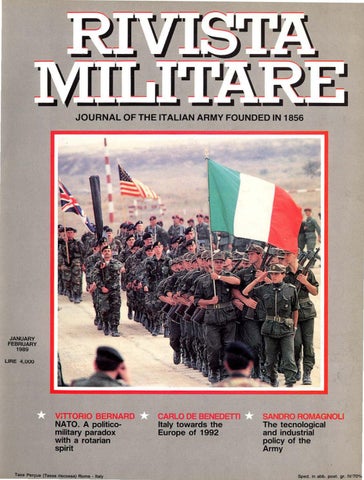
JOURNAL OF THE ITALIAN ARMY FOUNDED IN 1856
I
JANUARY FEBRUARY 1989
URE 4,000
v;TTQRIO BERNARD
CARLO DE BENEDETTI
SANDRO ROMAGNOLI
NATO. A politico-
Italy towards the Europe of 1992
The tecnological and industrial policy of the Army
military paradox with a rotarian spirit Taxe ~ (T.._ riacoeu) Roma -
Sped. in abb. post. gr. IV
CONTENTS
Number one 1989 January-February
Rivista Militare aims at b roadening and updating the technical and vocational training of OHicers and NCOs. It is thus a means of p rop agating the military way of thinking and a forum of study and debate. Throug h the p ublication of articles of technical and scientific interest, Rivista Militare also aims at informing the general public on the Army and on military issues.
Politics, Economics and Strategy
f. \The North Atlantic Treaty sig ned in . Washington on Ap ril 4, 1949, is an
ssential/y military alliance and is (P.xclusive/y defensive. Its basic aim j s to avoid war. '0
2
NATO. A politico-military paradox with a rotarian spirit. ( Vittorio Bernard)
I
14 Italy towards the Europe of 1992.
/
(Carlo De Benedetti)
22 The tecnological and industrial policy of the Army. (Sandro Romagnoli)
BIMONTHLY
,,
i Supplement to number one l of Rivista Militare Italian Edition : Editor in Chief: )Pier Giorgio Franzosi Management and Editorial Office 8, Via di S. Marco . 00 186 Roma Tel. 47357373
.
Science, Technology and Training 30 Airborne radar systems for battlefield surveillance. (Basilio Di Martino)
39 Glossary.
! Advertising
I Care
o f the Secretariat of
i Rlvlsta Militare
ITel. 6794200. J
.
Printer · Tipografia FUSA Editrice s.r.l. Via Anastasio II, 95 - 001 65 Roma
Subscription and forwarding By mail Gruppo IV • 70%.
Conditions for 1989 One issue: Lit. 4,000 One back issue: Lit. 8,000 Subscription rates: Italy 22,000 Abroad: Lit. 30,000 Payment must be made on postal account No. 22521009 in the name of ' SME Uflicio Rivista Militare • Administrative Department Via XX Settembre 123/A - Rome. Residents abroad may remit payment through bank cheque or international postal order.
Sociology and Staff Problems 50 Conscripts: from discomfort to integration. (Vittorino Andreoli)
58 The safeguard of the young recruits' health. (Guido Cucciniello)
History 68 The war in the mountains. (Rudyard Kipling)
j Authorized by the Court of Rome under J
No. 944 of the Registry by decree 7-6- 1949.
Issue edited by:
Militaria
72 The alpine press.
Augusto Mastrofini
(Claudio Magris)
76 Collectors' cards. 78 Book Reviews. © 1989 Proprieta letteraria artis!ica e scientiftea riservata
Member of USP! Unione Stampa Period1ca ltaliana
Instructions for contributors: Anyone may contribute. To g arantee the hig hest objectivity of information, Rivista Militare leav es contri b utors considerable freedom, though it d oes not necessarily share their opinions. The Aui hor is thus solely responsible for the articles which, published uned ited and w ithout ed itorial ties. exclu sively reflect his personal ideas. A rticles must be original in thoug ht and should not exceed ten typewritten pages. Once the Author is paid for his article. he loses all exclusive rights. Rivista Militare may then pass the article on to other publications and EMPA (European Military Press Agency) period icals Articles shoulo be accompanied by suitable photographs, illustrations and explanatory tab les. A p hotograph of the Author, together with a b rief "curriculum vi tae" and a 10 line typ ewritten summary of the article v.tould be much appreciated. Rivista Militare c laims the right to change the title of articles and choose the typeface deemed most suitable.
For almost forty years the Italians, together with the o ther people of Western Europe, have been living under the shield of the Atlantic ~lliancc,.kn?wing almost nothing of its o rganization. It is called N A TO, i.e. N orth Atlantic T reaty Organizatio n, but as a matter of fact even we, the mil itary, who are the most involved and ofte n ralk abo ut it, k now little about it, and when we happen to personally join its insitutional bodies, we discover many peculiar and surprising aspects. This is what happened to me, too. T herefore, with this survey l wish ro illustrate N ATO 's goals, strategy and structure but I also wam co tell abou t my personal experience and about the surprising and almost paradox ical things I found out. First of all, in addressing my Rotarian friends, I want to say that a kind of Rotary also exists within N ATO. In fact the words of its c harte r an d t he spir it w h ic h permeated the relations among mem bers belonging to so many diffe rent co untries could actually correspond to the letter and spirit of Rotary International.
Mixed f ormation of Turkish F4s, llalian PA-200s and A m erican Fl 6s operat'ing from the base of Eskisehir, Turkey, during the "DRA CON HAMMER 87" Exercise.
NATO GOALS AND STRATEGY The North Atlantic Treaty signed in Washington on April 4, 1949, which now counts 16 member Countries (1) w as esLablished first of all ro stop the Soviet U nion's expansionism which afte r the end of WWII had not demobilized its troops and in the space of a few years had imposed communist regimes in the countries it occupied suppressing all freedom. To this end it was - and remains - an essentially military alliance, but with a very different character from t hat of other similar historical precedents. As a matter of fact, this is an exclusively defensive alliance whose fundamental goal is to avoid war, any kind of war; if war breaks o ut because member countries are attacked, NA TO does not propose to win the war but o nly to make the aggressor stop the attack, to withdraw from the occupied territory and negotiate. The novelty vis-a-vis the history of previo us milit ary alliances however, is not so much inherent in its defensive and peaceful aims almost always declared as such even when they were not - as in the fact that N A TO a priori renounces victory, a renunciation w hich, I assure you, is not only apparent but very real. This against one of the fundamental and traditional principles of strategy, which says that "attack is the best defence", and contrary to what history teaches us about the inevitability of a co nflict between two opposing empires, in which, necessarily, one will have to eliminate the other, and against the Marxist theory about the inevitability of conflict between Capitalism and Communism, ending with the certain victory of the latter. According to these goals, the strategy of the North Atlantic 4
Jn-flight refueling of a PA -200 Tornado of the 36th Wing of Gioia de/ Colle. Six airplanes of the 36th Wing have been deployed at Eskisehir, Turkey for crossservicing exercises of the 6th Allied Tactical Air Force during "DRAGON HA ,WMER 87".
Alliance is based fi1 :-l of all on the principle of deterrence, i.e. discourage any possible armed aggression and any threatened use of force by the potential enemy, and, failing deterrence, on "flexible response" with "for ward defence" . In order to implement this strategy, the A ll ied countries have organized a military instrument based on the famous triad: strategic nuclear forces, non-strategic nuclear 6
(or theatre) forces and conventional forces, and have formed a politicomilitary organization - NA TO aimed at developing the relations among member countries, settling situations of international crisis and employing the military instrument in case of war. Within the framework of this strategy and as regards crises, Tonly wish to mention that NATO, if required, can also avail itself, as deterrence tools, of joint naval for mations, which operate in the Mediterranean and in the Atlantic, and of a Multinational Brigade called AMF (L), capable of prompcly redeploying in t he most threatened areas. As well known, this unit is presently com manded by an lcalian officer, Maj Gen . Angioni.
Having only the intention to deter and resist, not to win, NATO has clear ly neve r p u rsued a force superiority over che enemy, but has only aimed at having sufficient forces both as regards quantity and quality, to leave the enemy no certainty of viccory, regardless of a possible inferior global ratio. Such forces, therefore, muse ensure the possibility to resist at least as long as it takes to mobilize and fly to the European conti nent the already existing and potential large reserves available across the Atlantic. In view of chis, the answer, in case of enemy attack, would be " flexible" , in chat at the beginning it would be calculated according to the character of the attack, initially with the incen-
tion to defend with c~nventional units only and subsequently proceed to an escalated emp loym ent of n uclear weapons if t he en emy does not stop the aggression and our defence is u nable to resist. Mo reover when one is in a condition of inferiority as regards forces, as is at present the case of N AT O as compared w ith t he \V/ arsaw Pact, (Divisions: 1 to 1.7, T anks: 1 to 2.5, Artillery: 1 to 2.6, A ircraft: 1 to 2), st rategy teaches us that t he clefender should t ry to offset operatio nally such unbalance by surrendering space and reiterating resistance in depth on successive p ositions, in order t0 weaken the attack without an excessive engagement, gain ing tim e. But this
goes clearly against the p rinciple of "forward defence", which aims at stopping t he enemy at t he borders, following a choice made by N A TO at its establishment to show the Soviets its firm refusal to surrender even a square metre to their exp ansionism, even if t hat could cause a new world war. Thus, co mp ared with the traditional strategy we learned at school and already ap plied by t he Ro mans, for instance, against the Carchaginians, is another politico-military p aradox of the A tlantic A lliance, just like having discarded attack as the best form of defe nce, paradoxes which t he existence of n uclear weapons have made possi ble an d applicable to t he E uropean political situatio n.
But, as the political leadership of t he \Y/ est is apparently re_ady to give up, together w it h the double-zero option, the m ain n uclear tools of deterrence, one is bound to ask whether in the future NATO will still be able tO co nsider itself sufficiently secure with such a self-co ntradictory str ategy, in which the fear aroused in t he possible aggressor counts more than the actual willingness and ability to use t he tools of terror at the decisive mement.
STRUCTURE AND OPERATION OF NATO P aradoxes however do not en d here. 7
In addition to the conceptual and strategic ones, there are others of an organizational kind, which are no less evident. The organizational structure of the Atlantic Alliance is so complicated and detailed that if we were to compare it to the chemical formula of an organic system I think the balckboards of a university lectureroom could not contain it all. This is because NA TO has grown in time, both because the ccordination of the military effort has required the joint development: of ~11rveys plans and programmes, of weapon systems, of detection, warning and communication systems as well as large infrastructural units, besides the establishment of Multinational Commands at various levels, and because the scope of the Alliance's joint policy has extended well beyond the military area. The organizational structure consists of a civilian component, headed by the Atlantic Council, whose 8
members are the Ministers of Defence and Foreign Affairs, or their representatives, of member countries, and of a military component headed by the Military Committee which joins together the Chiefs of Staff of Defence or their representatives, as well as by a third joint civilian-military component, essentially formed by Agencies. The whole organization is coordinated by the Secretary General and by his International Secretariat. Under the authority of the Atlantic Council there are several Committees, which deal with many different matters, besides the specific politicomilitary ones (for examples, there is a Committee that tackles the challenges of modern society, one for information and cultural relations, a scientific committee, a committee for economic affairs, an antipollution committee, etc....) which prepare the work for the council and carry out its instructions. The Military Committee supervises the three Supreme Commands of the Alliance (ACE for
Europe, ACLANT for the Atlantic and ACCHAN for the English Channel) which form the territorial command organization of NATO. The same committee also controls various consultative bodies for study and research, among which the NA TO Defence College, located in Rome, where officers who are to be appointed to important NA TO posts are trained. In order to function, the Committees generate sub-committees, working groups, study teams, information centres, etc., many of which are standing and some temporary. All these bodies are made of representatives of the member countries and employ secretarial staff to do the bureaucratic work. Once inside this organizational structure however the most surprising aspect is not so much its bulk a.nd complexity, but its working system. In this connection it must be remembered that NATO is not a supranational organization but an
Top. Italian AB-212 and British LYNX helicopters ha'i,¡e helped increase the antisubmarine capabiliry of NA VOCFORMED during its 34th activation. Inset. Helicopter operations on the Italian Flagship "Vittorio Veneto: during the "DRAGO N HA,'v!MER 87" Exercise, carried out by a mixed swr/ace force engaged in maritime control operations.
Right. Helicopter operations on the USA "Inchon" off Capo Teulada. The amphibious assault ship "J,id,on " has taken part with the m ixed surface f orce in the amphibious training activity of the "DRAGON HAMMER 87" Exercise.
association of governments in which the member countries maintain full sovereignty and independence. Therefore, all choices, decisions, joint directions, as well as the evaluations at the basis of every resolution, are adopted o nly with the approval 9
of all m embers (not by majority) and spring from consultations among nations through t heir representatives within the various organs, as well as fro m co nsu ltations - and often binding advice - amo ng the organisms themselves. Therefore, a " no" fro m a small country weighs as much as a veto fro m a major one, and can block any proposal. Obviously a "yes" fro m the big ones has often a driving psychological effect on the small m e mbers.
In sho rt, we could imagine the organization of the Alliance, i.e. NA TO, as a " standing, perennial consultation" among member co untries on a great variety of problems, also of general interest, in an often long and labo rious quest of arrangements, aiming at obtaining a consensus on q uestions of specific interest involving the security of all. Even if the need to defend jointly in order to survive is w hat reallv counts, it is not so easy because ther~ arc considerable economic interests which also revolve around NATO and because often political interests are also different. How an organizatio n of this kind, during the stages of a polit ico-military \var crisis, can manage to control a huge complex of armed forces of different nationalities,
when it could become necessary to take vital decisions within min utes considering the times of action and reaction of modern offence and defence systems - ¡ is ~ifficulc to imagine. Hence, still another of the great NAT O paradox emerges. A s a matter of fact, at that point so me automatism s are foreseen in its warning system, but the decision on the use of nuclear weapons rests, in any case, with the political author ities.
THE "ROT ARIAN SPIRIT" OF NATO Where the organizat ional structure is wanting, its enlivening spirit makes up for it. The spirit is still one of solidarity, born of an essential need for security to counter a commo n mortal threat, that p rompted a number of \Vestern countries to form an alliance a few years after the end of a war which had seen opposing enemies on the battlefield. That spirit has become friendship, as \vas the intention of the countries that signed the t reaty, also because it is based o n real mutual respect and upholds the noble ideals of liberty for peoples and individuals, of democracy, of justice, to keep a stable peace and promote the development of prosperity through the understandi ng and cooperation of nations. In sum, one could say that what Paul H arris and his friends , founders of the Rotary Club, w anted to promote, initially in America, in the relations among citizens, often of different ethnic origins, au<l amu11g the various categories of citizens, NATO h as wanted to acco mplish among the states and peoples of the Alliance, and promote in the relations w ith the other countries and peoples of the world, reaffirm ing "the faith in the goals and p rinciples of the United N ations Charter, in accordance with the preamble of the T reaty. And this is not just talk, but facts ~hich we, living within the N ATO organization, witness every day.
As a matter of fact, it is the sense o f frie ndship among colleagues and the willingness to u nde rstand which permit to o vercome the first serious difficu!tv that the newcomer fro m a non English-speaking country finds at any N AT O organization: the working language. O fficially there are two languages: English and French; in p ractice 1 would say that there are three, o r sixteen, i.e. as many as the cou ntries of the Alliance: American English, British Engl ish and the Engl ish spoken by personnel of the other N ATO countries which is
Facing page and above. The 34th Na7.,,a/, On-Call Force Mediten-anean (NA VOCFORMED) in dose formation. First is the Turkish flagship, the destroyer ¡:c;avastepe", followed by tl1e US destroyer "Richard E. Byrd': rhe British fi-igare "Amazon " and the !1alian fi-igate "Perseo". Activated in Naples on A pril 22, 1987 during the "DETER RENT FORCE J/87" Exercise which lasted a m onth, this fo rce has also carried out an intense support activity of lhe important NA TO live exercises "DRA GON HA lvfJ1ER 87" and "OPEN GA TE". ft was the first time that NA VOCFOR MED operated with the A llied Sranding Naval Force in the Atlantic (STANAVFORLANT} beyond the Straits of Gibralta r.
11
no less difficult to understand than the other two . But the unusual thing that happens at NA T O - unlike in London or in Washington - is that the British and the Americans do their best to speak slowly, to mak e themselves understood, and if they h appen to know a few words of your mother tongue they say them to encourage you, an d smile. After a while, however, one realizes that the problems under discussion - or to put it better, under consultation - are far more difficult than the linguistic ones, because the points of view are remarkably divergent, just as the respective economic interests of countries that compete on the world market or, as may happen, for conflicting interests of domestic politics and different exposure to the threat. At first sight, finding a formula which would make, I cann ot say, everybody happy but at least acceptable to everybody, seems almost impossible. Then, slowly and laboriously, consultation after consultation both of the national representatives with the respective governments and, through the m, among the governments of member countries - intransigencies disappear, positions come closer, formulations are tempered, until the final statement is drafted and subsequently approved during a session of the Atlantic C ouncil or of the Committee concerned. Finally one realizes that " the miracle has occurred again", because the sense of solidarity, born of common defence needs, has prevailed, together with the sense of frien dship, wh ich can grant a frien d a favour today, with a view to having it r eturned tomorrow. In this frame of mind, t he representatives of Greece and T urkey coo (century-old enemies, still divided by recent contrasts, very strongly felt emotionally) can sit side by side and help reach a solution acceptable to all. Obviously, decisions often require a long time and boundless patience. N evertheless, as a rule, it can be said that up to now the decisions have
12
Admiral Cesare Majoli, COMNA VSOUTH, revie-<ils the cre-ws of NA VOCFORMED during the cictivadon. ceremony at Taranto on. April 22, 1987.
been reached in time, because NATO constantly studies how armaments may evolve in the future, and plans well in advance the improvements that will have co be introduced in our defence instru ments co face, in the future too the threat represented by the Soviet bloc. A particularly significant example of the difficult and long process required to reach a consensus can be seen in the decision concerning the "zero option" for the elimination of theatre nuclear m issiles in Europe. Initially the US intention to find an entente with the Soviet Union over this matter was n ot well accepted by Europeans, who had indeed suggested it when they h ad decided to deploy the Pershing and Cruise missiles to counter the Soviet SS 20s and improve N ATO 's capability of deterrence, considering the unbalance existing in other fields as well as that of co nventional and chemical weapons. A mong European countries, the N A TO , albeit remaining a member Federal Republic of Germany feeling of the Alliance, but there is no doubt the most direccly threatened seemed that, in case of need, N A TO can rely to be strongly against the elimination on the French Armies. of such weapons, capable of h itting When the split occurred, nobody the territory of the Eastern bloc ac- dreamt of asking the French Governcurately and deeply. ment to remain, contrary to what had Later, the Bo nn Government, happened in Czechoslovakia and after an ample internal debate, freely H ungary - where the USSR, together decided to share the allies' substantial- with other satell ite countries, brought 1y favourable o pinion on this first at- with its divisions the "brotherly help" tempt at a mutual, balanced and necessary to " convince" the Czech verifiable reduction of nuclear and Magyar p opulation of the conveweapons, risky though it may be. In nience of remaining fai thful and o beorder to c ut t he risks h owever we shall diem Lu M us<:u w's word. have to adopt the compensative This would have been the lot of measures and precautions suggested by the people of Western Europe, if the Military Committee and now N ATO had not been established or deemed necessary - though expensive had been unable to fullfil its mission. - by all, if we are to reduce the imbalance in the conventional forces and continue to apply the doctrine of flex- CONCLUSIONS ible response. In the past however differences A historical comparative analysis regarding nuclear strategy led De of the Atlantic Alliance, as a politicoGaulle's France to withdraw fro m the military o rganization of truly inintegrated military organization of dependent and free nations, associated
for a purpose so exclusively defensive as to forsake victory, would deserve an ampler and more accurate discussion than the above, maybe a U niversity dissertation for instance. Probing deeper, both in the relations with the past and inside the organization, one would probably discover other peculiar and paradoxical aspects, but also elements for more convincing answers to the question I sometimes ask myself: "How does NATO manage to work?" The proof that it does function auJ works today is supported by the history of these last forty years of peace on our Old Continent: This is such an unusual fact that it seems almost impossible. According to me this tells us that NATO may appear as a politicomilitary paradox in a perspective that refers only to the past, but it is actually not so. I believe in fact that NATO, in its goals, its way of existing and growing, is a multinational politicomilitary "structure" very much
abreast with the time, not only considering the immense destructive power of nuclear armaments, but also how the people of the world feel today, and the need for freedom of the citizens of the 21th century. In accordance with the general aspirations to liberty and p eace, NATO has up to now been able to solve, in a very effective way, the difficult equation that the history of this century has posed us, appropriately adjusting the power balance with the adversary bloc, without jeopardizing internal liberties and socioeconomic progress. Now we have the impression that the new Kremlin leader has also understood that it is no decisive solution and it does not pay economically and socially to continue the armaments race in an attempt to overcome the West to the extent necessary to impose his will, winning the war without having to fight. If the prospects of reduction and better balance of all kinds of ar-
maments between the two blocs are achieved we shall rightly be allowed to say that NA TO has attained its final goal: a more stable and more secure peace, with less risks for mankind. Before reaching this goal, or better still, in order to make quite sure we attain this goal, we must not disarm, neither morally nor materially, because only our determination to defend ourselves at all costs will convince the Soviets to negotiate with good will and serious intentions.
Lt. Gen. Vittorio Bernard Italian Military Representative at the NATO Military Committee NOTE (1) Belgium , Canada, Denmark, Federal Republic of Germany, France, Greece, Iceland, Italy, Luxembourg, Netherlands, Norway, Portugal, Spain, Turkey, United Kingdom, United States (France and Spain do nor participate in the integrated military structure; Iceland does not have armed forces).
13
IT AL y TOWARDS THE EUROPE
by Carlo De Benedetti
OF
We have always been accusto med to think of Italy as a country with great contrasts in economy and in society. Stories of extraordinary success and un exp ected ~ecover ies live together and intermingle ~ ith incredible delays and inefficiencies. In Italy, more than in ot her countries, t he moments of enthusiasm have a very short life: lit tle is needed fo r a stage of great development tO be transformed into a serious crisis and a total loss of t rust and viceversa. Italy's recent econom ic history is one of continuous falls and resurrections. It is not surprising t hat foreign - and not o n ly fo reign - investigators always fi nd themselves in great embarassment when they h ave to make a point of the situation in Italy. Their reports ofte n alternate betw een catast rophic predictio ns on t he downfall of t he system and an aston ish ed acknow ledgemenc o f another m iracle. Nowadays, I think that this schizoph renic sit uation, in wh ich we find very different behavio urs and in wh ich everyt hing is true but so is the opposite of everyt hing has come to its maximu m level. At the moment in w hich part of Italy is movin g in view of t he year 2000, organizing itself to make chat jump forward requ ired by the new techno logies , by t h e fact ch at econo my has beco me worldw ide, by t he develop ment of a p ost-industrial societ y based on information, t here is another part of t he country \vhich w astes and squanders, that loses itself in courtyard quarrels, in rearguard battles to defend co rporat ive, p atronand-client interests and even interests of the mafia t ype. It is justified to ask o neself if th is mixt ure of contradictions can continue to stand (i n fact t he image which very often acco mp anies t he reports written by foreigne rs on Italian economy and societ y is th at of t he leanin g cower of P isa, a challenge against the laws of equ ilibrium and force of gravity, something which at the same time seems to fall bu t is also a kind of miracle). T herefore it is right to ask oneself whether behind the Italian system
there will be a fall more disast rous than the previous ones or maybe a new resurrectio n . But it is no t up t o me to make predictions or give an answer to these questions. As an entrepreneur, I think that above all I have t he responsib ility of giving a contribution to build the future more than limiting myself to predicting it. Fo r this very reason , I am most of all interested in reflectin g on what we seriously h ave to do so t hat the 90s will be among the best years possible. In the last decade t he ltalv of economy and finance has un dergone great changes which go far beyond the cyclical and economic fluctuat ions. The business system and t he productive structure have changed and so has the model of capital ism. A t the end of t he 70s, the Italian industrial syste m seen from t he outside was like a big caravan fa lli ng to pieces, passive spectato r of the internat ional changes, made up of enterprises uncapable of p roducing new richness, but instead destroying it in great q uantities, so much so that they had to be sustained by a growing in debtedness or by continuous injectio ns of public m o ney . Today , the balance struct ure of t he Ita li a n ente rpr ises is unrecogn izable compared to t hat of about ten years ago. The last line of the economic balance sheet - the one giving the result of the business - has changed its sign: no more incredible losses (- 2.9 on the turnover of the sample Medioban ca in 1977), but profit margins (1.6% in 1986) which so meti mes reach levels t hat can be co mpared to those of the A merican r ivals. T hP- re.r.::ipi.rnlization, carried out inside and outside t he stock exchange, has destroyed t he indebtedness (the net fin ancial losses of the 1,603 fi rms
analyzed by Medioban ca have passed from 50°1h of t he turnover of ten years ago to abo ut 20% in 1986). The net financia l bur dens have gone do,vn (from 5.1 % of t h e t urnover to l.3°/4i); self-financing h as covered mo re than 80% of the investme nts made by the fi rms compared to th e 35-40% of ten years ago. To o btai n these results enterprises have not reduced investements: on the co ntrary, they have aimed at improving productivity, greatly increasing rhe. intensity of capital in t he p roductive processes. In t he indust rial sector, the added value pe r worker has, from 1980 to today , in creased by 30% in real terms, i.e. by nearly 4% a year. T hus, a new posit ive m ovement has staned: t he financial recovery has p roduced reso urces for investments, investments have improved product ivity , strengt hening even more the economic and finan cial eq uilibri u m. But it would n ot be en ough to " read" the renewal o f the enterprises on ly t hrough the balance data. The change is a deeper o ne: it is necessary to " read it" also in the new-foun d t rust in one's own strength, in t he capacit y of competing o n an open market, in the greater flexibility, in the aggressiven ess on international markets, wh ich are not only made up of exports but also of the acquisition and alliances with ot her enterprises. In t he last ten years we have set up the bases for a new capitalism in Italy. It is no longer a capitalism based on public intervention and on a restricted class of entrepreneurs, often belonging to few im portant families. It is no longer a system based essentially on the defence of t he existing activities and productions, to safeguard d ie:: interests of a fe w, op posing itself to _t he chan ges wh ich we are expenencmg. Confidence in the market has returned, a confidence in on e's own ability to compete in a clear way witho ut subsidies or evasions; t here is a new wish to compete in a w orld w hich is drastically ch anging u nder the t rust of in no vation and internationalization, but that for th is very reason offers great opportunit ies. , There has been a return to the en15
trepreneur system: the w!sh to grow has stimulated the creat10n of new enterprises and initiatives, wit~ a ~ew attitude towards th~econom1c nsk: there is no longer an escape towards protected -niches, but the co urage to thrust oneself in the search of new and even more risky - development opportu nities. . At t h e same t 1me , t h e economizers have reacquired confidence in the enterprises, giving new vitality to a stock market which before was dominated - not to say plastered - by very few agents. Italian families h ave an extraordinary capacity to save: 24.7% of the available private inco me is saved, a percentage which is astonishing compared to that of other industrial ized countries. We save more than the United States (3.9%), Great Britain (10.8%), France (1 1.3%), and Germany {13.2%). Even the very thrift y Japanese are very distant from o ur levels (17%). When a small part of the savings of the families again found the w ay to the stock m arket, the close link between savin g and enterprises was again created. The entrepreneur spirit has found the real support of the fi nancial means, helping the grow th of a widespread capitalism . T o the very few large groups, controlled by a small group of privates or by the State, often acting outside the market's logic. A growing number of enterprises capable of taking part in a new industrial process of aggregation. New industrial poles have risen and there has been the birth of a system of enterprises which is more pluralistic, w here the great num ber of agents destroys the positions of revenue and monopoly. Contrary to the past, the new industrial aggregations are more openly subject to the every day judgement and control of the market. The enthusiasm created by the reb~rth of the entrepreneur system, had ~1ve~ rise to the idea - or may be the illusion - that many other things had changed in Italy. Political stability, which was rather an idea more than a reality, had anyhow allowed to give life to the
Rep ublic's longest government, m aking one think that the re-birth of the entrepreneur system had also influenced the world of p ol itics and Italy, an industrial power which h ad never been taken seriously by its allies and enemies, seemed to slowly reconquer respect and credibi lity . Signs of a clear progress also came fro m so me aspects of the economic policy. The defence of the lira's exchange rate increased the p roblems of competitiveness fo r our exports, but stimulated the enterprises to improve productivity and direct themselves towards activities w ith a higher added value and technolo gical content. Even more important, is the fact that this policy allowed to break the spiral of devaluatio n-inflation: the gap between Italy's inflation and the average one of the industrialized countries, wh ich in 1983 w as of 10 points, is today reduced to only 1 point. Very carefully the economic policy made the first ~1:eps rowards the deregulat io n and liberalization of the fin ancial markets, favouring a process of internation alization which the enterprise system had already started a long time before with an intensity un know n in th e past. Italy had also made some real progress in what referred to t he relationships between public and private. A fter y ears of grow ing - and inefficient - interference of the State in the economy, time had come to change the trend. Even the pu blic deficit, used to break through all the levels established by the government and defy the laws of economic common sense, seem ed to be restrained in its continuous grov-rth if not in its size. T o d ay, we h ave t he unpleasant
feeling that many of the co nquests of these last years have van ished. T he political world has again set
There has been a return to the e11trepreneur system: . the wish to ¡ grow has stimulated the creation of new enterprises and initiatives, with a new attitude towards the ¡ ~conomic risk. ¡
up the usual rit uals, we have gone back to the well-known instability of t he governments and to the semiparalysis of the legislative activity. Facing situations which w ould require immediate and strong interventions, there is virtually total inability to make decisions. Half way through the m onth of March, we still do not have a budget for 1988: a situation which in an enterp rise would h ave already brought ab out th e firing of the m anagers in ch arge. Even worse, the indications which we have, show the possibil ity of a public deficit of n early 20 tho usand billions more than the 103 thousand billions which were the government's first ai m. . The sector of public services is usually clearly identified with that part of Italy th at is more reluctant to change and that continues with its in efficiencies an d delays w hich are unacceptable in a modern industrialized Cou ntry (each one of us can tell sto ries of never-endi ng inefficiencies and corruptions in transports, health systems, school an d public works). Publ ic services drown in trade-union and autonomous demands, among lack of fu nds, absence of leadership and different corporative interests. With incredible resignation, the Co untry is slowly gett ing used to second-rate services and to the lack of infrastructures which make the situation worse when compared to that of other European Countries. But apart from the domestic situatio n, it is the internatio nal economic atmosphere w hich creates serious problems. The crisis in the stock markets and the subsequent instability in the exchange rates have brought everyo ne back tO reality. The fa ll-back of share prices has brought back the saver' s former mistrust: it becomes more difficult for enterprises to finance themselves with vent ure capital. As regards families, who h ave seen their ow n fi nancial wealth dwindle there is a diminshing of the tren d to co nsumptio n. Above all, the financial crash has demonstrated the fact that it is impossible to create a development cy17
de by abusing indebtedness, as has been done by U n ited States in recent years. The recovery of. the American economy, which has passed its fifth year of life, is mainly based_ ~n , t_he State's deficit and on the fam1hes mdebtedness, ending up by determining an enormous deficit in foreign exchanges. Nowadays, the United St~tes finds itself to be a net debtor to foreign countries for an amount of about $ 450 billion, a figure which is more t han twice Brazil's and Mexico's external debts put together. T his debt corresp onds to a credit accumulated by other Countries, headed by Japan and G ermany. But these Co untries' inabilit y to turn their sudden financial wealth into the development of a real demand, has accelerated the growth of financial investments. The liquidity has not created new production, but has increased certain financial values beyond all limits, until t he " bubble" blew up. Even if the most recent indicators of international economy are q uite p ositive, the unbalance of American accounts is a contin uo us threat . The United States has to continue to reduce imports and increase exports: for Japan it is a market that is closing, a market which last year received more t han a third of Japanese exp orts; for Europe, apart from being a market which is shutting down, t here is a ser ious threat of a Jap anese reflux, subsequent to t he redimensioning of t he American market. The ratio debt/ credit between the United States and Japan h as accelerated in a strong way, the process of integration between the two countries: to the t rade and industrial relationships, one must n ow add the ever closer financial bonds. Japan is "forced" co invest in America a relevant p art of its en or~ous financial surplus; and America ~s forced to look for its missing cap itals tn Japan. Therefore an indissoluble link was cre::tted bet ween debtor and creditor wh ich co uld cause Europe to move out of position. It is difficult to imagin e that the necessary readjustment of t he interchanges and fi nancial fluxes between
the great industrialized areas could take place without worsenin g the rate of development and without particularly affecting European Cou ntries. W ith these premises, one could easily conclude chat Italy, after t he positive recovery of the last few years, is now ready for a new fall. In in dustry above all, as always, it is impossible to stand still: either you go forward or backwards; in any case the others will go on moving. What can be done to avoid mo ving back wards? I think chat once again Italy is faced with a great opportun ity: the problem is understanding t he meaning and doing some basic t hings t o take advantage of it. This o ppo rt u nity is called Europe, t he completely integrated Europe of 1992, a single market with 322 million consumers. Let us try to imagine, in terms of population, a market larger than N orth America and nearly three times th at of Japan; a market where t he technical standards are leveled out and do not form an obstacle to t he movem ent of goods; wh ere citizens can go fr om Pal er m o to C o penh agen without needing p assports; w here everyone can start a productive activity in any country w ithout t he danger of discrimination accordin g to n ationality; a market where there are no customs controls and where t ransport can subsequently be reduced to half che delivery times and transport costs; or even more a market where the VAT is the same everywhere and where the public jo b orders (which nowaday s represent 20% o f the econ o mic activity of the EEC) are open in a free competition to all C(?mmunit y e n terprises; a market, w h ere
each citizen can open a bank account in any Country and where the comp ~titi~n of t he bank and financial services 1s open to everyone. The creation of this market which the European governments would like to reach by 31 December 1992, can
mean a new stage of development for Italy. In other countries, especially in France and Spain, but also i n Germany and Great Britain t he date of 1992 has sec into motion an intense political debate, accompanied by a carefu l an aly sis of the advantages and threats w hich t he 1992 Europe could bring to every sector choosing the measures and counter-measures to be adopted. T here is an awareness that the change will be a great one and that ~conomy ai:id society will undergo an important impact. In Italy I do not see the same awareness, the same attention given to t he pro blem. Italian politics has often considered the EEC an annoying bureaucratic structure, an obstacle to its own game of power. It is not surprising now that t he aim of a fu ll integration in Europe is considered as utopian, also because the 30 years which h ave passed from the signing of the treaty of Rome have experienced a lon g series of disappointments and failures. le is too easy co be skeptical on t he h undreth European program. But this time things have changed, because to the utopian ideal of a united Europe it is necessar y to add the push which is represented by need and by economic convenience. Nowadays, t he European countries which are in a position of inferiority facin g t he alliance between North America and Sout hern Asia, h ave no other solution: to promote an acceleration of t he internal interch anges w hich will lead to a greater specialization of th e enterprises, to improved econ om ies of scale, creating a market which is no longer divided as is t he present one. This need has been clearly understood by the enterprises who , even before the p oliticians themselves, have moved to the European markets to conquer a European dimension at least. N owadays, ind ustries, banks and consu mers are try ing to force politicians so that the pro ject of a single European market w ill be carried out in the scheduled time. This is t he real reason for crusting and confiding in the construction of 19
Europe, despite t~e politic~) dis~ussions and the national particulansm which have been an obstacle to the definition of the Community's budget and handling. To solve its problems, Italy has to move at the same pace as the re~--c of Europe. There is an incredible n um ber of areas in which it is necessary to reallign ourselves in terms of production, bodies of legislation, fiscal and monetary policies. But I chink chat to
take advantage of the opportunities of a single market it is at lease necessary to do three things: • create a modern State, in the structures, services and law-making; • find a solution to the problem of public deficit; • give a more European dimension to the productive structure. Creating a modern State means that one has to face the problem of that part of Italy which opposes a real change: the Italy of many bureaucratic structures and in many public services. It also means creating infrastructures of European dimension to be compared with those which are available to our largest trade partners. It means creating laws w hich leave room for the growth of the market and enterprises, but that at t he same time offer some assurance abolishing abuse and especially guaranteeing that the rules of the game w ill be clear and the same for everyone. Finding a solution to the problem of public deficit requires a great sense of responsibility on behalf of politicians. It is intolerable for a country to have a public debt equal to the wealth it produces annually. We continue to feed a mechanism which will sooner o r later explode: when we buy treasury bills, we think that we have accumulated a bit of wealth. Actually, we are only buying back some of our own debt, because the State's debt is nothing more than the debt of each one of us. It is not true that public debt can be tackled only with difficult cuts in expenses and unpopular fiscal measures. There are at least three ways that are not too painful to solve public debt: recover the enormous area of
fiscal evasion, increase the very low productivity of public administration, promote a brave program of denationalization which will bring capitals in the ?tate's ~unds'. i?~re_asing at the same time pnvate rn1t1atrve. Finally, it is necessary to give a European dimension to the enterprises. Th is is what so me of our large entrepreneur groups have been doing for some time, often encountering opposition from abroad and from their own country. .But this process has to be spread to che area of small and medium size enterpnses. In the past some wanted to see Italy's strength in an industrial pattern made up of an incredible amount of small and very flexible enterprises. But no wadays, en terprises are not necessary to conquer Europe. T he concept itself of a small and medium enterprise has to be recalibrated. What is small for the Italian market, can become microscopic for the European one. We have to create che necessary conditions required by the small industry to grow. They are not conditions that can be achieved only by offering a greater availability of financial resources: it is necessary to give the enterprises a better strategic support, a larger contribution to professional formation and to cultural growth and a greater possibility of international contacts to have access to technological innovations. All this in an environment where the enterprise may be created in full freedom, grow, form alliances and also die; because o nly a co ntinuo us dynamic renewal of an industrial system can maintain a healthy balance. T he times to strengthen the grow th of the enterpr ises' structure in
an international way, are very short. In Europe, a process of intense aggregation of the enterprises has already started, favoured both by the fall of share prices and by the market difficulties which fo rce the competitors
to create alliances, fusio ns and acq u1s1t1ons. Italian industry tOo, has to take part more intensely in this process and not only through its large enterprises. The whole productive structure has to prepare itself fo r a new p rogram: the map of European industries is changing, and if the project of the 1992 Europe will be carried out, che competitive challenge of the 90's will be done among new or greatly renewed entrepreneur unions. ln the last few years, Italy has demonstrated that it can legitimately compete for a fi rst p lace in the European development: and th is has been demonstrated abo ve all by its enterprises. But the drive to a new capitalism and a new entrepreneur system is no longer sufficient. The Europe of enterprises is being created and is made up of concrete actions, productive and commercial structures which integrate themselves and it is an example for the politicians who have often remained blocked by the difficulties of national management, up to a point when they acted in a way which was contrary to that needed to reach European integration. It is now time for the political class to make a new change of quality and to prove itself capable of regaining the leadership in t he process of unification of Europe. In fact, this process, has deep political characteristics because it can renew the culture, society and structure of economy, an economy which in Italy, as in Europe, is facing major difficulties. It is not possible for Italy tO co ntinue to move with the energy produced by only one side of the engine: to the brave renewal of the enterprises there has to follow the less brave one of the public administration and of the . . . mst1tut1ons. And this is because in an integrated Europe w ith no boundaries, the handicap of having services which do not work, collapsing organizations and debts which grow at an incredible race, is no longer tolerable. Not even fo r an industrial system which in the last few vears has been able to astonish every~ne for its vitality and entrepreneurial aggressi_veness.
21
.
.
-
.
.
.
.
.
.
. .
. . .. .
. ''
.
...
RELATIONSHIP BETWEEN DEFENCE AND TECHNOLOGY From the postwar period onwards, one main concept has influenced military policy: the concept of deterrence, meant as discouragement from all aggressive ideas of a hypothetical enemy. It is clear that the instrument of deterrence is the military instrument and the more this instrument is able to remove the dangers of war, the better it carries out its function. To discourage with its presence and potential capacity, any threat, influence, suggestion and attempt, it is necessary for this instrument to be fully reliable, not only for the men's capability and self-sacrifice, but also for its technical value.
SISTEMA D'ARMA MISSILISTICO LEGGERO
ClA SKYGUARD ASPIDE
Sistet1:a ogni l.empo p!utiveicol,>re, a t,aino rncci::.inico, deslim1,to .:a.Ila dllesa ctmtr<.> her-
.sagli a ba.::::11 e bassissim~ q~1oi,1,
CARATTERISTICHE E PRESTAZIONI PRINCIPAL! -
Composizione
• unittl di scoperta, rilevarnento e calcolo • lanciatori a rampa sestup)a • veicolo caricatore trasportatoro - Portafa radar di scoporta: 20 km - N. c anali di fuoco: 2 ---: N. missili pronti a l lancio: 12 - Tempo rea.zione sisterna: 11 sec - Portata massima: 10 km - Porta.ta minima: 750 m - Quota massima: 3,5 km circa - Sistema di guida: homing somiattivo - Peso doJ missile: 220 kg circa - Velocit<) masshn.:i del missile: 650 miscc - Probabilito di abbattimento singolo mi,silo (SSKP}°: 80%
Having right! y abandoned the concept of mass as a prerequisite for victory and having landed on the shore of technological advantage, we recognize that there is a deep interdependence between military requirements and technology, an interdependence which cannot be ignored. It is clear that this interdependence can be defined in a different way, and we can talk of mutual incidence or integration. Apart from terminology and expressions, there are two main realities: • the use of new technologies proposed to the military instrument cannot be denied when technologies themselves influence the relation effort/ effectiveness, even if sometimes obstacles are interposed by traditions and feelings; • due to changes consequent to strategic, demographic or financial reasons the answer for the solution of the problems can be given only with the support of technology.
24
In the report "Defence Requirements and Technology", there is no doubt that the peculiarity of the national strategic problem, the human resources and the socio-political parameters that can influence the structure of the military instrument, together with the available financial resources, are conditioning factors for a defence technology. Moreover, military planning is based also, and to a large extent, on the long-term prediction of the innovations accounted for armament technology. In short, operational planning of the military instrument and technological prospects are so much linked together that it is probably more appropriate to talk of integration between Armed Forces and Industry, rather than of mutual incidence. Integration moreover, must not be intended as the expression of a more commercial relationship, but as a responsible and aware participation
in the solution of defence problems and therefore with a role which the sectorial industry must take up and develop with determination and responsibility. It is necessary to realize that there is a reality of defence, which can no longer be relegated to the sole and exclusive responsibility of the military, but includes a creative and technological world of large and qualified dimensions, if we wish to safeguard the absolute principles of independence and freedom, respecting the principles of the safeguard of human life, which are just as sacred. If the soldier has inferior weapons, in quality and power, he is more destined to death than to victory. A badly equipped army, requires its members to have a high degree of disregard for life, a quality which is no doubt positive for the Hero who, contemptuous of death, sacrifices himself for his community, but it is certainly negative and humiliating, not to say guilty, if it becomes a rule for Governments, General Staffs and Commanders. The maintenance of the capability of deterrence implies a continuous updating of the military instrument, whose operational efficiency requires an availability of more and more sophisticated equipment and expensive equipment and materials. Therefore, nowadays there is a philosophy which some call genetic strategy, consisting in the availability of war equipment more effective than the one available to the presumable enemy. Paradoxically, the shooting war is replaced, in peacetime, by the technological war. Some say that the technological advantage is characteristically transitory, quickly copied and parried, and therefore it cannot bring about significant changes in the ratios of forces among the various countries. But the objective difficulty of achieving surprise is balanced by the deterrence caused by the potential cap~city of realization and the credibility which can be obtained by the new and continuous development programs. Finally, one has to consider that the
1)
progressive revaluati?n of the c.onventional component involves, in any case, the research and adoption of armaments with evermore improved technology, with the objective of guarante~i?g a qualitative superiority to the military 111strument, adequate to face an enemy certainly superior in quantitative terms. What has been said up to now is only a theoretical statement: but it is not so if we refer to the military problem of our country, which in fact consists in guaranteeing an adequate participation in deterrence and in allowing, within the framework of the Western Alliance, freedom of action to the Nation, for the development of a far-reaching foreign policy' autonomously-conceived.
REMARKS ON TECHNOLOGY I would now like to dwell on some remarks relevant to the technological field. Nowadays technology allows us to realize armament materials with revolutionary performances and very high operational efficacy. The effects deriving from the great number of their possible applications influence the operational conceptions themselves, often exceeding them, and also influence organization, logistics and the policy of materials and personnel. It is true that technological evolution creates a more and more effective ratio man/machine, but one must not underestimate the negative consequences that an excess of sophistication in materials can have on the structure and actual capability of the military instrument. First of all, the extremely rapid increase of costs, which, in view of the resources available, drastically reduces the possibilities of acquisition. Moreover, the complexity of the systems, which greatly increases the time for research and development and requires for their maintenance specialized personnel at a very high technical level. Furthermore, the quick ob-
LANCIARAZZI CIC "APILAS"
Sistomo d'~rma clc, a. cort;, a itta1a. del Upo ''u~ e oett.:,''
CARATTERJSTICHE £ PRESTAZIONI PRINCIPAL! -
Peso dell'arma complela: 9 kg Lunghezza (pronto al tiro): 1,26 m Calibro: 112 mm Gittata utile: 25,400 m Potere perforante su bersaqlio di acciaio omoqeneo a 90~:670 mm
solescence of materials creates t he need to renew them frequently, increasing the risk of a perverse phenomenon of "escalation" with serious problems and tensions for the already limited military budgets. Finally, there is t he danger that the project of a weapon, searching for the most advanced sophistication, might end up not realizing, t i me ly, economicallv and in t he most convenient way, ~he most " gauged" and reliable product for the operational employment. The requirements of t he military instrument and the technological I eality, more advanced than the very culture which should govern it, pose remarkably complex problems, the solution of which requires reasoned and coherent choices, following strict criteria of cost/effectiveness. In t h is framework, evaluation mistakes, decisional uncertainties and changes of mind do not just influence only the operational effectiveness of the service but also the national armament industry. Therefore, an effective
policy of materials cannot be separated from a planning with the followi ng requirements: • certainty of financing, in relation to the industrial times; • continuity, to avoid generation jumps in production which would determine irreversible gaps; • timeliness in the definition of the needs, to avoid situations in which industry could respond too late to the national requirements or enter international coopcrations in an untimely manner.
ARMY/ TECHNOLOGICAL INDUSTRIAL WORLD: PRESENT MUTUAL POSITION Let us now move on to the description of the present position of the Army vis-a-vis the technological and industrial activities.
25
MIRACH 20
Aereo piJot.i,10 « d i;tanza dl piccofo dimensioni, pe-, !a :ion·<xJli(l;iz,a de! cal'upc di b-1ll.,. 9lia, l'ac<:rui, i~io:1.e obietti-:1 ed il i;o:itrollo del hro
CARATTER!STICHE E PRESTAZIONI PRINCIPAL! - PortatA! 40-50 km dalla sta~ione il terra con un'aulonomla di circa 2 ore Sansori a bordo: ·di lipo diverso socondo la mis$iono da svo)gere
-
e comaod~u da11a stazione a terra - Precisionc di rilevamen to degli obiettivi : inferiote ai 100 m - Peso del vettora: 150 kg - Trasmissione a lcrza delle immagini : in tempo re<.1le, einchc in condiiioni d i foschia, nebbi,, leggera c di notte - Recupero del ,..eicolo: ontro un raggio di 150 m do.I punto di a rrivo previsto
- Valocita di navi9a.:ione: circa 150 k.tn/ h -
Possibilitii di voli: interamente g uidati da tecrra, p rogrc:immati o gujdati 8 progr{lmmati
From the Service's perspective, it is possible to see three precise moments in the process leading to the realization of a defence product:
• research and development; • experimentation and technicaloperational evaluation; • production and prevision. Research is the vital effort which has the purpose of maintaining the military instrument up-to-date and credible, and has a hauling effect on national industry. The continuous technological and scientific progress requires ever greater financial efforts for Research and Development, so much so that the incidence of its cost on major weapon systems, which was about 10% in the '60s, now reaches 20-25% and will go up to 30% in the '90s. It is obvious chat the Army cannot give up such effort as it is also obvious that Research and Development cannot be limited to the national field. 26
Undertaking purely national programs would be a losing strategic economy as regards cost, because the Service cannot employ all its resources on one program; only on the economic plane, because the national market is limited and to enter the international market with a nationalonly project is out of the question; finally on the technical feasibility level, since the modern weapon systems, mainly because of their high sophistication, require very advanced technologies which are not all present in a single nation. Therefore, it follows that the Army proposes a policy of participation involving the sectorial industry, often forcing it to find new organizational formulas, such as Consortia, essential to carry out the given casks, whether national or international, at best.
The activity of experimentation and technical-operational evaluation, is presently under the control of
Bodies, Plants and Technical Centres, which are part of the TechnicalIndustrial area of Defence. They are Bodies carrying out a very demanding activity, from the technical point of view, given the complexity and sophistication of the materials, and they carry out their work - it must be said - to the limit of their possibilities. Therefore this is an activity which is carried out autonomously, aimed at the exclusive needs of the Service, in a context of limitations and difficulties which should be abolished with the realization of different structures which I will mention further on. Finally, as for production and provision, it is to be excluded that the military plants can carry out functions of production of great quantities, due to the lack of major production lines and of a class of technical experts. The planes will continue to have the main function of testing the supplied material and taking part in the major overhand of materials. In summary, the Army cannot express, through its installations, its productive capability in terms of quantity. At the moment, only a limited activity of research and development is carried our through the Army plants; they are used for testing and controlling requirements; they solve administrative problems and contribute co the general overhaul of the weapon system. It is a complementary component, of a very low percentage (not more than 10%), of an instrument which, in any case, has to turn for more than 90% to the productive capacity of private industries.
RELATIONSHIP DEFENCE/DEFENCE INDUSTRY Let us see now the relation
Defence/Defence Industry, as it is and as the Army would like it to be, moving from the present reality, reflecting on the tasks that can be assigned and considering the proposing policy exercised in the sector.
As an introduction, I shall give some simple and obvious clarifications, to avoid the need for backing up arguments: • • the armament indus~ry is a fu ndamental co mponent of national defence. · Therefore it represents a determining factor of the capability, credibility and defensive autonomy of the nation; • the defence industry is an organic and central part of the national industry, w hich cannot be separated from it. The fact that the Defence can count on national productive resources makes it possible to harmonize the growth of the military o rganization with the nation's economic development, giving it substantial financial resources. As a consequence, t he funds allocated for defence reenter the nation's economic ci rcuit. Moreover, the essential national supplies represent a safety factor as regards the continuity of supplies. Having cleared the field from these initial concepts let us say, though, that the armaments industry in Italy includes a group of very heterogeneous firms, mainly medium size, specialized only in military production; sectors dedicated to military production in large firms; a high number of minor firms, also at artisan level, not always concerned with military production only. This structure of the Italian armament industry is therefore characterized by: • extreme fragmentation of the industrial base, also at system level; • scarce specialization with particular reference to components; • tt::chnulugil:al dependence from abroad for the production of valuable components; • strong inclination towards the export market and consequent increase of the productive capacities out of proportion to the national needs. Therefore the industrial activity is characterized by distortions and duplications in certain areas, and by insufficient initiatives in others. There are sectors in w hich the defence industry should, moreover,
SlSTEMA:CONTROAEREI LEGGERO SEMOVENTE SU SCAFO Mll3, QUADRINATO DA 25 mm
S!.S?ema d 'a rm.., conttaouio les<;ea:, destin.,3:9 411'.su!od.:!esa deUe Uni'l.i mec<.:ll:t.iua.le e
cora.uate
CARATTERISTICHE E PRESTAZION! PRl NCIPALI - Sistema di puntamento: optoelethonico con calcola~ore digitale - Dlstanz.a ma.x di tiro: 2500 m -
C ele rita di tiro: 2400 colpi/min
- Tempo di scansione: 6 sec - Velocit,3. iniz,iale~ l463 m/sec - Dotaz.ione di b ordo: 640 colpi -
Capaciio !FF
express itself in a more complete and exhaustive manner. In the research and development sector, due to the burdens implied by basic· research, the activity should be carried out by industry and by Institutional Research Centres, with the help of the State, with long-term financial programs and in a coordinated context of national and international cooperation. In
t he
p rese nt
technolgical
framework, the experimenting and evaluatio n activity should be carried out by qualified and specialized interdisciplinary institutions, supported by sizable structures, means and bodies which exceed the capabilities, potentiality, available resources and indeed the very tasks of Defence. T herefore, Defence should not satisfy every need but limit itself to the determination of certain industrial trends, giving indications on the
research and development programs aimed at satisfying its operational needs, fixing limits and priorities. O nly later should the Defence have a preeminent role in the experimentati on and tec hn ical-operational evaluation of prototypes, with the burdens that this activity implies in terms of infrastructure, equipment and personnel. In recent times, however, in the industrial field there has been a timid process of reaorganization and rationalization, stimulated by the need for a renewal and modernization process started by the Armed Forces in the mid '70s. In the analysis of the relationship Defence/Defence Indu stry, we realize that this relation cannot be reduced to simple ratios between demand and supply: we understand that the programming and the development of the armaments industry must 27
ARMA DI REPARTO CAL. 5.56
Arnld di rnp,ulo c l).!. S, $6 :nm x ~'ATO, <1vente mohe parti r:1. comune co:t l'anna lodl· viduafo
CARATT~RISTICHE E PRESTAZIONl PRINCIPAL! -
Lunghezza: 1 m
- Peso: 5,340 Kg -
Caricatore: 30 co)pi Ctsdenza di tiro: 800 c /mi
maintenance of the equipment, as well as for the directing and spurring action which Defence must carry out vis-a-vis the armaments industry. And now the conclusions. The task of the Army is that of carrying out deterrence in concurrence with the other energies of the country. Deterrence needs a technology that only an organized Defence Industry can guarantee. The Defence Industry is an essential component of the deterrent instrument and cannot turn down the commitment to which it is called bv the Government and by the Minis(er of Defence in particular, a commitment which is shared by the major leaders of the national industry, who said: "The Industries now selling arms to the Third \YIorld will be able to work for a different customer, Europe.
Sandro Romagnoli be integrated with chat of Defence. In fact, Defence is both a customer and a supporter, because it creates the conditions for the existence of an industrial base able to satisfy the national defensive· needs. It is an entrepreneur, since it feeds an industrial strategy for defence, proposing its participation in an adequate market at international level. The simple and spontaneous role of customer is aimed at the acquisition of equipment and materials, while that of backer presents itself in various forms: • incentives: through the policy of orders, technological innovation and support in the development stage; • direct acquisition of equipment and materials, also accepting higher costs of development and production with the prospect of logistical and technical-operational advantages, besides, of course, the advantages of a socioeconomic and industrial nature, including the opportunities for employment; • introduction of a compensation system, intended to guarantee that a country exporting military products to Italy will import from our country a value corresponding to its exports; 28
• introduction of the national industry in the great European and World industry, through international cooperation agreements, as an essential condition and prerequisite for the acquisition of the technological and industrial capability to compete in the world market; • homologation of products to facilitate their access to the internatonal military market; • execution of practical tests for prototypes of weapons, vehicles, equipment and other devices in experimental centres and ranges; • promotion towards possible customers; • extension of the potential markets through intergovernment agreements on standardization and interoperability. In short, national development and production, supplies and exports, coproductions, productions under licence or foreign acquisitions are pan of an organic program which is the core of the industrial strategy of the defence system, made up by the Armed F orces and Industry. Therefore between Defence and Industry there must be a permanent and organic consultation, especially for research and development, provisions,
Lieutenant General Sandro Romagnoli has been Commander of minor Bersaglieri units at the "Ariere" Armoured Division, Observer Officer with the Air Force, Commanding officer of the 3rd Bersaglieri Bnttalion, Section Chief at the D Division of SID. He commanded the 8th Bersaglieri Regiment of the "Centauro" Armoured Division and the 8th "Garibaldi" Brigade of the "Ariete" Armoured Division. He was Deputy Chief of Staff of the Southern Military Region, Chief of Staff of the 5th Corps and Deputy Commander of the Southern Military Region. At present, Lt. Gen. Romagnoli is Head of che General Directorate for Ground Armaments and Ammunition (Terrarmimuni).
AIRBORNE RADAR SYSTEMS
A previous article (1) examined the electro-optical systems which could possibly be used for battlefield surveillance purposes. The same article also identified the most suitable aircraft for enhancing the performance of these systems in a predictable operational scenario. After analysing the possibilities offered by modern technology, the use of a multiband system comprising an infrared sensor and a low light level
N camera was recommended. Operational considerations dictated mainly by the deadliness of modern anti-aircraft systems indicated that the most suitable platform was an unmanned aircraft (UMA). Attention is now focused on radar systems, which also work by electromagnetic radiation, although at much greater wavelengths. The drawback of radar systems is that they function actively, i.e. their principle of functioning is based on the emission of electmmagnetic energy which can easily be detected by the enemy's electronic listening devices.
30
FOR
BATTI:EFIELD SURVEILLANCE
,
~
l
31
Starting of Drone.
Compared with electro-optical systems, they are heavier, appreciably more expensive and, in their conventional form, produce lower quality images that are more difficult to interpret. On the other hand, radar offers, considerable advantages in terms of range and can operate also in bad weather conditions. It is a fact that low intensity Tv systems cannot penetrate fog or smoke and that the effectiveness of infrared sensors is severely curtailed by the presence of high concentrations of water vapour in the atmosphere. Radar's potential as a recognition and surveillance system was realized as early as World War II. However, the technology of the time did not allow equipment to be constructed with the capacity to identify tactical land targets. The airborne radar systems available at the time were used in an air-ground role and would only allow the identification of naval targets or the recognition of ground features characterized by abrupt changes in reflectivity, such as coastlines and large rivers. Only recently has it become possible tO build on-board radar systems capable of providing high quality images, comparable to those of the conventional
32
aerial photography reconnaissance. T his was made possible by R & D programmes leading to the consolidation of techniques such as pulse compression and synthetic aperture. The article also analyses the problem of resolution, which is fundamental to the identification and recognition of tactical targets, and also discusses the main radar techniques used to solve it. Finally, prospects of development and present trends are also discussed, and several current programmes are examined briefly.
THE PROBLEM OF RESOLUTION The long-range detection of small objects, which is what all tactical Largc::ts can be considered co be (e.g. ordinary and armoured vehicles, artillery pieces), and the detailed mapping of ground requires a radar with good azimuthal and range resolution. In other words, the system must be capable of separating the radar echoes reflected by two objects lying close together. The distinction between azimuthal and range resolution is dependent on the fact that radar works by conveying energy in the form of pulses inside a comparative-
ly narrow angular sector, known as the radiation beam. The transmisson of pulses makes it fairly easy to measure an object's distance, while the concentration of energy into a narrow beam allows the angle to be measured. Range resolution is dependent on the capacity of the system w detect and display separately the echoes reflectecl hy two objects lying close together and characterized by the same angular bearing. This capacity is mainly dependent on the duration of the pulses transmitted: two targets with the same angular bearing can be distinguished on ly if they are separated by a distance exceeding the space corresponding to half the duration of one pulse. For example, 1 microsecond pulses give a range resolution of 150 metres. Azimuthal or angular resolution is defined as the capacity to detect and display as separate targets two objects lying the same distance away. The parameter used to determine t he angular resolution of a radar system is the width of the radiation beam, usually measured in radians. Since the arc of the circumference subtending the same angle at the centre increases with the radius, the azimuthal resolution, measured on the ground, decreases with increasing distance. An aerial with a radiation beam of 1° allows two objects located 5 nautical miles away to be represented as two distinct objects only if they are at least 175 metres apart. . In measuring both the range and the azimuthal resolution, consideration must be given also to the characteristics of the system used for displaying the image. The catode rays tubes used for this purpose must have adequate diameter and definition in order to ensure that there is no loss in sensor performance. The product of the range and azimuthal resolutions gives us-the socalled resolution cell of the system. The latter mav be defined as the area occupied on the display screen by the echo of a point-shaped target. Since
the azimuthal resolution is hardly ever as good as that of range the cell has a rectangular shape, so that one o'.ten speaks also of rec:angle of res.olut10n. Since resoluuon· determmes the quantity of data th~t it is ·po?si.ble to extract from a radar image, mission requirements must b~ taken into .account when it is bemg set. In domg so also the nature and size of the ta;gets must be taken in.to account, and it is necessary to decide whether it is sufficient to detect their presence or to proceed to rP.r.ogniu ~and e.ve.n identify them, in accordance with the meanings given in Tab. 1. T he detection and display on a monitor of an object located inside a resolution cell is dependent on the relative intensity of the echo generated. The case of two idea] adjoining cells, one of which containing an undefined natural object having a different reflectivity than the ground, is given in la. As far as the return signal is concerned, the difference between the two cells is comparatively smali and would be hard to pick up on a radar screen. The situation is improved considerably by using smaller resolution cells, as shown in Fig. lb. The object now occupies practically a whole cell and the different strength of the radar echo stands out by comparison with the adjacent cells. A further increase in the resolution of the system by which the object of interest was allowed to occupy two or more adjacent cells would not only increase the likelihood of an operator or an automatic device detecting the target immediately, but would also allow it to be identified. The performance requirements of a .radar system suitabe for detecting different target types are given in Tab. 2. From the same table it can he. see.n that, in order to build up a radar image of the target that is detailed enough to allow it to be recognized, the resolution requirements are even more critical, dropping to values between 1/5 and 1/20 of the object's largest dimension. One factor chat must not be overlooked when calculating the resolution of a radar system is the con~tructional complexity of the device itself. It can generally be assumed that,
Tab. 1
JNFORMATION LEVELS EXTRACTABLE :-- FROM AN IMAGE Target discovery Presence of an unidentified object in the image
Target classification
Definition of the class to which the object belongs: taok, ti:uck, helicopter, aircraft, etc.
Target identification
Identification of the type of target: T-72, M-60, MI-24, AH-64, etc.·
fig . 1
EFFECT OF RESOLUTION CELL SIZE ON TARGET DISCOVERY b.
a.
0
0 a. The presence of an object in one of the two resolution cells is hard to detect since the difference in terms of the return signal is negligible.
b. Once the d imensions of the resolmion cells are dim inished rh e object occupies them almost entirely and becomes easily visible when compared to adjacent cells.
Tab. 2
RESOLUTION REQUIREMENTS FOR AIRBORNE RADAR SYSTEMS FOR THEs PURPOSE OF DISCOVERING~ ND RECOGNIZING DIFFERENT TYPES OP TARGET Discovery (m)
Recognition (m)
Vehicle
once the size of the area to be explored has been decided on, the number of calculation operations required is directly proportional to the number of resolution cells contained in a single image. Costs increase at the same race, which is another factor that should not be underestimated, and so does the time needed to interpret the images produced by the system. Therefore, in any tactical application, the process
of analysing and extracting information must take place in real time. T his is not true in the case of strategic systems, in which the time available can run to days and even weeks. A happy compromise between degree of image detail and speed of analysis can be found by reducing the area explored, and thus the size of the radar map, without affecting the system's resolution.
33
Radar panels on the 3-3 A WA CS
SYNTHETIC APERTURE RADAR
PULSE COMPRESSION The range resolution of a radar is directly proportional to the duration of the pulse transmitted. The use of ultra-short pulses, although apparently the simplest solution to the problem, is unfortunately not without drawbacks. At constant peak power, if the pulse duration is reduced also the energy transmitted is reduced, an d there is a consequent shortening of the range. On the other hand, it is not possible to raise the peak power above a given value, which is set by the characteristics of the system and, in particular, by the transmitter-wave guide complex. A reduction in pulse duration entails also broadening the frequency band used by the system. T his raises difficult problems, particularly as far as antenna and radio frequency component design and construction are concerned. The maximum frequency band width in a modern radar system must lie between 3% and 10% of the operating frequency. A band width of 200 MHz, would be unlikely co be found in a system operating at a frequency of 10 GHz as it represents only 2% of the latter, while it would be virtually impossible to achieve in a system operating at a frequency of 1 GHz, of w hich it would represent 20%. The problem of range resolution can be solved only by means of special pulse compression techniques. T hese
34
would make available all the advantages of ultra-short pulses, without however penalizing performance, at the same time respecting the peak power and band width typical of systems actually used in practice. These techniques, which involve a special treatment of the signal transmitted and a special processing of the received signal, are known as linear frequency modulation and phase coding. In the first of these, the frequency is varied linearly inside each pulse (2). When receiving, a special filter is used to delay the low frequencies until the arrival of the higher ones, thus producing a narrower pulse than one transmitted at a higher peak power. The ratio between the duration of the pulse transmitted and t he duration of the compressed pulse during reception is known as the compression ratio and usually has a value of 300-400:1, although values as high as 1000:1 are also possible. By means of the phase coding technique, each pulse is split up into segments, the phase of which is determined according to a well defined code. Binary code is used, the two states of which, 0 and 1, correspond to a modulation of the frequency. This coding is characterized by a high sensitivity to changes in frequency due to the Doppler effect and does not allow such high compression ratios to be obtained. However, phase coding has the advantage of greater resistance co electronic disturbance.
The width of the radar beam, which affects the azimuthal resolu~ tion, is proportional to the ratio betw een die wavdt::11l:',d1 U!>t::d and the size of the antenna. Good resolution can thus be achieved eit her by operatin 6 at very short wavelengths or by using a larger antenna. Unfortunately, atmospheric attenuation phenomena, which increase in strength with increasing frequency, make it impossible to use wavelengths lower than the centimetre bands (I-J) without a considerable reduction in range. Again, in the case of airborne installations, weight and volume considerations place heavy constraints on antenna size. In an initial attempt to overcome: these limitations, designers exploited the relative length of the fuselage by installing the antenna parallel to the length of the aircraft. This meant that an antenna could be used of such a size as so satisfy reasonably narrow resolution requirements. A 5 m. long antenna operating at a frequency of 10 GHz, which corresponds to a wavelength of 3 cm., can provide satisfactory resolution up to a distance Fig. 2
FREQUENCY MODULATION IMPULSE COMPRESSION
Law of frequency variation
~
Modulated pulse
E-JA of NA TO AEW Force.
.
of 10-12 nautical miles. The first radar system of Jhis type, known as SLAR (Side Looking Airborne Radar), was tested in 1954 at the UK Royal Radar Establishment. Three years later the first operational SLAR was installed in a Lockheed R-69. In the quest for better and better resolution a 15 m. long antenna was installed in 1960 in B-58 bombers of the US Air Force. However, during the decade 1950-1960, work began in a different direction to develop the Synthetic Aperture Radar (SAR). This concept was expressed for the first time by Carl Wiley in the USA in 1951. The system exploits the movement of the aircraft on board which it is installed in order to construct or "synthesize" a much larger antenna than the actual antenna used. T he system emits pulses at right angles to the direction of flight. Each pulse is therefore transmitted and received from different position (3). When receiving, the echoes arriving over a time interval of several seconds are summed, thus obtaining the same result as if an antenna much longer than the fuselage of any aircraft had been used. This antenna can be likened to a hypothetical array antenna, i.e. one composed of several emitting elements. In the case in point,
' Fig. 3
SAR SYSTEM GEOMETRY 1:he figure shows the positions successively occupied by the aircraft as each Pll;lse is transmitted, the ground imprint of the radar beam and the ground area ex.plored.
these elements would simply be the different positions successively occupied by the aircraft when transmitting the pulses concerned. After a long development period, the first SAR system, named APS-73, became operational in 1961 and was used on at least one occasion during the Cuba crisis. The systems of that generation used an optical-photographic procedure for signal generation. This procedure involved reproducing the image on film and then using a coherent light source and a lens complex to construct the final version of the radar map on a second film. Using this technique it was possible to obtain good quality images, but only at the cost of complex processing that had to be carried out on the ground after the aircraft had landed. There was therefore no chance of making an analysis of the information contained in them in real time. In the 1970s, the application of digital technology led to the development of devices light and small enough to be inst ;illP.o in most of the tactical aircraft in service at the time. Real time processing of the radar data thus became a reality. In the more advanced SAR systems, azimuthal resolution is totally independent of the distance and is equal to half the length of the antenna installed on the aircraft. In other words, it is no longer than a few metres (4). A synthetic aperture radar provides images of a quality comparable to that of an aerial photograph
in all conditions of visibility and operating at a range of over 180 km from the target area, i.e. allowing the aircraft to keep out of the range of the enemy anti-aircraft defences. The system usually includes a data link for the transmission of the data collected to the ground in real time so that they can be promptly examined by the commands concerned, One example of digital SAR is the UPD-8 system developed by the Loral company. This system fu n ctions on a wavelength of 3 centimetres and has a maximum range of 130 km, depending on available power, with an azimuthal resolution of 6.1 m, and a range resolution of 4.5 m. At shorter distances performance is even better: at 50 km resolution is 3 m. T he UPD-8 system includes a data link and can be installed in a central container built by modifying a 1,250 litre supplementary fuel tank.
PRESENT TRENDS AND FUTURE PROSPECTS D evelopments in the field of airborne radar systems for battlefield surveillance are linked essentially to progress made in synthetic aperture radar technology, in which pulse compression techniques are now constantly being used. Current research is addressed mainly to ensuring effective operation also in hostile electronic environments and to improving inforn1ation processing capacity. 35
From the point of view of interception and disturbance systems, a SAR device is a very difficult target. A synthetic aperture radar functions by illuminating a point on the ground for only a few seconds. This fact, together with the low level of the lateral lobes, which is made possible by the use of several devices, makes it an LPI (Low Probability of Intercept) system. In order to fend off the growing onslaught of electronic countermeasures the level of the lateral lobes is being further reduced and innovative concepts such as that of bistatic radar are being developed. The latter involves instailing the transmitter and the r eceivers on different aircraft. The transmitting aircraft, which is more likely to be detected by the enemy, operates at a considerable distance from the threat, while the receiving aircraft can approach the target area without its position being given away by the emission of radio frequency energy. Although the results of the experiments carried out in the United States are obviously not known, the specialized press seems to indicate that the radar images thus obtained arc equally as good as those obtained using monostatic radar, i.e. radar in which the transmitter and receivers are mounted on the same aircraft, and so metimes even better since target "scintillation effect" is reduced. Very High Speed Integrated Circuits (VHSIC) appear to be very promising. The considerably greater calculation speed afforded by them can improve both range and resolution performances. N ew solid state technologies, increasing the signal processing capability, will also allow SAR systems to be developed which have the capacity to locate potential targets and if necessary to recognize or identify them automatically. This would greatly siplify the task of the operator who obviously has to face the problem caused by modern synthetic aperture radar of producing a huge quantity of data in a very short time, up to one million image elements per second. The algorythms used for the automatic target discovery and recognition in the United States and by the Royal Signal and Radar
36
Establishment in the UK not only make use of t he intensity of radar echoes, but also of signal polarization. T his represents an application of the concept of artificial intelligence designed to reduce the number and complexity of t he decisions demanded from the radar image analyst. An equally important objective is to acquire the capacity to discriminate between moving and stationary targets by exploiting the shift in frequency
due to the Doppler effect. Long-range airborne radar systems capable of scanning the enemy positions in depth will play an increasingly important role in any battlefield surveillance system. T he information collected by a high flying aircraft equipped with such instruments and operating well within its own lines, i.e. beyond the range of the enemy anti-aircraft weapons, is a precious intelligence support which will allow
Above
Left Cockpit ofa FIA-18 "Hornet" indicaring the complexities involved in flying the aircraft.
Drawing ofa NIMROD A.t:W 3X2 285 showing the radome in the nose housing 1he radar system.
Fig. 4
CHARACTERISTIC PLOT OF AZIMUTHAL RESOLUTION AGAINST DISTANCE FOR A CONVENTJONAL RADAR AND FOR A SYNTHETIC APERTURE RADAR OF THE LAST GENERATION. Azimuthal resolution (m)
. , Conventional radar
20
40
60
the enemy's moves to be countered promptly, especially those of the second echelon forces. On the strength of this information it would be possible to plan low level missions by piloted and unpiloted aircraft equipped with different types of sensors of lower resolution capacitv the use of which would however necessary for the purpose of examining the targe~s in detail, controlling the fire and inspecting the damage caused.
b;
80
100
Distance (Km)
Also in this role the electro-optical systems would be flanked by less sophisticated SAR systems. ln the latter case, si nce the aircraft would probably be flying no higher than a few hundred feet it would be sufficient for the system to have a range of 15-20 km, which would be ample to avoid the threat posed by the forward defences. The weight and size of the devices would have to be such as to allow them to be installed in belly
pods that could be used on high performance piloted aircraft or on UMAs. A SAR system of this type using FET gallium arsenide amplifiers and provided with an electronic sensor stabilizing device by means of signal processing is being developed by a US company. Also in this case the need to examine the image in real time or near real time means that a data lin k has to be used. The use of high resolution airborne radar systems for high altitude, long range battlefield surveillance is the underlying concept of the development programmes lau nc hed by various western countries. The British ASTOR (Area Stand Off Radar) and the US JSTARS Qoinc Surveillance Target Attack Radar System) both envisage the use of radar systems mounted on dedicated aircraft and data links for transmitting the data to the ground. The AST OR programme was launched when it had become clear from operational simulations that only with the availability of a system of this kind would it be possible to use Phoenix remotely piloted vehicles (RPV) effectively. These RPVs, equipped with electro-optical sensors, were used by the British army to satisfy their target acquisition and identification requirements. As part of the program me, which has taken on interservice characteristics, industry has developed two radar systems with different capacity and performance. The army wants a radar capable of quickly detecting moving targets while the air force is more interested in exploring and analysing fixed installations such as airports and stores. The answer to the first requirement has been provided by a PulsedDoppler radar, while a SAR system has been recommended for the RAF's purposes. A decision concerning whether to produce both or only one of these systems will be taken by the end of 1988 on the basis of flight tests carried out using a twin-turbo prop Pilatus Britten Norman BN-2T Turbo Islander and a modified Canberra bomber. The result of a joint USAF-US Army programme, also the JSTAR is
37
Dr,iwing of console-tahle of ,i radtlr.
time has to be limited co a few seconds and the helicopters have co change p osition continually at a low altitude. The ORCHIDEE system, whic h involves the real time transmission of data to a ground receiver, is scheduled to com e into service in 1991.
CONCLUSIONS
composed of two elements - an airborne multimode radar device and a mobile ground station which receives the raw data via a data link and processes and distributes them. T his extremely complex system, the logical outcome of the Airland Battle 2000 doctrine, should allow the comm ander to detect moving units well beyond the front line and co engage them using both long ran ge ground weapons and the air force. The radar system, w hich has SAR capabil ity, will be mounted in a ventral pod on a Boeing 707-320 aircraft, which w ill be renamed E-8A, and will be capable of carrying out the fu nctions of command and control post. The aircraft will probably operate at altitudes of 30,000 to 40,000 feet, at least 300 km behind the front line and can remain in position for about 8 hours. As in t he case of the AST OR
38
system, the informatio n collected w ill be supplemented by that obtained from o ther piloted and unpiloted aircraft equipped with vario us different kinds of sensors. A different solution is the one adopted by the French ORCHID EE (Observat o ire R adar Coherent H eliporte d'lnvestigatio n D es Elements Ennemis) system. T he vector aircraft is a Super Puma type helicopter with a 5 m antenna, exte nsible w hen in fli ght , mounted on the belly. T he radar device is of the Pulsed-Dopple r multimode ty pe capable of detecting both fixed and mov i ng t argets, particu larly helicopters at a maximum range of 150 km. The idea is to have the helicopters operate in groups of 3 at a distance of 50 km behind the front line at an altitude of between 6,500 and 13,00 feet. In order to increase t he aircraft's chances of survival t he o bservation
Airborne radar systems operating in t he centimetre wavelength band have become an essential component of any battlefie ld surveillance system involving the use of sensors functioning in different portions of the electromagnetic spectrum so that their different capacities are exploited effectively. T he problem of resolution, w h ich for a long time was an obstacle to this use of microwave sensors, has been solved using techniques such as pulse compression and synthetic aperture. It has thus become possible to exploit the range and all-weather capability of radar for the purpose of discovering, if not of recognizing, tactical targets, at the same time allowing the aircraft on wh ich the system is mounted to stay outside t he reach of the enemy's anti-aircraft w eapons. V u lne rabil ity to electron ic countermeasures, a typical drawback of radar systems, has been significantly reduced by using special procedures and as a result of the SA R characteristics t hemselves. Further improvements are linked to the development of the concept of bistatic radar.
Capt. Basilio Di Martino
NOTES (I) "Airborne Elect,¡o -optical Systems fo r Battlefield Surueillance" - Rivista Militare 4l 8J It. Ed.
ENGLISH
ITALIAN
GLOSSARY
aback (av.) to be taken to abandon v.t.
abandon sh ip! to abandon the post abatis, abattis, s. ability, s. able, ag. able-bodied seaman aboard, av. prep.
to go aboard to take aboard abreast, av. to march two abreast platoon abreast squad abreast two platoon abreast and one in support abscissa , s. absence, s. absent, ag. a. without leave (AWOL) absorbed, ag. radiation absorbed (RAD/A) abutment,
s.
academy, s. Military Academy acceptance, s. a. of a request non-acceptance accident, s. nuclear weapon accident
veh icle accident acclimatation, s. to acclimate, v.t. acclimation, s. acclimatizable, ag . acclimatization, s. to acclimatize, v.t . to accomodate, v.t. accomodated, ag. accomodation, s. billeting accomodation accompanying, ag. a. cargo a. suppli es to accomplish, v. t. to accomplish a mission accomplished, ag.
40
essere preso alla sprovvista abbandonare, desistere, rinunciare abbandonate la nave! abbandonare la postazione abbattuta semplice abilita, capac ita abile marinaio scelto a bordo (di nave-aeropiano) imbarcarsi imbarcare fianco a fianco, avanzato marciare a due a due p lotone avanzato squadra avanzata due plotoni avanzati ed uno di rincalzo ascissa assenza assente assente senza permesso assorbito dose rad ioattiva assorbita sostegno, spall a (di ponte), appoggio accademia Accademia Militare accettazione accettazione di una richiesta mancata accettazione incidente incidente ad un' arma nucleare incidente motoristico acclimazione acclimatare acclimazione acclimatabile acclimatazione acclimatare alloggiare alloggiato alloggio, ricettivita, sistemazione sistemazione in alloggi al seguito materiale al seguito rifornim en ti all'immediato seg ui to dei reparti portare a termine, compiere, ultimare, realizzare, perfezionare. portare a termine una missione portato a termine, compiuto
a. mi ssion accomplishment, s. a. of a task according, ag . a. to instructions
accounting, s. to accoutre, v. t. accoutrements (s), s. accuracy, s. firing accuracy accuracy of information
a. confirmed by other sources a. probably true a. poss ibly true a. doubtfully true a. im probable a. truth cannot be j udged achievement, s. ack-ack, ag . (sl. abbr. di anti-aircraft) to acknowledge, v.t.
acknowledgement,
s.
acoustic, ag . a. circuit a. mine a. minehunting a. warfare a. warfare support meas ures a. warfare countermeasu res acquisition, s. target acquisition territorial acquisition acting, ag.
a. captain action, s. blocking action
combined action contact action containment action counteroffensive action course of action defensive action delayi ng action demonstration action enemy action fire action
missione compiuta adempimento adempimento di un compito secondo, conforme secondo istruzioni , conforme agli ord ini contabilita equipaggiare, bardare equ ipagg iamen to, bardatura (di cavallo) precisione, accuratezza precisione di tiro attendibilita di una notizia confermata da altre fonti probabilmente vera possi bilmente vera di dubbia veridicita improbabile non si in grado di valutarne l'attendibilita gesta, azion e lodevole, impresa, (arald) scudo. antiaereo (d i cannone, fuoco) accusare ricevuta, ammettere, riconoscere (autorita, autenticita) dichiarazione di ricevuta, riconoscimento (di autorita) acustico messa a fuoco acustica min a acustica ricerca di mine acustiche guerra acustica misure di sostegno della guerra acustica contromisure della guerra acustica acquisizione acquisizione obiettivi ingrandimento territoriale fac ente, avente fun zione di tenente facen te funzione di cap itano. azione azione di resistenza e arresto, manovra di arresto azione combinata azione di presa contatto azione di contenimento azione controffen siva linea di azione azione difen siva azione ritard ante, f renaggio azione dimostrativa azione nemica azione di fuoco
e
radius of action shock action withdrawal action to go into action to go out of action active, ag . a. air defen ce a. defence
azione terrestre azione di f issaggio ucciso in combatt imento azione offensiva azione di investiment o e disarticolazione rag gio di azione azione d' urto manovra in ri t irata andare in combattimento fu ori combattimento attivo di fesa aerea attiva difesa att iva
a. duty
servizio a t tivo
a. material a. mi ne on active service activity, s.
materiale di fissione m ina a dispositivo attivo in servizio att ivo attivita a tt iv ita di co ntrospionaggio attivita del nemico attivita informat iva radioattiv ita indotta da neutroni attivita di pattugliamento attivita sovversiva reale, vero, e ffetti vo punto zero reale aggiungere allungate ii ti ro ! indirizzo gruppo indi ri zzi gruppo indicatore di indi ri zzi indirizzo telegrafico d estinatario (di messagg io, lettera). adiacente, lateral e u nita laterale regolare, mettere a punto regolabile sedi le regolabile d is positi vo di regol azione reg ol azione, re gi strazione, aggiustamento aggiustamento del ti ro ufficio di aiutante aiutante mag giore
ground action hold ing action (attack) killed in action offensive action overrunn ing and disrl:lpting action
c ount er intel l igence activity
enemy activity intell ige nce activity Neut ron Induced Gamma A (N IGA) patrol activity subversive activity actual, ag . a. ground zero to add, v.t. add! address, s. addresses grou p
a. ind icator group (AI Gf telegraphic address addressee,
s.
adjacent, ag. a. unit to adjust, v.t. adjustable, ag.
a. seat adjuster, s. adjustment,
s.
a. of fire adjutancy, s. adjutant, s. battalion adjutant
reg imen tal adjutant administer, v.t. to administer an oath administration, s. Administration and Logistics (para 4 opera-
tion order) administrative, ag .
a. area a. chain of command
a. control
a i utante
maggiore
in
seconda aiutante mag giore in 1 a dare, somm inistrare far prestare g iu ramento amministrazi one Organizzazione Logistica e servizi (para 4 dell 'ordine di operazioni) amm inistrativo area ammin istrativa (dei servizi) iter amminist rativo verifi ca ammi nistrativa
a. escort a. instruct ions a. loadi ng a. movement a. order a. and log isti c order
a. plan admiral, s. a. o f t he Fleet
Lord Hi gh admiral rear admiral vice admiral a. shi p
c on t ramm iraglio
s.
admiralship, admirality, s.
court o f admiralty F irst Lord o f the Ad¡ miralty admonition,
s.
adopt, v.t. advance, s.
a. guard a. party axis of advance to advance, v.t. advanced base t he army advanced w ith di fficu lty advancement, advantage,
s.
s.
a. ground adverse. ag.
a. weather adversely, av. adversity, s. advisor, s. medical advisor advocate, s.
telescopic aerial transm itti ng aerial aerobomb. s. aerodrome, s. aerodynamic, ag .
vice am mi ragl io nave ammiraglia ammi ragliato (f unzione, dig nita di) ammiragli ato, Ministero del la Marina (G.B.) tri buna le militare de lla Marina min istro del la Mari na r ichiam o, rimprovero, am mon izione seguire una l i nea di condotta avanzata, movimento verso ii nemico avanguardia nucleo avanzato , nucleo forieri asse di movi me nto avanzare base avanzata l'esercito avanzava con difficolta avan za men to , p romozione van taggio posizione vantagg iosa avverso, co ntrario c ond iz ioni c l im a tic he avverse avversamente avversita consulente consu lente sanitario d ifensorc (di causa, p rin-
ci p io) di fendere, sostenere anten na antenna ricevente
to advocate, v.t. aerial , s. receiving aerial s ide looking (SLAR)
scorta amm inistrativa di spo sizioni ammi nistrative c arico amm inistrat ivo movimento amministrativo ord ine amministrativo ord ine logistico-amministrativo piano amm ini strativo ammirag lio c omandante in c apo d el la fl otta grand'ammirag lio (G.B.)
aerial
apparecchiatura per ii rilevamento radar laterale ant enna a telescop ic antenna t rasmittente bomba da aeropl an e aerodromo aerodi namico 41
a. missile aeromedical, ag a. evacuation a. evacuation control centre a. evacuat ion co-ordinating officer a. evacuation operation officer
a. evacuation system
a. staging unit aeronaut, s. aeronautic (al), ag . aeronautics, s. technical aeronautics aeroplane, s. fi ght ing aeroplane
reconnaissance aeroplane affair, s. a. of hono ur c ivi I affairs affi liation, s. afield, av. afoot, av. ag. after, prep. a. burn ing after-flight inspection a. war aftermath, s. the aftermath of war age, s.
space age to be promoted in ord er of age agency, s. collecting agency directing agency of a service executive agency of a service intelligence agency mil itary agency for standardization {MAS) services coordinating agency agenda, s. p i agent, s. biological agent blister agent blood poison agent chemical agent chocking agent
42
missile aereodinamico di sanita aerea evacuaz io ne aerea di malati centro di controllo per l'evacuazio ne aerea di malat i ufficiale che cont rolla l'evacuazione aerea dei malat i ufficiale respon s abile delle op erazioni di sgombero aereo dei malati organi zzaz ion e dello sgom bero sa n itario aereo ospedale per passegeri in transito aeronauta aeronautico aeronautica aerotecnica aeroplano aeropl ano da com battim ento aereo da ricognizione affare duello affari civili affiancamento al campo, sul campo in marc ia dopo post-combustione verifica dopo ii volo dopo guerra conseguenza le conseguen ze del la guerra era, periodo , eta, anzianita era spaziale essere promosso per anzianita agenzia, agente, organo. organo di ricerca informativa organo direttivo di un servizio organo esecutivo di un servizio organ o informativo ente m ilitare per la standard izzazione organo coord inatore dei servizi ordine del giorno agente, aggressivo aggressivo batteriologico agg ressivo vescicatorio tossico del sangue aggressivo ch imico aggressivo soffocante
harassing agent incendi ary agent moderately persistent agent
aggressivo di disturbo aggressivo incendiario aggress ivo semipersistente
non-persi stent agent persistent agent smoke agent to aggregate, v.t.i. the armies aggregated to 100,000 men aggression, s. aggressive, s. to assume the a. aggressor, s. agitation, s. aglet, s.
aggressivo fugace aggress1vo persistente nebbiogeno ammontare gl i eserciti ammontavano a 100.000 uomini. agg ressione offensiva iniziare l'offensiva aggressore tumulto puntale metallico che scende dalla spalla di alcune uniformi militari convenzion e, patto, accordo. accordo bilaterale accordo di uni ficazione
agreement, s.
bilateral a. standardization a. (STAN AG)
aid, s. a. and comfort a. man a. station first aid first aid dressing
landing aid t raining aid visual aid aide-de-camp, {ADC), aileron, s. aim, s.
to take a. at train ing a. to aim, v.t.i. aiming, s. a. circle a. exercise air, s. a. alert a. arm a. attack a. halloon a. battl e a. defence a. display a. drop a. fleet Air forc e a. force base a. evacuation a. lift a. map a. pilot a. raid a. raid shelter
s.
aiuto, soccorso, ausili o aiuto e assistenza infermiere posto di medicazione pronto soccorso pac c hetto di medica¡ zione ausilio di atterraggio aus i I io addestrativo m at eriale didattico ausiliario. aiutante di campo alettone (aereonautica) mira, punto di mira, obbiett ivo, scopo mirare a obbiettivo addestrativo puntare (arma da fuoco) mirare puntamento, pun teria cerc hio di puntamento esercizio di puntamento aria allarme aereo in volo arma aerea attacco aereo aerostato battag lia aerea protezione antiaerea rivista, parata aeronautica aviolancio flotta aerea aviazione militare base aerea aerosgombero ponte aereo carta aerea pilota di aviazione incu rsione aerea rifugio antiaereo
a. route a. supply a. survey a. tanker a. transportable a. transport operation • airborne, ag. a. alert a. assault a. command post a. early warning and control a. force liaison officer a. force
a. interception
rotta aerea aviorifornimento rilievo aereo aerocisterna aerotrasportabi le aviotrasporto aviostrasportato allarme in volo attacco aereo posto di comando volante allarme e controllo aereo con mezzi aviotrasportati ufficiale di collegamento di forze aviotrasportate forza aviotrasportata centrale d'intercettazione
a. radio relay
a. unit airburst, s. air control air control team aircraft, s .
antisubmarine aircraft
a. carrier assault aircraft cargo aircraft fixed wing aircraft jet aircraft light observation aircraft pressurized aircraft reconnaissance aircraft rocket aircraft spotter aircraft transport aircraft tug aircraft a. commander
a. control unit
a. dispersal area a. guide a. marshallor
a. marshalling area a. mission equipment a. replenishing a. scrambling
a. platform airfield,
s.
staging airfield airground operation system airhead, s. airman, s. airmanship, s. air movement plans, s. airplane, s. airport, s. airship, s. airstrip, s. air support branch, s. air transportable, ag.
a.t. un it
equipment
a. operation
aircraftsman, airdrome, s. airdrop s.
arrival airfield departure airfield deployment airfield
s.
aviosbarco collegamento rad io in volo unita aviotrasportata esplosione aerea controllo aereo squadra di controllo aereo apparecchio, aereo, velivolo aereo antisommergibile portaerei velivolo da trasporto da assalto aereo da carico velivolo ad ala f issa aereo a reazione aereo leggero dell' Esercito (per osservazione) aereo pressurizzato aereo da ricognizione aviorazzo ricognitore aereo da trasporto aereo rimorchiatore comandante di controllo aereo reparto di controllo tattico aereo zona di dispersione di aerei guida per l'assegnazione dei posti per i velivoli segnalatore zona di manovre, zona di attesa equipaggiamento particolare di un aereo rifornimento aereo ordine di decollo immediate aviere aerodrome lancio dall'aereo piattaforma di lancio campo d' aviazione, aeroporto
airworthiness, airworthy, ag. alarm,
s.
s.
a. system fire alarm to sound the alarm alert, ag. s. air alert general alert quick react ion alert (ORA) reinforced alert runway alert simple alert to alert v. t.i. alerted, ag. alertness, s. degree of alertness alidad, alidade, s. alien, s.
a. land to alight, v.i. to alight on land to alight on water alighting, s. a. area to align, v.t.i. alignment, s . all-clear, ag. allegiance,
s.
alliance, s. allied, ag.
a. headquarters a. nations a. powers a. staff Allied Communication Publication (ACP)
aeroporto di arrive aeroporto di partenza aeroporto nel la zona di spiegamento aeroporto di sosta Sistema Operative Aeroterrestre testa di ponte aereo aviatore arte del volo, capacita piano di trasporto aereo (amer.) aeroplane aeroporto aeronave, dirigibile pista di atterraggio agenzia di concorso aereo aviotrasportabile unita aviotrasportabile navigabilita aerea atto al la navigazione aerea allarme sistema di allarme allarme antincendio dare l'al larme segnale di allarme allarme aereo in volo allarme generale allarme aereo in pronta reazione al larme rinforzato allarme aereo sul suolo allarme semplice mettere in stato di allarme allarmato vigilanza, prontezza state di vigilanza alidada straniero, alieno terra stran iera discendere (da un mezzo di trasporto) (aer) atterrare_ (aer) ammarare atterraggio, ammaraggio zona di atterraggio ammaraggio all i neare, al Ii nearsi allineamento (segnale di) cessato allarme fedelta, obbedienza (al sovrano, al governo, a un partito) alleanza alleato, confederate quartier generale alleato nazioni alleate potenze al leate stato magg iore al lea to Pubblicazione Alleata per le Comunicazioni 43
to allocate, v.t.
allogare, collocare, assegnare , stanziare, distribuire allocation, s. allogazione, assegnazione, distribuzione, collocazione, stanziamento air transport allocation organo per l'assegnaboard zione del trasporto aereo nuclear allocation assegnazione nucleare transport allocation assegnazione di trasporto allotment, s. assegnazione, concessione, distribuzione allowable, ag. ammissibile, lecito, permesso a. cargo load (ACL) carico consentito (!'iu mezzi di trasporto) allowance, s. assegno, indennita, spettanza, permesso, autorizzazione, razione (di viveri) lodging allowance indennita di alloggio mess allowance indennita di mensa travelling allowance indennita di viaggio monthly allowance spettanza mensile to allowance, v.t. mettere a razione, razionare ally, s. alleato, collegato, ausiliare to become allies allearsi to ally, v.t.i. alleare, al learsi, collegare, collegarsi, confederarsi alongshore, av. lungo la costa alongside, av. accanto, al fianco alp, s. alpe alpine, ag. alpino, alpestre a. troops truppe alpine alternate, ag . alternato , alterno, di sostituzione a. Command/Headquarters Comando alternato di (AWHQ) guerra alternative, s . alternativa, scelta alternative, ag. alternativo, scambievole a. routing istradamento alternato altimeter, s. altimetro sound ranging altimeter altimetro acustico altitude, s. altitudine, quota critical altitude quota critica cruising altitude quota di navigazione drop altitude quota di lancio flight altitude quota di volo ambulance, s. ambulanza a. point posto avanzato di raccolta e sgombero feriti ambuscade, s. imboscata, agguato, tranello to ambuscade, v.t.i. tendere un'imboscata, un agguato ambush, s. imboscata, agguato to ambush, v.t.i. tendere un'imboscata, un agguato to amend, v.t.i. emendare, emendarsi, correggere, rettificare amendment, s. correzione, rettifica, variante ammunition, s. munizioni, ordinanza a. boots scarpe d'ordinanza
44
a. bread
pane d'ordinanza cartuccera, giberna artillery ammunition munizionamento di artiglieria basic load of ammunition munizioni di 1a linea blank ammunition munizioni a salve chemical ammunition munizioni a caricamento chimico drill ammunition munizioni per addestramento fixed ammunition munizioni a carica fissa inert ammunition munizioni inert i live ammunition munizioni da guerra practice ammunition munizioni per scuola di tiro semifixed ammunition munizioni a carica semifissa separate loadin g am- munizioni a caricamento munition separato service ammunition munizioni per tiro di guerra small arms ammunition munizioni per armi portatili smoke ammunition munizioni nebbiogene amnesty, s. amnistia to amnesty, v.t. amnistiare amperage, s. amperaggio ampere, s. ampere a. meter amperometro amphibian, ag. anfibio a. landing force forza anfibia da sbarco amphibious ag. anfibio a. attack attacco anfibio a. force forza anfibia a. operations operazion i anfibie a. squadron squadrone anfibio a. task force gruppo operativo anfibio a. task group gruppo tattico da sbarco a. vechicle veicolo anfibio amplifier, s. amplificatore amplitude, s. ampiezza a. modulation modulazione di ampiezza amputation, s. amputazione amtrack, s. veicolo anfibio per operazioni di sbarco anaesthesia, s. anestesia anaesthetic, s. anestetico anaesthetist, s. anestesista analysis, pl. alalyses, s. analisi a. of information analisi di una informazione target analysis analisi dell'obbiettivo analyst, s. analista anchor, s. ancora to anchor, v.t.i. ancorare, ancorarsi, gettare l'ancora anchorage, s. ancoraggio ancillary, ag. ausiliario, sussidiario a. equipment equipaggiamento sussidiario anemometer, s. anemometro angle, s. angolo a. of fi re angolo di tiro a. of site angolo di sito di rection angle angolo di direzione high angle weapon arma a tiro curvo magnetic grid angle angolo di declinazione magnetica
a. pouch
safety angle annex,
s.
to annex, v.t. annexation, s. to annihilate, v.t. annihilation, s. annihilato¡r, s. fire a. announcement, s. ante-bellum, ag. antenna, s. ante-war, ag. anthem, s. anti-aircraft (A.A.), ag.
a. defended area (AADA) a. gun light anti-craft (LAA) anti-dazzle, ag. a. device a. headlights antifire, s. anti-freeze,
s.
a. fluid anti-gas, ag. a. mask antigropelos, s.pl. anti-guerrilla, s. anti-icer, s. anti-imperialist, s. antimilitarism, s. antimilitarist, s. antipersonnel, ag. a. mine antiradiation missile antisubmarine, ag. a. action a. aircraft
a. air distant support
a. barrier a. carrier group a. escort a. minefield
a. patrol
a. screen a. search a. support operation
a. warfare anti-tank, ag. (AT)
a. artillery a. gun a. helicopter a. mine antitoxic,ag. Anzac, s.
alzo di sicurezza annesso (documento, al legato) annettere (un paese) annessione annientare annientamento distruttore estintore annunzio, dichiarazione, proclama, affisso, avviso anteguerra, (amer.) di prima della guerra civile antenna anteguerra, prebellico inno nazionale contraereo area difesa dall'artiglieria contraerea cannone contraereo contraerea leggera anabbag Iiante dispositivo anabbagliante fari anabbaglianti antincendio anticongelante olio anticongelante antigas maschera antigas gambali impermeabili antiguerriglia (aer) dispositivo antighiaccio antimperialista antimilitarismo anti mi I itarista antiuomo mina antiuomo missile antiradiazioni antisommergibile operazione antisommergibile aereo antisommergibile concorso aereo antisommergibile a distanza barriera antisommergibile gruppo antisommergibili con portaaerei scorta antisommergibile campo di mine antisommergibile pattuglia antisommergibile schermo antisommergibile ricerca di antisommergibili operazione di sostegno antisommergibile guerra antisommergibile controcarro, anticarro artiglieria contraerea cannone anticarro elicottero anticarro mina anticarro antitossico soldato dell'Australian and New Zealand Army
apparatus, s.
s(gnalling apparatus smoke apparatus apparel, s. to apparel, v.t. to appease, v.t. appeasement,
s.
to appoint, v.t. appointed, ag. appointive, ag. a. office appointment, s. to appose, v. t. to a. one's signature on a
document appreciation,
s.
letter of appreciation apprenticeship, s. to serve one's apprenticeship approach, s.
a. lane a. march.
avenue of approach covered approach cross compartment ap¡ proach ridge approach
a. sequence a. schedule uncovered approach
valley approach to approach, v.t.i. approachability, s. approval, s. apron, s.
double apron load ing/unloading apron parking, apron arbalest, s. arbalester, s. arc, s. safety arc Arctic, ag. area, s.
a. bombing
a. command a. control centre
Corps (1914-18), pl. soldati australiani (in genere) apparecchio, congegno, dispositivo apparecchio di segnalazione apparecchio fumogeno armamento, equipaggiamento armare, equipaggiare pacificare a prezzo di concessioni pacificazione a prezzo di concessioni fissare, stabilire, assegnare, nominare fissato, designato, nominato assegnato per nomina carica ottenuta per nomina nomina, carica, incarico, assegnazione di un comando apporre apporre la firma a un documento apprezzamento, stima, valutazione, elogio lettera di elogio tirocinio fare tirocinio avvicinamento, pl. approcci corridoio di avvicinamento marcia di avvicinamento (a contatto imminente) via tattica avvicinamento al coperto avvicinamento su terreno compartimentato avvicinamento in cresta o su dorsale ordine di avvicinamento orario di avvicinamento avvicinamento allo scoperto avvicinamento su fondo valle fare degli approcci con accessibilita approvazione, benestare area delimitata, graticciata protettiva, siepe, (artig I.) bocchetta siepe di filo spinato doppia area di carico e scarico area di stazionamento (aer.) balestra balestriere arco arco di sicurezza artico, polare area, zona bombardamento di zona comando di zona centro di controllo regionale
45
a. damage control a. of influence a. of interest administrative area
air defence area antiaircraft combat c3rea anti aircraft defended area a. of inte ll igence interest a. of lines of communication (G.B.) a. of militarily significant fallout a. of operations a. of responsibility a. of surveillance Army service area assembly area
battle area bivouac area built-up area closed area contaminated area contingency area Corps service area dangerous area defensive area deployment area dispersive area Division service area employment area Force administrative area gunfire area load ing area main resistance area mined area minefields area objective area rear area restricted area staging area strategical concentration area target area (TA) temporary staging area unit area unit defence area un it sub-area vulnerable area arm, s. to arm, v.t.i. armada, s. armament, s. a. race
46
controllo della sicurezza di una zona zona d'influenza zona d'interesse area amministrativa (logistica) area vulnerabile area di combattimento antiaereo area difesa dall 'artiglieria contraerea zona di interesse informativo retrovie
a. supply armature, s. armband, s. armed, ag. A. Forces a. neutrality a. recce a. reconnaissance a. with a rifle armiger, s. armistice, s. army forces armorial, ag. with armorial bearings
zona di caduta radioattiva di interesse militare zona delle operazioni zona di competenza zona di sorveglianza zona dei servizi di armata zona di raccolta, zona di attesa area della battaglia zona di riposo zona abitata zona interdetta zona contaminata area di contingenza Zona dei servizi di Corpo d 'Armata zona di pericolo area difesa area di spiegamento zona di diradamento zona dei servizi divisionali zona d'impiego area amministrativa di una Forza area battuta dal fuoco antiaereo zona di carico posizione di resistenza zona minata zona minata zona deg li obbiettivi retrovie area riservata zona di sosta zona di raduno
armorist, s. armory, s. armour, s.
area degli obiettivi dell'Areonautica zona di sosta temporanea settore di reparto zona difesa da un reparto, settore difensivo sottosettore zona vulnerabile arma (vedi arms) armare, armarsi flotta di navi da guerra armamento corsa agli armamenti
a. bearer a. clad a. plating to armour, v.t. armoured, ag. a. car a. division a. fighting vehicles
a. personnel carrier (APC)
a. train a. unit a. vehicle launched (AVL) bridge a. vehicle, half tracked
a. vehicles tracked a. vehicles tracked cargo a. vehicles wheeled armourer, s. armoury, s. 1. arms, s. pl. fi re arms side-arms small arms 2. arms, El. pl.
comrade in arms in arms under arms to bear arms to lay down arms to take up arms man at arms 3. arms, s. pl. combined arms fight ing arms
munizionamento armatura bracciale distintivo armato Forze Armate neutralita armata ricognizione armata ricognizione armata armato di moschetto armigero armistizio forze di terra araldico portante lo stemma, blasonato studioso di araldica araldica armatura, corazza, blindatura, mezzi corazzati, scafandro scudiero blindato, corazzato piastra di protezione rivestire d'armatura, corazzare, blindare corazzato, blindato, protetto autoblindo divisione corazzata veicoli blindati da combattimento mezzo protetto per trasporto di personale treno blindato unita corazzata carro gittaponte veicolo blindato semi cingolato veicoli blindati cingolati veicoli blindati cingolati da trasporto veicoli blindati ruotati armaiolo, armiere armeria, arsenale, fab brica d'armi, sala d'armi armi (da fuoco) armi da fuoco armi bianche armi portatili servizio militare, assetto
di guerra compagno di armi armato, pronto alla guerra in assetto di guerra essere sotto le armi deporre le armi, cessare le ostilita iniziare le ostilita uomo d'arme armi interarma armi combattenti (Fanteria, Cavalleria, Corazzati, ecc.)
supporting arms 4. arms, s. pl. coat of arms army,
s.
a. Artillery a. club a. Corps a. group a. list Field Army standing army to assemble an army to be in the army to gather an army to go into the army to join the army arquebus, s. arquebusier, s. to arrange, v.t.i. to a. a meeting to a. a treaty arrangement, s.
a. for delivering fire array, s. battle array to array, v.t. arrear, arrest,
s. s.
under arrest a. in quarters close arrest to arrest, v.t. arrival,
s.
estimated time of arrival arrogation, s. arsenal, s. arson, s. to commit arson artery,
s.
main signals artery artificer, s. artillerist, s. artillery, s. antiaircraft artillery (AAA) antitank artillery army artillery coastal artillery Corps artillery detached artillery divisional artillery field artillery fortress artillery general support artillery heavy artillery horse artillery light antiaircraft artillery
armi di supporto (Artiglieria, trasmissioni, Genio, Aviazione dell'Esercito) arma (arald.) scudo araldico, stemma esercito, armata artig lieria di armata circolo militare Corpo d' Arma ta gruppo di Armate annuario militare Armata esercito permanente raccogliere un esercito prestare servizio militare raccogliere un esercito entrare nell'esercito entrare nel l'esercito archibugio archibugiere accomodare, ord inare, preparare, predisporre predisporre una riunione preparare un trattato sistemazione, di posizione, organizzazione, ordinamento accordo preparazione del tiro ordine, spiegamento schiera ordine di battaglia schierare, spiegare retroguardia arresto agli arresti consegna arresti di rigore arrestare, fermare, bloccare arrivo presunta ora di arrivo usurpazione arsenale incendio doloso provocare un incendio dolosamente arteria, asse asse principale dei collegamenti artificiere artigliere artiglieria artiglieria antiaerea artiglieria controcarro artiglieria d' armata artiglieria costiera artiglieria di Corpo d'Armata artiglieria decentrata artiglieria divisionale artiglieria da campagna artiglieria da fortezza artiglieria massa di manovra artiglieria pesante artiglieria a cavallo artiglieria leggera contraerea
mechanized artillery medium artillery mountain artillery n..aval artillery pack artillery self-propelled artillery siege artillery towed artillery artilleryman, s. ascent, s. ashore, av. asperity, s. asphyxia, s. asphyxia!, ag. to asphyxiate, v.t.
asphyxiating gas assault, s. a. aircraft a. echelon a. position a. shipping a. unit airborne assault main assault seaborne assault secondary assault tank assault to take a town by assault assaulting, ag.
a. echelon a. troops to assemble, v.t.i. assembly,
s.
a. area assembly hall to assess, v.t. assessment, s .
logistic assessment to assign, v.t. to assign a mission assigned, ag.
a. combat battallions a. forces assignment,
s.
assistance, s . logistic assistance medical assistance assistant, s. asylum , s. political asylum Atlantic, ag.
a. Charter North A. Treaty atom, s. atomic (al), ag.
a. bomb a. demolition munition (ADM)
artiglieria meccanizzata artiglieria pesante campale artiglieria da montagna artiglieria navale artiglieria someggiata artiglieria semovente artiglieria da assedio artiglieria trainata artigliere salita sulla spiaggia, a riva asperita (di terreno), rigore (d i clima) asfissia di asfissia asfissiare, soffocare gas asfissiante assalto aereo d'assalto scaglione d'assalto distanza di assalto navi d'assalto unita d'assalto avioassalto assalto principale assalto dal mare assalto secondario assalto carrista prendere una citta d'assalto d'assalto scaglione d'assalto t ruppe d 'assalto riunire, riunirsi, adunare, adunarsi, mettere insieme adunata, raccolta, riunione zona di raccolta, zona di attesa sala riunioni valutare, stimare, prevedere accertamento, stima, previsione previsione logistica assegnare, incaricare assegnare una missione assegnato battaglioni d-i combattimento assegnati forze assegnate incarico, compito, lavoro assegnato, assegnazione (di denaro) assistenza, supporto, aiuto assistenza logistica assistenza san itaria assistente, aiutante, vice asilo, rifugio asilo politico atlantico Carta atlantica Patto Atlantico atomo atomico bomba atomica mina nucleare
47
a. energy
a. warfare a. weapon to attach, v.t.i. attached, ag.
a. unit attache, s. mi litary attache attack, s. a. against built-up area a. against delaying positions a. against discont inuous res istance a. against forti fied positions a. against organized positions a. in depth a. pos ition
air attack amph ib ious attack converging attack convent ional attack daylight attack diversionary attack envelop ing attack flank attack frontal attack hold ing atta,ck main attack night attack nuclear attack on order attack secondary attack simulated attack surprise attack time of attack attempt, s. a. to escape to make an attempt on the State to attempt, v. t. he attempted the life of the President attempter, s . to attend, v.t.i. to attend orders to attend the Higher War Institute to attend one's country to attest, v.t.i. attrition, s . a. rate war of attrition augmentees, s. p l. authentication, s. authority, s.
48
energia atom ica guerra atom ica ordigno atom ico unire, assegnare , ag gregare assegnata, aggregata, unita, di rin forzo unita asseg nata di rinforzo addetto (d'Ambasciata) addetto mi litare attacco attacco in zona abitata attacco contro posizioni ritardanti attacco cont ro resistenza discont inua attacco contro posizioni fortificate attacco contra posizioni organ izzate attacco in profond ita base di partenza per l'attacco attacco aereo attacco anfibio at tacco convergente attacco convenzionale attacco di urno attacco sussidiario attacco avvolgente attacco sul fi anco attacco frontale attacco di fi ssaggio attacco princ ipale attacco ¡not turno attacco nucleare attacco su ord ine attacco secondario attacco simu lato attacco a sorpresa ora dell'attacco tentativo, prova, attentato tentativo di evasione attentare allo Stato
civilian authority customs authority military authority authorization, s . authorized, ag. Automated Command Control Information System (ACCIS) automatic, ag. a. data han dl ing
A. Data Processing (ADP)
a. control system
a. message distribut ion system
a. pi lot a. toss a. weapon semi automatic weapon autonomy, s. logistic autonomy auxiliary, ag . a. sh ip a. t roops auxiliaries, s . pl. availability, s. available, ag. a. forces a. suppl ies avalanche, s. avenue, s . a. of approach average, s. a. time aviation, s . Army aviation combat aviation awowed, ag.
an awowed enemy award, s. a. for valour to award, v.t.
attentare attento alla vita del Presidente attentatore to a. damages obbed ire, frequentare, axis s. essere al servizio di a. of advance esegu ire gli ordini a. of cont rol frequentare la Scuola di a. of signal Guerra municat ions essere al servizio della converging axis Patria azimuth, s . arruo larsi a. angle attrito, logoramento a. circle tasso di logoramento , a. difference guerra di logoramento grid azimut personale di rinforzo magnetic azimut auten ticazione autorita
com-
autorita civi le autorita doganale autorita militare autorizzazione autorizzato Sistema lnformat ivo Automatizzato per ii Comando e Controllo automatico t rasmissione automatica dei dati elaborazione automatica dei dati s istema d i control lo automatico s istema automatico distribuzione messagg i p ilota automat ico lancio au tomatico (bombardamento) arma automatica arma semiautomat ica autonomia aut onomia logist ica ausiliario nave ausiliaria truppe ausiliarie milizie ausiliarie disponib ilita disponib ile, uti lizzabile forze d ispon i bi Ii approvigionamenti disponibili valanga strada, via, accesso via tattica media t empo media aviazione aviazione del l'Esercito aviazione da combattimento con fessato, manifesto, aperto, dichiarato un nemico di ch iarato onorificenza, ricompensa ricompensa al valore asse gnare , conferire., risarc ire risarc ire i danni asse asse di movimento asse di control lo asse dei collegament i asse convergente azimut angolo azimutale cerch io azimutale parallasse rete azimutale azimut magn et ico
THE DLRH AM LIGH T Ii'~F ANTRY t68TH & 10 6TH FOOT,
CONSCRIPTS
A GENERAL LIMIT
When we talk of "the young" we risk an exagerated generalization, which allows for any type ofstatement and its opposite. Ibe danger, however, turning an extremely multicoloured reality into a metaphor, may discourage any at¡ tempt at going into details. We are therefore limited by the awareness that every individual story is unrepeatable and original and therefore practically unique, as well as by the need for more general schemes which allow us to go beyond the private dimension. Ibus one feels the ancient limit between analysis and synthesis in the knowledge process, which becomes even more relevant when the research is related to such a complex topic as that ofthe young. A reality integrating their psychosomatic structure but also the geosocial environment in which they live. Moreover the 'young conscript" expresses great extension and complexity, since all the young population, without socioeconomic class distinctions or dif ferences in their geograhical distribution, is called to military service. All complexities have to be simplified, but not to the point ofbecom-
ingfution. So, a limit to knowledge does not mean misunderstanding (or incomprehensibility} but limited knowledge. An adjective that probably belongs to scientific research itself, and which must always be kept in mind when dealing with a subject such as that of young people, where extreme variability must be added to polymorphism the former no longer dictated by the rythm ofbiological generations {25 years) but by that of psychologic generations (which are sometimes separated by a two-year period).
Ibis general limit already gives me the attitude ofsomeone making his own remarks with the highest respect for the
partial, and this one is also very peculiar because it analysis a suffering and selfdestroying youth, hiding behind drugs, violence, insanity, criminality or passivity, living outside the social dynamics. My cooperation inside the military institution was also concerned with serious psychopathological behaviours. Ibis world to which I have devoted my professional activity is a significant test for the whole of the society of the young. It is not an aberrant deep-rooted part and therefore a lusus naturae compared to other young people, but a thermometer which also allows to check the health of those who still do not show symptoms ofillness. Ibose dynamics are the extreme poles ofa creeping though unnoticed malaise. I have learnt that marginalization is a juvenile
experience of those, such as the military
phenomenon tout court and not only
CadresJ who for many years have been living the relationship with the world ofthe young. Certainly without the formalism which, in the past, did not permit to see what could be gained from the military experience, especially for the understanding of the world of the . young. A further Limit derives from my observation pgint, mainly focused on marginalization. A ll observatories are
a phenomenon from which most are immune. A recent historical example is provided by drug addiction. In the 60s, it was thought to exist only at certain social levels and in certain youngsters. Nowadays we know that there are no immune areas and that the phenomenon does not make distinctions, and every young person is a potential user of substances for non-therapeutic use (drugs).
A PROFESSIONAL LIMIT
CONSCRIPT After these necessary considerations, let us now speak of the young solc.lier. We shall divide our observations is two parts: how he arrives and how he returns.
The arrival The youth usually arrives with no information or with the wrong information on the meanings of what he is about to do. Usually he has a perception of the useleasness or of the damage for his own personal story (not least, the professional aspect). In 52
any case he thinks that what is about to begin is something annoying which he has not chosen and does not like. Sometimes there can be a prevailing passive attitude, such as when facing a misfortune. Sometime there is a feeling of ideological antagonism contrary to all the philosophy of agression, clearly represented by arms. An analysis of these common attitudes, leads us to see that they are not at all strange: they are indeed the consequence of a system of infonnation and background. During the school years, there is no information or education regarding the Armed Forces. There is no hist0ry
placing them inside the Republic. We never see the stages of their introduction in our Constitution. It seems a hidden chapter, something society is ashamed of and therefore something the young ignore. But why this silence? Should not such questions be asked before asking why the young reach their military service with a negative attitude? When the Armed Forces are mentioned, the talk is limited to certain "corps", creating a disparity that, while increasing the importance of a specialization, automatically diminishes, in the view of the young the value of anything different. Sometimes we talk
about the Armed Forces in connection with national disasters. That is to say, as civil forces. But, is t his not an unconscious desire co. hide them, to make them more acceptable? A society t hat undresses its soldiers of t he uniform so as not to see that they are military, must ask itself a basic question, and if it thinks that the Armed Forces have a present precise meaning, then it should give them the most beautiful and functional uniform, ~nd not ;i locker in which to hide it before leaving the barracks. What is a young soldier's view when faced with this continuous change of m asks? T he problem of integration of the military p opulation with the civilian one is not solved by hiding uniforms, but by cooperating to favour the acceptance of the Armed Forces in a country which has decided to form t hem with all its sons. Why do we continue to offer a distorted image of t he Armed Forces, in a society where everything becomes image? It is n egative for t he young people that have to face military service. It is necessary to solve the problem of how to present them, not only in t heir contents but also in t heir form, in t he images that one wants to stand out. An important aspect of the Armed Forces should be that of how they are advertised. The y oung arrive with no ideals. Very often they think of a day by day life. The future is limited to daily news. Without a perception of the future, how is it possible to talk of preparing for the future? And without future, how can we set values to which to conform and on which to model behaviour? The most important directive of today's juvenile world is opportunity. Actions do n ot fo llow principles but circumstances, and therefore chance. There are no criteria good enough to say no and there are none to say yes. In this confusion it is impossible to choose, or to choose with method. We select a way, but we could have done exactly the opposite. There is no perception of good or bad:
everything is included in a coherence of the moment. In this perception of the future we must also include juvenile suicides. Without a dimension of t he future, the distinction between life and death is insignificant and death can appear as a solution to a frustrat ion generating anxiety and worries at t hat moment. Considering that "afterwards" things will change, that it is "possible" to become actors of our own history and therefore change the anxiety, is something that has lost its significance. Every prospect disappears
in the hie et nunc and, if disagreable, it can be cancelled. Therefore o ne can culllmit suicide for reasons that appear futile to those used to a logic of sacrifice or who have even projected themselves in a dimension of eternity. But without these prospects, any frustration can become enormous, because it does not have a value with which it may be measured and is calculated only with the emotional parameter, which may present as an enemy even the person one loves. Any frustration may be the origin of suicide. Not school life, but a bad
53
mark. Not solitude, but a lover's quarrel. Not military life (as a system) but a day's leave postponed or an unexpected duty. Not a depressive syndrome but the disappointment of a moment. Therefore, young people come to the military service without a perception of the future, thus particularly susceptible and incapable of accepting frustrations. And with these young people we must create an Army. With disenchanted youngsters, coming from quarrelsome or silent families, where only television speaks. They come from a school that annuls, with unemployment, any effort required or any indifference punished. They come from a society where success is pursued at all costs and with all possible means, and he who leads an ordinary life feels he does not exist. Eicher you live on success or you are socially dead. They come from a society where power becomes arrogance and sometimes violence, even if hidden behind a smile. From a society where even love has no longer the caste of stability; where it is difficult tO have 54
a house and even the means to furnish it. From a society that gives many useless things, but not the essential ones. Many decorations but not substance. A society in which the young acquire an ideological mdependence from their parents, but not an economic one, and therefore they live as parassites with chose who no longer approve of their behaviour. Very often the Armed Forces represent a condition which underlines already existing inadequacies. It is necessary to pay attention to the young and their rapid changes. A permanent observatory to follow their characteristics and programme an adequate future and therefore a way to organize their work and provide them with opportunities for their free time, controlling the artificial induction of needs. Every promotion of a need also means the induction of a frustration, if not gratified. Hence the race for objects, for the identifications on labels and griffes. Nowadays we are what we wear. With a pair of shoes we belong to a group. Through cloches we create differences: the "heavy metals" are
enemies of the other groups and fight them. The way one dresses causes disagreements. An incentive to success cannot be promoted by a society that subsequently cannot guarantee it. This would mean promoting frustration, failure and the resulting behaviours. Often society is astonished by what it promotes. A society which improvises too much cannot educate to planning. When news fragmented by the spots and the infinite number of TV channels on which we tune prevails, one cannot hope to have a critical capacity and an analytical choice. Young people reaching the military service are fragile and scared. They have little capacity to adapt to new situations and feel great uncertainty. A vulnerability which is not linked to a specific object of fear but to something undefined. Fear expresses itself in a wish to escape which means passivity, depression, indifference - or with aggressivity, and therefore with continuous transgressions, provocations and even violent behaviours or destructive explosions (apparently for no reason whatever. Among the transgressions, there is also the use of drugs. This is the youth the Armed Forces receive and on whom they have to carry out the aims set by the Institution itself.
The departure He must go back home knowing how co be a soldier, having acquired a specific role ordered by our Constitution, through the most advanced methods. But I shall not enter this sector because I do not know it. I shall not even talk of the need to update the instruments and training methods, to avoid a losing comparison with the extramilitary experience, which makes high technologies felt in every sector of daily life. Instead I shall refer to the need that those who depart acquire a frame of mind without which no specific design, not even high operational efficiency, would have a meaning. Those who depart must have learnt what authority and service mean i.e. devotion tO others.
Let us not think that the young do not need authority. W ithout authority no learning or growing process is possible. A chil1 who does not feel the authority of his par ents feels abandoned and unloved. T he adolescent tends to oppose himself to his parents' authority, but in a dynam ic game which makes it necessary. It is an opposition used to prove that one is able to achieve success and authority. It is necessary confrontation. Without authority, also in this segment of the development there arise behavioural pathologies caused by the absence of authority. In short, it is time we put aside ideas that children have to grow without father and mother and without social rules. A tendency to oppose does not contradict the. need for authority, but rather demonstrates t he need for opposition, which implies the presence of an authority as a necessary reference. But the problem is: what kind of authority? Certainly not gratuito us do mination. This attitude is masked aggression. And authoritarianism is present in t he barracks . I t hink that authoritarianism is always a reaction to the lack of exercised authority. Officers and non-commissioned Officers must exercise authority and avoid authoritarianism. For this reason, they themselves mut not be frustrated. We cannot have good teachers when they are socially put aside, first for social considerations and then for the lack of economic recognition. A country cannot turn teachers and military into a marginalized class and then expect the serenity in which to exercise an authority originating from real values. Authority is a behaviour that may be analyzed and up to a certain point even taught. In the training of Officers and non-commissioned O fficers, there m ust be a predominance of the disciplines of decision making, that do not include only the great strategies of the General Staffs, but also the daily ones of interpersonal relationship between people with different responsibilities and hierarchical ranks, and therefore also the relationship with the young conscript. When facing pro-
55
me to be full of wisdom, of popular history. No doubt, without the perception of the future the young people of today are like canes in the wind, without hope. There is no doubt however that those perceiving the future to eternity find it more and more empty if they imagine it without them, without the young. It may be for this reason that I love the young, even when I feel them far away from my youth. And the more I see them confused and mistaken the more I love them.
Vittorino Andreoli
biems in military communities, one must not only consult doctors and psychologists, but also talk to those responsible for the smaller units (for example, the battery Commanders). One must not make the mistake of encouraging an excessive "medicalization" or "psychologicalization" because that would mean promoting only a great impotence covered by science (and words). One must not forget that without authority, the young form authoritative groups. They thus look for authority in new bodies. They look elsewhere for what is not. given to them in the present social groups. They thus organize themselves hiera.i-
chically within their marginalization: in criminal groups, terrorist groups, in the world of drugs, in the groups "in fashion", which cause upheavals in the stadiums (the yellow-blue brigades of my hometown), young people with a very strict hierarchy and strong exercise of authority. Everything must be done so that those returning from military service receive the imprint of "serving the others". Strangely enough in this
56
society of communications we have lost the dimension of the others. Everybody talks to himself as if in a mirror. Nowadays loneliness is felt in the middle of crowded squares. It is necessary to show the young people that the service ordered by the Constitution is necessary for others, for a group, for a Nation. The presence of the "other". The need for the "other", even for the person one does not know. And it is our duty to make the young understand that there is a need for an education for all services, for all types of service. It must therefore be taught that the conscription period though it does not seem to give an advantage for the individual, ~ive~ iL LU a community, inside which each of us finds himself. A teaching necessary to break the individualisms, tied to the uncertainty of tomorrow and to a denied and never announced future.
IN CONCLUSION, A WISE COMMONPLACE I shall end with one of the commonplaces which sometimes seem to
Dr. Victorino Andreoli graduated in medicine at Padua University and specialized in psychiatry and neurology at Milan University. Before starting his medical career, he qualified for university teaching in pharmacology and toxicology at the Pharmacologic Institute of Milan and was a researcher on the normal and pathological activity of the central nervous system at the Department of Biochemistry at Cambridge University, at the Department of Neuroanatomy at Cornell Medical College of New York and at the Department of Psychiatry at the General Hospital of Harvard University. He is the author of several works on biological and clinical subjects related to behaviour and its pathology; among them "The Third Way of Psychiatry" and "The Norm and the Choice". He is coauthor of "Drug Cycle" and "The Armed Forces and Drugs". At present, Dr Andreoli is Ch:ief Physician at the Verona Psychiatric Services and professor of medical sociology and cultural anthropology at the University of Verona.
T I
YOUNG RECRUITS'.- HEALTH Health is something which, for both different and coinciding motivations, mutually concerns the State and the individuaL Therefore, general interests and those of the single are polarised on it in various ways with multifarious possibilities of achieving the aim_ Hence, the individual's claim on the State for the safeguard of health as a natural right and as something he is personally entitled to; hence, the State's power-duty to intervene on the citizen in the general interest of the community when public health is threatened, However, what kind of health may the individual citizen demand the State and the latter, in a sense, impose on the individual? The well-known idea of health proposed by the World Health Organization goes beyond the biopsychologic and clinic one and, socially and juridically speaking, it harmonises with the trends inspiring the ideologies and structures of the modern States and ends up in the sphere of ethics advancing possible solutions within the systems of social security already existing or under way. We must realise however, that the analysis of the idea of health as proposed by the World Health Organization shows us something rather elastic and opinable regarding the possibility that every individual has of achieving the best possible health condition taking into account not only his constitutional characteristics but also his elective habitat, The fact remains, however, that the merit of the definition developed by the World Health Organization lies in having underlined the corelationship between the technical and social aspect of health by which the latter becomes co-related with the normal biophysiologic functions
of the human body as well as with the intrinsic state of welfare not resulting from the above normality which includes the possibility of expressing the person's features within the intellectual and social sphere, It therefore rightly includes that part of the extra-biologic sensation of well-being which may be summarised in joy of living, This principle, however, demands the pursuit of two priorities which are not only of a medical kind though the disturbance caused by one of them always ends up by creating problems of a medical type. On the one hand, the up-keep, promotion and recovery of the psycho-physic integrity, on the other the achievement of a state of welfare as a result of a harmonious integration of the individual into the collectivity, The latter aspect above all is both factor of mental harmony and psychic well-being, seeing that, as Prof Andreoli stated in a meeting some time ago, behaviour is essentially the result of three factors: the
characteristics of the individual's personality, the dynamic reaction with his neighbours, the environment as regards cultural, social and geographic features. If all the above is true, as it is, it is clear that the question of the recruit's health. is both easy and difficult at the same time, It is easy if we consider that the Army Medical Service has to take care of the health of a population of young, healthy people with a sufficient degree of physical sturdiness, Strangely enough, however, this situation makes our Institution more responsible and assigns it burdensome i:asks for the Armed For<;e::s, which recruit a healthy youth and have to send him back to the nation healthy, have to make him live and work in an environment where the action of certain morbid noxae show up either directly or as a potential danger. In this sense, the problems facing our organization are rather senous. As regards health, Armed Forces come in touch with citizens on
59
various occasions: recruitment, instruction and training, drills, barracking, institutional employment, working activity . T he workers of the sector, however, know very well that the different stages mentioned above, may in fact be reduced to three: recruitment, training and institutional employment. The above stages must be considered as linkages which generally speaking connect the first, civilian life to military life, the second, trainig life to the institutional one and lastly, the third, military life to the working life after discharge. Recruitment only concerns the medical aspect for the individual is either physically and psychologically fit and thus recruited or he is not and thus discharged. The up-keep of a state of health is rather more difficult for it also concerns the nonmedical aspect on which it is now necessary to draw the attention. It is no secret that the bearing pillars of military pathology may be summarised in three different p arts: traumatic facts, infectious diseases, phsychological unfitness. O n the basis of the above 1t 1s
60
now quite simple to spot out the st ro ngpoi nts co nd it ioning and guaranteeing the safeguard of the young recruits' health. On the one hand the improvement of the selective filter in its two expressions: recruitment-selection, incorporation; on the other hand the activation of all measures apt to: - reduce, by environmental changes and by increasing individual r esistence, the m o rbidness an d deadliness of infective pathology; li mit the incidence of traumatic f_o~ms by verifying the present trammg programmes, improving the qualification of the cadres and giving start to suitable initiatives in the field of ergono my; - limit juveni le disadjustment with military life giving an ever greater impulse and capillarity to strategies and structures designed to prevent the phenomenon. As regards the first aspect mentioned above, there is no doubt that the fun cti onal improveme nt recruitment-selection must be seen as regards technology of means and as regards the cultural-scientific preparation of medical personnel.
Nowadays there is a great demand fo r professio nality designed to guarantee diagnostic accuracy as well as research and singling out asy mptomati c and paucisympto mati c alterations which may be considered the basis of future disabling morbid developments. In this respect, I am happy to say that a true and proper mass screening is under way which includes electrocardiograph, spirometric and personalogic examinations besides the medical examination, urine analysis and thorax screening. Five specialists, that is 2 cardiologists, 2 psychiatrists and 1 radiologist are present at the recruitment-selection stage. To this, a further medical check-up will be added with blood analyses and the examination by the otorhinolaryngologist. T hese techn ical ch anges will be accompanied by a new structure in the organization of the recruitmentselection w ith a re-definit ion of the body of consumers for a better distribution of the job of selection on all the territory. As regards the committment designed to evaluate the psychophysical conditions of the young recruits, we believe that particular attention must be paid to medical activities during incorporation. In fact, these examinations are perfor med together with the dynamic evaluation of the individual when he first comes in touch with the military collectivity and must satisfy, physically and mentally, the needs of a new pattern of life. It is the ce ntral mo ment of the verification, the moment in which the fitness of the anatomic structures ;md biologic energies is valued as regards the nature and entity of the trammg engagements. As regards the above, our medical structures with the training organisations must reach, in some cases at least, satisfactory adjustments in quality. The recent experiment made at the Recruit Training Battalion of O rvieto gave very satisfying results. In the incorporation stage, recruits were again submitted, before starting
training procedures, to a very accurate evaluation of their physical and psychologic conditions. Modern diagnostic equipment was employed as well as specialists i n the various fields. ¡ Hence the necessity, in this field too, of qualifying men, improving the organization, sophisticating means and equipment, effecting ergonomic controls to verify, where necessary, the psycho-aptitudinal fitness of the recruit for the task assigned him. As regards prevention designed to reduce infectious diseases and traumatic pathology I believe it necessary to aknowledge that there are limits to this task and that we cannot expect a human organization to perform miracles which not even advanced countries with very high standards and economic possibilities are able to accomplish. As regards infective pathology, we must underline what emerged from a detailed analysis, both epidemiologic and statistic carried out during the recent SANITEC International Medical Congress in Turin according to which the military community is at risk only as regards aerodiffused infectious diseases: as regards the other forms the situation differs slightly from that of the civilian community in the same age range. Particular attention must be paid to meningitis and pulmonary tuberculosis. Statistics as regards the former seem to indicate that in the period Autumn 1987-March 1988 there has been a net reduction of cases of meningitis in concomitance, chronologic at least, of the relative vaccination which became operational more or less at that same time. Of course, a cautious evaluation of the above and a detailed epidemiologic analysis is necessary, but the fact remains that the incidence of meningitis in the above mentioned period registered the lowest levels since 1981. As immobilism in these fields, even if on favourable positions, is always harmful, the Army Medical
Service has started an initiative, being at present examined by the competent organisms of the General Staff, designed to enlargen the immunitary spectrum of protection as regards meningitis by using vaccines having as antigenes not only serumgroups A and C but also Y and W 135. If the above is achieved within next September, we shall be able to state that our contingent may count on an immunitarian protection regarding 80-85% of cases of the meningeococcus disease. In this respect we are far in advance as regards the civilian medical organization and achieve advanced policies of prevention as set down by the programmes of our General Staff and Defence Administration. As regards tuberculosis and other aero-diffused infections problems appear more difficult as the chances of reducing the morbidness of such diseases are rather low in spite of the fact that all regulations of direct prophylaxis (vaccination, disinfection, isolation, etc.) are respected. In fact, the most efficient strategies aimed at limiting the aerodi ffused forms must consist, at pre-
sent, rn interventions of an environmental type designed to eliminate housing problems as well as other infrastruc.1:ural incongruencies which, through overcrowded lodgings, facilitate the ÂŤgrowth of massive amounts of microbes and their diffusion among healthy individualsÂť. As regards traumatic pathology, prevention is, as is obvious, only partly of medical competence. This does not mean that the Military Health Service cannot be involved in this sector with its experiences and competence. Indeed, we wish to underline that we are ready to strengthen the relations of cooperation with all the other Bodies of the Armed Force within the initiatives already under way and hope that nuclei of officers, medical and not, expert in ergonomy and hygiene. of work be established at the levels deemed suitable. Today more than ever, the unrelinquishable binomial manmachine which is the basis of any operational programme, may no longer be organized on the basis of the old traditional ideas of development and management. 61
Within the modernisation of the Armed Forces and within the reorganisation of the Army Medical Service, the aspects connected to the adjustment of machines co men, so chat men may work better and machines be more efficient, require that the most important interests and operational impulses be polarised on them. Las cl y, as regards the third point, that is the one concerning the prevention of juvenile disadjustments w ithin military life, the Army Medical Service concentrates its attentions on this delicate sector. In 1980, experimentally, the first Psychological Advisary centre was established at the Military Hospital of Verona. The positive results obtained encouraged us to enlarge this activity and Psychological Advisory centres now exist throughout the national territory in every Military Medical centre. As is known, medical officers specialised in psychiatries or medical psychology operate in the above centres, assisted by civilian psychiatrists and psychologists: their prioritarian task is to give psychologic assistance to recruits with problems of disadjuscments regarding military life, aimed at favouring if possible, a better integration in the units they belong to. It must also be remembered that the prevention of psychic disturbance and of mental hygiene is also carried out at Army Corps, Military Region, Brigades, training School or Institute, and Regiment level by the Co-ordination of Psychologic Support Centres, established by the Director of the Medical Service, an Arm Officer and t he Military C haplain. The capillarity for the prevention of psych ic disorder within military life, just outlined above, indicates the engagement chat Army General Staff and the Military Medical Service are committed to in the field. Not only are medical Officers and psychologists engaged in this activity; the contribution suppl~ed br the cadres is deemed pnontanan.
62
Speaking of military psychology, I wish to mention that about two months ago the 12 Recruit Training Battalions have once more started che personalogic screening during the incorporation examination. This is a further organizational effort designed to improve the selection to avoid particularly fragile personalities from entering the military collectivity and increasing their disorders.
Of course, however, in a wider view of the above problems, each of us shou ld meditate on the brilliant considerations which my friend and colleague, Prof. Andreoli stated during a meeting devoted to military Health: the change in the world of t he yo ung. I still remember his words, so deep was their effect : (<I believe that everybody working with young peop le, realises how surprisingly rapid-
ly they change... Their adolescence becomes shorter as far as experience is concerned and longer as regards dependence, a dependence on conflieting patterns and on which depends, in part at least, the confliction be~ween teen-agers and their families, nowadays particularly strongÂť. I make Prof. Andreoli's warning my own: all of us, medical officers and not, can no longer take up rigidly structured attidudes, but must flexibly and intelligently adjust ourselves to these metamorphoses. Lastly, the Army Medical Service also follows with great attention the phenomenon of suicide within military life which, after an atypical increase in 1986, dropped to figures, extremely painful, but inferior to those of the corresponding age range in the civilian world. The average suicide rate among recruits in the period 1976-1986 was 4.2 fo r one hundred thousand individuals, while it was 4.7 in civilian life. The statistic curve, as stated in a wellinformed r eport of the Administrative Department of Army Medical Service, ÂŤshows a slight steady increase from 1976 to 1982. After a slight lowering in 1983-84, the phenomenon increases again in 1985 and also 1986 shows an increase of the phenomenon in civilian life. In the Armed Forces the mortality rate for suicide increased, even if not steadily, and reached its peak in 1986,,. Despite the above, the study of the single cases of suicide or attempted suicide is deemed very important for a more efficient prevention
well-knowing however, that an act of self-destruction cannot always be foreseen. I realise that with the above I have not always been- complete and exhaustive: many aspects would have deserved further analysis and study. I cannot, however, end without mentioning the programme for the establishment of Military General hospitals which will operate in cooperation with the most advanced civilian health structures and cure a vast range. of pathologies. In fact, the Military Hospital of Rome is already among the above and other medical centres such as the intensive coronary disease centre are already open to the civilian population too. So are the re-animation centre and dialysis department whi le a diagnostic centre is being established which will be supplied with T.A.C. and magnetic resonance. The Military Hospital of Padua has also become a qualified hospital, both technically and functionally, while the hospital for long lasting diseases in Anzio is being improved and developed. I wish, in conclusion, to underline that no plan and no policy may be seriously constructive if not based on verification and adjustment of the operational instrument. The impulse given by Army General Staff to Army Medical Service as regards means, structures and economic resources, will be sterile if the cadre of Medical officers will not be likewise enhanced, because only the health operator is able to use the above means so that the health of recruits be safeguarded and
the above mentioned improvements have a beneficial effect.
Guido Cucciniello
Medical Lieutenant General Guido Cucciniello was born in Avellino in 1926 and graduated in Medicine and Surgery at the University of Naples. He then specialised in Orthopedics and T raumatology, and legal and Insurance Medicine at the University of Genoa and in Kinesitheraphy, Physiotherapy, Rehabilitation and Medical Gymnastics in Orthopedy at the University of Rome. He worked for the Military Hospital in Milan and was appointed Director of the Medical Service of the Coronary Legion of Alessandria, Assistant Military at the Orthopedic Clinic of the University of Rome, in charge of the nucleus of Inspectors of the Headquarters of Army Health Corps, Head of Medical Services and Medical Director of the Central Military Region. At present he is Head of Medical Services and Chief of Army Health Corps.
THE SAFEGUARD OF THE YOUNG RECRUITS' HEALTH 63
ARMAMENT: LONG RANGE 155/41 AUTOMATIC LOADING OF PROJECTILES WEIGHT: 46 tons-CREW: 5 MEN - ROAD SPEED: 60 km/ h· RANGE: 500 km
OTO 'PALMARIA' SPH OTO MELARA ARMOURED FIGHTING VEHICLES
'OF 40' Mk2 MBT
ARMAMENT: 105/ 52 • STABILIZED FIRE CONTROL SYSTEM WEIGHT: 43 tons - CREW: 4 MEN ROAD SPEED: 65 km/h - RANGE: 600 km
EFIM _,eANZIARIA oro MELARA spA, nALv (1 19100) LA sPEz1A, 1s v1A vAL011occHi1ml~'iREOA TEL (39-187) 530111 - TLX 270368-281101 OTO I - TELEFAX (39-187) 530 669 A Company of the OTO MELARA - BREDA MECCANICA BRESCIANA- OFF/CINE GALILEO Consortium
RUDYA.RD KIPLING
The success achieved by the Italian edition of Rudyard Kipling's articles on the "Guerra nelle montagne" encouraged us to offer lovers of military literature the original English edition of the above. Starting from this issue of the English edition of Rivista Militare we will publish in succession the five ~rtides by Kipling. In fact, only a few specialists are aware of the fact that, in 1917, the "Greatest Poet of the Empire" was on the Italian front as special envoy for British and American daily newspapers. With the considerable help of scholars, among whom we must mention Professor Peter Lewis, we have been able to cast some light on Kipling's visit to the front and the implicit and explicit motivations. Accompanied by the distinguished British journalist, Perceval Landon, Kipling reached Italy in May 1917. About a month later he returned to
66
England where he published five articles on the Daily Telegraph and the New York Tribune under the following titles: The Roads of an Army Podgo.-a A Pass, a King and a Mountain Only a Few Steps Higher up The Trentino Front Shortly afterwards, the articles were republished by Doubleday in the USA in an edition of five pamphlets (a limited issue of 50 sets). Since then the articles have only been reproduced in the rare and expensive Sussex and Burwash Editions of Kipling's works. The above as regards the English language. As regards the Italian language, we find the five articles published in paper back form in Milan in 1917 by the Risorgimento Press. Moreover, two articles titled "I soldati della Montagna" and "II ventre di pietra" were published in 1965 in an anthology of war stories.
On Kipling's visit to Italy then: is also a thick correspondence with his wife which, uncensored as it was, contains accurate and detailed comment on the places he visited and the people he met. We may state quite safely that Kipling did not come to Italy merely as a journalist. In fact, before going on to the fruul Kipling spent some time in Rome. His letters to his wife suggest that he had important contacts with the Catholic Church hierarchy and that he was one of the representatives of that informal diplomacy encouraged by the British Prime Minister Lloyd George and thus a link between Pope Benedict's peace proposals and the British Government. We arc thus extremely happy to cast some light on this little known period of Kipl~ng's life and bring these articles to the knowledge of our readers.
IF... If you can keep your head when all about you Are losing theirs and blaming it on you, If you can trust yourself when all men doubt you. But make allowance for their doubting too; If you can wait and not be tired by waiting, Or being lied about, don't deal in lies, Or being hated, don't give way to hating, And yet don't look too good, nor talk too wise: If you can dream - and not make dreams your master If you can think - and not make thoughts your aim If you can meet with Triumph and Disaster And treat those two impostors just the same; If you can bear to hear the truth you've spoken Twisted by knaves to make a trap for fools, Or watch the things you gave your life to, broken And stoop and build 'em up with worn-out tools:
If you can make one heap of all your winnings And risk it on one turn of pitch-and-toss, And lose, and start again at your beginnings And never breathe a word about your loss; If you can force your heart and nerve and sinew To serve your turn long after they are gone, And so hold on when there is nothing in you Except the Will which says to them: 'Hold on!' If you can talk with crowds and keep your virtue, Or walk with Kings - nor lose the common touch, If neither foes nor loving friends can hurt you, If all men count with you, but none too much; If you can fill the unforgiving minute With sixty seconds' worth of distance run, Yours is the Earth and everything that's in it, And - which is more - you'll be a Man, my son!
RUDYARD KIPLING
67
THE WAR IN THE MOUNTAINS by
RUDYARD
KIPLING 1917
, -t
..
I THE ROADS OF AN ARMY When one reached the great Venetian plain near Army Headquarters, the Italian fronts were explained with a clearness that made maps unnecessary. 'We have three fronts', said my informant. ' On the first, the 'Isonzo front , which is the road to Trieste, our troops can walk, though the walking is not good. O n the second, the Trentino, to the north, where the enemy comes nearest to our plains, our troo ps must climb and mountaineer, you will see'. H e pointed souch-east and east across the heat haze to some evil-looking ridges a long way off where there was a sound of guns debating ponderously. 'That is the Carso, where we are going now', he said; then he turned north-east and north where nearer, higher mountai ns showed streaks of snow in their wrinkles. 'Those are the Julian Alps', he wem on. 'Tolmino is behind them, nort h again. Where the snow is thicker - do you see? - are the Camic Alps; we fight among them. Then to the west of them come the Dolomites, where tourists use to climb and write books. There we fight, also- The Dolomites join on to the Trentino and the Asiago Plateau, and there we fight. And from there we go round north till we meet the Swiss border. All mountains, you see'. He picked up the peaks one after another with the ease of a man accuscomed to pick up landmarks at any angle and any change of light. A stranger's eyes could make out nothing except one sheer rampart of brooding mountains - 'like giants at a hunting' - all along the northern horizo n. The glass split them into tangled crosschains of worsted hillocks, hollow-flanked peaks cleft by black or grey ravines, stretches of no-coloured rock gashed and nicked wit h white, savage thumbnails of hard snow thrust up above cockscombs of splinters, and behind everything an agony of tortured crags against the farthest sky. Men must be borne or broke to the moumains to accept them easily. They are too full of their own personal devils. The plains around Udine are better the fat, flat plains crowded with crops "'.heat and barley patches between trim vmeyards, every vine with her best foot forwards and arms spread to welcome. Every field hedged with old, strictly
pollarded mulberry-trees fo r the silkworms, and every road flan ked with flashing water-channels that talk pleasantly in the hean. At each few score yards of road there was a neat square of limestone road-metal, with the water-channel led squarely round ic. Each few hundred yards, an old man and a young boy wo~ked together, the one with a long spade, the other with a tin pot at the end of a pole_ The instant that any wear showed in the surface, the elder padded the hollow wit h a spoonful of metal, the youth sluiced it, and at once it was ready to bind down beneath the traffic as eight as an inner-tube patch. There was curiously little traffic by our standards, but all there was moved very swifdy. The perfectly made and tended roads do most of the motor's work. Where there are no bump there can be no strain, even under maximu m loads. The lorries glide fro m railhead to their
destination, return, and are off agai n without overhaul or delay. On the simple principle that transportatio n is civilisation, the entire Icalian campaign is built, and every stretch of every road proves it. But on the French front Providence does nor supply accommodating river-beds whence the beautiful self-binding stuff can be shovelled ready-made into little narrowgauge trucks all over the landscape. Nor have we in France solid mountai ns where man has but to reach out his hand to all the scone of all the pyramids. Neither, anywhere, have we populations expert fro m birth at masonry . To parody Macaulay, what the axe is to the Canadian, what the bamboo is to the Malay, what the snow-block is to the Esqimaux, stone and cement is to the Italian, as I hope to show later. They are a hard people habi tuated to handling hard stuffs, and, I should imagi ne, with a sense of property as keen
69
.~
,
(~ \ I
• '
;
.
··,. , ~ j
~~ \ f•
as the Frenchman's. The innumerable grey-green troops in the bright fields moved sympathetically among the crops and did not litter their surroundings wich rubbish. They have their own pattern of steel helmet, which differs a little from ours, and gives them at a distance a look of Roman Legionaires on a frieze of triumph. The infantry and, to a less extent, other arms are not recruited locally but generally, so chat the men from all parts come to know each ot her, and losses are more evenly spread. But the size, physique, and, above all, the poise of the men struck one at every step. They seem more supple in their collective movements and less loaded down with haberdashery than either f rench or Dritish troops. Dut che indescribable difference lay in their tread the very fall of their feet and the manner in which they seemed to possess the ground they covered. Men whose life runs normally in the open own and are owned by their surroundings more naturally than those whom climate and t rade keep housed through most of the year. Space, sunlight, and air, the procession of life under vivid skies, furnish the Italian with a great deal of his mental background, so when, as a soldier, he is bidden to sit down in the clean dust and be still as the
70
hours while the shells pass, he does so as naturally as an Englishman draws a chair to the fire.
The Belly of Stones 'And that is the lzonzo River', said the officer, when we reached the edge of the Udine plain. It mght have come out from Kashmir with its broad weeps of pale shoals that tailed off downstream into dancing haze. The milky jade waters smelt of snow from the hills as they plucked the pontoon bridges moorings which were made to allow for many feet rise and fall. A snow-fed river is as untrustoworth y as a drunkard. The flavour of mules, burning fuels, and a procession of high-wheeled Sicilian carts, their panels painted with Biblical stories, added to the Eastern illusion. But the ridge on the far side of the river that looked so steep, and was in reality only a small flattish mound among mountains, resembled no land on earth. If the Matoppos had married the Karroo they might have begotten some such <1bonion of stone-speckled, weather-hacked dirt. All along the base of it, indifferent to the thousands of troops around, to the scream
of mules, the cough of motors, t he whirr of machinery and the jarring carts, lay in endless belts of cemetaries those Italian dead who had first made possible the way to the heights above. 'We brought them down and buried them after each fight', said the officer. 'There were many fights. Whole regiments lie there - and there - and there. Some of them died in the early days when we made war without roads, some of them died afterwards, when we had the roads but the Austrians had the guns. Some of them died at t he last when we beat the Austrians. Look! As the poet says, the battle is won by the men who fall. God knows how many mothers' sons sleep along the river before Gradisca in the shadow of the first ridge of the wicked Carso. They can hear their own indomitable people always blasting their way towards the east and Trieste. The valley of the Isonzo multiplies the roar of the heavy pieces around Gorizia and in the mountains to the nort h, and sometimes enemy aeroplanes scar and rip up their restingplaces. They lie, as it were, in a giant smithy where the links of the new Italy are being welded under smoke and flame and heat - heat from the dry shoals of the river-bed before, and heat from the dry ridge behind them. The road wrenched itself uphill among the dead trenches, through wire entanglements red-rusted on the ground looking like 'harrows fit to reel men's bodies out like silk' - between the usual mounds of ruptured sand-bags, and round empty gun-pits softened at their angles by the passage of the seasons. Trenches cannoc be dug, any more than water can be found, on the Carso, for a spade's depth below the surface the unkindly stone turns to sullen rock, and everything muse be drilled and balsted out. For the moment, because spring had been wet, the stones were greened over with false growth of weeds which wither ut· terly in the summer, leaving the rocks to glare and bu1 u aloue. As if all dii~ savagery were not enough, the raw slopes and cusps of desolation were studded wich numberless pits and water-sinks, some exquisitely designed by the Devil for machine-gun positions, others like small craters capable of holding eleven-inch howitzers, which opened at the bottom through rifts into dry caverns where regiments can hide - and be dug out. I saw one such place which had been used as a bombproof by a couple of Austrian battalions, not far from a forlorn little assembly of inside house-walls, all
f:
silvery-grey, who leaned and whispered together in the thi n air like gusts. There were what remained of a village often taken and retaken. The only thing with life in it was an engi.ne pumping water through pipes up the hills .and over the stone flats and beyond, across the far haze co che thirsty troops lying in waterless trenches. ' We had the Austrians full on che run here once', said the officer. 'T he only thing chat stopped us was want of water. Our men went on till they choked in the dust. Now these pipes go with chem'. We wound under the highest rise of the ridge and came out on its safest side, on co what the Arabs would call a belly of stones. There was no pretence of gree~ - nothing but rock, broken and rebroken, as far as the eye could carry, by shell-fire, as though it were the far end of Lydd ranges. Earth, however battered, one can make some sort of shift to walk on, but here there was no more foothold than in a nightmare. No two splinters were the same size, and when a man stumbled on the edge of a she-II-crater, its sides rolled down with the rattle of a dried tongue in the mouth. Great communal graves were heaped up and walled down their long sides with stone, and on one such stack of death's harvest some one had laid an old brown thighbone. The place shivered with ghosts in the hot daylight as the scones shivered in the heac. Dry, ragged points, like a cow's hips, rose along the ridge which we had overloocked. One of them onlv a few feet lower than we stood had b~en taken and lost six times. 'They cleared us out with machi ne-guns from where we are now', said the officer, 'so we had co capture chis higher point first . It cost a good deal'. He told us tales of regiments wiped out, reconstituted and wiped out anew, who achieved, at their third or fourth resurrection, what their ancestors had sec out to win. He told us of enemy dead in multitudes put away somewhere beneath the ringing stones, and of a certain Austrian Honvcd division which by right of blood claim that this section of the Carso is specially theirs to defend. They, too, appear out of the rocks, perish, and are born again co be slain. 'If you come into this shell-hole - I don't think I should stand up too much - I'll try to show you what we want to do at our next push', che officer said. 'We're just getting ready for it' - and he explained with a keen forefinger how it was intended to work along certain hills that dominate certain roads which lead at last, towards the head of the Adriati~
- one could see it, a patch of dull silver to the southward - under some dark, shadowy hills that covered Trieste itself. A sun-warmed water-pipe crossed our shell-hole at about the height of one's chin, and the whirr of a distant shell. The officer's explanation was punctuated by the grumble of single big guns on the Italian side, ranging in anticipation of the serious work to come. Then the ground hiccupped a few yards in front of us, and scones - the poisonous edged scones of the Carso - whirred like partridges. 'Mines', said the officer scrcndy, while the civils automatically turned up their collars. 'They are working up the steep side of the ridge, but they mighr. have warned us!' The mines exploded in orderly line, and it being impossible to run away overthe stones, one had co watch them with the Ii vely consciousness that those scores of thousands of dead beneath and around and behind were watchi ng too. A pneumatic drill chattered undergound, as teeth chatter. 'I did'nt know there were so many loose scones in the world', I said.
'They are not all loose. We wish they were. They're very solid, Come and see!' Out of the ginning sunshine we walked into a great rock-cut gallery wich rails running underfoot and men shovelling rubbish into trucks. Half-a-dozen embrasures gave light through thirty feet of rock. 'These are some of the new gunpositions', said the officer. 'For six-inch guns perhaps! Perhaps for eleven'. 'And how'cl you get eleven-inch guns up here?' I asked. He smiled a little 1 learned the meaning of that smile up in the mountains later. 'By hand', said he, and turned to the engineer in charge to reprove him for exploding the mines without warning. We came off che belly of scones, and when we were on the flat lands beyond the Isonzo again, looked back at it across its girdling line of cemecaries. It was the first obstacle Italy found at her own threshold, airer she had forced the broad uneasy Isonzo, 'where troops can walk, though the walking is not good'. le seemed enough.
71
THE ALPINE sono
ILCASTELLO SEZIOIIE AlPllll GORIZIA
• na1a
scarpona
f.>1\ ydo!l,l-o"t<>< .. .
,,,.,,.,,H',t;,:. I-,~: """'
t ,v....1~-.11 9~
col _ .,. maor
®-
• 1;3°-~ ,.,,,,.,1.,-M,,. &' ,/4 ,/4.,.
'
TIUNUTllO.U ( -
72
,.....N.U_ .... ,...,.,~,- - ~,-
i:..,..., 11,;,pc. h..db. -
\1• koll<to""'J , . ~ \ 'lo Y. \........ -
10 1.. l < -
_ __
• .9.f..,,,_,,,,;li/,uu,
,
Pino 11\lpino
·-·
THE N ATION AL ALP IN I ASSOCIATION
'PRESS _,,_ N.7
Lo Scarpone V alsusino
Born in 1919 in Milan thanks to the initiative of a group of veterans of the Great War, the N atio nal Alpin i Association (AN A), with m ore than 320,000 members, has a well-defined organisational structure (mem bers flow into Groups, G roups into Sections, Sections into Natio nal H eadquarters) and is based on a " hierarchic from that, beyond its democratic aspect, managed to put into the Association a k ind of order, almost a discipline, allo wing whoever has posts of responsibility, co carry om in a serene and fami liar manner, a cert ai n action of command ... " (1 ). T he ANA became k nown co the big public through nume rous initiatives of solidarity among which the following may be quoted as example: the engagement in the reconstruction of Friuli and Basilicata after the earthquakes, the " Nik ilajewka" School in Brescia, the anti-drug centres in Treviso and in F riuli, the centres for the disabled in Padova and Conegliano . The Association also obtains from its members what in military terms may be defined a " rapid assem bly": fo r the n ational assembl ies (the conclusion of which is a parade lasting an average of eight hours) hundreds of thousands of discharged Alpini, many of who m accompanied by members of the family, in the space of a fe w days, flow into the city wh ich has been chosen fo r the assembly. Many may wo nder what makes such a big mass of citizens face expenses and unco rnfort for the satisfaction of parading in line. And this in a Co untry w hich seems " disench anted" from everything t hat looks
mi litary. Motivations are certainly multi farious an d go from the wish to meet former colleagues who have not been heard of for a long time to that of having an occasion of seeing new places. At the base of all this, however, we may, deem that there is an esprit de corp, a brotherhood and a solidarity, springing fo rth from comm on experiences in the alpini units and kept alive even after the end of the milicarv service. This is also due to the acti,;e
73
presence of the ANA and to its channels of communication within and without the Association for which the Alpine press plays a salient role.
THE ALPINE PRESS The Alpine newspapers are a communication channel w hich develops within the ANA and goes out through publications placed in meeting rooms of barracks of the Alpini units. The link between discharged citizens and citizens on active seivice strengthens the bonds already existing among personnel corning from the same territorial area - very often from the very same valley - making the esprit de corps stronger and giving a wider dimension to what is commonly called "tradition". Alpine pubblications, more than 80, are the information agency of the Groups and of the Sections, some of which abroad, and perform in a limited territ0rial contest. The press agency at national level is "L' Alpino", 74
a monthly magazine with a circulation of about 350,000 copies and a public estimated in 1,000,000 readers of whom 300,000 are women (2). This publication deals with very vase topics: articles on present problems of general interest, history, chronicles of events regarding the association, "reporcages" on the most important drills carried out by the units of the 4th Army Corps as well as articles of a "military" nature which tackle problems regarding the Armed Forces in general and the Specialities in particular. There have also been monographic works: in the historiographic sect0r "Storia delle Truppe Alpine" by General Emilio Faldella and in that of documentaries "Dai Fronte de! Fiuli" , a volume which, besides proving ANA's engagement in assisting the population and in the reconstruction after the 1976 earthq uake, puts together the front page of all the dailies of that time. Recently some "Nurneri Unici Fotografici" have been edited on
events concerning the life of the Association. The publications of the Sections and of the Group face and go into the details of the most important events though they deal with "local" events. This enormous quantity of printed paper, "cement of the life of the Association, offers members reasons for meditation and exchanges of opinion ... " (3) and contributes in forming a correct view of the daily problems. It also supplies a clue to the chronicles, thoughts and ideas transmitted by mass-media. Giuliano Perini w rites on "L' Alpino" 3/85: " ...each publication (by ANA, e.n.), even the least important, must feel the responsibility of giving an Alpine interpretation of the life and facts that take place in daily reality. And it cannot, indeed it must not, disappoint; it must not waste the opportunity of informing on the life of the Association, of giving a thought, a clue, an idea". As you may see from the above, the publishing activity of the National Alpini Association is not only the means through which information regarding Alpine issues reaches a vast public, but it also deals with subjects regarding defence and security and transmits this to those who would not usually pay much attention to these topics. The Alpine press may thus consider itself inserted in the vaster world of military publications, both for its "approach" and for other more complex reasons. Nowadays, in fact, mass-media, which represent the culture and the interests of the population, do not devote much space or attention to problems regarding the Nation's defence (4). Moreover, when the Armed Forces try to project the military reality towards the outside they are faced with a kind of "will to be ill-informed", as the average icalian seems to show some interest in the problems of defence only when he or his family is faced with the personal pro~lem of compulsory military service. However, it does not seem altogether right to attribute the lack of sensitivity towards problems of defence to the scarce attention paid by
information agencies and to the Italians' missing inclination towards "military" issues. Actually, the publications edited by agencies of the Armed Forces cannot as yet reach the big public with the¡ necessary timeliness, even though they are now beginning to reach out beyond the contest of the" elites" working in the sector. Those who do not work in the military field, however, are more exposed to a false interpretation of the news and risk assimilating it wrongly or incompletely, especially when it is put forth with scarce objectivity or with the intention of "dist0rtion". In a situation of scarce information and lack of objectivity in the information itself, the prestige and credibility of the Armed Forces are the first victims. The Alpine press addresses a vast public, quite sensitive and attentive, and carries out, together with the activity of information of the Association, the job of circulating thoughts and culture and fills part of the information gap on problems of safety reaching out to environments where military publications are only now making their timid entrance. For this reason and for its action of moral support to the Armed Forces, for its perseverance of traditions and its esprit de corps, it deserves respect and attention. Lieutenant Colonel Claudio Magris NOTES (1) Vincenzo Peri,., "L'A lpino", January, 1986. (2) Information given on "L' Alpino", March, 1985. (3) Giuliano Perini, "L'Alpino' ', March, 1985. (4) Rivista Milicare 3/84, "Gli Scudi strategici e la pubblica opinione" and Rivista Militare 1/86, Claudio Magris, "la publicist ica militare europea".
THE ALPINE PRESS 75
COLLECTIONS
COLLECTORS' CARDS
1.·:m::hi1et<<.l l.1:do Pi:11.:r.:1 <:olk·zio· n:t ~old Min i ill p io:-n bc. p ,·o<l\·, ui J :.i.
COLLECTION TOY-SOLDIERS
d in e 1ngk·si cd irnli:mc.
Le miniature sono rifioitc a
in:!·
no d:,,I <:o!Jc7,ionisrn.
La ,olk·zionc si -compone delle set!•:t:n1i sc:-ic:
- 24 pczii d i diverse <lltezze da 5,;
t l (){) 11) 11)
rd :uivi sl p:.~rio-,k> ri-
nasdmcntak· c napokonico: 160 pt:~:t.i cldr-Jhe:1.r.:1 d i 25
-
mm rclati\'i <"tlrcscrcico di L\1cc<l del
The hobby of collecting things is an unconscious defence against the eccessive levelling of tastes, preferences and habits imposed by today's life. Even if the wish for peace is alive everywhere, th e taste fo r the "uniform" is still widespread. And this can be seen in fashion, in the minor arts and in the hobby of collecting. A certain charme is exuded by helmets, caps and shakos, sabretaches and cross-belts; sabres, daggers and weapons; plates, gorgets and rifleslings; medals, badges, collar badges and decorations. The passion for toy-soldiers (or better still for hiscorical statuettes) is a great one. In fact they are not considered as plain toys and they create an ever growmg mterest among people of all ages, belonging to different types of groups: from t he collector to the artist, from the enthusiast to the historian, from the lover of war-games to the craftsman, from the antique dealer to the romantic. Hence, everyone can find in the "historical statuettes" something to satisfy his own person al taste. The most collected "historical statuettes", are those belonging to the period of the First Empire (in which uniforms are the most sumptuous), the American Civil War and the Second \X/ orld \X/ar (with particular reference to the \Y/ ehnnacht soldiers). Anyhow, as one can see from the
76
1320-'50; - 132 pc1.7.i ddl':1hczin d i 25 1nm relativi t1U'eserci10 imperia1t: d i
C:ado V c intcrnmc;nrc; ,;,-ostruid d~ll collezil)lllsta: JH:)l
250 ;y.;1.r.i dell' :iltc;7.7,:l d i 25
rda:ivi a guerrieri vit~1inghi;
-
148 1x:zr.i ddl':i.ltc:1.1.~1 d i 25
mm rd :ad.\;i aU'esC'rdto del ducaw di Rrnnswick; - 154 oczzi dd l'altezza d i 25 mm n:la1:,:i :.U't:scn.:ito inglcsc; dcl 181 5; - 2.52 pc;,:1.i de!}' alter.;rn di 25
mm rcl::ith·i alrcs<:rdto russo dd l 8ll ;
- 246 pe7,1,i dell' ::iltczza di 25 mm rchn h·i ttll'esercito s\·cdcsc.
l. P1>rt11h11ndicra tlci l.11.n:Uchc:ne:cd1i dd l:;25. 1.
F.$cr<:ito di t 1.1ce11 de! U20-'50,
}. Gcnd11rmi di C11rlo V dd 1525,
cards of some collectors of military articles, some enthusiasts have specialized in unusual topics such as samurai, ancient Egypt and the Middle Ages.
A BRIEF HISTORY A ccording co tradition, the history of military statuettes begins with 2 groups of painted, wooden soldiers, found in the comb of prince
Card of collector Lucio Piazza.
Emsah, of the XII dynasty. Centuries of "silence" divide the Emsah soldiers from the tin legionary found in Mainz and the two medieval knights also made of tin one of which is in the Cluny Museum. The historical statuettes appeared only in 1600 and they represented a kind of society game. The most famous toy-soldiers
COLLECTIONS
Christian Algeyer who established the "golden rules" of the Nuremberg toy-soldiers: the height of the soldier on foot was to be 30 mm measured from the forehead to the feet, and 40 mm for the soldier on horse. The statuette was sold either "in white" (i.e. tO be coloured) or painted, but always by the weight.
Q ue:Ha co:lt.•zi\)11,:, inizi;ll :l ( nn pm du1,:cni i:i <"Cnlmi<:<l di mezzi :'!li· lilal'i navali ::<.i .tt:n:i. si i: sp~:{· i:1Jiz, zm::i ncg: i :mni Sll\ ( ('SSi\'i nd <::lir: i}<'
Dut even if the Nurembergs were
dci sokhuini. · Ogv.i <.·c, n.::1 d nq\tcmil;) minh1turc.in pfosl:..:,t c miJlc 11: :,iomho di ..-~,. rit: misu n; d:l 5-1 mm fi ne ,l LlO mm: akunc- so1to :J prodo1lo<li assc:1:1:,lag giodcl n:oddli p:cdisposd. ilm.~so no ,1uto·com·t\il<.- . ..:oinunquc ll:llc ::;,)110 :-!1lh:dip in1.; d:,t (;olk·zionist<• l so!d,ni11i i1) p la£l 1oa :.i rif:.::ri:-w n o ~1 t·.1t1c le (·po::ht. mt::m re q\1clli in 1>iombo. indi,iz%o deli:,itivo ddl;i colh:zion,:, h:mno \ orr:c limht SJC· ri,:o i! l900 , 0 1) p;dcn;·n%a pi:r ii inc -
d io <-vo c i! pe: iodo rrnr:otc;nnk o. L:i .:ollc:d on<.- cornpn::ndc so:d,nif~i di h H !O ii 11:(m d o , 1r:1 i qu:,li :r0· '.';rno posto d<.~i modd lil)i ~i"vpc1)t:lti dell'~hczza <~i 9 0 mm cm..:.:i' n~i J):i1 piccoli 1>:Mticolari. ·
\'ohtAAiahm: Fr.111,;c:s,; 11115 i Ccrimoni11I SO mm).
Sir W' i!li~m Fiu.u.lph 1J ? C'I (Ccri,mmi.ul ?-0 mr.1i.
Gran Brcl.ll1;tn11 P r i\'.llh' l.igh1CompAny Cnld, su,;11111 Guu1Js ISIS (C:crimnni~I 8 1> mm!.
Card ofcollector Pietro Lorenzo Semere1ro.
were the ones which queen Maria de Medici had specially made in silver for her son, the future Louis XIII. At the end of 1700, tin became more popular, sometimes used as an alloy with lead, copper and antimony. With the creation of the national armies, an expression of popular strength, the armed corps became of
71h .\ litlcllc,;,;o: (1.A.mclQn $cQni,;hl VQ!unicr RiOt C.orp-Orumm i\1:!jor G:.:ird~,110 18'f: (Rc11I ~!Qdcl ?O n,m).
interest also to the man in the street (and to his sons). Casters and printers began to produce tin and paper toysoldiers. The paternity of tin toy-soldiers belongs to Johann Gottfried Hilfert, born in Coburg in 1732, who lacer moved to N uremberg to become a caster. Nowadays the town still gives the name tO the flat statuettes, with only 2 dimensions, held by a small base. Other artisans of the same kind were the Heinrichsen and John
suggestive, they appeared incomplete, therefore it was natural, for the Paris caster Lucotte, to build threedimensional statuettes (in French known as ronde-bosse), very similar to the statuettes built in a lead and antimony alloy. His competitors were the artisans Cuberly, Blonde! and Gerbeau who from 1850 began to produce special boxes for collectors, with either four standing statuettes or one character on a horse (Napoleon, Murat, Turenne). On the boxes, stamped in gold, was the famous label C.B.G . Even for the ronde-bosse there was an international size of 54 mm for the soldier on foot and 70 mm for chat on horse back. In 1893, the English artisan Britain invented an empty ronde-bosse soldier: this allowed for a higher and less expensive production but with lower quality, since the line joining t he two parts of the mould was very plain to see. Then there was a decline of fame for the military statuettes, which went through their hardest times between 1918 and the 50's. From 1950 onwards, there was a rebirth with the plastic statuette~ created by Heral Miniatures, Timpo and Crescent Toys, still of the ronde-bosse type of 54 mm. The first one to use plastic materials was t he German Hausser (with the label Elastoin which is still famous today). Among the "new" groups, there is the one of the extra-small soldiers, HO scale, about 1:86, i.e. between 18 and 20 mm. 77
BOOK
MUSEO
l)J~/,J,,\
Cl\!JI:l'J\ .ROMANA
A. Liberati - F. Silverio: "Organizzazione militare: esercito", published by Quasar, Rome, 1988, ps. 94, Lire 12,000. The fifth number of the Collection "Vica e Costumi <lei Romani Antichi" has just recently been printed. As already said (see R.M. No. 3, 1988) these books, sponsored by the Musco della Civilta Romana, are designed to inform on the way of life of the ancient Roma ns in its various aspects. The book under reference t ided "Organizzazione rnil itarc: esercito" has been p ublished in view of the above. The subject, hardly dealt with in the last ten years, has been matter for research and study by the authors who, starting from a critical analysis of ancient sources (Tito Livio, Polibio, Giulius Caesar, Flavio Gi useppe, Reanto Vegezio), have included in their work important testimo nies taken from epigraphic documents and f 1 0111 d ie: examination of historic su1¡veys. T he book, which is the result of an interdisciplinary research conducted on the double path of archeology and ancient military art, favours technical subjects though caking into account the didactical character of the work. The subjects dealt with start with the analysis of the military organization w ithin a period of time going from the origins of Rome co the lace empire and consider th e relative historic-political events. Particular mention is made of the deve-
78
REVIEWS
lopmenc of the most important combat unit of the Roman army: the Legion. The various systems of deployment on the battlefield of this great basic unit: phalangitic in the royal period, manipolar and cohortal in the republican period and during the principality and then again phalangitic during the middle and late empire. Parallelly, the system of command in its different hierarchical components is also considered, w ith particular m~ntion of those ranks and tasks which mostly symboliz.ed the value of the entire military appararns: centurions, military tribunes, ambassadors ... The book goes on to descri be war machines, weapons and armours. Lacking reliable testimonies, the authors explain these su bjects w it h several drawings of the various components (helmet, armour, uniforms ...) with the observation of historic surveys (the T rajan column, the Arch of Conscancine in Rome and or Galcrio in Salonika, the freeze of the praetorians at the Louvre Museum ...) and funerary stelae preserved in vario us museums t hroughout Europe. Military engineering is dealt with in its various the matics, through the description of the camps, the forti fied boundary system and urban forti fication. Daily life is drawn out in another chapter describing decorations, punishments and other subjects such as medicine, nutrition. Another result of the authors' research is the history, here comp ulsorily summarized, of 41 Legions of the Imperial age. Through a minute and patient historical reconstruction, almost a mosaic, we learn, for example, that the Legio V Alaudas, established by Caesar, owed its name to the fact that the legionaries were a plumed helmet. T he feathers were of "alauda" (crested lark) and were considered the distinguishing mark. \Y/e arc also told that the Legio XXl Rapax, at the end of the I century A.D. was defeated in batde by Sarmatians and Suebes and was never established again. To integrate and complete the book we find the following: the reconstruction of the Silpia battle (the episode of Scipio's campaigns in Spain against the Carthaginians), w hich is important for the innovating use of the movement of maniples on the battlefield and an appendix on the military presence, in t he Imperial age, of troops of "auxilia" (auxiliaries) in a province deemed of medium risk: Numidia. lconographically speaking, the volume is enriched by several photographs such as
the modern recons truction of war machines and many graphic documents. There are also several schemes of deployment of the Legion, a table indicating the range of the most com mon Roman launching weapons, a section of "vallum" and some reconstructions of colo urs and badges of the Legion.
F. Boneschi: "Cuore mio", published by Noi Publicisti, Rome, ps. 146, Lire 18,000. The fourth edition of the lucky collection of poems by Francesco Boneschi, "Cu ore mio", in which the author highlights moments of sublime liric value has recently come out with the addition of about te n new poems. At present deputy national secretary of the Federazione della Stampa, Boneschi, former winner of a Vallombrosa literary prize, began writing his first poems in Corsica in1943 and in 1945 he published his first collection ... Among the most communicative, tightly bound to that period, we find "Corsica" and "Per la morte di un soldato", moving and sincere testimony of the war drawn up by a then twenty year old grenadier serving on the French island. Moreover, the collectio n is accompanied by interesting photographs regarding times and places having a particular meaning for the Author according to whom t he illustrated leaflet contained in his volume "pays homage to the shy lad who has lived and paid within me ~nd for me with a senti ment of love the eternal cult of poetry, culture and truth".
Massimiliano Angelini
BOOK
RIZZOU
E.N. Luttwak: "Strategia della Vittoria" (Strategy of Victory) published by Rizzoli, Milan, 1988, ps. 395, Lire 25,000 In this book Edward Luctwak, full professor of Strategy of the Cencer of Strategic and International Studies in Washington, as well as Advisor of t he N ational Security C ouncil, of the USA Department of Defence and t he Department of State, draws o ut a particularly vivd picture of the great strategy of the 80's and 90'. According to Luttwak, the world today is living a historic period in which the strategic era of the nuclear regime has come .to an end, whi le a post-nuclear era in the relations bet ween EasL and West is beginning. The unsteadyness shown by the U nited States in the Internationa l field is, according to the Aut hor, one of the main causes of the present fickleness of world policy. In this respect, Luttwak mentions the two main changes undergone in the last years by t he international positio n of t he United States. A first: period of crisis arose when radical cuts in the USA Armed Forces were added to the loss of mili tary force due to the Vietnam conflict. This was accompanied by the maiming and P:U-alysis of the security service and the discouragement of the political forces. On t he contrary, the SovieL Union was, at t hat same time, marked by continuity ?f government and by an unusually big increase in its military force. Another period of crisis, according to the Author, may be spotted out when it seemed that the first and primary aim of foreign
REVIEWS
policy was LO avo id, at all costs, the use of force without consideri ng that the nat ural consequen ce of this was the weakening of the U niced Scates protection engagements as regards its allies. This attitude of "submission" brought the USA to suffer passively the affront at the hands of Iran which emprisoned USA diplomats and the successive attacks against American diplomats in Libya and Pakistan to the prejudice of the image che United States showed the world. Howeve r, these moments of crisis were followed by a rather quick recovery, amplified on the imernational policical scene by the fortuitous coincidence of the "degeneration" of the system of the Soviet government. ¡ And now that the "Reagan reannament" has reached its peak and in Moscow a new leading political cla.~s seems able to mend, if noL reform, a system historically destined to wane, a further change is probably close, a turn whic h we hope wi ll lead from disorder to stability. Lutcwak's book, w hich examines the most urgent issues regarding Slrategy and mili tary policy, underlines the need for peace which, however, should not be illusory and must thus be armed and, by no means, must it be left to unlikely utopias: we must say no to ti me-serving illusions wit hout, however, ever relinquishing hope.
Massimiliano Angelini
AA.VV.: "Italia - Arte e scienza nello Sport - Seoul 1988", published hy
Uniedit Efi mservizi, Rome, 1988, ps. 127, Lire 10,000. On the occas10n of the Seu! XXIV Olym pic Games, an Italian exhibi t ion citied "Art and Science in Sports" was held at the Korea National M useum. The exhibition was promoted by che Foreign Office which, assisted by the Ministry for Culture and Environment, the National Researc h Co un ci l and C.O.N.L (Italian Olympic Games Committee) and patronized by several Italian and Korean Bodies, achieved the interesting initiative and once again showed the world Lhe ancie nt and ever fascinating image of Italian culture. The following museums participated by sending several wo rks of art: t he Archeological Museums of Rome (Museo della Civilta Romana, Museo Nazionale Romano, Antiquariu m Comunale, M useo dei Gessi della U niversita degli Studi "La Sapienza"), of F lore nce (Musco A rcheologico N azionale, M usco di C asa Buonarroci, Leo ncini collect ion), oi Arezzo, Chiusi, Siena, F iesole, Cagliari, Benevento, Naples and Milan (Museo della Scienza). The exhibition avails itself of a rich catalogue which stares from the analysis of sports w it hin ancient Italian populatio ns and, through the Etruscans, reaches t he Romans. For each athletic discipline there is a brief study o f its characteristics during t he Greek and Rom an age. For the Greek the practice of spores was an undiscussed feature of natio nal unity, so much so that games formed one of the main elements of cohesion. In Rome, on the contrary, spores was never a binding e lement of state unity, as the latter was based on precise political and juridica l organizations, but ic was practiced with a view to develop t he moral and physical formation of youths and wiLhin public performances. Tightly bound to the latter was the .ichlctcs p rofcssion ism. The main o lympic games were the follow ing: racing, over distances wh ich varied fro m 190 to 4,500 metres: penthath lo n (called quinquennium during the Ro man age) which included racing, wresding, discus Lhrowi ng fro m 1,200 tO 2,400 grammes; javelin t hrowing, for wh ich che "amentu m" was used to give more drive to the javelin; jumping, long and maybe trip le; wrestling, pancratium, a combinat io n of wrestling and boxing, and finally boxing itself. Moreover, b igae and quadrigae races on a distance o f about 5-9
79
BOOK
kilometres, were also considered olympic sports. The gladiatorial game was considered an exclusively Roman "sport" to which originally only prisoners were admitted but which later saw the participation of free men, nobles and even emperors. The last gladiatorial match took place in the Colosseum in 404 A.D. The places designed for the practice of sporrs w~r~ p:ircicularly stately, especially in Ro me. C ircuses, amphitheatres, scadiums, gymnasia and baths attained an exceptional architectural level if we chink chat the Circo Massimo contained up to 300,000 spectacors. Anna Maria Liberati Silverio
R E VIEW S
Public opinion should not be left with doubts regarding the existing unbalance bet wcen the Western military power and that of the Warsaw Pact and the dangers connected with the gradual shifts of balance of the forces of the world. Alliance members must maintain their own defences and their own dissuasion potential on the same footing as their engagemem in armamem control and their effort to achieve detentc. The two objectives arc not contradictory, but mutually complete and strengthen each other. An authentic detente would reduce the need for dissuasion, while an efficacious dissuasion would counterbalance the limited significance of detente. In this book the reader may learn how the Treaty works in practice and how it does its best to promote firmer inccrnacional relations. /\. compact Alliance is, by itself, a means of dissuasion and may certainly be an advantage in the achievement of its aim: a lasting peace. Ferdinando Schettino
Scrvizio Informazioni dclla NAT O: " L' Alleanza Atlantica: storia, struttura, attivita", NATO Information Service, Bruxclles, 1983, ps. 404, s.i.p. The Norch Atlantic Treaty Organization rose from a state of necessity: it is not just a simple meafis designed to find rapid aml harmless solutions to difficult problems. lt is a complex mechanism which has developed throughout the years and requires continuous attentions and improvements to carry out its task. As regards armament control, the Alliance cannot voluntarily reduce its capacity of resisting an attack without tangible evidence of a reduced risk. Jf it relinquished its task of supplying an adequate defe nce it would not serve the cause of peace and would, on the contrary, encourage adventures.
80
"Domenico Grandi, Generale, Ministro, Senatore", Minutes of a Study Meetng on the 50th anniversary of his death, Published by Bonacci, Rome, 1988, ps. 174, Lire 20,000. A year after the above meeting which took place at Corinaldo on the 50th anniversary of Domenico Grandi's death, the " Minutes" come out. The fact that people who differ greatly in temperamen t and educational background have freely and objectively
discussed the human, military and political vicissitudes of Domenico Grandi through various testimonies, evaluations, hypotheses and interpretations must be greatly appreciated. From what was written and said during the meeting we may draw up an averse, pragmatic personality, estranged from all that is abstract and rhetoric: his negative opinion on the expansion policy in Africa, his being against ltaly entering the war, his opposition to fascisi m right from the very scare, are tl"; lti!:,<.::~l expressions of this personality and are, at the same time, the great lost battles of Domenico Grandi's life. One above all: neutrality. On September 23, 1914 he wrote to Antonio Salandra: ÂŤOn the whole, the Army is not at present in Lhe best possible conditions required co face a war compaign without concern... ... Whatever che result achieved, whatever the task events will encrust the Armv, it is certain that it will, as usual, do its duty and it would do it even better if it felt itself sustained and accompanied by the Country's consent as our Army is the sincerest cmanaLion of the Country... " . These words sound as hard as scone. Words which seem useless before the widespreading interventionism. A fortnight later he resigned from War Minister. The battle was lose, bul not for him alone. Did Italy and Europe win? Or did they commit suicide? Every incervention in this meeti ng has contributed to underline different aspects, human as well, of the character of General Domenico Grandi to whom boch military and political historiography has not paid the attention deserved. Anita Ginelli depicts Domenico Grandi through an atLentive exegesis of the autobiographic notes he drew up for his family. Here we undestand that this man, a public man, needed to leave a small testimony of himself to his family. Massimo de Leonardi writes of Domenico Grandi the politician, the character engaged in the public life of the Nation. Gian Nicola Amaretti highlights a particular period of Grandi's public lite: the African mission, a mission which is proof of che deep interest of the leading class of the time in a Nacion, Italy, which, in this field, was far behind the other European countries, in the problems of colonialism and territorial expansions. Much space has been given to lhe two most important periods of Grandi's public life: his activity as Minister of War during the Salandra cabinet and his work as military commander during the First World War. Augusto Mastrofini