![]()


Dinner Recipe: Avocado Pasta
Event: 29th Annual Herb Day at 5 Bell Road
Event: Masterworks IV: Tchaikovsky Season Finale
Event: Riverbend Bourban and Brews


Event: Montgomery Regional Airport Runway 5K
Event: MMFA Invites You to the Annual Flimp Festival
Event: Cloverdale Playhouse: Perfect Arrangement
Search Contest
Wealth Management


Founder Jim Watson (1950-2024)
Publisher Jason Watson
334.328.5189 cell/text jason@riverregionboom.com
Editor
DeAnne Watson
334.462.0225 cell/text
Contributing Writers
Jeff Barganier
Kimberly Blaker
Greg Budell
Archie Grumbleton
Cheryl Maguire
Susan Moore
Cover Photography
Photography by DiAnna Paulk
photographybydiannapaulk.com
Advertising
Jason Watson, 334.328.5189 jason@riverregionboom.com


April has a way of reminding us that growth doesn’t happen all at once. It shows up in small ways. Longer days. Warmer air. A little more color coming back into the world. And if we’re paying attention, it shows up in us too — not as a sudden transformation, but as a quiet, ongoing process. I’ve lived long enough now to know that life has a way of sanding us down every few years. Just when you think you’ve settled into a finished version of yourself, something shifts. Kids grow up and move into their own careers. Grandkids begin to arrive and change your perspective in ways you didn’t expect. And for some of us, there’s still a teenager at home keeping life interesting (and humbling) on a daily basis. Then come new opportunities… and a few hurdles you didn’t exactly plan for.
What I’ve come to realize is this — we’re never really “finished.” We’re always being shaped. And while that shaping isn’t always comfortable, it often reveals something better than what was there before.
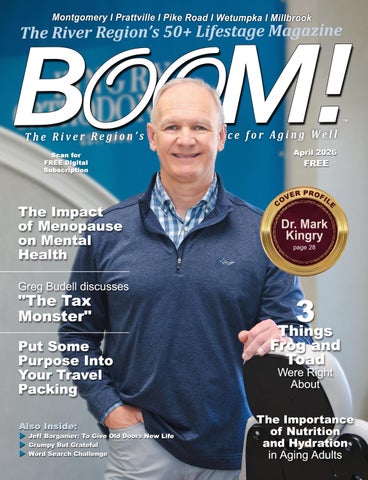
That’s what makes this month’s cover profile with Dr. Mark Kingry so meaningful. After more than three decades in practice, he’s still driven by one simple mission — creating smiles that change lives. And now, he’s experiencing something special: treating the children of patients he first saw years ago. It’s a full-circle reminder that what we build over time truly matters.
You’ll also find a fascinating story from Jeff Barganier about a set of antique doors with a past that’s anything but ordinary. Let’s just say bringing them back to life wasn’t simple—and the journey behind them is worth the read.
If you’re looking for something lighter, Greg Budell tackles “The Tax Monster” this month in a way that’s painfully relatable and laugh-out-loud funny. And in one of my favorite pieces in this issue, you’ll revisit the simple but lasting wisdom of Frog and Toad—proof that sometimes the smallest lessons stay with us the longest.
Maybe that’s what April is really about. Not becoming someone entirely new overnight…
But allowing ourselves to be refined, strengthened, and reminded of what matters most.
So wherever this season finds you — in a time of growth, transition, challenge, or joy — take a moment to appreciate the process.
You may not be finished. But you might be becoming something better.
As always, if you know someone who would make a great cover profile, I’d love to hear from you at jason@riverregionboom.com.
Age Well, My Friends!


As we age, our bodies change in a multitude of ways. Metabolism slows, appetites are not as robust, and the body’s ability to sense thirst becomes less reliable. These changes make proper nutrition and hydration especially important for older adults, and something that needs to be intentional and maybe even monitored. Eating well and drinking enough fluids help maintain strength, support the immune system, improve energy levels, and reduce the risk of chronic disease.
Older adults often need fewer calories but more nutrients. Every meal needs to provide as much nutritional value as possible. According to Medlineplus.gov, good nutrition may help prevent some diseases such as osteoporosis and high blood pressure, heart disease, type 2 diabetes and certain cancers. Foods that are nutrient-dense, rich in vitamins, minerals, protein, and healthy fats are essential. Some aging adults will also need more protein.
Key nutrients for older adults include:
• Protein: It’s the building blocks for our bodies. Muscle mass declines with age, so it helps preserve and strengthen the muscles. Foods such as lean meats, fish, eggs, beans, yogurt, poultry, and nuts are excellent sources.
• Calcium and Vitamin D: Support bone health and help prevent osteoporosis -- Dairy products, fortified plant milks, leafy greens, and sunshine, the natural Vitamin D.
• Fiber: Promotes digestive health and helps control blood sugar and cholesterol levels -- Whole grains, fruits, vegetables, and beans or peas are great sources.
• Vitamin B12: Important for nerve function and red blood cell production. Because absorption of vitamin B12 decreases with age, older adults may need fortified foods or supplements. Methylated B12 also known as
methylcobalamin, is the natural active form of B12 with superior absorption. A simple approach to balanced nutrition includes a variety of food groups at each meal:
• Half the plate: Fruits and vegetables
• One quarter: Lean protein (fish, beans, poultry, tofu)
• One quarter: Whole grains (brown rice, oats, whole-grain bread)
• Plus: A source of healthy fat such as olive oil, avocado, or nuts
Simple habits can help maintain healthy fluid levels:
• Start the day with a glass of water;
• Drink fluids with every meal and snack;

Smaller, more frequent meals can also help older adults who have reduced appetites to receive adequate nutrients throughout the day. Shakes provide a great way to get all the nutrients without needing to consume a big plate of food.
The Importance of Hydration
Hydration is just as critical as nutrition. According to the National Library of Medicine, water is the most important nutrient for all living things, as our bodies are made up of approximately 60% water. Certain medications, chronic conditions, and reduced kidney function can also affect fluid balance. Unfortunately, many older adults do not feel thirsty until they are already slightly dehydrated, which can affect electrolytes making key functions in the body, such as a beating heart, not work correctly.
Some Signs of dehydration may include:
• Fatigue or dizziness
• Dry mouth or lips
• Dark-colored urine
• Headaches
• Confusion
Older adults should aim to drink fluids regularly throughout the day, even when they do not feel thirsty.
• Carry a reusable water bottle;
• Include hydrating foods such as watermelon, cucumbers, oranges, and soups; and/or
• Limit sugary drinks and excessive caffeine.
• Posting notes in living spaces, in bathrooms, living rooms, above light switches to remind them to take a drink of water.
Water is the best choice, but herbal teas, milk, and low-sodium broths also contribute to daily fluid intake.
Good nutrition and hydration play a vital role in maintaining independence, mobility, and overall quality of life as we age. By focusing on nutrient-rich foods, drinking fluids regularly, and adapting eating habits to changing needs, older adults can support their health and vitality for years to come.
REMEMBER: Healthy aging doesn’t require a perfect diet—just consistent, mindful choices that nourish the body every day.
Senior Law Solutions, LLC offers a variety of opportunities to assist individuals and their families with aspects of Elder Law Care, Estate Planning, and Life Care Planning with individualized plans.
If you have questions or want to learn more, visit www.seniorls.com or call 334. 758.9400. Senior Law Solutions is located at 1043 Ambassador Court, Montgomery, Alabama 36117.


Photography provided by Jeff Barganier
For good reasons, we still get frequent questions about the doors on Cindy’s design studio at The Waters in Pike Road. Over the past 20 years, hundreds, if not thousands, of people have been photographed in front of them.
We acquired the doors during the initial construction stage of The Waters’ Town Square building. Early on, we asked the construction foreman to take a look at them and make sure they would work. “No problem, we’ll take care of it,” he said. But later I discovered there were, in fact, challenging issues. Never assume that modern-day builders will have a clue when it comes to making antique doors work with new construction.
Soon, I was being told that, in order to meet code, the doors would have to open out. Cindy’s doors were designed to open inward. They would have to be taken apart and reassembled. When I asked the foreman who would do that, he shrugged.
After a couple of weeks of asking around, I discovered a crew of lean, longbearded characters: JR, Butch (also known as ZZ Top), and Joel. They resembled bad guys in a Clint Eastwood western. But they sported cool tools rather than six-shooters. I soon learned to appreciate them for what they were. Master craftsmen. They convinced me they could do the job and soon had the massive 9-foot, 7-inch-tall, 4-foot-plus-wide doors detached from their jam, and the jam dismantled.
bearded craftsmen seemed unfazed.
Indeed, they were joyful as they bragged about what awesome doors these were and what a privilege it was to work on them.
“What’s this going to set me back?” I asked. They stared at the doors and pulled on their beards. Except Joel. He laughed and danced away like a pirate full of rum. Butch changed the subject. “Come look at this!” He scratched on the jam with a pocket knife. “This is solid mahogany! These doors need to be stripped and refinished! They’ll be incredible! I can’t believe somebody painted over this beautiful wood! And look here.” He pointed at a date written in black paint on the unpainted side of the jam: 1809.

JR, Butch, and Joel generated great clouds of dust. Other crews on the site were choking and gasping for air. But my

ball-bearing hinges, the hand-carved shell that sat atop their center, and the walnutcarved panels that adorned their bottom. They gathered the heavy Spanish iron grills and the glass doors that were shaped to fit over the grills, and the hand-carved center-piece fluted column with ionic capital. They loaded it all into their old dilapidated blue truck, along with their tools, and lurched away into the sunset.
“What’ll it cost to strip them and refinish them?” I asked. He scratched his beard.
With JR and the boys dominating the entire space, the other subs couldn’t get their work done. With reservations, I decided to let JR take the doors to his place in the country, where they could work undistracted, take their time, and properly refinish them. They gathered up the two tall, narrow mahogany doors with their serpentine tops, their massive
I scratched my own three-day-old beard when I heard Joel’s maniacal laugh as they rumbled away. Then I imagined little green dollars streaming from the shop and racing after them down the dusty road.
A week or so later, I was itching to have a look. It was late evening. JR’s place was thirty miles out in an adjacent county. The doors were kept in an old metal building about a hundred yards behind his mobile home. Old dead trucks and cars lined the muddy road back to the shed, making my high-mileage Volvo nervous as she fought for traction. A few mangy dogs circled me and howled as I walked toward the entrance. Butch emerged with his toothless grin. I was pleasantly surprised to find JR hard at work, as well as Rita, whom I was meeting for the first time. They were gracious and excited about the doors. I couldn’t help but feel
proud of them. Rita almost cried when she spoke of what an honor it was to be a part of the project. I watched her remove centuries of layered paint from the carved fixtures.
They had discovered that one of the doors had been badly damaged and hastily repaired. Many years before, in Buenos Aires, something or someone had knocked out the lower one-third of the left door. Fragments of a concrete block were found beneath a compound that had been plastered over the gaping hole in the wood. Pieces of a Buenos Aires newspaper had been stuffed into the cavity. Rita had removed the newspaper and neatly deposited little scraps in a plastic bag. One piece read Diciembre 1, 1968. door once belonged to a politically prominent Argentine Republic family whose home in December 1968 was

the target of revolutionaries? Or maybe a bomb had exploded in the street, sending shards of concrete smashing through the door. If only these doors could talk!
Christmas 2006 was days away. Cindy and I were excited to meet Rita and the guys at the shop the morning they brought the doors back. That’s when we discovered that, because the right door was mitered for an inside swing, if the left side was bolted, the right would not open at all.
We had to reverse the hardware


lessons. Matching trim for antique doors is very expensive. And never leave parts lying around. We lost original hardware when someone thought it was junk and threw it away! Hardware manufactured in Argentina hundreds of years ago can’t be matched. No one gives estimates on such projects because they don’t know what the work entails until they get into it.
Wish I knew where JR, Butch, Joel, and Rita are today. There’s much more to giving old doors new life than meets the eye!


Most people are familiar with menopause symptoms such as hot flashes, night sweats and weight gain around the middle.
But what people may not be aware of is the impact that menopause can have on a woman's mental health, especially during perimenopause.
During the menopause transition (perimenopause), hormonal shifts can affect brain chemistry and trigger anxiety, especially when women are in stressful situations. Dr. Esther Eisenberg, MD, Vice Chair, Editorial Board, American College of Obstetricians and Gynecologists (ACOG), and Professor Emerita at Vanderbilt University, explains, "Women may experience increased anxiety and depression in midlife but not attribute it to menopause."
Midlife is a time of a plethora of changes for women. Many midlife women are caregivers: dealing with adult children, aging parents (or both) in addition to
managing their own homes, finances, romantic relationships and careers.
"Women may be so busy they don't even realize that their periods are irregular or have stopped entirely," explains Eisenberg, whose new book, "Menopause: What Your Ob-Gyn Wants You to Know," is out this month. "They may feel anxious or depressed and think that it's just because of all the stressful life events occurring in their life simultaneously. They may not realize that those feelings could be tied to their hormone levels."
Our mothers didn’t talk about it. Their mothers didn’t either. So, we haven’t talked about it. Here’s why women need to open up about this shared experience.
"Menopause, mood and anxiety are connected in complex ways that we don't fully understand yet."
Determining whether or not a mood change is directly linked to hormonal changes can be difficult. "Menopause, mood and anxiety are connected in complex ways that we don't fully understand yet," says Eisenberg.
"Fluctuations in estrogen and progesterone can affect brain chemicals such as serotonin and dopamine, involved in regulating mood," explains Dr. Ashwini Nadkarni, Associate Medical Director of the Brigham Psychiatric Specialties. "Estrogen receptors are also located in parts of the brain which are associated with memory and mood, such as the prefrontal cortex and hippocampus. When estrogen levels decrease, it can affect these brain circuits. This can produce vulnerability to mood changes."
While hormonal fluctuations play an important role, given that they directly affect brain chemistry, it may also be that other symptoms associated with

menopause can also be factors. Nadkarni explains, "Mood swings can lead to frustration or sadness; increased anxiety with worry or depression with low mood and motivation; brain fog with difficulty concentrating and fatigue; and sleep disturbances that can worsen; mood changes or concentration difficulties, are all common. Hot flashes can also cause sleep fragmentation or frequent awakenings and a disruption of normal sleep patterns."
Risk factors for mental health issues in menopause include:
• Hot flashes and night sweats
• Certain health conditions, such as thyroid problems, irregular heartbeat, Lyme disease and vitamin B12 deficiency.

• A prior history of anxiety or other mental health issues
Eisenberg says, "For women who have experienced anxiety or other mental health issues in the past, it can be frustrating, thinking they had that under control."
But even for women with no history of mental health disorders, menopause can increase the risk of a depressive episode. "It may come as a surprise that they are having mental health issues because they seem to happen out of the blue," explains Eisenberg.
We live in an ageist society where women can feel invisible as they get older. Midlife women may be reluctant to tell their physicians that they are experiencing anxiety or depression. "Women may not feel comfortable admitting that they are having mental health struggles," says Eisenberg. "They may be embarrassed. They may believe they should just 'tough it out' and not complain or that there is nothing to be done for the symptoms, so why bring it up to their physician?"
But women don't have to suffer. "For every woman who lives long enough,
menopause will be a part of their life," says Eisenberg. "Their ovaries will lose follicles, estrogen will dip and these physical changes can cause a host of symptoms. The intensity will vary for different women, but it is normal and women should be comfortable talking with their physicians about what they are feeling."
Cultural attitudes about menopause and aging can play a role in how women experience menopause. "A lack of open dialogue can stigmatize mental health challenges associated with menopause," explains Nadkarni. "However, people are increasingly speaking openly about menopause; an example is former First Lady Michelle Obama."
Some women may be waiting for their physicians to prompt them to discuss their mental health issues. Eisenberg says, "It would be ideal if physicians brought these topics up to their patients, but many times it is up to the patient to advocate for themselves."
There are a variety of ways to treat the symptoms and improve the quality of life.
"The best approach is individualized," explains Nadkarni. "Options for medical treatment include combined estrogenprogesterone therapy in a woman with a uterus or estrogen therapy in a woman without a uterus, both of which are particularly valuable when the individual has other associated symptoms such as hot flashes or brain fog."
In some patients, medical reasons may preclude the use of HRT or it may not
be the most effective treatment given the severity of symptoms. Nadkarni says, "There are drugs such as antidepressants that directly address depression and anxiety. Combining HRT with an antidepressant is another option."
Therapy (including talk therapy and CBT) can also be an effective treatment for mood disorders, as can making positive lifestyle changes. A healthy diet, regular exercise, good sleep habits, meditation, avoiding smoking and limiting alcohol intake can all support mental health.
Before treating any menopause-related symptoms, women should be sure they are getting their information and remedies from reliable sources.
"There are many companies making money off of menopause products right now," says Eisenberg. "Some people are using their fame to make money off women who are suffering from menopause symptoms. We wrote this book as a resource for women so they can better understand what is going on with them and the options available to them through their physician."
The most important thing to remember is that women need not suffer in silence.
"Menopause is a normal life transition and mental health changes are part of the body's normal shift," explains Nadkarni. "The more we can frame this as a common physiological experience, normalize help-seeking, highlight the science underlying mental health conditions, and model comfort in our language, the more we can help people to consider open discussion with their doctors on anxiety and depression associated with menopause."

Courtesy of nextavenue.org.
By Greg Budell
Tax Day is April 15, 2026 - or as I call it, Wednesday. The one date on the calendar that unites Americans more than Thanksgiving, the Super Bowl, or discovering that your favorite fast-food chain now charges extra for dipping sauce. It's the annual reminder that Benjamin Franklin was only half right: in this life, you get death and taxes, but at least death doesn't come with a 1040 form and a side of audit anxiety.
Have you ever endured an IRS audit? It will make your next colonoscopy prep seem like a dream vacation. I received one of those when I was married to my crazy second wife. It took weeks to prepare the requested documents, but they accepted all my documentation. Hers? Not so much. We had to cut a check, and not long after our inevitable divorce, I learned she had an affair with our accountant. I didn’t care. I just never wanted to go through another one.
Fear. It’s how the IRS gets every dime they say you owe. That’s how they got Al Capone! He went to jail for tax evasion, not murder.
Let's be honest, taxes are the universe's way of saying, "Hey, you did okay this year— here, let me take a chunk of it and spend it on things you'll never see." We spend January through March in blissful denial, pretending our W-2 is just a fancy receipt. Then April rolls in like that friend who shows up unannounced, raids your fridge, and leaves you with the bill. Suddenly, you're knee-deep in receipts from 14 months ago, wondering if that $12.47 coffee run from July 2024 counts as a "business expense" because you answered one work email while waiting in line. (Spoiler: it doesn't. The IRS knows you were just doom-scrolling cute French Bulldog videos.)
The real comedy starts with the software. TurboTax greets you like an overly enthusiastic ex: "Welcome back! We've missed you! Let's relive every financial
mistake you've made since 2021!” You click through screens faster than a gambler at a slot machine, praying for that magical "refund" screen. Instead, you get the gut-punch message: "You owe $1,247." Your brain immediately launches the classic defense mechanisms: Denial: "This can't be right. I must have entered my income wrong. Let me just... add a zero by accident."

Bargaining: "Okay, universe, if I donate $50 to charity right now, can we call it even? No? How about $500? Still no? Fine, I'll just sell my kidney on eBay."
Anger: Staring at the screen, whispering, "Why do billionaires pay less than I do? I make $62,000 and owe more than a small country's GDP!"
Then there's the deductions game— our national pastime of creative fiction. People claim everything: home office (that corner of the couch where the Wi-Fi reaches), mileage (those three trips to the fridge), even "entertainment" (because watching Netflix while folding laundry is basically research for mental health). The IRS reads these like a bad stand-up routine: "So you're telling me your emotional support goldfish is a business expense? Fascinating. Audit scheduled for Tuesday." Accountants, bless their caffeine-addled souls, become superheroes this time of year. They morph from mild-mannered number crunchers into caffeinated wizards who can spot a deductible lunch receipt from 50 paces. But even they crack. You can tell tax season is peaking when your CPA starts responding to emails with just emojis.
They're basically running on Red Bull, spite, and the faint hope that extensions exist for a reason. And don't get me started on extensions. Filing for one feels like cheating on a test—you get six more months, but deep down you know you're just delaying the inevitable heartbreak. It's like saying, "I'll deal with my feelings later." Spoiler: later is never better. You just end up in October, panicking in flipflops while everyone else is carving pumpkins. The best part? After you hit "submit" and the confirmation email arrives, there's a brief, euphoric moment where you feel free. Taxes are done! Life can resume! You celebrate with takeout, maybe a beer, and vow never to procrastinate again. Then you remember next year's taxes are already accruing interest in the background, like a stalker in a trench coat. So here's to Tax Day 2026: may your refund be fat, your audit risk low, and your coffee strong enough to survive the math. Because in the end, taxes aren't just about money—they're about reminding us that no matter how adult we pretend to be, we're all just winging it.
One Schedule C at a time.
Greg Budell has lived in Montgomery for 20 years. A 50+ year veteran of radio, TV and writing, Greg hosts the Newstalk 93.1FM Morning Show with Rich Thomas and Jay Scott, 6-9 AM Monday - Friday. He returns weekday afternoons from 3-6 PM for Happy Hour with Pamela Dubuque and a variety of sidekicks. His favorite topic is life! Greg can be reached at gregbudell@aol.com.


Getting ready for a trip can be stressful. There's the worry of forgetting something essential behind or getting dinged with hefty fees at the airport because your bags are too heavy. Bringing exactly what you need is within reach if you follow some of these pro tips.
I will do anything to avoid checking a bag, including traveling for two weeks with just a carry-on. Chronic over-packers cram too much into their luggage because they can't decide what not to bring. Brooke Schoenman's experience traveling around the world with just a 3-gallon shoulder bag went viral, but she was once an over-packer, too.
"It took years of trial and error before I finally realized I was simply packing more stuff than I needed; many items were just weighing me down more than they were adding value to my travel experience," says Schoenman, an American ex-pat living in Sydney, Australia.
"I often returned home with untouched clothes. Reviewing my itinerary and honestly assessing my needs helped me curb my overpacking habit."
In 2010, Schoenman launched Her Packing List, which teaches women how to ditch excess baggage and travel with confidence. She suggests bringing less than you think you need, opting for versatile layers of clothing and avoid packing too many gadgets that add clutter, weight and stress.
"As a plus-size traveler, I often can't buy items upon arrival at most destinations, especially abroad. My main packing struggle was overpacking, as I aimed to be ready for every situation, which rarely occurred," says Ronny Maye, a North Carolinabased writer who travels two to three weeks each month.

Christiana Roussel, a Birmingham, Alabama-based editor who writes about food, travel and lifestyle, travels at least two weeks a month, and discovered that streamlining her wardrobe and bringing lightweight accessories made all the difference.
"Scarves, wraps, and jewelry add variety to a capsule wardrobe. I print out my itineraries in advance on 5x7 card stock and as I pack, I pencil in the outfit selected on the card. No dupes (duplicates), no extraneous items that don't get worn," she says.
I keep various packing lists organized by destination or type of voyage, and I'll adapt one of my go-to lists instead of starting from scratch when making new travel plans. I start packing up to a week in advance, planning by activity and compiling outfits including shoes and accessories.
Many people swear by rolling their clothes instead of folding them, to keep creasing to a minimum and use luggage space more efficiently, but some pro travelers like Maye fold and roll.
I start packing up to a week in advance, planning by activity and compiling outfits including shoes and accessories.
"My choice depends on the type of suitcase, the duration of my trip, and the items I need to pack," she explains. "I fold smaller items like T-shirts and undergarments and roll larger items such as sweaters."

I recently started using two items that have changed my packing habits. I got a bag strap that securely fastens one bag to another or can be used to clip a rolled-up jacket to my backpack. And I now attach my wide-brimmed sunhat to my carry-on with a magnetic clip instead of squishing it into my suitcase.
Travel writer Amber Gibson, who flies more than 200,000 miles a year and switches hotels every three nights, has forgotten plenty of hanging items in closets but her current suitcase solves that problem.
"It has a built-in shelving system for clothes so I can simply take out the entire closet to hang up in my room and pack it back in my suitcase when I leave," she says.
Roussel packs her device chargers in a black nylon fanny pack which she empties at her destination to use it as a purse while sightseeing.
Yvette Campbell, a Detroit-based certified meeting planner and broker who finds hotels worldwide for her clients, relies on packing cubes for each day's activities and events.
Maye uses compression packing cubes to maximize space in her luggage, and a bag with a built-in vacuum system. Schoenman says a variety of lightweight zippered pouches keep her organized without adding extra bulk.
For road trips or weekend getaways, Roussel uses a bag with a zip-around shoe compartment on the bottom.
"I insert a just-right-sized Lucite bin with all my toiletries, filling it as I get ready on the day of travel and ensuring I don't forget something I use daily," she says. "Then, when I arrive at my destination, I can just pull the bin out, place it on the hotel counter and everything is contained."
Robyn Davis, a trade show trainer and consultant in Charleston, South Carolina who travels several times per month, brings multiple bags when she's on the road.
"I'll pack one bag for items I'll need every day and separate bags for each hotel I'll stay in," she says. "This way, I can get in and out of hotels quicker, with less to carry and re-pack, and back on the road or out exploring quicker, too."
Hussain keeps a duplicate toiletries kit that's always ready to go and packs a cloth tote bag or backpack for daily essentials like sunscreen and a water bottle.
"This can be an additional bag if you have too many goodies to pack from your travels and it's easily washed," she says.
Maye suggests preparing for what might happen on the road by bringing an emergency kit with tools to escape the car and extra snacks in case you need to wait for roadside assistance.
Roussel avoids checking luggage and always finds out what laundry facilities she'll have access to.
"On a trip to Portugal, we dropped off a pile of clothes at a local laundromat and picked everything up after a day of sightseeing," she recalls. "In Japan, many of the hotel rooms we chose had laundry access; one was even in the room."
Hussain includes lightweight, airtight plastic containers when she travels abroad.
"They're great for storing small bags of snacks and liquids without having to worry about spillage or stains," she says.
Davis warns that travelers should always double-check the airline's size allowances for luggage.
When Gibson knows she'll be hitting different cities, she packs a neutral wardrobe consisting of layers she can mix and match. Roussel packs outfits according to activity or location in advance.
"I don't want to sort through everything I've packed, and prefer knowing 'Tuesday, bike ride through vineyard — this outfit'," she says.
Maye takes versatile pieces that can help her adapt to temperature changes.
"Focus on functional items that are wrinkle-resistant, odorcontrolling or moisture-wicking," she advises.
Hussain brings multi-purpose, reversible clothing or items with removable pieces she can easily change up to create a different look. Davis re-wears things but styles them differently throughout the trip.
"For example, a dress that can be worn with tights and a sweater in one place could be re-worn with just a belt in another," she says. "For multiple destinations, pack a mesh laundry bag. If you need to do laundry before you get home, you can just toss the whole bag in, with reduced risk of items getting lost or damaged in the process."
"Finally, I'd like to remind people traveling domestically or internationally to always photocopy your passport and driver's license and have a copy in a safe spot or in your luggage and possibly one with you under your clothes; this has saved me when my bag was stolen, and never put your phone down on a table, especially in Spain, because in a flash, it will be stolen."
Courtesy of nextavenue.org.

12 ounces spaghetti
2 ripe avocados, halved, seeded and peeled
½ cup fresh basil leaves
2 cloves garlic
2 tablespoons freshly squeezed lemon juice
Kosher salt and freshly ground black pepper, to taste
⅓ cup olive oil
1 cup cherry tomatoes, halved
½ cup canned corn kernels, drained and rinsed Instructions
Instructions:
In a large pot of boiling salted water, cook pasta according to package instructions; drain well.
To make the avocado sauce, combine avocados, basil, garlic and lemon juice in the bowl of a food processor; season with salt and pepper, to taste. With the motor running, add olive oil in a slow stream until emulsified; set aside.
In a large bowl, combine pasta, avocado sauce, cherry tomatoes and corn. Serve immediately.


https://damndelicious.net/2014/06/20/avocado-pasta/


8 AM to 3 PM I 5 Bell Rd, Montgomery, AL
Come and support the Alabama Herb Society as we share our knowledge and experience with the many current and aspiring gardeners, herbalists, and cooks of Montgomery and central Alabama. The open-air market features vendors who sell crafts, books, herbal teas, garden wares, and a huge selection of herbal plants. Visit www.alabamaherbsociety.org/herb-day/.
7 PM to 9 PM I Troy University's Davis Theatre
Experience the passion and intensity of two Romantic masterworks as the Montgomery Symphony Orchestra presents Sibelius’s Violin Concerto in D minor, featuring MSO Violin Fellow Haeun Honney Kim. The evening concludes with the sweeping emotional power of Tchaikovsky’s Symphony No. 4 in F minor—a dramatic and unforgettable musical journey. (334) 240-4004 or https://www.montgomerysymphony.org/masterworks4/


BOOM! starts conversations and shares stories. Share your business with BOOM! readers. For more information call/text 334.324.3472 or visit www.riverregionboom.com 334.328.5189

May 1 I 6 - 10 PM
Come enjoy a great night of drinks, food, music, and fun in downtown Montgomery. $40 per person, Discounts available for Military and League of Municipalities attendees. This year’s event includes returning beer distributors, new breweries, a bourbon experience featuring Jim Beam and Alabama-based distilleries, plus a cigar lounge, mechanical bull, yard games, food trucks, and live music. Follow our Facebook page for more information.
April 25 I 6 AM to 8 AM I 4445
This exciting event invites runners of all ages to take part in a unique 5K race on a closed course that showcases the airport’s stunning airfield. Participants will have the chance to run alongside aircraft on Taxiway Bravo, Delta, Echo, and Runway 3-21 south, all while enjoying breathtaking views of the MGM terminal and the thrill of planes taking off and landing. Visit https://findarace.com/us/ events/2026-mgm-runway-5k for more information and to register.


Flimp Festival I April 11 I 10 AM to 2 PM
Enjoy a whimsical day of imagination and creativity at Flimp Festival in the John and Joyce Caddell Sculpture Garden at the Montgomery Museum of Fine Arts—a free, family-friendly celebration featuring art activities, games, music, local partners, and food vendors, all inspired this year by artistic interpretations of landscapes. The event is rain or shine (activities move indoors if needed), service animals are welcome. Visit mmfa.org/event/flimp-festival-2026/.
April 30 - May 10 I 7:00 PM I 960 Cloverdale Road, It’s 1950, and new colors are being added to the Red Scare. Two U.S. State Department employees, Bob and Norma, have been tasked with identifying sexual deviants within their ranks. There’s just one problem: Both Bob and Norma are gay, and have married each other’s partners as a carefully constructed cover. Inspired by the true story of the earliest stirrings of the American gay rights movement, madcap classic sitcom-style laughs give way to provocative drama as two “All-American” couples are forced to stare down the closet door. $12.51. Visit https://www.cloverdaleplayhouse.org/.


We invite her to reconnect with nature, while enjoying

• Riding - English, Western, & Jumping • Swimming • Heated Pool
• Ropes Course • Climbing Tower • Nature Exploration
• Sports • Soccer • Basketball • Gymnastics
• Beach Volleyball • Tennis • Canoeing • Archery • Knitting
• Voice & Music
• Cheerleading • Dance • Chorus • Drama
• Arts & Crafts • CIT Program • Campfires every night
• Riverview Refinement & More!


I was sitting in traffic the other day—nothing major, just one of those slow crawls where nobody knows why we’re stopping, but everybody’s annoyed about it anyway.
I glanced at the clock, did the mental math, and immediately decided I was now “running behind,” even though I had left early and had absolutely nowhere urgent to be. That didn’t stop me from sighing, tapping the steering wheel, and acting like I was one inconvenience away from writing a letter to the Department of Transportation.
We get good at that, don’t we? The small frustrations. The daily inconveniences. The things that feel big in the moment—slow lines, late deliveries, pollen coating everything we own like it’s been sprinkled by an overenthusiastic baker.
I had just spent the weekend complaining about my yard. The grass grows too fast, the weeds come back overnight, and the pollen has turned my truck into something that looks like it belongs in a mustard commercial.
And then, right there in the middle of traffic, I noticed a car in front of me with an out-of-state tag and a small Air Force sticker on the back window. You start to notice those more this time of year—families coming into the River Region, not moving in yet, but looking around. Driving neighborhoods, checking out schools, trying to picture what life might look like here in a few months.
And it hit me—while I was sitting there frustrated about ten extra
minutes in traffic—that somewhere not far from me, someone is getting ready to pack up their entire life again. A new house, a new city, a new routine—not because they were ready for a change, but because they were called to it.
And just like that, my little frustrations started to feel smaller.
Because while I’m over here debating whether I want to deal with yard work or just complain about it again next weekend, there are men and women preparing right here in our community for something far heavier than anything on my to-do list. And behind every one of them is a family learning how to build a life in unfamiliar places—again and again— kids stepping into new schools and new friendships, figuring it out faster than most of us ever had to.
Meanwhile, I’m over here irritated because my Wi-Fi slowed down for ten minutes.
It’s humbling if you let it be. Not in a way that makes you feel guilty—because life is still life. Traffic is still annoying. The yard still needs cutting whether you feel like it or not. But it does give you perspective. It reminds you that while
we all carry things, not all weight is the same.
Some of us carry schedules and inconveniences. Some carry responsibility that stretches far beyond themselves—and they do it quietly. The older I get, the more I appreciate that kind of strength. It makes me look at my own life a little differently, realizing that the routines that sometimes feel frustrating are actually a gift. I get to sit in traffic and know exactly where I’m going. I get to wake up in the same place tomorrow. That’s not something everyone gets. So yes, I’m still grumpy. I’m still going to complain about pollen. I’m still going to sigh in traffic. But I’m also grateful—grateful for the men and women who carry a weight most of us never will, grateful for the families who stand beside them, and grateful that in the middle of my ordinary life, I get to live in a community where that kind of service and sacrifice is happening all around me.
It’s easy to miss if you’re not looking for it, but once you see it, you don’t forget.
- Archie Grumbleton


BOOM!: You’ve practiced orthodontics in Montgomery for more than three decades. When you look back at those early years, starting your practice in 1993, what stands out most to you today?
MK: First, I was blessed to be an associate with and then purchase a practice from a great orthodontist, Dr. Eugene Brown. He taught me how a professional should treat patients and be involved in the entire dental community.
Those early years were definitely a learning experience. In dental school and orthodontic residency, you don’t receive much in the way of business training. Then you find yourself in the real world as a solo practitioner running a small business with all the things that go with it. Human resources, business taxes, payroll, equipment, and changing technology were all areas I had to learn on the fly.
BOOM!: You grew up in Dothan but chose to attend Huntingdon College here in Montgomery. What was it about this community that made you decide
After more than three decades serving the River Region, Dr. Mark Kingry has built a career rooted in excellence, relationships, and a genuine passion for helping others. In this conversation, he reflects on the early days of launching his orthodontic practice, the evolution of technology in his field, and the deeper purpose that continues to motivate him each day. From leadership and lifelong learning to faith and service, Dr. Kingry also shares heartfelt insight into the role his wife, daughters, and now grandchildren play in shaping this meaningful season of life.
to build your life and career in the River Region?
MK: There were two main reasons: First, I met my wife, Beth Anderson Kingry, while at Huntingdon. She grew up in Montgomery and graduated from Robert E. Lee before attending Huntingdon. Secondly, a practice opportunity was available. I always knew I wanted to have my own practice, but opening a new one is very daunting. I was introduced to Dr. Brown during my first year of orthodontic residency, and he was interested in bringing in an associate to purchase the practice when he retired.

My experience in Montgomery while at Huntingdon was positive, and I had been involved with the Frazer Church College Ministry, where I had met many friends, which was another reason I felt comfortable returning to Montgomery to practice and raise a family.
BOOM!: Orthodontics has changed dramatically over the years—from traditional braces to digital treatment planning and customized aligners. What excites you most about how technology is improving the care you’re able to provide your patients?
MK: Traditional braces still make up over 50% of the treatment we do, but customized braces, behind-the-teeth braces, and aligners comprise about 35% of our current treatments. In the digital world, we can now take a 3D scan
of the teeth, use software to move the teeth and predict the final outcome, then have customized braces or aligners 3D-printed to fit exactly and proactively move the teeth to the final position. That is exciting to me, but for patients, the exciting part is that with more controlled tooth movement and proactive planning, treatment times and office visits can be reduced, making the patient experience so much better.
BOOM!: After more than 30 years in practice, what still motivates you when you walk into the office each morning?
MK: My motivator is creating smiles for patients that change their lives and give them confidence to share their smile with others. After 32 years, I am now also able to treat children of patients that I treated years ago, and to hear them recall their experience and share how orthodontics gave them confidence and changed their smile is always a fun motivator.
BOOM!: You’ve also taken on leadership roles in the profession, including serving as President of the Alabama Orthodontic Association. What have those xperiences taught you about leadership and serving others in your field?
the specific role I had the opportunity to serve in.
BOOM!: Many people don’t realize that orthodontics is both science and artistry. What do you enjoy most about helping create a smile that can change someone’s confidence for life?


MK: Serving in leadership in the dental and orthodontic associations allowed me to understand that we are colleagues and not competitors. We all want the best for patients, and organized dentistry can work to promote care for patients that individual practices often can not provide on their own. The challenge of leading your peers and serving also makes you up your game a bit. I am always humbled and amazed at the strengths of others in the room, and they challenge me to grow my skills and knowledge far beyond
MK: Yes, orthodontics is science and dentistry. To move a tooth, you have to understand bone biology and how a tooth can be moved, you have to understand physics and how to exert a specific force on a tooth to move it in the proper way, and you have to understand chemistry to know how to get a brace to bond to a tooth. But then you have to have an artistic eye to have a vision of where to place the teeth in the face to bring about the best possible smile for any given face. This means that each patient gets an individual treatment plan, and braces are placed differently for each patient to achieve the best results for that individual.
Actually, the thing I enjoy most is being able to teach patients a small portion of why and how we are changing the smile. This then gives them the understanding of why we are doing what we do and how they play a role in the process. Orthodontics is a partnership with the patient; both the orthodontist and the patient have to do their part to get the ideal results.
BOOM!: Family clearly plays a huge role in your life. You and Beth have raised three daughters—what has been one of
the greatest joys of watching them grow into adulthood?
MK: The greatest joy has been seeing the seeds of the Christian faith we tried to plant in them grow and develop. While each of them approaches their faith differently, as they are in different life stages, they all now challenge our faith by the way they serve and lead. Each of them is connected to a church, has a small group that they either participate in or lead, and love others. We could not ask for more than to know that they have grown and thrived while maintaining the values of our family.
BOOM!: Now you’re enjoying a new season as grandparents. What has it been like watching your grandsons grow and develop?
MK: Everyone tells you that grandparentsing is awesome, but you can’t understand until you’re there. When you are young and parenting, you can get so bogged down in the day-today of kids, work, and school, that it’s easy to miss the blessing of just spending time with little kids. As grandparents, you may not see them every day or have to “parent” every situation, so you are freed up to be a little more present. It has been so interesting to see them take on the traits that make their parents who they are, while still recognizing family traits that get passed from both sides of their family.
BOOM!: You and your wife have also become “foster grandparents” through
your daughter’s foster parenting journey. How has being part of those children’s lives shaped your perspective on family and faith?
MK: It has been quite profound. About five years ago, our middle daughter became a foster parent. She felt a calling to share her faith by ministering to those kids. It also quickly became a realization that we unknowingly became foster grandparents. The Bible tells us to care for widows and orphans and those less fortunate, and this journey has given us the opportunity to do that in a practical manner. We have been able to hold, love, care, play, and share with these kids the love of Christ in a way I never fully understood before. I didn’t know that God could fully give you a love for a child that’s not yours or even one you will never adopt, but when you are exposed to a child for 1 ½ years, feeding, changing diapers, getting up in the night, your faith is stretched to where you never dreamed.

situation where we have been able to stay connected and be the 3rd set of “grandparents”. It has made me realize that, regardless of race, background, or socio-economic situation, a child is a blessing from God and we are all created equally.
I believe as a Christian our calling is to love those placed in front of us, in the best way we can, while we have the opportunity, and that this is a practical way that we can put our faith into action.

Foster care and foster grandparenting are messy, with lots of highs and lows, and tears of both joy and sadness. We have been exposed to all sides, and while the goal is always reunification with the biological parents, that’s not always possible. Through our daughter, we have been a part of seeing kids go back to parents, kids being adopted and not seeing them again, as well as a special
BOOM!: Your family makes a point to take an annual trip together. Why has creating those shared experiences become such an important tradition?
MK: Beth and I believe that experiences were more important for our girls than things. We wanted the girls to be able to see different things and travel to different places. It also creates a time when the whole family is together and has to rely on each other. As they have gotten older, they continue to see the value of carving out time in their schedules to be together. As the families have grown and we now have 4 families to coordinate, it becomes harder, but we are blessed that even as adults, our kids and their families all like being together
BOOM!: Outside the office, you stay active through swimming, biking, running, and participating in local events. How important has physical activity been in helping you stay energized and balanced through the years?
MK: Exercise has been a huge part of the last 15 years or so. Prior to that, while I tried to stay in shape, raise a family, run a business, and be active in church professional leadership roles, I was headed down the path of not taking time to care for myself. Thanks to a great group of runner friends that we dubbed the TLRC, I was able to learn to enjoy the encouragement of and connection with a group while beginning to enjoy the challenge of distance running and then biking. That led me to challenging myself with races, triathlons, and ultimately to doing a Full Ironman race.
While some of the process was probably a bit extreme at times, the habits of setting goals and having to physically challenge myself helped me get through my 40’s and 50’s. Now into my 60’s,

I’m no longer pushing as hard on the endurance side; it’s now more about strength training to aid in longevity and make sure I can keep up with them as long as possible. Exercise has given me both physical benefits, but also emotional benefits of focus, relaxation, and camaraderie with other like-minded people.
BOOM!: You and Beth also enjoy traveling and experiencing other cultures. What have those experiences taught you about people and the world beyond Montgomery?

MK: Well, our first experience of experiencing other cultures was living in New Orleans for two years during my residency. We realized that ways of living and traditions that may have been different from the way we were raised were just different, not bad. That realization has allowed us to see travel as an opportunity to experience and appreciate something beyond ourselves. To realize that people are people around the world and that kindness, respect, love, and smiles translate worldwide, even if you may not share the same language or background.
BOOM!: As someone who has stayed curious and continued learning throughout your career, what advice would you give others about staying engaged and growing as they move into their 50s, 60s, and beyond?
MK: It’s important to continue to be curious, be willing to change, and maybe even fail. We grow as we stretch ourselves to do new things. I’m not planning retirement anytime soon, but when that time comes, I’m sure I’ll constantly be looking for opportunities to learn and grow new skills.
BOOM!: When you look ahead to the next chapter of life, what are you most excited about—both personally and professionally?

MK: Personally, there are two things I’m excited about. Most importantly, to influence the next generation through my grandkids. The fact that we are close enough to them to spend regular quality time with them is a blessing. Second, to do that, I have to continue to maintain strength and health, which involves adjusting and modifying my exercise routine to support longevity.
Favorite way to start the morning: Wake up 4:45-5, Coffee, 3-mile run, then lift weights at the gym, 15 minute quiet time to read the Bible. Then shower and off to the office.
Best family vacation spot so far: We took the kids to Alaska in 2012, and they still talk about kayaking to glaciers and the unreal scenery, but we have been going to Big Sky, Montana, to ski every couple of years since 2004, so the kids and now sons-in-law and grandkids think we need to continue that tradition.
A hobby that helps you unwind: Exercise!
Favorite local restaurant: La Jolla
Something patients would be surprised to know about you: I’m an introvert at heart. While I function and sound like an extrovert at the office all day and function well around others, I like my quiet times.
Best advice you ever received: Marriage is not 50/50. Some days it’s 0/100, and others are 100/0. You need to approach it with a sacrificial heart and to give the best you can every day.
One word that describes this season of life: Content
We thank Dr. Kingry for sharing his story with us! If you know someone who would make a great cover profile, please email jason@riverregionboom.com.
BOOM!: You’ve been part of the River Region community for many years through your practice, church, and family life. What do you enjoy most about living here?
MK: I think the thing we have enjoyed the most through the years is being close to family and the friends we have developed. It’s also convenient to so many places within 2-4 hours.
Professionally, I’m excited about new things happening in orthodontics, from customized behind-the-teeth braces, remote monitoring, where patients can scan their teeth from home to make sure they are staying on track with treatment, to the application of AI into treatment and workflows to make patient care more efficient and comfortable for patients. The future of making patients smile is exciting.


I still remember sitting on the floor next to the cubbies in my classroom. It was silent reading time which was my favorite part of the day. The book (and the words) were perfectly sized for my elementary hands. Little did I know the lessons were bigger.
Do you remember the books by Arnold Lobel all about Frog and Toad? They were fairly plain and didn’t stand out. Muted green, brown, and gray artwork filled the page. It was so plain one could wonder how it was possibly interesting. But sometimes the simplest things are the most beautiful. (Sounds like something I picked up from Frog and Toad.)
Anyone who learned to read in the eighties and even the nineties likely saw these simple stories. Maybe they were opened on a school desk to decode words or maybe, like me, they were treasured in quiet corners. I loved these stories. The simplicity, the friendship, the lessons. It turns out these fairly plain amphibians were right about a lot of things.
Here are a few of my favorite lessons I still remember today:
Lesson 1: Hold your list loosely and be the person your friend deserves.
I love lists. They create order in the world that sometimes feels too chaotic for my Type A brain. I’m not always good at completing lists, but they make me happy just the same. The problem comes when I hold on too tight.
Toad gets it. He wrote a list of his own. He even included basic things just

so he could have the pleasure of checking them off. Waking up, going to sleep and all the things in between made his list. Even things like eating meals and naps and time with his friend.
I like his lists. And he did, too. Until a breeze came. What happens when the list gets blown away in the wind of the day? I often wonder about that very thing.
The best part about Toad losing his list is what happens next. He has a friend, Frog, who tries to get it for him, and when that proves impossible, he just sits with Toad. He is the exact friend Toad needs. He doesn’t try to change Toad. He is just there with his friend.
We all need a friend like that. A friend that will be with us when life is giving us a beating when we don’t make any sense, and the only thing we can think to do is sit with our heads in our hands. Toad had that kind of friend in Frog. I want friends like that in my life, too. I’m learning that the best way to find one is to be one.
Lesson 2: Sometimes we have to wait in life. Books, music, and sleep make waiting so much easier.
In another story, we see Frog’s great friendship traits again. When Toad plants a garden he wants instant results. I can relate. And it’s not even about the garden. It’s about everything I do. When I discipline my kids, I want them to learn and move on. When I need to make dinner, I want to whip it up, clean it up, and move on. Sometimes I lack the patience life requires.
When Toad is trying to help his seeds grow, he does three things: reads,
sings, and sleeps. We know that there is no magic formula to grow a garden, but sometimes in life, we need to pass the time. And when we are stressed and anxious, pushing for something to happen that is simply not ready, we would do well to read, sing, and sleep.
Even the hardest things look a lot better after we do.
Lesson 3: Enjoy the cookies with a friend. My favorite story has nothing to do with waiting or lists. It’s all about cookies. When Frog and Toad find themselves unable to stop eating cookies, they work together to develop willpower.
Each step of the way, they put an obstacle between them and the beloved cookies. And each time they find a way through the obstacle to eating yet another cookie.
I’ve eaten many a cookie with my best friend. We could find other things to do. We could avoid the cookies. We could still be friends without the cookies. But the truth is, friendship can be much more delicious with them.
Life isn’t going to be perfect. Frog and Toad remind us of that. But we can keep learning and growing. Especially when we have a good cookie!
Rebecca Hastings is a freelance writer and contributor to numerous publications in the U.S.


Susan Clayton Moore, J.D., is a financial advisor and wealth manager of Moore Wealth Management, Inc., with offices Montgomery and Alexander City, AL. Susan has over $150 million in assets (as of 9.1.24) under management through Kestra Financial and has been a financial planner for over 40 years. Contact Susan at 256.234.2761. Email contact is susan@moorewealthmanagement.com.
The opinions expressed in this commentary are those of the author and may not necessarily reflect those held by Kestra Investment Services, LLC or Kestra Advisory Services, LLC. This is for general information only and is not intended to provide specific investment advice or recommendations for any individual. It is suggested that you consult your financial professional, attorney or tax advisor regarding your individual situation. Securities offered through Kestra Investment Services, LLC (Kestra IS), member FINRA/SIPC. Investment Advisory Services offered through Kestra Advisory Services, LLC (Kestra AS), an affiliate of Kestra IS. Kestra IS or Kestra AS are not affiliated with Moore Wealth Management, Inc. https://www.kestrafinancial.com/disclosures

EXPANDING
Our
Using
Conditions Treated
Irritable Bowel Syndrome (IBS)
Acid Reflux
Inflammatory Bowel Diseases
Gastritis
Pancreatitis

Liver Disease
Chronic Abdominal Pain, Nausea, and Vomiting
Acute and Chronic Diarrhea
Chronic Constipation
Our Providers
Nina Nelson-Garrett, MD
Heather Echols, MD
Ashley Morrow, CRNP
Katie Hargrove, FNP-C
Jackie Shumate, FNP-C