
1

Confidence in an emergency starts with preparation!
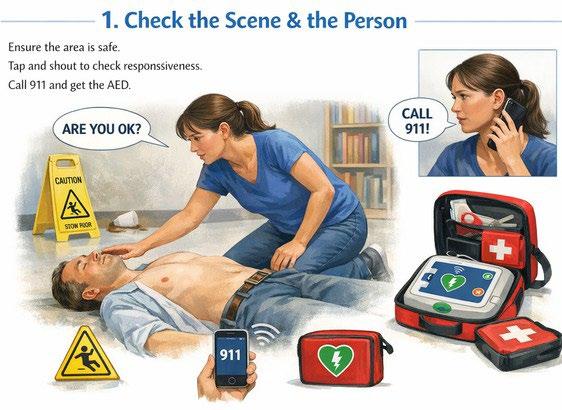
Before taking action , ensure the environment is safe for both you and the victim . Look for hazards such as electrical wires, fire, water, or sharp objects . Approach the person carefully, tap their shoulder, and shout to check responsiveness. If the person does not respond and is not breathing normally, immediately call 911 or activate emergency response Ask someone nearby to retrieve the AED while you begin CPR if trained
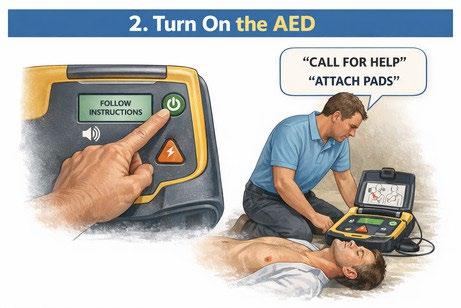
Open the AED lid or press the power button to activate the device . Listen carefully to the voice prompts and follow the visual instructions displayed on the screen . The AED will guide you step - by - step through the process, including pad placement and analysis
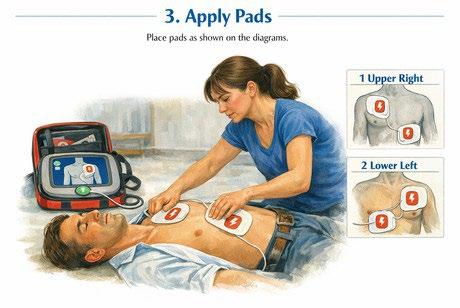
Remove clothing from the chest to ensure good contact between the pads and skin If necessary, dry the chest or shave excessive hair where pads will be placed Peel the backing from the electrode pads and place them exactly as shown on the diagrams :
One pad on the upper right chest, just below the collarbone
One pad on the lower left side of the chest, below the armpit Ensure the pads are firmly attached and the cables are connected to the AED .


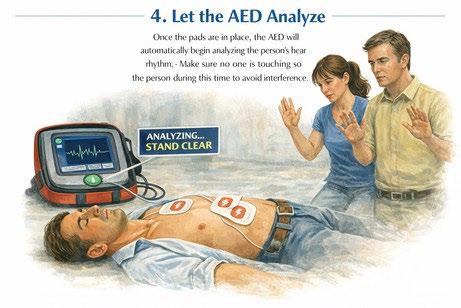
Once the pads are in place, the AED will automatically begin analyzing the person’s heart rhythm . Make sure no one is touching the person during this time to avoid interference
The device will determine whether a shock is needed and announce the next steps
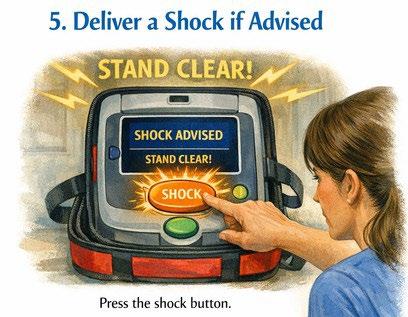
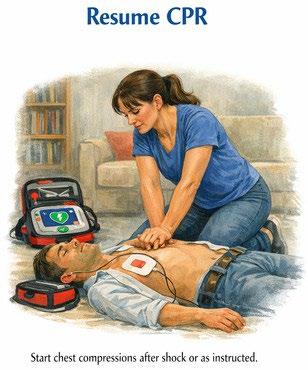
If the AED indicates “Shock advised,” loudly state “Clear!” and ensure everyone is away from the person Visually confirm that no one is in contact with the victim . Press the flashing shock button when prompted by the AED . After delivering the shock, follow the AED’s instructions it will tell you when to resume CPR
Begin chest compressions immediately after the shock or if no shock is advised Perform cycles of 30 compressions followed by 2 rescue breaths if trained, or continuous compressions if not Continue CPR and follow AED prompts until emergency medical services arrive and take over If the AED reanalyzes, stop compressions when instructed and resume after the analysis is complete

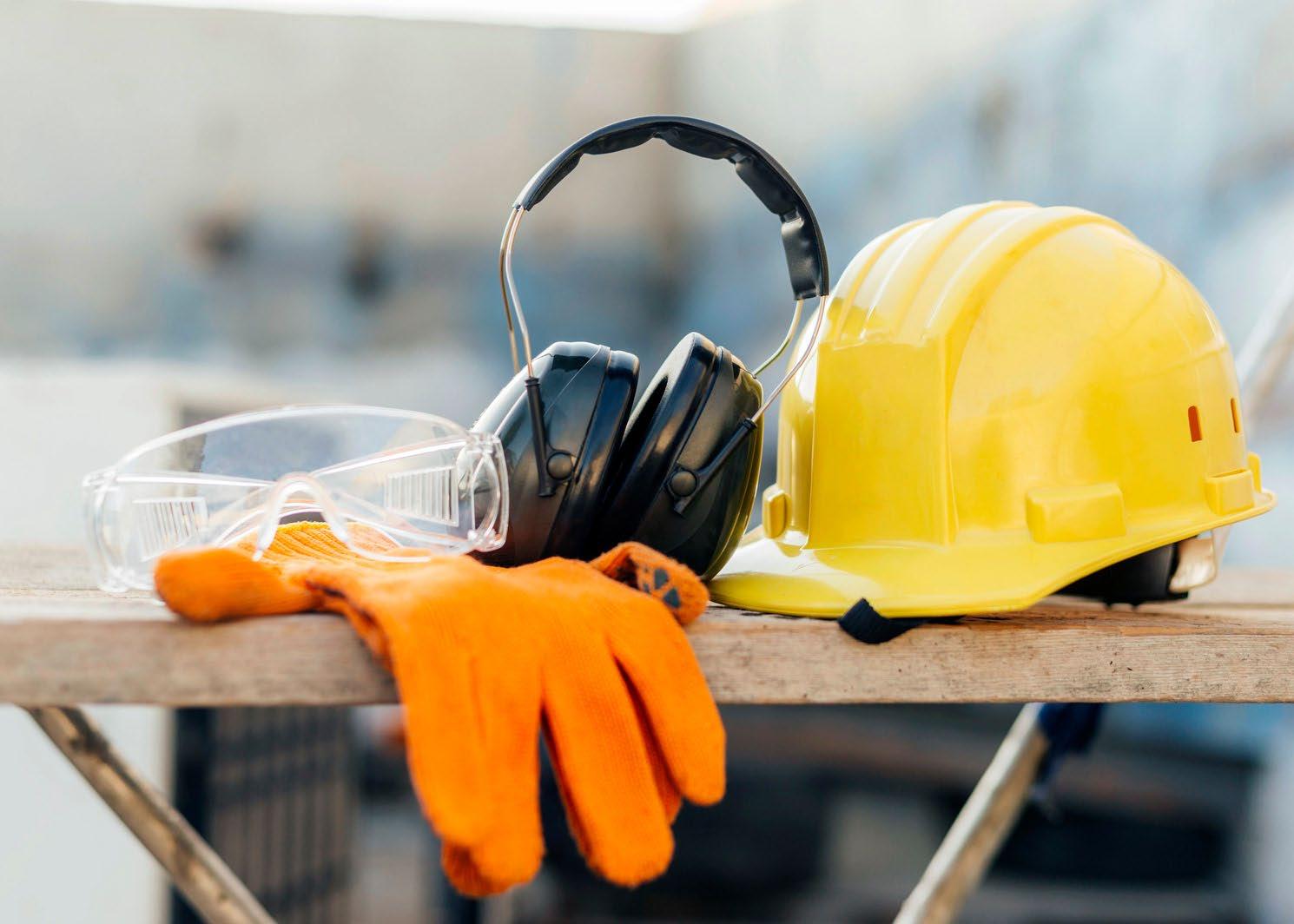
Personal protective equipment, commonly referred to as "PPE", is equipment worn to minimize exposure to hazards that cause serious workplace injuries and illnesses These injuries and illnesses may result from contact with chemical, radiological, physical, electrical, mechanical, or other workplace hazards. Personal protective equipment may include items such as gloves, safety glasses and shoes, earplugs or muffs, hard hats, respirators, or coveralls, vests and full body suits.
Employers bear the primary responsibility for ensuring a safe workplace through PPE:
• Hazard Assessment: Perform and document assessments to identify hazards requiring PPE
• Provide and Pay: Provide, pay for, and maintain appropriate PPE, including eye, face, head, and foot protection
• Fit and Selection: Select properly fitting PPE for employees and ensure it is in good condition
• Training: Train employees on when PPE is necessary, how to wear it, its limitations, and proper maintenance.
• Enforcement: Enforce the use of PPE on the job site
• Payment Rule: Employers must pay for PPE, with limited exceptions for items like nonspecialty safety shoes or prescription safety glasses that employees take home

Administrative Controls Engineering Controls Substitution Elimination
PPE: Last line of Defense

Employees are required to actively participate in the PPE program:
• Proper Use: Wear required PPE during relevant work activities.
• Maintenance: Clean, care for, and maintain PPE in a sanitary and reliable condition.
• Reporting: Inform supervisors immediately if PPE needs repair or replacement
• Training: Attend all required safety and PPE training sessions



Training, Water, Shade, Rest!
Cal/OSHA's Heat Illness Prevention for Outdoor Places of Employment regulation applies to all outdoor places of employment under working conditions that create the possibility that heat illness could occur.
For such outdoor workplaces and activities, employers must take steps to protect workers from heat illness. Some of the requirements include providing water, shade, rest, and training.
Exposure Concerns and Prevention:

Cal/OSHA requires employers to protect outdoor workers from heat illness when temperatures reach 80°F or higher
Core Requirements (at 80°F or higher):
Water: Provide, free of charge, enough fresh, cool water for employees to drink at least 32 ounces per hour (1 quart).
Shade : Provide access to shade (or alternative cooling methods) close to the work area when the temperature reaches 80°F.
Rest/Cool - Down: Encourage and allow cool-down rest breaks (at least 5 minutes) when employees feel the need to prevent overheating
Written Plan : Develop and implement a written Heat Illness Prevention Plan (HIPP).
Training: Train employees and supervisors on heat illness signs, prevention, and emergency procedures.
High-Heat Procedures (at 95°F or higher):
Observation: Implement regular observation of employees (e.g., direct contact, radio, or electronic monitoring) to identify signs of heat illness.
Mandatory Breaks : Provide additional mandatory, paid cool-down breaks, especially for employees working over 8 hours
Ensure effective
Communication: communication assistance.
Cal/OSHA now regulates that too!
Cal/OSHA's Heat Illness Prevention in Indoor Places of Employment regulation applies to most indoor workplaces, such as restaurants, warehouses, and manufacturing facilities where temperatures can get high.
For indoor workplaces where the temperature reaches 82 degrees Fahrenheit, employers must take steps to protect workers from heat illness. Some of the requirements include providing water, rest, cool-down areas, methods for cooling down the work areas under certainconditions, andtraining
While regulatory requirements regarding training, water access, rest periods, and written procedures are similar between these two types of environments, the effective temperature and other guidelines differ
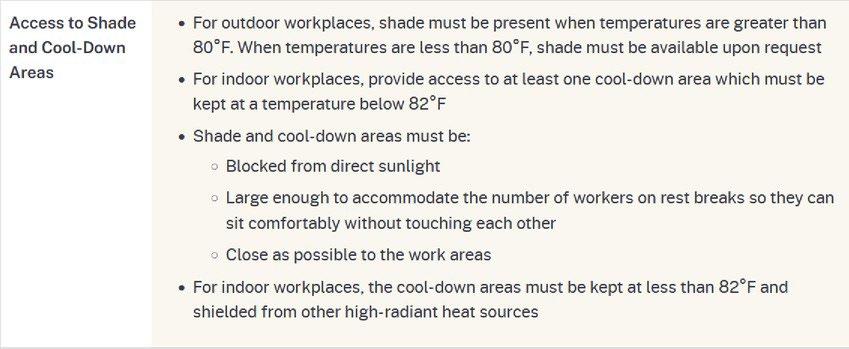
Measure the temperature and heat index and record whichever is greater whenever the temperature or heat index reaches 87°F (or temperature reaches 82°F for workers working in clothing that restricts heat removal or high- radiant-heat areas).
Implement control measures to keep workers safe Feasible engineering controls must be implemented first
For indoor workplaces that are affected by outdoor temperatures, train supervisors on how to check weather reports and how to respond to hot weather advisories

Every year, overexertion and improper material handling rank among the top causes of workers' compensation injuries in Riverside County. Whether you're moving a box of files down the hall, loading supplies onto a county truck, or shifting equipment on a field site the rules of safe material handling apply to every one of us This issue covers it all #1
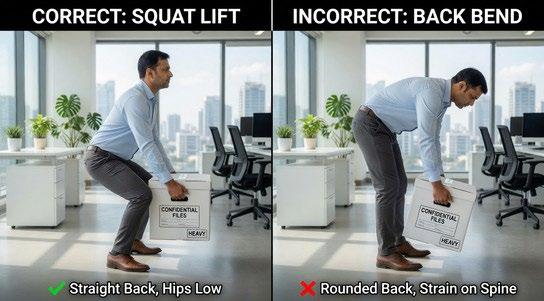
Always plan before lifting . Assess the weight, check your path, and decide whether you need equipment or a second person. A 10-second assessment prevents weeks of recovery
The Correct Technique
Stand close to the load. Bend at the knees not the waist Keep your back straight and your core braced Let your legs do the work Move your feet to change direction; never twist your spine under load.
If it feels too heavy, it is. No load in any County department is worth a herniated disc. Use a dolly, hand truck , or ask a coworker Two people lifting 60 lbs each is always safer than one person lifting 120.
California has no fixed legal weight limit for lifting, but Cal/OSHA requires employers to reduce ergonomic hazards. The NIOSH Lifting Equation gives the most widely used guidance. These limits assume ideal conditions real-world limits are often significantly lower
Ideal conditions (waist - high, no twist)
One - hand carry (office, files)
Overhead lift (above shoulder)
Floor-level lift (below knee)
Repetitive lifts (1+ per minute)
Team lift (two people coordinated)
USE EQUIPMENT WHENEVER POSSIBLE.
If a task requires repeated lifts near these limits throughout a shift, the task must be redesigned. Mechanical aids, team lifts, or workstation modifications are required — not optional.
2-WHEEL HAND TRUCK
Best for boxes, stairs, and office loads. Capacity: 400–600 lbs. Place heavy items low. Tilt back to balance over axle. Push don’t pull.
4-WHEEL PLATFORM DOLLY
Best for large or irregular loads. Furniture, equipment, field moves. Capacity: 1,000+ lbs. Center load. Use straps. Spotter for corners and doorways.
PALLET JACK


For warehouses, depots, and fleet operations. Capacity: 4,000–5,500 lbs. Training required before use. Never exceed rated capacity. Horn at every intersection. Inspect before every shift.
Office Environment
Copy paper case: 40 – 45 lbs use a cart
File boxes: max 2 at a time; hand truck for more
Monitors: use both hands; disconnect cables first
Never use a chair as a step stool for overhead storage
Field Environment
Never jump from a truck bed step down facing the vehicle
Slide loads to the tailgate before lifting
Heat reduces grip strength schedule heavy tasks early
Check footing before every lift on uneven terrain
INSPECT BEFORE EVERY USE
A damaged dolly or hand truck is more dangerous than no equipment at all. A wheel that catches mid-move or a frame that buckles can turn a routine move into a serious injury. Inspect your equipment before every use this takes less than 60 seconds
Wheels & casters
No flat spots, cracks, or debris on axle
Frame & welds
No cracks, bends, or warping
Handles & grips
No loose handles, sharp edges, or missing grips

TAG IT OUT:
Toe plate / forks
Not bent, cracked, or missing
Straps & tie-downs
No fraying, cuts, or worn ratchets
Hydraulics
If you find damaged equipment, tag it out of service and notify your supervisor immediately. Never remove another person's out -of-service tag Returning damaged equipment to service is a safety violation.
Any load over 50 lbs that cannot be mechanically assisted requires a team lift. In field settings: pipes, lumber, vehicle bed loading, and oversized equipment are common team lift scenarios.
Team Lift Protocol:
No leaks, slow descent, or uneven lift 1
Designate
Both lifters positioned symmetrically on the load
Agree on route and destination before moving
HEAT & OUTDOOR FACTORS FOR FIELD STAFF

Hydrate before you feel thirsty.
Dehydration reduces muscle function and increases injury risk. In Riverside County summers, hydration is not optional.

Leader calls: Ready Lift Move Set Down

Either person can call to stop no exceptions

Schedule heavy tasks in cool hours.
If your shift allows flexibility, schedule the heaviest material handling in the early morning before peak heat. Heat accelerates fatigue and impairs coordination
Never jump from a truck bed step down facing the vehicle, using the step and handrail (3 points of contact)
Slide loads toward you before lifting off a tailgate
never reach in and lift from a distance
Use ramps to slide loads where available rather than lifting over the tailgate

Stop if you feel dizzy or cramped . Dizziness, muscle cramping, and loss of coordination are warning signs. Stop. Report to your supervisor. These are not signs to push through
Position the vehicle to minimize carry distance
between the truck and the worksite
In high heat: grip strength decreases and fatigue compounds risk take breaks before heavy loads
Cut out or print this section and post it in your work area, breakroom, or on your equipment room door.

▸ Plan every lift assess weight and path first
▸ Bend your knees, not your waist
▸ Keep the load close to your body
▸ Use a dolly, cart, or hand truck whenever
▸ Ask for a team lift for anything over 50 lbs

▸ Twist your spine while holding a load
▸ Carry loads that block your line of sight
▸ Lift more than you can safely handle alone
▸ Use equipment that is cracked, bent, or
possible damaged rushing
▸ Inspect equipment before every use
▸ Report pain, discomfort, or near-misses
▸ Wear slip-resistant footwear on outdoor tasks
▸ Use gloves when handling rough or sharp
materials
▸ Take breaks during repetitive lifting tasks

Any County employee may request an ergonomic assessment through their supervisor. Once approved, Safety Loss Control schedules the evaluation no cost, no paperwork

Report all injuries, near-misses, and ergonomic symptoms to your supervisor. Early reporting leads to better outcomes and helps the County identify patterns and prevent future incidents.
▸ Rush most lifting injuries happen when
▸ Operate powered equipment without training
▸ Ignore pain or 'work through' an injury
▸ Skip the dolly because the distance is 'short'
▸ Reach into a truck bed to lift from a distance
▸ Stand on chairs, boxes, or unstable surfaces

Training on powered equipment (forklifts, electric pallet jacks) is required before use and available through your safety coordinator Manual equipment tips are in RIVCOTalent Click Here

Your back will carry you through a long career — or sideline you early. The choice happens in the moment before every lift. For ergonomic assessments, equipment training, or to report a safety concern:
The County has a return-to-work program for employees recovering from material handling injuries Speak with Workers Compensation “CLICK HERE” to learn more