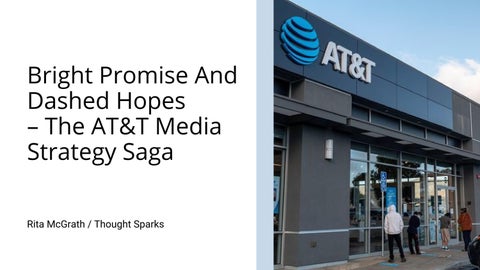
Bright Promise And Dashed Hopes – The AT&T Media Strategy Saga Rita McGrath / Thought Sparks
Big, expensive unions of large and unwieldy companies almost never work out well. The sudden termination of CNN+ is but the latest casualty in a long history of things that began with a lot of confident predictions that eventually crumbled into “oh, never mind…” There are lessons to be learned in the AT&T / Time-Warner / Discovery saga.
It was 2016, just six short years ago. AT&T, in a move that delighted investment bankers, lobbyists and lawyers, (but not their own investors) dug deep into the piggy bank and announced an $84.5 billion deal to acquire Time Warner, Inc., a media and entertainment company. At the time, it was positioned as a dreamy deal that would generate not only substantial cost savings, but also growth! Take the assets of the nation’s second-largest wireless phone provider and combine these with beloved entertainment and news properties such as HBO, CNN, TBS, Cartoon Network and the Warner Bros. film and TV studio in Burbank and you could see a bright new universe of new business models and customer touch points.
Rosy assumptions and deep pockets
Randall Stephenson, the AT&T Chief, and Jeff Bewkes, the CEO of Time Warner thought at the time that there was a billion of easy synergy savings to be captured. Moreover, that the acquisition would create a stronghold in the worlds of entertainment that couldn’t be copied because of AT&T’s massive reach.
So what were they thinking? (I/II) Anybody who is going to spend over $80 billion on something (or over $100 billion, if you take into account debt) must have a pretty good reason for doing so. So let’s see what they were thinking at the time.....
So what were they thinking (II/II)
Executives at AT&T felt they were at a competitive disadvantage in the media arena because companies such as Google, Netflix and Amazon had deep access to information about customers, which was attractive to advertisers. By joining up with AT&T, Time Warner would also be able to control more advertising minutes on its television stations. Another advantage that AT&T imagined it might have, and which its broadband-based competition didn’t, was a nationwide wireless network. Ultimately, the goal was to create a set of “over the top” services that could compete with cable and television networks.
Many twists in this merger story Before AT&T could consummate the deal, they first had to deal with the objections of the Department of Justice. In a move that sort of suggested the merger might actually be good for the companies, the Justice Department sued to block it. At the time, there was dark speculation that then-President Trump who made no effort to hide his utter dislike for CNN, one of the Time Warner properties, was behind the DOJ action.
But none of that darkened the 2018 Business Summit
Here’s where the story gets a little personal. I was invited to participate in a glitzy flagship event sponsored by AT&T, their 2018 Business Summit. I’d be speaking, doing some panel moderation and giving a VIP session to some of the high flyers at the event. This all took place near Dallas, roughly 100 days after the consummation of the merger.
That light at the end of the tunnel? (I/II) In April of 2020, Randall Stephenson, AT&T’s CEO announced his plans to retire. John Stankey would step in effective July 1st. At the time of his rise to the role, the company was struggling. Shares were down 22% from the start of that year. More importantly, analysts were approving of a strategy that involved serious cost-cutting (over $6 billion) and “protecting” AT&T’s dividend.
That light at the end of the tunnel? (II/II) “Then came the shocker. The new CEO, John Stankey, announced that AT&T was giving up on its dream for a combined content and distribution company. AT&T had agreed to spin off its media empire that included HBO, CNN, YNT, and Warner Bros. studio to Discovery. The sale wiped out tens of billions of dollars of equity value. Stankey would no longer challenge Comcast in PayTV or draw digital advertising from Google or challenge Netflix on streaming. It would revert to being a broadband and wireless company.”
Lessons learned? This is a case in which I think the strategy actually made sense. Take a contrasting example of a company that made the combination of content and distribution, that of Comcast. Comcast is widely regarded to have successfully navigated the merger of content and distribution businesses (not to mention theme parks). It has now positioned itself as a leading player in new streaming services, with the opportunity to potentially create international reach.
You can follow me on Twitter (@rgmcgrath), on Instagram (@ritamcgrathofficial), on LinkedIn and on YouTube. For access to the archives, ability to make comments and read longer versions of my regular communications, subscribe. Get in Touch, Keep in Touch!
https://thoughtsparks.substack.com/