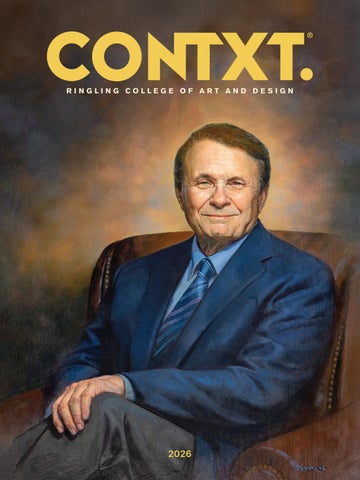
An academic legacy of building and evolving Ringling College’s curriculum
24
AWARDS
Our brightest achievements from the last year
30 THE CREATIVE JOURNEY OF PATRICIA THOMPSON
A sculptor finds her artistic path at Ringling College
Art by Illustration faculty member Bjorn Thorkelson.
THE LEGEND OF LARRY
How Dr. Thompson made his mark on Ringling College, Sarasota, and the world of art and design
THE SERENDIPITY OF SARASOTA ART MUSEUM
The vision and drive that brought the Museum to life
SEQUINS, SCHOLARSHIPS, AND A SARASOTA LEGACY
Inside the Avant-Garde Gala THE TRUSTEE SCHOLAR AWARDS CEREMONY HISTORY
A celebration of how the Trustee Scholar Awards Ceremony grew into Ringling’s highest honor
EXPERIENCE MATTERS
Bringing experiential learning to Ringling College
RINGLING ALUMNI GATHER ACROSS GENERATIONS
Hundreds attend the Alumni Weekend and Wall of Honor Ceremony
RINGLING COLLEGE WELCOMES ITS NEXT PRESIDENT
Dr. Davis Schneiderman
A Shared Vision, an Enduring Impact
Twenty-seven years. I almost can’t believe it. As I write my final CONTXT letter to you as President of Ringling College of Art and Design, I find myself reflecting on an extraordinary journey, one defined not by any single achievement, but by the collective vision and dedication of this remarkable community.
When I arrived in 1999, Ringling College was a vibrant campus of nearly 900 students with six majors and boundless potential. Together, we have built something truly remarkable: a thriving community of almost 1,600 students across 13 majors, and growing, spanning more than 60 acres and including world-class facilities like Sarasota Art Museum. We have weathered challenges, seized opportunities, and remained steadfast in our commitment to creative excellence and to providing a world-class art and design education.
If you know me, you probably know that the idea of retirement did not come easily for me. But, what sustains me in this moment of transition is knowing that the community we have cultivated extends far beyond our campus. Our students are pushing the boundaries of creativity. Our alumni are shaping industries worldwide. Our donors have made transformative dreams possible. Our colleagues at Sarasota Art Museum, the Osher Lifelong Learning Institute, TOWN HALL Speaker Series, and the College’s Galleries and Exhibitions have been true partners in building something that matters deeply, not just to us, but to the cultural fabric of our entire region.
This summer, we welcome Dr. Davis Schneiderman as Ringling College’s seventh president. The work of building and sustaining an institution of this caliber is never the work of one person, and I trust that he will find in you the same partnership and commitment that have defined my tenure here.
To each of you—thank you. Thank you for believing in the power of creativity, for investing in our students, and for helping build an institution poised to be recognized as the preeminent art and design college in the world. That dream remains within our grasp.
Creativity matters. It always has, and it always will.
With deepest gratitude,
Larry R. Thompson President, Ringling College of Art and Design
Portrait by Matthew Holler ’11, Photography and Digital Imaging
Ringling College Expanded
News from across the Ringling College community
Sarasota Art Museum
Over the past year, Sarasota Art Museum (SAM) set new attendance records with two landmark exhibitions, Art Deco: The Golden Age of Illustration and Janet Echelman: Radical Softness.
Next season, SAM will present photography by some of the most beloved and influential practitioners of the 20th century, a solo show by Ringling College alum Chie Fueki ’96, Fine Arts, and a thought-provoking exhibition of glass sculpture and installation by Monica Guggisberg and Philip Baldwin. SAM continues to be a community destination for educational programming and social connection through its regular artist talks and tours, live music events, film screenings, on-site studio classes, culinary events, and more. See what’s happening at sarasotaartmuseum.org.
Osher Lifelong Learning Institute (OLLI)
In Fall 2025 and Winter 2026, OLLI celebrated record-setting increases in enrollment, attendance, and membership.
As part of their Strategic Plan, they launched OLLI Talks, their first official fundraising event, featuring New York Times bestselling author and Florida native Carl Hiaasen on March 27, 2026. This highly anticipated event was a significant milestone in raising OLLI’s visibility in the community.
In the coming months, OLLI is preparing to continue the rollout of its Strategic Plan. In September 2026, they will expand their program options through participation with the Osher National Resource Center (NRC) to launch “Osher Online.” This new initiative will give members access to a broader network of online courses that are managed by the Osher NRC. Learn more at olliringlingcollege.org.
Art Deco: The Golden Age of Illustration and Janet Echelman: Radical Softness at Sarasota Art Museum of Ringling College of Art and Design
OLLI Previews build camaraderie and community among members and instructors.
Galleries and Exhibitions
Over the past year, Ringling College Galleries and Exhibitions presented a dynamic slate of shows celebrating alumni, faculty, students, and visiting artists, including the studentcurated exhibition Roots and Resilience, which highlighted diversity and inclusion, and Origins: Sarasota Artist Colony, honoring the legacy of artists who shaped the region.
Looking ahead, the 2026–2027 Ringling College Galleries
Season is anchored by John Chamberlain + Friends: Sarasota, a major premiere exhibition in the Lois and David Stulberg Gallery that explores Chamberlain’s deep ties to the region through dialogue with artists from his circle. Across campus, our seven additional galleries present exhibitions featuring both established and emerging voices, including a dynamic mix of student-organized and student-curated exhibitions alongside distinguished faculty, visiting artists, and alumni presentations—all reinforcing Ringling College’s role as a vital cultural resource in the region.
See what’s new at ringlingcollege.gallery.
TOWN HALL Speaker Series
This year, the Ringling College TOWN HALL Speaker Series celebrated 45 years of bringing the most influential voices and changemakers of our time to Sarasota. The 2026 lineup featured documentary filmmaker Ken Burns, CNN legal analyst Laura Coates, National Geographic Photographer Joel Sartore, Actor Hank Azaria, and U.S. Secretary of State Antony Blinken.
TOWN HALL is renowned for presenting ideas that challenge, inform, and inspire our community. Visit ringlingcollegetownhall.org for more information and to purchase a subscription for our 2027 season.
Roots and Resilience in the Lois and David Stulberg Gallery
Executive Director Lauren Kurnov in conversation with filmmaker Ron Howard
The of LEGEND LARRY
How Dr. Larry R. Thompson made his mark on Ringling College, Sarasota, and the world of art and design.
By Cooper Levey-Baker
LEGEND LARRY
One day in 1998, a headhunting firm reached out to Dr. Larry R. Thompson to tell him about a job opening as president of what was then called the Ringling School of Art and Design.
At the time, Dr. Thompson was working as the head of the Flint Cultural Center in Flint, Michigan, and before that, he had led The Rock & Roll Hall of Fame Museum in Cleveland, Ohio, and worked as an attorney at The Ohio State University in Columbus, Ohio. But he had never been a university president, he had never heard of the Ringling School, and he knew nothing about Sarasota, Florida, which, he learned, was where the school was located.
At first, he was skeptical. Thompson wasn’t an artist, and therefore did not think of himself as creative. That’s good, the recruiter told him. The school wasn’t looking for an artist—they were looking for a leader. But what about Florida? Thompson harbored biases about the state. “Florida’s reputation was not necessarily fantastic,” he says. “I thought the culture might be Mickey Mouse and Donald Duck.”
But as Thompson began learning more about the Ringling School, he grew intrigued, and he eventually came to Sarasota for an interview. Holed up in a hotel so that no one in the community would find out who was being considered for the position, he made a secret trip to campus to find out what he’d be getting himself into if he got the job. He sat down with a handful of students at a concrete table outside the school’s cafeteria and introduced himself as someone new to town who was just curious about the school and its culture.
“I started asking them questions,” Thompson remembers. “I said, ‘What do you think of this place? How do you like it? What brought you here?’ And the answers from the students were phenomenal. They said, ‘Oh my God, we love this place. We have the greatest faculty, because they spend so much time working with us.’ I was really impressed that the students loved it so much, because usually you don’t hear students rave like that about a college.”
It dawned on Thompson that he was in a special place. When the Board of Trustees offered him the job, starting in July 1999, he didn’t hesitate—he said yes.
Portrait by Matthew Holler ’11, Photography and Digital Imaging
Seen from the vantage point of 1999, the Ringling College of 2026 would barely be recognizable. In 27 years under Thompson’s leadership, the College has added 14 new buildings to its campus, grown the number of majors it offers from six to 13, doubled its enrollment from 892 to a peak of 1,722, increased its endowment from less than $4 million to $97 million, grown its total assets to $457 million, and reinvented itself as one of the—if not the—preeminent art and design colleges in the world.
Students today can take classes in everything from sculpture to artificial intelligence, glassblowing to virtual reality, figure drawing to projection mapping. They can help on film sets with Hollywood directors, interact with world-renowned artists at the College’s Sarasota Art Museum, and work with local businesses and nonprofits through the Center for the Creative Economy. They can relax on a patio behind the Alfred R. Goldstein Library, catch a bite to eat at Cunniffe Commons, and crash after a long day of classes in one of many new or newly refurbished residence halls or off-campus houses.
All of that is due, in part, to Dr. Thompson. He has steered the College from the era of America Online to the era of ChatGPT, through crises ranging from Category 5 hurricanes and evacuations to the COVID-19 pandemic. And when he retires in May, he leaves behind an institution that will forever be marked by his leadership.
Of course, he wouldn’t say that himself. According to him, his main goal when he was hired was simple: “Don’t screw it up.”
While the College’s academics had been rooted in traditional majors like fine arts, photography, and illustration, the school had embraced the emerging field of computer animation before Thompson’s arrival. (A 1993 Sarasota Herald-Tribune story outlined a Ringling program focused on the then-new concept of “interactive multimedia,” i.e., “software that uses both sound and animation.”) Thompson was impressed by the way the school had embraced emerging technologies, and he saw how expanding the school’s curriculum into high-tech fields had led to an increase in enrollment, which in turn enabled the school to grow in other ways. To build on that success, he theorized, the school would need to offer students even more choices and more opportunities.
That meant being open to new ideas. Thompson credits the College’s faculty for pushing the curriculum forward. Majors like Motion Design and Virtual Reality Development came about because faculty members approached Thompson and suggested them. “I’ve always had an open-door policy with anybody,” Thompson says. “Any student, any faculty member, anybody with a good idea can come see me. I’m always open to a discussion about it. That’s how you grow. That’s how you develop new things, because we are surrounded by incredibly creative people here.”
Alfred R. Goldstein Library
Dr. Thompson’s willingness to listen also led to other important decisions, like the effort to construct the Studio Labs and to convert the historic Sarasota High School into the Sarasota Art Museum. The Studio Labs were designed to give students in the Film program the chance to work on real-world projects with industry professionals who could, in turn, take advantage of the facility’s resources and the talents of the student body.
The idea behind the Sarasota Art Museum, meanwhile, came together in a matter of days. While proposals for a contemporary art museum in Sarasota had been bandied about for years, the idea for Ringling College to adapt the Sarasota High School building came together in days. Someone pitched Thompson on the idea on a Thursday—proposals were due the following Monday. When Ringling College’s concept won out, there was just one problem: Thompson needed to notify the College’s Board.
“I told them what had happened and said, ‘I don’t want you to be surprised when you read it in the newspaper,’” he remembers.
“And they said, ‘What in the hell are you thinking? Don’t you know museums eat money? They don’t make money.’”
In Thompson’s mind, however, the Museum represented an opportunity for the College to connect with the broader community in a unique way.
Large traditional universities can generate public attention through athletics. For a small art school like Ringling College, that’s not possible. But the Museum could create opportunities for visitors who know nothing about Ringling to learn about the school. “Think of this high school as our football field,” Thompson told the Board. “It will bring people from the community to the Museum and then into the College.” The Board bought into the idea. “And the next thing I know,” Thompson says, “we’re raising money to refurbish the high school.”
Connecting the Sarasota community to what was happening on campus has also been a major part of Dr. Thompson’s fundraising strategy. Sarasota’s affluence, combined with residents’ willingness to donate and support the arts, created another pathway.
The key was to let potential donors meet Ringling students, whose talent, passion, and inspirational stories would win them over, even if the donors had no existing connection to the College. “That’s why we have all these events—to bring people to campus and to talk to our students,” says Thompson. “It’s not just me going out to raise money.” There’s another strategy at play, too. “People are always looking for things to do,” he says, “and we have the best parties, I think, in Sarasota.”
Sarasota Art Museum, Marcy & Michael Klein Plaza
Ringling College students at work
Community members at play at Lillian Blades: Through the Veil
Installation view of Steven and William Ladd: Lead With a Laugh
Academic and campus advancements during
2009: Ann and Alfred Goldstein Residence Hall
2009: Larry R. Thompson Academic Center
2007: Film
2016: Visual Studies
2016: Creative Writing
2008: Business of Art and Design
2012: Student Health Center
2009: Motion Design
2006: Ulla Searing Student Center
2007: Game Art
27-year tenure of Dr. Larry R. Thompson.
2023: Cunniffe Commons
2018: Bridge Apartments
2026: Creative Technologies
2018: Virtual Reality Development
2019: Entertainment Design
2018: Ringling College Studio Labs Complex
2017: Alfred R. Goldstein Library
2019: Sarasota Art Museum
2020: Greensboro Hall
2018: Richard and Barbara Basch Visual Arts Center
When Thompson first visited the College, in addition to being impressed by the students, faculty, and staff, he was excited about the opportunities to further support whole student development. This happened through the creation of robust Student Life offerings such as recreation and fitness activities, student activities and leadership development, specialized clubs, and student government—in his mind, these weren’t just fun things for students to participate in. They helped develop socalled “soft skills,” like communication and teamwork, that can boost someone’s career as much as formal academic training. He sees the vibrant Student Life program of today as an asset that differentiates the school from its competitors.
Dr. Thompson saw, too, how those programs flourished because a majority of students lived on campus. Students’ physical proximity to one another, even outside the classroom, helped create a cohesive campus culture. With that in mind, the school has continually expanded its housing throughout Thompson’s tenure, but it hasn’t always been easy. When the College began developing plans for what would eventually become the Ulla Searing Student Center, existing city zoning rules would have capped the structure at just three stories.
“In order to do what we wanted to do with the building, we needed to make it taller,” Thompson says. “So we started talking to the city about making it five stories, and we went through this whole big process of trying to get a variance.” The school eventually convinced the City Commission to approve the plans, a decision he credits to deepening relationships with elected officials and other civic leaders. “You’ve got to have everybody on your side,” he says, “and at that point, people had really learned about the College and how incredible it was and how unique it was as an institution.” Thompson calls the approval of the student center a “game changer.” (Still, when construction began, even he was taken aback at how the new building dwarfed its surroundings. “I thought, ‘I hope I am not destroying this entire campus,’” he says with a laugh.)
The opening of the Ulla Searing Student Center in 2006 unlocked future growth by ensuring that other campus buildings could rise to five stories, as well. Thompson says providing on-campus housing remains a major priority for the school. “Getting an apartment in town is an expensive endeavor,” he says. “That’s one piece. The second is that it creates this entire community of people interacting with each other day and night, which is another big part of the Student Life component. It makes us somewhat distinctive among art colleges to have this volume of on campus housing.”
Student Life offerings flourished under Dr. Thompson’s presidency.
Of course, professional achievements aren’t everything, and Thompson has played other roles at Ringling College across the decades. His wife, Pat, graduated from Ringling with a degree in Fine Arts in 2016, and his son, Hunter, graduated in 2014 with a Motion Design degree, two experiences that allowed Dr. Thompson to better understand the Ringling experience from a student’s or a family’s perspective. He says sitting through orientations for new students with his own children was excruciating. “I thought, ‘This is really boring,’” he says. When he insisted that the College shake things up, he was tasked with loosening up the crowd by hopping on stage to do his best James Brown impression. (These days, he prefers to mimic Bruno Mars.)
Dr. Thompson’s love of dancing is well known to anyone who has attended a function that includes both him and a dance floor—a passion that inspired the theme of this year’s Avant-Garde fundraising gala. Thompson took tap-dancing lessons when he was five years old, but his love for movement cemented itself with the emergence of rock and roll. To this day, he swears by the music of the Rolling Stones (particularly their run of late ’60s and early ’70s records) and Motown. “It’s hard to listen to that music and not move,” he says, correctly.
This summer, someone new will be attempting to fill Dr. Thompson’s dancing shoes. On January 23, 2026, the College announced that Dr. Davis Schneiderman will be the next Ringling College President, starting on June 1.
Asked what he wants Dr. Schneiderman to know, Thompson says, “This institution is the most amazing place I’ve ever been. I absolutely love it. I love the people here. I love the students. I love the faculty. I love the staff.
It’s a phenomenal group of people. It’s such a joy to be here.”
Over the years, when Thompson has been stressed out or in what he calls “a funk,” he has gone out of his way to check in on what Ringling students are up to. It’s an energizing reality check, not all that far removed from what he was up to when he sat down with those Ringling students 27 years ago to hear what they had to say about the school.
How would he like to be remembered by the Ringling community?
Thompson pauses for a long time before answering, thinking back to the potential he saw in the school when he first arrived on campus in 1999.
He says, “It would be that, during my tenure, I helped bring Ringling to life as the place that it was meant to be.” That process, of course, doesn’t stop with his retirement. “This institution,” he says, “goes on forever.”
Watch the full interview with Dr. Larry R. Thompson.
Dr. Thompson brings Ringling College Orientation to life.
The Serendipity of Sarasota Art Museum
By Sylvia Whitman
Dr. Larry R. Thompson likes to tell Sarasota Art Museum’s origin story “because it’s a really good one.” In 2003, early in his presidency, competing ideas about creating a contemporary art museum were simmering in Sarasota. Dr. Thompson lurked at those community meetings “because I thought—contemporary art—probably ought to be involved in that, right?” One day, he got a call from developer Mark Kauffman. “He said, ‘Larry, give me 15 minutes of your time without throwing me out of your office.’ I said jokingly, ‘Okay, because I’ll talk to anybody.’”
Kauffman pitched a bold plan on behalf of 13 dreamers who eventually became known as The Founders. The Sarasota County School Board was entertaining proposals for adaptive reuse of the defunct historic Sarasota High School on Tamiami Trail. Would Ringling College like to go in on transforming that 57,000-square-foot building into a museum? Oh, and by the way, proposals were due Monday.
“This was a Thursday,” Thompson recalls. “I said, ‘There’s no way in the world I could do that. I’ve got a board; I’ve got all kinds of things. I can’t just rush off and commit to something like this.’ And he said, ‘Well, just think it through.’”
A self-described “recovering lawyer,” Thompson spent the weekend drafting a proposal with numerous contingencies. The school board’s blueribbon committee chose it, granting the figment of a museum a 99-year lease for $1 per year.
Thompson says he faced tough questions from Ringling College’s Board of Trustees. “Don’t you understand museums just eat money?” one Trustee asked. The College—and its endowment—was smaller then. In higher ed, athletics attract donations. Ringling didn’t have major sports, but an art museum would draw in local donors, connecting them with the College while creating opportunities for students. “Think of this museum as our football field,” Thompson told the Board.
He also promised that renovations wouldn’t start without full funding in place. Too often, he had seen promising projects flounder because donors mistook construction as a sign that they could close their wallets.
All this was the easy part. Raising millions of dollars, revamping the building, refining and refining and refining the vision and the blueprints—that took well over a decade.
Sarasota Art Museum opened in December 2019.
“I was married to Larry for 11 years,” jokes Wendy Surkis, “ringleader” of The Founders and now a Ringling College honorary life trustee. At age 50, she had retired to Sarasota after growing an ad agency into an international company with 18 branches. Volunteering to turn a 1926 brick high school into a modern museum-cum-learning-hub wasn’t on her bucket list, Surkis says, but it suited her energy and acumen. And she was married, in actuality, to an artist. “I worked day and night 24/7 to bring this to fruition.”
She and Thompson were “very simpatico,” Surkis says. “Larry was a big thinker, and he really reached outside and beyond the box, and that’s how I am.”
Thompson agrees. “It’s because of her that this actually happened,” he says. “We were joined at the hip.”
Plans for the Museum included programming for the Sarasota community. The Great Recession slowed the project. To sustain momentum, Surkis and The Founders brought in artists to lead activities on the grounds, such as gathering sticks with artist Patrick Dougherty to weave into his sculpture Out in Front
“I want to say this in a very positive way: Larry didn’t get in my way,” Surkis says. “I had tremendous latitude. Larry assured me that he was only a phone call away if I needed him.”
Others involved in this mammoth undertaking also appreciated Thompson as a hands-off decision maker and cheerleader. “He does not get into the weeds,” says David Sessions, CEO of Willis Smith Construction, which accomplished the renovation. “He hires good, qualified professionals. He listens to what they have to say and lets them do their job.”
Blueprints changed dramatically twice, especially after the school board offered Paul Rudolph’s vocational shops to the Museum Campus. Sessions saw Thompson step up again and again to respect the historic architecture. He backed, at major expense, hurricanehardened custom windows and repurposed hard-pine joists as flooring.
Thompson also empowered Virginia Shearer, SAM’s executive director since summer 2021. She took office after the new Museum had closed and reopened during the COVID pandemic. “When they recruited me, Larry said, ‘Jump start this museum; make it everything that we dreamed it could be,’” Shearer says. “My job was to throw a lot of gasoline out there, light a match, and see what would happen.”
Many successes have resulted, including free Second Sundays, Jazz Thursdays, and a play space opening in 2026 to engage young families. “What Larry’s done is set the conditions for excellence. We’re trying to build something that is very tailored and very specific for this community, something that’s going to ignite a lot of sparks and really resonate for people. And he trusts us to do that work.”
Wendy Surkis, now a lower-key volunteer and member of Shearer’s “kitchen cabinet,” feels that “as much as Larry will be missed, we couldn’t be in a better situation. Larry has worked his tush off. He gave his heart, soul, time, and life to Ringling College. It’s time for him to have time for himself.”
Dr. Larry R. Thompson still remembers what Ringling School of Art and Design looked like in 1999, before it became Ringling College of Art and Design. The campus was compact, the buildings modest, at best, and the academic structure was simple and clearly defined. Still, right from the start, he saw how seriously the students worked. Even within a small footprint at the corner of Dr. Martin Luther King Jr. Way and Tamiami Trail, students were producing ambitious projects on par with those of much larger schools, and faculty members were invested in their disciplines.
One program stood out right away: Computer Animation.
That kind of major wasn’t yet embraced at most other institutions, yet Ringling had already planted a flag. The space itself was “like a dungeon,” Dr. Thompson recalls with a laugh, but the point was much bigger than the square footage. “That told me the institution was already forwardlooking,” he says. “The question was how to build from there.”
Early in his presidency, Thompson led a strategic planning process that forced the College to look hard at its future. Staying small wasn’t a viable long-term plan, but growth needed to happen in ways that matched the College’s culture. He was clear from the outset. Students needed to be artists first, with everything else built on a shared foundation of visual thinking, craft, and storytelling.
Motion Design offers one of the clearest examples of how Thompson approached the development of academic programs. The major opened a new lane for students drawn to movement, pacing, and visual rhythm rather than character-driven storytelling, creating space for a broader range of animation practices within Ringling’s curriculum.
“I’m very, very proud of Motion Design,” Thompson says. At the time, the concept was unfamiliar, and even the name required explanation.
The program itself grew out of Ringling College’s longer history in animation. Before character animation became the dominant focus of Computer Animation, students were creating title sequences, abstract and experimental animation, stop motion, and other forms of motion-based work. As industry demand shifted following the success of feature-length animated films, the curriculum narrowed to better prepare students for character animation careers. Motion Design later re-embraced that wider terrain, expanding the definition of what animation at Ringling College could be.
“Motion design doesn’t fit into a single category,” says Ed Cheetham, head of Ringling’s Motion Design department. “It’s the use of animation to communicate ideas across all kinds of screens.”
That breadth is now visible everywhere. Motion design shows up in commercials, title sequences, social media, visual effects, interfaces, and largescale installations. What once felt difficult to define has become a common visual language across media, even if most people never think to name it.
Game Art followed a similar logic, reflecting how games are actually made by blending narrative, design, and technology in ways that matched real production workflow. It signaled Ringling College’s willingness to treat interactive media as a serious narrative and design discipline, not a niche specialization.
Other decisions grew out of harder moments, including Entertainment Design, which emerged during a period of transition. Interior Design had long been a significant presence at the College, but declining enrollment and restrictive accreditation requirements made it difficult to maintain in its existing form. Thompson and his colleagues responded by rethinking how that work could evolve within the College. Entertainment Design retained elements of spatial thinking while shifting focus toward themed environments and immersive experiences. That change aligned the program with how audiences actually encounter designed spaces today through experience, storytelling, and spectacle.
Film presented a different set of challenges. Visual storytelling was already central to Ringling’s culture, yet film wasn’t always associated with art schools in the public imagination. Credibility came from access to working professionals, not syllabi. The Studio Labs program became one way to close that gap, bringing film professionals to campus and placing students in real production contexts. Thompson understood why it mattered. “In film, it’s all about who you know,” he says. “Students needed real-world experience, not just coursework.”
Growth brought uncertainty, too, and some bets didn’t land. Thompson is open about the challenges faced by the Virtual Reality Development major, which he once believed would gain traction quickly. Despite its visual focus, it struggled to align with public expectations of what an art college was. Photography declined because of rapid technological change and shifts in the industry itself. Advertising Design launched with promise and proved difficult to sustain.
Those decisions were difficult. Letting go of programs is never simple, but Thompson argues that colleges must respond honestly to change, even when that means closing something that once felt central.
One of Thompson’s quieter but lasting contributions came through the Business of Art and Design. A successful and enduring major, it found its strongest role as a minor, giving students a clearer understanding of how creative careers function as freelance and contract-based pathways became more common. That perspective continues to shape how the college prepares students.
The College’s newest major, Creative Technologies, reflects Thompson’s instinct to stay attentive to what’s emerging, creating space for students building tools, applications, and entrepreneurial projects influenced by new technologies without being defined by them.
Across decades of change, Thompson returned to a small set of priorities. Curriculum quality mattered, as did faculty and the ability to stay alert to what might come next. “Enrollment drives everything,” he often reminded colleagues. “But behind enrollment is academic quality.”
As he prepares to retire, the academic landscape Thompson leaves behind tells a clear story. Ringling College is larger now, with a wider set of majors and deeper connections to the creative industries its students hope to enter. But the core expectations have remained consistent.
• Help students become artists with strong foundations.
• Give them room to adapt.
• Keep the institution flexible enough to change alongside them.
That balance, more than any single program, defines Thompson’s academic legacy.
Sequins, Scholarships, and a Sarasota Legacy: INSIDE THE AVANT-GARDE GALA
By Rick Dakan
Dr. Larry R. Thompson has emerged from a sarcophagus. He has sailed in on a pirate ship as Captain Jack Sparrow. He has ridden a palomino horse dressed as Roy Rogers, with his wife Pat as Dale Evans. He has been JFK to Pat’s Jackie, Sonny to her Cher, the Wizard of Oz to her Glinda. In 2023, Larry came as Elton John. So did Pat, but as Elton Jane. They each had their own piano and sang for a captivated audience. For 25 years, Larry and Pat Thompson opened Avant-Garde, Ringling College’s annual costume gala fundraiser, with entrances that have become the stuff of Sarasota legend and legacy. But behind the sequins and the stagecraft is a serious mission.
“Some of the worst days are when I talk to Ringling College seniors who had some life setback, and they’re going to have to leave the College, although they love it,” Thompson reflects. “Not through any fault of their own. Things happen. This support allows them to stay.” The funds raised at Avant-Garde support the student scholarships, which helps students who face unexpected financial hardships complete their degrees. The awards are based solely on need, not academics.
When Thompson arrived at Ringling College, Avant-Garde was already on the calendar. The event had started in 1995 under President Arland Christ-Janer, with a Red Dragon theme at Michael’s On East. By the time Thompson arrived, the event had moved to campus. “It was nice. A pleasant thing,” Thompson says of those early years. “Pretty small, a nice outdoor party on campus. Not the kind of numbers we have today. Not even close.”
Now in its 30th year, the gala regularly draws more than 400 guests. Thompson saw the potential early. As a college president, he knew he needed to raise money for students and scholarships. Thompson looked to Sarasota’s philanthropic community. And he had some other relevant experience. Before coming to Ringling College, Thompson oversaw the creation of the Rock & Roll Hall of Fame Museum. He loves to dance. He knows how to throw a party.
“One of the strategies for engaging the community was asking how do we become one of the most important nonprofits in Sarasota,” Thompson explains. “Avant-Garde has helped with that.” The event brings hundreds of people to campus each year, many for the first time. They meet students. They see the facilities. They learn what Ringling College does. Then they come back. “Once people come, they come again,” Thompson says. “It’s a great, great event. Sold out every year.”
The costume element sets Avant-Garde apart from other nonprofit galas. Thompson admits he wasn’t much of a costume person when he started. His first year, the theme was Italian. He came as the Pope. Pat came as a Papal Guard. “I thought I may not last long,” he jokes. “But everyone had fun with it.” Now costumes are central to the event’s identity. “It used to be half and half,” Thompson says. “Now almost everyone is in costume.”
In recent years, Ringling College’s Industry Experience program (INDEX) has elevated the production. Students work with the College’s Design Center to create the look and feel of each event, and students from nearly every major now contribute to the planning and execution. They design the event experience and create entrance concepts that set the stage for the gala. “That really stepped the game up quite a bit,” Thompson says. “Before, students were involved, but using INDEX as a way to organize it really stepped things up.”
More recently, Larry and Pat have pulled back from the grand entrances. They want the focus on the students. The highlight of each evening is the paddle raise, when guests pledge donations to Crossing the Finish Line. Students share their own stories of how the scholarship kept them enrolled. The emotional appeal works. The room gets caught up in the moment.
Thompson attends a lot of fundraising events in Sarasota. He calls Avant-Garde one of the most fun parties in town. But what stays with him is the community’s generosity. “I’m so impressed by the willingness of the community of Sarasota to really support this institution,” he says. This year’s theme is Dancing Through the Decades, a tribute to Larry and Pat Thompson and their nearly three decades at Ringling College. It’s a fitting choice. Somewhere on the dance floor, a student who thought they’d have to leave will be celebrating the scholarship that let them stay.
“Dueling Eltons” at Avant-Garde: Ringling College Rocks the 70s
Sonny and Cher at Avant-Garde: Let Us Entertain You!
The many facets of Dr. Thompson
A horse-drawn arrival as Sherlock Holmes and Dr. Watson
Jackie and John F. Kennedy greeting adoring fans
YOUR SUPPORT BRINGS CREATIVITY TO LIFE.
At Ringling College of Art and Design, creativity is the driving force of all that we do. It inspires every aspect of our daily lives, even beyond the artwork so beautifully created by our students. Creativity empowers us to reimagine how the world works. It changes lives. And your support makes it possible.
The emerging artists and designers of Ringling College have talent beyond measure and a true passion for their craft. They are dedicated to achieving great things, but they can’t always do it alone. The generosity of donors helps alleviate financial hardships for students, provides cuttingedge resources for faculty, and fosters an entire community of creativity. We hope you will join us as we navigate a new world—one where creativity comes to life.
Sam Grimm ’23, Ellie Massing ’24, Rebe Chen ’23, Business of Art and Design
Lizi Budagashvili ’23, Fine Arts
Film students on set
Josh Young ’23, Motion Design
Chloe Merwin ’23, Computer Animation
Nate Leahy, Sam Salfali, Beck Perez ’24, Entertainment Design
Tong Liu ’24, Virtual Reality Development
Ivy Jenkins ’26, Graphic Design
Pris Chng ’25, Game Art
Dallas Reynolds ’23, Visual Studies
Lola Burrill ’27, Illustration
Experience Matters:
How Dr. Thompson brought experiential learning to Ringling College
By Esty Loveing-Downes ’21, Creative Writing
Dr. Larry R. Thompson, president of Ringling College of Art and Design since 1999, is known for many things—his leadership and vision, wearing many hats, and the friendly, unassuming way he walks the campus sidewalks nodding and smiling to everyone he passes. Behind those traits, however, is a discerning innovator whose drive to support Ringling students has helped fuel progress in original and pioneering ways.
Around 2014, Dr. Thompson was considering an evergreen college graduate dilemma: Employers required prior work experience, but applicants first needed work experience to be hired. A classic catch-22. The old “I can’t get a job because I don’t have experience, but I don’t have experience because I can’t get a job” problem. How did Ringling College graduates find those all-important work experiences to support future employment without first having artistic work experience? At Dr. Thompson’s direction, Ringling College launched an endeavor to connect businesses and nonprofits with students—an idea designed to equip grads with opportunities so they could begin crafting portfolios chock-full of invaluable work experience, while also benefiting the business with whom they partnered and the communities they served.
“Creative confidence,” Dr. Thompson says, “is forged in the crucible of deadlines, demands, and deliverables.” And so, The Collaboratory was born.
Students pitch event branding concepts to the DreamLarge team.
Students at work on the Patriot Plaza Virtual Tour of the Sarasota National Cemetery
In partnership with leadership at The Patterson Foundation, Dr. Thompson created this “learning environment where businesses, nonprofits, governments, and other entities work with Ringling College students across disciplines.” First up through The Collaboratory, an opportunity for Ringling students to work with The Patterson Foundation to design a virtual tour of Patriot Plaza, the ceremonial amphitheater at Sarasota National Cemetery. Now, Ringling graduates were gaining industry experience in a learning environment while owning their own work and building their portfolios.
Soon, The Collaboratory expanded, rebranding as INDEX (Industry Experience), and students and faculty were paired with businesses and nonprofits seeking artistic collaboration and timely deliverables. Students were blending innovation, education, and collaboration to build their portfolios by participating in INDEX offerings with companies like General Motors, local businesses such as Art Ovation Hotel, and organizations such as the Sarasota Police Department, which partnered with students on its “Blue+You: Rethinking Community Engagement” initiative.
INDEX offerings multiplied, evolving to become a system of varying-sized projects available to all Ringling students. INDEX projects might be embedded within an offered course where students could use classroom time to meet directly with clients to troubleshoot workplace challenges. Another INDEX project might be a competition, such as the Porter Family Vineyards wine label competition. Or an INDEX opportunity might be a semester-length, class-sponsored project like the Sarasota African American Cultural Coalition’s Leonard Reid House Project.
Ringling College Class of 2024 graduate Shellsea Coe, now a fulltime 3D designer at Skanska, worked on the Leonard Reid House project as a student in 2022. She says, “Working on that project and being able to interact with so many impactful community leaders, hearing their stories and their experiences, really shaped me as a creative and a human. It was a project I’ll forever be grateful to have worked on.”
For Coe, who worked on the INDEX project with fellow students from Entertainment Design, Fine Arts, Graphic Design, Film, and Creative Writing, it was also key in learning how to collaborate with peers. “The cross-disciplinary work in that class was a huge benefit to my professional development,” she says. “It was one of the first projects I worked on with that amount of insanely talented creatives all working on different aspects. The work that I was doing over the course of the project is actually very similar to the job that I hold now in terms of scope and workflow pipeline. So, in terms of professional development, it really gave me a great opportunity to build my skills as a 3D modeler.”
INDEX was steaming along, equipping Ringling students with portfolios by connecting them with industry professionals, and doing so while giving them added benefits of community engagement, cultural education, and cross-departmental collaboration experiences, once rare on campus before INDEX was realized.
But Dr. Thompson wasn’t finished thinking about how to further innovate. While contemplating artists’ ability to find work after their art school days were over, he says, “We’re seeing a change in the economy and a change in relation to artists and designers. And now, instead of firms hiring an artist, they’re contracting with artists independently—no longer as an employer—and that’s becoming more and more common. So, we needed to actually create an opportunity for students to learn how to run their own businesses.” Hence, the Center for the Creative Economy came to be, a central hub designed to support students as they use creative ideas relevant to their professional goals. With an emphasis on student-generated entrepreneurship and the certificate program, alongside INDEX, the Center for the Creative Economy rethinks how artists make their ideas tangible, deliverable, and valuable.
As Rick Dakan, inaugural head of the new Creative Technologies major and co-director of the Center for the Creative Economy, says, “Any time students are getting to be creative in whatever their passion is, and serve outside and be in the community, it’s empowering, the ability to go out and have that experience. It can be eye-opening; it can be frustrating; it can even be remunerative.”
Dr. Thompson, I’d imagine, would agree.
Sarasota African American Cultural Coalition’s Leonard Reid House Project
Student-illustrated wine labels for Porter Family Vineyards
Illustration School in the U.S.
- Animation Career Review
AWARDS AND ACHIEVEMENTS
Artwork and layout by Alli Place ’26, Illustration
#2 in the U.S. for Graphic Design (#4 worldwide)
- The Rookies
#1 in the U.S. for Production Excellence in Immersive Media (#3 worldwide)
- The Rookies
in the U.S. for Architectural Visualization
- The Rookies
in the U.S. for 3D Animation - The Rookies
#1 in the U.S. for Production Excellence in 3D Animation
- The Rookies
#2 in the U.S. for Immersive Media
- The Rookies
in the world for Motion Graphics - The Rookies
Top Creative Schools worldwide (#2 in U.S.)
- The Rookies
#3intheU.S. forConceptArt -TheRookies
#17 worldwide in the Top 25 Film Schools
- The Hollywood Reporter
Top Graphic Design School - GDUSA
#2 in the U.S. for Game Design and Development
- The Rookies
Recognized for nonpartisan democratic engagement by ALL IN Campus Democracy Challenge
#33 worldwide in the Top 50 Film Schools - The Wrap
Motion Design faculty member won a Professional Gold Telly Award in the Craft – Sound & Sound Design category.
Illustration student received the $1500 Alan Peckolick Scholarship Award for Excellence in Illustration at the 67th annual Society of Illustrators Competition in 2025.
Graphic Design students claimed a Graphis Gold Poster winner and several Silvers.
2020 Film alum was the co-director of photography for a film that was acquired by independent Film production and distribution company, Neon.
2014 Computer Animation grad’s Pixar series Win or Lose won four Emmys at the 2026 Children’s and Family Emmy Awards.
2016 Motion Design grad was a Greater Sarasota Chamber Young Professional of the Year Honoree.
Illustration faculty member and 1976 Painting grad won a 2025 Gold Charlie award from the Florida Magazine Association for Traditional Illustration.
Two Graphic Design students were named “Students to Watch” by GDUSA.
2025 Game Art grad was named Rookie of the Year in DevelopmentGame byTheRookies.
Entertainment Design students took home seven out of 13 awards at the 2025 Themed Attraction Student Showcase Awards, including Best in Show, second, and third places.
2001 Computer Animation grad won the Supreme WOW Award and the Myths and Legends Award at the 10th annual WOW Wearable Art Award in Wellington, New Zealand.
2003 Computer Animation alum was nominated for a second Emmy for work on HBO series The Last of Us
2012 Illustration alum was honored with a $10,000 grant provided by Wicked Weed Brewing, recognizing his resilience, community spirit, and good works during the 2024 hurricane season.
Two 2025 Motion Design grads won a National Gold Addy in the Elements of Advertising: Animation category.
Entertainment Design student won co-first place in the 2025 Robert Bruce Thompson Annual Student Light Fixture Design Competition.
grads worked on KPop Demon Hunters
Animation grad worked on Jurassic World Rebirth
Computer Animation grads worked on Zootopia 2
Animation grads worked on Avatar: Fire and Ash 1
By Romina Bonomi ’26, Fine Arts
The Trustee Scholar Award is, today, the highest honor at Ringling College of Art and Design. Without a doubt, it holds a place in the heart of the Ringling College community—from the people who organize it, to the students, the faculty and staff, donors, and friends of the College.
The Trustee Scholar Awards Ceremony originated in 1996 as a formal event dedicated to recognizing the talent, discipline, and commitment of Ringling students. Since its inception, the award has represented both distinction and opportunity. Beyond its symbolic prestige, this award includes a significant scholarship that helps empower, sustain, and materialize the students’ aspirations and goals.
However, this elegant dinner has not always existed in the large and celebratory form we recognize today. The event was once held in a different location, at a different time of day, and on a much smaller scale. Ringling College itself has expanded significantly over the years—in size, in academic offerings, and in its community. Before the Studio Labs’ Soundstages even existed, which now host the current iteration of the event, there was a small building located in front of Scott Plaza where the Richard and Barbara Basch Visual Arts Center now stands—the old Selby Gallery. The site of the first Trustee events was similar in structure to the Ethel and Stanley Glen Fine Arts building, with European architectural influences.
At that time, the ceremony was held as a small gathering rather than an evening dinner. The space was the old Selby Gallery, which was small and the only gallery on campus at that time. The event was obviously much more intimate, with only the department heads, the student winners, the Vice President for Academic Affairs, and the President in attendance. The ceremony was held in the afternoon, and unlike today, no refreshments or food.
Ringling College President Dr. Larry R. Thompson has been hosting and presiding over the event since he took office in 1999, just a few years after it was established. While taking me on a brief tour of the site where this building once stood, he shared his memories of the event. From that moment, as I write this article, I feel I can close my eyes and imagine a different sensation, a different rhythm, and a different scent in the air. It may have felt warmer, more familiar, and very casual. But I am sure it was meaningful then, just as it is now.
I am fascinated by the way places shape our lives. I have moved many times throughout my life and, as a result, have lived within a wide range of houses and environments. Each one invited me to experience different smells, sensations, emotions, and ways of thinking. Places are never just physical locations. A room, a color, a language, or the aroma of certain street food create memories and associations. These elements of the places we belong to or have belonged to shape our tastes, our identity, and the way we perceive and inhabit the world.
But places change, and so do we. Traditions evolve, expand, and transform alongside the communities that sustain them. Today, the Trustee Scholar Awards Ceremony has become, in my view, a major party we look forward to throughout the year. It is a party to celebrate us, all of us. A celebration of talent, of effort, of possibility, and of the fact that things do, indeed, happen and evolve.
The evening is marked by speeches from the President, and most importantly, from the students themselves. It is a space to listen to one another, to speak, to laugh, to cry, to feel shy or confident, humorous or reflective. Each student has their five minutes of fame in the spotlight. It is a moment for each winner to deliver a message or simply to express gratitude. Gratitude for the people who support us, and for the places that have shaped us in the best way they could have.
Cheers, and congratulations to everyone who was part of the Trustee Scholar Awards Ceremony 2025.
Romina is a Uruguayan visual artist and poet born in Montevideo. She is the Trustee Scholar for Fine Arts 2025–26, and her work explores the coexistence of guilt and desire within contemporary femininity through diverse mediums.
Portraits by Matthew Holler ’11, Photography and Digital Imaging
JAYDE DAULEY
BETSY GRIMES
JULIAN AMODEO
ALYSSA COPELAND
EMELIA FELDMAN Film
NADIA GRASSO
MOBTAGHA BEJAOUI
NICK WHITTLE
BELLA RACE
ROMINA BONOMI
JULIA SANKAR
LILY BEAN
ALISSA POWELL
NEO MOTTEL
LUCIA ALONSO
Ringling Alumni Gather Across Generations
By Chandler Howard ’17, Film
Every five years, Ringling College alumni from all generations travel from across the globe to reunite with old classmates and faculty, revisit favorite campus haunts, and celebrate the unveiling of the Alumni Wall of Honor, an annual selection of the College’s most distinguished graduates.
Last October, nearly 300 Ringling alumni returned to campus for the celebrations and activities. The weekend kicked off with Art Walk, where alumni explored new buildings and galleries while reminiscing about the old. Saturday’s festivities included a figure drawing workshop, brunch in the recently opened Cunniffe Commons dining hall, followed by the unveiling of the newest Alumni Wall of Honor during a ceremony and reception in Soundstage A in the Ringling College Studio Labs.
Director of Alumni Relations and Engagement Susan Borozan reflected on the event. “There’s something magical that happens when Ringling alumni gather back on campus. From renewed friendships to the genuine appreciation for this place where many first realized they really could be working artists, it’s a sheer joy to host alumni reunions.”
Jeff Downes ’86, Graphic Design, who contributed as a major volunteer for the event, shared his experiences:
“Ringling has undergone many changes since I graduated in 1986. It was very exciting to attend the alumni weekend and see some of those changes. What a wonderful experience to see how Ringling has grown both structurally and academically. Also great to see that they have A/C! A luxury we didn’t have back in the 80s!
With our 40th reunion so close, I wanted to contact as many of my class alumni as possible. It was like going back in time, being able to reunite with so many former classmates. Attending Alumni Weekend was not only a great way to reconnect, but it also brought a sense of pride. Being a graduate of Ringling College of Art and Design is something I will always be proud to say. I look forward to seeing many of you at the next alumni gathering.”
60s
Ringling logo in the 70s 90s through 2006
Current
Left: Figure drawing session
Above: Alumni in Cunniffe Commons for the Alumni Luncheon
For seven years, Ringling College of Art and Design has celebrated the exceptional achievements of its graduates through the Alumni Wall of Honor. This October, the 2025 honorees were unveiled during the alumni reunion, bringing 12 new names to this distinguished tribute.
Ringling College Vice President for Academic Affairs Dr. Tiffany G. Holmes led the induction ceremony in the Studio Labs, home to the Wall of Honor since its design by Graphic Design Department Head Jeff Bleitz in 2018.
This year’s honorees represent transformative work across their fields.
Left to Right, top to bottom: Robson Tan ’17, Advertising Design; Nicole Gavrilles ’12, Graphic Design; Erisa Liu ’19, Game Art; Sharon Harris ’13, Motion Design; Ellie Winslow ’21, Business of Art and Design; Sean Murray ’01, Illustration; Natalie Lerner ’14, Fine Arts; Spencer Manning ’16, Film; Elisabeth Mejia ’11, Interior Design; Mariana Greif Etchebehere ’14, Photography and Imaging; Samantha Kelly Vernago ’19, Visual Studies; Alan Hawkins ’04, Computer Animation
News and Notes from the Alumni Weekend
Ronald Norvelle ’69, Fine Arts, retired in 2005 as Professor Emeritus from Florida A&M University. He now resides in Punta Gorda, Florida, where he generously volunteers his time building airplanes for the X-Plane flight simulator.
Pam Beagle-Daresta ’70, Fashion Design, recently held a solo exhibition at Mable House Art Center in Cobb County, Georgia, featuring 62 pieces. She currently teaches drawing, painting, printmaking, and papermaking at John C. Campbell Folk School in North Carolina.
Pebbie Mott ’70, Interior Design, has been teaching art at the John C. Campbell Folk School in North Carolina since 1999. She also teaches painting and palette knife workshops weekly in Knoxville, Tennessee, where she currently resides. Pebbie was recently featured as an artist at the Art Market Gallery in downtown Knoxville.
Catherine Strange ’70, Interior Design, retired after 28 years at Brigham Young University, where she served as Interior Design Supervisor. She founded her own firm, designing both residential and commercial properties in Wilmington, North Carolina.
David Pitchford ’70, Commercial Design, designs furniture for IB Furniture in Sarasota, Florida.
Michael White ’85, Illustration, resides in Sarasota, Florida, where he creates vibrant murals for local businesses throughout the city. He taught at Ringling College for 30 years and now shares his expertise at the Glenridge on Palmer Ranch. MichaelWhiteArt.com
Michelle Perego ’86, Graphic Design, currently resides in Boca Raton, Florida, where she has been the Vice President of Creative at Boston Proper, LLC for the past seven years.
Michelle Vair ’86, Graphic Design, is an exhibits coordinator at Arts Space 36 at Finger Lakes Community College. She resides in Upstate New York, where she continues to cultivate her photography work.
Glenn Sablich ’87, Illustration and Graphic Design, currently lives in a recently remodeled beach house in St. Augustine, Florida, working on his wildlife artwork. Glenn worked for 20 years as a computer graphics and special effects artist for the PGA Tour, retiring in 2020. He has three children and three grandchildren, aged seven, six, and three.
Teferri Stewart ’00, Illustration, has been with CNN since 2008 as a production manager for the Art Design department in Atlanta, Georgia. Teferri was nominated for an Emmy Award for his work on the Presidential Debate: President Joe Biden & Former President Donald J. Trump.
Eddy White ’01, Graphic Design with a minor in Photography, launched a new clothing pattern in December 2025. Eddy currently resides in St. Croix, U.S. Virgin Islands.
The Creative Journey of Patricia Thompson
By Widya Kendran ’27, Visual Studies
Portrait by Karen Arango ’13, Photography and Digital Imaging
The Florida sky was orange that evening as the sun set over the Cunniffe Commons patio. Patricia Thompson chose the location herself. Before our conversation, she asked that we use this time intentionally. There was a sense of serenity about her. I knew then that she was someone you could sit down with for hours without running out of things to discuss. The open-air setting lent itself to candor.
A sculptor and designer, a mother, a grandmother, and a wife, Patricia Thompson moves between many roles. She resists being limited by any single title. She finds power instead from her determination and hard-earned discipline. Pursuing art at a later stage in her life, which people might think unconventional, she refers to as “life” of its own.
Her artwork consists of client commissions, where she remains intentional and adventurous. Recently, her work explored the dynamics of the self and our interpersonal relationships. She holds honesty as a personal value criterion and responsibility.
“My life has been guided by speaking my truth,” Thompson explained, “not harshly or carelessly, but in a way I believe needs to be heard.”
Growing up in Ohio, she always considered herself a creative person. For her, there were many opportunities to be creative through play. With many siblings, she always had time to play at what she called her “playhouse.” Each week, her playhouse would transform from a school to a church, then to a restaurant. “I never thought of myself as an artist,” Thompson says. That distance from the label, however, did not diminish her instinct to create. When reflecting on her journey, she recalls her family and friends commenting on her creativity, allowing her to find comfort in knowing it became a larger practice that she carries later in life.
Thompson entered undergraduate studies as a business major at The Ohio State University, where a single art history class would set her world in motion. On the first day, a professor sparked a lasting interest in the arts. It was there that the connection became clear. Her love for finding meaning in the smallest things, like the minute details of a painting, made art history a natural fit. Like many college students trying to find their place, she spoke candidly about the challenge of balancing reality with the desire to pursue a lifelong passion.
In 1999, Thompson moved to Sarasota, Florida, with her husband, Dr. Larry R. Thompson, when he accepted the position of Ringling College of Art and Design’s sixth president. Against the sounds of cicadas, she gleamed as the memory surfaced, “I looked at the college and thought, Oh, this is a place for me, as well.” It was a chance to pursue what she might have chased in her twenties if she had been surrounded by a stronger support system.
With a leap of faith, she enrolled as a part-time Fine Arts major without any formal art training. Thompson reminisced, “I just did it. And I loved it. Attending Ringling College was the best thing I have ever done for myself.”
She was amazed by the campus culture. Surrounded by artists with extensive training, Thompson felt out of place at first. “I was terrified because I didn’t have the background,” she exclaimed, “You know how talented these Ringling students are!” Despite starting later than most students, she loved how they remained supportive of her craft, “Even though I was a non-traditional student, I realized I had found my tribe here.”
Thompson’s journey at the College took 15 years. After stepping away for eight years, she returned to earn her Bachelor of Fine Arts. When asked what pushed her to be headstrong about a decision, she paid homage to her grandmother as a major influence. “It’s just part of my DNA,” she said, “Women in her generation did not have much opportunity, and so she created it for herself.” Thompson also spoke about how her work touches on familial relationships, “I need and want in my life deep, meaningful connections with people. Not hundreds. Not an audience.”
Celebrating community came naturally to Thompson. Ringling College became bigger than herself as she found a safe haven for her creativity to wander. “My community was here. I think the faculty and staff here are such hardworking and dedicated people. It’s a very special place.”
In addition to her studies, she pulled strings behind Ringling College’s annual Avant-Garde gala, overseeing its creative direction for years. Gradually, she stepped back from the spotlight to let students take center stage. “I was the driving force behind the entrances that Larry and I did,” she laughed, “The costumes—what you see evolve after years and years—it took a lot of work.”
Years after walking the same halls she now gives back to, Patricia Thompson reflects on what that experience gave her.
When asked what advice she would offer her younger self, she shares, “Stay true to yourself, and everything will be okay. It will be great.”
Widya Kendran (b. 2003, Indonesia) is a multi-media artist interested in stories of belonging and memory through photography, video, and printmaking. Her art is brought to life from the lived experiences of people around her, as she believes her practice is always an amalgamation of meaningful human interactions.
Widya is currently a Visual Studies student with minors in Photography and Business of Art and Design at Ringling College of Art and Design in Sarasota, Florida.
Pandemic Aftermath, rended canvas, 36”x36” 2022
Cast aluminum mushrooms
DEAR FRIENDS,
On behalf of everyone at Ringling College of Art and Design, thank you for the many ways you support our creative community. Your generosity—through scholarships, program support, and engagement with our cultural and educational initiatives—sustains a creative culture defined by imagination, rigor, and purpose.
Creativity is at the heart of everything we do at Ringling College. It lives in our studios, galleries, and classrooms, where students learn from accomplished faculty who are active artists, designers, and scholars. It thrives in our interdisciplinary approach, our embrace of emerging technologies, and our commitment to experiential learning that connects students with industry, community partners, and real-world challenges. Beyond campus, this spirit extends into Sarasota through programs such as Sarasota Art Museum, TOWN HALL Speaker Series, Osher Lifelong Learning Institute, and our Galleries and Exhibitions—making Ringling College a vital contributor to the region’s cultural life.
As we look ahead, we do so with deep appreciation for the extraordinary legacy of President Larry Thompson, whose 27 years of visionary leadership shaped Ringling College into the internationally respected institution it is today. His unwavering commitment to students, faculty, and the arts helped cultivate a culture that values creative excellence, inclusivity, and global engagement. His influence will continue to guide and inspire our work for years to come.
This summer marks an exciting new chapter as Dr. Davis Schneiderman becomes president of Ringling College in June. Dr. Schneiderman brings a bold and thoughtful perspective to creative education—one that honors tradition while encouraging innovation, entrepreneurship, and new pathways for student success. We are energized by the possibilities ahead and look forward to embracing this next era with optimism and purpose.
Your continued involvement—whether through scholarships, academic and co-curricular programs, or participation in our cultural offerings—strengthens Ringling College and amplifies our impact. Together, we are nurturing the next generation of creative leaders and enriching the cultural landscape we share.
Thank you for believing in the power of creativity and for standing with Ringling College as we honor our past and shape our future together.
With gratitude,
Sara Curtis Robinson Vice President for Advancement
Terri and Alan Spoon
SUPPORTING STUDENTS AND VISITING ARTISTS, TERRI AND ALAN SPOON SHARE A LIFELONG COMMITMENT TO CREATIVITY
By Abby Weingarten | Portrait by Matthew Holler ’11, Photography and Digital Imaging
Combining art, education, and philanthropy isn’t just a hobby for Ringling College of Art and Design donors Terri and Alan Spoon; it is the foundation of a partnership that has lasted more than 50 years. Longtime residents of Longboat Key and Massachusetts, the Spoons have spent decades championing institutions that push the boundaries of visual communication. At Ringling College, they have found a perfect match for their passion.
A journey defined by art and design
Creativity has always been a shared language for the Spoons. While Terri was studying human environment and design at Michigan State University, Alan was preparing for a rigorous academic path that would lead him to degrees from MIT and Harvard Law School.
Though Alan’s career took him into leadership roles— including serving as a regent for the Smithsonian Institution and a trustee for MIT—he remained deeply connected to the arts, even drawing blueprints alongside Terri. Her career flourished first as a senior project manager at a commercial architecture and design firm, and later as a professional fundraiser and director of development. Throughout it all, her camera remained a constant companion.
“Photography is my way of observing the world through a different lens, literally,” she says.
Finding causes, and people, to support at Ringling
Naturally, the Spoons gravitated toward Ringling College, struck by the caliber of the students and the visionary leadership of President Larry R. Thompson. But a personal connection in 2022 deepened their involvement. After commissioning a large-scale piece by local artist and Ringling College Galleries and Exhibitions Director and Chief Curator Tim Jaeger, a friendship blossomed. Working with Jaeger and the advancement team at Ringling College, the Spoons sought a way to make a direct, tangible impact on the student experience. This led to their significant support of the Visiting Artist Program.
“The program exposes students to the realities of professional life post-college,” Terri says. “They learn to prepare portfolios, connect with industry professionals, and add tools to their ever-expanding toolbelts.”
Investing in current and future artists
Beyond the Visiting Artist Program, the Spoons have become pillars of the Ringling community as Masterpiece Scholarship donors and supporters of the proposed Signature Academic Building. Their philanthropy is rooted in the understanding that nearly 90% of Ringling students require financial assistance. For the Spoons, scholarships are not just gifts; they are essential tools that relieve the pressure on young creators, allowing them to pursue their dreams.
The Spoons view Ringling College as a vital component of Sarasota’s intellectual and cultural vibrancy.
“Our goal is to help Ringling become an even stronger magnet for attracting the best art and design talent from around the world,” Alan says.
Whether the Spoons are collecting contemporary works—like their recent acquisitions from visiting artists Kandy G. Lopez, Griffin Goodman ’17, Fine Arts, and Omar Chacón ’02, Fine Arts— or meeting with their scholarship recipients, they remain inspired by the evolution of Ringling College.
By supporting Ringling’s commitment to emerging technologies and modern facilities, Terri and Alan Spoon are ensuring that the next generation of artists is prepared to lead the way.
Bob Pozen
LAUNCHING CAREERS, BOB POZEN SETS STUDENTS UP FOR CREATIVE SUCCESS
By Abby Weingarten
Portrait by Matthew Holler ’11, Photography and Digital Imaging
Bob Pozen isn’t just a donor at Ringling College; he is an active mentor and architect of a new kind of creative education, helping artists and designers navigate the business world.
As a seasonal resident of Sarasota, along with his wife, Liz— a painter, poet, and author of children’s books—Pozen is using his expertise in global finance and MIT entrepreneurship to redefine the traditional trajectories of arts-based careers.
“In general, artists may not have a lot of business savvy, so if they have an idea, they often don’t know how to actualize it and run a business,” he says.
This observation sparked him to help students monetize their imaginations.
Blending creativity with practicality
Pozen is currently a senior lecturer at the MIT Sloan School of Management and a non-resident senior fellow at the Brookings Institution. In 2012, he garnered acclaim for his book, Extreme Productivity: Boost Your Results, Reduce Your Hours. In 2024, he created a website with handpicked AI tools to enhance the strategies in each chapter of the book.
He is the chair of the Leadership Council of the Tax Policy Center, a trustee for the IFRS Foundation, and the director of AMC (part of the World Bank Group) and Reboot RX.
At Ringling College, Pozen saw an opportunity to bring the rigors of the “Disciplined Entrepreneurship” MIT framework to the creative sector. He has since woven a cohesive ecosystem of support that empowers Ringling students to treat their art as viable ventures.
This commitment comes to life during the “Startup Weekend” at Ringling College, where Pozen rolls up his sleeves to teach alongside MIT lecturer Susan Neal.
“This Startup Weekend is rewarding because I actually teach the students and I’m involved intensely,” he says. “The students have been eager to learn things like how to develop a pilot, and they’ve absorbed new information about how to monetize their artistic ideas.”
Cultivating real-world success
The narrative of success continues through Pozen’s Summer Internship Grants, which have allowed students from various majors to work within the fast-paced environment of Floridabased startups. The impact is perhaps best felt in the feedback from the students themselves.
One student recipient noted, “This opportunity has been one of the best experiences for me, both on a professional level and a personal one... It was a whirlwind of a summer, and something I’ll never forget.”
To ensure this momentum remains a permanent fixture, Pozen also funded a Visiting Professorship of Entrepreneurship— a role that provides a constant academic anchor for the “business of art.”
Empowering the next generation of leaders
While Pozen remains deeply involved in various Sarasota institutions like the Education Foundation of Sarasota County, his work at the College is uniquely hands-on. He is ensuring that the next generation of artists doesn’t just create; they launch their own successful businesses.
As he puts it, “Being incredibly creative and thinking outside the box, these students at Ringling College have wonderful ideas that the world needs.”
Elaine and Bill Crouse
INSPIRING CREATIVITY, ELAINE AND BILL CROUSE INTRODUCE RINGLING STUDENTS TO ART DECO
By Abby Weingarten
Portrait by Matthew Holler ’11, Photography and Digital Imaging
For collectors and donors Elaine and Bill Crouse, the allure of the Art Deco era is more than a shared passion; it is a window into a pivotal moment in human history and a way to personally connect with Ringling College students.
Today, that passion has found a permanent home in Sarasota, where the Crouses have become transformative figures at Ringling College’s Sarasota Art Museum—donating their art to public exhibitions, giving guided tours, and inviting Ringling students to their home for private viewings and creative conversations.
From Manhattan to the Museum
Fittingly, the Crouses held their wedding reception at the Rainbow Room at Rockefeller Center—a setting suited for two people who have dedicated their lives to collecting and preserving historic Art Deco designs. While the Crouses’ professional backgrounds are rooted in the high-stakes worlds of finance and international business, their hearts have always remained in the arts.
“We have always been appreciators of art and we love sharing our collection,” Elaine says.
The Art Deco: The Golden Age of Illustration exhibit at Sarasota Art Museum featured 100 rare and iconic posters from the 1920s and 1930s, as well as some cocktail shakers and sculptures. Elaine also serves as a Ringling College trustee and is on the Sarasota Art Museum Advisory Committee, a subcommittee of Ringling College Advancement Committee.
For years, the Crouses have opened up their home—and their Art Deco collection—specifically to graphic design students in Christopher Wilson’s class at Ringling College.
“Once or twice a year, the students come over to our house to look at our poster collection, in conjunction with a project to design their own posters,” Bill says.
These visits serve as a bridge between the digital present and the handcrafted past. Bill and Elaine guide students through the nuances of 1920s and 1930s advertising, explaining how artists used bold imagery to communicate with the public.
“Today, students use computers for everything,” Bill says. “That wasn’t the case in the 1920s. The images had to reflect exactly what they were selling.”
By sharing their insights, the Crouses help students understand the “business of design”—the practical application of art in the real world.
Building a stronger creative community
The Crouses’ vision for the future is inextricably linked to the preservation of Sarasota’s architectural identity. They are advocates for the restoration of the Lundy Building—the former Galloway’s Furniture showroom, which is located on the Museum Campus property. They hope to see the building returned to its former luster as a landmark of the Sarasota School of Architecture.
The Crouses often lend their support to the scholarship program, Sarasota Art Museum’s Art Bash event, and AvantGarde at Ringling College, ensuring that the next generation of students will thrive. Elaine and Bill Crouse view Ringling College as an institution that exemplifies the “Two I’s”— impactful and innovative.
“I hope others will do exactly what Bill and I did,” Elaine says about donating to Ringling College. “The College has so much to offer. It is a jewel.”
HALL OF PRESIDENTS
Verman Kimbrough 1933-1971
Dr. Arland Christ-Janer 1984-1996; INTERIM 1998-1999
Dr. Robert E. Perkins 1971-1981
Thomas Linehan 1996-1998
Dr. Herbert J. Burgart 1981-1984
Dr. Larry R. Thompson 1999-2026
Dr. Davis Schneiderman 2026-
A NEW CHAPTER:
Ringling College Welcomes its Next President
This summer, Ringling College of Art and Design will welcome a new leader in the first presidential transition in 27 years. On January 15, the Board of Trustees unanimously appointed Davis Schneiderman, Ph.D., as the College’s seventh president. He will assume office on June 1, 2026.
Dr. Schneiderman brings more than two decades of higher education leadership from Lake Forest College, a nationally ranked liberal arts institution in Illinois. For 10 years, he served in senior leadership roles, including five years as Provost and Dean of the Faculty, during which he guided academic strategy, long-range planning, and resource allocation while emphasizing flexibility and sustainability in education.
Most recently, Schneiderman served as the founding Executive Director of the Krebs Center for the Humanities, which connects creative practice, technology, and public engagement. As a public-facing cultural institution, they integrate exhibitions, symposia, artist residencies, and community programs with regional, national, and international artists and writers. Through the Krebs Center and his leadership of three major Mellon Foundation grants, Schneiderman has built sustained partnerships with museums, libraries, schools, and civic organizations.
President Thompson said, “I am excited to be passing the baton to such an inspiring and capable leader in creative education. I have every confidence that Dr. Schneiderman will steer Ringling College and our campus community steadily and confidently forward. I believe he is fully committed to upholding our institution’s mission and vision, and our dream of becoming the preeminent art and design college in the world. He will continue to have my full support.”
A published novelist, multimedia artist, and frequent speaker on creativity and technology, Schneiderman sees tremendous potential ahead. “Ringling’s students will help shape our world to come, and this is an institution whose future is more than bright: it’s positively shining,” he said.
Schneiderman and his wife, Kelly Haramis—an actor, writer, and former Chicago Tribune journalist—have two college-aged daughters and look forward to making Sarasota their new home.
Dr. Schneiderman succeeds Dr. Larry R. Thompson, who announced his retirement in April 2025 after nearly three decades of creative leadership.
Dr. Davis Schneiderman and Dr. Larry R. Thompson
Thank you, Dr. Thompson, for your visionary leadership and enduring creativity.
DR. LARRY R. THOMPSON PRESIDENT, 1999-2026
RINGLING COLLEGE OF ART AND DESIGN
is designed and produced in-house by the Ringling College Design Center. It is published by the Office of the President of Ringling College of Art and Design.
Digital Alumni News + Notes
Board of Trustees Officers
Chair Dr. Joel Morganroth
Vice Chair Ali M. Bahaj
Treasurer Teri A Hansen
Secretary Willie Stanfield
President Dr. Larry R. Thompson
Ringling College Senior Officers
President Dr. Larry R. Thompson
Executive V.P. & Interim V.P. for Finance & Administration Dr. Tracy A. Wagner
Senior V.P. for Student Life & Dean of Students
Dr. Tammy S. Walsh
V.P. for Academic Affairs Dr. Tiffany G. Holmes
V.P. for Enrollment Management & Marketing
Dr. John A. Chopka
V.P. for Advancement Sara Curtis Robinson
V.P. & Chief Digital Information Officer Ashley Burt
General Counsel Elena Paul
Executive Director of Sarasota Art Museum
Virginia Shearer
Please recycle
Alumni!
This issue, we’re excited to give you expanded digital news and notes.
CONTXT Team
Publisher Dr. Larry R. Thompson
Executive Editor Dr. John A. Chopka
Creative Director Jennifer Mumford Brady
Marketing Director Chelsea Garner-Ferris
Editor Amanda Walters Designers / Art Directors Laura Bucholtz ’04 and Vanessa Landin
Production Manager Guy Vilt
Illustration Alli Place ’26
Writing Romina Bonomi ’26, Susan Borozan, Nicole Caron, Rick Dakan, Gayle Guynup, Chandler Howard ’17, Cooper Levey-Baker, Esty Loveing-Downes ’21, Sara Curtis Robinson, Dr. Ryan G. Van Cleave, Hannah Wallace, Sylvia Whitman, Abby Weingarten
Photography Karen Arango ’13, Daniel Connolly ’26, Élan Photography, Ryan Gamma, Matthew Holler ’11, Cecilia Marty ’26, Lucas McFarland ’23, Daniel Perales
The information presented in this issue of CONTXT is correct to the best of our knowledge. We hope you will alert us to any inaccuracies. We apologize for any concern they may cause.
Alumni, keep in touch!
Update your contact information and let us know what’s new in your life. Email alumni@ringling.edu
If you want email updates and/or to discontinue receiving printed copies of CONTXT magazine, contact us at contxt@ringling.edu.
Comments or questions about CONTXT contxt@ringling.edu