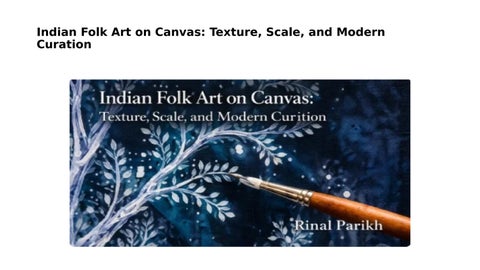
Indian Folk Art on Canvas: Texture,
Scale, and Modern Curation

• Historically, the ancient motifs of Indian folk art were never meant for a stretched canvas. They began as temporary murals. Generations of women painted them on village mud walls, floors, and raw fabrics, tying the artwork directly to the earth. But as collectors seek to bring this cultural history into modern homes, the art requires a different foundation.
• Moving these traditional narratives onto a tight, heavy canvas changes the context completely. It is a deliberate structural upgrade that shifts the work from a fragile artifact to a permanent, collectable asset. For a Philadelphia-based artist like Rinal Parikh, anchoring this imagery to primed canvas pushes heritage directly into the fine art space. It forces the viewer to treat the folk motif with the same reverence as a classic Western painting, turning it into a commanding physical object built to last.
• To understand why canvas matters, you have to look at the physical mechanics of the materials. Paper absorbs paint. Canvas holds it.
• When creating contemporary paintings, the woven texture of the canvas provides a rigid, springy surface that pushes back against the brush. Before the paint even touches the fabric, the surface is coated in a thick gesso primer. When artists execute the intricate, repetitive geometries of folk art painting in India the dense line work, the lotus blooms, the mythological figures the pigment sits heavily on top of that primed layer.
• This structural difference allows the artist to build thick, tactile layers. You don't just see flat color; you see the physical drag of the brush. The heavy pigment catches the ambient light in the room, casting microscopic shadows. This gives the artwork a rough, undeniable physical presence that flat paper simply cannot support.
• Because the canvas can support so much physical weight, it allows the artist to work much larger. And scaling up changes the narrative entirely.
• A motif that looks delicate and quiet on a ten-inch piece of paper becomes an imposing, structural focal point when transferred to a massive canvas. The cultural stories expand to dominate the room. The artwork no longer just decorates a wall; it anchors the entire space. You can see exactly how this bold physical scale translates to an interior setting by exploring the dedicated collection of Works on Canvas.
• Beyond the texture and scale, curators and interior designers prefer canvas for a very practical reason: it removes the barrier between the viewer and the art.
• Works on paper require glass and heavy matting for protection. Glass inevitably introduces glare. It places a physical, reflective wall in front of the artwork. Canvas removes that barrier entirely. There is a psychological shift when you take away the glass. You don't see the reflection of your living room window; you only see the raw pigment.
• Whether it is a massive 48-inch statement piece or a dense, chunky piece of small framed artwork, canvas feels architectural. The viewer can walk right up to it and examine the woven grain of the fabric without any visual interference.
• Because the canvas is so imposing, how you choose to display it matters. When building an art gallery portfolio, collectors have distinct styling options that dictate how the piece interacts with a room.
• A gallery wrap is the most modern approach. The painting continues entirely around the deep edges of the wooden stretcher bars, requiring no frame at all. It looks sleek and minimalist. Alternatively, placing the canvas inside a wooden "floater frame" gives it a defined boundary. A floater frame leaves a small gap between the canvas and the wood, highlighting the artwork's three-dimensional weight without covering the painted edges.
• Hanging a stretched, painted canvas completely shifts the energy of a room. It brings warmth, heavy texture, and history into modern spaces that might otherwise feel too sterile or rigid.
• If you are exploring contemporary art paintings for sale to elevate your collection, start with the foundation. Look past the digital screen and consider the physical object itself. For discussing specific artworks, commissions, and curatorial framing advice for your space, contact the studio.