RIDE Issue 28
09.2026
INDOOR CYCLING INSIGHTS & INSPIRATION
HIGH Ride beyond the race The surprising role of indoor cycling in Hyrox training
THE SECRET LIFE OF GROUPS Do you know why your best classes work so well?
When AI meets GX The new tech that's reducing friction in class participation
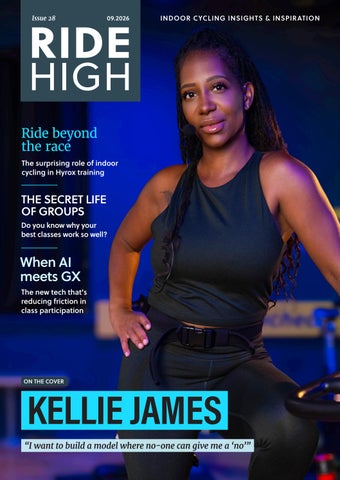
ON THE COVER
KELLIE JAMES
“I want to build a model where no-one can give me a ‘no’”
PRECISION.
PROVEN. WHEN RIDERS PUSH HARDER FOR ONE MORE WATT, THE WATT HAS TO BE REAL. That’s why BODY BIKE has embedded its new Precision Lab™ into all batch testing, rigorously validating every performance metric in pursuit of the world’s most accurate bike.
PHOTO: SHUTTERSTOCK/DREAM_MAKER0.2
DISCOVER PRECISION LAB NOW!
www.body-bike.com
INTRODUCTION
“At BODY BIKE, we believe riders should own their data, take it with them after class and, above all, be able to believe in it”
Trust in the numbers
T
here was a time when the only feedback from a workout was how we felt. Today, that’s no longer enough. Across developed markets, almost half of adults now use a smartwatch, fitness tracker or smart ring, monitoring heart rate, sleep, recovery, stress, training load and more. People don’t just want to exercise. They want evidence. How hard did I work? How much did I burn? Am I getting fitter? Am I ready to go again? The Quantified Self isn’t a niche pursuit any more. It’s the mainstream expectation – and it has transformed the way people engage with health and fitness. As an industry, we’ve embraced that shift. Connected equipment, integrated apps and personalised performance metrics have become central to the experience, helping members measure progress, stay motivated and understand the impact of every session. But as the volume of data grows, so too does an important question: how much confidence should we place in the numbers? It’s a question worth asking gently, because the answer isn’t simple. A widelycited Stanford University study, published in the Journal of Personalized Medicine, tested seven popular wearables against laboratory-grade equipment. Heart rate measurement, it found, was impressively accurate for cycling in particular, with six of the seven devices achieving a median error below 5 per cent. Energy expenditure
was a different story, with no device achieving an error below 20 per cent. Now, this was 2017 and technology continues to march on. But the point remains: when people are basing life decisions on the data we give them, our metrics have to be trusted. When a rider pushes for one more watt, that watt has to be real, not an estimate dressed up as certainty. It’s why we’ve spent the last 18 months building BODY BIKE Precision Lab™, a proprietary testing environment developed in pursuit of the world’s most accurate indoor bike. Through rigorous batch testing, Precision Lab verifies the accuracy of BODY BIKE’s power, cadence and distance measurements, giving operators and riders confidence in every performance metric. It’s a natural extension of a philosophy we’ve held since we launched our first app back in 2016: that riders should own their data, take it with them and, above all, be able to believe in it. In an industry built on effort, honesty and hard-won progress, the numbers only mean something if they’re numbers you can trust.
Uffe A. Olesen CEO, BODY BIKE International
RIDE HIGH
September 2026
3
CONTENTS
06
30
4
06
Kellie James
30
Ride for the room
14
The ride that isn’t in the race
36
The secret life of groups
A broken ankle, a brutal business lesson and a drive to succeed. How the founder of Drenched Studio is building a model no-one can say ‘no’ to.
Hyrox is one of the fastest-growing fitness phenomena on the planet, but what does it have to do with indoor cycling? Quite a lot, it seems.
RIDE HIGH
September 2026
Indoor cycling should make people feel stronger and more confident, says Tash Marshall Bean, as she calls for a return to purposeful programming.
You think you know how to run a class – but when it works well, do you know why? We explore the compelling science of group dynamics.
ISSUE 28 – 09.2026
14 36
PHOTO: SHUTTERSTOCK/MILJAN ZIVKOVIC
44 44
When AI meets GX
A new generation of tech is reducing friction around group exercise participation, guiding more people towards new habits and best-fit classes.
Do you have a great indoor cycling story you’d like to share? From studio successes to new innovations – and everything in between – we’re keen to showcase best practice in indoor cycling from around the world. So if there are any topics
FOLLOW US ridehighmagazine
CONTENT & CONTRIBUTIONS
you think we should cover, please let us know!
@ridehighmagazine
ALL IDEAS ARE WELCOME – info@ridehighmagazine.com
RIDE HIGH
September 2026
5
“Plenty of studios can deliver a good class. I wanted the level of care in every detail to be what set us apart.” 6
RIDE HIGH
September 2026
INTERVIE W – AMERIC AS
KELLIE JAMES
A broken ankle, a brutal business lesson and an undeniable drive to succeed. The VC-backed founder of Drenched Studio tells Kate Cracknell how she’s building a model no-one can say ‘no’ to Have you always worked in fitness? I’ve always been athletic, but my move into the business side of fitness came about almost by accident. I’m a qualified project manager who, in late 2021, was brought in to project manage the build-out of a new fitness hub here in Atlanta. As part of the agreement, I was promised my own studio within the space. I won’t go into details, but it didn’t end well. The experience left me determined that no-one would ever again stand in the way of me pursuing my dream. It also left me, quite literally, flat on my back. The stress of it all caused me to collapse and I broke my ankle in three places; I now have a rod and three screws in there. I was on bed rest for months, but I used that quiet time positively, taking the opportunity to conceptualise Drenched Cycle Studio. I still felt fuelled by an unquenchable fire to do the thing I wanted to do.
Tell us more about your vision. I’d never even heard of indoor cycling until 2021, when a colleague invited me to a heated class at a studio called Sweat Cycle. It was brutal, but I fell in love with the music, the challenge, the energy of the room. From
the back row, watching everyone in front of me hitting the moves, synchronised to the beat of the music. It was wonderful! I also lost 6lbs in the first two weeks, which made me love it even more. I had never done a workout that brought me such quick results. Within a handful of visits, I’d signed up for an unlimited membership and was going five days a week. I wanted to master it and, ultimately, introduce it to as many people as possible through my own studio. I had a vision of creating a space that felt genuinely welcoming. In some other studios I visited, the culture felt a bit cliquey – almost like high school. I wanted mine to be the opposite of that: somewhere anyone could walk in, regardless of background, and feel instantly part of something. I also wanted to put customer service at the heart of things. Plenty of studios can deliver a good class. I wanted the level of care in every detail to be what set us apart. Fast-forward to today, having opened Drenched in downtown Atlanta in March 2024, and that’s exactly how it is: the right size shoes laid out by each bike before members arrive, towels positioned in a certain way, complimentary water. I’m in the studio myself at
RIDE HIGH
September 2026
7
“Each class has a unique name. It allows instructors’ personalities to shine through before you’ve even met them.” 8
RIDE HIGH
September 2026
Left: Average class occupancy is around 70%, but many classes are waitlisted Right: Drenched has expanded beyond cycling alone, to meet member demand and future-proof the studio
least four days a week – it’s entirely an extension of my own personality – and I personally respond to every Google review as fast as I can. We’re sitting at a 5.0 rating and the consistent theme is that people feel seen and welcomed, not judged. In terms of the name, I wanted something short, memorable and brandable – a single word that people would associate with a feeling and that would be great for marketing and merchandise. Drenched felt right: not just being drenched in sweat, but the idea of showing up, giving something your all and leaving feeling depleted yet invigorated.
Your classes also have distinctive names. Each class has a unique name, which I help instructors come up. It allows their individual personalities to shine through before you’ve even met them. It’s a small thing, but it works really well as a marketing tool: people look at our timetable and something pops out at them. Our instructors are also empowered to inject creativity into their programming, albeit around an agreed structure so people know what they’re signing up for. And we run themed rides, too – no more than one or two a week, so they stay special rather than becoming routine. We’ve also developed hybrid formats, originally designed to bring something different to Fridays, which were proving a bit quiet. Double Drenched is 30 minutes of cycling followed by 30 minutes of bodyweight and light weights, often taken outside in the parking lot, while Pressure is a heavy resistance, climb-focused 45-minute ride followed by 15 minutes of core work. The number of classes on our schedule varies by time of year: things get quiet in the summer down here in Georgia and I’d rather run fewer, fuller classes than pad the timetable and have lots of empty bikes.
RIDE HIGH
September 2026
9
INTERVIE W – AMERIC AS
With space for 22 participants, across the timetable we average around 15, but a number of our classes are waitlisted. Monday is, surprisingly, our busiest day: the 5.45pm class, Magic Monday, is a great way to start the week, while the 7.00pm class, Never Miss a Monday, is waitlisted every week. Private and corporate bookings have also become a meaningful, largely word-ofmouth revenue stream. We’ve hosted rides for Georgia Tech and Google among others, plus birthday parties and non-profit events, usually averaging at least one a month.
How strong is your community? I always wanted the studio to be about more than just indoor cycling. Our catchment has a fairly transient population – there are always new people coming through – and Drenched has become a welcoming space where you can meet and get to know others. Just as one example, every class starts by asking riders to introduce themselves to those sitting to their left and right. The impact of our ethos is clear when you look at dwell time. On a Monday evening, for example, class might finish
Above: Themed classes include neon-lit Drenched After Dark – check out the video! Above right: To nurture a sense of community, classes start with riders introducing themselves to each other Right: Themed classes take place once or twice a week at most, so they still feel special
10
RIDE HIGH
September 2026
CLICK TO PLAY
“VC backing didn’t just save the business financially. It also brought guidance I didn’t even know I needed.”
at 8.00pm, but most people stay around chatting for an hour. We rarely leave before 9.00pm. We also do a lot of community activities, partnerships with hotels, meet-ups for members and so on. Especially in the summer, you have to get creative to keep people engaged.
How did you fund Drenched? I opened the studio entirely on my own savings, having been turned down for every loan and grant I applied for. Inevitably, that wasn’t sustainable: by the summer of 2024, I was funding payroll out of household money. I made the difficult decision to pause operations – transparent with my members about what I was doing and why – so I could focus exclusively on finding investment. Through a business connection, I was introduced to a venture capital firm that just so happened to be looking to back a
RIDE HIGH
September 2026
11
INTERVIE W – AMERIC AS
Left: Drenched was conceived as a space where everyone would feel instantly welcome Right: Instructors are empowered to bring an element of creativity to their programmes
female-owned business. By further chance, the individual I met with was a keen indoor cyclist himself, which meant I didn’t have to spend the whole pitch explaining what indoor cycling was. He wanted to help. It didn’t just save the business financially. It also brought the structural and operational guidance I didn’t even know I needed. Since then, everything has shifted. We now have 160 members, with a target of around 300 at our new location.
12
A new location? Tell us more.
“I want Drenched to have an answer whatever a person’s goal. I want to build a model where no-one can give me a ‘no’.”
On 1 September, we relocated to a 2,500sq ft space around seven minutes north of our original site in downtown Atlanta. We’re now in a very densely populated area, attached to a 300-unit luxury residential high-rise and within walking distance of around 10 Fortune 500 companies, including Google. Critically, our new studio has showers – something our original site lacked, which held back growth in morning membership. The new studio operates under the simplified brand of Drenched Studio, reflecting the addition of mat Pilates and HIIT alongside indoor
cycling. Pilates is currently the fastest-growing modality in the market, while cycling has been trending downwards; even SoulCycle has been closing locations. Rather than fight that trend, I wanted to meet it, giving members the variety they seek and future-proofing the business. We had already started offering mat Pilates at our old location, getting members used to the idea of doing more with us than just indoor cycling. And now, in our new studio, we’re bringing it all together as The Drenched Method.
RIDE HIGH
September 2026
Depending on a member’s goals and fitness level, we’ll recommend one of three tracks, each with a different weekly balance of cycling, Pilates and HIIT – cardio, core, flexibility, strength. Essentially, I wanted to build a model where no-one can give me a ‘no’. Previously, if someone said they needed to build core strength or lift weights, that was a lost sale. I want Drenched to have an answer whatever a person’s goal.
Where do you see the brand in five years? I’m aiming for two further Georgia locations under our umbrella, with franchising to follow. The ultimate ambition is to become a nationally recognised brand. I believe what we’re bringing to market now sets us up to do exactly that. l
@drenchedatl
RIDE HIGH
September 2026
13
Rout3 is an official Hyrox Training Club that uses indoor cycling with its athletes
INDOOR C YCLING TRENDS
LONG READ
WHOLE STORY
THE RIDE
THAT ISN’T IN THE RACE
“Most people aren’t able to run enough to get the aerobic engine they need to sustain a solid Hyrox output”
Hyrox is one of the fastestgrowing fitness phenomena on the planet, but what does it have to do with indoor cycling? Quite a lot, as it turns out. Kate Cracknell hears from the experts
H
yrox has taken the fitness world by storm: a global phenomenon that’s attracting everyone from elite athletes chasing sub-60minute PBs to first-timers who simply want to find out what they’re made of. The race format – eight 1km runs, each followed by a functional exercise station ranging from sled pushes to burpee broad jumps to wall balls – demands running
16
RIDE HIGH
September 2026
legs, a powerful upper body and the kind of cardiovascular engine that can keep firing long after every muscle is screaming at you to stop. At first glance, indoor cycling has no place here. There’s no bike on the race floor, no wattage target to hit, no RPM to chase, no final sprint to the beat. Yet speak to the coaches, instructors and operators who are most serious about training for Hyrox events – ask them what they put at the heart of their training programmes – and the answer keeps coming back to the same place. The indoor cycling studio.
Building the aerobic engine Hyrox may look like a strength event with some running thrown in, but in reality, the aerobic engine matters far more than many athletes realise. That’s certainly the view of Meaghan St Marc, co-founder and co-CEO of Revd Fitness in the US, who recently completed a Hyrox event
MEET OUR EXPERTS Abby Claus
Dan Summerson
Mandi Lora
Meaghan St Marc
Rachael Penrose RIDE HIGH
September 2026
17
“When you’re trying to increase your aerobic or anaerobic abilities, it doesn’t matter what cardiovascular modality you’re using” using Revd as her primary training facility. Revd isn’t a Hyrox Performance Center, nor does it run Hyrox-specific classes, but it has a strong community of Hyrox enthusiasts among its members and instructors, many of whom use its workouts to support their race prep. According to St Marc, first-time competitors often focus their training around the obvious bits: the functional stations that stand out on the race floor. But when it comes to the clock, she says, it’s often the running that does the damage: “People get really focused on the sled push and pull, the farmer’s carry, the wall balls – but then they get to the run and that’s where they lose all their time.” “If you struggle through the runs, you’re exhausted by the time you get to the exercises,” confirms Rachael Penrose, an indoor cycling instructor, personal trainer and strength & conditioning coach based in London, UK. That doesn’t mean the stations don’t matter. They do. But if athletes want to move well through the whole event – and especially if they want to improve from one Hyrox to the next – St Marc and Penrose suggest they may need to spend less time obsessing over individual stations, more time building the cardiovascular capacity that connects them all together. Indeed, when cardio capacity is welldeveloped, the running sections can become a form of active recovery on race day, says Penrose: “In my first Hyrox last year, I was able to complete the runs without too much stress on my body, keeping my heart rate under control. It meant I arrived at each station with the energy to really push into it.
18
RIDE HIGH
September 2026
“I wasn’t running much in preparation for the event – I just hadn’t found the time – so I wholly put that down to coaching indoor cycling.”
Transferable benefits Let’s be clear: our experts aren’t suggesting that would-be Hyrox participants shouldn’t do race-specific training, including getting their running up-to-scratch. They are, however, suggesting that running isn’t the only way to build the cardiovascular engine you need for these events. “Most people aren’t able to run enough to get the aerobic engine they need to sustain a solid Hyrox output,” confirms Mandi Lora, owner of Rout3 Health & Performance in Woodstock, Georgia – a fully-affiliated Hyrox Training Club that programmes indoor cycling directly into its Hyrox sessions.
Above: Rout3 uses indoor cycling to increase cardio training volume without excess wear and tear on the joints Right: Indoor cycling isn’t only good training for running. It improves muscular endurance for the functional stations, too.
RIDE HIGH
September 2026
19
Above: St Marc leads an indoor cycling class at Revd Fitness
“I noticed I lost some muscular endurance when I was doing all that running. It took the bike to get it back.” It is the repeated musculoskeletal pounding of running that makes this a challenge, particularly in a training programme that’s already likely to include a lot of jumping, lunging and loaded movement. Cue indoor cycling – a low-impact way to build cardio training volume when the limiter isn’t the heart and lungs, but the body’s ability to tolerate more impact. Lora explains: “When you’re trying to increase your aerobic or anaerobic abilities, it doesn’t matter what cardiovascular modality you’re using. It’s simply about training your body to do more work at a lower heart rate.” That idea is well supported by the wider literature, with research consistently showing that aerobic adaptations can transfer between modalities. In simple terms, the cardiovascular
20
RIDE HIGH
September 2026
system doesn’t care whether the stress is created by a treadmill, an indoor bike or a road run: if you spend enough time working at the right intensity, you can improve aerobic capacity and VO2 max. Recovery is also quicker with lowimpact cycling, meaning you can train more. It’s why Everlast Gyms, Hyrox’s exclusive UK Performance Center partner, prescribes indoor cycling for what it calls “off-feet training”. And why Lora ultimately returned to the bike when training for a Hyrox event herself. She explains: “Historically I’m not a runner, so at first I almost exclusively got rid of biking to ramp up my running. I was very diligent with slow, steady progression – a 10 per cent increase every week – but the wear and tear on my body was significant.
INDOOR C YCLING TRENDS
Hill climbs on the bike can be a great way to build the muscular endurance you need for Hyrox
RIDE HIGH
September 2026
21
Clockwise from below left: St Marc, Claus and Lora give it their all in Hyrox events Right: Revd’s Abby Claus puts riders through their paces
“With Hyrox, you’re switching between exercises every couple of minutes. That’s matched by the variety within a cycling class.”
22
RIDE HIGH
September 2026
INDOOR C YCLING TRENDS
“If you continue with that sort of wear and tear, at a certain point you won’t be able to work the energy system as effectively.” And so she returned to the bike – and recommends indoor cycling to all the Hyrox athletes at her club. “There’s a value to the bike whether you’re a beginner, intermediate or advanced athlete putting in many hours of training,” she confirms. “If you’re not used to running, all your runs need to be easy at first, but I have no problem telling a beginner to do 20 miles on a bike in a week. We can hit all energy systems aerobically and anaerobically, while also working muscular endurance, without worrying as much about wear and tear.”
Specificity in training On that note, Lora is clear that indoor cycling isn’t only good for aerobic training. It also plays an important role in building the muscular endurance and power you need for a Hyrox event. “I noticed I lost some muscular endurance when I was doing all that running,” she comments. “It took the bike to get it back. People associate indoor cycling with cardio classes, but there’s so much more to it than that: you can be very specific with what you’re trying to achieve. I’m now the strongest I’ve ever been on a bike. It’s an invaluable tool.”
Hill work is where much of this specificity lies: sustained climbs with heavy resistance load the legs for minutes at a time, building the kind of muscular endurance that transfers directly to Hyrox’s loaded stations. At Revd, around 30 per cent of any class is spent on hills – and for Hyrox athletes, there’s an intriguing, Hyrox-specific biomechanical comparison, says St Marc. “The forward body angle, hands positioned out in front, sustained leg drive and resistance under load, driving down with the heel, pushing, leaning into it. That motion of climbing a hill on the bike is so similar to the Hyrox sled push,” she says. “When I competed, I really leant into that ability to power through something resisting my body for sustained periods.” It isn’t a perfect replica, of course, but it’s a vivid image. Indoor cycling isn’t just developing fitness in the abstract. In some cases, it may be rehearsing elements of the physical demands Hyrox athletes will face on race day. Rout3 certainly uses a number of cycling techniques that have direct relevance to Hyrox, with one of Lora’s favourites being what she calls high-intensity continuous training (HICT): “In a seated position, you ride at the heaviest gear you can sustain while maintaining your RPMs between 30 and 40. If you can hold that for five, 10, 20 minutes, that’s developing endurance in your power.
RIDE HIGH
September 2026
23
INDOOR C YCLING TRENDS
“Where that translates to Hyrox is being able to maintain hard, powerful movements for longer periods of time. Pushing a sled, immediately running, then pulling a sled… Hyrox involves a series of muscularly-demanding stations on top of the running, all of which demand force production under fatigue.” She also highlights something subtler Rout3 works on with its athletes: cadence. “When we’re cycling at 85–90 RPM, moving our feet faster at a lower gear, it translates to the cadence our athletes will want to hit when they’re running. “Optimal running cadence is around 170–190, so if you can keep it around 85 to 90 on the bike, that’s going to translate well to the running form you’re aiming for.”
Switching energy systems With one of Hyrox’s defining features being the frequent changes in activity – heavy muscular work, sudden heart rate spikes, then a return to running before the whole cycle starts again – variability in training is also important.
24
RIDE HIGH
September 2026
You aren’t just training to be aerobically fit or strong in isolation; you’re training to become good at moving between the two. And once again, indoor cycling delivers, says Penrose: “With Hyrox, you’re switching between exercises every couple of minutes. That’s matched by the variety within a cycling class. A heavy hill prepares you for weighted lunges. Sprints prepare you for the burpees and the running.” The key is to think beyond generic ‘cardio’ and ask what quality you’re trying to develop, Lora explains. Is it aerobic capacity? Threshold tolerance? Muscular endurance? Power under fatigue? Cadence? Recovery? Once you know that, your indoor cycling programming can become much more precise. And so both coaches favour more than just steady-state riding. Yes, there’s a place for zone two work and threshold efforts, particularly if an athlete’s wider programme already includes a lot of high-intensity Hyrox training. As Penrose explains: “You have to look at the full picture of your training so you aren’t continually working your body in the same way.”
“Why are we going from a hill straight into a sprint? Because you’re tired and I want to challenge you while you’re tired.” Above: Lora returned to indoor cycling for her Hyrox prep when she found the wear and tear of running too much Above left: In Hyrox, you frequently switch between energy systems Below left: Revd Fitness has a strong community of Hyrox enthusiasts among its members and instructors
RIDE HIGH
September 2026
25
“By measuring outputs such as VO2 max, peak power and maximum minute power, we can prescribe targeted training” But there’s also a case for deliberately building in transitions on the bike: moving from heavy hills to fast efforts, from seated grinding climbs to short sprints, from long sustained work to bursts of power. The goal: to get riders better at producing effort when the body is under strain, rather than only when it feels fresh.
Training tired This is where Abby Claus, indoor cycling instructor at Revd and a high-level Hyrox competitor, brings a really interesting dimension to the discussion. For Claus, one of indoor cycling’s greatest benefits has nothing to do with whether it replicates a Hyrox movement pattern, nor
26
RIDE HIGH
September 2026
whether the resistance on the bike perfectly matches the force demands of a sled. It’s about mental preparation for race day. “You can prepare physically all you want,” she explains, “but ultimately it’s going to be a mental challenge as well.” It’s why she deliberately structures her training so that strength work comes after cycling. “Going into the exercises when I’m feeling my best isn’t representative of how I’m going to feel during the race. You’re never going to approach the skierg, rower or burpees feeling rested in zone one – that’s just not how Hyrox works. The first thing you do is run a kilometre. “So, I make sure I do my workouts in a compromised state: indoor cycling first, tiring me out aerobically before the functional
work, so my body is challenged similarly to how I’ll be during the actual race.” Her go-to sessions at Revd include long two-part climbs, heavy resistance pushes and upper-body tracks that demand continuous work for five to seven minutes at a time. The hand weights used in these tracks may be light – 2–3lbs, not the sort of load you face in Hyrox – but for Claus, that isn’t the point. The point is the uninterrupted effort, the time under tension and the need to keep going when the discomfort starts to bite. She makes sure her riders understand this, too. “Why are we going from a hill climb straight into a sprint? Because you’re tired and I want to challenge you while you’re tired,” she says, describing how her cycle classes can become a rehearsal space for the internal dialogue of Hyrox racing: the point at which the body wants to back off, but the athlete has to keep going. She talks about members carrying mantras from her classes into competition – “You are always stronger than your hardest moments” and “This moment is temporary” – and about athletes learning to trust their bodies because they’ve repeatedly experienced challenge in the studio and come through it.
Data-based programming Taken together, the evidence clearly points to indoor cycling as a powerful way to develop the aerobic engine, muscular endurance and repeatable power that Hyrox demands. At UK-based Everlast Gyms, those qualities are measured objectively before training even begins. Under the leadership of managing director Dan Summerson and with Faisal Abdalla – Global Hyrox MC – as head of Everlast Gyms’ Hyrox Performance Centers, the business has built what it describes as a race-day-accurate training environment. But the element that really sets it apart from a well-equipped gym floor is its commitment to removing guesswork from the preparation process.
Above: It’s important to prepare mentally as well as physically for Hyrox – and indoor cycling helps you do that Left: In the UK, Everlast Gyms has created in-club, race-day-accurate Hyrox training environments
RIDE HIGH
September 2026
27
Left: At Everlast Gyms, bikebased pre-testing allows Hyrox programming to be tailored to the individual athlete Below right: Mandi Lora (right) with her team of Hyrox athletes and enthusiasts at Rout3
“Wattbike gives us access to objective performance data,” says Summerson. “By measuring outputs such as VO2 max, peak power, maximum minute power and pedal efficiency, we can identify an athlete’s strengths, weaknesses and training priorities. “This allows our coaches to prescribe targeted training interventions, whether that’s improving aerobic capacity, developing race-specific power, addressing muscular imbalances or increasing overall performance.” Two bike-based tests are of particular importance in this respect. The first is the aerobic power test, which tracks VO2 max progression and heart rate kinetics. With retesting offered every eight to 12 weeks, coaches can monitor whether athletes are producing
28
RIDE HIGH
September 2026
more power at lower heart rates over time, a key indicator of improved aerobic efficiency and race durability heading into a Hyrox event. The second is an anaerobic power test, which measures fatigue factor and power decay under load: how well an athlete maintains output when fatigued. This has obvious transfer to stations such as sled push/pull, burpee broad jumps and wall balls, where maintaining force production late in the race is critical. “For Hyrox athletes, success requires a blend of endurance, strength and repeatable power output,” says Summerson. “Our combination of data-driven testing, expert coaching and structured programming allows us to deliver a more personalised training experience and help members achieve better results.”
INDOOR C YCLING TRENDS
The bottom line Hyrox is, on the surface, an event built around running and functional strength. But look more closely and the case for indoor cycling as a cornerstone of preparation becomes not just compelling but obvious. Indoor cycling builds the aerobic engine. It develops muscular endurance and power. It protects the joints that running wears down. It allows athletes to train at intensity more frequently and recover more effectively. It can replicate the feeling of arriving at each station already tired. And it conditions the mind, as much as the body, to keep going when everything is telling you to stop. And so the experts are clear: despite never featuring on the race floor itself, indoor cycling absolutely deserves a place in any Hyrox training schedule. Used intelligently, it can help build precisely the engine, resilience and confidence that Hyrox demands. l
“Used intelligently, indoor cycling can help build the engine, resilience and confidence that Hyrox demands”
@route3health
@mandilora20
@rachpenrosetraining @abby_claus
@revd.fitness
@everlastgyms
RIDE HIGH
September 2026
29
INDOOR C YCLING AC ADEMY
30
RIDE HIGH
September 2026
PHOTO: DAVID FLO
RIDE
for the
ROOM
Indoor cycling should make people feel stronger, more confident and capable, not excluded, embarrassed or unable to keep up. Tash Marshall Bean calls for a return to purposeful programming and inclusive coaching
H “An Olympian once asked me: ‘Why can’t I do those fast jogs?’ My answer: ‘Because you’re not supposed to.’”
Left: Marshall Bean believes the sector has lost focus on the riders in the room
ere’s a wake-up call for all the cycle studios and instructors out there: if most of the people in your class can’t follow what you’re teaching, you aren’t leading. It’s a real and growing problem in our sector – and it’s because, somewhere along the way, we’ve started rewarding instructors more for performing than for bringing people with them. We see it everywhere now: super-fast jogs out of the saddle, endless choreography combinations, move after move thrown into a ride in the misguided belief that more equals better, more equals harder. But indoor cycling is already hard when it’s done properly. Why add so much that people stop feeling successful? I had an Olympian once ask me: “Tash, why can’t I do those fast jogs?” My answer was simple: “Because you’re not supposed to.” As an instructor, the goal shouldn’t be to see how fast you can move. It should be to move well enough that the room can move with you. Yet we’ve normalised these unsafe movement patterns. We’ve created a culture where riders feel they should be able to keep up, blaming themselves when they can’t. Then we wonder why they don’t come back to class.
RIDE HIGH
September 2026
31
INDOOR C YCLING AC ADEMY
“Challenge and exclusion are not the same thing. You can push people hard without leaving them behind.” ONE FOR ALL
FLASH OVER FORM
Before anyone says I’m anti-rhythm riding or anti-fun, absolutely not. I first built a full-body cycling programme in Canada way back in 2012. I love a party on a bike. But I call it an athletic rhythm ride for a reason. The choreography should be a complement to the ride, not the entire ride. That distinction matters. I now see classes where the choreography has completely overtaken the foundation. Long combinations, endless add-ons, people riding out of the saddle so fast and so light that they look like Bambi trying to stay upright. And it keeps getting worse as instructors scramble to top one another by copying the latest thing they saw on social media. It’s all about the reel now. Studios are literally pulling instructors into the front row because it looks better on video. Meanwhile, newer riders sit there thinking: “I suck at this.”
32
RIDE HIGH
September 2026
Right: The best indoor cycling classes create a sense of community and moving together Below: Instructors need a strong foundation of education before layering on party moves
PHOTO: ©GROUND ZERO
Stop press. If most of the room is lost, overwhelmed or disconnected, the problem is not the riders. It’s that the class wasn’t built for them. At the end of the day, who are we teaching for: the whole room or the two die-hards in the front row? I’ve literally worked in studios where an owner told us: “Teach to the front row only.” Never! As an instructor, you’re there for everyone in the room. The nervous first-timer. The three-times-a-week regular. The athlete. The returner who’s rebuilding confidence. A good instructor can lead all of these individuals at once and still make each of them feel seen, included, challenged and supported.
PHOTO: ©SOULCYCLE
No, you don’t. You just walked into a class that prioritised performance over participation. Fitness isn’t a talent show. The studio is supposed to be a space where people come out feeling stronger, more confident and more capable than when they walked in. Not embarrassed. Not excluded. Not like they’ve failed for 45 minutes straight.
CHALLENGE, NOT EXCLUSION
In all honestly, I think we’ve drifted a long way from the foundations of great coaching. I’m training instructors right now who tell me no-one has ever taught them proper pedal stroke technique, resistance or the foundations of the bike. That’s outrageous!
The bike is not a prop. You have to respect it. And you absolutely need a foundation of knowledge and education before you start adding extra layers and party moves. Yes, classes should feel exciting. I always want my room to feel as though we’re in a music video: everyone moving together, connected to the music, sharing the same energy. But the key phrase here is ‘moving together’, not watching the instructor do something unattainable while half of the room gives up. Of course challenge matters. I’m not saying classes should become easier or watered down. But challenge and exclusion are not the same thing. You can push people hard without leaving them behind.
RIDE HIGH
September 2026
33
PHOTO: ©SHINE CYCLE
“Success isn’t about online likes. It’s the people in the room who actually matter.”
PODIUM, NOT PEDESTAL
I also think connection matters far more than this industry sometimes realises. Some instructors walk into the studio, put their music on, disappear, come back when class starts and suddenly switch on their ‘fitness personality’. But did they say hi to anybody? Did they help the newcomer clip into the bike? Did they notice the person hiding in the back row? All too often, the answer is no, yet this is the foundation of serving everyone in the room. How are we missing this stuff? In large part, it’s because we’ve forgotten who we’re there to serve and what success actually looks like, driven by online likes and
34
RIDE HIGH
September 2026
applause from other instructors rather than the people in the room who actually matter. To quote one of my beautiful former instructors, Jess Blaney: “It’s a podium, not a pedestal.” People should not feel beneath you in your class. They should feel supported by you. People should not watch you performing. They should be led by you to perform better themselves. If most of the people in your studio aren’t following you, it’s time to ask yourself a very honest question: Are you actually leading? l
@trainingwithtashie
Above: Good instructors know it isn’t about performing to the room. It’s about helping those in the room perform better. Left: It’s important to coach everyone in the room, not just the die-hards in the front row
RIDE HIGH
September 2026
35
THE SCIENCE OF INDOOR C YCLING
The secret life of groups You think you know how to run a group exercise class – but when it works well, do you know why? Professor Tim Rees and Professor Tom Wainwright explain how the science of group dynamics could transform class delivery
M
ost group exercise instructors would say they know how to run a class. In many ways they’re right. Years of experience have taught them how to build a workout, coach technique, motivate participants and create energy in the room. But why can one class buzz with energy while another, delivered by the same instructor to the same number of participants using exactly the same programme, fall somewhat flat? That’s the question Professors Tim Rees and Tom Wainwright have spent the past few years exploring. Their conclusion? The difference often has far less to do with the workout itself – even with instructor charisma – and far more to do with something instructors rarely receive any formal training in: the psychology of groups.
36
RIDE HIGH
September 2026
“Most of the behaviour change taught at Level 2 or 3 is about the individual,” explains Rees. “Goal-setting, the transtheoretical model, motivational interviewing… it all focuses on one person at a time. But when you get people into a group, it isn’t just 30 individuals. Something uniquely different happens – and most instructors have never been taught what that is or how to draw on it.” And so Rees and Wainwright have cofounded Group Works, launching a flagship course as their first offering. Delivered online, with options for bespoke in-person training, the course helps instructors understand – really understand – what happens when people exercise together, as well as how to deliberately harness this dynamic.
PHOTO: ØRBIKE
“Instructors are taught what to do in a class. They are almost never taught how to lead a group.”
It’s all about ‘us’
The science of groups exists, robust and compelling yet traditionally scattered across the diverse fields of psychology, behavioural science, organisational research and healthcare. What Rees and Wainwright have done is stitch it all together into something coherent and practical for those delivering group exercise classes. Drawing on social identity theory, group dynamics research and behaviour change science – alongside their own published research into group-based rehabilitation
Above: The new course teaches instructors to lead classes in a way that’s true to their personalities Left: Professor Tim Rees and Professor Tom Wainwright are the co-founders of Group Works
RIDE HIGH
September 2026
37
PHOTO: SCLPTCYCLE
– they have created a unified framework for what makes groups work and how instructors can actively shape that. The simple, overarching theme is belonging, explains Rees: “If someone isn’t sure whether to drag themselves out on a rainy evening, but they think ‘that’s what I do on a Thursday – it’s part of who I am, those are my people,’ they’ll go. That sense of identity and belonging is what drives attendance, which in turn is what drives outcomes. “And so instructors have one crucial question to ask themselves: Are they running a class or are they leading and developing a group?” It’s why identity leadership sits alongside social identity theory in the Group Works approach: the practical application of how a leader uses group psychology to get the best from the people in front of them. This, says Rees, is where a lot of training falls short: “Instructors are taught what to do in a class. They are almost never taught how to lead a group.” So, what does this mean in practice? A few examples from the new course begin to paint the picture.
38
RIDE HIGH
September 2026
“A whole series of micro-behaviours can either positively contribute to a sense of group or quietly undermine it”
Above: Partner work can be a great way to break down cliques in a cycling class Right: Even in a rolling weekly class, it’s possible to create cohorts around shared goals
THE SCIENCE OF INDOOR C YCLING
The language of ‘we’. One of the simplest and most powerful shifts an instructor can make is in pronoun choice. “Instead of telling everyone what you’re going to do today, you talk about what we’re going to do,” says Rees. “Instead of ‘come on, you’re nearly there’, it’s ‘we’re nearly there – let’s push through this last bit together’. Instead of ‘look at the great progress you’ve all made’, it’s ‘look at what this group has achieved today’. It sounds like a small thing, but it consistently and repeatedly signals that this is a shared endeavour, not 30 separate workouts happening in the same room.”
The arrival. How many classes start with the instructor asking the whole room: ‘Has anyone not done this before?’ “It’s well-intentioned, but consider how it feels to be the nervous newcomer, publicly identified in front of a room full of strangers,” Wainwright observes. “Compare that to an instructor who meets you at the door, introduces themselves, shows you the bike and says: ‘Do you want to sit
next to Sarah? She’s been coming for a while – she’ll look after you’.” Two seconds. One connection. A completely different experience.
The ending. Too often, classes finish unremarkably: a few people leave early, the instructor drifts over to chat with a friend, the group dissolves rather than closes. “There’s no sense of completion, no acknowledgment of what’s been achieved, no bridge to next week,” says Wainwright. “If you bring it to a proper close – ‘that was a great session, we pushed really hard on X today, come back next week because we’re building on it with Y’ – you’ve given people a reason to return and made them feel part of something.”
A shared journey. One of the challenges in a typical group exercise class is that there’s no shared starting point; a weekly class can mean newcomers on a regular basis. But that doesn’t mean you can’t create a cohort, says Wainwright: “Create blocks of work. Tell the
RIDE HIGH
September 2026
39
THE SCIENCE OF INDOOR C YCLING
40
RIDE HIGH
September 2026
“Research shows the most effective groups develop a kind of shared leadership. Others start to step up.” class: ‘Every Monday we’re here, but over the next four weeks we’re going to be working towards this specific goal.’ Suddenly there’s a shared objective, a reason to come back, a sense of building something together – even in an ongoing, open-access class.”
Dealing with cliques and dominant members. Every regular class has them: the long-timers with their established spots, their in-jokes, their unspoken sense of ownership. This can make it very hard for new members to feel they belong – but class structure, including techniques such as partner work, can instantly shift the dynamic, says Wainwright. “The regulars become hosts rather than a closed circle, assuming a responsibility to the group as a whole,” he explains.
Shared leadership. In line with the above and perhaps most interestingly, Group Works moves beyond the instructor-centric model. Rees explains: “Research shows the most effective groups develop a kind of shared leadership. Others start to step up, encouraging people, helping newcomers, quietly supporting the instructor through their behaviours, advocating for the group’s culture. Positive role models can influence others more powerfully than the instructor alone – and as an instructor, you can actively cultivate that.”
Being ‘one of us’. Underpinning it all PHOTO: SPORT ENGLAND/THIS GIRL CAN
Simply using ‘we’ instead of ‘you’ can help generate a real sense of togetherness in class
is a concept Rees returns to repeatedly: we follow leaders we see as one of us. “It’s about people feeling you’re genuinely in it for them – that you’re advancing the interests of the group, not just running a session,” he explains. That includes dialling back the urge to perform from the saddle, adds Wainwright:
RIDE HIGH
September 2026
41
“This has become something of a trend in indoor cycling in particular. We want to shift things back towards facilitation. Rather than ‘follow me’, it’s ‘we’re doing this together’.”
“Of course, many successful instructors instinctively do this already,” Wainwright acknowledges. “Group Works explores why this approach is successful and how to deliver it more consistently.” He continues: “We train instructors in a whole series of micro-behaviours that can either positively contribute to a sense of group or quietly and unintentionally undermine it. But crucially, we’re offering principles, not a checklist. We don’t want people to come away thinking they have to be someone they’re not. We help instructors lead more effectively in a way that authentically fits their personality.” There’s also a bigger picture goal behind Group Works, adds Rees, and that’s helping address the pandemic of physical inactivity. He explains: “Getting people to start exercising isn’t actually the hardest part. Getting them to keep coming back is – and groups, when led well, have a major role to play. “Fully harnessing their power has the potential to bring a whole new population of regulars into the system. If we focus on helping people feel connected, feeling they belong and that they’re having fun together, the mental and physical health benefits will follow.”
PHOTO: SCLPTCYCLE
The bigger picture
Early signs
Group Works is currently in soft launch, with the team actively gathering feedback as more instructors come through. The hard outcome data is still to come – they’re building it carefully. But the early signals are striking.
Above: Having fun together as a group is key to driving longterm outcomes, says Rees
“People tell us: ‘I’ve never thought about groups in this way. I didn’t realise I needed to attend to these things.’” 42
RIDE HIGH
September 2026
THE SCIENCE OF INDOOR C YCLING
Rees describes feedback from early adopters. “They say things like: ‘I’ve never thought about groups in this way. I didn’t realise I even needed to attend to these things. It’s completely changed how I approach what I do’.” For Rees and Wainwright, that’s both rewarding and telling. “Our first hurdle is always that initial reaction: ‘I already know about groups.’ And then you start to have the conversation and quite quickly people go: ‘Oh. I hadn’t thought about that.’” For instructors who have spent years honing their cueing, choreography and playlists, the idea that there’s an entire dimension
of their practice they may never have been formally taught will understandably give them pause. But as Wainwright puts it: “If someone’s enjoyed a class, they aren’t going to remember how many reps they did or exactly what the interval structure was. They’re going to remember how they felt. And if they felt great, a large part of that will be down to the group environment the instructor created.” l
Group Works’ flagship course launches on 1 October 2026: www.groupworks.uk
RIDE HIGH
September 2026
43
WHEN AI
MEETS GX A new generation of technology is helping operators reduce friction around group exercise participation, guiding more people towards new habits and best-fit classes. RIDE HIGH reports
44
Loyalty isn’t just about regulars. It’s about ensuring first-timers aren’t put off returning. RIDE HIGH
September 2021
INDOOR C YCLING TECHNOLOGY
‘
The industry has become very good at giving people choice, but not at helping them navigate it
T
PHOTO: SPORT ENGLAND/THIS GIRL CAN
he fitness industry has spent years talking about the power of group exercise in driving retention, building community and helping members form lasting habits. Yet for many people, there remain significant obstacles to walking through the studio door for the first time. For all the sector’s advances in programming, timetable innovation and boutique launches, the customer journey around group exercise has often remained surprisingly blunt: open the app, scan a timetable full of unfamiliar class names and try to work out where you belong. “The industry has become very good at giving people choice,” observes Danny Woods, CEO of Connect. “Where we still struggle is in helping people navigate it.” It is this gap – between offering experiences and actively guiding people towards them – that’s being addressed by a new wave of AI-enabled tools. Their focus: not on replacing instructors, nor automating the highly peoplecentric studio experience, but on reducing friction, uncertainty and the number of moments where someone quietly decides group exercise (GX) probably isn’t for them after all. Between them, these emerging technologies address a series of critical moments in the GX participation journey: helping members discover what to do; helping them feel confident enough to do it; helping operators understand what’s actually happening in their studios; and helping businesses reinforce the habits that keep people coming back.
RIDE HIGH
September 2026
45
Discovery & recommendations
Let’s start with Connect’s new LeisureWise product – a recommendation engine that integrates with operators’ existing tech stacks, embedding into member-facing apps to personalise the path into activity. “When somebody first joins a gym, LeisureWise asks a few simple questions around goals, confidence levels, preferred training times and activity interests,” explains Woods. “It then recommends classes, activities and experiences based on those inputs.” The top layer of recommendations are based directly on the member’s responses, followed by experiences enjoyed by others with similar profiles. The third layer – ‘why not also try’ – is non-targeted, allowing operators to strategically promote activities. For each activity, the member is shown the
46
RIDE HIGH
September 2026
schedule – linked to a booking option if the MMS allows – as well as a description of the activity, what to expect and what to bring. Crucially, LeisureWise also explains why something has been recommended. “If we’re using somebody’s data to shape their experience, transparency matters,” says Woods. Of course, some individuals will know exactly what class they’re looking for – including among non-members and new prospects. In this era of AI, that has a direct impact on how operators structure and present their class information. Steffie Bryant, president of Keepme, explains: “Increasingly, people aren’t searching by operator brand. They’re searching for the experience they want. It means operators must now structure their data so platforms such as ChatGPT, Gemini and Perplexity can surface relevant experiences through conversational search.”
‘
INDOOR C YCLING TECHNOLOGY
Increasingly, people aren’t searching by operator brand. They’re searching for the
Left: imin shows where instructors are creating classes people come back to Below: Meet our technology experts!
experience they want.
PHOTO: SHINE CYCLE
Danny Woods
Dominik Nilsson
Tamara Bailey
Steffie Bryant
RIDE HIGH
September 2026
47
INDOOR C YCLING TECHNOLOGY
‘
If someone says they’re interested in indoor cycling, but it’s their first time, the issue isn’t timetable information. It’s reassurance.
Emotional reassurance
But even with clearer discovery, uncertainty doesn’t disappear. The barriers to finding a class might be gone, but for many members and prospects, it’s replaced with another: actually walking into one. This is where conversational AI is beginning to reshape expectations. “Our sector has talked about personalised journeys for years, but the reality hasn’t historically lived up to the vision,” notes Tamara Bailey, customer success manager at HireBob. This is now changing – and fast – with the growth of agentic AI tools such as HireBob. Integrated into operator websites and apps, HireBob responds to any chat or voice enquiry in real time. “Ask it anything, at any point, and it instantly provides an answer that’s personalised, relevant, conversational and empathetic,” explains Bailey. Unlike traditional chatbots, HireBob’s focus is on intent rather than keywords. “If someone says they’re interested in indoor cycling, but they’re nervous because it’s their first time, the issue isn’t timetable information – it’s reassurance,” Bailey observes. Understanding and responding to this is critical, with group exercise intimidation a major barrier to participation: fear of not keeping up, not knowing what to expect or just feeling out of place. Where a traditional chatbot might simply share a timetable link in response to any GX enquiry, HireBob’s agentic AI conducts a needs analysis and responds appropriately. It can explain what to expect, suggest arriving early for bike set-up, reassure nervous users they can sit at the back, even propose a studio tour before booking.
48
RIDE HIGH
September 2026
“The conversation can continue for as long as the individual needs support, whether they’re a member or a prospect,” adds Bailey. “It’s why we use the term ‘AI employee’ rather than ‘AI agent’ – because HireBob operates as an extension of your team. It communicates with customers in a way that feels human and on-brand, without ever getting frustrated or having a bad day.” She continues: “All our AI employees are trained in four things: the operator’s tone of voice and brand personality; the interventions it should choose from; the knowledge base it can draw on; and the goal(s) it’s working towards, whether that’s selling a membership, improving visit frequency, supporting retention or enhancing customer service.”
Above: HireBob responds to customers in a human way, as well as providing real-time operational insights for clubs
PHOTO: LES MILLS
Connect’s recommendation engine can signpost other activities you might enjoy
RIDE HIGH
September 2026
49
‘
INDOOR C YCLING TECHNOLOGY
Our tool instantly predicts the likely occupancy, financial and operational impact of any timetable change
Operational intelligence
PHOTO: SHUTTERSTOCK/PEOPLEIMAGES
Crucially, every HireBob interaction feeds in to the system’s ‘Business Optimisation Brain’ to generate operational intelligence. Via their own unique portal, operators can tap this data to identify recurring questions, behavioural patterns and friction points at scale, across thousands of member interactions. “A gym might discover its members are repeatedly confused about booking windows or frustrated by timetable changes,” says Bailey. “Instead of relying on occasional surveys or anecdotal feedback, operators gain visibility into what large volumes of
50
RIDE HIGH
September 2026
members are consistently experiencing in real time. This allows them to optimise what’s happening across the full customer journey – all the while providing members with immediate, personalised, relevant support.” imin’s new Smart Timetable product continues on this theme. “When we started building this tool, our goal was to help operators genuinely understand what’s happening inside their studios,” says head of partnerships Dominik Nilsson. He argues that, while operators hold reams of attendance and booking data within their leisure management systems, historically very
PHOTO: SHUTTERSTOCK/MILJAN ZIVKOVIC
little of it has been surfaced in a meaningful or actionable way. By contrast, Smart Timetable pulls together occupancy data, historical performance, anonymised competitor data, attendee profiles, class reviews, costs, revenues and instructor availability to help operators understand not only which classes are full, but which are genuinely working. It then instantly predicts the likely occupancy, financial and operational impact of any timetable change, helping optimise the schedule for operators and members alike. But at least as important is what happens beneath this operational layer.
Supporting best practice
“Group exercise isn’t just about filling classes,” says Nilsson. “It’s about creating experiences people want to come back to. And so we’ve started looking not just at occupancy, but at loyalty. Which classes are building long-term habits? Which appeal to newer members? Which instructors are creating environments where people feel supported and welcomed? Are any classes particularly popular among guests, acting as a strong conversion tool?
“And then on the flip side, are there any classes that look successful on paper, but that might actually be putting people off? “In indoor cycling especially, regulars in the front row can create fantastic energy, but can unintentionally make a class feel intimidating for first-timers. And so there’s another question sitting behind the data: how many people try that class once and never return? “Traditional occupancy reporting rarely reveals this, so we’re actively exploring how we can surface it within the imin platform. If operators can identify where this is happening, they can start asking better questions about onboarding, instructor approach
Left: HireBob’s ‘Business Optimisation Brain’ portal shows operators what members are experiencing in real time Above: Keepme tracks consistent data points to ensure a “contextualised conversation at every touchpoint”
RIDE HIGH
September 2026
51
PHOTO: SCLPTCYCLE
and studio culture, implementing changes and delivering team training as needed. “If we can help operators make smarter decisions, help instructors feel more supported and help members feel more engaged and comfortable in returning for that second or third class, then we think technology is doing its job properly.”
Built around behaviours
In this respect, there is further insight to be gained directly from the member. “LeisureWise 2.0, launched last month, expands its focus beyond new joiners to also actively embrace existing members,” says Woods. “Users can now rate recommendations directly within the platform – thumbs-up or thumbs-down – creating a continuous feedback loop that helps the engine learn what they do and don’t enjoy. “This is actionable business intelligence that operators can also use to continually optimise the experience and create better outcomes at scale.” Better outcomes are also central to the Keepme proposition, says Bryant, as she takes up the story.
52
RIDE HIGH
September 2026
“The fitness industry has talked about personalised member journeys for a long time, but most remain highly fragmented,” she observes. “A prospect might tell a club they enjoy group exercise and want to lose weight, for example, but those data points disappear the moment they sign up. Valuable intent data is captured, then effectively lost.” Keepme’s agentic AI platform – Keepme Antares – steps into this void, its five agents sharing consistent data reference points and a common intelligence layer to keep data alive throughout the member journey. Stitching together sales, retention, member services, inbound voice and answer engines such as ChatGPT, member behaviours are continuously tracked and analysed against original stated goals. “It ensures a completely contextualised conversation at every touchpoint and provides the sort of continuity that’s been missing from the sector for years,” says Bryant. If attendance starts to drop or engagement patterns change, the platform can intervene
‘
INDOOR C YCLING TECHNOLOGY
Users can rate recommendations – thumbs-up or thumbs-down – creating a continuous feedback loop People still matter
Yet even the most advanced technology can only take you so far. “When it comes to the genuine personalisation of group exercise, instructors are still at the centre of everything,” says Nilsson. Bryant agrees: “We can leverage AI to influence habits, attendance and engagement. We can help get the right people into the right classes at the right time. But operators still have to decide what kind of experience they want members to have once they get there – and instructors still have to deliver it.” l
PHOTO: SHUTTERSTOCK/KRAVETS MISHA
early, she adds: “AI is particularly good at recognising behavioural patterns at scale. We can identify member profiles that are more likely to stay if they attend two group exercise classes a week, for example, or when someone might benefit from trying another class format. Off the back of this, we can recommend timely interventions. “Instead of generic retention campaigns, operators can start building journeys around actual member behaviours, preferences and goals.”
Left: Conversational AI might suggest newcomers come in for a chat before committing to a class Right: Even with the latest tech, clubs must still craft the GX experience – and have instructors deliver it
RIDE HIGH
September 2026
53
RIDE
HIGH MAGAZINE .COM
POWERED BY
Get every edition of RIDE HIGH delivered direct to your inbox - FOR FREE