THE SHRUBS
Ceanothus americanus
N AT U R E
DEPENDS ON Native shrubs support pollinators, birds, and beneficial insects which strengthens the food webs that sustain our environment.
AVA I L A B IL ITY
Spiraea tomentosa
Sambucus canadensis
CONTACT OUR SALES TEAM: P: 847-742-1790 MGSALES@MIDWESTGROUNDCOVERS.COM WWW.MIDWESTGROUNDCOVERS.COM
CONTENTS Excellence In Landscape Awards Project
8
FOCUS: You Can’t Hide From AI Our Industry’s 10x Future A look into the future
10
AI Powered Sales 14 Boost your process and make more sales Summer Field Day A day at the County Fair
18
18
Living the American Dream Miguel Rodriguez and Big Trees
24
2026 Landscape Design Tour Preview
31
Growing Trends Growers’ Explore Tree Trends 36 Every Nursery Has a Burn Pile 40
24
Midwest Plant Talk 42 Pycnanthemum, fragrance, beauty, and more Landscape Illinois Strategic Plan 2026
48
EN ESPAÑOL Summer Field Day Preview
50
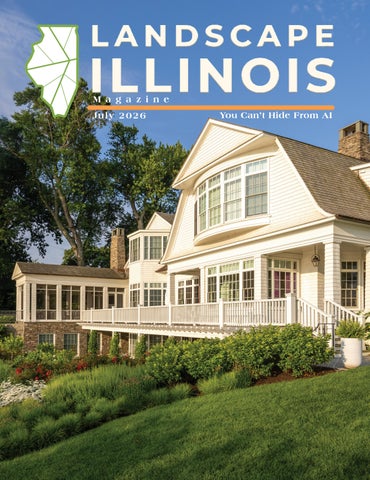
It’s Just Dirt, Isn’t It? 54 Before You Go 62 Rodgersia — Textural Anchors On the cover... Mariani Landscape won the 2025 Gold Award with this project titled Inspired Lakeside Living.
Landscape Illinois Magazine July 2026
36
62 3
CONTENTS
DEPARTMENTS Events Calendar 4 From Where I Stand 5 President’s Message 7 Classified Ads 56 Advertisers Index 61 Photo Credits
Awards Committee 1, 8-9 Landscape Illinois 19-20 Rick Reuland 20, 22, 51-52 Miguel Rodriguez 24-28 Design Committee 31-34 J. Frank Schmidt & Sons 36 Chicagoland Grows 37
Cedar Path Nursery Alex Head Midwest Groundcovers Nina Koziol Mark Dwyer
38 44 42-46, 61 62
JULY July 9, 2026 Design Tour Chicago, IL July 23, 2026 Landscape Design Unplugged The Morton Arboretum Lisle, IL
AUGUST
August 20, 2026 Summer Field Day: The Landscape & Snow Expo Lake County Fairgrounds Grayslake, IL
SEPTEMBER
The official publication of Landscape Illinois, — Landscape Illinois —The Magazine is dedicated to educating, advising and informing members of this industry and furthering the goals of the Association. Landscape Illinois Magazine carries news and features relating to landscape contracting, maintenance, design and allied interests. Publisher is not responsible for unsolicited material and reserves the right to edit any article or advertisement submitted for publication. Publication reserves right to refuse advertising not in keeping with goals of Association. www. LandscapeIllinois.org. Volume 67, Number 7. Landscape Illinois Magazine (ISSN # 0194-7257, USPS # 476-490) is published monthly for $75.00 per year by: the Illinois Landscape Contractors Association, 2625 Butterfield Road, Ste. 104S, Oak Brook, IL 60523. Periodicals postage paid at Oak Brook, IL and additional mailing offices. Printed in USA. Postmaster: Send address changes to Landscape Illinois Magazine, 2625 Butterfield Road, Ste 104S, Oak Brook, IL 60523. Display Advertising Sales: Association Publishing Partners, Inc., Ph. (630) 6378632; email: rmgi@comcast.net. Classified ads, Circulation and Subscription: Landscape Illinois (630) 472-2851 Fax (630) 472-3150 Editorial office: Association Publishing Partners, Inc., Naperville, IL PRODUCT DISCLAIMER: The Illinois Landscape Contractors Association, its Board of Directors, The Magazine Committee, Landscape Illinois Staff, Landscape Illinois Magazine Staff, neither endorse any products nor attest to the validity of any statements made about products.
September 3, 2026 Turf Education Day (TED) NIU Naperville Naperville, IL September 15-17, 2026 Growers Tour Ohio Nurseries
OCTOBER
October 2-3, 2026 LIFT: The Landscape Professional Summit For Women Eaglewood Resort & Spa Itasca, IL
THE STATEWIDE ASSOCIATION FOR LANDSCAPE PROFESSIONALS
Staff Executive Director Scott Grams (630) 472-2851 sgrams@landscapeillinois.org Statewide Director of Development Kellie Schmidt kschmidt@landscapeillinois.org Director of Events AnneMarie Drufke adrufke@landscapeillinois.org Education Manager Melissa Custic mcustic@landscapeillinois.org Office Manager Alycia Nagy anagy@landscapeillinois.org Membership & Marketing Manager Marissa Stubler mstubler@landscapeillinois.org
v Landscape Illinois
2625 Butterfield Road Ste. 104S Oak Brook, IL 60523 (630) 472-2851 • Fax (630) 472-3150
www.landscapeillinois.org
4
Magazine Staff
Rick Reuland Publisher/Advertising Sales (630) 637-8632 rmgi@comcast.net Debbie Rauen Advertising Sales (817-501-2403) debbie.landscapecontractor@ yahoo.com Feature Writer
Let us make your landscape shopping easier and installations more successful!
Nina Koziol
our offerings
Meta Levin
meta.levin@comcast.net Feature Writer
n.koziol@att.net Heather Prince Feature Writer
SHADE TREES • ORNAMENTALS EVERGREENS • SHRUBS
princeht@sbcglobal.net Patrice Peltier
Feature Writer/Editorial Assistant
Mark Dwyer Feature Writer
Krystal Flogel Feature Writer
Maggie Thomas Harper Special Correspondent
Contributors Dr. Aaron Patton Kevin Donnelly Daniel Wood
sales@dotynurseries.com P 630 365 9063 MAPLE PARK 45W121 Beith Road Maple Park, IL 60151
Landscape Illinois Magazine July 2026
HUNTLEY 14029 Church Road Huntley, IL 60142
No occupation is so delightful to me as the culture of the earth, and no culture comparable to that of the garden. Such a variety of subjects, someone always coming to perfection... tho’ an old man, I am but a young gardener. — Thomas Jefferson, American Statesman love the United States of America. Sometimes, it feels good just to say that out loud. Social media, the daily news cycle, and partisan politics distract us from the fact that over 250 years ago, some of the smartest men in history gifted us with a country strong enough to endure. Somedays, we may not like what the United States does, but I always appreciate what the United State is — a country of the people, by the people, and for the people. Years ago, I went to a wedding for a friend in Newcastle, England with my wife. Newcastle is a working man’s town. Drinking at an English wedding starts about 30 seconds after the couple says “I do.” In fact, walking out of the church we were handed a half pint of English Ale and the size of the glasses and consumption only grew from there. Dinner wasn’t going to be served for over 10 hours and the guests just drink and eat crisps until you can barely stand. As the beer flowed, I got into a conversation with a guest from Newcastle. We got to talking about America and England and I felt like I was back loading a rifle at Lexington. The conversation was barely friendly and he challenged me with, “What do you really think America does better than anyone else?” I thought about it and said, “Rollercoasters.” He laughed and that broke the tension. I said, “In all seriousness, our sense of obligation to do what is right even if it is unpopular.” I was satisfied by that answer. I am sure he called me “a wanker” after I walked away, but at least I get to ride cooler rollercoasters. Patriotism is never a bad thing. Patriotism is a feeling of love, devotion, and attachment to a country. We share an identity, culture, history, myth, and lore with our fellow citizens. It is what gets us to paint our faces, wave our flags, and chant U-S-A at no one in particular. I fly an American flag in front of my house because I deeply appreciate the freedoms enshrined in our Bill of Rights. I am too damn opinionated to live in a country who polices my speech. I believe people should be allowed to pray to whatever God they want when they say their prayers at night. I believe the press, as annoying as they can be, must hold the line because those in power will always try and cross it. I believe smart men and women who care, have the right to petition their government, because the government is often not smart and doesn’t care. And, finally, I believe the system is designed to send us chasing our tails until we leave it alone. Sometimes, we have to assemble in the streets to show it we won’t. That is what I believe and so did the Founding Fathers. Most of us remember the 3rd grade version of the founding fathers and that is ok. Images of these men fill our history books and our plastic cups filled with loose change. They write books and make movies and show 12-part miniseries on PBS about the founding fathers. We name states, cities, streets, and elementa-
I
ry schools after them. We turn them into herky-jerky robots at Disney World. And what parent hasn’t spent an evening with their kids gluing cotton balls onto James Madison’s wig the night before a big school presentation? There are hundreds of books about the founding fathers that will tell you their motivations from every conceivable angle. In my opinion, the only thing you need to know about the philosophy of the founding fathers is that they were absolute maniacs about freedom. The Constitution and Bill of Rights are a backstop of rights and liberties because the founding fathers demanded it be put there. They knew that men in power cannot be trusted. We can only trust artfully designed systems that made freedom our most important cultural value. The founders fully understood that with personal freedom, there is no middle ground — you either have it or you don’t. And, what was the reason they were so maniacal about personal freedom? Because they were gardeners. Andrea Wulf, an author and historian wrote the book Founding Gardeners: The Revolutionary Generation, Nature, and the Shaping of the American Nation. Wulf makes the argument that it is no accident that America was built by men who gardened and were passionate about agriculture and botany. Jefferson, Washington, Adams, and Madison were all avid gardeners and plantsman and that is no coincidence. Let’s start with Thomas Jefferson. Jefferson was the most maniacal of the individual liberty maniacs. He wanted limited government and felt that the self-sufficiency of an agrarian republic was the best way to get there. Jefferson was a serious vegetable gardener and even wrote The Garden Book which is a 66-page horticultural diary still in print. Jefferson felt that all of America should be built on the concept of the Gentleman Farmer. This was rooted in Greek and Roman society where citizens who farmed their own land had prestige and strength. By having their own land and food, they did not grow desperate and unpredictable. By trading with other farmers, they became fair and civil. Gentleman farmers were left alone and only got involved in politics when something went wrong. They didn’t waste or want. A society built on those principles would last. When Jefferson made The Louisiana Purchase, the largest land purchase in history, he did it because of farming and gardening. Jefferson hated cities and wanted to spread Americans out across this great land. Many in Congress did not want to purchase more land from France when the United States already had too much territory. Jefferson knew that land meant farms and gardens. Farms and gardens meant more Americans controlling their own destinies. James Madison is credited as the father of the constitution. He believed in a balanced government that must protect individual liberty at all costs. Madison was also a prolific gardener. He had a four-acre garden at his estate filled with flowers, vegetables, and rare plants. He traded seeds and plants extensively with a network of botanists around the world. Madison was one of America’s first conservationists. He advocated for crop rotation, forest stewardship, and the eradica-
The American Garden
Landscape Illinois Magazine July 2026
5
Garden Prairie, IL (866) MARIANI 627-4264 6
tion of invasive species. Madison picked up where Jefferson left off. There was no purpose to have a country of gentleman farmers if they didn’t take care of the land. He preached to agricultural groups about soil erosion, rainwater harvesting, and natural fertilization. He championed a series of canals and riverways for farmers and gardeners to get products to market. In one of his final speeches, he urged Americans to restore symmetry to the land and felt the most dangerous threat to the republic was to return to an overreliance on foreign trade. Madison’s garden is still in operation to this day as a final testament to his methods. John Adams was a staunch advocate for checks and balances. He was the resident cynic. He knew man’s worst ambitions would take over unless a system was designed to protect the individual from the many. Adams owned a 600-acre farm in Massachusetts and grew up farming. He shared the views of Madison and Jefferson that farming would form the backbone of America. He was obsessed with composting and soil management. He tried to find uses for all of the farm’s waste including for fertilization and construction. When he left public office, he returned to the farm and worked it diligently until he died. His farm and gardens allowed him the privacy he craved after his presidency. Politically, George Washington pushed for a strict separation between church and state. He pushed the framers to allow for religious freedom and to protect all faiths. Washington owned five farms and there wasn’t a part of agriculture he failed to touch. His farms grew crops, vegetables, ornamentals, and yes, even hemp. He raised animals and was a commercial fisherman. Washington viewed himself as a farmer first, military man second, and politician, a distant third. At his estate at Mount Vernon, Washington ordered hundreds of trees and shrubs from John Bartram. Bartram was the most famous and notable plant collector of his day. Bartram enjoyed relationships with almost all the founding fathers who worked the land. Washington also believed in a nation of farmers who would be more self-reliant and resistant to the corruption that was rampant among wealthy aristocrats. If that wasn’t enough, Wulf’s book tells the story of the great impasse that threatened the Constitutional Convention. Half of the delegates wanted a strong, central government. The others wanted power spread evenly among the colonies. After days of debate, everyone needed a break. They decided to visit the garden of John Bartram. Bartram had a nursery that collected native plants from all 13 colonies. Together, as one, these plants thrived. The garden became something greater than the sum of its parts. Two days after the visit to Bartram’s garden, five delegates changed their vote, the Constitution was ratified, and our nation was born. Three years after the American Revolution ended, Jefferson and Adams returned to England. Jefferson hated the English, but he gave them credit for being the best gardeners. On that trip, he noticed that American species were being used in formal English gardens. The English put gardening above nationalism, and saw the beauty and durability in American plants. At that moment, Jefferson and Adams recognized that America was finally established. Our plants had crossed the sea. Soon other products, manufactured goods, and American idealism would follow. Gardeners know that gardens thrive because homegrown plants can intermix with exotic varieties. It’s not the garden, it’s the freedom to take chances, make mistakes, and leave behind something more beautiful than you found. I hope we, as the current caretakers of this wonderful, magical, unique garden, never forget that. Happy 250th birthday, America. We are just getting started.
Scott Grams, Executive Director June 16, 2026
Landscape Illinois Magazine July 2026
President
Kevin McGowen Lurvey Landscape Supply (224) 500-4396 kmcgowen@lurveys.com
Vice President
Ryan Heitman The Fisher Burton Company (847) 566-9200 ryanheitman@fisherburton.com
Secretary-Treasurer
Adam Bellas Bellas Landscaping (309) 827-5263 adam@bellaslandscaping.com
Immediate Past President Kim Hartmann Rosborough Partners 847-404-7669 hartmannkim@comcast.net
Directors
Jim Cirrincione Hinsdale Nurseries, Inc. (630) 323-1411 jcirrincione@hinsdalenurseries .com Shane Griffith Weed Man (847) 459-9333 shane.griffith@weedmanusa.com Tom Klitzkie Nature’s Perspective Landscaping (847) 475-7917 tklitzkie@naturesperspective.com Ashley Marrin Bret-Mar Landscape Management Group, Inc. (708) 301-2225 ashley@bretmarlandscape.com Michael Massat The Growing Place Nursery & Flower Farm, Inc. (630) 355-4000 michaelm@thegrowingplace.com Nikki Melin Midwest Groundcovers (847) 742-1790 nmelin@midwestgroundcovers.com Becky Thomas Spring Grove Nursery, Inc. (815) 448-2097 bthomas@springrovenursery.com Aaron Zych ILT Vignocchi, Inc. (847) 487-5200 azych@iltvignocchi.com
www.landscapeillinois.org
W
hen I started working on this message, I asked Microsoft CoPilot to write me a 150 word article on the landscape industry. In seconds, it produced a 153 word article about landscaping. It seemed to say a lot in a short space until I realized… it said nothing at all. It reads well, sounds smart, but then you realize there is no substance. Just a lot of AI mumbo jumbo. I had a realization that AI is cool, but I’m not sure its personality is fitting of the landscape industry. I’ve seen exciting AI in our industry. Inventory systems with drones counting the plants in houses. Pruning machines that move through a crop, making everything cookie-cutter. Spacing machines that make sure plants are not touching in the nursery. Things that can cut down on physical labor seem to be what is most highly sought after for AI in our industry. However, it’s hard to tell if the plants have disease while being pruned when your brain isn’t a brain! The quality of the plants is less certain when it isn’t a human determining the qual- Kevin McGowen ity. If the plant spacers move a Fire light® Hydrangea into a row of Strawberry Sundae® Hydrangea, there could be an issue with inventory and with pulling the wrong plants for an order. Truly, this can happen with humans too. We all make mistakes. I get worried about the landscape designers of the world. People can type into ChatGPT, “Design me a patio 10’ x 16’ with a kidney shape and tell me how much it costs.” This is fine if you want a cheap design and you don’t have any questions. But what kind of design would that be? Would the end consumer ever be satisfied with a computer-generated landscape that looks like everyone else’s? Will a contractor want to install this for you and have the passion that makes their projects spectacular want to take a job like this? If you don’t like daylilies, and the computer tells you to plant them, what do you do? Ask AI to change the design? How do you even design for a person/personality that you’ve never met? Surely, AI can make the changes, but how confident are you that they’re correct? If you ask AI to give suggestions for the most popular evergreens for screening, and Blue Spruce comes up, who is going to tell you not to do that!? What I’m trying to say is, even though AI can be useful in some ways, it doesn’t replace a human. You, the landscape contractor, salesperson, designer or producer, are the ones that make this industry what it is. A movie about our industry would rival that of the classic, Best in Show. If AI took over our industry, the personality would be missing. Is AI the honeybee that produces all the honey we need? In the words of Parker Posey, “No! It’s a bear in a bee costume!” If you don’t get the reference, you now have homework. Kevin McGowen, President Landscape Illinois Cuando empecé a trabajar en este mensaje, le pedí a Microsoft CoPilot que me escribiera un artículo de 150 palabras sobre el sector del paisajismo. En cuestión de segundos, generó un artículo de 153 palabras sobre paisajismo. Parecía decir mucho en tan poco espacio, hasta que me di cuenta de que… en realidad no decía nada. Se lee bien, suena inteligente, pero luego te das cuenta de que no tiene sustancia. Solo un montón de jerga sin sentido sobre la IA. Me di cuenta de que la IA mola, pero no estoy seguro de que su personalidad encaje con el sector del paisajismo. He visto ejemplos interesantes de IA en nuestro sector. Sistemas de inventario con drones que cuentan las plantas en los viveros. Máquinas podadoras que se mueven entre los cultivos, dejando todo igualito. Máquinas espaciadoras que se aseguran de que las plantas no se toquen en el vivero. Las cosas que pueden reducir el trabajo físico parecen ser lo más buscado en materia de IA en nuestro sector. Sin embargo, ¡es difícil saber si las plantas tienen alguna enfermedad mientras se podan cuando tu cerebro no es un cerebro! La calidad de las plantas es menos segura cuando no es un humano quien la determina. Si las máquinas espaciadoras colocan una hortensia Fire light® en una fila de hortensias Strawberry Sundae®, podría haber un problema con el inventario y con la selección de plantas equivocadas para un pedido. La verdad es que esto también puede ocurrir con los humanos. Todos cometemos errores. Me preocupan los paisajistas de todo el mundo. La gente puede escribir en ChatGPT: «Diseña un patio de 3 x 5 metros con forma de riñón y dime cuánto cuesta». Esto está bien si quieres un diseño barato y no tienes ninguna pregunta. Pero, ¿qué tipo de diseño sería ese? ¿Estaría el consumidor final alguna vez satisfecho con un paisaje generado por ordenador que se parece al de todos los demás? ¿Querrá un contratista instalar esto para ti y tendrá la pasión que hace que sus proyectos sean espectaculares para aceptar un trabajo como este? Si no te gustan las azucenas y el ordenador te dice que las plantes, ¿qué haces? ¿Le pides a la IA que cambie el diseño? ¿Cómo se diseña siquiera para una persona o personalidad que nunca has conocido? Sin duda, la IA puede hacer los cambios, pero ¿qué seguridad tienes de que sean correctos? Si le pides a la IA que te sugiera las plantas de hoja perenne más populares para crear una pantalla y te propone el abeto azul, ¿quién te va a decir que no lo hagas? Lo que intento decir es que, aunque la IA puede ser útil en algunos aspectos, no sustituye a un ser humano. Vosotros, los contratistas de paisajismo, los comerciales, los diseñadores o los productores, sois los que hacéis de esta industria lo que es. Una película sobre nuestro sector rivalizaría con el clásico Best in Show. Si la IA se hiciera con el control de nuestro sector, se perdería la personalidad. ¿Es la IA la abeja que produce toda la miel que necesitamos? En palabras de Parker Posey: «¡No! ¡Es un oso disfrazado de abeja!». Si no entiendes la referencia, ahora tienes deberes.
Landscape Illinois Magazine July 2026
7
8
Landscape Illinois Magazine July 2026
T
Chalet • Wilmette Continuous Color
his North Shore property has been carefully maintained by the same team for the last 25 years. Weekly visits by an experienced management crew ensure the lasting beauty of the landscape. Careful attention is paid to bed edging, weeding, and trimming all done by hand. The mature trees on the property are trimmed annually, and an extensive regime of fertilization and preventive care applications ensure the trees will be healthy. The organic turf care
program keeps the lawn healthy throughout the growing season despite the shady conditions. Summer and winter seasonal plantings are custom designed and installed for twenty-five planters and six window boxes. Extensive annual ground plantings also encompass the front and back yards. Careful attention to detail ensures the client’s property will be beautiful for the life of the landscape.
Landscape Illinois Magazine July 2026
9
Our Industry’s 10x by Lawson Thalmann III
M
edia today optimizes for headlines that produce shock and awe. A shocking story, pushed by the frontier AI companies themselves, has been that AI is going to take your job. A variation is that AI isn’t going to take your job, but someone who uses AI is. That narrative is accepted widely enough that it’s now a contrarian view to say that AI won’t take any jobs. I lean towards this contrarian take but focus instead on what AI will give us, which is the power to do more. In an industry that makes outdoor spaces beautiful, and that means a more beautiful world! That’ll be achieved through the talented people in this industry raising their game to the next level through re-imagined AI-powered processes. It’s that vision of the world I’d like to promote instead of the dystopian one.
AI Is Not Here to Take Your Job
At Chalet, we’re very transparent about how we bring AI into our business. We communicate thoroughly that AI is not here to take your job, it’s your assistant to help take things off your plate and enhance what you already do so you can accomplish more. We’ve gone a step further and given our AI Agents and Apps names like R.O.S.E. and P.A.U.L. They’re anthropomorphized acronyms – that is, they stand for something meaningful, but purposefully spells out a name that easily rolls off the tongue and feels like a part of the team. Think J.A.R.V.I.S. (Just a Rather Very Intelligent System) from Iron Man and the Marvel franchise. Each team has their own JARVIS – their own intelligent assistants. It’s the removal of the boring parts of our jobs that has me most optimistic. This is where some do the math and say jobs are going away. Some companies have investors with higher expectations on profit to sell the company and make returns in the shorter term. Cutting jobs can be a part of that recipe and AI can certainly help with that. It’s a valid approach for the goals of those shareholders, but will be a challenge to be successful in the longer term since the longer-term approach is based on the human factor that makes our industry so great. We’re playing the long game at Chalet. Speaking for the 4th generation Thalmannfamily ownership, we hope to play a leading role in building the future of our industry into something yet more beautiful than it already is. By taking those with unique skillsets like design, sales and operations and re-building those functions for the age of AI, we see 10x improvements. That could be 10x more customers, 10x more work per customer, or 10x better and more beautiful work. 10
Rethinking Processes
To achieve this, the key is to rethink business processes from start to finish given these new capabilities, rather than simply speeding up existing steps. Azeem Azhar, an AI thinker I follow, sums this up in stages in his article. “Why AI isn’t showing up on your bottom line.” The answer to this question is that you’re in Stage 1 which he compares to the introduction of the light bulb. Initially, it was used to light factories, which led to less strain on the eyes and safer conditions. However, proving out its effect on the bottom line was difficult. Stage 2 for electricity meant hooking up electricity to various machines, improving efficiency and cutting costs. Stage 3 brought Henry Ford who re-oriented machines and workers around the new assembly line workflow.
The Assembly Line did wonders for the car industry, plummeting the cost of the Model T in half over 8 years and even more in the years to come by rethinking how cars could be made and a vision that people could get behind: “I will build a motor car for the great multitude... it will be so low in price that no man making a good salary will be unable to own one.” How exciting! The age of AI requires a similar rethink. The assembly line solution was great for 1908. 2026 requires an equally impactful but different invention. As for a vision… The great multitude deserve a beautiful and ecologically sustainable outdoor space at an affordable price. This doesn’t mean margin erosion – quite the opposite. As we expand our capabilities and productivity by rethinking how our industry does things, efficiencies could allow us to sell more products and services to people even at the same level of spend per customer while capturing the same (or more) margin dollars throughout the supply chain.
Landscape Illinois Magazine July 2026
Future This may result in downward pressure on prices. People equate lower prices with shrinking of revenues which is scary. The optimistic view lies in Jevons’ Paradox. That is, demand for a product or service skyrockets as the price goes down. The increase in demand will outstrip the decrease in prices by multiples, if the theory holds. In Ford’s example, cars went from selling 10,000 to the 1% of incomes in 1909, to two million cars to a wider array of consumers in 1923. Imagine a similar 200x explosion in demand for garden center products and landscape services over the next decade. Sure enough, none of us are Henry Ford so that kind of multiple seems steep. Yet, AI is considered an ‘exponential’ technology which is what gives me confidence in my 10x prediction in the next 10-20 years for our industry – whether it be in quantity or quality of output. I’ll leave that up to your interpretation and give myself plenty of flexibility in determining whether I’m right or not.
Exponential Growth
“In one hour, I was able to accomplish a project I’ve been working on for two years. It’s living up to hype so far, and it proves that the bottleneck is no longer the technology, but the imagination and skill of the people directing it.”
We should be prepared for this exponential surge in demand to trigger a fundamental evolution in how our industry captures value. We have already seen a macroeconomic shift from selling standalone products to services as the primary driver of revenue in the economy. In the U.S., the service sector grew from 59% of GDP in the mid-20th century to over 70% today. Our industry will not be an exception to this trend. For Chalet, and our broader industry, this means our future revenue won’t just come from the plant units we sell, but from the ongoing, high-value outcomes we guarantee. Instead of a customer just buying perennials, we may provide an ongoing, dynamically managed ecosystem service powered by predictive data.
Making this leap requires an architectural rewiring of how a company thinks, operates, and executes. It demands a rare blend of deep domain expertise and cutting-edge technical ambition. To orchestrate a shift of this magnitude, you cannot rely on the status quo or passive adopters. It requires builders who aren’t afraid to re-engineer legacy systems from the ground up, moving beyond simple spreadsheet automation into true intelligent process orchestration. The companies that successfully navigate this pivot will be rewarded. They will be the ones creating highly predictable, recurring revenue streams while delivering an unprecedented level of precision and beauty to the customer. But to construct that reality, you need an environment that treats AI not as a cost-cutting threat, but as an intellectual launchpad.
Industry Coordination
That said, it’ll require coordination amongst our industry to steer. We’ll need to foster industry and supply chain coordination to ride this wave for all our businesses. To that end, we’ve developed a treasure trove of plant and other industry data that powers agents and applications which in turn power reinvented business processes. As those processes take shape, we’ll work with industry partners that are ready to jump into this fast lane with us. These partners will get unprecedented data at their fingertips to inform better decisions while using tools to re-architect their business processes around these new capabilities. If you’re simply bouncing ideas off Chat GPT and having it process a spreadsheet here and there, you will have the prerequisite for making this jump, but it will be a large jump, nonetheless. (continued on page 12)
Landscape Illinois Magazine July 2026
11
(continued from page 11)
What’s Next
Our Apps and Agents – A Sneak Peek
Let’s take a quick tour around some of our Agents and Apps. They power everything from selecting the right plant for the right spot, conceptualizing the design, selling the work and plants, sourcing them from the right vendor, receiving and dispatching them to the job and then ensuring the health and quality of that plant all through data and AI in the hands of our talented staff. Let’s take a quick tour around our internal ecosystem. These intelligent assistants super power the members of the team they serve: • R.O.S.E. (Responsive Outdoor Space Engine): Generates stunning, data-backed imagery for our sales and design teams to help clients visualize their new spaces instantly. • P.A.U.L. (Procurement, Allocation and Unit Logistics) & R.A.L.P.H. (Retail Assortment & Logistics Planner for Hardy-plants): Manage complex plant procurement, allocation, and unit logistics for hardy plants on both the retail and landscape sides. • F.O.R.D. (Farm Operations, Reporting and Distribution): Streamlines picking, shipping, and distribution logistics from our farm via desktop and mobile. These are just a few of the newest additions to our team with more to come.
12
We’re still in the first inning of what’s possible with AI. As I write this, I just got access to Anthropic Claude’s Mythos model which has been considered too dangerous to release over the past four months. In one hour, I was able to accomplish a project I’ve been working on for two years. It’s living up to hype so far, and it proves that the bottleneck is no longer the technology, but the imagination and skill of the people directing it. Next week, I’ll be talking with Anthropic’s Public Policy team about how to help steer AI into positive use cases. With my wife working for Google, I’m partial to Gemini as well and excited about its geospatial abilities for our industry. We have some beautiful use cases in our industry. For example, we’re in the early stages of developing systems around collecting data to predict which plants and gardening approaches are best for the ecosystem using research techniques borrowed from our friends at Northwestern University. That data can flow up and down the supply chain to grow more beneficial plants and develop more sustainable products. Predicting the future is hard, but if I’m even close to right on my 10x predictions, we’re standing at the edge of an incredible and fun new era.
Landscape Illinois Magazine July 2026
YOU DESERVE
!
R.O.S.E. evaluated this photo (above) and created this stunning image (below) having learned our design style
Lavender ‘SuperBlue’ is better than Lavender ‘Hidcote’ thanks to bigger blooms and a better habit in the landscape!
Scan for BETTER landscapes! ©2026 Ball Horticultural Company 261073250
Landscape Illinois Magazine July 2026
13
AI-Powered Sales: Boost Your Process and Close More Deals
by Meta L. Levin
T
he key to using AI to boost your sales success is putting good processes and procedures in place before even nodding at any AI tools. “AI is only as good as the processes and systems” already there, says Frank Bourque, a professional speaker, writer, consultant and entrepreneur, who spoke about, “AI Powered Sales: Boost Your Process and Close More Deals” during iLandscape 2026. He maintains that well defined inputs lead to better AI responses. In the landscape industry, AI has been used to allow contractors to develop quotes faster, automate crew routing and produce digital visual images of proposed projects, among other things. There are, says Bourque, more than 40,000 AI tools available now and that number, as well as what they offer, changes rapidly. There are several types of AI that can be used and help in different ways. Bourque focused on two: generative and agentic. Generative primarily generates new content, such as text and images. The number one cause of burnout in the landscape industry is the amount of information contractors have to learn, he 14
says. “AI can help you process and analyze that information.” It helps those in the landscape industry save time, win more work and run smoother by automating tasks and improving follow-up. To do this successfully, try thinking of AI as another crew member. Just as a crew member needs information to do his job, so does AI. That is why Bourque emphasizes planning the task in plain terms and detail first. Have a clear idea of what role you want AI to play, i.e., write a script for the person who answers your phone and is a prospective customer’s first contact with your company, or generate a client ready proposal. “The best thing you can do to have a competitive advantage is build a sales process and then tie AI into it, because that is going to create efficiency,” says Bourque. “It will make it easy for your clients to do business with you.” First, create a clear, easy-to-follow process with regular client follow-ups built into every step so they always know what is happening. AI can make that much easier. Start by drafting a standard operating procedure. Work on building sales scripts, let AI summarize meetings for you. Create job descriptions, outline necessary training and explain key performance indicators (KPI) and financials. Once you have entered
Landscape Illinois Magazine July 2026
So, when thinking about adding AI, those procedures and more into your AI take Bourque’s tour of your customer’s program, it will summarize for you; it will create a check list for your crew and journey. Ask yourself, what kind of feedback are you getting about it? That at the end of the day, it will even tell you if the check list has been completed way you can tweak the process and procedures before adding AI. “If you don’t or not. It starts, however, with getting have a clear standardized sale process, information out of your mind and into that is where I would start,” he says. your computer. “If AI knows your “You deserve a system that makes your process, it is going to be able to do the expertise shine.” work for you,” says Bourque. Bourque provided a sample step by For instance, in sales it is important step sales process: to use the same kind of language that 1. Capture a lead from wherever it your client uses. “Rapport is better,” he originates. says. AI is good at doing these things. Agentic AI at a basic level can, 2. Budget. Set expectations at the among other things, perform multistart. step jobs using tools. “You set rules and it works in the background,” says 3. Classify the lead: Bourque. “Once you have the process and procedures in place, agentic AI will a. An “A” lead is your ideal. know what to do at different times.” Book a sales consultation. Using it, you will be able to pull inforb. A “B” is smaller, but viable. mation from different divisions in your Book a sales consultation. company. AI will track what is going on and alert you if something happens. c. A “C” is not your ideal. It is Using agentic AI, you can take inforlow budget and a mismatch. mation and set some automation in place Refer that to another conso that AI knows what to do in different tractor or politely decline. situations. You can put a human in the
loop. It will stop at different proscribed 4. Set up a call to get the informapoints and you can control where it tion you need before meeting with needs to come in and make decisions. the client. That way the salesperIt can help with sales follow-up, son can come prepared. scheduling, job cost review, KPI monitoring, client communication and trainAt this point AI can be useful. It ing reminders. “If something should just can help the salesperson prepare for the happen, that is AI agentic’s job,” says meeting by generating a list of specific Bourque. “That is where AI does best.” questions to ask the prospective client, It is good for accountability. It will which will help structure the conversaalways remember when it needs to do tion. “When you set up the sales call, the next step. the goal is to control expectations,” says When Bourque comes into a compa- Bourque. The script or list of questions ny as a consultant, his first action is to can help you confirm goals, identify look at a customer’s journey. “It tells me decision makers, establish an agenda for what to put in place to have a smooth the first meeting and qualify the budget. process and operation from getting the Once there, the salesperson should lead, to how it is processed, how to sell, work to connect with the client in the how to manage the job, how to nurture first 90 seconds. “Clients want someone the relationship with the client,” he says. who ‘gets them,’” he says. Mirror the But it does not stop there, once the job is client’s style, pace and communication complete, his clients should ask for feed- style. To do this he recommends compliback and referrals. How will Bourque’s menting the property or neighborhood. client get more of those types of jobs if Reset expectations (“Here’s what we’ll he wants them? (continued on page 16) Landscape Illinois Magazine July 2026
15
(continued from page 15) do today.”). “People buy from people who “get them,” not people who pitch.” Next, uncover the needs, the emotional drivers, the real why behind the project. “Get the homeowner talking more than you,” says Bourque. The questions programmed into the list AI provides you should include those that will elicit the most important outcome the client wants from the project (i.e. a place to entertain or a place for the children to play), how he or she wants the space to feel and what frustrations do they hope to solve? Share relevant stories. AI can help you call up visual
examples on your tablet that reflect designs and other illustrations that show what you are hearing from the client, but also what you can do. Translate these features into benefits and outcomes. The next step is to present the cost or what Bourque refers to as the “investment range.” Let AI create different packages based on what you have learned, as well as what you have given it to work with. Initially, this can be done on your tablet while you are with the client. AI also can be used to create a price range for the options. For each, AI can help you show visual proof, using photos, design examples and materials. Translate the features into benefits
“If AI knows your process, it is going to be able to do the work for you,” says Bourque
AN INCREDIBLE SELECTION WITH INFINITE POSSIBILITIES. Over 15,000 trees, 35,000 shrubs, 100,000 perennials, and 500 varieties at our 650-acre farm.
Trees, Ornamentals, Evergreens, Shrubs, Annuals, Perennials, Vines, and Groundcover. Over 11 acres of holding yard in two convenient locations.
Main Office & Sales Yard
7200 S. Madison · Willowbrook, IL 60527 630-323-1411
Little Rock Farm
2353 Creek Road · Plano, IL 60545 630-552-8314
For sale updates and availabilities, sign up for our email newsletter.
16
HinsdaleNurseries.com
Landscape Illinois Magazine July 2026
and outcomes. Use AI to combine different possibilities and give the client the price range right away. If there are objections, AI can help there, as well. Bourque believes that objections “are requests for clarity,” he says. So, say something like, “would it help to see options at different price points?” Then use AI to generate some. Finally, Bourque recommends offering one, clear next action, such as booking a meeting with the designer or getting a deposit. “Always close to the next commitment, not the final commitment,” he says. You can, says Bourque, begin using AI now. Develop clear procedures from start to finish, even to what happens after the job is sold and installed. Once it is integrated, AI will begin to know the process. Deploy AI agents across your departments. They will listen to conversations, create recommendations and learn over time. There are a few AI tools built for the industry, such as Landscaper AI,
HOME OF THE
which Bourque describes as ChatGPT for landscaping. There also is Lean ScraperAI, which helps build systems and procedures, if you enter the right information. Currently Lean Scraper is free, but Bourque predicts that once it encompasses agentic AI, they will begin to charge. There also is Outdoor Design, as well as AI tools that allow drones to measure property. AI can do oh, so much now, but it will be doing much more in the future.
PINK PIG!
Family Owned & Operated 817 E. Route 38 Elburn, IL 60119
630-365-8888
www.kclandmat.com Authorized Distributor:
Landscape Illinois Magazine July 2026
17
by Meta L. Levin
T
his year’s Summer Field Day: The Landscape and Snow Expo fully embraces its place as the association’s longest running and oldest conference. The 2026 event will be held on the Lake County Fairgrounds in Grayslake. Attendees will have one foot in “Ye Olde Tyme” county fair, with the other firmly planted in the landscape and snow industries’ latest and greatest. Think red and white checkered tablecloths, hay bales, bunting, a coke bottle ring toss, cows, goats and the industry’s own version of the Lincoln-Douglas debates. Now juxtapose that with the exhibitors’ newest technology and equipment, treatments, healthy green plants and a myriad of colorful flowers. All this and more are planned for the 2026 Summer Field Day: The Landscape and Snow Expo. “It will be a nostalgic blast from the past,” says AnneMarie Drufke, Landscape Illinois’ Director of Events. 18
Scheduled from 8 am to 2:30 pm, Thursday, August 20, on the Lake County Fairgrounds, the event will kick off with the first debate, where participants will find Summer Field Day Cochair Anna Blankenhagen dressed as Honest Abe, while debaters face each other on some decidedly modern topics (scheduled to include) 1. Gas equipment vs electric 2. Plant warranties vs no warranties 3. AI vs no AI 4. Design fees vs no design fees 5. Natives vs nativars 6. Formal vs naturalistic design For the first time ever, the Summer Field Day Committee will host a puppy/dog adopting opportunity. Run by “4 Paws 4 U 4 Ever,” a family-funded and operated shelter based in West Chicago that places the dogs and puppies in good homes. There will be dogs for adoption, and the committee will raise money
Landscape Illinois Magazine July 2026
Lunch line at Summer Field Day in 1963 for the shelter via a walking auction, auctioning off plants donated by exhibitors at the end of the show. Jim Schwantz, founder and CEO of Goodmark Nurseries, will tap into his own private menagerie to bring along cows and goats to display, making Summer Field Day look even more like a traditional county fair. Since its 1961 beginning on the Tures Brothers Nursery property in Plato Center, Summer Field Day always has been held at nurseries and other places rife with beautiful flora. The committee felt that lack, but found answers close by. Taking advantage of the locality, it scheduled two tours of the nearby Prairie Crossing, a nationally recognized conservation community. The tours will focus on the sustainable and ecological landscaping practices on which the community was built. These include native landscaping, biodiversity, stormwater management and preserving open space. In fact, more than 60 percent of its site is and will continue to be open space. “It felt natural to tour it,” says Blankenhagen, Wholesale Yard Representative for Midwest Groundcovers. (continued on page 20) Landscape Illinois Magazine July 2026
19
(continued from page 19) Also nearby is The College of Lake County (CLC), which has a thriving horticulture program. Members of the horticulture club and faculty traditional will be on site, holding their weekly farmstand, usually on the CLC campus. Proceeds go toward supporting their program. “We don’t have a traditional host this year,” says Scott Grams, Landscape Illinois Executive Director. “So, we asked the horticulture students to bring the produce stand to us.” Grams is excited about the location and theme this year. He notes that the committee thought long and hard about the name, which had been changed for a few years. In the end,
20
they decided to return to the traditional Summer Field Day moniker. Once they made that decision and looked at the Lake County Fairgrounds, the theme, a salute to the classic county fair, fell into place. Perennial favorites, the third annual Container Wars, will be back, as will the gnome hunt. But what is a county fair without a pie eating contest? Summer Field Day will have one. Representatives from Landscape Illinois committees will compete to see who can scarf down a nine-inch fruit pie the fastest, with the prize of a Committee Hapy Hour going to the winning committee. (continued on page 22)
Landscape Illinois Magazine July 2026
one was the Indy 500 Pace Car (owner: Eric Schoenfeld) Do you have one you would like to display? Contact AnneMarie Drufke at adrufke@landscapeillinois.org. Old school county fair games will include Hi Striker, a classic test of strength game, milk bottle knock down and a milk can toss. There will be prizes. Most contractors are there to see what is the latest and greatest, says John Downing, Summer Field Day co-chair for snow and Territory Manager for Casey Equipment Co. To that end, there will be more than 80 exhibitors, as well as opportunities to ask questions and see some equipment in action. And, yes, the Kona Ice Truck will be back. “Everyone loves going to the country fairgrounds,” says Downing. “It should be a great event.”
(continued from page 20) Are vintage cars your thing? And you think they belong in a county fair? Well, the committee agrees with you. There will be a vintage car show featuring autos owned by Landscape Illinois members. At the time of this writing, a partial list included: • Vintage farm truck from Midwest Trading (as seen at iLandscape) • 1940’s Chevy truck from Chalet • 1959 Chevy Chevelle (owner: Andrew Keppel, LandCare) • 1966 Ford Mustang convertible (owner: Tim Caldwell, The Savanna Group) • 1979 MG Midget convertible (owner: Tim Caldwell, The Savanna Group) • 2011 Chevy Camaro SS. This
22
Landscape Illinois Magazine July 2026
L O N G S H A D OW
®
. COM
Hand Crafted in Southern Illinois by The Artisans at Classic Garden Ornaments, Ltd.®
Introducing the New Geodesic Collection
For inquiries call 618 893 4831 Landscape Planters Illinois Magazine& Garden Ornaments 23 Fine Dry Cast Limestone July 2026
Living the American Dream Miguel Rodriguez and Big Trees by Nina A. Koziol
W
hen Miguel Rodriguez was 14, his family emigrated from Mexico to the United States. “When I was fresh out of high school, I couldn’t get any jobs but just kept applying. I came across one with Big Trees and they gave me an opportunity as a regular laborer with a wheelbarrow and a shovel,” he recalls. Now, some 30 years later, Rodriguez owns Big Trees based in Joliet. Besides selling and transplanting deciduous trees and evergreens, the company services residential and commercial properties, including golf courses and municipalities. “When my boss Kevin told me he was going to retire, I thought, ‘Shoot, the only thing I know how to do is dig trees’. I just needed to come up with the money to buy the company. I had to borrow some money to buy the equipment.” That was more than a decade ago, and Miguel has not looked back. In the beginning, Big Trees did planting and nothing else.
24
“We had a big spade and a truck. I’d climb the tree and tie up every branch so we could move it. We’d buy trees from homeowners.” Now, he moves 30-foot-plus trees with sophisticated machinery and hydraulic controls. Miguel has a five-member crew and extra help depending on the project. “When I first started it was just me and another guy. The people I hired came from other companies and they know their stuff.” Today, his pride and joy is the Donovan residence in Palos Park where he (continued on page 26)
Landscape Illinois Magazine July 2026
Landscape Illinois Magazine July 2026
25
(continued from page 24) has not only moved or planted some 700 trees and countless shrubs and perennials but has done an incredible job with hardscaping throughout the five-acre property. “This is the biggest project I’ve done, and we’ve been working on it for the past five years. For months we had more than 10 guys working every day.”
A Woodland Paradise
“He’s done all of this,” says owner Vita Donovan, as she looks past the sweeping lawn into the woods and winding creek. “We started off with one path and it’s been a progression. You couldn’t walk through parts of the property. He saved all the trees by putting the boulders in along the creek, which would overflow,” Vita says. One of the most challenging aspects was hand-placing each of the boulders one-by-one on the steep creek walls. At times the water would be at their waistline while the crew worked. Miguel estimates that more than 600 tons of stone has been used in the project thus far. “We did it little by little, almost like a trial, and Vita liked it, so we kept going. It was like building a puzzle because you need to have an eye for a boulder and how it’s going to fit,” Miguel notes. Pulleys were used but almost every stone was set by hand. “Every tree he’s planted has survived,” Vita says. One of them was a 40-foot-tall Autumn Blaze maple with a 12-inch diameter trunk. “Miguel is very modest,” says Vita’s husband
26
Tom. “He always has a knack for putting trees in the right places. He knows our property so well.” Miguel visits nurseries and hand picks every new plant. “There are plenty of native trees here,” Miguel says. “Black walnut, a giant beech, catalpa, some hickories, a Kentucky coffeetree, oaks and an ancient cherry.” He’s also added redbuds, spruces, arborvitae and many unusual dogwoods. Miguel and Vita often walk the property and discuss what she’d like to change or add. “I think I drive them nuts,” she says, “but I love watching them work.” “Vita and Miguel are a good team,” Tom says. “I’m just a junior partner,” he jokes. He may not be involved with the design, but his favorite plants are the hydrangeas, especially Limelight. The couple enjoys strolling or taking the golf cart down paths that now meander through the rolling woodland that holds many native ephemerals, perennials and understory trees. “The Japanese maples are my favorite,” Vita says. The couple has incorporated the original bridge from the 1920’s that once spanned the creek and served as an entryway to this beautiful property, historically named Brookwood. “People came across it to a restaurant that was on the site a century ago,” Tom explained. The bridge now rests amongst the boulders, keeping a unique piece of Palos Park history alive. “This was only possible because of Miguel’s planning and his ability to transform Vita’s vision into reality.” Besides all of the hardscape additions, along the roadside, (continued on page 28)
Landscape Illinois Magazine July 2026
Dapper Buddleia Series ®
Butterfly Bush Dapper® Lavender
Buddleia davidii ‘Buddaplav’ · PP 33,625
Attracts butterflies and hummingbirds
The best compact Buddleia: Tested for high sterility Reblooming & self-cleaning Sturdy stems
Butterfly Bush Butterfly Bush Dapper® Pink
Buddleia davidii ‘Condappin’ · PP 35,922
Attracts butterflies and hummingbirds
Dapper® White
Buddleia davidii ‘Dapconwhi’ · PP 33,566
Attracts butterflies and hummingbirds
Butterfly Bush Dapper® Blue
Buddleia davidii ‘Bud18blu20’ · PPAF
Attracts butterflies and hummingbirds
Scan to view the full program
Contact our team for orders and availability. 1-800-457-1859 • www.StarRosesand Plants.com Landscape Illinois Magazine July 2026
27
(continued from page 26) Miguel’s crew adds a monumental mix of tulips and other spring-blooming bulbs that are followed by drifts of colorful annuals for summer and fall. Flanking the driveway are two elegant urns that also have seasonal plantings. Other colorful containers dot the property. At night, the landscape has a subtle, elegant glow. “We have been maintaining, adding to, and manipulating the lighting on this property for over 20 years,” says Jillyan MacMorris, Integrator for Night Light, Inc., in Lombard. “To see the development was gratifying. It has such fresh character. Miguel and his team did spectacular work and were a joy to work with. Vita is such a vibrant creator, so this is one of those properties that is always in process.” Hard Work Pays Off What does Miguel like best about working on the Donovan property? “Everything! I never imagined it like this,” he says. “Vita gave me the opportunity to do this project and I’m enjoying seeing everything coming together little by little.” It’s been a long, often strenuous journey since he joined the green industry after high school. “I thought it was going to be a lot easier, a piece of cake, but that’s not true,” Miguel says with a smile. “But, I had the opportunity and everything is working.” The best thing about his job? “I enjoy planting trees. When I plant a tree, I feel like I’m not working. I’m doing good for the world. Everybody’s cutting trees. I’m planting them.”
28
Landscape Illinois Magazine July 2026
THE BEST DIRT IN TOWN IS CLOSER THAN YOU THINK FOR PICK UP OR DELIVERY
AGGREGATES
SAND
CLAY
TOPSOIL
PULVERIZED & ROUGH
WHOLESALE PRICES
CUSTOM BLENDS
DUMP TRUCK SERVICES
COMPOST
IDOT APPROVED
SALES: 630-768-4172 EMAIL: INFO@STRAUGHNFARM.COM Landscape Illinois Magazine July 2026 WWW.SFITOPSOIL.COM
29
An
So the World Bilds Better
•
Company
Supplying All Your Landscape Needs
Since 1934
DELIVERY AVAILABLE • Outcroppings and Boulders • Concrete & Clay Pavers • Retaining Walls • Ponds and Low Voltage Lighting • Seeds & Fertilizers • Mulch & Decorative Stone • Limestone Sills & Counter Tops • Bluestone - Nominal & Dimensional • Building Stone • Masonry Products
1300 Route 31 • South Elgin, IL 60177 (Corner of Route 31 & McLean Blvd.)
847-888-6133 • www.foxriverstone.com
2026 Design Tour
A Full-Day North Shore Estate Tour
J
Thursday, July 9, 2026 Organized by the Landscape Illinois Design Committee
oin us for an immersive day on Chicago’s North Shore — one of the region’s most celebrated landscapes for residential design. The Landscape Illinois Design Tour is a curated, all-day bus tour of six privately owned estates, each chosen to illuminate exceptional work in landscape design, engineering, construction, and long-term maintenance.
At each stop, the designers and landscape professionals behind the project will be on hand to walk attendees through their process — the design decisions, site challenges, and solutions that make each estate distinctive. These sites have been handpicked to offer a rare, behind-the-scenes perspective that no conference room can replicate.
8:00 - 8:15 AM Arrive: Chicago Botanic Garden (1000 Lake Cook Rd, Glencoe, IL 60022) • • •
Cars must use parking lot #4 and make every effort to park at the northeastern-most corner. Attendees should then walk quickly to parking lot #2 to check in and board the motorcoaches. There will not be any admission fees, and Design Tour attendees will not be charged a parking fee. Please carpool if possible and bring your CBG membership passes if you have them! The Garden opens at 8:00 AM. No private cars or buses may enter before that.
8:30 AM — Depart Chicago Botanic Garden Motorcoaches will leave on time from parking lot #2. Please be punctual and leave time to walk from parking lot #4 to parking lot #2.
8:50 – 9:35 AM Culliton Quinn — Private Residence, Winnetka This one-acre corner parcel in Winnetka has approx- points with the various angles in the architecture. For the south garden to capture both kitchen and eastimately five feet of grade change across the property. west views through the garden gate, we conceived a resoThe design intent was to have the house perched on a flat upper plane to create separation from the more pub- lution of a circular stone inlay. However, this garden was later reworked into an entertaining area with a custom limelic front yard below. The client sought to maintain the expansive views to the golf course with the illusion that stone firepit to take advantage of the golf course views. The site’s mature trees consisted of three Silver Maples the front lawn extends over the road to the rolling green. and one Elm tree that were protected during construction. Keeping with the formal Georgian house, the home New large trees, including Swamp White Oak, Shingle Oak, owner looked to carry this same organization into the Redpointe Maple, and Skyline Honeylocust, will eventually landscape. Circulation is a key component providing a 360-degree architecture and garden walking experience. provide additional privacy and help anchor the home. Donald Wyman Crabapples are planted in groupings along the front The landscape structure begins with a long brick wall borders and provide a spectacular, white floral spring display. at the front of the property enveloping the home within an upper-tier garden. A clipped boxwood hedge forms a private An 18’ tall Wintergreen Arborvitae hedge screens the rear borders and also maximizes open space. interior space, hidden from the road but preserving views. A fun and challenging aspect of the project was how Chippendale railings around the pool area pick up on architectural details. Garden gates were designed with inlays to soften some of the rigidity in the formal gardens while to respond with the same design language, and a decorative, keeping with our client’s tidy taste. Globe boxwood sited in random bubbles emerge from an organic gravel space in the diamond lattice fence adorns the front drive court. The front parterre garden was envisioned as a vast gravel front garden. Then the outer borders loosen into large masses of Sesleria grass that contrast against cloud masses. layer moving across the entire area without creating friction Landscape Illinois Magazine July 2026
31
10:05 – 10:50 AM Mariani — Private Residence, Highland Park A long-term maintenance relationship set the wheels in motion for this project. The client had worked with the team on multiple properties. When they began a new home on Lake Michigan twenty-five miles north of Chicago, they brought the team back together. Thinking ahead to maintenance was part of the process from day one. The project was fully collaborative--landscape, architecture, interiors, and construction were developed together. The goal was alignment across disciplines, not handoffs. That approach shaped everything that followed, including how the landscape would be maintained over time. Site conditions drove many decisions. The property sits high on a bluff with constant exposure to wind, shifting light, and lake-driven weather. Plant selection focused on durability across microclimates. The east side is exposed and active. The west side is more protected and calm. Each zone required a different strategy for plant performance and long-term care. Soil preparation was critical. The team invested early to build a stable growing medium. Plants were spaced for maturity, not immediate fullness. That choice supports long-term health but creates shortterm maintenance demands. Open soil increases weed pressure in the first seasons. Active management is required until the planting knits together and suppresses competition naturally. Grading and drainage were equally important.
The site has a nine-foot elevation change across the main tableland. The team softened transitions to improve circulation and usability. Subsurface drainage was installed to control runoff and protect both planting and hardscape systems. These are not visible features, but they define maintenance success. The landscape is multi-dimensional, integrating hardscape, pool, lighting, and irrigation into a single system. Each component was designed with serviceability in mind. Access, durability, and efficiency were prioritized to support ongoing care. Arrival sequences reinforce the site’s character. One driveway moves through woodland, while the other is open and sunlit. Both are intentionally edited. The same restraint applies to planting. The design avoids excess and focuses on performance. A funicular connects the bluff to the beach. The bluff itself was restored as part of the project, effectively creating a second scope of work with its own maintenance requirements. The result is a newly installed landscape that depends on disciplined care. With proper management, it will transition from high-input establishment to stable, lower-intensity maintenance. The groundwork has been set to make that shift successful, and to do so beautifully.
11:05 – 11:50 AM Reflections Water Gardens — Private Residence, Highland Park The natural world is all about making connections that help people learn and grow. Our project has our client, their adult children and their grandchildren enjoying outdoor water experiences that create memorable family moments and a sense of wonder about the environment. Crafting a water feature to be both a playground and living laboratory had us connecting with natural experiences. Because the unlined pond did not hold water, it was a muddy eyesore. We drained the 5,000-square-foot basin, removed old field tiles, installed a filter and added a new liner.
32
In front, a footbridge crossed a dry creek bed drainage swale. Accommodating a 5- to 6-foot grade change, a meandering 419linear-foot natural stream with waterfalls connects the dry bed with the newly renovated pond. Weathered limestone boulders provide structural integrity, while flat stone walkways crisscross this water feature, creating a natural border that beautifully complements the neighboring prairie landscape.
Landscape Illinois Magazine July 2026
12:05 – 1:05 PM Reflections Water Gardens — Private Residence, Mettawa Peace and tranquility are in harmony at this 1.5-acre waterfall and recreation pond, carefully crafted at a private residential estate. The home, deep among ancient spruce, is the site of a former Christmas tree farm. A 9-foot slope meandered around an existing mucky watering hole. To fix the shoreline and create shelving for plants, excavation began from the “inside-out.” Removed soil expanded a privacy berm. Drainage tiles fed water 24 hours a day, so continuous pumping was vital. Shorelines were feathered
upwards to create planting beds, stabilized with glacial boulders. A meandering stream, pool and waterfall were nestled into the corner to create dramatic sound and stunning visuals when viewed from the home’s exterior—a near-solid wall of glass. Water recirculates through a 1,600-square-foot filter, then drops nearly 8 feet back to the recreation pond. Homeowners joyfully enjoy this year-round, serene oasis through hours spent relaxing, swimming, sunning, and boating.
1:35 – 2:35 PM JMR Open Lands Retreat — Private Residence, Mettawa Set within the natural character of Mettawa, Open Lands Retreat designed to invite exploration, gradually revealing secondary spaces and moments of discovery. is conceived as a layered residential landscape that prioritizes Programmatic elements are seamlessly integrated into the broadimmersion, movement, and long-term evolution. The design estaber design language. A productive garden, introduced through fruit lishes a woodland-forward arrival sequence, where mature trees and trees and enclosed with custom fencing, balances utility with aesa diverse perennial understory create a softened threshold between thetics. Adjacent cutting gardens extend seasonal expression indoors, architecture and surrounding open land. Filtered light, natural texreinforcing the connection between landscape and daily life. Open tures, and controlled density work together to deliver a sense of turf panels provide visual relief and functional flexibility, offering calm—an intentional transition from exterior to refuge. contrast to the surrounding density of planting. Spatial definition is achieved through disciplined bed lines, Lighting design extends the usability and character of the landcurated plant massing, and a restrained material palette. These scape beyond daylight hours. Carefully positioned fixtures emphaelements organize the landscape into legible outdoor rooms while size plant form, texture, and structural elements, creating depth allowing seasonal variation to remain the primary visual driver. through shadow and illumination. The result is a nighttime enviColor is introduced in measured comporonment that mirrors the calm and clarity of the daytime experience sitions, creating moments of contrast that shift throughout the year without disrupting while adding a heightened sense of atmosphere. Long-term performance is embedded within the design approach. overall cohesion. The landscape is not static; it is continually evaluated and refined as Custom carpentry trellises act as verplant material matures and site conditions evolve. Even infrastructical anchors within the planting scheme, tural elements—such as a heated paver driveway—are integrated to reinforcing rhythm along key circulation support year-round functionality without compromising the visual paths. These structures support climbing integrity of the site. material while contributing architectural The result is a cohesive landscape that balances precision with clarity, guiding movement and framing softness—an environment that feels both designed and discovered, views. Circulation itself is experiential— and one that continues to resolve and strengthen over time. stepping paths and layered plantings are
Landscape Illinois Magazine July 2026
33
3:00 – 3:15 PM Return — Chicago Botanic Garden Attendees are free to head home, roam the garden, or join one of the two optional guided garden tours. 3:30 – 5:00 PM Optional guided garden tours (space limited)
Tour option 1: Beauty and Ecology (30-person capacity): Meet at the Picnic Pavilion. Andrea Kramer will discuss how the Garden’s natural areas are woven throughout the campus, showcasing the beauty and ecological functions of native plants. We will start by discussing our Lake Shorelines, where we have used a bioengineering approach to shoreline restoration on more than 6 miles of shoreline that leverages landscape architecture (designed by Heidi Natura of Living Habitats) and native plants
as part of the solution. We will also discuss how the Garden is strategically approaching opportunities to convert turf to natural areas, including a newly-converted area merging our shorelines with our remnant oak woodland (McDonald Woods). Finally, we will walk the nature trail in our McDonald Woods and discuss how nearly 40 years of restoration and stewardship is helping these woods thrive.
Tour option 2: Unifying Design Principles (30-person capacity): Meet in the Welcome Plaza, outside the ticket kiosks. EVP and Director Fred Spicer will lead a tour highlighting the design of a number of gardens and buildings at the Chicago Botanic Garden. You’ll see how basic design principles have been employed to stitch spaces, forms, and plants together into a much larger and coherent composition. Along the way, you’ll also learn about the detail and meaning behind some of the individual gardens. We might talk about plants, too!
Thank you to the 2026 Design Tour swag sponsors! Hats are courtesy of Lurvey and sunglasses are courtesy of Mariani Plants.
34
Landscape Illinois Magazine July 2026
Growers Explore Tree Trends by Heather Prince
I
f you’re a grower of trees, most days you wish you had a crystal ball on your desk as you try to decide what to plant. What will landscapers and consumers want in 10 or 15 years? What curve balls will climate change continue to throw at us? We talked to three different growers on how much new versus tried-and-true varieties are in their mixes, what trends they are experiencing, and just a peek at what the future of trees might bring. Dennis Rohr, operations manager at Hinsdale Nurseries; Kenny Fiantago, account manager at Cedar Path Nurseries; and Kelly Kall, inventory and promotions manager at Willoway Nurseries, all weighed in.
Deciding the List
While it’s tempting to try every new variety coming up from trial programs, university introductions, and independent breeders, most growers utilize a conservative approach to adding new cultivars and species that makes for a steadier bottom line. For Hinsdale Nurseries, Rohr finds new varieties an intriguing challenge. “That’s the fun thing about it. You’re taking a shot Redpointe® red maple in the dark. We’re planting this spring what we’re guessing we’re going to sell in about five to seven years. We pay attention to what’s going on in the market, plus, what is the Illinois Department of Natural Resources doing with invasive plant material? What is happening with new pests or diseases? Sometimes we’re a little bit behind on a trend; sometimes we’re a little bit ahead, but we try to pay attention to the whole picture.” Hinsdale balances a mix of wholesale and retail sales and grows most of their plants in northern Illinois. They plant about 20,000 new trees every spring from small ornamental and patio trees up to big shade varieties. Rohr and the team tend to be more conservative in changing over to new cultivars. “When we plant 36
something new, it may only be 50 or 100 individual plants. Every year that may only amount to two or three new types of trees, which is about one to two percent. So, it’s a slow, gradual changeover. We’re cautious about it. We’ll try 20 to 25 of a new variety by lining them out in the fields, see how they do, and then, after a year or two, figure out if we want to add them fully into the program.” Cedar Path Nurseries are wholesale only and cater to landscape companies, municipalities and re-wholesale clients. They specialize in two-and-a-half to four-inch caliper balled and burlapped material. Fiantago stressed, “one of the keys for us at Cedar Path is being really consistent and knowing what we’re going to have year over year. We fight the urge to have a big pendulum swing on total numbers and new varieties. We typically have about five percent or less of new varieties being planted each year but definitely have our ear to the ground for what’s up and coming.” Fiantago and the team evaluate each new selection. “We look for trees that are hardy to Chicagoland, evaluate the demand in the marketplace, and if this is a replacement or an improved variety for an existing plant, versus something that’s truly new to the market. For example, in the last few years we’ve seen a transition from Red Sunset® red maples to pretty much exclusively growing Redpointe® red maples. It’s an improved variety that doesn’t get chlorotic. On the other hand, Skinny Latte™ Kentucky coffee tree is a columnar coffee tree that’s new to the market. We’re seeing that columnar trees still seem to be rising in popularity. Another thing we consider is growth rate. Is it faster, or are they taking a long time? We talk to other growers in our area and to the Ornamental Growers Association. We evaluate the success rate as we go through a trial period. And then there’s also the resistance to disease and pests.”
Landscape Illinois Magazine July 2026
On the Other Hand
In contrast, Willoway Nurseries believes one of their core strengths is new varieties. Shipping nationwide, they sell to landscapers, independent garden centers and re-wholesalers. They run their own trial program that informs what new plants to offer. Kall reports, “New varieties are about 20 percent of our total inventory. Our nurseries are big into trialing new products and trees. We focus on plants that help solve problems and those that can bring meaningful improvements to people. So, whether it’s new genetics, better disease resistance, improved hardiness or enhanced durability, we look at all of that. We put them in our gardens. Our customers can come out and vote on which ones that they like. We take all of that into account, and that’s how we pick what’s new.”
What’s Hot and What’s Not
Since Hinsdale serves a mix of local landscapers and retail homeowner clients, their customers tend to be focused on residential and commercial sites throughout the suburbs of Chicago. Rohr reports Prairie Sentinel® hackberry that they are seeing more demand for tall, skinny trees and smaller ornamentals that will fit in small spaces. “Our customers are working at some of the new town home complexes where there aren’t big yards, so they need small selections. They’re purchasing tree-form hydrangeas, lollipop crabs, or dwarf Korean lilacs on a standard. Then there’s a huge demand for narrow, upright trees, whether it’s Prairie Sentinel® hackberries or the columnar oaks.” Fiantago is seeing redbud market share increasing. “More redbuds are coming into the Chicagoland market than 15 years ago when I first got started in this industry. Then, it was pretty dominated by Minnesota Strain. Now there’s more purple leaf cultivars, for example. Traditionally, we were worried about hardiness, but it seems like they’re having better winter success for a handful of reasons. I think the liner growers are grafting them onto hardier
rootstock.” One of the tree species Cedar Path is backing away from is Colorado spruce (Picea pungens). “I think we’re at the end of the road on blue spruce at this point,” said Fiantago. Rohr agrees that spruce is a challenge. “We have a few of them in the yard because people still want them. But we’re adamant about telling folks we’re treating these with fungicide on a regular basis. That’s why they’re looking good. You’ve got to keep up with it. The straight copper sprays seem to be the easiest and best way to control for rhizosphaera.”
The Next Big Tree(s)
Our growers peered into their crystal balls and had some predictions for what will be in demand in the next few years. “I like some of the selections coming from the Chicagoland Grows™ program,” commented Rohr. “Their Morning Starburst™ maple is one we’re trialing to see how it does.” Morning Starburst™ is a hybrid vine maple collected at The Morton Arboretum that demonstrates spectacular fall color with the large leaves and habit of a Japanese maple. Hinsdale is also trialing new Carpinus varieties, sweet gum, and Zelkova. Rohr has also seen an increase in demand for native trees. “I see more growers are starting to trial some of the native trees, like straight white oak. I see the demand for native trees continuing, but I think most of them are going to be in the smaller sizes, like the one-and-a-half to two-inch caliper range.” Fiantago shared, “I think smaller trees – that is overall canopy size, columnar trees, purple leaf or some type of color to the leaf, and grow bags or other methods of growing are becoming more popular. Plus, natives.” Fiantago feels that grow bags are a more sustainable option, and are easier to handle, especially in small urban and suburban yards. The demand for columnar cultivars keeps increasing with the trends of building big houses with tiny yards. One of Fiantago’s favorites is Little Volunteer tulip tree (continued on page 38)
Landscape Illinois Magazine July 2026
37
W
W
Wilson
Wilson
est. 1972
est. 1997
Nurseries
Landscape Supply
strong roots,
reliable
plants!
(continued from page 37) because it’s a columnar cultivar of one of our native trees. For purple or colored leaf trees, “it’s such an easy sell for me, because you get the multi-season interest. And if you like fall color, why not have fall color all year? It’s such a nice contrast in your green landscape.” Kall has been following the new home building trends. “I think we’ve learned as housing sales have fallen flat that demand for landscape trees falls with it. So, when that starts picking back up, I think there’ll be a steadier demand for trees. That could be 10 years, 20 years out. Today, people are looking for climate-resistant species and looking to plant more trees in parks and cities. But I think until housing numbers pick up, sales will be even.”
Growers Growers&&Distributors DistributorsofofQuality QualityNursery NurseryStock Stock
We thethe premier shade shade tree grower the Chicagoland We are premier tree in Weare are the treein grower grower in the the INpremier SERVINGshade THE LANDS CAPE Chicagoland area of 400 acres of area with 400 acres ofwith quality nursery stock. Chicagoland areaTRADE with offield-grown 4001972 acres of quality quality SINCE field-grown nursery Cedar Path field-grown nurseryisstock. stock. Cedar PathinNurseries Nurseries Cedar Path Nurseries conveniently located Lockport www.wilsonnurseries.com has two conveniently located sales yards, has two conveniently located sales yards, to serve our clients. Lockport Lockport and and Barrington, Barrington, to to better better serve serve our our clients. clients. Cedar Path Nurseries carries a full line of B&B trees and CHECK
OUT OUR shrubs, container shrubs, perennials covers. Cedar rseries carries aaand fu line B&B Cedar Path Path Nu Nu rseries carries fullllground line of of B&B INVENTORY trees and shrubs, container shrubs, perennials trees shrubs, shrubs, perennials We are,and not only your container one-stop shop, but we are also TODAY! and grou ndcovers. Not only are we you r oneand grou ndcovers. Not only to areassisting we you onesourcing experts. We look forward onr your stop-shop, stop-shop,but butwe weare aresourcing sourcing experts. experts. We We look look next project. forward forwardto toassisting assistingon onyour yournext nextproject. project.
As for what types of trees will be in demand in the near future, Kall agrees that natives are here to stay. “We are always looking at adding more natives to the mix. We’re also switching some of our #10s into root pouches as a more sustainable practice. It’s less plastic, plus they’re lighter and easier to move around. We’re trying to be a better partner to our landscapers and our garden centers. One of our main goals is to make our customers look good.” As you shop trees this year, what are your customers requesting? Our growers want to know.
Psssst…What Growers Want You to Know
Sometimes your grower partner can make or break a project. By having a better understanding of how growers operate, you can circumvent misunderstandings, set clear expectations and even delight your customers. Rohr explained about the process, “I think it’s important to understand the costs behind growing trees. Most two and a half to three-inch caliper finished trees are in the $250 to $300 range for wholesale. For Hinsdale, we prefer to plant a six-foot branched 38
Landscape Illinois Magazine July 2026
liner. It’s typically a two-year-old tree. We buy those liner trees for $35 to $40 apiece. It’s not a cheap investment to put a couple hundred plants in and then care for them for five years before we can sell them. We’re growing out in open fields in Illinois clay soils. Not every species can handle it. Plus add the labor to prune, water, then dig them for sale as well as the materials and equipment required.” Hinsdale Nurseries offers a large variety of balled and burlapped material. Rohr shared, “I’d like landscapers to understand that we dig a little bit larger ball than some other nurseries to help give the trees as many roots as possible. But when you actually put the math to it, it’s not tremendously much larger from the tree’s perspective. It stands up better and presents itself a lot prettier, but there’s still much of it left in the ground. I’d like folks to have a better understanding of the care required for the survivability of that tree.” Fiantago at Cedar Path Nurseries would like landscapers to better understand the timeline involved with new introductions. “When a new tree hits the market, it takes the Oregon suppliers a good three years to even get that first crop of liners going. Let’s say we get some of that first crop and then we plant it in our fields. Then, it’s at least another three to four years in our field to reach a two-and-a-half-inch caliper landscape size. That tree is already a six-plus year-old tree, and it might have been announced 10 years prior. Sometimes our suppliers have some crop failure. You ordered 100 and you got 20. It definitely takes time to build the supply when the demand is there. So, just keep asking. We hear you. And sometimes it just takes time.” Kall finds most folks think of Willoway Nurseries for smaller container-grown stock, but they do have large sizes of material. “We do everything from a one gallon to a 45 gallon. We find sometimes that people are really attached to balled and burlapped material because of the big caliper. However, when they come out for a tour and they see the caliper of some of our 25s and 45s, they’re impressed. A container-grown tree can be so much easier to maneuver.” Because of the depth of their selection, Krall stresses, “We’re a one-stop shop. We want everybody to know that we have a wide availability of items. Another thing is that you can also get it when you need it, which I don’t think people necessarily understand. A lot of people bring in trucks from Oregon, and they have to bring in a whole semi full. Well, you don’t have to get that quantity from us. You can get what you need the week you need it, because we have just-in-time delivery.” Finally, communication is key when working with growers. The sales team is a terrific asset when you need something fast or are looking for a special tree. “We have a great availability of trees, and I think that we can improve our communication with the landscape architects,” commented Kall. “We want folks to understand that there are better, newer varieties. We find a lot of people stick with the tried and true, because that’s what they know. For example, I have beautiful 20-gallon Japanese maples, but they’re not cookie cutter. They’re perfect for a landscape architect looking for a tree with character. Talk to us! We might surprise you with what’s available.”
Landscape Illinois Magazine July 2026
39
Every Nursery Has a Burn Pile F by Alex Head
or people outside of production growing, that can come as a surprise. There’s often an assumption that once a tree is lined out in a field or potted into a container, it’s on a straight path to eventually being planted somewhere in the landscape. The reality is far less predictable. Growing nurseries work hard to sell everything they produce. There’s too much land, labor, equipment, and time invested not to try. But over the course of a long production cycle, a certain percentage of plants simply never make it to market.
Sometimes the loss happens early
A liner planted in a wet spot of the field may simply die. In evergreens, those same poorly drained areas might not kill the plant outright, but they can leave it stunted, thin, or off-color compared to the rest of the crop. Once a plant falls behind, it rarely catches back up. Other times, the issue is market timing A nursery may plant heavily based on strong demand for a particular species or cultivar, only to find that the market has shifted years later when the crop is finally ready to sell. Trees are a long-term investment, and growers are constantly trying to predict what contractors, designers, municipalities, and homeowners will want nearly a decade into the future. Sometimes those guesses are right. Sometimes they are not. There are also trees that simply outgrow the nursery’s capabilities A tree can become so large that the nursery can no longer dig an adequately sized root ball with the tree spades and equipment it owns. At that point, the tree becomes risky or impossible to transplant and difficult to market,
40
even if it looks perfectly healthy standing in the field. Container production has its own version of the same problem. Material that sits too long can become root-bound or overgrown for the container size it’s in. The longer plants remain unsold, the harder they become to manage and successfully move. Then there is the issue of quality itself The landscape industry has developed high expectations for uniformity and structure. Buyers are trained to look for straight trunks, dominant leaders, balanced branching, clean bark, and consistency across an entire block of trees. In many ways, those standards are important and beneficial. They push growers to produce better material.
Trees are still living things, not manufactured products A leader breaks during a storm. One side develops heavier than the other. A trunk develops a slight curve. A deer rubs the trunk. A tree may be perfectly healthy and perfectly functional in a landscape setting, yet still fail to meet the expectations of the market. Over time, those realities add up. Some plants are lost to environmental conditions. Others outgrow their market, their container, or the equipment available to harvest them. And some simply fail to meet the quality standards buyers expect. At some point, growers have to make difficult decisions. Land must be reused. Containers need to be turned. Labor and resources have to focus on the next crop cycle. Holding onto unsellable material indefinitely is not realistic for any operation. So the trees get pushed out It’s never enjoyable to watch. Years of pruning, watering, fertilizing, spacing, and care may have gone into those
Landscape Illinois Magazine July 2026
plants. No grower plants a tree hoping it eventually ends up in a burn pile. But culling is part of maintaining the overall quality of the nursery stock that does make it to market. In a way, that unseen selection process is one of the reasons quality standards remain as high as they are. For every tree that ships to a contractor or landscape project, there were others that didn’t quite measure up somewhere along the way. When people walk a nursery yard and see rows of uniform, healthy trees, they are seeing the finished result of years of growing—but also years of grading, sorting, and hard decisions. It’s not the part of the business anyone likes to talk about. But it is one of the realities behind producing quality plant material in a long-term, unpredictable growing industry.
www.SpringGroveNursery.com SpringGroveNursery
SGNtrees
Did you know? “Trees lower surface and air temperatures by providing shade. Shaded surfaces may be 20– 45°F cooler than the peak temperatures of unshaded areas.” - U.S. EPA
WE’RE FOR EVERY TREE. EXPERT TREE CARE FOR 115 YEARS — AND GROWING.
For 115 years, our family-owned company has brought a rare mix of groundbreaking science, award-winning safety practices, and global resources to every tree and shrub care task at hand. And at the heart of our success are our people — experts who know and champion every tree, no matter the species. Discover how our passion is inspiring one beautiful property after another.
Call 877-227-8358 or visit bartlett.com PRUNING | FERTILIZATION | CABLING & BRACING INSECT & DISEASE MANAGEMENT | TREE INVENTORIES STORM DAMAGE | LIGHTNING PROTECTION | REMOVALS
Northbrook - Bolingbrook - Lake Barrington - Chicago
The F.A. Bartlett Tree Expert Company
Landscape Illinois Magazine July 2026
41
Midwest Plant Talk
Pycnanthemum: Fragrance, Beauty, and Ecological Value By Mandy Komes-Leifheit
W
hen selecting native perennials that provide exceptional ecological value, mountain mints are always near the top of the list. Members of the genus Pycnanthemum may not have the showy flowers of Purple Coneflower (Echinacea purpurea) or Dense Blazing Star (Liatris spicata), but few native plants can rival their ability to attract an astonishing diversity of bees, butterflies, wasps, flies, beetles, and other beneficial insects. Despite their common name, mountain mints are not typically found in mountainous habitats. These North American natives belong to the mint family (Lamiaceae), sharing the family’s signature square stems, aromatic foliage, and nectar-rich flowers. Their fragrant leaves have been used historically in teas and herbal remedies, while their blooms serve as critical mid to late season food sources for pollinators. Research and field observations consistently rank mountain mints among the most attractive native plants for pollinator abundance and diversity. On a warm summer day, a single planting can host dozens of insect species at once, making these plants indispensable additions to natural gardens and ecological landscapes.
42
Pycnanthemum muticum
Clustered Mountain Mint / Short-Toothed Mountain Mint Perhaps the most recognizable mountain mint, Pycnanthemum muticum stands out with its distinctive silvery-white flower bracts that appear to glow in the summer garden. Fragrance Profile: Strong peppermint aroma with sweet herbal notes. The foliage releases an intense mint scent when brushed or crushed. Habit & Size: Forms a dense mound reaching 18 to 24 inches tall and spreading 24 to 36 inches wide. It slowly expands by rhizomes, creating attractive colonies over time. It thrives in moist, welldrained soils in sun to part shade. Bloom Time: July through September. Pollinator Highlights: If there were a “pollinator magnet” award, P. muticum would be a strong contender. The nectar-rich flower clusters attract an incredible diversity of native bees, honey bees, beneficial wasps, butterflies, skippers, and pollinating flies. Many gardeners report this species hosting more insect visitors than almost any other plant in bloom. (continued on page 44)
Landscape Illinois Magazine July 2026
Chicago Boxwood
Green Velvet Boxwood
Green Mountain Boxwood
Norway Spruce
Green Giant Arborvitae
DeGroot’s Spire Arborvitae
Volume discount on 3" – 4" caliper trees.
2814 Todds Point Rd Simpsonville, KY 40067 502-266-9299 sales@bowlingwholesale.com
Visit our website for link to our current inventory and photo gallery. www.bowlingsnursery.com
Dogwood
Redbud
Catalpa
Ginkgo
October Glory Maple
Triumph Elm
Midwest Plant Talk (continued from page 42)
other mountain mints. Some gardeners describe subtle notes reminiscent of basil or thyme, which explains its historical nickname, “Virginia Thyme.” Habit & Size: Forms an upright, bushy clump 24 to 36 inches tall and equally wide. The extremely narrow leaves create a soft, fine-textured appearance that pairs beautifully with prairie grasses and summer-blooming natives. It tolerates drier conditions than many mountain mint species and grows well in sun to part shade. Bloom Time: July through September. Pollinator Highlights: The abundant white flower clusters attract native bees, bumble bees, honey bees, butterflies, and a variety of beneficial insects. Its extended bloom period makes it especially valuable during midsummer when pollinator populations are at their peak.
Pycnanthemum virginianum Virginia Mountain Mint Virginia Mountain Mint offers a finer texture than P. muticum and blends beautifully into prairie and meadow plantings. Fragrance Profile: Clean, classic mint fragrance with subtle spearmint notes. The scent is refreshing and strong when foliage is disturbed. Habit & Size: An upright, many-branched perennial growing 24 to 36 inches tall and 18 to 24 inches wide. Its fine-textured foliage creates an airy appearance while maintaining excellent garden structure. It prefers moist, well-drained soils and performs well in full sun. Bloom Time: June through September. Pollinator Highlights: The dense clusters of white flowers support an impressive range of insects, including bumble bees, sweat bees, cuckoo bees, honey bees, butterflies, beneficial wasps, and numerous pollinating flies. Because the flowers are accessible to insects with varying tongue lengths, this species becomes a feeding station for a remarkably diverse pollinator community.
Why Native Mints Matter
Native mints provide some of the highest-quality nectar resources available to pollinators. Their flowers are rich in nectar, bloom during the height of summer, and attract an unusually broad range of beneficial insects. Beyond supporting pollinators, mountain mints also serve as host plants for several moth species and help sustain predatory insects that contribute to natural pest control. Their aromatic foliage is generally avoided by deer and rabbits, making them (continued on page 46)
Pycnanthemum tenuifolium Slender Mountain Mint With its needle-like foliage and delicate appearance, Slender Mountain Mint provides exceptional texture while delivering the same ecological benefits as its relatives. Fragrance Profile: A lighter, sweeter mint scent than
44
Landscape Illinois Magazine July 2026
PROVEN SOLUTIONS
FOR LANDSCAPE PROFESSIONALS • Amendment and Mulch in One • Fuller, Healthier Plants • Suppresses Weed Growth • Requires Less Watering • Includes Mycorrhizae & Gypsum • Skip the Rototilling (see website for info)
• Designed for Landscape Contractors • 19-5-8 Fertilizer Lasts Through the Season • Ideal for all Container Sizes and Hanging Baskets • Superb Balance of Drainage and Water Retention
CALL OR EMAIL TODAY TO PLACE YOUR ORDER! CONTACT OUR SALES TEAM: P: 630-365-1990 | F: 630-365-3818 mtsales@midwest-trading.com midwest-trading.com Greenhouse & Nursery Mix
Engineered Soils
Mulch
Soil Amendments
Horticultural Supplies
Compost
Midwest Plant Talk (continued from page 44) reliable performers in challenging landscapes. Combined with their adaptability, long bloom period, and ecological value, mountain mints deserve a place in every native garden, pollinator meadow, rain garden, or naturalized landscape. Whether you choose the silver-bracted beauty of Pycnanthemum muticum, the graceful texture of P. virginianum, or the fine foliage of P. tenuifolium, you’ll be adding one of North America’s premier pollinator plants to your landscape.
Plant Colorblends This Fall 46
Landscape Illinois Magazine July 2026
Chicagoland area with of 400 acres of quality field-grown nursery stock. Cedar Path Nurseries has two conveniently located sales yards, Lockport andof Quality Barrington, Growers & Distributors Nursery Stockto better serve our clients.
We are the premier shade tree grower in the Growers & Distributors of Quality Nursery Stock Cedar Nuacres rseries carries a full line of B&B Chicagoland area withPath of 400 of quality We are the premier shade tree grower in the Chicagoland field-grown stock. Cedar Nurseries and shrubs, container shrubs, perennials We are nursery thetrees premier shade treePath grower in the area with 400 acres of quality field-grown nursery stock. has Chicagoland two conveniently located sales yards, area grou with ndcovers. of 400 acres of quality and Not only are we your oneCedar Path Nurseries is conveniently located in Lockport field-grown nursery stock.toCedar Pathserve Nurseries Lockport and Barrington, better our stop-shop, we sales are sourcing experts. We look has two conveniently but located yards, to serve our clients. clients.
forward to assisting your Lockport and Barrington, to better on serve our next project.
Cedar Path rseriescarries carries fullof line of B&B Cedar PathNu Nurseries a fulla line B&B trees and clients. treesshrubs, and container shrubs,shrubs, container shrubs, perennials perennials and ground covers. Cedar Path Nurseries carries a full line of B&B and We grou ndcovers. Not only shop, are we you r oneare, not only your one-stop but we are also trees and shrubs, container shrubs, perennials stop-shop, but we are sourcing experts. We look and grou ndcovers. Notforward only are we youon r onesourcing experts. We look to assisting your forward to assisting on your next project. stop-shop, next project. but we are sourcing experts. We look forward to assisting on your next project.
Lockport, Illinois Lockport, Illinois
Barrington, Illinois
Bar
190 W. Penny Road, Barrington, IL 60010 15235 W. Bruce Road, Lockport, IL 60491 Barrington, Illinois Lockport, Illinois 190 W. Penny 15235 W. Bruce Road, Lockport, IL 60491 Office 847.551.3700 | Fax 847.551.3707 815.838-4900 |Fax 815.838.4999 190 W. Penny Road, Barrington, IL 60010 15235Office W. Bruce Road, Lockport, IL 60491
Office 847.55 815.838-4900 |Fax 815.838.4999 Office 847.551.3700 | Fax 847.551.3707 Office 815.838-4900Office |Fax 815.838.4999
SALES@CEDARPATH.NET
|
WWW.CEDARPATH.NET
SALES@CEDARPATH.NET | WWW.CEDARPATH.NET SALES@CEDARPATH.NET | WWW.CE Landscape Illinois Magazine July 2026
47
LANDSCAPE ILLINOIS STRATEGIC PLAN 2026 Mission Statement: To enhance the professionalism and expertise of all members through leadership, collaboration, education, representation, and services while advancing the value of the landscape industry.
1 2
3 4 48
Objective I: Support internal interest groups and explore new opportunities for collaboration, leadership growth, and networking. Implement and strengthen:
Southern, Central, and Northwest Regions of the Women’s Network Owners and Senior Managers Committee
Evaluate the viability of:
Mid-Career Professionals Network (ages 35–55) Software and technology user groups
How this helps members: Demographic and interest-based groups are among the strongest offerings of Landscape Illinois. These groups bring members together around shared traits or interests—such as women in the landscape industry or users of specific business software—to enhance networking, education, and peer support.
Objective II: Support external partner organizations that provide value to Landscape Illinois and expand opportunities for collaboration, promotion, and advocacy. Strengthen relationships with: Illinois Department of Natural Resources (IDNR) JULIE – Joint Utility Locating Information for Excavators Seed Your Future How this helps members: These organizations were selected from a broader pool based on their alignment with member needs. IDNR supports initiatives in invasive species management, urban forestry, and ecology. JULIE manages the 811 system, which is critical to workforce safety. Seed Your Future advances national, student-focused initiatives that promote careers in the landscape industry.
Objective III: Enhance content sharing and member communication while evaluating new delivery methods. We will expand Landscape Illinois’ digital library, Bloom, by increasing “direct-to-Bloom” content. We will also assess alternative communication channels, including podcasts, AI-driven tools, social media video, and simulcasting. At the same time, we will streamline email communications by reducing both volume and length. How this helps members: Landscape Illinois will provide more accessible and diverse ways for members to engage with content beyond email and print. By strengthening Bloom, we aim to position Landscape Illinois as the leading resource for professional development. Members will also benefit from clearer, more concise communication with less inbox clutter.
Objective IV: Refine the statewide engagement strategy and clearly communicate expectations to staff and committees. We will build on the progress of the past two years by refining regional education and networking efforts. Additionally, we will evaluate the committee structure to identify opportunities for broader participation, including a potential goal of achieving 25% statewide representation on select committees. How this helps members: Landscape Illinois will continue delivering meaningful value across all regions of the state. By leveraging improved technology and a more inclusive committee structure, we will ensure broader representation and stronger, more relevant programs and services.
landscapeillinois.org Landscape Illinois Magazine July 2026
FRESHLY GROUND SOIL • MULCH • COMPOST • AGGREGATES
ENRICH YOUR CLIENT’S SOIL, THE NATURAL WAY
TOP DRESSING MIX
SPRING BLEND
MUSHROOM COMPOST
PLANTING BED MIX
SCREENED COMPOST
TRY OUR CUSTOM SOIL BLENDS
CALL TO ORDER
VIEW OUR PRODUCTS AT
847-459-7200
mulchcenter.com Landscape Illinois Magazine July 2026
49
por Meta L. Levin
L
a edición de este año del «Summer Field Day: The Landscape and Snow Expo» se reafirma como la conferencia más antigua y de mayor trayectoria de la asociación. La edición de 2026 se celebrará en el recinto ferial del condado de Lake, en Grayslake. Los asistentes tendrán un pie en la feria del condado al estilo «Ye Olde Tyme», mientras que con el otro estarán firmemente anclados en lo último y lo mejor de los sectores del paisajismo y la nieve. Imagínese manteles a cuadros rojos y blancos, fardos de heno, banderines, un juego de lanzar aros sobre botellas de Coca-Cola, vacas, cabras y la versión propia del sector de los debates Lincoln-Douglas. Ahora yuxtaponga todo eso con la tecnología y los equipos más novedosos de los expositores, los tratamientos, las plantas verdes sanas y una miríada de flores de colores. Todo esto y mucho más está previsto para el «Summer Field Day: The Landscape and Snow Expo» de 2026. « Será un nostálgico viaje al pasado», afirma AnneMarie Drufke, directora de 50
eventos de Landscape Illinois. Programado de 8:00 a 14:30 horas del jueves 20 de agosto en el recinto ferial del condado de Lake, el evento comenzará con el primer debate, en el que los participantes encontrarán a la copresidenta del Summer Field Day, Anna Blankenhagen, vestida como el «Honesto Abe», mientras los debatientes se enfrentan en torno a algunos temas decididamente modernos: 1. Equipos de gas frente a eléctricos. 2. Garantías de las plantas frente a ninguna garantía. 3. IA frente a sin IA. 4. Honorarios de diseño frente a sin honorarios de diseño. 5. Especies autóctonas frente a variedades autóctonas. 6. Céspedes frente a reducción de césped. 7. Diseño formal frente a naturalista. Por primera vez, el Comité del Summer Field Day organizará una oportunidad para la adopción de cachorros y perros. La iniciativa estará
Landscape Illinois Magazine July 2026
a cargo de «4 Paws 4 U 4 Ever», un refugio financiado y gestionado por una familia con sede en West Chicago que busca buenos hogares para los perros y cachorros. Habrá perros en adopción, y el comité recaudará fondos para el refugio mediante una subasta itinerante, en la que se subastarán plantas donadas por los expositores al final del evento. Jim Schwantz, fundador y director ejecutivo de Acres Enterprises, Inc., recurrirá a su propio rebaño privado para traer vacas y cabras que se exhibirán, haciendo que el Summer Field Day se parezca aún más a una feria del condado tradicional. Desde sus inicios en 1961 en los terrenos del vivero Tures Brothers Nursery en Plato Center, el Summer Field Day siempre se ha celebrado en viveros y otros lugares repletos de hermosa flora. El comité echaba en falta eso, pero encontró la solución muy cerca. Aprovechando la ubicación, programó dos visitas guiadas a la cercana Prairie Crossing, una comunidad de conservación reconocida a nivel nacional. Las visitas se centrarán en las prácticas de paisajismo sostenible y ecológico sobre las que se construyó la comunidad. Estas incluyen el paisajismo autóctono, la biodiversidad, la gestión de las aguas pluviales y la conservación de los espacios abiertos. De hecho, más del 60 % de su terreno es y seguirá siendo espacio abierto. «Nos pareció
Mejores Plantas, Mejor Servicio Y Mejor Selección. Mariani Plants se enorgullese en su attencion al cliente. Tenemos expertos ajentes de ventas de habla hispana en nuestras dos localidades, Kenosha Wisconsin y Garden Prairie Illinois. Mariani Plants esta aquí para proveerle mejores plantas, mejor servicio y mejor selección.
Llámenos a Mariani Plants: 866-627-4264 / marianiplants.com
TODOS JUNTOS MEJOR.
Landscape Illinois Magazine July 2026
51
está de acuerdo contigo. Habrá una exposición de coches antiguos natural visitarlo», dice Blankenhagen, representante de ventas al con vehículos propiedad de miembros de Landscape Illinois. En el por mayor de Midwest Ground Covers. (continúa en la página 20) momento de redactar este artículo, la lista parcial incluía: (continúa de la página 19) También cerca se encuentra el College • Camión agrícola clásico de Midwest Trading (visto en of Lake County (CLC), que cuenta con un próspero programa de iLandscape) horticultura. Los miembros del club de horticultura estarán allí, • Camión Chevy de los años 40 de Chalet montando su puesto de productos agrícolas semanal, que suele • Chevy Chevelle de 1959 (propietario: Andrew Keppel, tener lugar en el campus del CLC. Los ingresos se destinan a LandCare) financiar su programa. «No tenemos anfitrión», dice Scott Grams, • Ford Mustang descapotable de 1966 (propietario: Tim director ejecutivo de Landscape Illinois. «Así que les pedimos a Caldwell, The Savanna Group) los estudiantes de horticultura que trajeran el puesto de productos • MG Midget descapotable de 1979 (propietario: Tim a nuestras instalaciones». Grams está entusiasmado con la ubiCaldwell, The Savanna cación y el tema de este año. Group) Señala que el comité pensó • Chevy Camaro SS de mucho en el nombre, que se 2011. Este fue el coche había cambiado durante unos de seguridad de la Indy 500 años. Al final, decidieron (propietario: Eric Schoenfeld) volver al nombre tradicional ¿Tiene alguno que le gustaría de Summer Field Day. Una exhibir? Póngase en contacto vez tomada esa decisión y con AnneMarie Drufke en la tras ver el recinto ferial del oficina de Landscape Illinois. condado de Lake, el tema, un Entre los juegos tradicionales homenaje a la clásica feria de las ferias del condado se del condado, encajó a la perincluirán el Hi Striker, una fección. Volverán los clásicos clásica prueba de fuerza, favoritos, la tercera edición derribar botellas de leche y anual de Container Wars, lanzar latas de leche. Habrá así como la caza de gnomos. premios. La mayoría de los Pero, ¿qué es una feria del contratistas acuden para ver cuáles son las últimas novedades y lo condado sin un concurso de comer tartas? El Summer Field Day mejor del sector, afirma John Downing, copresidente del Summer tendrá uno. Representantes de los comités de Landscape Illinois Field Day para Snow and Terr competirán para ver quién es capaz de devorar un pastel de fruta de veintitrés centímetros lo más rápido posible, y el comité ganador se llevará un premio. ¿Te gustan los coches antiguos? ¿Y crees que tienen cabida en una feria del condado? Pues bien, el comité 52 Landscape Illinois Magazine July 2026
WWW.MCKUBOTA.COM
INTRODUCING THE MCCULLOUGH ADVANTAGE - LET’S GO! AT MCCULLOUGH KUBOTA, DOWNTIME ISN’T AN OPTION. At McCullough Kubota, we understand that downtime costs more than repairs—it costs productivity, deadlines, and profits. That's why the McCullough Advantage was built around one simple goal: keeping your crews working. From priority service support and loaner equipment availability to waived service call fees and dedicated customer care, our team is committed to getting you back up and running as quickly as possible. When your equipment is down, we're ready to step up— because your success depends on staying productive.
FRANKFORT | GURNEE | MORRIS | WATSEKA (888) 488-6728 Landscape Illinois Magazine July 2026
53
It’s Just Dirt, Isn’t It? Where Topsoil Really Comes From by Kevin Donnelly
Y
es, I know, no need to curse with the word like “Dirt.” This summer at Midwest Trading we have an intern from Georgia. During his training, we got onto the topic of landscape soils and the materials we use for landscaping. He was fascinated by the fact that we have a rich dark soil that, for the most part, seems to grow plants with few adjustments. That isn’t the case everywhere, and it got me thinking about what this resource actually is that we often take for granted. When we think of the term
54
“soil,” it can mean a lot of different things to different people. Here we are discussing mineral topsoil which, more specifically, is the A Horizon extracted from a field. What we have is unique to our region of the country and we benefit from having such a high quality and forgiving resource. Topsoil is not a material where we seek out specific materials to harvest. These materials are essentially byproducts from development. Warehouses, subdivisions, and other construction activity require stripping away the top layers of soil for proper
Landscape Illinois Magazine July 2026
support of roads, foundations and buildings. These piles of soil are usually pulverized and screened for sale to the industry. As such, the fields available can vary from year-to-year and month-to-month. A lot depends on the exact situation of the development project. There are some soil piles from very large projects that can be available for multiple years, but that is not as common. While some is kept and eventually used in the site’s landscaping, most is removed from the property. Additionally, availability is highly dependent on weather. Rain and freezing temperatures can really mess with the ability to screen, pulverize, and transport material. As is with most things in nature, there is variability. Topsoil is not a single thing and each field it is extracted from will vary in its characteristics. I have tested a lot of soil over the years, and silt loams seem to be the dominant type of soil we encounter. This chart plots the soils we have tested, and as you can see, the majority are high in silt, varying levels of clay, and low sand. While there are some sandy loam soils as well, those tend to be in isolated areas and are not regularly available. Adding to the variability in what fields/piles are currently available, there is also another fun little quirk. The soil characteristics can vary within a single field. I learned this the hard way. Early in my career we pulled soil from a pile pushed aside to build the Webber Grill warehouse/factory in Huntley right off the highway. A soil blend was approved for a landscape project using that material and we started producing. Partway through the project we got feedback that the blend had changed. It turned out that the organic matter content of the soil went from 3-4% down to 1%, making the blend much lighter in color. I have taken to looking at the USDA soil survey whenever I get material from a new field to look at potential variability that could cause an issue. It is all online and you can really nerd out on soil data if you want. I mean, it is maps and soil data.
It doesn’t get much better for Saturday night entertainment. This snapshot of the survey shows the measured organic matter content, and you can see how it ranges from 0.75% up to 5.5%. The 45% wetland area was not touched. From what I have seen, most fields I have investigated don’t have this level of variability. Getting to the root of the issue, what can be done? Certainly, be cognizant of the natural variability that exists in the soils available. In many applications, that variability is not an issue. However, in urban environments, the needs of soil and soil blends are specified to deal with the constraints that exist with plant growth, drainage and other considerations in the urban setting and are often project specific. You will have specifications that mainly focus on soil texture requirements (percent sand, silt, clay), organic matter content, and pH. Other data points get used, but these tend to be the primary focus. When it comes to creating blends to meet specifications, there are no such things as piles of silt or clay. The only real option you have for manipulating the soil texture is to add sand. Compost or other organic materials are used to increase organic matter. We often refer to these blends as “manufactured soils” because we are intentionally blending materials to achieve a desired result. However, unlike most manufactured products, the primary ingredient is a natural resource that varies from field-to-field and even within the same field. Understanding that reality can help avoid many of the headaches that occur when specifying and working with these materials. For all the challenges that come with sourcing and blending topsoil, the bigger picture is that we are pretty lucky in the Midwest. So, it’s not just dirt. Soil is a natural resource, a byproduct of development, and one of the reasons we have as much success as we do with our landscapes and gardens.
Landscape Illinois Magazine July 2026
55
HELP WANTED
HELP WANTED
HELP WANTED
Entry-Level Landscape Designer Dickson Design Studio, Inc. | Lake in the Hills, Illinois Dickson Design Studio is seeking an Entry-Level Landscape Designer to help shape commercial developments across the Chicagoland region. We’re looking for someone who is motivated and eager to grow within a collaborative, fast-paced, and client-focused environment. The Opportunity • Support schematic design, foster design development and prepare construction documents • Contribute to meaningful commercial landscape projects while building technical skills, refining design sensibility, and strengthening your professional voice • Mentorship, growth and increasing responsibility over time • Produce high quality drawings, visualization models and presentations • Participate in site visits and client meetings Why Dickson Design Studio • Direct involvement with studio leadership • Opportunity to work on projects from day one through built construction • A tight-knit team where your ideas are welcomed and supported• Visible impact on built work across the region This role offers a clear path toward Design Associate/Project Manager, with opportunities to be an integral thought-leader as you grow. The ideal candidate brings: Required: - Landscape Architecture degree or similar field (horticulture, graphic arts, technical drafting) - Proficiency in AutoCAD - Desire to listen, respond, and continuously eager to learn - Organization and initiative Preferred: - 2D rendering and 3D modeling experience (Photoshop, SketchUp, Lumion, Enscape, or similar platforms) - Knowledge of Zone 5 plants - 1-3 years of experience How to Apply: Interested in an opportunity to do your best work? Send your resume, portfolio/work samples, and a short note about you to assistant@dicksondesignstudio. com. We’d love to see how you think and understand your current skill set. Salary Range: $50K-$60K
Mid-Level Landscape Architect / Designer Dickson Design Studio, Inc. | Lake in the Hills, Illinois Dickson Design Studio is seeking a MidLevel Landscape Architect/Designer to help shape commercial developments across the Chicagoland region. We’re looking for someone who is not only technically capable, but genuinely excited about thoughtful design, collaborative problem-solving and client satisfaction. The Opportunity • Contribute to design direction and project storytelling • Lead design development from concept through construction documents • Collaborate directly with clients, municipalities and internal team • Produce high-quality drawings, visualization models and presentations • Participate in site visits and oversee implementation Why Dickson Design Studio • Direct involvement with studio leadership and design direction • Opportunity to work on projects from day one through built construction • A tight-knit team where your ideas are heard and implemented • Visible impact on built work across the region This role offers a clear path toward Project Manager/Senior Designer, with opportunities to lead projects and mentor junior staff as you grow. The ideal candidate brings: Required: - Landscape Architecture degree or similar field (horticulture, land planning) - Strong proficiency in AutoCAD - Excellent design sensibility and strong graphic composition skills - Strong knowledge of Zone 5 plants - Organization, initiative and the ability to manage multiple projects in a fast-paced studio environment Preferred: - 2D rendering and 3D modeling experience (Photoshop, SketchUp, Lumion, Enscape, or similar platforms) - 3-6 years of experience How to Apply: Interested in an opportunity to do your best work? Send your resume, portfolio/work samples, and a short note about you and your design approach to assistant@dicksondesignstudio.com. We’d love to see how you think and understand your design process and technical abilities. Salary Range: $70K-$80K
Assistant Turf Care Manager The primary responsibility of this position is to assist with quality control and growth of our Profession Turf Care Program. The individual selected for this role will be applying granular fertilizer, liquid herbicide, operating sprayers, seeders, tractors, and aeration equipment. This person will be working along side and assisting the Turf Care Manager and Operations Manager to coordinate logistics and planning for all PTC work as requested. This may include assisting with purchasing, inventory and other administrative responsibilities. Position Accountabilities Regular and on time attendance Strong written and verbal communication skills to include note taking Oversee equipment, and materials preparation for each job Customer Service skills Show care for Contour and client property Help maintain vehicle and equipment to ensure proper function and safety Manage job times and production through Aspire software program Team player Take part in snow operations as required during winter season Employment Requirements Must have Illinois Pesticide license or be able to obtain one within 60 days of employment Must have a valid driver’s license Must be able and ready to lift, push, or pull 80 pounds Proficient in math related to application work Horticulture or turf degree (2-4 years) preferred Must be able to or learn to tow a trailer Previous experience in operating equipment a plus English and Spanish bilingual preferred Compensation Hourly compensation based on experience $20-$30/hour Fulltime Position Overtime available Five Paid Sick/Personal days after 60 days PTO after 60 days Paid Holidays Job Type: Full-time Benefits Dental insurance Health insurance Paid time off Referral program Vision insurance License/Certification: Driver’s License (Required)
56
Landscape Illinois Magazine July 2026
HELP WANTED
HELP WANTED
HELP WANTED
How to apply: Please send resume to: info@ callcontour.com Salary Range: $20-$30.00
passionate about horticulture, landscaping, lawn care applications and turf/ plant health management. Will participate in day-today scheduling, planning, and hands on application work. Will work directly with Operations and Account Managers. Responsibilities Include: Apply fertilizer and weed control to designated areas while adhering to safety regulations and guidelines. Conduct regular inspections of landscapes to identify weed and plant health issues and determine appropriate treatment methods. Collaborate with team members to ensure timely completion. Provide excellent customer service and educate clients on best practices for lawn and plant care. Maintain accurate records of applications and treatments. What You’ll Gain: Hands-on experience in horticulture and landscaping Outdoor work in a supportive, team-based environment Competitive summer pay + flexible scheduling Great résumé experience for majors in horticulture, agriculture, biology & environmental science Opportunity to network with industry contacts Qualifications Valid Driver’s License Currently enrolled in a horticulture, science or similar program Desire to learn and expand your resume How to apply: Please reach out to Trishatrisha@callcontour.com or Josh- josh@callcontour.com or Call 847.673.5149 to set-up an interview Salary Range: $18-$23.00
ships. -Generate new sales leads through cold calling, door-to-door outreach, networking, and follow-up on internal leads. -Develop and retain clients to build a profitable and sustainable customer base. -Prepare and present high-quality proposals that support property improvement and company sales goals. -Facilitate the transition of new clients to the management team after closing. -Adhere to all company and industry safety guidelines. -Maintain ongoing communication with new clients throughout the season. -Assist in expanding the company into new business areas. -Support onboarding and development of additional Business Development Associates. -Maintain high levels of phone and in-person activity to drive new business. -Demonstrate strong leadership, decision-making, communication, negotiation, and Microsoft Office proficiency. Requirements: -Minimum 3 years of experience in the landscape industry or a related field -Valid driver’s license with a clean driving record -Proficiency in Microsoft Office Suite (Outlook, Excel, Word, etc.)
Landscape Maintenance – Foreman Position Primary Responsibility – Landscape Maintenance Foreman Position Expectations The overall roll of this position is to lead and assist with physical work related to completing each assigned landscape maintenance job, while maintaining the standards and quality assurance set forth by Contour Landscaping. Leadership by example and strong communication and organizational skills are required to be successful in this role. Position Accountabilities Regular and on time attendance Strong communication skills Oversee provided equipment and materials preparation for each job Show care for client properties and awareness of each job’s expectations Maintain vehicle and equipment as required to include inspections and general care Manage job times for entire crew for each job and at the Contour facility Follow end of day procedures for returning to yard, parking and storing equipment Position Standards Follow all daily staff procedures including required paperwork and reporting quality assurance concerns and job specific notes to management Comply with general safety practices and assure crew compliance Comply with all standard operating procedures mandated by Contour Landscaping Inc. Comply with equipment use, maintenance and safety standards Comply with appearance and uniform standards mandated by Contour Landscaping Inc. Background/General Foreman must have at least two years’ experience operating light and medium duty landscape equipment and previous driving experience. Applicants must have a valid Driver’s License and be able to lift 80 pounds. How to apply: Please send resume to: info@ callcontour.com Salary Range: $20 to $25 per hour based on experience. Overtime pay after 40 hours per week Paid Summer Intern Attention College Students! Looking for more than just a summer job? Contour Landscaping is now hiring students
Business Development The Business Development Associate is responsible for generating new business for Hanson Landscape, including landscape maintenance and snow removal services. This role focuses on securing new clients, managing the full sales cycle from lead generation to proposal delivery, and ensuring a smooth transition to the account management team. The Associate works closely with ownership and management, supports cross-department collaboration, and helps expand the company’s market presence. Key Responsibilities: -Deliver exceptional customer service and maintain strong long-term client relation-
Landscape Illinois Magazine July 2026
How to apply: Email office@hansonlandscape.com Salary Range: $,65,000 to $80,000 Customer Service / Sales Clesen Brothers Inc is growing our Sales Team at our South Elgin greenhouse facility and is seeking a dedicated Sales Representative to oversee and manage customer accounts. In this role, you will be responsible for building and maintaining strong client relationships from initial contact through ongoing account management and sales closure. The ideal candidate is customer-focused, results-driven, and committed to delivering exceptional service while identifying opportunities for business growth. This is an excellent opportunity for a motivated sales professional who enjoys relationship building, account management, and helping customers succeed while contributing to the continued growth of our company. Key Responsibilities: • Develop and maintain long-term relationships with existing and prospective customers. • Maintain established sales volume by keep-
57
HELP WANTED ing current with client needs, changing trends and competitors; increase sales by following up on new leads and prospective clients. • Regularly communicate with clients to ensure ongoing satisfaction and address concerns promptly. • Manage accounts from initial sales inquiries through order fulfillment and follow-up. • Collaborate with internal teams to deliver a seamless customer experience. Job Requirements: • Identify business opportunities by identifying prospective clients and evaluating their position in the industry; researching and analyzing sales options. • Approach prospective clients. • Sell material by establishing contact and developing relationships with prospective clients; recommending solutions. • Often make cold calls. • Respond to emails and calls from customers. • Maintain relationships with clients by providing support, information, and guidance; recommending and upselling new material. • Secure sales and achieve quotas. • Maintain quality service by establishing and enforcing organization standards. Skills and Qualification: • Proven experience with Sales or other related positions in the industry • Experience in Customer Service • Strong knowledge of Annuals and greenhouse operations • Excellent listening skills. • Attention to detail is a must. • Ability to address client needs and concerns is vital. • Exceptional communication, organizational and relationship-building skills. • Positive energy level in a high-pressure situation • Ability to multi-task • High level of resilience and the ability to handle rejection well • A great sense of self-motivation, ambition and determination • Ability to achieve desired results both individually and as part of a team • Experience with Excel and/or Microsoft Office • Meeting Sales Goals The Perks: • 401(K) with 5% company match • Paid time-off • Paid Holidays • Medical Insurance • Supplemental Insurance How to apply: via email to sschuyler@clesenbrothers.com Salary Range: 40,000 - 52,000
58
Landscape Illinois Magazine July 2026
Landscape Illinois Can Help Your Career Bloom! Bloom, is an on-demand video library, with more than 200 videos and over 10,000 minutes of instruction for landscape professionals.
Education for Everyone
Content for the Whole Company
ONLY
$75 PER YEAR
Continuing Education Scan the QR Code or Visit
landscapeillinois.org/bloom to get started!
www.TheTreeConnection.com
Contact Us Today!
jim@thetreeconnection.com
(248)656-2260
Amrise Fox River Stone .....................................30 Bartlett Tree Experts ....................................41 Bowling Nursery ..................................................43 Cedar Path Nurseries ....................................47 Colorblends ..........................................................46 Darwin Perennials ..................................15, 17, 19 21
Summertime Blues By Nina A. Koziol
“I want BLUE flowers,” the client says. Most blue flowers tend to be purple or violet. There’s the Himalayan blue poppy, a genuine blue, but it only grows in cool climates. Don’t be bummed. Plant breeding brings us ever closer to true blue-flowering annuals, perennials and shrubs. And when you pair them with warm colors, it’s a knockout combo. Take it from a master — Vincent van Gogh — who said, “There is no blue without yellow and without orange.”
Dayton Bag and Burlap .....................................39 DitchWitch Midwest..........................................12 Doty Nurseries LLC ...............................................4 Goodmark Nurseries ..........................................25 Green Glen Nursery ............................................63 Hinsdale Nurseries, Inc. .........................................16
Ageratum Artist Blue Flossflower
Homer Industries ...................................................21 JKS Ventures ........................................................46 Kane County Landscape Materials & Supply....... 17 Longshadow Planters ...........................................23 Mariani Plants ...........................................................6
Salvia Rockin’ Blue Suede Shoes
Mariani Plants ........................................................51
Hydrangea Let’s Dance Loveable
McGinty Bros. ........................................................41 McCullough Kubota ..............................................53 Midwest Groundcovers ..........................................2 Midwest Trading ...................................................45 SFISoils......................................................29 Spring Grove Nursery .............................................41 Star Roses ..............................................................27
Sweet Romance Lavender
The Mulch Center ..................................................49 The Tree Connection ............................................60 Turtle Creek Nursery ...............................................39 Unilock, Inc. ..........................................................64 Wilson Nursery & Landscape Supplies .....................38
Perovskia ‘Denim ’n Lace’
Landscape Illinois Magazine July 2026
61
Rodgersia – Textural Anchors
by Mark Dwyer
I
f you’ve never grown Rodger’s flower (Rodgersia sp., z 4-9) species, hybrids and varieties, consider really exploring what this herbaceous, clumping perennial can contribute to the landscape. This is a perennial that I constantly regret not sourcing and utilizing more and while it does have some specific cultural needs, the massive, luscious, architectural foliage of these subtropical looking plants offers significant textural heft, interesting color and the flowering contribution is noteworthy. I’ve never met a rodgersia that I didn’t like. I tend to utilize available selections I can source in identical cultural situations and expect to see the bold foliage reach 24-36” in height with additional extended height when flowering. With fun varietal names like ‘Chocolate Wings’, ‘Bronze Peacock’ and ‘Clug’s Colossus’, there are no shortage of excellent options. Richard Hawke at the Chicago Botanic Garden did a comparison trial of Rodgersia selections many years ago and the data and his article (available online) are excellent and relevant. The foliage characteristics of this plant, and associated species, fall into the two categories of palmately compound (R. aesculifolia and R. podophylla) or pinnately compound (R. pinnata and R. sambucifolia). There are some hybrids as well. I’ve grown many Rodger’s flower selections over the years for their large, bold, leathery foliage with many selections emerging with corrugated foliage exhibiting an impressive shade of maroon. It’s important to note that these “bronze-leaf” species and varieties feature the deepest maroon coloration in spring and on the youngest, emerging foliage. By mid-summer, these plants may still have a slight maroon
62
tint but universally transition to a deep green color in the summer heat. The “plumy”, “astilbe-like” flowers (slightly fragrant!) appear in early to mid-summer and are typically white or pink depending on the species and/or variety. Some selections have flowers that transition from white to pink. The reliability of flowering (considered “shy” bloomers) fluctuates with lack of flowering on some years which is not unusual. Rodgersias are native to east Asia and thrive primarily in part shade locations where ample moisture is available. These clumpformers settle in nicely along borders, woodland edges and pond margins. As bold and prominent anchor plants, rodgersias provide excellent textural contrast. Sheltered locations from desiccating wind are advised. I can’t emphasize enough how important consistent water is to their success as they are not drought tolerant. Overly damp or standing water situations should be avoided. Full sun is acceptable if consistent moisture is available. Leaf scorching is inevitable in locations where direct sun and drought combine to stress the plant. Mulching around the base of rodgersias can help retain moisture and keep the soil cooler. With no serious insect or disease problems or interest by deer or rabbits, rodgersias are quite low maintenance and long-lived once established. I wish I could source them more frequently and consistently. Well positioned rodgersias have long performed admirably and offer impressive textural contributions to the garden and landscape. They’ve simply been waiting to be fully embraced, appreciated and grown more often!
Landscape Illinois Magazine July 2026
Modern Edge in Speed and Strength
SienaEdge
™
ONE BLOCK DOES IT ALL Build corners End seat walls Vertical walls Battered walls With just one unit for both standard and corner placement, plus one unit for coping, SienaEdge simplifies the estimating and ordering process. This multifunction block design is ideally sized for fast, efficient machine placement, yet manageable for manual maneuvering. Transform your next retaining wall project, and give your business the modern edge, with SienaEdge.
EXPLORE UNILOCK WALLS
CONTACT YOUR LOCAL TERRITORY MANAGER