The Landscape Contractor magazine Digital Edition April 2018
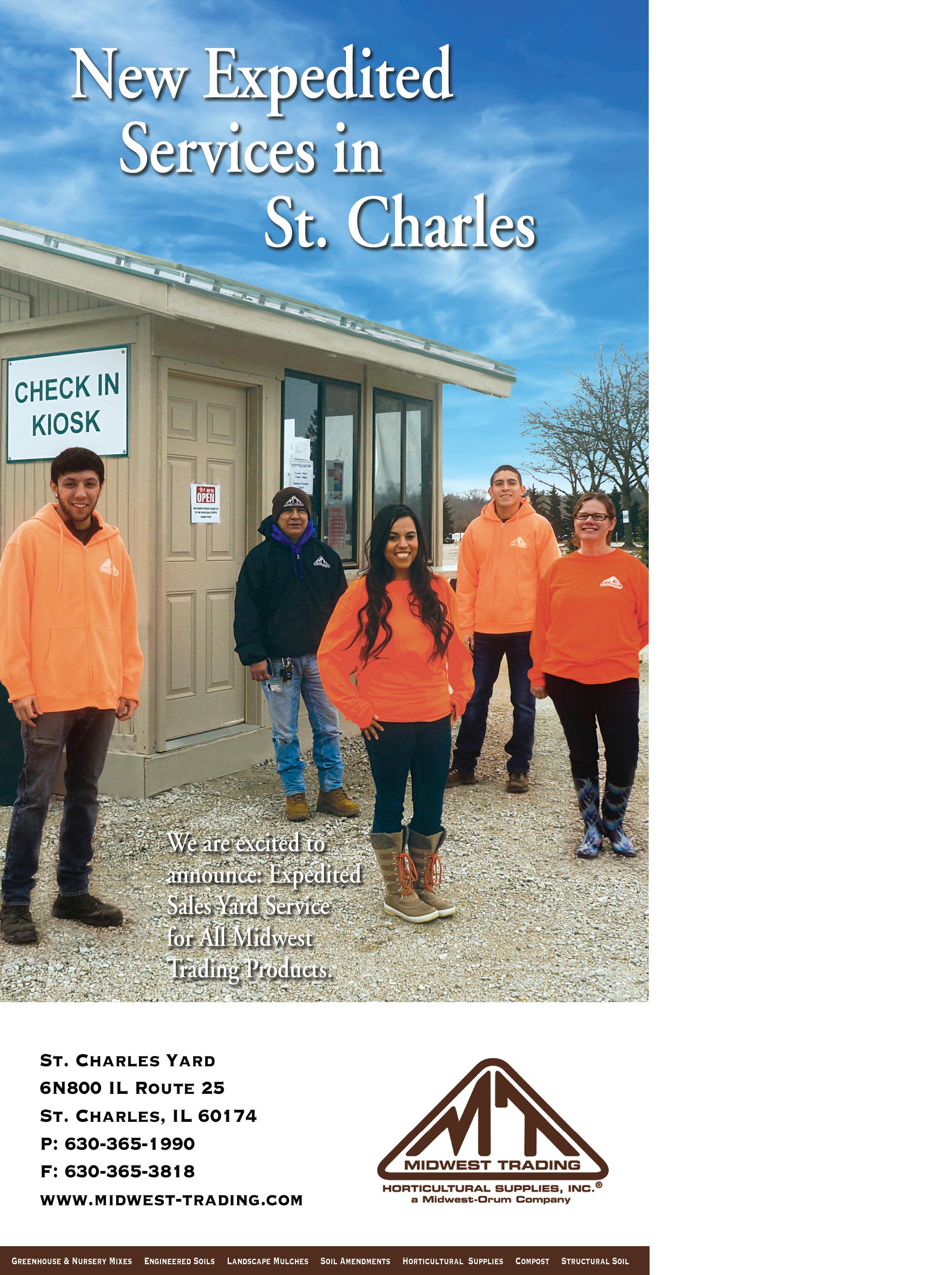
Pull Up, Pick Up & Go.
We are here to save you time.
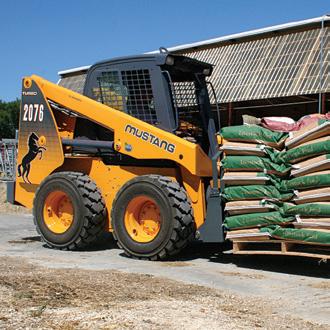
Midwest Trading is excited to announce a brand new service for our customers. All Midwest Trading products that are stocked in St. Charles are now available for purchase through our "fast pass" Check In Kiosk. Whether you want 5 yards of mulch or a 6 wheeler full of soil, you can get in and get out in no time flat. There will be no need to call ahead to order and waiting in lines will be a thing of the past. With our state-of-the-art tablets, we now come to you without you ever
“We understand time is important to our customers. Our goal is to help them pick up what they need as quickly as possible. With our new drive up service from our St. Charles Check In Kiosk, we will make that happen”
having to leave your vehicle; look for our friendly staff in the safety orange shirts at the Check In Kiosk. We will quickly place your order and you will be on your way in no time.
“We understand time is important to our customers. Our goal is to help them pick up what they need as quickly as possible. With our new drive up service from our St. Charles Check In Kiosk, we will make that happen”, stated Devon Kane, the Wholesale Yard Supervisor.
As long as Midwest Trading has your credit card on file or terms on your account for credit, you can enjoy the convenience of the St. Charles Expedited Service. This time-saving service begins early April and runs through the end of October.
ILCA Awards Program 1, 8-9, 34-40, Rick Reuland 7, 16-24, 28-29
DT Kindler Photography 42-51 Foundation for Homan Square 45, 46, 49, 50, 51
Ken Williams 52-59 Red Stem Natives 64 Scott Mahaffey 70
The official publication of the Illinois Landscape Contractors Association (ILCA), The Landscape Contractor is dedicated to educating, advising and informing members of this industry and furthering the goals of the Association. The Landscape Contractor carries news and features relating to landscape contracting, maintenance, design and allied interests. Publisher is not responsible for unsolicited material and reserves the right to edit any article or advertisement submitted for publication. Publication reserves right to refuse advertising not in keeping with goals of Association. WWW.ilca.net
Volume 59, Number 4. The Landscape Contractor (ISSN # 0194-7257, USPS # 476-490) is published monthly for $75.00 per year by the Illinois Landscape Contractors Association, 2625 Butterfield Road, Ste. 104S, Oak Brook, IL 60523. Periodicals postage paid at Oak Brook, IL and additional mailing offices. Printed in USA.
POSTMASTER: Send address changes to The Landscape Contractor, 2625 Butterfield Road, Ste 104S, Oak Brook, IL 60523. DISPLAY ADVERTISING SALES: Association Publishing Partners, Inc., Ph. (630) 637-8632 Fax (630) 637-8629 email: rmgi@comcast.net CLASSIFIED ADS, CIRCULATION AND SUBSCRIPTION: ILCA (630) 472-2851 Fax (630) 472-3150 PUBLISHER/EDITORIAL OFFICE: Rick Reuland, rmgi@comcast.net, Naperville, IL 60540 Ph. (630)637-8632
ILCA Staff
Executive Director
Scott Grams (630) 472-2851 sgrams@ilca.net
Education Manager
AnneMarie Drufke adrufke@ilca.net
Events Manager Terre Houte thoute@ilca.net
Office Manager
Alycia O’Connor aoconnor@ilca.net
Magazine Staff
Rick Reuland Publisher/Advertising Sales (630) 637-8632 rmgi@comcast.net
Debbie Rauen Advertising Sales (817-501-2403) debbie.landscapecontractor@ yahoo.com v
Becke Davis Senior Writer treethyme@aol.com
Patrice Peltier
Membership & Marketing Coordinator
Marissa Stubler mstubler@ilca.net
2625 Butterfield Road Ste. 104S Oak Brook, IL 60523
Feature Writer patpeltier@charter.net
Meta Levin
Feature Writer meta.levin@comcast.net
Nina Koziol
Feature Writer n.koziol@att.net
Heather Prince Feature Writer princeht@sbcglobal.net
Marilyn Witney
Feature Writer madwitney@comcast.net
April 4, 2018 Webinar Introduction to OSHA Silica Dust Law
Photo Credits
From Where I Stand —
The last ILCA event
prior to the busy season is in the books. In the subsequent weeks, the phones begin to quiet. Emails slow. The weekly calendar of meetings is more white than black. ILCA runs countercyclical to the landscape season. When landscape contractors go back to work, we get a few months to breathe.
With that said, the phones still ring. Instead of member contractors signing up for events or seeking resources, we begin to hear from clients. The most common phone call we receive are not from jilted clients. Instead, the most frequent call we receive from clients is that no one from the member company is calling them back.
We receive these calls for months at ILCA. We listen. We sympathize. We write their names and numbers down. We attempt to explain that this is the busiest time of year for landscape professionals and that they should remain patient. We attempt to allay their fears by reassuring them that someone will likely call them back in a few days. We hang up the phone not knowing entirely if that is true.
Answering the phone has always been a priority in all my association management jobs. When I became Executive Director, I wanted to ensure that if staff was in the office, the phone would be answered. The only exception we allow is when we are in a full-staff meeting. Since it is our jobs to provide information and support to our members, I view the phone as the first line of defense. With all of today’s communication options, people use the phone when they need something or want to make a human connection. Allowing member calls to go directly to voicemail or an automated system does neither. ILCA members will pick up the phone if they view their issues as critical. I want to make sure an ILCA staff member is there to assist, even when we don’t have the answer. I want to make sure our members hear a human voice so they understand that we are there, working tirelessly for them.
Your Call Is Important To Us
I am not going to lie. This is an awkward conversation to have with our members’ clients. They are dumbfounded that it can take a few days or weeks to receive a return phone call. We tell them about the velocity of the busy season, but that falls on deaf ears in a society that demands instant gratification, especially when making consumer purchases. They don’t understand how a service based industry can operate like this. Further, they don’t understand that if the ILCA staff can answer the phone by the 3rd ring, why a landscape company cannot.
It’s complicated and I am in the rare position where I get to hear both sides of the story. First off, I know full well that clients embellish their hardships. Most often, when I hear that they’ve tried to call a company six times, it’s probably twice. If they’ve been waiting three weeks, it’s probably one. Second, many of the members I speak to really don’t sweat it. I know that landscape professionals aren’t sitting around from March-July with their feet on their desks. These calls are going unreturned due to the neverending to-do lists that manifest themselves this time of year.
Any book on time management will explain the importance of setting priorities and returning client cold calls are not always at the top of the priority list. Finally, many new landscape clients look at landscaping as if it’s ordering a pizza. They are under the impression that when they want landscaping, they simply make a call, and some piping hot landscaping will be delivered to their door in 30 minutes or less.
In a strange way, I feel the way some companies handle their phone calls and prospective clients during the busy season is about control. The busy season is cruel and unforgiving and heaps massive amounts of stress on top of an already difficult job. In addition, bodies are physically pushed to the brink. People are exhausted. They are eating worse. They are sleeping less. It is difficult to remain focused. Finding any variable that one can control restores a tiny shred of sanity back to a topsy-turvy time.
There are thousands of businesses who have migrated to interactive voice mail or IVMs. These are those labyrinthine systems whose sole purpose is to see how quickly they can melt the human spirit. We spend ten minutes yelling louder and louder commands into the abyss where a friendly, soothing automated voice responds, “Sorry, I didn’t get that.” We endlessly repeat or punch in our account numbers or pin numbers until we finally pull the ripcord, talk to a human being, who summarily asks for our account or pin number. We are told our call is important to them (whatever that means) over and over again until a part of me begins to think they may not really mean that. We are reminded that many of these questions can be found on their websites which is IVM speak for “Turn back now! There is only misery beyond this point!” Finally, when we do finally speak to a human being, possibly 12 time zones away, we sound like unhinged lunatics as we finally have a chance to release our biblical fury.
This sounds weird, but I enjoy listening to my staff members answer the phone. Alycia O’Connor is the ILCA Office Manager and she is the primary staff member who answers the phone. Alycia is so good at balancing courteous service with not wasting anyone’s time. She is soft when she needs to be soft and firm when she needs to be firm. She understands that customer service is not simply getting walked all over. Alycia realizes it’s far more effective to allow the person to be heard then to tell the person what he or she wants to hear.
I used to answer phones and it is far more challenging than it looks. Almost all landscape professionals deal with a heavy call volume, but that is much different than being a gatekeeper. Most of the calls we receive are expected or, at least from someone we know. Gatekeepers like Alycia remind me of those old school operators constantly connecting circuits. When the phone rings, she needs to drop whatever she is doing whether her daily workload or a partially eaten sandwich.
Alycia must immediately identify what the call is about and many times, the caller doesn’t even know. Sometimes a member will call about an “education” issue that turns into a “regulatory” issue after a few more key sentences. A good gatekeeper stays on
ALL TOGETHER BETTER
866-627-4264
From Where I Stand —
long enough to understand the true meaning and how that call should be answered or forwarded. It is a waste of everyone’s time to immediately transfer the call to the wrong person simply to get them off the line.
I encourage ILCA members to monitor their phone etiquette this season. Some member companies, large and small, are masters at handling phone calls. I speak to a live person who makes me feel like my call is the most important call they have received that day. I am given timeframes for a return call or given insight into the person I am trying to contact’s schedule for the rest of the day. I get to have some ingratiating small talk and I hang up feeling valued.
I understand that not every landscape company can afford a gatekeeper, receptionist, or customer service rep. There are now services like CallRuby or MAPCommunicatons. Some use domestic workers and others use foreign workers who are trained in English. These individuals can handle all of your scheduling and phone volume for less cost than hiring a full-time employee. These may be intermediary steps before investing in a full-time administrative professional.
I can’t imagine a scenario where a small company benefits from having poor customer service whether real or perceived. I understand and empathize with the hectic pace of the landscape season and the hair-on-fire attitude of most customers. Yet, I also know that watching that list of people I owe calls to grow simply adds more stress. The quick pleasure I receive by not having to interrupt my day is usually replaced by a nagging feeling of guilt until I return those calls.
Landscape professionals should look critically at their phone procedures. I wager that many companies with IVMs have put it on set-and-forget and likely have no idea what is says anymore. To tell you the truth, I had to make it a point to review our afterhours message because I had no idea what it said anymore or how confusing the navigation was. I also recommend bringing your customer service team together to discuss phone policies. I am the absolute worst person to dictate phone policy because I answer the phone the least. Also, my employees go crazy as they attempt to pin me down during my whirlwind weeks of off and onsite meetings.
I know there is a pervasive thought in the green industry that the public does not respect what you do. Our members fear the public views landscape companies as disorganized, unprofessional, corner cutters. I know nothing could be further from the truth after spending almost ten years with this incredible industry. Yet, I also sense the frustration in the voices of these potential customers willing to give our members money. If there was one thing I would change about the green industry it would be to hire every company one more administrative staff person to help your business grow by mastering the little things. Until then, I’d be fine with everyone realizing that it’s possible to have a terrible phone call even without saying a word.
Scott
Grams March 19, 2018
President Lisa Fiore
Don Fiore Company, Inc. (847) 234-0020 lfiore@donfiore.com
Vice-President Tom Lupfer Lupfer Landscaping (708) 352-2765 tom@lupferlandscaping.com
Secretary-Treasurer Jose Garcia Natural Creations Landscaping, Inc. (815) 724-0991 info@naturalcreationslandscaping.com
Immediate Past President Mike Schmechtig Schmechtig Landscape Company (847) 566-1233 mschmechtig@schmechtiglandscapes.com
Directors
Mark Breier National Seed Co. (630) 963-8787 mark.breier@natseed.com
Allan Jeziorski Hartman Landscape (708) 403-8433 allan@hartmanlandscape.net
Kevin Manning K & D Enterprise Landscape Management, Inc. (815) 725-0758 kmanning@kdlandscapeinc.com
Scott McAdam, Jr. McAdam Landscaping, Inc. (708) 771-2299 Scottjr@mcadamlandscape.com
Dean MacMorris Night Light, Inc. (630) 627-1111 dean@nightlightinc.net
Mark Utendorf Emerald Lawn Care, Inc. (847) 392-7097 marku@emeraldlawncare.com
Donna Vignocchi Zych ILT Vignocchi, Inc. (847) 487-5200 dvignocchi@iltvignocchi.com
President’s Message —
www.ilca.net
“Youth is a gift of nature, but age is a work of art” –Stanislaw Jerzy Lec
How else would I have the opportunity to attend the Old Timer’s Gathering in the fall and a Day-In/Night-Out with the young professionals’ group except for being a part of the Illinois Landscape Contractors Association. Although I am not quite an old timer, and a few years over the age cap to be considered a young professional, I was excited to see that ILCA has a place for both, and a means to start bringing them together, as well of those of us happily in the middle!
For a first time event, it was great to see so many young professionals networking amongst each other, making new friends and realizing there are people out there going through similar situations. Thanks to ILCA staff, Bob Hursthouse (and his crew), Barry Conlin and Chris Kane for creating a platform for this group to come together to discuss company culture, team building and career goals. I learned a lot from both groups on how the younger generation is working on things now, how the established generations have grown to adapt, and tips to successfully keep things on track as the landscape world evolves. I look forward to hearing about the next event for this group.
Keeping things on track and successful are very important to our board of directors here at ILCA. In mid-February, we spent two days working on strategic planning to keep us in line with where we would like to be in the next three years and devising objectives, strategies and tactics to help ensure we get there. It’s always a little difficult not to try and solve every single problem we can think of at the table, but looking at the big picture items and what’s important to the association and its members. This gives us some concrete things to work on and allows us to set measurable goals for our operational plan that we work on over a given fiscal year. For 2017-2018, our operational plan included items such as creating a staff and committee chair training program, increasing membership, develop a PAC committee and raising funds to support it, as examples. I am happy to say that these have been or will be completed by the end of this fiscal year as planned. It’s always a good idea to look back and see what you have done well, what didn’t go so well and then determine where you go from there.
In relation to remembering where you came from, I was also thankful for the chance to be a part of the past presidents’ dinner in early March. The current executive committee had the opportunity to meet and talk with those presidents who came before and let them know what we are up to, as well, as get their input and feedback. This is an incredible group of individuals who have and continue to push our industry forward. We have just sprung forward with daylight savings, so I know now it is time to buckle in and get ready for the ride that spring always takes us on. I want to pass on a wish of best success to all of you gearing up for 2018.
“Spring is nature’s way of saying, ‘Let’s party!’”
–Robin Williams
Thank you,
Lisa Fiore March 15, 2018
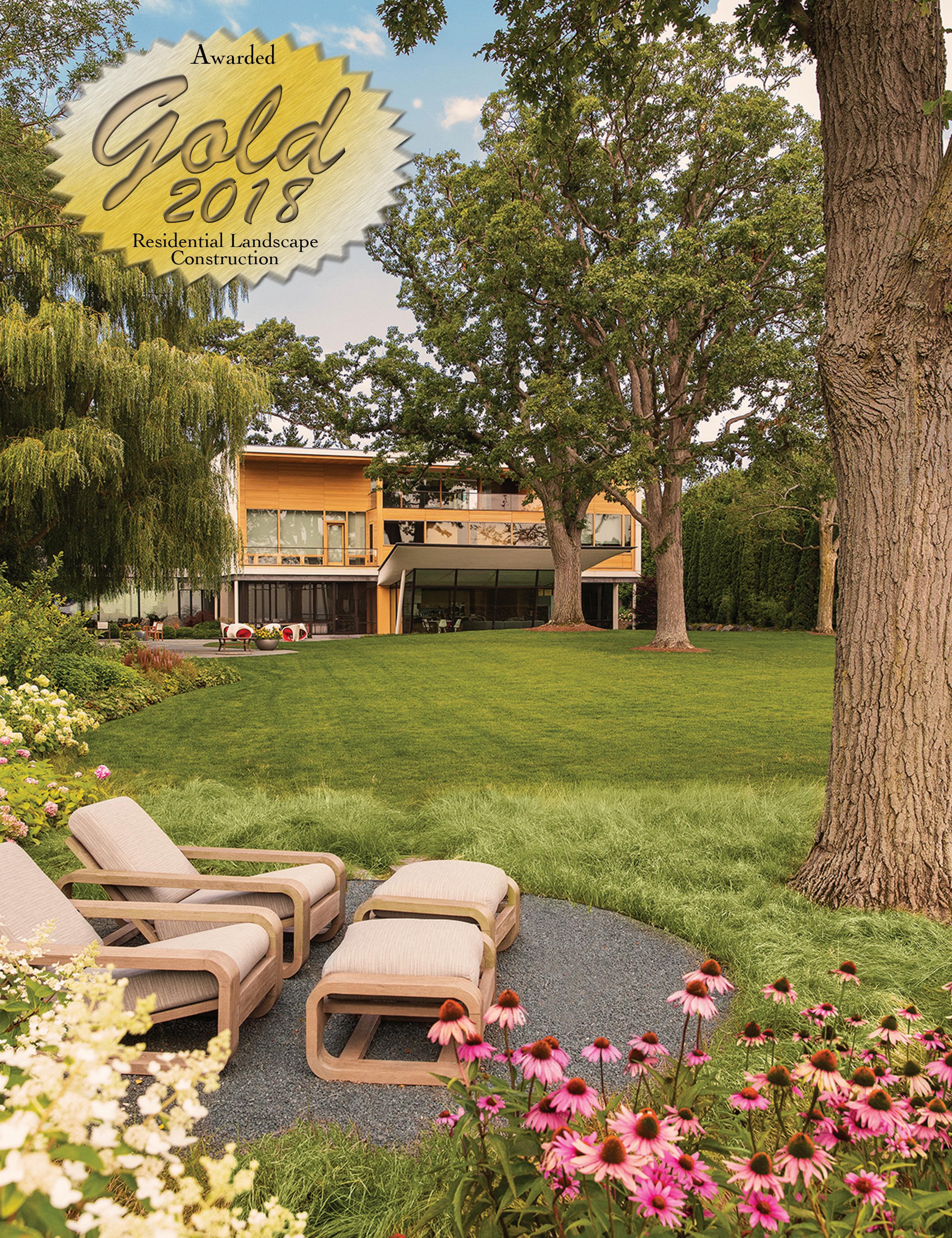
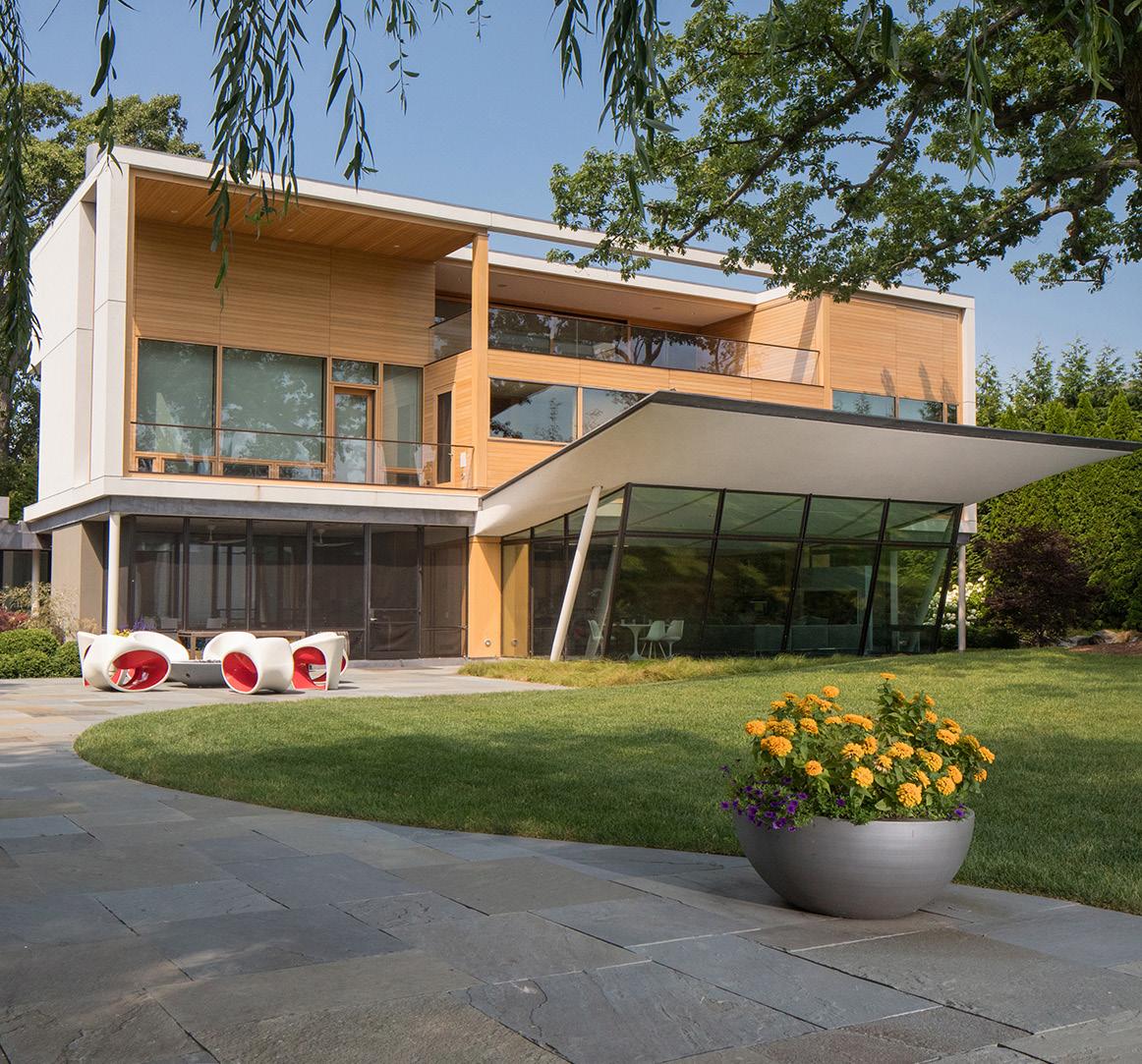
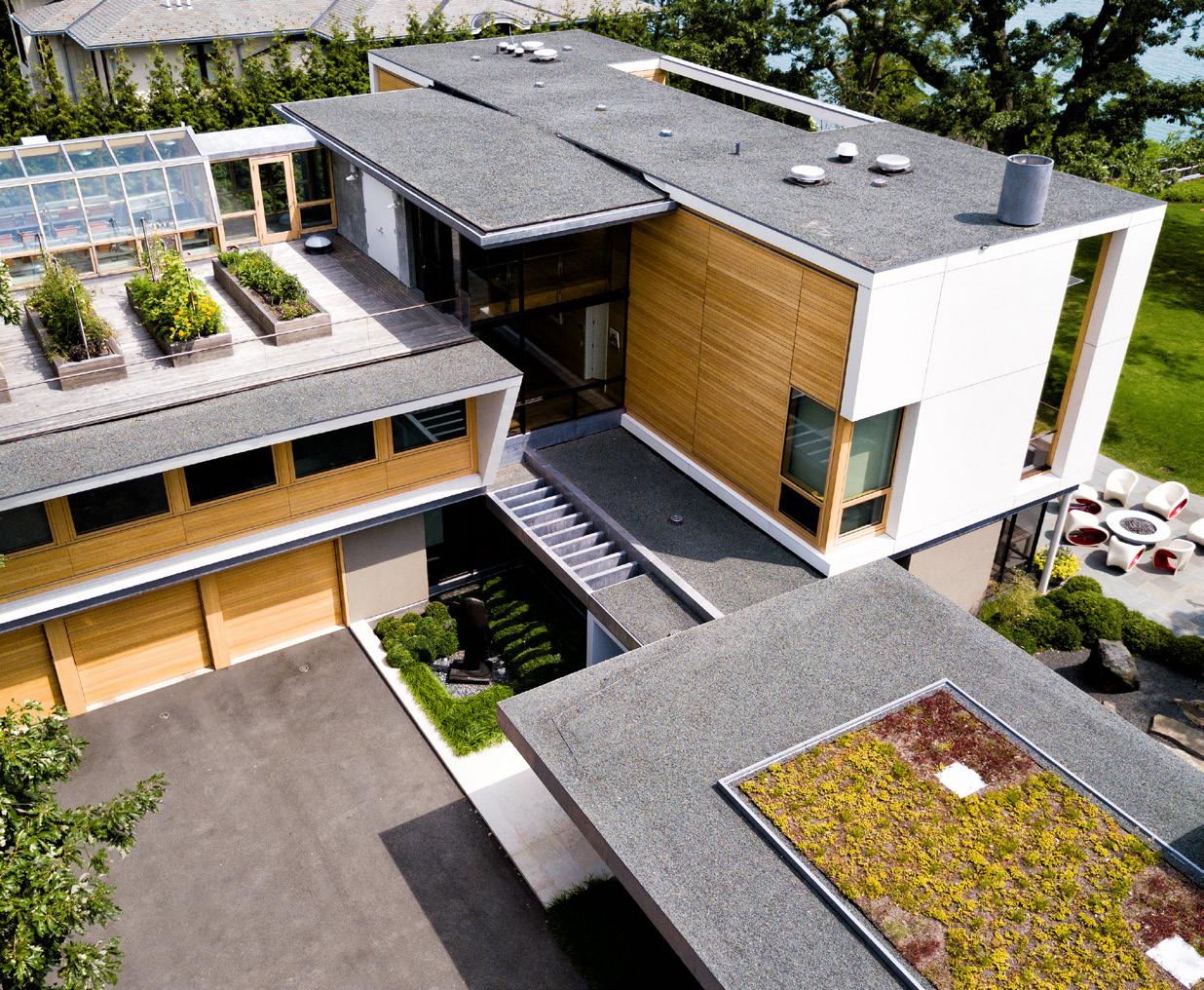
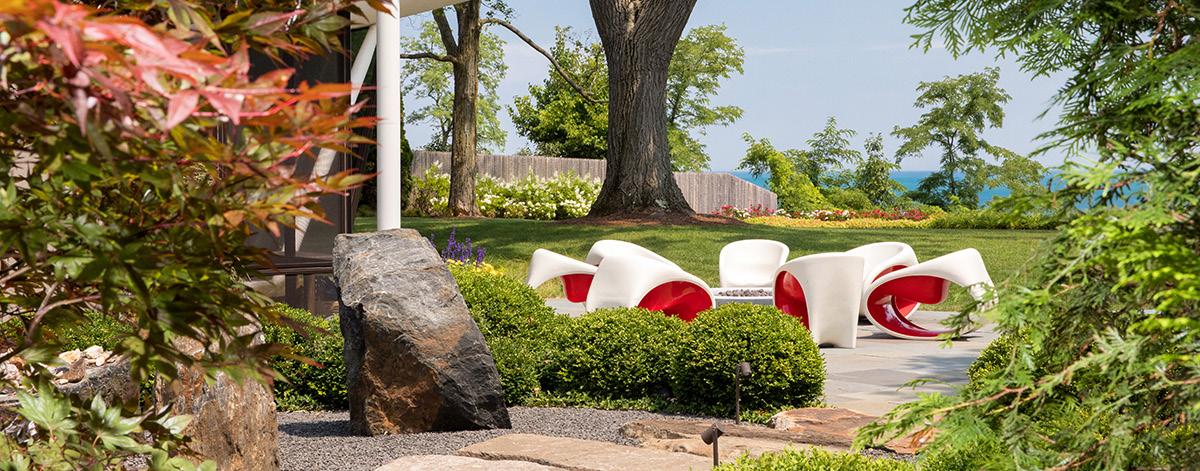
Scott Byron & Co. • Residence with a View Lake Bluff
This
distinctive residence, along with its striking outdoor rooms and surrounding landscape are the result of a great collaboration between landscape architect, architect, and client, who worked together to ensure every detail throughout the property was perfect for the homeowners.
Surrounding the home with a Zen-like succession of outdoor rooms while making the most of all views both inside and outside while letting the lake be the star, was a main goal of the landscape architect. The landscape would also need to complement the cubism-inspired architecture. Additional goals included providing a physical connection to the lake, increasing privacy, and ensuring all spaces were visually stunning and livable.
During construction bluff stabilization and erosion control techniques were implemented as good site practice and invasives were cleared. Existing canopy trees including a Heritage Oak were preserved to enhance and frame views to the lake. From there the design and building of the experiential journey from land to water could begin to take place.
The landscape was inspired by Thomas Church and the “gardens are for people” movement. Modern, clean lines of the bluestone terrace work together with large sweeps of lush plantings to create a sense of movement and make a bold statement. Within the landscape, outdoor rooms are visually and functionally connected seamlessly through material selection and style while providing ample opportunities for a variety of outdoor experiences. On the lake side of the property, a bocce court, fire table, bluestone terrace, fire pit, viewing gardens, and interactive Japanese rock garden all contribute to the variety of experiences and also add to the livability component for the homeowners. A connection to the beach is made through a long, winding path down the bluff as well as secondary tram access. At the beach a cedar deck and kayak storage building with a live roof system mitigates storm water runoff and ensures naturally beautiful, livable spaces and relaxing views from aspects.
The completed landscape addressed many needs and wants of the owner, and also reflected a lifestyle rhythm of balance, harmony, and minimalist Zen-inspired philosophy.
Millennials and the Future
The Question Soon to Be on Everyone’s Mind... What Do Millennials Want?
By Beth Berry
They’re attached to their cell phones, devoted to social media and are the fastest growing segment of homebuyers. If they aren’t already, soon Millennials will be your customers.
If you learn to speak their language, walk their walk and pay attention to what’s important to them, you will be rewarded with loyal customers who will sing your praises to their friends, as well as on social media, says Beth Berry, vice president of service solutions for Real Green Systems, a company that specializes in green industry software.
Berry has 30 years’ experience in the landscape industry, including a stint as director of customer service for ScottsMiracle-Gro, where she hired and managed many Millennials, as well as time as the executive director of the Ohio Better Business Bureau.
She has developed expertise in customer engagement for both business to customer and business to business aspects of the industry. That includes what works best for different age groups. (continued on page 12)
Generational Scorecard —
Millennials and the Future
(continued from page 10)
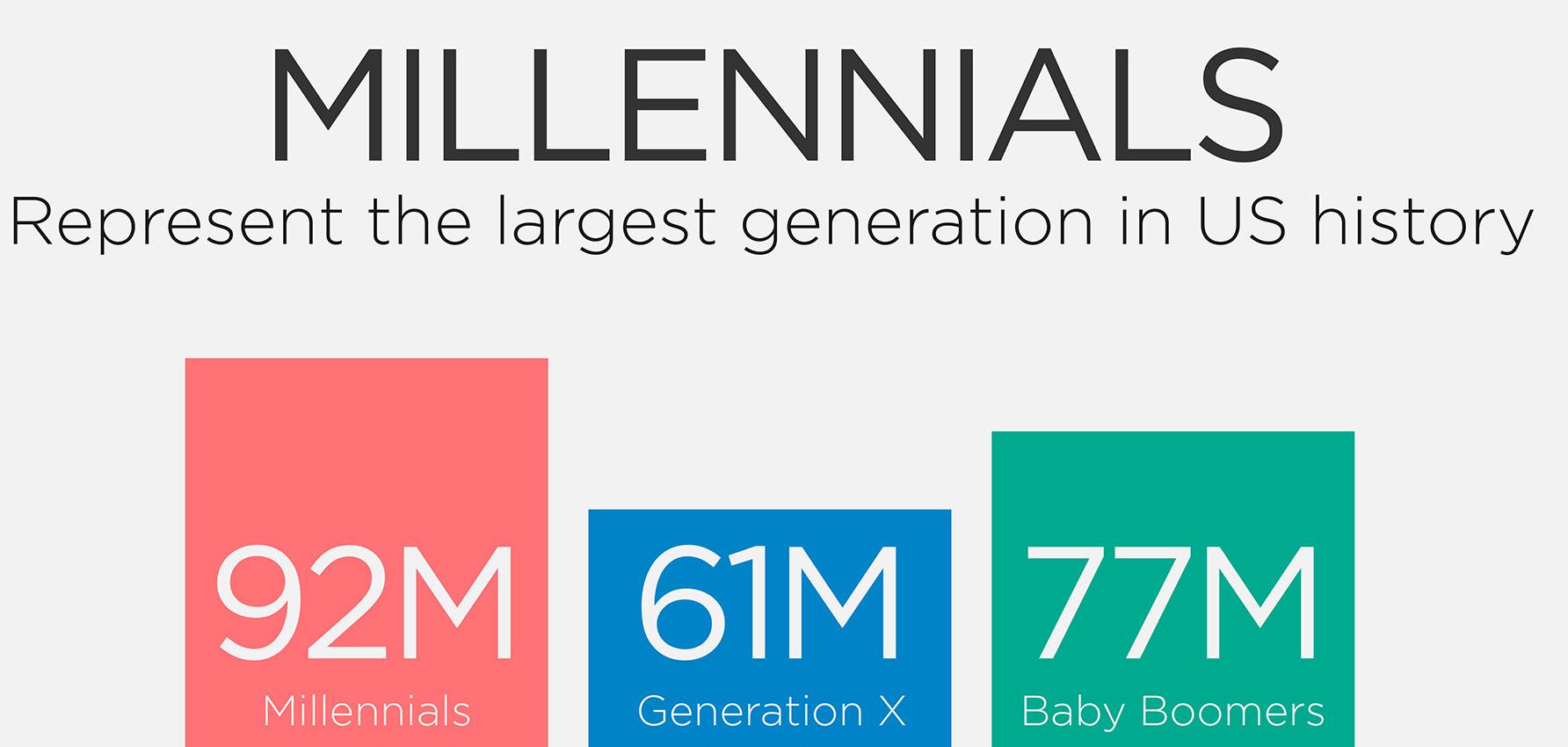
Clearly, Generation Z isn’t old enough to buy a house or hire a landscape contractor, but many of those 80 million Millennials are and they are doing it at a rate that exceeds other age groups. According to the Pew Research Center in 2017, the Millennials outspent every other generation. Seventy-five percent of them have done a home improvement project during the last year and, of those, most hired contractors to do the work.
Home improvement could very well include their yards: installation of turf, flower beds, vegetable gardens and hardscapes. But beware, they are sensitive and specific in their wants and needs.
“They are into green and landscapes,” says Berry. And how do they choose the contractors they use? Advice from family and friends tops the list. But, says Berry, they don’t pick up the phone and ask Mom and Dad for a reference. Instead, they post their needs on Facebook, Instagram, Snapchat and other similar social media sites. This expands the number of their trusted friends who can and will offer advice.
By the way, they trust Amazon comments, because Amazon only allows verified customers, who bought the product, to comment. That now can include landscape contractors, turf maintenance and other service providers, because Amazon recently started Amazon.com Home and Business Services.
And those smartphones they always have at the ready? Yep, they use those to access information. So, make sure that your website is mobile enabled.
Not as popular when looking for advice comes sales people/store employees; company/brand websites; online videos (You Tube); company/brand brochures/catalogues; social media; non-commercial lawn and garden websites; magazines/ newspapers and printed or electronic books.
They may not buy a house or fix up their yards for the rea-
sons you might think. Children? Well, maybe, but more likely for their pets. “They want pet friendly yards,” says Berry. In fact, when looking for a place to live, proximity to dog parks rates high on the list of must-haves.
Given their love of their pets, here are some ways to endear yourself and your business to your Millennial customers:
1. Include the dog/cat/other pets’ names in the customer profile you build; acknowledge the pet’s value to the family.
2. Use the pet’s name while on the property and when talking with the customer.
3. Let them know that you will be careful with the products you use so that there will be nothing harmful to pets, like dogs, that go outdoors; that what you use has low environmental impact.
4. Perhaps include a spray of flea and tick protection at the end of the project.
5. Let your Millennial customer know that you will take care not to use cocoa mulch, which may contain theobromine, the same ingredient that makes chocolate poisonous to dogs.
6. Check out the way the dog uses the back yard and create paths and walkways along the routes the dog already uses. Dogs are loath to deviate from areas they’ve already claimed.
When talking with your Millennial customer, use the word “protect,” says Berry. Tell them what you are doing to protect their pets or to add an extra level of flea and tick protection. Communication is important, but Millennials are particular about how and when they communicate. Email works well for delivering lots of information, but for a quick update – what time to expect your crew at their homes, for instance – text is best.
(continued from page 13)
(continued on page 14)
They don’t like telemarketing calls and won’t answer the phone. They don’t read the newspaper or direct mail and find ways to eliminate commercials. They definitely do not like door-to-door selling.
Texting allows the recipient to respond at his or her convenience. Calls, on the other hand, “presume that the person you are calling should drop everything and adhere to your agenda,” says Berry. “Texting is effective and efficient. Ninety percent of all text messages are read within three minutes.”
Millennials also want to know that you are a good community steward. So, if you take care of the lawn for the local high school, participate in Project EverGreen or SnowCare, which provides free or discount services for families of deployed military personnel and post 9/11 disabled veterans with ser-
Reclaimed from the old streets of many Midwestern cities, vintage clay pavers have become a unique, preferred choice when design requires the elusive look of originality. Once an old street, now an exclusive driveway, reclaimed street pavers provide the look and appeal of natural design.
vice connected disabilities, or do any one of a number of community programs, let your customers know.
You can use a sign, a line on your invoice or a logo on your trucks or stationary. Even better, make it easy for anyone who sees it to learn more through a link or QR code.
When you ask for and get feedback, respond. “Let them know that you heard them,” says Berry. “Thank them and tell them how you are addressing the problem.” Or, if it’s a compliment about an employee, tell them that you’ve passed it along to the employee or otherwise given him
or her a commendation.
The bottom line is to make communication easy. Provide a link, a QR code or some other one-step way for your customers or potential customers to get in touch with you. Do it their way. You will be rewarded.
A complete line of cool hardy annuals and fresh branches for your inspired spring designs.
diverse selection of summer annuals, foliage, blooming tropicals and colorful hanging baskets.
Van Doren Planter - Old World Texture with Round Base, LS 9778
Millennials and the Future
Young Professionals Connect, Learn, Share and Grow with ILCA Event
by Nina Koziol
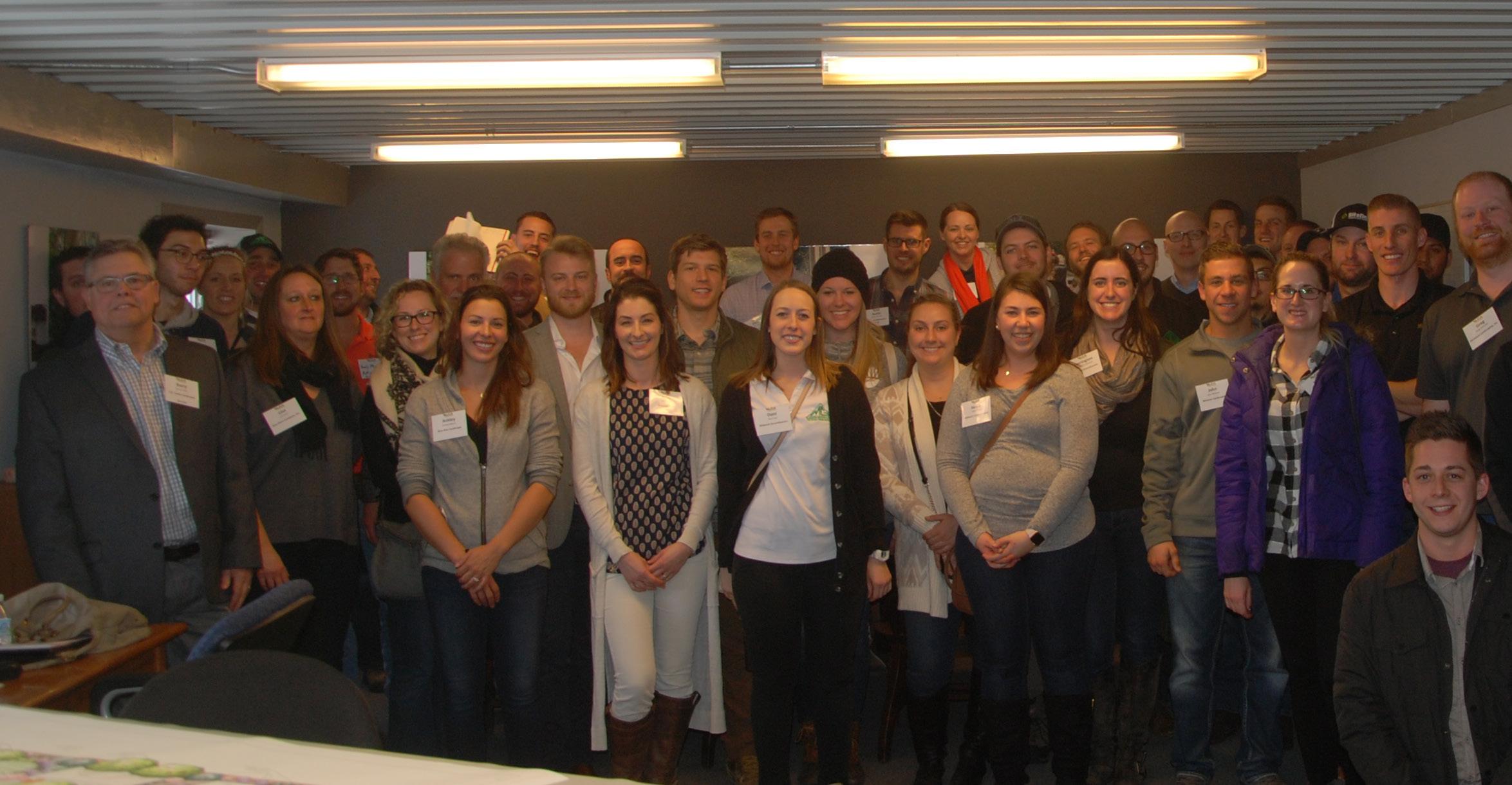
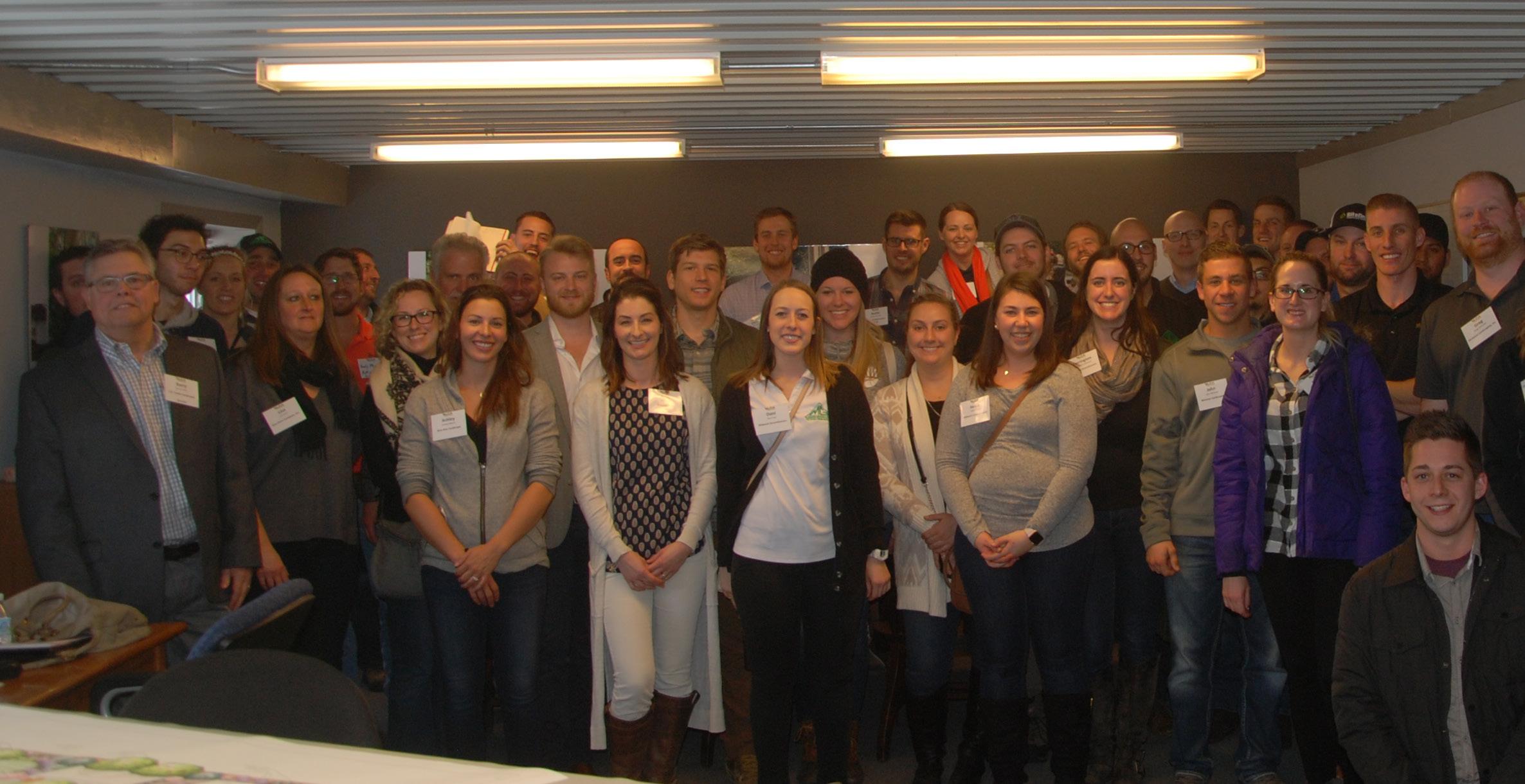
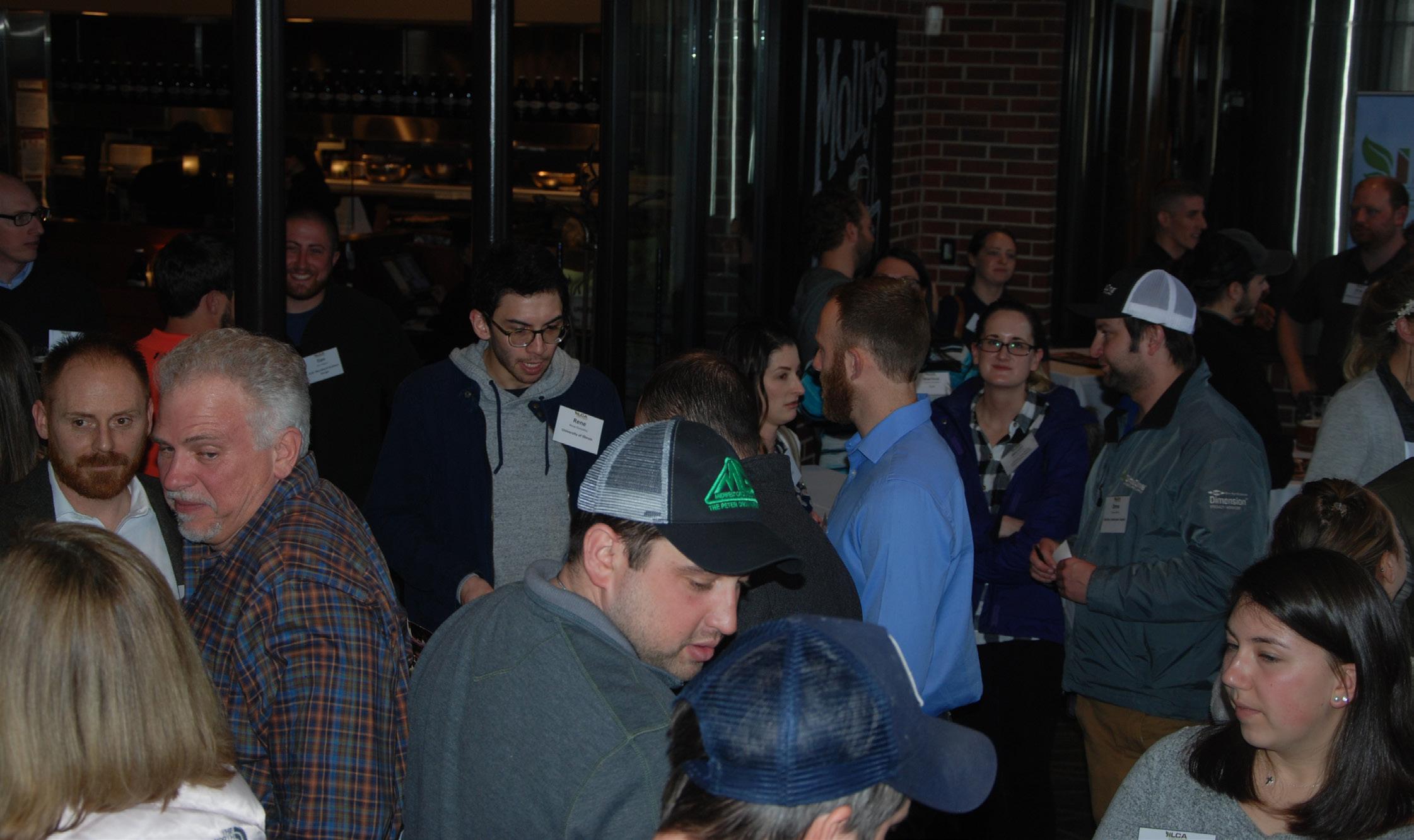
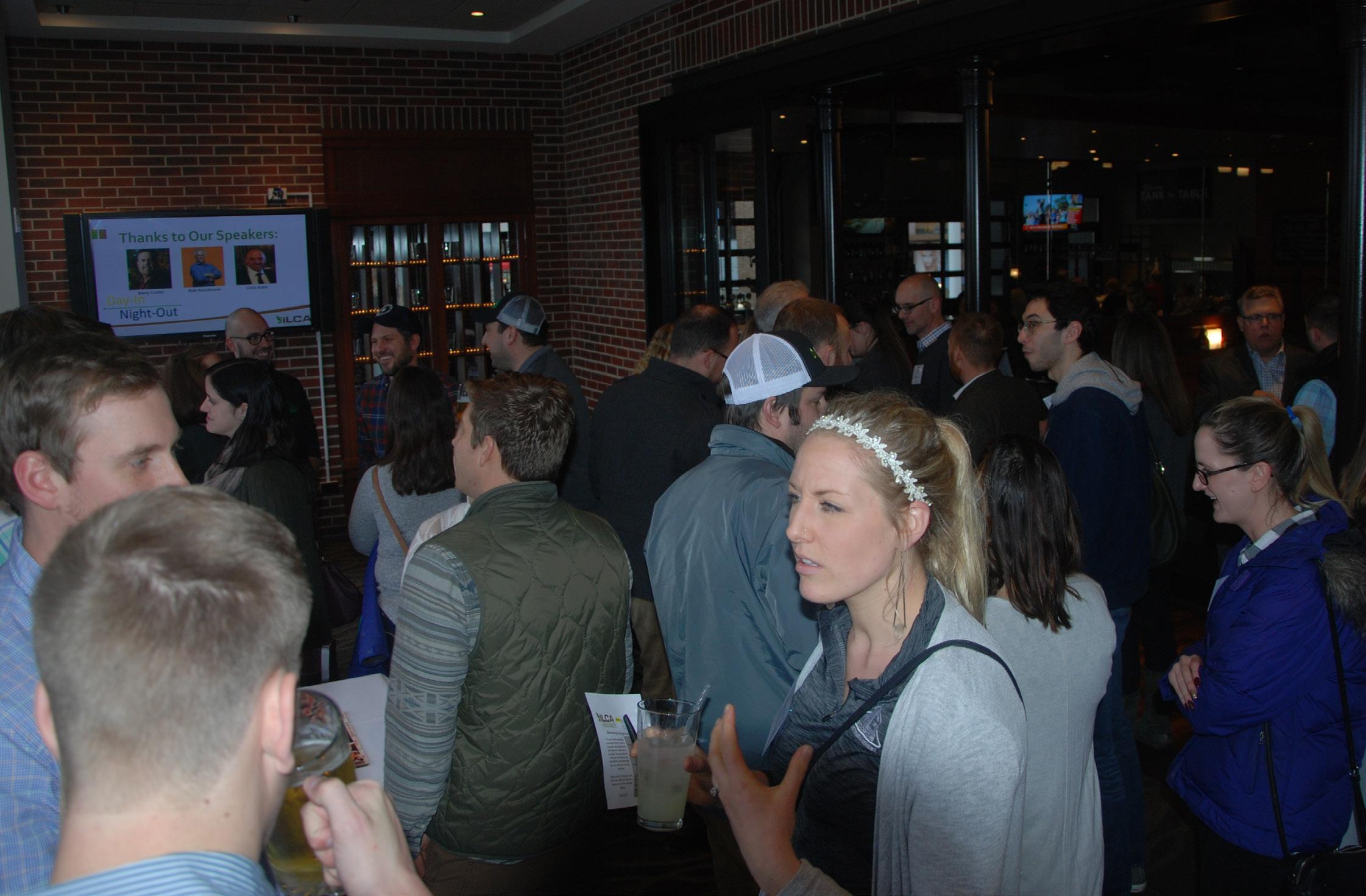
When you’re new in your career, you’re not necessarily thinking about the four-decade span that lies ahead. But that’s something that ILCA wants young people in the industry to think about right now. The association launched the first “Young Professionals Day-In/Night-Out” event in February and by all measures it was a roaring success. What started out as an event intended for 25 to 30 attendees drew more than 60 people age 35 and younger.
“It was nice to have an event in which we could learn from successful businesses and their tactics on company culture,” said Carrington Misener
“I really wanted to meet more young professionals in the industry and hear about how experienced and successful companies work.”
—Tim Sweeney
of Midwest Groundcovers. Misener has worked in the green industry for just over a decade. “The event was learning-focused, but in a comfortable environment where everyone felt that they could speak up. It was nice to hear from people who had varying experiences in their companies—both good and bad—and the different strategies used to solve problems.”
Tim Sweeney of Sweeney’s Custom Landscaping Inc. has been in the business for 11 years. “I really wanted to meet more young professionals in the industry and hear about how experienced and successful companies (continued on page 18)
Millennials and the Future
(continued from page 16) work. It was interesting to see their focus and how others do team building.”
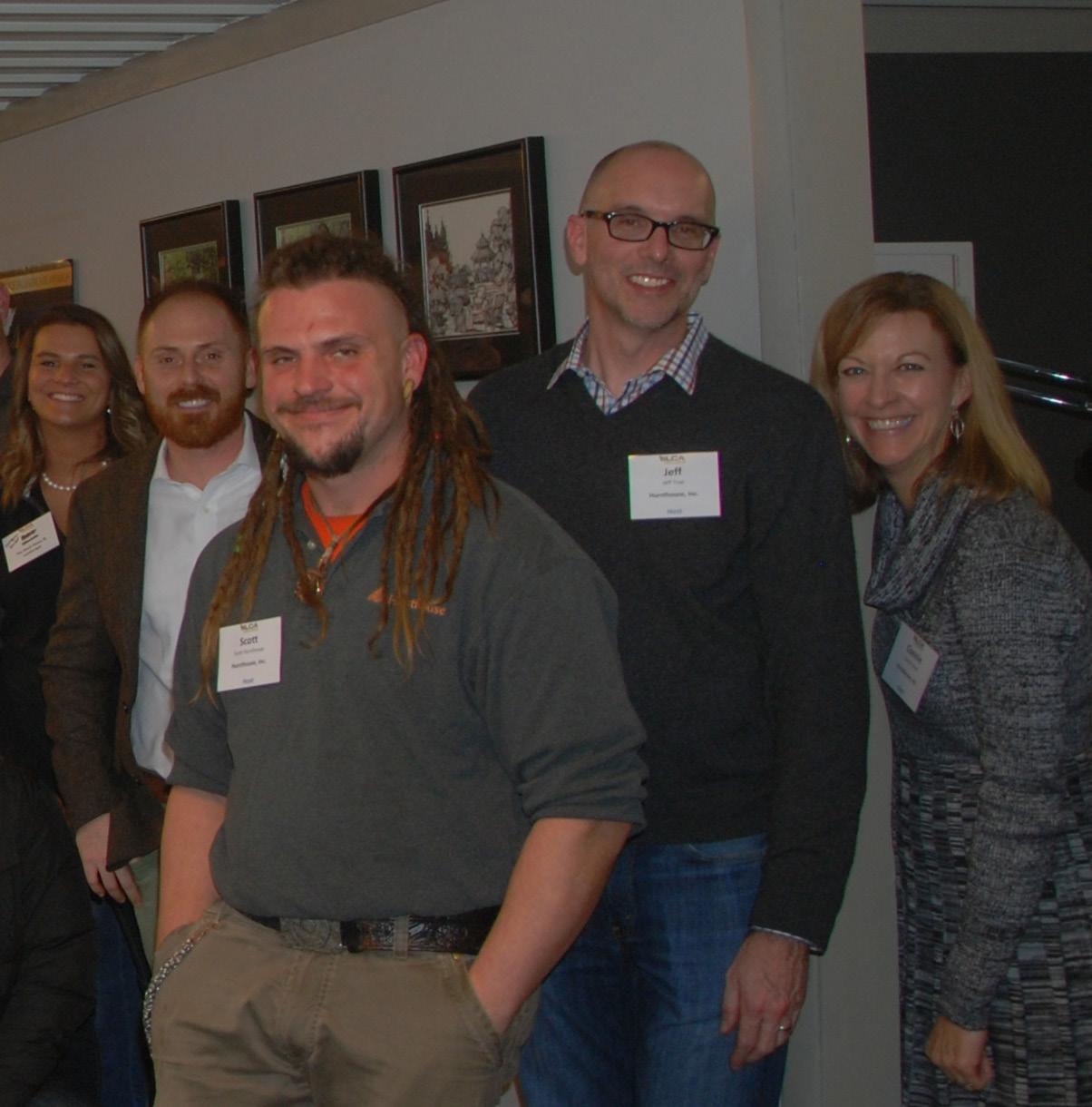
The program examined the power of teamwork, company culture and professional development. It took place at Hursthouse Landscape Architects and Contractors in Bolingbrook where attendees toured the design studio and shop. Bob Hursthouse, Barry Conlin, of C.B. Conlin Landscapes, and Chris Kane from Kane Brothers Water Features answered questions and gave attendees a firsthand look at what it takes to not only succeed but thrive.
“We talked about team building and career paths and there were lots of questions about working for a parent,” Bob Hursthouse said. “We talked about our company culture, who we are, why we’re that way, and how we maintain it. We’re a big team organization—we don’t have employees, we have team members. We also talked about career development and how you build up a 40-plus year career.”
are valued—not everything is about salary, certainly for a younger generation.”
“The question and answer session was really good... it gave us a chance to meet others and forge connections, to meet people we may do business with in the future.”
—Dan Migacz
Chris Kane explained how Kane Brothers Water Features functions and why a good work environment is key. “Everyone wants a modern company culture where employees
Technology is playing a giant role in today’s business processes, Kane said. “Modern technologies, social media— things are moving quickly, how things are done, how business is tracked, and we’re light years ahead of where we were 10 years ago. Younger generations have grown up with technology and they know how to deal and cope with that and they’re bringing older generations into that today.”
The event drew young landscape industry professionals, students and suppliers.
“I had a fantastic time. I was happy to see the level of interest and the opportunity,” said Matt Dingeldein, owner of The Oak Grove Gardeners in Naperville. “The industry is getting older, getting gray and getting more female, so women were represented at the event. I think it’s nice to see the changing demographics reflected in the next generation of the industry.”
Ashley Marrin works at Bret-Mar Landscape in Homer Glen. “I grew up in the landscape industry as my parents own a design-build company,” she said. “Besides working summers, I’ve been a full time employee for about seven
years. It was wonderful to have several successful landscape business owners at the event to share their knowledge. Everyone in the room shared experiences whether it was with their current company or a past one. It was great to learn about what works and what does not work. We had quite a big discussion on how to create an excellent company culture.”
Dan Migacz of A.M. Woodland Outdoor Design has been in the business seven years. “The question and answer session was really good. And, it gave us a chance to meet others and forge connections, and to meet people we may do business with in the future.”
Cultivating Culture
Kyle Sanders graduated in 2010 and works at Hursthouse as a landscape architect. “When we were discussing our company culture model and the intentional ways we go about implementing that, I was struck by a couple of questions essentially asking, “So what went wrong?” as if the only reason a company would place a high value on strong company culture was if there had been some serious issue or incident.”
Several questions were raised about how to create a better working environment when departments don’t communicate with one another. Lack of information regarding projects was mentioned as a common concern.
“Our designers’ office is upstairs but I’m always talking to designers and they come down and talk to production,” said Luis Arteaga, a project manager at Hursthouse.
(continued on page 20)
Reclaimed from the old streets of many Midwestern cities, granite pavers have become a unique, preferred choice when design requires the elusive look of originality. Once an old street, now an exclusive driveway, reclaimed street pavers provide the look and appeal of natural design.
Millennials and the Future
(continued from page 19)
“It’s that culture—it’s not that I’m just doing this alone. It’s just a back and forth communication.” He points to the company’s “upside down pyramid” concept in which Bob Hursthouse is at the bottom, not the top. It’s all about support from the bottom up at all levels. “It’s my job to make sure the crews have all the information they need and support them and not boss them around,” Arteaga said.
Sharing information, whether it’s explaining to the crew why something is being done a certain way, or having an open-door “policy” to speak to designers or others in the company is key to successful team work. “At the end of the day, when we clean up, we’d have a quick meeting to talk about what was done,” Arteaga explained. It’s all about communication.
“The folks at Hursthouse are focusing on what they’re best at and doing it with so much grace, that you have no choice but to admire them,” Dingeldein said. “As a young
“Our own attitudes play a large part in our work environment. I think a lot of people would be surprised how much more enjoyable a work day can be when you have a group of people that have decided they want to work somewhere that’s challenging, but fun and in a way that keeps them engaged.”
—Kyle Sanders
business owner, it’s inspirational and aspirational.”
The consensus is that work should be fun, at least most of the time. “Our own attitudes play a large part in our work environment,” Sanders said. “I think a lot of people would be surprised how much more enjoyable a work day can be when you have a group of people that have decided they want to work somewhere that’s challenging, but fun and in a way that keeps them engaged.”
A behind-the-scenes peek at an established business was eye-opening for many young attendees. “It gave them a chance to see how we function on a day-to-day process and what our journey has been,” said Jeff True of Hursthouse. “Regardless of their age, they were from all different offices, systems, cultures and thought processes.”
For Ashley Marrin, “Going forward, an excellent company culture will prove to be very important and a requirement for young professionals when choosing a company to begin a career with.”
(continued on page 22)
Skid steers
Mini excavators
Tillers
Stump grinders
Wood chippers
Lawn mowers
Dethatchers
Aerators
Overseeders
Concrete saws
Millennials and the Future
(continued from page 20)
Family Ties
Several attendees work in their parents’ business and it’s not always a great environment. A few gradually confided that there were frequent shouting matches with their fathers in the office.
“I found it very interesting how many reported directly to or are starting to manage their family members and how that affects their relationships, personal and professional,” Misener said.
“You have to be confident to bring up an issue and ask for help.
The answers came from their peers and others in the room — an open discussion back and forth.”
The loud discussions between parent and adult child affect company culture in peculiar and negative ways. “They might be used to that relationship, but to others that see that, it’s offensive,” Arteaga said. “If you’re a new employee getting brought into that culture, do you want to be around that?”
—Bob Hursthouse
Arteaga had his own challenges with his father when their roles were reversed. “When I started, my dad was a crew leader and I was on his crew. After five years I became a crew leader and he was on my crew. Having that role reversal was hard and challenging. Everything I know I learned from him. For him to relinquish power and for me to tell him what to
do—it was hard.”
The biggest challenge was getting his father to try new things and new equipment. “Everything is changing and we’ve got better tools for things now. Once he realized I knew what I was doing and helping him out as well, he released control and let me lead, and after that it was fun. We were in sync— we blended.”
From Kane’s perspective, “Keeping it focused on the business and not family relationships is important.”
As the son of a business owner, Dingeldein recognizes the importance of good family relationships, but also moving the business forward with new tools. “It’s maintaining a tradition of good service, but trying to innovate in the 21st century. With social media, text, email, phone, it’s hard to keep up. We have more to keep up with than just the phone or fax now.”
Hursthouse was impressed by the group’s openness and professionalism. “You have to be confident to bring up an issue and ask for help. The answers came from their peers and others in the room—an open discussion back and forth.”
(continued on page 24)
Millennials and the Future
(continued from page 22)
Party On
After the two-hour conversation, the group headed to Rock Bottom Restaurant & Brewery for complimentary cocktails, sponsored by Landscape Hub (https://www. landscapehub.com) and for informal networking from 4 to 6 p.m. “I left at 7 and at least 90 percent of the people were still there,” Hursthouse said.
A good time was apparently had by all. “It’s nice to have an outing with just the young professionals in the industry,” Marrin said. “I feel it gives us all a chance to connect and share our experiences. It’s a great way to get some of us out to network who currently do not have the opportunity to attend some of the larger networking events.”
“People felt that the event was informative without feeling like a lecture.” —Kyle Sanders
One thing that Sweeney would like to see next time is a “round robin” exchange where attendees move to different tables throughout the evening’s event. “A lot of people from the bigger companies tend to gravitate together and you have to work your way into a group.”
The conversation at the brewery was a bonus for Migacz. “It was a very valuable time and we made great connections with vendors and another contractor who we don’t compete with but our companies are similar in size and we had a great discussion.
From Sanders perspective, “People felt that the event was informative without feeling like a lecture.”
Matt Dingeldein agrees. “I love events like that. It’s a great way to connect with people you already know before it starts to get real busy in spring and getting to meet new folks.” Good things are worth repeating. This event was the first in a series. More will follow.
Check out future ILCA events: https://www.ilca.net/ professional/events.
(continued on page 26)
Millennials and the Future
Young Pros Join the Pack
If you’re a young landscape professional, there are plenty of reasons to belong to ILCA throughout your career.
This inaugural ILCA event was intended to give young pros an opportunity that will help them in the next phase of their careers. “My ILCA membership is worth thousands of dollars a year in business,” Dingeldein said. “Membership is a chance to meet other contractors that may need my business to fill a gap or just offer some specialized service that they aren’t equipped to handle or have a need to supplement their workload. I’ve worked really hard to have a vast network with ILCA and it takes time but it pays dividends. I get my dues back way more.”
Hursthouse worked 10 years in the industry before he started his company 28 years ago. “I became active in ILCA by attending educational programs. I think the first business check we wrote in 1990 was my membership check to ILCA.”
Get involved, Sanders said. “As a newer member of the ILCA Design Committee, a great step forward would be to find ways to get young professionals involved in the committees.”
We all want to grow throughout our career and try new things and learn new things, True said. “You can try and do it on your own, but somebody else may have already tried it. You’ll learn the pros and cons. You might learn something better. There are classes, seminars and the informal events where you get to know more people and have a conversation with them and have some fun along the way. Industry groups in general are always best if you want to learn and share and continue to grow throughout your career.”
ILCA Hosts 2018 Edition of Popular Foremanship Seminar: Mastering Foremanship
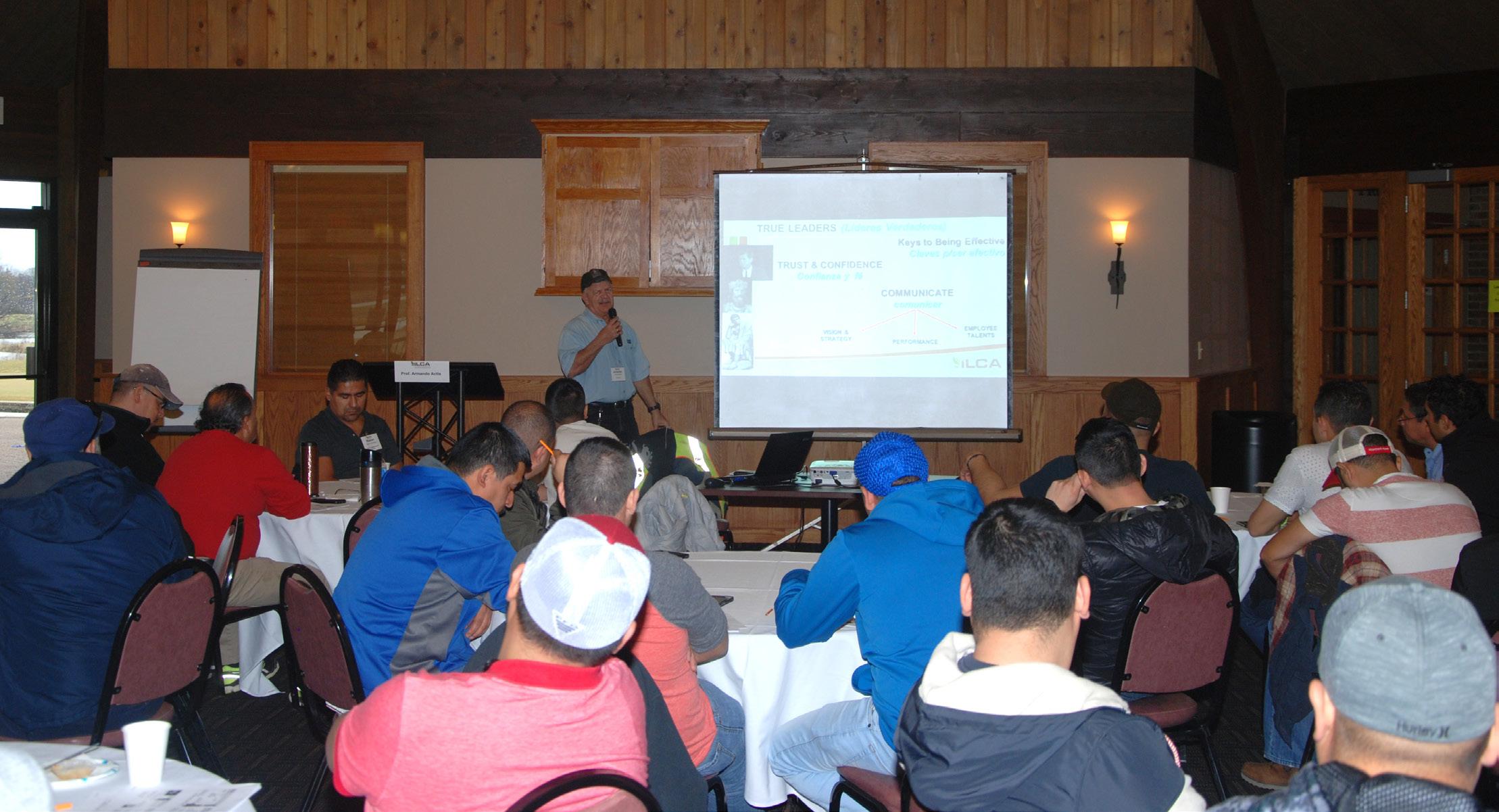
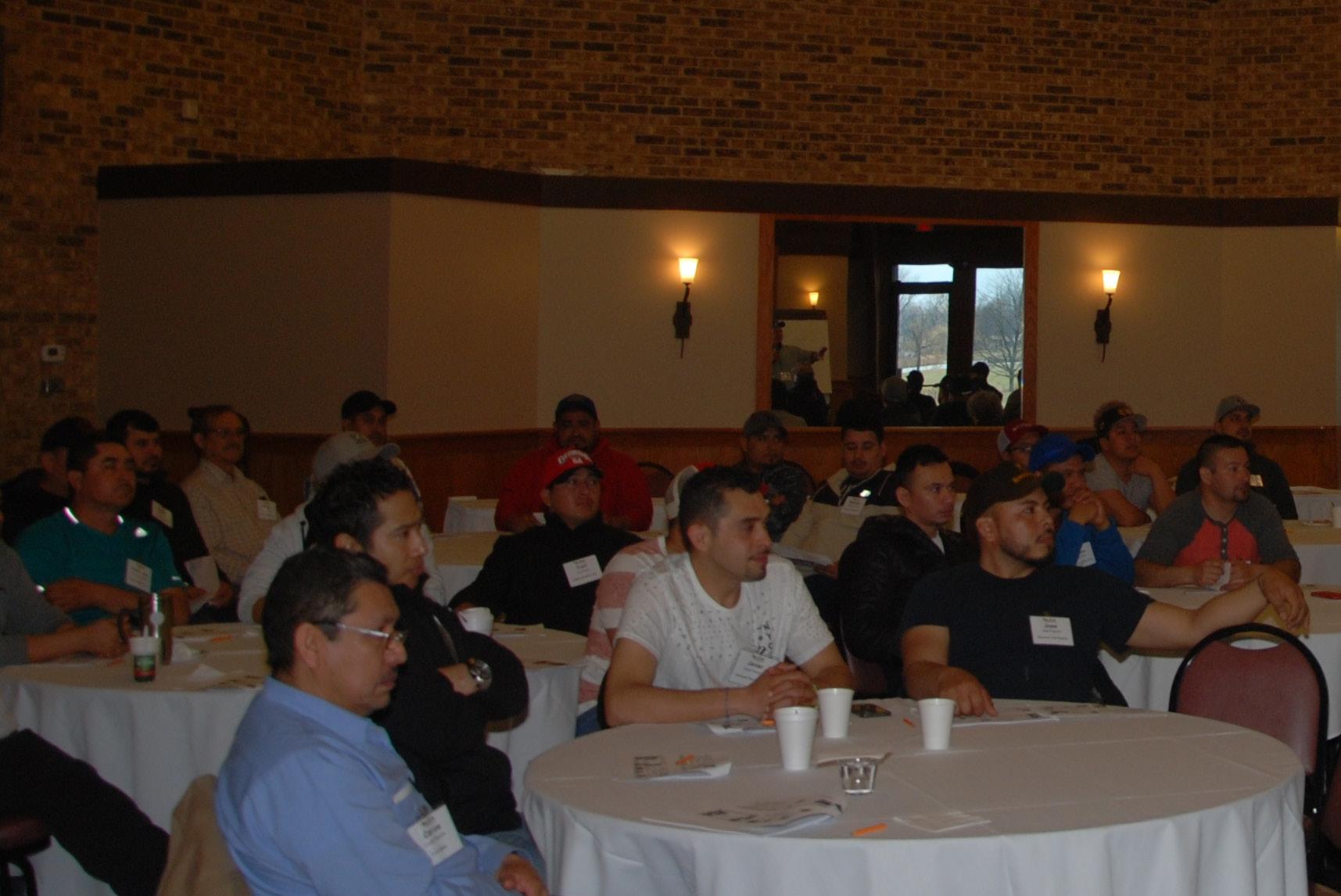
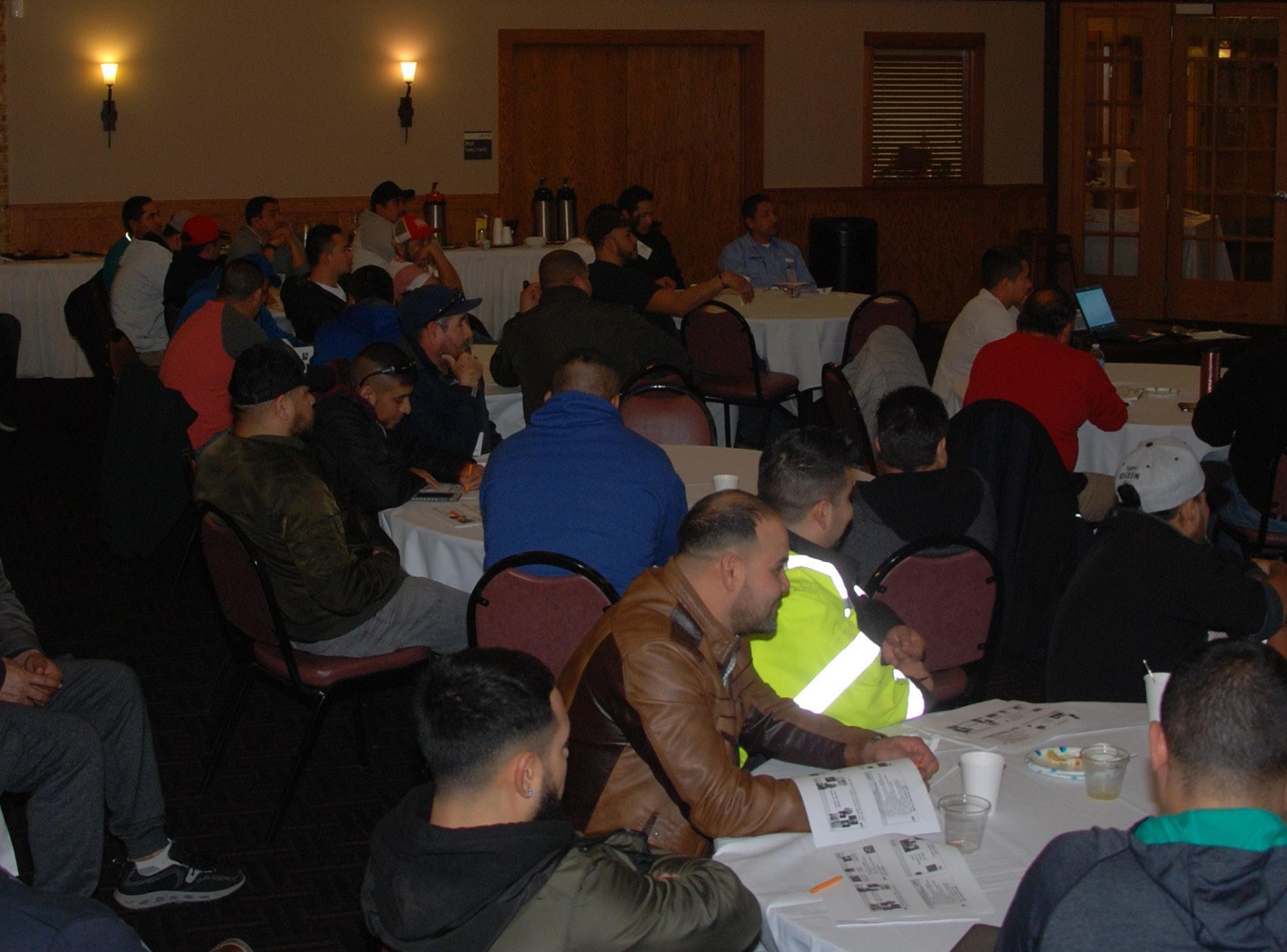
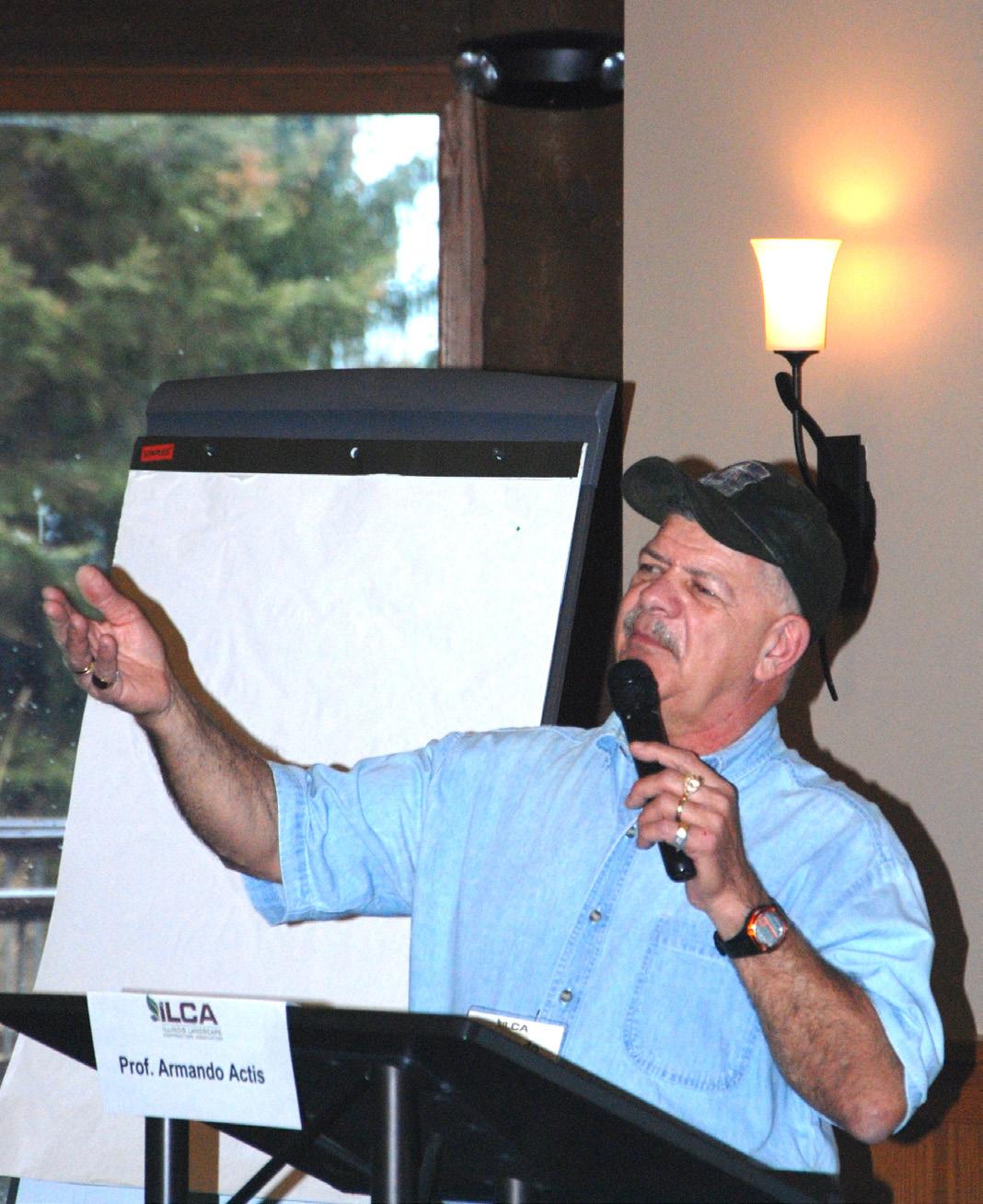
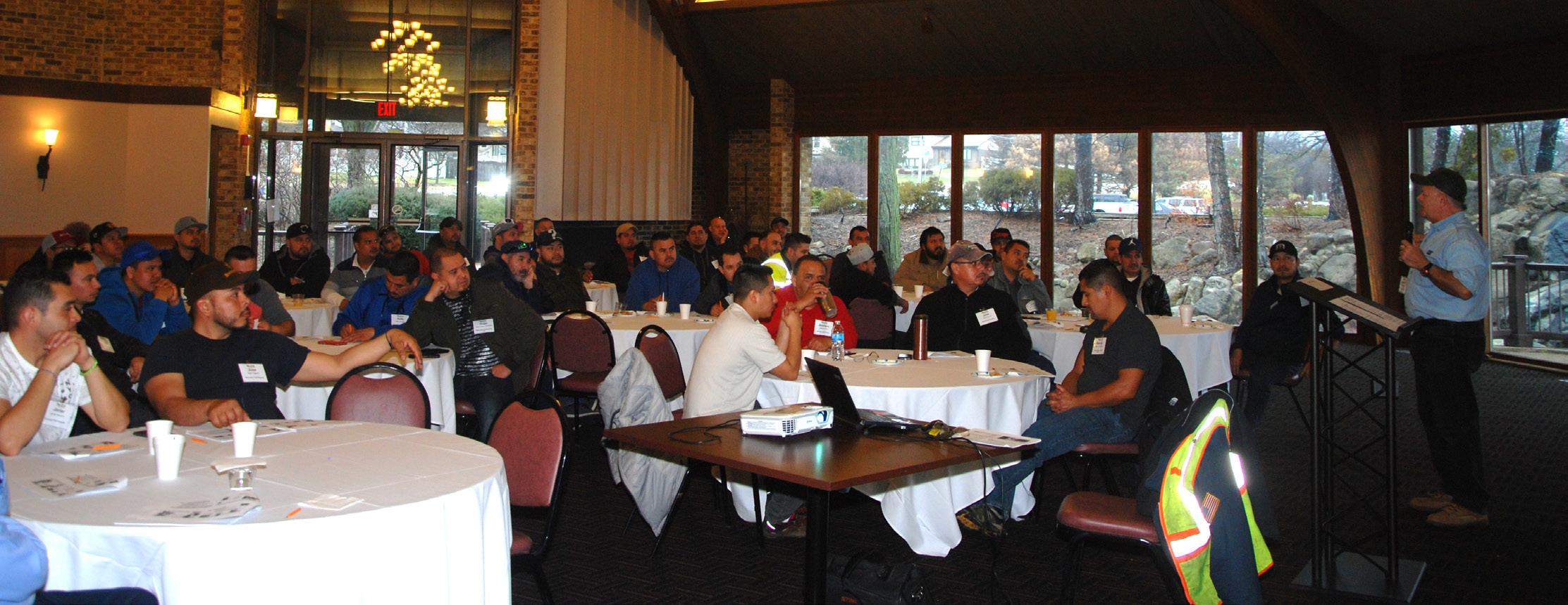
The two-day event was held March 1-2, 2018 at the Fox Run Golf Links in Elk Grove Village. The class was presented by long-time ILCA member, Professor Armando A. Actis.
Production and maintenance landscape foremen have unique needs as they have to wear two hats: a worker and a leader. Foremen have to walk the fine line in working side by side with the employee and having to direct, motivate and critique at the same time. Managing former peers and friends can be especially difficult, dealing with problems and obstacles can take skills that only can be developed by stepping out of the work environment for a few days, learning best practices, applying it in a learning environment through role play, and then going back and applying it on the job.
In this dynamic seminar, participants learned how to more effectively handle tight deadlines, tight margins and increase customer satisfaction. Also, participants were energized when they saw the class was prepared and designed specifically to meet their unique needs and not just another cookie cutter seminar.
Key components of the program included—
• The central role of the “worker-leader”
• How to properly supervise friends, peers, and former equals
• How to effectively communicate with your boss and superiors
• To generate 100 percent accountability from your team
• How to motivate and delegate at the same time
• To require accountability for all work (both bad or good)
• How to implement and follow daily & weekly work schedules
• How a team can produce quality work that stays within the budget and is completed on time
• The effectiveness of the work team
• How to deal with challenges and personal problems that occur outside the workplace that impact productivity
• To manage problem behavior
• How to produce client focused work using a moral compass
• To understand that mannerisms and values are as important as technical abilities
Seasonal Selling Tips
Selling to the Sustainable Landscape Customer
By Patrice Peltier
If you have expertise in designing, installing and/or maintaining sustainable landscapes, there’s a sophisticated group of customers looking for you. But, you’ll have to prove to them you know what you’re doing, Pamela Todd of Chicago Living Corridors told participants at ILCA’s recent Impact Conference.
“There’s a huge, untapped market,” she says. “Many organizations are working to educate people about sustainability issues. People want to do the right thing, but they don’t always know how.”
Chicago Living Corridors (CLC) encourages private landowners to be instruments of change by restoring or creating natural habitat on their land and connecting to habitat corridors of protected conservation areas. “It’s the urban areas that are going to make the difference,” she says. “We can impact climate change by what we do in our yards.”
Chicago Living Corridors works with a variety of organizations including Citizens for Conservation, The Conservation Foundation, West Cook Wild Ones, Northern Kane County Wild Ones, Barrington Area Conservation Trust, and the Wildflower Propagation and Preservation Committee.
To date, CLC’s map includes about 2,500 landowners, Todd explains. Many of these people ask CLC for referrals to knowledgeable contractors. Her organization, and others like it, are looking for experts to recommend, she says.
Not just any contractor will do, Todd cautions. She told the story of a residential landowner who hired a contractor to install a rain garden to address some drainage issues. At the time, the customer described himself as “a native plant newbie.”
As the homeowner became more educated about native plants, soils and drainage issues, he ended up completely revising the contractor’s work.
“He thought the contractor installed the rain garden without addressing the underlying problem,” Todd told her audience.
If you’re a contractor with true expertise, however, “we’re out there looking for people like you,” Todd said.
Some homeowners don’t need help creating a sustainable habitat, they need help maintaining it, Todd says. A member of Chicago Living Corridors has been working on restoring her five-acre property since 1986. “She’s created a preserve on her own property,” Todd says. As the homeowner has gotten older, however, maintaining the property is becoming a physical challenge.
One of the people the homeowner hired used herbicide on a native planting, Todd continues, adding, “It’s very challenging to find people who understand how to manage a property without hurting what’s already there.”
In addition to a growing number of interested homeowners, another group of potential customers is institutions. Many schools have embraced the idea of creating native habitats but their installations have been neglected or destroyed over time, Todd says.
“People want to do the right thing, but they don’t always know how.”
A LEED Silver stormwater management project at Triton College is now overrun by invasive plants, Todd says Adrian Fisher at the school’s Sustainability Center told her. As a result of her experience, Fisher suggests contractors include maintenance as part of an installation proposal.
Railroad, street, highway and utility right-of-ways are another source of customers, Todd says. She recommends connecting with the Right of Ways as Habitat Working Group at the Energy Resource Center at the University of Illinois at Chicago. The Working Group sponsors workshops and webinars as well as maintaining a (continued on page 32)
Seasonal Selling Tips
(continued from page 30)
database of pollinator habitat managed on rights of way and other landscapes. The organization includes 160 utility, transportation, government and non-profit organizations in the U.S. and Canada.
For more information, go to the website: http://www.erc. uic.edu/biofuels-bioenergy/pollinator-habitat/rights-of-way-ashabitat/
Speaking of transportation corridors, Todd points out the Illinois Tollway Authority maintains 500 acres of offsite wetland mitigation sites that need contractors for native vegetation management. Another 75 miles of toll roads planted with low-profile natives are maintained with a workforce supplemented by contractors, she says.
Todd recommended contractors make sure their crews are well educated through industry programs or by attending programs offered by conservation-oriented not-for-profit organizations.
Once contractors have expertise, she also suggests they promote themselves by becoming members or sponsors of conservation-oriented organizations such as CLC, Wild Ones, Chicago Wilderness, The Conservation Foundation and others.
There are a number of organizations both nationally and in the Chicago region that are educating homeowners, landowners and property managers about the benefits of sustainable landscapes. She encouraged ILCA members to develop and market their expertise in designing, installing and maintaining these landscapes. She urged members to connect with conservation-oriented organizations to help promote their services.
“Together,” she says, “we can make a huge difference.”
A personal story
Seeing is believing. What Pamela Todd saw when she created a wildlife habitat on her quarter-acre lot in Oak Park made her a believer.
Todd, of Chicago Living Corridors, told the audience at a recent ILCA event that once she established a small prairie planting in her yard, birds, butterflies and even a pair of Coopers hawks showed up.
Soon, it wasn’t just the Todds who enjoyed watching the hawks nesting and raising their young. “The neighbors stopped by at night with their binoculars and wine to watch the hawks,”
Todd reported with a chuckle. “They saw that they could bring that kind of wildlife into our urban neighborhood.”
Although it was just a small planting, the little prairie made a big impact on people who observed the difference it made. It also made a true believer of Todd. “It was the Coopers Hawks,” she says, “who taught me we can bring nature back.”
Heroic Work
“You are the heroes,” Pamela Todd told ILCA members as she reminded them of the benefits of creating habitat. Her list includes:
• Reduce input costs
• Reduce water use
• Manage stormwater
• Reduce air pollution
• Sequester carbon
• Impact climate change
• Conserve soil & energy
• Stop extinction of species
• Save pollinators
Anatomy of an Award Winning Landscape
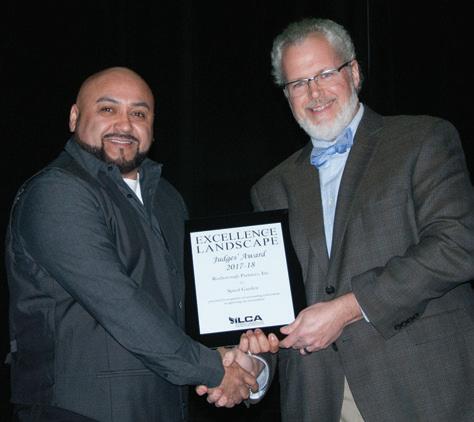
Rosborough Partners Wins
by Heather Prince
In this exuberant plant collector’s garden, the double spiral lawn sets a dramatic stage and creates a unique maintenance challenge. Starting in 2014, Rosborough Partners, Inc. began maintaining this dynamic landscape owned by a dedicated plant lover. “We meet with and walk the site with the client,” reports Phil Rosborough, President, Principal and Co-founder, as he describes the process. “As a professional, you see everything that needs to be done. However, it’s critical to spend the time working with the client to find out what’s important to them. You’ve got to prioritize.” This approach has been particularly successful with this site. With any project, “We set expectations and goals. Then
we meet with the crew and review those expectations to make sure we’re all on the same page,” explained Jose Mercado, Residential Maintenance Manager. The client for this special garden differs from most. “She’s a huge plant lover. She tinkers and plays in her gardens all the time. We needed to create a program that allows her to do what she loves, and us to maintain the rest without stepping on each other’s toes,” commented Rosborough. Working with a client that’s a true gardener has been a refreshing challenge, Rosborough reflects. “She constantly adds and changes the plants. You need to know your stuff. If she doesn’t have confidence in our people, it doesn’t work.”
(continued on page 38)
— 2018 Judges’ Award
A Spiral Success
Anatomy of an Award Winning Landscape —
Anatomy of an Award Winning Landscape
(continued from page 34)
The eye-catching spiral lawn has been the key design element for years in this garden. Jose Mercado leads a threeman crew that visits weekly. They have instituted a rigorous maintenance program for the lawn. “The turf was struggling when we took over the contract,” remembers Rosborough. “We had to reset it, get it back to health before we could start the mowing process.” They elected to change the height differential of the turf to create more contrast and changed the maintenance process to create crisp edges. “The unique shape was initially inspired by a shape inside the home,” reports Mercado. The lawn is cut using a 21 inch mower and proper mowing techniques. “During the growing season, we will mow the lawn twice a week then start paring back in July. The team will start with the first mowing on the taller spiral and finish the second mowing on the short spiral. The crew carefully carries the mower to the center to do the short spiral, only stepping on the spiral that is not yet mowed to minimize foot prints and keep a crisp look. We want the lawn to be the best it can be, and we have trained our people to provide the best lawn mowing techniques for the property.” The team
has three rules to keep the spiral looking it’s best: mow at the proper height to avoid scalping and prevent weeds; always use sharp blades to prevent damage to the turf; and mow often enough so no more than one third of the grass is removed. “By adhering to these rules, we make sure your lawn is healthy and beautiful all year,” remarked Mercado.
“The challenges with it are diseases, fungus problems, and insect issues. To keep on top of these factors and still keep the lawn looking tip top means we’ve employed a custom blend fertilizer and added additional fertilization treatments.” There is an irrigation system in place that sometimes becomes an issue as the homeowners prefers to run it for the annuals and any new plants. Mercado and his crew would rather underwater the turf. “Overwatering the lawn brings out the diseases. Irrigation management is a big deal with this property. We really prefer to do more handwatering,” commented Rosborough. Mowing is a rigorous process that requires precision and attention to detail. “If you make one bad cut, it doesn’t go away. You have to wait for it to grow out,” remarked Rosborough. The lawn has been featured on many garden walks and tours, so there is constant pressure to keep it at peak performance.
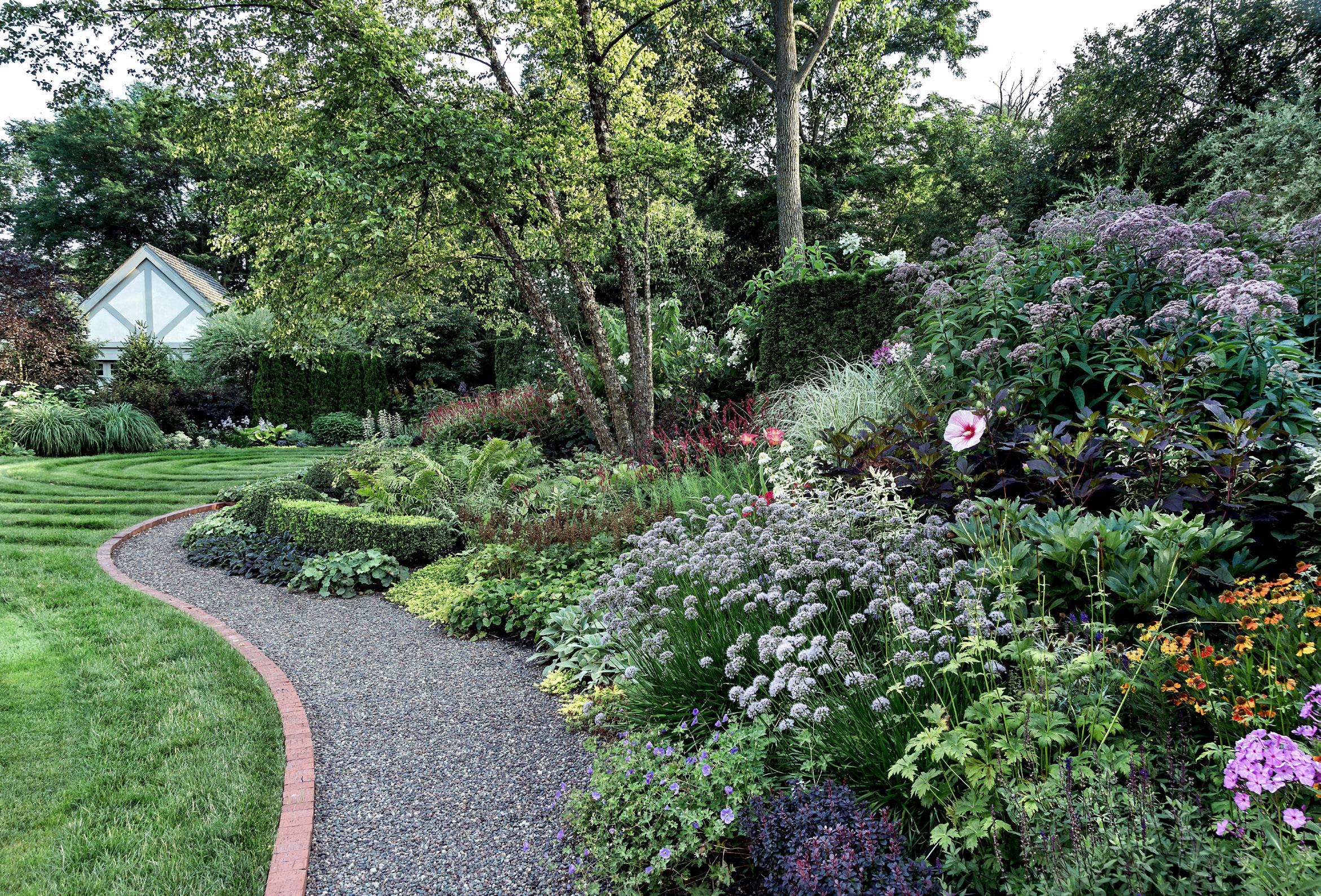
Although the lawn sets the stage, the gardens surrounding it are a lush reflection of the homeowner’s passion for plants. The homeowner embraces bold texture and color such as plume poppy and Joe Pye weed as a foil for crisp lines of the hedges. She prefers a layered approach where new plants can be tucked in and season-long color created by strategic annual flower plantings. Swing open the cast iron gate and you are greeted with a gently burbling circular fountain set at grade level with flagstone walkways leading to the patio or lawn. It is flanked by hosta, hydrangeas, and ligularia. A Forest Pansy redbud provides a dramatic splash of purple and hides the garden view, creating mystery. Silvery lambs ears provide a contrasting texture and color, cooling the plant palette. A mature smoketree towers overhead, its delicate smoky blossoms a foil for the sturdy Annabelle hydrangeas.
Bright swathes of purple sweep across the garden in the form of garden phlox, delphinium, coneflower, blazing star, cosmos, and catmint. Their brightness is contrasted by lady’s mantle, hosta, creeping Jenny, and carefully clipped purple barberry. Artfully planted kousa dogwood trees offer clouds of flowers in spring, bright red fruit for the birds, and burgundy fall color. The planting beds are deep and large, allowing for flowing specimen shrubs such as Diablo ninebark, rose
of Sharon, variegated red twig dogwood, and panicle hydrangeas. Clipped Emerald arborvitae, hornbeam, and boxwood hedges provide a formal framework for the lavish garden areas packed with color and texture. These hedges are precisely pruned using a string line to keep a perfect alignment with the home and hardscape. Winter challenges the team to protect the evergreens from deer browsing.
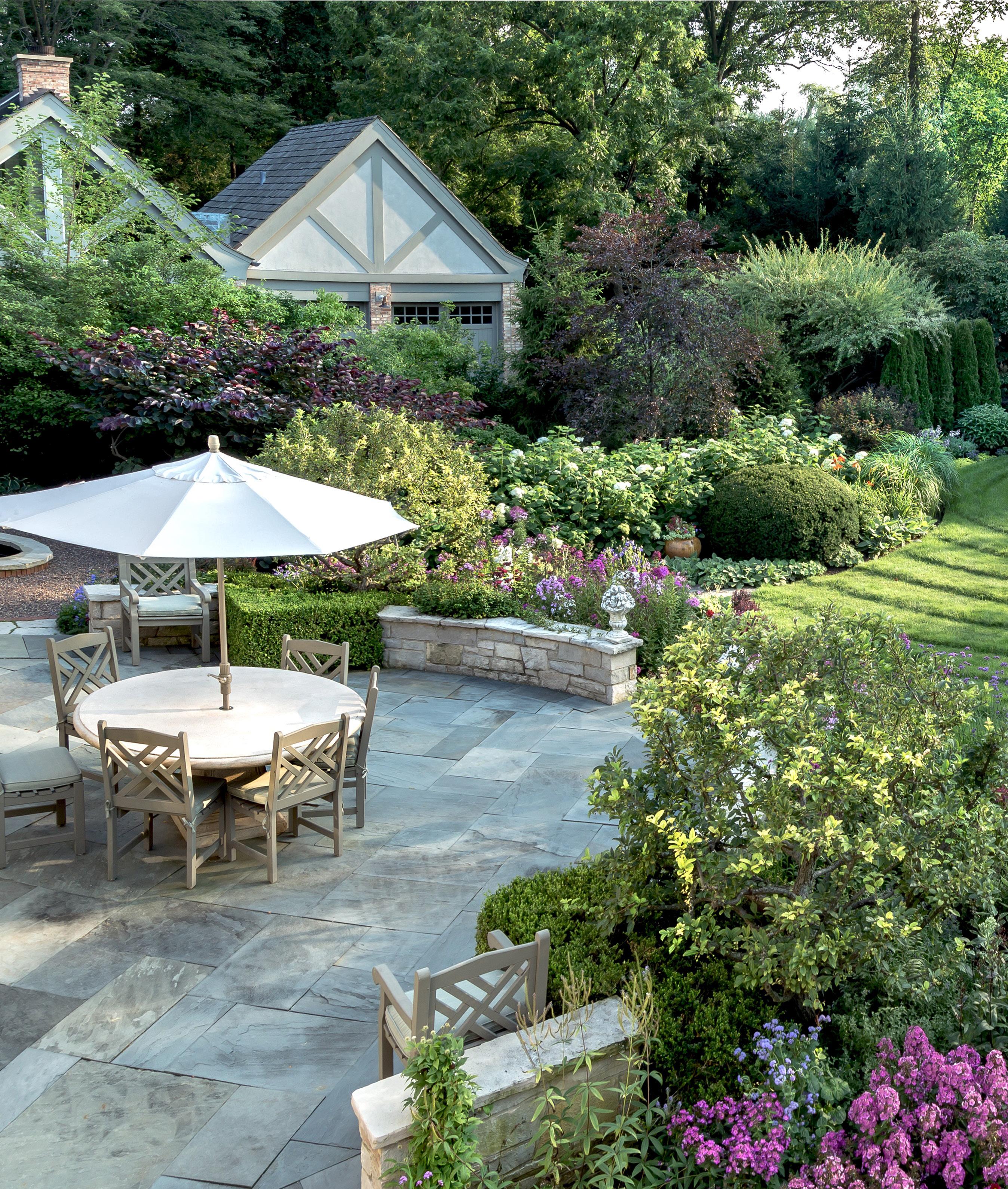
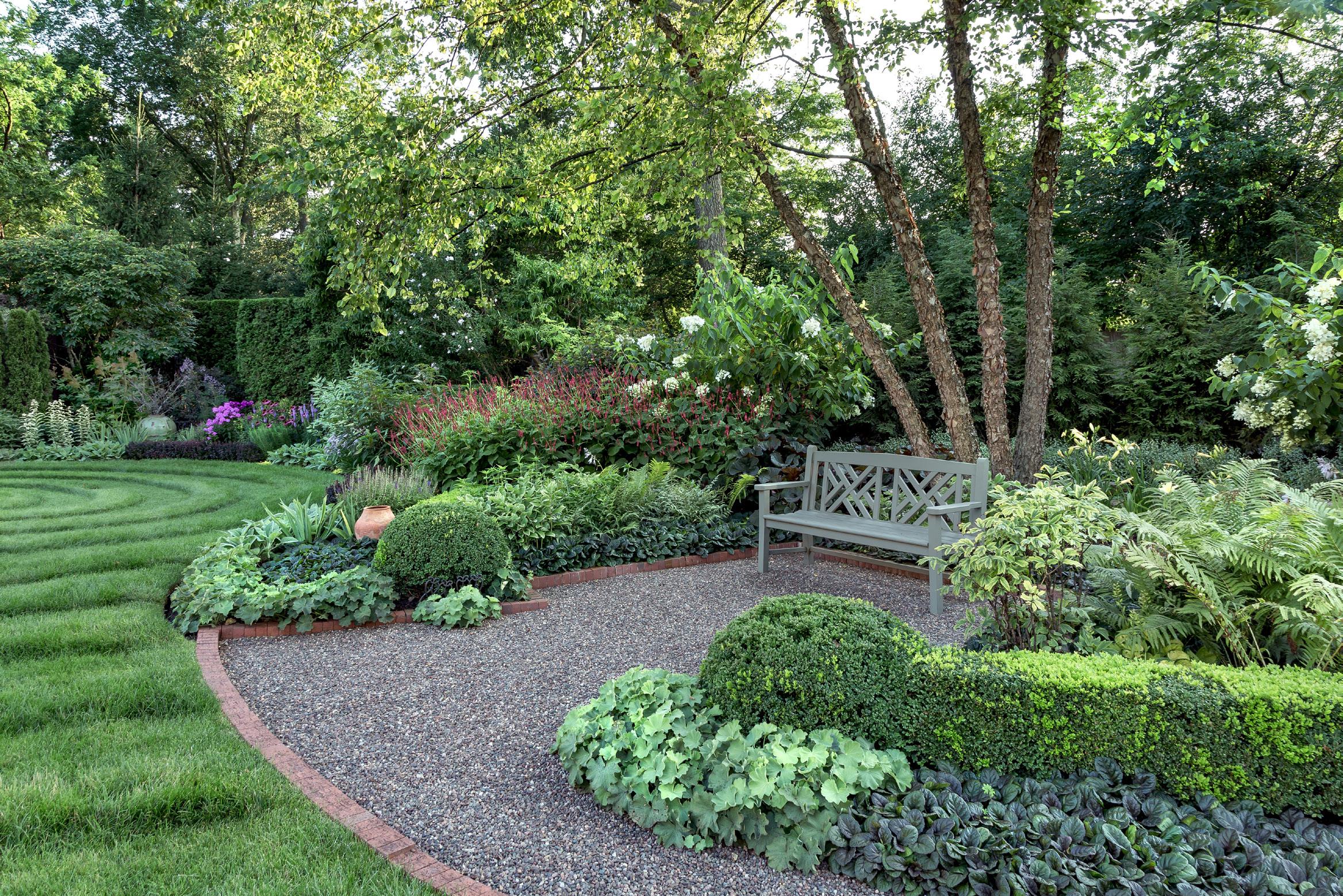
Clipped boxwood eases the transition from the stone patio to the lawn space and offer an illusion of continuing the stone seat wall. A pair of manicured crabapple trees help to frame the view to a garden bench, give a welcome breath of spring flowers, and feature berries for winter interest. A deep green fan of pruned arborvitae trees terminates in a specimen Japanese maple, while the billowy texture of a dappled willow on a standard provides height, color, and privacy. A gravel walk leads to the comfortable bench tucked under a tall river birch, creating a stroll garden experience and a shady nook. Mercado and Rosborough have moved plants around and added some low structured boxwood hedges to embrace this quiet seating area. Weekly maintenance keeps the path clean, neat, and fresh. The homeowner is constantly adding and editing the plant pallet as she finds something new to try or decides to refresh a vignette. “This property has to be garden (continued on page 40)
Anatomy of an Award Winning Landscape
(continued from page 39)
walk ready at all times,” commented Rosborough.
“It’s constantly being visited by groups or guests.” Landscape lighting is “strategically placed to highlight key plants and make the site attractive at night,” reports Mercado.
In this plant collector’s gardens, “she really knows her stuff. You have to rise up to her level,” observed Rosborough. With the huge variety of plants, “the plant list is enormous. There’s always something going on, something to do,” reports Rosborough, it is particularly rewarding to maintain. The weekly visits always find tasks that need doing and communications with the homeowner on areas of responsibility are frequently reviewed. “She loves it. It’s her passion. She’s a realist when things struggle,” commented Rosborough. This is an exceptionally high maintenance garden due to the depth of the plant list and the need for it to be at peak performance. The crew needs to have extensive “plant knowledge, skills in pruning naturally and formally, as well as perennial care, turf maintenance knowledge and strategic mowing,” reports Mercado. This project requires experienced horticulturists who are energized by the continual care challenges and rewarded by interacting with new and unusual plants. Rosborough and Mercado report that earning the trust of the homeowner has been one of the most gratifying aspects of
the project. The care of the gardens become an interesting challenge, “it’s really gardening, not maintenance,” observed Rosborough. At this unique site, there’s something to delight the senses with every visit.
Para que crezca su negocio, unase a...
Servicios y Beneficios
• Certificaciones
• Seminarios
• Talleres de Trabajo
• Publicaciones
• Capacitación
• Videos
• Eventos
• Programa de Seguros
• Trabajadores Temporarios
• Subasta de Herramientas de jardinería
A Must-Read Feel Good Story
Oaks of North Lawndale
Spoiler alert: Read this story if you want to feel good about the work you do and the impact it has on people’s lives.
By Patrice Peltier
Much has been written about the art of landscaping. This is a story about trees as art—and a whole lot more.
A new project involving the School of the Art Institute of Chicago (SAIC), various community organizations in the North Lawndale neighborhood of Chicago and a handful of green industry folks is turning trees into an art installation. If all goes as planned, it will also turn planting trees into a health initiative, a crime prevention program, a jobs training
effort and a source of community pride.
The project, called “The Oaks of North Lawndale” involves planting 7,000 trees (not all of them oaks) over the next five to seven years. Planted mostly on public property, the trees will span 3.2 square miles of North Lawndale connecting it to neighboring East Garfield Park.
The project started as the brainchild of Paul Coffey, a fifth generation Chicagoan, who is vice provost and dean of civic engagement for SAIC. Part of Coffey’s job is helping the
Pedro Reyes
Paul Coffey
Doug Rappe
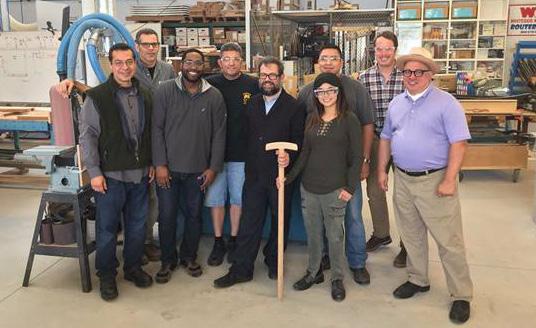
Identified in the photo are: Pedro Reyes; Paul Coffey; Doug Rappe ( Lead Technical Instructor / Program Coordinator - Greater West Town Training Partnership) Others pictured are students at Greater West Town Training Partnership
Lawndale
school be a good institutional citizen in its North Lawndale neighborhood.
A chance comment about how the tree canopy increases as one drives away from North Lawndale prompted Coffey to research the correlation between tree canopy and crime rates. He was struck by the findings of Baltimore researchers who documented a 10% increase in tree canopy with roughly a 12% decrease in crime. Coffey also learned that North Lawndale has a 15% tree canopy, one of the lowest in the city. Its crime rate is also one of the highest.
As he pondered a project involving large-scale tree planting, he was reminded of the work of German artist Joseph Beuys. In 1982, Beuys began a public art project titled “7,000 Oaks” in Kassel, Germany. Over five years, with the help of volunteers Beuys installed 7,000 trees (not all of them oaks), each paired with a stone column. His intent was to humanize the living space in an increasingly urbanized area.
A project is born
“Why not create a similar public art installation in North Lawndale?” Coffey thought. He shared his idea with one of the school’s community partners, the North Lawndale Community Coordinating Council (NLCCC). Annamaria León, edible landscapes director for Christy Webber Farm & Garden Center, lives in North Lawndale and chairs the NLCCC’s Greening, Open Space, Water and Soil (GROWS) subcommittee. When she heard the idea, she thought it had “Christy Webber Landscapes” written all over it.
“We’re becoming known for our work on community projects,” León says. “People think, ‘If you need something, go to Christy Webber Landscapes. They’ll help you if they can.”
One of the people León talked to was Clare Johnson, Marketing Manager at Christy Webber Landscapes. As an undergraduate landscape architecture student focused on therapeutic garden design, Johnson had studied the positive impacts of trees on health and community with Professor (continued on page 44)
A Must-Read Feel Good Story
(continued from page 43)
William Sullivan, head of landscape architecture at the University of Illinois at Urbana-Champaign. When she heard about SAIC’s project, she immediately saw the potential benefits.
“I was very excited and intrigued by SAIC’s idea of taking this artist’s installation and making it about community and the need for greenspace,” she recalls. Like León, she knew her boss would be interested.
“Christy Webber Landscapes’ involvement was a nobrainer, thanks to Christy herself,” Johnson says. “She’s so engaged in helping the community—especially the west and south sides. She says, ‘We need to be bringing green space to them.’ This is absolutely what she loves to do with the company she’s built.”
León and Johnson recruited Angela Liegel, vice president of business development, Design Principal Tiffany Danielle, Senior Estimator Matt Draus and Construction Project
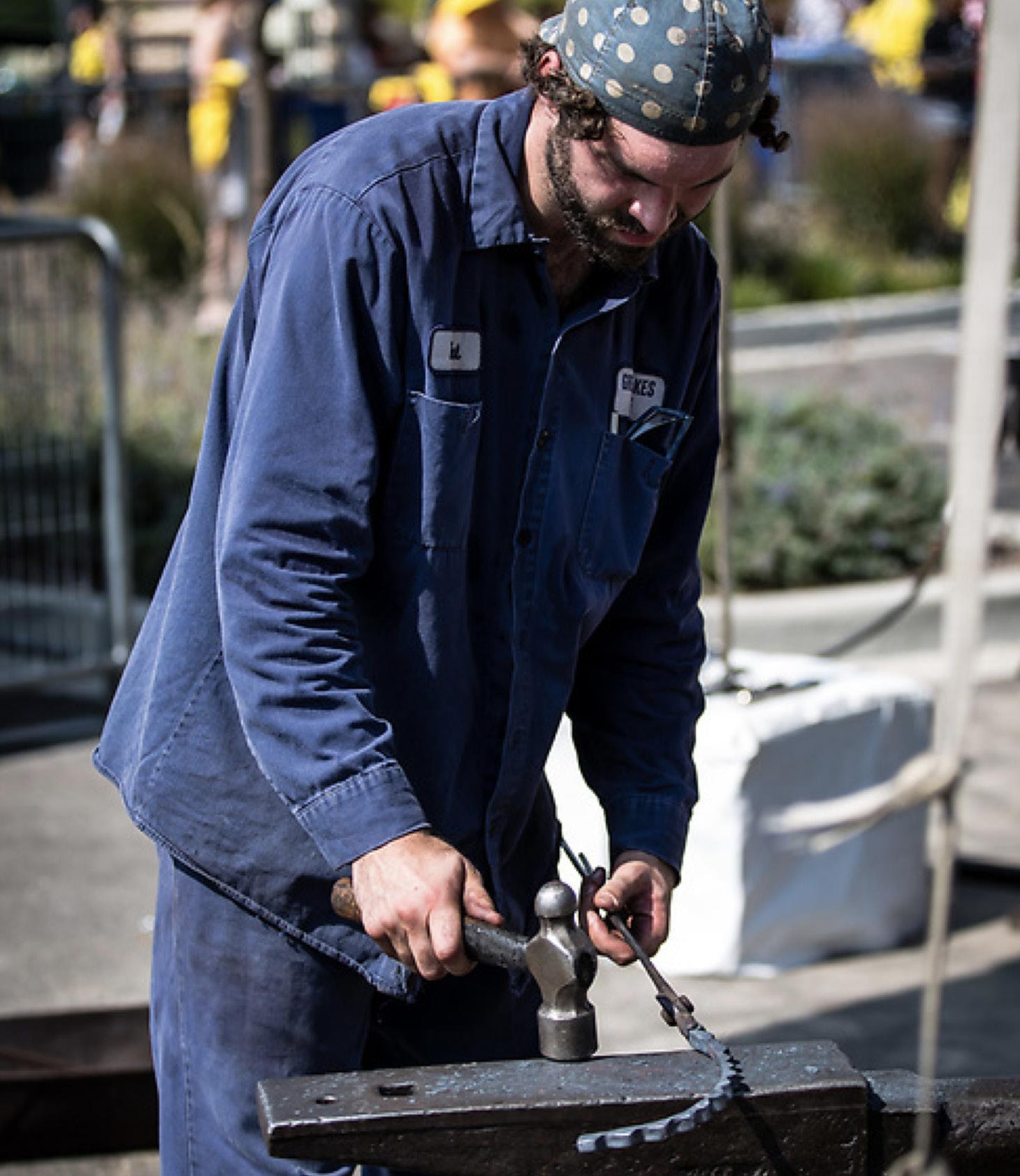
Paul Russell (the artist and Smith who hammered out the shovels) with Pedro Reyes
Manager Deb Penyak to help launch the project in September, 2017.
To prepare for the kickoff, Penyak purchased ten 1.25” caliper trees. The organizers agreed it was important to diversify the species planted, so the first ten trees included bur oak, chanticleer pear and Autumn Blaze Maple.
“I chose trees that would provide varying colors and contrast as well as tree varieties that were healthy for the long haul,” Penyak explains. “The site where these are planted doesn’t provide the most ideal environment for success, so I wanted to be sure we had the most sturdy specimens given the time of year and the short notice.”
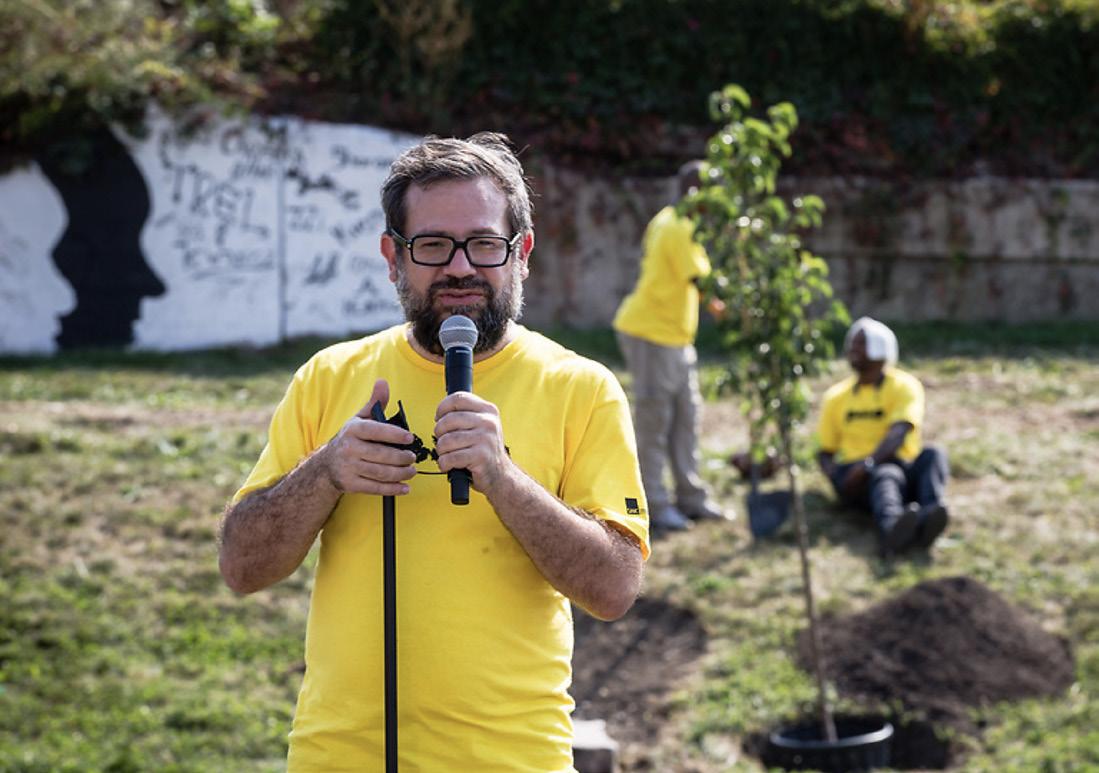
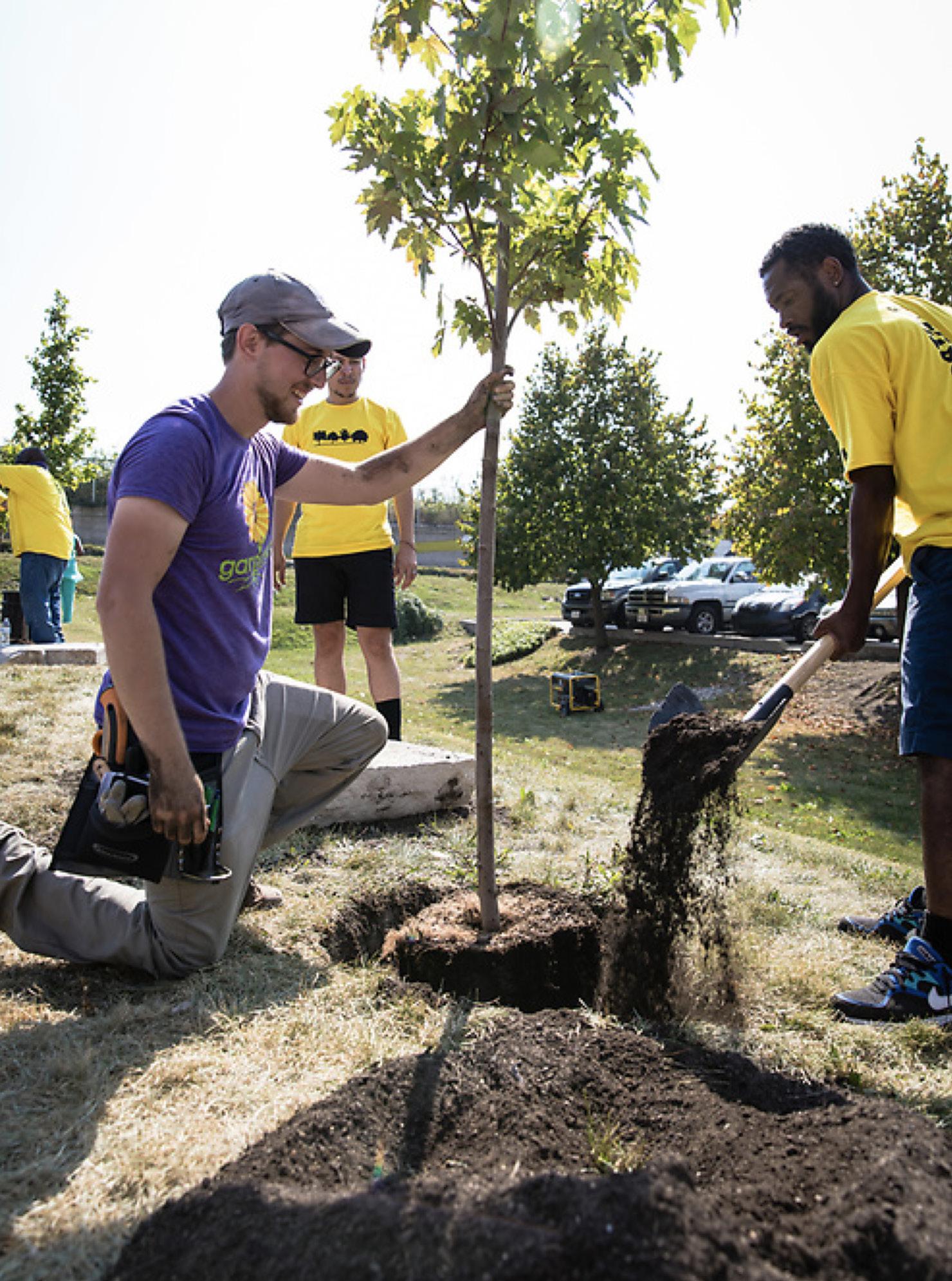
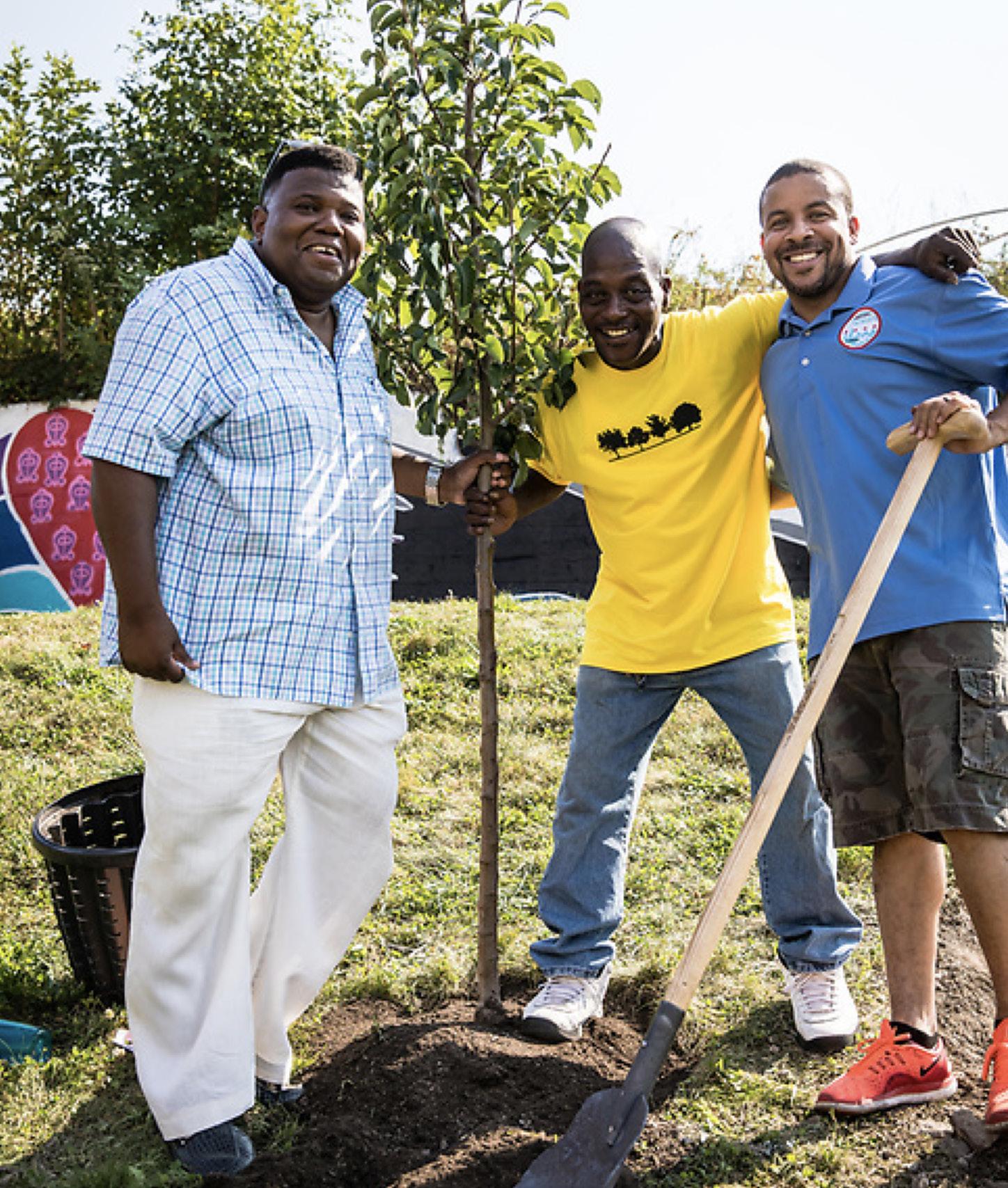
On September 22, 2017 Penyak and a crew of three delivered the trees and prepared the planting holes around Homan (continued on page 46)
The Natural Choice for Soil and Plant Nutrition
QUALITY ORGANIC FERTILIZERS FOR ALL YOUR LANDSCAPE NEEDS
Nature Safe offers an organic granular fertilizer made from animal proteins. These nutrients feed the roots of the plant, thus building a stronger and deeper rooted plant producing a healthier lawn. A healthier lawn requires fewer applications of fertilizer and can reduce the need to water. Excellent results when used for grow-ins, sod installation, trees, shrubs, flower beds, and vegetable gardens
More OMRI listed products than any other organic manufacture in the industry
· Use on properties to help obtain needed LEED points
· Conforms with the U.S. Biopreferred program
· Extensive product line that provides options for almost any agronomic challenge
· Used on many botanical gardens, professional sports fields and by landscape companies across the country
616-566-0307 naturesafe com
Paul Russell blacksmith at work
A Must-Read Feel Good Story
(continued from page 45)
Square where SAIC is housed in Nichols Tower. They also set limestone slabs near each tree to mimic the stone columns in Beuys German installation.
Guns into Shovels
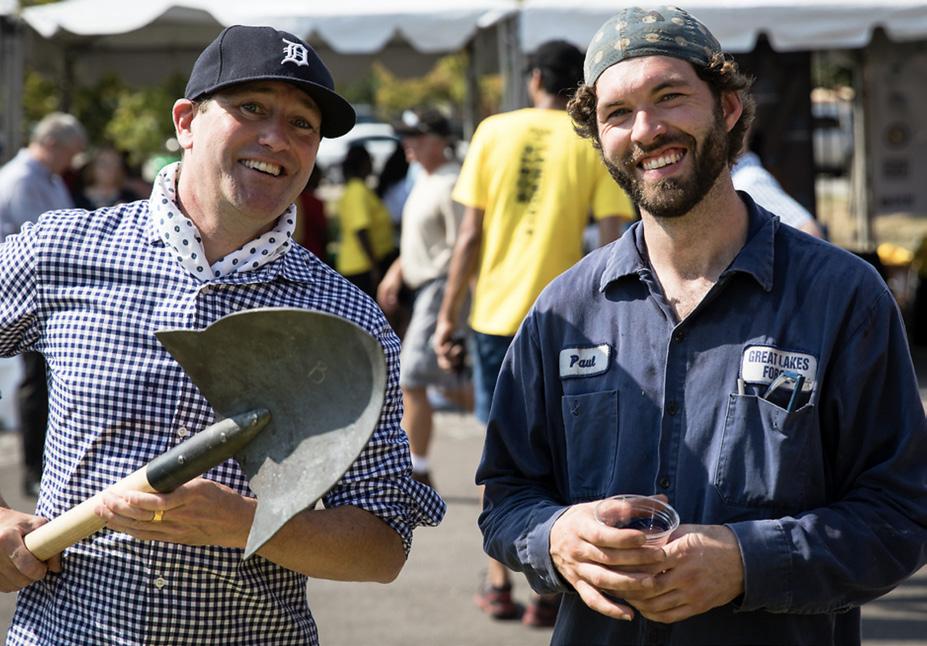
On kickoff day, there was a festival atmosphere around Homan Square. Mexican artist Pedro Reyes created a Chicago version of his work “Palas por Pistolas” (Guns for Shovels). Designed ten years ago to take weapons out of circulation in his home country, Reyes re-created the symbolic act of turning an agent of death into an agent for life in North Lawndale.
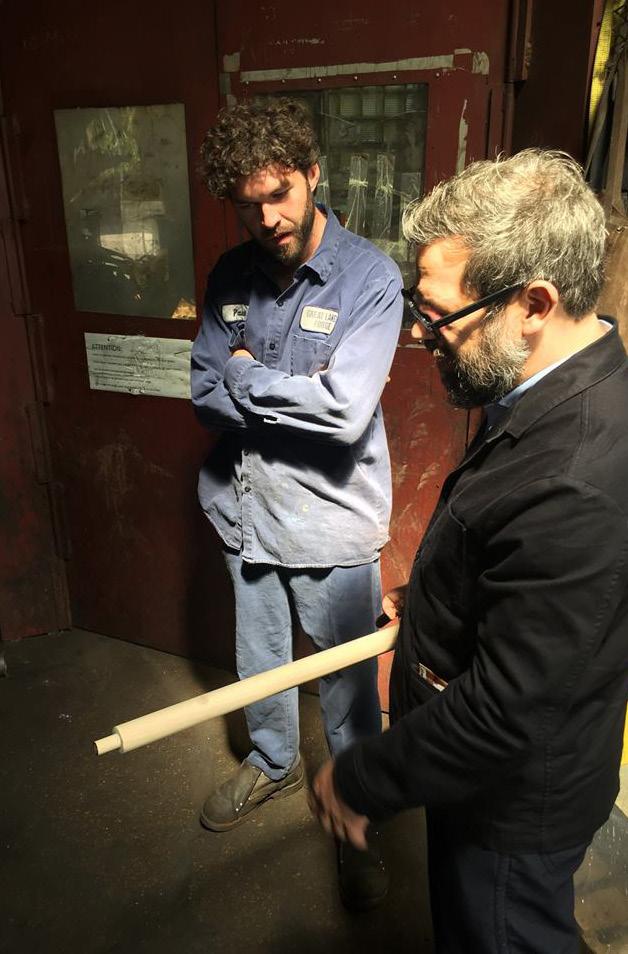
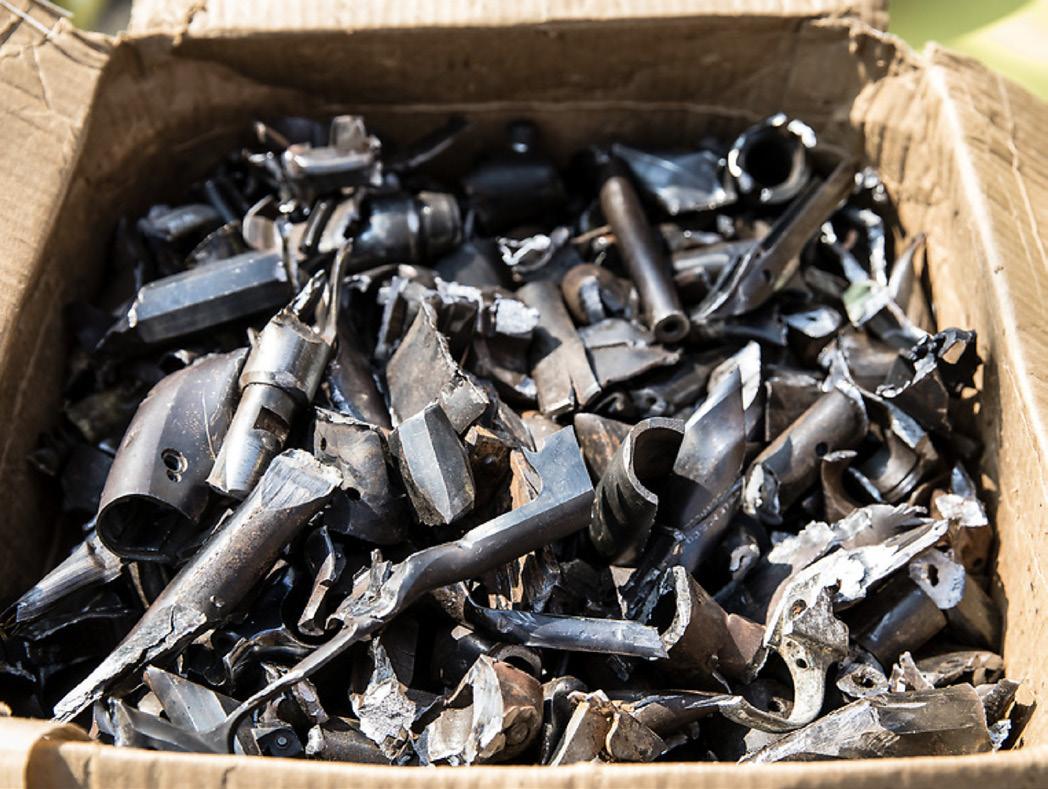
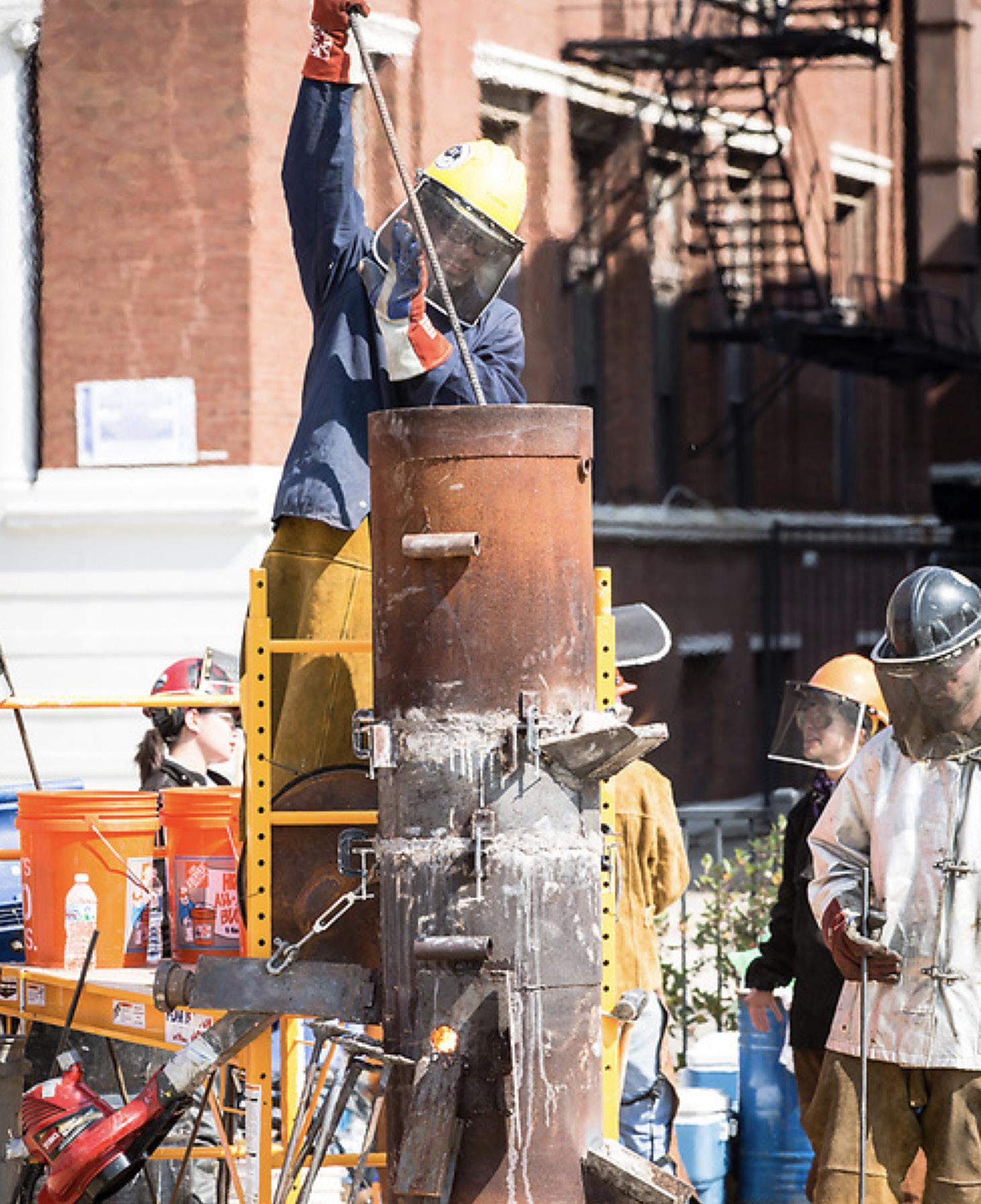
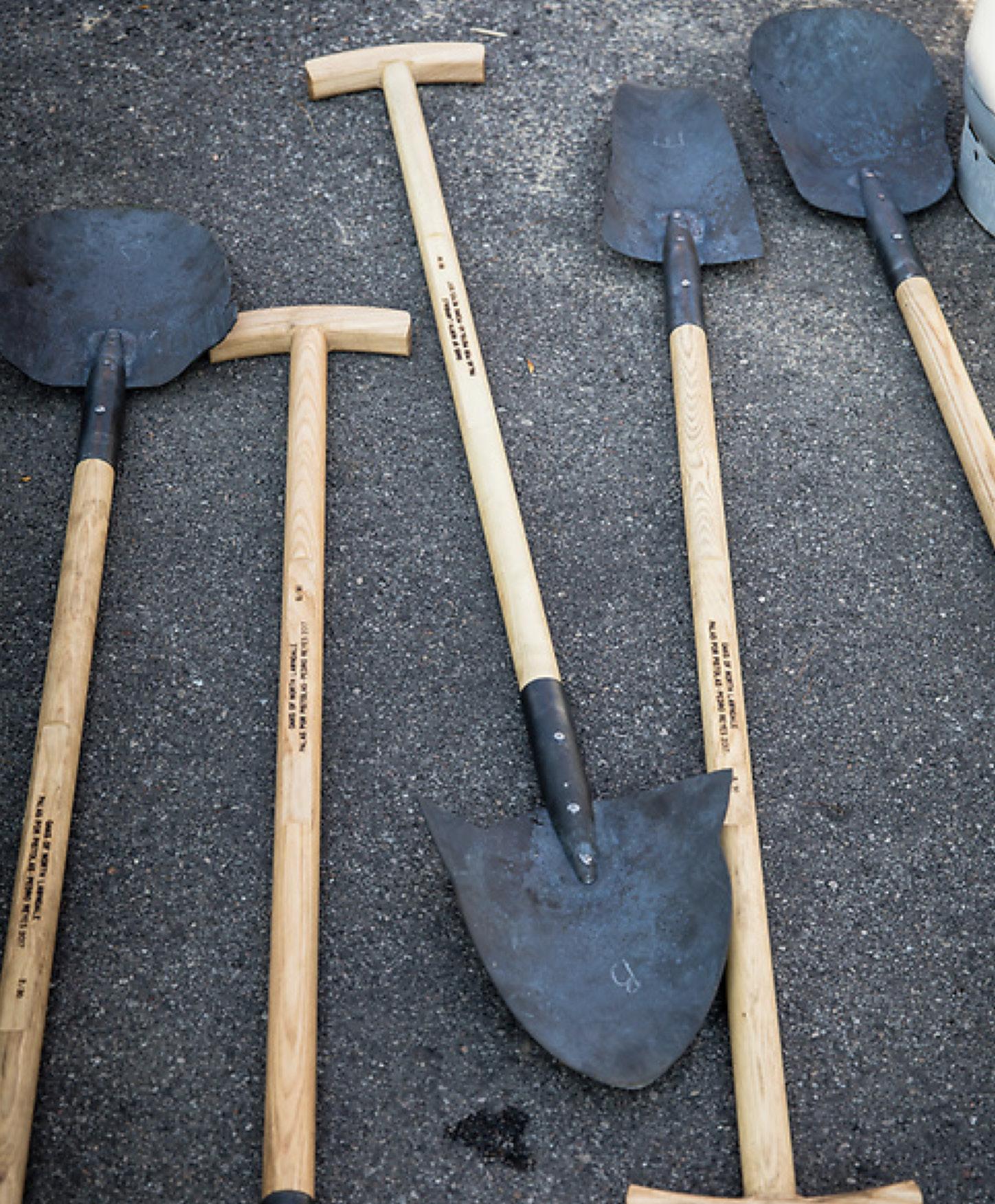
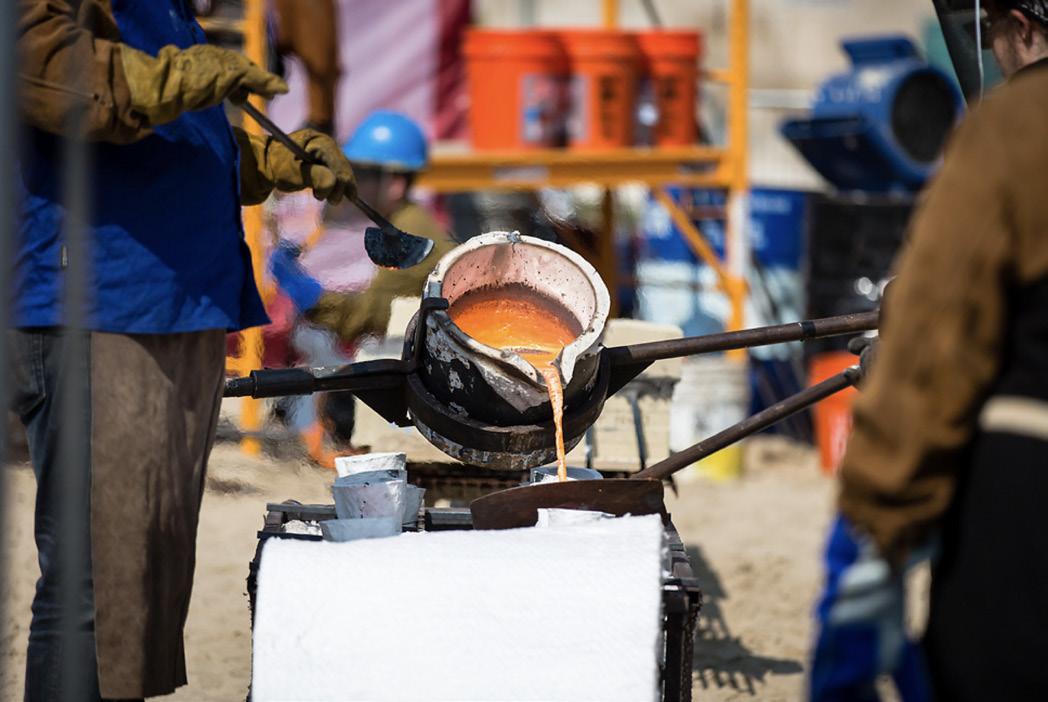
Using guns confiscated in Chicago, Reyes melted the metal and forged it into shovel heads. Using SAIC’s mobile forge, Reyes led students, alumni and community members in melting confiscated guns. The molten metal was smithed into shovel heads by Lawndale Forge a local industrial blacksmith.
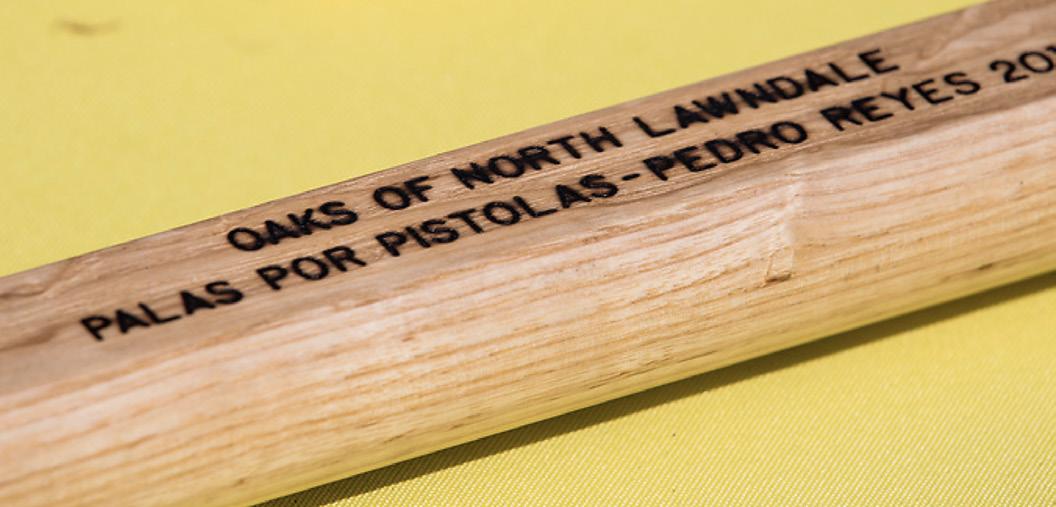
Local ash trees felled as a result of the emerald ash borer were milled into handles prepared by youth involved with Greater West Town Training Partnerships, a group that links the employment and training of the neighborhood workforce with local economic development efforts and the needs of small and mid-sized employers. Locally collected beeswax was also used in preparing the shovels.
“The shovels represent a lot of combined labor and resources from North Lawndale,” Coffey explains. Later, the shovels were used by politicians and members of
the community to plant the trees. “This is the transformative essence of this project: to turn an instrument of death into an instrument of life,” Reyes is quoted as saying in an SAIC press release.
Reyes donated the 30 shovels created at the event to be sold for $3,000 each as a fundraiser for “The Oaks of North Lawndale.” (For more information about purchasing a shovel, contact Paul Coffey at SAIC.)
Representatives of The Morton Arboretum were also present at the kickoff event to provide information about the selection, planting and care of trees. Coffey says The Morton Arboretum will be involved going forward in advising the project on tree selection.
Other community organizations and tenants of Nicolas Tower also set up informational exhibits.
What’s Next?
Ten trees are a small down payment on 7,000 trees. But there are big plans.
For starters, the City of Chicago Water Reclamation District has offered to supply 5,000 whips in 1-gallon containers as part of its water management strategy. The first batch of 500 trees includes black, red and swamp white oaks as well as pecan trees, according to Jeff Levrant, Manager of Homan Rails Farm and co-owner of a new North Lawndale nursery, Homan Grown.
(continued on page 48)
Shovel Handle made out of dead Ash Trees by students from Greater West Town Training Partnership
SAIC students and staff working on the foundry melting weapons waste
A Must-Read Feel Good Story
(continued from page 46)
With the help of paid community trainees, Levrant will tend the trees until they are large enough to plant. He will also work with Gardeneers, a non-profit group that provides gardening curriculum in Chicago Public Schools, to develop curriculum that can be implemented at local schools over the course of the five-year planting project.
“We anticipate starting trees from seed with students,” Levrant explains. “Eventually some kids’ trees may be planted along the street as part of the Oaks of North Lawndale.”
In fact, many of the community partners working on this project hope it will spur jobs growing, planting and maintaining the trees. As the tree canopy grows, community organizers hope the neighborhood will grow, too.
“The programming that will surround this project aims to address job creation and economic development, environ-
mental improvements, equity issues and encourages wellbeing,” Coffey says.
All that is a ways off, Coffey admits. For starters, the City of Chicago specifies a minimum caliper for the installation of street trees. “Obviously, we will need to source bigger trees while the seedlings grow,” he says.
Eventually, though, Coffey foresees trees planted along city streets throughout North Lawndale…and then some.
The project is also talking to CCA Academy, a charter high school with an urban agriculture program, about adding oaks to the school’s food forest. And, there are discussions with NeighborSpace, a non-profit that turns vacant lots into pocket parks, about adding trees to their projects.
Of course, it will all take money, and Coffey is busy drumming up funding. He is looking for help from private and public partners, including the City of Chicago. “We’re poised to bring social
change to North Lawndale, but there’s a fiscal reality,” he says. “The City of Chicago needs to step up and help with funding.
“We’re trying to reforest what was once a savanna,” he continues. “What we’re after is a reduction in violence. We hope North Lawndale will become an arboretum that will bring peace, jobs, equity and health to this neighborhood.”
(continued on page 50)
Mulch and Topsoil
Completed Shovels
Paul Russel with an attendee
SAIC students and staff working on the foundry melting weapons waste
Pedro Reyes
In Blue - Alderman Michael Scott Jr.; in Yellow - NLEN Client
A Must-Read Feel Good Story
Who’s Who?
The “Oaks of North Lawndale” has a lot of moving parts in the vast network participating in this project. Here are some of the organizations involved:
• School of the Art Institute of Chicago (SAIC) opened its first permanent classroom outside its downtown campus in 2015. It is housed within Nichols Tower on the Homan Square campus where it offers arts education to North Lawndale residents, holds classes for SAIC students and hosts an artist residency program.
• North Lawndale Community Coordinating Council (NLCCC) includes North Lawndale stakeholders, including communitybased organizations, business owners, elected officials and individuals, that guide comprehensive planning and implementation in North Lawndale.
• North Lawndale Employment Network—offers employment services and transitional jobs to North Lawndale residents, many of whom are returning from incarceration and others with significant barriers to employment.
• Homan Grown is a social enterprise wholesale nursery in North Lawndale founded by Jeff Levrant, Roy Diblik and Annamaria León, to provide perennials to landscape contractors in the city, employment and jobs training for North Lawndale residents and educational resources for local schools.
• Christy Webber Landscapes and Christy Webber Farm & Garden Center provide resources including planning, horticultural expertise, materials and labor, community outreach and engagement to this and a number of other projects in the city’s underserved areas.
• Gardeneers is a nonprofit founded by Chicago Public School teachers May Tsupros and Adam Zmick to provide comprehensive gardening curriculum and horticulture services to Chicago Public Schools.
Left - Jeff Leverant - Homan Grown; center - SAIC Student Xavier Armas; NLEN Client
Homan Grown: A new resource for urban contractors
Jeff Levrant, manager of Homan Rails Farm and project specialist for Gardeneers, has joined forces with Roy Diblik, co-owner of Northwind Perennial Farm, and his wife, Annamaria León, edible landscapes director for Christy Webber Farm & Garden Center, to create a wholesale perennial nursery in North Lawndale called Homan Grown.
Diblik sees the nursery as an opportunity for local landscape contractors to conveniently and economically source quality perennials suitable for tough urban conditions. Often urban contractors resort to buying plants at big box stores because it’s not practical to source plants from suburban wholesalers, Diblik says.
“There are no wholesale nurseries within 60 miles of the area,” León says. “Many of the smaller landscapers want to know how and which perennials to use,” she adds.
The partners’ idea is to provide a small palette of “urban durables” in plugs as well as design services and horticulture education.
This spring the nursery will open its facility at 3844 W. 16th Street between S. Springfield Ave and S. Ayers Avenue atop a City of Chicago stormwater reclamation installation. The nursery will include four, 50’ hoop houses with room for open growing and parking for contractor pick up. Already, the nursery is filling orders, including hundreds of prairie dropseed plants for the Lurie Garden.
Because the three partners are also community activists, they want Homan Grown to do more than meet the needs of local contractors.
“We knew we wanted to make opportunities for people in the neighborhood. It’s something all three of us have been thinking about,” Levrant recalls. “Roy said, ‘There’s no wholesale nursery in this area. Why not start one here?’”
This spring, Homan Grown will hire two people from North Lawndale to work from April through October. Employees will be trained in general nursery skills, horticulture, landscape design and landscape construction.
“We will allow them to find something in the field that interests them and then connect them with another company or resource that can help them pursue that direction,” Levrant explains.
Eventually, the partners hope to increase the number of employees and provide paid internships to high school students through After School Matters, a career exploration program for teens started by Chicago’s former First Lady, the late Maggie Daley.
Longer term, the partners are among a group of people, including 24th Ward Alderman Michael Scott, working to create a “green industry corridor” along a one-mile stretch of 16th Street. By establishing a focal point for urban agriculture and green industry enterprises, the consortium hopes to create a source of jobs and job training to reinvigorate the neighborhood, León explains.
“We plan to use a trade school model to bring neighborhood people into the industry,” Levrant adds.
To see the plant list or place orders, go to the nursery’s website: www.
homangrown.org
Left - Kevin Sutton Executive Director Foundation for Homan Square; center- NLEN Client; right - Alderman Michael Scott Jr.
A Weed Assassin Takes Aim at Maintenance Practices
By Patrice Peltier
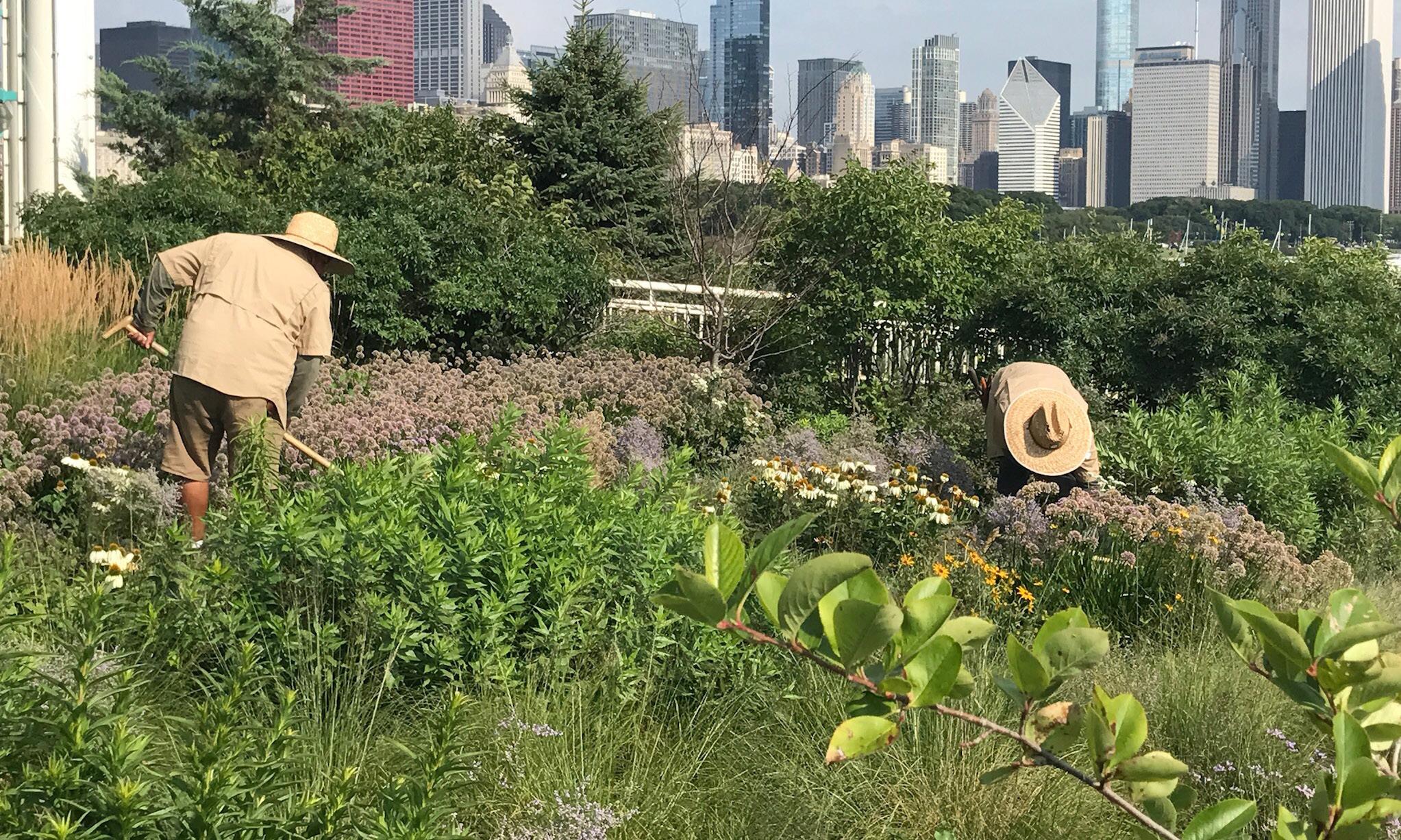
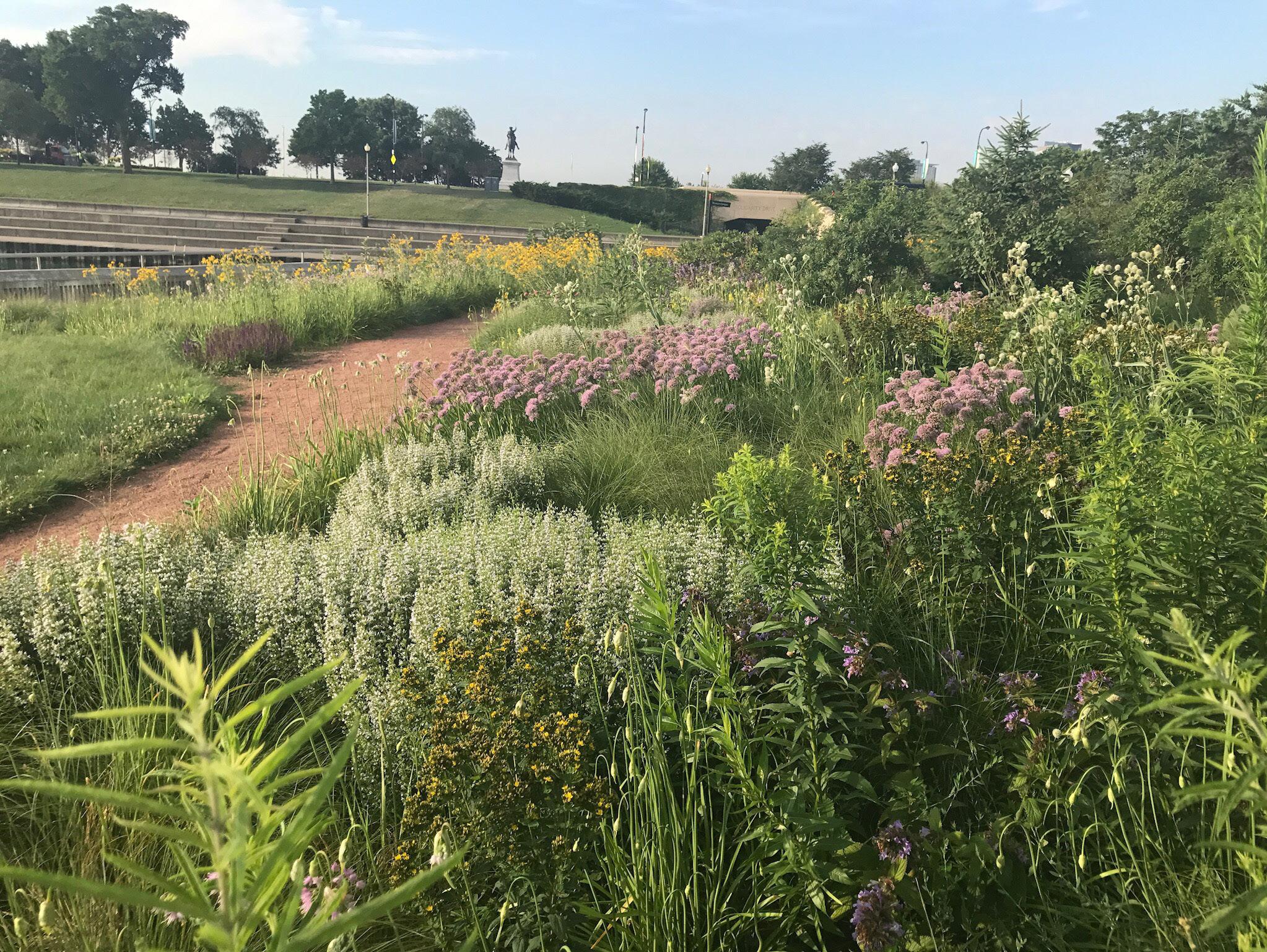
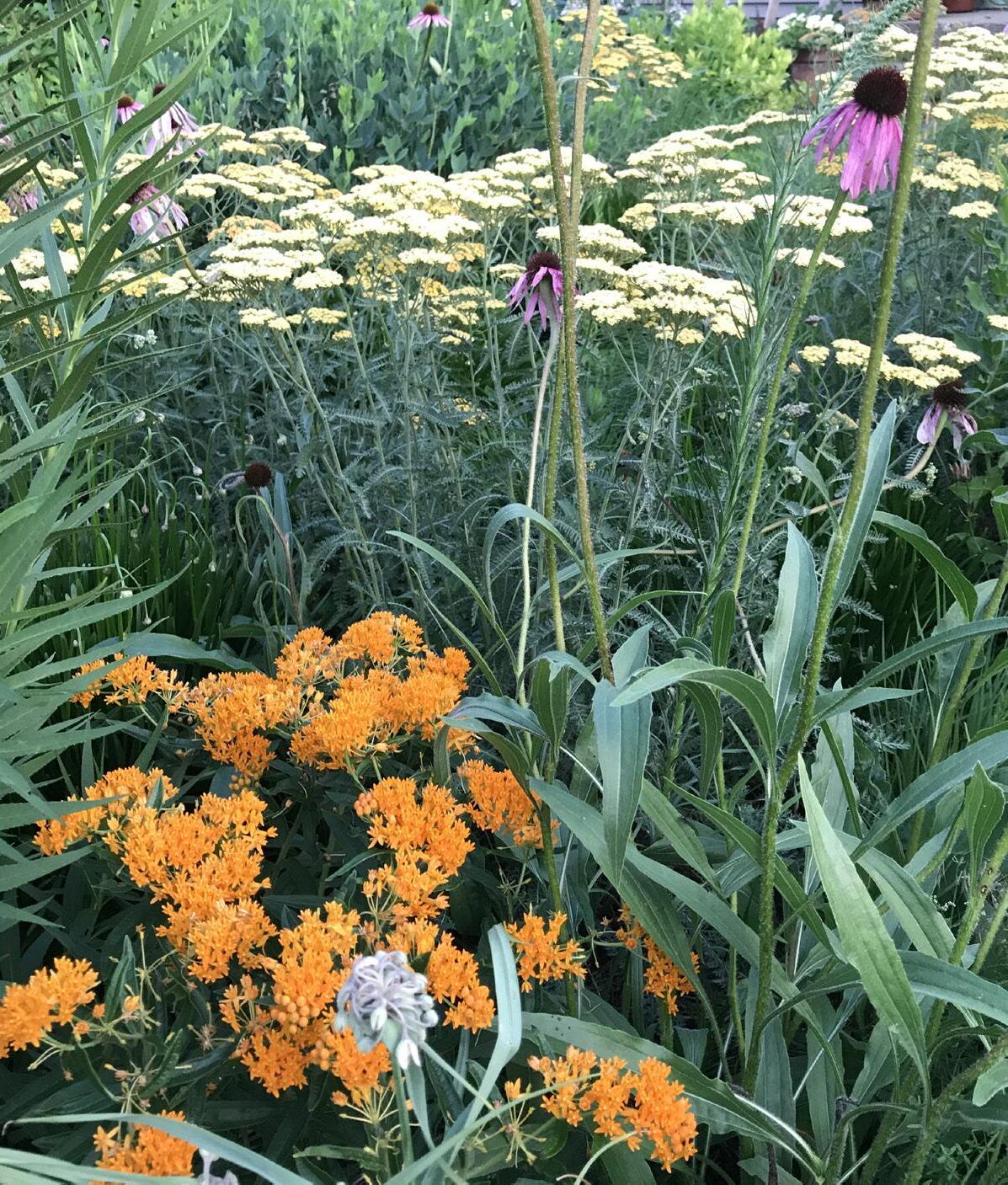
Traditional landscape maintenance practices don’t cut it for today’s new naturalistic, native-plant-focused landscapes, Horticulturist
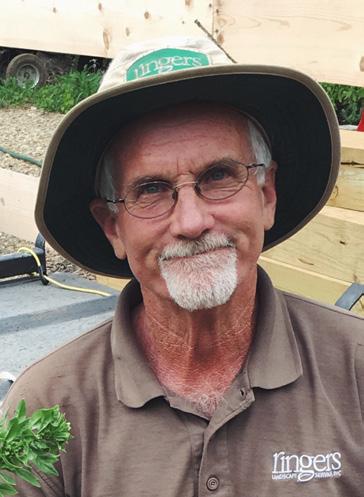
Ken Williams of Ringers Landscaping declared at ILCA’s recent Impact Conference.
“When you’re working with the nature of the plants—not against it--this frees up more time to deal with the weeds,” explains Williams, a selfdescribed “weed assassin”.
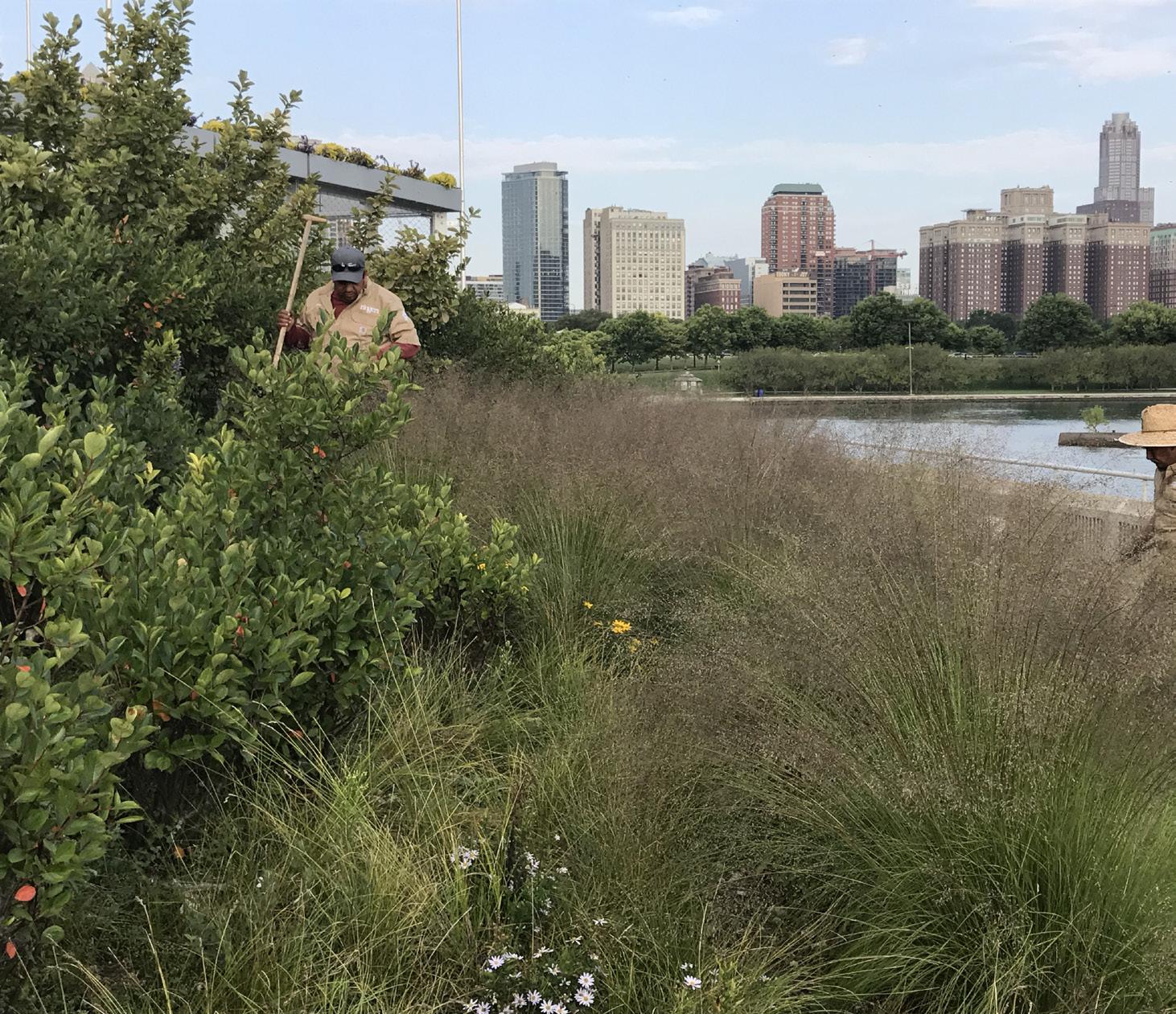
Showing the audience photos of roundabout and road medians where Canada thistle and other weeds were crowding out newly installed native plantings, Williams said, “We’ve got to stop doing this. Maintenance starts the week after the plants are put in the ground—not three years after. That’s resuscitation, not maintenance.”
For more than 20 years, Williams has been developing a system of landscape gardening, which he describes as
maintaining “controlled” naturalistic spaces. The gardens he maintains generally start with plants and plugs not seeds and feature native, native hybrids and “selected non-invasive exotics”, Williams explained.
Once the garden is established, Williams’ job is not over, though. Maintaining a garden never ends, he says. “A garden is a dynamic system,” he explains. “There is no such thing as finished.”
Site prep is key
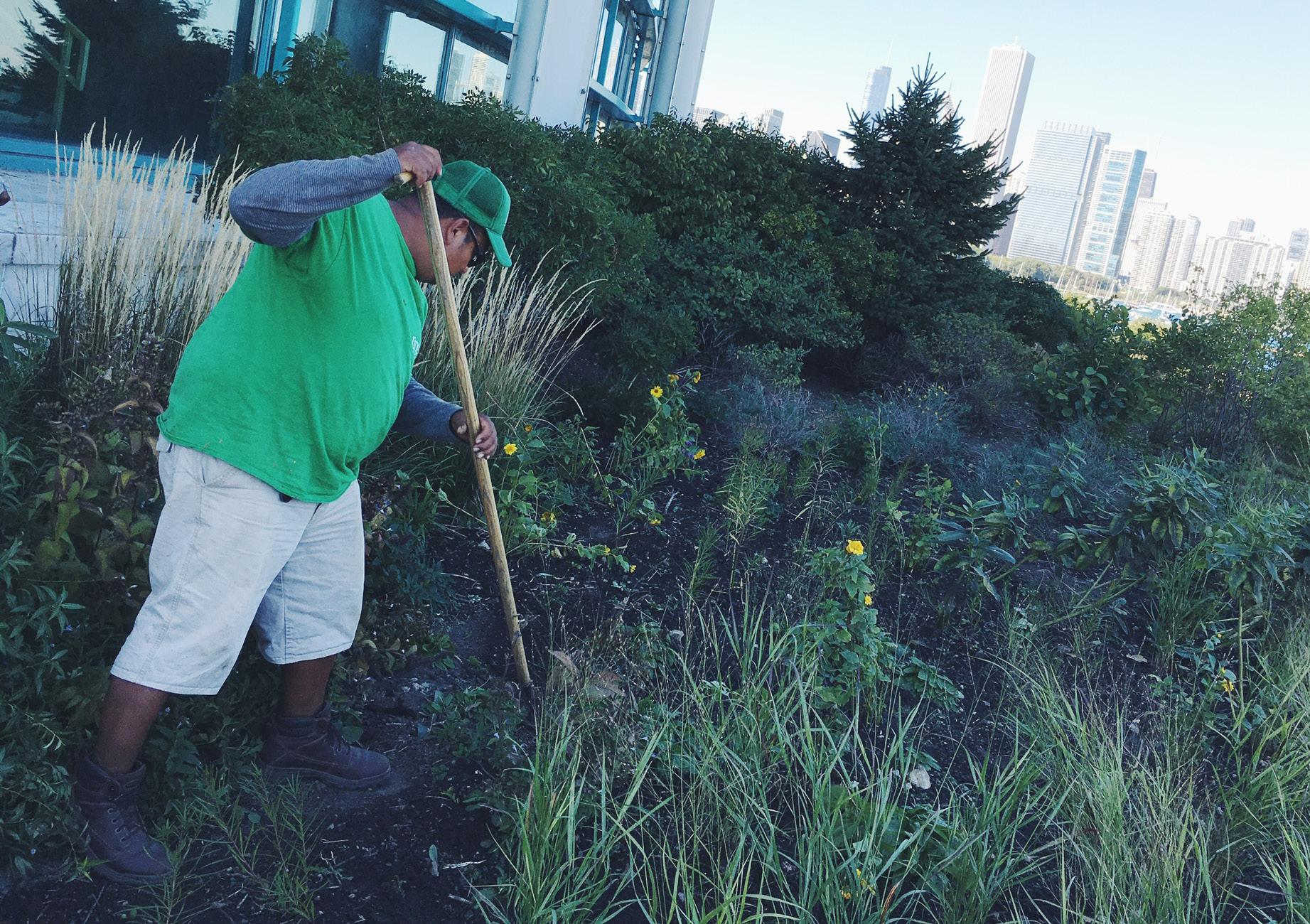
Success with this garden style requires vigilant weed control, especially while the planting establishes and matures enough to out-compete weeds. And weed control starts with good site preparation, according to Williams. “You’ve got to win the war against weeds before you plant,” he says.
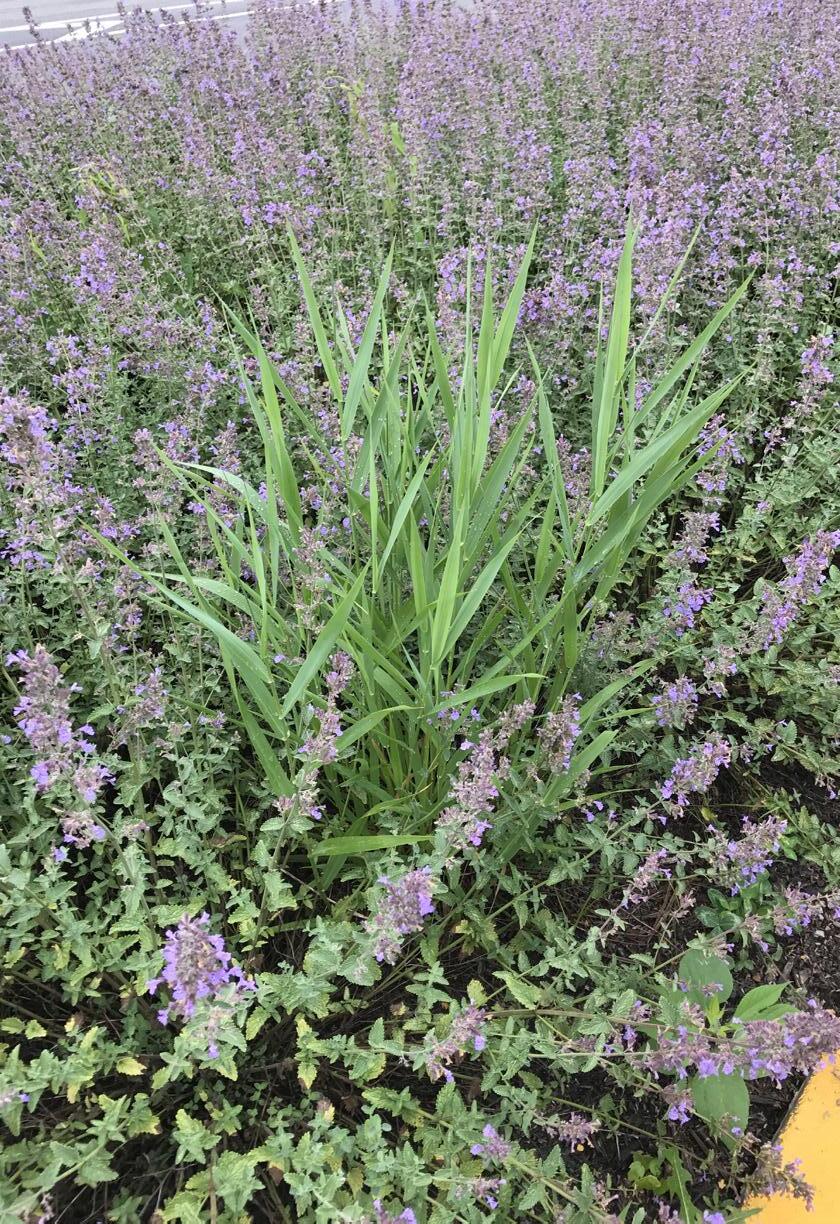
Perennial weeds are especially important targets. “Quackgrass (continued on page 54)
POWER FLEET PROGRAM
Higher Quality & More Productivity
With the latest equipment, your company will be able to work at higher levels of production than your current equipment can provide.
Pay Less for New Equipment
Purchasing new equipment through Russo’s Fleet Program qualifies your company to receive instant fleet rebates that are otherwise unavailable.
Less Maintenance-Related Labor & Parts
Replacing your entire fleet of equipment helps to eliminate frequent breakdowns therefore, reducing the need for constant repair.
Receive Discounts on Everything
Participating in Russo’s Fleet Program saves your company money on all items, every time you shop at Russo’s!
Seasonal Maintenance Tip —
(continued from page 52)
in an established garden is a nightmare,” he notes. “You have to make sure it’s dead before you plant anything.”
Williams discussed several methods for killing weeds before garden installation. Sometimes the method depends on the types of weeds present. It may also depend on the preferences of the contractor and/or the client.
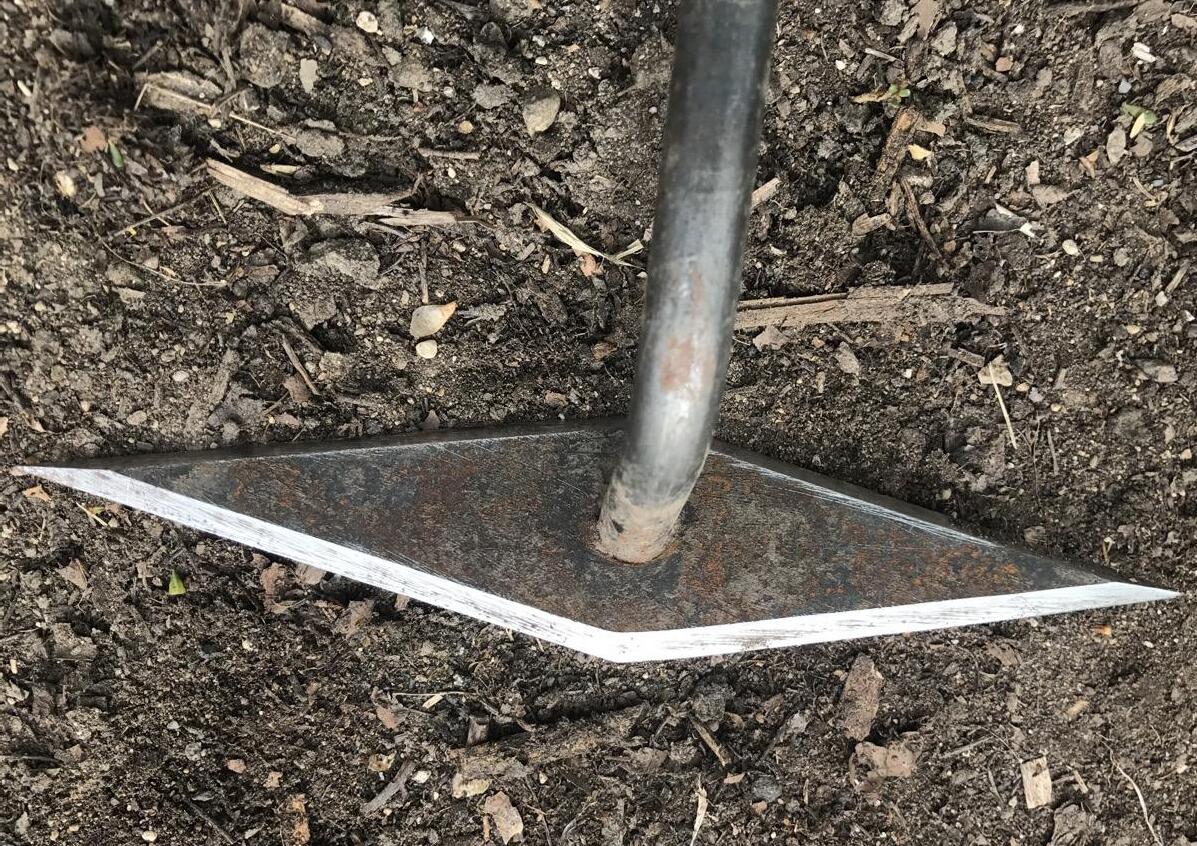
Herbicides such as glyphosate are often an effective way to start, but they don’t eradicate all weeds. “For quackgrass, you have to dig three to four inches below the soil to lift the rhizomes out,” he says. “Glyphosate doesn’t travel far enough through the rhizomes to kill everything.”
Smothering weeds with black plastic is a non-chemical way to kill weeds before planting. “This is good, especially with shallower-rooted weeds,” Williams notes. You can also cultivate and continuously remove weeds that germinate from seed brought to the surface.
Whatever method you choose, you’ll need to monitor the area for persistent perennial weeds before planting. “Site preparation can take an entire season of knocking back persistent perennial weeds,” he notes.
Know how they grow
When it comes to controlling weeds before and after planting, it’s important to not just be able to identify weeds but to know their life cycle, root structure and growth habit, Williams says. “Know thy enemy is a strategy,” he says. “You have to know who they are and what part of the plant you have to remove to stop it.”
For instance, he says creeping Charlie doesn’t have tenacious roots or substantial underground structures. “Just get it off the top of the ground, and you’ve got it,” Williams says.
Goldenrod, on the other hand, has extensive, rhizomatous roots. “Chemicals are a waste of time,” he says (continued on page 56)
Seasonal Maintenance Tip —
(continued from page 54) because chemicals aren’t translocated throughout the extensive root system. Plants like this can be controlled by continuously cutting new growth back to the ground. This weakens the plant by ending its ability to produce food. “It can take a long time to get rid of plants this way,” Williams warns.
In an existing planting, weeds—especially annual weeds—can be controlled by cutting off flowers before seeds can be formed. “With perennial weeds, you can’t let any seed hit the ground,” Williams cautions.
Be vigilant
“Weeding is like housework. If you don’t keep up it’s awful. If you do, it’s easy,” Williams says. “The first year of a planting, you have to maintain relentlessly. In the second year, plants begin
seeding, and they’re really good at forming spectacular combinations.”
Two years ago, Williams took over maintenance of the migratory bird garden at The Shedd Aquarium. The garden was designed by Williams’ wife, Shedd Horticulturist Christine Nye, and Roy Diblik, co-owner of Northwind Perennial Farm.
He said the previous contractors had been more concerned with traditional maintenance practices such as mulching and had neglected weeding. The garden’s original planting was losing the battle with weeds, Williams explained.
“There’s a fundamental problem in our industry. We don’t know how to maintain these naturalized gardens,” Williams says. “The maintenance contractors let the weeds go to seed year after year, including the Canada thistle. It was a weed patch when we took it over.”
“Roy said seeing the garden was like
visiting an old friend in the hospital and seeing a once-healthy person hooked up to tubes everywhere,” Williams recalls.
Getting on top of the weed problem required 21 visits by a 3-person crew in 2016. In 2017, the garden only required 14 visits. “If the garden had had proper maintenance since installation, it would have needed half—or less—of that,” Williams notes.
Arm yourself with the right tools
You don’t need an arsenal of tools to win the war on weeds, Williams says. He uses just three. His favorite is a Dutch push hoe.
“Dutch hoes are awesome,” he says. “One of the few regrets in my life is that I haven’t had one of these for the last 40 years.” Williams likes the Dutch hoes because they cut weeds off just below (continued on page 58)
Seasonal Maintenance Tip —
(continued from page 56)
the soil surface. “The shallower you cultivate, the less new seeds you bring up,” Williams explains. The Dutch hoes can be used to prepare a site for planting as well as for removing weeds from existing plantings, he says.
Williams’ other go-to tools include pruners and a soil knife.
Clean ups
Williams is not a proponent of extensive fall clean ups in a naturalized garden. “My rule of thumb is: ‘If you don’t like looking at it, cut it off,’” Williams says. Otherwise, he leaves plants standing for seasonal interest, crown protection and habitat for butterflies and insects. He may even top dress plantings with shredded leaves. “When the neighbors put leaves out at the curb, I go get them,” he says.
In spring, Williams’ crews use string trimmers to cut back the dried plant material and reduce it to “a shredded mass,” he explains. The shredded materials are left in the garden as mulch for the emerging plants to grow through. He believes this is a more natural way to mulch the garden than wood chips or shredded bark. “I’ve never seen a horticultural reference recommending using wood chips on herbaceous materials,” he said in response to a question from the audience.
Spring or fall, Williams says, in general, “The less you process the material, the better. Often, the less you chop stuff up, the better it is for insects, butterflies and other animals using the garden for cover.”
A new paradigm
someone on a maintenance crew pulled seedlings of prairie dropseed and big bluestem.
“He saw that these plants were going to cause the landscape to change, so he removed them,” Williams explains. “The disturbance he created by pulling those grasses provided an environment for Echinacea to come up everywhere the next year. Today, the garden is pretty when in full bloom, but we will never know what kind of complex beauty might have occurred if natural processes had been shepherded instead of ruled over.”
During the presentation, Williams shared several examples of maintenance crews doing damage to a planting’s design. In one case, crews put mulch on top of Carex pennsylvanica seedlings, mistaking them for weeds. In another,
“You’ve got to keep control of who comes in to work in your gardens,” Williams warned. “Not everyone understands what’s going on in your site.”
Williams called for companies to better train their crews and for the industry to establish training and certification programs. He suggested crews could learn by volunteering with horticulturists at The Lurie Garden in Chicago’s Millennium Park or by working with Williams and his crew at The Shedd Aquarium.
“Even in the most complex garden, you can go back to the basics,” he says. “You know what a weed is. If you see one, kill it. If you’re not sure about a plant, compare it to the plants growing nearby. See if it looks like one of them. If you’re still not sure, watch it grow for a while. Be patient. Keep learning.
“Keeping a garden ‘looking nice’ is not the same thing as maintaining it,” Williams says. “These naturalistic gardens are coming. We need to know how to maintain them.”
Double your color.
DOUBLE PLAY ® Spiraea
We know that spirea are tough, durable plants. So double down on the color to make these landscape workhorses as showy as possible. Double Play® spirea have abundant, vibrant flowers with rich color. Double Play® Red spirea has distinctive burgundy flower buds and carmine-red flowers that will set your landscapes apart from the rest. Color is more than just flowers, too – Double Play® Red also has burgundy new growth and nice fall color, too. Double Play® Pink has more abundant and richly colored blooms than any other pink spirea.
DOUBLE PLAY® Red Spiraea japonica ‘SMNSJMFR’ pp#26,993, cbr#5633
www.provenwinners-shrubs.com
Available from these suppliers
Alsip Home & Nursery St. John • 219-365-0882
Cedar Path Nurseries
Lockport | Barrington www.cedarpath.net
CJ Fiore
Prairie View IL • 847-913-1417
Hinsdale Nurseries
Willowbrook IL • 630-323-1414
Kaknes Landscaping Supply
Naperville IL • 630-416-1002
Lurvey
Des Plaines | Park City | Volo www.lurveys.com
Midwest Groundcovers
St. Charles IL • 847-742-1793
SiteOne
Addison | Naperville www.siteone.com
DOUBLE PLAY® Pink
DOUBLE PLAY® Red
New Member Profile Snapshot
Red Stem Native Landscapes, Inc.
3501 W Jarvis
Skokie, IL 60076
(773) 454-4800
redstemlandscapes.com
by Meta Levin
Five years ago, Monica Buckley decided to leave her career and follow her passion. The result was Red Stem Native Landscapes, Inc. in Chicago. “I’m a native plant enthusiast,” she says.
For years Buckley had been studying native plants and related fields, earning a Master Naturalist certification at Morton Arboretum, as well as taking classes at the Chicago Botanic Garden and the College of DuPage. Much of her knowledge, however, comes from studying on her own, as well as from working with a mentor, who she found through some projects her daughter was doing.
Buckley can trace her own interest in gardening to watching her father tend to his prize Iris plants. “Being around someone who loves flowers and bugs, helped me appreciate nature,” she says.
A former editor for the American Bar Association, she already had provided some landscape design and installation on the side for family and friends, when she decided it was time to take it to the next level and start her own business.
When she announced her imminent departure from the American Bar Association, she was in for a surprise. It turns out that one of her colleagues also had been giving native plants a lot of thought. “I’ll be your first customer,” she said. Not only was she Buckley’s first paying customer, but she continues to be a client.
In the early years, Buckley had a crew of two. She only had enough work to keep them busy a couple of days a week, so she “spent the first year finding other work for them so they wouldn’t leave me,” she says. Landscape contractors who needed one or two laborers for a day or so were happy to get them.
Now, however, Buckley employs five people full time, and more on a part time, as needed basis. She has worked hard to train them to install and maintain the native plants.
“Native plant landscaping is different,” she says. Workers must recognize which plants to trim during different times of the year and how to do it properly. Designers must understand
which plants work well in different climates. The Chicago area is comprised of a whole range of environments, from wetlands to woodlands to sandy beaches and prairies. When planning a garden, it is necessary to use the right suite of plants for each one.
This includes designing a garden so that there is something blooming all year round. “From decades of loving these plants, I have learned to do that in a way that is artful,” she says.
While Buckley still does the bulk of the landscape design, she is training another employee to do some, as well. Her company provides both design/build and maintenance. A few customers choose to do their own maintenance, but given the vagaries of native gardens, Buckley usually finds that they do better when Red Stem maintains them.
In fact, Red Stem Native Landscapes, Inc. is growing so fast that she is working toward finding qualified people to help in other areas of the business. “I want to ensure that my clients continue to have good customer service, from people who are knowledgeable and responsive,” she says.
Her clients represent a list of local concerns, including and especially water. “We see a lot of trouble with water; a lot of flooding and downspout water,” she says. This is just one kind of what Buckley calls “climate chaos” or more weather extremes, including droughts, in our future.
Native plants, Buckley says, are more adaptable, allowing them to adjust to changes in the weather and amount of rain.
A former MELA member, Buckley was attracted to ILCA by its good programs and networking opportunities. She finds iLandscape fun to attend and its business advice educational offerings valuable. As someone who values ecology, she was pleased that the 2018 iLandscape featured badges without plastic.
Buckley has passed her love of gardening and native plants to her three daughters. The eldest works in the Little Village neighborhood of Chicago, where she has built six community gardens. “Urban gardening is her passion,” she says. Her youngest daughter bought a house where she is installing a native garden.