your HEALTH body / mind / fitness
February 24, 2022
You are what you eat
in lowering cholesterol levels. Their protein has been shown to reduce triglyceride levels. And they also make a delicious snack when boiled.
Enjoy a handful of plain walnuts or almonds, or chop some up and sprinkle them on salads.
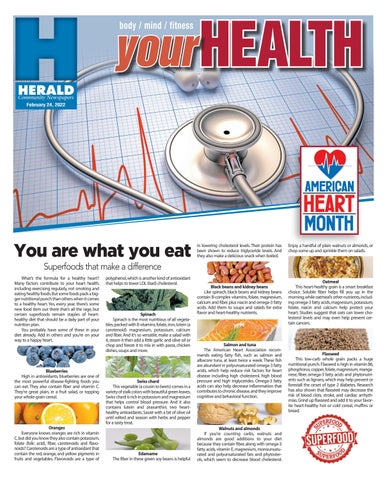
Superfoods that make a difference What’s the formula for a healthy heart? Many factors contribute to your heart health, including exercising regularly, not smoking and eating healthy foods. But some foods pack a bigger nutritional punch than others when it comes to a healthy heart. Yes, every year, there’s some new food item out there that’s all the rage, but certain superfoods remain staples of hearthealthy diet that should be a daily part of your nutrition plan. You probably have some of these in your diet already. Add in others and you’re on your way to a happy heart.
Blueberries High in antioxidants, blueberries are one of the most powerful disease-fighting foods you can eat. They also contain fiber and vitamin C. They’re great plain, in a fruit salad, or topping your whole-grain cereal.
Oranges Everyone knows oranges are rich in vitamin C, but did you know they also contain potassium, folate (folic acid), fiber, carotenoids and flavonoids? Carotenoids are a type of antioxidant that contain the red, orange, and yellow pigments in fruits and vegetables. Flavonoids are a type of
polyphenol, which is another kind of antioxidant that helps to lower LDL (bad) cholesterol.
Spinach Spinach is the most nutritious of all vegetables, packed with B vitamins, folate, iron, lutein (a carotenoid) magnesium, potassium, calcium and fiber. And it’s so versatile; make a salad with it, steam it then add a little garlic and olive oil or chop and freeze it to mix in with pasta, chicken dishes, soups and more.
Swiss chard This vegetable (a cousin to beets) comes in a variety of stalk colors with beautiful green leaves. Swiss chard is rich in potassium and magnesium that helps control blood pressure. And it also contains lutein and zeaxanthin, two hearthealthy antioxidants. Sauté with a bit of olive oil until wilted and season with herbs and pepper for a tasty treat.
Edamame The fiber in these green soy beans is helpful
Black beans and kidney beans Like spinach, black beans and kidney beans contain B-complex vitamins, folate, magnesium, calcium and fiber, plus niacin and omega-3 fatty acids. Add them to soups and salads for extra flavor and heart-healthy nutrients.
Salmon and tuna The American Heart Association recommends eating fatty fish, such as salmon and albacore tuna, at least twice a week. These fish are abundant in polyunsaturated omega-3 fatty acids, which help reduce risk factors for heart disease including high cholesterol, high blood pressure and high triglycerides. Omega-3 fatty acids can also help decrease inflammation that contributes to chronic disease, and they improve cognitive and behavioral function.
Walnuts and almonds If you’re counting carbs, walnuts and almonds are good additions to your diet because they contain fiber, along with omega-3 fatty acids, vitamin E, magnesium, monounsaturated and polyunsaturated fats and phytosterols, which seem to decrease blood cholesterol.
Oatmeal This heart-healthy grain is a smart breakfast choice. Soluble fiber helps fill you up in the morning, while oatmeal’s other nutrients, including omega-3 fatty acids, magnesium, potassium, folate, niacin and calcium help protect your heart. Studies suggest that oats can lower cholesterol levels and may even help prevent certain cancers.
Flaxseed This low-carb whole grain packs a huge nutritional punch. Flaxseed is high in vitamin B6, phosphorus, copper, folate, magnesium, manganese, fiber, omega-3 fatty acids and phytonutrients such as lignans, which may help prevent or forestall the onset of type 2 diabetes. Research has also shown that flaxseed may decrease the risk of blood clots, stroke, and cardiac arrhythmias. Grind up flaxseed and add it to your favorite heart-healthy hot or cold cereal, muffins or bread.
WITH MORE ST. FRANCIS HEART CENTER LOCATIONS FROM THE SOUTH SHORE TO THE NORTH SHORE,
YOUR HEART IS ALWAYS IN THE RIGHT PLACE
The most awarded heart care is now available to more people throughout Long Island. For over a half century, we’ve been a national leader in cardiac medicine. And now our unmatched heart care and patient experience is available at more Catholic Health practicesand hospitals, including Good Samaritan Hospital in West Islip, Mercy Hospital in Rockville Centre, St. Catherine of Siena Hospital in Smithtown, and soon, St. Joseph Hospital in Bethpage. For a location near you, visit chsli.org/heart
1163966
February 24, 2022 — Your Health - Heart Health - HERALD COMMUNITY NEWSPAPERS
S-2
S-3
Take it to heart
F
Show your ticker some love
ebruary is about far more than conversation hearts and romantic rendezvouses: the month of love also marks American Heart Month, which calls major attention to heart health. And for good reason: as the fifth largest and most important organ in your body, your heart beats a hundred thousand times a day, pumping blood to all of your organs and enabling you to perform everything from driving a car to performing downward facing dog. In other words, when your heart is in jeopardy —of the physical sort, mind you — so is your life. Indeed, heart disease is the number one killer in both men and women, rendering it a greater hazard than breast and prostate cancer. According to the Centers for Disease Control and Prevention (CDC), about 659,000 people in the United States die from heart disease each year — that’s one in every four deaths. As well, people with poor cardiovascular health are at increased risk of complications and severe illness from Covid-19. During severe Covid infection, heart function may decrease, explains cardiologist Charles C. Nydegger, MD. Heart changes in people who have recovered from the virus include irregular heart rate, inflammation of the heart muscle or the sac around the heart, elevated heart rate, and abnormal heart rhythms. Although it can’t be predicted which Covid patients will experience these changes, those with healthy cardiovascular systems are less likely to have severe symptoms. Most middle-aged and even young adults have one or more risk factors for heart disease, such as diabetes, high blood pressure, high cholesterol, or being a smoker or overweight. Having multiple risk factors increases your risk for heart disease. Connecting Is Good For Your Heart Feeling connected with others and having positive, close relationships benefit our overall health, including our blood pressure and weight. Having people in our lives who motivate and care for us helps, as do feelings of closeness and companionship. We all know the basics of a heart-healthy lifestyle, but do we keep to that beat? √ Be more physically active. √ Maintain a healthy weight. √ Eat a nutritious diet. √ If you’re a smoker, quit. √ Reduce stress. √ Get seven to eight hours of quality sleep. √ Track your heart health stats. You don’t have to make big changes all at once. Small steps will get you where you want to go. Move More Invite family, friends, colleagues, or members of your community to join you in your efforts to be more physically active. Ask a colleague to walk “with you” on a regular basis, put the date on both your calendars, and text or call to make sure you both get out for a walk. Get a friend or family member to sign up for the same online exercise class, such as a dance class. Make it a regular date! And make sure to get the family involved. Grab your kids, put on music, and do jumping jacks, skip rope, or dance
in your living room or yard. How much is enough? Aim for at least two and a half hours of physical activity each week — that’s just 30 minutes a day, five days a week. In addition, do muscle strengthening exercises two days a week. Can’t carve out a lot of time in your day? Don’t chuck your goal, chunk it! Try 10 or 15 minutes a few times a day. Aim For A Healthy Weight And Eat Heart-Healthy Find someone in your friend group, at work, or in your family who also wants to reach or maintain a healthy weight. (If you’re overweight, even a small weight loss of five to 10 percent helps your health.) Check in with them regularly to stay motivated. Agree to do healthy activities, like walking or cooking a healthy meal, at the same time, even if you can’t be together. Share low-calorie, low-sodium recipes. Quit Smoking Still can’t beat the habit? To help you quit, ask others for support or join an online support group. Research shows that people are much more likely to quit if their spouse, friend, or sibling does. Social support online can help you quit. You’ll find many free resources to help you quit, such as apps, a motivational text service, and a chat line at BeTobaccoFree. hhs.gov and Smokefree.gov. If you need extra motivation to quit, consider those around you: Breathing other people’s smoke, called secondhand smoke, is dangerous. Many adult nonsmokers die of stroke, heart disease, and lung cancer caused by secondhand smoke. Manage Stress Reducing stress helps your heart health. And since the onset of the pandemic, stress is more prevalent in our lives than ever. Get it under control — now. Set goals with a friend or family member to do a relaxing activity every day, like walking, yoga, or meditation, or participate in an online stressmanagement program together. Physical activity also helps reduce stress. And if stress, is really overtaking your life, talk to a qualified mental health provider or someone else you trust. Improve Your Sleep Good sleep is a must. De-stressing will help you sleep, as does getting a 30-minute daily dose of sunlight. Take a walk instead of a late afternoon nap! Family members and friends: remind each other to turn off the screen and stick to a regular bedtime. Instead of looking at your phone or the TV before bed, which we’re all doing so much more of throughout the pandemic, relax by listening to music, reading, or taking a bath. Track Your Heart Health Stats, Together Keeping a log of your blood pressure, weight goals, physical activity, and if you have diabetes, your blood sugars, will help you stay on a heart-healthy track. Ask your friends or family to join you in the effort. Check out the National Heart Lung and Blood Institute’s Healthy Blood Pressure for Healthy Hearts: Tracking Your Numbers worksheet at www.nhlbi.nih.gov. Above photo: Your heart works nonstop for you throughout your life. It needs plenty of TLC to be at its best.
It’s sleep We all know by now that getting enough shut-eye each night is essential for your health and well-being. Quality sleep does everything from boost productivity and concentration to strengthen your immune system to prevent depression. Sleep is also, it turns out, vitally important for your heart. Why lack of sleep matters “Lack of sleep doesn’t necessarily cause heart disease,” says Phyllis Zee, MD, PhD, professor of neurology and director of the Sleep Disorders Program at Northwestern University’s Feinberg School of Medicine. But, she notes, “it really increases the risk factors for heart disease.” For example, your blood pressure goes down while you sleep — but when you don’t get enough sleep, or you have irregular sleep patterns, it stays higher for longer. High blood pressure, or hypertension, is one of the leading causes of heart attack and stroke. Sleep has also been found to affect levels of hemoglobin A1c, a key marker of blood sugar control. The CDC cites research suggesting that optimizing sleep duration and quality may be important means of preventing type 2 diabetes (which raises your risk of heart disease) and, for those with the chronic illness, improving blood sugar control. A European Heart Journal review of 15 studies involving nearly 475,000 people found that “short sleepers” (five to six hours per night) had a 48 percent greater risk of developing or dying from coronary artery disease and a 15 percent greater risk of developing or dying from stroke during a seven- to 25-year follow-up period. Fix Irregular Sleep Patterns Too little sleep isn’t the only thing that can increase your risk of heart disease. Not keeping a regular sleep time can also throw your heart out of whack. A 2019 study from the American Heart Association examined subjects’ nightly sleep duration and how long it took them to fall asleep. The researchers looked at data from nearly 2,000 people without cardiovascular disease at the start of the
study. Participants wore sleepmonitoring wrist devices for seven-day periods from 2010 to 2013. It turned out those with irregular sleep patterns also were at higher risk for a cardiovascular event such as stroke, congestive heart failure, and coronary heart disease. People whose night-to-night sleep length varied over a seven-day period by more than an average of two hours were more than twice as likely to have a cardiovascular event than those who varied by an hour or less. Research suggests young people are at particular risk for irregular sleep-related heart problems. A 2019 study out of MassGeneral Hospital for Children found that adolescents who didn’t sleep well were at greater risk for developing cardiovascular problems. They had higher cholesterol levels, a higher body mass index, larger waist sizes, higher blood pressure, and an increased risk of hypertension. Recognizing a sleep problem According to Harvard Medical School, anywhere from 47 to 83 percent of people with cardiovascular disease, 35 percent of people with high blood pressure, and 12 to 53 percent of people with heart failure, atrial fibrillation (a heart rhythm abnormality), and stroke also have sleep apnea. People with sleep apnea are constantly awakened during the night as they repeatedly gasp for air, which leads to poor sleep quality and thus an increased risk of heart problems. Harvard Medical School notes that untreated sleep apnea may up your chances of dying from heart disease by up to five times. Do you wake up tired and with a dry mouth? Feel sleepy or fatigued by day? These are signs of sleep apnea. Other sleep apnea symptoms include snoring, seeming to stop breathing during sleep, and gasping for breath or choking — which many people don’t realize they do, so it’s important to ask your bedmate. Above photo: Do yourself — especially your heart — a favor. Get more sleep.
February 24, 2022 — Your Health - Heart Health - HERALD COMMUNITY NEWSPAPERS
A secret to cardiovascular health:
Cool it on the salt Fresh herbs can reduce your reliance on sodium
Salt has long been used to add flavor to our favorite foods. In fact, the use of salt as a means to preserving foods and adding flavor to recipes dates back to ancient times and has led to countless conflicts ever since. Way back when wars over access to salt reserves in China are believed to have been fought as early as 6,000 B.C. Though that shows just how valuable salt has been throughout much of human history, it doesn’t indicate the negative effects that can result from diets that feature excessive amounts of sodium. Sodium plays an essential role in the human body by regulating the kidneys and helping to control the body’s fluid balance. Sodium also helps send nerve impulses and affects muscle function. However, excessive amounts of sodium can compromise heart health. The American Heart Association (AHA) notes that excessive amounts of sodium in the bloodstream pulls water into the blood vessels, increasing the total volume of blood within them. As more blood flows through blood vessels, blood pressure increases. Over time, that can adversely affect blood vessels and speed up the build-up of plaque that can block blood flow. Higher blood pressure forces the heart to work harder and increases a person’s risk for heart disease. So what about sodium, a mineral so valued, and indeed vital to human existence, that it’s led to wars and created countless devotees in kitchens over the centuries? Flavor, of course.
And that’s where herbs are great alternative. They’ll give plenty of flavor so that you can reduce your reliance on sodium. Experiment with adding more fresh herbs to your diet. You’ll do your heart a favor and introduce a host of new flavors to your meals. Basil: Basil has a sweet and fresh flavor profile and is best added to a dish right before serving. Freshly cut basil leaves can be added to any number of dishes, including tomato sauces, pastas, salads, pizzas, and eggs. Cilantro: Cilantro are the delicate leaves and stems of the coriander plant. Like basil, cilantro should be added to a dish right before serving and should not be cooked. Cilantro can be paired with beans, tomatoes, corn, and avocados among other foods, and is widely used when preparing Mexican foods at home. Oregano: Greek dishes often combine oregano, mint and lemon to create a memorable, delicious flavor profile. If chopping fresh oregano, strip the leaves from the stem and then discard the stem. Parsley: Parsley isn’t just a garnish used to add aesthetic appeal to plates. Flat-leaf parsley provides a light and fresh flavor, while the AHA notes that curly parsley offers a slightly peppery profile. Parsley is typically added to a dish during the final minutes of cooking or right before serving, and can be paired with chicken, fish, potatoes, and pasta among countless other foods. Above photo: Herbs give meals a flavorful punch and can help minimize the use of salt.
Restore Your Hearing
at I Love Hearing At I Love Hearing, we use a special MEET OUR TEAM process to ensure that our clients receive the ideal hearing loss solutions for their needs. Dr. Amy Sapodin,
3 Hearing aid fitting 3 Hearing aid repair 3 Hearing testing
3 Hearing protection
3 Tinnitus therapy
3 Ear wax management
Au.D., F-AAA, CCC-A
3 Auditory therapy & rehabilitation Dr. Alison Hoffmann, Au.D., F-AAA, CCC-A
1163704
February 24, 2022 — Your Health - Heart Health - HERALD COMMUNITY NEWSPAPERS
S-4
(516) 788-7830 ilovehearing.com 30 Merrick Avenue North, Suite 109, East Meadow, New York 11554
Seth Dank,
Clinical Audiologist, M.A., F.A.A.A 1160171
S-5
February 24, 2022 — Your Health - Heart Health - HERALD COMMUNITY NEWSPAPERS
Mount Sinai's quality care, right here in Oceanside. When Claudia, 63, experienced unusual spasms that radiated from her collarbone to her back and sometimes jarred her from sleep, she thought she had pulled a muscle. Tests at Mount Sinai South Nassau in Oceanside revealed that one of Claudia’s main coronary arteries was 99 percent blocked. Through a minimally invasive procedure, Dr. Freeman, our Director of Interventional Cardiology, was able to restore blood flow to the heart by propping the artery open with a tiny mesh tube, called a stent. Today, Claudia is pain-free and looking forward to a long retirement. Learn more about why her son’s recommendation to see Dr. Freeman saved her life in this edition of Good Health.
1163798
At Mount Sinai South Nassau in Oceanside, we offer the only cardiac service on Long Island affiliated with the world-renowned Mount Sinai Heart program. Because results matter.
February 24, 2022 — Your Health - Heart Health - HERALD COMMUNITY NEWSPAPERS
S-6
HEALTH MEMOS
HEALTH MEMO
What You Should Know About Trigeminal Neuralgia (TN) and Dentists
P
region of the procedure; (3) the pain is predominantly dull or achy in nature, and (4) there may be numbness in the affected area. Such nerve injury pain usually improves with time. To request a consultation with Dr. Michael Brisman, call (516) 255-9031 or visit nspc.com.
eople routinely visit their dentist for evaluation of suspected dental disease. Trigeminal neuralgia (TN), a facial nerve compression syndrome, frequently causes pain in the mouth and teeth. “As such,” according to neurosurgeon Michael H. Brisman, M.D., NSPC Brain & Spine Surgery, “there are commonly overlapping concerns between the TN patient and the dentist.” How is TN similar to other dental problems? TN can cause pain anywhere in the face, from the top of the head to the bottom of the jaw. TN most often causes pain in the cheek and jaw areas, including the gums and teeth. How is TN different from other dental problems? The critical difference in symptoms is that TN patients will experience attacks of pains that are sudden, brief, sharp, and excruciating, usually described as either “electric shocks” or “stabbing.” These pains usually radiate to include a much larger area than just one tooth.
Dr. Michael Brisman
Is TN frequently confused with dental disease? Yes. TN patients often experience severe pain in their teeth and gums, which frequently leads them to visit a dentist. Dentists may suspect a dental cause for the pain and offer various procedures to try to help.
Can TN be caused by problems with the teeth or gums, or by dental procedures? No. TN is usually caused by a small blood vessel compressing the trigeminal nerve at the root entry zone, an area where the nerve enters the brain.
About Neurological Surgery, P.C. (NSPC) Founded in Freeport in 1958, NSPC Brain & Spine Surgery (NSPC) has grown to become one of the largest, independent neurosurgical groups in the U.S. with seven conveniently located offices on Long Island. The practice’s 22 experienced neurosurgeons are experts in “bloodless” spine and brain surgery, including endoscopic spine surgery, laser spine surgery, ultrasonic spine surgery, radiosurgery, endoscopic brain surgery, and other advanced, minimally invasive techniques which are used to treat herniated disc, spinal stenosis, chronic back pain, brain tumors, brain aneurysms, trigeminal neuralgia, and other conditions. Visit www.nspc.com for more information.
Can dental work cause nerve pain syndromes? Yes, but very rarely. Signs that suggest a procedure may have caused a nerve pain syndrome include: (1) the pain syndrome occurs soon after the procedure; (2) the nerve affected was in the
100 Merrick Road, Suite 128W, Rockville Centre, NY 11570 • 844-NSPC-DOC Health memos are supplied by advertisers and are not written by the Herald editorial staff.
HEALTH MEMO
Mount Sinai South Nassau is the only hospital-based Long Island location of internationally acclaimed Mount Sinai Heart
W
pictures could look very different hen Claudia, 63, if it weren’t for Dr. Freeman,” she experienced spasms said. that radiated from Dr. Freeman, along with his her collarbone to her back and colleague Lawrence Kanner, MD, sometimes jarred her from sleep, Chief, Cardiology, leads a team of she thought she had pulled a cardiac care staff and muscle. cardiovascular specialists at The pain persisted and Mount Sinai South Nassau, the increased in frequency and only Long Island location of intensity. “I have a high pain Mount Sinai Heart, internationally tolerance, but this pain got to acclaimed for its cardiac care. me,” said Claudia. Dr.Jason Freeman, MD, Director Mount Sinai South Nassau is Her son, worried that she of Interventional Cardiology designated a “High Performing” might have a heart problem, hospital for Heart Failure and Heart Attack by U.S. urged her to get a second opinion from Jason News & World Report. Freeman, MD, Director of Interventional Cardiology at Mount Sinai South Nassau. An EKG, Mount Sinai South Nassau provides patients ultrasound test of the heart, nuclear stress test, access to a network of board certified and angiogram revealed a 99 percent blockage of cardiologists and cardiac surgeons who use the her left anterior descending artery, which can latest advancements in cardiac care to treat the trigger life-threatening sudden and massive heart range of cardiovascular conditions, from coronary attacks. Dr. Freeman quickly placed a stent to artery disease to atrial fibrillation. This includes: prop open the artery and normal blood flow was • Rotational atherectomy, a revolving diamondtipped instrument that spins at a high speed to restored to her heart. effectively break up complex calcified plaque in Today, Claudia is pain-free and looking forward a clogged coronary artery, restoring blood flow to retirement and enjoying her family. Her son, to the heart; Jeremy, was recently married. “His wedding
• The world’s smallest temporary assist heart pump for patients with severe coronary artery disease and diminished heart function who are undergoing an emergent coronary intervention, such as stenting to unblock a clogged artery that is causing a heart attack; • A small implantable receiver placed in the pulmonary artery for patients with congestive heart failure that transmits vital data of the heart’s function back to the cardiologist that can be used to adjust the prescribed treatment plan, without a visit to the hospital; and • Cardiac MRI, a 3D imaging technology that helps cardiologists pinpoint exactly where the heart is not pumping well and diagnose what is causing the problem. The information produced by the cardiac MRI results in treatment plans tailored uniquely for each patient. If more advanced treatment is needed—such as a heart transplant—Mount Sinai South Nassau patients can be seamlessly treated at The Mount Sinai Hospital in Manhattan. Mount Sinai South Nassau is among the nation’s leaders in providing emergency coronary interventions to treat acute heart attack. Its doorto-balloon-time is approximately 56 minutes – 34
minutes faster than the national standard benchmark of 90 minutes – which leads to better patient outcomes. (Door-to-balloon time is the time measured in minutes from the moment the patient walks in the door to the point the artery in the heart is reopened with a stent procedure.) Designated a 4-star achiever by the American College of Cardiology, Mount Sinai South Nassau is accredited by the Intersocietal Commission for Accreditation of Echocardiography Laboratories; is designated an Aetna Institute of Quality for interventional cardiology and rhythm disease diagnosis and treatment; and has The Joint Commission’s Gold Seal of Approval® for its heart failure program. In an emergency call 9-1-1. If you, a loved one, or a friend need a cardiac care consultation, look no further than Mount Sinai South Nassau in Oceanside. For more information or to schedule an appointment, call 1-877-SOUTH-NASSAU.
One Healthy Way Oceanside, NY 11572 • 877-SOUTH-NASSAU (877-768-8462) • www.mountsinai.org/southnassau Health memos are supplied by advertisers and are not written by the Herald editorial staff.
HEALTH HEALTHMEMOS MEMO
S-7
Y
St. Francis Heart Center now available at multiple locations
Groundbreaking technology, therapy and research
ear after year, Catholic Health’s flagship, St. Francis Hospital & Heart Center®, is recognized as a national leader in Cardiology & Heart Surgery by U.S. News & World Report. Now, St. Francis Heart Center’s groundbreaking treatments and superior standards of care are available at multiple Catholic Health locations across Long Island:
“It’s one thing to be the best at today’s cardiovascular procedures — it’s another to be in the lead on what’s coming tomorrow,” said Dr. Shlofmitz. “At St. Francis Heart Center, we are bringing tomorrow’s solutions to Long Islanders today. St. Francis isn’t simply participating in clinical trials—we are leading a good many, both in terms of science and enrollment.”
• Good Samaritan Hospital in West Islip • Mercy Hospital in Rockville Centre • St. Catherine of Siena Hospital in Smithtown • St. Joseph Hospital in Bethpage (coming soon)
St. Francis Heart Center is leading clinical research trials to study enhanced methods of:
Wherever you live on Long Island, you have easy access to the highest quality and most advanced cardiac diagnostics, treatments and therapeutic interventions. All driven by Catholic Health’s signature devotion to compassionate care, always provided with comforting confidence. “Catholic Health approaches patient care in a unique manner,” said its President & CEO Patrick O’Shaughnessy, DO, MBA. “We place our patients and their families at the center of all we do, delivering quality care with compassion.” Under the leadership of Catholic Health’s Chairman of Cardiovascular Services Richard Shlofmitz, MD, St. Francis Heart Center’s physicians are best in class in every cardiology sub-specialty:
Cardiologists have a saying: “Once a cardiac event occurs, time is heart muscle,” said Catholic Health’s Chairman of Cardiovascular Services Richard Shlofmitz, MD. “By placing the highly recognized cardiovascular services of St. Francis Heart Center at multiple locations across Long Island, we can deliver exceptional cardiac treatment where and when it’s needed, improving outcomes and saving lives.”
• Interventional Cardiology – Minimally-invasive remediation of blocked arteries • Electrophysiology – Pioneers in the treatment of irregular heartbeats • Open Heart Surgery – Among the largest caseloads in New York State with consistently high success rates for the past 30 years • Congestive Heart Failure – State-of-the-art disease management to reduce the frequency and duration of hospital visits
• Structural Heart Repair – Leaders in minimally invasive valve replacement, such as TAVR • Diagnostic Cardiology – Experts in the use of sophisticated intravascular imaging to pinpoint the source of cardiac issues St. Francis Heart Center uses leading-edge technology, diagnostic imaging and restorative techniques to treat patients coping with all forms of heart disease. “We’re leading the way in more and more non-invasive approaches to unblock arteries and replace failing heart valves,” said St. Francis Hospital & Heart Center President Charles Lucore, MD. “That’s adding years to the lives of so many Long Islanders.”
• Placing intracoronary stents with greater precision • Clearing blocked arteries with the support of 3-D intravascular imaging • Correcting leaky heart valves with minimally invasive techniques • Improving recovery times for open heart coronary bypass surgery Dr. Shlofmitz was also the principal investigator for ultrasound sonic pressure therapy to unblock arteries, which resulted in FDA approval. And St. Francis Heart Center is a world leader in calcium ablation for complex angioplasty. With unmatched cardiac care now available across Long Island, your heart is always in the right place. For more information, visit chsli.org/heart, or to schedule an appointment call (866) MY-LI-DOC.
Health memos are supplied by advertisers and are not written by the Herald editorial staff.
HEALTH MEMO What if I have “total hearing loss” in one of my ears? (And what is a CROS System?)
s a general rule of thumb, hearing ability in the two ears should be near equal to each other. After all, your ears are the same age. If you have a history of noise exposure it was likely the same in both ears, and if you were prescribed a medicine with a side effect that could impact hearing, it would impact both ears similarly. But, in some patients, hearing in one ear will diverge from the other. This can result from a host of otologic issues, including viral infection of the ear, physical trauma to the ear, and of unknown origin (medically diagnosed as “idiopathic hearing loss.” The separation of hearing levels between the two ears can sometimes be dramatic or even complete. Unfortunately, some patients have a “dead ear” (medically defined as anacusis) with normal hearing in the other ear. In other patients, there is an “asymmetric hearing loss” which implies hearing loss in one ear and even worse hearing in the other ear. The brain was designed to hear with two ears, and it will function best with equal hearing in both ears. Binaural (two-ear) hearing has significant benefits that include increased sound localization ability (e.g. figuring out where sound is coming from in the room) and enhanced perception of speech in noisy situations. These characteristics of binaural hearing are often referred to as the “Binaural Advantage.” Someone with “lopsided” hearing loss will always strategize to improve the listening environment by having the speaker(s) on the better hearing side.
While the course of treatment for individuals with significantly poorer hearing in one ear is different than the patient with symmetrical hearing loss, NeuroTechnology™ can be used to significantly enhance hearing and understanding in all listening situations.
(516) 788-7830 ilovehearing.com
Health memos are supplied by advertisers and are not written by the Herald editorial staff.
North Shore Animal League America has a wide variety of dogs, cats, puppies and kittens to choose from. That special pet is waiting just for you!
OPEN DAILY FOR ADOPTIONS: 10 AM – 6 PM 25 Davis Ave., Port Washington, NY 11050 • 516.883.7575 animalleague.org • RR006 • FOLLOW US ON:
1161258
A
NORTH SHORE ANIMAL LEAGUE AMERICA
February 24, 2022 — Your Health - Heart Health - HERALD COMMUNITY NEWSPAPERS
Exceptional cardiovascular services for all Long Islanders
ONE OF THE NATION’S LARGEST BRAIN & SPINE SURGERY GROUPS IS BASED RIGHT HERE ON LONG ISLAND. Nassau Neurosurgeons Michael H. Brisman, M.D. Trigeminal Neuralgia Brain Tumors
Suffolk Neurosurgeons William J. Sonstein, M.D. Spine Surgery
Ramin Rak, M.D. Spine Surgery Brain Tumors
Alan Mechanic, M.D.
Jeffrey A. Brown, M.D.
Artem Y. Vaynman, M.D.
Neuropathic Facial Pain
Spine Surgery
General Neurosurgery Spine Surgery
Stephen T. Onesti, M.D.
Donald S. Krieff, D.O.
Spine Surgery
Spine Surgery
Sachin N. Shah, M.D.
Zachariah M. George, M.D.
Spine Surgery
Spine Surgery
Vladimir Y. Dadashev, M.D.
Alexandros D. Zouzias, M.D.
Spine Surgery
Spine Surgery
Benjamin R. Cohen, M.D.
Daniel M. Birk, M.D.
Spine Surgery
Spine Surgery
Xavier P. J. Gaudin, D.O.
Raymond Baule, M.D.
Spine Surgery
Spine Surgery
Jonathan L. Brisman, M.D. Neurovascular Neurosurgery Endovascular Neurosurgery Brain Tumors
Brian J. Snyder, M.D. Parkinson’s Surgery Epilepsy Surgery Pain Surgery
John A. Grant, M.D. Pediatric Neurosurgery Neurovascular Neurosurgery Brain Tumors
Paolo A. Bolognese, M.D. Chiari I Malformation Syringomyelia
Robert N. Holtzman, M.D. General Neurosurgery Spine Surgery
Neuropsychology
Yusef Imani, M.D. Spine Surgery
Gad Klein, Ph.D.
Neuroendovascular Surgery John Pile-Spellman, M.D.
Neuropsychology
Neuroendovascular Surgery
Neuro-Oncology
Sundeep Mangla, M.D. Neuroendovascular Surgery
Jai Grewal, M.D. Neuro-Oncology
(844) NSPC-DOC | nspc.com Scan here to request a consultation
In-Network with The Empire Plan (NYSHIP)
Jae Choi, M.D. Cerebrovascular Neurology
Offices: Rockville Centre | Lake Success | Bethpage | Commack | West Islip | Port Jefferson Station | Riverhead
1164254
February 24, 2022 — Your Health - Heart Health - HERALD COMMUNITY NEWSPAPERS
S-8