Vol. 76, No. 23
What’s inside?
Thursday, June 4, 2026
Citi Bike expansion sparks debate By Michelle Mullen mmullen@riverdalepress.com
Love lives on Legacy of a beloved local couple Page A3
$1.00
An expansion of Citi Bike stations across Bronx Community District 8 is drawing mixed reactions from residents. Twenty-two new stations are expected to be installed throughout the district this year, bringing the total number in the area to 46. The additions aim to expand access to the bikeshare system in neighborhoods where stations have historically been limited or absent. Among the most debated installations has been the Citi Bike station at Knolls Crescent and Kappock Street. Installed in late May, the station replaced several curbside parking spaces near the Knolls shopping center and quickly became a flashpoint in the neighborhood’s
broader debate over the expansion. Cynthia Rabinowitz, who lives near the shopping center, said she does not oppose Citi Bike itself but believes the station should have been placed elsewhere. “I said I’m not against it. Put it on the sidewalk, or put it somewhere, you know, there must be another area where they could put it, not in the middle of the street,” Rabinowitz said. Rabinowitz said she worries the loss of parking could become even more noticeable when a Fine Fare Supermarket opens in the shopping center, replacing the vacant Rite Aid, and begins drawing additional customers and deliveries. “It’s discouraging people from shopping,” she said. “When that Fine Fare comes in, peo-
ple are going to be coming in and there won’t be enough spots for them.” Not every resident, however, sees the stations as a problem. Kevin Childress, who lives in Knolls Cooperative Building 2, said he welcomed the arrival of Citi Bike in the neighborhood and believes the stations can help connect Riverdale to surrounding communities while supporting local businesses. “I’ve never really had concerns about Citi Bike,” Childress said. “I was excited when I heard that they were coming into the retail area.” Childress recalled friends visiting from Inwood who rode Citi Bikes across the Henry Hudson Bridge to Knolls Crescent, stopping at a local wine shop before heading home.
“I thought, this is exactly what this docking station stuff is supposed to do,” Childress said. “It’s supposed to bring new retail business into the area.” He said many critics simply do not see the value because they are unlikely to use the system themselves. “People act like the bike demographic is not important,” Childress said. “It’s a fourth demographic that we’re adding to the shopping mix there.” But concerns have also emerged in North Riverdale, where new stations recently appeared along Broadway near Van Cortlandt Park. Angela Tassone, who has lived in the neighCITI BIKE ON PAGE A4
Lawyer, civil rights activist Clarence B. Jones, 95, dies By Michelle Mullen and Olivia Young mmullen@riverdalepress.com oyoung@riverdalepress.com
of waste left behind after the snow. As a dog owner himself, he said irresponsible behavior by a minority of pet owners reflects poorly on everyone else. “It’s a responsibility,” Bunin said. “If you take on a pet, you’re taking on a responsibility.” City lawmakers say the SCOOP Act is intended to address both the practical and behavioral sides of the problem, making cleanup supplies easier to access while reminding pet owners of their obligations. The legislation consists of five separate bills. One measure would require the department of sanitation to install and regularly refill dog waste bag dispensers on or adjacent to every public litter basket on city streets. Another would establish a pilot program to collect dog waste from parks department dog runs for composting. Additional proposals would require public education campaigns about the health and environmental impacts of uncollected dog
Dr. Clarence B. Jones, the former Riverdale resident who helped the Rev. Dr. Martin Luther King Jr. draft the famed “I Have a Dream” speech and served as one of his closest advisers, died May 22 at 95. A lawyer, speechwriter and fervent civil rights advocate, Jones’ influence touched some of the defining moments of the civil rights movement, from the March on Washington to the release of King’s “Letter from Birmingham Jail.” For years, Jones’ work in the civil rights movement bloomed in Riverdale, where his home became both a refuge for King and a behind-the-scenes planning center during preparations for the 1963 March on Washington. In later writings, Jones recalled the spring of 1963, when King arrived in Riverdale physically and emotionally drained after the Birmingham campaign. “It was the late spring of 1963, and my friend Martin was exhausted,” Jones wrote in his memoir “Behind the Dream: The Making of the Speech That Transformed a Nation.” Jones said King hoped for a brief escape from the relentless pressures surrounding him, wanting “nothing more than to take Coretta and the children away for a vacation and forget — forget his looming book deadline, the internal politics of his ever-growing Southern Christian Leadership Conference and the constant need to raise funds.” But with the March on Washington rapidly approaching, Jones recognized King needed a quiet place to work away from constant interruptions. “That would be my house in Riverdale, N.Y.,” Jones wrote. Jones and his family temporarily moved out of their five-bedroom rental near West 254th Street, allowing King to use the home as what they later called his “command post north.” From Riverdale, King and Jones coordinated plans for the march, speaking with advisers in New York and Atlanta while navigating transportation logistics, security concerns and political tensions surrounding the historic demonstration. Born in Philadelphia on Jan. 8, 1931, Jones was the son of a chauffeur and a maid who worked for a wealthy New Jersey family. According to the Clarence B. Jones Insti-
DOG WASTE ON PAGE A4
JONES ON PAGE A4
Photographer finds his stride Artist finds strength in adaptation Page A5
Michelle Mullen
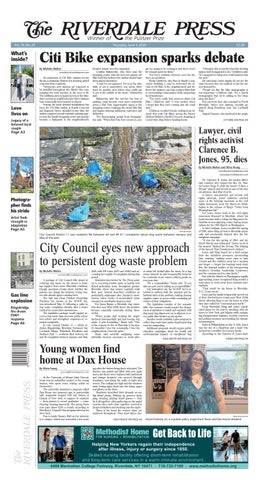
City Council District 11 saw residents file between 60 and 90 311 complaints about dog waste between January and May of this year.
City Council eyes new approach to persistent dog waste problem By Michelle Mullen mmullen@riverdalepress.com
Gas line explosion Kingsbridge fire draws FDNY response Page A6
A package of City Council bills aimed at reducing dog waste on city streets is drawing support from some Riverdale residents, though questions remain about whether the policies can change the behavior of dog owners who already ignore existing laws. The Safe and Clean Outdoor Ownership Practices Act, known as the SCOOP Act, was introduced May 15 following a spike in dog waste complaints citywide after a winter marked by consecutive snowstorms. The legislative package would expand access to dog waste bags, increase public education efforts and strengthen responses to repeated complaints. In City Council District 11 — which includes, Kingsbridge, Riverdale, Norwood, Van Cortlandt Village, Wakefield, Woodlawn and Bedford Park — residents filed between 60 and 90 complaints between January and May
2026, with ZIP codes 10471 and 10463 each accounting for roughly 35 complaints during that period. Residents interviewed by The Press pointed to recurring trouble spots in heavily trafficked pedestrian areas throughout greater Riverdale where dog owners regularly walk their pets. Several described conditions as particularly unpleasant after January’s snowstorms, when weeks of accumulated waste emerged as snowbanks began to melt. For Jason Bunin, a Riverdale dog owner who lives near West 235th Street, the problem became especially noticeable during those weeks. “When people start treating the neighborhood disrespectfully and just leaving dog waste, it gets frustrating,” Bunin said. “One of the reasons we live in Riverdale is because it’s beautiful. I love the community, I love the neighborhood, I love the parks.” Bunin said carefully navigating some sidewalks became necessary to avoid piles
Young women find home at Dax House By Olivia Young oyoung@riverdalepress.com
At the University of Mount Saint Vincent, home was an unfamiliar comfort to five young women who spent years relying solely on themselves. The university launched a program called Dax House two summers ago, in partnership with nonprofits Depaul USA and Sisters of Charity of New York, to support its students — from juniors to recent graduates — experiencing housing insecurity. The group there now pays about $250 a month, according to Mel Reyes, Depaul’s Dax program director for New York. Dax is inside Rosary Hall on the university’s campus, which was renovated a few years
ago after the Sisters living there relocated. The kitchen was gutted and filled with new appliances, the floors were replaced with hardwood and vintage furniture was secured through donations, now lining the walls of eight bedrooms. The ceilings are high and the windows wide, letting light flood into the living space and glisten on the floor. Residents described their dynamic as one big friend group. Waking up, grocery shopping, cleaning, playing board games — they do it all together, often gathering on the pastel couches they push close together, covered in heaps of blankets and studying into the night. Hints of the bond the women share are scattered throughout. They draw kitten dooOlivia Young photos
DAX HOUSE ON PAGE A4
Grace Pavlock, 22, is a public policy major from Texas and Dax House resident.