Vol. 76, No. 13
What’s inside?
Thursday, March 26, 2026
Marble Hill Senior Center reopens By Olivia Young oyoung@riverdalepress.com
Dylan Lopez Contreras freed
$1.00
After being forced to close for more than a month because of a sewage leak, the New York City Housing Authority Marble Hill Senior Center at 5365 Broadway is open once again. In early January, senior center director Ana Bayron and program coordinator Sandra Nielsen encountered rising, murky sewage water in the center’s lounge as a stench Nielsen described as a “Molotov cocktail of horrible stuff” wafted through the air. This leak wasn’t the first. Last November, the center had another instance where water seeped into the center’s lobby and
dining room. After the January leak, NYCHA maintenance vacuumed up the water, and traced the problem to a collapsed underground waste line in one of the center’s storage closets. On Jan. 16, the New York City Department of Health and Mental Hygiene ordered the affected areas be closed, since repairs would involve ripping up the floor, according to a NYCHA spokesperson. A few days later, the pipe was patched up, and over the next two weeks the floor was replaced. Maintenance then painted and sanitized the affected rooms. But the incident left more than 50 seniors without a familiar place to connect with one another. They had come to rely on the center for its daily lunches, mental health and referral
services, clubs, parties, and classes such as belly dancing. “They didn’t care for it too much,” Bayron said about the seniors. “They were looking to come back here — this is like their home, they feel comfortable here.” Bayron and Nielson said they still went into the office to call the seniors and check in daily. They recommended seniors visit other adult centers in the area, but many refused. For others, it was a matter of convenience. Charlyne Henry, a 69-year-old who has lived in the nearby Marble Hill Houses for 15 years, couldn’t make the time to go to another community center when she already had doctor’s appointments to attend and errands to run. Henry lost her
husband at the start of the pandemic, and found comfort in the center. “That was really traumatizing for me,” she said about her husband’s death. “They didn’t know what COVID was. I couldn’t have my family visit me. I couldn’t have anybody … The center was a therapy for me.” Yvette Hoover, 71, has frequented the senior center for the last five years, and met Henry through St. Stephen’s Methodist Church on West 228th Street, where they both sing in the choir. Hoover said she kept busy with the Jewish Association Serving the Aging on West 231st Street, but was glad to see the center back open. SENIOR CENTER, PAGE A4
Bailey Avenue businesses seek alternatives to bike lane redesign
Bronx teen out of ICE detention Page A3
By Michelle Mullen mmullen@riverdalepress.com
Since those changes were implemented, crashes in those areas dropped by 14 percent and injuries from vehicle incidents fell by 31 percent, according to DOT data. However, all residents are convinced the lower limits will be practical in neighborhoods dense with schools. Bob Zolt, who lives across from the Riverdale/Kingsbridge Academy and near P.S. 24, questioned how the changes would affect daily driving. “There are schools all along Independence Avenue that we must pass to drive south,” he said. “I don’t think a 15 mph speed limit will make the area safer. There are schools all over the community and we likely will have to crawl before getting on the highway.” City officials, however, point to transportation department data showing that speed plays a critical role in crash
On a busy Kingsbridge street, parking has been replaced by infrastructure including a protected bike lane — improving safety, officials say, but removing dozens of spaces as business owners push for solutions that accommodate both customers and cyclists. The redesign is part of a broader effort by the city to address longstanding safety concerns along Bailey Avenue, a 1.1 mile corridor that the New York City Department of Transportation ranks among the top 10 percent of the Bronx’s most dangerous streets. Between 2020 and 2024, nearly 180 pedestrians, bikers and drivers were hurt on the strip, including 18 who sustained severe injuries and two who were killed. The agency noted the corridor, which previously lacked dedicated bike lanes, was used by roughly 150 cyclists a day, many of whom navigated around double-parked vehicles or merged into traffic. When it came to pedestrians, more than 43 percent of injuries along the stretch were caused by drivers failing to yield to people crossing with the right of way. Under the city’s plan, Bailey Avenue was reconfigured between Van Cortlandt Park South and West 225th Street to include a twoway protected bike lane separated by barriers. It also added pedestrian islands, curb extensions and redesigned intersections intended to slow traffic and reduce conflicts. But for Gladys Grijalva and other business owners in the area, the changes have discouraged customers from visiting altogether. “If they didn’t find [somewhere to stop], they’re gonna leave,” Grijalva said, who has owned Sugargirl for 17 years. “I have customers that come here daily for coffee and a danish. They won’t come anymore. They don’t take that risk of coming in if they can’t find parking right away, they just keep going, and those are the people I used to rely on every single day.” Grijalva emphasized that her frustration is not with cyclists themselves, but with the design of the street. “I don’t have a problem with the bikers at all,” she said. “They deserve to be safe too.
SCHOOL ZONE, PAGE A4
BAILEY AVENUE, PAGE A4
Fire ravages apartment building Residents, day care flee blaze Page A5
GARY JEAN-JUSTE
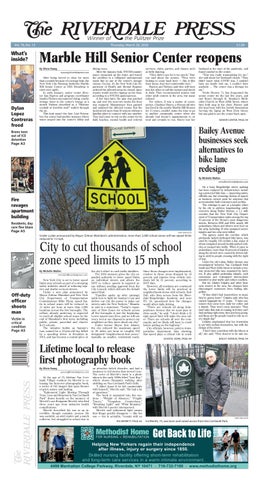
Under a plan announced by Mayor Zohran Mamdani’s administration, more than 2,000 school zones will see speed limits reduced to 15 mph.
City to cut thousands of school zone speed limits to 15 mph By Michelle Mullen mmullen@riverdalepress.com
Off-duty officer shoots man Victim in critical condition Page A5
New York City is set to lower speed limits near schools as part of a sweeping safety initiative aimed at reducing injuries and deaths on local streets. Under a new plan announced by Mayor Zohran Mamdani and New York City Department of Transportation Commissioner Mike Flynn, speed limits in school zones will be reduced to 15 miles per hour at more than 2,000 locations across the five boroughs. The rollout, already under way, is expected to reach all eligible school zones by the end of Mamdani’s first term, including public, private, parochial and charter K-12 schools. The initiative builds on Sammy’s Law, named for a 12-year-old boy killed by a speeding driver in Brooklyn in 2013, and has become a central piece of
the city’s effort to curb traffic fatalities. The 2024 measure gives the city expanded authority to lower speed limits on individual streets and allows the DOT to reduce speeds in targeted areas without needing approval from the City Council, which still sets the default speed limit. “Families spoke up after unimaginable loss to fight for Sammy’s Law and deliver our city the power to make our streets safer for New Yorkers,” Mamdani said in a statement. “Today’s expansion of Slow Zones for schools across all five boroughs is just the beginning. Lower speeds save lives, and we will use ever y tool at our disposal to protect our neighbors as they move about our city.” Under former Mayor Eric Adams, the city reduced the maximum speed to 20 miles per hour in roughly 250 designated “neighborhood slow zones,” typically on smaller, residential roads.
Lifetime local to release first photography book By Olivia Young oyoung@riverdalepress.com
At the age of 75, lifetime Van Cortlandt Village resident Ira Merritt is releasing his first-ever photography book, a series of 165 images that span themes of grief, nature and healing. “Ephemeral Light Moving Through Time, Loss and Renewal in Van Cortlandt Park” draws heavily on the memor y of Merritt’s son Benjamin Merritt, who died three years ago from unknown health complications. Merritt described his son as an incredible, though complex, person. He was sociable, an avid reader and a watch collector, but struggled in school due to
an attention deficit disorder, and had a tendency to tell stories that weren’t true. The cover of Merritt’s book is a photo taken in the early 1990s titled “Lost Boy,” which shows Benjamin walking after sledding on Van Cortlandt Park’s hills. “I didn’t know if he felt comfortable with himself,” Merritt said. “He had a lot of questions.” The book is separated into five sections : “Weight of Absence,” “Fragile Traces,” “Unspoken Connections,” “Breaking Light” and “What Remains,” with Merritt’s poetr y interspersed. Merritt said ephemeral light means that things quickly disappear — like his son — but in actuality, “remain with us IRA MERRITT, PAGE A4
GARY JEAN-JUSTE
Ira Merritt, 75, was born and raised across from Van Cortlandt Park.