Vol. 76, No. 29
What’s inside?
Thursday, July 16, 2026
City to trade parking for trash bins By Olivia Young oYounG@riverdalepress.com
Art in the park New mural celebrates nature Page A3
$1.00
New York City recently released plans to replace at least 543 parking spaces in greater Riverdale with 1,272 new “Empire Bins,” or on-street, sealed trash containers. The plan is part of the New York City Department of Sanitation’s efforts to improve quality of life by reducing the amount of plastic-bagged trash that piles on the sidewalk, often spilling into the street and attracting rats, the plan said. The announcement comes as some Riverdale residents express frustration over the shrinking number of available parking spots in the neigh-
borhood, particularly amid the addition of new Citi Bike stations and ongoing Metropolitan Transportation Authority construction along Broadway. The “Citywide Containerization Program” is a draft environmental study by the department released July 1. The plan still needs approval from city and state agencies, and to undergo a public hearing July 28. If approved, the changes would roll out over the next six years. A pilot of the program launched in West Harlem last June, and has been successful, according to the mayor’s office. The city is focused on schools and residential buildings with more than 30
units, and Empire Bins would be mandator y for them, the report said. Buildings with 10 to 30 units can choose between Empire Bins or single, official city bins, the report added. The department also said it would avoid putting bins in spots like bus stops, hydrants, bike lanes or intersections. In total, Bronx Community District 8 — which includes Riverdale, Kingsbridge, Spuyten Duyvil, Marble Hill, Van Cortlandt Village and part of Kingsbridge Heights — has 21,732 legal on-street parking spaces, the report found. At most, the neighborhood would lose 597 spots for 1,390 bins, or about 2.8 percent, according to the study.
Community members The Press spoke to had mixed reactions on the proposal. Orlando Peña, a professional driver in the area for more than 10 years that routinely parks by the West 231st Street 1 train stop, said he supports the plan as long as it doesn’t impact his spot. Residents getting off the train rely on drivers to make it back to their homes in North Riverdale, he said. “It’s good to keep the rats away because it’s ver y non-hygienic,” Peña said, but, he added, “the people, the community of Riverdale, they need us.” Another longtime professional drivTRASH BINS ON PAGE A4
City baselines Parks Enforcement Patrol funding By Michelle Mullen
mmullen@riverdalepress.com
Community in concert Neighbors gather for concert series Page A5
GARY JEAN-JUSTE
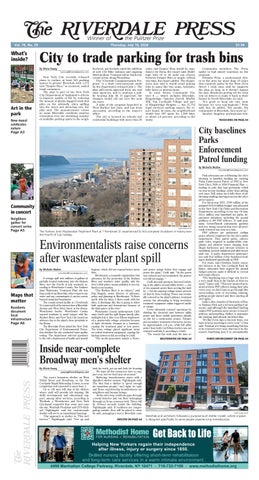
THe YonKers JoinT 7asTeWaTer TreaTmenT 0lanT aT &ernBrooK ST. eXperienced iTs krsT compleTe sHuTdoWn in HisTorY over THe &ourTH oF JulY HolidaY.
Environmentalists raise concerns after wastewater plant spill By Michelle Mullen mmullen@riverdalepress.com
Maps that matter Residents document local infrastructure Page A6
A sewage spill sent millions of gallons of partially treated wastewater into the Hudson River over the Fourth of July weekend, according to Westchester County. The Yonkers Joint Wastewater Treatment Plant sits less than a mile from Riverdale, where experts say water and any contaminants it carries moves beyond municipal boundaries. The county-owned facility at 1 Fernbrook St. is just north of the intersection of Riverdale Avenue and West 261st Street at the BronxWestchester border. Westchester County warned residents to avoid contact with the Hudson River, and New York City issued an advisory due to the plant’s close proximity to the Bronx. The Riverdale Press asked the New York City Department of Environmental Protection whether the city conducted water quality testing. The department referred questions to the city’s department of health and mental
hygiene, which did not respond before press time. Riverkeeper, a nonprofit organization that advocates for the protection of the Hudson River and monitors water quality, said the river’s tidal nature means pollution is not confined to one location. “The Hudson River is an estuary,” said Dan Shapely, senior director of advocacy, policy and planning at Riverkeeper. “It flows north with the tides, it flows south with the tides. A discharge like this is going to affect both upstream and downstream because of the tidal nature of the river.” Westchester County spokesperson Catherine Cioffi said the spill began shortly after midnight July 4, after Con Edison implemented a system-wide voltage reduction because of high electricity demand in a heatwave, causing the treatment plant to lose power. The lower voltage placed significant strain on critical treatment equipment, causing the backup system to fail, according to Cioffi. “The on-site generators require a 30-sec-
ond power outage before they engage and power the plant,” Cioffi said. “As the power was reduced and not terminated, the generators did not engage. “ Cioffi also said operators first tried switching to the plant’s second utility feeder — one of two separate power lines serving the facility — but the ongoing voltage issues prevented that fix from working. Power was eventually restored to the plant’s primary treatment system, but attempting to bring secondary treatment equipment online triggered another outage. Crews ultimately restored operations by dividing the electrical load between utility power and three mobile generators already on site for a construction project. Primary and secondary treatment returned to service by approximately 1:45 p.m., while full utility power from both Con Edison feeders was not restored until July 6, according to Cioffi. “The reason this work took the time reWASTEWATER ON PAGE A4
Park advocates are celebrating the city’s decision to baseline funding for existing Parks Enforcement Patrol, or PEP, in New York City’s 2026 to 2030 Financial Plan — locking in jobs that had previously relied on year-to-year funding, rather than adding new ones. Still, many say it falls short of addressing staffing shortages across the city’s green spaces. For fiscal year 2027, $709 million of the adopted $125.8 billion budget was allocated to the New York City Parks and Recreation Department, according to the city. Of that, $14.4 million was baselined for parks department initiatives, including the annual addition of 100 PEP officers, 15 staff positions, GreenThumb community gardens and tree stump removal that were all previously restored one year at a time. PEP officers are uniformed civilian peace officers employed by the city’s parks department. They patrol parks, enforce park rules, respond to quality-of-life complaints and address issues ranging from illegal barbecues and off-road vehicles to vandalism, permit violations and after-hours park use. A parks department spokesperson said $6.4 million of the baselined funding is dedicated specifically to PEP. For years, said Christina Taylor, executive director of the Van Cortlandt Park Alliance, advocates have argued the annual budget process made it difficult to recruit and retain officers. “The baselining was a huge win, but it’s a very small drop in the bucket of what we need,” Taylor said. “This now means that instead of these PEP officers losing their jobs every year, we don’t have to go through this never-ending cycle of recruiting, training, getting people started and then starting all over again.” Jodie Colón, founder of Stewards of Henry Hudson Park and a fervent parkland advocate, said although the baselined funding makes PEP positions more secure, it doesn’t address understaffing. Rather, it maintains the existing staff already stretched thin. “It’s like if you sign a one-year lease, you have to keep renewing it every year,” Colón said. “Instead of it being something that has to be renewed every year, that has to be discussed, baselining puts it in automatically. PARKS ENFORCEMENT ON PAGE A4
Inside near-complete Broadway men’s shelter By Olivia Young oyoung@riverdalepress.com
The men’s homeless shelter on West 262nd Street and Broadway, or the Van Cortlandt Rapid Rehousing Center, is near completion and expected to open Sept. 1. Up to 130 men will stay at the shelter, where staff will provide job training, life skills development and educational support, among other services, according to Westhab, a Westchester and New York City-based nonprofit that owns and runs the site. Westhab President and CEO Richard Nightingale said the custom-made shelter will serve as transitional housing. “Our approach to shelter is, ‘This isn’t forever,’” Nightingale said. “Get up and
look for work, get up and look for housing … We have all the resources here to support you, but we don’t just sit around.” Reducing homelessness starts with a dignified shelter system, Nightingale said. The idea that a shelter is “good enough for homeless people,” isn’t right, he said, and those experiencing homelessness are neighbors and human beings. At the entryway, residents pass through a metal detector and run their belongings through an X-ray conveyor belt. There will be 24-hour security inside the building, Nightingale said. If residents are congregating outside, they will be asked to clear, he said, assuaging a worry Riverdale comSHELTER ON PAGE A4
GARY JEAN-JUSTE
Westhab and architects followed a purpose-built shelter model, where a space is desiGned specikcallY to serve people eXperiencinG homelessness.