TheJewishStar.com
Honest Reporting • Torah-True • Kosher and Fat-Free
Reach the Star: Editor@TheJewishStar.com • 516-622-7461 x291
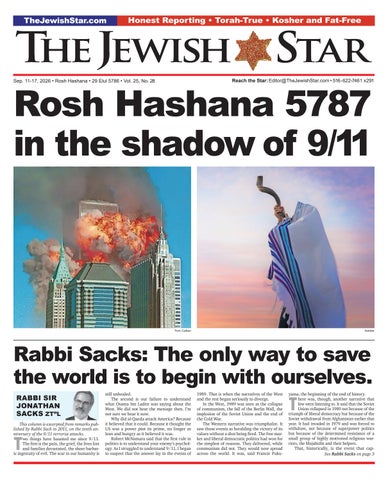
Rosh Hashana 5787 in the shadow of 9/11 Sep. 11-17, 2026 • Rosh Hashana • 29 Elul 5786 • Vol. 25, No. 28
Tom Callan
Adobe
Rabbi Sacks: The only way to save the world is to begin with ourselves. RABBI SIR JONATHAN SACKS ZT”L This column is excerpted from remarks published by Rabbi Sack in 2011, on the tenth anniversary of the 9/11 terrorist attacks. wo things have haunted me since 9/11. The first is the pain, the grief, the lives lost and families devastated, the sheer barbaric ingenuity of evil. The scar in our humanity is
T
still unhealed. The second is our failure to understand what Osama bin Laden was saying about the West. We did not hear the message then. I’m not sure we hear it now. Why did al-Qaeda attack America? Because it believed that it could. Because it thought the US was a power past its prime, no longer as lean and hungry as it believed it was. Robert McNamara said that the first rule in politics is to understand your enemy’s psychology. As I struggled to understand 9/11, I began to suspect that the answer lay in the events of
1989. That is when the narratives of the West and the rest began seriously to diverge. In the West, 1989 was seen as the collapse of communism, the fall of the Berlin Wall, the implosion of the Soviet Union and the end of the Cold War. The Western narrative was triumphalist. It saw those events as heralding the victory of its values without a shot being fired. The free market and liberal democratic politics had won for the simplest of reasons. They delivered, while communism did not. They would now spread across the world. It was, said Francis Fuku-
yama, the beginning of the end of history. here was, though, another narrative that few were listening to. It said that the Soviet Union collapsed in 1989 not because of the triumph of liberal democracy but because of the Soviet withdrawal from Afghanistan earlier that year. It had invaded in 1979 and was forced to withdraw, not because of superpower politics but because of the determined resistance of a small group of highly motivated religious warriors, the Mujahidin and their helpers. That, historically, is the event that capSee Rabbi Sacks on page 3
T
September 11-17, 2026 • 29 Elul 5786 THE JEWISH STAR
2
25 Years Later, We Remember. On the 25th anniversary of September 11th, we honor all of those we lost that day - our neighbors, our friends, our co-workers - and those who died later of 9/11 related diseases. We salute the courage and dedication of all 9/11 first responders - including the FDNY, NYPD, PAPD - and the many Long Island volunteers who also answered the call to help. We will never forget their sacrifices, and we
1359263
continue to serve in their memory.
Continued from page 1 tured the imagination of Osama bin Laden. According to this account, that one event, the humiliating retreat of the Soviet Army, set in motion a series of internal crises that resulted, months later, in the fall of a great power. If one of the world’s two superpowers was vulnerable to asymmetric warfare — the war of the few against the many — why not the other, America itself? What 1989 represented was not the end of history but the end of a history dominated by the twin superpowers of communist Russia and capitalist America. Both were vulnerable because both were overripe and about to fall from the tree. Much excitement was felt in the West by the failure of communism. Less attention was paid to what Daniel Bell called the cultural contradictions of capitalism. hroughout this period there were voices that few seemed to be listening to. First and greatest was the philosopher Alasdair MacIntyre in his 1981 masterwork, “After Virtue.” He argued that the moral discourse of the West had broken down. The “Enlightenment project” of a purely rational ethic had failed — not because there was no such thing, but because there were too many. They clashed inconclusively and people were left with a sense that morality is whatever you think it is. His minatory warning was: “The barbarians are not waiting beyond the frontiers; they have already been governing us for quite some time.” That was a scary thing to hear from one of the world’s great philosophers. I soon began to hear it from other leading intellectuals also, such as Philip Rieff, Christopher Lasch
T
and Robert Bellah. That is what I heard in the echoes of 9/11: that all great civilizations eventually decline, and when they begin to do so they are vulnerable. That is what Osama bin Laden believed about the West and so did some of the West’s own greatest minds. f so, then 9/11 belongs to a wider series of phenomena affecting the West: the disintegration of the family, the demise of authority, the build-up of personal debt, the collapse of financial institutions, the downgrading of the American economy, the continuing failure of some European economies, the loss of a sense of honor, loyalty and integrity that has brought once esteemed groups into disrepute, the waning throughout the West of a sense of national identity. These are all signs of the arteriosclerosis of a culture, a civilization grown old. Whenever Me takes precedence over We, and pleasure today over viability tomorrow, a society is in trouble. If so, then the enemy is not radical Islam, it is us and our by now unsustainable self-indulgence. The West has expended much energy and courage fighting wars abroad and defeating terror at home. It has spent far less, if any, in renewing its own morality and the institutions — families, communities, ethical codes, standards in public life — where it is created and sustained. But if I am right, this is the West’s greatest weakness in the eyes of its enemies as well as its friends. The only way to save the world is to begin with ourselves. Our burden after 9/11 is to renew the moral disciplines of freedom. Some say it can’t be done. They are wrong: it can and must. Surely we owe the dead no less.
I
THE JEWISH STAR September 11-17, 2026 • 29 Elul 5786
Rabbi Sacks: A better world begins with us…
3
NO ONE SAVES MORE LIVES IN ISRAEL IN TIMES OF CRISIS.
How rabbis freed 9/11 widows to marry again The agunah case that took the longest to resolve — about three years — involved a woman whose husband could be placed on the 78th floor of the South Tower. A co-worker who survived said that when she got into the elevator, before the South Tower was struck, she saw the man speaking to a Port Authority officer, who was advising him not to get into the elevator. “Though we know this man was standing there, who knows?” Reiss said. “The plane zigzagged into the 78th floor. Maybe somehow he escaped the nose of the plane. It was very unlikely.” “We had to rely on the passage of time in that particular case,” Reiss said. “We had to rely upon the fact that he had a good relationship with his wife and he wasn’t looking to escape her, and after three years he didn’t turn up. We also relied upon the very strong circumstantial evidence.” “Everything comes to an end. There’s always a transition point,” he said. “The Torah provided a framework for how they should process their loss and deal with their tragedy and how they should conduct themselves in terms of transitioning from mourning to being able to move on with their lives.” Rabbi Reiss said that the message is clear this year, the attack’s 25th anniversary.. “All the curses of the previous years should come to an end, and we’ll move on to a time of blessings,” he said. G-d “is going to give us the opportunity to move on in a way in which we honor the memories of those who perished and never ever forget them,” he said. —JNS
There are many ways to support Israel and its people, but none is more transformative than a gift to Magen David Adom, Israel’s emergency services system. Your gift to MDA isn’t just changing lives — it’s literally saving them — providing critical care and hospital transport for everyone from victims of heart attacks to rocket attacks. Donate today at MagenDavidAdom.org or call 866.632.2763.
1357080
A new book addresses the status of wives whose husbands were killed in the World Trade Center on Sept. 11, 2001 but whose bodies were not identified, making them agunot. Rabbi Yona Reiss, av beit din of the Chicago Rabbinical Council, told JNS that the Beth Din of America handled 10 such cases, and four other cases were addressed by other Jewish courts. “In many cases, their remains couldn’t be identified because they had fallen from 100 stories and they were basically pulverized or they were incinerated by the flames that broke out when the planes collided,” the rabbi said. The book is the second volume of “Kanfei Yonah,” which RIETS Press released this week with the CRC. Some 40% of 9/11 remains have yet to be identified scientifically, although the identities of the victims are known. In 2001, Rabbi Reiss consulted scientists at the medical examiner’s office and rabbis “to determine the feasibility from the standpoint of halacha of relying upon DNA identification,” he said. Rabbi Reiss said “if you have a margin of error of less than one in 1,000, then that is considered to be an ironclad proof of identification that would satisfy the halacha threshold of what’s necessary to determine that a man has been killed.” “Halacha says that if, for example, you have a witness that sees somebody go into a fiery furnace from which they can’t escape, then even if you didn’t actually watch them die, that’s considered to be sufficient evidence,” he said.
Safety fears must not ‘overwhelm’ our holidays
By Rikki Zagelbaum When he faced Mayor Zohran Mamdani at a closed-door meeting with other Jewish New York spiritual leaders in early August, Rick Jacobs told the mayor plainly that his inflammatory rhetoric on Israel was “making Jews less safe.” But heading into the High Holidays, Jacobs, president of the Union for Reform Judaism, told JNS that he wants safety and security to be the last things about which Jews think when they walk into their synagogue. “We have holy things to do,” he said. “We have a community that is also about celebration, joy, pride in being Jewish.” He said that anti-Israel views among Reform Jews, reportedly among younger Reform rabbis in particular, are not as concerning going into the High Holidays and looking ahead as media reports have suggested. He called those reports “inaccurate.” Since becoming URJ president in 2012, Jacobs has led the movement through challenging periods including what he called the “toxic polarization” among Americans, “imperiled” democracy — which he said “is the thing that has kept Jews safe — and efforts to make it “more difficult for people to vote.” Rising Jew-hatred is now “a dominant reality.” His meeting with Mamdani was one example of how he believes that Jewish leaders should respond. “We meet with the people who are in leadership, whatever we think of them,” Jacobs said. “To not meet means that our voices will not be heard, our concerns will not be in any way noticed.” The discussion included “rabbinic colleagues from across the spectrum,” including Orthodox, Reform, Conservative and Reconstructionist movements, who were united in the view that the mayor’s rhetoric about Israel
Rabbi Rick Jacobs, president of the Union for Reform Judaism, at the First Station in Jerusalem in 2018. Yonatan Sindel, Flash90
had been “unhelpful and hurtful” and had “created more danger for the Jewish community,” he said. “What was amazing about our meeting was we weren’t divided as a rabbinate,” Jacobs said. “We were a minyan of rabbis, but we were not divided on these questions.” That willingness to work across ideological and denominational lines characterizes much of the rabbi’s approach to the role. He works very closely with Orthodox and Conservative leaders, and with the Orthodox Union, Jewish Federations of North America, American Jewish Committee, Anti-Defamation League and the Jewish Agency for Israel, he said. “More often than not, we work very, very
well together, even in our differences,” he said. “We understand that there’s something profound we need to do together.” Jacobs said that he “fell in love” with Israel while attending Reform summer camps and studying in Israel as a college student and “thought seriously about aliyah, and I would have loved to have done that, but I felt called also to lead here in North America.” While in Israel, Jacobs studied with Rabbi David Hartman, the Orthodox founder of the Shalom Hartman Institute and a disciple of Rabbi Joseph B. Soloveitchik. He also spent several years volunteering on an Orthodox kibbutz. He said concerns that Reform youth today were moving away from supporting Israel
were overblown. “Anytime they see someone who’s an anti-Zionist, they say, ‘Oh, they’re Reform’,” Jacobs said. “There are some anti-Zionists within the Reform movement. There are some within the Conservative movement and yes, even some within the Orthodox.” “The largest swath of our movement is connected to Israel,” and is supportive of Israel as a “democratic, Jewish, pluralistic state,” he said. “So let’s be clear about that.” As for those who are not, “rather than scold them, I like to actually talk with them,” he said. “I like to listen. I think our job is also to be supportive of their own quest for understanding.” During the High Holidays, Jacobs is focused on reaching Jews who may feel uncertain about where they belong. “How do we find ways to bring people into the synagogue, into Jewish community, who have yet to find their Jewish home?” he said. “So many have maybe made their decision to live outside of the organized Jewish world. What are the doorways that we can open?” He said that he had “many congregants” who were in and near the World Trade Center that day in 2001 and that he later buried victims of the attacks. “The 25th anniversary is obligatory for us,” he said. “It’s Yom Hazikaron, the ‘day of remembering.’ How do we not remember those people? … To think that that does not have a place in our spiritual observance — I have trouble even imagining that.” Despite the dangers Jews face at home and abroad, Jacobs rejects the idea that American Jewish life is nearing its end or that fear should guide the Jewish community throughout the holidays. Quoting the Israeli poet Yehuda Amichai, Jacobs said that the Jewish people is negu’ei tikvah — “infected with hope.” —JNS
WE REMEMBER September 11, 2001
Honoring the lives lost, the heroes who answered the call, and the strength of their families and our community.
1359718
September 11-17, 2026 • 29 Elul 5786 THE JEWISH STAR
4
5 THE JEWISH STAR September 11-17, 2026 • 29 Elul 5786
Wherever Your Dreams Take You, May The New Year Bring You Home.
1363220
בברכת שנה טובה ומתוקה
How Gloria Steinem connected to a Jewish heritage
By Debra Nussbaum Gloria Steinem, a mother of Second Wave feminism and a shaper of American culture, who connected with her Jewish lineage later in life died last Wednesday in her home on Manhattan’s Upper East Side. She was 92 years old. The longtime political agitator, activist and prolific writer who created Ms. Magazine was known for her forceful activism and speeches on behalf of women’s equality. Steinem co-founded the National Women’s Political Caucus and, through her magazine and her other writings, brought then-taboo subjects and women’s experiences, including abortion and rape, into American mainstream conversation. She was famous, and instantly recognizable, for her streaked, straight hair and aviator glasses. Less well-known was her Jewish heritage and connection to it. Her father, Leo Steinem, was Jewish, but the future feminist lived with her mother, who was Protestant, after her parents divorced when she was 10. Religion of any kind was not much part of Steinem’s life until later, when through her relationships with co-founders of Ms. magazine, including Letty Cottin Pogrebin, she began participating in an annual feminist Seder. Steinem famously said, “Never in my life have I identified myself as a Christian, but whenever there is antisemitism, I identify as a Jew.” Her paternal grandmother, Pauline Steinem, was an influence on her, although she died when Steinem was young. Her grandmother kept kosher, was a notable suffragist and helped rescue family members from Europe during the rise of the Nazis. She learned the extent of her grandmoth-
Gloria Steinem in 2019, during a conversation hosted by Friends of the LBJ Library in Austin, Texas. WikiCommons
er’s activism when she had lunch with Judith Rosenbaum, who at the time was curating an exhibit on feminism and Jewish women, in 2005. Rosenbaum now serves as CEO of the Jewish Women’s Archive. “It was meaningful for her to learn that she wasn’t the first in her family to be a feminist activist, but in fact it was part of her legacy,” Rosenbaum told JNS. “It was very moving to her. It was the piece ultimately that connected Gloria to her own Jewishness.” Another major connection for Steinem was the feminist Passover Seders in which she participated for more than 20 years. Each year, usually on the third night of
Passover, a small group of “Seder sisters” gathered to elevate the role of Biblical women in the Exodus story and apply the lessons to contemporary women’s challenges, wrote Pogrebin in the “Encyclopedia of Jewish Women,” published by Jewish Women’s Archive. They also applied those lessons to “their current struggle for equality in Jewish life.” “Over the years, Steinem sang ‘Dayenu’ and ‘Miriam ha-nevi’ah’,” “shared in discussions of the ‘Ten Plagues of Women’ and the ‘Four Questions of Women’ and helped to make modern midrash about our Jewish foremothers,” wrote Pogrebin, of her close friend. “When I feel most drawn to Judaism it’s not
the law part that attracts me, it’s the mystical part, the Kabbalah, the shechinah,” seen by many as a female aspect of G-d, Steinem said, per Pogrebin’s entry.“I do feel socially drawn to Jewish warmth, sensuality, expressiveness.” Ruth Messinger, the former Manhattan borough president and longtime political organizer, participated in feminist Seder with Steinem for several years. “Gloria was iconic,” said Messinger, who after her political career went on to become president of the American Jewish World Service, a nonprofit that benefits women and others in the global South. “This is a sad day for women,” Messinger said. She said that she knew Steinem “forever.” “I was there at the famous 40th birthday press conference when someone from the media said, ‘You don’t look 40,’ and she said, ‘This is what 40 looks like’,” Messinger said. “She really cared about the future for women at a time when that was a novelty,” she said. “She had a huge impact.” Nancy Wartik worked at Ms. magazine as a researcher in the mid-1980s. As soon as she heard that Steinem had died, she and a friend who had also worked there went to lay flowers on the doorstep of Steinem’s home. There were already flowers laid, Wartik said. She also found “a constant presence of older women” at the home. Wartik later became a writer and editor at the New York Times. Steinem “was an inspiring example,” Wartik said. “She changed my life. Young women today mostly have no idea what they owe her.” The subject of her being Jewish didn’t come up while Wartik was at Ms., but she said that Steinem “was an exemplification of what Jews ought to be.” —JNS
A SWEET NEW YEAR
FROM MY FAMILY TO YOURS Shanah Tovah U'Metukah
"From my family to yours, may the new year be filled with health, happiness, peace and prosperity."
Lisa
LISAVIDER.COM
Paid for by Vider for Senate.
1363294
September 11-17, 2026 • 29 Elul 5786 THE JEWISH STAR
6
THE JEWISH STAR September 11-17, 2026 • 29 Elul 5786
1358395
7
Jew-haters exploit Japanese Tengu folk imagery An organization that spots hateful online trends has alerted social media giants of the growing use of Tengu — imagery from Japanese folklore — to demonize Jews. CyberWell found that the trend, which has circulated online since at least 2023, has gained renewed visibility and engagement in recent weeks across Meta (Facebook and Instagram), TikTok and X, including posts in English, French and Farsi. Tengu are supernatural beings from Japanese folklore commonly depicted with red faces, long noses, and small box-like hats. Users spreading antisemitism have appropriated the figures to draw comparisons with Jews, using their exaggerated features to promote stereotypes about Jewish appearance while invoking depictions of Tengu as demonic beings to portray Jews as evil, warmongering and responsible for kidnapping children. The posts often place Tengu images alongside photographs of visibly Orthodox Jews or the “Happy Merchant,” a well-known antisemitic caricature. One Instagram post received more than 40,000 likes, while an X post amplifying the comparison received more than 249,000 views. In the vast majority of posts identified by CyberWell, the words “Jew” or “Jewish” did not appear. Instead, users relied on visual comparisons and established antisemitic imagery to communicate their message, potentially allowing the content to evade detection by hate-spotter systems that rely heavily on text. “Comparing Jews to evil demons through this use of Japanese imagery is a grotesque form of dehumanization, with roots in religious antisemitism,” explained CyberWell CEO & Founder Tal-Or Cohen Montemayor. “Repeat exposure to the dehumanization of Jews through powerful algorithmically driven platforms has seeded the conditions in which hostility, hatred, discrimina-
Images on social media relating depictions of Tangu with common antisemitic stereotypes, including the “Happy Merchant” at left. CyberWell
tion and even violence against Jews are increasingly justified and commonplace today. “The Holocaust did not begin with mass murder, but with years of propaganda, discrimination and systematic state-sponsored dehumanization of Jews,” he said. “The increasingly open antiJewish vitriol that CyberWell has tracked online has similarly desensitized many of our most open societies to antisemitism.” CyberWell said the content violates Meta’s,
TikTok’s, and X’s own policies, including rules against dehumanizing comparisons, harmful stereotypes, and portraying protected groups as inherently dangerous. The Tengu trend follows a separate antisemitic narrative involving Japanese cultural references previously identified by CyberWell, in which antisemites appropriated “Celestial Dragon,” a reference to the Japanese manga series “One Piece,” to promote conspiracy theories about Jewish wealth, power and
global control. Together, Tengu and Celestial Dragon trends illustrate how otherwise non-antisemitic cultural references can be appropriated to give longstanding antisemitic narratives new forms. “Especially with the widespread adoption of AI and the rise of algo-speak, antisemites do not need to use the word ‘Jew’ to create antisemitic content,” added Cohen Montemayor. “Much of the hate content is designed to evade content moderation systems. Technology must adapt. “As platforms increasingly rely on AI-based enforcement, their systems must recognize the images and visual cues that make coded content antisemitic. Expert partners who understand how antisemitism evolves across languages, cultures and contexts can help platforms identify emerging forms of Jew-hatred before they spread.” CyberWell called on social media platforms to strengthen AI-based detection of visually coded antisemitic content, improve detection of recurring antisemitic stereotypes, apply their policies consistently and continue working with organizations that specialize in online hate. CyberWell said early identification of emerging antisemitic trends remains critical to preventing new forms of hate from spilling from the digital universe into the physical world. CyberWell is an independent, tech-based nonprofit combating the spread of antisemitism online, operating globally. Its AI-powered technologies monitor social media in English and Arabic for content promoting antisemitism, Holocaust denial and incitement to violence against Jews and their allies based on the International Holocaust Remembrance Alliance’s (IHRA) working definition of antisemitism. Its analysts review and report this content to platform moderators and index verified posts in the first-ever open database of antisemitic social media posts, cataloging it openly for transparency at app.cyberwell.org.
Wishing you a Happy & Healthy New Year
L’Shana Tova A Message from The Nassau County Auxiliary Police Department Fourth Precinct Assist The Police
Support Your Community
May your New Year be wonderful and blessed!
Inspector Danny Gluck Commanding Officer Fourth Precinct Auxiliary unit
C O U N C I L W O M A N
1362243
Join Today! For more information call 516-573-6492 www.NCPDAux4.org
1341251
September 11-17, 2026 • 29 Elul 5786 THE JEWISH STAR
8
9 THE JEWISH STAR September 11-17, 2026 • 29 Elul 5786
Walsh Ambulatory Pavilion
Episcopal Health Services is proud to introduce the Walsh Ambulatory Pavilion, a state-of-the-art outpatient center offering multispecialty care in one convenient location. Equipped with advanced technology and comprehensive treatments, EHS provides an elevated patient experience and seamless access to high-quality care.
Services Include: • Primary Care
• Endoscopy
• Behavioral Health
Colonoscopy • Obstetrics & Gynecology • EHS Cancer Center Maternal Fetal Medicine Medical Oncology Radiation Oncology • Endocrinology
19-20 Brookhaven Avenue, Far Rockaway, NY 11691 For the EHS Cancer Center, please email cancercenter@ehs.org.
1362037
Call 718-347-3627 or visit ehs.org/walsh to schedule an appointment today!
September 11-17, 2026 • 29 Elul 5786 THE JEWISH STAR
10
Mamdani visit to Eichler’s sparks a firestorm
By Rikki Zagelbaum and Mike Wagenheim Mayor Zohran Mamdani’s visit to Eichler’s Judaica store in Borough Park last week was an “embarrassment” that allowed him to portray himself as an ally of Jews while continuing to promote anti-Israel views, Inna Vernikov, a Jewish member of the New York City Council, told JNS. The mayor, whose visit was disrupted by an irate woman in the store, met with Avi Greenstein, CEO of the Borough Park Jewish Community Council, Rabbi Yaakov Landau, and Hirsch Meir Traube, who owns the Borough Park Eichler’s store. The store is separately owned from the Eichler’s store in Brooklyn’s Midwood neighborhood. The mayor’s director of special projects, Uri Fraenkel, blew a shofar and the mayor was gifted honey to symbolize the hope for a sweet New Year. Every Jew who helped “stage” the mayor’s “photo op allowed the mayor to keep selling a lie that one can be an ally of the Jewish people while denying the basic reality of Judaism,” according to Vernikov, a Ukrainian-born Republican who represents Brooklyn’s 48th District. “The question is not whether the mayor is allowed to walk into a shop,” she said. “The question is who invited him into the heart of our community and why anyone thought that was an honor.” “Courtesy to the office of the mayor is one thing,” Vernikov said. “Drawing a crowd, though very modest for a community that usually flocks to comparable events, presenting gifts, using religious objects and treating him like an honored guest is another.” “It’s an embarrassment and disservice to the majority of Jewish New Yorkers who did not vote for him, including roughly 85% of Borough Park,” she said. Mayoral spokesman Sam Raskin responded that Mamdani was “proud to visit Borough Park ahead of the High Holidays” and “ to wish everyone a shanah tovah and a happy and healthy new year.” While Mamdani was at the store, a woman identified as Stephanie Benshimol called out to the mayor, “Stop the antisemitism! You have all the power to stop the antisemitism.
Mayor Zohran Mamdani visits the Eichler’s store in Borough Park on Sept. 2.
I’m begging you to do it.” Unidentified people tried to nudge her away from Mamdani. Raskin said that Benshimol does not live in Borough Park, and he disputed the suggestion that she was a shopper who happened upon the mayoral visit. “She was not a shopper who was passing by,” Raskin said. “She came directly to the shop.” Menachem Gindi, an employee at Eichler’s, was there and told CBS News NY that it was similar to visits made by politicians in the past to the store. “I was shocked that he was coming,” said Gindi, of when his boss, the owner, gave him a heads up. When Benshimol yelled at the mayor, “it was uncomfortable, but I would say that she’s right,” Gindi said. During Mamdani’s first month in office, “antisemitic incidents spiked far more sharply still,” 182% in fact, Vernikov said. “Our people are assaulted, our streets desecrated with vile graffiti and our shuls protested.” NYPD last week released data showing that Jews were targeted in 19 — or 42% — of the city’s
Ed Reed, Mayoral Photography Office
45 confirmed hate crimes in August. Eichler’s does not “take any political sides” as a business, said Traube, the owner. If community rabbis or Agudath Israel of America were to “tell us otherwise not to welcome, not accept anyone, we will for sure do that,” he said. “But as a business owner, I do not have the capacity or the shoulders to take any political sides or to turn the business into a political field.” “We weren’t involved in kicking anyone out of the store,” he said. “We do support Israel. Am Yisrael Chai.” Mamdani has been harshly critical of Israel and has taken steps to distance the city government from Israel-related partnerships. On his first day in office, he revoked an order by former Mayor Eric Adams adopting the International Holocaust Remembrance Alliance’s working definition of antisemitism. In May, he boycotted the annual Israel Day parade. His contact with the Jewish community has largely involved progressive and anti-Zionist factions and organizations, and he has dismissed calls to tone down his rhetoric by those who claim it is leading to more attacks on, and threats against,
Jews in the city. “When he is not libeling Israel, threatening to jail its prime minister or denying the Jewish people’s historical connection to our homeland, including Jerusalem, Judea and Samaria, he plays the ally by surrounding himself with carefully curated Jewish symbols that omit Israel,” Vernikov said. “Always with that wide Cheshire cat smile that says ‘look how warm I am, while I spend the rest of the year mainstreaming hatred of your people’,” she said. “All in the name of ‘progressive values,’ of course.” Vernikov acknowledged that many Jews in Borough Park do not identify as Zionists but said that opposition to Zionism within parts of the Orthodox community should not be equated with anti-Zionism from outside the Jewish community. “There is no festival on our calendar that is not bound to our ancestral homeland,” she said. “We are called the People of Yisrael. Many of the Torah’s mitzvot can only be in the Land of Israel. The very way we daven,” or pray, “today was set in Jerusalem.” Vernikov cited the late Satmar Rebbe, Rabbi Yoel Teitelbaum, a fierce opponent of political Zionism, who she said taught that fervent anti-Zionist non-Jews “hate the Jewish people.” “Mamdani fits the Rebbe’s description of this type of non-Jew to a T,” she said. “Look at the company he keeps,” she said. “The ‘love of his life’ liked posts celebrating Oct. 7, the day it happened, which would have included slaughtering the Jews at the Kotel had Hamas gotten as far as they wanted.” “Bringing such an individual into our community so close to the yahrtzeit of those murdered Jews is a mockery of their memory,” she said. The blowing of the shofar, “a custom interlaced with our historical connection to the land of Israel,” is one example, she said. “Blowing the shofar has another meaning I think is relevant — to ‘awaken slumbering souls that have grown complacent’,” she said. “To Jews who have still not been paying attention, now might be a good time to start.” —JNS
Trump has historic meeting with Hasidic leaders By Mike Wagenheim The Trump administration hosted a historic gathering of leaders of major Hasidic communities on Thursday, drawing controversy because several of the rabbis are explicitly anti-Zionist or non-Zionist. Brokered in part by Rep. Mike Lawler, whose Rockland County district includes large Hasidic communities, the meeting also produced a rare reunion between the two Satmar rebbes, brothers who have been at odds since a succession dispute following their father’s death. Rabbi Aharon Teitelbaum of Kiryas Joel and Rabbi Zalman Leib Teitelbaum of Williamsburg greeted each other at the White House, likely marking their first face-to-face meeting in decades. Their dispute began after their father, Rabbi Moshe Teitelbaum, died in 2006 and designated Zalman Leib as his Williamsburg successor, angering Aharon’s supporters and leading to a split within the Satmar community. The brothers reportedly shook hands and exchanged greetings at the meeting from which the press was barred. Aharon also congratulated Zalman Leib on his grandson’s engagement, which had been announced the previous day, attendees said afterwards. The roughly 30-minute Oval Office meeting was the first gathering of its kind at the White House since 1979, according to the White House. The delegation included Rabbi Benzion Halberstam, the Bobover Rebbe; Rabbi Yisroel Hager, the Vizhnitzer Rebbe of Monsey; Rabbi Malkiel Kotler, rosh yeshiva of Beth Medrash Govoha in Lakewood, NJ; and Rabbi Aharon Mendel Twersky, representing his father, Rabbi
President Donald Trump welcomes leaders of American Hasidic communities to the White House. Before speaking with the president, they met with Vice President JD Vance (at right). White House
Dovid Twersky, the Skverer Rebbe. The delegation first met with White House officials in the Roosevelt Room, where Vice President JD Vance joined the gathering. White House Jewish liaison Martin Marks, who had worked for months to organize the meeting, and Staff Secretary Will Scharf also participated. Jared Kushner joined the group for the Oval Office meeting with President Donald Trump. The rabbis discussed issues affecting their communities, including religious education and the needs of Jewish prisoners. Concerns also in-
cluded protecting haredi educational independence from New York state requirements and issues facing the Kiryas Joel community. The delegation’s presence at the White House drew criticism from some pro-Israel voices because Satmar is explicitly anti-Zionist, while other members of the group are more accurately described as non-Zionist. Satmar rejects the establishment of a Jewish state before the arrival of the Moshiach. It was reported that some of the attendees raised the topic of the military draft of haredi
men into the Israel Defense Forces, but Belaaz News reported that the rabbis had agreed not to discuss the contentious issue Trump also met privately with Aharon, Vance and Kushner, according to photos published by Satmar. Aharon led the other rabbis in a traditional blessing for the president and government and thanked Trump for his support of the Jewish community. Yossi Gestetner, a Hasidic community activist and strategist who accompanied the delegation to the White House, told reporters on the White House lawn that “today was an opportunity for the first time in over 50 years for the president of the United States to meet with the grand rabbis of the largest Hasidic sects, the visibily Hasidic communities. … We had the opportunity to thank the president for everything that he does for the United States.” Gestentner walked off as reporters asked questions. —JNS with The Jewish Star
11 THE JEWISH STAR September 11-17, 2026 • 29 Elul 5786
The Gift of Time. New beginnings call us to pause, reflect, and renew. At Grandell, we see the beauty in every moment, where compassionate care meets dignity and strength. May the year ahead be filled with blessings of health and happiness.
podium.nyc
Shanah Tovah
645 WEST BROADWAY, LONG BEACH, NY 11561
1359867
516.889.1100 | WWW.GRANDELLREHAB.COM
Best wishes for a healthy, sweet and prosperous New Year!
h a n T a o h v S a ’ L Wishing you a
CONGRESSWOMAN
Happy and Healthy New Year from Congresswoman
Paid for and authorized by Grace For New York
Laura Gillen
1361998 1316598
GRACE MENG
Warmest Wishes for a Happy, Healthy and Sweet New Year Stacey Feldman Executive Director
The Marion & Aaron Gural JCC • 207 Grove Avenue, Cedarhurst 516-569-6733 • www.guraljcc.org
Paid for by Friends for Gregory Meeks
1341245 1297474
David Kaye President
1360570
Paid for by Gillen for NY
1363219
September 11-17, 2026 • 29 Elul 5786 THE JEWISH STAR
12
Public school, yeshiva parents find a common cause: financial aid
I
N
What public school parents and yeshiva families agree on
T
From our family to yours,
SHANA TOVA Wishing everyone a sweet & uplifting new year. Margaret Tietz is proud to provide the Jewish community with the highest quality short-term and long-term Subacute Rehabilitation, Clinically Complex Care and a state-of-the-art virtual reality rehab system. Combined with a beautiful & spacious new Shabbos house and renovated gym, cafe and recreation center, you’ll rehab comfortably and confidently in our five-star rated, fully Kosher facility. Quick recoveries is where we excel. At Margaret Tietz, we will get you back on your feet... and back home quickly for the next holiday.
H
FREE GUIDE!
Scan for the guide!
The Jewish Family’s Guide to Selecting a Nursing & Rehab Facility
718-298-7806
•
margarettietz.org
164-11 Chapin Parkway, Jamaica Hills, NY 11432
1360648
T
he Federal Scholarship Tax Credit Program exists, whether or not New Yorkers participate and Albany appropriates nothing to fund it. The program would allow eligible families to access scholarships for educational expenses from tutoring and after-school programs to special-education services and tuition — if New York opts in. And some of the parents asking Albany to do that are not who you might expect. Yifang Chen is a working mother from Queens, with two children in the city’s public schools. “With rising costs all around us,” she wrote, “this program would really help my family afford much-needed after-school programs.” Chen’s children attend public school. And that is precisely the point. This program is not just about yeshiva families or private school tuition. Families across New York are looking at the rising cost of giving their children the support they need, which is why Chen is standing alongside a broad alliance of public and nonpublic school families asking New York to opt in. That is worth paying attention to. spend my days advocating for Jewish schools and the families who choose them. What has been striking this summer is how many outside our community are doing the same math. A parent pricing out a math tutor. A mother whose workday does not end at three. Public school may be tuition-free, but raising and educating a child is not. The schools are different. The math is often surprisingly similar. That shared challenge is why we launched Scholarships for All NY, a statewide alliance bringing together dozens of organizations, from the Brooklyn Chamber of Commerce to the New York State Catholic Conference and PLACE NYC, to urge Gov. Kathy Hochul to opt New York into the new Federal Scholarship Tax Credit Program once federal regulations are finalized. Even if 30% of eligible New York taxpayers participate, the program could generate about $1.5 billion a year for New York students, helping pay for a reading tutor, a bus route, a speech therapist twice a week, an after-school program or tuition. Roughly 2.8 million students in public and nonpublic schools would be eligible. Now consider what happens if New York sits this out. ew Yorkers could still claim the federal credit but would direct it to scholarship organizations serving students in participating states. New Yorkers would be the ones left out. That’s a hard thing to explain to a parent packing a lunch this week. I know the objection because it is being made loudly right now: that a program like this drains public education and that any dollar moving through a scholarship organization is a dollar taken from a public school classroom. It comes from people who care about children,
THE JEWISH STAR September 11-17, 2026 • 29 Elul 5786
SYDNEY ALTFIELD
and it deserves a real answer. Here is mine. This program does not touch New York’s education budget. The credit is federal; it exists whether or not we participate, and Albany appropriates nothing to fund it. Chen’s children are in public school. If she gets help paying for an after-school program, no classroom in this state loses a dollar. In Arizona, which has run a version of this for years, roughly 70% of participating donors chose to support public school programs. For Jewish families, back-to-school season brings its own set of financial pressures. There is the excitement of children returning to the rhythms of Jewish learning. There is also the tuition bill, transportation and the special-education services a child is entitled to but does not always receive. As Jonathan Katz, a parent at the Hebrew Academy of Long Beach put it, tuition keeps rising while schools spend more just to keep children safe, and families still want to raise their children in a way that is true to who they are. he newest of those costs is security. Jewish schools now spend an average of more than $400,000 a year on it, up 124% in three years. Every dollar spent keeping children safe is a dollar not spent teaching them, and tuition closes the gap. No family chose that trade. Within our own community, the range of support for Scholarships for All NY says something too. Federations and advocacy organizations. The Orthodox Union and the Sephardic Community Federation. Neighborhood councils in Borough Park and Canarsie. They represent very different parts of Jewish New York, and they are on this letter together. In all my years doing this work, this is one of the first times we have come together in a formal campaign of this scale with families and organizations far beyond our own community. We are not asking only for Jewish schools or Jewish families. We are asking—as public and nonpublic school families, Jewish and nonJewish communities, business leaders and faith groups — for something that can help all of our children. That makes the alliance stronger and the opportunity bigger. ochul has already signaled support for bringing this opportunity to New York, becoming only the second Democratic governor in the country to do so. That leadership deserves recognition. Once the federal regulations are final, we hope she will take the next step and formally opt the state in. Her decision will matter beyond New York. As one of the country’s most prominent Democratic governors, what Hochul does could help shape how other Democratic-led states approach this program. New York has an opportunity not only to bring these scholarships to its own students, but to show that helping families afford the education and services their kids need is not a partisan issue. In a few days, the forms will be in, the buses will be running, and another year will be underway. Yifang Chen is asking for help covering after-school care for two kids in public school. Jonathan Katz is asking for help keeping Jewish education affordable for his family. New York can answer both of them with the same decision. And if it does, other states may follow. New Yorkers can read and sign the alliance’s open letter to New York Gov. Kathy Hochul at: ScholarshipsForAllNY.com. Sydney Altfield is CEO of Teach Coalition, a project of the Orthodox Union, and a member of the Scholarships for All NY alliance.
13
September 11-17, 2026 • 29 Elul 5786 THE JEWISH STAR
14
WINE & DINE Fish and fall fruits break our Yom Kippur fast Ethel’s Kitchen
ETHEL HOFMAN
I
t’s tradition! After Neilah services at my synagogue on Yom Kippur, there’s a surge to tables of light fare typically set out by the Sisterhood. Tired and hungry worshippers gather round to gulp down a glass of orange juice or sweet wine, along with a bit of sponge or honey cake. Then it’s back home for platters of fish, cheese, kugel and dairy dishes. That’s a custom for American Jews in the United States. •But for those from Russia, break-fast is a slice of sweet babka and a glass of lemon tea. •Syrian and Iraqi Jews tend to nibble on ka’akim, round crunchy sesame cookies that look like mini-bagels. •Turkish and Greek Jews break their fast with a sweet drink made with melon seeds. •On the Shetland Islands where I grew up, my mother served homemade pickled herring and seltzer water — essential, she insisted, “to replenish liquids and salt lost during fasting.” And rightly so. Close as Shetland is to Norway, my mother served the Norwegian herring salad year-round, not just during the High Holidays. Similarly, these break-fast recipes can be enjoyed all year long. A rib of celery adds a slight zest to Cool Peach Soup. Vegans will delight with an antipasto platter, Jewish-style, as supermarkets offer the makings of a bright palette of exotic and familiar items. Look for briny items like pickled eggplant, baby corn, straw mushrooms and hearts of palm to name just a few. Open the cans, drain and arrange on a lettuce-lined platter. Add fresh veggies like sliced avocado (sprinkled with lemon juice to avoid discoloration), tricolored fresh pepper strips, sweet cherry tomatoes and pitted black olives. Toss sliced water chestnuts over top to add some crunch. No recipe is needed. What could be easier?
A few things to keep in mind: •Have plenty of seltzer and orange juice ready to pull from the fridge. •Measure coffee and water into the percolator to plug in as soon as you get home from synagogue or set on a timer so it’s ready when the fast ends. •For a crowd, set up two percolators, one for decaf coffee and one for regular. If using only one, make it decaf unless you know guests definitely want regular coffee. •Split bagels ahead of time, arrange on a tray and cover with a damp paper towel, then with plastic wrap to prevent drying out. •Don’t hesitate to use paper and plastic; there are so many lovely designs these days. Heavy-duty plastic flatware may be recycled. •Cook ahead and freeze. L’Shanah Tovah! May we be inscribed for a sweet, healthy and happy New Year.
Cool Peach Soup (Dairy)
Serves 4 to 6 Cook’s Tips: •May use 4 small mangoes instead. •Kefir is fermented milk similar to a thin type of yogurt. Ingredients: • 4 large peaches, pits removed and sliced
Herring Salad.
Ethel G. Hofman
Fresh peaches.
Pixabay
• 1 cup orange juice • 1 Tbsp. fresh-squeezed lemon juice • 1 cup peach kefir • 1 rib celery, sliced • 2 Tbsp. finely shredded mint or 2 tsp. dried Directions: Place ingredients except mint into a blender or food processor. Purée, stir in the mint and chill. Serve in small bowls or glasses.
Norwegian Herring Salad (Dairy)
Serves 6 Cook’s Tips: •May be prepared 1 to 2 days ahead and stored in fridge. •Top the bowl of herring salad with sliced hard-cooked egg. Ingredients: • 1 jar (12 oz.) pickled herring tidbits with onions, drained • 1 small baked potato, peeled and cut into 1/4-inch chunks • 1 sweet apple, peeled, cored and cut into 1/4-inch chunks • 2 to 3 Tbsp. plain yogurt • 2 Tbsp. snipped dill, packed Directions: Snip the onions into 1/2-inch pieces. Place in a bowl with herring tidbits and remaining ingredients. Stir lightly to mix. Cover and refrigerate until ready to serve.
Potato Pesto Soufflé (Dairy) Serves 8 to 10 Cook’s Tips: •Recipe may be doubled. Bake in a 13x9x2-inch dish. Ingredients:
Herring.
Cinnamon sticks, powder and flowers.
Simon A. Eugster via WikiCommons
• 10 potato blintzes • 1-1/2 cups frozen sugar snap peas, thawed (optional) • 1/2 medium onion, thinly sliced • 3 Tbsp. butter or margarine • 1/2 cup bottled pesto • 3 eggs • 1 cup sour cream • 1/2 tsp. minced garlic • 1/2 tsp. freshly ground pepper • 2 Tbsp. Parmesan cheese Directions: Preheat oven to 350 degrees. Spray a 9-inch square baking dish with nonstick cooking spray. Arrange the blintzes in one layer in prepared dish. Scatter the snap peas (if using) and onions over the blintzes. Set aside. Continued on next page
Pixabay
Potato Pesto Soufflé.
Ethel G. Hofman
15 THE JEWISH STAR September 11-17, 2026 • 29 Elul 5786
Wishing our entire community, both in the New York area and in Eretz Yisrael, a 5787 filled with an abundance of good health, happiness and peace. Ketivah V’Chatima Tova! Ed Weintrob, Editor and Publisher Nechama Bluth, Jewish Star Associate Stuart Richner, Richner Communications
Continued from previous page In a medium bowl, melt the butter in the microwave. Add the pesto, eggs, sour cream, garlic and pepper. Mix well. Pour over the blintz mixture. Sprinkle with Parmesan cheese. Bake in preheated oven 1 hour, or until puffed and nicely brown. Serve hot or at room temperature.
Figs in Pomegranate Syrup (Pareve)
Serves 6 to 8 Cook’s Tips: •Fresh figs may be used for dried figs. No need to soak or microwave. •Substitute 1 tsp. ground cinnamon for a cinnamon stick. •May prepare 1 to 2 days ahead and refrigerate. •Pomegranate juice is available in supermarkets. Ingredients: • 1 lb. dried figs • 1 cup golden raisins • 1-1/2 cups pomegranate juice • 1/2 cup kosher white wine (Pinot Grigio or Sauvignon Blanc, for instance) • 2 Tbsp. fresh-squeezed lemon juice • 3 Tbsp. water • Cinnamon stick • 3 thin slices of ginger root, about 1-inch diameter • 2 Tbsp. honey or to taste Directions: Place figs in a bowl and cover with hot water. Microwave 3 minutes at high heat. Drain well. Place in a saucepan with raisins, pomegranate juice, wine, lemon juice, water, cinnamon stick, ginger root and honey. Cover loosely.
Figs.
Simmer for 30 minutes or until dried figs are plump. Sweeten to taste. Chill. Remove cinnamon stick and ginger before serving.
Simple Espresso Mold (Pareve)
Serves 6 to 8 Cook’s Tips: •Substitute for espresso, strong coffee with 1/4 tsp. vanilla extract. •For a dairy showstopper: When chilled, chop mold coarsely, spoon into demitasse cups or wine glasses. Top with a dollop of vanilla yogurt or whipped cream and a sprinkling of shaved chocolate. Ingredients: • 2 (3-oz.) packages kosher peach gelatin • 1-1/2 cups boiling water • 1-1/2 cups cold espresso coffee • 3/4 cup white wine • 1/2 cup pareve chocolate coffee beans Directions: In a large bowl, thoroughly dissolve gelatin in boiling water. Stir in the coffee and wine. Pour into a 1-quart bowl or mold. Refrigerate until just beginning to jell. Stir in the coffee beans. Return to fridge and chill until set.
Bundt Cake Stuffed With Fall Fruits (Pareve)
Serves 15 to 18 Ingredients:•This cake freezes well. Freeze individual slices to remove as needed. •Use kitchen scissors to snip plums and dates. •Substitute diced mango for pear, apple or dates. •Make a batch of cinnamon sugar; equal amounts of cinnamon and sugar. Stir,
Pixabay
Espresso.
cover tightly and store in a cool dry place. Do not refrigerate. •Note: 1 Tbsp. of baking powder equals 3 tsp.. Ingredients: • 1 pear, core removed and coarsely diced • 1 Granny Smith apple, core removed and coarsely diced • 4 prune plums, pitted and snipped in 1/4-inch pieces • 1 cup dried cranberries • 1 cup pitted dates, coarsely chopped • 2 Tbsp. cinnamon-sugar • 1 tsp. cardamom • 3 cups all-purpose flour • 2 cups sugar • 1 Tbsp. baking powder • 1 cup vegetable oil • 5 eggs • 1 Tbsp. vanilla extract • 1/4 cup orange juice (optional) Directions: Preheat oven to 350 degrees. Spray a 12-cup Bundt pan with nonstick cooking spray. In a medium bowl, combine the pear, apple, plums, cranberries, dates, cinnamon-sugar and cardamom. Set aside. In a large bowl, stir together the flour, sugar, baking powder, vegetable oil, eggs, vanilla and orange juice. Using an electric hand mixer, beat at medium speed, 3 to 4 minutes, until mixture is smooth and little bubbles appear. Spoon half the batter into prepared pan. Spread about 3/4 of the fruit mixture over. Top with remaining batter and fruits. Bake in preheated oven for 1-1/4 hours or until toothpick inserted in center comes out clean. Cool slightly on a wire rack. Loosen sides and turn out onto a serving platter.
Pixabay
WE NOW ACCEPT WIC
KOLSAVE FRESH FLOWERS STARTING AT $4.99!
ORDER NOW ON
TM
Prices Good Monday, September 14th through Friday, September 18th, 2026
Chasadim Flour
Avenue A Canola Oil
All Purpose or High Gluten
7
$ 79 5 LB
$ 99 96 oz
Klein’s Parve Ice Cream
J & J Whipped Cream Cheese
2
3
$ 49 8 oz
7
$ 99 56 oz
Oneg Crunchy Fried Onions
Heaven & Earth Silan
3
$ 99 10 oz
3
$ 49 23 oz
Heaven & Earth Veggie Sticks
Dorot Herb Cubes
2
$ 99 5 oz
Except Sauteed Onion
5
2/$
2.8 oz
Friendship Cottage Cheese
Mikee Garlic Stir Fry Sauce
2
5
$ 79 16 oz
$ 99 20 oz
China Mehadrin Sweet Chili Sauce
Gefen Cooked Beets
5
$ 49 10 oz
3/$
Tropicana Orange Juice
Rich’s Whipped Topping
2
3
$ 99 46 oz
17.6 oz
3
2/$
8 oz
Near East Rice Pilaf
Galil Whole Hearts of Palm
5
2/$
Dark or Light
5
1
$ 49 6.09 oz
14 oz
Bowl & Basket Brown Sugar
2/$
Original Only
32 oz
Mehadrin Chocolate Leben Pouches 6 Pack
5
$ 99
Bloom’s Semi Sweet Chocolate Chips
Farmland Whipped Topping
Polar Seltzer
Flaum’s Herrings
3
2
$ 99 14 oz
$ 79 8 oz
5
4/$
3
33.8 oz
$ 99 7 oz
Post Cocoa or Fruity Pebbles
Kellogg’s Corn Flake Crumbs
Tusanini Mini Gnocchi
Meal Mart Kishka
Paskesz Mint Rounds
Pepperidge Farm Puff Pastry Sheets
2
2
$ 99 11 oz
$ 99 2 oz
2
3
$ 49 16 oz
3
$ 99 6.6 oz
$ 99 16 oz
5
$ 99 17.6 oz
LB LB
Haddar Tahini Paste
3
Heaven & Earth Veggie Croutons
McCain French Fries
$ 99 24 oz
Penn Dutch Noodles
3
1
$ 49 12 oz
$ 99 12 oz
1 Day 69¢ Rokeach Memorial Tins 5/$2
Paskesz Mini Milk Munch or Mini Encore Bars
5
$ 49 16 oz
Yehuda 1 Day Glass Candle
B’gan Broccoli or Cauliflower Florets
2
$ 99 19 oz/32 oz
Plastic House Deli Containers
Simcha Collection 10 oz Tumblers
3
$ 49
$ 49
7
$ 99 16 oz
6
$ 99 8.8 oz
LB
15 Pack/24 Paqck 8 oz/16 oz/32 oz
Kosher R Us Pelmeni
100 Pack
7
Tuscanini Tomato Paste
3
2/$
7.05 oz
Trendables Earth Trend Combo Plates 32 Pack
1299
$
Savings Plaza | 11 Lawrence Lane, Lawrence, NY | (516) 371-6200 | info@kolsavemarket.com | /kolsavemarket Hours: Sunday-Tuesday: 7am-8pm | Wednesday: 7am-10pm | Thursday: 7am-11pm | Friday: 7am-5pm We reserve the right to limit quantities. No rain checks. Not responsible for typographical errors.
1358388
September 11-17, 2026 • 29 Elul 5786 THE JEWISH STAR
16
17 THE JEWISH STAR September 11-17, 2026 • 29 Elul 5786
WE NOW ACCEPT WIC
KOLSAVE FRESH FLOWERS STARTING AT $4.99!
ORDER NOW ON
TM
Prices Good Monday, September 14th through Friday, September 18th, 2026
All of Our Meats are Chasidishe Shechita and Bet Yosef
WhatsApp 516-761-0314 or Email You Meat Orders to butcher@kolsave.com
1st Cut Brisket
Family Pack
10
$
1499
99 LB
$
Bone-In Beef Flanken
2099
$
1499
$
9
99 LB
$ 49 LB
Ground Beef Chicken Mix
Boneless Spare Ribs
99 LB
(California Roast)
11
$
LB
Shoulder Roast
8
Super Family Pack
$ 99 LB
5
$ 99 LB
LB
Avenue A Flour Mini All Purpose or Unbleached Pastrami $ 991st 5 LBCut
Avenue A Flour
All Purpose or Unbleached
Minute Roast
Small Kolichel
1149
$
9
$ 49 LB
$ 49 LB
99¢
White Turkey Roast
Pickled Turkey Roast
Red, Yellow or Orange Bell Peppers
Bag Clementines
Butternut Squash
Bartlett Pears
Missing Wing
8
Le Chocolate Jelly Rings
9
$ 99 LB
Spatchcock Chicken
Honey Mustard Seasoned 1/2 Chicken
Meal Mart Dry Rub Pastrami
3
String Beans
Jumbo Red Peppers
Hass Avocados
Grape Tomatoes
8
1
1
$ 49 LB
4
3
1
$ 99 LB
4
$ 99 6 oz
$ 29 LB
2/$
4/$
$ 49 LB
3D Apple Gleezies
3
$ 79 LB
$ 99 LB
4
LB
KolSave Gefilte Fish
10
$
99
LB
Skinless Chicken Legs
$ 99 EA
1
1199
$
3
$ 49 LB
$ 29 LB
(Cooked)
$ 79 LB
LB
8
7
$ 79 LB
79¢
1 7
Chicken Bones
Frozen Duck
1
Feet $ 99Beef $5 LB 79 LB
LB
LB
Chuck Eye Roast
In Original Vacuum Bag
1499
21
$
1249
$
Boneless Rib Roast
$
Flanken Rack 5 Bones
9
$ 49 LB
LB
Boneless Rib Eye Steak LB
Mehadrin Corned Beef 2nd Cut Brisket
Shoulder London Broil
Rib Steak
Israeli Vegetable Salad
5
$ 99 EA
Assorted Chicken Fingers Bar
1499
$
LB
Savings Plaza | 11 Lawrence Lane, Lawrence, NY | (516) 371-6200 | info@kolsavemarket.com | /kolsavemarket Hours: Sunday-Tuesday: 7am-8pm | Wednesday: 7am-10pm | Thursday: 7am-11pm | Friday: 7am-5pm We reserve the right to limit quantities. No rain checks. Not responsible for typographical errors.
1362737
We Carry Veal Upon Request:
NEWS BRIEFS Merz: Germany an Israel key
Profs feel campus heat
German Chancellor Friedrich Merz says Germany’s military support is helping keep Israel alive — and the weapons will keep flowing. “As long as I bear political responsibility, we will always support the State of Israel’s right to exist, including militarily — because otherwise, that state would no longer exist today,” Merz said during a Q&A on broadcaster ARD. His claim drew pushback from historian Rafael Medoff, a regular contributed to The Jewish Star, who noted that Germany did not begin selling significant quantities of weapons to Israel until 1962. Germany supplied 31% of Israel’s defense imports in 2025, according to the Stockholm International Peace Research Institute, while the US supplied 68%. Germany also provides tank engines and Israel’s submarine fleet.
Canadian Jewish professors changed their behavior after Oct. 7 amid plunging safety fears on campus, a new study found. Researchers surveyed 120 Jewish professors, with 51 sitting for interviews. Just 40% reported feeling somewhat or very physically safe after Oct. 7, while 79.2% changed their behavior, including avoiding parts of campus. Emotional safety fell even further: Only 14.2% felt somewhat or very emotionally safe, while 87.5% reported campus distress. Professors described threatening graffiti, disrupted courses and hostility from colleagues and students.
Budapest boots fest protest
A planned pro-Palestinian demonstration at the entrance to Budapest’s Cholent Festival was pushed away from the Jewish celebration after community leaders cried foul. Rapper and activist Gergely Komáromi sought to stage the demonstration under the slogan “Together for Justice — From Palestine to Budapest.” Jewish community officials called the planned protest a hostile provocation. Municipal authorities ultimately directed it away from the festival grounds. “We are not hiding, we are not afraid and we are not concerned,” Rabbi Shlomó Köves said.
Congo eyes J’salem move
The Democratic Republic of the Congo is moving closer to planting its flag in Jerusalem. Following President Félix Tshisekedi’s visit to Israel, the countries said they would continue talks on moving Congo’s embassy from Tel Aviv to Jerusalem while opening a resident Israeli embassy in Kinshasa. No timetable was announced. Israeli Prime Minister Benjamin Netanyahu and Tshisekedi also agreed to strengthen economic and security ties. Israeli officials have increasingly sought deeper diplomatic ties with African nations.
Jew-hate jumps in Spain
Antisemitic incidents jumped 14% in Spain last year, the Federation of Jewish Communities of Spain and the Movement Against Intolerance said. “Since Oct. 7, 2023, Spanish Jews have had to attend our gathering places under special se-
lower cost homeowners insurance let our team of experts design a much lower cost quality policy for you free quote
➤ commercial insurance policies ➤ life & disability insurance ➤ car insurance ➤ self employed health insurance ➤ long term care insurance
Rabbi S.M. Leiner, cLtc
Independent Insurance broker P.O. box 7655 at 600 Franklin Ave. Garden city, ny. 11530
Moses10987@aol.com
917-543-0497 Attention: AFFLUENT Clients — Tax Free, Guaranteed, Return of FULL PREMIUM PAID, for CERTAIN Insurance Coverage.
curity measures. Our children are the only ones who go to school with a police presence, and insults and discrimination are part of everyday life,” federation President David Obadía said.
Senate flags NEA hate
Jewish members of the National Educaiton Association — America’s largest labor union — have faced a “distinct and serious concern” over their treatment, according to a Senate committee report. The Committee on Health, Education, Labor and Pensions said Jewish members reported feeling increasingly threatened and ostracized. The report cited allegations of harassment at the union’s 2025 Representative Assembly and criticized educational resources and partnerships that members said promoted anti-Israel or antisemitic material. The Senate report acknowledged that the union has taken steps to address Jew-hatred but said it has not adequately protected Jewish members or responded to their concerns.
African Christians for Israel
Fourteen African Christian leaders — from Kenya, Malawi, Tanzania and Uganda — are touring Israel as the Jewish state ramps up outreach across a continent with hundreds of millions of Christians. “Young generations know Israel according to social media, and what they see and hear is negative,” Ugandan Pastor Drake Kanaabo said. “Israel has to step up countering bad news with good news.” “In 30 years, Christians in sub-Saharan Africa will make up 40% of Christians all over the world,” Israeli envoy George Deek said. Kenyan Bishop Abraham Mulwa offered Israel a simple message: “Be strong. We are with you.”
Protesters crash Israeli event Anti-Israel protesters tried to disrupt an event featuring two wounded IDF veterans at California Polytechnic State University, San Luis Obispo. Campus police ordered several protesters out after officials said they violated university rules. The protesters complied, and there were no arrests. The Aug. 30 event, “Rising to the Challenge,” was hosted by Mustangs United for Israel and Chabad of SLO and Cal Poly and sponsored by CAMERA. Protesters carried signs including “UN says genocide” and “end the occupation,” according to video shared by CAMERA. Another video appeared to show an “IDF kills” sign.
Nauru embassy in Jerusalem
The Pacific nation of Naoero (formerly known as Nauru) opened an embassy in Jerusalem on Monday, becoming the ninth country to locate its diplomatic mission in Israel’s capital. “Israel’s relations with the nations of the South Pacific are advancing tremendously,” Israeli Foreign Minister Gideon Sa’ar said. Linking the Pacific nation’s reclaimed indigenous name to Jewish history, Sa’ar added that “we, too, are the indigenous people of this land” and that “Jews are called Jews because we are from Judea.” “Our support for Israel has been unwavering,” said Naoero’s Foreign Minister Lionel Aingimea. “Naoero is historically one of Israel’s most reliable and consistent diplomatic allies at the United Nations.”
DESK of RABBI S.M. LEINER- INSURANCE BROKER 917-543-0497 Note the ACCOLADES from our CLIENTS RE: SYNAGOGUES and YESHIVOS Dear Rabbi Leiner, Thank you for replacing the Insurance for our Synagogue, with a Savings of almost 50%. B.F. Executive Director RE: REAL ESTATE CORPORATION Dear Rabbi Leiner, You and Your Experts, have saved our Corp. Very Substantial Sums, with your Quality Insurance Replacement on our Real Estate Buildings. Thank you, M.B. Pres. RE: HOMEOWNERS INSURANCE Dear Rabbi Leiner, Our Insurance Company Refused to renew our Insurance Homeowners Policy. However, You and Your Experts were able to Secure for us other Insurance Coverage, even at a much lower Premium, than the Prior Canceled Insurance Policy. Thank You So Much. Mrs. D.S.
1361097
September 11-17, 2026 • 29 Elul 5786 THE JEWISH STAR
18
5788
For 24 years, kosher and fat free.
THE JEWISH STAR September 11-17, 2026 • 29 Elul 5786
One reason to advertise in 5787:
19
September 11-17, 2026 • 29 Elul 5786 THE JEWISH STAR
20
Azerbaijan’s Jewish story in three alphabets MICHAEL FREUND
The synagogue in Manama is a reminder of a longenduring Jewish presence.
Wandering Jew
I
n a small museum in northern Azerbaijan sit two objects that tell a surprisingly long story. They are a pair of tefillin so tiny that the black boxes are barely a centimeter wide. During the Soviet era, when openly observing Judaism invited trouble, Jews could conceal them beneath a hat or sleeve. Today, the tefillin are displayed in the Museum of Mountain Jews in Qırmızı Qəsəbə, or Red Village, across the Kudyal River from the Muslim city of Quba. The museum occupies the restored Karchag Synagogue and opened in 2020. For most Western Jews, Azerbaijan barely registers in Jewish history. Yet for centuries, this small country on the shores of the Caspian Sea has been home to one of the Jewish world’s most distinctive communities. The Mountain Jews, who call themselves Juhuro, are neither Ashkenazi nor Sephardi. Their roots lie in the Persian Jewish community, and their traditional language, Juhuri or Judeo-Tat, is Persianbased, with Hebrew and other influences. When their ancestors first reached the eastern Caucasus is debated. Mountain Jewish tradition traces their origins to Jews exiled from the ancient Land of Israel, while scholars generally point to later migrations northward from Persia. ews have lived in the region for centuries. Benjamin of Tudela, the famed 12th-century Jewish traveler, wrote of Jewish communities in the mountains near the frontiers of Media. By the 18th century, one of the most remarkable centers of Mountain Jewish life had emerged in what is now northern Azerbaijan: Red Village. The settlement took shape when Jews fleeing violence elsewhere were granted protection by Huseynali Khan, the ruler of the Quba Khanate, and later by his son and successor, Fatali Khan. Under their rule, Jews were permitted to settle across the river from Quba and build a community of their own. Groups arriving from different villages established their own neighborhoods, or mahallas, often building synagogues reflecting the communities from which they had come. What emerged was something remarkable: an overwhelmingly Jewish town in the Caucasus. Red Village once had 13 synagogues, and its population at one point reached roughly 18,000. Even today it remains one of the few places outside Israel where Jews comprise the overwhelming majority of a town. But Azerbaijan’s Jewish population was never
J
Israeli President Isaac Herzog with his Azerbaijani counterpart Ilham Aliyev in Baku in 2023. Haim Zach, GPO
limited to the Mountain Jews. As the Russian Empire expanded into the region during the 19th century, Ashkenazi Jews began settling in Baku just as the oil boom was turning the city into a major commercial center. By the beginning of the 20th century, Baku had a sizable Ashkenazi community. The Rothschild family’s Caspian-Black Sea Company was among the major players in the city’s oil industry. eorgian Jews also settled in Baku, and the city still has congregations serving Mountain, Ashkenazi and Georgian Jews. The community produced a number of notable figures, among them Lev Landau, born in Baku in 1908 to a Jewish family. One of the towering figures of 20th-century theoretical physics, he won the 1962 Nobel Prize in Physics for his work on superfluidity. Jews also played a role in the country’s public life. When the Azerbaijan Democratic Republic was established in 1918, the Jewish physician Jevsei Gindes served as minister of health and social welfare. The republic lasted less than two years. The Bolsheviks seized control in 1920 and quickly began dismantling independent Jewish religious life. Jewish schools were closed, Zionist activity was suppressed, rabbis were arrested and religious observance was pushed behind closed doors. Even Juhuri, the language of the Mountain Jews, was transformed under Soviet rule. For centuries, it had been written in Hebrew letters. In the late 1920s, Soviet authorities switched it to a Latin-based alphabet. One of those involved in developing the new script was Yakov Agarunov, a Mountain Jew born in Red Village in 1907 who became a poet, playwright and important figure in Juhuri literature. Agarunov devoted much of his life to preserving the language, including compiling Juhuri dictionaries. But the alphabet he helped create did not last long. In 1938, Soviet authorities replaced Latin with Cyrillic. Within a single generation, the same Jewish language had been forced to change alphabets twice. Today, Juhuri is still written mainly in Cyrillic, although Latin is occasionally used as well. Language was only part of the broader assault on Jewish life. ost of Red Village’s synagogues were closed or repurposed by the Soviet authorities. The Six Dome Synagogue became a warehouse and later a sewing workshop. The nearby Gilaki Synagogue was a remarkable exception, remaining open throughout the Soviet period. When it was renovated in 2000, workers reportedly discovered a hiding place in one of its walls containing some 50 Torah-scroll cases, ap-
G
parently connected to scrolls confiscated from the village’s synagogues by the Soviet authorities. During those years, what could no longer be practiced openly often continued in private. Families held on to traditions at home, Jews studied Torah clandestinely, and some found ingenious ways to perform mitzvot without attracting attention. That helps explain the miniature tefillin now sitting in the museum. By the late 1980s, however, Soviet control was loosening. Jewish cultural and Zionist organizations reemerged in Baku and Sumqayit, and in 1987 Baku became home to what the World Jewish Congress says were the first legal Hebrew courses in the Soviet Union. Then, in 1991, the Soviet Union collapsed, and Azerbaijan regained its independence. The new era brought religious freedom, though economic upheaval prompted many Azerbaijani Jews to leave for Israel, Russia, the United States and elsewhere. A 2022 New Lines Magazine report found that Red Village’s population falls to about 500 in winter but rises above 3,000 in summer, when families return from Moscow, Brooklyn, Tel Aviv and Baku. Many spend most of the year thousands of miles away, but they still regard Red Village as home. Azerbaijan’s Jewish population is currently estimated at 7,200. Synagogues, Jewish schools and communal institutions function openly. Moreover, the Jewish community has helped strengthen the close ties that developed between Azerbaijan and Israel after the fall of the Soviet Union. srael recognized Azerbaijan’s independence on Dec. 25, 1991, and formal diplomatic relations were established on April 7, 1992. Israel opened an embassy in Baku the following year. Azerbaijan became a major source of crude oil for Israel, much of it carried through the Baku-TbilisiCeyhan pipeline to Turkey and shipped onward by
I
tanker. Israel, in turn, became an important supplier of defense equipment and technology, while cooperation expanded into agriculture, cybersecurity and trade. Israel proved a valuable partner during Azerbaijan’s conflict with Armenia, supplying weapons systems that played an important role in Azerbaijani military operations. That was especially visible in the 2020 war, when Israeli-made drones and other systems were used extensively. In March 2023, Azerbaijan opened an embassy in Israel, becoming the first Shiite-majority Muslim country to do so. Azerbaijan shares a long border with Iran, but Baku has resisted Tehran’s pressure over its close ties with Israel. Oil, arms and Iran go a long way toward explaining why Jerusalem and Baku cooperate so closely. But they do not tell the entire story. Tens of thousands of Jews of Azerbaijani origin live in Israel, many retaining close emotional and family ties to the country. Azerbaijani officials have repeatedly emphasized the Jewish community’s role as a bridge between the two countries. This is likely why, in the days after Hamas-led terrorist attacks in southern Israel on Oct. 7, 2023, Azerbaijanis came to the Israeli Embassy in Baku to lay flowers and wreaths in memory of the victims. he story of Albert Agarunov illustrates just how deeply rooted Jews are in Azerbaijani society. A member of Azerbaijan’s Mountain Jewish community, Agarunov was born in Baku’s Amirjan district to a family originally from Red Village. He volunteered for the Azerbaijani army during the first war with Armenia over Nagorno-Karabakh. A tank commander, he was killed in 1992 at age 23 during fighting for Shusha, a strategically important city in the then-disputed region. He was posthumously named a National Hero of Azerbaijan, the country’s highest honor, and buried in Baku’s Martyrs’ Lane. Rabbis and Muslim clerics attended his funeral. In 2019, a monument depicting Agarunov with his tank was unveiled in Baku’s Narimanov district. Its presence in the capital says something important about how Azerbaijan views its Jewish citizens — as part of the country’s history, not apart from it. Azerbaijan’s Jews have written their story in Hebrew, Latin and Cyrillic, and somehow managed to preserve the same identity through them all. Michael Freund is founder and chairman of Shavei Israel, an organization that assists descendants of Jews and the Lost Tribes to reclaim their roots.
T
M
The view outside the “Six Dome Synagogue” designed in 1888, one of three synagogues in Quba, Azerbaijan. Eliana Rudee
Baku, Azerbaijan.
Kripovnik, Pixabay
SHARON PARDO
O
n Friday night in Copenhagen, I went to Shabbat dinner. Nobody else there knew that’s what it was. There were no candles, no Kiddush, no challah. Instead, I found myself at Folkehuset Absalon, a community house created inside a former church by Danish Jewish entrepreneur Lennart Lajboschitz, the founder of Flying Tiger Copenhagen. Absalon is built around a remarkably simple idea. Bring strangers into the same room. Feed them. Give them a reason to talk. Every day, tourists sit beside Copenhageners, young visitors beside pensioners, friends beside those they have never met. Large dishes are passed around. You do not choose everyone around you. If something you want is beyond your reach, you have to ask someone else to pass it. It sounds almost embarrassingly simple. It also felt strangely familiar. Around me were tourists from India, the Netherlands and Slovenia, as well as a group of Danish pensioners. Questions moved around the room together with the serving dishes. Where are you from? Why are you in Copenhagen? Where have you traveled? What do you do? Eventually, someone asked where I came from. Israel, I said. And almost nothing happened. The young tourists could not have cared less. There was no dramatic pause and no sudden transformation of our conversation into a seminar on the Middle East. They
wanted to talk about travel, cities, work and one another. I was an Israeli having dinner, not Israel having dinner. That distinction has become more important than we sometimes realize. e live in an age in which identity often arrives before the individual. Social media has made the process brutally efficient. We sort strangers before meeting them and increasingly encounter the world through categories that tell us whom to admire, distrust or blame. Sitting with strangers works differently. You meet the individual before constructing the category. Conversation does not dissolve political differences or magically produce common values. The achievement is considerably more modest and perhaps more important. Those who disagree remain seated beside one another. Jews know something about that. For thousands of years, the Jewish table has been far more than a place where we consume food. On Friday night, time itself is reorganized around it. We bless wine and bread. We talk, argue, tell stories and invite others into our homes. For a few hours, an ordinary domestic space becomes a community. Perhaps that is why Absalon felt so familiar. ajboschitz did not create a synagogue, and those around me had not come to observe Shabbat. Yet the impulse behind it was recognizably Jewish. Community does not simply happen. It requires rituals and spaces that make encounters possible. Modern cities are very good at allowing us to avoid one another. We can live in the same building without knowing our
W
L
strangers sit together. The young tourists did not need to agree with Israeli government policy to speak with an Israeli. The Danish pensioners did not need to abandon their hostility toward America for the conversation to continue. Nobody had to issue a declaration of shared values before asking for another serving. That sounds trivial until one considers how much of contemporary politics is devoted to doing precisely the opposite. e increasingly demand political agreement as the price of social legitimacy. We withdraw from conversations, institutions and sometimes even relationships because those on the other side hold views we dislike. Judaism offers a more demanding model. Anyone who has attended a large Jewish family dinner knows that consensus is hardly a prerequisite for breaking bread. Argument does not mean something has gone wrong. Sometimes, it is evidence that the relationship is alive. The challenge is to disagree without destroying the bonds that make disagreement possible. My accidental Shabbat did not solve anything. Nobody left Absalon with a new theory of international relations. What Absalon offered was something smaller. Nationality did not disappear.Politics did not disappear. Neither did disagreement. But none of them determined who was allowed to remain in the conversation. And when something was beyond our reach, we still had to ask a stranger to pass it. In a world becoming remarkably skilled at keeping us apart, that may be a modest form of repair. Sharon Pardo is a senior fellow at the Jewish People Policy Institute (JPPI).
W
Folkehuset Absalon (Absalon Church) in Copenhagen, Denmark, 2006.
Ib Rasmussen, Public Domain via WikiCommons
neighbors, travel on the same train without exchanging a word and sit in a restaurant speaking only to those with whom we arrived. Technology has made isolation even more convenient. Food reaches our door without conversation. Entertainment is individually selected. Political opinions are delivered by algorithms that increasingly know which views will keep us comfortable or angry. Absalon disrupts that convenience by doing something almost primitive. It makes
P R O U D LY S E R V I N G L O N G I S L A N D H O M E O W N E R S
PROPERTY TAX REDUCTION
PAY LESS. KEEP MORE. File your grievance today.
Personalized attention from start to finish Decades of proven, real results Pay nothing upfront New customer discounts • Referral programs
516-915-0829
516-915-OTAX 1359606 1359603
LIMITED-TIME
TheTaxReliefPro.com • info@TheTaxReliefPro.com
1361099 1249534
THE JEWISH STAR September 11-17, 2026 • 29 Elul 5786
Copenhagen Shabbat dinner in a former church
21
September 11-17, 2026 • 29 Elul 5786 THE JEWISH STAR
22
Walking tour animates forgotten Jewish Bronx By Rebecca Szlechter On a breezy Sunday morning in the Bronx, about 20 people gathered near the 182nd-183rd Street subway station to explore a side of the neighborhood near Fordham University that is easy to miss today — its Jewish past. “There are so many layers of history that people aren’t aware of,” David Herszenson, a physician and licensed city guide, told JNS at the end of the Aug. 30 “Jewish life” walking tour, which ran for two hours. Herszenson told attendees that the Bronx used to be called the “Jewish borough.” “It was almost half Jewish,” he told the group, on a tour organized by the Fordham Center for Jewish Studies as part of its Bronx Jewish History Project. “The south Bronx was majority Jewish for a while,” he said. Herszenson’s tour, which he has been leading since the pandemic, didn’t actually cover the campus of Fordham, a private Jesuit school, but it snaked around the neighborhood, including sites that used to be synagogues, movie theaters, businesses and other landmarks, all of which offered glimpses of the Jewish community that once lived there. Outside Love Gospel Assembly, a church with two Corinthian columns on the facade and an inscription quoting “the Lord’s voice cries to the city” from Micah 6:9, Herszenson drew the attention of participants to two Jewish stars embedded in the stones above some ironwork. The stars, dwarfed by a large cross closer to street level and traces of the former Con-
Loew’s Paradise Theatre in the Bronx. Rebecca Szlechter
course Center of Israel, were easy to miss, and participants appeared to be surprised when the guide pointed them out. “They retain some Jewish elements,” Herszenson said of the church, which he said still has the original ark inside. He passed around photos of architectural elements in the interior. “I actually emailed them asking if we could go in, but they didn’t reply,” he told the group. Herszenson also said the site of the former Reform synagogue Tremont Temple Gates of Mercy, which was constructed around 1920 for a congregation that traces its roots back 10 years prior. That synagogue, which served German Jews, was converted to a church and has since been demolished. Herszenson shared a photograph of the ark doors, which are preserved at Congregation Beit Simchat Torah in Manhattan’s Chelsea neighborhood. He said that the synagogue used to be an ornate building, which came to be surrounded by a high-density apartment development, and which is now being developed for housing. In addition to the two former synagogues, Herszenson told participants about business and entertainment venues that once drew Jewish crowds, and which have since faded away and been replaced by other kinds of stores. Stanley Kubrick used to go to movies at theaters, including the former Loew’s Paradise Theatre, which inspired him, according to Herszenson. He showed the group the facade of the building, a city landmark which still contained the Loew’s name, set in front of a stylized sun and beneath a clock. Herszenson spoke about the ice cream parlor Krum’s, which used to be across the street from Loew’s and which once had five soda fountains and 17 “soda jerks,” or people operating the soda fountains. On Saturday nights, crowds became so large that people would form a mass several feet deep trying to reach the counter, Herszenson said. The tour also took attendees into a Fine Fare supermarket, where signage from the former Dollar Savings Bank and five murals
David Herszenson leads a Jewish life walking tour of Fordham in the Bronx on Aug. 30. Rebecca Szlechter
Love Gospel Assembly, site of the former Concourse Center of Israel. Rebecca Szlechter
could be seen behind food aisles. He told participants that the murals depict “erecting the first stone house,” the “original bridge connecting the Bronx to Manhattan” (the Kingsbridge), “welcoming settlers at Fort Schuyler,” “early settlers gathering at the first community house” and “Jonas Bronck buying the land from the Indians.” The mural of the fort, the last of the five to be installed, was placed in 1957, Herszenson said. Herszenson said that Fordham developed from colonial-era settlements into an urban neighborhood, as transportation infrastructure expanded, including New York and Harlem Railroad in the 1840s, and the Third Avenue elevated line and the Grand
Concourse, in 1909. By the 1920s and 1930s, Fordham had become a bustling commercial area, where residents could find shopping, religious institutions, entertainment, transportation and banking within a relatively small area. After World War II, the Bronx transformed with new public housing and highway construction and, in the 1970s, with widespread fires and disinvestment. What was once a largely Jewish and Italian neighborhood also changed in its demographics and now has become more black, Puerto Rican, Dominican and, most recently, West African, he said. “People say that the subways made the Bronx and the highways killed it,” he said on the tour. As the tour began, Herszenson asked participants to introduce themselves and share why they had joined. Some said that they were curious, and others said that they had personal connections to the area or a broad interest in history. I-Fong Wu, 62, of New Jersey, said that although he is not Jewish, a close Jewish friend inspired him to learn more about Jewish history. “I’m curious about the history of Jewish people in a major New York area,” he said. “I hope to take away an understanding of why they chose to be here and why they chose to move away.” Herszenson said that getting reactions like Wu’s is one of the best parts of leading tours. “I love doing this,” he said. “I love the Bronx, and I love its history.” He began exploring the Bronx more deeply during the pandemic, walking through different neighborhoods and researching former businesses and other historic sites. He enjoys introducing tour participants to places they might walk past without appreciating, including, on his recent tour, the former Alexander’s department store site, the Wagner Building and the former Jacob H. Schiff Centre, a Jewish center. “I do hours and hours of research and people can learn everything I learned in two hours,” he said. —JNS
At Vanderbilt NYC: kosher food, synagogue link By Rikki Zagelbaum A “secret garden.” That’s how James Kellerhouse describes the grassy, historic grounds of Vanderbilt University’s new campus in Manhattan’s Chelsea neighborhood. “You walk through the gates and you’re just in this oasis of historic, beautiful buildings,” Kellerhouse, assistant vice chancellor for strategic initiatives and executive director of operations and engagement for Vanderbilt in New York, told JNS during a walkthrough of the campus on opening day, Aug. 25. Tucked behind iron gates on West 21st Street and surrounded by red-brick, Gothic buildings, the campus welcomed its first cohort of 87 students two days prior. Kellerhouse said that there are Jewish students in the inaugural cohort and that Vanderbilt has begun discussions with Central Synagogue — the Reform congregation recently attacked during a Friday night service — about possible partnerships. “Vanderbilt is known fairly well as a university that welcomes and has a welcoming environment for our Jewish students,” Kellerhouse said. The campus’ grab-and-go food provider will make kosher food available if students
Vanderbilt University’s new campus in Manhattan’s Chelsea neighborhood.
request it, Kellerhouse said. For its first five years, the campus is authorized to offer an undergraduate studyaway program for rising juniors and seniors and a planned one-year, full-time master’s program in business and technology set to launch in fall 2027. Undergraduate students take classes on Mondays and Wednesdays and work at internships on Tuesdays, Thursdays and Fridays. Students, Vanderbilt officials and New York lawmakers gathered on the lawn for the opening ceremony, during which Vanderbilt Chancellor Daniel Diermeier and NYC
Rikki Zagelbaum
Comptroller Mark Levine delivered welcome remarks. “If you want to build a great film school, don’t do it in a rural location,” he said. “You want to do it in a thriving artistic community, like New York, LA. whatever it is. That is true for every other area as well.” Each of Vanderbilt’s locations is “designed with a particular purpose in mind,” he said. “New York is very much about allowing our students to be in a global city,” Diermeier said prior to the opening. “You can’t replicate this in Nashville. Nashville has other assets — has other advantages — but not that.” The property was formerly home to Gen-
eral Theological Seminary, an Episcopal institution founded in 1817 that established its Chelsea campus in 1827, according to Kellerhouse. Vanderbilt occupies 13 buildings on the property, known as “the Close,” including seven residence halls and the Chapel of the Good Shepherd, built in 1889. Vanderbilt has drawn attention in recent years for taking a different approach than many other schools to the campus turmoil that followed Oct. 7. At the New York campus, Vanderbilt intends to carry over its emphasis on free expression coupled with expectations governing how students engage with one another, according to Kellerhouse. Vanderbilt “had stuff,” he said, of widespread campus protests in the wake of Oct. 7. “We know that students have the right to protest. We have created spaces for that to happen, but where we really focus our time is on creating community together and having different opinions and living and working with one another.” The campus is generally closed to the public outside of events and requires electronic access. “We’re in an incredible neighborhood,” he said. “But safety and security is important to us.” —JNS
Dear Jewish students, My name is Nate Leipciger, and I am a 98-year-old Holocaust survivor. Today marks the 87th anniversary of the outbreak of World War II — the day that changed my life, and the lives of so many others, forever. I was 15 years old when the Nazis deported my family from the ghetto to Auschwitz-Birkenau. My father and I survived together. Most of our family did not. As a new academic year begins, I am writing because many of you are returning to campus carrying more than books, plans and ambitions. Since Oct. 7, 2023, you have also carried grief, fear, anger and a painful awareness of how quickly antisemitism can enter spaces that promise knowledge, openness and belonging. You may have seen the murder and kidnapping of Jews met with excuses, celebration or silence. You may have heard ancient accusations in modern language, or been asked to answer for distant events before anyone asked whether you were mourning, afraid or safe.
A Happy, Sweet New Year 1032 Broadway, Woodmere, NY 11598 (516) 295-2800 Email: Misstricia1@hotmail.com @hartandsouldancestudio
Hart & Soul Dance and Performing Arts Woodmere
1341228 1297574
Here is his letter:
It is an answer to Jewish powerlessness. … Be courageous, but do not stand alone. Find one another. Support the classmate who is afraid or isolated. Build alliances. Stand against racism, hatred of other minorities and every form of dehumanization and discrimination. Just as importantly, diligently study Jewish history so that you are able to confront the lies and propaganda being spread against the Jewish people and the Jewish state. Jewish pride is strongest when joined with moral courage. I would like to remind you that during the Holocaust, Jewish youth made the ultimate sacrifice to preserve the dignity and honor of the Jewish people — fighting to their deaths in the Warsaw Ghetto and across Nazi-occupied Europe. Today, we do not ask you to risk your lives. But please be aware that there are others, the same age as you, who put their young lives at Holocaust survivor Nate Leipciger participates in the 2026 March of the Living. Kinneret Rifkind risk every day in the State of Israel, defending the Jewish state and the future of the Jewish Some of you have wondered whether to hide a your place in the wider world. people. Jewish identity is not merely a response to Star of David, a kippah or your voice. After everything I witnessed, people ask Please remember: You are not responsible persecution. It is an inheritance of faith, learn- how I can still have hope. I have hope because I for the hatred directed at you. You do not have ing, family, creativity, justice and hope. Across have seen Jewish life rebuilt. … to conceal who you are to earn the right to be- millennia, Jews have studied, questioned, The future of Jewish life is passing into your long. Never permit those who hate you to de- prayed and thrived. We are defined by what we hands. Carry it without apology, with compascreate and carry forward. fine you. … sion and strength. You belong to a people that Learn that inheritance. Read Jewish history has endured exile, persecution and attempts at A university should be a place where evidence matters, difficult questions are ex- beyond persecution. Ask your family for its stories. erasure, yet continues to learn, celebrate, love amined honestly and disagreement never Enter a synagogue, a Jewish student center or a and hope. becomes intimidation. Criticism of any govern- Shabbat table. Learn a Hebrew word, a melody or Antisemitism is old. Your future is not. ment, including Israel’s, is legitimate. Harass- a page of text. The more deeply you know who you This initiative is being promoted in partnering or excluding Jewish students, celebrating are, the less power a slogan has to define you. ship with Jewish and Zionist student organizaNo one should demand that you deny Jew- tions worldwide including the World Union of violence against Jews or demanding that they renounce part of their identity is not criticism. ish history, disown the Jewish people or sur- Jewish Students, the Jewish Agency for Israel, render your connection to Israel. For those of ASHER, the World Zionist Organization, the It is discrimination. Do not allow anyone to force you into a us who lived when Jews had nowhere safe to Israeli-American Council and Students Supportfalse choice between your Jewish identity and turn, a Jewish homeland is not an abstraction. ing Israel.
1362109
As Jewish students around the world begin a new academic year amid heightened antisemitism, a 98-year-old Holocaust survivor is urging them to stand proudly as Jews and never allow hatred to define them. The International March of the Living launched a global initiative on Sept. 1 — the 87th anniversary of the outbreak of World War II — centered on an open letter from survivor and educator Nate Leipciger to Jewish students returning to school. “Antisemitism is old. Your future is not,” he writes. In 1948, Nate immigrated to Canada, where he married Bernice. They had three daughters, and he later became a grandfather of 16 and great-grandfather of 12.
THE JEWISH STAR September 11-17, 2026 • 29 Elul 5786
98-year-old survivor: Hatred won’t define you
23
כוכב של שבת
September 11-17, 2026 • 29 Elul 5786 THE JEWISH STAR
24
Jewish Star Torah columnists: Rabbi Benny Berlin, spiritual leader of BACH Jewish Center in Long Beach; Rabbi Avi Billet of Anshei Chesed, Boynton Beach, FL, mohel and Five Towns native; Rabbi Binny Freedman, rosh yeshiva of Orayta, Jerusalem; Dr. Alan A. Mazurek, former ZOA chair, retired neurologist, living in Great Neck, Jerusalem and Florida. Contributing writers: Rabbi Sir Jonathan Sacks zt”l, former chief rabbi of United Hebrew Congregations of British Commonwealth; Rabbi Yossy Goldman, president South African Rabbinical Association; Rabbi Dr. Tzvi Hersh Weinreb, OU executive VP emeritus. To submit commentary, inquire at: Editor@TheJewishStar.com. Contact our columnists at: Columnist@TheJewishStar.com.
Fri Sept 11 / 29 Elul
Erev Rosh Hashana Five Towns Friday candles: 6:53 Sat candles: 7:51 • Sun Havdalah 7:58 Scarsdale Friday candles: 6:53 Sat candles: 7:51 • Sun Havdalah 7:50
Mon Sept 14 / 3 Tishrei Tzom Gedaliah
Fri Sept 18 / 7 Tishrei
Ha’azinu • Shabbos Shuva Five Towns candles: 6:41 • Havdalah: 7:48 Scarsdale candles: 6:41 • Havdalah: 7:39
Sun Sept 20 / 9 Tishrei
Erev Yom Kippur Five Towns candles: 6:37 • Havdalah: 7:45 Scarsdale candles: 6:38 • Havdalah: 7:36
Five Towns Candlelighting: From the White Shul, Far Rockaway, NY Scarsdale Candlelighting: From the Young Israel of Scarsdale, Scarsdale, NY
Encountering real love … a love that says ‘no’ RABBI SIR JONATHAN SACKS ZT”L
W
hen I was Chief Rabbi, each year before Rosh Hashana I used to make a television film for the BBC. It was an interesting challenge. Among the viewers, 99.5% were not Jewish. Jews are only half a per cent of the population of Britain. Besides which, many — even most of them weren’t religious believers at all. Britain is quite a secular society. So how do you explain to a non-Jewish non-religious audience what teshuva is? It occurred to me that one dramatic way of doing so was thinking about addiction. After all, to cure an addiction you have to go through most of the stages of teshuva. •You have to recognize that taking drugs is wrong: what we call charatah. •You have to undertake to act differently in future: what we call shinui maaseh. •And we have to be able to resist temptation when it comes our way again: what Maimonides defined as teshuva gemura, complete repentance. So I spent a day at a rehabilitation center for heroin addicts. I found it incredibly moving. Here were kids, 16 to 18 years old. Most of them came from broken homes. Some had suffered abuse when young, others simply neglect. They’d had a terrible past. Trouble was, by seeking refuge in drugs, they were going to have an even more terrible future. The people running the center were amazing, and they were changing lives. But to me
Explaining teshuva.
the most remarkable moment happened while I was speaking to the head of the center, a young woman with, I remember, pink hair and punk clothes. Yet when she spoke, Shechinah medaberet toch gronah, it was as if I were hearing the Divine Presence. asked her what it was that the center did for the young addicts that helped them change their lives. She replied: this is the first place
I
they’ve been to that offers them unconditional love. Then she said: We are the first people they’ve met who care enough about them to say “No.” When I heard those two sentences, I realized that is what G-d does for us this time of the year. We are sin addicts. We do things we know we shouldn’t — whether it’s taking drugs, or taking liberties, or not respecting others, or blaming
someone else when we should be blaming ourselves. Whatever it is. We could carry on like this forever, harming others but most of all harming ourselves, were it not for Rosh Hashana and Yom Kippur calling us to account. That’s when — if we open our hearts — we encounter G-d offering us unconditional love, but caring about us enough to say, “No.” Published by Rabbi Sacks in 2014.
More than a sleepy year: 4 lessons of ‘shana’ RABBI DR. DAVID WISEMAN
I
believe it was my mother, A”H, who first taught me the classic rule: “You are not supposed to nap on Rosh Hashana.” If you
Turning divisions into unity.
nap on Rosh Hashana, she warned, you’ll end up with a g’shluffinah year (a sleepy, sluggish year). I was pretty young at the time and I didn’t quite understand what was so terrible about a sleepy year. People love to sleep! We constantly complain about not getting enough rest, so a “sleepy year” didn’t sound half bad. Now, while I may not actively schedule a nap on Rosh Hashana, sitting in a comfortable chair with the right sefer after a long davening sometimes means sleep overtakes me anyway. So what is the real issue with a g’shluffinah year? On a simple level, napping on the Day of
Judgment implies we aren’t taking the moment seriously (though, of course, if someone needs rest for health reasons, it is entirely understandable). But I arrived at an insight this year that offers a deeper connection. In Yiddish, to sleep is to shluff. In Hebrew, sleep is shayna ()הָנֵׁש. And the letters for sleep — shin, nun, hei — are the exact same letters that spell shana ()הָנָׁש, year! You can either have a Rosh Hashana — the head of a vibrant new year — or a Rosh HaShayna—the start of a sleepy one. The first moments set the tone for everything that follows. Do we want our new year to be spent asleep at the wheel? Probably not.
W
hen we examine those same three letters — shin-nun-hei — we discover they yield three distinct blueprints for the year ahead: •First, shana is rooted in shinui (change). Rosh Hashana can be read as Rosh HaShinui, the beginning of change. It is the ideal time to evaluate what in our lives requires recalibration. The shift in our prayers, the white kittels, the symbolic foods — everything in our environment signals that change is within reach. This is the essence of teshuva: turning away from bad habits, breaking routines that no longer serve us, and reconnecting with Hashem See Wiseman on page 30
RABBI BENNY BERLIN
Jewish Star columnist BACH Long Beach
S
even years ago, I stood at the bris, eight days after my son’s birth, and said his name out loud for the first time. We named him Akiva Yosef after his great-grandfather, who was himself named after Rabbi Akiva Yosef Schlesinger. Rabbi Schlesinger was a relative whose life and Torah have always fascinated me. I remember feeling, even in that moment, that I was handing him something with weight attached, a name that carried a whole argument inside it. Rabbi Schlesinger, who lived in Yerushalayim in the nineteenth century, devoted significant effort to trying to reinstate the blowing of the shofar when Rosh Hashana falls on Shabbos. His efforts were controversial and ultimately did not change the accepted practice. But this year, as Rosh Hashana falls on Shabbos and my son
answers to that name for his seventh year running, I find myself thinking about him and about the question that motivated him. What exactly are we giving up when we put the shofar aside? The question becomes more significant in light of a striking Gemara in Rosh Hashana (16b). Rabbi Yitzchak teaches that any year in which the shofar is not sounded at its beginning will experience difficulty at its end, because the Satan was not confused. Tosafos, quoting the Baal Halachos Gedolos, clarifies that this cannot refer to a year when Rosh Hashana falls on Shabbos and halacha tells us not to blow. Rather, it refers to a year in which the shofar should have been blown but, because of some unforeseen circumstance, was not. The distinction makes sense, but it leaves us with another question. The Gemara in Kiddushin (40a) teaches that when a person intends to perform a mitzvah and is prevented from doing so, Hashem considers it as though the mitzvah was performed. If the Jewish people wanted to blow shofar but simply could not, why should
The merit of no shofar. the year suffer as a result? The Meshech Chochmah, in Parshas Emor, offers a fascinating answer. hofar is not only a mitzvah for which we receive credit. It also accomplishes something. He compares it to medicine. A sick person may desperately want to take their medicine, and may be entirely blameless if circumstances prevent them, but the medicine still never entered the body. Good intentions cannot produce the effect of a dose one never took. If we were prevented from blowing shofar through no fault of our own, we receive credit for our desire, but we still lack the spiritual effect the shofar itself produces. Its sound awakens Divine mercy, recalls the Akeidah, and silences the accusations against the Jewish people. Wanting to hear that sound is not the same as hearing it. That explanation makes our situation this
S
year even more difficult. If the shofar is our medicine, what happens when Rosh Hashana falls on Shabbos and we deliberately do not take it? The Gemara in Rosh Hashana (29b) teaches that blowing shofar on Shabbos is permitted on a Torah level, but Chazal prohibited it because someone might take the shofar to an expert to learn how to blow and carry it four amos in a reshus harabim. We enter Rosh Hashana knowing how desperately we need the shofar and put it aside anyway to protect the sanctity of Shabbos. think about that trade differently now than when I first learned it. A parent who loves a child does not prove that love only through what they give. Sometimes the clearer proof is what they withhold, even something good, even something the child wants, because a larger relationship asks it of them. Shabbos is not competing with the shofar. When we set it down for Shabbos, we are not choosing one mitzvah over another. We are letting the deeper relationship define what we are See Berlin on page 30
I
Facing a stern king or a loving father (or both) RABBI YOSSY GOLDMAN
S. African Rabbinical Assn.
I
remember, as a boy, standing beside my father in shul during Rosh Hashana and Yom Kippur, listening as he recited Avinu Malkeinu. Two words in Hebrew, four in English: Our Father, Our King. And I remember asking him once, which one is it, Tatty? Is G-d a king, sitting in judgment on high, weighing every deed on His scales? Or is He a loving father? My dad smiled the way dads do when a question is bigger than the child asking it. He told the story of a Jew back in Eastern Europe who made his living as an innkeeper on a crossroads where there was no Jewish community and no school to send his children. So he became his kids’ teacher. It was home-schooling long before that idea became popular.
But in the place in their home designated as a classroom, he played the role of teacher quite firmly. His children had to raise their hands to ask a question. They needed permission to leave the room. Just like in real school. One day, he was being particularly strict with the kids and one of his sons was moved to say, “Dad, yes, we know you are our teacher, but please remember that you are also our father.” And so do we say Avinu Malkeinu, “Our Father, Our King.” Yes, G-d, you are our king sitting in judgement. But please never forget that you are also our Father in Heaven, and please have mercy upon Your children. hat conversation has stayed with me my whole life — and never more than in Elul, when we hear the shofar’s blast every morning. Something in us starts to tremble a little, a tremor down the spine. Rosh Hashana is coming! The Day of Judgment. Who shall live, who shall die, who by fire and who by water. It’s serious business, and Judaism never pretends otherwise. But here’s the question: What is supposed to
T
What the ‘King in the Field’ actually means. be driving us through this season? Is it dread? Guilt? A kind of low-grade spiritual depression, ticking down the days until the gavel falls? Or is it something else entirely? Because there’s a version of religion (and it’s not ours) where G-d sits somewhere far away on a cloud keeping score, and the best you can hope for is to sneak by without getting hit by lightning. Fear without warmth. Judgment without embrace. And with respect to other paths, that has simply never been the Jewish way, and certainly, not the Chassidic way. The 16th-century mystic, Rabbi Isaac Luria (known as the Arizal) writes that in the Hebrew month of Elul leading up to Rosh Hashana, the 13 attributes of G-d’s mercy are more revealed in the world. Rabbi Schneur Zalman of Liadi — the Alter Rebbe and the founder of the Chabad-
Lubavitch movement — illustrates this with a famous parable of the “King in the Field.” icture it: a king who is ordinarily unreachable — surrounded by palace guards, layers of ministers, a formality so thick that an ordinary citizen could go a lifetime without so much as glimpsing his face. But once a year, this king does something extraordinary. He leaves the palace. He travels out to the countryside to see how his subjects are doing. He visits the villages, the open fields and walks among his people. No throne. No entourage. No royal protocol. And there, in the field, is a farmer — boots caked in mud, overalls stained from a full day’s labor digging ditches and tending the earth. This is not a man dressed for an audience with royalty. And yet, the king approaches him directly and doesn’t scowl at the dirt on the man’s hands. He smiles. He embraces him. He asks about his family, his struggles and his hopes for the harvest. No appointment was necessary. No fine clothing required. The king simply wants to be close to his people as they are, where they are. See Goldman on page 30
P
Rosh Hashana reflections on divine kingship RABBI DR. TZVI HERSH WEINREB
Orthodox Union
T
his period of the year demands two kinds of spiritual commitment. The first is charatah, regret: an honest inner search of our past year’s behavior, especially conduct that was sinful, immoral, inconsiderate, evil, or cruel. The second is teshuva, repentance — a sobering, if frightening, experience, for sure. Besides feeling regretful, we must commit to abandon such practices from this day forward. That. As I grow older, however, I have become aware of a different type of regret. It is not regret for missed behavior. It is regret for missed opportunities. Chief among them was my failure to draw closer to the great rabbinic figures of my youth, particularly Rabbi Joseph B. Soloveitchik (the Rav) and Rabbi Menachem Mendel Schneerson (the Rebbe), both of blessed memory. I was nev-
er a direct student of the former, although I did attend quite a few of his public lectures. Of the latter, I had even less exposure, even though, in the early years of my marriage, I resided within walking distance of his home and synagogue headquarters. As readers of my weekly columns, you may have noticed that I have tried to rectify my missed opportunity by studying their works, reading their biographies, and befriending some of their most prominent students. oth giants stressed another aspect of the upcoming days, beginning with Rosh Hashana. It is the concept of MalchutShamayim (the Kingship of the Almighty). This concept is aptly explained in Rabbi Dr. Aaron Rakeffet-Rothkoff’s two-volume biography of Rav Soloveitchik, entitled “The Rav: The World of Rabbi Joseph B. Soloveitchik”: Rabbi Joseph Soloveitchik, doyen of Jewish thinkers in the 20th century, used to explain this by telling the story of his first Hebrew teacher, a Chabad Chasid who made an indelible impression on him as a child by telling him that Rosh Hashana was G-d’s coronation. “And who puts the crown on
B
Peace for all of Israel. His head? We do.” He spoke about his memories of praying as a child among the Chasidim on the first night of Rosh Hashana: “I can feel the unique atmosphere which enveloped these Chasidim as they recited the prayers by which they proclaimed Him their King. The older Chasidim termed this night the “Coronation Night.” These poor and downtrodden Jews … were able to experience the enthroning of the Almighty and the true meaning of the Kingship prayers of the Rosh Hashana liturgy. The Shofar on Rosh Hashana is our way of participating in G-d’s coronation. As one born and bred in the United States of America, taught the values of democracy from kindergarten, I have always found it difficult to accept Kingship as a metaphor for the Ribbono shel Olam, the Master of the Universe. The kings that I read about in world history were rarely models of competence, let alone morality and beneficence.
Similarly, the presidents of the United States, with perhaps a few exceptions, were hardly exemplary individuals. Even the current president, who occasionally asserts royal powers, is met by masses who cry out, “No Kings!” he Lubavitcher Rebbe, who had a long and deep connection with the Rav, developed a conception of Kingship much more appropriate to the Ribbono shel Olam. For one version of his approach, I will introduce you to his profound mystical, spiritual, Chassidish definition of divine Kingship. It is to be found in his commentary on Pirkei Avot chapter 3, paragraph 2. It reads: Rabbi Chanina, the deputy High Priest, said: Pray for the welfare (shalom) of the government (malchut, or Kingship), for were it not for fear of it, people would swallow one another alive. The Rebbe is troubled (as are numerous other commentators, including the Maharal of Prague) by the phrase “would swallow one another alive.” Why not simply, “would kill each other”? The Rebbe is also troubled by the fact that the theme of Ethics of the Fathers is ethics, piety, and See Weinreb on page 30
T
THE JEWISH STAR September 11-17, 2026 • 29 Elul 5786
Shabbos shofar that we are willing not to hear
25
26 September 11-17, 2026 • 29 Elul 5786 THE JEWISH STAR
TheJewishStar.com Honest Reporting • Torah-True • Kosher and Fat-Free • Established 2002 Published weekly except during certain religious and civil holidays by The Jewish Star LLC
New York City office: 5676 Riverdale Ave Suite 311, Bronx NY 10471 • LI office: 2 Endo Blvd, Garden City NY 11530
Here’s how to reach The Jewish Star — Write: Editor@TheJewishStar.com. Call: 516-622-7461 ext 291 Editor & Publisher: Ed Weintrob 516-622-7461 ext 291 Jewish Star Associate: Nechama Bluth 516-622-7461 ext 241 Advertising: Publisher@TheJewishStar.com News: Editor@TheJewishStar.com Content: The Publisher endeavors to ensure that our content is within the bounds of normative halachah and hashkafah. Anyone who feels anything we publish may be inappropriate in this regard is urged to bring the item in question to the attention of the Publisher. Advertising accepted at sole discretion of the Publisher and should conform to standards appropriate for distribution in an Orthodox community.
Kashrut: The Jewish Star is not responsible for the kashrut of any product or establishment featured in its pages. If you have questions regarding any establishment or product, including its supervision, please consult your rabbi for guidance. All submissions become the property of The Jewish Star and may be edited and used by the Publisher, its licensees and affiliates, in print, on the web and/or in any media that now exists or will exist in the future in any form, including derivative works, throughout the world in perpetuity, without additional authorization or compensation. The individual or entity submitting material affirms that it holds the copyright or otherwise has the right to authorize its use in accordance with these terms for submissions. Opinions: Views expressed by columnists and other writers do not necessarily reflect the position of the Publisher or of The Jewish Star LLC.
Distribution: The Jewish Star is available free in kosher food establishments, stores, synagogues, and curb-side newsboxes on Long Island, in New York City and Westchester. To request free delivery to your location, write Publisher@TheJewishStar.com. Copyright: All content is copyright and may not be republished or otherwise reproduced without written permission by The Jewish Star; to do so without permission is against the law and halacha. For content reproduction write to Publisher@TheJewishStar.com. The Jewish Star subscribes to JNS. It, or its contributors, own the copyrights on material attributed to them. The length and content of JNS material and all other submitted material may be edited by The Jewish Star. Member: American Jewish Press Association. This newspaper contains words of Torah. While it is not considered shaimos, please dispose properly.
OPINION COLUMNISTS
To comment on or to contact any of our columnists, write: Columnist@TheJewishStar.com Among our regular opinion columnists are: Ben Cohen, senior analyst, Foundation for Defense of Democracies; Stephen Flatow, president, Religious Zionists of America-Mizrachi and father of Alisa Flatow, murdered in an Iranian-sponsored Palestinian terrorist attack in 1995; Yisrael Medad, American-born Israeli journalist and political commentator; Fiamma Nirenstein, Italian-Israeli journalist, author of 13 books, leading voice on Israeli affairs, Middle Eastern politics and antisemitism; Melanie Phillips, British journalist; Thane Rosenbaum, Distinguished University Professor at Touro University (published by Jewish Journal); Jonathan S. Tobin, editor-in-chief, Jewish News Syndicate.
Can they really be comfortable with Vance? JONATHAN TOBIN
JNS Editor-in-Chief
T
he last thing Jewish Republicans want is to find themselves in the same predicament as their Democratic counterparts. And if it means accepting a less-than-ideal candidate for president in 2028, then that is a pill they’re prepared to swallow so long as their party sticks to its basic principles and remains both opposed to antisemitism and committed to supporting the State of Israel. As far as most are concerned, that’s the situation they face heading into the next presidential election cycle with Vice President JD Vance assuming the role of frontrunner in the GOP race. And if they’re far from completely satisfied with what Vance told an audience at the annual Republican Jewish Coalition National Leadership Summit in Las Vegas this week — and there’s no reason why they should be — they can at least console themselves that their situation is nothing like the one faced by the dwindling remnant of moderate pro-Israel Jews in the Democratic Party.
Friendship or compromise? Indeed, if all anyone focuses on is what Vance said to the RJC (as opposed to what he didn’t say), then they may be right to consider that their place in the party is secure whether or not he succeeds President Donald Trump. What he told them could also lead them to believe that a prospective Vance administration would be — if not as sympathetic to Israel or as eager to fight campus antisemitism as Trump — committed to preserving the alliance and ideologically opposed to the toxic woke theories and practices that are driving Jew-hatred in 21st-century America.
Vance has been materially contributing to the mainstreaming and normalization of toxic antisemitism in the Republican Party.
President Donald Trump and Vice President JD Vance walk along the West Colonnade of the White House on July 18, 2025. Daniel Torok, WH
T
he points of agreement between Vance and politically conservative Jews are numerous, and his willingness to join them in expressing horror at what is happening on the other side of the aisle with the Democrats went a long way to assuring his listeners. But the fact that Vance chose to exclude the press and forbid the recording of his remarks (even though, as both the vice president and the RJC knew would happen, myriad recordings of his appearance were made on private phones and then circulated widely on the Internet) was in and of itself a warning sign. That and the fact that Vance pointedly refused to address the most serious concerns about his candidacy and said some things that called into question the extent of Tucker Carlson’s influence on him made it obvious that what was going on wasn’t necessarily the start of a beautiful friendship. Instead, it may turn out to be a political shape-shifting act that could end badly for the Jews who talk themselves into believing that he’s a friend rather than a potential adversary. The veep certainly wants Jewish Republican campaign contributions and votes in 2028. But his appearance at the RJC, which was reportedly in response to their invitation and not at his request, should be seen
as more an effort on the part of the group to remain relevant in the post-Trump era than a prospective presidential candidate coming to court them.
The Tucker problem At the top of the list of issues with Vance are his close ties with the nation’s most prominent and arguably most dangerous antisemite: political commentator and podcaster Tucker Carlson. Vance pointedly refused to address the issue with the RJC, but any doubt about his refusal to disavow him was dismissed later in the week when he said as much in public and on the record. The vice president frames the issue as both a matter of personal integrity and opposition to the troubling politicization of relationships in the era of Donald Trump. But while he can be applauded for his ideas about not blowing up friendships over politics and the toxic nature of cancel culture, this deliberately misses the point about his connection to Carlson. The issue here isn’t about a political faction demanding that he be mean to an old pal. It’s about a deliberate stance in which, as he first made clear at the Turning Point USA AmericaFest last December, Vance won’t write off Carlson’s antisemitic followers. He may now speak of his disagreement with Carlson over many issues, including Is-
rael, and, most recently, the former Fox News host’s endorsement of Michigan Democratic Senatorial nominee, Dr. Abdul El-Sayed, because of their mutual embrace of Jew-hatred. But as long as Vance maintains that Carlson and his antisemitic followers must be included in the GOP “big tent” — a stance Trump doesn’t share — then Jews and the vast majority of pro-Israel Republicans who aren’t Jewish would be faced with a very different reality if he is elected president. Their views would be but one among many constituencies that a President Vance would consider, including those who view Jews with intense hostility, suspicion and even outright antipathy. Nor should voters accept the notion that Vance considers his bond with Carlson to transcend political differences. No one should care if he doesn’t let disagreements with a close personal friend over tax rates, tariffs or even geostrategic issues like the war on Iran interfere with such a relationship. The problem is Vance’s apparent belief that Carlson’s rabid antisemitism, coupled with his platforming and endorsement of some of the most vicious tropes of Jew-hatred, falls within the proverbial Overton Window of issues about which reasonable people should be expected to agree to disagree.
Tolerating hate People who spread antisemitism the way Carlson has done the past few years once he began podcasting on his own network after his firing from Fox News ought to be beyond the pale. And when a potential president signals that a rabid Jew-hater is still his buddy, it sends a message to the country and the world that prejudice against Jews is OK. It’s true, as Vance alluded to at the RJC, that there is a growing constituency, especially among young conservatives who don’t view the US-Israel alliance with the same instinctual support the way older Americans do. He’s not wrong that the pro-Israel community must find ways of reaching these people. But the issue isn’t only teaching them, as he noted, about the amazing benefits that the United States derives from its ties with Israel. It’s that all too many of them have been indoctrinated — either by the teachings of woke leftists who dominate the education system or the influence of people like Carlson See Tobin on page 30
RABBI NATAN SLIFKIN
T
his past Thursday, several leading chassidic Rebbes, along with R. Malkiel Kotler of BMG Lakewood, met with President Trump. The chassidic rebbes included the Satmar Rebbes of both Kiryas Yoel, Aaron Teitelbaum, and that of Williamsburg, his brother Zalman Teitelbaum. They have been estranged and have fought bitterly for decades, but they put their differences aside for this occasion. Achdus! The meeting opened with the Kiryas Yoel Rebbe reciting the Hanosein Teshuah prayer for Trump. This of course the traditional weekly Jewish prayer for the ruling powers of whatever country the Jews happen to be in. However, note that charedi rabbis, including these chassidic rabbis, generally do not recite it anymore on Shabbos, neither for the USA nor for Israel. What was so important about this meeting with Trump that it brought these Chassidic rebbes for their first face-to-face meeting in two decades, along with the Rosh Yeshiva of Lakewood?
This meeting is reminiscent of when Jews asked Rome to intervene in Jerusalem.
Well, they discussed several things, including increasing welfare assistance for the undereducated and impoverished US charedi communities that they seek to keep undereducated and impoverished, and improving conditions for charedim in US prisons (consistent with the prevalent charedi approach of treating criminals as martyrs and heroes). But the main topic of discussion was apparently something else, which does not quite tie in to the achdus theme (unless you define Klal Yisrael as referring strictly to charedim, which of course they effectively do). Here is a letter that was delivered to Trump: “September 3, 2026
out the world. We will be forever grateful. “In light of this longstanding relationship, we implore your intervention on behalf of the 100,000 students studying in Haredi yeshivas and seminaries in Israel. There is no need for us to explain to you the unique way of life of Haredi Judaism, generally known here in the United States as the ultra-Orthodox community. “For nearly two hundred years, students attending recognized religious schools and training themselves to become ordained clergy have been exempt from conscription into the United States military. For more than seventy-five years, a similar exemption
President Trump did the impossible: He brought together Satmar Rebbes Zalman Leib and Aaron Teitelbaum.
“The Honorable Donald J. Trump President of the United States The White House 1600 Pennsylvania Avenue NW Washington, DC 20500 “Dear Mr. President, “On behalf of tens of thousands of Jews currently living in Israel, we are writing to you to request your assistance regarding a matter of the utmost importance to us. “Long before you first ran for public office, you demonstrated great kindness toward the Jews whom you encountered. After you assumed the presidency, you extended that kindness to the Jewish people through-
existed in Israel. Recently, it was abolished, a step that has had a devastating impact on the Haredi community. “For many reasons, it is not practical for the IDF to accommodate the religious and cultural needs of the Haredi community. It would be almost impossible for Haredim to serve in a secular Israeli army without sacrificing their unique identity and relinquishing essential religious freedoms. Here in the United States, we enjoy the protections afforded by the First Amendment to the Constitution, protections that do not exist in Israel. “It seems inconceivable that in the Land
of Israel Jews are being deprived of their religious freedoms. Yet, tragically, this is the situation. Tens of thousands of God-fearing students, whose only desire is to continue living according to the tradition of their forefathers—a tradition reaching all the way back to the patriarchs of the nation—are living in genuine fear. “As we write these words, dozens of students are imprisoned in military prisons because of their refusal to enlist. Every Haredi Jew of draft age walks the streets in fear and goes to sleep at night knowing that he may be arrested at any time, solely because of his religious faith. “They are unable to leave the country for any reason, including in order to seek refuge elsewhere. As we understand it, thousands of American citizens who hold dual citizenship are unable to return to their homes. “Mr. President: Since the days of the Founding Fathers, the world has not seen a leader so determined to defend religious freedom. You will be recorded in history alongside Thomas Jefferson and George Washington because of your courageous efforts to assist Jews throughout the world in practicing their faith in peace. “We respectfully ask you to instruct your administration to raise this matter at the highest levels of the Israeli government, and to urge its leaders to follow your example by protecting the religious freedoms of ultraOrthodox Jews instead of persecuting them.” So finishes the letter. See Slifkin on page 31
Now the Jews are expected to commit suicide BEN COHEN
Global Focus
I
n the space of one month, Dana Nessel, Michigan’s Democratic attorney general, has issued two extraordinary statements with profound implications for Jewish life in America. On July 30, she said she would not be attending the Michigan Democratic Party’s nominating convention in August because she feared for her safety as a Jew. “I feel like my presence isn’t going to be welcome. I don’t want to get chased around. I don’t want to get harassed. I don’t want to get yelled and screamed at. I don’t want to get booed off the stage, irrespective of what I’m saying,” she admitted candidly. Nessel, a progressive, rightly won a great deal of applause from within the Jewish community for identifying an ugly truth about antisemitism in the current iteration of the Democratic Party that is still too painful for many of her fellow Jews to acknowledge. Her words left no doubt that what the party’s proPalestinian factions sell as a political critique of Zionism and Israel is actually a sledgeham-
I refuse to bow to the demands made of Jews by antisemitic non-Jews and their Jewish collaborators to commit suicide or else.
Michigan Attorney General Dana Nessel.
mer that slams into all Jews, regardless of their beliefs or affiliation. In a subsequent interview with David Frum of The Atlantic, Nessel emphasized that the hostility she is dealing with has been incubated over the past three years. “Things changed in so many different ways after Oct. 7,” she said. “And then it wasn’t just, basically, I would say mentally unstable people on the far right that were threatening me or other Jews, but now it became really a bothsides situation, and I began to perceive an enormous amount of antisemitism within the Democratic Party.” Actually, the problem among the Democratic Party’s progressive and socialist fac-
Michigan Department of Attorney General.
tions long predates the Hamas pogrom of Oct. 7, 2023, as a careful survey of the last 20 years would demonstrate. But leave that aside for the moment, since the latest twist in the Nessel saga should focus American Jews squarely on the future and not on the past that got us here. peaking to Jewish Democrats on the last weekend in August at an event in support of the antisemitic Michigan US Senate candidate Abdul El-Sayed, Nessel did not back down from her previous condemnation of the tide of Jew-hatred in her party. What she did was far worse; she held up a white flag to the antisemites by arguing that if there is a tension between Jewish survival and the survival of hu-
S
manity overall, then human survival comes first. “We have a moral imperative to place the needs of the world above even our own selfinterest and, yes, even our own survival,” she declared. She then asked: “What is defending the historic homeland of our ancestors and demanding that candidates acknowledge its right to exist, if the planet upon which it rests is no longer inhabitable?” The first observation to be made about this argument is simply that it is deeply stupid. The choice that Nessel is articulating — either Jewish survival or human survival — exists only in her head. And it fails to address the key point: If she is somehow correct that Jews may have to accede to their own sacrifice in order to save humanity, then what has humanity become? Why should preventing environmental devastation require Jews to surrender who we are, or worse, our very physical existence? Moreover, what are we supposed to conclude? That antisemitism, which history has proved time and again is innately genocidal, is a minor irritant when compared to our collective carbon footprint? essel is also seemingly unaware that her argument can be taken in the diametrically opposite direction. If sacrificing Judaism and Jewishness is a necessary compromise to secure the survival of the human race, then aren’t we Jews entitled to ask whether humanity is worth preserving if it cannot tolerate the existence of one single, small Jewish state? Why are Jews obliged to care about a world that, yet again, spits on us and our aspirations? Why, in such conditions, should we be forced to embrace a universalist ideology? Why, frankly, should we not react in tribal terms?
N
See Cohen on page 31
THE JEWISH STAR September 11-17, 2026 • 29 Elul 5786
Charedim urge Trump: Be an Israeli buttinsky
27
September 11-17, 2026 • 29 Elul 5786 THE JEWISH STAR
28
There’s an Israel paradox in thinking of Finland DOV MAIMON
W
A
quiet story out of Finland last week deserves more attention than it received. The country’s public broadcaster Yle reported that in 2024, in the middle of the Gaza war, the Finnish government proposed extending its defense-industrial cooperation agreement with Israel through 2034. Previous extensions ran five years, while this one would run 10. The Finnish Defense Ministry did not announce the agreement publicly. However, 23 joint defense projects are now underway between Finland and Israel. Israel is now Finland’s second-largest foreign defense supplier. Over the past decade, Helsinki has committed more than 800 million euros to Israeli weapons systems: 316 million euros for the David’s Sling air-defense system, with a 213 million euro option attached; 213 million euros for Spike anti-tank missiles; and 162 million euros for Gabriel anti-ship missiles. Finland’s defense minister called David’s Sling “critically important” to national air defense. Finnish public opinion has not undergone a corresponding turn toward Israel. A 2025 poll found 48% of Finns favor recognizing a Palestinian state against 24% opposed to it. Helsinki has publicly condemned Israeli settlement expansion. Yet at the same time, it is locking in a defense partnership with Jerusa-
This isn’t a Finland story so much as a story with Finland as the clearest example.
dent on what Israel is selling. Vulnerability alone does not produce strategic closeness to Israel, but vulnerability combined with dependence can. estern Europe runs on a different domestic political logic. Gaza has become a highly salient public and electoral issue. Pro-Palestinian activism is widespread, and in countries such as France, Britain, Belgium and Germany, sizable Muslim communities are a major part of the political environment. A 2025 YouGov poll across six major Western European countries found only 13% to 21% holding a favorable view of Israel, against 63% to 70% unfavorable. Those numbers reflect domestic politics as well as views of the ongoing war itself. But domestic politics isn’t the only force in play, and it may not be the decisive one for long. For much of the postwar era, Western Europeans didn’t have to think seriously about territorial defense. American guarantees and steady prosperity made that unnecessary. Russia’s war in Ukraine ended the holiday. Defense budgets are climbing across the continent, and with them, a set of questions Europe has not asked in a generation: Who defends this border, with what and how fast? Sooner or later, that reckoning will collide with another habit of Western European thinking: viewing Israel mainly through the lens of the Israeli-Palestinian conflict. Countries already confronting immediate security threats are more likely to see another side of Israel as a small state that has built military technology, doctrine and institutions around persistent vulnerability. They may criticize Israeli policy, condemn its conduct in Gaza and support Palestinian statehood, yet still regard Israel as an unusually valuable security partner. Finland is simply where that contradiction has become especially visible in writing, with a signature attached. Dov Maimon is a senior fellow at the Jewish People Policy Institute (JPPI), where he oversees European activities.
A snowy Finish landscape in Lapland.
lem that will run into the 2030s. The contradiction is not an anomaly. It is the story. entiment doesn’t explain it, but geography does. Finland shares a 1,340-kilometer border with Russia, joined NATO in 2023 after decades of non-alignment and maintains a potential wartime force of roughly 280,000 troops. War, for Finnish planners, is something to prepare for, not a subject for the history department. In contrast, look at Iceland: It is small, wealthy and secular, like Finland. But it has no army, no land border with Russia and a population that is, if anything, more pro-Palestinian than most of Europe. Some 72.5% sympathized more with the Palestinians in a 2024 survey against 9.5% with Israel, and a majority favored cutting diplomatic relations with Israel altogether. Reykjavik doesn’t need Spike missiles or David’s Sling, however. Helsinki does. Put the two countries side by side and public opinion alone tells you little about defense policy. Strategic exposure tells you considerably more. his isn’t a Finland story so much as a story with Finland as the clearest example. Poland, the Czech Republic and the Baltic
S
T
Nancy Pauwels, Adobe
states share Finland’s problem — Russia next door — and increasingly share its instincts. Czech officials have gone so far as to compare the threat Russia poses to Central Europe with the threat Iran poses to Israel. It’s a comparison that Israeli officials are only too happy to hear repeated. Greece and Cyprus, facing pressure in the increasingly contested Eastern Mediterranean, particularly in their relations with Turkey, have arrived at a similar conclusion. Athens calls Israel an outright strategic partner. On Aug. 31, Greece signed a 3.035 billion euro agreement with Israel to develop the “Achilles Shield,” an integrated air, missile and drone defense system. Cyprus, too, has deepened both bilateral defense cooperation with Israel and trilateral cooperation with Athens and Jerusalem. Norway complicates the pattern, and the exception is instructive. It borders Russia and takes the Russian threat seriously. It also recognized Palestinian statehood in 2024 and has stayed firmly behind Palestinian sovereignty ever since. What distinguishes Norway is not exposure but room for maneuver. It has immense energy wealth, a robust defense industry of its own and access to alternative suppliers. It is less depen-
The much-hyped Mecca pact is only just a show JOSEPH ROZEN
S
audi Arabia signed the Mecca Joint Defense Agreement with Pakistan and Turkey on Aug. 7. The first ministerial-level defense pact between the three parties, a Saudi official called it “comprehensive, all military means”; Pakistan’s foreign minister said it was “purely defensive” and open to any state willing to join; while his Turkish counterpart said the pact is not aimed at any other country. In April, when a “Sunni NATO” label first got attached to the Riyadh-Ankara-Islamabad grouping, I argued that the framing of the alignment as the formation of a regional axis was mistaken. The Iran war had already proven it. Indeed, Pakistan’s response when Iran struck Saudi Arabia showed the limits of the pact. Islamabad deployed around 16 jets, nearly 8,000 troops and an air-defense battery to Saudi soil in April under a 2025 bilateral agreement, but these were confined to an ad-
Israel’s partnerships with the US, India and UAE are very real.
visory role. Moreover, all three parties are still operating under the American security architecture. One of them is even a member of NATO. They are simply maneuvering to serve their own independent interests. •For Saudi Arabia, the pact came just weeks after a civil nuclear deal with the United States was stalled because of U.S. President Donald Trump’s precondition of normalizing relations with Israel, which the Saudis declined. •For Pakistan, the agreement is a play aimed at developing global reach and a global image while trying to contain India’s influence in the Middle East and the international arena. Pakistan’s close relations with China are also a factor. •For Turkey, the pact serves its aspiration to become the dominant Muslim power in the Middle East by taking advantage of Iran’s weakened position. It must be noted that, in doing so, Turkey presents a growing threat to Israel’s national security. he pact was tested just hours after the signing when the Houthis struck Saudi-backed positions in Yemen’s Marib province, killing eight. A Saudi Aramco facility in Jazan was hit within two days. There was no sign that Turkey or Pakistan was preparing to enter the Yemen war directly. Although the agreement defines an attack on one as an attack on all, no one has defined what response such an attack would trigger. Clearly, the first attack after the signing didn’t visibly trigger anything. Behind the optics, the most concerning as-
T
President Donald Trump and King Salman bin Abdulaziz Al Saud of Saudi Arabia on May 20, 2017. Shealah Craighead, WH
pect of the pact is the potential strengthening of military ties between Turkey and Pakistan. The Israeli government should closely monitor developments in this regard and ensure that the issue remains on the security agenda following the upcoming Israeli elections. Some argue that Israel-India-United Arab
Emirates relations were the driving force behind the Mecca agreement; however, those relations were already rooted in place years before anyone in Riyadh, Ankara or Islamabad was thinking about a formal pact. In fact, Riyadh was closer to joining the Abraham AcSee Rozen on page 31
K
now what I did the other day? Brace yourself. I went to the supermarket. I shopped for yogurt and bread, veggies and snack foods for my family. Basic stuff. Can you believe the audacity? To a certain segment of society, that’s the epitome of evil, all due to my geographic location. I live in Israel. The public ostracism of the Jewish people is nothing new. Example after example describes the attempted erasure of their presence in cultural life — comedians have been disinvited to events, book talks and poetry readings have been canceled, museum and music events nixed due to supposed “security concerns.” Jewish-owned eateries have been left out of articles about Middle Eastern cuisine or their menu items renamed altogether (classic Israeli salad is now called “Palestinian salad” in urban eateries). Add to that a troubling media trend that has recently emerged: the demonization of daily life.
Those who stump for Israel’s destruction have turned their ire on the daily routines of Jews.
to blaming others for their lot. ecent polls show that support for Hamas is declining. At the same time, Marwan Barghouti leads over Palestinian Authority head Mahmoud Abbas, who was elected to a four-year term in January 2005. Abbas, turning 91 this November, surely needs a successor. Barghouti is serving five life sentences for terrorist attacks carried out during the Second Intifada from the years 2000 to 2005. Hollywood actors like Mark Ruffalo and some of his “Avengers” co-stars are calling for Barghouti’s release, despite a murderous past. The Gazan people have long traveled this path, and it only leads to bloodshed on both sides. Better choices need to be made because achieving the goal of destroying Israel won’t translate into their own success. What all these articles are missing is that Israelis are not living like normal people all over the world despite their country’s actions; they are continuing to live because of its actions. Recent military offensives weren’t undertaken to punish other populations. The IDF — made up of regular Israeli citizens —went to war to protect their country and a way of life. Israel fought to protect its freedoms and those of the West because no one should be able to take them away. There was a time when the free world understood the value of self-defense and resoundingly supported it, appreciating the loyalty of a steadfast ally. The time has come for its return. Rabbi Hayim Leiter is a mohel and founder of Magen HaBrit, an organization that protects the ceremony of brit milah and the children who undergo it.
R
RABBI HAYIM LEITER
Shopping for food at a Carrefour supermarket in Ashkelon during the war with Iran in March. Tsafrir Abayov, Flash90
I
n her New York magazine article, after leveling the standard accusations of genocide, Madeline Leung Coleman took aim at Israeli cuisine, claiming that Mizrahi food has somehow been coopted by the Jewish state. Coleman ignores that a sizable portion of Israel’s population can trace their roots to places like Egypt, Iraq, Iran, Libya, Morocco and Yemen — all Middle Eastern and North African lands that forced Jews out decades ago or made their lives miserable if they stayed. A recent Haaretz article attempted to equate air-conditioning to the Iron Dome. Just as bomb shelters and aerial-defensive measures insulate civilians from danger, apparently these cooling systems insulate Israelis from “other” uncomfortable realities. Current Affairs made a similar equation regarding concert music — it, too, is used to
drown out the “sound of our victims.” It was only a matter of time until those who stump for Israel’s destruction turned their ire on the daily routines and conveniences of Jews. The mere fact that Israelis continue to live while Palestinians in Gaza struggle seems incomprehensible to these writers. Most of them would be happy to see the Jewish state disappear, irrespective of its “socalled” sins. But since in their minds, Gaza’s status is inextricably linked to Israel’s success, its demise is that much more warranted. However, this correlation is a fallacy. Gaza isn’t failing because Israel is succeeding. The ultimate success or failure of the coastal enclave bordering Israel is much more a reflection of personal responsibility than anything else. It’s time for Gazans to focus on improving their future as opposed
Times, BBC ignore Amnesty report on Hamas MAIA ZELKHA
A
mnesty International has been anything but a marginal source in BBC and New York Times coverage of the Gaza Strip. From October 2023 to October 2025, Amnesty International was among the top three most heavily cited organizations in reporting by the two mainstream media outlets on the HamasIsrael conflict. Yet these leading media outlets, which are otherwise highly attentive to NGO reports detailing Gaza Strip fatalities or crises, strikingly failed to note Amnesty’s new report on Hamas’s extrajudicial killings. On Aug. 21, Amnesty International published an extensive report condemning Hamas’s extrajudicial executions in Gaza and called for justice for the victims. It documented nine cases in which Hamas-affiliated authorities and forces carried out extrajudicial executions and one unlawful killing, most of them in the immediate aftermath of the October 2025 ceasefire. One particularly shocking case was the
Extrajudicial executions against Palestinian Arabs in Gaza doesn’t fit the media’s narrative.
public execution of eight members of the Dughmush family from the Al-Sabra neighborhood of Gaza, accused of collaborating with Israel. Family members who attended the burial of the eight victims told Amnesty International that the victims’ bodies bore visible signs of torture. The report also documented the killing of Hisham al-Saftawi, 57, in Al-Bureij Refugee camp in October 2025. Thirty masked men, who identified themselves as members of Hamas’s Al-Qassam Brigades, stormed alSaftawi’s home and shot him in the back after he refused to comply with arrest orders. The report cited a UN Commission of Inquiry finding 249 cases of extrajudicial executions and severe violence in Gaza between August 2024 and January 2026. At least 60 of them are attributable to Hamas-affiliated forces. he total silence at the BBC and the New York Times on these killings is noteworthy given the two media outlets’ history of heavily relying upon Amnesty in their obsessive coverage of the humanitarian issues in the coastal enclave. A single Amnesty statement on humanitarian conditions in Gaza routinely generates several articles within each outlet, which often reuses the identical quoted language across different pieces published days or weeks apart. When Amnesty International became the first human-rights organization to accuse Israel of genocide in December 2024, that single finding went on to anchor more than a dozen separate articles over the following nine months. Whenever Amnesty speaks about Israel, both outlets use their reports to
T
An anti-Israel Amnesty International demonstration in Helsinki on Nov. 21, 2023. rajatonvimma via WikiCommons
create content for months or even years afterwards. Across two years of coverage, the Times uncritically cited dozens of NGOs in Israel-related coverage hundreds of times. More than one-third of their Amnesty-specific citations were related to Israel, and some 65% of all NGO citations in its coverage of the period’s global conflicts concerned Israel’s conduct. Against that volume, the paper’s total lack of coverage on Amnesty’s newest report on Hamas crimes makes clear whose conduct is
treated as newsworthy and whose is not. The New York Times constantly returned, long after they were published, to several questionable Amnesty charges about Israeli misbehavior: its allegation that Israel illegally used white phosphorus in Lebanon; the accusation that Israel was operating “automated apartheid” through facial recognition technology; the controversial report on mass graves near Nasser Hospital in the southern See Zelkha on page 31
THE JEWISH STAR September 11-17, 2026 • 29 Elul 5786
Air-conditioners hot and bother the Jew-haters
29
September 11-17, 2026 • 29 Elul 5786 THE JEWISH STAR
30
TOBIN: Learning to be comfortable with Vance…
Continued from page 26 — to believe that Israel and the Jews are intrinsically evil. Vance assures us that he doesn’t share those beliefs, and we hope that’s true. And he was willing to denounce by name the neoNazi groyper Nick Fuentes (who has been platformed and given a softball interview by Carlson), though that may have more to do with the vile podcaster’s personal attack on the vice president’s family than anything else. Still, by continuing to treat Carlson — and others who share his opinions or who have been influenced by them — as persons who shouldn’t be considered beyond the pale, Vance has been materially contributing to the mainstreaming and normalization of toxic ideas that he claims to oppose. lso unaddressed in the RJC event, where he was tossed the softest of softball questions by former Minnesota Sen. Norm Coleman, was how Vance has emerged as the leading Israel critic in the administration during the current war on Iran. The vice president has variously accused Israel of trying to manipulate US opinion on the war and echoed conspiracy theories about pedophile Jeffrey Epstein being
A
Vance’s political shapeshifting act could end badly for the Jews.
Wiseman..
Continued from page 24 and our families. Rav Moshe Feinstein contrasts the sounds of the shofar to illustrate this process: the steady tekiah reflects stability and staying the course, while the broken teruah symbolizes veering off path. The final tekiah represents our return to the proper coordinates laid out by the Torah. •Second, shana is connected to mishna — repetition and refinement. The Book of Devarim is called Mishneh Torah because it repeats and clarifies what came before. Rosh Hashana and the Days of Awe demand discernment: figuring out where we must change but also recognizing what we are already doing well. Teshuva that demands a person completely uproot who they are rarely sticks. Taking a measured look at our strengths, taking healthy pride in them, and doubling down on maintaining our successes is a far more sustainable path. And mishna, of course, implies learning, making Rosh Hashana the ultimate time to commit to regular Torah study (especially if you aren’t napping!). •Finally, if we expand from the singular shana to the plural shanim (years), we find a fourth message. Shanim shares its root with shnayim (two). hat is the message of Rosh HaShnayim? The Vilna Gaon highlights a subtlety in Parshat Shoftim regarding the testimony of witnesses: “Al pi shnayim edim.” The Gaon explains that the word shnei refers to two separate, disparate individuals who merely happen to stand next to each other. But shnayim refers to two distinct entities that come together to form an integrated unit. Rabbi Levi Yitzchak of Berditchev once observed two tailors arguing in the market right before Rosh Hashana. He stopped them and said: “Two tailors can sit in the same room for 30 years. If one drops his needle and the other doesn’t help him pick it up, they aren’t partners, they are just two strangers sharing rent. True partnership means realizing that if your neighbor’s needle breaks, the whole shop comes to a halt.”
W
connected to Israeli intelligence. His words that disingenuously admonished Israelis — telling them they can’t “kill [their] way out of security threats” — also raised alarm bells about him in the pro-Israel community. He has further seemed to be taking a position on Tehran that resembled the Obama administration’s appeasement of the Islamist regime more than that of Trump’s position. But he wasn’t asked about any of that. Also of concern was one thing he did say in the course of a convoluted attempt to show his opposition to antisemitism. Vance confused the concept of a “blood libel” with that of “blood guilt.” A blood libel is when Jews are falsely accused of horrible crimes, such as the current accusation hurled by people like Carlson and his counterparts on the left that Israelis are committing a “genocide” against Palestinian Arabs in Gaza. Blood guilt has to do with the deicide myth in which Jews are wrongly held responsible for the death of the Christian messiah, something that has been used to justify antisemitism down through the ages.
‘Blood guilt’ v. ‘blood libels’ By claiming that Jews are hated today because of “blood guilt,” rather than because of “blood libels,” it made it appear as if the highly educated and intellectual Vance knows very little about the subject. But since “blood guilt” is something that Carlson likes to talk about, it was more eviWhether changing or maintaining our course, our goal for this Rosh HaShanim must be to become more shnayim. We need deeper achdut (unity) in our lives, becoming true units with our spouses, our families, our community — and Am Yisrael as a whole. This brings us back to the Shofar. Every set of blasts begins and ends with a single unbroken sound: the tekiah. The fractured teruah in the middle — with all its various opinions and interpretations — symbolizes the friction, arguments and disunity of daily life. Conflicts inevitably arise, but every set must resolve in the clarity of an ending tekiah. As we hear the tekiah gedolah at the conclusion of the service, let its sound echo in our souls long after we leave shul. May it inspire us to turn our divisions into unity, ensuring that as we build harmony in our physical relationships, Hashem graces us with peace and blessing in our spiritual ones as well. Amen. Rabbi Dr. David Wiseman, who practices dentistry in Cedarhurst and Fresh Meadows, prepared these remarks for delivery on Rosh Hashana at the Five Towns Rehabilitation and Nursing Center in Woodmere. He’s been leading a weekly Torah class at the Young Israel of Hewlett for over 20 years.
Berlin…
Continued from page 25 willing to give up. We believe in the shofar’s power, and still, when Shabbos asks us to put it down, we do. On an ordinary Rosh Hashana, the blast of the shofar expresses our devotion. On a Shabbos Rosh Hashana, our willingness to leave it untouched expresses it differently. We surrender something precious because sometimes our relationship with Hashem asks us to give up even the spiritual protection we desperately seek. Perhaps this is why I keep returning this year to Rabbi Schlesinger, and to the boy who car-
dence that the podcaster has more influence on his close friend than those who want to minimize the relationship care to admit. Should Vance be their nominee in 2028 and win, the influence of figures linked to Qatar, who are supporting the vice president while also financing Carlson’s network, could wind up being a lot more important than the views of the RJC.
The Obama precedent If so, then we may look back at the attempt to portray Vance as a friend of Israel and the Jewish people the same way we regard the sales job done by then presidential candidate Barack Obama in 2008 when he was wooing Jewish Democrats. Obama, too, had associations, beliefs and statements that rightly worried Jews and others who cared about the US-Israel relationship. But so successful was his effort to pull the wool over the eyes of those who were eager to support him that even after eight years of Israel-bashing, appeasement of Iran and sowing the seeds of the Democrats’ current embrace of antisemitism, many Jews still revere him. Indeed, so complete was his mastery of the art of persuasion that after a first term that alarmed the pro-Israel community, Obama was able to execute a Jewish charm offensive in 2012 before pivoting again to attempt a rapprochement with Iran. History doesn’t repeat itself. Nor does it rhyme. The situation with Vance is different. ries his name. He understood just how much we lose without the shofar’s sound, which is why he fought so hard to restore it. When I named my son at his bris, I was not naming him after a man who won his argument. I was naming him after a man who could not accept that loss without wrestling with it. On the first day of Rosh Hashana, there will be a moment in shul when we reach the place where we are accustomed to hearing the shofar. There will be no tekiah, no shevarim, no teruah. My son will be sitting there, seven years old, carrying the name of a man who never stopped wanting to hear that sound. But the silence is not empty. It represents a people willing to surrender one of the day’s most powerful mitzvos because Shabbos asks it of them. Most years, we stand before Hashem with the sound of the shofar. This year, perhaps our greatest merit will be the shofar we are willing not to hear. Rabbi Benny Berlin is spiritual leader of BACH in Long Beach. www.bachlongbeach.com.
Goldman…
Continued from page 25 This, says the Alter Rebbe, is Elul. This whole month, the king is in the field. G-d doesn’t wait for us to clean ourselves up, straighten our ties, rehearse the perfect words of teshuva before He’ll receive us. He comes to us. Wherever we are standing. Whatever mess is on our hands. And He embraces us with a love that doesn’t ask to be earned first. Now, I’m not telling you fear has no place. Of course, it does. Yiras Shamayim, “Awe of Heaven,” is real and necessary; a Jew without any trembling before G-d is missing something essential. But here’s the secret Rabbi Schneur Zalman was teaching: Love and fear are not equal partners. Love must be the dominant note. Fear is the string that keeps the instrument in tune; love is the music itself. Think of it this way. If you’re trying to clear a
He is clearly not as invested in a view of Israel and the Jews that was connected to settler-colonialism ideology as was Obama. While Obama had mentors and people with influence in his orbit hostile to Jewish interests, like former terrorist Bill Ayers and the Rev. Jeremiah Wright, he didn’t have a close friend quite like Carlson. And Vance also doesn’t have Obama’s knowledge of Jewish politics and ideas. Unlike Trump, who knew the pro-Israel community well from a life spent in New York real estate (though he remains baffled by Jews who don’t prioritize support for the Jewish state), Vance is clearly at sea when it comes to understanding American Jews. In one sense, the RJC’s effort to build bridges with Vance may be sound political strategy. Politics is always a matter of difficult choices, and there’s no question that the Democrats are — and likely will be for the foreseeable future — worse for the Jews. The Republican Party as a whole remains solidly pro-Israel and aligned against the antisemitism that has taken hold of their rivals. If Vance wins, they need to be able to claim that they did their best to support him and be able to claim a place at the table in the next GOP administration.However, if Israel and Jew-haters are allowed to sit at the table alongside them, they will never be able to trust him or really feel at home in an administration where Carlson and his followers are also welcome.
dark room, you have two options. You can take a broom and start furiously sweeping at the darkness, swatting and swinging at shadows — and you’ll exhaust yourself and accomplish nothing because darkness isn’t a thing you can chase out. Or you can light a single candle. And the moment you do, the darkness simply isn’t there anymore. It doesn’t fight back. It doesn’t negotiate. It just recedes, immediately, on its own. hat is teshuva done right. Not a frantic sweeping at our failures, wallowing in regret and self-recrimination. Rather, we shine a light. We draw close to our Father and contemplate His greatness, His warmth, the sheer privilege of a king who wants to know us. We feel close to him and want to do His will, and the darkness has nowhere left to stand. So this Elul, as the shofar sounds each morning and that tremor runs down your spine, let it be. Let yourself feel it. But don’t let it be the last word. Because right behind that tremor is an embrace; the king has left the palace for you. He is not waiting for you to arrive polished and perfect. He’s already walking toward you, right now, in the field, exactly as you are. Let us reciprocate and walk toward Him, too. Not with our heads down in dread, but with our hearts open in hope. That is how a child approaches a father. And that, my friends, is how we ought to walk toward the New Year that awaits us — with confidence and warmth in His forever-loving embrace. Shana Tovah!
T
Weinreb…
Continued from page 25 religious service. Why is Rabbi Chanina preaching political strategy? He explains that “swallow one another alive” does not describe a physical act. Rather, it captures the dynamic between an arrogant, powerful person and someone he sees as inferior—someone he feels entitled to demean at will. Continued on next page
Continued from previous page
R
Slifkin… N
Continued from page 27 ow, the most obvious horror with this letter is charedi Jews trying to recruit the US administration’s help to harm Israel. We saw this previously with Rabbi Dovid Hofstedter of Toronto (Dirshu), and now we’re seeing it with American charedi rabbis. Historically, it’s reminiscent of when Jews asked Rome to intervene in Jerusalem. But it’s not just the effort that is a terrible thing. The lies in this letter are numerous. There was no 75 exemption from the IDF for students in religious schools. Rather, there was an initial exemption for 400 students, to rebuild the losses of the Holocaust, which was gradually increased until Begin removed the cap, and successive charedi religious and political leaders then extended it to include even charedim who are not in yeshiva. Likewise, it is a sheker on numerous levels to state that the only desire of charedim is to continue living according to a tradition, reaching all the way back to the patriarchs. First of all, there was no ancient tradition not to help with a defensive war! Second, there was not even a recent tradition to refuse to be economically self-sufficient. Charedim do not only desire an army exemption, they also demand a multitude of tax exemptions, welfare benefits, and additional funding. But I also want to point out an additional distortion in this letter - the appeal to there being a similar exemption from the military in US history. This is something often voiced by charedim arguing for a draft exemption. But it is an utterly fraudulent comparison, for two reasons. First is that the primary (and single most frequently cited legal) reason for the US
exemption is that removing ministers from communities would damage civilian morale during a time of crisis. In a 1944 ruling against Isaac Trainin, an Orthodox Jew who was denied an exemption as being a rabbi, a US Federal Appeals Court explained that ministers are exempt “not so much for their personal religious training and beliefs, but for the disruption of public worship and religious solace to the people at large which would be caused by their induction,” which accordingly did not apply to Trainin since he was only a part-time rabbi. Congress believed that keeping the home front spiritually stable was vital to national well-being. If the government drafted practicing clergy and stopped the training of future religious leaders (divinity students), entire communities would be left without spiritual guidance, funeral officiants, or counseling when they needed it most. The exact opposite is the case with the vast majority of the 100,000 charedim seeking exemptions today. They are neither clergy nor divinity students training to be clergy - indeed, the goals of charedi yeshivos today are not at all for their students to enter the rabbinate, and are often specifically for them not to enter it. And unlike the situation with Christian clergy in the 1940s, it is their refusal to enlist which harms national morale and disrupts religious solace! (Dati-leumi rabbis and yeshiva students who enlist, in contrast, help national morale and inspire people with religious solace.) The second critical difference between the US military exemption and the Israeli charedi desire for exemption is that the United States is a gigantic powerful country that has never suffered an existential threat. It is surrounded by oceans, Mexicans and Canadians. It has always had far more manpower available than it requires and has accordingly historically been extremely generous with its exemptions. And, of course, it’s also important to keep the economy strong and society healthy during a war, as much as possible. Thus, the US historically gave broad exemptions to people merely on the basis of such things as their being in higher education and/or being married breadwinners. gain, the exact opposite is the case with Israel. It is a tiny country facing constant immense threats. It needs to have a strict mandatory universal draft policy in order to survive. It cannot repeatedly deploy all its older reservists in a long conflict without suffering enormous domestic damage in all kinds of ways — which is what has been happening. Careers have crashed, emotional health problems have exploded, family lives have collapsed, marriages have broken, suicides have soared. The very broad exemptions that are possible and helpful for the US are devastating for Israel. And charedi isolation neither helps with the economy or society healthy — in fact it dramatically harms both. The charedi claim of being as entitled to exemptions as US clergy is a double fraud that needs to be exposed. Rabbi Dr. Slifkin is executive director of the Biblical Museum of Natural History in Beit Shemesh. We writes on Facebook and the Rationalist Judiasm blog on Substack, where this column first appeared.
A
Cohen…
Continued from page 27 At the same time, Nessel inadvertently touched on something very valuable. By insisting that Jews face this stark choice, she was perhaps channeling the logic of the anti-Zionist mutation of antisemitism, which holds that the Jewish state must be destroyed and that Jews outside must be “de-Zionized.” Some supporters of the Palestinian cause in the West, particularly Jewish ones, might protest that this outcome is not what they want, and that those who say otherwise are an unrepresentative fringe. This is wishful thinking; the fringe is now the mainstream. hen individuals like Susan Abulhawa, a Palestinian children’s author, describe Jews in Nazi terms as “parasites” and “monsters,” as she frequently does, or when Rahmeh Aladwan, a Palestinian doctor based in the United Kingdom, denounces the “Amidah” prayer Jews recite in every service as evidence of their genocidal intentions, we should make no mistake, they are speaking for the entire movement. Their goal is to eliminate Jews, Judaism and Israel. The only question Jews should be asking themselves is whether we will let them. Nessel’s answer to that is clearly “yes.” It’s possible that she believes by saying so, she will dilute the hatred of people who fantasize about incarcerating her and every other Jew — male and female, young and old, black, brown and white — in a “re-education” camp where they will “unlearn” their Zionism. As I’ve argued in this column on many occasions, these tendencies will only become more widespread should the conflict in Gaza reignite. Israel has arrived at a key moment: Either Hamas will disarm voluntarily, as required by UN Security Council Resolution 2803, or the Israel Defense Forces will be compelled to make them. On this point, there can be no compromise. For my part, I refuse to bow to the demands made of Jews by antisemitic non-Jews and their Jewish collaborators to commit suicide or else. I will defy them by any means necessary. Because when we said “Never Again” after the Shoah, we meant it. Didn’t we?
W
Rozen…
Continued from page 28 cords than any agreement with Turkey and Pakistan. Unlike the Mecca pact, which is driven by self-interest, Israel-UAE-India cooperation is natural and has proven resilient in challenging times. During the Iran war, Israel deployed an Iron Dome battery, interceptors and Israel Defense Forces personnel to the UAE, while the Emiratis reportedly joined Israel and the United States in striking Iran. India continued to supply defense shipments to Israel during the Gaza war despite domestic criticism, and Israel assisted India during Operation Sindoor, in which Turkey supported Pakistan. Furthermore, the artificial and fragile connections between the members of the Mecca pact create an inherent conflict between Turkey and Saudi Arabia over who should lead the Middle East’s Muslims. This conflict is only a matter of time and could eventually bring the Saudis closer to Israel. ne major issue for the Saudis is the ongoing conflict in Gaza. At an Aug. 17 meeting, Israeli Prime Minister Benjamin Ne-
O
tanyahu called progress on the administration’s 31 15-point Gaza framework “politically problematic” ahead of Israel’s upcoming Oct. 27 election and insisted Hamas make the first move. Hamas, however, is refusing to disarm before any Israeli withdrawal from Gaza. This remains a serious obstacle to any normalization with the Saudis. On Aug. 18, in a Fox News interview, Kushner stated that “Israeli politics in an election are very complicated. Hopefully, when we get after the Israeli election, there will be some opportunities for expansion.” This means normalization is still on the table. In response, the Israeli political system should show unity on security matters. It ought to insist on disarming Hamas, preventing a Turkish military buildup in Syria and containing growing Pakistani-Chinese involvement in the Middle East. With that unity, Israel can keep the possibility of normalization alive. Saudi Arabia is still negotiating its own civil nuclear deal with Washington, and that lever will stay on the table after Israel’s election and the US midterms that follow. Neither Jerusalem nor Riyadh has any incentive to act before then. Joseph Rozen is a geopolitical strategist and a senior fellow at the Misgav Institute for National Security.
THE JEWISH STAR September 11-17, 2026 • 29 Elul 5786
A king need not kill his subject; he can simply reduce him to fodder. The Rebbe chooses to adopt a completely different interpretation of Rabbi Chanina’s teaching. It is the interpretation of the medieval rabbinic sage, Ritva, as quoted in the compilation known as Midrash Shmuel. itva explains that “pray for the welfare, or shalom, of the government — malchut, or king” means praying for the shalom of the heavenly attribute of divine Kingship. It is a call to ask the Almighty to intervene in worldly matters of war and peace. The “inner” meaning, insists the Rebbe, is incorporated in this verse in Kohelet (Ecclesiastes) chapter 5, verse 7: “If you see in a province oppression of the poor and suppression of right and justice, don’t wonder at the fact; for one high official is protected by a higher one, and both of them by a still higher one.” The “kings” whom we tend to fear are ultimately subject to a Higher Authority, to the Master of the Universe, the Ribbono shel Olam. Only He can thwart the schemes of those who would “swallow us alive.” Lord Acton knew that if power corrupts, then absolute power corrupts absolutely. Ritva, the Rebbe, and surely the Rav as well, knew that the “absolutely” powerful are subject to the One with Absolute Power, the King whom we coronate on Rosh Hashana. Oseh shalom bimromav (may He who makes peace in His high places) Hu berachamav ya’aseh shalom aleinu (in His compassion make peace for us and all Israel) V’imru amen (and say: Amen).
Zelkha…
Continued from page 29 part of the Gaza Strip; and its description of Israeli evacuation warnings as “inadequate.” Given the paper’s extensive use of Amnesty reports as they relate to Gaza, this newest report detailing Hamas’s killings is precisely the kind of information one would expect it to cover. Yet in this two-year period, only two New York Times articles used an NGO finding to substantiate an accusation against Hamas. They cited a 2014 Amnesty report about how Hamas used Al-Shifa Hospital in Gaza City to “detain, interrogate, torture and otherwise ill-treat suspects,” pairing it with scrutiny over Israel’s bombing of the hospital. ike the New York Times, the BBC’s use of Amnesty statements in its Israel coverage also took many forms. It extensively and uncritically covered Amnesty’s characterization of Greta Thunberg’s flotilla as “an indictment” of Israel’s blockade. It reported on Amnesty’s campaign to lobby FIFA and UEFA to suspend Israel from competing in international soccer tournaments. When the United Kingdom partially suspended arms sales to Israel in September 2024, the BBC quoted Amnesty calling the move “gesture politics” and “riddled with loopholes” across three separate articles in a single day. Within this two-year period of BBC coverage, the only NGO citation that condemned Hamas was a Human Rights Watch report that stated Hamas and other groups committed war crimes on Oct. 7, 2023 — published more than nine months after the massacre occurred. Outlets like the Times and BBC treat Amnesty International reports as gospel to be detailed and amplified in hundreds of articles, legitimizing the gravest of accusations against Israel. Publishing follow-up articles on such reports about Gaza is the usual pattern in their coverage of the conflict. Yet neither outlet has touched this rare report condemning Hamas’s abuse; it simply does not fit the story they have chosen to tell about this war. Maia Zelkha is a research fellow at CAMERA (Committee for Accuracy in Middle East Reporting and Analysis).
L
1363078