Honest Reporting • Torah-True • Kosher and Fat-Free
TheJewishStar.com
Reach the Star: Editor@TheJewishStar.com • 516-622-7461 x291
North Dakota’s mezuzah August 15-21, 2025 • Eikev • 21 Av 5785 • Vol. 24, No. 26
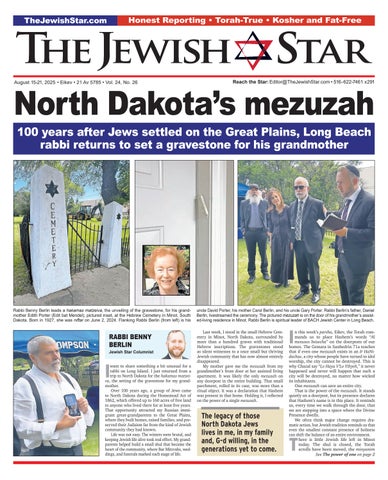
100 years after Jews settled on the Great Plains, Long Beach rabbi returns to set a gravestone for his grandmother
Rabbi Benny Berlin leads a hakamas matzeiva, the unveiling of the gravestone, for his grandmother Edith Porter (Edit bat Mendel), pictured inset, at the Hebrew Cemetery in Minot, South Dakota. Born in 1927, she was niftar on June 2, 2024. Flanking Rabbi Berlin (from left) is his
RABBI BENNY BERLIN
Jewish Star Columnist
I
want to share something a bit unusual for a rabbi on Long Island. I just returned from a trip to North Dakota for the hakamas matzeiva, the setting of the gravestone for my grandmother. Over 100 years ago, a group of Jews came to North Dakota during the Homestead Act of 1862, which offered up to 160 acres of free land to anyone who lived there for at least five years. That opportunity attracted my Russian immigrant great-grandparents to the Great Plains, where they built homes, raised families, and preserved their Judaism far from the kind of Jewish community they had known. Life was not easy. The winters were brutal, and keeping Jewish life alive took real effort. My grandparents helped build a small shul that became the heart of the community, where Bar Mitzvahs, weddings, and funerals marked each stage of life.
uncle David Porter, his mother Carol Berlin, and his uncle Gary Porter. Rabbi Berlin’s father, Daniel Berlin, livestreamed the ceremony. The pictured mezuzah is on the door of his grandmother’s assisted-living residence in Minot. Rabbi Berlin is spiritual leader of BACH Jewish Center in Long Beach. Last week, I stood in the small Hebrew Cemetery in Minot, North Dakota, surrounded by more than a hundred graves with traditional Hebrew inscriptions. The gravestones stood as silent witnesses to a once small but thriving Jewish community that has now almost entirely disappeared. My mother gave me the mezuzah from my grandmother’s front door at her assisted living apartment. It was likely the only mezuzah on any doorpost in the entire building. That small parchment, rolled in its case, was more than a ritual object. It was a declaration that Hashem was present in that home. Holding it, I reflected on the power of a single mezuzah.
The legacy of those North Dakota Jews lives in me, in my family and, G-d willing, in the generations yet to come.
I
n this week’s parsha, Eikev, the Torah commands us to place Hashem’s words “Al mezuzos beisecha” on the doorposts of our homes. The Gemara in Sanhedrin 71a teaches that if even one mezuzah exists in an Ir HaNidachas, a city whose people have turned to idol worship, the city cannot be destroyed. This is why Chazal say “Lo Haya V’Lo Yihyeh,” it never happened and never will happen that such a city will be destroyed, no matter how wicked its inhabitants. One mezuzah can save an entire city. That is the power of the mezuzah. It stands quietly on a doorpost, but its presence declares that Hashem’s name is in this place. It reminds us, every time we walk through the door, that we are stepping into a space where the Divine Presence dwells. We often think major change requires dramatic action, but Jewish tradition reminds us that even the smallest constant presence of holiness can shift the balance of an entire environment. here is little Jewish life left in Minot today. The shul is closed, the Torah scrolls have been moved, the minyanim See The power of one on page 2
T