TheJewishStar.com
Honest Reporting • Torah-True • Kosher and Fat-Free
July 17-30, 2026 • Devarim • 3 Av 5786 • Vol. 25, No. 22
Reach the Star: Editor@TheJewishStar.com • 516-622-7461 x291
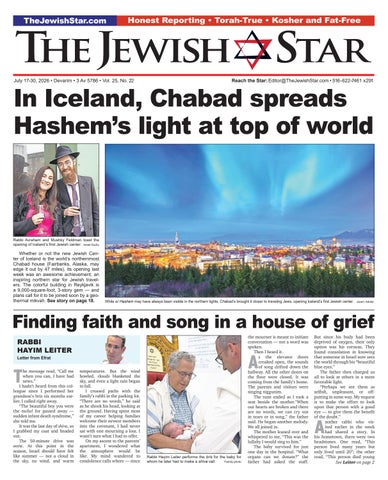
In Iceland, Chabad spreads Hashem’s light at top of world
Rabbi Avraham and Mushky Feldman toast the opening of Iceland’s first Jewish center. Israel Sudry
Whether or not the new Jewish Center of Iceland is the world’s northernmost Chabad house (Fairbanks, Alaska, may edge it out by 47 miles), its opening last week was an awesome achievement, an inspiring northern star for Jewish travelers. The colorful building in Reykjavik is a 9,000-square-foot, 3-story gem — and plans call for it to be joined soon by a geothermal mikvah. See story on page 18.
While or Hashem may have always been visible in the northern lights, Chabad’s brought it closer to traveling Jews, opening Iceland’s first Jewish center.
Javen, Adobe
Finding faith and song in a house of grief RABBI HAYIM LEITER
A
Letter from Efrat
T
he message read, “Call me when you can, I have bad news.” I hadn’t heard from this colleague since I performed her grandson’s bris six months earlier. I called right away. “The beautiful boy you were the mohel for passed away — sudden infant death syndrome,” she told me. It was the last day of shiva, so I grabbed my coat and headed out. The 50-minute drive was eerie. At this point in the season, Israel should have felt like summer — not a cloud in the sky, no wind, and warm
temperatures. But the wind howled, clouds blanketed the sky, and even a light rain began to fall. I crossed paths with the family’s rabbi in the parking lot. “There are no words,” he said as he shook his head, looking at the ground. Having spent most of my career helping families welcome their newest members into the covenant, I had never sat with one mourning a loss. I wasn’t sure what I had to offer. On my ascent to the parents’ apartment, I wondered what the atmosphere would be like. My mind wandered to condolence calls where — since
the mourner is meant to initiate conversation — not a word was spoken. Then I heard it. s the elevator doors creaked open, the sounds of song drifted down the hallway. All the other doors on the floor were closed. It was coming from the family’s home. The parents and visitors were singing niggunim. The tune ended as I took a seat beside the mother.“When our hearts are broken and there are no words, we can cry out in tears or in song,” the father said. He began another melody. We all joined in. The mother leaned over and whispered to me, “This was the lullaby I would sing to him.” The baby survived for just one day in the hospital. “What organs can we donate?” the father had asked the staff.
Rabbi Hayim Leiter performs the bris for the baby for whom he later had to make a shiva call. Family photo
But since his body had been deprived of oxygen, their only option was his corneas. They found consolation in knowing that someone in Israel now sees the world through his “beautiful blue eyes.” The father then charged us all to look at others in a more favorable light. “Perhaps we see them as selfish, unpleasant, or offputting in some way. My request is to make the effort to look upon that person with a good eye — to give them the benefit of the doubt.” nother rabbi who visited earlier in the week had shared a story. In his hometown, there were two headstones. One read, “This person lived many years but only lived until 20”; the other read, “This person died young See Leiter on page 2
A