TheJewishStar.com
Honest Reporting • Torah-True • Kosher and Fat-Free
War or peace, I’m going Reach the Star: Editor@TheJewishStar.com • 516-622-7461 x291
June 12-18, 2026 • Sh’lach • 27 Sivan 5786 • Vol. 25, No. 18
c Fear cannot have a permanent veto over Jewish life.
STepHen M. FlaToW
A
s the father of a terror victim, as a Zionist and as an Israeli citizen, I quake with the report of every missile strike or terror attack against the Jewish state. That is not a figure of speech. It is not political theater. It is the involuntary reaction of someone who knows what a phone call can mean, what a headline can hide, and how quickly an ordinary day can become the day that divides a family’s life into before and after. The targets are always civilians. They are people going about their lives, trying to make a shekel, waiting for a bus, walking along a street, taking a child to school, visiting a parent, finishing a shift at work or sitting down for dinner when a missile or terrorist strikes. And so, 24 hours after the latest wave of missile attacks, I am off to Israel. I am no hero for doing this. It’s just who I have become. ran’s latest missile barrage against Israel on June 7 was not an abstraction. It was not some distant geopolitical chess move. It was an attack on a living country — on families, on hospitals, on children, on the elderly, on the frightened and the defiant alike. According to reports, Iran fired roughly 10 or 11 ballistic missiles toward Israel in several waves. The missiles were intercepted, thank G-d. But “intercepted” is not the same as harmless. Every siren is a warning that murder is incoming. Every scramble to a shelter is a reminder that Israeli children grow up learning how many seconds they have to live. Every hospital that moves patients underground is a
I
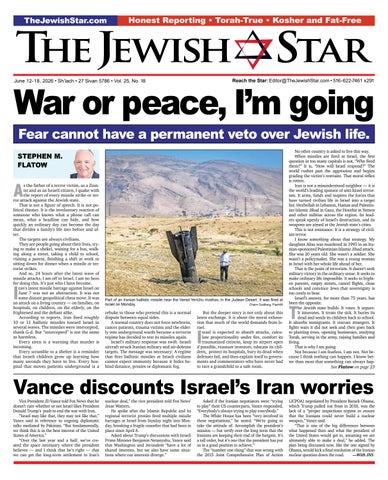
Part of an Iranian ballistic missile near the Vered Yericho moshav, in the Judean Desert. It was fired at Israel on Monday. Chaim Goldberg, Flash90
rebuke to those who pretend this is a normal dispute between equal sides. A normal country does not force newborns, cancer patients, trauma victims and the elderly into underground wards because a terrorist regime has decided to test its missiles again. Israel’s military response was swift. Israeli aircraft struck Iranian military and air-defense targets. The message was necessary: A regime that fires ballistic missiles at Israeli civilians cannot expect immunity because it hides behind distance, proxies or diplomatic fog.
But the deeper story is not only about this latest exchange. It is about the moral exhaustion that much of the world demands from Israel. srael is expected to absorb attacks, calculate proportionality under fire, comfort its traumatized citizens, keep its airport open if possible, reassure investors, educate its children, protect its hospitals, bury its dead when defenses fail, and then explain itself to governments and commentators who have never had to race a grandchild to a safe room.
I
No other country is asked to live this way. When missiles are fired at Israel, the first question in too many capitals is not, “Who fired them?” It is, “How will Israel respond?” The world rushes past the aggression and begins grading the victim’s restraint. That moral reflex is rotten. Iran is not a misunderstood neighbor — it is the world’s leading sponsor of anti-Israel terrorism. It arms, funds and inspires the forces that have turned civilian life in Israel into a target list: Hezbollah in Lebanon, Hamas and Palestinian Islamic Jihad in Gaza, the Houthis in Yemen and other militias across the region. Its leaders speak openly of Israel’s destruction, and its weapons are aimed at the Jewish state’s cities. This is not resistance. It is a strategy of civilian terror. I know something about that strategy. My daughter Alisa was murdered in 1995 in an Iranian-sponsored Palestinian Islamic Jihad attack. She was 20 years old. She wasn’t a soldier. She wasn’t a policymaker. She was a young woman in Israel with her whole life ahead of her. That is the point of terrorism. It doesn’t seek military victory in the ordinary sense. It seeks to make ordinary life impossible. It seeks to frighten parents, empty streets, cancel flights, close schools and convince Jews that sovereignty is too costly to bear. Israel’s answer, for more than 75 years, has been the opposite. he Jewish state builds. It votes. It argues. It innovates. It treats the sick. It buries its dead and sends its children back to school. It absorbs immigrants. It rescues strangers. It fights wars it did not seek and then goes back to planting trees, opening businesses, studying Torah, serving in the army, raising families and living. That is why I am going. Not because I am fearless. I am not. Not because I think nothing can happen. I know better than most that something can always hapSee Flatow on page 23
T
Vance discounts Israel’s Iran worries
Vice President JD Vance told Fox News that he doesn’t care whether or not Israel likes President Donald Trump’s push to end the war with Iran. “Israel may like that, they may not like that,” Vance said in reference to ongoing diplomatic talks mediated by Pakistan. “But fundamentally, we think this is in the best interest of the United States of America.” “Over the last year and a half, we’ve created the space necessary where the president believes — and I think that he’s right — that we can get the long-term settlement to Iran’s
nuclear deal,” the vice president told Fox News’ Jesse Watters. He spoke after the Islamic Republic and its regional terrorist proxies fired multiple missile barrages at Israel from Sunday night into Monday, breaking a fragile ceasefire that had been in place since April 8. Asked about Trump’s discussions with Israeli Prime Minister Benjamin Netanyahu, Vance said that Washington and Jerusalem “have a lot of shared interests, but we also have some situations where our interests diverge.”
Asked if the Iranian negotiators were “trying to play” their US counterparts, Vance responded, “Everybody’s always trying to play everybody.” The White House has been “very involved in these negotiations,” he noted. “We’re going to take the attitude of: Accomplish the president’s mission — but verify over the long term that the Iranians are keeping their end of the bargain. It’s a tall order, but it’s one that the president has put us in a good position to achieve.” The “number one thing” that was wrong with the 2015 Joint Comprehensive Plan of Action
(JCPOA) negotiated by President Barack Obama, which Trump pulled out from in 2018, was the lack of a “proper inspections regime to ensure that the Iranians could never build a nuclear weapon,” Vance said. “That is one of the big differences between what happened then and what the president of the United States would get to, assuming we are ultimately able to make a deal,” he added. The plan being discussed now, like the one signed by Obama, would kick a final resolution of the Iranian nuclear question down the road. —With JNS