TheJewishStar.com
Honest Reporting • Torah-True • Kosher and Fat-Free
IRANIAN IMPASSE May 1-7, 2026 • Emor • 14 Iyar 5786 • Vol. 25, No. 13
Reach the Star: Editor@TheJewishStar.com • 516-622-7461 x291
Why haven’t we won yet?
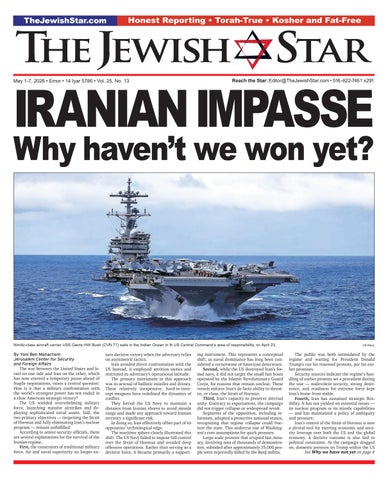
Nimitz-class aircraft carrier USS Geore HW Bush (CVN 77) sails in the Indian Ocean in th US Central Command’s area of responsibility, on April 23.
By Yoni Ben Menachem Jerusalem Center for Security and Foreign Affairs The war between the United States and Israel on one side and Iran on the other, which has now entered a temporary pause ahead of fragile negotiations, raises a central question: How is it that a military confrontation with the world’s strongest power has not ended in a clear American strategic victory? The US wielded overwhelming military force, launching massive airstrikes and deploying sophisticated naval assets. Still, the two primary objectives — reopening the Strait of Hormuz and fully eliminating Iran’s nuclear program — remain unfulfilled. According to senior security officials, there are several explanations for the survival of the Iranian regime. First, the constraints of traditional military force. Air and naval superiority no longer en-
sure decisive victory when the adversary relies on asymmetric tactics. Iran avoided direct confrontation with the US Instead, it employed attrition tactics and restricted its adversary’s operational latitude. The primary instrument in this approach was its arsenal of ballistic missiles and drones. These relatively inexpensive, hard-to-intercept weapons have redefined the dynamics of conflict. They forced the US Navy to maintain a distance from Iranian shores to avoid missile range and made any approach toward Iranian territory a significant risk. In doing so, Iran effectively offset part of its opponents’ technological edge. The maritime sphere clearly illustrated this shift. The US Navy failed to impose full control over the Strait of Hormuz and avoided deep offensive operations. Rather than serving as a decisive force, it became primarily a support-
ing instrument. This represents a conceptual shift, as naval dominance has long been considered a cornerstone of American deterrence. Second, while the US destroyed Iran’s formal navy, it did not target the small fast boats operated by the Islamic Revolutionary Guard Corps, for reasons that remain unclear. These vessels enforce Iran’s de facto ability to threaten, or close, the Strait of Hormuz. Third, Iran’s capacity to preserve internal unity. Contrary to expectations, the campaign did not trigger collapse or widespread revolt. Segments of the opposition, including reformists, adopted a protective national stance, recognizing that regime collapse could fracture the state. This undercut one of Washington’s core assumptions for quick pressure. Large-scale protests that erupted last January, involving tens of thousands of demonstrators, subsided after approximately 35,000 people were reportedly killed by the Basij militia.
US Navy
The public was both intimidated by the regime and waiting for President Donald Trump’s cue for renewed protests, per his earlier promises. Security sources indicate the regime’s handling of earlier protests set a precedent during the war — malevolent security, strong deterrence, and readiness for extreme force kept Iran’s home front stable. Fourth, Iran has sustained strategic flexibility. It has not yielded on essential issues — its nuclear program or its missile capabilities — and has maintained a policy of ambiguity and pressure. Iran’s control of the Strait of Hormuz is now a pivotal tool for exerting economic and security leverage over both the US and the global economy. A decisive outcome is also tied to political constraints. As the campaign dragged on, domestic pressure on Trump within the US See Why we have not yet on page 4