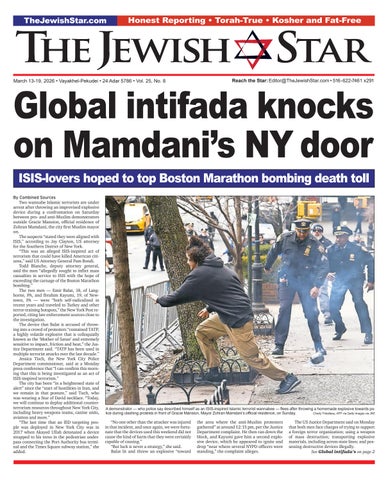
Two wannabe Islamic terrorists are under arrest after throwing an improvised explosive device during a confrontation on Saturday between pro- and anti-Muslim demonstrators outside Gracie Mansion, official residence of Zohran Mamdani, the city first Muslim mayor on.
The suspects “stated they were aligned with ISIS,” according to Jay Clayton, US attorney for the Southern District of New York.
“This was an alleged ISIS-inspired act of terrorism that could have killed American citizens,” said US Attorney General Pam Bondi. Todd Blanche, deputy attorney general, said the men “allegedly sought to inflict mass casualties in service to ISIS with the hope of exceeding the carnage of the Boston Marathon bombing.”
The two men — Emir Balat, 18, of Langhorne, PA, and Ibrahim Kayumi, 19, of Newtown, PA — were “both self-radicalized in recent years and traveled to Turkey and other terror-training hotspots,” the New York Post reported, citing law enforcement sources close to the investigation.
The device that Balat is accused of throwing into a crowd of protesters “contained TATP, a highly volatile explosive that is colloquially known as the ‘Mother of Satan’ and extremely sensitive to impact, friction and heat,” the Justice Department said. “TATP has been used in multiple terrorist attacks over the last decade.”
Jessica Tisch, the New York City Police Department commissioner, said at a Monday press conference that “I can confirm this morning that this is being investigated as an act of ISIS-inspired terrorism.”
The city has been “in a heightened state of alert” since the “start of hostilities in Iran, and we remain in that posture,” said Tisch, who was wearing a Star of David necklace. “Today, we will continue to deploy additional counterterrorism resources throughout New York City, including heavy weapons teams, canine units, aviation and more.”
“The last time that an IED targeting people was deployed in New York City was in 2017 when Akayed Ullah detonated a device strapped to his torso in the pedestrian underpass connecting the Port Authority bus terminal and the Times Square subway station,” she added.
door
“No one other than the attacker was injured in that incident, and once again, we were fortunate that the devices used this weekend did not cause the kind of harm that they were certainly capable of causing.”
“But luck is never a strategy,” she said. Balat lit and threw an explosive “toward
the area where the anti-Muslim protesters gathered” at around 12:15 pm, per the Justice Department complaint. He then ran down the block, and Kayumi gave him a second explosive device, which he appeared to ignite and drop “near where several NYPD officers were standing,” the complaint alleges.
The US Justice Department said on Monday that both men face charges of trying to support a foreign terror organization; using a weapon of mass destruction; transporting explosive materials, including across state lines; and possessing destructive devices illegally.
A demonstrator — who police say described himself as an ISIS-inspired Islamic terrorist wannabee — flees after
lice during clashing protests in front of Gracie Mansion, Mayor Zohran Mamdani’s official residence, on
Mamdani hosts anti-Israel rabble-rouser at Gracie
By David Isaac
Mayor
Zohran
Mamdani and his wife hosted Mahmoud Khalil, a former leader of anti-Israel protests at Columbia University and the target of an unsuccessful deportation effort by the federal government, for an Iftar dinner at the mayoral residence in Manhattan on Sunday.
“Last night, as we marked the one year anniversary of his detention, Rama and I were honored to welcome Mahmoud, Noor and their son Deen to Gracie Mansion to break our fast together,” Mamdani wrote on social media on March 9.
He included a photo of the meal, with his wife—whom Mamdani has defended as a private citizen after it reemerged that she liked social media posts glorifying the violence of Oct. 7 — standing beside Khalil.
“A year ago, Mahmoud was walking home through our city after sharing an iftar with his wife Noor when he was detained by federal agents, flown to Louisiana and then held in an ICE facility for months,” Mamdani stated.
Khalil was a spokesman for the anti-Israel encampment at Columbia.
Federal agents arrested him in March 2025 and a move to deport him was blocked by the courts. The federal government is still reportedly seeking his deportation.
“In New York City, terrorist sym-
pathizers have a seat at Zohran Mamdani’s table,” the Republican Jewish Coalition stated. “Mahmoud Khalil should be deported, not fluffed by the mayor of the City of New York. Disgraceful.”
Leo Terrell, who runs the US Jus-
tice Department task force on Jew-hatred, commented several times on the mayor hosting the activist at Gracie Mansion.
“After getting exposed for liking posts about Oct. 7, why waste any time before hosting a man who justi-
Global intifada’s knocking on
Continued from page 1
Those charges add up to a maximum sentence of 50 years to life for each individual, the department said.
“This isn’t a religion that just stands when people talk about the blessed name of the prophet,” Balant allegedly told police officers. “We take action! We take action!”
“If I didn’t do it someone else will come and do it,” he allegedly said. At the police station, he asked for a pen and paper and wrote “all praise is due to Allah, lord of all worlds,” per the complaint. “I pledge my allegiance to the Islamic State.”
He also used the ISIS slogan “die in your rage,” which he directed at non-believers, using an Arabic term, the Justice Department said.
According to the Justice Department, while Kayumi was inside a police car, he responded to someone in the crowd asking why he carried out the attack by saying “ISIS.” It added that he later told police officers that he is part of the terror group.
When police officers asked Balat if he was aware of the Boston Marathon bombing, he allegedly told them that he wanted to accomplish something “even bigger,” because “it was only three deaths.”
The brothers Tamerlan and Dzhokhar Tsarnaev killed three and injured more than 500 in the Boston bombing on April 15, 2013.
The target of Saturday’s aborted terrorist attack was a “Stop the Islamic takeover of New York City, stop New York City public Muslim prayer” rally outside Gracie Mansion.
Mayor Zohran Mamdani said that he and his wife knew that the protest was planned and were at the New York City Sign Museum in Brooklyn at the time.
When FBI specialists evaluated the mason jar-sized devices, they found that “each had an attached fuse, and that they each had nuts and bolts attached to the exterior, surrounded by duct tape.”
fies terrorism too?” he wrote. “These people are proud.”
“To Jewish students and faculty members of Columbia University: What do you think of the mayor inviting a Jew-hater for dinner?” Terrell wrote.
“To Jewish citizens who voted for Mamdani: Were you invited for dinner? Shame on you,” he added.
City Councilmember Inna Vernikov wrote that it was “just a casual dinner at Gracie with the lovely, private citizen, shy wifey, whose fingers could not keep up with liking posts about the massacre of Jews.”
Vernikov referred to Khalil as the “ringleader and chief ‘negotiator’ of Columbia’s antisemitic encampments where Jewish students were harassed and intimidated, and where they literally glorified convicted terrorists.”
“This is incredibly offensive to the Jewish community, as Mahmoud Khalil spent the last almost three years aggressively harassing Jewish students on campus,” wrote Rabbi Steven Burg, CEO of Aish. “Whether you agree with his deportation or not, his behavior was abhorrent and he should not be celebrated by the mayor.”
Mamdani’s wife, Rama Duwaji, is a Syrian-American born in Texas.
Khalil denied he was leading the protests. He said he was only acting as a spokesman and mediator for the
the
demonstrators, though there are images and videos of him leading protests.
The government attempted to deport him to Algeria, where he holds citizenship as a result of family ties to that country.
Robert Silverman, a former US diplomat and president of the American Foreign Service Association, writing in JNS in March 2025, said the visa application form asks: “Have you ever, or do you intend, to provide financial assistance or other support to terrorists or terrorist organizations?”
Khalil failed to disclose employment with the British embassy in Syria, according to federal authorities.
“Had he truthfully answered the questions on the visa form — nor perhaps had the visa officer checked out his social media — then he should have been denied a visa,” Silverman said. “But Khalil slipped through the visa vetting process. Then he married a US citizen, which allowed him to adjust status to permanent resident and get a pathway to citizenship.”
Silverman said Khalil engaged in state crimes, citing his involvement in the illegal occupation of several university buildings, his part in organizing an illegal encampment that barred “Zionist” students, and his mediation to pressure the Columbia administration to accommodate student demands based on their illegal activities.
mayor’s door…
Mayor Mamdani speaks
In a press conference on Monday, Mamdani led, as he did in a Sunday statement, with the anti-Muslim rally rather than with the attempted terror attack.
“This was a vile protest rooted in white supremacy entitled ‘Stop the Islamic takeover of New York City’,” he said. “I’m the first Muslim mayor of our city. Anti-Muslim bigotry is nothing new to me, nor is it anything new for the 1 million or so Muslim New Yorkers who know this city as our home.”
Mamdani said that the anti-Muslim protest was “appalling” but that he is unwavering in his belief that such a gathering is protected free speech. He then pivoted to discussing the violence and what he said was a mostly peaceful counter protest.
“Let me also be clear about something else. New York City will never tolerate violence, whether from protests or counter protests,” he said. “Many of the counter protesters met this
display of bigotry peacefully, with a vision of a city that is welcoming to all. But a few did not. Two men … traveled from Pennsylvania and attempted to bring violence to New York City.”
The two “are suspected of coming here to commit an act of terrorism,” he said. The mayor did not reference the statements the two allegedly made about supporting ISIS.
“They should be held fully accountable for their actions,” he added. “We will continue to keep New Yorkers safe. We will not tolerate terrorism or violence in our city.”
On Saturday, Brad Lander, a former New York City comptroller who is running for Congress, stated that “vile displays of Islamophobia will never be tolerated in our city.”
Some 20 hours later, Lander, an avowed anti-Zionist and a harsh critic of Israel, posted an update.
“The explosives yesterday near Gracie Mansion were not thrown by the Islamophobic protestors, but by their counter-protesters,” he stated. “I’m sorry for jumping to conclu-
sions and posting too soon, but I’m not sorry for hating Islamophobia as much as I hate antisemitism.”
Mamdani, who is also a harsh critic of Israel, drew criticism for his statement, which noted that “white supremacist Jake Lang organized a protest outside Gracie Mansion rooted in bigotry and racism.” The mayor did not make clear that the violence came from among some 100 people who were protesting against the small anti-Muslim protest.
“Violence at a protest is never acceptable,” the mayor stated. “The attempt to use an explosive device and hurt others is not only criminal, it is reprehensible and the antithesis of who we are.”
Some 40 minutes before Mamdani posted his statement, NYPD Commissioner Tisch named the two suspects who were arrested and said that department’s bomb squad “has conducted a preliminary analysis of a device that was ignited and deployed at a protest yesterday and has determined that it is not a hoax device or a smoke bomb. It is, in fact, an improvised explosive device that could have caused serious injury or death.”
“I want to again thank the brave members of the NYPD who ran towards the danger without hesitation and quickly apprehended the suspects,” Tisch said.
Rep. Mike Lawler, Republican of Westchester, decried Mamdani’s post.
“To give full context to what happened yesterday, the two individuals arrested for throwing a homemade explosive device filled with nails, have admitted to authorities they were inspired by ISIS,” Lawler said. “In other words, they were radical Islamic terrorists.”
“As mayor of the largest city in the world, and the greatest target of terrorism, you need to confront this head on. Don’t just call out one group of protestors and not the other group, and certainly don’t ignore the background of those responsible,” Lawler continued. “White supremacy and radical Islam are equally bad. That shouldn’t be hard to say.”
Mayor Zohran Mamdani and his wife host anti-Israel activist Mahmoud Khalil at Gracie Mansion, the official mayoral residence, on March 8. NYC mayoral social media
Mayor Zohran Mamdani holds a press conference at Gracie Mansion with New York City Police Commissioner Jessica Tisch, on Monday. Tisch is wearing a Jewish star. Ed Reed, Mayoral Photography Office
Episcopal Health Services Cancer Center
Now open at the Walsh Ambulatory Pavilion
EHS is proud to introduce the EHS Cancer Center at the new Walsh Ambulatory Pavilion, bringing together leading oncologists, comprehensive treatments, state-of-the-art technology (PET/CT, TrueBeam linear accelerator) and coordinated support services in a serene, streamlined setting. Radiation oncology is now available on the Rockaway Peninsula ������������������������������������������������������������ space, new physicians and new era of cancer care at EHS.
• Medical Oncology
• Radiation Oncology
• Surgical Oncology
• Immunotherapy
• Access to Clinical Trials Comprehensive
Treatments and Services
• Cancer Navigation Program
• Inpatient Physical Rehabilitation
• Social Work and Counseling
• EHS Specialty Pharmacy
• Pastoral and Spiritual Support
19-20 Brookhaven Avenue, Far Rockaway, NY 11691
For more information, visit ehs.org/oncology or call:
Mark Ashamalla, MDChief of Radiation Oncology (left) and Marc Warshawsky, MDChief of Hematology/Oncology (right)
Henry Ford to Tucker: ‘Just asking questions’
In recent weeks, former Fox News host and current podcast Tucker Carlson has been asking a series of questions about the joint US-Israeli war against Iran. Why did America strike? Who pushed the United States into the conflict? Could the war somehow be tied to Israel’s religious aspirations regarding the Temple Mount in Jerusalem?
Carlson insists that he is merely asking questions. His defenders argue that criticism of foreign policy — specifically, American involvement in Middle Eastern wars — is entirely legitimate. On that point, they are correct. Americans have always debated foreign policy, and vigorous disagreement is healthy in a democracy.
But there is something about Carlson’s line of questioning that should sound familiar to students of American history.
The pattern is not new.
In the early 1920s, industrialist Henry Ford used his newspaper, The Dearborn Independent, to publish a series of articles later compiled as “The International Jew.” The publication presented itself as investigative journalism. Week after week, it raised some “questions” about Jewish influence in banking, politics and world affairs. The articles suggested that Jews manipulated governments and pushed
nations into wars that served their interests.
Ford didn’t always make direct accusations. Instead, he initiated suspicions. He hinted and prodded. He invited readers to draw their own conclusions.
The result was one of the most influential antisemitic propaganda campaigns in American history.
A decade later, the Catholic priest Charles E. Coughlin reached tens of millions of Americans through his radio broadcasts. Like Ford before him, Coughlin framed his attacks on Jews and “international bankers” as populist criticism of elites and foreign entanglements. He claimed that he was defending ordinary Americans against hidden forces manipulating the country’s policies.
Coughlin also insisted he was simply raising questions.
Today, the technology has changed, but the rhetorical strategy remains remarkably similar.
Carlson’s podcast and streaming programs reach millions of listeners.
His influence rivals that of major television networks. When he repeatedly asks why Israel supposedly benefits from American military action or suggests that hidden actors are pushing the United States into war with Iran, the implication is clear, even if it is never stated outright.
The technique is simple and effective: raise provocative questions while avoiding direct claims.
“Could this be about rebuilding the Third Temple?” Carlson recently asked. No evidence is offered. None is re-
quired. The power of the insinuation lies precisely in its vagueness. Once such ideas are planted, they circulate widely across social media, detached from the context in which they were first raised.
None of this means that criticism of Israeli policy is antisemitic. It is not. Israelis themselves engage in vigorous debate about their government’s decisions every day.
Nor is isolationism inherently antisemitic. Americans have long debated whether the United States should intervene abroad or focus primarily on domestic concerns.
However, there is a clear line between legitimate debate and the revival of a familiar historical trope: the suggestion that Jews — or the Jewish
state — are manipulating great powers into wars for their own purposes.
That accusation has a long and ugly history.
It was used against Jews in Europe for centuries. It surfaced in America during debates over World War I and World War II. It animated the propaganda of figures like Ford and Coughlin. And it helped fuel antisemitic movements on both sides of the Atlantic.
History shows that once this narrative gains traction, it rarely stops with criticism of Israel. It inevitably expands into suspicion toward Jews more broadly.
For those of us who have experienced Iran’s terrorism firsthand, the current debate has an additional dimension.
My daughter Alisa was murdered in a 1995 terrorist bombing in Israel carried out by terrorists who were funded and trained by the Iranian regime. In the years since her death, I pursued legal action against Iran in US courts and obtained judgments recognizing its responsibility for sponsoring terrorism that killed Americans.
Iran’s leaders openly call for Israel’s destruction and have spent decades funding terrorist groups across the Middle East. Confronting that regime is not some mystical religious crusade or geopolitical conspiracy. It is a response to a government that has made violence against Americans and Israelis a central pillar of its policy.
Americans are free to debate how best to confront that threat. Reasonable people can disagree about strategy, diplomacy and military action. But history teaches us to pay attention when influential voices begin framing those debates through insinuations about Jewish motives or Israeli manipulation.
A century ago, Henry Ford used the pages of his newspaper to raise similar questions. A decade later, Father Charles Coughlin used the new medium of radio to spread the same suspicions to millions of Americans.
Today, the medium is podcasts and social media. But the formula hasn’t changed.
The insinuation is familiar. The questions sound the same. And history warns us where such questions can ultimately lead.
Write: Columnist@TheJewishStar.com
HOUSE Job Fair!
Now Hiring Sales Professionals
Richner Communications is expanding our sales team and looking for motivated, competitive professionals ready to grow their careers.
We offer strong earning potential, established multimedia products, digital solutions, and a respected brand presence throughout the communities we serve.
If you have proven sales experience and the drive to succeed, we
President Warren G. Harding with Thomas Edison and Henry Ford, as his guests stop informally in the woods to read newspapers in 1922. Getty Images via JNS
NSHA students chant ‘gantze’ Megillah for 24th year
Twenty-seven middle school students at North Shore Hebrew Academy in Great Neck chanted the gantze Megillah, the complete text of the Book of Esther, at the school’s Cherry Lane campus in Great Neck.
Students from both Ashkenazic and Sephardic backgrounds participated.
The program was created in 2001 by dermatologist Dr. Paul Brody. It was renamed the Dr. Paul Brody Megillah Readers Program when Brody retired four years ago.
The holiday holds particular significance in Great Neck, home to one of the largest Persian Jewish communities outside Israel.
As part of the program’s tradition, Ashkenazic readers wear a century-old tallis that belonged to Brody’s maternal grandfather, Rabbi Jacob Brown.
Brody said his grandfather encouraged him to read the entire Megillah after he first learned the trope from Rabbi Solomon Berl at the Cantorial Training Institute (now the Belz School of Jewish Music) at Yeshiva University. Cantor Yitzy Spinner instructed the Ashkenazic students, while Middle School Judaic Studies Principal Rabbi Simon Basalely and Elementary School Judaic Studies Principal Rabbi Adam Acobas worked with the Sephardic students.
Over the years, the Megillah Readers Program has trained hundreds of students. Some alumni have gone on to chant the entire Megillah themselves or share readings with others at synagogues, nursing homes and private residences.
Brody himself has read the Megillah publicly for more than five decades, including 30 years at the Great Neck Synagogue. He first read the Megillah in 1973 at the Young Israel of Kew Gardens Hills under Rabbi Fabian Schonfeld.
In 1985, in the Soviet Union, Brody read the Megillah clandestinely at the Great Synagogue of Leningrad while assisting Jewish refuseniks. “Better REaD than dead,” he figured.
At HALB, the colorful costumes come out for Purim
Students at North Shore Hebrew Academy’s Cherry Lane campus chant the Megillah on Purim, as part of the Dr. Paul Brody Megillah Readers Program. With student readers, from left: Cantor Yitzy Spinner, NSHA Executive Director Laura Cohen, Rosh HaYeshiva and Head of School Dr. Jeffrey Kobrin, program founder Dr. Paul Brody, and (at far right) Middle School Judaic Studies Principal Rabbi Simon Basalely. Abby Zausmer Weiss, NSHA
NY City Council caucus talks Jewish challenges
By Rikki Zagelbaum
Jewish communal leaders from across New York City met with members of the City Council’s Jewish Caucus on Friday to discuss rising Jewhatred, Holocaust education and the challenges that face Jewish service organizations in the city.
The hourlong meeting brought more than a dozen Jewish nonprofits and communal organizations together with city lawmakers for what Eric Dinowitz, chair of the caucus, said was a discussion about how he and fellow councilors can better support Jewish institutions and strengthen education efforts in public schools.
“We focused on the needs and challenges facing our service providers in the city,” Dinowitz, a Democrat who represents a Bronx district that includes Riverdale, told JNS.
“It was the first time in a long time that we had all of them sitting down together, sharing ideas, talking with one another and having us as members all hear directly from them at the same time,” he said.
Representatives came from the UJA-Federation of New York, Jewish Community Relations Council of New York, Blue Card, Met Council, New York Jewish Agenda, 92nd Street Y, Rabbi Sacks Legacy, Project Witness, Ohel Children’s Home and Family Services and Hatzolah.
Much of the conversation centered on education, particularly Shoah education in the city’s public schools and wider efforts to teach students about antisemitism and Jewish history.
“Whether it relates to antisemitism or to helping students in our city understand different cultures and histories, there is a real need for more robust education, particularly around the Holocaust and the diversity of the Jewish community,” Dinowitz said.
The council’s Jewish Caucus, made up of its Jewish members, works on issues affecting Jewish communities across the city, including rising antisemitism. Its members include Julie Menin, the council’s first Jewish speaker; Lynn Schulman of Forest Hills and Kew Gardens, caucus vice chair; Harvey Epstein of Midtown South and the Lower East Side; Lincoln Restler of Brooklyn Heights and
South Williamsburg; Simcha Felder of Midwood and Boro Park, and Inna Vernikov of Brighton Beach and Gravesend.
Dinowitz said that the meeting opened with a discussion of the council’s five-point plan to combat antisemitism.
“We’re there to support these groups,” Dinowitz said. “We’re grateful that these organizations are so hardworking and have already demonstrated really positive results.”
With Vernikov, Dinowitz also cochairs the City Council Task Force to Combat Antisemitism, a bipartisan body launched in 2026 as part of the five-point plan to combat Jew-hatred.
Vernikov, a former Democrat who is now the lone Republican on the caucus, is an outspoken supporter of President Donald Trump and has been a sharp critic of New York City Mayor Zohran Mamdani, who has taken a firm anti-Israel stance.
In February, Mamdani announced that Phylisa Wisdom, who has drawn criticism for what many see as an antiChassidic stance, was the new executive director of the Mayor’s Office to Combat Antisemitism, which the former Mayor Eric Adams, created.
“I’m willing to work with anyone who wants to tackle the crisis of antisemitism in our city,” Dinowitz said. “The mayor is continuing the office
that was created under the previous administration, and I look forward to working with anyone, including the mayor’s office, if it means addressing antisemitism.”
JNS asked Dinowitz what his message is for Jewish New Yorkers who are concerned about anti-Israel policies and statements from City Hall. Mamdani has said that he would have the Israeli prime minister arrested in the Big Apple, and his spokeswoman said that synagogues shouldn’t hold events in violation of international law, including pro-Israel gatherings.
“There are people in the New York City Council fighting day in and day out to make sure New Yorkers are safe and feel safe,” Dinowitz responded.
The caucus’s next steps include working to pass a city budget that can better sustain and support the nonprofit sector and bringing what Dinowitz called “tried-and-true educational methods” into more city schools.
“We want to make sure the groups in the Jewish community that are doing good work, not just for the Jewish community but for all New Yorkers, are uplifted and supported,” he said.
“Whether that means securing funding for these organizations, providing logistical support as they work with city agencies, passing a city budget that includes increases for humanservice providers or working with the Department of Education to embrace the rich diversity of New York City,” he said. “Those are all part of the work we are doing as a caucus.”
Note the ACCOLADES from our CLIENTS
RE: SYNAGOGUES and YESHIVOS
Dear Rabbi Leiner, Thank you for replacing the Insurance for our Synagogue, with a Savings of almost 50%.
B.F. Executive Director
RE: REAL ESTATE CORPORATION
Dear Rabbi Leiner, You and Your Experts, have saved our Corp. Very Substantial Sums, with your Quality Insurance Replacement on our Real Estate Buildings. Thank you, M.B. Pres.
RE: HOMEOWNERS INSURANCE
Dear Rabbi Leiner, Our Insurance Company Refused to renew our Insurance Homeowners Policy. However, You and Your Experts were able to Secure for us other Insurance Coverage, even at a much lower Premium, than the Prior Canceled Insurance Policy. Thank You So Much. Mrs. D.S.
Eric Dinowitz, chair of the NY City Council’s Jewish Caucus chairman, is flanked by City Council Chair Julie Menin and caucus vice-chair Lynn Schulman (in pink), at a roundtable with Jewish organizations and community stakeholders on March 5. William Alatriste,
High Performing Heart Care, Right Here on the South Shore
Mount Sinai South Nassau is proud to be named a high performing hospital in heart attack and heart failure by U.S. News & World Report ® year after year.
Our comprehensive heart care, including award-winning expertise in minimally invasive treatments to address blockages, has made us the premier choice for cardiac care on the South Shore. Cardiac surgeons from the world-renowned Mount Sinai Fuster Heart Hospital in Manhattan also now see patients at our Oceanside campus for pre and post operative evaluation and rehabilitation. The Mount Sinai Fuster Heart Hospital at The Mount Sinai Hospital is ranked No. 2 in the nation for Cardiology, Heart, and Vascular Surgery by U.S. News & World Report ®, outranking every cardiac program on the South Shore.
Learn more at mountsinai.org/southnassau
WINE AND DINE
Pesach is coming. It’s time for Matzah Balls!
t is time once again for the annual “Sinkers or Floaters” great debate. Should the Pesach Matzah Balls float in the chicken soup or should they sink below the surface?
This debate has raged through the ages, close in importance to the other great debates of our culture. And should we bend, just this once, and use (dare I even think it!) REAL chicken fat — schmaltz! — for flavoring? Should we clog our arteries just once a year for a taste that is like no other?
Such decisions must be carefully deliberated as we clean and cook to use up all the chometz in time.
I remember these matzah ball discussions from my childhood. My paternal grandmother made sinkers — dense, chewy flavorful kneidlach that tasted of chicken fat and gribenes. Everyone loved them. But the trend at the time was to make more modern matzah balls that were light and airy and totally different from what they considered kneidlach from the old world.
Every year my mother and aunts would discuss the matzah balls as if these Pesach delicacies were a world changing issue. Were they saltier than usual? Were there enough gribenes? Too much? Were they lighter than last year or chewier? My poor little grandmother would sit there and listen and tell everyone that she made them exactly like last year — even though she never used a recipe.
When Pesach moved to our house, my mother followed a matzah ball or “k’neidal” recipe from our synagogue’s cookbook.
Each year she would worry about them. Each year we would tell her they were delicious — and they usually were. They were lighter, but often, because they were so light, they fell apart in the cooking water.
Then suddenly, a matzah ball mix appeared in the market and my mother, like many other cooks, decided to end the yearly matzah ball
anxiety; from then on, any results would no longer be her fault — she could now blame it on Manischewitz!
Still, even with a no-fail mix, every year, new recipes make their ways into our kitchens. Spicy matzah balls, stuffed ones, potato-based — the list seems endless. And so, the debate continues with new generations and new recipes and choices that seem endless.
Whatever your favorite recipe may be — from scratch, or box, or a hybrid — I hope you have a wonderful Pesach and may the great debate continue for generations to come as we pass on our favorite recipes from generation to generation.
Matzah Ball 101
•Follow the recipe/directions carefully. The chilling time and mixing times are there to help create the perfect matzah ball according to the specific recipe, so don’t skimp on either.
•Most recipes call for chilling the mixture for at least an hour. Longer chilling time — even overnight — allows the liquid to really soften the matzah meal and make the matzah balls melt-inyour-mouth soft and delicious.
•Use either wet hands or oiled hands to form the matzah balls. I like to use a bit of vegetable oil as it helps keep the matzah balls smooth. (I also use disposable rubber or plastic gloves to keep hands clean.)
•Make all the matzah balls and place them on a plate/platter. Then put them into the water one by one, as quickly as possible.
•Don’t make the matzah balls too large — about the size of a walnut is best. They usually double or triple in size as they cook, so the larger they are to start with, the more likely they are to become “sinkers.”
•Use as large a pot as you can. The more room the matzah balls have to expand, the lighter and fluffier they will be when cooked.
•Make sure you add some salt to the water. They need the salt to help them keep their flavor but they won’t pick up much additional salty flavor, so don’t worry.
•Make sure you start with water at a rolling boil. Then, immediately turn the heat down to a gentle simmer just before you add the matzah balls. If the water boils too vigorously the matzah balls will fall apart. And be sure to keep the pot tightly covered.
•NEVER peek at cooking matzah balls! They will sink to the bottom of the pot. When the time is up, turn off heat, let the pot sit for 10 to 15 minutes, and then remove the cover. Remove matzah balls to a bowl or serve directly into bowls for soup.
Simple, Delicious Matzah Balls That Usually Float (Pareve)
Sometimes they sink and sometimes they float. But my kids love these simple matzah balls)
• 4 egg yolks (extra- large or jumbo), room temperature, separated
• 1 tsp. salt
• 1 Tbsp. grated onion
• 3 Tbsp. chicken fat or vegetable oil
• 1/4 cup club soda at room temperature
• 1 cup matzah meal
• 1 tsp. finely minced parsley
• OPTIONAL: 2 tbsp. finely chopped gribenes
Beat together the egg yolks, onion, salt, chicken fat or oil and parsley. Add the club soda
and mix well. Add the matzah meal, and optional gribenes, mix completely and set aside. Beat the egg whites until soft peaks form. Blend into the matzah meal mixture and fold gently. Cover and chill for at least an hour. Bring a large pot of salted water to a boil and, using oiled hands, make walnut sized balls. Place on a plate, reduce the heat to simmer, and then drop the matzah balls into the water one by one. Cover and simmer for 30 to 40 minutes. Let cool, covered, for 10 to 15 minutes and then uncover and serve.
• 2 tsp. any mixture of dried herbs like parsely, dill, tarragon, etc.
• 2 tsp. spices like garlic powder, onion powder, paprika, turmeric, cumin, any flavor mixture you like
• 4 Tbsp. grated onion, drained of liquid (more if you like)
• 1 tsp. (scant) salt
• 1/2 tsp. white pepper
• 1/4 cup cold seltzer or ice water
• 1/4 cup vegetable oil
• 1-1/2 cups matzah meal
Break the eggs into a large bowl. Beat them well. Add the oil and mix thoroughly. Add the herbs and spices and mix well. Add the seltzer or water and mix. Add the matzah meal and mix until well-blended. Cover and chill for at least an hour. (Overnight is fine.)
Bring a large pot of salted water to a rolling boil. Form walnut sized matzah balls, place on plate and then add to the water one at a time. Cover partially so that the steam can escape, this will ensure the chewiness, and cook for 30 to 40 minutes. Let cool for 10 to 15 minutes before serving.
These matzah balls are delicate and will barely hold their shape so make them small and treat them gently
• 5 Tbsp. chicken soup (use the fattier top part of the soup)
• 1 tsp. salt
• 1 tsp. baking powder (Kosher for Pesach)
• 1 cup matzah meal
• 4 extra-large eggs
• 2/3 cup (scant) vegetable oil or chicken fat
• 1 large head mashed roasted garlic
NOTE: TO roast garlic, take a small head of garlic and cut off the tips pf each clove. Place on a piece of aluminum foil. Drizzle generously with olive oil and sprinkle with kosher salt. Fold up the foil and bake at 350 for about 40 minutes or until golden and the cloves start to protrude from the skins. Let cool and remove the cloves with a fork. Add about 1 or 2 tablespoons of vegetable or olive oil and mash well to obtain a sour cream-like consistency.
Mix the oil and the eggs with a whisk just until blended. Don’t overmix or you will end up with mayonnaise! Add the broth and the salt and mashed garlic.
Mix well to evenly distribute the garlic. Mix the baking powder with the matzah meal and add in thirds, mixing well after each addition. Let stand for about 10 minutes. The batter should be soft. If it is too stiff, add some more chicken soup, using the fattier soup that has
Continued on next page
Sinking Chewy-Good Matzah Balls.
risen to the top. Cover and refrigerate for 1 to 3 hours.
Bring a large pot of salted water to a rolling boil. Reduce heat to a simmer. Use well oiled hands to make walnut sized balls with the matzah mixture.
Cover the pot and simmer gently for 35 to 40 minutes. I always go a little longer. Remember, these are delicate matzah balls, so handle them carefully. Use a slotted spoon to remove them from the water.
Matzah Balls
With Everything (Meat)
These matzah balls have it all from fresh parsley to gribenes and chicken fat. They are truly delicious and will remind you of your grandmothers’ kitchens.
• 4 large eggs
• 1/4 cup chicken fat
• 1/4 cup chopped onion pieces from the gribenes
• 1 tsp. salt
• 1/2 tsp. white pepper
• 1 to 2 roasted garlic cloves, mashed with 1 tbsp. vegetable oil
• 1/4 chicken soup
• 1 Tbsp. fresh, finely minced parsley
• 1 cup matzah meal
Beat the eggs and chicken fat. Add the onion bits, salt and pepper and mix well. Add the garlic and parsley and mix. Add the matzah meal, mix thoroughly and set aside for about 10 minutes. Stir again, cover and refrigerate for 2 to 3 hours. Bring a large pot of salted water to a rolling boil. Reduce heat to a simmer. Make the matzah mixture into small balls and set on a plate. Place them quickly into the boiling water, cover and simmer for 35 to 45 minutes. Remove with a slotted spoon.
Hot and Spicy Matzah Balls (Pareve)
These add a lot of zip to a bowl of chicken soup
and are also delicious as a side dish with chicken
• 3/4 cup minced onions, drained
• 2 scallions, green and white parts, minced
• 2 to 3 cloves garlic, grated or presses through a garlic press.
• 1/2 stick Pareve margarine
• 8 pieces regular matzah
• 1/4 tsp. (more to taste) cayenne pepper
• 2 jumbo or 3 extra large or 4 large eggs, separated
• 1/2 cup minced parsley
• 1/2 cup matzah meal
• 1 clove garlic, finely minced (more to taste)
• salt and pepper to taste
Set a large pot with salted water on the stove to boil.
Heat a large skillet over medium heat and add the margarine. Add the onions and scallions and sauté until lightly golden. Add the garlic, stir and remove from heat. Set aside. Break the matzah into very small pieces and soak it in water until very soft. Drain and squeeze out the excess water. Place the skillet with the onions back on medium heat and add the matzah, stirring until well blended.
Add the egg yolks and stir well. Add the cayenne, parsley, salt and pepper and cook, stirring constantly until the matzah is dry and leaves the sides of the pan when stirred. Turn off the heat. Beat the egg whites until stiff, but not dry. Fold into the matzah mixture. Pour the matzah meal in a small bowl and set aside. Using a little oil on your hands, roll the matzah mixture into small balls, and then roll them in the matzah meal. Set aside for 10 minutes and then lower them gently into the simmering water. Cover and simmer for 35 to 45 minutes. Remove with a slotted spoon and drain well.
Almond Matzah Balls (Meat)
These add a different taste and texture and are delicious.
• 4 extra-large eggs
• 1/2 cup club soda
• 2 Tbsp. vegetable oil or chicken fat
• 2 Tbsp. finely chopped parsley
• 1/4 cup ground almonds or walnuts
• 1 tsp. almond or walnut oil
• 1/4 tsp. freshly grated nutmeg
• 1/2 tsp. salt, more to taste
• Freshly ground black pepper to taste
• 1 cup matzo meal
Break the eggs into a large bowl. Whisk until blended and add the oil, soda salt and pepper. Whisk until well-blended. Add the ground nuts, nut oil, nutmeg, and matzah meal. Whisk thor-
oughly. Cover and refrigerate for several hours or overnight. Bring a large pot of water (6 to 8 quarts) to a boil. Add 1 teaspoon of salt. Oil or wet hands and form the mixture into walnut sized balls. Place them on an oiled cookie sheet or plate. Drop them quickly into the boiling water, cover the pot and let cook for about 40 to 50 minutes. Turn off the heat and let sit for about 10 minutes. Makes about 12 to 16 matzah balls.
Onion-Leek and Chive Matzah Balls (Meat)
• 1/2 cup (firmly packed) finely minced leeks (white and light green parts only)
• 1/2 cup (firmly packed) finely minced chives
• 2 Tbsp. grated onion
• 4 extra-large eggs
• 1 tsp. salt
• 1/2 tsp. pepper
• 3 Tbsp. ginger ale (not diet)
• 6 Tbsp. unsalted pareve margarine
• 1 cup matzah meal
Heat a medium skillet and add the margarine. When melted, add the leeks and sauté for about 5 to 7 minutes over medium to low heat to soften the leeks. Add the grated onion and stir for another 30 to 40 seconds. Add the chives and heat for another 30 to 40 seconds, stirring constantly. Set aside.
Place the eggs, ginger ale, salt, and pepper in a bowl. Whisk to blend. Add the leek mixture and mix well. Add the matzah meal and mix until well-blended. Cover and chill for several hours or overnight.
Heat a large pot of water and add a teaspoon of salt. Bring to a boil.
Make small matzah balls and place them on a well-oiled plate. When done, reduce the heat to a simmer, add them quickly, cover and simmer for about 40 to 50 minutes. Turn off the heat and keep covered for another 10 minutes. Makes about 24 regular sized or 48 mini-matzah balls. Write: Columnist@TheJewishStar.com
Onion-Leek and Chive Matzah Balls. amateurgourmet.com
Almond Matzah Balls.
Jewish Star Torah columnists: Rabbi Benny Berlin, spiritual leader of BACH Jewish Center in Long Beach; Rabbi Avi Billet of Anshei Chesed, Boynton Beach, FL, mohel and Five Towns native; Rabbi Binny Freedman, rosh yeshiva of Orayta, Jerusalem; Dr. Alan A. Mazurek, former ZOA chair, retired neurologist, living in Great Neck, Jerusalem and Florida.
Contributing writers: Rabbi Sir Jonathan Sacks zt”l, former chief rabbi of United Hebrew Congregations of British Commonwealth; Rabbi Yossy Goldman, president South African Rabbinical Association; Rabbi Dr. Tzvi Hersh Weinreb, OU executive VP emeritus.
Five Towns Candlelighting: From the White Shul, Far Rockaway, NY
Scarsdale Candlelighting: From the Young Israel of Scarsdale, Scarsdale, NY
Essential qualities for 3 types of communities
Along drama had taken place. Moses led the people from slavery to the beginning of the road to freedom. The people themselves witnessed G-d at Mount Sinai, became recipients of revelation. Then came the disappearance of Moses for his long sojourn at the top of the mountain, an absence which led to the Israelites’ greatest collective sin, the making of the Golden Calf. Moses returned to the mountain to plead for forgiveness, which was granted.
Its symbol was the second set of Tablets. Now a shattered people must be rebuilt. How does Moses proceed? The verse with which the sedra begins contains the clue:
Moses assembled all the community of Israel and said to them: “These are the things G-d has commanded you to do.” —Shemot 35:1
The verb vayakhel — which gives the sedra its name — is crucial to an understanding of the task in which Moses is engaged. At its simplest level it serves as a motiv-word, recalling a previous verse. In this case the verse is obvious:
When the people saw that Moses was long delayed in coming down the mountain, they assembled around Aaron and said to him, “Get up, make us gods to go before us.” —Shemot 32:1
Moses’ act is what the kabbalists called a tikkun : a restoration, a making-good-again, the redemption of a past misdemeanor. Just as the sin was committed by the people acting as a kahal or kehillah , so atonement was to be achieved by their again acting as a kehillah , this time by making a home for the Divine presence as they earlier sought to make a substitute for it.
Moses orchestrates the people for good, as they had once been assembled for bad (The difference lies not only in the purpose but in the form of the verb, from passive in the case of the Calf to active in the case of Moses. Passivity allows bad things to happen — “Wherever it says ‘and it came to pass’ it is a sign of impending tragedy”. (Megillah 10b) Proactivity is the defeat of tragedy:
“Wherever it says, ‘And there will be’ is a sign of impending joy.”—Bamidbar Rabbah 13 At a deeper level, though, the opening verse of the sedra alerts us to the nature of community in Judaism.
In classical Hebrew there are three different words for community: edah, tzibbur, and kehillah, and they signify different kinds of association.
Edah comes from the word ed, meaning “witness.” The verb ya’ad carries the meaning of “to appoint, fix, assign, destine, set apart, designate or determine.” The modern Hebrew noun te’udah means “certificate, document, attestation, aim, object, purpose, or mission.”
The people who constitute an edah have a strong sense of collective identity. They have witnessed the same things. They are bent on the same purpose. The Jewish people become an edah — a community of shared faith — only on receiving the first command:
“Tell the whole community of Israel that on the tenth day of this month each man is to take a lamb for his family, one for each household”. — Shemot 12:3
An edah can be a gathering for bad as well as good. The Israelites, on hearing the report of the spies, lose heart and say they want to return to Egypt. Throughout, they are referred to as the edah (as in “How long will this wicked community grumble against Me?” Bamidbar 14:27). The people agitated by Korach in his rebellion against Moses and Aaron’s authority is likewise called an edah (“If one man sins, will You be angry with the whole community ? Bamidbar 16:22). Nowadays the word is generally used for an ethnic or religious subgroup. An edah is a community of the like-minded. The word emphasises strong identity. It is a group whose members have much in common. By contrast the word tzibbur — it belongs to
Mishnaic rather than biblical Hebrew — comes from the root tz-b-r meaning “to heap” or “pile up”. (Bereishit 41:49) To understand the concept of tzibbur, think of a group of people praying at the Kotel. They may not know each other. They may never meet again. But for the moment, they happen to be ten people in the same place at the same time, and thus constitute a quorum for prayer.
Atzibbur is a community in the minimalist sense, a mere aggregate, formed by numbers rather than any sense of identity. A tzibbur is a group whose members may have nothing in common except that, at a certain point, they find themselves together and thus constitute a “public” for prayer or any other command which requires a minyan
A kehillah is different from the other two kinds of community. Its members are different from one another. In that sense it is like a tzibbur. But they are orchestrated together for a collective undertaking — one that involves making a distinctive contribution. The danger of a kehillah is that it can become a mass, a rabble, a crowd.
That is the meaning of the phrase in which Moses, descending the mountain, sees the people dancing around the Calf:
Moses saw that the people were running wild, for Aaron had let them run out of control and become a laughingstock to their enemies. —Shemot 32:25
The beauty of a kehillah, however, is that when it is driven by constructive purpose, it gathers together the distinct and separate contributions of many individuals, so that each
can say, “I helped to make this.” That is why, assembling the people on this occasion, Moses emphasizes that each has something different to give:
Bring of what is yours an offering to the L-rd. Let everyone who is willing bring an offering to the L-rd: gold, silver, and bronze. And let all among you who are skilled come and make the things that the L-rd has commanded. —Shemot 35:5, Shemot 35:10
Moses was able to turn the kehillah with its diversity into an edah with its singleness of purpose, while preserving the diversity of the gifts they brought to G-d:
So all the community of Israel left Moses’ presence. And they came, everyone whose heart inspired him and whose spirit moved him, and brought an offering for the L-rd, to be used for the Tent of Meeting and all its service, and for the sacred vestments. All whose hearts moved them –the men with the women — brought brooches, earrings, signet rings and pendants, all kinds of gold ornaments. …
Everyone who had sky-blue, purple, or scarlet wool. … Whoever could make an offering of silver or bronze brought it. … Every skilled woman spun with her own hands, and brought what she had spun. … All the women whose hearts inspired them used their skill. … The leaders brought rock crystal stones and other precious stones. … So the Israelites — all the men and women whose hearts moved them to bring anything for the work that the L-rd, through Moses, had commanded — brought it as a freewill offering to the L-rd. —Shemot 35:20-29
The greatness of the Tabernacle was that it was a collective achievement — one in which not everyone did the same thing. Each gave a different thing. Each contribution was valued — and therefore each participant felt valued. Vayakhel — Moses’ ability to forge out of the dissolution of the people a new and genuine kehillah — was one of his greatest achievements.
Many years later, Moses, according to the Sages, returned to the theme. Knowing that his career as a leader was drawing to an end, he prayed to G-d to appoint a successor: “May G-d, L-rd of the spirits of all flesh, appoint a person over the community.” (Bamidbar 27:16)
Rashi, following the Sages, explains the unusual phrase “L-rd of the spirits of all flesh” as follows:
He said to Him: L-rd of the universe, the character of each person is revealed and known to You — and You know that each is different. Therefore appoint for them a leader who is able to bear with each person as his or her temperament requires. —Rashi on Bamidbar 27:16
To preserve the diversity of a tzibbur with the unity of purpose of an edah — that is the challenge of kehillah -formation, communitybuilding, itself the greatest task of a great leader.
Our Father, Our King. ‘I will be what I will be’
DR. ALAN mAzUREK
Jewish Star columnist Great Neck / Jerusalem
Hashem has many names and titles. Being an Infinite Being, He likely has an infinite number of them.
We, however, are extremely finite beings. The concept of infinity is difficult for us to grasp, accept or even visualize. Because of that, forming a relationship with an Infinite Being can feel almost impossible.
Yet that is exactly what Hashem wants from us. Not merely a polite relationship, but an inti-
mate, loving, dependent and daily connection. That, in a nutshell, is why He gave us Torah and tefillah — to teach us how to relate to Him.
Before we get there, however, we must address the elephant in the room: those who do not believe in Him at all. For some, the vastness of the idea of the infinite makes belief seem illogical or unscientific. Yet the opposite is actually true. Consider mathematics.
Anyone who has studied geometry knows the number pi, the ratio of a circle’s circumference to its diameter. We usually say it equals 3.14, but that is only an approximation. In reality, pi has infinite decimal places — its digits continue forever without repeating. You can never know the exact value of pi, yet that does not stop us from using it.
He created everything — even pi.
Modern construction, space travel and advanced technology rely on this number. We estimate it, and that is sufficient for our finite world. Ask why pi is infinite and no one can answer — it simply is. And yet we confidently build our technology (even missions to the moon) upon it. Our world cannot function without it, and no one is troubled by that fact.
That, in a sense, is G-d. He simply is. He is infinite. He created everything, including the
Life, with woes, is what Mishkan
RABBI BENNY BERLIN Jewish Star columnist BACH Long Beach
There is a famous philosophical framework articulated by Plato that divides reality into two distinct realms. In the perfect realm exists the true tree, the true chair, the absolute form of every concept. And then there is our world, which Plato considered merely a partial and imperfect reflection of that higher reality. Truth exists above, in the realm of perfect forms. It is an idea the Torah quietly rejects in Par-
shas Vayakhel Pekudei.
The question begins with an obvious difficulty. The Torah is written in famously condensed language. Entire bodies of halacha are derived from a single extra letter or a seemingly redundant word. And yet here we encounter two full parshios that appear to repeat material we already know.
Parshas Terumah already recorded every detail of the Mishkan’s construction, down to the most precise specifications, as Hashem commanded Moshe. Why does the Torah spend two additional parshios repeating every plank, every curtain, every socket as Bnei Yisrael actually built it?
One sentence would have sufficed. Bnei
concept of pi. Just as you cannot draw a circle without pi, you cannot truly exist in this world without Him.
Accept it. Get over it. It’s as easy as pie (I couldn’t resist).
Once we accept His existence, another question arises. If G-d is infinitely powerful and merciful, why does He allow suffering? Why does evil flourish? Why do children develop leukemia? Why have the Jewish people endured so much persecution throughout history?
Why did a missile fall on a synagogue shelter in Beit Shemesh, killing nine people — including three children from one religious family? Why does a young mother die in childbirth on Purim?
See Mazurek on page 22
Hashem chose
a divine vision into the messy reality of the physical world.
Yisrael did everything exactly as Hashem commanded.
Why the repetition?
Many commentators note that the Torah describes not one Mishkan but two.
The Mishkan of Terumah exists first as a perfect divine vision. Flawless, ideal, a heavenly blueprint. And then there is the Mishkan of Vayakhel and Pekudei, constructed by human hands in the desert. By definition, it is imperfect. It is built by finite people attempting to translate
These are two entirely different structures. And yet it is specifically the second Mishkan, the human one, the imperfect one, where Hashem chooses to place His presence.
This is the Torah’s profound inversion of Plato. The Gemara states that Hashem does not enter the Yerushalayim shel maalah (the heavenly Jerusalem) until He first enters the Yerushalayim shel matah (the earthly Jerusalem) (Taanit 5a). The divine presence chooses to dwell not in abstract perfection first but in the imperfect reality created by human hands.
And that truth has a human face.
Living earthly lives while looking for Hashem
RABBI YossY GoLDmAN
S. African Rabbinical Assn.
How would you define the word “holy?” It’s not “religious,” nor is it “spiritual.” I actually prefer the word “distinctive.” One does not have to be otherworldly to be holy.
Take money, for example. It’s greasy, often corrupt, the ultimate expression of materialism. But give it to a pauper, and you’ve sanctified it.
This week in Vayakhel — the first of two portions read this Shabbat — the Mishkan, our sanctuary built in the wilderness, was finished. It was a place for G-d’s infinite presence to reside, be seen and felt tangibly. It would make the earthly
material world into a spiritual, holy, G-dly place.
For reasons the mystics grapple with, G-d desired that in the physical realm, there should be a manifestation of the Divine. So gold, silver, copper, different types of wool, tapestries, animal skins, spices etc., came together to create the sanctuary where G-d’s sacred presence would be discernible on earth.
Perhaps nowhere was this idea more evident than in the contribution by women.
He made the copper urn and its copper base from the mirrors of the women who had congregated at the entrance to the Tent of Meeting” (to give their contributions).” —Exodus 38:8
The urn was used for the Kohanim to wash their hands and feet before performing the sacred services in the sanctuary. Today, when the Kohanim bless the congregation in shul, they, too, must wash their hands first.
Rashi shares some of the behind-the-scenes goings-on. The copper the women were donating for the sanctuary was sheets polished brightly until they shone and became like mirrors. The women used them to adorn themselves. Moses found it distasteful to use objects of vanity in the House of G-d and was reluctant to accept them.
But G-d told him to take them from the women. Why? Because these mirrors were used to build the legions of Israelites back in Egypt. The
Since my childhood, I have been an avid reader. When I first discovered the joy of reading, I devoured everything I could get my hands on. Even today, my tastes remain eclectic. However, there is at least one genre of literature that I tend to avoid.
I do not read science fiction. I trace my distaste for the genre to one of its recurring themes: the possible existence of a fourth dimension. Somehow, the three dimensions of our ordinary reality are quite enough for me. The possibility of a mysterious fourth — a “black hole” in the
universe — has always struck me as unimaginable.
The three dimensions of our existence are not only part of physical reality. Forward and backward, left and right, up and down all play a role in our religious experience as well.
For example, when a Jew shakes the lulav on Sukkot, he moves it left and right, up and down, forward and backward. In doing so, he mimics the ritual of tenufah (waving) performed in the ancient Holy Temple, where sacred objects were lifted and rotated through all three dimensions. When the Shema is recited and the Jew declares that the L-rd is one, echad, he is instructed to imagine that G-d’s dominion extends over all three dimensions of existence — the horizontal plane, the vertical plane and the dimension of inner and outer.
Our tradition also speaks of another dimen-
Time,
sional triad — not three aspects of space, but three modes of human experience: time, space and person. In Hebrew, this triad is known as olam-shana-nefesh; literally, “world-year-soul.”
Part of our experience is temporal; we live in time. We also live spatially, bound by geography. And we possess an inner experience of consciousness and personal awareness. Thus, three dimensions.
These three dimensions play a central role in this week’s parsha, Vayakhel. Three themes intertwine in the chapters of Exodus 35:1–38:20 that comprise our parsha.
menfolk would come home after a day of backbreaking labor in the service of the Egyptian taskmasters, and they were hurting and exhausted. All they wanted was to sleep. But the women used their mirrors to entice their husbands to carry on their intimate marital relationships.
Far from denigrating these polished copper mirrors, G-d told Moses: “These are more precious to me than all the other donations.”
Thanks to the women using them, the Jewish people were fruitful and multiplied in Egypt. The Jewish nation was born as a result of these righteous women and their mirrors.
This story carries with it a very important and revealing message about the Jewish view of marriage and family. In faiths, the ideal holy men and women disavow marriage and pledge to live a life of celibacy. Other faiths encourage
See Goldman on page 22
Exploring the 3 dimensions of our spiritual life
These themes are the Sabbath, the Mishkan (Tabernacle), and the individuals addressed in the parsha — those who contribute materially and creatively to the Mishkan’s construction.
The parsha begins as Moses assembles the entire congregation of the Children of Israel. Moses and the Jewish people together constitute one dimension — one nefesh, one people. He shares with them the message of the Sabbath: working for six days and resting on the seventh. He commands them not to kindle fire in their homes on the Sabbath day. In doing so, he introduces the second dimension — time. He initiates the concept of sacred time, set apart from the mundane.
The remainder of the parsha describes the construction of a sacred place — a space demarcated from the surrounding environment.
See Berlin on page 22 See Weinreb on page 22
Published weekly except during certain religious and civil holidays by The Jewish Star LLC New York City office: 5676 Riverdale Ave Suite 311, Bronx NY 10471 • LI office: 2 Endo Blvd, Garden City NY 11530
Here’s how to reach The Jewish Star — Write: Editor@TheJewishStar.com. Call: 516-622-7461 ext 291
Editor & Publisher: Ed Weintrob
516-622-7461 ext 291
Jewish Star Associate: Nechama Bluth
516-622-7461 ext 241
Content: The Publisher endeavors to ensure that our content is within the bounds of normative halachah and hashkafah. Anyone who feels anything we publish may be inappropriate in this regard is urged to bring the item in question to the attention of the Publisher. Advertising is accepted at the sole discretion of the Publisher and should conform to standards appropriate for distribution in an Orthodox community. Send us your news! Editor@TheJewishStar.com
Advertising: Publisher@TheJewishStar.com
Kashrut: The Jewish Star is not responsible for the
MELISSA BRODSKY
Ithought I understood the Red-Green Alliance. At least in a general sense of what it was — leftists and Islamists finding common ground in some kind of oppositional politics. I filed it under “things I know enough about.” Then I sat down and read about it.
It’s not just a strange marriage of convenience. It’s a case study in how movements with completely opposite end goals can work together long enough to do serious damage, and how the weaker partner in that arrangement almost always ends up destroyed by it.
Here’s the basic structure, which most already know. But it sets the stage.
“Red” refers to the radical left: Marxists, socialists, movements rooted in communist ideology. “Green” refers to political Islam: Islamist ideology, movements inspired by the Muslim Brotherhood, the Iranian Islamic Revolution.
On paper, these two groups have nothing in common. One wants a classless secular workers’ state. The other wants a global Islamic caliphate governed by religious law. Those aren’t compatible visions. Not even a little.
Yet somehow they keep finding each other.
This happened in Iran in 1978 and 1979. Leftists, liberals, communists and secular progressives all joined with Ayatollah Khomeini to bring down the Shah.
They weren’t completely naive about his extremism. Many of them knew Khomeini’s politics were reactionary. They just convinced themselves he didn’t have the ability to actually take over. They thought they could use him — or at least outlast him.
They were wrong. Obviously.
On paper, these two groups have nothing in
kashrut of any product or establishment featured in its pages. If you have questions regarding any establishment or product, including its supervision, please consult your rabbi for guidance.
Submissions: All submissions become the property of The Jewish Star and may be edited and used by the Publisher, its licensees and affiliates, in print, on the web and/or in any media that now exists or will exist in the future in any form, including derivative works, throughout the world in perpetuity, without additional authorization or compensation. The individual or entity submitting material affirms that it holds the copyright or otherwise has the right to authorize its use in accordance with The Jewish Star’s terms for submissions.
Opinions: Views expressed by columnists and other writers do not necessarily reflect the position of the Publisher or of The Jewish Star LLC.
Distribution: The Jewish Star is available free in kosher food establishments, stores, synagogues, and curb-side newsboxes on Long Island, in New York City and elsewhere. To request free delivery to your location, write Publisher@TheJewishStar.com.
Copyright: All content is copyright and may not be republished or otherwise reproduced without written permission by The Jewish Star; to do so without permission is against the law and halacha. For content reproduction write to Publisher@TheJewishStar.com.
The Jewish Star subscribes to JNS. It, or its contributors, own the copyrights on material attributed to them. The length and content of JNS material and all other submitted material may be edited by The Jewish Star.
Member: American Jewish Press Association. This newspaper contains words of Torah. While it is not considered shaimos, please dispose properly.
OPINION COLUMNISTS
Mitchell Bard, foreign policy analyst, authority on USIsreal relations; Ben Cohen, senior analyst, Foundation for Defense of Democracies; Stephen Flatow, president, Religious Zionists of America-Mizrachi and father of Alisa Flatow, murdered in an Iranian-sponsored Palestinian terrorist attack in 1995; Yisrael Medad, Americanborn Israeli journalist and political commentator; Rafael Medoff, founding director of David S. Wyman Institute for Holocaust Studies; Fiamma Nirenstein, Italian-Israeli journalist, author of 13 books, leading voice on Israeli affairs, Middle Eastern politics and antisemitism; Melanie Phillips, British journalist; Moshe Phillips, national chairman, Americans for a Safe Israel; Thane Rosenbaum, Distinguished University Professor at Touro University (published by Jewish Journal); Jonathan S. Tobin, editor-in-chief, Jewish News Syndicate.
After the revolution succeeded, the Islamists consolidated power and turned on their former allies. Executions. Purges.
The leftists who helped bring Khomeini to power were among the first casualties of the state they helped create.
What makes that history even more damning is what was happening in the West at the same time.
When Saddam Hussein expelled Khomeini to a suburb of Paris in October 1978, Western journalists suddenly had access to him.
Over three months, Khomeini gave 132 interviews. He was portrayed as a pious reformer, maybe even a progressive figure. Intellectuals across Europe bought it.
Michel Foucault, one of the most influential philosophers of the 20th century, traveled to Iran and wrote glowingly about the revolution in progress, describing it as a new form of political spirituality. He wasn’t some outlier. He was the voice of the Western intellectual left, and he got it catastrophically wrong.
That’s the historical lesson. And it’s mindblowing that it hasn’t been learned. Right now in the West, you can watch this weird version of a tango play out.
Democratic Socialists of America simultaneously advocate for transgender youth healthcare and call for globalizing the intifada. University protesters march under banners that combine socialist slogans with Hamas ones. Groups with names like “Queers for Palestine” exist — apparently without any awareness of what Hamas actually does to gay people in Gaza.
Philosopher Judith Butler, a prominent queer theorist, has publicly described Hamas
and Hezbollah as part of “the global Left.”
This isn’t happening at the edges or in back alleys. It’s happening in mainstream progressive spaces, on major university campuses, in prominent activist organizations.
And we already know it’s not spontaneous.
Qatar has spent hundreds of millions of dollars funding academic programs at American universities, including Georgetown and Northwestern, that promote postcolonial frameworks which happen to align with both progressive and Islamist critiques of the West. Al Jazeera and its digital outlet AJ+ push the same talking points to Arabic and English-speaking audiences simultaneously. Iran and China have used bot networks to flood social media with antisemitic content, particularly since October 7.
These aren’t coincidences running in parallel — they’re deliberate pressure on the same fractures.
Which produces violence.
In May 2025, Elias Rodriguez shot and killed two young Israeli embassy workers, Yaron Lischinsky and Sarah Milgrim, outside a Washington DC event. He was captured on video chanting “Free Palestine” after the murders. His social media was full of socialist declarations and open contempt for the United States.
Days later, Mohamed Sabry Soliman threw incendiary devices at Jewish marchers in Boulder, Colorado. His online presence was wall-towall Muslim Brotherhood content.
Two attacks, two different ideological roads, the same targets.
Here’s what I find genuinely disconcerting: The leftists in this alliance aren’t secretly Islamist. Most of them are sincerely progressive
people who believe they’re fighting imperialism.
The problem is that their energy and moral credibility are being put to work for a movement that would, if it got what it wanted, demolish everything they claim to stand for. Women’s rights. Gay rights. Secularism. Free speech. All of it. They are, to quote a sadly tired and overused phrase that goes back to Lenin, useful idiots. There are no subtleties as to what happens to useful idiots after the revolution succeeds.
I want to be clear about something. I’m not saying that everyone who criticizes Israeli policy, or who has concerns about US foreign policy, is part of this alliance. That’s not the argument.
The Red-Green Alliance describes something specific. It’s an organized cooperation between Marxist radicalism and Islamism, aimed at taking down Western liberal democracy and, more explicitly, destroying Israel.
That’s a different thing from ordinary political disagreement. Blurring that line doesn’t help anyone think clearly.
What I am saying is that this alliance is more developed, better funded and more deliberately organized than I previously understood. I almost wish I steered clear of this rabbit hole.
The progressive left in the West has, in many cases, been too locked into its own worldview to see clearly what it’s walked into. Sadly, most don’t want to listen. At least, not the ones I’ve had conversations with. To them, I’m the brainwashed one, the indoctrinated one.
The Iranian leftists of 1979 had an excuse. Khomeini was a relatively unknown figure. They were moving fast inside a revolution with incomplete information. Foucault was writing from Paris, largely in the dark about what was coming.
But man … Western progressives in 2026? They have the complete historical record sitting right in front of them. If they had been paying attention at all to the past, then they should know where this leads in the future.
Melissa Brodsky is a copywriter and content strategist who became an “accidental activist” after October 7. Follow her on Facebook (facebook. com/melissabrodsky) and on Substack (substack. com/@thelionesswrites)
Write: Columnist@TheJewishStar.com
War began in 1979 with 52 American hostages
THANE ROSENBAUM Distinguished University Professor
An Islamist regime that terrorized the world and brutalized its own people is on its last legs — with those legs now nearly dismembered. Clerics purporting to be men of God, but who were actually cold killers, Jew-haters and enablers of child rape, are now, thankfully, dead. Since 1979, these fanatical Muslims killed at least 1,000 Americans.
As the world’s leading funder and cheerleader of terrorism, they assisted proxies such as Hezbollah, Hamas and Islamic Jihad, and other terror outfits such as ISIS, al-Qaeda, Al-Shabaab, Boko Haram, and the Taliban, to bomb and gun down Americans and Westerners.
Domestically, they tormented their own people with political executions, detentions, torture, and forced confessions that were broadcast on national television. The regime specialized in suppressing the freedom of women and girls. Stoning became a spectator sport. Homosexuals were hung from cranes. Religious minorities were consigned permanent infidel status.
All throughout their reign, Ayatollahs threatened the one democratic nation in its region with being “wiped off the map.” These shamelessly trigger-happy terrorists all the while enriched
uranium and never renounced their intention to acquire nuclear weapons so they could make good on their threats and ultimately globalize the Islamic Revolution.
Oh, one more thing: Iran was mischievously and financially allied with America’s enemies — China and Russia.
After 47 years as implacable nemesis finally coming to an end, many Americans, improbably, can’t take yes for an answer. They are, essentially, rooting for terrorists, taking up their depraved cause! Democratic Party leadership, America Firsters, and legions of anti-America, anti-Israel, pro-terror Islamists and socialists refuse to celebrate this monumental national security achievement.
Is this some kind of sick joke?
Many, instead, are mourning the Ayatollah and his mullah entourage. Some believe America was suckered into a war by Israel. Others maintain that the United States did not face an imminent threat and therefore should not have acted preemptively. Obviously, it’s always preferable to be Pearl Harbored than to initiate hostilities.
Only the Iranian people, Iranians in the diaspora, and Israelis can fully comprehend and wholly appreciate what has been taking place.
Iran posed no “imminent threat?” It has never not presented a guaranteed peril!
This war didn’t commence last week. It began in 1979 with an earlier Ayatollah declaring war by ransacking the American Embassy in Tehran and taking 52 Americans hostage for 444 days.
With moral clarity not clouded by anti-Trump, anti-Israel hysteria, everyone should be able to get behind this just war against Iran.
We are hastily calling this a war against Iran, but it is really a continuation of the War on Terror that commenced in 1979, reached its zenith on 9/11, and is still ongoing. What do you think the recent mass shooting in Austin, Texas — with the assailant wearing a “Property of Allah” hoodie — was really about? Molotov cocktails thrown at Jews walking along the Pearl Street Mall in Boulder, Colorado. Two murdered Embassy staffers outside the Capital Jewish Museum in Washington, DC.
Just ask the world’s most famous fatwa recipient, novelist and American citizen Salman Rushdie, whether Iran was maintaining peaceful relations with the United States. A few years ago, in upstate New York, Rushdie lost an eye and the use of one of his hands when an Islamist savagely reminded him that an Ayatollah’s death sentence is never forgotten.
Where were the outrage and solidarity from
American novelists and artists? No campus protests demanding justice for Rushdie?
Europeans understand this all too well. And Australians, after the Bondi Beach ambush, finally do, too.
The West has too slowly come to realize the ticking timebomb of those whose core beliefs erode Western values and are wholly incompatible with liberal democracies. Sharia courts are in session. No-go zones stop the police in their tracks. Grooming gangs have their way with white women.
Since 1979, there have been nearly 70,000 Islamic terrorist attacks worldwide, killing nearly 250,000 people. The fall of the Twin Towers and the bombing at the Boston Marathon in America; gunmen, suicide bombers and car rammings laying siege to subways, a concert hall, a major stadium, bars, restaurants, and Christmas markets
See Rosenbaum on page 22
Newsom asks regime change in Israel, not Iran
There is a great deal of anger swirling around California Gov. Gavin Newsom’s description of Israel “as sort of an apartheid state.” That anger is entirely justified.
The smear that Israel has duplicated the cruel Jim Crow-style segregation in the US South that prevailed in South Africa for much of the previous century was originated at the height of the Cold War by the Soviet Union, as an ideological justification for both its alignment with Israel’s Arab enemies and its persecution of its domestic Jewish population.
But lost in the furor is the fact that Newsom said something arguably far worse at the same event where he uttered the “apartheid” libel in making the case to end US military aid to Israel.
As Newsom speculated about what motivates Israeli Prime Minister Benjamin Netanyahu — pointing to his legal woes and Israel’s looming national election — he suddenly pivoted to the subject of the combined US and Israeli military
To place the Jewish state in the same category as a monstrous regime like the Islamic Republic is to enter a morally inverted world.
operation against Iran.
Here is what he said:
They couldn’t even — I mean, we’re talking about regime change? For two years, they haven’t even been able to solve the Hamas question in Israel. So this is, I mean, you know, I wanna be careful here, but, you know, in so many ways, that influence in the context of the conversation of where Trump ultimately landed on this is pretty damn self-evident.
These sentences are hardly eloquent, so one has to look closely to discern the meaning.
What stands out is the latter half of those remarks. The comments about Hamas are so vague as to be meaningless and could even be taken as criticism of the Israel Defense Forces for not going far enough in “solving” what Newsom called “the Hamas question in Israel.” But then he jumped back to the question of regime change in Iran.
There’s that telling whistle at the outset — “you know, I wanna be careful here.” That’s a form of words we’ve become accustomed to hearing whenever Jews are topic of conversation. What it really means is, “I’m about to invoke a stereotype about Jewish power, and I expect to be called an antisemite as a result.”
Among many listeners, such wording tends to elicit a sympathetic rolling of the eyes or shrug of the shoulders, as if to say, “right, I hear you, you just want to tell the truth, but it’s so hard to do that when it’s about the Jews.”
Then we get to the stereotype itself — “that influence in the context of the conversation of where Trump ultimately landed on this is pretty damn self-evident.”
Again, these words aren’t connected particularly elegantly, but their meaning is clear. The “influence” is not spelled out, but it’s obvious that this is a reference to Netanyahu and Israel (and very likely their supporters outside) in the
form of the nefarious “Jewish Lobby.”
It was an influence, Newsom says, that swayed President Donald Trump into attacking Iran instead of fretting about Israel’s actions in Gaza. For emphasis, he goes on to add that “this is pretty damn self-evident.” In other words, it is unarguable, so if you do argue with that contention, then you are automatically under suspicion.
Like the “apartheid” slur, the argument that the Jewish state dragged the United States into the current war against Iran’s vicious regime is based on distortions and half-truths rooted in the enduring myths about Jewish power and influence. Indeed, according to Trump, it was the other way around; he decided when to launch the attack, and the Israelis fell in line.
It’s correct that Israel’s primary concern is its own security and survival, as would be the case with any other state faced with an enemy sworn
to its destruction and determined to obtain nuclear weapons. But Israel’s calculus is narrower than that of the United States.
As the world’s main power, America is also concerned with, among other items, secure energy supplies, Iranian-backed terrorism against soft American targets in the Middle East and the well-being of its Arab allies, many of whom have spent at least the past decade praying for US-led action against the Islamic Republic in private while distancing themselves in public.
All this was as much, if not more, influential over US decision-making as Israel’s own imperatives were. Moreover, Israel is not asking Washington to fight alone on its behalf.
With the region’s best military, the Jewish state is a full partner in the operation — its fighter jets taking part in risky missions against targets that include the Tehran regime’s nuclear facilities and its infrastructure of repression in the form of the Islamic Revolutionary Guard Corps, the hated Basij militia and other allied institutions.
Newsom also caused offense by bracketing Israel’s democratically elected government with a theocracy that permits child marriage, tortures dissidents, and, in January, murdered some 30,000 anti-regime protesters in the space of a few days — and very likely more.
In two years of war in Gaza, up to 75,000 people were killed, many of them Hamas terrorists. The Iranian regime managed to eliminate at least half of that number in a fraction of that time, doing so while looking into the whites of the eyes of unarmed protesters.
To place Israel in the same category as a monstrous regime like this one — to hint, as Newsom did, that Israel should be a candidate for “regime change” in the way that Iran is — is to enter a morally inverted world. More practically, it is
Iranian Americans and other opponents of the Islamic regime rally outside the White House in on Jan. 3.
California Gov. Gavin Newsom at an event promoting his book “Young Man in a Hurry,“ on Feb. 28. Benjamin Fanjoy, Getty Images via JNS
Selective outrage as Jewish safety erodes in NY
Living as a Jew in New York City carries a particular tension.
•On one level, it is one of the most vibrant Jewish centers in the world. Synagogues are full. Jewish schools are thriving. Hebrew can be heard on sidewalks and in grocery stores. There is visibility and confidence.
•On another level, there is an understanding that visibility requires vigilance. That understanding has intensified over the past year. The data is clear. Jews remain the most targeted group in reported hate crimes in New York City.
Antisemitism today does not always arrive in the form of overt violence. It often surfaces in institutional responses that feel uneven. I saw this firsthand in a New York City school. After the Hamas-led terrorist attacks in Israel on Oct. 7, 2023, I wrote to school leadership asking that Jewish students be explicitly included when the administration addressed minority communities facing rising hostility.
The reply was polite and empathetic. Jewish families were assured that they were cared for. When I followed up and asked what concrete steps would be taken to address antisemitism in the school community, there was no response. The conversation ended.
We’re not competing over whose history is more painful. The issue is consistency.
Shortly afterward, my son came home from class and told me he had seen a flag displayed in the classroom that looked to him like a Nazi symbol. He was unsettled. I was unsettled. I sent an email with the subject line “Urgent response needed” and asked for clarification. The following day, I was told that the symbol in question was part of an ancient Indian tradition. That may well have been accurate. Intent matters. So does perception.
In a school community that includes descendants of Holocaust survivors, a symbol that resembles a swastika carries weight. Children do not parse historical nuance on their own. When a symbol evokes the memory of genocide, it requires explanation.
I asked that the school address the issue openly and provide context to students so that confusion and hurt would not linger. The image was removed. There was no broader communication. There was no acknowledgment that the resemblance itself had caused distress.
Afew weeks later, a racist remark targeting another minority group during a public meeting prompted an immediate and forceful response from school leadership. A clear statement was sent to families. The language was strong. The commitment to accountability was visible.
That response was appropriate. Racism demands clarity and action. The disparity in tone and urgency between the two situations raised a question that extends beyond one school. Why do some concerns trigger immediate institutional engagement while others are handled quietly and allowed to fade?
This is not a competition over whose history is more painful. Every community carries trauma. The issue is consistency. When institutions articulate values of inclusion and equity, those values must apply evenly. If a symbol or statement that harms one group requires a public response and restorative steps, then a
symbol or statement that harms Jews requires the same level of attention.
Selective engagement has consequences. It teaches Jewish families that their concerns may be acknowledged politely but will not always be treated as urgent. Over time, that lesson discourages people from speaking up. Silence becomes a coping mechanism. Silence also allows problems to grow.
Antisemitism has a long history of adapting to its environment. It appears in new language. It hides behind political discourse. It is sometimes minimized because Jews are perceived as successful or secure. The perception of security does not eliminate vulnerability. The increase in harassment and hate crimes over the past year confirms that.
Solutions require more than symbolic gestures. Schools and workplaces should state explicitly that antisemitism is addressed with the same seriousness as any other form of racism.
Educational programs on bias should include material on antisemitism, including its historical symbols and modern forms. Many educators are not trained to recognize how certain imagery or rhetoric affects Jewish students. Training can correct that gap.
Communication standards should also be consistent. When incidents arise, leadership should explain what happened, acknowledge impact and outline steps being taken. The quiet removal of a problem without discussion
See Shemesh on page 22
The Philippines remains Israel’s lifeline in Asia
History not only tests great powers but smaller nations as well. When the Jewish people faced two defining moments in the 20th century — the desperate search for refuge from Nazi persecution and the struggle to re-establish sovereignty in their ancestral homeland — the Philippines made a choice that placed it on the right side of history.
Separated from Israel by geography, culture and continent, the Philippines might have remained a distant observer of the Jewish story. Instead, at both moments of crisis, it chose involvement over indifference.
The first test came in 1937. As Nazi persecution intensified and the gates of the world narrowed to a sliver, the Philippines did what far larger and more powerful nations refused to do: It offered refuge.
Under Manuel L. Quezon, who served as the country’s second president from 1935 until his death in 1944, working with US High Commissioner Paul McNutt and the Frieder brothers of Manila, as many as 1,300 Jews fleeing Europe were granted sanctuary between 1937 and 1941. In an era defined by quotas, excuses and
closed borders, Manila opened a door. Quezon even backed an ambitious, but ultimately unrealized plan to resettle thousands of Jews as farmers on the island of Mindanao, underscoring how far the Philippines was prepared to go when others closed their doors.
Both are democracies — shaped by faith, anchored in family — navigating complex regional environments.
These refugees rebuilt their lives in the archipelago. They established businesses, practiced medicine, formed a functioning community and worshipped at Temple Emil — the first synagogue in the Philippines, dedicated in 1924 and named for communal leader Emil Bachrach. At the edge of Asia, Jewish life took root.
Bthe islands in the 16th and 17th centuries.
In the late 19th century, Jewish merchants from Europe, particularly from Alsace-Lorraine and Germany, settled in Manila as trade expanded. By the early 20th century, a modest but organized Jewish community had emerged.
World War II brought new uncertainty. When Japanese forces occupied the Philippines in 1942, Jewish refugees once again faced danger. Though some were interned alongside other foreign civilians during the occupation, they were not subjected to the systematic annihilation unfolding in Europe. The community endured until liberation.
Many later emigrated to the United States, Australia or the newly established State of Israel, but some remained, preserving a small yet continuous Jewish presence in Manila. After Temple Emil was destroyed during the war, the community rebuilt with help from the US Army and renamed it Beth Yaacov, preserving Jewish life in the archipelago.
A decade after the rescue effort began came the second test.
In November 1947, when the United Nations voted on the partition plan that would determine whether the Jewish people would regain sovereignty in their ancestral homeland, the Philippines again chose principle over pressure. It was the only Asian nation to vote in favor of the resolution that paved the way for the establishment of the State of Israel. In a vote that required a twothirds majority, every affirmative ballot mattered — and the Philippines provided one.
FSee Freund on page 22 Michael Freund
ut the Jewish presence in the Philippines, in fact, predated the refugee era. During Spanish colonial rule, conversos — descendants of Iberian Jews forced to convert during the 14th and 15th centuries — are believed to have reached
ormal diplomatic relations with Israel, established in 1958, have since grown into a multifaceted partnership grounded in the gratitude for 1937 and 1947.
A view from Park Slope, the upscale Brooklyn neighborhood where the author runs a Krav Maga studio. James, Adobe
Volunteers from the Philippines work at a vineyard in Kibuutz Malkia, near the Israeli border with Lebanon, in 2024. Ayal Margolin, Flash90
IN CANADA, JEWS ARE UP ‘SCHITT’S CREEK’
It’s not 400 BCE. Let’s escape the Esther trap
B’nai B’rith Canada
As Jews marked Purim, roughly 2,800 years after the events it commemorates, it is worth asking whether the political lesson many Jews draw from the story still holds. The uncomfortable answer is that it does not.
Purim tells the story of salvation through proximity to power. In the fifth century BCE, in what is now Iran, the Persian King Achashverosh took a Jewish woman, Esther, as his bride. Her uncle Mordechai encouraged the marriage after recognizing what it represented: access.
Esther’s presence in the palace proved decisive. When Haman, the king’s prime minister, issued a decree to exterminate the Jews, she used her influence to expose and reverse the genocidal policy. The Jewish people were saved because one of their own stood next to the throne.
The moral seems straightforward: If the Jewish community has one of its own positioned near the centre of power, that person will protect the community. Keep our heads down. Stay close to the ruler. Let the insider
The age of court politics is over.
do the work.
For centuries, that lesson made sense. Jews were a vulnerable minority living at the pleasure of monarchs, emperors and autocrats. Access and personal influence mattered enormously. Survival often depended on a single adviser or intermediary who could whisper into the ruler’s ear at the right moment.
But Canada in 2026 is not the Persian Empire. It is not the medieval court of Louis X of France, the Republic of Venice or the palace of Tsar Alexander III. Parliamentary democ-
racy does not operate the way the Book of Esther assumes. Yet much of the Jewish community still behaves as if it does.
There remains a persistent belief that electing Members of Parliament, appointing Jewish cabinet ministers or placing Jewish staffers in senior ranks of the civil service will somehow safeguard Jewish interests. So entrenched is this belief that some assume protection even if an elected official is merely married to someone Jewish, regardless of that official’s political commitments.
The hope is that shared identity will translate
into quiet advocacy, and that “one of ours” will subtly move the needle when it matters. The companion belief is that the leaders of major Jewish organizations, backed by wealthy donors, wield decisive influence behind closed doors. This is a basic error.
The Purim model treats power as personal and assumes the ruler’s mind is malleable. In 21st-century Canada, decision-making is centralized in the Prime Minister’s Office and enforced through strict party discipline. Former Prime Minister Pierre Trudeau famously described MPs as “nobodies” 50 yards from Parliament Hill and referred to backbenchers as “barking seals.” The language was harsh; the structural truth endures.
An MP, even a cabinet minister, who breaks ranks becomes isolated or removed. Personal identity offers no exemption from party discipline. Jewish MPs are no different.
Anthony Housefather represents one of the most heavily Jewish ridings in Canada. He is Jewish. Yet his Liberal Party recognized a Palestinian state, described Israel’s war against Hamas as a genocide and affirmed that Canada would arrest Israeli Prime Minister Benjamin Netanyahu if he set foot on Canadian soil. Whatever one’s view of those policies, the structural reality is undeniable: A Jewish MP does not control party doctrine.
What matters today is not who occupies a seat, but which ideas dominate a party, which coalitions are rewarded and which voting blocs are electorally decisive.
This reality is not new. The Jewish community, however, has been excruciatingly slow to break from the medieval model.
Bullets fly because Canada’s leaders look away
rAbbI
STEvEN burG
CEO, Aish Global
The Greater Toronto area was rocked by a shooting at a boxing gym in Richmond Hill, Ontario, owned by Salar Gholami, an Iranian-Canadian dissident who had spent years organizing pro-freedom rallies against the mullahs in Tehran. Seventeen bullets shattered his windows and walls a few hours after reports emerged of the Feb. 28 death of Iran’s supreme leader, Ayatollah Ali Khamenei. Another shooting took place on March 2, when gunmen opened fire on Temple EmanuEl in North York. Having just celebrated Purim, most congregants were barely out the door — some were still inside — when the shots rang out.
These are the predictable consequences of a political culture in Canada that has spent years signaling to extremists that the lives of those who oppose radical Islamist regimes are acceptable targets, especially Jewish lives. Canadian Jews and others who oppose radical Islam have watched the leadership of
More than a tweet, stopping Jew-hate requires a genuine change of heart.
their cities and the national leadership of the country fail to prevent the spread of radicalization for years. The mayor of Toronto positioned herself as a champion of progressive causes, going as far as to support Palestinian causes and calling the war in Gaza a genocide. Yet in her own city, she looked the other way as antisemitic hate crimes soared.
The country’s prime minister, Mark Carney, has gone even further, adopting language that demonizes Israel and echoes the talking points of those who would celebrate its destruction. He declared his support for a Palestinian state before the last Israeli hostage even left the Hamas-run Gaza Strip. When leaders at the highest levels of government treat the Jewish community as a political inconvenience rather than a community worthy of protection, they send a signal. That signal travels fast. Now it has arrived, in the form of bullets.
Toronto police confirmed that 22 antisemitic incidents have been reported so far this year alone, accounting for 63% of all hate-crime reports in the city. Let that number sink in.
Yet for far too long, the response from elected officials has been tepid, reactive and hollow. Toronto Mayor Olivia Chow posted a tweet condemning the synagogue shooting. But stopping hate requires more than a tweet — it requires action, and it requires a genuine change of heart among Canadian leadership.
The attack on the gym carries a broader warning that should alarm every freedomloving Canadian. Iranian-Canadian dissidents have been living under threat for years, yet they are still organizing, speaking out and demanding liberty for their people who con-
tinue to suffer under the Islamic Republic.
Canada designated the Islamic Revolutionary Guard Corps as a terrorist entity in June 2024. However, deportations have moved at a glacial pace, bogged down in bureaucratic delays and endless appeals.
Meanwhile, men like Gholami host rallies and get rewarded with 17 bullets through their windows. The IRGC does not respect borders; it follows its enemies across continents and into their neighborhoods. Canada has allowed its open-door immigration policies to become a vehicle for those who wish to export Tehran’s terror onto Canadian soil.
What connects these two attacks is a climate of permissiveness. The Canadian government refuses to enforce consequences for hate and prioritizes political positioning over public safety, while treating the concerns of the Jewish community or Iranian dissidents as inconvenient noise rather than urgent alarm bells. Carney, Chow and others like them create the conditions in which extremists feel emboldened.
The Jewish community warned that this would happen. It was said in op-eds, meetings and public statements. The Jewish community begged Canadian leadership to take the threat
“Haman begging Esther for Mercy,” Purim story, oil on panel, circa 1618, by Pieter Lastman. National Museum in Warsaw via WikiCommons
See Goldstein on page 23
Kevin Masterman, Toronto Police Service
Mazurek…
Why, G-d, why?
Asking that question may be as futile as asking why pi is infinite; still, we ask.
Moshe Rabbeinu himself asked this very question. In last week’s parsha, Ki Tisa, Moshe has perhaps the most remarkable conversation with Hashem in all of the Torah. This occurs after the sin of the Golden Calf, when Moshe pleads successfully for the survival of the Jewish people. He then asks that Hashem personally lead the nation through the desert.
But Moshe goes even further. He begs Hashem, “Hodieni na et derachecha (Make Your ways known to me)” (Exodus 33:13).
Rashi, citing the Talmud (Berachot 7a), explains that Moshe was asking the deepest question of all: Why do the righteous suffer while the wicked prosper?
Moshe continues pressing. He asks that the Jewish people remain distinct from all other nations, and he even asks Hashem to reveal His glory.
Hashem responds with great tenderness. He tells Moshe to stand on a rock. When His glory passes by, Hashem will place Moshe in the cleft of the rock and shield him. Moshe will be allowed to see G-d’s “back,” but not His face.
Of course, this language is metaphorical. It teaches that while we may ask why, we are ultimately incapable of fully understanding G-d’s actions.
Many scholars offer another analogy.
Life is like looking at a needlepoint from behind. From that perspective we see a tangled mess of threads and colors. Only when the canvas is turned over do we see the true image in its beauty and clarity.
So too with our lives.
We see the world only from behind. Still, we continue searching for answers.
King David did the same. In Psalm 86 he pleads with Hashem: “Horeni Hashem darkecha (Teach me your way).” The psalm offers no reply. Perhaps that silence itself is the answer.
In my humble opinion, Hashem is telling us: My children, you may never fully understand. Believe in Me. Trust in Me. Follow My Torah and mitzvot, and I will guide you just as I guided your ancestors in the desert.
Our sages teach that this dialogue with Moshe occurred after the sin of the Golden Calf, when we were no longer on the spiritual level we had achieved at Sinai with the first tablets.
For more than 3,000 years we have been striving to rise again. One day we will return to that elevated state — when Moshiach arrives.
Given the momentous events of our time, we pray that day is not far away.
Shabbat shalom.
Write: Columnist@TheJewishStar.com
Berlin…
Continued from page 15
A young couple from Krakow had been deeply in love before the Holocaust. The Nazi deportations separated them, and each believed the other had been killed. On the day of liberation, the young man spotted his kallah across the fence. They entered an abandoned home, and she caught a glimpse of herself in a broken mirror. She was horrified. Her hair had been shaved. Her body was gaunt and bruised. She looked nothing like the young woman he had once known. She turned to him and said, how can you possibly love me looking like this?
And he answered, you have never been more beautiful to me than you are right now.
He was not seeing the external. He was seeing a human being who had endured unimaginable darkness and still chose to live, to love, to walk forward. That shaken but unbroken will to continue, that was the beauty he saw.
That is what Hashem sees when He looks at us.
When Hashem sees a person carrying anxiety and imperfection, struggling to daven, struggling to maintain shalom bayis, struggling to pass their heritage to children who do not always want to receive it, and that person still tries, still lights Shabbos candles, still sits at a Seder, still reaches toward something higher, Hashem turns to the angels and says: did you ever see anything more beautiful?
This is precisely how Parshas Pekudei concludes. After all the human work, after the beams are raised and the curtains are hung, the Torah tells us that vayechas he’anan et Ohel Moed, u’kavod Hashem malei et haMishkan (Shemot 40:34). The cloud covered the Tent of Meeting, and the glory of Hashem filled the Mishkan.
Not the Mishkan of the perfect blueprint. The Mishkan that Betzalel built, assembled by human hands in the desert, imperfect and finite and holy.
Today we have no Temple. We have no altar. Our Mishkan is our homes. Our avodah is the life we are actually living, not the one we once imagined we would have.
Do not mourn the life you did not have. The life you have, with all of its struggles and imperfections, is the Mishkan Hashem chose.
Build it.
He will come.
Rabbi Benny Berlin is spiritual leader of BACH in Long Beach, www.bachlongbeach.com
Write: Columnist@TheJewishStar.com
Goldman…
escaping to the mountaintops to live lives far removed from the everyday, mundane, material existence. In their view, to be spiritual means to reject the physical.
Judaism says no to all that.
“In the beginning, G-d created the heaven and the earth,” is the very first line of the Bible. Heaven and earth are part of G-d’s universe. He is to be found down here on Earth as He is found in the heavens above. The whole purpose of creation was to establish a “dwelling place for G-d below.”
When we take the earthly, material world and use it for a higher purpose, a G-dly endeavor, we are bringing heaven down to earth and elevating the lowly earth to the heavenly realms.
So it was when the Israelites built the sanctuary in Moses’s time, and so it is now when we use the material world appropriately for worthy, G-dly causes.
We neither reject the world nor escape it. We embrace it. We engage with it. And by using it correctly as G-d has taught us, we elevate and sanctify it.
And that is why the Creator put us here in the first place, to do just that. We live human lives. We marry, we raise families, we use the material world to build a sanctuary for G-d on earth. Every mitzvah we do takes an element of the material world and sanctifies it — whether it be tefillin, kosher food, Shabbat candles, etc.
The women back in Egypt knew this secret. We must learn it, too.
Write: Columnist@TheJewishStar.com
Weinreb…
Throughout Parshat Vayakhel we read of those whose “hearts are stirred up and whose spirits are willing” (Exodus 35:21) to bring gifts and contributions from which this sacred space will be built. We read of the “wise-hearted women … whose hearts stirred them up in wisdom” (Ibid. 35:26), whose hands crafted the embroidered cloths that decorated this sanctuary.
We also read of two individuals, Bezalel and Oholiab, who are “filled with a G-dly spirit, with wisdom, understanding, and knowledge in all manner of workmanship” (Ibid. 35:31).
These three very different dimensions define not only the physical reality of space, but the spiritual reality of humanity. The human condition is such that space can be sanctified, time can be hallowed, and humans possess a transcendent spirit that distinguishes them from the rest of the animal world.
This week’s parsha is sometimes considered an uninspiring list of technical details. In truth, the lessons embedded in these three dimensions are among the most important in Scripture.
First comes the lesson of shana — time. We have the ability to set aside special moments for celebration, introspection and memory. This capacity has sustained the Jewish people throughout history. As the 19th-century thinker Ahad Ha’am famously wrote, “More than the Jewish people have kept the Sabbath; the Sabbath has kept the Jewish people.”
Then there is the lesson of olam — the world, the dimension of space. There are places that are home and places that are exile. While “home is where the heart is” in a psychological sense, in a national and religious sense the Land of Israel is our place. Our synagogues and study halls become sacred spaces wherever we may be.
Finally, there is the lesson of nefesh — the personal soul. It is our spiritual potential that enables us to sanctify time and place and thereby lend meaning and purpose to our lives.
A fourth dimension? Perhaps there is one. But for me, the three dimensions of olam, shana and nefesh are more than sufficient to provide an agenda for religious life — a powerful framework contained within this week’s parsha
Write: Columnist@TheJewishStar.com
Rosenbaum…
Continued from page 17
in Europe; and the massacre at the Nova Music Festival in Israel, are merely the best known. Yes, terrorism is terrifying and rightly generates phobia about Islam.
Was Hitler an “imminent threat” to the United States in late 1939? Should it have taken the Japanese attack on Pearl Harbor two years later to finally draw America into the fight? Many credit the United States for winning World War II. But might the Third Reich have come to a sooner end — making Japan’s entry superfluous — had the United States not taken an isolationist, America First stance?
Remember, the Nazis always spoke in euphemistic language: “The Final Solution to the Jewish Question,” and not Jewish genocide; “resettlement” and not death camps; “living space” and not global expansion. Perhaps there was cause for America to hesitate. Did we know for sure where this would all lead?
Iran, however, has never disguised its intentions with euphemisms. Just listen to what Islamists openly say in state rooms and mosques around the world: the clear intention to bend the will of Western nations toward Islamic teachings; manipulating the freedoms of democratic societies for duplicitous ends; and the killing of all Jews and infidels.
Hitler’s speeches were rife with Jewish scapegoating. But he never once spoke of “wiping countries off maps” or announced what he had in mind for Auschwitz.
Iran has never been coy. Trash-talking threats are always imminent. There is but one G-d, one prophet and one truth, and none of it has room for Judeo-Christian traditions.
With moral clarity not clouded by anti-Trump, anti-Israel hysteria, everyone should be able to get behind this just war against Iran — not unlike Israel’s just war in Gaza. For half a century, Iran has been begging to be defeated. That day has finally arrived. And it has come all wrapped up with the added bonus of expanding the list of Abraham Accord nations — Arabs and Jews coming together to fight a common enemy.
If ever there was a time to dance the hora, this is it.
Write: Columnist@TheJewishStar.com
from page 17
another ominous sign that the Democratic Party, once the political home of some of Israel’s greatest supporters in government and diplomacy, is steering itself in the same direction as left-wing parties in Europe. It is also a sign of the Palestinians’ success in elevating their cause into the center of the progressive consciousness to the exclusion of all else, nurturing terms like “genocide” and “apartheid” as sticks with which to beat Israel. At the same time, that strategy has won them no material benefits, least of all a state, while the alignment with Iran’s clerical regime does them no favors in much of the Sunni Arab world.
For as long as the Democratic Party is dominated by those who believe that the Palestinian cause is the only international cause that matters, forcing those in its ranks who still support Israel to sound apologetic and defensive, it cannot be regarded as a trustworthy partner in the quest for peace in the Middle East.
Such a peace must encompass the region with all its nationalities, minorities, religions and languages — not just the Palestinians — to be worthy of the word.
Write: Columnist@TheJewishStar.com
does not build trust; transparent communication does.
Jewish families also carry responsibility. Speaking up is uncomfortable; it can attract criticism. Some advise restraint. They argue that other groups have endured more visible suffering and therefore deserve greater attention.
That reasoning misunderstands equality. Addressing antisemitism does not diminish the legitimacy of other communities’ struggles. Rather, it affirms that equal standards apply to all.
New York remains home to one of the largest Jewish populations in the world. Its institutions have an opportunity to model principled consistency. When schools and workplaces respond evenly to all forms of hate, they strengthen social cohesion. When responses vary according to political or cultural pressure, they weaken it.
The safety of the Jewish community depends on more than police presence. It depends on whether institutions are willing to confront antisemitism with the same resolve they bring to other forms of bias. Equal protection under the law is a foundational principle. Equal moral clarity should accompany it.
If New York is to remain a city where Jews live openly and confidently, then the standard must be clear and unwavering. Harm is addressed fully. Concerns are taken seriously. Values are applied consistently. That is how trust is built. That is how communities remain strong.
Tsahi Shemesh is an Israeli-American veteran of the IDF Defense and founder of Krav Maga Experts in New York, with studios in Park Slope and on the Upper West Side.
Write: Columnist@TheJewishStar.com
Today, the Jewish community in the Philippines remains small, centered primarily in Manila, where Beth Yaacov synagogue serves as its communal hub. The community includes descendants of early settlers, expatriates, diplomats, businesspeople and a number of Filipinos who have formally embraced Judaism. Though modest in size, it reflects continuity — proof that Jewish life, once planted, can endure even far from traditional centers.
Continued from previous page outcomes, they do not control, and disappointment curdles into cynicism.
At the same time, some 30,000 Filipinos, the vast majority working as caregivers, have become part of the social fabric of Israel, forming a living bridge between the two nations. In Jerusalem, Tel Aviv and Haifa, the Tagalog language can be heard in parks and on buses. Filipino workers care for Israel’s elderly and vulnerable with dedication and warmth, forming bonds that often transcend employment. These quiet, human connections have deepened ties between the two societies in ways that official communiqués cannot replicate.
The relationship extends beyond people-topeople exchanges.
The Jewish state has provided agricultural expertise, water technology and emergency assistance to the Philippines. When typhoons and earthquakes strike the islands, Israeli humanitarian teams are often among the first to arrive. For example, after Typhoon Haiyan in 2013, Israel deployed a 148-member search-and-rescue and medical team that operated a field hospital and treated thousands of survivors.
Both nations understand adversity. Both are democracies navigating complex regional environments. Both are societies shaped by faith and anchored in family.
For the Jewish people, memory carries weight. We remember those who offered refuge when others would not. We remember those who stood with us when sovereignty hung in the balance.
By opening its doors in 1937, the Philippines saved not only lives but generations. Children and grandchildren of those refugees are alive today because Manila chose action over indifference.
In an era when moral clarity is often diluted by political calculation, the example of the Philippines endures. It demonstrates that influence is not measured solely by size or power. It is measured by choices.
Not once, but twice, the Philippines aligned itself with Jewish survival and Jewish sovereignty. That record speaks for itself, and its echoes can still be felt in Manila, Jerusalem and beyond.
Write: Columnist@TheJewishStar.com
Goldstein…
Continued from pag 21
Purim’s lesson traps Jewish organizations into submission before the king out of fear of losing favor. In Canada, where the Liberal Party has governed for most of Confederation, the Centre for Israel and Jewish Affairs (CIJA) is often accused of being too close to the Liberals. I was told directly by a senior leader that the organization did not want to criticize the Liberals for what many view as anti-Zionist antisemitism for fear of losing access.
That is palace politics.
After Hamas’ hideous attack on Oct. 7, numerous grassroots Jewish organizations emerged to fill what they perceived as a leadership vacuum. Among them is TAFSIK (Hebrew for “stop”), which has organized opposition to what it sees as the normalization of antisemitism and the misuse of “diversity” policies that divide rather than unite Canadians.
TAFSIK has done publicly what CIJA has hesitated to do: Call out government policies and rhetoric directly.
The reaction from segments of the legacy Jewish establishment has been telling. Dissenting organizations are marginalized. It echoes the anxiety of 18th-century court Jews who opposed broader Jewish emancipation because equality threatened their privileged access to sovereign power. Our error has consequences. It leads the community to over-invest in access and under-invest in persuasion. To celebrate representation while policies move in the opposite direction. To assume goodwill where political calculation governs. And, to engage in self-deception by supporting diversity policies that are the cause of normalizing antisemitism.
It also places Jewish politicians in an unfair position by expecting them to act as communal guardians in a system that does not permit individual guardianship. When they fail to deliver
The deeper lesson of Purim is not proximity. Esther did not merely occupy the palace; she confronted power publicly when the moment demanded it.
In a parliamentary democracy, influence is not secured by identity or access. It is earned through coalition-building, persuasion and electoral relevance.
The age of court politics is over. If Jewish Canadians want political security in the 21st century, we must abandon the comforting illusion that symbolic representation is protection — and learn how modern power actually works.
Sam Goldstein is a criminal lawyer in Toronto. He is the former director of legal affairs for B’nai B’rith Canada.
Write: Columnist@TheJewishStar.com
Burg…
Continued from page 21
The Jewish people have survived far worse and will survive this, too. Still, a community’s resilience should never be used by governments as an excuse to under-protect it.
Canada’s leaders must move beyond performative condemnation.
•They need to deport IRGC-linked operatives.
•They need to secure the borders against those who
lence dissidents and terrorize communities.
•They need to empower and resource the Hate Crime Unit and the Integrated Gun and Gang Task Force.
•Most importantly, the government needs to reflect honestly on the political rhetoric that has normalized hostility toward Israel, the Jewish community and those who protest terrorists over the past several years.
If the leadership of Canada continues to turn a blind eye toward blatant acts of criminal activity and hate crimes, then Canadians will see just how radical Islam can become within their own borders.
That would be a terrible shame and a blatant disregard for the peace, harmony and respect for life that the liberal government claims to champion.