The Jewish Star 03-05-2026

Page 1


March 6-12, 2026

17 Adar 5786

Ki Sisa

Vol. 25, No. 7

Reach the Star:

Editor@TheJewishStar.com

516-622-7461 x291

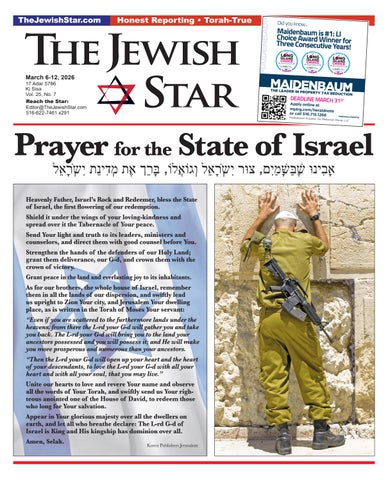
Prayer for the State of Israel

Heavenly Father, Israel’s Rock and Redeemer, bless the State of Israel, the first flowering of our redemption.

Shield it under the wings of your loving-kindness and spread over it the Tabernacle of Your peace.

Send Your light and truth to its leaders, ministers and counselors, and direct them with good counsel before You.

Strengthen the hands of the defenders of our Holy Land; grant them deliverance, our G-d, and crown them with the crown of victory.

Grant peace in the land and everlasting joy to its inhabitants.

As for our brothers, the whole house of Israel, remember them in all the lands of our dispersion, and swiftly lead us upright to Zion Your city, and Jerusalem Your dwelling place, as is written in the Torah of Moses Your servant:

“Even if you are scattered to the furthermore lands under the heavens, from there the L-rd your G-d will gather you and take you back. The L-rd your G-d will bring you to the land your ancestors possessed and you will possess it; and He will make you more prosperous and numerous than your ancestors.

“Then the L-rd your G-d will open up your heart and the heart of your descendants, to love the L-rd your G-d with all your heart and with all your soul, that you may live.”

Unite our hearts to love and revere Your name and observe all the words of Your Torah, and swiftly send us Your righteous anointed one of the House of David, to redeem those who long for Your salvation.

Appear in Your glorious majesty over all the dwellers on earth, and let all who breathe declare: The L-rd G-d of Israel is King and His kingship has dominion over all. Amen, Selah.

Finally, clock reads midnight for the mullahs

President Donald Trump boasted that “no president was willing to do what I am willing to do tonight,” speaking to the people of Iran shortly after unleashing a joint attack with Israel that may finally end the theocratic nightmare that has been their miserable fate since 1979.

He was right: For nearly half a century, the Iranian clerics who ruled the country with morality policemen and Revolutionary Guards did everything imaginable to deserve the retaliatory fury of the United States. And, yet, aside from last summer’s 12-Day War, which degraded Iran’s nuclear capabilities and led to the assassination of military brass, and the war that continues today, no other American president could make Trump’s claim.

Looking back, this failure is astonishing.

Instantly in 1979, Ayatollah Khomeini made no secret of his nation’s contempt for international norms. Drunkards on radical Islam stormed the American Embassy, taking and holding 52 hostages for 444 days. Jimmy Carter was the first of our presidents to cajole Iran to join the civilized world, only to look like a smiling peanut farmer with a toothless understanding of how to wield American power.

Until Trump, six American presidents nonchalantly watched Iran become a regional menace and the world’s chief instigator of terror. America had no business lounging on the sidelines.

After all, it was a frequent Iranian target: bombings at the American Embassy and Marine

barracks in Beirut, which left nearly 300 dead; over 600 American servicemen killed in Iraq; a pizza shop bombing in Jerusalem that resulted in American casualties; scores picked off by drone strikes at military bases; and of the 1,200 slaughtered in southern Israel by Iran’s proxy, Hamas, on October 7, 2023, 40 were American citizens.

No other president had the gumption to show the Islamic regime the consequences of messing with America and its Western allies. Countless times, thousands would gather on the streets of Tehran and shout, “Death to America!”— with Uncle Sam and the Israeli flag torched in effigy.

No other nation provoked more fights and behaved in such barbaric fashion. Threats to wipe Israel from the map became the calling card of Iranian diplomacy. All the while its scientists enriched uranium at weapons-grade levels for ostensibly “civilian” purposes. Iran was a global exporter of oil. Were they spinning centrifuges to eventually operate toasters?

The United States — the first victim of Iran’s terror operations — always gave the mullahs the benefit of the doubt. Slavish appeasement reached a new low with Barack Obama’s haughty confidence that he could charm the mullahs. Such faculty lounge hubris led to the pathetic

America’s new muscularity has placed the world on notice: This is no longer the US of Obama and Biden.

Iran “deal,” which had the mullahs laughing in mosques all over the country.

The deal was a death wish in disguise. Iran’s nuclear ambitions were merely delayed. Compliance was unverifiable. Ballistic missiles remained intact. Proxies like Hezbollah, Hamas and the Houthis grew in numbers. And, as a goodwill gift, Obama unfroze nearly $50 billion in Iranian assets, which ultimately funded terror operations that Israel, nearly a decade later, would be forced to destroy.

These presidents stood frozen in fear, completely overestimating Iran’s fighting force. They never realized that Iran’s only talent was as regional mischief-maker. It couldn’t fight its own battles. Worse still, time and again the United States thwarted Israel’s determination to go it alone and preempt the mullahs’ provocations and its enrichment of uranium.

And here we are — 47-years later, having come full circle. The latest “Supreme” Leader of Iran, Ayatollah Khamenei, staked everything on acquiring a nuclear weapon and lost his life to a Tomahawk missile. The same airstrike felled his defense minister, a senior advisor and the head of the Islamic Revolutionary Guards — along with an entourage of 40 henchmen.

The home of the former President of Iran, Mahmoud Ahmadinejad, who frequently taunted Israel from the rostrum of the General Assembly, received a visit from an Israeli sortie that probably ended his life, too. Wiping the Jewish state from the map is proving to be both an empty threat and a serious health risk.

In a perfect alignment of calendars, the Jewish holiday of Purim is upon us. Its origins story takes place 2,500 years ago in ancient Iran where Jews escaped yet another perilous biblical encounter.

The big megillah today, however, is the destiny of a post-Islamic Revolutionary Iran. Will the people be able to wrest control of their homeland from religious fanatics hellbent on hegemonic dreams of a modern caliphate across the globe?

Hard to imagine, but prior to 1979, Iran was a sane, secular state. Women wore stylish

European dresses. They were not beaten or imprisoned for showing hair and skin. Even more improbable, Iran was allied with both the United States and Israel!

Speaking of that fearsome pair of allies, for those Americans who know of no greater pleasure than hating Israel, is there a more qualified military partner-in-arms than the Jewish state — a wingman nation with such seamless coordination and adept intelligence-gathering, and that packs such a lethal punch?

There is no coincidence that the very same people cheering for Hamas on college campuses and in street rallies are now protesting the dismantling of the sugar daddy of state-sponsored terror. The fact that the Ayatollahs suppressed dissent by murdering 32,000 in the past two months places the humanity of Iran’s sycophants in sharp relief.

What can go wrong? Given the landscape so far, American boots on the ground and a forever war is not likely. The B-52 bombing campaign last summer left nuclear fission on the table. The same can’t occur this time with Iran’s massive stockpile of ballistic missiles.

The gravest concern is the borderless track meet of unvetted immigrants welcomed by the Biden administration. Surely sleeper cells are among them. One thing all such inchoate terrorists have in common: At some point the Prophet commands the killing of Americans and Jews.

The good news is that America’s new muscularity has placed the world on notice: This is no longer the United States of Obama and Biden. Red lines will be enforced. Provocations will not be ignored. Allies will be defended. No apologies for American Exceptionalism will be made. The United States will not enter a conflict it cannot finish. The days of cowardly appeasement are over.

Of course, protesters will be out in full force carrying anti-American signs and invoking the War Powers Act. It won’t matter to Trump. He has a far weightier constituency in mind: the Iranian, Israeli and American people.

Published in Jewish Journal.

Write: Columnist@TheJewishStar.com

Iran’s strategic blunder reshaping Middle East

Something remarkable happened this week and almost no one seems willing to absorb its meaning.

The Palestinian Authority condemned Iran and its attacks on Arab states.

It did so “strongly,” listing Saudi Arabia, Jordan, Qatar, Kuwait, Bahrain, the United Arab Emirates and Iraq among the countries attacked by Tehran.

PA chief Mahmoud Abbas even accused Iran of harming its Arab friends.

Iran did not act out of stupidity. It acted out of ideology — and miscalculation.

The regime attacked not only Israel and US interests but also Arab states hosting American

bases and even Cyprus, long viewed by Tehran as part of a hesitant and fatigued Europe. The result was the opposite of deterrence.

Britain reacted with visible anger. France, whose naval assets were struck in the UAE, hinted at possible military participation. Even cautious Germany began speaking in the language of defense rather than restraint.

The Revolutionary Guards also set fire to Saudi energy infrastructure, threatening the global oil market in an attempt to frighten the international system and pressure Washington to halt the war. Instead, it convinced many governments that Iran is prepared to endanger the world economy to preserve its revolutionary doctrine.

American military leaders now openly describe a long campaign against an enemy that, since 1979, has methodically built a sophisticated network dedicated to undermining the free world while brutally suppressing its own population.

Tehran believed familiar tactics — promises of nuclear moderation never implemented — could once again buy time. But the Hamas attacks on Oct. 7, 2023, and the wars that followed changed the strategic psychology of the region.

Even Lebanon, historically hostage to Hezbollah’s decisions, now fears being dragged into catastrophe. Lebanon’s Prime Minister Nawaf Salam has warned Hezbollah figures against igniting another war on Lebanese soil. That alone marks a profound shift.

Israeli Prime Minister Benjamin Netanyahu has worked toward this moment for four de-

cades, identifying the source of the threat and signaling to the world where the head of the dragon lay.

Since Oct. 7, 2023, he has turned the principle of refusing any threat to the Jewish people into a concrete military doctrine.

The Abraham Accords are no longer a diplomatic ornament; they are becoming a security architecture. States now understand that remaining outside the emerging alignment means living permanently under Iranian intimidation. Tehran, in trying to demonstrate strength, has accelerated the formation of the very coalition it sought to prevent.

In the background stand Russia and China, while in Europe — even reluctantly — countries begin repositioning themselves. Increasingly,

the question is not whether Iran threatens global stability, but whether the international system is finally prepared to admit it openly.

There remains a strange phenomenon: parts of the Western political discourse continue repeating narratives detached from events, accusing Israel of actions demonstrably carried out by Iran itself. Yet beyond rhetoric, strategic reality is shifting. Governments act according to interests, not slogans.

The truth, quietly understood in more capitals each day, is simple: a world without a regime built on permanent revolutionary confrontation would be a safer world.

Tehran intended to intimidate. Instead, it clarified.

Write: Columnist@TheJewishStar.com

Israeli Prime Minister Benjamin Netanyahu convenes a security meeting in Tel Aviv with the defense minister, IDF chief of staff and Mossad director, March 1. Avi Ohayon, GPO

Campus Intifada: How a decades-long strategy turned ‘Free Palestine’ into deadly global brand

As plot unfolded, divided and self-absorbed Jewish leaders lost the game

BRODSKY

In the mid-1990s, a Jewish-American marketing professional named Gary Wexler was hired by the Ford Foundation to help build a marketing institute for its Israeli grantees. Ford was funding both Jewish and Arab civil society organizations inside Israel, believing it was helping construct a liberal, democratic Middle East. Wexler sat down with every organization on the list. The Jewish groups were euphoric. Peace, co-existence, a new Middle East. The Arab organizations were having a completely different conversation. The word “peace” never came up. And from every Arab organization he interviewed, whenever Wexler pressed on anything sensitive, he got the same answer: “Go ask Ameer Makhoul.”

Makhoul ran an Arab civil rights organization in Haifa. He was also the person coordinating every Arab NGO in that network.

When Wexler finally sat down with him, Makhoul opened by reciting Wexler’s biography back to him. His college. His campus activism. His kibbutz summers. His Jewish organizational clients. Then he made his intentions clear.

“Just like you were a Zionist campus activist, we will create Palestinian campus activists in America and all over the world. Bigger and better. Just like you spent your summers on the kibbutz, we will bring college students to spend their summers in refugee camps. Just like you helped create global pro-Israel organizations, we will create global pro-Palestinian organizations.”

The money, he said, would come from the European Union, Arab governments, Muslim governments, and wealthy Arab donors. Not from Jewish liberal foundations.

The next morning, Ford called Wexler to say Makhoul had reported he’d threatened him and “spewed Zionist propaganda.” It was an outright lie. Wexler’s partner was in the room for every word. Ford backed down.

Years later, Ameer Makhoul had been arrested as a spy for Syria and Hezbollah. He pleaded guilty and served time in an Israeli prison.

The plan he described in that Haifa office was carried out almost exactly as he outlined it.

From 2000 to 2001, the Ford Foundation extended more than $35 million to some 272 Arab and Palestinian organizations through its Cairo office. Since the 1950s, Ford’s Beirut and Cairo offices had awarded more than $193 million to

more than 350 Middle Eastern organizations, the overwhelming majority Arab, Islamic, or Palestinian.

In August 2001, the UN held its World Conference Against Racism in Durban, South Africa. It was supposed to address global racial injustice. What it became was an internationally broadcast antisemitism festival. Nazi imagery and Jewish caricatures were distributed openly. Resolutions were drafted labeling Israel a “racist apartheid state” guilty of genocide. The US delegation walked out.

The NGOs orchestrating much of that conference were Ford grantees.

The Palestinian NGO Network, funded by Ford, drove the effort to pass a resolution calling for “a policy of complete and total isolation of Israel as an apartheid state,” including mandatory sanctions and the full cessation of all diplomatic, economic, and military ties. Another Ford grantee, according to UN Watch, “was instrumental in creating the antisemitic and anti-Zionist focus at Durban.”

In 2003, Congressman Jerrold Nadler and 20 colleagues sent a formal letter to Ford Foundation President Susan Berresford documenting the grantees’ activities, including one that maintained website links to Hamas, Islamic Jihad, and the Popular Front for the Liberation of Palestine.

Berresford met with Nadler and committed that Ford would not fund groups that espouse

Good intentions running in 200 separate directions aren’t a strategy.

antisemitism, promote violence, or deny Israel’s right to exist. Some grantees were cut. New guidelines were issued. But independent monitors at NGO Monitor later found that the Durban strategy continued inside Ford’s grant portfolio even after those public commitments.

Meanwhile, the campus infrastructure was being built.

Students for Justice in Palestine was founded at UC Berkeley in 1993, built primarily by Hatem Bazian, who also founded American Muslims for Palestine in 2006. The Foundation for Defense of Democracies has documented links between AMP and Hamas.

The tactics were designed for maximum impact. Mock Israeli military checkpoints were built in campus plazas. Fake eviction notices were slipped under Jewish students’ dormitory doors. BDS resolutions were timed to coincide with Jewish holidays, when Jewish students would be least likely to attend governance meetings. By 2023, SJP had an estimated 250 active chapters across the US, Canada, and New Zealand, with more than 80 additional applications

filed in the weeks after October 7. The language these chapters use is engineered, NOT organic. Israel is a colonial project. Zionism is white supremacism. Jews have white privilege, even though more than half of Israel’s Jewish population is Mizrahi, Ethiopian or Sephardic, meaning they or their families came from Arab countries, Iran, or Africa. Every phrase slots Palestinian advocacy into the identity-politics vocabulary that dominates American university culture and places Israel on the wrong side of the progressive moral hierarchy. Challenge any of it, and you’re a racist. That’s how it was designed to work.

AMCHA Initiative research found that antisemitism is eight times more likely to occur on campuses with at least one active anti-Zionist student organization. A Brandeis University study found that an active SJP chapter is one of the strongest statistical predictors of a hostile campus environment for Jewish students.

The Jewish institutional response has been reactive, fragmented, and late.

Within weeks of October 7, Wexler had received more than 200 separate fundraising solicitations from more than 200 separate Jewish organizations. No coordination, no unified message, and zero shared strategy. Donors put up billboards. Social media campaigns were assembled. Every one of these efforts was a reaction to a playing field built by the other side, in a language developed by the other side, within a moral framework constructed over 30 years.

Good intentions running in 200 separate directions aren’t a strategy. A lot of expensive noise. And it fell flat.

There was a documented, deliberate, organized, multi-decade campaign to build Palestinian advocacy infrastructure on American campuses and in global institutions. The Ford Foundation funded Palestinian organizations that played central roles at Durban. Despite reforms, it continued funding organizations pursuing that same strategy. Again — documented. Campus antisemitism is statistically correlated with the presence of anti-Zionist student organizations. Yep — documented.

Not everyone holding a “Free Palestine” sign is a knowing participant in a coordinated operation. People adopt ideas because those ideas offer a clear story and come with social belonging. The Palestinian advocacy campaign understood that and built for it. The Jewish world mostly didn’t.

One question worth addressing directly is why did so much of the left embrace this cause while the right largely stayed on Israel’s side?

The campaign Makhoul described was built specifically for a progressive audience, using the language of anti-colonialism, indigenous rights, and racial justice because that’s the vocabulary the Western left organizes around.

Conservatives were never the target. They had their own reasons to support Israel, rooted in evangelical theology, Cold War alignment, and an instinctive respect for a small sovereign nation defending itself against hostile neighbors.

The campus was the chosen battlefield precisely because campuses lean left, and the language was engineered to be persuasive there. That doesn’t mean everyone who was persuaded is antisemitic. Some were genuinely moved by Palestinian civilian suffering. Some buckled under social pressure, working from a framework that had been deliberately fed to them over decades without their awareness. But the campaign

Anti-Israel protesters set up a Gaza solidarity encampment on the Columbia University campus on April 21, 2024. WikiCommons.
A student encampment in solidarity with Gaza at Brown University on April 29, 2024. Courtesy of Kenneth C. Zirkel

Jewish voices react as US and Israel hit Iran

Orthodox Union

Today, in coordination with Prime Minister Netanyahu and the IDF, President Trump and the US Armed Forces took decisive action to silence a modern threat from the same ancestral land of Haman.

For decades, Iran’s Islamic regime has sown death and destruction including the murder of American citizens, the murder of Jews and Israelis globally, and the murder of their own citizens who dare stand up for freedom. Iran’s insatiable aspirations to become a nuclear power cannot be tolerated and today’s action in eliminating the Ayatollah is an important step in ensuring it doesn’t happen.

G-d bless President Trump. G-d bless the United States of America and its courageous military servicemen and women conducting this noble mission, may you all return home in peace.

To the brave women and men of the IDF: We support you. We pray to the Almighty to keep you safe and aid you in prevailing over our enemies. May G-d protect the people and defenders of Israel.

We call upon all members of our community to increase your tefillot in the coming days and hours and do all we can to support our brothers and sisters in Israel.

Signed by OU President Mitch Aeder and Rabbi Dr. Josh Joseph, executive vice president and chief operating officer.

Religious Zionists of America

We commend President Donald J. Trump and Prime Minister Benjamin Netanyahu for their resolve and for the historic level of cooperation demonstrated at this critical hour. This reflects a partnership rooted not only in shared interests, but in shared values. …

In every generation there are those who rise with the intent to destroy us. The names change. The ideology does not. Our tradition is not merely about remembering the past. It is about recognizing present danger. …

We remember that Jewish history turns not on despair but on courage. Strength, unity and faith have always defined our survival. They will define it now.

Signed by RZA President Stephen M. Flatow. (See Flatow’s column, “A father thinks about Purim in a time of war,” on page 6.)

B’nai

B’rith

International

For 47 years, the Iranian regime has fueled instability across the Middle East, armed terrorist proxies, threatened its neighbors and endangered global security. It has exported violence while denying its own people freedom, dignity and opportunity.

The actions now unfolding come in response to a regime that has long declared its hostility toward Israel and worked actively to undermine peace and stability in the region.

We express profound gratitude to American service members who act with courage and discipline in defense of democratic values. Their service strengthens not only our allies but the broader community of free nations. We also honor Israel’s defenders, including our members serving in uniform and in essential civilian roles, who stand watch over our homeland with extraordinary resolve.

At this hour, air raid sirens are sounding across Israel as the country braces for and absorbs Iranian missile and drone attacks. Families, including our Israeli brothers and sisters, are remaining close to shelters and safe rooms. Parents steady anxious children. Daily routines give way to vigilance and to a deep sense of shared responsibility. Our hearts are with the people of Israel and with all who are carrying the strain of these days. …

In the story of Purim, the Jewish people living in the Persian Empire faced a decree of annihilation. Through courage, unity and faith, fear was transformed into resilience and de-

spair into relief. Darkness did not endure.

History does not repeat itself in identical patterns, yet its echoes remind us that those who seek to destroy the Jewish people have never had the final word. Tyranny is not eternal.

We also stand with the people of Iran who have lived under repression and fear for nearly two generations. They deserve liberty and dignity, free from a regime that has invested in terror abroad while silencing hope at home. A future in which Iran no longer sponsors violence and extremism would not only transform the lives of its citizens, it would bring greater stability to the Middle East and greater security to free societies around the world.

These are days that call for steadiness and unity. We look toward a future in which Israel is secure and the world is no longer threatened by Iranian backed terror. In this moment of uncertainty, we remain united in purpose and in commitment, standing shoulder to shoulder with Israel and with all who defend freedom.

Even in moments of danger, we hold fast to the enduring truth of our history: darkness does not prevail.

Zionist Organization of America

We are profoundly grateful to President Trump for the courageous, necessary joint USIsraeli operation against Iran’s terror regime and its monstrous terrorist leadership; this was a historic strike for freedom and security and has already successfully removed Iran’s terrorist fanatic Ayatollah Khamenei from the equation. …

Let’s be clear: even if Israel didn’t exist, the United States would have had to act to defend itself from a regime openly at war with America, responsible for American blood from Beirut to 9/11 and beyond, actively expanding and willing to use its stockpile of ballistic missiles and suicide drones against civilians it designates as enemies and pursuing — and likely willing to use — nuclear weapons against those same targets.

Too many American administrations have appeased and funded these terrorist fanatics while they plotted against US officials and oppressed its own people. …

History will record that when the moment came, President Trump chose strength over sur-

Agudath Israel of America

Agudath Israel of America expresses its deep appreciation to President Donald Trump for his bold and decisive actions earlier today in Iran, and we offer our heartfelt prayers for the success of this vital undertaking.

For more than 40 years, the Iranian terror regime has called for “Death to Israel” and “Death to America.” Their nuclear ambitions threatened not only Israel, but all countries and US assets in the region.

Iran is the world’s largest state sponsor of terrorism and has used its proxies like Hezbolah, the Houthies, and Hamas to murder innocent Americans, Israelis, and citizens of other countries. Iran did not hesitate to fire hundreds of ballistic missiles towards civilian targets in Israel last year and again today. The ruthless regime has also massacred tens of thousands of its own citizens, which is why the death of the Ayatollah was celebrated in the streets of Tehran and across the world. …

Purim celebrates the downfall of those who rose up against the Jewish People in ancient Persia nearly 2,400 years ago. We are reminded how the key to the miraculous salvation was the heartfelt prayers of men, women, and children. While prayer is always powerful, our sages have taught that it carries special power during the Purim holiday season. We call upon the Jewish community to unite in prayer and beseech the Almighty to protect all those on the front lines and in harm’s way in Israel and across the Middle East.

Contacts your Senators and Representatives today and urge them to support continued maxium pressure on the Iranian regime.

Signed by OU Advocacy Center Executive Director Nathan Diament.

Left-wing groups

Left-wing US Jewish groups railed on Saturday against the Trump administration’s decision to join Israel in a strike against Iran.

“We are appalled by President Trump’s reckless decision to launch a war of choice against Iran explicitly seeking regime change,” said J Street CEO Jeremy Ben-Ami in a statement.

While acknowledging that Iran’s nuclear program, regional proxy support and domestic repression pose real security concerns, Ben-Ami said Iran didn’t present an immediate threat justifying preventive war.

J Street’s X account reposted posts from several US congressmen condemning the attack.

The extremist group IfNotNow, which regularly engages in smears against Israel, including accusing it of genocide and apartheid, also criticized the Trump and Netanyahu administrations.

“The people of Iran are experiencing a brutal US-Israeli bombing campaign. US-made bombs have already struck schools in Iran, killing children and other civilians,” the group posted to X.

Referring to Trump and Israeli Prime Minister Benjamin Netanyahu as “fascist demagogues [trying] to distract us with claims about regime change and alleged weapons of mass destruction,” IfNotNow reserved most of its sympathy for the Palestinians.

“Palestinian communities—who still face genocide and ethnic cleansing—are especially vulnerable to Iranian missiles. They don’t have the protection of Israel’s missile defense systems or its shelter system, which protect Jewish citizens over others,” IfNotNow posted.

IfNotNow ignored the fact that Israel’s Iron Dome Missile Defense System doesn’t distinguish between faiths and backgrounds.

Similarly, Jewish Voice for Peace (JVP) denounced “the immoral and illegal war on Iran launched by the United States and Israel last night. These attacks expand the endless wars that could destroy the lives of tens of millions of people. We stand in solidarity with the people of Iran and against the US and Israeli government’s imperial warmongering.”

render, and that decision may finally change the course of the Middle East…

Signed by ZOA National President Morton “Mort” Klein.

OU Advocacy

The United States and Israel have taken decisive military action against Iran’s nuclear and military infrastructure.

But this is not the end of the story.

Iran spent years enriching uranium near weapons-grade levels while building the infrastructure to rapidly achieve nuclear capability.

At the same time, it armed Hezbollah on Israel’s northern border, supported Hamas in Gaza, funded the Houthis attacking global shipping, and directed militias targeting American forces.

For years, sanctions were imposed. Deals were negotiated. Deadlines were extended. Iran used the time to expand its nuclear program and strengthen its terror network.

A damaged regime can regroup. A partially destroyed program can be rebuilt. Anything short of decisive and sustained force leaves the threat intact.

Congress must stand firmly behind continued military operations aimed not merely at degrading capabilities but at ensuring this regime can never again pursue nuclear weapons or orchestrate regional terror.

We understand the meaning of eliminationist rhetoric. When a regime openly declares its intent to destroy the Jewish state while racing toward nuclear capacity, those threats cannot be ignored.

It was revealed on May 11, 2023, that Hatem Bazian, a founder of Students for Justice in Palestine (SJP), controls JVP’s X account.

The Muslim radical, whom Campus Watch says is the “driving force behind a quasi-academic activist effort to stifle speech and writing about Islamism and to portray research into Islam as inherently hateful,” ended his message with: “As Jews who believe in human rights and justice, we demand you do better.”

Rep. Gregory Meek

A long-term ally of the Jewish state, whose congressional district includes Far Rockaway, objected to President Trump’s initiative.

Rep. Gregory Meeks, ranking member of the House Foreign Affairs Committee and Queens County Democratic leader, stated that “the Trump administration’s strikes against Iran represent a reckless abuse of the president’s power, threatening to pull the United States into yet another open-ended Middle East war without clear justifications or a defined strategic end state.”

“Congress was not consulted, nor was it given the opportunity to authorize the use of force,” he said. “This is an unacceptable breach of its constitutional role.”

“The administration owes Congress and the American people a direct accounting: What is the threat, what are the objectives, what is the exit strategy, and what will it cost?” Meeks said. “Instead, we are seeing evasion at a moment that demands transparency.” —JNS

People dance during Purim at an underground parking lot amid missile attacks emanating from the Islamic Republic on March 2. Chaim Goldberg, Flash90

A father thinks about Purim in a time of war

I write these words from Jerusalem in a country at war.

Ever since my first child was born, I have been fascinated by Purim. Of all our holidays, none invites us into the world of our children the way Purim does.

We dress our daughters as Esther and our sons as Mordechai. We allow noise in the synagogue. We beam as infants in costume are passed from arm to arm. It is joy, mischief and memory rolled into one.

Yet beneath the laughter lies something unsettling.

The Megillah opens with the familiar words: “And it came to pass in the days of Achashverosh.” Our sages teach that when a story begins that way, trouble is ahead — but it will ultimately turn out well. A genocidal decree is signed. A date is set. The Jews of Persia are marked for annihilation.

And then — through courage, faith and stubborn refusal to bow — the story turns.

We read it every year as though we do not know the ending. We cheer when Haman falls. We celebrate deliverance.

But this year, it feels different.

On Oct. 7, Hamas did not merely threaten genocide — it attempted it. Families were slaughtered in their homes. Babies and the elderly were dragged into captivity. The language of annihilation was not metaphorical. It was operational.

Haman had a decree. Hamas had trucks, guns and missiles.

Behind Hamas stands modern-day Persia — the regime in Tehran that funds, arms and directs the very forces sworn to Israel’s destruction. Hamas has long been supported by the Islamic Republic, as has Hezbollah in Lebanon and other Iranian-backed proxies encircling the tiny Jewish state.

For decades, Iran’s rulers have positioned themselves as heirs to an ideology that speaks openly of wiping Israel off the map. They have built a ring of fire around the Jewish state from Gaza to Lebanon, from Yemen to Syria, investing billions in terror and in missiles aimed deliberately at civilians. What was once theoretical is now kinetic.

Purim reminds us that Jews in exile are vul-

nerable when power rests entirely in the hands of others. In Shushan, the fate of the Jews hinged on palace politics. Their lives depended on access to a king.

Today, Israel exists precisely so that Jewish fate is not subject to the whim of foreign rulers. That is the great post-Megillah revolution of Jewish history: sovereignty.

Yet sovereignty carries its own burden. The

The great post-Megillah revolution of Jewish history is sovereignty.

Jewish state must fight. Its sons and daughters stand on the front lines. Reservists leave families and businesses behind. Religious and secular soldiers alike shoulder the same rifles and the same risks. They are today’s Mordechais — refusing to bow, refusing to disappear.

As a father who lost a daughter to Iraniansponsored terror in 1995, Purim has always carried a double meaning for me: joy and memory, celebration and warning.

Haman failed. But the impulse he represented did not disappear.

It resurfaced in those who allied with the Nazis. It resurfaced in suicide bombers sent onto buses. It resurfaces today in chants across Western campuses calling not for coexistence but for Israel’s eradication.

The Megillah famously does not mention the name of G-d. Divine intervention is hidden. Salvation unfolds through human courage, moral clarity and collective resolve. That may be the most relevant message of all.

We cannot assume that history bends toward justice on its own. Esther had to act. Mordechai had to refuse. The Jewish people had to stand together.

So yes, here in a subdued Jerusalem, we will still dress our children in costumes. We will still drown out Haman’s name. We will still deliver mishloach manot to neighbors and soldiers alike. But we will do so knowing that Purim is not a fairy tale. It is a reminder that Jewish vulnerability is real, and so is Jewish resilience. In Shushan, the Jews defended themselves. In Jerusalem today, they do the same.

And as the Megillah is unrolled in a nation still at war, the ancient words feel less like distant history and more like living memory. The story is timeless because the struggle is timeless. But so is the survival.

Write: Columnist@TheJewishStar.com

DO YOU HAVE WHAT IT TAKES TO SUCCEED IN MULTIMEDIA SALES?

At The Jewish Star, selling advertising for the newspaper is just part of the job.

Our staff’s toolkit includes an exceptionally broad range of useful products (including both religious and secular publications and websites; digital, email, radio and social media marketing; in-person events; direct mail; commercial printing, and more) — whatever it takes to build business and raise revenue for our commercial and non-profit partners.

Employees are trained by the best in the business, in a supportive, collegial and kosher environment.

These F/T positions (P/T schedules may be arranged) offer competitive compensation ($40k-$90k) with excellent commission and bonus opportunities, paid holidays (including Jewish holidays), time off, medical and 401(k).

Reading Megillat Esther on Purim in Kibbutz Hukok in northern Israel on March 2. Michael Giladi, Flash90

NY library exhibit: Magic helped Jews succeed

In 1899, before he was Harry Houdini, Ehrich Weiss walked into an Omaha, Neb., police station and asked officers to tie him up, lock him down and see if he could escape. Minutes later, the young Jewish immigrant was free, and the handcuffs were off — a feat that would propel him into a life of stardom.

Nearly a century after his death, the same handcuffs, shackles and other apparatus Houdini owned and used are on display in a new exhibit, “Mystery and Wonder: A Legacy of Golden Age Magicians in New York City,” at the New York Public Library for the Performing Arts at Lincoln Center.

The exhibition features more than 300 artifacts from New York’s “golden age” of magic, including objects tied to many of the Jewish ma-

gicians who helped define the field in America.

Jews made up a significant share of the world’s most successful magicians during the rise and peak of the field’s popularity, from roughly the 1870s to 1940. The reason, according to exhibit curator Annemarie van Roessel, was tied in large part to their immigrant status.

“Magic really gave the Jews a way to succeed,” van Roessel told JNS at a preview of the show, which opened Feb. 12 and is on view until July 11. “It was a way to reinvent themselves.”

For many Jewish immigrants facing discrimination, limited privilege and restricted access to education and professional opportunities, entertainment, including magic, offered a path forward, van Roessel said.

“Entertainment, not just magic but singing and theater, was an incredibly important way

Public Notices

Episcopal Health Services, Inc. hereby provides notice of the planned relocation of the following clinical services:

“Community Mental Health Center (CMHC) currently located at 521 Beach 20th Street, Far Rockaway, NY 11691

“Endocrinology and OB/GYN, currently

located at 19-09

Plainview Avenue, Far Rockaway, NY 11691

“Wellness and Recovery Center (WRC) currently located at 19-08 Brookhaven Avenue, Far Rockaway, NY 11691

“Endoscopy, currently located at 327 Beach 19th Street, Far Rockaway, NY 11691

“Oncology, currently located at 275

Rockaway Turnpike, Lawrence, NY 11559

“Family Medicine and Internal Medicine, currently located at 495 Beach 20th Street, Far Rockaway, NY 11691 These services are relocating to the Walsh Ambulatory Pavilion at 19-20 Brookhaven Avenue, Far Rockaway, NY 11691 in Spring 2026. This relocation

supports Episcopal Health Services’ continued commitment to enhance access to care and supporting the long-term health and well-being of the communities we serve. Issued by: Episcopal Health Services, Inc. 327 Beach 19th Street Far Rockaway, NY 11691 158645

for a lot of immigrant families, especially Jewish immigrant families, to find a foothold and potentially become incredibly successful,” she said.

The exhibit centers on the collection of Dr. Saram Ellison, a New York physician and co-founder of the Society of American Magicians, whose 1,500-volume library of rare magic books was donated to the public library system around the time of his death in 1918.

Ellison’s collection included ephemera, illusion models, magic wands and the first magic book published in the United States.

Van Roessel, who began working on the exhibit in 2020, said that the show is centered on New York because the city was the hub of popular entertainment when magic was coming into its own.

As the capital of music, dance and theater, she said, New York became both a home base for magicians and a launching point for the tours and connections that defined the field.

Jewish immigrants were an integral part of the New York theater scene in the early 20th century, according to Jeffrey Gurock, professor of Jewish history at Yeshiva University.

“As far as music and theater and things of that sort are concerned, there was a tradition among secularized Jews in Eastern Europe,” Gurock said. “There was a Yiddish theater in Eastern Europe, and they transplanted it here. But to some extent, their embrace of these types of activities was part of their becoming Americanized.”

Many performers changed their names to blend more fully into American culture, van Roessel said. The most notable example was Houdini, who was born in Budapest, moved with his family to the United States as a child and later settled in New York as a teenager.

He modeled his stage name after the French magician Robert-Houdin.

“Many of these magicians were from immigrant families, were first- or second-generation immigrants, immigrants themselves, and they almost all changed their names to sound more American or also just to create stage presence,” said.

Gurock added that widespread name-changing was not primarily a response to antisemitism.

“It wasn’t so much overt antisemitism, but the pressure to look and sound like an American led Jews to change their names,” he said. “Italians changed their names. Irish changed their names. All those groups wanted acceptance. It wasn’t a uniquely Jewish phenomenon.”

Joshua Jay, a New York-based Jewish magician who has performed in more than 100 countries, offered a different explanation.

He said that for much of magic’s golden age, Jewish immigrants were shut out of many conventional career paths and had trouble finding employment in non-Jewish-owned businesses.

One of the “great, wonderful exceptions,” Jay said, was the theater, much of which was Jewish-owned.

“The theater was somewhere where you could excel and go out on your own,” he said. “It was somewhere where you didn’t have to feel antisemitism and being closed out.”

Houdini talked about this explicitly, according to Jay.

“He saw somebody onstage, and it was the first time he felt he could look up to somebody because of their career,” he said. “That’s the moment he decided he wanted to be a magician.”

When Jay first began practicing card tricks with his father in Canton, Ohio, he did not know he was stepping into a tradition shaped in no small part by Jewish performers. Today, the 44-year-old spends much of his time lecturing across the country on the subject.

“There are things in the Kabbalah, and there are mystic aspects of Judaism that touch on magic,” he said. “But for me, it came from a much more rational place.”

Jay said the subject of Jews in magic began to interest him only later in his career, over the course of which he has performed for two US presidents and at halftime shows, thrown out a ceremonial first pitch with a magic trick, helped the US Postal Service create its magic stamp series and consulted on magic for “Game of Thrones” and other television and film projects.

Now, he said, he spends much of his time outside of performing lecturing on why so many magicians were Jewish — a discovery he said he made almost by accident.

“I guess you could say I developed an expertise in a very arcane subject matter, which is all of the magicians and spectators and assistants who have been killed in the line of magic,” he said.

“There are lots of them: people who’ve been accidentally shot, purposely shot to look like an accident, framed murders, burned alive, buried alive, and I noticed even many of those people were Jewish,” he said.

A second reason so many Jews were drawn to magic was the value Jewish culture places on entertainment, according to Jay.

In his view, many Jewish families saw performance not as frivolous but as a meaningful skill tied to joy and community life.

“Being raised in a Jewish family, in my family, it was never frowned upon to be a performer,” he told JNS. “It was never frowned upon to say, ‘I want to entertain people for a living,’ whereas so many people I meet to this day say, ‘Oh, you’re a magician. Can you make a living doing that? Do you get paid to do that?’”

“That’s just such a — to be frank — such an un-Jewish line of inquiry,” he said.

Houdini’s Jewish roots are on display at the Houdini Museum in Scranton. Photos show he grew up in an observant family, and his gravestone in Machpelah Cemetery in Glendale. Ed Weintrob, The Jewish Star
Illusionist and escape artist Harry Houdini performs his famous stunt, submerged in the East River in a crate, on July 7, 1912. He escaped in just under a minute. FPG, Getty Images via JNS
William Harrison “Jack” Dempsey mock punches magician Harry Houdini, who is held back by boxer Benny Leonard in a photo from the early 1920s. Library of Congress

Former Hamas hostage speaks in West Hemp

Yosef Chaim Ohana, a former hostage who spent 738 days in Hamas captivity, was the guest speaker at a packed Congregation Anshei Shalom on motzei Shabbat, when he shared a harrowing story of survival with the West Hempstead Jewish community.

Ohana attended with his friend, Daniel Sharabi, who acted as Ohana’s translator and was also present on Oct. 7, 2023, when the Nova Music Festival massacre took place.

The pair had been enjoying the festival with friends when the attack occurred, they said. A former member of the Israel Defense Forces, Ohana helped evacuate those who were wounded in the massacre. Sharabi was also helping wounded when he and Ohana were separated.

Ohana eventually took shelter with several people, all of whom were killed by Hamas terrorists before they abducted him. Ohana was one of 251 hostages taken that day and held captive in the Gaza strip.

During his two years in captivity, Ohana said he was beaten, tortured, starved and psychologically abused. He also described being held in underground tunnels and being forced by his captors to choose which of his fellow hostages would be injured or killed.

‘Even in the darkest place, I could still choose to see hope and believe that one day we will be free.’
— Yosef Chaim Ohana

He recalled “the knowledge of how close the end was, just one breath away,” Ohana said through Sharabi.

“The hardest part is the psychological impact of what happens when you’re hungry like that,” Sharabi said, translating for Ohana about his experience of being fed a piece of pita bread each day. “It’s the war inside.”

Ohana shared with the audience the three tools he relied on to survive: “Peace, love and sympathy helped me to stay strong”

“Even in the darkest place, I could still choose to see hope and believe that one day we will be free,” Ohana added. “That belief was a compass, giving me not just the will to survive but to think about the future.”

Those who attended the program said they held never lost hope that Ohana would be released.

“I prayed for him every day,” said Sergey Kadinsky, a West Hempstead resident. “I never thought I’d see him in West Hempstead.”

Ohana was set free on Oct. 13, 2025, on Hoshana Rabbah. He was one of the final 20 living hostages returned to Israel as part of an agreement to halt the war with Hamas. Before he spoke, a video of Ohana reuniting with his father was played.

“For two years, all of us, and Jewish people around the world, carried names on our shoulders, engraved in our hearts, our minds,” Rabbi Elon Soniker, of Congregation Anshei Shalom, said. “The names of hostages, soldiers, the names of the fallen. We all felt the relief, the happiness, this past Hoshana Rabbah, when clips emerged from Israel of families reuniting after two years being a hostage.”

Ohana told the audience that he greatly appreciated all the prayers and support that they had shown him and the other hostages.

“The knowledge that a lot of people, the Jew-

ish people around the world, they remember me, they love me, and everything they’ve done for me,” Ohana said. “For me to be here today and to see that, thank you,” he told the audience, remarking that without the continued action of the global Jewish community calling for the release of the hostages, he may not have been freed. In addition to Congregation Anshei Shalom, also sponsoring the event were Stand With Us, Eitz Chayim of Dogwood Park, Chabad of West Hempstead, Young Israel of West Hempstead, and Bais Torah U’Tefilah of West Hempstead.

Yosef Chaim Ohana, left, a former hostage held by Hamas, and his friend, Daniel Sharabi, a Nova Music Festival survivor, at Congregation Anshei Shalom in West Hempstead last Saturday evening. Madison Gusler, LI Herald

HAFTR students and staff dress in spirit of Purim

HALB kids split the sea Hilchot Brachot at YCQ

Students at the Yeshiva of Central Queens (YCQ) concluded two weeks of intensive study with a Bracha Bee. The event marked the finale of a brachot unit that launched on Tu B’Shvat.

Grades 1 through 8 participated in a series of Kahoot games to crown class winners after studying hilchot brachot in great detail. These digital competitions challenged students to quickly identify the correct brachot and halachot for various items.

The interactive format turned the traditional classroom setting into an arena of friendly competition and collective learning.

Junior High School students showcased their creativity through a door decorating competition where each classroom entrance was themed around a specific bracha. In addition to the internal celebrations, the school organized a food drive to collect items for those in need.

Congratulations go to classes 1-203, 2-205, 3-21, 4-304, and 5-302, and to Erez Cohen and Avigail Cohen in the Junior High School. The week also featured hands-on activities like pizza making to learn more about the difference between hamotzi and mezenot, and class brachot parties, which allowed students to apply their knowledge in a social setting while enjoying a wide variety of foods.

Students in Lev Chana at HALB recreated kriat yam suf by building models in their classrooms — and then they reenacted the splitting of the sea as they walked and danced down the hallway with blue walls all around them.

Restored Shoah violins headline Molloy concert

Symphony of Hope will bring restored Holo caust‑era violins, international soloists and lo cal ensembles to Long Island for a concert that will transform private histories of loss into pub lic acts of remembrance and education.

The Madison Theatre at Molloy University will host the program on Wednesday, March 12, at 8 pm. It is a collaborative event presented by Molloy with the Jerusalem Academy of Music and Dance, the Holocaust Memorial and Tol erance Center of Nassau County, and the Long Island Concert Orchestra.

The evening’s centerpiece will be the Violins of Hope collection — instruments once owned and played by Jewish musicians before and dur ing the Holocaust that have been meticulously restored for performance.

“It really brings to life the people who once owned them and played on them in real time,” said David Winkler, executive director and LICO composer in residence.

Winkler, who founded the orchestra in 2016, framed the event as both a memorial and a com munity effort. “I consider Symphony of Hope to be a celebration of the human spirit through music,” he said.

Only a portion of the collection will be used in the Madison Theatre performance; around 70 instruments are currently in performing con dition, with many more awaiting restoration.

Avshi Weinstein, who continues the restora tion legacy begun by his father, master luthier Amnon Weinstein, will participate in the pre sentation, bringing the project’s craft and his torical expertise to the stage.

Winkler explained why violins, in particular, carry such resonance.

to peace.” Grammy‑nominated music direc tor Enrico Fagone is listed as the orchestra’s artistic leader.

Institutional leaders framed the concert as both an artistic event and an educational mis sion.

“Molloy University is honored to host The Symphony of Hope at our Madison Theatre,” said James Lentini, the university’s presdent. Jolanta Zamecka, vice chair of HMTC and a LICO board member, emphasized the event’s broader purpose.

“The Symphony of Hope enables us to honor musicians whose lives ended far too soon and to inspire future generations to reject hatred and intolerance,” Zamecka said.

Michael Klinghoffer, president of the Jeru salem Academy of Music and Dance, added that the arts “have a power to transcend time and place and bring the world together with a heal ing presence.”

LICO traces its roots to the Sea Cliff Cham ber Players, formed in 1971, evolving through various iterations before Winkler established the Long Island Concert Orchestra in 2016 af ter the Long Island Philharmonic ceased op erations. Winkler described the orchestra’s mission as responding to Long Island’s “grow ing needs” with large‑scale special events and community‑oriented programming.

That portability, he explained, allowed per secuted musicians to carry cultural identity and, in some cases, a means of survival.

The program pairs local and international talent.

“Only the violins fall into this category,” he said. “All other instruments were either dis carded or torn apart. Violins are relatively small instruments that can be taken, put into a knap sack, into a bag.”

The Long Island Concert Orchestra will be joined by the Long Island Choral Society, with rising guest conductor Jeffrey Dokken on the podium and Simon Zhu. The repertoire blends historical resonance and contemporary voic es, including Violin Concerto No. 7 by Long Island composer Alexey Shor and work by Winkler titled Pacifica, which is “dedicated

Each instrument in the Violins of Hope col lection carries a distinct story of survival, loss or rescue. Some were played in ghettos or camp orchestras, others were hidden or carried by those who escaped persecution. A goal of pre senting these violins onstage is to give voice to those personal histories in a way organizers say can resonantly educate and move contempo rary audiences.

Ticket and sponsorship information for Symphony of Hope is available at madisontheatreny.org.

HOUSE Job Fair!

Now Hiring Sales

Richner Communications is expanding our sales team and looking for motivated, competitive professionals ready to grow their careers.

Now Hiring:

We offer strong earning potential, established multimedia products, digital solutions, and a respected brand presence throughout the communities we serve.

If you have proven sales experience and the drive to succeed, we want to meet you

Paganini International Violin Competition winner Simon Zhu will perform Alexey Shor’s Violin Concerto No. 7 as part of The Symphony of Hope, a unifying musical program, on Wednesday, March 12, at 8 pm.

Sarah Sassoon reclaims voices of Iraqi Jewry

Sarah Sassoon grew up surrounded by the food, music and warmth of an Iraqi Jewish home in Australia — but without the stories that explained where her family came from or why they had left.

That silence, she says, is what ultimately drove her to become a writer.

Sassoon, an author, poet and educator who now lives in Jerusalem with her family, has emerged as a leading voice exploring the 2,600year history of Babylonian Jewry, the experience of refugees and resilience, and the largely untold stories of Middle Eastern Jewish women.

“I grew up with immigrant parents who didn’t speak about their lives in Iraq, or why they had to leave,” Sassoon said in an interview at the end of January. “There was a silence, and writing became a way of traveling where my family didn’t speak.”

That journey has produced a growing body of work, including the award-winning children’s books “Shoham’s Bangle “and “This Is Not a Cholent,” as well as the poetry micro-chapbook “This Is Why We Don’t Look Back,” which won the Harbor Review Jewish Women’s Poetry Prize.

Her essays and poetry have appeared in publications such as Hadassah Magazine and Michigan Quarterly Review, and she serves as an editorial adviser to Distinctions, a Sephardi Mizrahi journal.

The horrific events of Oct. 7, 2023, she said, gave new urgency to her research into Iraqi Jewish history, particularly the 1941 Farhud pogrom in Baghdad.

“All the red flags I saw in my research suddenly became very present,” she said, drawing parallels between the incitement that led to the Farhud and contemporary antisemitism. “The red hands marking Jewish homes in Baghdad — suddenly I’m seeing red hands again,” she said.

Sydney to Jerusalem

Born in Sydney to Iraqi Jewish parents whose family fled Baghdad in 1951, Sassoon said she was raised in a Middle Eastern cultural world without being given its historical context.

“I wasn’t told about life in Iraq, or why they had to leave, or even about their early years in Israel,” she said. “I grew up with the food and music, but not the language or the stories.”

That changed after she spent several years living and working with her South African-born husband in Johannesburg, where she taught at the Ezra Nehemia Academy before making aliyah. The family settled in Jerusalem and she began writing seriously in community workshops.

“For years, I wrote Ashkenazi stories because those were familiar,” she said. “Then one day I wrote a poem about my Iraqi grandparents, and my writing group told me, ‘That’s what you need to write.’ They were right.”

Sassoon said her love of storytelling is rooted in her family, particularly her grandfather, who was known in the family as a gifted raconteur. Though much of his life story was left unspoken

while she was growing up, he later committed his memories to writing, producing a memoir late in life that documented the world of Baghdad Jewry he had lost.

Sassoon sees a direct line between his storytelling and her own work today. “My grandfather was a storyteller,” she said. “Stories were how our family made sense of the world. I’m only now learning how much he carried, and how much he passed on without words.”

Recovering what was lost

Sassoon said her work is driven by a desire to recover what was lost — not only property or status, but memory.

“How do you put 2,600 years of Babylonian Jewish history into a tent camp?” she asked, referring to the harsh conditions faced by Iraqi Jews after arriving in Israel. “So much was erased. My generation is finally able to say: there is so much to be proud of.”

Yet Sassoon strives to convey complexity.

“For every Jew killed in the Farhud, there were Muslims and Christians who saved Jews,” she said. “That’s the difficult truth — to hold both the violence and the humanity.”

That perspective informs her belief that Jews from Arab lands can help bridge cultural divides in the Middle East.

“We need to stop looking at the region with Western eyes,” she said. “The Middle East speaks the language of family. Protection of the family. Dignity. That’s where real connection happens.”

Sassoon co-hosts a new podcast, Ayuni: Voices of Our Jewish Grandmothers, with Dr. Drora Arussy and Dalya Arussy, focused on uncovering the stories of Middle Eastern and North African Jewish women long left out of mainstream narratives.

‘Almond blossoms on trees’

As a mother of four sons — two of whom have served in the Israel Defense Forces — Sassoon said the past two years have been deeply personal.

“My sons are there to defend everyone here — Jews, Muslims, Druze, Christians,” she said. “It’s not about religion. It’s about basic humanity.”

That ethos also shapes her children’s books. “Shoham’s Bangle” draws on her own family history, telling the tale of a young Iraqi Jewish girl forced to leave Baghdad for Israel and introducing a new generation of readers to the stories of Middle Eastern Jewish refugees.

“This Is Not a Cholent” is the story of a girl who enters a cholent competition using her Iraqi grandmother’s Shabbat dish, challenging narrow definitions of Jewish tradition.

“It’s about being proud of where we come from,” she said. “Tradition gives us roots, but it also lets us build new communities.”

Her next picture book, “The Oud in the Orchestra,” soon to be published in Hebrew by Keter, draws on the story of the Al-Kuwaiti brothers

— Jewish musicians whose names were erased from Iraqi culture even as their music endured.

“For years, Middle Eastern Jewish culture was treated as something to be hidden,” Sassoon said. “Now we’re saying: this belongs. Our stories belong.”

Despite the pain of recent years, Sassoon remains hopeful.

“The reality is grim,” she said. “But there are almond blossoms on the trees. There are people across the Middle East who look to Israel as a model of freedom and dignity. That is exactly why our enemies hate us — and exactly why we should be proud.”

Sarah Sassoon’s maternal grandmother’s Laissez-Passer Passport of No Return issued by Iraq. Sassoon Family Archive
Sarah Sassoon. Photo by Rachel Markowitz
The cover of “Shoham’s Bangle” by Sarah Sassoon, illustrated by Noa Kelner.
Sarah Sassoon’s grandparents with their five children in Baghdad, 1951, just before leaving for Israel. Her father is the child in between her grandparents. Sassoon Family Archive

Where you work is less important than what you accomplish.

Many of our editorial and marketing positions are hybrid or remote, offering optimal flexibility.

Impact New York’s Orthodox communities from your home office, a

library or Starbucks (even a local park when the weather’s warmer!) — as well as from our well-equipped congenial workplaces in Riverdale and Garden City where our teams collaborate and inspire each other.

Don’t be put off by the grind of a

daily commute. If a Jewish Star position calls out to you, you owe it to yourself to call back.

Enjoy working for a media company devoted to honest journalism, whose goals are Torah-true and where all Jewish holidays are observed.

View current openings on our website at www.thejewishstar.com/jobs.html

Medal of Honor for saving WWII Jewish POWs

US Army Master Sgt. Roderick (“Roddie”) Edmonds, who saved roughly 200 Jewish American soldiers from certain death during World War II and is the only US soldier recognized by Yad Vashem as one of the “Righteous Among the Nations,” was posthumously awarded the Medal of Honor at a White House ceremony on Monday.

Edmonds’ son, Pastor Chris Edmonds, accepted the medal on his father’s behalf from President Donald Trump, who said, “Today, your father gets the honor he so courageously merited.”

“He was always a great father,” Chris Edmonds told JNS. “Everybody loved him, and he loved everybody.”

The elder Edmonds was among the more than 1,200 American troops captured during the Battle of the Bulge and sent to Stalag IX-A, a German prisoner of war camp, in January 1945.

On the evening of Jan. 26, 1945, the Germans ordered that only Jewish American prisoners report for roll call the next morning.

As the senior non-commissioned officer, Edmonds was aware of the danger facing those soldiers. He ordered every American POW to

report for roll call, helping conceal the identity of the 200-plus Jewish prisoners. He cited the Geneva Convention, which required him to disclose only names, ranks and serial numbers.

Edmonds refused to back down even when the commandant pressed his gun against his

head and demanded he give up the Jewish service members.

“We are all Jews here,” Edmonds replied. The Nazi officer eventually lowered his weapon and returned to his office.

In March 1945, as Allied forces approached, the camp commandant ordered the prisoners to assemble for evacuation. Once they were outside and with transports arriving, Edmonds led the men back into the barracks, ensuring they remained behind and out of German hands.

“Really amazing,” Trump said. “It’s an amazing story.”

“When the Nazi commander approached and threatened Dad, Lester was there,” Edmonds said.

Nineteen members of Edmonds’ family traveled to Washington and met Trump before the ceremony.

Edmonds was recognized by Yad Vashem in Jerusalem in February 2015 as one of the “Righteous Among the Nations,” non-Jews who risked their lives to save Jews during the Holocaust. He was only the fifth American and first US soldier so honored.

Stanlee Stahl, executive vice president of

the Jewish Foundation for the Righteous, attended the ceremony and stated that the award “affirms what the survivors of Stalag IX-A have long known: his actions represent the highest standard of bravery, humanity and responsibility.”

On Tuesday, Edmonds was also set to be inducted into the Hall of Heroes at the Pentagon.

Reflecting on Monday’s ceremony, Chris Edmonds told JNS his father would have been humbled.

“He would certainly feel greatly honored, but he would say, ‘I’m not a hero. I was just doing my job, and I came home safe and I lived a full, meaningful life. So, the boys that are the real heroes are the ones that were buried over there that helped save me,’” he said.

“That would be his thoughts on it, and largely I would agree with him, because the men who have given their full measure of sacrifice are truly the heroes,” Edmonds said.

“The Medal of Honor is even bigger than Dad or even the men and ladies who have received it over the years. He really speaks to the American heart and the character of our nation, people who have the courage to go to the greatest degree to help save others.”

President Donald Trump presents the Medal of Honor to Chris Edmonds, son of US Army Master Sgt. Roddie Edmonds, at the White House on March 2. Christopher Kaufmann, US Army

Jewish Star Torah columnists: Rabbi Benny Berlin, spiritual leader of BACH Jewish Center in Long Beach; Rabbi Avi Billet of Anshei Chesed, Boynton Beach, FL, mohel and Five Towns native; Rabbi Binny Freedman, rosh yeshiva of Orayta, Jerusalem; Dr. Alan A. Mazurek, former ZOA chair, retired neurologist, living in Great Neck, Jerusalem and Florida.

Contributing writers: Rabbi Sir Jonathan Sacks zt”l, former chief rabbi of United Hebrew Congregations of British Commonwealth; Rabbi Yossy Goldman, president South African Rabbinical Association; Rabbi Dr. Tzvi Hersh Weinreb, OU executive VP emeritus.

To submit commentary, inquire at: Editor@TheJewishStar.com. Contact our columnists at: Columnist@TheJewishStar.com.

תבש לש בכוכ

Fri March 6 / 17 Adar

Ki Sisa • Parah

Five Towns candles: 5:33 • Havdalah: 6:43

Scarsdale candles: 5:33 • Havdalah: 6:34

Fri March 13 / 24 Adar

Vayakhel-Pekudei • Shabbos Mevarchim

Five Towns candles: 6:41 • Havdalah: 7:51

Scarsdale candles: 6:41 • Havdalah: 7:42

Fri March 20 / 2 Nissan

Vayikra

Five Towns candles: 6:48 • Havdalah: 7:58

Scarsdale candles: 6:49 • Havdalah: 7:49

Fri March 27 / 9 Missan

Tzav • Shabbos HaGadol

Five Towns candles: 6:56 • Havdalah: 8:06

Scarsdale candles: 6:56 • Havdalah: 7:57

Five Towns Candlelighting: From the White Shul, Far Rockaway, NY

Scarsdale Candlelighting: From the Young Israel of Scarsdale, Scarsdale, NY

2 tablets and 2 types of religious encounter

Framing the epic events of this week’s sedra are two objects — the two sets of Tablets (the first given before and the second after the sin of the Golden Calf). Of the first, we read: The Tablets were the work of G-d, and the writing was G-d’s writing, engraved on the Tablets. —Ex. 32:16

These were perhaps the holiest objects in history: from beginning to end, the work of G-d. Yet within hours they lay shattered, broken by Moses when he saw the Calf, and the Israelites dancing around it.

The second Tablets, brought down by Moses on the tenth of Tishri, were the result of his prolonged plea to G-d to forgive the people. This is the historic event that lies behind Yom Kippur (which falls each year on the tenth of Tishri), the day marked in perpetuity as a time of favor, forgiveness, and reconciliation between G-d and the Jewish people. The second Tablets were different from the first in one respect. They were not wholly the work of G-d:

“Carve two Tablets of stone like the first, and I will inscribe on them the Words that were on the first Tablets that you broke.” —Ex. 34:1

Hence the paradox: the first Tablets, made by G-d, did not remain intact. The second Tablets, the joint work of G-d and Moses, did. Surely the opposite should have been true: the greater the holiness, the more eternal.

Why was the more holy object broken while the less holy stayed whole? This is not, as it might seem, a question specific to the Tablets. It is, in fact, a powerful example of a fundamental principle in Jewish spirituality.

The Jewish mystics distinguished between two types of Divine-human encounter. They called them itaruta de-l’eylah and itaruta deletata, respectively “an awakening from above” and “an awakening from below.” The first is initiated by G-d, the second by humankind.

An “awakening from above” is spectacular, supernatural, an event that bursts through the chains of causality that at other times bind the natural world. An “awakening from below” has no such grandeur. It is a gesture that is human, all too human.

Yet there is another difference between

Divine intervention changes nature, but it is human initiative that changes us.

them, in the opposite direction. An “awakening from above” may change nature, but it does not, in and of itself, change human nature. In it, no human effort has been expended. Those to whom it happens are passive. While it lasts, it is overwhelming; but only while it lasts. Thereafter, people revert to what they were. An “awakening from below”, by contrast, leaves a permanent mark.

Because human beings have taken the initiative, something in them changes. Their horizons of possibility have been expanded. They now know they are capable of great things, and because they did so once, they are aware that they can do so again.

An awakening from above temporarily transforms the external world; an awakening from below permanently transforms our internal world. The first changes the universe; the second changes us.

Two examples. The first: Before and after the division of the Red Sea, the Israelites were confronted by enemies: before, by the Egyptians, after by the Amalekites. The difference is total.

Before the Red Sea, the Israelites were commanded to do nothing:

“Fear not. Stand firm and see the deliverance the L-rd will bring you today. The Egyptians you see today, you shall never see again. The L-rd will fight for you. You stay silent.” —Shemot 14:13-14

Facing the Amalekites, however, the Israelites themselves had to fight:

Moses said to Joshua, “Choose men for us, and go out and do battle with the Amalekites.”—Shemot 17:9

The first was an “awakening from above,” the second an “awakening from below.” The difference was palpable. Within three days after the division of the Sea, the greatest of all miracles, the Israelites began complaining again (no water, no food).

But after the war against the Amalekites, the Israelites never again complained when facing conflict (the sole exception — when the spies returned and the people lost heart — was when they relied on hearsay testimony, not on the immediate prospect of battle itself). The battles fought for us do not change us; the battles we fight, do.

The second example: Mount Sinai and the Tabernacle. The Torah speaks about these two revelations of “G-d’s glory” in almost identical terms:

The glory of the L-rd rested on Mount Sinai, and the Cloud covered it for six days. On the seventh day, He called to Moses from within the Cloud. —Ex. 24:16

Then the Cloud covered the Tent of Meeting, and the glory of the L-rd filled the Tabernacle. — Ex. 40:34

The difference between them was that the sanctity of Mount Sinai was momentary, while that of the Tabernacle was permanent (at least, until the Temple was built, centuries later).

The revelation at Sinai was an “awakening from above.” It was initiated by G-d. So overwhelming was it that the people said to Moses, “Let not G-d say any more to us, or we will die” (Ex. 20:16). By contrast, the Tabernacle involved human labor. The Israelites made it; they prepared the structured space the Divine Presence would eventually fill.

Forty days after the revelation at Sinai, the Israelites made a Golden Calf. But after constructing the Sanctuary they made no more idols — at least until they entered the land. That is the difference between the things that are done for us and the things we have a share in doing ourselves. The former change us for a moment, the latter for a lifetime.

There is one further difference between the first Tablets and the second. According to tradition, when Moses was given the first Tablets, he was given only Torah shebichtav, the “Written Torah”. At the time of the second Tablets, he was given Torah she-be’al peh, the Oral Torah as well:

R. Jochanan said: G-d made a covenant with Israel only for the sake of the Oral Law, as it says: “…for in accordance with these words I have made a covenant with you and with Israel” (Ex. 34:27).

The difference between the Written and Oral Torah is profound. The first is the word of G-d, with no human contribution. The second is a partnership — the word of G-d as interpreted by the mind of man. The following are two of several remarkable passages to this effect:

R. Judah said in the name of Shmuel: Three thousand traditional laws were forgotten during the period of mourning for Moses. They said to Joshua: “Ask” (through ruach hakodesh, the Holy Spirit). Joshua replied, “It is not in heaven.” They said to Samuel, “Ask.” He replied, “These are the commandments,” implying that no prophet has the right to introduce anything new. (B.T. Temu-

rah 16a) “If a thousand prophets of the stature of Elijah and Elisha were to give one interpretation of a verse, and one thousand-and-one Sages were to offer a different interpretation, we follow the majority: the law is in accordance with the thousandand-one Sages and not in accordance with the thousand prophets.” —Maimonides, Commentary to the Mishneh, Introduction

Any attempt to reduce the Oral Torah to the Written — by relying on prophecy or Divine communication — mistakes its essential nature as the collaborative partnership between G-d and man, where revelation meets interpretation.

Thus, the difference between the two precisely mirrors that between the first and second Tablets. The first were Divine, the second the result of Divine-human collaboration. This helps us understand a glorious ambiguity. The Torah says that at Sinai the Israelites heard a “great voice velo yasaf” (Deut. 5:18).

Two contradictory interpretations are given of this phrase. One reads it as “a great voice that was never heard again”, the other as “a great voice that did not cease” — i.e. a voice that was always heard again. Both are true. The first refers to the Written Torah, given once and never to be repeated. The second applies to the Oral Torah, whose study has never ceased. It also helps us understand why it was only after the second Tablets, not the first, that “when Moses came down from Mount Sinai with the two Tablets of Testimony in his hand, he was unaware that the skin of his face shone with light because he had been speaking with G-d” (Shemot 34:29).

Receiving the first Tablets, Moses was passive. Therefore, nothing in him changed. For the second, he was active. He had a share in the

‘So it shall be written, so it has been done…’

Those of a certain age will recognize the title as a slight variation of the famous line from Cecil B. DeMille’s epic film “The Ten Commandments.” There, the villainous Pharaoh, played by Yul Brynner, would declare, “So it shall be written, so it shall be done!” Though that line appears nowhere in the Torah, Hashem apparently appreciates a well-turned phrase — because sometimes, history unfolds exactly that way.

I had intended to write a lumdish column weaving together Purim, Parshat Ki Tisa, Parshat Parah and current events. But the events of this past Shabbat changed everything. Instead, with anticipation and awe (mixed with anxiety) I write about history unfolding before our eyes.

At the time of this writing, Israel is under massive attack. Iran has unleashed waves of missiles and drones in response to coordinated American and Israeli strikes. Operation Epic Fury and Operation Lion’s Roar have targeted hundreds of military sites. The scale is staggering.

Baruch Hashem, the military results have been extraordinary. The coordination between the United States and Israel has been precise beyond expectation. Aircraft have returned safely. Strategic targets have been neutralized. The lev-

In

el of success defies statistical prediction. On the civilian side, there have been painful losses. Even one Jewish life is an entire world. We do not minimize suffering. And yet — given the scale of what was launched against Israel — the level of devastation could have been far worse.

A reasonable person must ask: Is this normal?

The bravery, intelligence and skill of American and Israeli forces are remarkable. But repeated outcomes of this magnitude point to something more. We are witnessing partnership — human effort joined with Divine assistance.

This is not new.

When Bnei Yisrael first battled Amalek after leaving Egypt, Yehoshua led soldiers into combat while Moshe Rabbeinu stood atop the hill, hands raised in prayer, supported by Aharon and Chur. When Moshe’s hands fell, the people faltered. When they were raised, Israel prevailed. Did Moshe’s arms win the war? No. The people fought. They bore arms. They risked their lives. But prayer made the difference.

Moving confidently to fill the voids of history

Last Friday, I WhatsApped my dear mentor and colleague, Rabbi Freundlich, to ask what he was planning to speak about on Shabbos. He shared an idea. By Shabbos morning, as the news broke, it no longer felt like an idea. It felt like a lens through which to understand the moment.

A we read Zachor and Parshas Tetzaveh, the United States and Israel launched a joint

military operation against Iran. Supreme Leader Khamenei was killed, and the Islamic Republic, the world’s foremost state sponsor of terror for decades, began to fracture. The Torah speaks to every moment. But sometimes the alignment is so precise it stops you cold.

Parshas Tetzaveh contains one of the most striking anomalies in the Torah: Moshe Rabbeinu’s name does not appear. From the time he is introduced in Shemos until his passing in Devarim, this is the only parsha in which he is entirely absent. The omission is not accidental. It is deliberate.

Moshe steps back. Aharon steps forward. One towering presence recedes, and space opens for another to rise.

True leadership is not self-preservation. It is space-making. Greatness is not only what a person builds. It is what he allows others to become.

In Hilchos Shabbos there is a melachah called mochaik, erasing. But erasing alone is not the full act. The melachah is mochaik al menas lichtov, erasing for the sake of writing something new. Rav Kook applied this framework to mechiyas Amalek. The goal was never annihilation for its own sake. Destruction alone is not holy. The erasure is al menas lichtov, to make room for Ka-

vod Shamayim, the glory of G-d. The clearing is only the beginning. The writing is the purpose. A canvas is cleared so that something greater can be inscribed.

Now look at where we stand.

The regime that bankrolled Hamas, rebuilt Hezbollah, armed the Houthis, funded proxy wars against the Jewish state, and pursued nuclear capability with the declared goal of annihilating Israel is collapsing. For years it exported terror as policy. Inside Iran, protesters who endured massacres and brutal crackdowns are filling the streets.

This is a mochaik on a historic scale.

And it came during the Parsha of the missing

Remember Amalek: Persia’s Purim, Iran today

As I write these lines, our people are huddling in shelters to protect themselves from the Iranian missile barrage on Israel. And tragically, there are a growing number of fatalities in Israel. May there be no more.

What began on Shabbat Zachor, when we read of the commandment not to forget the unprovoked attack by Amalek against the Israelites following the Exodus, has spiralled into a regional conflagration with Iran firing missiles and drones on all sides. We pray that our people — and indeed, all peace-loving people — will re-

main safe and sound, despite the ballistics and the bluster of the Iranians.

Zachor is the commandment to “remember” (and eradicate) Amalek, considered the archenemy of our nation. It is read immediately before Purim since Haman, Purim’s villain, was himself a descendant of Amalek.

The Purim story took place in Persia, today’s Iran.

What incredible timing that Ayatollah Ali Khamenei was eliminated on this very Shabbat! We can only hope and trust that we are reliving a modern-day Purim miracle story and that will soon see a new Middle East with the notorious state sponsor of terrorism finally neutralized.

This all underscores how Israel and Jewish history continue with the same patterns repeating again and again. As we recite in the Pesach Haggadah, “In every generation they rise

up to annihilate us and the Holy One, Blessed be He, keeps on saving us from their hands.”

It also reminds us that Purim is not just a Jewish Halloween or children’s masquerade party but a very serious holiday. The depth and meaning between the lines and in the outer layers of the story makes the Book of Esther my favorite biblical volume.

G-d’s name is never mentioned overtly. It all seems like a political tale of palace intrigue. But when all the seeming “coincidences” pile up one after another, it becomes clear that what happened was not natural; there had to have been a higher hand guiding these fortuitous events.

Purim has so many profound lessons for Jewish life:

•Our vulnerability as a dispersed minority.

•The unpredictability of even seemingly friendly despots.

•Becoming complacent and smug where we are afforded civil rights is not a good idea.

•Prayer, fasting and sincerely returning to G-d gave Queen Esther the power to turn the tables on Haman.

Today, we are watching the news with bated breath. We pray. We recite Psalms. We give tzedakah to help our brethren spiritually. We hope for more of the miracles that we’ve almost become “accustomed” to in recent years. G-d knows, we could use them now. I was present in Israel on a solidarity mission during the first Gulf War, when Saddam Hussein

Do not take down your signs of the Sabbath

Times were very different then. When one of our books was torn, we didn’t junk it. We took it to a little shop where a bookbinder rebound it.

When our briefcase (we didn’t have backpacks then) was falling apart, we didn’t discard it. Instead, we took it to that same shop where the proprietor stitched it and fixed it.

The proprietor of the shop that my friends and I frequented, down on the Lower East side of Manhattan, was an old man named Yossel. Looking back, I now realize that Yossel, who

was arthritic physically and far from genial emotionally, was a Holocaust survivor who eked out a meager livelihood by binding books, fixing broken zippers, and repairing all sorts of every day tools and trinkets.

I remember once bringing some books to Yossel for rebinding and finding that the shop was closed. There was no sign on the door indicating that he was out to lunch, or that he had gone to pray, or when he would return.

So I came back to Yossel’s shop several times that week, and then but occasionally for the next two or three months. His sign, advertising his services, was still suspended over his doorway. I had every reason to assume that he would eventually reopen.

Finally, one day I approached his shop, and saw that the sign over his door was taken down. Now I knew that Yossel was out of business.

This experience, hardly significant in its own right, took on a very profound meaning for me when I first heard an explanation, given by the great sage known as the Chofetz Chaim, of why the Torah calls the Sabbath a sign in this week’s portion, Ki Tisa.

The people of Israel shall keep the Sabbath.… It shall be a sign for all time between Me and the people of Israel.” (Exodus 31:16-17)

The Chofetz Chaim explained that the Sabbath is like a sign on a shopkeeper’s door. However far a Jew might stray, he is still connected to the Jewish people as long as he keeps the Sab-

bath in some manner. As long as there is a sign on the shopkeeper’s door, he may one day return and reopen for business. But once the sign is removed, once Sabbath observance is totally abandoned, then even that tenuous connection is severed.

It occurs to me that just as there are all sorts of signs, and Yossel’s makeshift shabby sign was certainly very different from signs on more luxurious stores, so too do Jews differ in the way in which they observe the Sabbath.

There are those who focus on every halachah involved in Sabbath observance. They are punctilious in following every rule contained in our code of laws.

There are others whose observance is a more spiritual one. They may keep the basic Sabbath laws in some fashion but find the joy of the

Published weekly except during certain religious and civil holidays by The Jewish Star LLC New York City office: 5676 Riverdale Ave Suite 311, Bronx NY 10471 • LI office: 2 Endo Blvd, Garden City NY 11530 Here’s how to reach The Jewish Star — Write: Editor@TheJewishStar.com. Call: 516-622-7461 ext 291

Editor & Publisher: Ed Weintrob

516-622-7461 ext 291

Jewish Star Associate: Nechama Bluth

516-622-7461 ext 241

Content: The Publisher endeavors to ensure that our content is within the bounds of normative halachah and hashkafah. Anyone who feels anything we publish may be inappropriate in this regard is urged to bring the item in question to the attention of the Publisher. Advertising is accepted at the sole discretion of the Publisher and should conform to standards appropriate for distribution in an Orthodox community. Send us your news! Editor@TheJewishStar.com

Advertising: Publisher@TheJewishStar.com

Kashrut: The Jewish Star is not responsible for the

JONATHAN S. TObIN

JNS Editor-in-Chief

Does it matter if a famous athlete is Jewish?

I’ve doubted it. My position used to be that while it once meant a great deal, decades after the Holocaust and the creation of the modern-day State of Israel — with all it means for Jewish empowerment — it stopped being quite so important. But last week, I realized that I needed to rethink that assumption.

Most American sports fans have been celebrating Jack Hughes, the 24-year-old member of the ice-hockey team who scored the “golden goal” in the final of the 2026 men’s Olympic final, giving Team USA its first victory in that competition since the “miracle” defeat of the Soviet Union in 1980. But the negative reaction on social media to the way some Jews pointed with pride to the fact that he was Jewish was a sobering reminder of the antisemitism that has been surging around the globe.

It was hardly surprising that Piers Morgan, the British media personality and consistent Israel-basher since Oct. 7, would respond negatively to a post by Israeli influencer Noa Tishby that noted that he was a member of the tribe.

Morgan asked, “Who cares what religion he adheres to?” He never questions other faith, ethnic or national groups taking pride in the achievements of their fellow adherents.

Hughes, who plays for the NHL’s New Jersey Devils when not representing his country, was a particular target for celebration and opprobrium for what he said after the Olympic final.

He had been injured in the game’s final minutes, struck by the hockey stick of a Canadian opponent, and lost parts of his front teeth. But he quickly returned to the ice, and soon after, he scored the winning goal. Afterward, he couldn’t stop grinning, exposing his missing teeth and creating an image of undaunted pride, as well

kashrut of any product or establishment featured in its pages. If you have questions regarding any establishment or product, including its supervision, please consult your rabbi for guidance.

Submissions: All submissions become the property of The Jewish Star and may be edited and used by the Publisher, its licensees and affiliates, in print, on the web and/or in any media that now exists or will exist in the future in any form, including derivative works, throughout the world in perpetuity, without additional authorization or compensation. The individual or entity submitting material affirms that it holds the copyright or otherwise has the right to authorize its use in accordance with The Jewish Star’s terms for submissions.

Opinions: Views expressed by columnists and other writers do not necessarily reflect the position of the Publisher or of The Jewish Star LLC.

as a stereotypical one of tough-as-nails hockey players.

And he warmed the hearts of many of his fellow countrymen when, draped in an American flag, he also used that moment to express his patriotism, saying, “This is all about our country right now. I love the USA. I love my teammates. … I’m so proud to be American today.”

This was an Olympics where some of the American athletes in Milan used their 15 minutes of celebrity to speak of their opposition to President Donald Trump and lack of comfort in representing their country at this time.

Indeed, much of the commentary about Hughes and the rest of the team after their triumph seemed to focus more on criticizing them for not refusing to have anything to do with Trump, rather than ending a 46-year-old drought in Olympic hockey. Jerry Brewer, lead columnist for The Athletic (the national online sports magazine that replaced the sports department at the New York Times), claimed they had tarnished their legacy by not realizing that all decent people must oppose Trump. Politics, or at least a left-wing version of it, was considered more important than national pride.

One can argue that the history of the Olympics, in which totalitarian governments like Nazi Germany and Communist China have used the event to whitewash their regimes, has discredited the games. So, too, did the Olympic movement’s long resistance to honoring the 12 Israeli athletes and coaches murdered by Palestinian terrorists at the 1972 Summer Games held in Munich, Germany.

But if we’re going to hold the Olympics, then there is no reason why Americans should have to refrain from supporting their country’s national teams just because some of their compatriots and many foreigners don’t like the current president.

If Americans think that illegal immigrants should have the same rights as citizens (a point made by Trump in his State of the Union address that infuriated Democrats), then flag-waving over US sports victories can seem off-putting. But for the majority who disagree with such atti-

Distribution: The Jewish Star is available free in kosher food establishments, stores, synagogues, and curb-side newsboxes on Long Island, in New York City and elsewhere. To request free delivery to your location, write Publisher@TheJewishStar.com.

Copyright: All content is copyright and may not be republished or otherwise reproduced without written permission by The Jewish Star; to do so without permission is against the law and halacha. For content reproduction write to Publisher@TheJewishStar.com.

The Jewish Star subscribes to JNS. It, or its contributors, own the copyrights on material attributed to them. The length and content of JNS material and all other submitted material may be edited by The Jewish Star. Member: American Jewish Press Association. This newspaper contains words of Torah. While it is not considered shaimos, please dispose properly.

OPINION COLUMNISTS

Mitchell Bard, foreign policy analyst, authority on USIsreal relations; Ben Cohen, senior analyst, Foundation for Defense of Democracies; Stephen Flatow, president, Religious Zionists of America-Mizrachi and father of Alisa Flatow, murdered in an Iranian-sponsored Palestinian terrorist attack in 1995; Yisrael Medad, Americanborn Israeli journalist and political commentator; Rafael Medoff, founding director of David S. Wyman Institute for Holocaust Studies; Fiamma Nirenstein, Italian-Israeli journalist, author of 13 books, leading voice on Israeli affairs, Middle Eastern politics and antisemitism; Melanie Phillips, British journalist; Moshe Phillips, national chairman, Americans for a Safe Israel; Thane Rosenbaum, Distinguished University Professor at Touro University (published by Jewish Journal); Jonathan S. Tobin, editor-in-chief, Jewish News Syndicate.

Jack Hughes of Team USA celebrates after a gold-medal win in the men’s ice-hockey match between Canada and the United States at the 2026 Winter Olympic Games in Italy. Elsa, Getty Images via JNS

tudes, defending the red, white and blue — like the blue and white of Israel, as well as the whole idea of the nation-state being a necessity for the defense of liberty — is all the more necessary.

Meanwhile, the question for Jews is: How important is it to treat successful athletes as heroes?

A century ago, that was not a question that was often asked. The image of Jews was the opposite of the strong and confident persona of an athlete. Two millennia of exile and persecution, coupled with the lack of opportunities to shine in anything but religious and other scholarship, reinforced not merely a general attitude about Jews but the truth about their place in the world. They were a weak people unable to defend themselves with anything but their wits and ability to flee.

In that context, the attachment of Jews to the exceptions understandable.

sacrificing one’s self-respect or identity as a Jew.

A generation later, Sandy Koufax of the Los Angeles Dodgers did the same when he didn’t pitch the first game of the 1965 World Series. Both are still the only Jewish members of baseball’s Hall of Fame.

But at a time when Jews are fully integrated into the upper echelons of virtually every sector of American society, the need to point with satisfaction to the achievements of anyone who can be connected to the Jewish community is no longer quite so obvious.

Hughes’s family background is typical of his generation, where the majority of American Jews who are non-Orthodox don’t marry within their faith.

One such was baseball player Hank Greenberg, the first baseman for the Detroit Tigers and a dominant force in the 1930s, who challenged Babe Ruth’s home-run record and led his team to a championship. Though he was not observant, his decision not to play in a crucial game in 1934 on Yom Kippur was an inspiring example of how one could participate in secular society without

His mother, Ellen Weinberg Hughes, is Jewish. A pioneering women’s hockey player, she is currently the head of player development for the gold medal-winning Team USA women’s team. His father is Jim Hughes, a veteran hockey coach who is Catholic. The main theme of their family life is clearly hockey. Older brother Quinn was also one of the key players on Team USA and scored the winning goal in overtime in the Olympic quarterfinals. Their younger brother, Luke, also plays professionally in the National Hockey League.

In a time of surging antisemitism, celebrating the achievement of Jack Hughes and Aerin Frankel shouldn’t be sacrificed to partisan contempt for Trump or nationalism. See Tobin on page 22

NY Times finds P’stinian curricula antisemitic!

In a glowing profile of a Palestinian American neurosurgeon building schools and offering hot meals to children in the Gaza Strip, the New York Times inadvertently exposed a far more consequential story than the one it intended to tell. Beneath the “feel good” narrative lies an uncomfortable truth: the curriculum used in Palestinian Authority schools is saturated with anti-Israel incitement, antisemitism and the glorification of violence — an educational framework that has served to indoctrinate generations of young Palestinians with the hatred that produced the Oct. 7 terrorists and obstructed peace. Israel and its allies have complained about the issue for decades. The Palestinians pledged in the Oslo Accords to end such incitement, but have, if anything, intensified it. The Times offered only three examples, but they exemplify the extremism of the PA (you know, the moderates who are supposed to be partners for peace) curriculum:

A math lesson asked students to calculate the number of “martyrs” killed in the first and second intifadas. A reading comprehension passage celebrated Dalal Mughrabi, the perpetrator of the

1978 Coastal Road massacre that left 38 Israelis dead, including 13 children. (The Times, which scrupulously avoids labeling Palestinian murderers as terrorists, described her blandly as “a woman.”) An Islamic studies text recounted an alleged Jewish plot to murder the Prophet Muhammad, reinforcing ancient antisemitic tropes.

These are not isolated slips. They are emblematic of a system.

Missing from the article was any discussion of the ubiquitous maps in Palestinian textbooks that erase Israel entirely, replacing it with “Palestine.” Nor did the paper explore the extensive body of research documenting years of incitement. In 2005, Congress formally opposed funding for educational programs in the PA because of the inclusion in textbooks of material fostering antisemitism and rejection of peace.

Twenty years later, the European Parliament called for freezing funds to the PA until “all examples which incite to hatred and violence are removed.”

Typical of its response to US and EU complaints, the PA created a new curriculum for Gaza that incites violence, promotes antisemitism, glorifies terrorism and martyrdom, as well as encourages jihad.

Yet what makes the Times story so revealing is how easily reform proved possible when someone tried. Dr. David Hasan simply replaced the “martyr” math problem with one about soccer. He swapped out praise for the terrorist with

a profile of a Palestinian educator. He reframed the religious passage to emphasize respect rather than hatred. He added weekly peace-building lessons to promote tolerance. In other words, he demonstrated that indoctrination is not inevitable; it is a choice.

permission, provoking threats of reprisal from the education ministry.

He also took a step others have conspicuously avoided. Unlike organizations such as the UN Nations Relief and Works Agency for Palestine Refugees (UNRWA) and Doctors Without Borders, both of which were infiltrated by Hamas, Hasan coordinated with Israel to vet staff and ensure that they had no ties to “militants” (another of the Times’ euphemisms for terrorists). He also changed the curriculum without the PA’s

As a Jewish Israeli international student conducting postdoctoral research at the University of California, Berkeley, I am exactly the kind of person my union, the United Auto Workers Local 4811, claims to champion.

In its ongoing contract negotiations for many UC employees, now clouded by the threat of an imminent strike, the union has declared “protect[ing] immigrants’ rights” to be one of its top priorities for all international workers. If only that had been true for me.

I came to the United States in 2022 to continue my scientific work on bacterial resistance to antibiotics. I wanted to build on my Ph.D. research and other work with the Israeli Ministry of Health, where I helped with advanced detection of COVID-19. But my own union has made it increasingly difficult for me to work and feel safe, simply because I’m an Israeli Jew.

Days after the Hamas-led terrorist attack in southern Israel on Oct. 7, 2023, UAW Local 4811, which represents nearly 50,000 UC employees, including me, released a state-

Imagine teaching mathematics without martyrdom, history without erasure, religion without demonization. Imagine classrooms where maps prepare children for coexistence rather than ‘liberation.’ The United Auto Workers celebrates some academics while targeting others.

In another example of Times’ speak, reporters frame the curriculum debate as a matter of dueling narratives: Israel, the United States and the European Union “complaining” about the textbooks. Almost as a rebuttal, they evenhandedly tell us, “the authority says that its schools appropriately teach Palestinian nationalism, history and culture.”

Since when is journalism stenography? Where are the vaunted investigative skills of the New York Times? Are reporters incapable of reading the textbooks themselves? If three ex-

See Bard on page 23

UCal union fails to protect Israelis immigrants

ment blaming Israel for the “escalation” of violence. For Israelis at Berkeley — some who were mourning murdered or kidnapped friends and family members — it felt like a knife in the back at a moment of national trauma.

As I recently testified before Congress, UAW officials soon put actions to their words. They promoted anti-Israel protests and walkouts, and took part in a “Union Village” inside an anti-Israel encampment.

It is difficult enough to uproot your life and build a new one in a foreign country. But then the organization that claims to defend immigrant workers instead fuels what I see as hostility to Israelis, it becomes clear which immigrants it values and which it does not.

Hoping to ease tensions, I joined the union, naively believing that my voice would finally be heard.

I was wrong. Israelis who spoke in meetings were mocked. One colleague, whose relatives were kidnapped by Hamas, was openly ridiculed for objecting to the union’s actions. The

hostility became so constant that I stopped showing my face during Zoom meetings.

I was also sidelined procedurally with union officials belatedly sharing meeting agendas and disguising discussion topics, including those related to Israel, and making up participation rules.

When I joined a subcommittee of the union’s boycott, divestment and sanctions (BDS) exploratory committee, I allege in my lawsuit that I was left off subcommittee communications. A union official even told me it would be “illegal” to exclude me from the main committee, implying to me that they had considered it or wished they could.

In public, union officials claimed that their BDS resolutions targeted programs connected to Israel’s military. But internally, they targeted academic partnerships and research with any connection to Israel or Jewish culture.

Union members drafted a report titled “Who Rules the University of California?” that echoed conspiracy theories about Jewish control of

institutions. It identified Jewish or Israel-connected regents and labeled respected American and Jewish philanthropic foundations that fund education, science and social causes as “Israelconnected” and therefore suspect.

This was not a policy debate. It was evident to me that it was about targeting and excluding Jews, Israelis and anyone associated with them.

Though UC Berkeley chancellor Rich Lyons personally rejected BDS in July, the union continues to push this agenda using different language.

In its current bargaining session, UAW 4811 is demanding that the university reveal funding sources for research and academic partnerships “to empower workers to follow their conscience.” Framed as transparency, this would make it possible to create lists of programs and researchers to target, threatening academic careers across the UC system.

All of this contradicts UAW 4811’s public claims that it is fighting to protect immigrants and international researchers from “abuse, harassment and discrimination in the workplace.” Union officials are even demanding that the university set up a $750,000 legal fund to help international students navigate sudden federal changes in visa rules.

But in my experience, those protections do not seem to extend to everyone. I believe the union has shown selective compassion, celebrating some immigrants while targeting others, especially Jews and Israelis.

Academic freedom is supposed to allow scholars to pursue the truth without fear. But when unions make moves that would allow them to target research funding linked to Jewish or Israeli organizations, they imperil entire labs and create an atmosphere of intimidation.

If these tactics spread, Israeli scholars will

Palestinian children read the Quran inside a damaged mosque in Khan Yunis, in the southern Gaza Strip, on the fifth day of the month of Ramadan, Feb. 22. Abed Rahim Khatib, Flash90

In France, far left replaces far right as pariah 1

However rapidly political change around us takes shape, some facts stay the same.

For well over a century, Jews have understood that political parties of the far left and the far right cannot be trusted. And what was true in the past remains true in the present.

The far right, traditionally distinguished by its ultranationalist, racist and antisemitic agenda, has always been an enemy. The far left, traditionally denying that it is antisemitic while frowning upon any expression of Jewish collective solidarity, most of all Zionism, has never been a friend.

When I was on a reporting trip in Russia and Ukraine a few years ago, I met several elderly Jews who had experienced the rule of both extremes. In Kharkiv, a city that has since been decimated by invading Russians, I interviewed a woman whose father had been imprisoned by the NKVD, the precursor to the KGB. She described how, as a 6-year-old in the late 1930s, she would lie in bed every night listening to the churning sound of the elevator in her building traveling between floors, as NKVD agents car-

For French Jews, the largest of Western Europe’s Jewish communities, the threat posed by the extremes has always been palpable.

ried out arrests of residents.

By the turn of the next decade, she observed, such fear had pivoted to invading Germans, who occupied Kharkiv between 1941 and 1943, murdering thousands of Jews.

Listening to her stories and those of other Jews whom I interviewed drove home to me the terrifying nature of political extremism, whether red or black-shirted. I truly felt grateful to have been born in a different, gentler, more enlightened time.

Now, however, we find ourselves suspended again between the pincers of the far right and the far left, waiting warily for one or both to snap down upon our necks.

Since the Hamas-led pogrom in Israel on

Oct. 7, 2023, both far-left and far-right politicians and pundits have rounded on Israel, Zionism and the Jews. In the United States, we have become all too familiar with the antisemitic ravings of political commentator Tucker Carlson on one side and Rep. Rashida Tlaib (D-Mich.) on the other, to name just two of many adversaries. As the country edges towards the midterms later this year and then the 2028 presidential election, related anxiety is expected to become only more acute.

The next test will take place in France, where municipal elections are being held in March. Those elections are increasingly regarded as a testing ground for next year’s presidential vote. And as in other liberal democracies right now,

in France, liberals and conservatives alike are being squeezed to the benefit of both political extremes.

For French Jews, the largest of Western Europe’s Jewish communities, the threat posed by the extremes has always been palpable. For the last half-century, the accent of concern has been focused on the far right, with a cordon sanitaire drawn around the National Front (FN) and its successor, the National Rally (RN).

But with the rise of anti-Zionism on the far left, that sanitary cordon is now being extended to France Rising (LFI), a party combining various leftist factions that is led by the veteran politician Jean-Luc Mélenchon.

LFI is currently being excoriated across the French political spectrum to the point where it is replacing the RN as the country’s leading political pariah. That’s because two weeks ago, a young far-right activist named Quentin Deranque was murdered by a group of left-wing extremists while he provided security to a rightwing feminist group that was holding a protest on a university campus in the city of Lyon.

Deranque’s alleged killers, who beat him to death with their fists and their boots, included members of a violent group, the Young Guard, which provided security for Mélenchon and LFI before it was proscribed last year.

One of the seven accused, Jacques-Elie Favrot, previously served as a parliamentary assistant to LFI deputy Raphaël Arnault. It was Arnault who launched the Young Guard in 2018. Another one of Arnault’s youthful assistants, Adrian Besseyre, was also charged with involvement in Deranque’s murder.

Disgust at the manner of Deranque’s death spread quickly throughout France, to the detriment of LFI. “Mélenchon’s party has become the formation that is the most condemned in politics and the media,” wrote one conservative

See Cohen on page 23

All together now: Let’s call it ‘Zionophobia’

Zionophobia is a term people should get used to using. It deserves to be amplified far and wide.

According to Wiktionary, “Zionophobia means hostility toward Zionism or people who identify as Zionists, often extending into prejudice against Jews when Zionism is treated as an inherent Jewish trait.”

Judea Pearl, a computer scientist (and father of Daniel Pearl, employed by the Wall Street Journal, who was murdered by Al-Qaeda in 2002), has been trying to spread the word about this language change — and it is indeed worth spreading.

He says instead of trying to defend against the claim of being a Zionist, people ought to turn around and point to the accuser of being a Zionophobe. He says Jews and supporters of Israel have made a strategic error by constantly defending, denying or softening their identification with Zionism.

He contends that instead of treating “Zionist” as a charge that must be refuted, it should

be recognized for what it often is — a marker used by others to justify hostility and bigotry. When that happens, the correct response is not an apology but identification of prejudice. Words and approach matter. This tack shifts from a defensive posture to an offensive one. The power of naming this behavior has been proven. Terms like “Islamophobia” and “homophobia” have forced society to distinguish between critique and hostility. Once named, bigotry became harder to hide under the guise of virtue.

Zionophobia deserves the same treatment. It exposes how “anti-Zionism” frequently oper-

ates not as principled dissent, but as a socially acceptable vehicle for antisemitism: The word Zionist has replaced the word Jew. When Jewish individuals or even unrelated commercial brands are targeted simply for perceived Zionist affiliation, the line has already been crossed.

Arecent campaign circulating online illustrates the point. The graphic places the word “boycott” in bold red letters above an image of Bernard Arnault, CEO and chairman of LVMH Moët Hennessy, surrounded by dozens of luxury brands. At the center of the image, beneath his name, is a single label: “Zionist.” The explicit message is unmistakable. Sup-

port for Israel — or even perceived association with it — is treated as a moral stain. This is used to justify collective punishment of businesses, brands and individuals.

No other national movement is treated this way. No one organizes mass boycotts and sanctions of global companies because their leadership supports Chinese sovereignty, Irish nationalism or Palestinian self-determination. Only Zionism is singled out as uniquely disqualifying. That is Zionaphobia in its purest form.

The message is simple: Association with Jewish self-determination renders a person or company illegitimate. It harkens back to the Juden signs during Nazi Germany.

Repeating the obvious, Israel is the only democracy in the Middle East, and disagreement is part of its strength. But denying the Jewish people the right to national self-determination while affirming that right for every other group remains the problem.

The word Zionism has been weaponized, and it’s time to take the word back. Using the term Zionophobia is not about shutting down debate, but about restoring moral clarity. It shifts the burden back to where it belongs, forcing those who weaponize “Zionist” onto their back foot by implying the bigoted nature of their accusation. Pearl has made it his mission to propagate this term, and he deserves to be commended. Zionophobia ought to be on the lips of every individual who is thrust into the Israel debate. The term should be broadcast far and wide on social media and beyond.

Daniel Rosen is co-chair of Emissary, an organization that combats antisemitism on social media.

Write: Columnist@TheJewishStar.com

French politician Jean-Luc Mélenchon (center) with fellow parliamentarian Éric Coquerel, Sept. 21, 2017. Drutchy2017 via WikiCommons

Proudly Jewish. Proudly Zionist.

Brodsky…

from page 3

was sophisticated enough to reach all of those people simultaneously, through the same message.

Ameer Makhoul is free. He served his sentence and was released. The plan he described in a Haifa office in the 1990s was executed with a patience and strategic precision that most Jewish organizations responding to October 7 still haven’t matched.

The question Wexler raised in 2023 remains unanswered:

Is there a Jewish leadership capable of the long-horizon, coordinated effort required to actually change this? Not to win a news cycle or raise money off a crisis. But to build something durable that doesn’t just react to the field as drawn but insists on drawing its own.

Twenty-five years after that meeting in Haifa — we’re still waiting.

And now, as Israel and the United States move to dismantle the Islamic regime in Iran, the same people who marched for Hamas are marching for the ayatollahs. The same students who called October 7 “resistance” are now framing an oppressive, murderous regime that funds Hamas, Hezbollah, etc., executes its own citizens for protesting, and has spent 40 years promising to wipe Israel off the map, as a victim of Western imperialism.

The Iranian people who have been dying in the streets trying to break free from that regime don’t register. They don’t fit neatly into the story.

This was never only about Palestine. It’s about a fixed ideological position that designates the United States and Israel as the permanent villain in every conflict, regardless of who the actual victims are.

When the cause shifts but the coalition stays identical and the target stays identical, you’re not looking at humanitarian concern. It’s a strategy. The machinery Makhoul described in that Haifa office wasn’t built to protect civilians.

October 7 proved it. Iran is proving it again. Melissa Brodsky is a copywriter and content strategist who became an “accidental activist” after October 7. Follow her on Facebook (www. facebook.com/melissabrodsky) and on Substack (https://substack.com/@thelionesswrites)

Write: Columnist@TheJewishStar.com

Sacks…

making. He carved the stone on which the words were to be engraved. That is why he became a different person. His face shone.

In Judaism, the natural is greater than the supernatural in the sense that an “awakening from below” is more powerful in transforming us, and longer lasting in its effects, than is an “awakening from above.”

That was why the second Tablets survived intact while the first did not. Divine intervention changes nature, but it is human initiative — our approach to G-d — that changes us.

comprehension. Yet even from that abyss, within three years, the Jewish people returned to their homeland after 2,000 years. History turned again.

Now consider the timing.

Haman chose the 14th of Adar for the annihilation of the Jews. Mordechai and Esther had less than a year to overturn the decree. Haman was executed on 17 Nisan. Yet the date of destruction remained on the books. The Jews were authorized to arm and defend themselves.

The Megillah records a curious date: the 23rd of Sivan, when Mordechai sent letters throughout the empire instructing the Jews to prepare to defend themselves. Why note that date? Because it underscores the lesson: the Jews had to organize. They had to prepare. They had to fight.

And then the Megillah tells us that Shushan was filled with joy. Why joy? The danger was not yet over. The 13th of Adar — the day of battle — had not yet arrived.

Because they understood something essential: the decree had shifted. They were no longer passive victims. They had agency. They had permission to defend themselves. They were partners in their own redemption.

And now, as Purim approaches once again, the parallels are impossible to ignore. A Persian tyrant threatens the Jewish people. Letters of mobilization go out. Armies assemble. Adar arrives.

Coincidence? In Hashem’s world, Jews don’t believe in coincidence.

The Hebrew name for this current campaign, Shaagat Aryeh — “The Lion’s Roar” — echoes the verse in Amos: “A lion has roared, who will not fear? Hashem Elokim has spoken, who will not prophesy?”

The lion is the symbol of Yehuda.

In Parshat Vayeshev, we read of division among brothers — Yosef and his brothers torn apart by jealousy and distrust. Yehuda played a central role in Yosef’s sale. Yet later, Yehuda stood ready to sacrifice himself for Binyamin. That act of self-sacrifice healed the rift and united the family.

Centuries later, that unity resurfaced in Mordechai — described as a Yehudi, yet also an Ish Yemini, a descendant of Binyamin. The tribes of Yehuda and Binyamin, once divided, stood together.

Unity precedes redemption.

Perhaps that is the deepest message of this moment.

Today, we face not only external threats, but internal division. In Israel there is tension between chilonim and charedim, between those who rely primarily on military strength and those who rely primarily on spiritual merit.

But the Torah model rejects both extremes.

We must fight — and we must pray.

Those who believe weaponry alone secures our future are mistaken. Those who believe prayer alone suffices are equally mistaken. Amalek is defeated only when Yehoshua fights below and Moshe prays above.

Yehuda and Yosef needed one another. So do we.

The prophet Yechezkel foresaw a time when the divided sticks of Yehuda and Yosef would become one in Hashem’s hand. “My servant David will be king over them … and they shall all have one shepherd.”

Unity is not sentimental. It is strategic. It is spiritual. It is survival.

If we have learned anything from Amalek, from Purim, from our long history, it is this: when we stand united — physically and spiritually — partnering with Hashem, extraordinary outcomes follow.

Perhaps the greatest miracle would not be military success, but national unity. Wouldn’t that be the most powerful roar of all?

Shabbat Shalom.

Write: Columnist@TheJewishStar.com

Berlin…

name. On the heels of Zachor. Just before Purim, the holiday that teaches us what happens after Amalek falls.

The Megillah does not say the Jews merely survived after Haman fell. It says, “LaYehudim Haysah Orah VeSimchah VeSason VeYikar” (8:16).

There was light. There was joy. There was gladness. There was honor.

When Mordechai walked through Shushan in royal garments, when the city that had been paralyzed by fear erupted in celebration, the story did not end with Haman’s execution. Amalek’s fall was not the climax. It was the clearing.

The Jews stepped into the space hatred once occupied and rewrote its meaning.

The response to Haman is not only to defeat Haman. Defeating evil may be necessary. Sometimes it is miraculous. But it is never the endgame. The sacred work is what comes next.

Just as Moshe stepped back so that Aharon could rise, history sometimes removes one force so another can emerge. A void opens.

And a void does not fill itself.

It waits for moral courage. For spiritual confidence. For a people willing to write.

Orah VeSimchah VeSason VeYikar. Light where there was fear. Joy where there was trauma. Honor where there was humiliation.

The canvas is being cleared before our eyes.

It is time to write.

Rabbi Benny Berlin is spiritual leader of BACH in Long Beach. www.bachlongbeach.com.

Write: Columnist@TheJewishStar

of Iraq fired 39 Scud missiles on Israel. Not a single fatality!

During the night of April 12-14, 2024, Iran fired more than 300 missiles and drones on Israel in the largest drone attack in history. One Bedouin girl was struck and injured, and 31 others suffered minor injuries. Some 99% of the attacking missiles were neutralized by the Israel Defense Forces. Unbelievable!

On May 19, 2024, exactly six weeks after the first Iranian provocation, Iranian cleric and president Ebrahim Raisi, one of the masterminds of the attack on Israel, died in a helicopter crash. It blew up into a fiery ball with no survivors.

On Oct. 1, 2024, another 200 Iranian projectiles were fired toward Israel. Once again, incredibly, there was no loss of life, and no significant destruction occurred.

ister plan was to overwhelm the emergency-response personnel and then attempt another Oct. 7 massacre.

But erroneously, instead of 9 am, the bombs were set for 9 pm. Three buses had already returned to their stations in Judea and Samaria, and were parked when the blast, which totaled the vehicles, alerted Israeli authorities. Immediately, all buses were stopped and searched, and any remaining suspect explosives neutralized. We need these miracles now! Please G-d, as we said in one of the blessings on Purim when we read the Megillah: “Blessed are You, L-rd our G-d, King of the universe, who performed miracles for our forefathers in those days, at this time.” May we see lifesaving miracles now as we did then.

Write: Columnist@TheJewishStar.com

Weinreb…

Continued from page 17

bath more personally rewarding. They enjoy the festive meals, and they heartily sing the Sabbath songs.

Still, others take delight in intellectual indulgences in celebration of the Sabbath. They study, they read, they converse, they teach.

Then there are those of a more mystical bent who use the Sabbath for introspection, meditation, and contemplation, and maybe even as an occasion to delve into the classics of Jewish mysticism.

For some the Sabbath is something entirely different. It is merely a day of rest, a physical respite from the toil and stress of a busy week.

Whatever your Sabbath is like, dear reader, as long as it is a special day for you in some way, the sign of Sabbath is suspended over your door. You are, at least potentially, a Sabbath observer, and that is a sign of your connection to God and to the Jewish people.

But there is a lesson here for all of us: None of us can say that our Sabbath observance is a perfect one. None of us is innocent of some minor halachic infraction. Certainly, none of us can say that our Sabbath is one of pure and untainted spirituality. We all have “a way to go.”

Yet the vast majority of Jews whom I know, of whatever level of observance or denominational persuasion, have the sign of Sabbath on their shop door, in some manner or another. As long as that sign hangs suspended over our doorway, we can confidently look forward to that day when each of us will celebrate a Sabbath worthy of the ultimate redemption of which our sages assure us. For they have said the geulah, the final redemption of our people, will come about when we fully observe two Sabbaths in succession.

Don’t take down the sign!

Write: Columnist@TheJewishStar.com

Continued from page 17

Hashem does not demand passivity. He demands partnership.

Throughout our history — from King Shaul’s battle with Amalek, to David HaMelech, to Mordechai and Esther — we fought. The odds were against us. We could not sit back and say, “Hashem will handle it.” Nor could we rely solely on swords and strategy. Victory came when we engaged physically and spiritually.

The one time we could not fight — when we had no land, no army, no weapons — was during the Shoah. That tragedy remains beyond

The Midrash Yalkut Shimoni teaches that before the final Geulah, Persia will threaten the world and nations will panic. And Hashem will say to Israel: “Banai — bishvilchem asiti et hakol. He-gia zman geulatchen. (My children, for you I have done everything. The time of your redemption has arrived).”

We do not know the timetable of redemption. We do not claim prophecy.

But we do know this: Jewish history moves in patterns. Purim was not merely ancient history. It was a template. So it was written.

And so, once again, we are watching it unfold.

Maximillian Abitbol, a physics professor at Oxford University and an expert in air defense, calculated that Israel and its coalition partners’ 99% success rate in thwarting those attacks was statistically impossible.

If 90% of the missiles were intercepted, it would have been a miracle; that 99% were intercepted with no loss of life and virtually no damage is the equivalent of the splitting of the sea,” he said.

On Feb. 20, 2025, terrorists planted timed bombs on Israeli buses in Judea, Samaria and elsewhere. The bombs were set to detonate at 9 am on Friday during rush-hour traffic to cause the maximum amount of destruction. The sin-

The boys attended a Catholic high school in Michigan, chosen by the family because it helped their development as athletes. Despite that, the boys were raised as Jews, had bar mitzvahs and have publicly embraced their faith as adults. By any standard, halachic or otherwise, their Jewish identity is not in question. Nor is their loyalty to their country.

It can be argued that the only true Jewish heroes of our day are the soldiers of the Israel Defense Forces, who put their lives on the line to defend the Jewish people against genocidal foes like Palestinian and Lebanese terrorists, and their Iranian paymasters. The same can be said about Jewish members of the US armed forces.

Still, at a time when so much hatred from the left and the far right is being spewed daily, Jews

Continued from previous page alongside them rather than in perpetual war.

are in dire need of all sorts of role models, not just those in the military.

From that perspective, there is nothing wrong and much that is right about calling attention to the achievements of Jews in every field, not least those that involve physical courage and athletic skill. That is particularly true when those who exhibit such qualities and accomplish great things are not only proud of their Jewish heritage but also unabashed American patriots.

The same toxic ideological trends behind the hostility to patriotism are making college campuses unsafe for Jews. Haters of all backgrounds are particularly interested in reinforcing negative stereotypes about Jews as weak, while at the same time demonizing those who contradict that image.

When so many seek to avoid being identified as Jewish in public or are stereotypical “as a Jew” members of the community using their heritage to help attack Israel and its supporters, the need to celebrate proud Jews is not a frivolous concern.

Seen from that perspective, holding up the Hughes brothers or Aerin Frankel, the 26-yearold goalie for the women’s ice-hockey team, whose record-setting performance throughout the Olympics was essential to their victories (including the overtime gold-medal game thriller against the Canadians), for praise and communal pride isn’t silly or a throwback to an earlier era.

Refraining from doing so because of contempt for nationalism or Trump isn’t just wrongheaded. It’s downright unsportsmanlike.

Write: Columnist@TheJewishStar.com

Bard…

Continued from page 19

amples in their own story illustrate extremism, what would a deeper investigation uncover?

This is not a marginal issue. It is the crux of the conflict’s perpetuation. For years, “peace processors” have clung to their two-state fantasies while ignoring the cultural and educational ecosystem that nourishes rejectionism. Their attitude has been, “we can’t get the Palestinians to change, so let’s focus all our energy on pressuring Israel to make concessions.” The result has been predictable: Israelis see textbooks glorifying those who murder their children and conclude — rationally — that the problem is not borders but beliefs. Diplomats refuse to see the connection between the rejectionism endemic to Palestinian society and Israelis’ distrust.

Curriculum reform should not be an afterthought; it should be a precondition. Any serious plan for Gaza’s reconstruction must tie funding to demonstrable, verifiable educational change.

Hasan, however, has shown how little it takes to make the curriculum straightforwardly academic rather than propaganda. One suspects that he would prefer to remain in the operating room, saving lives rather than battling bureaucrats and extremists.

But the PA could do far worse than making him Minister of Education. Instead, he remains a well-intentioned reformer who reportedly cannot safely show his face in Gaza because Hamas has marked him for daring to challenge its influence and the culture of complicity in the Strip, going as far as to inspect hospitals for hostages. That stark contrast says everything about the forces shaping Palestinian society today.

Still, imagine a Palestinian curriculum that taught mathematics without martyrdom, history without erasure, religion without demonization. Imagine classrooms where children learn science and literature instead of slogans, and where maps prepare them for coexistence rather than “liberation.”

Imagine a generation raised not on fantasies of elimination but on the tangible rewards of peace. Israelis might finally glimpse the possibility that a future generation (the current one is irredeemably hateful) could emerge ready to live

Even if the Trump administration succeeds in transforming Gaza’s coastline into a strip of gleaming skyscrapers, concrete and glass will not quell a culture of incitement. Economic development cannot substitute for educational reform. Roads and resorts cannot neutralize textbooks that sanctify violence.

Hasan has demonstrated how easily the poison can be removed — how a few deliberate changes can replace glorification of terror with lessons in tolerance.

The question is no longer whether reform is possible. It is whether the international community that bankrolls the PA will finally demand it. Will donors condition their support on genuine, verifiable change, or will they continue underwriting a system that sabotages the very peace they claim to seek?

Write: Columnist@TheJewishStar.com

Yaniv…

Continued from page 19

think twice before pursuing their careers in the United States.

After months of harassment and exclusion, I chose to stand up for myself and others under the law. With the help of a nonprofit law firm, the Fairness Center, I sued the union under Title VII of the Civil Rights Act, alleging that union officials discriminated against me because I am an Israeli Jew. Now, as the union returns to the bargaining table, the question is simple: Will its immigrant protections apply to all immigrants or only to those it finds politically acceptable?

I am not asking for special treatment. I am

simply asking that when UAW 4811 says it wants to protect immigrants, it means immigrants like me as well.

Karin Yaniv is an Israeli Jew and postdoctoral fellow at the University of California, Berkeley.

Write: Columnist@TheJewishStar.com

Cohen…

Continued from page 20

commentator. “For the RN, it is a godsend, after half a century in which the distinction belonged to it.”

French Jews should remain cautious about any softening of their historic rejection of the RN, which began life as the project of the French neo-fascist Jean Marie Le Pen, who once infamously called the Shoah “a minor detail” of the history of World War II. But in the nearly twoand-a-half years that have elapsed since Oct. 7, LFI has established itself as the most immediate political threat to the community.

If you’re seeking a comparison for LFI, look no further than the British Labour Party during the five-year tenure of its former leader, the farleft politician Jeremy Corbyn. Antisemitism in the United Kingdom soared under his tenure, with a 2020 investigation by the Equality and Human Rights Commission finding the party responsible for unlawful acts of harassment and discrimination. He was also seen over the years hob-knobbing with officials from Palestinian terror groups.

The feminist protest at which Deranque was killed had targeted an event addressed by Rima Hassan, a French Palestinian who represents LFI in the European Parliament. Hassan has de-

Jewish

scribed the Hamas massacre in the Jewish state as a “legitimate action.” Last year, she was detained by the Israeli authorities and deported after she participated in the so-called “humanitarian flotilla” to Gaza led by the irredeemably irritating Swedish environmental activist Greta Thunberg.

Mélenchon himself has uttered several antisemitic comments during his long career. In 2013, he accused then-Finance Minister Pierre Moscovici, who is Jewish, of no longer “thinking in French but thinking in the language of international finance.” He also leapt to the defense of his British comrade Corbyn, declaring that “Corbyn had to endure without help the crude accusation of antisemitism from the chief rabbi of England and the various Likud networks of influence.” He then added that Corbyn, “instead of fighting back, spent his time apologizing and giving pledges. (…) I will never give in to it for my part.”

The RN is currently riding high in French opinion polls and is poised for victory in next year’s presidential contest. One poll released just last week showed that more than two-thirds of French voters would vote tactically against LFI should the election reach a second round, compared to 45% who said they would do the same against the RN.

While LFI is highly unlikely to win an outright majority, it could still garner enough seats to decide the composition of a future French government. France’s centrist parties must now apply the same principle to Mélenchon and his thugs as they did with the RN: no negotiations on the formation of a government and no joint participation in any coalition.

Allowing LFI anywhere near the levers of power is a guarantee that anti-Zionism will continue to make strides in French politics.

Write: Columnist@TheJewishStar.com

Turn static files into dynamic content formats.

Create a flipbook