The Jewish Star 02-19-2026

Page 1


Feb. 20-26, 2026

3 Adar 5786 Terumah

Vol. 25, No. 5

Reach the Star: Editor@TheJewishStar.com 516-622-7461 x291

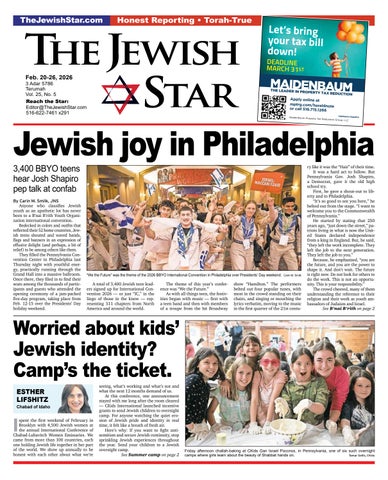
3,400 BBYO teens hear Josh Shapiro pep talk at confab

Anyone who classifies Jewish youth as an apathetic lot has never been to a B’nai B’rith Youth Organization international convention.

Bedecked in colors and outfits that reflected their 52 home countries, Jewish teens shouted and waved hands, flags and banners in an expression of effusive delight (and perhaps, a bit of relief) to be among others like them. They filled the Pennsylvania Convention Center in Philadelphia last Thursday night with youthful energy, practically running through the Grand Hall into a massive ballroom. Once there, they filed in to find their seats among the thousands of participants and guests who attended the opening ceremony of a jam-packed five-day program, taking place from Feb. 12-15 over the Presidents’ Day holiday weekend.

Jewish joy in Philadelphia

A total of 3,400 Jewish teen leaders signed up for International Convention 2026 — or just “IC,” in the lingo of those in the know — representing 511 chapters from North America and around the world.

The theme of this year’s conference was “We the Future.”

As with all things teen, the festivities began with music — first with a teen band and then with members of a troupe from the hit Broadway

Worried about kids’ Jewish identity? Camp’s the ticket.

Chabad of Idaho

I spent the first weekend of February in Brooklyn with 4,500 Jewish women at the annual International Conference of Chabad-Lubavitch Women Emissaries. We came from more than 100 countries, each one holding Jewish life together in her part of the world. We show up annually to be honest with each other about what we’re

seeing, what’s working and what’s not and what the next 12 months demand of us. At this conference, one announcement stayed with me long after the room cleared — CKids International launched incentive grants to send Jewish children to overnight camp. For anyone watching the quiet erosion of Jewish pride and identity in real time, it felt like a breath of fresh air. Here’s why: If you want to fight antisemitism and secure Jewish continuity, stop sprinkling Jewish experiences throughout the year. Send your children to a Jewish overnight camp.

show “Hamilton.” The performers belted out four popular tunes, with most in the crowd standing on their chairs, and singing or mouthing the lyrics verbatim, moving to the music in the first quarter of the 21st centu-

ry like it was the “Hair” of their time. It was a hard act to follow. But Pennsylvania Gov. Josh Shapiro, a Democrat, gave it the old high school try.

First, he gave a shout-out to liberty and to Philadelphia.

“It’s so good to see you here,” he belted out from the stage. “I want to welcome you to the Commonwealth of Pennsylvania.”

He started by stating that 250 years ago, “just down the street,” patriots living in what is now the United States declared independence from a king in England. But, he said, “they left the work incomplete. They left the job to the next generation. They left the job to you.”

Because, he emphasized, “you are the future, and you are the power to shape it. And don’t wait. The future is right now. Do not look for others to do the work. This is not an opportunity. This is your responsibility.”

The crowd cheered, many of them understanding the reference to their religion and their work as youth ambassadors of Judaism and Israel.

Friday afternoon challah-baking at CKids Gan Israel Poconos, in Pennsylvania, one of six such overnight camps where girls learn about the beauty of Shabbat hands on. Tamar Gellis, CKids
See B’nai B’rith on page 2

B’nai B’rith event draws 3,400 young people…

Continued from page 1

“It is not your duty to finish the work, but neither are you at liberty to neglect [or desist from] it,” is found in Pirkei Avot and often used as a rallying cry to go out and get things done.

The governor, who attended day school in the Philadelphia-area suburbs and now-famously asked his wife to marry him while in Jerusalem, told the crowd that “I lean on my faith, and I am proud of my faith, just like all of you.”

That got even more applause.

“Go back to your communities and make a difference. … Go home and act in ways big and small,” he said, telling the teens to wear their Stars of David and to confront the bullies with an effort to change minds, stressing that they are not victims.

Upon the conclusion of his address, he was presented with BBYO’s Stand UP Gemilut Chasadim Award by two student emcees: Daniel Goldstein, a senior who attends the same day school Shapiro did, and his niece, Vered Shapiro.

Next on stage were Jonathan Greenblatt, national director and CEO of the Anti-Defamation League, and his wife, Marjan Keypour Greenblatt, an Iranian Jewish political refugee to the United States who is the founder and director of the nonprofit Alliance for Rights of All Minorities, or ARAM.

They were introduced by one of their three children, who currently holds a leadership position in BBYO.

Greenblatt also encouraged the teens to exhibit their Jewish identity publicly by wearing

chai necklaces and BBYO T-shirts. “You guys,” he said, “are what courage looks like.”

But it was his wife who dominated their talk on stage, explaining that she was smuggled out of Tehran, where she was born and raised, at age

7, and settled in Los Angeles. A once-carefree early childhood changed dramatically with the 1979 Islamic Revolution, after which she had to cover her hair, and suddenly, watch what she said and did.

Now, she is advocating for the plight of Iranian protesters who are attempting to break the yoke of their regime — “the world’s largest state sponsor of terror, antisemitism and extremism.”

She told the crowd that the Hamas-led terrorist attacks and atrocities in southern Israel on Oct. 7, 2023, were “straight out of the Islamic Republic playbook — and their pocketbook.”

Iran, she said, is “a brutal dictatorship that spreads hate and death across the Middle East.”

And many of its civilians across the country have been in the streets, on and off, since January, “risking everything to fight for their freedom. But they are paying the price,” she stated, as military-grade weapons are being used against them.

Reports have estimated a death toll of 35,000 or more, though no one can be sure.

She looked at the audience members and said of the protesters: “They are refusing to be intimidated by people sowing fear — just like you.”

Softening, she ended by saying that she dreams of reconnecting to the Jewish community she left behind in Iran, and that maybe one day, BBYO can welcome Jews from Iran at the IC.

Summer camp called key to kids’ Jewish identity…

Continued from page 1

As a mother of 12 living in Idaho, I used to wonder if sending our children away to overnight camp summer after summer was excessive or even realistic. However, after seeing what it did

for them, I learned that the research backs up what I witnessed.

Here’s what we need to acknowledge: When children face confusion and negativity about Israel and Jewish identity from classmates, social

Reader lauds Jewish Star’s printing ICE-critical column

Two weeks ago, The Jewish Star featured a column by Yeshiva University senior Yechiel Amar, a resident of Woodmere, urging Orthodox Jews to speak out against abuses by ICE in the current immigration crackdown.

Reaction to this column has been divided between those thanking us for publishing it and those upset that we ran it.

Last week, we featured a letter by a resident of Woodmere critical of Amar’s points (the writer stating that “this administration and DHS are simply upholding the law. … Don’t fight the brave men and women who are upholding the law against violent agitators, many of whom are funded by some of the same sources that fund anti-Israel causes).

This week, we’re publishing a letter whose writer, also from the Five Towns, said “I applaud The Jewish Star for publishing this article on the front page and hope that you will continue to ring the alarm bells about what is happening to our country and the erosion of our democracy. Jews lose in chaos! We must remain vigilant!”

Both writers requested anonymity.

We invite further discussion.

Write: Columnist@TheJewishStar.com

— Ed Weintrob, Editor and Publisher

To the editor,

Yechiel Amar’s question — “How Long Will We Be Silent?” — demands more than polite discussion. It demands vigilance.

Jewish history teaches us that authoritarian shifts do not begin with camps

(though the government is currently creating “detention centers”) or laws stripping rights overnight. They begin with language. When political leaders normalize describing fellow citizens as “enemies,” when dissent is framed as disloyalty, and when ideological opponents are treated as threats rather than participants in democracy, warning lights should flash.

At the same time, we are witnessing unprecedented data-collection capabilities in the hands of our government and private corporations. The existence of powerful analytics systems (Palantir) capable of compiling detailed dossiers on individuals is not in itself tyranny. But history reminds us that centralized data becomes dangerous when paired with dehumanizing rhetoric and weakened democratic guardrails — the Rule of Law.

In the 1930s, administrative technologies — including punch-card systems derived from the Hollerith process — were used by the Nazi regime to efficiently identify and track Jewish populations. That history does not mean we are living in 1933. It does mean we should never ignore the convergence of surveillance capacity and language that casts segments of society as enemies.

“Never Again” was never meant to apply only to Jews. It was meant to sensitize us to early warning signs: erosion of norms, normalization of exclusion, and the moral laziness of silence.

We do not serve democracy by hysteria. But neither do we serve it by complacency.

media or the broader culture, even excellent Jewish day schools are competing with an overwhelmingly non-Jewish world.

Jewish education during the school year teaches about Judaism. Camp lets them live it.

The Foundation for Jewish Camp found that camp alumni are 55% more likely to feel being Jewish is very important and 45% more likely to practice Jewish traditions than peers who never attended. Recent 2024 data show these patterns hold: 96% of camp families report their children feel proud to be Jewish with that pride persisting years later.

The Lubavitcher Rebbe understood this 70 years ago when he founded the Gan Israel movement, which today has 500 day camps and 67 overnight camps internationally, before researchers quantified what he knew intuitively — Immersion works; you can’t instill Jewish pride in two-hour increments between soccer practice and piano lessons.

Last summer, we sent a girl from our Boise community to a CKids Gan Israel Overnight Camp in the Pocono Mountains in Pennsylvania. She came home inspired and empowered, not because someone lectured her, but because she woke up for 21 consecutive days surrounded by dozens of other Jewish kids just like her. She saw counselors who were proud, joyful and unapologetically Jewish.

Her mother called me, overwhelmed with gratitude. When classmates questioned her daughter about Israel that fall, she didn’t shrink or change the subject. She engaged, defended and stood firm. That immersive experience gave her something no parent or teacher could provide — the unshakable knowledge and strength that she belonged to something larger than herself.

You might be thinking: “But my child isn’t isolated. We live in the Five Towns or Riverdale. She goes to Jewish day school.”

Here is what parents in thriving Jewish communities often miss: Your child’s Jewish experience is still fragmented. He or she is Jewish at school from 8 am to 4 pm, then American at soccer practice. They are Jewish on Friday night and then bombarded by anti-Israel propaganda online come Saturday night.

Aday school provides knowledge. Camp turns Jewish identity into something whole — weeks where being Jewish isn’t a subject or a schedule, but simply who you are. That psychological shift matters whether you’re in Boise or Brooklyn.

Yet I watch Jewish mothers make the same mis-

take repeatedly. They wait until their children are teenagers to consider camp, believing that those under 13 are “too young to be away from home.” Mother to mother: This logic is backwards. Studies tracking Jewish adults found that those who attended camp during elementary school showed three to four times higher rates of synagogue membership and Jewish organizational involvement than those who started as teenagers. The greatest threat to Jewish continuity isn’t external antisemitism; it’s internal indifference. When Jewish children grow up viewing their heritage as an obligation rather than a gift, we’ve already lost. Camp doesn’t just teach kids to be proud Jews. It makes them want to be Jewish. The barriers are real. From Boise, getting to camps requires two connecting flights at $600 to $700 per child, plus anywhere from $3,000 to $5,000 for tuition.

This is why the new grant initiatives matter. CKids International joins the Foundation for Jewish Camp, PJ Library and dozens of federations now subsidizing camp costs.

When we’ve raised funds locally to send children, the results are undeniable. Every child we’ve sent has returned begging to go back. Their parents report what the data confirms: Overnight camp delivered what years of programming couldn’t.

Fellow mothers: We agonize over finding the best schools, the right coaches, the elite soccer leagues. We invest thousands in music lessons, academic tutors and sports. All that has certainly has value. But a child who quits soccer at 14 hasn’t lost much, whereas a child who reaches 18 without a strong Jewish identity has lost a great deal. The evidence is clear. What’s missing is not the infrastructure but the urgency.

Don’t wait until your children are older. Don’t convince yourself that Hebrew school is sufficient. The grants exist. The camps are waiting. Esther Lifshitz is co-director of ChabadLubavitch of Idaho in Boise, where she and her husband, Rabbi Mendel Lifshitz, have served the Jewish community for more than two decades.

Write: Columnist@TheJewishStar.com

Jewish education teaches about Judaism. Camp lets them live it.

Pennsylvania Gov. Josh Shapiro receives the “Stand UP Gemilut Chasadim Award” from his niece, Vered Shapiro, and Daniel Goldstein, a senior at the same day school Shapiro attended, at the 2026 BBYO International Convention in Philadelphia on Feb. 12. BBYO

NEFESH B'NEFESH IS COMING TO NEW JERSEY!

MEDEX

FOR MEDICAL PROFESSIONALS CONSIDERING ALIYAH!

Meet with representatives from the Ministry of Health and the IMA, open your licensure application and submit documents on-site, and connect with potential employers.

SUNDAY, MARCH 15

IMAP.ORG.IL/MEDEX-NEW-JERSEY

NEFESH B'NEFESH ALIYAH FAIR

Take the next steps of your Aliyah journey with Nefesh B’Nefesh at the NBN Aliyah Fair. Learn more about the Aliyah process, communities, employment and more!

MONDAY, MARCH 16

NBN.ORG.IL/ALIYAH-FAIR SCAN

REGISTRATION IS REQUIRED

NY funding delay leaves Jewish schools in lurch

Since 2017, the New York state budget has included millions of dollars for non-public school teacher salaries in science, technology, engineering and math.

The last of this money that Jewish schools received was designated for the 2022-23 school year and received at the end of 2024, according to Sydney Altfield, CEO of Teach Coalition, an Orthodox Union program.

While the 2026 budget allocated $85.5 million for STEM teachers in non-public schools, none of that money has been paid out,

Non-public schools include secular private schools and parochial schools, including Catholic and Jewish educational institutions, and Jewish schools represent about 30% of the STEM teacher program recipients, Altfield told JNS.

Jewish school principals like Rabbi Bini Krauss, of SAR Academy, need New York state to catch up on distributing money that the government has already allocated for paying some teacher salaries.

SAR Academy is a large Modern Orthodox K-8 Jewish day school with 1,050 students in the Riverdale section of the Bronx. Its sister high school, SAR, has another 650 students.

In 2022-23, 140 Jewish schools were awarded the money for STEM teacher salaries, Adam Katz, associate director of government programs at Teach, said.

Since the STEM teacher salary program began, SAR has received between $900,000 and $1 million, which has partly funded salaries of about 50 teachers, Rabbi Krauss said. State money for STEM teachers “has been very, very important for us,” he said.

Annual tuition at SAR’s lower and middle schools is about $28,000, and for the high school, $37,000. Getting the state money “al-

lows us to keep quality up and keep tuition increases reasonable, all thanks to the state,” Rabbi Krauss said.

Teach Coalition advocates for 250 Jewish day schools in its network across the country, 120 of which are in New York. They range from community day schools serving Jewish students across the religious spectrum to Yeshiva Rabbi Chaim Berlin, a fervently Orthodox school in Brooklyn. Established in 2013, Teach helps more than 30 Jewish schools apply for the state funds.

In addition to the STEM teacher salary funding, money designated for music and art teachers in non-public schools and muchneeded security grants are also severely delayed, Altfield said.

The music and art teachers state funding budget was first approved with $5 million in 2024, and the same again in 2025, though none of that money has been disbursed, according to Altfield.

New York State’s Education Department is charged with processing applications and distributing the allocated funds. Multiple messages that JNS left for officials there were not returned.

Emma Wallner, deputy press secretary for New York Gov. Kathy Hochul, a Democrat, said that the governor “has committed more state funding for teacher salary and retention efforts than any of her predecessors.”

“The State Education Department, a separate entity from the governor’s office, oversees the dispersal of funding,” Wallner said. “The governor is working closely with them to ensure student and teacher success statewide.”

There are strict requirements to qualify for the teacher salary reimbursement. A teacher must have a master’s degree, for instance,

and can’t teach any religious subjects. The graduate school requirement for teachers means that Chassidic yeshivas generally don’t qualify, Altfield said.

To help teachers earn their graduate degrees, Teach has developed a program with State University of New York’s Empire State University, Gratz College and Touro University, according to Katz, of Teach.

State STEM reimbursements don’t cover the entire teacher’s salary, according to Katz, of Teach. The state’s budgeted amount is divided between approved schools which apply. For instance, he said, in the last round for which applications were accepted, $58 million was available, but schools applied for $134 million in total.

The average award for that year was more than $100,000 per school, so schools received 43% of what the funds for which they asked, Katz said.

Delays also cause problems for schools in budgeting, hiring decisions and more, according to Altfield.

“The reality is that without money coming in the door, schools are running in the red,” she said. “They have to dip into other places, reserves or scholarship funding, more fundraising from the community just to be able to stay afloat until that money comes in.”

The federal Education Freedom Tax Credit program, slated to begin in January 2027, will provide a $1,700 tax credit to each family which makes a $1,700 donation to a scholarshipgranting organization. That organization will, in turn, provide scholarships of $1,700 to the school of the donor family’s choice.

But states have to opt into the program in order for their residents to be eligible for the scholarships.

Colorado Gov. Jared Polis became the first Democrat considered a possible 2028 US presidential candidate to opt into the program. Kentucky Gov. Andy Beshear, Maryland Gov. Wes Moore, California Gov. Gavin Newsom, Illinois Gov. J.B. Pritzker, Pennsylvania Gov. Josh Shapiro and Michigan Gov. Gretchen Whitmer have not said if they will include their states in the program.

Hochul has also not said if she will sign the state up for the Republican program.

A source in the governor’s office said that Hochul is waiting to review program guidance from the Trump administration, which New York has yet to receive. Given the “constantly changing federal funding landscape and the president’s troubling track record,” Hochul cannot commit until she does, the source said.

“A lot of our families would benefit from this program,” Rabbi Krauss, of SAR, said. “It would be a real game changer.”

DO YOU HAVE WHAT IT TAKES TO SUCCEED IN MULTIMEDIA SALES?

At The Jewish Star, selling advertising for the newspaper is just part of the job.

Our staff’s toolkit includes an exceptionally broad range of useful products (including both religious and secular publications and websites; digital, email, radio and social media marketing; in-person events; direct mail; commercial printing, and more) — whatever it takes to build business and raise revenue for our commercial and non-profit partners.

Employees are trained by the best in the business, in a supportive, collegial and kosher environment.

These F/T positions (P/T schedules may be arranged) offer competitive compensation ($40k-$90k) with excellent commission and bonus opportunities, paid holidays (including Jewish holidays), time off, medical and 401(k).

Gov. Kathy Hochul speaks at an Orthodox Union event about fighting Jew-hatred, on Dec. 12, 2022. Governor’s Office

Silent genocide is emptying Syria of minorities

he collapse of Kurdish autonomy did not inaugurate Syria’s current phase of violence; it confirmed a pattern already in motion. Long before Kurdish towns were pressured into surrender, Syria’s religious minorities were being subjected to a systematic campaign of intimidation, siege and erasure.

Christians, Druze, Yazidis and Alawites — each distinct in history and identity — have faced the same progression: accusation, coercion, violence, displacement and silence.

What unites these assaults is not spontaneity but method. Across communities, violence has been deployed not merely to punish but to reshape demographics and consolidate control. The objective is not reconciliation. It is submission — achieved incrementally, normalized diplomatically and obscured narratively.

Christianity was born on Syrian soil. Antioch was among the earliest centers of the church; Damascus is inseparable from the conversion of St. Paul. For nearly two millennia, Christian communities survived conquest and upheaval. What they face today is different in kind — not episodic persecution, but elimination by attrition.

Over the past year, Christian life in Syria has been steadily dismantled. Churches have been shelled or vandalized. Clergy have been detained, threatened or forced into silence. Christian neighborhoods, particularly in mixed areas, have been subjected to raids and intimidation under accusations of “foreign loyalty” or insuffi-

cient ideological conformity. These are not legal charges; they are religious indictments.

The suicide bombing of a Christian church in Damascus was not only an act of terror but a declaration: Sanctuaries no longer protect, worship itself has become dangerous. In the aftermath, attendance collapsed — not because faith diminished but because survival intervened.

Education has become another front. An in-

creasing number of Christian parents and other minorities report that children are pressured to recite jihadist slogans and conform to religious practices alien to their faith as a condition of acceptance. This is not social friction; it is coercion at the level of identity. When education becomes indoctrination, coexistence has already failed. No formal decree ordering Christians out has been issued. None is required. Fear, iso-

lation and abandonment have done the work more efficiently. What remains of Christian Syria survives at the mercy of forces that tolerate Christians only insofar as they are silent or compliant or both.

If Christian persecution has been incremental, the assault on the Druze has been openly genocidal. In July 2025, regime forces and

Continued on next page

The Church of Saint Simeon Stylites in Aleppo, Syria, is one of the oldest surviving ruins of a church building in the world. Bernard Gagnon via WikiCommons

Continued from previous page

allied jihadist militias killed an estimated 3,000 Druze civilians in one of the bloodiest sectarian massacres since the fall of the former Syrian regime of Bashar Assad. Homes were torched. Druze-run hospitals were overrun, with doctors and nurses murdered inside.

One atrocity became emblematic: the execution of the Saraya family. Jihadist fighters allied with the regime rounded up the male members of the family, blindfolded and handcuffed them, marched them to Tishreen Square and executed them with machine-gun fire. The perpetrators filmed the killings — an act of deliberate terror intended to warn the Druze population that lineage itself was now a death sentence. One of the victims of this terrorist massacre was an American Druze named Hossam Saraya from Oklahoma, which triggered an FBI counterterrorism investigation.

In an extraordinary interview with Ynet news, Druze religious leader Sheikh Hikmat al-Hijri, thanked Israel for preventing a much greater slaughter — “Israel saved us from genocide.”

He told the media outlet, “The only crime for which we were murdered was being Druze. … This is an ISIS-style government, established as a direct continuation of Al-Qaeda.” (The elite media totally ignored this interview.)

His words carried unusual gravity: absent outside force, he said, the killing would not have stopped. That admission underscores a devastating reality — Druze survival depended not on the Syrian state, but on external deterrence.

Nevertheless, Tom Barrack, US ambassador to Turkey, has become a veritable negotiator for the Syrian regime in demanding that Israel withdraw its insistence on a demilitarized zone from the Golan Heights to Damascus to protect the Druze, as well as its northern border, from terrorist attacks. This is not Israeli “aggression,” even though Syrian President Ahmed al-Sharaa (nom de guerre Abu Mohammed al-Jolani) continues to blame Israel for all his problems.

Videos of displays of Syria’s jihadist soldiers chanting “Death to the Jews,” along with massive Islamist demonstrations in Syria threatening infidels, tell the true story.

Even with Israel trying to protect the Druze, the Syrian regime and its jihadist militias continue to viciously torment them. Some 200 Druze women and children have been held hostage by jihadists for the last four months. Druze areas, particularly Suwayda, have been subjected to sustained siege conditions — electricity cut for as long as 12 to 20 hours a day, major roads systematically closed and intermittent shelling that keeps civilians in a state of constant fear. Economic life has been strangled. Aid has been obstructed.

Despite repeated promises by al-Sharaa to conduct investigations into the July massacre in Suwayda, no credible inquiry has occurred. No commanders have been named. No perpetrators arrested. The absence of accountability has functioned as permission, signaling that violence against the Druze carries no cost.

For Yazidis, the current violence reopens

wounds that never healed. Still recovering from ISIS’s genocidal campaign, Yazidi communities in Syria have again been displaced. Homes and shrines have been destroyed or desecrated. Families have fled under threat, fearing a repetition of the horrors that defined their recent past.

The most alarming development is the destabilization of camps and detention facilities holding ISIS-linked families. As Kurdish forces were forced to withdraw, security deteriorated. Radicalized networks reasserted themselves. Yazidis, already marked for extermination once, understand the implications.

Alawite communities, long associated — fairly or not — with the former regime, have not been spared. In coastal regions, Alawite villages accused of insufficient loyalty have faced retaliatory violence, mass arrests and killings.

The purpose is discipline. Alawites are being taught that neutrality is unacceptable, that ambiguity invites punishment. Entire villages have been emptied. Families have disappeared into detention systems with no transparency and no recourse.

Taken together, these assaults reveal a coherent strategy rather than a series of disconnected crises. Each community is targeted differently, but the mechanics are identical.

First comes accusation: disloyalty, foreign alignment, resistance to unity. Then comes pressure: raids, infrastructure cutoffs, road closures, economic strangulation. Violence follows — sometimes spectacular, sometimes incremental. Displacement becomes inevitable.

The fears of Syria’s minorities that alSharaa’s forced centralization of governmental power and the concomitant stripping of local sovereignty will bring even more catastrophes are not exaggerated. A significant portion of Syria’s reconstituted military leadership and rank-and-file emerged from networks that were forged under the command of al-Sharaa, drawing heavily on fighters previously aligned with Hayat Tahrir al-Sham. That organization developed a record of violent repression in areas it controlled, particularly toward religious and ethnic minorities, while governing through the enforcement of Sharia.

The incorporation of these former combatants into state security structures all but guarantees future massacres, religious coercion, sectarian abuse and doctrinal enforcement of Islamic law, which has already begun in various areas under government control.

The impending death knell of additional thousands of Syrian minorities in the very near future was ominously sounded by Sam Brownback, former senator and U.S.ambassador-atlarge, who candidly warned two weeks ago during a conference on international religious freedom that “these groups must be allowed to maintain their own security forces, or I guarantee you today, a genocide will happen in Syria.”

Steven Emerson is executive director of the Investigative Project on Terrorism. Frank Wolf served 17 terms in the House of Representatives before retiring in 2015 to focus on advancing human rights and religious freedom. Write: Columnist@TheJewishStar.com

Members of the Druze community in Israel attend a ceremony in memory of Druze murdered by the Syrian government forces on May 3, 2025. Flash90

Teddy, a therapy dog, transforms hospital care HEALTH, MIND & BODY

“The interaction with Teddy and the connection he creates gives patients energy, strength, motivation and a sense of inner happiness,” Keren Matry, a senior nurse and therapy dog specialist at Rabin Medical Center, told JNS.

While therapeutic dogs have been in some hospital settings in Israel, Matry is among the first nurses to formally combine nursing with AnimalAssisted Therapy, alongside Michal Loewenstein, who also helped pioneer the field at Rabin Medical Center. She works with Teddy, her therapy dog, across nearly all hospital departments.

“Dogs may be present in rehabilitation units or on hospital grounds, but allowing a dog into intensive care with acute patients, as we do, is not common,” she said. “Nurses understand the environment and the risks, so it was important to integrate the two roles.”

Teddy, now six, was originally Matry’s personal dog. They began working together at the hospital four years ago. “When I put on his vest, he knows he’s going to work. He walks in as if it’s his own department,” she said.

The pair started in geriatrics and now respond to consultation requests hospital-wide, including intensive care, oncology and surgery. Matry sets individual objectives for each patient and monitors medical status and contraindications.

The therapy focuses on emotional goals and has shown measurable benefits: increased participation in treatment, reduced pain and anxiety, improved mood, decreased reliance on medication and an overall better hospital experience.

“As a patient, you lose part of your identity. You wear pajamas and an ID tag, you lose control, and you feel low. Then a dog walks in, and something opens up,” she explained.

“The dog brings warmth and unconditional acceptance. It doesn’t matter whether the patient can see, walk or speak.”

The interaction stimulates the release of oxytocin, helping reduce stress and promote relaxation. “We feel this energy, and the dog feels us. It’s mutual,” she said.

Matry recalled a survivor of the Oct. 7, 2023, Hamas massacre who had lain injured under bodies for hours. “When I came with Teddy, something clicked. She began telling her story for the first time to her family. The dog gave her the confidence to speak,” she said.

In another case, a young woman hospitalized in critical condition after a violent attack was unable to be transferred to rehabilitation because she remained dependent on oxygen. “She started talking to Teddy and feeding him. While she focused on him, I gradually reduced the oxygen to zero. She didn’t notice. When I told her she was breathing fully on her own, the fear was gone, and she was sent to rehab,” said Matry.

The hospital is now conducting what she described as Israel’s first evidence-based study on the impact of nursing combined with AnimalAssisted Therapy on acute stroke patients. “The same patient performs exercises with and without the dog. We see a 40% improvement in completion rates when the dog is involved,” she said.

Some patients develop a sense of responsibility toward Teddy. “One uncooperative patient agreed to shower and get ready to take Teddy outside. Once downstairs, he stopped thinking about himself and focused entirely on whether Teddy was comfortable. He shifted from patient to caretaker,” she said.

Matry emphasized that Teddy is not the same as a patient’s own pet. “A personal dog is part of routine and responsibility. Teddy arrives at the hardest moments. He comes to take care of you,” she said.

She recalled a soldier injured in combat who had lost a close friend in the same incident. “When Teddy rested his head on him, they com-

municated without words. In the end, the soldier placed his Givati beret on Teddy,” she said.

Matry envisions a future in which each department includes a nurse working alongside a therapy dog. Teddy undergoes biannual health checks, and she is careful to protect his wellbeing. “He is not a robot. He works with joy because he knows I look after him,” she said.

In the neurology department, where Teddy spends much of his time, the focus is on the brain, emotions and behavioral responses. “If a therapy dog can stimulate damaged areas of the brain and support recovery, it is logical that they would be effective in a neurology ward,” Dr. Mark Hellmann, a senior neurologist and head of the neuroimmunology clinic at Rabin Medical Center, said.

Hellmann said dogs possess a heightened sensitivity to emotional changes. “They often detect shifts in a patient’s emotional state before

others do. Because they don’t rely on language, communication can be easier. Through stimulation of brain regions we cannot otherwise access, animals can evoke verbal and motor responses that others cannot. They reach patients,” he said.

He noted that in epilepsy cases, some dogs can sense an impending seizure before it occurs and alert the patient or those nearby, potentially allowing medication to be administered in time or reducing the severity of the episode.

Dogs’ lack of judgment and expectation can also help patients express emotions they might suppress around other people. According to Hellmann, this can enable medical staff to access damaged neurological pathways and observe meaningful responses or improvement.

While certain contraindications exist — such as avoiding contact with immunocompromised patients — a properly trained dog working alongside a qualified nurse who carefully screens patients poses minimal risk, he said.

“Anything that relieves the sadness and stress of hospitalization, even briefly, is a valuable service. Positive emotional stimulation supports the brain and recovery. There are many ways, both small and significant, that therapeutic animals can help,” Hellmann added.

In the neurological ward, JNS met Rebecca, 74, from Hod Hasharon, who was visiting her husband. She said Teddy’s presence had an immediate calming effect.

“My husband doesn’t want a dog at home, but I think it would calm me down and make me feel better,” said Rebecca, who is undergoing cancer treatment at Assuta Hospital. “I have cancer, and my husband is now in very serious condition with an infection and heart disease.”

“It would definitely help me to have a dog — some warmth and love. ‘A dog is a man’s best friend’ may be a cliché, but in this case, it’s true,” she said.

A gap year’s life-saving bone marrow donation

Moshe Goldsmith of Teaneck never imagined that something he did almost absentmindedly during his Masa Israel Journey gap year would one day help save a life.

Six years ago, while participating in the Aardvark Israel program, he attended an educational event where participants were invited to join the bone-marrow registry run by Gift of Life, an organization dedicated to saving lives through marrow and stem-cell transplants.

The process was simple: a quick cheek swab to collect a saliva sample, which would be entered into a global database in case it matched a patient in need.

“I remember when I did the swab, thinking it would never come to anything; I immediately forgot that I even did it,” he told said in a recent interview. “I thought I would donate if I was a match, but I really didn’t expect it.”

After completing the one-year program, which allowed him to immerse himself in Israeli society, Goldsmith returned to the United States. But the experience left such a strong impression that he later decided to make aliyah — a choice that would ultimately

prove life-changing for both him and someone else.

Six years later, Goldsmith received a call that set off one of the most meaningful chains of events in his life. By the time the Gift of Life registry managed to reach him — through his mother, after struggling to track down his new number — he was already living in Jerusalem.

“When I realized I could save

someone’s life, it was a moment I’ll never forget,” he said.

He had been identified as a match for a 67-year-old woman battling cancer.

“It wasn’t even a question — I immediately said yes,” he said. “I knew it was the right thing to do, and I would want someone to do the same for me if I were ever in that situation.”

On Jan. 19, Goldsmith donated

stem cells at Hadassah Medical Center in Jerusalem. A month later, he said he felt “100%” and had no symptoms.

He hopes his experience will help dispel misconceptions about the process.

“The day of the donation itself was actually pretty light,” he said.

“I had an IV in each arm and sat for about four hours. I walked out of the hospital feeling pretty much back to normal.”

He has no regrets. “I feel that the woman I donated to received the gift of life,” he said. “And I received my own gift — the opportunity to save one.”

During his Masa program, Goldsmith interned at a Jerusalem food bank that prepares and distributes meals for people in need.

“It was an amazing year,” he said. “I loved my internship so much that I saw it as volunteering rather than work. I enjoyed making food and knowing I was doing something meaningful.”

The experience solidified his decision to move to Israel permanently.

“My gap year cemented my decision to make aliyah,” he said. “After working, volunteering and learning

here, I knew it would be my home.” He arrived in Israel on Oct. 4, 2023. Three days later, the Hamasled attacks of Oct. 7 upended daily life across the country.

“I had so many plans, but after Oct. 7 everything was turned upside down,” he said. “No one had any sense of routine.”

Friends and family urged him to return to the United States, and a former employer offered him his job back. He declined.

“Not for a single moment did I consider going back,” he said. “It didn’t feel like an option. I had this feeling I could do this.”

Today, Goldsmith lives in Jerusalem with one of his brothers, who is serving in the Israel Defense Forces. All four of his siblings have made aliyah. He now works as head chef at a Jerusalem restaurant, Mojos.

Looking back, he sees a clear thread connecting his journey — from his Masa year to his immigration to Israel, and ultimately to the moment he helped save a life.

“To me, it feels like reassurance that I’m on the right path and in the right place,” he said. “None of this would have happened if I didn’t have my connection with Israel.”

Moshe Goldsmith donating bone marrow at Hadassah Hospital in Jerusalem in January 2026.
Teddy the dog and a hospitalized IDF soldier. Rabin Medical Center

Where you work is less important than what you accomplish.

Many of our editorial and marketing positions are hybrid or remote, offering optimal flexibility.

Impact New York’s Orthodox communities from your home office, a

library or Starbucks (even a local park when the weather’s warmer!) — as well as from our well-equipped congenial workplaces in Riverdale and Garden City where our teams collaborate and inspire each other.

Don’t be put off by the grind of a

daily commute. If a Jewish Star position calls out to you, you owe it to yourself to call back.

Enjoy working for a media company devoted to honest journalism, whose goals are Torah-true and where all Jewish holidays are observed.

View current openings on our website at www.thejewishstar.com/jobs.html

If

They say if you want to sell your house, you should bake some chocolate chip cookies just before an open house. Make sense to me — nothing smells as welcoming as cookies baking in the oven. And at this time of year, my oven is often busy with delicious treats at all times of the day and night.

Cookies can be a simple after school snack or a gourmet dessert. They can stand alone or be the basis for a cookie sundae, an ice cream sandwich and so much more. Cookies can bring smiles and brighten days and are favorites among old, young and in-between. They are the perfect special treat when the snow drifts are high, or the sun is scorching and are equally delicious with hot cocoa or iced tea making them a great year-round treat.

Cookies are actually ancient and date back to the seventh century in Persia, now Iran, one of the earliest areas of the world to use sugar. It is believed that cookies were the earliest oven thermometers. They were actually small cakes that were placed in an oven. If they burned in a certain amount of time, the oven was too hot and the test cake discarded. If they baked properly, the test cakes were eaten by the bakers.

By the fourteenth century, cookies were commonplace and sweet wafers were sold on the streets of France and beyond. A cookbook dating back to 1596 offered a cookie recipe of flour, sugar, butter, egg yolks, mace, cloves and saffron.

The cookie gained popularity and as the recipes changed through time, people added currants, more spices and other flavorings. Cookies evolved in all kinds of ways and in every culture.

By the eighteenth century, hardtack, a version of a cookie, was the food that sustained people as they travelled westward, sailed the high seas, and fed soldiers in our earliest wars. Cookies helped make America!

Regionally, the northeast and Massachusetts in particular, can claim a lot of “cookie pride.” In 1892 an inventor, James Henry Mitchell, patented a machine that could place jam filling into a cookie. The resulting soft dough and fig filling confection was a hit without a name. He named it the Fig Newton after Newton, MA.

In 1937, Ruth Graves Wakefield created the Toll House Cookie after the Tool House restaurant which stood on the site of an actual 1700s toll house in Wakefield, MA. Today, 50% of cookies baked at home are some version of Toll House Cookies. Cookies make perfect shalach manot (they use up chametz!) and, most importantly, they make memories. Do you remember your mom’s cookies? Your grandmother’s, A favorite aunt’s? Make some delicious cookies and some great memories with your family, and smile, the snow will, eventually, disappear.

Chewy Coconut Toffee Cookies (Dairy or Pareve)

• 1-1/4 cups unbleached flour

• 1/2 tsp. baking soda

• 1/2 cup butter or pareve trans-fat free margarine

• 2/3 cup dark brown sugar, firmly packed

• 1/3 cup white sugar

• 1 tsp. pure vanilla extract

• 1 extra-large egg

• 1-1/3 cups flaked unsweetened coconut

the cookies!

• OPTIONAL: 1/2 cup toffee candy bits, 1/2 cup grated bittersweet chocolate

Preheat the oven to 350 degrees. Place the butter and baking soda in a bowl and mix. Set aside. Place the butter sugars and vanilla in the bowl of an electric mixer and beat until light and creamy. Scrape the sides as needed. Add the egg and beat until light and fluffy. Add the dry ingredients and beat slowly to blend. Add the coconut, toffee bits and/or chocolate and mix by hand.

Drop by spoonfuls on an ungreased cookie sheet. Bake for 8 to 12 minutes until golden, but not burned. Let cool and remove to a plate. Keep in sealed container. Makes about 3 dozen cookies.

Spicy Molasses Cookies (Dairy or Pareve)

• 1-3/4 cups unbleached flour

• 1 rounded tsp. cinnamon

• 1/2 tsp. ground cloves

• 1/2 rounded tsp. ground ginger

• 1/2 tsp. baking soda

• 1/2 (scant) tsp. kosher salt

• 3/4 cup sugar

• 1-1/2 sticks unsalted butter, melted

• 1/4 cup light brown sugar

• 1/4 cup plus 1 tbsp. blackstrap molasses

• 1/2 tsp. pure vanilla extract

• 1 extra-large egg

• OPTIONAL: Extra sugar for rolling the dough before baking

Heat the oven to 350 degrees. Line cookie sheets with parchment paper. Set aside. Place the flour, spices baking soda and salt in a bowl and whisk together. Place the butter, sugars, molasses, vanilla and egg in another bowl and whisk together until wellblended. Pour the liquid over the dry ingredients and mix until just blended. Do not over-mix.

Drop by spoonfuls on the prepared cookie sheets or roll the dough in sugar and put then place on cookie sheets at least 2-es apart.

Bake for 8 to 11 minutes until the edges look cooked but the middle is a bit underdone. This will make a chewy cookie. Bake a little longer for a crispy cookie.

Chocolate Hamantaschen

Cookie Dough Base (Dairy)

• 1/2 cup solid vegetable shortening or trans-fat-free-pareve margarine

• 1/2 cup butter

• 1 cup sugar, minus 1 tbsp.

• 1/4 cup light brown sugar, firmly packed plus 1 generous tbsp.

• 2 large eggs

• 1/2 cup whole milk, almond milk, or water

• 2-1/2 tsp. pure vanilla extract

• 2/3 cup dark cocoa powder (I use ExtraDark)

• 4-1/2 to 5 cups unbleached flour

• 2 to 1/2 tsp. baking powder

• 3 Tbsp. grated bittersweet chocolate

Chocolate Hamantaschen Cookie Dough Base. consciouslykosher.com Almond Crunchies. brokenovenbaking.com
Chocolate Flecked Mocha Meringues. shutterbean.com
Spicy Molasses Cookies. vintagekitchennotes.com

Kosher Kitchen: It’s time to bake the cookies…

Continued from page 11

EGG WASH:

• 1 egg

• 1 egg yolk

• 1 to 2 tsp. water

• 1 tsp. sugar

Preheat the oven to 375 degrees. Place the shortening, butter and the sugars in the bowl of an electric mixer and beat until creamy. Add the eggs and vanilla and beat until very smooth, scraping bowl often.

Place the milk or other liquid and the cocoa powder in another bowl and whisk until the liquid becomes a paste, scraping the bowl as needed.

Add to the egg mixture and beat until fully combined.

Remove the bowl from the stand and fold in the flour, baking powder and grated chocolate. Mix until fully combined. Divide the dough into three equal parts, mold into a disc and cover with plastic wrap. Let sit for 10 minutes and then refrigerate for 10 to 15 minutes.

Remove one disc from the refrigerator and place on a surface lightly covered with a flour and unsweetened cocoa mix.

Use a 3-1/2- circular cookie cutter or glass and cut out as many rounds as possible. Brush with the egg wash, fill with your favorite filling, and pinch the 3 sides closed at the edges. Brush with egg wash and sprinkle with coarse sugar or regular sugar.

Bake for 15 to 22 minutes, until dry looking and golden at the edges. Repeat with the other two discs, using different fillings. Makes a total of 4 dozen or so.

Chocolate Flecked Mocha Meringues (Pareve)

These are deep, dark chocolate decadence on a low-fat, lower sugar scale. Still delicious!

• 1/2 cup unsweetened cocoa powder

• Pinch of salt

• 2 tsp. to 1 Tbsp. instant coffee powder, to taste (I use decaf)

• 1/2 cup sugar, divided

• 2 oz finely grated bittersweet chocolate

• 3 extra-large egg whites, room temperature

• 1/8 tsp. cream of tartar

• 1 tsp. vanilla extract

• 1 Tbsp. confectioners’ sugar

Sift the cocoa powder, salt, coffee and half the sugar into a small bowl. You may have to press the coffee granules with the back of a spoon. Add the finely grated chocolate and mix with a fork to blend.

Place the egg whites into the bowl of an electric mixer. Set the bowl in another bowl filled with about an- of very warm water if the egg whites are cold. Let sit until the egg whites are about room temperature or a bit warmer. Place the bowl on the stand and turn the mixer on low speed. Beat the egg whites until frothy,

add the cream of tartar and increase the speed of the mixer to medium high, beating until soft peaks form.

Add the extract and turn the mixer to medium-high speed and add the remaining sugar, one teaspoon at a time until all the sugar is used and the whites are shiny and stiff peaks form.

Remove the bowl from the stand and fold in the cocoa/chocolate mixture until completely blended.

Drop by rounded spoonfuls about 1” apart onto the prepared baking sheets. Bake for about 25 minutes, for soft, chewy cookies or for about 40 minutes, for crispy cookies. Dust cooled cookies with cocoa powder or confectioners’ sugar. Makes about 24 to 30 cookies.

Chocolate Dunked Toffee Almond Cookies (Dairy)

These are great for that office party!

• 1/2 lb. (2 sticks) butter, cut into chunks

• 1 cup firmly packed light brown sugar

• 1/2 cup granulated sugar

• 1/2 cup dark brown sugar, firmly packed

• 1 Tbsp. Golden Syrup or corn syrup

• 2 large eggs, well beaten

• 1 tsp. pure almond extract

• 1 tsp. pure vanilla extract

• 2 cups almond flour

• 3 cups unbleached flour

• 1-1/2 tsp. baking soda

• 1 cup toffee pieces like Heath

• 1 cup slivered or chopped almonds

• 12 oz semi or bittersweet chocolate

Preheat the oven to 350 degrees. Line 2 baking sheets with parchment paper. Set aside.

Place the sliced almonds in a flat bowl or on a plate. Set aside.

Place the chocolate in a microwave safe bowl. Set aside.

Place the butter and sugars in the bowl of an electric mixer. Cream until smooth. Add the Golden syrup and extracts. Blend completely. Add the eggs and ground almonds. Combine the flour and baking soda. Add to the egg mixture. Mix just until blended. Add the toffee bits and mix well.

Roll the dough into 1-1/2- balls. Place on the baking sheet. Flatten gently with a fork or fingers. Space cookies 2-inches apart.

Bake until golden brown, 10 to 13 minutes.

While the cookies are baking, melt the chocolate in 20 second bursts in the microwave. When melted, stir frequently to cool the chocolate.

Immediately transfer the cookies on the parchment to a wire rack to cool.

Cool the baking sheets and reline with parchment. Repeat until all the dough is used.

Once the cookies are cooled, dip one end in the chocolate and gently press a few sliced almonds onto the chocolate. Place on a foil-lined tray to cool.

Makes about 5 to 6 dozen cookies.

Almond Crunchies (Pareve)

• 1/2 cup vegan butter, softened

• 1/2 cup sugar

• 3 Tbsp light brown sugar

• 1 tsp. pure vanilla extract

• 1/2 tsp. pure almond extract

• 1 cup unbleached flour

• 1 cup almond flour

• 1/2 to 3/4 cup chopped almonds, plain or toasted

• 1 tsp. baking powder

• Pinch salt

• Almond icing (see recipe below)

• OPTIONAL: Toasted almonds; Sliced almonds

Preheat the oven to 350 degrees. Place the vegan butter, sugars and extracts in the bowl of an electric mixer. Beat until light and fluffy. Mix the flours, chopped almonds, baking powder and salt together in another bowl. Add the flour mixture to the sugar mixture and mix on very low speed until well blended. If the dough becomes too stiff, mix by hand. The dough should be a bit sticky.

Roll the dough into balls about an inch in diameter. Place on the prepared pans, about 2 inches apart.

Bake for about 12 to 15 minutes or until lightly golden brown around the edges. Remove from the oven and let cool for about 3 minutes. If you are using icing, place the cookies on a plate, frost with almond icing and top with a toasted almond. Makes about 2 to 3 dozen cookies depending on size.

Almond Icing (Pareve)

• 1-1/4 cups powdered sugar

• 1/2 tsp. almond extract

• 1/8 tsp. vanilla extract

• 2 to 3 Tbsp. unsweetened vanilla almond milk, more if needed

Mix all ingredients, starting with about half the almond milk. Add more to thin, but the mixture should be fairly thick. Spread some frosting on each cookie and top with a toasted almond.

OPTIONAL: You can add about 2 teaspoons of unsweetened cocoa to the sugar for chocolate almond frosting.

TO MAKE TOASTED ALMONDS: Place whole almonds on a cookie sheet. Toast in a 350 degree oven until fragrant, just a minute or two. Do not burn. Let cool. Makes about 2 dozen cookies.

Write: Columnist@TheJewishStar.com

Chocolate Dunked Toffee Almond Cookies. tablespoon.com
Chewy Coconut Toffee Cookies. bakeorbreak.com

Students at HANC HS experience a ‘Winter Extreme’

The HANC High School Girls’ Winter Extreme trip kicked off with a lively glowin-the-dark dodgeball game followed by a wonderful din-

ner. After that, buses were boarded and we headed to a hotel in New Jersey.

The evening featured students and faculty in game shows with a DJ and Dov

Darchei adopts survivor

Katz (known as Digital Dov) as the game show host. There were lively Lip Sync battles, followed by a spirited chagiga and a heartfelt kumzitz. The evening wrapped up with midnight snacks of fried oreos and churros.

The following morning began with Shacharit, breakfast and a presentation by Rabbi Benzion Klatzko, founder of Shabbat.com. Rabbi Klatzko emphasized the ability of every person, no matter their circumstance, to make a positive impact on their community and the world.

The girls then headed to an escape room challenge, where they were divided into teams to see who could crack the puzzles first and escape the room. After a pizza lunch, the warmest jackets and winter gear were donned

for snowtubing that reached exhilierating speeds.

The trip was capped with dinner in Teaneck.

Meanwhile, the boys began their trip closer to home.

On Thursday, they traveled to the Five Towns to hear a series of shiurim at Aish Kodesh in Woodmere.

After an opening by Rabbi Yirmi Ginsberg, the boys heard from the renowned Rabbi Moshe Weinberger, founder of the very shul they were sitting in and father-inlaw of HANC’s Rabbi Yisroel Simcha Weingot.

Afterwards, Rabbi Eytan Feiner, Rav of the White Shul in Far Rockaway, inspired the audience with words of Torah. The impactful morning left a durable impression on the participants.

After their Torah-filled

morning, the boys headed to the American Dream Mall in East Rutherford.

The trip continued at the Prudential Center in Newark, with a New York Islanders vs.

New Jersey Devils game (the Islanders beat the Devils, 3-1). Students reported that the HANC High School winter retreat was nothing short of amazing.

HALB snow fun Hero visits HALB Mercaz shuk

With so much snow, you have to find fun ways to use it! Lev Chana students were excited for their snow paintings.

IDF Hero Adi Karni

sharing his experiences as a chayal, delivering words of encouragement — and playing some basketball.

Yeshiva Darchei Torah eighth graders traveled from Far Rockaway to Lakewood to interview Holocaust survivor Shaya Zelczer as part of the yeshiva’s acclaimed Adopt-A-Survivor project.
visited HALB,
Tu B’Shvat at Mercaz featured a shuk connecting students to Eretz Yisrael while teaching life lessons.
In honor of learning the mitzvah of Hafrashat Challah in Chumash class, HALB’s seventh grade girls made delicious challah with their morahs.

Jewish Star Torah columnists: Rabbi Benny Berlin, spiritual leader of BACH Jewish Center in Long Beach; Rabbi Avi Billet of Anshei Chesed, Boynton Beach, FL, mohel and Five Towns native; Rabbi Binny Freedman, rosh yeshiva of Orayta, Jerusalem; Dr. Alan A. Mazurek, former ZOA chair, retired neurologist, living in Great Neck, Jerusalem and Florida.

Contributing writers: Rabbi Sir Jonathan Sacks zt”l, former chief rabbi of United Hebrew Congregations of British Commonwealth; Rabbi Yossy Goldman, president South African Rabbinical Association; Rabbi Dr. Tzvi Hersh Weinreb, OU executive VP emeritus.

To submit commentary, inquire at: Editor@TheJewishStar.com.

Contact our columnists at: Columnist@TheJewishStar.com.

תבש לש בכוכ

Fri Feb 20 / 3 Adar

Terumah

Five Towns candles: 5:17 • Havdalah: 6:27

Scarsdale candles: 5:17 • Havdalah: 6:18

Fri Feb 27 / 10 Adar

Tetzaveh • Zachor

Five Towns candles: 5:25 • Havdalah: 6:36

Scarsdale candles: 5:25 • Havdalah: 6:26

Mon March 2 / 13 Adar • Ta’anis Esther Tue March 3 / 14 Adar

Purim

Fri March 6 / 17 Adar

Ki Sisa • Parah

Five Towns candles: 5:33 • Havdalah: 6:43

Scarsdale candles: 5:33 • Havdalah: 6:34

Five Towns Candlelighting: From the White Shul, Far Rockaway, NY

Scarsdale Candlelighting: From the Young Israel of Scarsdale, Scarsdale, NY

In parasha Terumah, we learn the gift of giving

rabbi Sir

It was the first Israelite house of worship, the first home Jews made for G-d. But the very idea is fraught with paradox, even contradiction. How can you build a house for G-d? He is bigger than anything we can imagine, let alone build.

King Solomon made this point when he inaugurated another house of G-d, the First Temple:

But will G-d really dwell on earth? The heavens, even the highest heaven, cannot contain You. How much less this house I have built! I Kings 8:27

So did Isaiah in the name of G-d Himself: Heaven is My throne, and the earth is My footstool. What house can you build for Me? Where will My resting place be? Is. 66:1

Not only does it seem impossible to build a home for G-d. It should be unnecessary. The G-d of everywhere can be accessed anywhere, as readily in the deepest pit as on the highest mountain, in a city slum as in a palace lined with marble and gold.

The answer, and it is fundamental, is that G-d does not live in buildings. He lives in builders. He lives not in structures of stone but in the human heart. What the Jewish Sages and mystics pointed was that in our parsha G-d says, “Let them build Me a sanctuary that I may dwell in them” (Ex. 25:8), not “that I may dwell in it.”

Why then did G-d command the people to make a sanctuary at all? The answer given by most commentators, and hinted at by the Torah itself, is that G-d gave the command specifically after the sin of the golden calf.

The people made the calf after Moses had been on the mountain for 40 days to receive the Torah. So long as Moses was in their midst, the people knew that he communicated with G-d, and G-d with him, and therefore G-d was accessible, close. But when he was absent for nearly six weeks, they panicked. Who else could bridge the gap between the people and G-d? How could they hear Gd’s instructions? Through what intermediary could they make contact with the Divine Presence?

That is why G-d said to Moses, “Let them

build Me a sanctuary that I may dwell among them.” The key word here is the verb sh-chn, to dwell. Never before had it been used in connection with G-d. It eventually became a keyword of Judaism itself. From it came the word Mishkan, meaning a sanctuary, and Shechinah, the Divine Presence.

Central to its meaning is the idea of closeness. Shachen in Hebrew means a neighbor, the person who lives next door. What the Israelites needed and what G-d gave them was a way of feeling as close to G-d as to our nextdoor neighbor.

That is what the patriarchs and matriarchs had. G-d spoke to Abraham, Isaac, and Jacob, Sarah, Rebecca, Rachel, and Leah intimately, like a friend. He told Abraham and Sarah that they would have a child. He explained to Rebecca why she was suffering such acute pain in pregnancy. He appeared to Jacob at key moments in his life telling him not to be afraid.

That is not what the Israelites had experienced until now. They had seen G-d bringing plagues on the Egyptians. They had seen Him divide the sea. They had seen Him send manna from heaven and water from a rock. They had heard His commanding voice at Mount Sinai and found it almost unbearable.

They said to Moses, “Speak to us yourself and we will listen. But do not have G-d speak to us or we will die.” G-d had appeared to them as an overwhelming presence, an irresistible force, a light so bright that to look at it makes you blind, a voice so strong it makes you go deaf.

So for G-d to be accessible, not just to the pioneers of faith — the patriarchs and matriarchs — but to every member of a large nation, was a challenge, as it were, for G-d Himself. He had to do what the Jewish mystics called tzimtzum,“contract” Himself, screen His light, soften His voice, hide His glory within a thick cloud, and allow the infinite to take on the dimensions of the finite.

But that, as it were, was the easy part. The difficult part had nothing to do with G-d and everything to do with us. How do we come to sense the presence of G-d? It isn’t difficult to do so standing at the foot of Mount Everest or seeing the Grand Canyon.

You do not have to be very religious, or even religious at all, to feel awe in the presence of the sublime. The psychologist Abraham Maslow, whom we encountered in parshat Va’era, spoke about “peak experiences,”

How do you feel the presence of G-d not when it is surrounded by thunder and lightning as it was at the great Revelation, but today, just a day among days?

and saw them as the essence of the spiritual encounter.

But how do you feel the presence of G-d in the midst of everyday life? Not from the top of Mount Sinai but from the plain beneath? Not when it is surrounded by thunder and lightning as it was at the great Revelation — but today, just a day among days? That is the lifetransforming secret of the name of the parsha, Terumah. It means “a contribution.”

G-d said to Moses: “Tell the Israelites to take for Me a contribution. You are to receive the contribution for Me from everyone whose heart prompts them to give” (Ex. 25:2). The best way of encountering G-d is to give.

The very act of giving flows from, or leads to, the understanding that what we give is part of what we were given. It is a way of giving thanks, an act of gratitude. That is the difference in the human mind between the presence of G-d and the absence of G-d.

If G-d is present, it means that what we have is His. He created the universe. He made us. He gave us life. He breathed into us the very air we breathe. All around us is the majesty, the plenitude, of G-d’s generosity: the light of the sun, the gold of the stone, the green of the leaves, the song of the birds.

This is what we feel reading the great creation psalms we recite every day in the morning service. The world is G-d’s art gallery and His masterpieces are everywhere.

When life is a given, you acknowledge this by giving back.

But if life is not a given because there is no Giver, if the universe came into existence only because of a random fluctuation in the quantum field, if there is nothing in the universe

that knows we exist, if there is nothing to the human body but a string of letters in the genetic code, and to the human mind but electrical impulses in the brain, if our moral convictions are self-serving means of self-preservation, and our spiritual aspirations mere delusions, then it is difficult to feel gratitude for the gift of life. There is no gift if there is no giver. There is only a series of meaningless accidents, and it is difficult to feel gratitude for an accident.

The Torah therefore tells us something simple and practical. Give, and you will come to see life as a gift. You don’t need to be able to prove G-d exists. All you need is to be thankful that you exist – and the rest will follow.

That is how G-d came to be close to the Israelites through the building of the sanctuary. It wasn’t the quality of the wood and metals and drapes. It wasn’t the glitter of jewels on the breastplate of the high priest. It wasn’t the beauty of the architecture or the smell of the sacrifices. It was the fact that it was built out of the gifts of “everyone whose heart prompts them to give” (Ex. 25:2).

Where people give voluntarily to one another and to holy causes, that is where the Divine Presence rests.

Hence the special word that gives its name to this parsha: Terumah. I’ve translated it as “a contribution” but it actually has a subtly different meaning for which there is no simple English equivalent. It means “something you lift up” by dedicating it to a sacred cause. You lift it up, then it lifts you up. The best way of scaling the spiritual heights is simply to give in gratitude for the fact that you have been given. G-d doesn’t live in a house of stone. He lives in the hearts of those who give.

Living in the now: Key lesson from the Mishkan

There is a question that never quite leaves us. When does real life begin?

As children, we cannot wait until high school. In high school, we long for yeshiva in Israel, then college. Then comes marriage, then children, and eventually we count the days until the house is quiet again. We are, almost all of us, perpetually waiting, standing in line for the next chapter while barely noticing the one we are living right now.

In parshas Terumah, we journey into the intricate world of the Mishkan. The Mishkan was the traveling sanctuary in the desert that provided us with an answer to how to live in the moment.

The Mishkan moved constantly. The ananei hakavod, the clouds of glory, served as the spiritual GPS system of the desert. When the clouds lifted, Klal Yisrael dismantled the Mishkan and traveled. When the clouds rested, they stopped and rebuilt again. They might remain in one place for three hours, three days, or three years. No one knew.

Can you imagine living like that? Every morning, waking up uncertain whether you are building or dismantling today?

This dynamic generates one of the most fascinating halachic questions in all of Shabbos.

The

We derive the 39 melachos from the labors performed in constructing the Mishkan. Among them is boneh, building. Yet the Gemara teaches that boneh is biblically prohibited only when the structure is kayama, permanent (Shabbos 102b). A temporary structure does not carry the same prohibition.

But the Mishkan was, by definition, temporary. It was packed up and unpacked repeatedly across forty years in the desert. So how can we derive the prohibition of permanent building from a

structure that was never permanent?

The answer is simple yet very relevant to our lives today. Even though the Mishkan was dismantled and rebuilt, in every place it stood, that was precisely where Hashem wanted it to be at that moment. It was not permanent in the architectural sense, but it was permanent in the sense of divine intention. Wherever it stood was the right place, at the right time, by divine design.

There are two kinds of travelers, a distinction beautifully developed by the Yitav Lev. One is the oveir derech, the passerby, who sees the road as nothing more than an obstacle between Point A and Point B. The journey itself feels meaningless. Only the destination matters.

Just as in the Torah, living our lives out of order

The saying in “out of order” has several meanings. On a vending machine it means you aren’t getting your favorite candy bar. In a courtroom it means you’ve offended the sensibilities of the presiding judge. But usually it means out of the proper sequence, either numerically, alphabetically or chronologically.

In Torah study, the idea that events presented in Torah may be out of chronological

order is represented by the term ain mukdam u’meuchar ba’Torah (which literally means “there is no early and no late in the Torah,” that is, things can be presented out of chronological sequence.

This clearly is the case starting with last week’s parsha Mishpatim and continuing over the next few parshiyot

Commentators Rashi and Ramban differ on the extent of this “out of order” principle. Both agree the laws of Mishpatim were presented to Moshe Rabenu at Har Sinai, after the Luchot were given. But when were they in fact presented by Moshe to B’nei Yisrael? And what about the command to build the Mishkan itself and all the details of its construction?

According to Rashi, relying on Talmudic and Midrashic sources, we can go back to parshat B’shalach when after the miraculous splitting of the Sea, B’nei Yisrael camped at Marah, so named because its waters were bitter. They complained they had no water, so Hashem showed Moshe a way to make the water sweet and drinkable, and also placed before him a chok u’mishpat (a decree and ordinance) that were immediately taught by Moshe

to the people and included a recapitulation of the Seven Noahide Laws, the Laws of Shabbat, honoring one’s parents, Parah Adumah, and the Civil Laws of Mishpatim — all before he giving of the Luchot on Har Sinai.

These of course were later explained and expounded, first when the people were gathered for three days at the foot of Har Sinai, then more specifics with the giving of the Luchot and then the Mishpatim, the civil laws in more detail after the Luchot were given, while they were still camped at Sinai. (No wonder tradition tells us B’nei Yisrael overslept the morning of the giving of the Luchot; they were exhausted!) Now here is where it gets complicated. At

Building the Mishkan: Our house and His house

There is a well-known joke that is told about the Jews, which I find particularly sad. The joke tells of a group of explorers who find a Jew who has been stranded on a desert island for years. As he takes them around the island and shows them how he survived, they find that he built two synagogues for himself. When asked why he needs two since he is all alone, he says that one is the one he prays in, and the other is the one he would never walk into.

This joke, if you can call it that, makes a discouraging comment about some of our people.

Some of us to seem to have a favorite house in which to worship and another house which we stubbornly shun.

It is true that every Jew needs at least two houses of worship. But he must enter both of them. One is his synagogue, and the other is his home.

Jewish worship takes place in the home to an even greater extent than in the synagogue. It is in the home that we recite grace after meals, prayers upon awakening and before bedtime, special prayers before Shabbat candle lighting, and countless informal prayers and benedictions. The synagogue, on the other hand, is the place for formal prayer and for communal worship.

In this week’s Torah portion, Terumah, we learn of the very first house of worship: the Mishkan, or Tabernacle. We also learn about some of the furnishings which were essential to the construc-

tion of this house.

I want to suggest that these furnishings are not merely of historical import but are necessary in both the public synagogue and the private home.

The first three components mentioned in this week’s Torah portion are the Ark, in which the tablets with the Ten Commandments (and according to some, the entire Torah) are contained; the holy Table upon which 12 breads were placed every Sabbath; and the golden Menorah, exquisitely decorated.

These three vessels are also prominent features of both synagogue and home and indeed should be so.

Like the Tabernacle of old, every synagogue today has an ark in which the Torah scrolls, often along with scrolls of the Prophets and of the Megilot, are contained.

In our faith, traditional holy texts are at the core of our worship. The original holy texts were housed in the Tabernacle’s Ark, and later in the Ark of the holy Temple in Jerusalem. So too, in the contemporary synagogue, the holy texts are central to our worship experience, and every occupant of the synagogue faces those texts as he or she prays.

Where, you might ask, is the analog of the Ark in one’s private home? I maintain that the bookcase is the Ark of one’s personal dwelling. Ideally,

The creation of sacred spaces through Judaism

This week’s portion, Terumah, introduces us to one of the most challenging concepts in Judaism.

Ve’Asu’ Li’Mikdash, Ve’Shachanti’ Be’Tocham. (And they shall make for me a sanctuary, and I will dwell in their midst.) (Shemot 25:8)

Hashem wants … what, exactly? A home? A sanctuary?

The most obvious difficulty with this idea is why — how! — G-d, the endless unlimited One, can or would be confined to a limited space. Hashem, is everywhere, so how can He have a

physical home?

It is interesting to note that the Ramban says that the essence of this Mishkan (Tabernacle) was to recreate the Sinai experience, wherein Gd’s presence dwelled on the mountain. In other words, the mitzvah to build a physical space on earth for G-d’s presence stems from the first physical place where G-d chose to “dwell” on earth: Mount Sinai. Of course, the notion of receiving the Torah from G-d at Mount Sinai raises the same question as does the Mishkan: why did we have to go to a specific mountain to receive the Torah? — if G-d is everywhere, what difference would it make where we were when we received it?

This mitzvah forces us to confront a basic theme in Judaism: the seeming need for creating sacred space. We are confronted with this every time we go to pray in a synagogue.

The ultimate and inevitable result of this philosophy has the entire Jewish people, and one might easily argue (based on the disproportionate attention in the media) the entire world focused on the crisis brewing in the Middle East. Two groups of people completely at odds over a strip of land so small, that the name “Israel” doesn’t even fit inside the country on standard globes. Why is this piece of property so important?

And of course, the essence of this struggle is very clearly not just over the land of Israel, but also over the city of Jerusalem, and specifically

over a small mountain made holy because of a building, long since destroyed, which sat on top of a very special rock. Known as the Even Yetzirah, or Foundation Rock, Jewish tradition suggests that it was from this holy slab of rock, over which the Temple was built three thousand years ago that the earth was formed. Can you imagine? The entire Middle East crisis, five wars in the last fifty years, and the majority of the world poised for what may become a global confrontation, all over who gets the deed to … a rock?

Is any space worth so much pain and suffering? Are we all mad? What lies at the root of this concept of sacred space that is apparently so essential to what Judaism stands for?

Judaism has never suggested that one comes closer to the spiritual essence of G-d by aban-

Editor & Publisher: Ed Weintrob

516-622-7461 ext 291

Jewish Star Associate: Nechama Bluth

516-622-7461 ext 241

Content: The Publisher endeavors to ensure that our content is within the bounds of normative halachah and hashkafah. Anyone who feels anything we publish may be inappropriate in this regard is urged to bring the item in question to the attention of the Publisher.

Advertising is accepted at the sole discretion of the Publisher and should conform to standards appropriate for distribution in an Orthodox community. Send us your news! Editor@TheJewishStar.com

Advertising: Publisher@TheJewishStar.com

kashrut of any product or establishment featured in its pages. If you have questions regarding any establishment or product, including its supervision, please consult your rabbi for guidance.

Submissions: All submissions become the property of The Jewish Star and may be edited and used by the Publisher, its licensees and affiliates, in print, on the web and/or in any media that now exists or will exist in the future in any form, including derivative works, throughout the world in perpetuity, without additional authorization or compensation. The individual or entity submitting material affirms that it holds the copyright or otherwise has the right to authorize its use in accordance with The Jewish Star’s terms for submissions.

Distribution: The Jewish Star is available free in kosher food establishments, stores, synagogues, and curb-side newsboxes on Long Island, in New York City and elsewhere. To request free delivery to your location, write Publisher@TheJewishStar.com.

Copyright: All content is copyright and may not be republished or otherwise reproduced without written permission by The Jewish Star; to do so without permission is against the law and halacha. For content reproduction write to Publisher@TheJewishStar.com.

The Jewish Star subscribes to JNS. It, or its contributors, own the copyrights on material attributed to them. The length and content of JNS material and all other submitted material may be edited by The Jewish Star.

OPINION COLUMNISTS

TKashrut: The Jewish Star is not responsible for the

Mitchell Bard, foreign policy analyst, authority on USIsreal relations; Ben Cohen, senior analyst, Foundation for Defense of Democracies; Stephen Flatow, president, Religious Zionists of America-Mizrachi and father of Alisa Flatow, murdered in an Iranian-sponsored Palestinian terrorist attack in 1995; Yisrael Medad, Americanborn Israeli journalist and political commentator; Rafael Medoff, founding director of David S. Wyman Institute for Holocaust Studies; Fiamma Nirenstein, Italian-Israeli journalist, author of 13 books, leading voice on Israeli affairs, Middle Eastern politics and antisemitism; Melanie Phillips, British journalist; Moshe Phillips, national chairman, Americans for a Safe Israel; Thane Rosenbaum, Distinguished University Professor at Touro University (published by Jewish Journal); Jonathan S. Tobin, editor-in-chief, Jewish News Syndicate. Published weekly except during certain religious and civil holidays by The Jewish Star LLC New York City office: 5676 Riverdale Ave Suite 311, Bronx NY 10471 • LI office: 2 Endo Blvd, Garden City NY 11530 Here’s how to reach The Jewish Star — Write: Editor@TheJewishStar.com. Call: 516-622-7461 ext 291

Opinions: Views expressed by columnists and other writers do not necessarily reflect the position of the Publisher or of The Jewish Star LLC.

Member: American Jewish Press Association. This newspaper contains words of Torah. While it is not considered shaimos, please dispose properly.

he tsunami of global antisemitism in the wake of the massacre of Israelis on Oct. 7, 2023, and during the Gaza war that followed, has caused as much bafflement as horror at the sheer perversity of this malevolence.

It’s now become clear, however, that what we’re looking at is an even more sinister pattern of behavior. Appallingly, the slaughter of Jews excites a large number of people so much that it galvanizes them to howl for the blood of more.

This was manifest on Oct. 7 itself, when mobs started pouring onto the streets of Western cities screaming about genocide and “intifada now,” even while the Israelis were still battling the Hamas terrorists perpetrating the slaughter.

This week, Israeli President Isaac Herzog visited Australia to express solidarity with its beleaguered Jewish community, six weeks after the Bondi beach terrorist atrocity when 14 Jews and one off-duty police officer were murdered by Islamist gunmen.

Obscenely, the memory of those victims was desecrated by a hate-fest on the streets of Sydney and Melbourne. Herzog was greeted by mobs screaming “From Gadigal to Gaza, globalize the intifada!” (Gadigal being the Aboriginal name for Australia), and promoting the same lies about genocide and war crimes that had incited the pogrom-style atmosphere culminating in the Bondi Beach atrocity.

The same shocking phenomenon has been on display in Britain. The latest report by the Jewish defense body, the Community Security Trust, which recorded last year the second-highest number of attacks in a calendar year, says that the Yom Kippur terrorist attack on a Manchester synagogue that left two Jews dead triggered an immediate spike in antisemitism.

On the day of that attack, the CST recorded 40 antisemitic incidents, with a further 40 the following day — the two highest daily totals during the year. And, in December, it recorded a similar if smaller spike in the wake of the Bondi Beach atrocity.

In other words, terrorist atrocities against Jews have produced not sympathy or horror, but rather, spikes in Jew-hatred, even in other

countries. This isn’t just confined to a few cranks and nut jobs on the fringes of society. It involves many thousands of people.

There’s nothing remotely normal or explicable about this. It’s a form of madness that’s taken widespread hold.

Even if Israel is hated, that doesn’t explain why so many regard it as the single greatest threat to the world, deserving a level of opprobrium meted out to no other country on earth, including the world’s great tyrannies such as Russia, China or Iran.

What can explain such an obsession with Israel and Zionism? What is driving people in the supposedly civilized West to call in their droves for the killing of Jews?

This deranged and murderous hatred is, of course, standard fare in the Muslim world, and

Muslims have been leading the charge against Israel and the Jews ever since Oct. 7. But plenty of non-Muslims have been pitching in alongside them.

One reason is Palestinianism: that exterminatory creed whose aim is the destruction of Israel, and whose antecedents lie in both the murderous Islamic theological hatred of Jews and in the Nazi party of the 1930s to which the Arabs of pre-Israel Palestine were allied.

Deploying the Nazi demonization of the Jews and Soviet-style inversion of language and reality, the Palestinian cause has acted as a Trojan horse for antisemitism among the liberals and leftists who control Western culture and for whom “Palestine” has become their moral lodestar.

Grotesquely, this has reframed bigotry as conscience. This week, a new and sinister low was plumbed in the politically liberal British seaside resort of Brighton. Keffiyeh-clad activists went door-knocking from house to house asking residents to boycott Israeli goods — and noting down those who didn’t agree to do so — to turn the town into a “Zionist-free” zone.

Many reasons can be adduced for this wild

and venomous hostility. There’s the grip of “anti-colonialist” dogma that’s now standard in the universities, along with the “intersectional” network of so-called “oppressed” victim groups. There’s the fact that the idea of Israelis as victims can’t be allowed to get in the way of that “colonialist oppressor” narrative.

These and more are valid reasons. Ultimately, however, this obsession defies rational explanation because it is a form of Jew-hatred — and that’s a pathology, a paranoid neurosis, a collective derangement that defies reason itself.

In a thoughtful but provocative lecture last week at New York’s 92nd Street Y, New York Times columnist Bret Stephens said that since antisemitism is immune to rational engagement, Diaspora Jews should stop trying to defeat it. Instead, they should concentrate on building and maintaining thriving Jewish communities devoted to instilling Jewish knowledge and culture among their young.

Building up Jewish identity and peoplehood is indeed absolutely critical. However, that’s no reason to abandon the fight against the madness engulfing the West.

A protest against antisemitism in Manchester on Jan. 21, 2024. Among those attending is then-UK Security Minister Tom Tugendhat. UK Home Office via WikiCommons

If the horseshoe fits, then it’s time to saddle up

American culture invented the Hollywood western. The Dallas Cowboys are America’s Team. The wisdom of the West is often described as “horse sense.”

But nowadays it’s horseshoes — worn by both Democrats and Republicans — that have been given a political shine. A political theory bandied about in what passes for smoke-filled backrooms these days is that the two parties, at their extremes, are united on one solitary issue: a hatred for Jews. Progressives and Islamists on one end; nationalists, neo-Nazis and anti-globalists on the other — both with a common enemy.

That’s what is meant by the woke, alt-right — “woke” breeds antisemitism, even among political opposites that otherwise agree on nothing else.

The antisemitic fervor and hatred of Israel on the far right is both growing and not all that different from the progressive Democratic left. And the woke right is not influenced by the a historical revisionism on campus and the irresponsible journalism of mainstream media. The far right doesn’t need propaganda to feed its addictions.

When it comes to the hatred of Jews, it seems, the extreme margins of the political spectrum bend toward one another and then run on parallel tracks — making the U-shape of a horseshoe, with political centrists upholding the center.

This past week put the horseshoe theory through its paces. The US Religious Liberty Commission met specifically to address the alarming national surge in antisemitism. One commissioner, a former “Miss California,” Carrie Prejean Boller, was dis-

pleased with the meeting’s agenda.

Wearing a pin of the Palestinian flag, she unleashed a screed against Jews and Israel, emphatically making it known that she will “never bend the knee to the State of Israel. Ever!” Not unlike Tucker Carlson, she attacked Christian evangelicals for their staunch Zionism. And in a weird contortion of Catholic theology, she claimed to be bound by her faith to reject both Jews and Israel. (Mel Gibson notwithstanding, the Catholic Church, officially, does not condone antisemitism and fully supports Israel’s right to exist.)

She then defended the open antisemitism of podcasters Tucker Carlson and Candace Owens — and demanded that the commission condemn Israel for defending itself against Hamas. Her master class in Jew-hatred resulted in

her removal from the commission. That’s when Owens took to her podcast to accuse nefarious Zionists of conspiring to punish the former beauty queen for being a good “Christian.” (Prejean Boller apparently was required to forfeit her crown on account of an undisclosed sex tape and some beyond-the-pale opinions about gay marriage.)

Much of the recent aggressive Jew-hating, anti-Israel rhetoric on the right can be attributed to both Carlson and Owens. They regularly invoke the “Jewish power” canard and its control over the American foreign policy establishment. Carlson floated the crackpot analogy of hummuseating Israelis conspiring to assassinate Charlie Kirk, a modern-day Passion Play with a new cast of malevolent Christ-killing Jews.

Carlson hosted “groyper” neo-Nazi leader Nick Fuentes without rebutting any of his fantastical antisemitic claims. The president of the Heritage Foundation, ordinarily a pro-Israel think tank, inexplicably came to Carlson’s defense. Vice President JD Vance, purporting to be neutral on

the subject, proved to be otherwise. He dismissed the recent scourge of Republican antisemitism as merely a dispute about America’s support for the Jewish state.

With friends like these, Israel might as well give Bernie Sanders and the Squad another chance, except it appears they have already befriended and made common cause with the alt-right.

Conservative comedian Dave Smith, who made his ignorance about the war in Gaza known on The Joe Rogan Experience, took his act on the road, appearing on Krystal Ball’s hard-left podcast. Both traded bizarre and defamatory falsehoods about Israel. Meanwhile, Rolling Stone, the iconic magazine of the cultural left, favorably quoted right-wing podcaster Theo Von, who now also purports to be a legal expert on Israel’s alleged “genocide” in Gaza.

What’s going on here? These are not merely strange bedfellows. Ordinarily, they wouldn’t be caught dead in the same room!

At the Second International Conference on Anti-Semitism in Jerusalem, conservative pundit Yoram Hazony played down the far right’s flirtation with antisemitism. If any problem exists, he casts blame on pro-Israel advocates who haven’t convincingly informed the general public about the national security threats Israel has faced since its modern inception.

This must all be very disillusioning for President Trump — the conflict within his own party over Israel. Many of these same Republicans are among his most ardent supporters. Here he is holding universities accountable for the Jewhatred allowed to fester on their campuses, while at the very same time, Republicans are falling for the same anti-Israel propaganda embraced by the masked lunatics now banished from campus life. But is it even the same? The woke left opposes Western civilization and has little love for the United States. No one is shouting “Death to America!” in a Red state. The left, however, is guided by decolonial marching orders to erase all evidence of capitalist white supremacy. To them, Israel is no less guilty than the United States and Canada.

See Rosenbaum on page 22

The headache we face over Gaza’s disarmament

Amid the blood-drenched madness of Hamas’s pogrom in southern Israel on Oct. 7, 2023, there was yet method.

The abduction of more than 250 Israelis and foreign residents — seized as houses were set on fire and women were subjected to brutal rape — was a criminal masterstroke.

The presence of the hostages in Gaza, the long weeks and months of uncertainty over their fates, the periodic release of videos of emaciated Hamas captives pleading to be released — all played havoc with the Israeli psyche. On the ground in the Strip, fear that the hostages might be executed meant that the Israel Defense Forces, for all their successes, was not able to inflict the irreversible defeat on Hamas that was warranted.

Hamas is now reaping the benefits of that strategy. Having come out of the war badly damaged but still intact, the Islamist terror organiza-

tion deftly grasped the key aspects of the immediate post-war situation that crystallized following the US-brokered ceasefire in October. Hamas understood that it was still the unrivaled government in the Strip. And Hamas understood that its fighters still had their weapons. On both those points, it would not concede, for doing so would amount to bowing down to the “occupation.”

This week’s meeting at the White House between US President Donald Trump and Israeli Prime Minister Benjamin Netanyahu was thin on publicly released details on both subjects — the enduring threat posed by Iran and the next phases of securing peace in Gaza — the two leaders discussed. Nevertheless, the tight-lipped atmosphere around their talks suggested that they were not on the same page on either issue.

Gaza and Iran are, of course, closely intertwined, not least because the Islamic Republic has been Hamas’s main backer and because the regime in Tehran is pledged to Israel’s destruction. Even if Iran were not a factor, the current direction of the peace and reconstruction process in Gaza would still be a source of deep anxiety for Israel.

For the Jewish state to enjoy enduring security along its border with Gaza, two measures are non-negotiable. First, Hamas and the other armed Palestinian factions must be comprehensively and verifiably disarmed. Second, future terrorist onslaughts cannot be prevented by security arrangements alone; a program of deradicalization of the population and government alike is urgent and necessary. Otherwise, the vision of Gaza outlined in the first of Trump’s

20-point peace plan for Gaza — a “deradicalized, terror-free zone that does not pose a threat to its neighbors” — will remain a pipe dream.

Reporting of the closely guarded US plans on disarmament has been patchy at best. The suggestion presently doing the rounds is that Hamas should be allowed to keep those weapons that do not pose a threat to Israel. It is not clear which weapons would fall into this category, with the common assumption that it is small arms that are being referred to.

Allowing Hamas to retain its pistols, its AK-47s and its drones does not only pose a threat to Israel, as has been demonstrated on numerous occasions before and after Oct. 7. It poses a threat to

Combat equipment seized by the Israeli Defense Forces during the two-year war in Gaza, Lebanon and Syria, displayed at the Tzrifin military base near Rishon Letzion in central Israel on Dec. 30, 2025. Flash90
Carrie Prejean Boller delivered a master class in Jew-hatred, at last week’s meeting of the US Religious Liberty Commission. CSPAN

Call to action: Why antisemitic Wikipedia is bad

Almost a year ago, I started using a hastage on social media that’s critical of Wikipedia.

It’s shorthand for a problem that has gotten out of control with Wikipedia, which describes itself as a “free online encyclopedia written and maintained by a community of volunteers.”

According to Merriam-Webster, an encyclopedia is “a work that contains information on all branches of knowledge or treats comprehensively a particular branch of knowledge usually in articles arranged alphabetically, often by subject.”

The etymology of “encyclopedia” can be traced back to the Greek enkyklios paideia, which means “general education.”

When Wikipedia was founded in 2001, the intent may have been the idealistic creation of a free online source of objective, readily available information with the goal of “general education” to democratize the concept of an encyclopedia and help spread knowledge in the world.

Sadly, a quarter of a century later, Wikipedia has strayed far from these high-falutin’ ideals. Like 180 degrees.

If it ever was a trusted source of objective information and knowledge, Wikipedia has since devolved into a cesspit of disinformation, misinformation, agitprop and pseudointellectual (and unintellectual) anti-Jewish racism.

Journalists like Aaron Bandler and Ashley Rindsberg, along with X/Twitter accounts like WikiBias have meticulously documented and exposed Wikipedia’s utter lack of objectivity and credibility when it comes to certain subjects like Israel, Jewish history (and to an extent, history in general) and Jewish identity, among others.

There are a number of reasons for Wikipedia’s descent into the realm of hate propaganda, including internal rules and protocols that lead to manipulation and biased entries.

Unfortunately, Wikipedia’s governance board and rules authorities refuse to address these issues in any meaningful fashion. Some of the problems are structural: Wikipedia uses

a system whereby content is managed by anonymous editors. Sunshine, as they say, is the best disinfectant, and unless the veil of anonymity is pierced, it is virtually impossible to uncover the hidden motives of bad actors who attempt to use Wikipedia to promote false narratives and/or ideological agendas.

For example, it was recently exposed that public-relations firms were paid by Qatar to “edit” Wikipedia pages and downplay Qatari human-rights abuses. For all the violations of Wikipedia’s own policies that have been uncovered, just imagine how many have not been exposed, especially considering the policy of author and editor anonymity.

There’s a reason that serious journalistic outlets make sure their reporters use bylines. It’s a simple matter of transparency and credibility. Wikipedia has neither now.

Clearly, pay-to-play Wiki-laundering means that users have no idea about the motives of article authors and editors, and are unable to separate fact from fiction, propaganda from reality.

Wikipedia’s lack of trustworthiness is complicated by how widespread the site has become, frequently appearing at the top of Google searches. It is used by AI engines when creating AI texts, with massive problems resulting from the simple principle of “garbage in, garbage out.”

As suggested, much of Wikipedia’s credibility problem may be structural. Ultimately, there might not be any realistic fixes, especially if the governing authority insists on maintaining author and editor anonymity. It’s not only democracy that dies in darkness. So does journalism and academic integrity.

Until and unless these systemic problems are addressed and fixed, the Wikimedia Foundation, which owns the rights to Wikipedia, should be stripped of its tax-exempt status. There is no reason for American taxpayers to be subsidizing an unreliable, racist propaganda machine.

I propose that the Beverly Hills City Council in Southern California adopt a resolution condemning Wikipedia’s lack of objectivity, its non-existent credibility, while highlighting the dangers of using Wikipedia as a source of fact or general knowledge. The resolution should also urge the US Treasury Department to immediately strip the Wikimedia Foundation of its tax-exempt status, demanding a detailed plan to address and permanently fix the documented abuses of the platform.

Furthermore, I urge the council to prominently post public warnings about Wikipedia at our public library. Wikipedia does not deserve to be a trusted source of information by anyone interested in actual facts, and the

This unreliable source of ‘knowledge’ has become a repository of halftruths, disinformation, innuendo and anti-Jewish propaganda.

widespread frequency of Wikipedia in search engines means that our library users should be warned about the site’s lack of credibility and reliability.

Such a warning might read:

To all library users, please be advised that the Beverly Hills City Council has issued a resolution condemning Wikipedia’s lack of credibility. While attempting to give the appearance of objectivity, Wikipedia is unreliable, filled with propaganda and inflammatory bias, and should not be looked at as a trustworthy source of information.

Please use the Beverly Hills Public Library’s extensive resources to access more reliable, real sources of knowledge and information than Wikipedia.

Our kids, in particular, are susceptible to relying on Wikipedia. To that end, I have also initiated discussions with schoolboard members on the recommendation that the school district ban the use of Wikipedia on campuses and as a reference source for any school-related projects.

Wikipedia does not deserve the trust of our residents, library users or students. And it’s time for us to call out the dangers of using such an unreliable source of “knowledge,” which has become a repository of half-truths, disinformation, innuendo and anti-Jewish propaganda. Wikipedia’s bias and its erasure of Jewish history and identity make our community less safe. A little bit of knowledge may indeed be a dangerous thing, but a lot of disinformation most certainly is a dangerous thing.

As a result, Wikipedia in its current form is a very dangerous thing, and it deserves more scrutiny, more countermeasures and more collective action in opposition, not to mention more hashtags.

Write: Columnist@TheJewishStar.com

UN faces a moral test over Francesca Albanese

The current controversy surrounding UN Special Reporter Francesca Albanese is not merely about one official. It is about the United Nations itself — and whether institutions created after World War II to defend democracy still recognize their purpose.

France and Germany have already signaled that Albanese’s anti-Israel rhetoric has compromised her credibility. Yet the problem does not exist in isolation. It reflects a deeper and long-standing hostility within the international system toward the Jewish state — small, demo-

Removing Albanese would not fix the UN but it would show it still a conscience.

cratic and persistently singled out.

The record speaks clearly. Between 2015 and 2024, the UN General Assembly passed 173 resolutions condemning Israel and only 80 against the rest of the world combined. In the Human Rights Council’s first 15 years, 90 condemnations targeted Israel and only 10 Iran. Numbers alone reveal a political obsession, not a humanrights standard.

After the Hamas massacre of Oct. 7, 2023, the pattern intensified. Instead of moral clarity, senior UN figures argued the attack “did not occur in a vacuum,” shifting attention toward alleged Israeli guilt.

While victims were still being identified in the kibbutzim, the institution prioritized ceasefire resolutions criticizing Israel. Soon followed accusations of war crimes and genocide — echoed by Albanese in language blending ideology, conspiracy and delegitimization.

Even after US sanctions against Albanese, senior UN officials defended her. Yet in parallel, the organization offered diplomatic courtesies to the Iranian regime and elevated Tehran within its committees — at the very moment its leaders openly call for Israel’s destruction.

Dismissing Albanese will not reform the United Nations overnight. But it would be a signal:

that international law cannot serve as a weapon against one democracy while excusing terror and authoritarianism.

In a world increasingly fractured, such a gesture matters. It would tell younger generations that international institutions still distinguish between justice and propaganda — and that

there remains a horizon beyond the anti-Israel chant, “From the river to the sea.”

On Feb. 23, UN member states will decide whether to renew Albanese’s mandate — effectively endorsing or rejecting her record. The vote is not procedural. It is moral.

Write: Columnist@TheJewishStar.com

Francesca Albanese, UN special reporter for Palestinian rights, at the Bogotá summit on July 16, 2025. Office of the President of Colombia JOHN mirisCH
The Wikipedia logo on the wall of the Wikimedia Foundation office in San Francisco. HaeB via Wiki Commons

Ethiopian Israeli’s identity is not black and white

SHMUEL LEGESSE

In America today, too many Jews are letting other people tell them who they are.

On campuses and in newsrooms, in protest marches and corporate training, Jews are increasingly described and often describe themselves in the language of American racial politics: “white,” “privileged,” “oppressor,” “ally,” “minority,” “progressive.”

These words may have a place in American debate. But when they become the primary way that American Jews understand themselves, something essential is lost.

I say this as someone who has lived in three very different Jewish worlds: I was born and raised in Ethiopia’s ancient Jewish community; I spent more than two decades working in New York’s justice system; and I now live in Jerusalem as an Ethiopian Israeli Jew.

My journey from Ethiopia to New York City to Israel has convinced me that when Jews forget that we are first and foremost a covenantal people — not a race, not a political bloc, not a set of talking points — the vacuum gets filled by others with far darker stories about us.

My teacher, Rabbi Jonathan Sacks, used to say that the Jewish people are “not a race, not a class, but a covenant.”

We are not an ‘ethnic group,’ we are a people of covenant that happens to come in many colors.

Jews are not defined by skin color, social status or party affiliation. We are defined by a shared narrative that begins with slavery in Egypt and moves through exile, persecution, resilience and return — and by responsibilities we carry toward God and one another. In contemporary America, that covenantal identity is being slowly replaced by something thinner and more brittle.

Consider how leading universities have handled antisemitism since the Hamas-led terrorist attacks in Israel on Oct. 7, 2023. Administrators at elite institutions have twisted themselves into knots to avoid saying plainly that calling for the genocide of Jews is unacceptable. When asked basic questions in Congress, they responded with legalese and word games, as if Jewish students were simply on the wrong side of a policy debate.

Underneath this evasion lies a deeper failure: Jews are no longer seen as a people with a 3,000-year-old history of vulnerability, but as a subset of “whiteness” aligned with power. And because many American Jews have come to think of themselves in these same categories — white, liberal, professional, progressive — they sometimes lack the language to push back.

On the far left, Jews are assigned the role of “white colonizers” and “Zionist oppressors.” On the far right, they are “globalists” and “elites.”

In both narratives, Jews are reduced to symbols, not seen as a flesh-and-blood people with internal diversity and an ancient calling.

When Jews begin to see themselves primarily as participants in these scripts — “we are white,” “we are people of color,” “we are progressives,” “we are conservatives” —

rather than as a global, multi-color covenantal people, they become vulnerable to whatever the script demands next.

There is another way. It begins by recovering what Sacks called the story we tell about ourselves. That story is not about race. It is about a promise: Abraham leaving Mesopotamia; Moses leading slaves out of Egypt; exiles from Spain and Yemen and Morocco and Ethiopia and Poland all saying the same words at the Passover seder table: “Next year in Jerusalem.”

In that story, Jews are not a monolith. We are Ashkenazi, Sephardi, Mizrachi, Indian, Latino, black, brown, white and everything in between. We are not an “ethnic group” in the American bureaucratic sense; we are a people of covenant that happens to come in many colors.

When we forget that, even when we Jews speak as if Judaism is “white like us,” then we cooperate in our own erasure.

This reality is still poorly understood in America not only by non-Jews, but sometimes by Jews themselves. When black and Latino activists in New York chant that Israel is a “white supremacist” project, they erase millions of Jews who look like me and my family. When Jewish institutions put only pale faces on their stages and in their leadership, they unintentionally confirm that erasure.

Changing that tone requires not only better explanations, but different voices. It means giving more space, right now, to black and brown historical Jews, including Ethiopian Jews, to stand at the front and speak. And to do so not as tokens, but as natural heirs and witnesses to our shared story. If you want to show America that Judaism is not white, you must let black and brown Jews be seen and heard, not just photographed in diversity brochures.

A healthier American Jewish identity would include:

•Teaching our children that their deepest

See Legesse on page 23

Remember this: Our Jewish unity is existential

As I was walking out of the Old City recently, my mind turned to Rabbi Reuven Biermacher. A wonderful man with seven children, he did what thousands do every day — walked out the Jaffa Gate on his way home. There, on a fateful day in 2015, he was viciously by a terrorist whose only criterion for choosing his victim was that he was Jewish.

I remember what struck me most in the aftermath: the deafening silence. No interfaith outreach. No international outcry. A rabbi who came from Argentina, a religious educator, a father, was murdered for being Jewish in Jerusalem. We mourned in solitude.

I thought perhaps Oct. 7, 2023, would be different. Surely, the largest massacre of Jews since the Holocaust — marked by unspeakable brutality, rape and the kidnapping of innocents — would awaken the world’s conscience. Instead, protest tents appeared on campuses within days. The same voices that championed #MeToo refused to believe Israeli women’s testimonies of sexual violence. The narrative was set before Israel even responded: genocide, apartheid, oc-

We cannot return to the divisions and infighting that weakened us.

cupation and lies repeated so often that they became truth in too many minds. Even some Jewish ones.

The loneliness has been profound. We watched as Israel went to extraordinary lengths to minimize civilian casualties while fighting an enemy that uses hospitals and schools as military installations. We knew that our hostages were in Gaza, and specifically, in Rafah, yet the world demanded we not enter the Palestinian city to retrieve them. World leaders and governing bodies, as well as social-media influencers and celebrities, offered no other alternatives. Just condemnation.

A few weeks ago, we witnessed Iran’s brutal suppression of its own people seeking freedom, when tens of thousands of civilians were killed. Their sacrifice for freedom was met with crickets from most of those who claim moral authority. There were no campus protests. No op-eds. The silence spoke volumes and reminded us that when Jews aren’t the perceived aggressors, suddenly, human rights cease to matter.

This hypocrisy reveals an uncomfortable truth: What angers so many, particularly on the radical left and far right, is not Israeli policy, but the very fact that Jews can defend themselves. The image of someone wearing a kippah and carrying a weapon, declaring “Never Again” as more than a slogan, fundamentally disturbs those who have grown comfortable with Jewish vulnerability.

Here is what these two-and-a-half years have taught me: The isolation we’ve experienced has paradoxically strengthened us. It has deepened our connection to each other, our resolve to stand with Israel and our understanding of why a Jewish homeland is a necessity. The loneliness has been bearable because we have each other.

Yet we must learn from our mistakes. Too

many young Jews embraced the false narrative about Gaza because they don’t know what we stand for as a people. And for some, surviving the Holocaust was their only connection to Judaism, but we can’t raise a culture on pain. We need to provide them with knowledge and pride.

The generations who grew up disconnected from their heritage — never studying Torah, never learning the stories of our ancestors — were bereft of knowledge as to why Israel is so important for Jews everywhere. Israel cannot thrive without Torah, and Torah loses its meaning without Israel. We are the “People of the Book,” but if our children don’t read it, if they don’t understand the profound moral and ethical tradition they inherit, then

they will be vulnerable to the lies that surround us.

The lesson is clear: We cannot go back to the way we were before Oct. 7. We cannot return to the divisions and infighting that weakened us. We cannot afford the luxury of Jewish communities fractured by denomination, politics or practice.

Our unity is existential. It is our path to survival, but more than that, it is our path to pride and growth.

We won’t agree on everything. But we must approach every fellow Jew with love. I challenge everyone reading this to choose wisdom over judgment. To recognize that the forces ar-

See Burg on page 23

Ethiopian Jews take part in a prayer of the Sigd holiday on the Armon Hanatziv Promenade overlooking Jerusalem on Nov. 28, 2024. Yonatan Sindel, Flash90

Phillips: World’s Jew derangement syndrome…

First, Jews have a duty to bear witness against such a monstrosity and to stand up for truth and justice. Second, it’s wrong to cast the issue as antisemitism. While anti-Jewish feeling is certainly at its core, it expresses itself through anti-Zionism. And this has gained such traction because it uses claims that purport to be observable facts.

Even though these are wildly distorted and false, they derive from actual events, such as the war in Gaza, which gives these claims a level of plausibility. That has persuaded many who are not antisemites to believe them as true, and therefore to hate Israelis and Zionism.

Those lies can and should be fought. Indeed, anti-Zionism is an evil in itself and should be attacked as such.

It is bizarre and wrong to single out one coun-

try for double standards — to demonize it alone by wall-to-wall lies and distortions, to deny to one people alone the right to their own ancestral homeland. Anti-Zionism should be fought as a form of bigotry in itself.

But while there are good reasons for not publicly identifying this onslaught as antisemitism, the fact remains that bigotry against a country doesn’t have the same level of evil as bigotry against a people — and this bigotry only happens with Jews.

We need to face squarely what we’re up against. Jew-hatred isn’t just another kind of prejudice or racism. It’s a unique desire to rid the world of a people because their very existence is felt to be unbearable.

Such haters don’t think Jews are victims because they don’t behave as victims. They are instead conspicuously successful. This inspires re-

sentment and jealousy among Westerners, who therefore think claims of antisemitism and Jewish victimization must be a Jewish scam to sanitize Jewish wrongdoing.

And the really terrible reason that the murderous attacks on Jews incite and inspire such Westerners to double down with calls for more attacks on Jews is that, like the Islamists, they believe they’re now within sight of their goal to get rid of the “Jewish problem” once and for all.

They treat as gospel what’s said by the entire global humanitarian establishment that has framed the demonization of Israel and dehumanization of Zionists as “anti-racism” and has cast Israel and its supporters as pariahs. They hear no push-back whatever from the lilylivered liberals and revolutionary fellow travelers that form the governments of Britain and

wherever it comes.” For him, that meant even from the ancient Greek philosophers.

France, Canada and Australia.

Hypocritically wringing their hands about Bondi, Manchester and Oct. 7 — and professing falsely that there’s no place for antisemitism in their own countries while doing nothing to stop it — these governments parrot propaganda that incites hatred of Israel and have given way to Islamist intimidation and cultural creep at home. So Jew-haters think their time has come. If they now pile in to kick the Jews in the gut when they’re down and vulnerable, they may get rid of them altogether from their heads, their conscience and their world.

In other words, the Jews are facing a cultural war against them. The proper response to such a war is not to give up or deflect it. It is to fight back better.

Write: Columnist@TheJewishStar.com

But the holech derech is different. This traveler notices Hashem’s hand in every step, finds meaning in every experience along the way, and understands that the journey itself carries purpose.

The Torah says of Yaakov Avinu, “V’Yaakov halach l’darko, Yaakov went on his way” (Bereishis 32:2). Yaakov was a holech derech, someone for whom the road itself was sacred.

The Kohen performing the avodah in the Beis Hamikdash was required to maintain this same consciousness. If, while walking from one point to another in the Temple service, his mind wandered to the wrong offering or the wrong time, the sacrifice could be invalidated. It was called pigul. Even the intention while walking with the sacrifice mattered. The movement itself was part of the avodah.

AJew was once imprisoned and informed that he would be granted release for one day each year, a day of his choosing. Unsure which day would carry the greatest spiritual weight, he wrote to one of the leading halachic authorities of his time, Rabbi David ben Zimra, known as the Radbaz. Should he select Yom Kippur? Rosh Hashanah? Perhaps another sacred day on the calendar?

The Radbaz, who lived in the sixteenth century and served as a rabbinic leader in Egypt and later in Tzfat, ruled decisively in his responsa (Shu”t Radbaz, Vol. 4, Siman 13) that the man should choose the very first day he is able. One does not postpone a mitzvah opportunity in anticipation of a seemingly greater future moment. Spiritual life is not meant to be deferred. The holiest day is the day placed before you now.

That ruling carries a quiet but powerful message. We are not meant to wait for a more perfect tomorrow. We serve Hashem in the present.

Rav Chaim Shmulevitz once offered a beautiful mashal to illustrate this idea. A mother travels all day, to the market, onto a bus, back home. She moves constantly. But her baby, cradled in her arms the entire time, has not moved at all. Al pi Hashem yachanu v’al pi Hashem yisa’u (By the word of Hashem they encamped and by the word of Hashem they traveled) (Bamidbar 9:23). Wherever we go, we are held. We are always in the same place, in the arms of the Ribono Shel Olam.

The Mishkan teaches us that permanence is not a function of geography or time. It is a function of intention. Where Hashem wants you to be, that is where you are permanent. That is where you are home.

Instead of living to wait and waiting to live, may we be blessed to simply be in the moment. To feel the loving embrace of Hashem’s arms throughout every step of the journey, through every encampment and every stage of travel, through every moment of uncertainty and every moment of grace.

The road itself is the gift. May we have the wisdom to recognize it.

Write: Columnist@TheJewishStar.com

that bookcase contains the entire Jewish Bible, along with essential commentaries and classic Jewish texts.

So the Ark, which was situated prominently in the Tabernacle, is a feature of both of our “houses of worship,” our synagogue and our home.

So too, with the table. A wooden table covered over with a layer of gold occupied a place of honor in the Tabernacle. The food kept there, the “shew bread” was distributed to the priests on duty every Sabbath. This table symbolized the divine blessings of sustenance.

Every synagogue has a bima that is analogous in many ways to the table in the Tabernacle.

The synagogue’s table is the place from which the Torah is read and from which G-d’s spiritual nourishment is shared.

In traditional synagogues, this table is not placed up front, on stage as it were, for spectators to behold. Rather, it is placed in the middle of the synagogue sanctuary, among the people. The message is clear: The table symbolizes G-d’s spiritual providence and bounty and as such is something of which every member of the congregation should partake.

The table in the home, equally sacred, is the place for physical nourishment. A beautiful Talmudic expression has it that “the table is like an altar.” Whereas the Jew of old expressed his ultimate sense of worship by offering a sacrifice upon the altar, the contemporary Jew worships G-d by sharing the food on his table with other individuals.

Again, like the Ark, the table which glorified the ancient tabernacle persists as a central feature of both of our modern houses of worship, our synagogues and our homes.

Finally, the golden Menorah which beautified the historic tabernacle and the later Beit HaMikdash. Just about every synagogue I ever attended features a menorah in a very conspicuous place. And Hanukkah menorot occupy a place of honor in the Judaic art collections of even the humblest Jewish home.

There is a symbolism to the Menorah which is even more apt when applied to the two houses of worship we have been discussing. The Menorah symbolizes light; the light of wisdom, the light of the intellect. A central feature of Judaism is that it is not a mystical religion based upon blind faith or irrational emotions.

Quite the contrary. Our faith is largely based upon reason and is respectful of the power of the intellect and the gift of true wisdom. Thus, many commentators see a connection between the seven branches of the Menorah and the seven classical sciences, or categories of knowledge. The Torah is pre-eminently sacred, but other sources of wisdom are important and have their place.

So too, in our two houses of worship. Our synagogues must allow for the expression of knowledge from all human sources. As Maimonides put it, “We must accept the truth from

Our private homes must be open to the truths of science, of literature, and of other cultures. The intellectual life should not be seen as threatening to our religious belief. A life of Torah is made more sublime when it is appropriately enriched by the wisdom of the world.

When some people read this week’s portion, they are frequently put off by the details of an ancient religious structure which seems to have little relevance for their lives. But by looking a little more deeply, and with a dose of creative contemplation, there is much to be learned from even the most technical and seemingly outdated passages of our Torah.

I hope that my suggestions in this week’s column help the reader connect the Ark, the Table, and the Menorah of the Tabernacle in the wilderness to the ark, the table and the menorah of our own synagogues.

I hope, too, that the reader can take the further step and see his or her own home as a house of worship and discover, or construct, arks and the tables and menorot in the places dearest to us.

Write: Columnist@TheJewishStar.com

doning the physical world. In Judaism, the goal is not to find G-d on top of Mount Sinai; the goal is to bring G-d down below.

Can I infuse the physical world with the spiritual essence of G-d? This is the ultimate question posited to us as a people at Sinai. And this is why the Jewish people attempt to infuse the very spiritual experience of Sinai, which began with three days of separation and purification (19:1011,15), with the very physical experience of the Golden Calf.

But they were sadly mistaken, because in the end, they were not infusing the physical with the spiritual, they were merely creating a purely physical experience alongside a purely spiritual one.

There is a beautiful Mishnah in Ethics of the Fathers, which teaches that a person who interrupts his Torah study by exclaiming: “How beautiful is this tree!” literally is worthy of forfeiting his life. Rav Shimshon Raphael Hirsch points out that this does not mean a person should not interrupt his Torah study to wonder at the beauty of the trees. Rather, it means that if the beauty of nature and the world is an interruption of one’s Torah study, then there is something wrong with said person’s relationship with Torah. Because the beauty inherent in all of creation is not an interruption of one’s relationship with G-d, it is part of it.

All of which is why G-d’s response, according to Rashi, to the debacle of the Golden Calf was to build a Mishkan. In this Mishkan was a Holy, and a Holy of Holies. And inside the Holy of Holies, on top of the ark, were two cherubs, little golden angel-winged … idols! And these

cherubs are at the epicenter of the holiest spot in Judaism. Because only in such a spiritual place can we recognize the challenge and the value of synthesizing both the physical and the spiritual into one, with the aim of bringing G-d into the world, through us.

This is the concept of sacred space. Every great idea and every worthy goal needs a focal point, and if the mission of the Jewish people on this world is to bring G-d into the world, then the challenge of infusing the physical world with spiritual beauty begins with that rock where tradition has it the world was first created, because the entire purpose of physical creation, was to allow us as human beings to be partners with G-d in creating a holy world. And the definition of holiness is seeing G-d in every physical reality, every flower and every tree, every bug and every grape. Which is why we need a land, because only in connecting with land that is our own, can we really achieve as a people that ideal of transforming the physical world into the spiritual majesty of building a place for the endlessness of G-d in our seemingly limited physical reality.

Write: Columnist@TheJewishStar

The woke right has a very different view of the world and why they hate Jews. They are not flag-burners but avowed nationalists. The “dual loyalties” of American Jews and their cosmopolitan flair for globalist shenanigans stirs nationalist anxieties about being “replaced” by mixed-race foreigners.

The left side of the horseshoe believes that hating Jews is entirely consistent with social justice, anti-racism and human rights. The woke left’s influence over higher education and mass media has enabled bigotry to be fancied up by cultural elites. Supporting Israel results in permanent banishment from the Venn diagram of intersectional politics.

The woke right sees Jews as sinister threats to the American heartland, a danger to national identity and social cohesion. Israel is merely a stalking horse for the woke right, a misdirection on a map no one can read anyway. Lies about Israeli genocide are just convenient updates to shadowy biblical Christ-killers and medieval plague-carriers — all pretext with no regard for truth.

Meanwhile, the silence of the centrists within the horseshoe, and the timid Jews who have acceded to the self-hatred demanded of their beloved Democratic Party, grant more power to extremists than they would ever hope to achieve on their own. All throughout history, power is invested in bystanders who always refuse to exercise it.

Antisemitic extremists on both left and right may have coalesced into a misshapen but not harmless horseshoe. But that’s no excuse for Jews wearing a dog collar and resigning themselves to yield.

Write: Columnist@TheJewishStar.com

Mazurek: As in Torah, living lives out of order…

Continued from page 17

the end of parshat Mishpatim, the Torah tells us that Moshe was commanded by Hashem to take Aharon, his sons Nadav and Avihu and the 70 z’keiinim (elders) and to approach Har Sinai from a distance — but only Moshe will approach Hashem, after which Moshe will “tell the people all words of Hashem” and all the ordinances and the people will respond to all of this “na’aseh (we will do).”

Moshe was instructed to write down all that Hashem had told him, and build an altar and 12 pillars, corresponding to the 12 tribes of Israel. He would then bring karbanot (sacrifices), take the sefer ha’brit (the Book of the Covenant, understood to be the Torah Moshe had been instructed to write, from Bereishit up to this point in Sh’mot) and read it aloud to the people after which they would famously proclaim, “Everything that Hashem has said “naaseh v’nishmah (we will do and we will obey).

Afterwards, Moshe, Aharon, Nadav and Avihu and the 70 z’keinim will have an incredible vision of Hashem’s Throne and Glory and Majesty followed by a tremendous and delicious kiddush!

Thus according to Rashi, quoting the Talmud (Pesachim 6b) this all happened two to three days before he Luchot were given, with the events of Sh’mot Chapter 20 (parshat itro) oc-

Cohen…

Continued from page 19

those Palestinians inside Gaza opposed to Hamas, who were the first targets of its “Arrow” internal security force after hostilities ended.

That arsenal also ensures the survival of Hamas as a distinct group that can consolidate and keep its hold on power over the coming years, despite the various pledges during the war from Washington, Paris and other capitals that Hamas should not and cannot be a partner in the postwar governance of Gaza.

If the terror organization continues as the main political and military force inside Gaza, we may as well forget about deradicalization — a cumbersome word that essentially means rooting out Islamist ideology, glorification of jihad and the kind of genocidal antisemitism that drove the Oct. 7 atrocities.

Many, if not most, of the Hamas terrorists who invaded the Jewish state on that black day were children during the previous two decades. They will have been nurtured on a diet of hatred throughout that time, indoctrinated with monstrous caricatures of Jews at home, at school and on television, watching a Hamas version of “Sesame Street” in Arabic that featured an oversized talking mouse named Farfour who would denounce Jews and Israelis, and exhort his audience to “Kill! Kill! Kill!”

Some argue that Israel’s most realistic option is to quarantine the coastal enclave. That can be achieved through the creation of an impenetrable closed military zone around its borders, as well as by prohibiting the entry of Palestinian residents of Gaza into Israel.

The risk with that approach, however, is its shortsightedness. Gaza does not exist in a vacuum; it is one node, albeit a vital one, in a network of extremism and terrorism that runs across the region. That reality is graphically illustrated by the fact that the war against Hamas in Gaza was also a war against Hezbollah in Lebanon, the Houthis in Yemen, Iran-aligned militias in Iraq and the Iranian regime itself. As long as Hamas rules in Gaza, it can be a participant in a future multifront war.

Moreover, the absence of sustained fighting in Gaza has provided Hamas with an opportunity to solidify its rule during the reconstruction process. One of the many disappointing features of the US-led Board of Peace’s nascent transitional government is the prominence it gives to senior

curred after the events of Chapter 24 (parshat Mishpatim)!

How can that be? No problem: Ein mukdam u’meuchar (the Torah is not written in chronological order.

The Ramban disagrees. He subscribes to the view that generally the Torah is presented in chronological order, and only on rare occasions are things presented out of order. The Mishpatim were presented as described, after the Luchot, not before, and the momentous events described at the end of Mishpatim took place after the Luchot were received at Har Sinai.

But what about the construction of the Mishkan and its vessels in parshat Terumah, the garments and role of the Kohanim in parshat Tezaveh, and the sin of the Egel Hazahav (the Golden Calf) in parshat Ki Tisa?

For Rashi that is easy. Things are frequently written out of order, so the sin of the Golden Calf happened shortly after B’nei Yisrael heard but didn’t yet receive the actual Luchot from Moshe. This would be one of the rare times the Ramban would have to agree, since it is recounted so long after the Torah was actually given.

Why the delay? Simply because the giving of the Torah was so profoundly consequential that to talk of Israel’s terrible failing at that moment

representatives of Qatar and Turkey. Both countries promote antisemitism as effectively a state doctrine, both lionize Hamas, and both are experiencing a boost in influence in tandem with Iran’s relative decline as a regional power. With Qatar and Turkey in the driving seat, Hamas has even less incentive to disarm. As for deradicalization, how could that process even get off the ground when two of the Board of Peace’s leading members actively promote the same poisonous doctrines?

The obvious answer here — that the IDF should be permitted to complete the job it started in the wake of the Hamas massacre — is not the easy one. Trump has hinted several times that he may give the green light to such an operation if Hamas fails to comply with the demands of the ceasefire, but his mercurial nature and transactional approach to diplomacy mean that it would be foolish to invest such comments with any lasting value.

If Israel does launch a final operation against Hamas because its refusal to disarm left the Jewish state with no choice but to “dismantle it and all of its capabilities,” as Israeli Defense Minister Israel Katz put it just last week, it may find itself doing so alone. And that might be a necessary price to pay.

Write: Columnist@TheJewishStar.com

Legesse…

Continued from pag 21

identity is not “white” or “POC” or “ally,” but part of a people bound in covenant, with obligations to other Jews and to the wider world.

•Elevating Jews of African and Mizrachi/ Arab background into real leadership and visible roles, so that the public face of Jewish life matches its reality.

•Reviving the idea that Jews can be, as Sacks put it, “a creative minority” fully engaged in American life but not defined by its latest ideological fashions.

As a black Ethiopian Israeli Jew who has walked the streets of Addis Ababa, New York and Jerusalem, I end with a question to our Jewish leaders worldwide and to the leadership of the State of Israel: We say, rightly, that Judaism is not white and that we are a global people, not a racial category.

The sooner we allow all our colors to do that, the less power others will have to decide who we are.

would have farshtered (spoiled the simcha).

Then why did the Torah not relate it after the Torah was received and before the command to build the Mishkan?

The answer is fundamental to understanding the purpose of the Mishkan. According to Rashi and the S’forno and other commentators, the building of the Mishkan was not supposed to be necessary — it was only required after the sin of the Egel.

As the S’forno beautifully describes, every home was originally to be a mikdash me’at (a mini-Holy Temple) and every b’chor (firstborn) a Kohen. With the sin, that plan was revoked by Hashem. But as always, He gave us a way of repairing our sin, a “plan B,” a kapara (atonement for our sins) — and that was the building of the Mishkan.

In contrast, according to Ramban, the building of the Mishkan, a place for Hashem’s shechina on earth, was part of the original plan, the culmination of the entire geula, the redemption from the galut of Mitzrayim. Therefore it is in the Torah narrative in the precise order, coming immediately after matan Torah on Har Sinai, allowing us to replicate that experience of Revelation in the Mishkan, later in the Batei Mikdash and even in our Batei Knessiyot, our synagogues, till such time when the Beit Hamikdash can be rebuilt, b’mehaira beyamenu

Shmuel Legesse, Ed.D., is an Israeli-American diplomacy expert, international educator and community activist from Ethiopia’s ancient Jewish community. Write: Columnist@TheJewishStar.com

Burg…

Continued from page 21

rayed against us make no distinction between Israeli and American, religious or secular, between engaged and distant. To them, we are simply Jews. Perhaps it’s time we saw ourselves the same way.

The path forward requires us to double down on what has sustained us through this painful period: love, support and unity among our people. It demands that we invest in Jewish education; that we ensure that no Jewish home lacks connection to our tradition; and that we meet

This idea of whether the Torah is “in or out of order” is not a trivial issue. It has stirred some of the deepest controversies amongst us, leading to outright apikorsus (heresy and crises of faith). Thankfully the “documentary hypothesis” has been largely debunked by careful textual analysis, historicity and archaeological discoveries.

But in truth this issue of “order” shouldn’t trouble us at all. Just like the differences between Hillel and Shammai, the differences between Rashi and Ramban, Ibn Ezra and the Rashbam — they are all elu va’elu divrei Elokim Chayim (words of the living G-d). And that is what the Torah is, a living document.

Life is messy, often out of order, unexpected and unpredictable. We know what we need to do but we forget. So we have to repeat it, to our children, to our spouses, to ourselves.

Often we intend to do the right thing, but we blow it. We mess up, we sin. But Hashem, in His infinite mercy, always has a plan B, called teshuva, available to us to make things right, to put things back in order.

What a comfort, what a relief. Just as Hashem says, back in parshat B’Shalach: “Ani Hashem Rof’echa (I am Hashem, your doctor).”

Just what the Doctor ordered. Shabbat shalom.

Write: Columnist@TheJewishStar.com

every Jew, regardless of where they are in their journey, with patience and compassion.

History has shown us that those who seek to destroy the Jewish people end up in its dustbin. But it has also shown us that we are strongest when we stand together. The resolve I see in young, committed Jews today gives me hope. They understand what’s at stake. They’re ready to fight for our future.

We’ve been shaken into reality these past few years. The loneliness has been our teacher. Now, let us take that lesson and build something stronger: a Jewish community that will never again allow itself to be divided from within while threats gather from without.

Resolve alone isn’t enough. We need unity. We need each other. This is what Rabbi Biermacher taught, and it is a lesson that will stay with me forever. We may at times stand alone in the world, but we will always have the Almighty, and we will always have each other.

Write: Columnist@TheJewishStar.com

Turn static files into dynamic content formats.

Create a flipbook