
![]()


By Ben Baruch, JNS
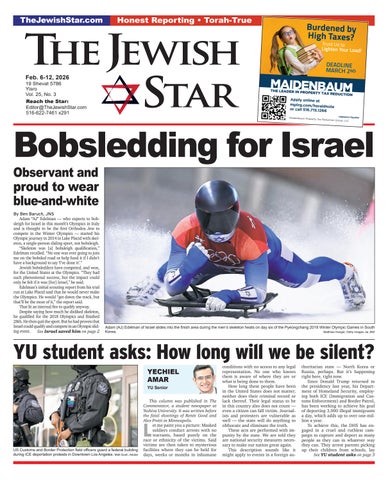
Adam “AJ” Edelman — who expects to bobsleigh for Israel in this month’s Olympics in Iraly and is thought to be the first Orthodox Jew to compete in the Winter Olympics — started his Olympic journey in 2014 in Lake Placid with skeleton, a single-person sliding sport, not bobsleigh.
“Skeleton was [a] bobsleigh qualification,” Edelman recalled. “No one was ever going to join me on the bobsled road or help fund it if I didn’t have a background to say ‘I’ve done it’.” Jewish bobsledders have competed, and won, for the United States at the Olympics. “They had such phenomenal success, but the impact could only be felt if it was [for] Israel,” he said.
Edelman’s initial scouting report from his trial run at Lake Placid said that he would never make the Olympics. He would “get down the track, but that’ll be the most of it,” the report said.
That lit an internal fire to qualify anyway.
Despite saying how much he disliked skeleton, he qualified for the 2018 Olympics and finished 28th. He then quit the sport. But he had proven that Israel could qualify and compete in an Olympic sliding event.

See Israel saved him on page 2


This column was published in The Commentator, a student newspaper at Yeshiva University. It was written before the fatal shootings of Renée Good and Alex Pretti in Minneapolis.
Let me paint you a picture: Masked soldiers conduct arrests with no warrants, based purely on the race or ethnicity of the victims. Said victims are then taken to mysterious facilities where they can be held for days, weeks or months in inhumane
conditions with no access to any legal representation. No one who knows them is aware of where they are or what is being done to them.
How long these people have been in the United States does not matter; neither does their criminal record or lack thereof. Their legal status to be in this country also does not count — even a citizen can fall victim. Journalists and protesters are vulnerable as well — the state will do anything to obfuscate and eliminate the truth.
These acts are performed with impunity by the state. We are told they are national security measures necessary to make our nation great again.
This description sounds like it might apply to events in a foreign au-
thoritarian state — North Korea or Russia, perhaps. But it’s happening right here, right now.
Since Donald Trump returned to the presidency last year, his Department of Homeland Security, employing both ICE (Immigration and Customs Enforcement) and Border Patrol, has been working to achieve his goal of deporting 3,000 illegal immigrants a day, which adds up to over one-million a year.
To achieve this, the DHS has engaged in a cruel and ruthless campaign to capture and deport as many people as they can in whatever way they can. They arrest parents picking up their children from schools, lay
See YU student asks on page 3

Continued from page 1
He then assembled a bobsleigh team to compete in the 2022 Olympics. Most of the people he contacted to join the team thought it was a scam, he said. The team finished 0.1 seconds short of qualifying.
Edelman didn’t quit after 2022. He felt indebted to Israel for saving his life — twice.
As a child living with depression, he visited Israel during the 2006 Lebanon War, spending most of the summer in bomb shelters, reflecting on his struggles with school and life.
He used the experience as motivation to set goals to go to college, turn his life around and become a better person, he said.
Then Israel saved his life a second time. During a gap year in Israel after high school, he was still struggling with depression and became obese.
“You promised yourself back in 2006 that you were going to be the best version of yourself — that you were going to be something in life,” he recalled telling himself. “Right now, you can’t see your toes.”
Edelman lost about 35 pounds in three months, took the SAT subject tests in Israel and got accepted to MIT.
“Israel saved my life, basically twice,” he told JNS. “That’s something that I’ll always be indebted to Israel for, and because of that, everything is only for Israel.”
The Boston-born athlete, who grew up in a Modern Orthodox home, said he “never wanted to be an Olympian. For me, the Olympics are a tool, and they’re a tool of changing how the Jewish community views itself in sport.”
His passion is getting young Jewish kids involved in sports.
The Israeli Olympics program asked him to compete for the Jewish state’s hockey team, but the former goalie for the Massachusetts Institute of Technology team decided that he could have more impact at bobsleigh.
That’s one of the hardest Olympic events for which to qualify.
Either two or four athletes must guide the cylindrical sled down an ice track at more than 90 miles an hour. One wrong move can crash the sled, slamming it and its occupants into walls or capsizing it until gravity brings it to a halt.
The sport requires immense funding and training. Edelman said that the United States likely spent more than $8 million on its program for this year’s Olympics.
Team Israel had fewer funds and resources than other countries do, but Edelman wanted to help prove that the Jewish state could accomplish something that could seem impossible.
The hardest part about being an Orthodox athlete is finding protein, he told JNS, but he feels that his Jewish identity gives him a purpose.
“You’re constantly reminded that you’re part of am Yisrael,” Edelman said.
The athlete said that he prays every night before going to sleep and asks that he represent Jews well on the world stage.
If Oct. 7 “has taught us anything, it’s just reinforced the inescapable fact that we’re all part of the talent stream of the Jewish people,” Edelman said.
“Against all odds, no one gave us a shot,” he said, noting that Israel wasn’t thought to be competitive in bobsleigh.
“We had no money and no organizational support. Everything was stacked against us. The war prevented us from having a team for a couple of years — like a consistent four-man team — but we stuck through it, and we did it.”
American fans shouldn’t feel any conflict between rooting for him and rooting for Team USA, he said.
“I don’t think people need to be torn on who to root for,” he said. The Israeli team stands for

the “absolute standard of excellence for which everyone should be proud.”
He recommends that Americans root for Team USA to medal, and for Israel to perform very well.
Edelman told JNS that he thinks that Jewish communities tend to value things like music lessons above children’s sports when it comes to important parts of young people’s development and self-expression. He doesn’t think it should be that way.
“For some kids, sport is the best outlet to learn right from wrong, setting goals, dealing with loss and dealing with victory,” he said. “It’s such an important tool and developmental platform, but we neglect it because we don’t see the value in it.”
“We don’t see the value in it, because we don’t have enough role models,” he told JNS. “We don’t have enough role models, because it’s a self-perpetuating cycle of depressing participation.”
His own sports path from ice hockey to bobsleigh, rather than the more natural speed skating, is an important message to others, he thinks.
“If I take the impossible and make it work, it’s a much more powerful and potent result to go to kids and say, ‘Hey I was the worst when I started’,” said. “‘You can be no worse than me. So wherever you are now, you can make it work and you can make it happen.’”
Beyond the personal obstacles that Edelman overcame, the current Israeli bobsled team faces its own challenges.
Some members were reservists in the Israeli military, and the team couldn’t come together in full until after the war.
“What the team has done is so remarkable — to knock off countries that trained together for four, eight, 12 years,” Edelman told JNS, and they’ve done so in the aftermath of Oct. 7. “That’s just one of the things that we do,” he said.
He hopes that fans will take away from the team’s achievement that Jews “really can do anything.”
Israel knocked off Czechia to qualify, and it is one of 28 sleds from 18 countries to make this year’s games in Milan.
So what will the future, after the games, hold for the Orthodox athlete?
Edelman plans to find a job and hopes to coach bobsleigh, but he won’t compete in any future Olympics after this one.
He told JNS that he has just some 24 days left of wearing the Israeli flag “on my chest and saying that I represent the country and people of Israel in a very particular way.”
He’s sad to approach the end of this chapter, he said, but is excited for what’s next, and he intends to hand off the baton — to mix sports metaphors — to the next generation of Israeli bobsledders.
in wait at courts for people coming out of mandated immigration appointments, and illegally raid homes without a warrant. Their victims are then detained in gulag-like centers — and they can be moved to new locations in such a manner that they effectively disappear in the system.
Some people are deported to countries from which they left because of great danger, some are deported to countries they aren’t even from — and notably, some have been sent to the notorious El Salvadoran prison CECOT.
All of this upsets me immensely, but it is not the sole cause of my frustration.
What adds to my anger at these injustices is that I am a member of a community toward which a similar series of events was directed in the 1930s and 40s — a state-run campaign of persecution we now refer to collectively as the Holocaust.
We constantly and correctly hold to task those who stood by and let it happen and consider them guilty for ignoring our plight.
As Martin Niemöller, a Lutheran theologian, stated with hindsight and regret:
They came for the Jews and I did not speak out — because I was not a Jew.
Now, when much the same is occurring to the vulnerable among us, we find ourselves in the same position: silent.
Some of us are ignorant of what is happening, often willfully so, and others are dismissive of claims of injustice. Some are even supportive of the DHS’ extreme measures. It is imperative for the sake of others and ourselves to speak out and decry the very crimes we once experienced as a community.
Why does the American Orthodox Jewish community not decry this injustice? Why is it ignored? What benefit is gained by our silence?
Is it because the Trump administration bends slightly more towards our community’s favor on certain issues, and we are willing to sacrifice America’s vulnerable for its promise of security for Israel?
Ignore the fact that the right (which I’ve heard offhandedly referred to as “the party of Torah values”) grows more conspiratorial and antisemitic by the day. Never mind that adopting such an attitude plays into bad faith critics’ “double loyalty” accusations against us.
Take no notice of all those being trampled on, because things are good for us. We are no longer like those immigrants. Besides, we will have Israel, a place to go to in the event that things get bad for us here in America. And all those we stepped on in the process of achieving this security are mere extras in the Jewish narrative.
Being a student at Yeshiva University in the current environment adds insult to injury. Our president, Rabbi Dr. Ari Berman, gave the benediction at President Trump’s second inauguration. Many assume that this places a rabbinic and communal stamp of approval on
Jews and I did not speak out — because I was not a
the administration and its actions.
President Berman has affirmed this assumption to be correct: in several emails, he has praised the administration’s actions concerning Israel. Yet in all other areas, our university has been silent. Its silence, which could be charitably assumed to result from fear of upsetting the administration, suggests agreement.
Is Torat Adam — the idea that each human has infinite worth and potential — a value we actually live by? Does it apply to the children and parents abducted from schools and soccer games or taken off the streets? Or is it merely a platitude that sounds good during assemblies?
President Berman also recently engaged in efforts to have a dialogue with and emulate other faith-based universities that he sees as our peers. This is in alignment with the rightward-shifting Modern Orthodox community’s embrace of “Judeo-Christian values,” which has increasingly allowed the ideas and rhetoric of the Christo to encroach upon and affect the public view of the Judeo. Yet even as emulators on this stage we fall short. Pope Leo has called for defending migrants. ICE has gassed and fired upon clergy members praying at the Broadview ICE facil-
ity in Chicago. Our supposed peers have the moral clarity to meet this moment. Why have we fallen short?
There is a machloket (argument) over the mantra “Never Again.” One side says it means “Never again will something like the Holocaust happen again to anyone,” while others have it as “Never again will the Jewish People, specifically, be attacked like this.”
It seems our community has chosen the latter. We have chosen universal indifference over universal compassion and thus become the very people we rail against.
Iworry that we will reach the point where our silence becomes our own downfall, where the mechanisms of the state being developed now for unaccountable authority are wielded against us.
Niemöller documented the devastating result of such silence when he said: Then they came for me — and there was no one left to speak for me.
I am impassioned in my criticism for one reason: I care about my community. I feel betrayed by its actions and inactions in the present moment, and I worry where such a path might lead in the near future. Take my words as a plea for action, for courage and for a rededication to the ideals of truth and compassion that are emblazoned on the side of our buildings. Remember what we once were, who we are and what we stand for.
When the vulnerable are attacked, let us be the ones who break the chain and speak up.
Yechiel Amar, a resident of Woodmere, is a senior at Yeshiva University.
Write: Columnist@TheJewishStar.com


HAFTR’s first graders received their first siddurim at the school’s annual Chagigat Siddur celebration. Families filled the room to witness this significant step in their children’s Jewish lives.
The Lower School mashgiach ruchani, Rabbi Asher Klein, shared a bracha, reminding students that their siddur provides a way for them to speak directly to Hashem, in words that are pure, meaningful, and filled with heart. The first graders then sang and recited tefillot as they proudly held their siddurim.
The day was fruit of the work of HAFTR’S first grade and Judaic Wtudies team: Etia Cohen, Rebecca Feuer, Brittany Gannon, Debra Haft, Penina Klein, Yael Polak, Rivky


After school hours, students built robots, learning to drive them in preparation for taking the robots to the competition.
Lock, Hannah Nierenberg, Aviva Parness, Miriam Rosenberg, Julia Rubin, Rus Solomon, and Naomi Stern, with musical support from Janet Goldman.
After the ceremony, students took part in that helped bring tefillah and their new siddurim to life. They decorated their siddur covers, marked special pages, and explored what prayer means in their own lives. The next day, they opened their siddurim in class together as one grade — no longer as something new, but as something that felt like their own.
Chagigat Siddur is a reflection of how HAFTR nurtures faith, honors tradition and celebrates each child as they begin a lifelong relationship with Hashem.


Over Shabbos Parshas Vayechi, 100 MTA talmidim filled West Hempstead neighborhood with Torah, tefillah, ruach and achdus.
MTA took over the teen minyan at the Young Israel of West Hempstead on Shabbos morning, with students leading every aspect of davening and leining. The yeshiva then sponsored a deluxe kiddush.
Lunch was hosted by local
MTA families, with gradespecific seudos throughout West Hempstead joined by administrators and alumni, multi-generational tables filled with conversations, singing and connection. With community Shabbatonim planned in North Woodmere, Queens and Brooklyn, these weekends highlight a defining part of the MTA experience.
By Jonathan D. Salant, JNS
Pennsylvania Gov. Josh Shapiro says he has become more open about his Jewish faith following the massacre at a synagogue in Pittsburgh, Pa., and the Hamas attack against Israel and subsequent rising Jew-hatred.
“As people have approached me and expressed to me the fear that they have to live openly about who they are in this country, I have felt the responsibility to be more open about my faith, to offer some comfort to them,” Shapiro told a group of reporters at an event sponsored by the Christian Science Monitor.
He said this was a result of the killing of 11 worshippers at the Squirrel Hill synagogue housing three different congregations — Dor Hadash, New Light and Tree of Life — and the Hamas-led attack on Oct. 7, 2023.
“I’m very proud of my religion and proud of my faith,” said Shapiro, who has been mentioned as a potential 2028 Democratic presidential candidate.
“But I think that’s true of people from all different faiths and all different walks of life who may feel targeted in this country right now and they feel scapegoated by this administration,” he said. “I do feel a sense of responsibility, because of who I am, to offer some comfort.”
Shapiro recounted an incident in his new book, “Where We Keep the Light,” when he met the grandson of someone who used to work for Jimmy Carter at the late president’s funeral.
The man wanted to tell Shapiro that “how I lived my life, how proud I am of my faith and how I practice and what I believe makes him more comfortable about being open about his faith and being proud of who he is,” Shapiro wrote.

The governor wrote about the arson attack in the first chapter of the book, “A Night Guarded by G-d,” referring to Torah references about the Seder night.
“It was a night G-d guarded for the purpose of leading the Israelites out of Egypt and one that remains guarded for generations to come,” Shapiro wrote. “It’s so guarded that some rabbis have long said you don’t even need to lock your doors,” he added. “Harm did try to find its way in, but this night had, in fact, been guarded.”
Shapiro also wrote that he looked to the victims of the Tree of Life massacre for guidance in living as a Jew during a time of such antisemitism.
“There have been times where I have struggled to figure out what my responsibility is as a person so public about my faith, at a time when it is more tenuous than ever to be Jewish in America,” he wrote. “In these moments, I look to the Tree of Life community as my guidepost for what it means to live our faith out loud, without fear or question.”
Shapiro said at the Monitor event that he has a deeper connection to Judaism today, even as his approach to practicing his religion has changed.
The governor told reporters that the encounter has stayed with him.
“Conversations like that hung with me in a way that makes me feel that I have this responsibility now to offer comfort to others,” he said.
“To hear that it’s impactful to others, particularly to young people who take it in, made me think about it in ways that I had not before,” he added.
Shapiro experienced antisemitism first-hand when a man set the governor’s mansion afire shortly after Shapiro hosted a Passover seder. No one was injured, but Harrisburg joined Washington, DC, and Boulder, Colo., as the locations of violent attacks against Jews by anti-Israel assailants.
“I grew up, as I write in this book, as someone whose faith was tied to the practice of religion,” he said. “I would go to synagogue regularly. I would pray regularly, but I would oftentimes pray in an institutional setting, in a synagogue. And I followed the rituals and the practices and the way that my parents raised me to follow.”
Things are different today, he said.
“As the years have gone on, in many ways, I have practiced less in a religious setting,” he said. “But I pray more. I do less of the religious steps but find myself having a deeper connection to my faith and leaning on it more.”


There is nothing as wonderful to me as a “traditional” Shabbat dinner. But what does that even mean anymore?
While it once meant wine, challah, chicken soup, roasted chicken and more, now it may mean GF challah and a vegan meal. The foods have changed too much to cite here. But since Shabbat is more than the food, that idea of “traditional” in other ways has changed also; traditions change all the time, from generation to generation and even in-between.
My grandparents’ traditional Shabbat meant that my grandmother started cooking on Thursday morning making her lockshin and challot and stuffed hoelzel and maybe even her schmaltz and gribenes. On Friday she made chopped liver, chickens and brisket and cholent and more.
On Friday night we would arrive at her apartment and the festival began. There were 11 grandchildren and at least 10 adults (often there were more). The tables formed a “T,” the long part in the living room and the top along her long hallway. That meant we could not see my grandfather at the head of the table, but we could sure hear him. In fact, I think at times, the whole town could hear him as he sang Shabbat prayers in tunes from “the old country.” He then sang some songs in Yiddish and finally we could eat!
Those wonderful years ended too soon and my “traditions” changed as my mother took over. My mother was what she, herself, called an “adequate” cook. She really did not like cooking all that much, so those homemade challot and noodles, schmaltz and more were replaced with salads, vegetables and simpler fare. The challah came from a very good kosher bakery, but it was from a bakery and it was different.
There was no one to sing those songs anymore, so we went to synagogue after dinner for services and tea and sang there. The tea was served on china dishes and I got to sit with the adults and eat the fancy delicate pastries that came with the tea. These new traditions were

not the old ones, but they became our traditions, nonetheless.
Something in me must have longed for the days of my childhood Shabbat dinners, because I found myself trying to recreate that ideal for my children. I made challah and chicken soup and more, and we sang songs while eating on my grandmother’s cream colored, Irish linen “Shabbat” tablecloth. This was a new tradition born from sweet memories of past ones.
Now my children are grown and we have yet more new traditions. Every Shabbat, my son-inlaw serenades our daughter with Eishet Chayil. We bless all our children and our daughter and her husband bless their sons. To accommodate bedtime, dinner is often earlier than we are used to, but that, too, is part of this new tradition. Happily, my table can grow and we have a

long L-shaped space for more family members and guests.
Someday, hopefully far down the road, my children will all create their own “traditional” Shabbat and will take from ours what will work for them. Still another way of celebrating will begin. “Traditional” Shabbat is an ever-changing concept that is the thread that holds generations together — past, present and future.
• 1/4 cup Canola oil
• 4 to 5 large onions, chopped (according to your love of onions)
• 5 shallots, chopped
• 1/2-1 lbs. mushrooms (we use a whole pound)
• 4 to 5 hard-boiled eggs
• 1/4 cup walnut halves
• 1/4 cup salted cashews
• 1 cup canned baby peas, drained
• 6 to 12 round snack style crackers (I use 12, but you may like fewer)
• Seasonings such as onion and garlic powder, paprika, marjoram and thyme, to taste
• Salt and pepper to taste
Heat a large skillet and add all but about 1 tablespoon of the oil. Add the onions and shallots and sauté until deep golden brown, but not burned. Heat another sauté pan and add the rest of the oil. Add the sliced mushrooms and sauté until all the liquid is reabsorbed, about 10 minutes and the mushrooms begin to turn golden. Add the mushrooms to the onion mixture and mix well. Place some crackers in the food processor and process until even, tiny crumbs. Add the nuts and pulse until the nuts are also, small and even. Put all the vegetables into the food processor. Pulse 2 to 3 times. Cut the eggs in half and add. Pulse until smooth, but not pasty. Add a bit of olive oil if too dry. Season with desired seasonings, to taste. Chill several hours or overnight. Check seasonings before serving. Makes about 3 cups.
This is a simple, unbraided pull apart challah that is delicious, light and fluffy and can work in a pinch when you forget. Only a total of 90 minutes rising time, and this recipe uses your bread machine to save time!
• 1 cup very warm water 110 to 115 degrees
• 1/4 cup canola or other neutral oil
• 2 extra large eggs
• 1 extra-large egg yolk
• 1-1/4 tsp. salt (I just use a mounded teaspoonful)
• 2 Tbsp. sugar (I use mounded tablespoonful)
• 4 to 4-1/2 cups bread flour
• 2-1/4 tsp instant rise yeast
• 1 stick Pareve margarine (Earth Balance) melted
• OPTIONAL: Everything seasoning, chives, poppy seeds, sesame seeds, cinnamon/sugr
Place the water, eggs, yolk, oil, salt and sugar in the pan of the bread machine. Mix a bit to break up the yolks. Add the flour evenly over the liquid. Sprinkle the yeast over the flour. Place the pan in the machine and set the cycle to “homemade.” Set it to rest for 15 minutes, knead for 15 minutes, and rise for 1 hour. When the bread is almost risen, melt the margarine in a deep, small bowl. Take a 10-inch (9-inch is fine) spring-form pan and brush lightly with melted margarine. Wrap the bottom and sides of the pan with foil to prevent the margarine from seeping out onto the oven. Remove the dough pan from the machine and bring it to your work area close to the prepared pan. Gently deflate the dough and remove enough to make a small ball, about the size of a large ping pong ball. Dip about halfway into the melted margarine and place in the pan. Repeat until you have used all the dough. You should have about 12 to 18 balls, depending on the size you made. Cover lightly with plastic wrap and place in a very warm space. (I turn on the oven


to 100 degrees and when it reaches that temp, I turn it off, open the door for a minute or two and then place the dough inside to rise. In a few minutes, I close the door GENTLY. Let rise for 30 to 45 minutes 30 is fine.
Preheat the oven to 350 degrees.
Brush the dough generously with the remaining margarine and place in the center of the preheated oven. Bake for 30 to 45 minutes or until the bread registers 195-200 degrees in the center. Remove from the oven and immediately brush with remaining margarine. Let cool, remove the sides of the pan and serve.
NOTE: You can sprinkle with seeds, cinnamon and sugar, or Everything Seasoning between the dough balls and before baking. I like some snipped fresh chives and parsley. Delicious!
A favorite with kids and adults alike. Best when there’s no company as sticky fingers are the norm!
SAUCE:
• 3-1/2 cups pineapple juice
• 1 cup dark brown sugar
• 1/4 cup tamari sauce
• 1/4 cup rice vinegar
• 2-1/2 Tbsp. fresh grated ginger
• 5 large cloves garlic, minced
• 1/3 cup Sriracha sauce (Less or none for a less or non to spicy dish)
DRUMSTICKS:
• 18 to 24 chicken drumsticks, patted dry
• 3 to 4 extra-large egg whites beaten until frothy
• 3/4 cup unbleached flour or GF flour
• 4 Tbsp. tapioca or corn starch
• 1 Tbsp. salt, scant
• 1 tsp. black pepper
• 1 Tbsp. onion powder
FINISHING:
• 1 bunch scallions, thinly sliced, divided
• Sesame seeds
• Cooked jasmine or basmati rice
Line two rimmed baking sheets with foil and then parchment (saves clean-up) set aside.
Preheat the oven to 425 degrees.
Place the pineapple juice and all remaining sauce ingredients in a large pot. Stir to combine. Bring to a boil, reduce the heat and simmer until reduced by half, 15 to 20 minutes. Cover and set aside.
While the sauce is simmering, pat the chicken pieces dry and place on a plate.
Beat the egg whites in a large bowl just until frothy.
Whisk the flour, corn or tapioca starch, salt, pepper, and onion powder together in a large bowl.
Dip each drumstick into the egg whites, let the excess drip off and dredge in the flour. Place on the parchment evenly spaced apart. Alternating bone end to meat end for more space. Continue until all drumsticks are done.
Bake the drumsticks for 20 minutes, turning once.
While the drumsticks are baking, make the rice according to directions. Season as desired and, when cooked, add half the scallions and mix well.
After 20 minutes of baking, remove the pans from the oven and drizzle half the sauce evenly over the drumsticks. Carefully, using tongs, turn the drumsticks to coat them completely. Place back in the oven and bake another 15 to 20 minutes until deep mahogany. Sprinkle with half the sliced scallions and sesame seeds. Serve with the rice and the remaining sauce. Serves 6 to 12.
This root veggie dish will get kids to eat their carrots!
• 2 heads garlic, cut in half crosswise and roasted
• 2 lbs. yams or sweet potatoes, peeled and cut into inch-thick slices, then quarters
• 2 lbs. butternut squash, peeled and cut into inch-thick slices, cut to size of yams
• 1 lbs. turnips, cut into inch-thick pieces, then in half
• 2 lbs. carrots, peeled and cut into inchthick pieces
• Extra-virgin olive oil
• 1 to 2 Tbsp. grated fresh ginger, to taste
• 4 Tbsp. (rounded) dark brown sugar, to taste
• 1/4 cup freshly squeezed orange juice
• 1/3 cup Canola or Corn oil, divided
• 1/3 cup pure maple syrup, grade Dark Amber
• Parsley and sesame seeds for garnish, if desired
Preheat the oven to 375 degrees.
Cut the top ends off of the garlic bulbs and place on a piece of aluminum foil. Drizzle generously with olive oil and wrap the foil over the bulbs. Roast in the oven for about 40 to 50 minutes, until the garlic is soft and golden. When done, set aside and let cool. At some point while the veggies are roasting, remove the cloves from the skins, place in a small cup and discard skins. Set aside the garlic.
Increase the oven temperature to 400 degrees.
Generously grease a large casserole dish. Place the sweet potatoes, squash, turnips and carrots into it. Add about a quarter cup of water to the pan and drizzle with 1 to 2 tablespoons of oil. Cover tightly with aluminum foil. Bake for 20 minutes until fork tender. Remove from oven and uncover carefully to avoid a steam burn.
Peel the ginger and, using a micro plane grater, grate about 1 to 2 teaspoons into a small bowl. Mix the ginger with 3 to 5 tablespoons of brown sugar. Add the orange juice and 2 tablespoons of oil and mix well. Add the maple syrup and whisk to emulsify. Scatter the roasted garlic over the veggies. Pour the glaze over the veg-
etables and toss gently to coat.
Place back in the oven and roast, uncovered, until the vegetables are golden and soft, about 20 to 25 minutes. Remove once during roasting to mix gently. Replace in oven to finish roasting. Place on a serving platter and spoon any glaze over the veggies. Sprinkle with sesame seeds and minced fresh parsley, if desired. Serves 8 to 10.
This avoids the task of making your own caramel. The flavor is a bit different, but it is delicious and my kids prefer it to the traditional. And no burnt sugar!!
• 2/3 cup canola oil
• 1-1/4 cups dark brown sugar
• 4 extra-large eggs
• 1 tsp. salt
• 3/4 to 1 tsp. black pepper, more if you like it really hot
• 1 lbs. fine egg noodles
Spray a glass 9 or 10-inch round cake pan or 3 quart oblong baking pan generously with nonstick spray. Set aside.
Preheat the oven to 350 degrees. Bring a large pot of water to a boil and cook the noodles as directed. Drain and place the noodles back into the pot. Add the one tablespoon of oil and mix well.
Place the sugar and remaining oil in a medium, heavy saucepan. Heat over medium heat until the sugar is melted, stirring almost constantly with a wooden spoon. Stir until a bubbly liquid caramel has formed. Immediately pour the caramel over the noodles and stir with the wooden spoon. Sprinkle the salt and pepper over the noodles and mix well. Let cool for 5 minutes. Add the eggs, one at a time and mix well.
Pour into the prepared pan and bake at 350 degrees 60 to 90 minutes until golden and completely set. Serve hot or warm. Serves 8 to 12. Write: Columnist@TheJewishStar.com

LEGAL NOTICE PUBLIC NOTICE OF COUNTY TREASURER’S SALE OF TAX LIENS ON REAL ESTATE
Notice is hereby given that I shall, commencing on February 17, 2026, sell at public on-line auction the tax liens on real estate herein-after described, unless the owner, mortgagee, occupant of or any other party-ininterest in such real estate shall pay to the County Treasurer by February 12, 2026 the total amount of such unpaid taxes or assessments with the interest, penalties and other expenses and charges, against the property. Such tax liens will be sold at the lowest rate of interest, not exceeding 10 per cent per six month’s period, for which any person or persons shall offer to take the total amount of such unpaid taxes as defined in section 5-37.0 of the Nassau County Administrative Code. Effective with the February 17, 2026 lien sale, Ordinance No. 175-2015 requires a $175.00 per day registration fee for each person who intends to bid at the tax lien sale. Ordinance No. 175-2015 also requires that upon the issuance of the Lien Certificate there is due from the lien buyer a Tax Certificate Issue Fee of $20.00 per lien purchased.
Pursuant to the provisions of the Nassau County Administrative Code at the discretion of the Nassau County Treasurer the auction will be conducted online. Further information concerning the procedures for the auction is available at the website of the Nassau County Treasurer at: https://www.nassaucountyny. gov/526/County-Treasurer
Should the Treasurer determine that an in-person auction shall be held, same will commence on the 17th day of February, 2026 at the Office of The County Treasurer 1 West Street, Mineola or at some other location to be determined by the Treasurer.
The liens are for arrears of School District taxes for the year 2024 - 2025 and/or County, Town, and Special District taxes for the year 2025. The following is a partial listing of the real estate located in school district number(s) 15, 7 in the Town of North Hempstead, Town of Hempstead only, upon which tax liens are to be sold, with a brief description of the same by reference to the County Land and Tax Map, the name of the owner or occupant as the same appears on the 2024/2025 tentative assessment roll, and the total amount of such unpaid taxes.
THE NAMES OF OWNERS SHOWN ON THIS LIST MAY NOT NECESSARILY BE THE NAMES OF THE PERSONS OWNING THE PROPERTY AT THE TIME OF THIS ADVERTISEMENT. SUCH NAMES HAVE BEEN TAKEN FROM THE 2024/2025 TENTATIVE ASSESSMENT ROLLS AND MAY DIFFER FROM THE NAMES OF THE OWNERS AT THE TIME OF PUBLICATION OF THIS NOTICE. IT MAY ALSO BE THAT SUCH OWNERS ARE NOMINAL ONLY AND ANOTHER PERSON IS ACTUALLY THE BENEFICIAL OWNER.
TOwN OF HEMPSTEAd SCHOOL:15 LAwRENCE UFSd
L.C MEADOW FAMILY LTD PARTNERSH 3,262.94
40 D0101060
KARP SELWYN & ADAMS-KARP BARBAR 7,901.94
40 D0102110
LEGUM IRIS 649.26
40 D0102190
LEGUM STEVEN G 12,225.50
40 D0102200
DAVIDSON KAREN 6,803.56
40 G 00480
ARZ GLOBAL DEVELOPMENT LLC 11,817.83
40002 00240 24-25
GRIER TRACY L & GREAVES DIANA C 13,434.72
40002 01040
S3N 9 WEST LLC 7,598.93
40002 02100
GONZALEZ LUCIA 3,601.03
40008 00660 66-67
MEADOWMERE PROPERTY MANAGEMENT 7,949.61 40008 00780 78-79
GORIS B DIAZ & HERMINO 4,690.94
40010 00270 27-28
691 BURNSIDE AVE INC 3,246.73
40012 02270
352 GCP LLC 8,096.46
40014 00140
553 BURNSIDE AVENUE LLC 16,041.27
40015 00960 96-97,100-104,108-109, 267 BURNSIDE EQUITIES LLC 18,458.81
40021 00070 7-10
MMDK GROUP LLC 8,506.44
40022 00120 12-14
AYALA JAIME 13,946.50
40023 00390 39-42
EAGER OWEN M 3,098.33
40031 00190
SAWH T NANDALALL & S 2,487.50
40032 01130
QUEENS BH HATZLACHA LLC 321.39
40033 01530
KAUFMAN MOSHE & REBECCA SARA WA 5,042.93
40033 01590
MANN MICHAEL & REENA 3,855.72
40034 02290
CHAN YI BEI CHEN & FANG 8,588.49
40035 00810 81-82
30 NORTON ST LLC 2,808.87
40036 01110 111-112
30 NORTON ST LLC 342.52
40036 01980
PITTS DIANN 594.79
40037 02320
ADAMS DOUGLAS & YVETTE 2,902.42
40039 00840 84-88
TRANSAMERICA CREDIT 3,224.43
40039 00930 93-94
JAWITZ GLENN & RIVKA 5,422.70
40054 00130 13-15
270 DOUGHTY MW LLC 12,172.99
40055 00090
AQUINO LUCRECIO 6,150.49
40057 00480
MOTT INWOOD CORP 5,466.97
40063 00740
MOTT INWOOD CORP 7,123.34
40063 01880
FUTERSAK RIVKY 22,243.40
400840200020
SCHWARTZ SIDNEY & JUDITH 20,077.35
40085 00290
GILGAN NINA 427.21
40085 00390
CARDENAS ELIZABETH A 5,756.77
40086 00010
SCHNEIDER FREDERICK & GAIL 4,263.90 40086 00120
FORLADER CRAIG 4,448.65 40087 03100
ROSS PETER 619.80 40087 03130
311 BAYVIEW LLC 5,002.71 40088 03690
MUNDELL MARK S 6,518.02
40090 00300
SALAMON JACOB B & SUSAN 23,648.72
401010100520 52-53-54,155
RED ROCK EQUITIES LLC 25,748.88
40104 01010
CHACHAS JOHN G & CHACHAS DIANE 6,148.84 40121 00010 1, 103
LENSU LINDA & LENSU WAYNE
00270
00490


MOINIAN MOIN
01178 00400 MOINIAN MOIN
01178 00520
SIVAN REGINE 9,461.23 01179 00230
HOLLANDER MILTON M 19,940.30 01179 00310
EVERGREAT HOLDINGS LLC 30,036.12 01179 00390
DONG XIANG & WANG SHIBIN 10,824.32 01182 00300
WYKOWSKI HENRY & STEPHANIE TRUS 12,794.09 01182 00410
MULLER MARCIA 7,519.33 01182 00440
GONZALEZ DIRLA 17,617.44 01182 00470
KAUFMAN NOAH & 19,148.70 01183 00010
ROZWADOWSKI ANDRZEJ & SHARMIN 6,881.17 01183 00580
BRAL E RASTEGAR & M 6,728.23 01187 00160
BEHNAM MIRIAM 10,882.80 01188 00370
BALAZADEH FARID & SOORI ELHAM 18,819.85 01189 00490
COUNTY OF NASSAU 300.73 01190 00270
COUNTY OF NASSAU 301.56 01190 00280
HAKIMIAN SHAWN & ADINA 11,835.94 01196 00180 18
MITCHELL BARBARA 8,823.93 01199 00040
63 STREAMBOAT ROAD LLC 1,954.01 01199 00470
KHAKSHOOR DALIA 72,531.23 01201 00590
SCHMUELIAN ELANA & NATANIEL 2,026.11 01202 00090
HE XIAORONG & YAN LI 662.25 02006 0254UCA03080 UNIT 308
TANKEL SYLVIA TRUST 12,492.30 02007 00110
SHAFFER DAVID E 33,032.84 02035 00150 15,131
LIU XIAODUO & ZHOU QINGTAO 18,218.84 02051 00130 13-14
12 NORTHERN BOULEVARD CORP 6,150.95 02055 05600
12 NORTHERN REALTY LLC 12,206.76 02055 06600
CARHART THOMAS & JANINE 3,903.83 02073 00350 35,38
388 NORTHER BLVD INC 127,934.52 02085 00140 14,16,28,30-31
12 SOMERSET DRIVE NORTH LLC 29,237.98 02085 00220
KIONE ENTERPRISES INC 42,591.12 02085 00350
KIONE ENTERPRISES INC 15,398.05 02085 00360
MITRA SUNANDAN & KUNTALIKA 10,434.94
02099 00020
MAGIC ONE HOUSE LLC 11,955.93 02107 00430 43-45
KOKALIS STELLA 5,058.03 02111 00290 29-31
JOHNSON EUGENE LIFE ESTATE 12,191.15 02114 00120 12-17
JACKSON ETAL ALBERTINE 7,428.39 02121 00060 6-7
SIMKOVIC NEAL & DEBORAH 21,083.95 02147 00010 1-2
SIMKOVIC NEAL & DEBORAH 1,417.84 02147 00030 3-4
NAPELONIAN MANAGEMENT 26 LLC 5,001.82 02148 00310 31-34
HAROUNI DANIEL 37,696.80 02162 00680 68-71
COUNTY OF NASSAU 301.50
02181 02230
233 EAST SHORE ASSOC INC 1,078.52 02186 03270
NEDD AUDREY P 8,437.07 02189 01110 5-9 GRACE PLAZA LLC
00210
00010
02212

08215 00490
08228 00020
08229 00100
08229 00220
08278 0014A 14A,14B
2054007100 03 E 0100C5400010000
Such tax liens shall be sold subject to any and all superior tax liens of sovereignties and other municipalities and to all claims of record which the County may have thereon and subject to the provisions of the Federal and State Soldier’s and Sailors’ Civil Relief Acts.
However, such tax liens shall have priority over the County’s Differential Interest Lien, representing the excess, if any, of the interest and penalty borne at the maximum rate over the interest and penalty borne at the rate at which the lien is purchased.
The Purchaser acknowledges that the tax lien(s) sold pursuant to these Terms of Sale may be subject to pending bankruptcy proceedings and/or may become subject to such proceedings which may be commenced during the period in which a lien is held by a successful bidder or the assignee of same, which may modify a Purchaser’s rights with respect to the lien(s) the property securing same. Such bankruptcy proceedings shall not affect the validity of the tax lien. In addition to being subject to pending bankruptcy proceedings and/ or the Federal and State Soldiers’ and Sailors’ Civil Relief Acts, said purchaser’s right of foreclosure may be affected by the Financial Institutions Reform, Recovery and Enforcement Act (FIRREA), 12 U.S.C. ss 1811 et. seq., with regard to real property under Federal Deposit Insurance Corporation (FDIC) receivership.
The County Treasurer reserves the right, without further notice and at any time, to withdraw from sale any of the parcels of land or premises herein listed.
The rate of interest and penalty which any person purchases the tax lien shall be established by his bid. Each purchaser, immediately after the sale thereof, shall pay to the County Treasurer ten percent of the amount from which the tax liens have been sold and the remaining ninety percent within thirty days after such sale. If the purchaser at the tax sale shall fail to pay the remaining ninety percent within ten days after he has been notified by the County Treasurer that the certificates of sale are ready for delivery, then all deposited with the County Treasurer including but not limited to the ten percent theretofore paid by him shall, without further notice or demand, be irrevocably forfeited by the purchaser and shall be retained by the County Treasurer as liquidated damages and the agreement to purchase be of no further effect.
Time is of the essence in this sale. This sale is held pursuant to the Nassau County Administrative Code and interested parties are referred to such Code for additional information as to terms of sale, rights of purchasers, maximum rates of interest and other legal incidents of the sale.
Furthermore, as to the bidding,
1.The bidder(s) agree that they will not work with any other bidder(s) to increase, maintain or stabilize interest rates or collaborate with any other bidder(s) to gain an unfair competitive advantage in the random number generator in the event of a tie bid(s) on a tax certificate. Bidder(s) further agree not to employ any bidding strategy designed to create an unfair competitive advantage in the tiebreaking process in the upcoming tax sale nor work with any other bidder(s) to engage in any bidding strategy that will result in a rotational award of tax certificates.
2.The tax certificate(s) the Bidder will bid upon, and the interest rate(s) bid, will be arrived at independently and without direct or indirect consultation, communication or agreement with any other bidder and that the tax certificate(s) the Bidder will bid upon, and the interest rate(s) to be bid, have not been disclosed, directly or indirectly, to any other bidder, and will not be disclosed, directly or indirectly, to any other bidder prior to the close of bidding. No attempt has been made or will be made to, directly or indirectly, induce any other bidder to refrain from bidding on any tax certificate, to submit complementary bids, or to submit bids at specific interest rates.
3.The bids to be placed by the Bidder will be made in good faith and not pursuant to any direct or indirect, agreement or discussion with, or inducement from, any
other bidder to submit a complementary or other noncompetitive bid.
4.If it is determined that the bidder(s) have violated any of these bid requirements then their bid shall be voided and if they were the successful bidder the lien and any deposits made, in connection with, said bid shall be forfeited.
This list includes only tax liens on real estate located in Town of Hempstead. Such other tax liens on real estate are advertised as follows:
TOwn OF HEMpSTEAd
Dist 1001
Dist 1002
Dist 1003
Dist 1004
Dist 1005
Dist 1006
Dist 1007
Dist 1008
Dist 1009
Dist 1010
Dist 1011
Dist 1012
Dist 1013
Dist 1014
Dist 1015
HEMPSTEAD BEACON,
NASSAU COUNTY WEBSITE
NEW YORK TREND
NEW YORK POST
UNIONDALE BEACON
HEMPSTEAD BEACON, NASSAU COUNTY WEBSITE
NEW YORK POST
UNIONDALE BEACON
EAST MEADOW HERALD
NASSAU COUNTY WEBSITE
NEIGHBOR NEWSPAPERS
NEW YORK POST
BELLMORE HERALD
MERRICK/BELLMORE TRIBUNE
NASSAU COUNTY WEBSITE
NEIGHBOR NEWSPAPERS
NEW YORK POST
NASSAU COUNTY WEBSITE
NEIGHBOR NEWSPAPERS
NEW YORK POST
THE NASSAU OBSERVER
NASSAU COUNTY WEBSITE
NEW YORK POST
SEAFORD HERALD CITIZEN
WANTAGH HERALD CITIZEN
BELLMORE HERALD
MERRICK/BELLMORE TRIBUNE
NASSAU COUNTY WEBSITE
NEW YORK POST
BALDWIN HERALD
HEMPSTEAD BEACON,
NASSAU COUNTY WEBSITE
NEW YORK POST
FREEPORT HERALD
NASSAU COUNTY WEBSITE
NEW YORK POST
BALDWIN HERALD
NASSAU COUNTY WEBSITE
NEW YORK POST
NASSAU COUNTY WEBSITE
NEW YORK POST
OCEANSIDE TRIBUNE
OCEANSIDE/ISLAND PARK HERALD
MALVERNE/WEST HEMPSTEAD HERALD
NASSAU COUNTY WEBSITE
NEW YORK POST
VALLEY STREAM/MALVERN TRIBUNE
NASSAU COUNTY WEBSITE
NEW YORK POST
VALLEY STREAM HERALD
VALLEY STREAM/MALVERN TRIBUNE
FIVE TOWNS JEWISH TIMES
FIVE TOWNS TRIBUNE
NASSAU COUNTY WEBSITE
NASSAU HERALD (FIVE TOWNS)
NEW YORK POST
FIVE TOWNS JEWISH TIMES
FIVE TOWNS TRIBUNE
JEWISH STAR
NASSAU COUNTY WEBSITE
NEW YORK POST
GARDEN CITY NEWS
GARDEN CITY TRIBUNE
NASSAU COUNTY WEBSITE
NASSAU ILLUSTRATED NEWS
NEW YORK POST
Dist 1019
Dist 1020
Dist 1021
Dist 1022
EAST ROCKAWAY TRIBUNE
LYNBROOK/EAST ROCKAWAY HERALD
NASSAU COUNTY WEBSITE
NEW YORK POST
ROCKAWAY JOURNAL
EAST ROCKAWAY TRIBUNE
LYNBROOK/EAST ROCKAWAY HERALD
NASSAU COUNTY WEBSITE
NEW YORK POST
ROCKVILLE CENTRE HERALD
NASSAU COUNTY WEBSITE
NEW YORK POST
ROCKVILLE CENTRE HERALD
ROCKVILLE CENTRE TRIBUNE
NASSAU COUNTY WEBSITE NEW HYDE
Dist 1023
Dist 1024
Dist 1025
Dist 1026
Dist 1027
Dist 1028
Dist 1029
Dist 1030
Dist 1031
Dist 1201
Dist 1205
FLORAL PARK HERALD COURIER
NEW YORK POST
NASSAU COUNTY WEBSITE
NEW YORK POST
SEAFORD HERALD CITIZEN
WANTAGH HERALD CITIZEN
NASSAU COUNTY WEBSITE
NEW YORK POST
VALLEY STREAM HERALD
VALLEY STREAM/MALVERN TRIBUNE
MERRICK HERALD
MERRICK/BELLMORE TRIBUNE
NASSAU COUNTY WEBSITE
NEW YORK POST
NASSAU COUNTY WEBSITE
NEW YORK POST
THE NASSAU OBSERVER
MALVERNE/WEST HEMPSTEAD HERALD
NASSAU COUNTY WEBSITE
NEW YORK POST
LONG BEACH HERALD
LONG BEACH TRIBUNE
NASSAU COUNTY WEBSITE
NEW YORK POST
MERRICK HERALD
MERRICK/BELLMORE TRIBUNE
NASSAU COUNTY WEBSITE
NEW YORK POST
NASSAU COUNTY WEBSITE
NEW YORK POST
VALLEY STREAM HERALD
VALLEY STREAM/MALVERN TRIBUNE
ISLAND PARK TRIBUNE
NASSAU COUNTY WEBSITE
NEW YORK POST
OCEANSIDE/ISLAND PARK HERALD
EAST MEADOW HERALD
NASSAU COUNTY WEBSITE
NASSAU ILLUSTRATED NEWS
NEW YORK POST
MALVERNE/WEST HEMPSTEAD HERALD
NASSAU COUNTY WEBSITE
NASSAU ILLUSTRATED NEWS
NEW HYDE PARK FLORAL PARK HERALD COURIER
NEW YORK POST
TOwn OF nORTH HEMpSTEAd
Dist 2001
Dist 2002
Dist 1016
Dist 1017
NEW HYDE
Dist 1018
NASSAU COUNTY WEBSITE
NASSAU ILLUSTRATED
Dist 2003
FRANKLIN SQ/ELMONT HERALD
NASSAU COUNTY WEBSITE
NEW YORK POST
FRANKLIN SQ/ELMONT HERALD
NASSAU COUNTY WEBSITE
NASSAU ILLUSTRATED NEWS
PARK FLORAL PARK HERALD COURIER
NEW YORK POST
Dist 2004
Dist 2005
NASSAU COUNTY WEBSITE
NASSAU ILLUSTRATED NEWS
NEW YORK POST
MINEOLA WILLISTON TIMES
NASSAU COUNTY WEBSITE
NASSAU ILLUSTRATED NEWS
NEW YORK POST
BNH
MANHASSET PRESS
NASSAU COUNTY WEBSITE
NEW YORK POST
ROSLYN NEWS TIMES
MANHASSET PRESS
NASSAU COUNTY WEBSITE
NEW YORK POST
PORT WASHINGTON NEWS
By Debra Nussbaum Cohen, JNS Staff
While the NYC Police Department was reporting its safest January for gun violence in recorded history, it also noted that antisemitic hate crimes were up 182% in the city in January 2026 compared to January 2025.
Overall, the NYPD hate crimes task force investigated 152% more incidents last month (58) compared to January 2025 (23), including 31 anti-Jewish hate crimes last month compared to 11 in January 2025. The antisemitic hate crimes “accounted for more than half of all the hate crime incidents in January,” the NYPD stated.
According to NYPD statistics, there were seven anti-Muslim incidents in January in the city, compared to zero in January 2025.
NYPD Commissioner Jessica Tisch stated that “for the first month of the year, the women and men of the NYPD delivered the fewest shooting incidents, victims and murders in recorded history.”
“These results show that this department remains focused on building on the historic public safety gains made last year. Our strategy is simple: don’t just get tough on crime, get smart,” Tisch said. “Deploy the best police officers in the nation to get it done and make New York safer.”
NYPD also said that retail theft was down 16% in January due to what it said was its “data-driven strategy” and that “school safety zones reduced overall crime by more than 50%.”


Continued from previous page
NASSAU COUNTY WEBSITE
NEW YORK POST
SYOSSET JERICHO TRIBUNE Dist 3017
HICKSVILLE/LEVITTOWN TRIBUNE NASSAU COUNTY WEBSITE
NASSAU OBSERVER
BETHPAGE NEWSGRAM MASSAPEQUA POST NASSAU COUNTY WEBSITE
BAYS NEIGHBOR - N. MASSAPEQUA
NASSAU OBSERVER Dist 3019
BETHPAGE NEWSGRAM
NASSAU COUNTY WEBSITE NEW YORK POST Dist 3020
BETHPAGE NEWSGRAM
NASSAU COUNTY WEBSITE
NEW YORK POST
SOUTH BAYS NEIGHBOR - BETHPAGE THE NASSAU OBSERVER
3021
3022
BETHPAGE NEWSGRAM
NASSAU COUNTY WEBSITE NEW YORK POST
SOUTH BAYS NEIGHBOR - BETHPAGE
NASSAU OBSERVER
MASSAPEQUA POST NASSAU COUNTY WEBSITE
NEW YORK POST
SOUTH BAYS NEIGHBOR - FARMINGDALE
THE NASSAU OBSERVER Dist 3023
MASSAPEQUA POST
MID-ISLAND TIMES
NASSAU COUNTY WEBSITE
SOUTH BAYS NEIGHBOR - N. MASSAPEQUA
THE NASSAU OBSERVER Dist 3024
GLEN COVE OYSTER BAY RECORD PILOT
NASSAU COUNTY WEBSITE


‘Facing
NEW YORK POST
SEA CLIFF - GLEN HEAD HERALD Dist 3203
LONG ISLAND PRESS
NASSAU COUNTY WEBSITE
NEW YORK POST
ROSLYN NEWS TIMES Dist 3306
MASSAPEQUA POST
NASSAU COUNTY WEBSITE
NEW YORK POST THE NASSAU OBSERVER
City of Glen Cove Dist 4005
GLEN COVE HERALD GAZETTE
GLEN COVE OYSTER BAY RECORD PILOT
NASSAU COUNTY WEBSITE
NEW YORK POST THE NORTH SHORE LEADER
City of lonG BeaCh Dist 5028
LONG BEACH HERALD
LONG BEACH TRIBUNE
NASSAU COUNTY WEBSITE
NEW YORK POST
Nassau County does not discriminate on the basis of disability in admission to or access to, or treatment or employment in, its services, programs, or activities.
Upon request, accommodations such as those required by the Americans With Disabilities Act (ADA) will be provided to enable individuals with disabilities to participate in all services, programs, activities and public hearings and events conducted by the Treasurer’s Office. Upon request, information can be made available in braille, large print, audio tape other alternative formats. For additional information, please call (516) 571-2090 ext. 13715.
Dated: February 05, 2026 THE NASSAU COUNTY TREASURER MINEOLA, NEW YORK 1334626


adds ‘The Assignment’
By Jessica Russak-Hoffman, JNS
Facing History and Ourselves has added the young-adult novel “The Assignment” by author Liza Wiemer to its newly released Teaching Holocaust Literature Collection, a set of classroom resources designed to help educators teach Holocaust literature.
The collection, intended for grades seven through 12, helps teachers plan Holocaust literature units that build literacy and critical thinking skills while fostering empathy. In its 2024 annual report, Facing History said it provides resources to more than 278,000 educators across the globe.
Wiemer’s novel, published in 2021, was inspired by a real-life 2017 incident in Oswego County in upstate NY. It follows two teenagers who face antisemitic hate and online bullying after challenging a classroom assignment that asks students to defend the “Final Solution,” the exterminist policy put into place by Nazi Germany to eliminate the Jews of Europe.
Wiemer, a longtime educator and writer who lives in Milwaukee, told JNS that Facing History reached out after reading “The Assignment” and saw it as a tool for addressing antisemitism and broader forms of hate through literature.
“I think Facing History feels so strongly about having this book because it has the ability to stop antisemitic incidents and to give students multiple ways to use their voices,” Wiemer said, describing the guidance for teaching her book as “phenomenal.”
“It’s so detailed, and it makes teaching
this book so easy for educators,” she said. The guide includes a chart of antisemitic tropes that includes Holocaust distortion and dual loyalty, and a resource on the impacts of antisemitism.
“At a time of rising antisemitism and polarization, this book offers a timely and accessible way to engage students about what it means to speak out against hate, even when doing so is unpopular, and to consider the very real consequences of taking action,” the guide states.
Wiemer said she has run 750 workshops connected to the book and that its application extends beyond bigotry.
“I had an eighth-grade girl write me a letter saying that it gave her the courage to speak up,” she said. “Girls were being sexually harassed in her school, and this gave her the courage to say, this isn’t OK.”
She shared another anecdote, saying, “I had a young woman in a classroom situation. She waited until everyone was gone, walked past me, and said, thank you very much. She went out of the classroom, turned around, had tears streaming down her face. And she said to me, ‘I wish, I just wish so much that we could have a kinder world’.”
Wiemer, a mother and grandmother, noted that “we are blessed to live in a country where we have free speech, and under the guise of free speech, we can say hateful things. You have the right to say it. It doesn’t make you a nice person.”
She added that “there’s nothing funny about hatred.”
By Menachem Wecker, JNS
A1786 glass tumbler associated with the Prague burial society offers two very different views.
Clad in long black coats with white pleated collars and flat black hats, male members of the society can be seen on the outside of the glass; those holding the tumbler see something else— 10 women with black-and-white dresses and white head coverings.
The glass “illustrates the argument of this book,” Debra Kaplan, chair of German Jewish history at Bar-Ilan University, and Elisheva Carlebach, professor of Jewish history, culture and society at Columbia University, write in their new volume, “A Woman Is Responsible for Everything: Jewish Women in Early Modern Europe.”
“Women’s work in the hevrah, and by extension in the community at large, was an integral part of the life in the kehillah,” they write, of the burial society and the Jewish community respectively. “When facing outward, the tumbler shows only the men in the hevrah. The women remain hidden unless one seeks them out.”
The proliferation of published material, which became cheaper with the printing press, and the emergence of formal Jewish communities, often ghettos, in Europe in the early modern period, from around 1500 to 1800, led to a proliferation of records about women.
The book, published by Princeton University Press in October, addresses a wide range of experiences of Jewish women, from wives of rabbis and communal leaders to those who sewed shrouds for burial societies to criminals and adulterers. Women show up when they lead both successful and failing business ventures, when they sue others or face allegations as defendants, and when they acquire property in marriage or when their husbands and fathers fight over their belongings after they die.
There are witches and a woman, Kresle bat David, whom the Altona, Germany, community (kahal) found guilty of “provoking her husband’s violence” in 1693.
“First, Kresle insolently challenged a decision of the kahal by raising her voice and interrupting the prayers in the synagogue,” the scholars write. “The kahal accused her of ‘causing her husband to lie in wait when people were exiting the synagogue, and he stabbed … lay leader R. Moshe … with a knife’.”
“As punishment for the public insult to the authority of the kahal and for causing her husband to commit violence against one of its members, Kresle would be relegated forever to a distant bench in the back of the synagogue,” per the book.
In Prague, the scholars write, the men’s burial society grew “increasingly perturbed” by what it saw as the women’s burial society’s “growing autonomy.” In 1692, the men said there was “disorder” in the latter, and by 1739 or 1740, the men took over the women’s society in the city.
At issue, according to the book, were glasses and linen fabrics that the women sold. “Showing industry and entrepreneurial spirit, the women began to stock extra shrouds to be used in the event of need,” they write. “Extras could be sold, and the proceeds could further the charitable aims of the society.”
But the men thought that the women weren’t sufficiently discerning about whom they appointed to the society, “the debased alongside the dignified.”
The men’s burial society seized the extra shrouds and barred the women from selling them in the future, per the book.
“They’re trying to replace the slate of the female leaders, and they’re unhappy with the women and they say, ‘They collect too much charity, and they stand all day asking for money, and they’re so successful’,” Kaplan said. “So we read that as how entrepreneurial and successful the women were, so much so that they attracted the ire of the men.”
The scholars also, when reading a rabbinic responsum about Jewish law, perhaps related to

women’s menstrual status, are “reading not to understand the Jewish legal perspective but to really think about what’s going on with women and their bodies, or whatever other issue is being addressed in the responsum,” Kaplan said.
Ironically, the scholars record in the book, when the Prague men’s burial society struggled with “an undeniably immense and difficult task” 12 years after its gripe with the women’s burial society, it used the phrase from Genesis of appointing a “helpmate, to lighten his accounting burden” when, in January 1752, it named R. Moshe Weibler to assist R. Yissakhar Maldstein.
In so doing, the scholars write, it was “ironically using the biblical phrase referring to Eve as Adam’s partner despite the fact that the men retained sole control over the finances.”
Around the same time, in 1745, in Berlin, there are records of a formal women’s burial society, for which women, or gabbetes, kept the books and administered finances. The women worked with the men, who often paid for their labor.
“The constant coordination between the men and women was undoubtedly facilitated by the familial relations between them,” the scholars write, noting that gabbetes were wives and widows of communal leaders.
One, Sarah, was married to the head of the men’s burial society, and another, Gela, was married to the head of the men’s society that administered to the sick, according to the book. “That society’s elites were the leaders and members of both the men’s and women’s hevrot is a reminder of the great dignity that was associated with caring for the sick and the dead in Jewish communities,” the scholars write.
The period and geographic span that the scholars study varies widely. Unlike in Prague, where there was gendered professional jealousy, in 18th century Amsterdam, the scholars record, communal leaders added the work of women sewing shrouds — which became too costly — to the list of things to which those called up to the Torah could donate weekly, “thereby actively encouraging and supporting the women’s work in a public communal forum.”
When Carlebach speaks to Jewish groups, often women’s groups, she asks them if they have records of what might be a monthly lecture series that has run for decades.
“Do you keep a list of who came and who lectured?” she asks the groups. “It doesn’t even occur to them.”
At a lecture in Queens, which was the last of a monthly, 20-year series, she saw posters pasted on the walls of various prominent women who had lectured in the program.
“I said, ‘I assume you have a collection like this somewhere in the synagogue’s archive, right?’” Carlebach said. “She said, ‘Oh, no. I’m using it as wallpaper for our last session, and I was going to throw it out.’”

“I said, ‘No. Didn’t you learn anything from what we taught you’?” she said. “This in itself is just a small example of something that I had read once in a New York Times review. It isn’t the victors who win history. It’s the writers. It’s the people who keep the records. Those are the ones who have immortality in history, and unfortunately, women’s voices have been so long discounted.”
The two are pushing against the grain both in the “common assumptions in the Jewish world that there’s nothing there to write about or discover about the way women experienced life in the community so long ago,” and also “even professional historians like our own mentors, who told us, ‘There’s no material.’ ‘It can’t be done.’ ‘There’s nothing there’,” Carlebach said. “We are pushing against that larger grain as well.”
A wide range of women’s voices and experiences — often anonymously — emerge in the book. JNS asked the scholars what they thought the women would make of having their stories told centuries later.
“There were women, who wrote to have their voices preserved for posterity. We had a woman by the name of Bella Perlhefter, who wrote with her husband. She was the author of the introduction and several sections that are clearly hers.
A 1,000-page Yiddish encyclopedia of Jewish thought that she intended to have published,” Carlebach said.
“We have the title page, which looks like a printed title page almost. In her lifetime it was copied several times. It was clear that she wanted it to be as well known as possible as a memorial for her children who passed away. There’s a woman who wanted her voice to be preserved,” she said. “She writes about herself as a writer, and people who mock women writers and they don’t know how to put a sentence together.”
“This is in the 17th century. It’s mind-blowing,” Carlebach told JNS. “We have women, who wrote wills — more like ethical wills and actually say, ‘This will should be preserved in my family and read every year on my yahrzeit.’ So they wanted their voices and their lives to be preserved.” (Rebecca, daughter of Abraham Halfon, of Manheim, whose will was preserved in March 1720, was one such woman.)
The book discusses Devorah Traub, who was executed by sword in the public Hamburg square on Feb. 4, 1793, for poisoning and killing her sister and mother-in-law. The Jewish community secured permission from the judge to not only visit Traub in her cell and study Torah with her, go through the viduy confession with her and to purify her — something generally done after death — but also to later exhume her body and move it to a Jewish cemetery.
The latter took place in the place where “Jews deemed dishonorable or marginal by the community were buried,” the scholars write.
“We believe that she was mad and could have
probably pleaded insanity had she lived even a short time later,” Carlebach said. At the time, there was no treatment for the woman’s mental illness.
“Although she may not have wanted to be remembered for it, we are trying to show that the people in the community cared about her and took care of her even after her death,” she said. “They unearthed her body from the place of execution in the middle of the night” and gave her a Jewish burial, “because they believed that she wasn’t an evil person but rather mentally unable to make good judgments.”
There are also illiterate women who appear in the sources that the scholars studied, Kaplan told JNS.
“I think part of what facilitated us writing this book was the fact that we’re in an age of recordkeeping, and the early modern period was so much about documenting and writing,” she said.
The scholars found a logbook from an Amsterdam charitable society for orphan girls, meaning, at the time, those who lost their fathers.
“Sometimes when the terms of an agreement were reached between the confraternity and the family, the girl or the mother would sign,” Kaplan said. “You can see sometimes in the signature a woman, who really probably only knew how to write her name, but in some instances a woman, who didn’t even know how to write her name and has a little circle. The scribe writes, ‘This was where she signed,’ because she didn’t know how to write her name.”
“Even women who were illiterate expected to be included in communal records, which is not the same as our book, but I think we’re thinking very much about being included,” she said. There were also, of course, literate women who didn’t pen books. “You have women keeping their own personal logbooks of what’s going on in their households,” Kaplan said. “We found a court case where a woman — they weren’t sure if a maid servant was owed money, so they looked at the woman’s book to see had she paid the salary, was she up to date on her payments.”
“It was expected that people would keep records, appear in records,” Kaplan added. “So I think they would have rather liked it.”
Exciting finds
Given the wealth of detail in the 450-page book, JNS asked Kaplan and Carlebach if there were things that surprised them in the course of their research.
“I don’t know if I want to say ‘surprises.’ There were surprises. There were treasures. There were so many exciting finds that it’s really hard to capture that, and it’s not just in terms of let’s say a category, but just a story, a person’s life that we could not have imagined, a voice we couldn’t have imagined capturing,” Kaplan said.
“A love letter or the voice of an abused wife, which we found in a rabbinic responsum,” she said. “I think some of the images that we found
Continued on next page
were unbelievable. We didn’t expect to find — or at least I didn’t expect to find as many images as we did, and that was exciting.”
The scholars knew about communal ovens, but when they found pots with women’s names on them, that was “really exciting,” she added. Carlebach told JNS that she learned about something that was instituted in the days of Rabbeinu Tam, the rabbi Jacob ben Meir, who lived from 1100-1171, and was “very much practiced in our own period” in the book.
The “years of return,” or shenot ha’chazarah, “which I had never heard of before doing this research,” was a rabbinic decree, takanah, “that if a woman died in the first and possibly second year of marriage, which was very very common in those days for women to die in childbirth after giving birth to the first child,” Carlebach said.
“What happened is that women get married and carry a dowry with them and many different objects of value into their marriage, and very often that represents a very significant portion of a family’s wealth.”
If the woman dies very soon after getting married, “is it fair for the husband to inherit that wealth when they were barely married?” Carlebach said.
“Rabbeinu Tam institutes this takanah, and they write this in advance” as a condition going into a marriage, “that if the woman dies in the first and in some regions also the second year, they have to give back a certain percentage.”
“The woman’s family gets back many of her possessions, and what we had found was an actual inventory in a case of a dispute between a father of a woman, who died, and the husband of the woman,” she said. “Interestingly, she is never named in the case. It’s only the two men, but her presence is there and they list every single item — the little salt shakers that she brought into the home.”
“It’s an inventory of every item of value,” she added. “The furniture, the clothing that she had that she came into her marriage with, what her

father expected to come back into the family coffers, so to speak, and what her husband claimed he had given her either as a gift and so forth.”
That inventory gave the scholars both a sense of the Jewish legal practice that “was very widespread in early modern Europe that I don’t think most people know about today,” Carlebach told JNS. “It also gave us a glimpse into this life.”
Carlebach told JNS that she and Kaplan are pleased that readers seem to be learning so many new things from their book, “including people who say, ‘We never knew that it was possible to know so much about the lives of women in particular from such a period, a long time ago.’”
“Practically every paragraph and footnote could become a book on its own. There’s so much material in the kinds of sources that we looked at — commu-

nity-produced sources, of all different types,” she said. “There’s just an abundance here, and we’re hoping that this book will really open a a gateway for a flood of new work on the lives of people, who we didn’t know about in the Jewish past.”
The scholars, who met during Kaplan’s postdoctoral fellowship in 2004-2005 at Queens College, where Carlebach was a professor, had been kicking around the idea of the book for more than 20 years. They decided to take the plunge before the pandemic, and found themselves talking much more frequently.
At Queens College, “we decided to do a course on the history of Jewish women in the medieval and early modern period,” Carlebach told JNS. “That really planted the seed for this project, because we realized that there was so little material from primary sources available to distribute to our students. There really was no adequate textbook.”
The two had to “pretty much invent everything from scratch from our own files, and that really became the roots of the project,” she said. “Over many years, as we both worked in archives in Israel, Europe and the United States on parallel, different projects, each one of us had our own scholarly trajectory, but we would overlap.”
“Eventually we just said, we have to put this all together and do something to put this material before a public that’s really curious and interested,” Carlebach said. “We worked through the pandemic. We worked through a war. We worked through personal crises on both sides, and we worked across an ocean.”
“This is a book that had a very strong idea in both of our minds, and we were both tremendously motivated once we got started, because otherwise there’s no way it could have come to fruition,” she said.
Kaplan told JNS that they two wrote the whole book together.
“We read the sources together, whether in libraries or on the phone or imagine in the pandemic using digitized sources and then reading them together,” she said. “We wrote it together, so there’s not a chapter that one of us wrote, but we really wrote it together, sent it back and forth.”
“I don’t know that we could pick out sentences that one of us wrote,” she said. “It was really a team effort.”
Carlebach told JNS it was the first time that she ever had a coauthor on a book, and it was “absolute mutual respect” and there was “always a sense of joy and enthusiasm when either of us came up with a new reading idea.”
“The synergy is amazing,” Kaplan told JNS. “I don’t feel I could have written such a book without Elisheva. Our skills came together.”
“They say in Hebrew, tovim ha’shnayim min ha’echad, two are better than one,” she added. “This is that experience. It was just so wonderful when we would exclaim about a treasure we had found to be able to share it with somebody and just be thrilled.
is looking to add a full-time reporter to our team as we expand our coverage of local news that’s important to Modern Orthodox communities on LI and in Queens, Riverdale and Westchester.
Position offers expert mentoring, a starting salary of $36,400 to $39,520, and a menu of benefits including all Jewish holidays.
Salary ($35,000–$38,000) offers a menu of benefits including all Jewish holidays.
Candidates who have reporting and news-writing experience (professional or collegiate) are invited to email a resume with clips or links to Jobs@TheJewishStar.com.
Candidates who have reporting and news-writing experience (professional or collegitate) are invited to email a resume with clips or links to Jobs@TheJewishStar.com


Jewish Star Torah columnists: Rabbi Benny Berlin, spiritual leader of BACH Jewish Center in Long Beach; Rabbi Avi Billet of Anshei Chesed, Boynton Beach, FL, mohel and Five Towns native; Rabbi Binny Freedman, rosh yeshiva of Orayta, Jerusalem; Dr. Alan A. Mazurek, former ZOA chair, retired neurologist, living in Great Neck, Jerusalem and Florida.
Contributing writers: Rabbi Sir Jonathan Sacks zt”l, former chief rabbi of United Hebrew Congregations of British Commonwealth; Rabbi Yossy Goldman, president South African Rabbinical Association; Rabbi Dr. Tzvi Hersh Weinreb, OU executive VP emeritus.
To submit commentary, inquire at: Editor@TheJewishStar.com. Contact our columnists at: Columnist@TheJewishStar.com.
Fri Feb 6 / 19 Shevat
Yisro
Five Towns candles: 5:00 • Havdalah: 6:11
Scarsdale candles: 5:00 • Havdalah: 6:02
Fri Feb 13 / 26 Shevat
Mishpatim • Shekalim • Shabbos Mevarchim
Five Towns candles: 5:09 • Havdalah: 6:19
Scarsdale candles: 5:08 • Havdalah: 6:10
Fri Feb 20 / 3 Adar
Terumah
Five Towns candles: 5:17 • Havdalah: 6:27
Scarsdale candles: 5:17 • Havdalah: 6:180
Fri Feb 27 / 10 Adar
Tetzaveh • Zachor
Five Towns candles: 5:25 • Havdalah: 6:36
Scarsdale candles: 5:25 • Havdalah: 6:26
Five Towns Candlelighting: From the White Shul, Far Rockaway, NY
Scarsdale Candlelighting: From the Young Israel of Scarsdale, Scarsdale, NY
rabbi Sir JonaThan SaCkS zt”l

The revelation at Mount Sinai — the central episode not only of the parsah of Yisro, but of Judaism as a whole — was unique in the religious history of humankind. Other faiths (Christianity and Islam) have claimed to be religions of revelation, but in both cases the revelation of which they spoke was to an individual (“the son of G-d”, “the prophet of G-d”). Only in Judaism was G-d’s self-disclosure not to an individual (a prophet) or a group (the elders) but to an entire nation, young and old, men, women and children, the righteous and not yet righteous alike.
From the very outset, the people of Israel knew something unprecedented had happened at Sinai. As Moses put it, forty years later: For ask now about earliest times, times long before your own, from the day G-d created humans on the earth; ask from one end of heaven to the other: Has anything as great as this ever happened before? Has anyone heard of anything like this? Has any people ever heard the Voice of G-d speaking out of fire, as you have, and lived?... To you this was shown — so that you may know that the L-rd is G-d; besides Him, there is no other. From heaven He let you hear His Voice. (Deut. 4:32-35)
For the great Jewish thinkers of the Middle Ages, the significance was primarily epistemological. It created certainty and removed doubt. The authenticity of a revelation experienced by one person could be questioned. One witnessed by millions could not. G-d disclosed His presence in public to remove any possible suspicion that the presence felt, and the voice heard, were not genuine.
Looking at the history of humankind since those days, it is clear that there was another significance also — one that had to do not with religious knowledge but with politics. At Sinai a new kind of nation was being formed and a new kind of society — one that would be an antithesis of Egypt in which the few had power and the many were enslaved. At Sinai, the children of Israel ceased to be a group of individuals and became, for the first time, a body politic: a nation of citizens under the sovereignty of G-d whose written constitution was the Torah and whose mission was to be “a kingdom of priests and a holy nation.”
The people of Israel knew something unprecedented had happened at Sinai.

Even today, standard works on the history of political thought trace it back, through Marx, Rousseau, and Hobbes to Plato’s Republic, Aristotle’s Politics and the Greek city state (Athens in particular) of the fourth century BCE. This is a serious error. To be sure, words like “democracy” (rule by the people) are Greek in origin.
The Greeks were gifted at abstract nouns and systematic thought. However, if we look at the “birth of the modern” — at figures like Milton, Hobbes, and Locke in England, and the founding fathers of America — the book with which they were in dialogue was not Plato or Aristotle but the Hebrew Bible. Hobbes quotes it 657 times in The Leviathan alone. Long before the Greek philosophers, and far more profoundly, at Mount Sinai the concept of a free society was born.
Three things about that moment were to prove crucial. The first is that long before Israel entered the land and acquired their own system of government (first by judges, later by kings), they had entered into an overarching covenant with G-d. That covenant (Brit Sinai) set moral limits to the exercise of power. The code we call
Torah established for the first time the primacy of right over might. Any king who behaved contrarily to Torah was acting ultra vires, and could be challenged. This is the single most important fact about biblical politics.
Democracy on the Greek model always had one fatal weakness. Alexis de Tocqueville and John Stuart Mill called it “the tyranny of the majority”. JL Talmon called it “totalitarian democracy.” The rule of the majority contains no guarantee of the rights of minorities.
As Lord Acton rightly noted, it was this that led to the downfall of Athens: “There was no law superior to that of the state. The lawgiver was above the law.” In Judaism, by contrast, prophets were mandated to challenge the authority of the king if he acted against the terms of the Torah. Individuals were empowered to disobey illegal or immoral orders. For this alone, the covenant at Sinai deserves to be seen as the single greatest step in the long road to a free society.
The second key element lies in the prologue to the covenant. G-d tells Moses:
This is what you shall say to the House of Yaa-
kov, what you shall tell the people of Israel: “You yourselves have seen what I did to the Egyptians: how I lifted you up on eagles’ wings and brought you to Me. Now, if you faithfully heed My voice and keep My covenant, you will be My treasure among all the peoples, although the whole earth is Mine. A kingdom of priests and a holy nation you shall be to Me.” These are the words you must speak to the Israelites. (Ex. 19:3-6)
Moses tells this to the people, who reply: We will do everything the L-rd has said. (Ex. 19:8)
What is the significance of this exchange? It means that until the people had signified their consent, the revelation could not proceed. There is no legitimate government without the consent of the governed, even if the governor is Creator of heaven and earth. I know of few more radical ideas anywhere.
To be sure, there were Sages in the Talmudic period who questioned whether the acceptance of the covenant at Sinai was completely free. However, at the heart of Judaism is the idea –way ahead of its time, and not always fully realized — that the free G-d desires the free worship of free human beings. G-d, said the rabbis, does not act tyrannically with His creatures.
The third, equally ahead of its time, was that the partners to the covenant were to be “all the people” — men, women and children. This fact is emphasized later on in the Torah in the mitzva of Hakhel, the septennial covenant renewal ceremony.
The Torah states specifically that the entire people is to be gathered together for this ceremony, “men, women and children.” A thousand years later, when Athens experimented with democracy, only a limited section of society had political rights. Women, children, slaves, and foreigners were excluded.
In Britain, women did not get the vote until the twentieth century. According to the sages, when G-d was about to give the Torah at Sinai, He told Moses to consult first with the women and only then with the men (“this is what you shall you say to the House of Yacov” — this means, the women). The Torah, Israel’s “constitution of liberty,” includes everyone. It is the first moment, by thousands of years, that citizenship is conceived as being universal.
There is much else to be said about the political theory of the Torah (see my “The Politics of Hope,” “The Dignity of Difference” and “The Chief Rabbi’s Haggadah,” as well as the important works by Daniel Elazar and Michael Walzer). But one thing is clear: With the revelation at Sinai something unprecedented entered the human horizon.
It would take centuries, millennia, before its full implications were understood. Abraham Lincoln said it best when he spoke of “a new nation, conceived in liberty, and dedicated to the proposition that all men are created equal.” At Sinai, the politics of freedom was born.

Every year on Tu B’Shevat, tens of thousands of new trees take root across Israel. Jews from all parts of society and all stages of life participate to mark the day commonly explained as the New Year of the Trees. With this celebration of Israel’s bounty comes a reminder of our obligations in the land. We are reminded not to eat any fruit until the tree it comes from is at least three years old and we also recall the mitzvah of living in the land of Israel.
We are endowed with responsibility toward the people who live there, with our tradition teaching that “Man is a tree of the field” (Deut. 20:19). Among the ideals embodied in this deceptively simple verse is a reminder that all people have roots in the places they live, along
with the potential to bear fruit. They should not be uprooted, disrespected or hurt. Respecting those different from us is an ancient Torah value, embodied in multiple sources over the millennia.
About 25% of the people living in Israel today are Muslim, Christian or Druze.
For generations, how to relate to others was not especially relevant for most of the Jewish people, as we were a scattered minority bereft of dominion over the land promised to us. As a result, for 2,000 years, there were only a small number of Jewish legal texts, written long before the modern State of Israel was established, that addressed the treatment of non-Jews in the Holy Land and their right to live in the land of Israel. Some might argue that these sources create barriers to non-Jewish residence, though a careful examination of the texts reveals otherwise.
For example, the Torah’s discussion (in Exodus 23:32,33 and Deut. 7:1,2) of a prohibition against non-Jews owning and living in the land


Most readers of this column are likely familiar with this week’s title as belonging to a brief but powerful and yet controversial work written by the incredible Rambam, Moses Maimonides (1135-1204).
I do not intend to talk about him other than to say that the Hebrew title of this work is Moreh
Nevuchim, which is usually translated as Guide to the Perplexed. But is that an accurate translation?
Before we continue, let me say that the answer is more than one of semantics, but rather has profound implications and relevance for all of us today.
If we look at last week’s parsha, B’Shalach, we note the presence of this very same word, nevuchim, uttered by Pharaoh as he sees B’nei Yisrael trapped between his advancing forces and the Yam Suf (Re(e)d Sea): “V’amar Paroh, nevuchim hem ba’aretz; sagar aleihem hamidbar (Pharaoh will say of the Children of Israel, they are locked in the land, the Wilder-
ness has shut them in).”
This is based on Rashi’s interpretation, where he uses the words keluim and meshukaim to explain — which he says means locked in, like a prison, and submerged, as in underwater, citing several verses in Tehillim (84:7) and Job (28:11, 38:16).
But all those places he cites are talking about being in depths of water. Here, B’nei Yisrael are still on dry land and furthermore there’s nothing about being perplexed. Rashi, realizes these difficulties, and adds a second interpretation that states “they were locked in to the midbar (wilderness) and didn’t know how to get out and where to go.” This is certainly closer to being confused or lost, but we’re not at “perplexed” yet.
When I read how B’nei Yisrael were confronted by galloping Egyptian chariots behind them and teeming waters of the rest-

Last week, Israel received the remains of Ran Gvili, the final hostage whose body had been held in Gaza since October 7.
I watched people celebrating, removing their yellow ribbons, marking the end of what had been a count of 239 hostages. When I saw footage of soldiers singing Ani Maamin after recovering his body, my gut response was raw: a young man was brutally murdered; this was not a mo-
ment of triumph.
I shared these conflicted feelings with my dear teacher and colleague Rabbi Freundlich, and his framing helped me see it differently. It was a moment of victory.
There is a world of difference between a victim abandoned in enemy territory and one brought back to rest among his people. That distinction does not eliminate pain, but it provides a form of Nechama, a sense of wholeness that resonates deeply within our tradition.
Many have noted that for the first time since 2014, no one remains in Gaza whose whereabouts are unknown. That fact alone carries the weight of a nation that refused to stop searching.
Last week’s parsha, Beshalach, describes an-

Much has been written about most family relationships. There are books about fathers and sons, fathers and daughters, and mothers and sons and daughters. Many volumes have been written about relationships, typically rivalrous, between siblings. But comparatively, little has been written about the relationship between father-in-law and son-in-law. Often, admittedly, there is lit-
tle or no relationship between them. But just as often the relationship is an important and rewarding one.
I personally have benefited immeasurably from my relationship with my father-in-law, of blessed memory. Unlike the father-son relationship, the relationship between father-inlaw and son-in-law usually begins in maturity and is, therefore, more of a relationship between equals, more man to man.
My father-in-law modeled his relationship to me after the precious relationship he had with his father-in-law. He would often joke that whereas a father couldn’t choose his son, he could choose a son-in-law, to which I would usually respond, “Yes, true, and a son cannot
other national exodus, another movement from enslavement toward freedom.
“Moshe took the bones of Yosef with him” (Shemos 13:19).
While the Jewish people prepared to depart from Egypt, they busied themselves collecting the riches Hashem had instructed them to take. They were fulfilling the divine assurance that they would emerge from slavery
with great wealth. Moshe Rabbeinu, however, accepted a different mission entirely. As everyone else accumulated gold and silver, Moshe devoted himself to transporting Yosef’s remains.
The Gemara in Sotah 13a identifies this choice as evidence of Moshe’s profound attachment to Mitzvos. The Pasuk declares, “Chacham lev yikach mitzvos” (Mishlei 10:8), a wise hearted person seizes mitzvos. Our Sages apply this verse to Moshe. Not because the people acted improperly, but because Moshe perceived a deeper calling.
The nation fulfilled their explicit command. Hashem had instructed them to request gold and silver from the Egyptians before leaving, a fulfillment of the promise to Avraham that his descen-
choose his father, but a son-in-law can choose his father-in-law.”
In this week’s Torah portion, Yisro, we read of a very rich relationship between a sonin-law, Moses, and his father-in-law, Yisro. Of course, we first read of their connection much earlier on in the book of Exodus. But in this week’s portion, the relationship begins to sound much more familiar to those of us who have “been there.”
Yisro travels to meet Moses and is the one who reunites Moses with his wife and children. They converse with animation and in great detail, each one narrating his story to the other. Moses narrates the story of the Exodus, of the splitting of the sea, and of the war with Amalek.
Yisro too tells a story, but it is a very different one. He tells of his religious quest, of his search for a G-d he can believe in. He informs Moses that he has dabbled in every conceivable type of idol worship. He has seen it all. And “now he knows” who the true G-d is. Every son-in-law tells his father-in-law his story, although I suspect that often some of
Editor & Publisher: Ed Weintrob
516-622-7461 ext 291
Jewish Star Associate: Nechama Bluth
516-622-7461 ext 241
Content: The Publisher endeavors to ensure that our content is within the bounds of normative halachah and hashkafah. Anyone who feels anything we publish may be inappropriate in this regard is urged to bring the item in question to the attention of the Publisher.
Advertising is accepted at the sole discretion of the Publisher and should conform to standards appropriate for distribution in an Orthodox community. Send us your news! Editor@TheJewishStar.com
Advertising: Publisher@TheJewishStar.com
kashrut of any product or establishment featured in its pages. If you have questions regarding any establishment or product, including its supervision, please consult your rabbi for guidance.
Submissions: All submissions become the property of The Jewish Star and may be edited and used by the Publisher, its licensees and affiliates, in print, on the web and/or in any media that now exists or will exist in the future in any form, including derivative works, throughout the world in perpetuity, without additional authorization or compensation. The individual or entity submitting material affirms that it holds the copyright or otherwise has the right to authorize its use in accordance with The Jewish Star’s terms for submissions.
Distribution: The Jewish Star is available free in kosher food establishments, stores, synagogues, and curb-side newsboxes on Long Island, in New York City and elsewhere. To request free delivery to your location, write Publisher@TheJewishStar.com.
Copyright: All content is copyright and may not be republished or otherwise reproduced without written permission by The Jewish Star; to do so without permission is against the law and halacha. For content reproduction write to Publisher@TheJewishStar.com.
The Jewish Star subscribes to JNS. It, or its contributors, own the copyrights on material attributed to them. The length and content of JNS material and all other submitted material may be edited by The Jewish Star.
Mitchell Bard, foreign policy analyst, authority on USIsreal relations; Ben Cohen, senior analyst, Foundation for Defense of Democracies; Stephen Flatow, president, Religious Zionists of America-Mizrachi and father of Alisa Flatow, murdered in an Iranian-sponsored Palestinian terrorist attack in 1995; Yisrael Medad, Americanborn Israeli journalist and political commentator; Rafael Medoff, founding director of David S. Wyman Institute for Holocaust Studies; Fiamma Nirenstein, Italian-Israeli journalist, author of 13 books, leading voice on Israeli affairs, Middle Eastern politics and antisemitism; Melanie Phillips, British journalist; Moshe Phillips, national chairman, Americans for a Safe Israel; Thane Rosenbaum, Distinguished University Professor at Touro University (published by Jewish Journal); Jonathan S. Tobin, editor-in-chief, Jewish News Syndicate. Published weekly except during certain religious and civil holidays by The Jewish Star LLC New York City office: 5676 Riverdale Ave Suite 311, Bronx NY 10471 • LI office: 2 Endo Blvd, Garden City NY 11530 Here’s how to reach The Jewish Star — Write: Editor@TheJewishStar.com. Call: 516-622-7461 ext 291
Kashrut: The Jewish Star is not responsible for the
Opinions: Views expressed by columnists and other writers do not necessarily reflect the position of the Publisher or of The Jewish Star LLC.
Member: American Jewish Press Association. This newspaper contains words of Torah. While it is not considered shaimos, please dispose properly.

The 12-day air campaign against Iran carried out by Israel last June, and then eventually joined by the United States, changed the strategic equation in the Middle East. But as much as that is an enormous benefit to both Jerusalem and Washington, there was one consequence to this victory that will discourage many observers of the region.
The tacit alliance between the Jewish state and Saudi Arabia against a common enemy in Tehran was the basis for the success of the first Trump administration’s ability to make the Abraham Accords a reality. It also raised the possibility of the entire Arab and Muslim world coming to terms with the permanence of Israel, as well as the possibility that the guardian of Islamic holy places in Mecca and Medina might embrace formal recognition of Israel.
But after a week of war, the threat of Iran building a nuclear bomb in the near future no longer hangs over the Saudis. The crippling of Tehran’s nuclear facilities — and stripping it of its air defense and much of its missile arsenal — proved an enormous victory for Israel and America. It largely removed the prospect of an existential Iranian nuclear threat that had been hanging over the Jewish state for the last 20 years.
But it has now removed Riyadh’s prime motivation for its tilt toward Jerusalem.
That trend began when the Saudis were largely abandoned by an Obama administration that was committed to appeasement of
Now that they’ve stopped worrying about an Iranian bomb, Riyadh is making clear that it will never recognize the State Israel.

Iran, rather than confronting or containing it. In response, they turned to the Jewish state to counter what appeared to be a threat to the existence of their government. If that threat is largely removed, then why should they normalize relations with Israel?
As insider reports have made clear, Saudi Crown Prince Mohammed bin Salman, the de facto ruler of the country, has decided to alter his country’s course. Instead of continuing to move closer to Jerusalem and, as so many in the United States and Israel hoped and even expected, joining the Abraham Accords themselves, the Saudis seem to be eyeing a different sort of regional realignment, in which they will now link up with other Islamist countries like Qatar and Turkey. They have even reportedly been advocating for the United States not to attack Iran so as to help the protest movement succeed in overthrowing the Islamist theocrats that have despotically ruled since 1979. They’ve also refused to let Washington use their territory for potential attacks on Iran.
On top of that, the Saudis are also moving away from their efforts to erase antisemitism from their education system and public discourse, as they had been doing as late as
2024. Instead, the regime’s state-run media has again turned to spewing out anti-Israel venom, in addition to the sort of open hatred of Jews that was routine before Riyadh’s turn to Israel and the West. Among other monitors of the situation, the Anti-Defamation League is sounding the alarm about prominent Saudi voices — closely tied to the royal family and the government — promoting antisemitic conspiracy theories and trashing the Abraham Accords.
This is very disappointing for both Washington and Jerusalem. President Donald Trump has invested a lot of effort in trying to undo the damage to US-Saudi relations done by the Obama and Biden administrations, which both sought to downgrade relations with Israel and Saudi Arabia in order to effect a rapprochement with Iran. It’s equally frustrating for Israeli Prime Minister Benjamin Netanyahu, who saw the expansion of the Abraham Accords to include the Saudis as his prime foreign-policy objective.
To be fair, the idea of an Israeli embassy in Riyadh — and the Saudis following the lead of the United Arab Emirates in becoming an open friend of Israel and a friendly place for Jewish
visitors — was a beguiling prospect. It made sense for the Saudis to go down this road from a strategic point of view. And it also dovetailed with MBS’s hopes of modernizing Saudi society, and even more importantly, its finances, to openly engage with the Start-Up Nation, the most economically dynamic in the region. It’s time to admit that while it would have been nice, it was probably always a fantasy. Even before the war that began as a result of the Hamas-led Palestinian Arab terror attacks on Israel on Oct. 7, 2023, which put a freeze on any efforts to expand the accords, there was good reason for skepticism about the Saudis ever fully embracing normalization. As I wrote in 2022, for a government whose identity has always been bound up with its alliance with the extreme Wahabi sect of Islam, recognition of Israel was always going to be a stretch. For all of his desire to get his nation into the 21st century and shake its reliance on oil income, MBS knew that good relations with the Jewish state are still extremely unpopular inside his country and elsewhere on the Arab street.
Israeli diplomats like to speak of the difference between cold and hostile public comments toward the Jewish state uttered by their Arab and Muslim counterparts and warmer private ones. However, the reason — with the possible exception of the UAE — that contrast still exists is the fact that hatred for Zionism and vicious antisemitism is the rule in the region, regardless of whether a war is going on. The leaders of moderate Arab nations know that letting a Palestinian national movement that cannot move beyond its dreams of Israel’s destruction hold them hostage to those fantasies is a mistake. But while the authoritarian rulers of these states do, as a general rule, ignore public sentiment, even a stable regime such as that in Riyadh knows that such governments are not invulnerable to threats of being toppled.
Moreover, for all of the optimism about the inevitability of their transforming their underthe-table good relations with Israel into one of open recognition, it’s not clear that it was ever a possibility. Even when it was being formally discussed after the Biden administration belatedly began pushing for their joining the Abraham Accords (though Biden’s team hated using the name because it was Trump’s signature foreign-
‘Holocaust

About 30 years ago, I ran into an old BBC colleague while on a reporting trip in the Balkans. After spending an evening drinking in a local bar with a few other journalists, we walked back to the hotel where we were both staying. A bizarre conversation ensued.
My colleague told me he had been spending a lot of time in Jerusalem, a city I knew well because my father lived there. I asked him where he stayed when in town.
He looked at me askance, as if the answer was so obvious that there was no need for me to have asked the question. “At the American Colony, of course!” he exclaimed, referring to the handsome Palestinian-run hotel in eastern Jerusalem. Then he told me that whenever he landed in Tel Aviv, he couldn’t wait to get to the hotel, as he would now be among Palestinians and not Israelis.
He said all this knowing that I was Jewish. His tone, moreover, was not hostile or challenging. To him, this was evidently just common
Because of its World Service, the BCC is not entirely a British problem.
is part of the

sense, unarguable and not at all objectionable.
That encounter has stayed with me all these years for one simple reason: The BBC and its institutional culture haven’t changed in all that time.
I spent much of the 1990s working for the British public broadcasting corporation, both on staff and as a freelancer. I encountered antisemitism there on more than one occasion, including the time when a colleague called me a “Jew boy” in the context of a banal discussion over who owed what when a takeaway meal for the editorial team arrived. He was never disciplined for invoking the stereotype of a moneygrubbing Jew; I, on the other hand, received a formal warning from a senior editor because, in
my frustration, I had shoved my abuser when he refused to apologize, asking me where my sense of humor was instead.
It’s striking that this incident occurred at a time when the conflict between Israel and the Palestinians was comparatively less acute, and antisemitism was hardly the mass social phenomenon it is today. What it shows is that the casual disdain for Jews that marks current BBC coverage has always been lurking in the minds of too many of its reporters and producers.
There is a long tradition on the left of excising Jews from their own tragedy.
Of course, the BBC is primarily a British problem, but it is not solely one. Thanks to its World Service, which was genuinely a lifeline during

There is an odd footnote to the many summers I spent in the tiny upstate village of Tannersville, NY. On the side of a backroad, framed by imposing peaks of the Catskill Mountains, is the barren site of the long-gone Camp Betar. It was there that Ze’ev Jabotinsky died in the summer of 1940.
The author, statesman and Zionist activist founded the Betar Movement in Latvia in 1923 with the goal of mobilizing Jewish youth for the Zionist cause. Jabotinsky was visiting the New York Betar Camp when he died of a heart attack at the age of 59.
I remembered that spot a week ago when I attended the New York premiere of “Jabotinsky’s Dream: The Man and the Legend.” Hosted by the Consulate General of Israel in New York, the play was produced by the Shomron Theater and premiered in Lower Manhattan at the Museum of Jewish Heritage.
The play highlighted the transformation of Odessa-born Jabotinsky the writer into Jabotinsky the fierce defender of the Jewish people. He was profoundly influenced by the Kishinev pogroms in 1903, which shaped his vision of Jewish self-defense and the necessity of a Jewish state.
Jabotinsky co-founded the Jewish Legion of the British Army in World War I with famed war
Jabotinsky was a man of vision and a man of action.

hero and Zionist Joseph Trumpeldor, created the Betar movement, and later on, formed the Irgun in British Mandatory Palestine. He begged Jews in Europe to flee to Palestine before and during the Holocaust, and was haunted thereafter by the inefficacy of his efforts.
Before the play, New York Consul General
Ofir Akunis spoke about the enduring relevance of Jabotinsky’s philosophy.
“When Jabotinsky wrote his famous thesis ‘The Iron Wall,’ he brought the idea that we must not be weak in the eyes of our enemies,” Akunis said. “We must first build that iron wall and then peace can happen. This idea was relevant then, when he warned the Jews about the rise of antisemitism in Europe that ultimately led to the Nazi regime, and is relevant today with the existence of the Iranian regime and their proxies.”
Akunis noted the difference today of having a Jewish state and the Israel Defense Forces. But he also warned that “our enemies can feel when we show weakness and are not united. We must continue to be strong, stand up for our values and never be Jews with trembling knees.”
In a twist of irony that demonstrated Jabotin-
the Cold War for residents of the Soviet bloc and other authoritarian states, it has long been a global brand. Its offerings in drama, music and comedy are regularly found on streaming and cable platforms in the United States and around the world, as are its news channels.
Throughout the war in Gaza, British Jews openly despaired at the bias embedded in the BBC’s coverage, along with its echoing of patently false claims, such as the libelous accusation that the Israel Defense Forces deliberately targeted medical staff at the Shifa Hospital in Gaza City in November 2023. Last week, however, its coverage took an even more sinister turn on an issue that is not directly related to the Palestinians but deeply relevant to Jews.
As the world marked International Holocaust Memorial Day on Jan. 27, BBC anchors on several programs told their audience that what was being commemorated was the extermination of “6 million people.” Not 6 million Jews; 6 million people. The omission amounted to what the French philosopher Bernard-Henri Lévy called “Holocaust erasure” — acknowledging that the event took place without specifying who was targeted or why.
In its subsequent apology, the BBC did not explain how the script ended up “incorrectly worded” so that “Jewish” was dropped in between the terms “6 million” and “people.” We are therefore forced to guess why, and the plausible answer comes from examining the culture which the BBC itself represents.
To begin with, there is a long tradition on the left of excising Jews from their own tragedy. In the Soviet Union, memorials to the victims of the Nazi genocide referred to them as “Soviet citi-
See Cohen on page 23
sky’s enduring relevance, just one week before the play’s premiere, New York Attorney General Letitia James said she had reached a settlement with Betar US.
As antisemitism skyrockets across America, particularly in New York, James was busy probing the activities of the group Jabotinsky had founded 100 years ago. James, who eagerly and early on endorsed anti-Israel New York City Mayor Zohran Mamdani, investigated Betar for having “repeatedly targeted individuals based on religion and national origin.”
In other words, she blamed the victim, rather than the perpetrator. James accused Betar, a tiny group of pro-Israel activists, of counterprotesting at pro-Palestinian demonstrations, using slur-filled “public and private statements” and calling on supporters to “fight back” at antiIsrael protests.
While pro-Hamas protesters shouted “Death to the Jews,” James accused Betar of intimidating the protesters. If Oct. 7, 2023, hadn’t produced animosity rather than compassion for Jews, then it would be almost impossible to believe this 21st-century version of a Kishinev blood libel to be true.
Another simultaneous event saw threats to Israel from a friendlier quarter. Jewish leaders in Israel reacted negatively to the Trump administration’s inclusion of Turkey and Qatar — enablers of Hamas — into President Donald Trump’s “Board of Peace” to oversee the reconstruction of Gaza. From Israeli Prime Minister Benjamin Netanyahu to Israeli Minister of National Security Itamar Ben-Gvir to opposition head Yair Lapid, the rejection was unanimous. Leaders also rebuffed the idea of a Palestinian technocratic governing committee in Gaza, whose responsibilities would stretch so far as to almost form a quasi-Palestinian government. In both the local and international governing boards, no one wants to see the fox guarding the henhouse.
There were also reports of anger and skepti-
cism in Israel at US Middle East envoy Steve Witkoff, who apparently was pressuring Israel to open the Rafah crossing in a premature gesture before the return of hostage Ran Gvili’s body by Hamas, a condition of the plan’s first phase. Thankfully, Gvili’s body was recovered — but by the IDF, not by Hamas.
Then there is the matter of Hamas’s intransigence when it comes to disarmament. Speaking recently in Davos, Switzerland, at the World Economic Forum, Trump warned that Hamas “will be blown away very quickly” if it fails to disarm under the second phase of his Gaza peace plan.
Trump’s long, true and tested friendship with the State of Israel is not debatable. However, seeming pressure by his some of his envoys to precipitously move from one phase to the next is hardly a reassurance that any of the phases’ conditions will be fulfilled satisfactorily.
Nitsana Darshan-Leitner, president and founder of Shurat HaDin-Israel Law Center, commented on the return of the last hostage, saying “Ran Gvili is a symptom of the entire Trump plan for Gaza and the proposed Board of Peace. Just as Hamas acted in bad faith during the agreement — knowing where the last hostage was held and refusing to cooperate with Israel to secure his return — Israel was ultimately forced to enter and do the job itself.
The same pattern will repeat: Hamas will refuse to disarm and surrender, and once again, Israel will be left with no choice but to go in and complete the mission on its own. In the end, Israel will once again be expected to pay the price for illusions others are free to entertain.”
Jabotinsky was a man of vision but also a man of action. Allowing for realpolitik, it can be assumed that in these scenarios, he would not have yielded authority over Jewish self-defense to friends, let alone enemies. Unless it was behind an iron wall.
Sara Lehmann is a New York-based columnist. Write: Columnist@TheJewishStar.com

We know that Mayor Zohran Mamdani is passionately opposed to Israel’s existence as a Jewish state, but we don’t know how many of the city’s school teachers share his beliefs. We do know these three facts:
•There is serious anti-Israel bias in the New York City school system
•A newsletter promoting anti-Israel activities was recently distributed by an office within the city’s Department of Education
•There is an ongoing pattern of activists targeting children with indoctrinating materials inside the classroom.
Why did Mamdani lend his support for the Hidden Voices K-12 curriculum, given that the program acknowledges Zionism as a legitimate manifestation of Jewish identity?
On the surface, the curriculum guide is a valuable resource for teachers committed to integrating lessons about the significant contributions the Jewish people have made and continue to make to enhance the general welfare and democratic institutions of the United States. In the hands of a fair-minded teacher, it could be used to enlighten students who are either ignorant of or hostile to Jewish history and culture.
The problem is that Hidden Voices does not dilute Mamdani’s position that denying Jews the right to self-determination in Israel is not antisemitic, since the curriculum legitimizes anti-Zionism as a respected position held by influential
On the surface, the curriculum guide is a valuable resource. It goes downhill from there.

members of the American Jewish community.
While the Liberated Ethnic Studies Curriculum that has made its way into California schools is direct in its opposition to Zionism, Hidden Voices takes a more nuanced approach, opening the door to teachers who choose to develop lessons that uncritically promote ideas held by the anti-Zionist margin of the Jewish community. Students, rather than learning about the historical context of Zionism and its critical importance to the survival of the Jewish people, may be led to believe that Zionism and anti-Zionism are simply two equally respected political positions.
Omar Barghouti, a co-founder of BDS (Boycott, Divestment and Sanctions) hasn’t been shy about the movement’s destructive intent toward the Jewish people. Unless teachers are able and willing to teach their students about the destructive forces that underlie the anti-Zionist movement and its dire consequences for the Jewish people, they will be sowing the seeds of more misunderstanding about Jewish history rather than being sources of enlightenment.
While the guide does point out that 82% of
adult American Jews “feel a strong connection to Israel,” teachers who base lessons on the “Jewish Americans in the United States” curriculum guide will be able to emphasize the anti-Zionist position and deemphasize the fact that Zionism is intrinsic to the Jewish identity for the majority of the world’s 16 million Jews.
Case in point: “Jewish students should not be made to feel responsible for the actions of Israel’s government and should not be pressured to represent or speak for the larger Jewish community or the State of Israel.”
This statement may seem benign, but it assumes Israel’s government has acted irresponsibly or illegally. It is puzzling why teachers who are offered a detailed and rich guide to help them weave hidden voices of the American Jewish community into their social studies curriculum would venture into the highly complex and contentious politics of the Middle East without having a deep appreciation of its history.
Does a teacher get a pass if they accuse Israel of being a settler-colonial enterprise as long as they inform their students that Jewish New Yorkers should not be held accountable?
With or without the Hidden Voices guide, teachers have much more leeway in their ability to attack Israel’s legitimacy now that Mamdani has abandoned the use of the International Holocaust Remembrance Alliance’s (IHRA) working definition of antisemitism. It’s worth reminding that there is an ancient bond between Jews and the land of Israel.
Elliot Cosgrove, spiritual leader of the Park Avenue Synagogue in Manhattan, eloquently communicated why Zionism is non-negotiable for the Jewish people: “Zionism, Israel, Jewish, self-determination; these are not political preferences or partisan talking points. They are constituent building blocks and inseparable strands of my Jewish identity.”
He speaks for the vast majority of the Jewish population.
Anti-Zionism is a uniquely uncompromising position. It takes the view that Jews have no right to national self-determination as a sovereign Jewish state. Antisemitism intersects with antiZionism when the position taken is that Jews have no claim on the land between the river Jordan and the Mediterranean Sea, or when Israel is falsely accused of being an apartheid, settler colonial state and is therefore illegitimate. To be anti-Zionist is to condemn the people of Israel to political destruction and very likely physical destruction. A sincere anti-Zionist must come to terms with this fact and be honest in stating that they care not for the future of the Jewish people. This was on full display on Jan. 8 outside the Young Israel synagogue in Kew Gardens Hills, when people gathered to chant their adoration of Hamas. This was not a protest; it was a demonstration calling for the murder of Jews. If New York teachers take their cues from the mayor on the issue of Zionism, the lesson plans in the Hidden Voice’s guide concerning Jewish Americans will likely be biased in favor of the anti-Zionist position.
The implementation of the Hidden Voices pilot program includes teacher training and a process for collecting feedback from students and teachers. The analysis will be critical See Stone on page 23

Israel’s Diaspora and Combating Antisemitism Ministry announced on Sunday that it was “moving to terminate the activities of Médecins Sans Frontières (MSF) — Doctors Without Borders — in the Gaza Strip.”
According to the ministry, the departure of MSF will take place by Feb. 28. In the meantime, Israel is seeking to provide alternative solutions for the medical needs of Gaza’s residents.
“Humanitarian aid, yes. Security blindness, no,” said Minister Amichai Chikli. “Unfortunately, MSF is once again demonstrating a lack of transparency and acting out of irrelevant interests. The organization abruptly changed its position after publicly committing to act according to procedure.”
He was referring to the fact that MSF has consistently violated “existing registration procedures designed to facilitate legitimate hu-

manitarian activity while preventing the misuse of humanitarian cover for hostile activities and terrorism.”
One such procedure involves submitting a list of the group’s local workers.
“We are aware that MSF employs individuals active in terrorist organizations, which is why it hides its employee lists,” said Chikli. “The organization operates in coordination with the Hamas Ministry of Health, and not by coincidence, its statements were published in proximity to similar statements from elements within the Strip.”
Chikli pointed to the “unequivocal and irrefutable evidence that aid organization employees have simultaneously acted as terror operatives.”
If there was any doubt about that, NGO Monitor has provided proof that MSF is not only far from a neutral humanitarian organization, but is openly partisan. Against Israel, of course. It’s accused Israel of “genocide,” “collective punishment” and “apartheid,” while lobbying foreign governments to halt arms sales to the country. Nor has it ever condemned the Hamas massacre of Oct. 7, 2023.
But it has frequently decried Israeli operations in Gaza, downplaying or omitting Hamas’s systematic use of hospitals, ambulances and medical infrastructure for terrorist purposes. No wonder it’s been refusing to disclose the identity of its employees.
By resisting such transparency, it thought it could dupe Israeli authorities into allowing it to continue collaborating with mass murderers under the protective international cloak — and guise — of selfless physicians devoted to helping Palestinians in need of medical treatment.
How ironic that it’s been doing so for the very people whom the terrorists have purposely maimed and killed, as well as tried to starve, in order to frame Israel for their deaths. Talk about giving new meaning to the Hippocratic Oath.
As NGO Monitor founder and president Gerald Steinberg told JNS’ David Isaac on Monday, “MSF has gotten away with using its massive annual budget ($2.4 billion) and the influence this buys to promote antisemitic propaganda … and to avoid accountability for links to Hamas. But attempts to use bullying tactics through journalists and European political allies to avoid vital Israeli counterterror registration have failed. Their moral medical facade has been exposed for all to see.”
Indeed, even the best surgical masks can’t hide the group’s true face and ill will — for which there’s no cure.
Au revoir, MSF. Don’t let the door hit you in the derrière on your way out of Gaza.
Write: Columnist@TheJewishStar.com
Michael Freund

When the gates of much of the world slammed shut to Jews fleeing Nazi Europe in the 1930s and 1940s, refuge was often denied by powerful nations that could easily have offered it. Yet salvation sometimes came from unexpected quarters. One such place was Jamaica, a small British colony in the Caribbean that, without fanfare or grand declarations, opened its doors to Jews in desperate need of safety.
Jamaica’s role as a haven during the years of World War II and the Holocaust was not accidental. It was the product of a long, deeply rooted Jewish presence on the island stretching back centuries, and of a local culture that at a crucial moment chose humanity over indifference. And its legacy is one that deserves greater recognition.
Jamaica’s Jewish story began in the 16th century, when Sephardic Jews fleeing the Spanish and Portuguese Inquisitions arrived on the island, often by way of Brazil or Amsterdam. Many came as conversos, Jews com-
When Jews were at great peril, a small island did what the world’s great powers refused to do.

pelled to convert to Catholicism who practiced Judaism in secret. Since the island was still under Spanish rule, they were forced to continue to hide their identity.
After Britain conquered the island in 1655, the situation changed significantly, and they were able to live openly as Jews. They became merchants, traders, financiers and ship owners, playing a disproportionate role in the island’s commercial life. Jewish communities flourished in Port Royal, and later, in Kingston, complete with synagogues, cemeteries and communal institutions. Tombstones writ-
stephen M. Flatow

California state Sen. Scott Wiener’s decision to step down as co-chair of the California Legislative Jewish Caucus after accusing the State of Israel of “genocide” is not just a local political drama. It is a revealing moment in a broader pattern: Jewish politicians increasingly find themselves caught between activist politics and Jewish communal expectations — and too often choose language or positions that weaken both.
Wiener’s problem was not that he criticized Israel. That is hardly new, even among pro-Israel Democrats. His problem was adopting a term — “genocide” — that carries a specific legal and moral meaning and has long been used as a weapon to delegitimize the Jewish state.
Wiener himself acknowledged that he had avoided the word precisely because of the harm it causes to the Jewish community. He only embraced it after political pressure from rivals in a Democratic primary.
That pivot made his role in a Jewish caucus untenable. A caucus meant to represent Jewish concerns cannot be led by someone using the most extreme moral accusation available against the world’s only Jewish state. Wie-
‘Genocide’ and ‘apartheid’ are not neutral descriptors.
ner’s resignation was not censorship; it was accountability.
But California is not unique. New Jersey offers another case study, this time over antisemitism itself. Former Gov. Phil Murphy declined to help advance legislation adopting the International Holocaust Remembrance Alliance (IHRA) working definition of antisemitism — a definition already used by the US State Department and dozens of democratic governments. Jewish leaders across New Jersey pleaded for passage as antisemitic incidents rose sharply. The bill stalled.
The reasoning offered by opponents sounded familiar: concerns about free speech, fears that criticism of Israel would be “chilled,” and arguments that IHRA blurs political critique with hatred. Murphy never quite said “no,” but he never said “yes” either. The result was paralysis.
Together, the men illustrate two sides of the same problem. In one case, a Jewish politician adopts activist rhetoric that treats Israel as uniquely criminal. In the other, a political leader refuses to adopt a definition of antisemitism because it might upset progressive allies who resist linking antisemitism to certain anti-Israel narratives.
Different issues, same dynamic: antisemitism and Israel are being filtered through coalition politics rather than moral clarity.
Contrast that with Senate Majority Leader Chuck Schumer.
When Schumer publicly criticized Israeli Prime Minister Benjamin Netanyahu and called for new Israeli elections, he did so while affirming Israel’s legitimacy and security needs. He framed his remarks as a family argument, grounded in U.S. interests and democratic values — not as a moral indictment of Israel’s existence or war aims. Many disagreed with him, but few could plausibly
ten in Hebrew, Portuguese and English still testify to that early presence.
By the 18th and 19th centuries, Jamaican Jewry was woven into the fabric of island life. Jews served in civic roles, participated in local politics and helped shape Jamaica’s economy. This was not a transient community; it was one with strong roots. And that mattered when catastrophe struck European Jewry generations later.
In the 1930s, as Nazi persecution intensified, European Jews searched frantically for anywhere that would take them. The
infamous Evian Conference of 1938 exposed the moral bankruptcy of much of the Western world, as country after country expressed sympathy while refusing to increase immigration quotas.
Jamaica was different.
Between the late 1930s and the end of World War II, the island accepted hundreds — by some estimates, more than 1,000 — Jewish refugees from Germany, Austria and other Nazi-occupied territories. For those who arrived, Jamaica was not a first choice. It was simply a choice, and that was enough to save lives.
Refugees were admitted under British colonial authority, often with the quiet encouragement of local officials and the active assistance of Jamaica’s Jewish community. The island established refugee facilities, most notably at Gibraltar Camp near Kingston. Unlike the camps of Europe, these were places of safety where refugees could live, work and begin to rebuild shattered lives.
Some refugees stayed permanently. Others moved on after the war to the United States, Canada or Israel. But for all of them, Jamaica was the bridge between annihilation and survival.
What makes Jamaica’s record especially striking is not only that it accepted Jews, but that it did so without the virulent antisemitism that marked so many other societies at the time. Jewish refugees reported warmth, curiosity and a genuine willingness to help from local Jamaicans.
This was no small thing. In an era when Jews were portrayed as threats, burdens or outsiders, Jamaica treated them as human beings.
See Freund on page 23

claim that he had crossed into delegitimization.
That difference matters. Words like “genocide” and “apartheid” are not neutral descriptors. They are legal claims implying criminal intent to destroy a people. When American politicians apply them to Israel while ignoring far clearer cases in Syria, Yemen, Iran or China, they feed a narrative in which Jewish power itself becomes suspect.
Likewise, refusing to adopt a modern definition of antisemitism sends a message of its
own: that Jewish safety is negotiable if the language might offend ideological allies. Antisemitism becomes a “speech dispute” rather than a real-world threat.
Is this pandering for “the Jewish vote”?
Often, it is the opposite. These positions usually pander to non-Jewish political constituencies — activist groups, campus networks, civil-liberties organizations and donor ecosystems that treat Israel as a moral litmus test and antisemitism definitions as political traps. Jewish politicians are then expected to prove their virtue by distancing themselves from mainstream Jewish concerns.
This creates a perverse incentive structure. A Jewish official who supports Israel plainly risks being labeled reactionary. A Jewish official who criticizes Israel in extreme terms is praised as courageous. A governor who pushes antisemitism legislation risks angering activists. A governor who lets it die can claim neutrality.
The casualty is trust.
Jewish communities do not expect unanimity on Israeli policy. But they do expect consistency, seriousness and a refusal to traffic in slogans designed for applause lines. They expect leaders to distinguish between Israel and the Israeli government, between war conduct and national legitimacy, between hatred of Jews and debate over borders or leadership.
They also expect antisemitism to be treated as a public-safety issue, not a coalitionmanagement problem.
There are some simple rules Jewish politicians — and those who seek Jewish support — should follow.
•First, define terms or don’t use them. If “genocide” cannot be legally and factually defended, then it should not be used rhetori-
See Flatow on page 23
Continued from page 18
policy achievement), the terms the Saudis asked for demonstrated that they weren’t really serious about it.
The price they demanded in exchange for normalization included a formal defense pact with the United States and Washington gifting them a nuclear program — two things that were never going to happen under any circumstances.
The Saudis knew this, and by asking for the moon in this manner, they were sending a signal to much of the world, including many Americans and Israelis who ought to have known better.
Nor would it have been worth it for Israel to acquiesce to the principal demand made of them: the creation of a Palestinian state.
That has been a key element of the price tag the Saudis put on their joining the accords. That sounded right to an American foreign-policy establishment that continued to believe that a two-state solution was the only way to end the conflict. Of course, as Palestinians have made clear, over and over again, they have no interest in the idea if it means they’ll have to commit themselves to living in peace with a Jewish state, no matter where its borders are drawn.
After the Second Intifada (2000-2005), and then Oct. 7, the once broad Israeli support for the concept has evaporated. Even most
Continued from page 17
of Israel is clearly limited to the seven Canaanite nations, a category of nations that has long been extinct. Because these peoples do not exist anymore, such a prohibition is no longer relevant (Yoma 54a; Berachot 28a).
While early rabbinic sources interpret these commandments in Exodus as including a prohibition against all non-Jews who are idolaters from having a foothold in the land of Israel, a prohibition codified by Maimonides (Sefer HaMitzvot, negative precepts, pp. 50-51), this, too, is not relevant in our contemporary circumstances.
None of the non-Jews living in Israel today, including members of the Christian and Muslim communities, is considered idolaters. In fact, Rabbi Rafael Meyuchas, chief rabbi of Jerusalem in the 18th century, publicly endorsed selling land in Israel to Muslims based on the fact that the prohibition does not apply to them.
While some halachic commentaries suggest that the prohibition of non-Jews living in Israel includes all those who do not abide by the seven Noachide laws, this perspective is not fully endorsed. According to the 12thcentury scholar Rabbi Abraham ben David of Posquières, this demand is textually undocumented (Hilchot Avoda Zara 10:6).
Furthermore, even those who require the observance of the seven Noachide laws would not require a formal embrace of these laws (Kesef Mishnah, Hilchot Avoda Zara ibid.). In these cases, an informal commitment by nonJews to the seven Noachide laws, which include basic moral concepts such as refraining from murder and theft, is sufficient to permit their residence in the land of Israel.
These teachings make clear that in modern Israel, there is no halachic justification for discriminating against Christians, Muslims or Druze. In fact, according to many, such as Israel’s first chief Ashkenazi rabbi, Rabbi Isaac Herzog, we have a responsibility to be inclusive and fair. Anything else constitutes a chilul Hashem and places Israel in danger.
In reality, our relationships with minorities continue to be a work in progress, with room for improvement. While we should be proud of achievements such as equal access to health care and representation on the Supreme Court,
left-wing Israelis know that the Palestinians aren’t interested in peace. Acquiescing to demands for Palestinian statehood would have meant repeating the same catastrophic blunder made by the late Ariel Sharon when he withdrew from the Gaza Strip in the summer of 2005, thus setting in motion the events that allowed Hamas to seize control of the coastal enclave and eventually to be able to commit the atrocities in southern Israel on Oct. 7. Doing so in the far larger and more strategic areas of Judea and Samaria (the “West Bank”) would have endangered the very existence of the state.
It’s equally true that the Saudis have no real desire to help create another failed Arab state that would, in all likelihood, be a perfect target to be taken over by Islamists — in this case, Hamas. Yet even before the Palestinians won general Arab and Muslim sympathy by launching a war on Oct. 7 with an orgy of mass murder, rape, torture, kidnapping and wanton destruction, the Saudis were only using the statehood issue to help deflect pressure to join the Abraham Accords. That should serve as a reminder to Israelis and Americans not to be too disappointed by the Saudis’ decision to attempt to reclaim their status as the leader of Islamist rejection-
discrimination persists in government investment in the Arab sector, in housing policies, in workplaces, in educational institutions and elsewhere.
Meanwhile, only about one-third of Arabs in Israel say they feel that the state ensures their security, in contrast to more than half of Jewish Israelis, according to a study by the Israel Democracy Institute. These feelings were on public display this month as thousands of Arabs demonstrated against the abandonment of policing and other services in their communities.
Both Arabs and Jews alike cite tensions with one another as one of the largest sources of social friction in Israel today, making it clear that interfaith and intercultural relations remain a challenge for everyone.
As Israelis and Jews, we face real threats that are based on hatred toward us. We are also grappling with the enormous loss of more than 2,000 Israelis over the past two years of war, and with the fact that many leaders in the Middle East decline to call out Islamic extremism or hold terror groups responsible for the terrorist attacks of Oct. 7, 2023, and the ongoing Palestinian suffering in Gaza, instead choosing to place blame on Israel.
But none of this means we can abandon our principles.
Rather, we must be patient and seek to do good, for that is what G-d commanded. This is an idea rooted in Jewish law and symbolized by Tu B’Shevat’s call for ethical responsibility beyond the environment itself. We must let others plant their trees alongside ours.
Rabbi Dr. Kenneth Brander is president and rosh yeshivah of Ohr Torah Stone. Write: Columnist@TheJewishStar.com
ist forces in the region, a stance that, in recent years, they surrendered to Qatar. Would it ever have been worthwhile for Israel to have made such a grave sacrifice of its security concerns in exchange for Saudi recognition?
For Israelis, having the Saudis embrace them fully and openly as partners would have signaled the end of the Muslim world’s refusal to accept the Jewish state’s permanent place in the region. But setting up a situation where the Palestinian Authority would likely have been toppled by Hamas would have been suicidal. The scenario in which Hamas assumes control of the territories is a guarantee of nothing but another and even more bloody round of war.
As much as it’s nice to dream of a world where the region could truly be transformed into a “new Middle East,” such as the one that the late Shimon Peres dreamed of when he agreed to the 1993 Oslo Accords, 33 years later, Israelis still don’t live in such a world.
That’s why it is far better to keep such fantasies out of efforts to ensure that the Saudis remain outside of coalitions bent on Israel’s destruction. The Riyadh regime may still hope to develop its economy and needs to modernize its society to achieve that; how-
There is another place in Tanach where the same root word as nevuchim is used, and honestly I’m surprised that Rashi did not bring it as a source that would explain everything. It too is familiar to almost all of us, coming from Megillat Esther.
At the end of Chapter 3, verse 15, just as evil Haman has convinced Achashverush to allow him to murder ALL the Jews and take ALL their possessions, they sign an official document, seal it with the King’s royal signet ring — v’Hamelech v’Haman yashvu lishtot, v’ha’ir Shushan navocha (and the King and Haman sit down to have a drink and the city of Shushan is perplexed)!” Bewildered, confused, perplexed, not having the foggiest notion what is happening and why it’s happening. That’s what nevuchim/ navocha means.
But in truth, further examination indicates Rashi may be right as well. This confusion, this feeling of being lost is not just an academic issue. that you can dismiss as being incomprehensible but of no concern or consequence to you. For B’nei Yisrael in the midbar after leaving Mizrayim and then being blocked by the sea, or the Jews of Persia given a deadline for their destruction that is irreversible, it affects you and your family and your people personally. You are not just lost; you are trapped. You feel doomed.
Isn’t this the way we feel today? Israel is opening Gaza, even though Hamas is still there and still armed. Iran is threatening Israel, in fact the whole world, with destruction, while it slaughters its own population. China and Russia have rushed plane loads of aid and support to Iran while the United States is supporting Israel. The United States under President Trump has amassed an armada of military might to bring down upon Iran, but messages are mixed. Is he bluffing? Is this a masterclass in war strategy and a brilliant feignt? Or will he cut a deal that will leave Iran and Hamas still armed and a threat? Are we on the brink of nuclear World War?
We don’t know! We are perplexed, trapped, confused and petrified! It turns out Rashi, Onkelus and even Cecil B. DeMille are all correct.
ever, it is never going to be entirely divorced from the Wahabi extremism that put their family in control of the Arabian Peninsula in the first place.
Riyadh can’t change
And so, Americans and Israelis should stop chasing after the vain hope of getting the desert kingdom to behave as if it is anything other than the Islamist regime that it has always been and likely always will be. The Saudis will always act in their own best interests, and if that lines up with a more Israel-friendly policy, then they’ll do that. And being realists and still desirous of friendly relations with the United States, there will be limits on how far they will go in terms of open hostility to Israel. But they can neither be persuaded nor bribed to give up their basic character.
It’s long past time for Washington and Jerusalem to acknowledge this fact and stop trying to pretend that Saudi Arabia is anything other than what it is. It may not be at war with Israel and may even prefer for it to, along with the United States, continue to act to deter Islamist forces that are hostile to Riyadh, even if they are no longer worried about Iran. But it’s never going to be a real friend or ally of a Jewish state.
Write: Columnist@TheJewishStar.com
Torah. The Torah, and by Divine extension all of Tanach, is our map, our instruction manual, our source of prayer and protection all rolled into one. It is our Guide to the Perplexed, the Lost and the Frightened. It has all the solutions.
The people of Shushan, were saved by Yad Hanistar, Hashem’s hidden Hand. But ostensibly it was two Jews, Mordechai and Esther who worked with a non-Jew Achashverush to overcome the threat of Haman. They were aided by other non-Jews, such as Charvonah, an otherwise minor figure, who suggested they hang Haman high (Esther 7:9) and he is remembered for this good deed.
Today we are led by a president that some describe as Achashverush. I believe he is a combination of both Achashverush and Koresh, both Persian kings that did great things to aid the Jewish people. It is ironic, but evidence of Yad Hashem b’Kol davar, Hashem’s hand is in everything, that this president must now defend us and all truth loving people from the new Persian despots. There are many non-Jews, worthy and righteous, even more so than Charvonah, in Trump’s administration. Mike Huckabee and Marco Rubio are two that come to mind. And how many know that the Abraham Accords were in fact named by a non-Jew named General Miguel Correa of the National Security Council? It is so clear that we are on the verge of incredible miracles, the ultimate Geula. But like Kriyat Yam Suf before and the rescue of the Persian Jews on Purim, it took the actions of both Jews and non-Jews, individual leaders and the people as a whole, to make it happen. Nachshon jumped in but the rest of the Children of Israel had to follow. Mordechai and Esther led the way, but the rest of the Jewish community had to fast and pray, display their emunah, and then fight to bring about victory. They had to lead their nonJewish allies in this battle. But before they could do that, they had to unite themselves. They had to come together, as Esther instructs Mordechai, “Lech knos et kol hayehudim (Go, gather all the Jews together).”
Continued from page 17
less sea in front of them, I can hear Yul Brynner murmuring with glee, “This G-d of the Hebrews is a bad general. He’s left them no way of escape. They’re trapped up against the Red Sea; there’s nowhere for them to turn.” Based on that, I don’t think they were perplexed — they were terrified! Targum Onkelus has a better interpretation using the word m’arbelin, meaning mixed up. That’s closer to our understanding of they’re being confused.
So what do you do when you are lost, confused and frightened? You pull out a map, or open Waze; you read your instruction manual and you start praying.
And that brings us to this week’s parsha, Yitro. As is often the case we need a virtuous non-Jew to remind us of the gifts we have but often neglect. Yitro got the honor of having the parsha that bears his name, describe for all time, the greatest gift Hashem has given to the people of Israel and to all humanity, our Holy
We must do the same and come together as One people, so we can lead the civilized world to victory over evil. Just as B’nei Yisrael came together upon the exodus from Egypt, as Esther and Mordechai united the Jews of Shushan, we must put aside our differences and lead the world away from this abyss and to the light of redemption. Nothing less than the fate of the world depends on it.
Shabbat shalom.
Write: Columnist@TheJewishStar.com
Continued from page 17
dants would leave Egypt with great wealth. They were engaged in a mitzvah, doing precisely what they had been told.
Moshe, however, embraced an obligation of a different nature. He chose a mitzvah that promised no material benefit. He undertook the transport of bones. He committed himself to honoring a covenant made generations earlier to someone no longer alive to acknowledge him in this world. This is chesed shel emes.
That decision reveals something fundamental about our identity. We are a people who affirm the soul’s immortality and recognize that human dignity extends beyond the grave. We hold life sacred, while also insisting that how we treat the deceased carries immense significance.
Tending to those who can offer no reciprocation exemplifies chesed shel emes, authentic kindness in its purest form. This stands in stark contrast to a world that measures worth by power and productivity, that discards what it can no longer use. We look at a body in the ground and see not an ending, but a person still deserving of honor.
We refuse to abandon our own. Redemption is incomplete while even one of our people remains behind, both the living and the dead alike. We could not experience Geulah from Mitzrayim until Yosef’s bones were taken out. And we cannot close the chapter of the bitter war of October 7th until every last remain is removed from the hands of our enemies. This is a moment of victory, not because tragedy has disappeared, but because dignity has been restored.
Last week’s development, heartrending as it was, holds genuine significance. Returning someone for proper burial does not reverse tragedy or resurrect the dead. Yet it embodies Kavod, profound respect. It demonstrates our refusal to forget and fulfills our most sacred commitments. It marks the final accounting of 239 precious souls, some returned to us alive and others returned to us only in death.
And so we find ourselves, thousands of years later, living out this same principle. Over the past two years, the nation of Israel has refused to accept that any of our people should remain lost. We have negotiated, we have fought, we have searched, we have waited. Not because it was easy or efficient, but because we are the students of Moshe, and we do not leave our own behind.
With hearts that are simultaneously burdened and complete, we turn to prayer. Rabbi Rimon suggested that when reciting HaTov VeHaMeitiv, the fourth blessing of Birkas HaMazon, we might include intention for the holy martyrs now brought to burial, connecting them to the martyrs of Beitar for whom this Beracha was originally established (Berachos 48b).
May the memory of Ran Gvili and all those taken on October 7 be a blessing. May their return to the soil of Israel bring comfort to their families and a measure of closure to a nation that refused to forget them.
And may we merit to see the day when all forms of captivity end, when no Jewish soul remains unredeemed, and when the promise of “V’Shav Yaakov v’shaket v’shaanan v’ein macharid” (Yirmiyahu 30:10), “Yaakov shall return and be tranquil and secure, with none to frighten him,” is fulfilled in our time.
Write: Columnist@TheJewishStar.com
Continued from page 17
that story is suppressed. And every father-inlaw, that is every father-in-law worth his salt, shares his narrative with the young man who requests his daughter’s hand.
I remember telling my father-in-law some of my story. I remember some of the questions he asked me, and his disappointment when he discovered that I did not share his fascination with the game of chess.
But I can never forget the story he told me — not once, but throughout the more than 40 years that we knew each other. His was a story of pre-Holocaust Eastern Europe, of a culture that is no more, a culture that he never ceased to mourn.
It is no wonder that the Torah characterizes the dialogue between Moses and Yisro by the word vayesaper, which means to tell a story. Most relationships consist of stories told by one party to the other. In the case of the father-inlaw and son-in-law relationship, these stories become essential and, at least in my case, were lifelong narratives.
Yisro models another essential aspect of this unique relationship: He offers counsel, he gives advice. Not that Moses asked for Yisro’s opinion as to how he should conduct the judiciary system for his people. But Yisro assumed that it was his prerogative as a fatherin-law to gently and constructively find fault in his son-in-law’s approach to things and offer reasonable alternatives.
I number myself among those fortunate sons-in-law whose father-in-law did not hesitate to occasionally criticize him, but who did so lovingly. He offered wise and practical suggestions which indeed were often drawn from his own past and sad, personal experiences.
It has been pointed out that the Hebrew word for a son-in-law is chatan, a bridegroom. I am convinced that this is because in the relationship between son-in-law and father-in-law, the former always remains the young bridegroom and the latter, the sage elder.
In the end, Moses asks Yisro to remain with him, the ultimate tribute that a son-in-law can pay to his father-in-law.
I would like to close with an original thought, and if it is theologically daring, or in some other way off the mark, I beg the reader to forgive me.
It is a truism that G-d is our Father, and we are his sons and daughters. It strikes me that, in a certain way, G-d is also our Father-in-Law. G-d as Father is the G-d with whom we began a relationship in our infancy. G-d as Father-in-Law is the G-d whom we freely choose, sometimes repeatedly, at later stages of our lives.
G-d is also our Father-in-Law because we have taken, so to speak, His daughter as our bride. The Torah has been described, by prophets and rabbis, as G-d’s daughter. And we, who have accepted the Torah, are betrothed to the daughter of G-d Himself. He entrusted His beloved princess to our inadequate and unreliable care.
But we asked for her hand. We accepted the Torah and committed ourselves to “doing and listening” to her words. If we are faithful to the Torah, we are demonstrating to our “Father-inLaw” that we deserve his daughter.
Only then we can claim a close relationship to Him, closer even than the relationship I had with my father-in-law, may he rest in peace.
Write: Columnist@TheJewishStar.com
Continued from page 19
zens” with any mention of “Jews” strictly forbidden. It is no accident that this coincided with the Soviet Union’s aggressive pushing of an “antiZionist” foreign policy, which meant repressing Soviet Jews domestically by stigmatizing their religion, banning the study of Hebrew and preventing them from making aliyah to Israel. These attitudes have been transplanted to the West. In an environment where Jews are perceived as privileged whites whose Israeli cousins have dispossessed an indigenous nation, talking about their historic victimhood won’t do. And if you sincerely believe that Israel is guilty of genocide in Gaza, then you will likely find that discussion of the Holocaust leaves a bad taste in your mouth. After all, legacy media outlets, of which the BBC is one, have not been immunized from the dunderheaded “oppressor/oppressed”
bifurcation that distinguishes so many of the political contributions on social media.
Or you may feel that the proper purpose of Jan. 27 is now to encourage, or even compel, Jews to atone for Israel’s supposed crimes against the Palestinians — for doing to them, in other words, what was done to us.
Whatever the motivation, the fact remains that for the BBC, Holocaust Memorial Day cannot be uncomplicatedly marked in the way that it is intended: as a commemoration of the Nazi slaughter of 6 million Jews for the sole reason that they were Jews.
With its ostensible “mistake,” coupled with its apparent refusal to investigate whether the omission really was an error, or whether it might have been deliberate, the BBC has demonstrated that it can be swayed by the antisemitic tropes that are increasingly common in the cultural and discursive environment in which we live.
It’s worth pointing out that unlike its competitors, the BBC receives a whopping 65% of its income by levying a so-called “license fee,” currently priced at around $250, on its British audience. While BBC executives bristle when the corporation is described as a “state broadcaster,” the fact remains that as an institution, it could not survive without forcing the British public to cough up the cash for its operations.
Increasing numbers of Britons, including those who appreciate the BBC, are tired of subsidizing such bias and believe that the corporation should be forced to stand or fall in the marketplace, just like other broadcasters. They are, quite simply, correct.
Write: Columnist@TheJewishStar.com
Continued from page 20
in helping teachers design and redesign lessons that are engaging and objective. Feedback from the classroom is essential for monitoring and evaluating the consistency of learning outcomes with curriculum goals. It will be critical that the feedback does not stop after the pilot phase ends to ensure that students are educated and not activated to take political stances.
School principals should brainstorm with teachers who are responsible for teaching social studies and history to figure out the best way to assure the public that education and not indoctrination is the goal of their school and of every teacher in the school.
While the mayor may have abandoned IHRA, nothing is preventing a school or school district from adopting it to guide teachers and students in their understanding of what constitutes antisemitism. This would be extremely useful in helping students understand the important difference between being critical of a government and advocating for the elimination of a country.
Finally, New York School Chancellor Kamar Samuels should assure communities that school administrators and concerned stakeholders will receive timely information regarding the content of lessons on Israel and Judaism, and will have his support and encouragement to work with teachers to help them both correct and prevent their classes from descending into an anti-Zionist narrative. This would be an effective check on bias and misinformation, which causes long-term damage to the Jewish community.
It would be a shame if the hidden voices of the majority of Jewish New Yorkers become whispers drowned out by the chants to “globalize the intifada.” The mayor’s support for the Hidden Voices addition to the social studies curriculum should be welcomed; it would be far better if, in a very loud voice, he would recognize that Zionism is the legitimate right of the Jewish people.
This is the way for the mayor to honor his commitment to cherish the Jewish community.
Charles A. Stone is a professor in the Department of Management, Marketing and Entrepreneurship at the Koppelman School of Business at Brooklyn College.
Write: Columnist@TheJewishStar.com
Continued from pag 21
The local Jewish community mobilized to provide housing, employment and social support. Synagogues became centers of aid. Families took refugees into their homes. A small island did what the world’s great powers refused to do.
Places like Jamaica matter more now precisely because they preserved life when it mattered most. Every Jew who survived because a small island opened its doors became a witness to history. Without such havens, there would be fewer voices left to remind the world of what indifference looks like and what moral courage can accomplish.
As memory fades, responsibility grows. Remembering Jamaica’s noble act is not an exercise in nostalgia; it is an obligation to truth.
That is why 2026 should not pass as just another calendar year. It should be a moment of overdue recognition. Jamaica’s role as a refuge for Jews fleeing the Holocaust deserves formal acknowledgment by Jewish organizations, Israel and the wider international community.
Memorials, educational initiatives and official commemorations would not merely honor the past; they would strengthen the moral foundations of the present. Recognizing Jamaica’s quiet righteousness would send a powerful message: that saving lives, even without fanfare or reward, is a legacy worth honoring.
History will judge nations not only by their power, but by their choices in moments of darkness. True, Jamaica did not save millions. It did not issue lofty declarations or convene international conferences. But it opened a door when others turned their backs.
With the passage of time, fewer Holocaust survivors are living among us. The men and women who could say “I was there” are rapidly leaving, taking with them not only memories of horror but of rescue.
As the witnesses pass away, Jamaica’s example remains — an enduring reminder that moral clarity has never required size or strength, only the willingness to act. And that is something worth preserving.
Michael Freund, founder and chairman of Shavei Israel, was deputy director of communications under Israel Prime Minister Benjamin Netanyahu.
Write: Columnist@TheJewishStar.com
Continued from page 21
cally.
•Second, separate Israel from Israeli government policy explicitly. Criticism of Netanyahu is not criticism of Israel’s right to exist.
•Third, be consistent across audiences. A position that changes depending on who is in the room is not leadership; it is theater.
•Fourth, do not outsource moral language to activists. Politicians are elected to make judgments, not to mirror slogans.
Scott Wiener’s resignation and Phil Murphy’s inaction are warning signs. Together, they show how easily politicians — Jewish and non-Jewish alike — can be pulled into symbolic fights that do nothing to reduce antisemitism or advance peace, and much to damage their credibility with the Jewish community.
If Jewish political leadership is to mean anything, then it must rest on the courage to resist the vocabulary tests of the moment and the clarity to say what antisemitism is, what Israel is and what neither should be. Otherwise, the loudest voices will keep defining both.
Write: Columnist@TheJewishStar.com


