TheJewishStar.com
Honest Reporting • Torah-True • Kosher and Fat-Free
Sep. 4-10, 2026 • Nitzavim-Vayeilech • 22 Elul 5786 • Vol. 25, No. 27
Reach the Star: Editor@TheJewishStar.com • 516-622-7461 x291
No ‘springtime for Hitler’ in NY as Met cancels hate
Art museum was set to honor antisemitic Nazi-loving fashion icon at its gala in May
For The Jewish Star With the Metropolitan Museum of Art facing a torrent of criticism for its decision to honor a self-proclaimed Hitler-lover and Jew-denigrater, a planned exhibition of the work of British fashion designer John Galliano at the Met Gala in May 2027 was cancelled on Monday. “John Galliano: Horizons” was to form the basis of the prestigious gala, which was scheduled for Monday, May 3, the same night that Yom HaShoah begins. Galliano was convicted in Paris in 2011 of “public insults based on origin, religious affiliation, race or ethnicity.” He was fired by Dior in 2011 after a video surfaced in which he said, “I love Hitler,” and told people at a Paris bar that their ancestors “would all be [explative] gassed” in the Holocaust. He was also filmed insulting a woman’s “ugly Jewish face” and telling the man with her, “[explative] Asian bastard, I will kill you.” Galliano has since apologized and said that he was struggling with alcoholism and drug addiction at the time. The exhibit, announced on July 31, was to examine his four-decade career and promised to all address the conduct that led to his downfall. It was reported that Galliano would have been only the third living designer to receive a solo Costume Institute exhibition. In a story featured prominently in its Sunday print edition, the NY Times helped fuel growing outrage at the Met’s decision to honor Galliano.
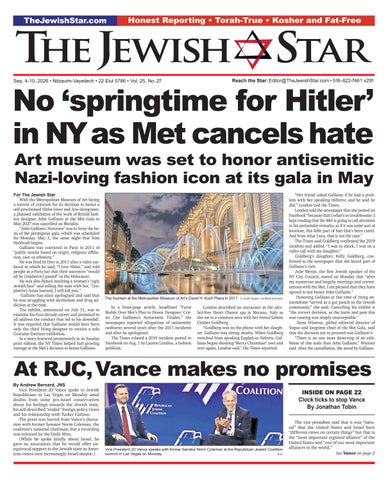
The fountain at the Metropolitan Museum of Art’s David H. Koch Plaza in 2017 G. Scott Segler via WikiCommons
In a front-page article, headlined “Furor Builds Over Met’s Plan to Honor Designer; Critics Cite Galliano’s Antisemitic Tirades,” the newspaper reported allegations of antisemitic outbursts several years after the 2011 incidents and after he apologized. The Times related a 2019 incident posted to Facebook on Aug. 1 by Lauren London, a fashion publicist.
London described an encounter at the alcohol-free Henri Chenot spa in Merano, Italy as she sat in a common area with her friend Sabine Cimber Goldberg. “Goldberg was on the phone with her daughter. Galliano was sitting nearby. When Goldberg switched from speaking English to Hebrew, Galliano began shouting ‘Merry Christmas!’ over and over again, London said,” the Times reported.
“Her friend asked Galliano if he had a problem with her speaking Hebrew, and he said he did,” London told the Times. London told the newspaper that she posted on Facebook “because that’s what’s so troublesome: I kept reading that the Met is going to call attention to his antisemitic remarks, as if it was some sort of footnote, this little part of him that’s been cured. And from what I saw, that is not the case.” The Times said Goldberg confirmed the 2019 incident and added, “I was in shock. I was on a video call with my daughter.” Goldberg’s daughter, Kelly Goldberg, confirmed to the newspaper that she heard part of Galliano’s rant. Julie Menin, the first Jewish speaker of the NY City Council, stated on Monday that “after my numerous and lengthy meetings and conversations with the Met, I am pleased that they have agreed to not honor John Galliano.” Honoring Galliano at this time of rising antisemitism “served as a gut punch to the Jewish community,” she said. Cancelling his exhibit is “the correct decision, as the harm and pain this was causing was simply unacceptable.” Anna Wintour, global editorial director of Vogue and longtime chair of the Met Gala, said that the decision not to proceed was Galliano’s. “There is no one more deserving of an exhibition of this scale than John Galliano,” Wintour said. After the cancellation, she stood by Galliano.
At RJC, Vance makes no promises
By Andrew Bernard, JNS Vice President JD Vance spoke to Jewish Republicans in Las Vegas on Monday amid doubts from some pro-Israel conservatives about his feelings towards the Jewish state, his self-described “realist” foreign policy views and his relationship with Tucker Carlson. The press was barred from Vance’s discussion with former Senator Norm Coleman, the coalition’s national chairman, but a recording was released by the Daily Wire. (While he spoke kindly about Israel, he gave no assurances that he would offer unequivocal support to the Jewish state as American voters turn increasingly Israel-skeptic.)
INSIDE ON PAGE 22 Clock ticks to stop Vance By Jonathan Tobin
Vice President JD Vance speaks with former Senator Norm Coleman at the Republican Jewish Coalition summit in Las Vegas on Monday. RJC
The vice president said that it was “natural” that the United States and Israel have “different views on certain things” but that is the “most important regional alliance” of the United States and “one of our most important alliances in the world.” See Vance on page 2
September 4-10, 2026 • 22 Elul 5786 THE JEWISH STAR
2
2 rabbis now lead OU: EVP Silber, CEO Joseph By Menachem Wecker, JNS During the upcoming High Holidays, Rabbi Shmuel Silber, of Suburban Orthodox Toras Chaim in Baltimore, plans to ask for divine help in his new job as executive vice president of the Orthodox Union, a role that his friend, Rabbi Moshe Hauer, held until his untimely death on Oct. 14. “I walk into this Rosh Hashana with a tremendous feeling of being overwhelmed at the opportunity to hopefully do something even greater for the Jewish people,” he told JNS. The first year, Rabbi Silber said, will be a bit of a “hybrid model” between being in the OU office in New York a few days a week and working remotely. “I feel a tremendous sense of responsibility to my shul. It’s not just my shul — it’s my family,” he said. The Orthodox Union said on last week that in his new role, Rabbi Silber would be “responsible for representing the OU’s vision on both Torah and public policy and providing hashkafic and halachic guidance within the organization and beyond.” Rabbi Josh Joseph, currently executive vice president and chief operating officer at the OU, is becoming the Orthodox umbrella organization’s new chief executive officer. In that role, he will oversee “management of
From left: Rabbi Josh Joseph, the Orthodox Union’s new chief executive officer, and Rabbi Shmuel Silber of Suburban Orthodox Toras Chaim in Baltimore, the OU’s new executive vice president. OU
all OU programs and operations,” and like Rabbi Silber, he will report to the group’s executive committee, the OU said. “I think where the board is going with this is that there is one person, who everybody understands, that is the senior executive, who from a reporting perspective, from a supervisory perspective, from a management perspective, from a financial accountability perspective — there is one person to focus on, and that’s the CEO,” Rabbi Joseph said. “We’re a lay-leadership driven organization, so Mitch Aeder is the presi-
Rabbi Shmuel Silber, of Suburban Orthodox Toras Chaim in Baltimore, and the late Rabbi Moshe Hauer. Israel Orange
dent. He’s the senior lay leader. Rabbi Moshe Elefant is the CEO of kashrus and me as CEO of klal, or community,” he said. The OU has nearly 3,500 employees in 115 countries worldwide, including at 640 plants in China, according to Rabbi Joseph. “That doesn’t include all of the volunteers,” he said. “When you add in volunteers and you add in consultants and you add in advisers, it’s much larger.” At 128, the Orthodox Union is still growing, according to Rabbi Joseph. The organization’s new strategic plan includes an emphasis on bringing more Jews — and not just Orthodox ones — closer to G-d, including through Jewish Student Union at NCSY, which aims to go from engaging 20,000 to 40,000 to 100,000 teens a year, he said. It also aims to engage Jews more via Birthright and in its work on the federal education tax credit, which can be used for Jewish education. “Being focused on Jewish identity, Jewish pride, knowing what it means to be Jewish — yes as a reaction to antisemitism but also because people are asking for it,” he said. “That is priority number one.” “Priority number two is more focused on Israel, our Anglo engagement in Israel,” he said. “So 10 years ago, we had no couples on campuses in Israel,
25 campuses in America, called JLIC couples. We now have 17 couples in Israel on 11 campuses and in four communities for young professionals.” Under Rabbi Silber’s leadership since 2003, Suburban, which is in its 70th year, has grown significantly. “As our spiritual leader, Rabbi Silber’s dedication and commitment is demonstrated time and again through his shiurim and classes, as well as a strong caring presence during times of simcha,” joy, “and sorrow,” per the Orthodox congregation’s website. Rabbi Silber created the synagogue’s Institute for Jewish Continuity, an “in person and online learning center dedicated to providing inspiring and intellectually invigorating Torah learning to all levels of learners,” per the synagogue. Rabbi Silber said that he grew up in East Brunswick, N.J., and was inspired by Rabbi Yaakov Wasser, then of the Young Israel of East Brunswick, who was a “tremendous influence” on him and his family and who inspired Rabbi Silber to pursue a rabbinic career. “I have been privileged, thank G-d, to spend my life in Jewish communal service, obviously in different arenas at different times,” Rabbi Silber said. He went to Yeshiva University, where he earned his rabbinic ordination, and he did his rabbinic internship
at Congregation Shearith Israel, also known as the Spanish and Portuguese Synagogue, in Manhattan, then under Rabbi Hayyim Angel. The first time that he spoke “really” publicly was at the synagogue, Rabbi Silber said. The sermon (drasha) came after services, and Rabbi Norman Lamm, a former Yeshiva University president who died in 2020, was then in the audience. “I was a kid. This was my first drasha given in a shul, and I have Rabbi Lamm — the orator of orators was there,” Rabbi Silber said. “I will never forget. Immediately after he pulled me to the side. I don’t remember exactly what he said, but I remember it was critique and compliment in a beautiful synthesis way that was just fantastic.” Rabbi Silber was then assistant rabbi, for three-and-a-half years, of Congregation Shomrei Torah, in Fair Lawn, NJ, under then Rabbi Benjamin Yudin. Rabbi Silber was also education director at the time at the kosher certifier Kof-K. (The OU also has a kosher division, which operates separately and with its own executive.) He also holds a graduate degree in Jewish education from Yeshiva, and he and his wife Aviva Silber have six children, according to his synagogue biography. Rabbi Silber said that Suburban, which opened a new building in 2025, is a “beautiful, diverse, eclectic congregation.” Rabbi Hauer, the former OU executive, “was a friend and a mentor, and I heard from Rabbi Hauer just a lot of the different things that he was able to accomplish at the OU,” Rabbi Silber said. “I can’t say that we were looking for anything, but this opportunity presented itself, and I think the unique platform of the OU is an opportunity to help the klal,” Hebrew for the community. “I feel very privileged that throughout my entire life, I’ve been devoted to the needs of community, but obviously, community I would say in a narrowSee 2 rabbis at helm on page 16
Vance makes no promises to Jewish Republicans…
Continued from page 1 “I believe there are a few countries — Israel, the UK — where there’s a much deeper cultural symbiosis and harmony than exists with most other countries,” Vance said. “I wouldn’t say that it’s purely transactional in the same way that I wouldn’t say that our alliance with the UK is purely transactional.” Vance said that one of the “elephants in the room” is that “that there is a growing suspicion among, I would call it under-40s, of the US-Israel relationship.” “My view is what we have to do is articulate why this is in the best interest of the United States of America and actually get out there and talk about the ways in which it is in the best interest of the United States of America,” he said. “I can only speak for myself here, but I think it’s very, very important to talk about the concrete alignment of interest and to hook the relationship on that, rather than something that may have made a lot of sense, rhetorically, 30 or 40 years ago, but just doesn’t have the same purchase as it did 30 or 40 years ago,” Vance said. President Donald Trump’s record of support for Israel was a common refrain from GOP officials at the conference, but as Vance is a likely contender for 2028, it is an open question
whether he will be as enthusiastically received by pro-Israel Republicans as are other potential candidates, like Sen. Ted Cruz (R-Texas) or Secretary of State Marco Rubio. Vance’s remarks were closed to press, but RJC CEO Matt Brooks, former White House press secretary Ari Fleischer and Sen. Jim Banks (R-Ind.) answered questions from reporters about the discussion after the vice president spoke. JNS asked if Vance’s appearance at the conference should be viewed as the first campaign event of the 2028 presidential election. “Senator Coleman said over and over again that the Trump-Vance administration is the most pro-Israel administration we’ve ever had and that line resonated with the crowd,” Banks said. “That’s a line that I think you heard then that you’re going to hear after the midterm as we head into the presidential cycle, too.” Fleischer, who is also on the coalition’s board of directors, said that the focus of Vance and Republicans remains the 2026 midterms but that the vice president’s talk was important engagement with American Jews. “I think the vice president really answered a lot of questions in a way that made a Republican Jewish Coalition really comfortable,” he said.
During their talk in front of about 1,000 attendees, Coleman asked Vance about his interviews with Tucker Carlson, Joe Rogan and other podcasters who have hosted anti-Israel guests or been accused of antisemitism and how he distinguishes them from Holocaust deniers like Nick Fuentes. “Where I really do draw the line is on people who engage in what I call this ‘blood-guilt attitude’,” Vance said. “I recognize a lot of people in this room are going to disagree with things that Tucker Carlson or Megyn Kelly or Joe Rogan have said, but just to hone in on Fuentes and Rogan, I think these are two very very different categories of people.” He did not explicitly condemn Carlson, whose podcast he appeared on in 2024 shortly after Carlson was accused by Yad Vashem of engaging in antisemitism and Holocaust denial. “As a political matter, I think that we have got to be willing to go everywhere and bring our message anywhere and to any person,” the vice president said. “Outside of some pretty bright lines, I try to talk to as many people as I can.” Vance said that he believes antisemitism is “corrosive for the soul” and spoke about his relationships with Jews and views on ChristianJewish relations.
“I’m hardly an expert on the Jewish faith, but I believe that Jews and Christians, one of the critical things that we agree on is this concept of Imago Dei, that we are all made in the image of G-d,” he said. “The core of antisemitism to me is the idea of blood libel, the idea that because of your genetics, because of your blood, because of your ancestry, you are guilty of a crime that you never committed,” he said. “I think that blood libel, which is at the root of antisemitism, is the exact opposite of the Christian gospel, and because of that, I believe the gospel is actually the solution to this.” Vance attributed some of the rise of antisemitism in America to immigration policy. “The worst antisemitism grows up when you allow the importation of large groups of people who bring their ethnic rivalries to the United States,” he said. A prominent New York conservative voice said he was unimpressed with Vance’s performance. “My honest assessment of Vice President Vance tonight? He was not strong enough on Israel,” wrote Sid Rosenberg, the WABC New York talk radio host. “I don’t think he wowed the strong Jews in the room tonight.”
THE JEWISH STAR September 4-10, 2026 • 22 Elul 5786
1362035
3
Olim on Nefesh flights arrive job-search ready By Jessica Russak Hoffman, JNS More than 2,300 people are making aliyah on 92 group flights through Nefesh B’Nefesh this summer, including 1,100 singles, 480 families and 250 retirees, ranging from 5 months to 98 years old, with an average age of 29. While Jerusalem, Tel Aviv-Yafo, Modi’inMaccabim-Reut, Ra’anana and Beit Shemesh are the leading destinations, according to Nefesh, choosing among them — with an eye on job opportunities — can be a challenge. “People say to me when I’m traveling the US, ‘If you find me a job, I’m going to come,’ but very few people get recruited to jobs before they make aliyah,” said Marc Rosenberg, vice president of diaspora partnerships at Nefesh. “Fear of the unknown” is often the biggest obstacle to making the move, he said. Families often start deciding where to live by looking for schools that are good fits for their children, he said. “If you find a school, the school will give you a neighborhood to live in.” Olim often choose communities for their children and accept the possibility of a long commute to work, he added. Rivka Goldglancz, who is moving from West Hempstead with her four daughters — ages 6, 9 and 15-year-old twins — chose Modi’in in part due to its location between Jerusalem and Tel Aviv, which she thinks can expand her employment options. “I’m looking for a new job,” she said. Goldglancz had not seen their new apartment in person. Her sister, who lives in Jerusalem, toured it and sent a video. Her 6-yearold daughter Nava was already sold. “I’m really excited because we have two balconies, and I just love balconies,” Nava
The Goldglancz family of West Hempstead at Ben Gurion Airport on Aug. 27.
said. “It’s so good because you can see a big view.” The family had to decide what to bring and what to leave behind. “Things are just things,” Goldglancz said. “I gave away a lot of my precious things to family and friends, so I’m happy they’ll continue to be used.” Rella, one of the twins, took a similar view. “Stuff is stuff,” she said. “We’re so lucky to have this opportunity. I’m open to trying new stuff. I’m not stuck in my routine.” She and her sisters sipped on Starbucks — their last for a while — at the airport. Rella said that she would miss the coffee chain. “It’s one small thing,” she added. “I’m going to be in the Holy Land, so I can leave my
Jessica Russak-Hoffman
Starbucks behind.” For Ilana and Steven Snyder, who moved from Cedarhurst, where they lived for 33 years, living near family was the priority. Two of their daughters live in Jerusalem, one in Katamon and the other in Talbiya, so the couple rented an apartment in nearby Arnona. They have only seen it remotely. “I’ve watched that video about 100 times,” Ilana Snyder said. Steven Snyder, an accountant, was able to keep his American job remotely and initially plans to work East Coast hours. The arrangement made the move easier, though it was not a deal-breaker. “We would have come anyway,” he said. Without the job, “our standard of living
would have been different,” he said. The Snyders see Jerusalem as a starting point but not necessarily a final destination. Their children are nearby, public transportation is easy, and they know their way around the city, they said. But they seek a quieter community in northern or southern Israel, they said. Rosenberg said that of 4,500 expected olim this year, some 20% might arrive with remote jobs or commute abroad for work. While the other 80% arrive without jobs in hand that doesn’t mean they haven’t prepared, he said. “They’ve networked. They’ve spoken to people. They’ve sent resumes, and they’ve got feelers to understand where they can find jobs and what their projected income could be.” He said that he encourages people to speak to the Nefesh employment department and consult the job board but not to apply for jobs yet. “They’re going to interview you and say, ‘When can you arrive’?” he said. “It’s going to be tough to get there in a few weeks. But if you see a job and how much it pays, it gives people the confidence in their ability to find the job.” Israel’s skills-focused employment culture can give newcomers room to pivot, he said. “They don’t really care where you went to school,” Rosenberg said. “People often have a second career when they come here.” Nefesh B’Nefesh works in partnership with Israel’s Ministry of Aliyah and Integration, the Jewish Agency for Israel, Keren Kayemeth LeIsrael and JNF-USA to facilitate immigration to Israel.
| GET READY | for straight-A style | AMERICAN EAGLE OUTFITTERS FOOT LOCKER HOLLISTER CO. MACY’S OLD NAVY THE CHILDREN’S PLACE +MORE SCAN FOR SALES & OFFERS
ShopGreenAcres.com GAM-26159 A2 BTS Print Ad_VERSION 2.indd 2
1358873
September 4-10, 2026 • 22 Elul 5786 THE JEWISH STAR
4
8/10/26 2:35 PM
THE JEWISH STAR September 4-10, 2026 • 22 Elul 5786
1362734
5
September 4-10, 2026 • 22 Elul 5786 THE JEWISH STAR
6
HEALTH, MIND & BODY
A ‘tsunami of hate’ confronts Jews in medicine By Jonathan D. Salant, JNS • Jews were labeled as oppressors, at the University of California Los Angeles David Geffen School of Medicine. • Patients were afraid to be identified as Jews, at the University of California, San Francisco. • Protesters targeted medical schools in New York City and demanded the destruction of the State of Israel. These are some of the antisemitic incidents that erupted in hospitals, dental schools, psychology conferences and elsewhere since Oct. 7, according to a new study published in the Rambam Maimonides Medical Journal. “After Oct. 7, the landscape shifted in a seismic way, not that antisemitism was brand new, because we do have a history of quotas to limit Jewish enrollment in medicine and other examples of discrimination against Jewish doctors,” Hedy Wald, clinical professor of family medicine at Brown University’s Warren Alpert Medical School and a co-author of the study, told JNS. “But you had medical students and health professionals posting horrific things on social media, very antisemitic, very anti-Israel biased, and starting to see this appear in medical journals,” said Wald, who holds a doctorate in clinical psychology from Yeshiva University. She said that she and her co-author, Dr. Steven Roth, Michael Reese endowed professor at the University of Illinois College of Medicine and associate head for research, for faculty development, and for faculty affairs in the anesthesiology department, found examples of Jew-hatred in medicine that amounted to a “tsunami of hate.” That came “in the sacred space that we inhabit — providing healthcare to people when they’re most vulnerable
Adobe AI
and actually watching this right before our eyes,” she said. The 22-page review chronicles antisemitic incidents across the medical profession. It found medical school faculty and health practitioners posting antisemitic tropes and dentists in Miami and Boston losing their jobs after tearing posters of the hostages taken from Israel by Hamas on Oct. 7. The valedictorian at the University of Manitoba Max Rady College of Medicine, in Winnipeg, received a standing ovation after using the address to demonize Israel, and anti-Israel bias has seeped into medical and scientific journals, the researchers found. “We must take firm action to counter all of this more broadly as a ‘malignant normality,’ which manifested in the ethical perversion and complicity of physicians in Nazism and the Holocaust,” the article states. “Today, antisemitic prejudice and associated forms of anti-Israel bias and anti-Zionism must be countered,” the authors add. “It is our duty and moral responsibility within clinical care, research, teaching, systems policy and administrative leadership in the health professions.” The report states that there was
a need for medical schools to teach about antisemitism, which few currently do. Wald said that teaching on Jew-hatred should include lessons on Jewish identity, the nature and prevalence of antisemitism, including in anti-Israel forms, and medicine’s complicity in Nazism and the Holocaust. “Advocacy against hate is a core component of medical professionalism,” the article states. “The health professions have challenged past and ongoing injustices. Antisemitism is no exception and deserves attention. There is work to be done in countering all forms of discrimination. This includes antisemitism in the health professions.” The Association of American Medical Colleges acknowledged the rising number of antisemitic incidents and the group’s role to play in addressing them. “A safe, respectful and welcoming learning environment is fundamental to academic excellence, professional development and well-being,” Malika Fair, the association’s chief community, opportunity and engagement officer, said. A 150-year-old nonprofit, the AAMC accredits US medical schools. “As antisemitic incidents rise across
the United States, including on college and university campuses, medical schools have a responsibility to ensure that learners, leaders, faculty and staff, including those who identify as Jewish, can learn, teach and work in environments free from discrimination, prejudice and harassment,” Fair said. Wald said that she and Roth saw the need to chronicle the rise of Jewhatred in health professions, compiling a list of incidents from news stories, peer-reviewed publications, government documents and other sources. She said that they wanted to see how widespread this phenomenon was after Oct. 7, and the only way to do it was to follow the time-honored medical tradition of studying the facts and seeing where they led. “We had a lot of questions, and we said the way we address questions in our world is we do research,” Wald said. “We decided that it was time for a rigorous narrative review of what we called anatomy of antisemitism in the health professions, not just medicine but across-the-board,” she said. “We had heard from our colleagues in the mental health field, such as psychology and social work, that they were suffering.”
“When you start talking about things like ‘decolonizing therapy’ and see blatant antisemitic hate out there, you’ve got a big problem,” she said. The list went on and on, according to the report. Medical students used social media to spread the classic antisemitic trope of the allpowerful Jew, while protesters stood outside hospitals and called for the destruction of Israel. Wald admitted being stunned at the antisemitic and anti-Israel rhetoric among members of the medical profession, none of which she said had any basis in fact. “To see the wrath and the tsunami of hate that was coming out from people that are supposed to be caring and empathic, people that are supposed to be evidence-based, you have a responsibility, a particular responsibility as a health professional, to fight antisemitism, hate and discrimination of all kinds,” she said. “That’s your oath. You can’t violate your oath,” she said. “To see that happening, that’s when I would say I was stunned.” The daughter of a Holocaust survivor, whose entire family was murdered in the Holocaust, Wald said the post-Oct. 7 antisemitism in the medical profession was too pronounced to ignore, and she had the ability to call attention to it. “Sometimes you’re given opportunities, and you need to take those opportunities when you see injustice in the world,” she said. “Elie Wiesel talked a lot about silence being complicity, and he inspired me so much. His son inspires me too.” “When I see things that are a moral outrage, I cannot stand by,” she said.
Hadassah letter denounces Jew-hate in medicine The Lancet, one of the world’s leading medical journals, has published a letter written by Carol Ann Schwartz, Hadassah national president, and Yoram Weiss, MD, director general (CEO) of its Jerusalem-based Hadassah Medical Organization. The letter denounces the “continued effort to isolate Israeli medical professionals,” which the leaders say is “a thinly disguised attempt to normalise (sic) anti-Zi-
onism and antisemitism.” The impetus for the letter, which appears in the current edition of The Lancet (August 15, 2026), was a petition being circulated to expel the Israeli Medical Association (IMA) from the World Medical Association (WMA), of which the IMA is a founding member. The petition was the subject of an article in the June 13 issue of The Lancet entitled “Petition calls for boycott of Israeli Medical Association.”
The Hadassah leaders urge the WMA to reject the petition and to exclude it and any related resolutions from the agenda of the group’supcoming General Assembly, which will take place in Rotterdam, The Netherlands, in October. Schwartz and Weiss write that the petition “targets Israeli medical professionals based solely on their nationality and the actions of their Government,” continuing: “The accusations lodged against
the IMA, including the failure to condemn its government’s conduct, create a double standard for Israeli health-care (sic) professionals and contribute to the rise in antisemitism experienced by 40% of Jewish practitioners.” The two leaders praise the WMA “for rejecting the anti-Israel campaign and affirming [the WMA’s] commitment to inclusive.” They add: “Hadassah’s hospitals have long
been a bridge to peace for patients and practitioners of every race, religion, or nationality. … Attempts to politicise (sic) medicine derail potentially lifesaving collaboration among health-care (sic) professionals, compromise global health and, ultimately, harm countless patients.” Schwartz and Weiss end the letter by saying, “Hate has no place in medicine.” Reported by Hadassah.
Mount Sinai opens Central Nassau surgery center Mount Sinai Health System has opened the opening of Peakpoint Central Nassau Surgery Center, a 20,400-square-foot ambulatory surgical center, in Carle Place. The state-of-the-art facility offers advanced care in gastroenterology, gynecology, ophthalmology, orthopedic and spine surgery, otolaryn-
gology, pain management, plastic surgery, podiatry, and urology, transforming access to outpatient surgical care across Long Island. Peakpoint is a joint venture between Mount Sinai, leading surgeons, and Merritt Healthcare, an industry leader in ambulatory surgery centers.
Equipped with two operating rooms, two procedure rooms, and 17 recovery bays, including three private and three 23-hour stay rooms, the surgery center is equipped with the latest surgical technology and can manage both routine and complex procedures. “With Mount Sinai care hubs now
located in Wantagh and Greenlawn, this centrally located ambulatory surgery center helps connect existing facilities while expanding access for patients across Long Island,” said Michael Gorin, MD, Mount Sinai urologist and Peakpoint medical director. “Peakpoint Central Nassau is an important part of Mount Sinai’s on-
going commitment to bring high quality clinical services close to where patients live,” said Ken Long, senior vice president of network operations for the Mount Sinai Health System. “Mount Sinai is bringing Manhattan-level clinical services to the communities of Long Island.” Reported by Mount Sinai.
7 THE JEWISH STAR September 4-10, 2026 • 22 Elul 5786
Keep Your Independence
Your Health. Your Culture. Your Parker.
Customized Health Care On-site or at Home •
Short Term Rehabilitation / Sub-Acute Care
•
Home Health Care
•
Long Term Care Facility
•
Medical House Calls - Parker At Your Door
•
Dialysis - community / on-site
•
Dementia GUIDE Model
•
Palliative care
•
Willing Hearts, Helpful Hands
•
Hospice - community / on-site
•
Research and Grants
1356388
271-11 76th Avenue | New Hyde Park, NY 11040 parkerinstitute.org | 877-727-5373
September 4-10, 2026 • 22 Elul 5786 THE JEWISH STAR
8
Angola has an overlooked place in Jewish history MICHAEL FREUND
Wandering Jew
I
n 1711, a woman named Mariana Pequena stood before the Portuguese Inquisition in Lisbon, accused of secretly practicing Judaism. Born in Angola and later enslaved and taken to Brazil, she had managed to secure her freedom. But she could not escape her past or her faith. Testimony suggested that she observed Jewish customs and was accused of clinging to beliefs and rituals associated with Judaism. For this, she was condemned. Her story, at once tragic and extraordinary, opens a window onto one of the least-known chapters of Jewish history: the surprising and largely forgotten connection between the Jewish people and the southern African nation of Angola. The origins of that connection lie in the expulsions from Spain in 1492 and Portugal soon thereafter. Countless numbers of Jews had been forced to convert or flee. Some of these “New Christians,” or Conversos, went to distant territories in Portugal’s expanding colonial empire. By the 16th century, these crypto-Jews had established a presence in Angola, particularly in Luanda. Much of this activity traces back to Paulo Dias de Novais, the Portuguese conquistador and grandson of explorer Bartolomeu Dias, who was granted lordship over Angola in 1571. Some historians have suggested that Novais may have had Converso connections and that New Christian artisans and settlers accompanied his enterprise to Luanda. In later accounts and Inquisition records, there are hints of a clandestine rabbi and secret prayer gatherings — possibly even a makeshift synagogue — one of the most remarkable (and least documented) outposts of hidden Jewish life in sub-Saharan Africa. Angola was not merely a refuge; for some, it also served as a conduit. estimonies gathered by the Inquisition in the Americas suggest that certain individuals accused of Judaizing first encountered Jewish customs in Angola, making it a bridge linking Europe, Africa and the New World. Yet, like Mariana Pequena, those who clung to Judaism did so at enormous risk. The trans-
T
Kalandula Falls on the Lucala River in Angola, about 225 miles from Luanda. They are one of the largest waterfalls by volume in Africa. Travel Telly, Adobe
A symbol of Angola, its people and culture.
atlantic slave trade and ongoing persecution gradually eroded these fragile communities. Along parts of the Angolan coast, early modern European sources refer to Luso-African groups sometimes described as “Black Portuguese,” whose identities emerged through intermarriage and cultural adaptation. Some modern writers and scholars have speculated that vestiges of Sephardic customs may have persisted among segments of these communities, even as the slave trade scattered their descendants. But the evidence is fragmentary, and many of these people were ultimately swept into slavery, their traditions largely lost. Thus, Angola’s Jewish story is marked not only by resilience but also by disappearance. And yet, remarkably, Angola would reemerge in Jewish history at a moment of profound global crisis. n the early 20th century — and with renewed urgency in the 1930s as Nazi persecution intensified — some Jewish leaders raised the idea of settling Jews in Angola. The so-called “Angola Plan,” associated with the Jewish Territorialist movement led by Israel Zangwill, envisioned the Portuguese colony as a potential refuge for Jews fleeing antisemitism. Portuguese authorities, including members of parliament, entertained and advanced proposals that could have opened the way to organized Jewish settlement in Angola. At one point, in 1912, the Chamber of Dep-
I
About 150 people attended the opening of the Chabad center in Luanda, Angola, in 2016.
Chabad.org
Ndalthiz, Pixabay
uties approved a bill to authorize land concessions to Jewish settlers, but nothing came of the initiative due to a lack of funds. The plan briefly gained renewed attention in 1934 as European Jewry faced mounting danger under Adolf Hitler, but it went nowhere. Had it been implemented on a significant scale, Angola might have become a haven for thousands of Jews seeking escape. History would render that failure all the more tragic. As the Holocaust unfolded, 6 million Jews were murdered while much of the world remained closed to Jewish refugees. The idea that Angola — remote, underdeveloped and far from the centers of Jewish life — might have offered even a partial refuge underscores the devastating consequences of missed opportunities and international indifference. One cannot but wonder how many lives might have been saved. And yet, in the decades that followed, Angola would again intersect with the Jewish story, this time through the modern State of Israel. iplomatic relations between Israel and Angola were formally established in 1993, with Israel opening an embassy in Luanda in 1995 and Angola establishing its embassy in Tel Aviv in 2000. Since then, cooperation has expanded across numerous fields. Israeli expertise has contributed to Angola’s development in areas such as agriculture, health care and infrastructure, with training programs helping to build local capacity. Israeli companies have been active in sectors ranging from construction to telecommunications and water management. These ties continue to develop. In 2025, Israel’s newly accredited ambassador to Angola, Leo Vinovezky, highlighted what he called “unique opportunities” to expand cooperation in agriculture, health, space technology and vocational training. At the same time, Angola has often aligned itself against Israel in international forums, reflecting broader African and developing-world perspectives. Yet it has also maintained bilateral ties and affirmed Israel’s right to security, illustrating the complex and often dual-track nature of modern diplomacy. In recent years, Jewish life in Luanda has grown stronger after the grand opening in 2016 of Chabad Lubavitch of Angola’s center in Luanda. Hundreds gathered for the dedication of a Torah scroll specially commissioned for the community, complete with a sofer
D
Drawings and images for sale in Angola. mdccruz01, Pixabay
from Canada and festive celebrations, in what the community describes as the first public hachnasat sefer Torah, or Torah dedication ceremony, in Angolan history. Though small in number, the community represents a striking continuity — a visible Jewish presence in a land where Jewish identity once survived only in whispers. And so, Angola today embodies two parallel Jewish narratives. The first is early and largely forgotten: the story of Sephardic exiles who carried their faith across oceans, struggled to preserve it under persecution and ultimately saw many of their communities fade into obscurity. The second is modern and evolving: the story of a sovereign Jewish nation building ties with an African nation, alongside a small but resilient Jewish community living openly where others once could not. Together, they offer a powerful reminder. Jewish history does not unfold only in the places we expect. It stretches into distant corners of the world, shaped by exile, resilience and the constant search for refuge. And sometimes, as in the case of Mariana Pequena, it is preserved in the life of a single individual whose quiet determination to remain connected to her people echoes across the centuries. Michael Freund is founder and chairman of Shavei Israel, an organization that assists descendants of Jews and the Lost Tribes to reclaim their roots. Write: Columnist@TheJewishStar.com
Israeli entrepreneur Haim Taib and Armando Manuel, chairman of Angola’s Sovereign Wealth Fund, at the signing of a $1 billion Lobito Corridor development initiative during the US-Africa Business Summit in Luanda, Angola, in June 2025. Mitrelli
SHARON PARDO
F
or years, a cheap airline ticket made the Jewish state feel almost European. An Israeli could fly to Warsaw for the weekend, a student in Milan could visit family in Israel, and a European Jew could travel to Tel Aviv almost as easily as to another European capital. Budget aviation accomplished something that diplomacy and treaties never quite achieved: It made the Mediterranean Sea seem smaller and brought Israel into the everyday rhythms of European life. Then came Oct. 7, and the old boundaries reappeared. A recent report on the changing economics of European aviation offers an unexpected window into this transformation. Selected economy fares on Ryanair, easyJet and Wizz Air were 39.2% higher in May than a year earlier. Compared with early 2024, average fares had more than doubled. Fuel costs have risen sharply, while baggage, seat selection and other additional charges have become increasingly important to the business model. These companies are making commercial and security calculations, not geopolitical statements. In the past seven decades, Israel has become deeply connected to Europe without ever becoming fully part of its institutional order. The European Union is Israel’s largest trading partner. Israeli researchers participate extensively in European research programs. Israelis study at European universities, purchase homes in European cities, ac-
A Wizz Air flight prepares to take off from Ben-Gurion International Airport, Sept. 3, 2014. Moshe Shai, Flash90
quire European citizenship and travel across the continent in enormous numbers. Budget airlines provided much of the physical infrastructure for this relationship. Ryanair, easyJet and Wizz Air turned European capitals into places Israelis could visit frequently rather than occasionally. Rome and Vienna became weekend destinations. Bucharest and Athens were less than three hours away. This wasn’t simply tourism. It altered how Israelis imagined their place in relation to Europe. The wars since the Hamas-led terrorist attacks in southern Israel on Oct. 7, 2023, have exposed the fragility of that arrangement. When security conditions deteriorate, foreign airlines can leave — and quickly. Europe remains deeply attractive, even when Israelis are angry with it. easy Jet has canceled its Tel Aviv services until late October 2026, while Ryanair remains absent for a combination of commer-
cial and operational reasons. Wizz Air offers perhaps the clearest illustration. It returned to Israel in May following an earlier suspension, only to halt its Tel Aviv operations again when Iran fired missiles at Israel in June. For decades, Europe appeared close for Israelis, inexpensive and readily available. During periods of calm, an Israeli could inhabit several worlds almost simultaneously: working in Tel Aviv, holding a Portuguese passport, collaborating with colleagues in Brussels and spending a weekend in Budapest. Security crises reveal the limits of that experience aand exposed another vulnerability that receives far less attention: Europe’s Jewish communities. For many European Jews, Israel is not just another foreign destination. Children study there. Relatives live there. Families travel for holidays. Friends move between Israeli and European cities. Some contemplate aliyah. Oth-
ers would never consider leaving their home countries, but still regard Israel as part of their emotional, communal and religious world. Frequent and affordable flights, therefore, helped create an informal Jewish space stretching from Tel Aviv to London, Paris, Berlin, Madrid and acquired particular importance since Oct. 7 when Jewish communities across Europe experienced a dramatic resurgence of violent antisemitism. At precisely the moment when some may feel a stronger bond with Israel, getting there has become less predictable. Knowing Israel is three hours and a modest airfare away produces a different sense of security and belonging than knowing that flights may disappear with the next missile attack. Israel remains deeply embedded in European economic, academic, cultural, sporting and social networks, yet it does not enjoy the institutional protections that underpin integration among EUmember states. Now the economics of European aviation are changing as well. Fares are rising, operating costs are increasing, and carriers are reconsidering where they deploy their aircraft. For many Europeans, that may mean paying more for a weekend abroad. Israel faces an additional vulnerability: It sits at the edge of the European aviation system and risks being removed from it whenever the regional security calculus changes. For 20 years, budget airlines taught Israelis that Europe was next door. Since Oct. 7, they have been reminded that it is still abroad. For Israelis and European Jews alike, what is becoming more fragile may ultimately matter far more than the price of the ticket. Sharon Pardo is a senior fellow at the Jewish People Policy Institute (JPPI). Write: Columnist@TheJewishStar.com
P R O U D LY S E R V I N G L O N G I S L A N D H O M E O W N E R S
PROPERTY TAX REDUCTION
PAY LESS. KEEP MORE. File your grievance today.
Personalized attention from start to finish Decades of proven, real results Pay nothing upfront New customer discounts • Referral programs
516-915-OTAX
TheTaxReliefPro.com • info@TheTaxReliefPro.com
1359180
516-915-0829
1359603
LIMITED-TIME
THE JEWISH STAR September 4-10, 2026 • 22 Elul 5786
For Israelis, Europe no longer cheap flight away
9
September 4-10, 2026 • 22 Elul 5786 THE JEWISH STAR
10
Horn says American Jews need a new activism KAREN LEHMANN
F
or 80 years, American Jewish activism had a reliable formula: build institutions, tell the story and trust that education would do the rest. It worked well enough for long enough that most American Jews never had to ask whether it still worked. Oct. 7 answered the unasked question: It doesn’t work, not on its own, and not fast enough for a fight that has moved from the op-ed page to TikTok algorithms. This week, Dara Horn published a new book, “The Final Solution to the Jewish Question,” a deliberately provocative title. It argues that American Jews have been fighting with the wrong era’s weapons. Her core claim is that antisemitism is not bias or ignorance to be corrected with better facts. It’s a lie and always the same lie: Jews are destroying whatever a given society claims to value most. You don’t out-argue a lie like that with a pamphlet. You must disrupt it. That reframing matters because it changes the target. If antisemitism were simply ignorance, the old model — educate, publish, litigate — would eventually win. But most people spreading or absorbing these lies aren’t Haman. They’re Ahasuerus; not malicious, just credulous, going along with whoever has their ear. That’s good news. Ignorance is fixable and doesn’t want to stay duped once it realizes it’s been played. Part of the old failure was definitional. For decades, Jews have attempted to fit into a framework
If antisemitism were simply ignorance, the old model — educate, publish, litigate — would eventually win.
that was never entirely accurate — a mere religion, a community, just one group among many in a pluralistic society — that made us easier to dismiss. In reality, Jews are a people and allowed to define ourselves as such, even if we are a non-conforming people that doesn’t dissolve into someone else’s identity categories. We shouldn’t be negotiating that down to something smaller and safer just to be accepted. Horn notes that Jewish survival itself is a result of refusing to assimilate into invisibility. This was a choice, repeated across 3,000 years. battle is taking place today on platforms where the loudest voices — left and right alike — get amplified because outrage is the business model. When Jews respond only by defending ourselves over and over, we concede the premise that a defense is owed in the first place. Feeding that campaign is an education gap Horn has named directly: In most American schools, the only thing students are reliably taught about Jews is that they were murdered in Europe between 1933 and 1945, period. Everything else has been outsourced to TikTok. Teaching a 12-year that snapshot of history, without any context or explanation of the events that preceded (with genocidal antisemitism going back millennia) or followed, leaves students with a deep understanding of the horror but complete ignorance of the history that explains it. So, what would a new Jewish activism look like? Like pattern recognition rather than incident-by-incident amnesia. And being loud in the rooms where the extreme fringe dominates by default because no one else shows up. Visibility is both leverage and leadership. I’ll admit something my generation might not like to hear: Some of this is on us. We had the platforms and some of the most brilliant, creative Jewish minds of any generation in entertainment, media, law and technology. But we often squandered this advantage by not actively engaging in the fight on social media, where the real action was taking place. e fell asleep at the wheel. That complacency is how a DSA-aligned candidate like Zohran Mamdani could rise from a backbench state assembly seat to the mayoralty of New York City in barely a year. It’s how he never faced a serious challenge from the communities
A
W
Author Dara Horn and the cover of her new book.
nal lie has already reached). What competes is original, engaging Jewish content — history, humor, daily life, culture — that shows up in the feed before the lie does. A new form of activism involves coalitionbuilding beyond the community, not just within it. Much Jewish activism focuses on Jews talking to Jews, but if the majority of people being misled are more like Ahasuerus than Haman, then the most effective audience often lies outside the community; among other groups targeted by the same disinformation networks, originating from the same sources and receiving the same funding. Finally, a new activism means investing in culture, not just advocacy. The Jewish creative talent already present in film, comedy, music and gaming has never been effectively mobilized to formulate a coordinated counternarrative. But culture moves faster than curricula. It always has. Visibility, culture, coalition and leverage all come down to the same underlying choice. orn frames this as a Queen Esther moment, and the analogy is more apt than it should be. King Ahasuerus ruled an empire comprising 127 provinces, stretching from India to Ethiopia. He issued a decree to annihilate his own Jewish subjects within those provinces without ever asking who they were. A ruler, and by extension a public, was willing to endorse such annihilation so long as no one confronted them directly with the reality of their target. Esther’s true obstacle was not the decree itself. It was her own fear of being discovered and losing the safety of hiding within the palace walls. The pivotal moment in the story occurs when she ceases to conceal herself and identifies herself as one of the individuals marked for destruction. Today, we find ourselves at a similar crossroads. We all must choose whether to continue to quietly assimilate or finally declare our true selves. We didn’t disappear when it would have been easier to disappear. That was not an accident. It was a choice, and the time has come to choose again. We are a people that has already outlasted every empire that tried to erase us against odds that should have ended us many times over. We are still here. We intend to remain here. Karen Lehmann, based in Washington, is a photographer, journalist and political activist. Write: Columnist@TheJewishStar.com
H
who should have seen it coming. Mamdani wasn’t a surprise attack. It came in plain sight, while we looked away. Education and rebuttal will always be necessary, but both are reactive, a response that comes only after the lie has become universal. Our new strategy must alter the landscape itself, beginning with controlling the content pipeline rather than merely policing it afterward (with a correction reaching only a fraction of the audience the origi-
From Brown U, Bartov screams genocide libel PAUL SCHNEIDER
T
he Israeli academic Omer Bartov may be the most prominent scholar currently making genocide accusations against Israel. His new book, “Israel: What Went Wrong,” will no doubt enhance his reputation in this regard. Since 1989, Bartov has been on the faculty at Brown University where, he says, he is a historian specializing in
Holocaust and genocide studies. But as his book shows, since joining American academia, he has become more of a propagandist, displaying the anti-Israel bias typical of today’s college campuses. For example, adopting the popular jargon of that milieu, he writes that the Jewish state amounts to “a settler-colonial takeover of land and resources from the indigenous Palestinian population.” He views the Hamas attack of Oct. 7, 2023 as “indigenous resistance,” arguing that it “cannot be understood without taking into account the larger historical context” and “the growing despair of the population in the Gaza Strip.”
Using the term ‘genocide’ not because it is legally accurate but because it is rhetorically necessary.
Having spent part of his career studying the indoctrination of Nazi soldiers, Bartov can’t resist comparing the IDF to the German Wehrmacht. He also likens the current Israeli government to the Zealots of Masada who “had no interest in politics or compromise” and by their intransigence “sent the Jews into 2,000 years of exile in the name of their insane, profoundly unJewish messianic faith.” Like many of his colleagues in the American academy, Bartov has become an apologist for the bigoted protests that followed Oct. 7. In “Israel: What Went Wrong,” he makes the unsupported claim that antisemitism “has been shown to be rarely present in the multiple protests by students and others around the world.” Somehow, he manages to ignore the harassment of Jewish students that accompanies those protests at nearly every elite col-
Omer Bartov and the cover of his new book. Bildungsstätte Anne Frank via WikiCommons
lege and university, and the fact that many Jewish students feel forced to hide their identities. The core of Bartov’s book is his claim that Israel is committing genocide in Gaza. This is where his intellecSee Schneider on page 16
From left: CUNY Chancellor Felix V. Matos Rodrigues; Gideon Taylor, president of the Conference on Jewish Material Claims Against Germany; Sarah Valente, director of the Sandra K. Wasserman Jewish Studies Center at Baruch College; and Baruch College President S. David Wu. CUNY
“Antisemitism and Holocaust denial and distortion are flourishing around the world,” Taylor stated. “We know all too well how words of hate quickly escalate to acts of violence. The public today — 80 years after Holocaust survivors were liberated — worries that something like it could happen again.” “The Holocaust cannot be a static discipline that is discussed and forgotten,” he said. “We must not only remember the 6 million Jews murdered but also learn from the acts that allowed this horror to happen.” Taylor said that while the Claims Conference funds academic Holocaust research at universities, the CUNY fellowship is the first project of its kind that the organization has supported.
1361098 1249534
“With everything happening on college campuses” in terms of anti-Jewish hate, Taylor said, “we felt that this is a priority project. We are especially interested in developing infrastructure and capacity” to potentially expand the initiative. The fellowship is intended to serve as a model that could eventually be expanded to additional CUNY campuses and potentially other universities, organizers said. The Claims Conference has cited gaps in Holocaust knowledge among younger Americans as another reason for strengthening education. Its 2020 US survey of millennials and Gen Z found that 56% could not identify Auschwitz-Birkenau, while 48% could not name a single concentration camp or ghetto.
1359181
By Debra Nussbaum Cohen, JNS The City University of New York is launching a new faculty fellowship designed to develop and strengthen Holocaust education across disciplines at three of its campuses. The CUNY Faculty Fellowship on Holocaust Distortion will bring together six faculty members from Baruch, Hunter and Queens colleges for a year of seminars, monthly meetings and experiential learning, including a study trip to Holocaust sites in Poland and the Czech Republic. The fellows will develop new courses or revise existing ones to incorporate Holocaust history and examine how the Holocaust is represented in academic and contemporary contexts, according to CUNY. The program will culminate in a 2027 spring summit showcasing the new courses and teaching approaches. The initiative aims to address what CUNY describes as the growing problem of Holocaust distortion, including the minimizing, exaggeration or misrepresentation of Holocaust terminology, imagery and analogies. CUNY said the fellowship is a first-of-itskind consortium among the three colleges. CUNY, despite its name and its role as New York City’s public university system, is funded primarily by New York state. About 60% of the operating funding for its four-year colleges comes from the state, while New York City and the state share funding for CUNY’s two-year community colleges. The Sandra K. Wasserman Jewish Studies Center at Baruch College is leading the fellowship. Sarah Valente, director of the center and a professor at Baruch, is the project’s principal investigator. “This fellowship stands to empower CUNY faculty to combat Holocaust distortion through innovative scholarship and firsthand study in Eastern Europe,” CUNY Chancellor Félix V. Matos Rodríguez stated. He thanked the Conference on Jewish Material Claims Against Germany for supporting the initiative. The Claims Conference is funding the fellowship through its Rabbi Israel Miller Fund for Shoah Research, Education and Documentation. The grant is $200,000 for the first year of the initiative, Gideon Taylor, president of the Claims Conference, said. The nonprofit, which advocates for Holocaust survivors and administers compensation and funds social-service programs, distributed about $530 million in reparations from Germany and Austria to survivors in 2025 and allocated another $960 million for survivor welfare needs, including home care, food and medicine.
THE JEWISH STAR September 4-10, 2026 • 22 Elul 5786
Fellowship at CUNY to expand Shoah education
11
September 4-10, 2026 • 22 Elul 5786 THE JEWISH STAR
12
WINE & DINE Observance trifecta: 9/11, Shabbat, R’Hashana Ethel’s Kitchen
ETHEL HOFMAN
R
osh Hashana begins on Friday night, Sept. 11. It’s the 25th anniversary of the 2001 terrorist attacks that rocked America and the world. And it’s Shabbat to boot. That means a trifecta of events that will bring the Jewish community together physically and spiritually. After lighting and reciting the Shehecheyanu blessing — “Blessed are You ... who has sanctified us ... and commanded us to kindle the light of the Sabbath and of the Day of Remembrance” — family and friends gather for a special holiday meal. • Traditionally for Ashkenazi Jews, apples are dipped in honey, symbolizing the wish for a sweet and happy year ahead. • Some Sephardic communities may use sugar or other sweet foods, such as preserves. The focus is on sweet foods, including pomegranates, dates and pumpkins. The head of a fish represents the literal meaning of the holiday — the head of the year. According to the “Book of Jewish Food” by Claudia Roden, nothing sour, bitter or black is served. To hold to tradition, a fruit or green tea puts the finishing touch on the meal, instead of coffee. osh Hashana comes on the heels of Labor Day, when families get their last licks of summer and when school starts for most children. Indeed, that week can seem overwhelming. What’s at the top of my list? Buying the best kosher honey available: Manuka honey from New Zealand is expensive, but exceptional. Less expensive varieties are certainly available, such as Lin’s Honey from wildflowers and L’Shana Tova honey from New York. I’ll also pick up ingredients for the Georgian Chicken and the Sweet Moist Honey Cake, the latter of which I make year-round. Seven Spices (available from Pereg) give a tasty boost. Crown Challah — round for the New Year, denoting the continuous cycle of life and a crown representing G-d as king. The seeds on top symbolize fertility and plenty, but there’s no shame in buying challah
R
Mango-Melon Soup.
from the store, brushing it lightly with honey and sprinkling a variety of seeds on top before placing on the table. Much can be done at the last minute. Mango-Melon Soup can be made in a jiffy: Toss the ingredients in the blender or food processor, and give it a whirl. The result is a smooth, sweet-and-tangy cool soup, or it can even be a late-summer smoothie. Serve in bowls or small glasses with a dusting of cinnamon or nutmeg. For a simple and refreshing salad, drizzle a bag of arugula (skip the iceberg lettuce this year as a safety precaution) with good olive oil and rice wine vinegar to lightly coat the greens. If desired, garnish with pecans and dried cranberries or raisins. For an edible centerpiece, heap a bowl high with clementines and tuck in tiny bunches of champagne grapes. My recipe for a deep-dish apple pie is a nod to America on a day when both national pride and national sorrow soared. ack to a more contemplative note this year: Day one of the holiday falls on Shabbat, which is joyous, and Sept. 11, which is not. A quarter of a century has passed since the United States lost nearly 3,000 people in four different airline hijackings, plus all of the law-enforcement officers and brave firefighters who went to work that day and never returned. An entire generation has grown up with no memory of that day. While they cannot recall the fear and anguish, they also don’t remember the immediate unity all across the country and the world. People of every different faith and background joined together to support and pray for those who died or were injured in the attack sites: New York City (the World Trade Center); Washington, DC (the Pentagon); and a field in Western Pennsylvania (Schwenksville). Rosh Hashana teaches us that a new beginning is possible. Twenty-five years after 9/11 is indeed a time to reflect and remember — and to dream of new beginnings, even in a world that seems compounded by war right now. With kindness, let us all move forward together. L’Shanah Tovah!
B
Ethel G. Hofman
A spoonful of honey.
Crown Challah (Pareve)
Makes 1 loaf Cook’s Tips: • Using a food processor speeds up mixing all the ingredients. • To preserve the aroma and flavor, seeds may be stored in an airtight bag in the freezer. Ingredients: • 1/2 cup warm water (about 110 degrees Fahrenheit) • 2 Tbsp. honey, warmed, divided • 1 (1/4 oz) envelope rapid-rise dry yeast • 3 cups all-purpose flour • 1-1/2 tsp. salt • 1/4 cup vegetable oil • 3 eggs, divided Seeds (your choice): sesame, black sesame, poppy, pumpkin, cumin, dried onion, caraway, anise Directions: Preheat oven to 350 degrees. In a small bowl, mix the water and 1 tablespoon honey. Sprinkle the yeast over and stir once or twice. Let stand at room temperature until foamy, 10 to 15 minutes. In the food processor, add the flour, salt, oil and yeast mixture. Lightly beat 2 eggs and add with the remaining 1 tablespoon honey. Pulse in the processor until mixture comes together in a ball, about 30 seconds. Turn onto a floured board. Knead for two minutes or until smooth. Let rest 10 minutes. Punch down.
Crown Challah.
Stevepb, Pixabay
Spray an 8-inch cake pan with nonstick baking spray. Form the dough into six 2-inch balls and arrange them, touching each other, along the inside rim of the pan. With remaining dough, make a larger ball and place in the center. Cover lightly with a kitchen towel. Set in a warm, draft-free place until it doubles in size, about 1 hour. Brush with beaten egg and sprinkle with seeds of your choice. Bake for 35 minutes until golden brown. Cool for five minutes in pan. Turn onto a wire tray to cool completely.
Mango-Melon Soup (Pareve)
Serves 6 Cook’s Tips: • In a hurry? Buy pre-cut cantaloupe from a store’s produce department. • 1 large lime equals 3 tablespoons juice. Ingredients: • 2 cups frozen mango cubes, slightly thawed • 1-1/2 cups cubed cantaloupe • 2 cups peach mango nectar • 3 Tbsp. freshly squeezed lime juice • 3 Tbsp. honey or to taste • 1/8 tsp. nutmeg Directions: Place all ingredients in a blender jar or See ETHEL on page 17
Ethel G. Hofman
Kosher Kitchen
JONI SCHOCKETT
For The Jewish Star
M
any years ago, while sitting on the beach, I prepared my Rosh Hashanah invitation list and made my calls. Almost no one was available. It seemed that everyone was either going away or hosting. I had not called too late, in fact, I had called so early that I startled some friends. It was just one of those things. Then, about a week before the holiday, some friends called. It seemed their plans had fallen through, could they come to my house. And then it happened again, another friend could not go to her daughter’s house; they all had the Flu. And then my son called from college — could he bring home 3 friends who had no place to go. And my daughter called — her close friends — 2 parents, 3 kids — had nowhere to go. My guest list went from 9 to 20 in a matter of days and just a few days before the holiday! It called for adjustments. I already had cooked and frozen the brisket, the chicken stock was in the freezer, I had everything planned, had shopped for everything and was ready to go — until I had to double everything! I bought a turkey, three whole chickens and more veggies and then got to work on desserts. I made three different kinds of chickens, added a pot of zucchini leek soup I had in the freezer, made three side dishes — my daughter made some more — and we served buffet style (after serving the soup and matza balls). It all worked out and everyone was happy. What I discovered was that these dishes could also be used for a smaller crowd. Each was so individualized that a single one could suffice for a small crowd or use two for a few more guests. Are you cooking for a smaller crowd this year? Perhaps just for two of you or a few more? These recipes will work. No matter the size of your group, 2 or 32, you can adapt these for your group. We do not need 40 people at our table to have a delicious and joyous holiday meal. L’Shanah Tovah!
One Pan Roast Chicken Dinner (Meat)
This is one of those recipes that can be totally customized according to what you like. Add more carrots and leave out the potatoes or add yams and something else. I admit that this is one of my favorite meals, and I make it often for Shabbat. Sometimes I add dried fruit; other times I add olives, tomatoes and more. You can add anything you like, but I advise against adding most green veggies as they will turn to mush. • 1 broiler chicken about 3 to 4 lbs. • 2 onions, roughly chopped • 4 to 5 shallots, roughly chopped • 3 to 4 leeks, cut in half lengthwise, pieces cut
Adobe AI
into half-inch pieces placed into bowl and washed thoroughly, rinsed well, drained well • 4 to 10 cloves of garlic, to taste, cut in half lengthwise • 4 to 5 carrots, peeled, cut into inch-long pieces • 2 lbs. red bliss baby (creamer) potatoes, cut in half • 4 cups chicken broth • 2 cups water • Salt, pepper, garlic powder. Oregano • Fresh dill, parsley, tarragon • Canola oil or schmaltz Any powdered spices you like such as paprika, kosher salt, onion powder, smoked paprika, celery salt, etc. Optional: 2 cups egg noodles, uncooked, wide or medium work best, plus 2 to 3 cups boiling water Pat the chicken dry and set aside. Pour about 1/4 cup of canola oil in the bottom of a large roasting pan. Set aside. Preheat the oven to 375 degrees. Cut up the vegetables as directed and add to the bottom of the roasting pan starting with the onions, shallots, garlic and leeks. Add the chicken broth evenly over the vegetables. Chop any of the fresh herbs that you are using and mix with just enough canola oil, olive oil or schmaltz to make a loose paste. Loosen the skin from the chicken breast area and rub the paste over the meat, under the skin. Place the skin back in place and rub the outside of the skin with canola or olive oil, or schmaltz. Season with any of the powdered spices you like and place the chicken in the pot on the vegetables. Tent with foil and place in the oven. If you are using the noodles, after 40 minutes, remove the pan from the oven. Add the hot water and add the noodles. Mix the noodles into the veggies so that they are submerged. Place back in the oven and cook another 30 to 45 minutes, until the temperature in the thickest part of the thigh registers 165 degrees. Check often to make sure that there is enough liquid in the pot. Add more boiling stock or water if the liquid is too low. If you want very crispy skin, turn the oven to 450 degrees for the last 10 to 15 minutes of cooking. Remove from the oven and let the chicken rest for 15 minutes. Spoon the noodles (if you used them) and veggies into a large serving bowl. Cut up the chicken and add to the bowl of noodles or serve on a platter. Serves 2 to 4.
Variations:
Flourless Lemon Almond Cake. loveandoliveoil.com
Honey Orange Glaze for Chicken: • 2 Tbsp. Avocado or Canola oil • 1 onion, minced • 2 to 3 cloves garlic, minced • 1 cup orange juice with lots of pulp • 1/2 cup orange blossom honey • 1/2 to 1 tsp. freshly grated ginger • 1/3 cup low sodium Tamari sauce • 1 Tbsp. apple cider vinegar
• 1 tsp. cornstarch Heat a small saucepan and add the oil. Add the onions and garlic and heat until softened and translucent. Mix the rest of the ingredients, add to the pot and heat until just bubbly. Mix the cornstarch with some cold water and add to the pot. Stir until thickened and clear. Brush the chicken with the glaze several times during cooking. For this recipe use apricots, plums, pears and dried cherries. Lemon Herbal Rub for Chicken • 2 Tbsp. grated or finely minced garlic • Zest from 1 large lemon • Juice from one large lemon • 1/2 cup mixture of fresh parsley, basil, oregano, tarragon (any herbs you like) • 1 tsp. kosher salt • 1 tsp. less to taste coarsely ground black pepper • 6 Tbsp. extra virgin olive oil Mince the lemon zest and garlic in the bowl of a food processor. Add the herbs, salt and pepper and pulse a few times to blend. Add the olive oil through the feed tube, just until the mixture comes together into a thick sauce like consistency. Spread 1/4 over the chicken, and baste 3 to 4 more times throughout cooking. Use this with olives, leeks, mushrooms, small potatoes, and other veggies you like.
Simple Zucchini and Roasted Tomatoes (Pareve)
I love this dish. You must use fresh from the garden or farm stand tomatoes. Roma are best, but I used Better Boy, Early Girl and Beefsteak. Also small tomatoes like Compari or Sugar Bombs. Still delicious and the extra liquid and veggies were perfect over pasta the next day. The garlic becomes soft and creamy. I removed it and used it in a homemade salad dressing. Yum! Also, you can make as much or as little as needed. • 2 to 4 zucchini, sliced 1/3 inch thick • 6 to 7 tomatoes, cut into eighths, or 2 to 3 pints cherry or grape tomatoes • 5 to 15 cloves of garlic, cut in half, to taste • Fresh basil, oregano, or rosemary leaves — any fresh herbs you like • Extra virgin olive oil • Salt and pepper to taste OPTIONAL: Fresh snipped chives and parsley for garnish if you like Line two large, rimmed baking sheets covered with foil. Line with parchment paper. Set side. Preheat the oven to 425 degrees. Cut the tomatoes and place in a bowl. Add the garlic and any fresh herbs. Drizzle with a generous amount of olive oil and gently toss to cover. Pour onto one of the prepared pans and spread evenly. Place in the oven. Place the cut zucchini in the same bowl that the tomatoes were in, and drizzle generously with olive oil. Add some of the herbs, toss and pour onto the second prepared pan. Spread the slices in a single layer. Place in the oven.
One Pan Roast Chicken Dinner.
theforkedspoon.com
Simple Zucchini and Roasted Tomatoes. onelovelylife.com
Roast until the zucchini and tomatoes are cooked through and the tomatoes are shriveled and charred in a few places. The tomatoes may take up to 10 minutes longer than the zucchini, so watch carefully and remove the zucchini when done. Remove the tomatoes from the oven and place all the vegetables in a large serving bowl. Toss gently to mix and season with salt and pepper. Add some fresh basil if you like. Be sure to add the liquid from the tomatoes. Serves 4. This is delicious the next day over rice or pasta!
Flourless Lemon Almond Cake (Pareve, GF)
A friend gave me this recipe. She could not remember where she got it as she makes it so often. I found a very similar one on the Spruce, so I will credit them. I added the glaze which adds a nice sweet, tangy flavor. You can use Meyer lemons which are sweeter, and often smaller, so use 3-1/2 or 4. You want a lot. Surprisingly, boiling the lemons removes all the bitterness from the pith and the rind. Blending them in the food processor makes a creamy, tangy addition that is the lemon basis of the cake. • 3 organic lemons, or 4 organic Meyer lemons (if they are smaller) • 6 large eggs, divided and brought to room temperature • 1-1/4 cups sugar • 3/4 lbs. almond flour (about 3-1/2 cups plus a Tbsp. or so) • 2 tsp. baking powder Lemon Glaze: • 1/4 cup freshly squeezed lemon juice. Enough confectioners’ sugar to make a thick glaze. Wash the lemons and place them in a saucepan filled with enough water to completely cover See Joni on page 16
THE JEWISH STAR September 4-10, 2026 • 22 Elul 5786
As guest list grows, recipes for every table
13
WE NOW ACCEPT WIC
KOLSAVE FRESH FLOWERS STARTING AT $4.99!
ORDER NOW ON
TM
Prices Good Sunday, September 6th through Friday, September 11th, 2026
Unger’s Honey
3
$ 99 32 oz
Heaven & Earth Silan
Bahar Honey Bears
3
3
$ 99 40 oz
Ha’olam Shredded Cheese
Bowl & Basket Brown Sugar
$ 49 23 oz
1
$ 99 12 oz
Hoffman’s Pizza Snaps
5
6
2/$
$ 99 20 oz Osem Mini Mandel
4
Except Sauteed Onion
5
2/$
4
3/$
2.8 oz/3.1 oz
1
$ 79 64 oz
3
2/$
Osem Soup Mixes
5
$ 99 14 oz
1
2
LB
2 Pack
4
$ 99
Plastic House Deli Containers
12” x 50 Feet
1
$ 99
2
$ 79 5 LB
Beleaves Salad Dressing
3
$ 99 12 oz
Flaum’s Sour Pickles
4
$ 99 55 oz
Kellogg’s Corn Flake Crumbs
2
$ 99 2 oz
6
$ 99 16 oz
2
$ 99 9 oz/12 oz
LB LB
T’nuva Sheep Feta Cheese
Lieber’s Parchment Paper
Hecker’s All Purpose Flour
Pereg Bread or Panko Crumbs
Osem Couscous or Orzo
5
1
$ 29 2.75 oz
Mechel’s Deep Dish Pie Shells
5
$ 99 12.3 oz
Sungrown Broccoli or Cauliflower Florets
$ 49 8 oz
Except Low Sodium
Sharon’s Sorbet
2
$ 69 17.6 oz
3
$ 99 12 oz
8 oz
Goodman’s Onion Soup Mix
Galil Pomegranate Syrup
$ 99 24 oz
Penn Dutch Noodles
1 Day $ 99 Rokeach Memorial Tins 5/$
8 oz
2 Liter
4
2/$
8 oz
Rich’s Whipped Topping
Turkey Hill Iced Teas
72 Pack
Goodman’s Rice & Vermicelli
Sabra Hummus
Chocolate or Vanilla
Ohr Zion 3 Hour Shabbos Candles
Friendship Cottage Cheese
4
2/$
$ 79 16 oz
Osem Pudding
4
Coke, Diet Coke, Sprite, Fresca
2
$ 99 12 oz
2
5
$ 99 20 oz
3/$
B & B Sour Cream & Onion Crackers
3
Mikee Garlic Stir Fry Sauce
32 oz
Bowl & Basket Chocolate Chips
$ 99 10.6 oz
2.8 oz
5
2/$
Imagine Broths
$ 29 32 oz
Dorot Herb Cubes
Dark or Light
8 oz
3
$ 79 14.1 oz
4
Gold’s Duck Sauce
15 Pack/24 Paqck 8 oz/16 oz/32 oz
3
$ 49
Simcha Collection Zip & Lock Challah Bags 15 Pack
1
$ 79
Leifer’s Gefilte Fish
3
$ 99 20 oz Combo Plates STARTING AT
3
$ 99
Jet Foil 8 Inch Round Pans 10 Pack
1
$ 99
Savings Plaza | 11 Lawrence Lane, Lawrence, NY | (516) 371-6200 | info@kolsavemarket.com | /kolsavemarket Hours: Sunday-Tuesday: 7am-8pm | Wednesday: 7am-10pm | Thursday: 7am-11pm | Friday: 7am-5pm We reserve the right to limit quantities. No rain checks. Not responsible for typographical errors.
1358387
September 4-10, 2026 • 22 Elul 5786 THE JEWISH STAR
14
15 THE JEWISH STAR September 4-10, 2026 • 22 Elul 5786
WE NOW ACCEPT WIC
KOLSAVE FRESH FLOWERS STARTING AT $4.99!
ORDER NOW ON
TM
Prices Good Sunday, September 6th through Friday, September 11th, 2026
We Carry Veal Upon Request:
WhatsApp 516-761-0314 or Email You Meat Orders to butcher@kolsave.com
1st Cut Brisket
Family Pack
10
$
1499
99 LB
$
Bone-In Beef Flanken
2099
$
99 LB
1499
$
1149
9
Mini Pastrami 1st Cut (Cooked)
Frozen Duck
Missing Wing
8
Pickled Turkey Roast
Honey Mustard Seasoned 1/2 Chicken
Cello Carrots
String Beans
Red Seedless Grapes
Cara Cara Oranges
Tirat Z’vi Thinnies
8
$ 49 LB
5
$ 99 LB
WE HAVE FISH
HEADS FOR ROSH HASHANAH
1
$ 99 LB
4
5
$ 99 6.5 oz
5/$
$ 49 LB
Jelly Fish
3
$ 99 LB
1
1
4
$ 49 EA
$ 79 LB
$ 49 LB
Red Delicious Apples
5 LB Bag
8
White Turkey Roast
$ 99 EA
Yukon Potatoes
LB
3
3
1
1
5 LB
$ 79 LB
LB
5 LB
$ 49 LB
1 $949
Spatchcock Chicken
$ 79 LB
Red, Yellow or Orange Bell Peppers
$ 99 LB
1 7
7
$ 49 LB
Fruit Mania
Feet $ 99Beef $5 LB 79 LB
Avenue A Flour All Purpose or Unbleached Shoulder London Broil $ 99
Skinless Chicken Legs
99¢
99 LB
8
$ 99 LB
5
$ 99 LB
Chicken Bones
11
$
LB
Shoulder Roast
Super Family Pack
All Purpose or Unbleached
$
$ 49 LB
$ 49 LB
Ground Beef Chicken Mix
LB
Minute Roast
9
99 LB
Avenue A Flour Small Kolichel
(California Roast)
11
$
LB
Chuck Eye Roast
In Original Vacuum Bag
99 LB
Boneless Spare Ribs
21
$
1149
$
Boneless Rib Roast
14
$
Flanken Rack 5 Bones
7
$ 99 LB
LB
Boneless Rib Eye Steak LB
Mehadrin Corned Beef 2nd Cut Brisket
Mehadrin Corned Beef Top of the Rib
Rib Steak
KolSave Gefilte Fish
10
$
99
Homemade Apple Strudel
5
$ 99 EA
Large Stuffed Cabbage
1199
$
Savings Plaza | 11 Lawrence Lane, Lawrence, NY | (516) 371-6200 | info@kolsavemarket.com | /kolsavemarket Hours: Sunday-Tuesday: 7am-8pm | Wednesday: 7am-10pm | Thursday: 7am-11pm | Friday: 7am-5pm We reserve the right to limit quantities. No rain checks. Not responsible for typographical errors.
LB
1362736
All of Our Meats are Chasidishe Shechita and Bet Yosef
September 4-10, 2026 • 22 Elul 5786 THE JEWISH STAR
16
JONI: Rosh Hashana recipes for every table… Continued from page 14 them. Bring the water to a boil, and then reduce the heat to maintain a gentle but constant simmer. Simmer for one hour, adding more water if needed to keep the lemons covered. Discard the water. Let the lemons cool. When cool, trim off the stem ends, cut the lemons in half in a bowl to catch the juice and discard the seeds. Place the lemons in the bowl of a food processor and add any juice from the bowl. Process the lemons until they are thick, very smooth, and creamy. Preheat the oven to 360 degrees (Not a mistake — 360!) Grease and dust with almond flour a 9-inch spring form pan — or spray with baking spray — and set aside. Place the yolks in the bowl of an electric mixer and beat on medium. Add the sugar slowly and beat until the mixture is lighter yellow and very frothy. Add the lemon from the food processor and beat well. Add the almond flour and beat until completely blended and smooth. Set aside. NOTE: If you don’t have two mixer bowls, scrape the yolk lemon mixture into another large bowl and wash the mixer bowl in hot water. Make sure the bowl is thoroughly clean as even a tiny bit of egg yolk will prevent the whites from becoming fluffy and stiff. Place the whites in the cleaned bowl of the electric mixer and beat until stiff peaks form, but the whites are not dry. Remove the beater and fold the whites gently into the yolks. Sprinkle in the baking powder and fold in completely so it is evenly distributed. Scrape the batter into the prepared pan, place in the oven and bake for 60 to 70 minutes, or until a tester inserted in the middle comes out moist.
Remove the pan from the oven and let cool completely before removing the ring. While the cake is cooling, make the glaze. Place the fresh lemon juice in a small deep bowl and whisk in enough confectioners’ sugar to make a glaze the consistency of thick heavy cream. Set aside. To remove the ring, run a thin knife twice around the cake. Remove the ring and slowly pour on the lemon glaze, spread it over the top and let it run down the sides just a bit. Serves 6 to 8.
Orange Spice Honey Cake with Tea (Pareve)
I love the spicy warmth of the orange spice tea in this cake. • 3-1/2 cups all-purpose flour • 1 Tbsp. baking powder • 1 tsp. baking soda • 1/2 tsp. salt • 4 tsp. ground cinnamon • 1/2 tsp. ground cloves • 1/2 tsp. ground allspice • 1 cup vegetable oil • 1 cup honey (orange blossom is good here) • 1-1/2 cups white or new golden sugar • 1/2 cup light brown sugar, packed • 3 extra-large eggs • 1-1/2 tsp. pure vanilla extract • 1 cup freshly squeezed orange juice or high pulp juice • 1/2 cup completely flat ginger ale (not diet) • 1/4 cup very strong orange spice tea, cooled • 1/2 cup slivered or sliced almonds (optional) Optional: 1 to 1-1/2 cups raisins plumped in hot water and well drained GLAZE: 2 Tbsp. orange juice, 3 Tbsp. honey,
Orange Spice Honey Cake with Tea.
2 Tbsp. confectioners sugar. Whisk together until smooth. Brush on or drizzle over cake. Preheat oven to 350°F. Generously grease a Bundt pan or a 9x13 pan. Please adjust baking time down if using a 9x13 pan. Place the flour, baking powder, baking soda, salt, cinnamon and allspice in the bowl of an electric mixer. Mix with a fork to blend. Place the bowl onto the stand and add the oil, honey, sugars, eggs, vanilla, ginger ale, tea and juice. Mix on low to blend and the increase speed to medium and beat for 30 seconds until all ingredients are well-
browneyedbaker.com
blended. Don’t overmix. Scrape into the prepared pan. Bake for 55 to 75 minutes depending on the pan and your oven. A tester should come out just barely clean and the cake should spring back when touched. Let stand for 15 minutes to cool before removing from the pan. Remove from pan and drizzle with honey orange glaze. Sprinkle with sliced almonds. Serves 10 to 12. Write: Columnist@TheJewishStar.com
2 rabbis at helm of OU… SCHNEIDER: ‘Genocide’… Continued from page 2 er way. In Fair Lawn, N.J. In Baltimore, Md.,” he said. “In both, thank G-d, through different platforms, I am able to teach Torah that is able to go to a much wider audience.” “That platform at the OU, I think, is an opportunity to help the klal in a very different way,” he said. “I would like to think that I will bring some of the skillsets of my rabbanus with me. Much larger congregation.” The way that Rabbi Silber has approached his rabbinic career is “I love my people,” he said. “I don’t look at myself on the perch and them on the floor. I try to live with them, alongside them,” he said. “Obviously, I have responsibilities towards them, but I’ve always seen myself as just one of the congregation.” (As an aside, he pays membership dues, “because I want to,” he said. “As much as I’m the rabbi of the congregation, I feel a part of the congregation.”) He tries to love and accept congregants for who and what they are, the rabbi said. “I know what a flawed human being I am,” he said. “I like people to accept me with all of my flaws, and so I’ve come to feel that I could — I try to bring a certain sense of unconditional love and unconditional acceptance to the people around me.” He thinks his congregation has created a “safe space” for people to grow in their own ways, and to become the “best version” of themselves. When Rabbi Silber came to Baltimore, he was “probably” the youngest rabbi and Hauer was the second youngest. The two had a “very unique” friendship, and Hauer was a mentor, he said. “From when I came to Baltimore, from the beginning, he just extended his hand in friendship and really made himself available,” Rabbi Silber said. “As a new rabbi — as much as I had been the assistant rabbi, this was my first time on my own — the ability to have someone who was somewhat in the same stage of life but had
a good amount of additional life experience, had rabbanus experience under his belt. He just always made himself available to me.” “I’m not from Baltimore. Baltimore is a multi-generational town, so it’s kind of like if you’re not born in Baltimore, you’re never really from Baltimore,” he said. “Here I was, kind of alone on the island. My family does not live here. Having someone who could be a friend, a sounding board, a mentor. I was able to run things past him, bounce ideas off him, and we had a good relationship.” He added that Baltimore is a “big city with sometimes like a small town neshamah.” He plans to approach his new position with “humility,” and he hopes to focus on unifying Jews, Rabbi Silber said. “Part of the power of the OU is the OU has such profound and holy tentacles, that go into so many different directions and so many parts of the Jewish community, and to be able to have this position to leverage that, to build bonds of unity,” he said. “I would like to think that with this new opportunity, there’s a whole arsenal of incredible, holy tools to be able to address it.” Jews feel like “we’re getting pummeled from multiple directions,” he said. “It feels that way. Internally. Externally.” That might be because of “information and sensory overload,” in which everyone knows “everything that is happening everywhere at all times,” he said. “It feels like we’re getting bombarded from all sides.” He hopes that after 2,000 years of waiting for the Redemption that it is forthcoming. “We are the masters of patience and simultaneous impatience. I feel a little bit more on the impatience side,” he said. JNS volunteered that if the Messianic era arrives, he and his family could move to Israel rather than New York. “Or I could just focus on giving shiurim,” religious instruction,” he said, “because all of the problems will be solved.”
Continued from page 10 tual dishonesty reaches an extreme. he crime of genocide is defined by the Genocide Convention, an international treaty passed by the UN General Assembly on Nov. 9, 1948. The UN officials who drafted the Convention wanted the definition to be precise. Thus, it requires intent, which is the crucial element of any crime. The Convention limits the crime of genocide to “acts committed with the intent to destroy, in whole or in part, a national, ethnical, racial or religious group, as such.” In other words, there is no crime unless the perpetrators target their victims because of their membership in a specific group. Moreover, the issue of intent matters more than the number of deaths. As UN Secretary-General Trygve Lie pointed out in early discussions of what became the Genocide Convention, “The infliction of losses, even heavy losses, on the civilian population in the course of [war], does not as a rule constitute genocide.” Bartov takes wartime rhetoric by the most radical members of the Israeli government as evidence of genocidal intent. For example, he cites statements by Israeli officials dehumanizing the Hamas fighters who attacked Israel on Oct. 7. However, as a group of scholars has written in Haaretz, “Dehumanizing terrorists who raped women, decapitated babies, tortured their victims, shot and burned them alive … is not evidence of genocidal intent but a reflection of the limits of language to describe behavior that truly seems inhuman.” n addition, Israel’s conduct of the war proves that it has no genocidal intent or indeed any intent to harm civilians at all. As urban warfare expert John Spencer wrote in Newsweek, “Israel has implemented more precautions to prevent civilian harm than any military in history, above and beyond what international law requires.” Those measures include thousands of direct phone calls, millions of warning texts, millions of voice mails, millions of air-dropped fliers, “roof knocking,” drones with speakers, evacua-
T
I
tion corridors and humanitarian zones. None of this is a problem for Bartov. Whether Israel’s conduct meets the actual definition of genocide is of no interest. As the scholar Sabrina Soffer reported, “During a lecture on mass atrocities in April 2025, when discussing the IsraelHamas War and the Israeli-Palestinian conflict, [Bartov] deliberately stretched and blurred the definition of genocide, while acknowledging that it is indeed a legal term. Bartov also suggested he insists on using the term ‘genocide’ in debates not because it is legally accurate but because it is rhetorically necessary.” Contrary to Bartov’s view, however, the actual definition of genocide does matter; and it matters above all that the definition not be twisted to accommodate a political agenda. otwithstanding the anti-Israel bias that dominates UW campuses, Bartov has not escaped academic criticism. For example, the historian Jeffrey Herf, an expert on Nazi ideology and the Holocaust, argues that when it comes to genocide, Bartov writes as a polemicist, not a historian. Bartov, said Herf, “refuses to address the reality that Hamas posed an existential threat to Israel’s existence, and that [Israel] was thus fighting for its very survival.” Bartov, Herf asserted, writes “as though Israel faces no threats to its existence that are not the fault of its own unjust policies.” One hopes “Israel: What Went Wrong” will fade into well-deserved obscurity. Sadly, that is unlikely. Rather, Herf predicts, “Bartov’s tome is likely to contribute to the ongoing effort to make hatred of Israel respectable in the faculty lounge, the editorial office, the think tank and in many political parties.” It will add “to the global campaign to undermine the legitimacy of the State of Israel.” When that happens, Herf rightly noted, “it will not be the first time a very bad book has an outsized impact on public and published opinion.” Paul Schneider is an attorney, writer and member of the Board of Directors of the American Jewish International Relations Institute (AJIRI), an affiliate of B’nai B’rith International.
N
Pomegranate.
Continued from page 12 food processor. Process until smooth. Serve at room temperature or chilled in pretty bowls or glasses.
Georgian Chicken With Pomegranate Sauce (Meat)
American Deep Dish Apple Pie (Pareve)
Serves 6 to 8 Cook’s Tips: •Use a combination of sweet and tart apples, like Honey Crisp and Granny Smith. •Substitute 1/2 teaspoon each cinnamon and nutmeg for the allspice. Ingredients: • 7 to 8 cups peeled, cored and sliced apples • 1 Tbsp. fresh lemon juice • 1/4 cup brown sugar, packed • 2 Tbsp. all-purpose flour • 1 tsp. cinnamon, nutmeg or allspice • 1 Tbsp. butter • 1 egg, whisked • 1 sheet puff pastry (half of a 17.3-oz package) Directions: Preheat oven to 375 degrees. In a large bowl, toss the apples with lemon juice, sugar, flour and spice of choice. Transfer to a 9x9 baking dish. Dot with a pareve butter. Press out the fold lines on the puff pastry sheet and place over the filling. Pinch edges to cover. Brush with egg. Cut four to five slits in the pastry to vent steam. Bake in preheated oven for 45 minutes, until crust is golden and apples are tender. Serve warm or at room temperature. Top with nondairy frozen yogurt.
Deep Dish Apple Pie.
• 1 cup vegetable oil • 1 cup canned pumpkin (not pumpkinpie mix) • 3/4 cup molasses • 1/2 cup honey, warmed • 1 cup dark brown sugar • 3 cups all-purpose flour • 2 tsp. baking soda • 1 Tbsp. Seven Spice (seasoning) • 1/2 cup raisins (optional, adds sweetness) • 1/2 cup currants (optional, adds sweetness) Directions: Preheat oven to 350 degrees. Spray pans with nonstick baking spray with flour.
Ethel G. Hofman
In a large bowl, beat the eggs and water until blended. Add in the remaining wet ingredients. Mix well. Stir in the brown sugar and flour, about half a cup at a time. Add the baking soda and spice with the last half cup of flour. Spoon the batter into prepared pans. Scatter raisins and/or currents over top. Bake 50 to 60 minutes or until a toothpick inserted in the center comes out clean. Mini-pans will bake in about 35 minutes. Cool for 10 minutes in the pan. Loosen edges by running a round-bladed knife around the edges. Turn onto a wire tray to cool completely. Write: Columnist@TheJewishStar.com
Sweet, Moist Honey Cake (Pareve)
Serves 12 to 15 Cook’s Tips: • Makes 1 loaf (8x4-inch loaf pan), plus 3 mini loaves, or one cake using a Bundt pan. • Use 1 tablespoon pumpkin-pie spice instead of Seven Spices. • Cooked cake freezes well. Ingredients: • 4 eggs • 1/2 cup water
1359182
Serves 5 to 6 Cook’s Tips: • May be made two days ahead of time and frozen. • Use the food processor to coarsely chop the onions. Coarsely chop parsley and cilantro separately. Ingredients: • 2 medium red onions, coarsely chopped • 1 cup coarsely chopped cilantro • 1 cup coarsely chopped parsley, divided • 1 tsp. bottled chopped garlic • 1 tsp. paprika • 1 tsp. red-pepper flakes • 1/2 cup pomegranate juice • 3 Tbsp. tomato paste • 2 tsp. ground coriander • 1 tsp. salt or to taste • 10 chicken thighs, skinless • 1/2 cup pomegranate seeds (optional) Directions: In a large pot, mix the onions with the cilantro, 1/2 cup parsley and all the remaining ingredients, except the chicken thighs. Cover and simmer on low heat for 15 minutes, stirring often. Add the chicken thighs and ladle the sauce on top. Cover. Cook, simmering, for one hour and 15 minutes, or until chicken is done. Meat should be opaque when pierced with a sharp knife. Transfer to a serving platter. Garnish with the remaining 1/2 cup parsley and pomegranate seeds, if using. Serve hot.
angelicavaihel, Pixabay
Sweet, Moist Honey Cake.
zerowastechef.com
THE JEWISH STAR September 4-10, 2026 • 22 Elul 5786
ETHEL: 9/11, Shabbat, Rosh Hashana trifecta…
17
September 4-10, 2026 • 22 Elul 5786 THE JEWISH STAR
18
NEWS BRIEFS Prisoner of Zion Sharansky is honored in Kyiv By JNS and other sources Ukrainian President Volodymyr Zelenskyy honored Natan Sharansky with the country’s Order of Merit for his work supporting Ukraine and preserving Holocaust memory. Sharansky, the former Prisoner of Zion and Israeli statesman, received the medal in Kyiv for efforts that include chairing the supervisory board of the Babyn Yar Holocaust Memorial Center. “Ukraine’s war against Russian aggression and Israel’s war against terrorist organizations are different, but we are fighting the same axis of evil,” Sharansky said during his visit. Born in Donetsk in 1948, Sharansky was imprisoned by the Soviet Union in 1977 for Zionist activism and became an international symbol of the fight for human rights. He was freed in 1986. The Babyn Yar center works to preserve the memory of the Holocaust massacre in which German troops and Ukrainian Auxiliary Police murdered at least 33,000 Jews outside Kyiv in September 1941.
Shapiro re-election surge
Pennsylvania Gov. Josh Shapiro is sitting on a commanding re-election lead — and voters are largely sticking with his approach to Israel. Shapiro, a Democrat, leads Republican state Treasurer Stacy Garrity 55 percent to 39 percent among likely voters in a New York TimesSiena College-Philadelphia Inquirer poll. On Israel, 47 percent said Shapiro’s position was about right, while 14 percent called him too supportive and 19 percent said he wasn’t supportive enough. The Jewish governor has strongly defended Israel’s right to exist and defend itself while criticizing Israeli Prime Minister Benjamin Netanyahu and supporting an independent Palestinian state alongside Israel. Shapiro also earned a 60 percent job approval rating.
Fight over ‘Palestine’ course
A Minnesota college’s new “Palestine” course is igniting a fight over Israel, antisemitism and academic freedom. Macalester College in Saint Paul will offer the sociology class this fall, with topics including what its description calls Israel’s “continued territorial expansion” and the “ongoing genocide of Palestinians.” Students Supporting Israel is demanding the college cancel the course, accusing it of replacing “education with ideology.” The syllabus includes “How to Sell a Genocide” by Adam Johnson and “Perfect Victims and the Politics of Appeal” by Mohammed ElKurd. The Anti-Defamation League has accused El-Kurd of justifying the Hamas-led Oct. 7, 2023, attack and mocking Israeli hostages. Macalester is standing behind its faculty.
Europe trains mohels
European Jewish groups are launching a Brussels training program for mohels as legal battles over ritual circumcision intensify. The European Jewish Association and Rabbinical Centre of Europe said their new certification program will give Jewish circumcisers advanced medical and safety training under the supervision of physicians and scientists. The program comes after Belgian authorities searched the homes of three mohels in Antwerp in 2025. They were later prosecuted for allegedly violating laws requiring surgical procedures to be performed by recognized medical personnel.
The company also agreed to update its religious-observance policy, train relevant managers and human-resources staff, and provide written explanations when accommodation requests are denied.
Costa Rica diplomat prize
Costa Rica’s foreign minister has snagged the Jerusalem Prize as his country rapidly warms relations with Israel. The World Zionist Organization honored Manuel Tovar Rivera for strengthening Costa Rica’s ties with Israel and its Jewish community and fighting global antisemitism. “Costa Rica has stood with Israel in our darkest hour,” Israeli President Isaac Herzog said in a video address at the ceremony in San Jose. Natan Sharansky and Ukrainian President Volodymyr Zelenskyy in Kyiv on Aug. 25. Babyn Yar Holocaust Memorial Center
“Jewish life and Jewish religious practice belong in Europe,” European Commissioner Oliver Várhelyi said, calling the new program a “constructive and credible model.” The curriculum includes newborn assessment, hygiene, infection prevention, bleeding and wound care, emergency response and aftercare. European Jewish organizations have fought restrictions on ritual circumcision for years, including earlier legal battles in Germany and elsewhere.
G’heimer targets Jew-hate
Rep. Josh Gottheimer is pushing House leaders to put lawmakers on record against antisemitism — whether it comes from the political left or right. “Hatred is hatred. Period,” the New Jersey Democrat said. Gottheimer, who is Jewish, and Rep. Mike Lawler, a New York Republican, introduced a bipartisan resolution targeting antisemitic rhetoric from influencers Hasan Piker and Candace Owens.
Montreal rejects Israel rift
Montreal lawmakers backed away from a proposal to cut the city’s institutional ties with Israel — but Jewish leaders say the revised measure still goes too far. The City Council voted 38-22 to strip references to “apartheid” and “genocide” from the original motion and add language recognizing Hamas as a terrorist organization and acknowledging rising antisemitism. The amended version, which passed 546, expresses solidarity with Palestinians and backs a negotiated two-state solution. “A substantially improved motion is not the same thing as a good motion,” Rabbi Saul Emanuel of the Jewish Community Council of Montreal said.
Gaza data fuels pushback
New UNICEF nutrition data from Gaza is fueling Israeli pushback against accusations that the Jewish state deliberately starved Palestinians. “The truth is always stronger than their lies,” Israeli Consul General in New York Ofir Akunis told JNS. The UNICEF survey, based on data collected May 31 to June 15, found relatively low levels of acute malnutrition among children in accessible areas of Gaza. Akunis said the findings vindicated Israel’s rejection of widespreadstarvation claims that he said amounted to a “blood libel” against Israel.
Ancient sickles timeline Israeli researchers have dug up evidence that humans were working wild grain crops 15,000 years ago — thousands of years before established agriculture. University of Haifa researchers examined 158 ancient sickle blades from archaeological sites south of Haifa and in the Jordan Valley. Microscopic wear showed Natufian huntergatherers harvested wild grains at different stages of maturity over several weeks, suggesting an organized system and sophisticated knowledge of the plants. All 158 archaeological blades showed signs consistent with grain harvesting, and about half showed evidence of prolonged use. “We see this as an early form of grain cultivation, although it is not yet the established agriculture that developed in the Neolithic period,” lead researcher Dr. Iris Gruman-Yaroslavsky said.
Abbas Jewish-state row
Ra’am chief Mansour Abbas is under fire after saying his party accepts Israel as a Jewish state out of political necessity. “The Jewishness of the state is an existing situation forced upon us, not by us,” Abbas wrote in Arabic, saying Arab parties must accept it or risk disqualification from elections. Finance Minister Bezalel Smotrich pounced, accusing Abbas of concealing his true aims and calling him “a dangerous enemy — a wolf in sheep’s clothing.” Abbas, whose United Arab List is rooted in the Southern Branch of Israel’s Islamic Movement, was defending his political approach to constituents. He said changing his rhetoric did not mean denying the Palestinian narrative or the Nakba, the Arabic term meaning “catastrophe” used for events surrounding Israel’s 1948 War of Independence.
Apple pays Shabbat case
Apple will pay $150,000 to settle a federal religious-discrimination lawsuit brought over a Jewish employee’s Shabbat observance. The employee asked to be off from Friday evening through Saturday evening while working at an Apple store in Reston, Va., according to the US Equal Employment Opportunity Commission. “Accommodating an employee’s religious beliefs is not optional,” EEOC attorney Debra Lawrence said. Under a two-year consent decree, Apple will pay $80,000 in back pay and $70,000 in compensatory damages.
Slovenia blocks Israel hit
Slovenia’s prime minister is pushing back against what he calls Europe’s Israel-bashing habit. Prime Minister Janez Janša defended his government’s reported refusal to join a European Union statement condemning Israel’s plans for 1,400 homes in E1, east of Jerusalem. Slovenia’s objection reportedly forced the EU to issue a statement from foreign-policy chief Kaja Kallas rather than one representing all 27 member states. Janša blasted what he called the bloc’s “incessant, disproportionate condemnations of Israel for every move it makes,” accusing the EU of double standards.
Israel goes big on water
Israel is going supersized in its battle for water security, launching a tender for one of the world’s largest seawater desalination plants. The planned Emek Hefer facility near Netanya would pump out 400 million cubic meters of desalinated water annually — equal to about 40 percent of Israel’s yearly household and industrial freshwater consumption, according to the government. Officials say the massive project will help Israel confront declining rainfall and rising demand from its growing population, agriculture and industry.
Trump boosts Jewish alum
President Donald Trump is moving Ben Moss up the White House ladder. Moss, currently deputy staff secretary, was set to become assistant to the president and staff secretary on Sept. 2, succeeding Will Scharf, who is now White House counsel. Moss earned his law degree from the University of Chicago in 2018, where he served as president of the Jewish Law Students Association and editor-in-chief of the Chicago Journal of International Law. Before joining the administration, Moss served as general counsel to Senator JD Vance.
El-Sayed donor scrutiny
Michigan Democratic Senate nominee Abdul El-Sayed shares nearly two dozen donors with a former Republican congressional candidate condemned for antisemitic attacks, according to a Fox News Digital review of campaign-finance records. The overlapping donors gave more than $61,000 combined to El-Sayed and Dan Bilzerian, who lost a Republican primary to Jewish Rep. Randy Fine of Florida. Bilzerian’s campaign included an AI-generated ad calling Fine a “fat Jew,” along with attacks on US support for Israel. Fox said the shared donors gave $38,626.20 to El-Sayed and $23,144.12 to Bilzerian.
Making Jewish journalism great again.
THE JEWISH STAR September 4-10, 2026 • 22 Elul 5786
'Give light and people will find their own way.'
19
כוכב של שבת
September 4-10, 2026 • 22 Elul 5786 THE JEWISH STAR
20
Jewish Star Torah columnists: Rabbi Benny Berlin, spiritual leader of BACH Jewish Center in Long Beach; Rabbi Avi Billet of Anshei Chesed, Boynton Beach, FL, mohel and Five Towns native; Rabbi Binny Freedman, rosh yeshiva of Orayta, Jerusalem; Dr. Alan A. Mazurek, former ZOA chair, retired neurologist, living in Great Neck, Jerusalem and Florida. Contributing writers: Rabbi Sir Jonathan Sacks zt”l, former chief rabbi of United Hebrew Congregations of British Commonwealth; Rabbi Yossy Goldman, president South African Rabbinical Association; Rabbi Dr. Tzvi Hersh Weinreb, OU executive VP emeritus. To submit commentary, inquire at: Editor@TheJewishStar.com. Contact our columnists at: Columnist@TheJewishStar.com.
Fri Sept 4 / 22 Elul
Nitzavim-Vayeilech Five Towns candles: 7:04 • Havdalah: 8:12 Scarsdale candles: 7:05 • Havdalah: 8:04
Fri Sept 11 / 29 Elul
Erev Rosh Hashana Five Towns Friday candles: 6:53 Sat candles: 7:51 • Sun Havdalah 7:58 Scarsdale Friday candles: 6:53 Sat candles: 7:51 • Sun Havdalah 7:50
Mon Sept 14 / 3 Tishrei Tzom Gedaliah
Fri Sept 18 / 7 Tishrei
Ha’azinu • Shabbos Shuva Five Towns candles: 6:41 • Havdalah: 7:48 Scarsdale candles: 6:41 • Havdalah: 7:39
Sun Sept 20 / 9 Tishrei
Erev Yom Kippur Five Towns candles: 6:37 • Havdalah 7:45 Scarsdale candles: 6:38 • Havdalah: 7:36
Renewing our days as a new year approaches RABBI SIR JONATHAN SACKS ZT”L
T
he moment had come. Moses was about to die. He had seen his sister Miriam and brother Aaron pre-decease him. He had prayed to G-d — not to live forever, not even to live longer, but simply, ‘Please let me cross over and see the good land beyond the Jordan, that good hill country and the Lebanon’ (Deut. 3:25). His request was simple. Please let me complete the journey. Let me reach the destination. But G-d said no: ‘It is enough!’ the L-rd said... ‘Never speak to Me about this again!’ Deut. 3:26 G-d, who had acceded to almost every other prayer Moses prayed, refused him this. What then did Moses do on these last days of his life? He told the people: “At the end of every seventh year, the year of remission, of cancelling debts, during the Festival of Tabernacles, when all Israel comes to appear before the L-rd your G-d at the place that He will choose, you shall read out this law in the presence of all Israel, for them to hear. Assemble the people — men, women, and children, including migrants living in your towns — so that they may listen and learn to fear the L-rd your G-d and carefully keep all the words of this Law, and so that their children, who do not know it, may listen and learn to be in awe of the L-rd your G-d, as long as you live in the land you are crossing the Jordan to possess.” Deut. 31:10-13 There is no specific reference to this command in the later books of Tanach, but there are accounts of very similar gatherings, covenant renewal ceremonies, in which the king or his equivalent assembled the nation, reading from the Torah or reminding the people of their history, and calling on them to reaffirm the terms of their destiny as a people in covenant with G-d. That, in fact, is what Moses had been doing for the last month of his life. he entire book of Deuteronomy is a restatement of the covenant, almost 40 years and one generation after the original covenant at Mount Sinai. There is a similar occurrence in Tanach, after Joshua fulfils his mandate as Moses’ successor, brings the people across the Jordan, leads them in their battles, and settles the land. Another occurred many centuries later in the reign of King Josiah. His grandfather, Menasseh, who reigned for 55 years, was one of the worst of Judah’s kings, introducing various forms of idolatry including
T
Immortality is on earth, not just in heaven.
child sacrifice. Josiah sought to return the nation to its faith, ordering (among other things) the cleansing and repair of the Temple. It was during this restoration that a copy of the Torah was discovered, sealed in a hiding place to prevent it being destroyed during the many decades in which idolatry flourished and the Torah was almost forgotten. The king, deeply affected by this discovery, convened a Hakheltype national assembly: Then the king called together all the elders of Judah and Jerusalem. He went up to the Temple of the L-rd with the people of Judah, the inhabitants of Jerusalem, the priests and the prophets — all the people from the least to the greatest. He read in their hearing all the words of the Book of the Covenant, which had been found in the temple of the L-rd. The king stood by the pillar and renewed the covenant in the presence of the L-rd — to follow the L-rd and keep his commands, statutes, and decrees with all his heart and all his soul, thus confirming the words of the Covenant written in this book. Then all the people pledged themselves to the Covenant. II Kings 23:1-3 he most famous Hakhel-type ceremony was the national gathering convened by Ezra and Nehemiah after the second wave of returnees from Babylon (Neh. 8-10). Standing on a platform by one of the gates to the Temple, Ezra read out the Torah, after positioning Levites throughout the crowd so that they could explain to the people what was being said. The ceremony that began on Rosh Hashana culminated after Sukkot when the people col-
T
lectively “bound themselves with a curse and an oath to follow the Law of G-d given through Moses the servant of G-d and to obey carefully all the commands, regulations and decrees of the L-rd our L-rd” (Neh. 10:29). The other command from our parsha — the last Moses gave the people — was contained in the words: “Now write down this song and teach it to the Israelites,” understood by rabbinic tradition to be the command to write, or at least take part in writing, a Sefer Torah. Why specifically these two commands, at this time? Something profound was being transacted here. Recall that G-d had seemed brusque in His dismissal of Moses’ request to be allowed to cross the Jordan. “Enough! … Never speak to Me about this again.” Is this the Torah, and this its reward? Is this how G-d repaid the greatest of the prophets? Surely not. In these last two commands, G-d was teaching Moses — and through him, Jews throughout the ages — what immortality is, on earth, not just in heaven. e are mortal because we are physical, and no physical organism lives forever. We grow up, we grow old, we grow frail, we die. But we are not only physical. We are also spiritual. In these last two commands, we are taught what it is to be part of a spirit that has not died in four thousand years and will not die so long as there is a sun, moon, and stars. G-d showed Moses, and us, how to become part of a civilization that never grows old. It stays young because it repeatedly renews itself.
W
The last two commands of the Torah are about renewal: first collective, then individual. Hakhel, the covenant renewal ceremony every seven years, ensured that the nation would regularly rededicate itself to its mission. I have often argued that there is one place in the world where this covenant renewal ceremony still takes place: the United States of America. The concept of covenant played a decisive role in European politics in the sixteenth and seventeenth century, especially in Calvin’s Geneva and in Scotland, Holland, and England. Its longest-lasting impact, though, was on America, where it was taken by the early Puritan settlers and remains part of its political culture even today. Almost every Presidential Inaugural Address — every four years since 1789 — has been explicitly or implicitly a covenant renewal ceremony, a contemporary form of Hakhel. In 1987, speaking at the bicentennial celebration of the American Constitution, President Ronald Reagan described the constitution as a kind of “covenant we’ve made not only with ourselves but with all of mankind… It’s a human covenant; yes, and beyond that, a covenant with the Supreme Being to whom our founding fathers did constantly appeal for assistance.” America’s duty, Reagan said, is “to constantly renew their covenant with humanity… to complete the work begun 200 years ago, that grand noble work that is America’s particular calling — the triumph of human freedom, the triumph of human freedom under G-d.” See Sacks on page 26
RABBI BINNY FREEDMAN
Jewish Star columnist
T
eaching in the old city of Jerusalem, one develops a certain awareness of the different types of people who can wander in off the street. Many of the people who frequent the old alleyways and ancient stones of Jerusalem are incredible people with incredible stories, but sometimes you get real characters walking through your door. We once had a fellow wander in who was absolutely convinced that he was King David. (In
fact, there is a medical term for a specific mental disorder that affects people who may visit Jerusalem and have too intense a spiritual experience, resulting in the conviction that they are prophets or the like — Jerusalem Syndrome.) One day, a few minutes after my class had begun, the fellow sat down in the last remaining seat, right next to mine. Something about him seemed a bit “off,” so I kept my eye on him, obviously not wanting to react in any way that might embarrass him, yet aware of a responsibility to the rest of the participants in the program and their right to remain focused on the study they were pursuing. I soon noticed he was staring at my coffee mug, bringing his face really close to it, with what seemed like a mad look in his eye. Not
There are consequences for not honoring Hashem’s Torah with joy. wanting to break the flow of the class, I stood up as I spoke gradually moved towards the other side of the room, figuring this way people wouldn’t notice him. Then he did a really odd thing: he picked up my mug, half full of coffee, continuing to stare at it. Now that’s just not normal; and then he placed his lips over the edge of my mug and took a sip of the coffee!
B
y this time, of course, no one was paying attention to my lecture, so there was nothing left but to make light of it: “Enjoy!” I said, “and feel free to help yourself to more coffee in the back!” Everyone laughed, and this fellow’s pleased look changed to one of embarrassment, as he seemed to come out of his reverie. “You don’t understand,” he said, “I just wanted to see if this was a coffee mug. You see, I’ve never seen one before.” “Don’t get me wrong, I’m not an idiot, I know what a coffee mug is,” he continued, “but I was born blind, and three days ago, they did experimental laser surgery on my left eye, and now I can see. So I decided to take some time to ‘see’ See Freedman on page 26
Netzavim-Vayelech: Which train are we on? RABBI BENNY BERLIN
Jewish Star columnist BACH Long Beach
D
oes anyone else reading this have a hard time with Selichos? I naturally connect with davening in general, but I always have a harder time with Selichos. Maybe part of it is the timing. I am not a night person. When the SHUL fills up well past midnight on the first night of Selichos, I sometimes wonder why. The Rama explains that this is an eis ratzon,
a time of favor before HaKadosh Baruch Hu (Shulchan Aruch, Orach Chaim 581:1, Rama). But why is that the case? Why are we doing this now? Why begin the entire season of teshuva at an hour when most of the world is asleep? Bais Nechemya gives a fascinating answer. Before Kabbalas HaTorah, the day was understood to begin with the daytime hours. That order reflected a world centered primarily around physical life, building, producing, and accomplishing. A person’s physical strength is greatest at the beginning of the day and gradually fades as the hours pass. Kabbalas HaTorah changed the way we understand what comes first. Spirituality became the ikar and physicality the tafel.
The question is: where we are heading? Spiritual strength works differently. By the end of a day, a person carries everything they have learned, experienced, and absorbed during the hours that came before. Physically, we may be more tired, but spiritually, we are stronger. Bais Nechemya explains that this is why the order changed after Kabbalas HaTorah. The Jewish day now begins at night. This helps us understand why Selichos begins at night this Motza’ei Shabbos, when we
are emerging from the spiritual high point of the week. efore we say a single word asking Hashem for forgiveness, the hour itself is already a statement. Our lives may demand enormous amounts of time spent working, building, and earning, but none of it was ever meant to be the ikar. Selichos opens by putting us back in the right order, signaling what our true priority is. Imagine two trains sitting beside each other in a station. They may be separated by only a few feet, and from the platform they look almost identical, but one is headed to New York and the other to California. Ask how far apart they are See Berlin on page 26
B
So many reflections as we reach the year’s end RABBI DR. TZVI HERSH WEINREB Orthodox Union
I
t is the last Sabbath of this year, and we will shortly usher in the New Year. Without a doubt, there is quite a bit of sadness attached to this Sabbath, and indeed, to this time of year. As we look forward to a new year with new blessings and opportunities, we cannot escape the fact that this year was marked with its frustrations, disappointments and even, yes, tragedies. It is in a state of physical and spiritual exhaustion that we find ourselves on this last Sabbath
of the year. Our energies are spent, our vigor diminished. Amazingly, this mood is especially reflected in the opening verses of the second of this week’s double Torah portion, NitzavimVayelech: Moses went and spoke these words to all Israel. He said to them: I am now 120 years old, I can no longer come and go. Moreover, the Lord has said to me, “You shall not go across yonder Jordan.” (Deuteronomy 31:1-2) Who cannot hear resignation in the voice of Moses, and perhaps even a note of despair? ashi notes the words of our Sages, who are surely in tune with Moses’ mood when they comment, “The traditions and the wellsprings of wisdom were shutting down for him.” Rabbi Chaim ben Attar, known because of his
R
‘Moses went…’ Where did he go? masterwork Ohr HaChaim as the “saintly” Ohr HaChaim, answers the question raised by the mystical Zohar: “Moses went…? Where did he go?” He suggests that the phrase “Moses went...” signifies that “he felt that his soul was leaving him, and that he was aware that his end was drawing near on that day.” I once, in the grips of this mood of sadness during this same time of year, paid a visit to my parents’ grave. This act of homage was consistent with the ancient Jewish custom of visiting the graves of one’s ancestors during the month
of Elul, just prior to Rosh Hashana. As I stood before my mother’s grave, may she rest in peace, it was the fragrance of the sweet holiday meals which she prepared that rose to my nostrils, and the image of her kindling the holiday candles that appeared before my eyes. As I stood before my father’s grave, and he died quite a few years before my mother, I had a different experience entirely. My father was a prayer leader in the synagogue, a baal tefilah, literally a “master of prayer.” I closed my eyes and remembered well standing beside him as he positioned himself before the lectern at the front of the small synagogue in which he habitually prayed. At that poignant moment, there emerged from the recesses of my memory a teaching of See Weinreb on page 26
We’ve got the owner’s manual. Now go read it! DR. ALAN MAZUREK
Jewish Star columnist
Boynton Beach / Jerusalem
A
nyone who has purchased a computer, electronic device or appliance knows that it comes with a thick multilingual owner’s or user’s manual. We also know that nobody reads it. At best, we look at the “QuickStart” sheet and dive right in. Usually, you can figure things out by asking a more experienced or savvy person or by Googling it. If there’s a serious issue, you may watch an online video or call a tech professional. But the manual is basically discarded, and many manufacturers don’t even bother to include it
anymore. Now imagine you were given a user’s manual for LIFE. Not only would it tell you how to do everything — think, speak, dress, eat, behave, listen, believe, raise your kids — and also what’s going to happen, when and sometimes why. In the owner’s manual for LIFE, if you don’t follow directions, bad stuff may happen to you or those around you. But it also tells you how to prevent, fix, correct and even reverse those problems. By now you have figured out that we have that manual for LIFE in the Torah, and the corrective, the patch that repairs, is teshuva. Chazal tell us that everything that was, is and ever will be is in the Torah. Ben Bag Bag in Pirkei Avot (5:22) tells us, “hafach ba, v’hafach ba, d’chula ba (turn it over every which way, for everything is within it).”
Tzei u’lmad — go and study.
T
he Vilna Gaon, whose genius is beyond our comprehension, asserted that all wisdom, all life events, science, human and earthly activity and history are contained in the Torah. That is because it originated from Hashem, was given to us by Hashem and therefore is whole and complete, Ha’tzur tamim pa’alo (Devarim 32:4). Unfortunately, often it is not apparent to us because our intellectual ability is insufficient, though with time and diligence it can sometimes be ascertained, at least partially, by careful study and inquiry. This is what talmud Torah, learning
Torah, is all about — preferably with a Torah scholar, a rabbi, leading the way. To take the Torah-user’s manual analogy further, the rabbi is the expert, the technician you consult when you don’t understand what the manual is saying. (Ask anyone who’s tried putting an oven on Sabbath mode for the first time!) For those who think this concept of the Vilna Gaon and Chazal — that everything is in the Torah is somewhat fantastical — consider this: Science tells us that all matter and energy are composed of the same atoms. That means the farthest star in the farthest galaxy consists of the same atoms as the hair on your head. Different quantities, structures and arrangements, but the same building blocks. All forms of life also contain instructions for production and reproduction in DNA, whether See Mazurek on page 26
THE JEWISH STAR September 4-10, 2026 • 22 Elul 5786
If Judaism is devoid of purpose, it cannot last
21
September 4-10, 2026 • 22 Elul 5786 THE JEWISH STAR
22
TheJewishStar.com Honest Reporting • Torah-True • Kosher and Fat-Free • Established 2002 Published weekly except during certain religious and civil holidays by The Jewish Star LLC
New York City office: 5676 Riverdale Ave Suite 311, Bronx NY 10471 • LI office: 2 Endo Blvd, Garden City NY 11530
Here’s how to reach The Jewish Star — Write: Editor@TheJewishStar.com. Call: 516-622-7461 ext 291 Editor & Publisher: Ed Weintrob 516-622-7461 ext 291 Jewish Star Associate: Nechama Bluth 516-622-7461 ext 241 Content: The Publisher endeavors to ensure that our content is within the bounds of normative halachah and hashkafah. Anyone who feels anything we publish may be inappropriate in this regard is urged to bring the item in question to the attention of the Publisher. Advertising is accepted at the sole discretion of the Publisher and should conform to standards appropriate for distribution in an Orthodox community. Send us your news! Editor@TheJewishStar.com Advertising: Publisher@TheJewishStar.com Kashrut: The Jewish Star is not responsible for the
kashrut of any product or establishment featured in its pages. If you have questions regarding any establishment or product, including its supervision, please consult your rabbi for guidance. Submissions: All submissions become the property of The Jewish Star and may be edited and used by the Publisher, its licensees and affiliates, in print, on the web and/or in any media that now exists or will exist in the future in any form, including derivative works, throughout the world in perpetuity, without additional authorization or compensation. The individual or entity submitting material affirms that it holds the copyright or otherwise has the right to authorize its use in accordance with The Jewish Star’s terms for submissions. Opinions: Views expressed by columnists and other writers do not necessarily reflect the position of the Publisher or of The Jewish Star LLC.
Distribution: The Jewish Star is available free in kosher food establishments, stores, synagogues, and curb-side newsboxes on Long Island, in New York City and elsewhere. To request free delivery to your location, write Publisher@TheJewishStar.com. Copyright: All content is copyright and may not be republished or otherwise reproduced without written permission by The Jewish Star; to do so without permission is against the law and halacha. For content reproduction write to Publisher@TheJewishStar.com. The Jewish Star subscribes to JNS. It, or its contributors, own the copyrights on material attributed to them. The length and content of JNS material and all other submitted material may be edited by The Jewish Star. Member: American Jewish Press Association. This newspaper contains words of Torah. While it is not considered shaimos, please dispose properly.
OPINION COLUMNISTS
Mitchell Bard, foreign policy analyst, authority on USIsreal relations; Ben Cohen, senior analyst, Foundation for Defense of Democracies; Stephen Flatow, president, Religious Zionists of America-Mizrachi and father of Alisa Flatow, murdered in an Iranian-sponsored Palestinian terrorist attack in 1995; Yisrael Medad, Americanborn Israeli journalist and political commentator; Rafael Medoff, founding director of David S. Wyman Institute for Holocaust Studies; Fiamma Nirenstein, Italian-Israeli journalist, author of 13 books, leading voice on Israeli affairs, Middle Eastern politics and antisemitism; Melanie Phillips, British journalist; Moshe Phillips, national chairman, Americans for a Safe Israel; Thane Rosenbaum, Distinguished University Professor at Touro University (published by Jewish Journal); Jonathan S. Tobin, editor-in-chief, Jewish News Syndicate.
Clock is ticking on chances to stop JD Vance JONATHAN TOBIN
JNS Editor-in-Chief
W
hen the Republican Jewish Coalition gathers this week in Las Vegas for its annual conference, it will honor the legacy of the late South Carolina Sen. Lindsey Graham and hear from many other prominent figures in the pro-Israel community. Doubtless, the proceedings will include the usual celebration of the US-Israel alliance and President Donald Trump’s historic support for the Jewish state and his opposition to Iran and its Islamist terror network. Equally, if not more important, will be an effort to sound the alarm about the hijacking of the Democratic Party by its intersectional and antisemitic left-wing led by the Democratic Socialists of America, or DSA. That’s exactly what the RJC should be talking about. But participants should also be aware that along with the merits of the current administration and the threat that the Democrats’ increasing assumption of a position as America’s anti-Israel party poses, there’s another just as troubling peril hanging over their party and the country. And his name is Vice President JD Vance.
Groypers in big tent Vance was scheduled to address the RJC on Monday. That makes sense for him since it is a prime venue for potential candidates for the 2028 Republican presidential nomination. But the question hanging over his appearance will not be whether he utters the usual platitudes aimed at pleasing Jewish do-
Vance’s presidential ambitions are a threat not just to American Jews and the alliance with Israel, but to the values of Western civilization that are the foundation of American democracy.
pair of buddies came through again for him two years later, when Trump tapped Vance to be his running mate in 2024. The vice president has made it clear that he will always stick with his friends no matter what. As a general principle, that’s an admirable sentiment. But in this case, it involves him being willing to tolerate and tacitly encourage Carlson’s descent down a rabbit hole of antisemitism and obsessive hate for Israel, not to mention a bizarre affinity for the Islamist regime in Qatar — an Iranian ally — and Vladimir Putin’s regime in Russia. n 2022, Carlson was still widely considered a tribune of modern conservatism due to his use of his influential perch as the host of a prime-time show on Fox News, where he led the opposition to wokeism, the “mostly peaceful” Black Lives Matter riots in 2020, and the authoritarian and ultimately futile COVID-19 pandemic policies of the Biden administration. By 2023, however, his penchant for promoting conspiracy theories and an increasingly hostile relationship with the Murdoch family that owns the network, along with racist text messages that were made public due to the lawsuit against the channel about claims of voter fraud in the 2020 presidential election, led to Carlson’s firing. Since then — and with the help of Malik and Trump Jr. — Carlson’s podcast has become one of the most watched and listened to political programs on the Internet, claiming nearly 4 million subscribers and tens of millions of views every week. But rather than merely continuing to express the same views he aired on Fox, which could be described as, for the most part, those of a mainstream conservative, he blazed a new trail on his own network. I had noted as early as July 2019 and then again in March 2021 that Carlson was a threat to the US-Israel alliance and American Jews. Those warnings were vindicated by what happened once the guardrails imposed on him by his bosses at Fox were removed. Since it was launched in December 2023, his podcast has become a regular source of openly antisemitic material. He has hosted and granted friendly interviews to Holocaust denier Daryl Cooper and neo-Nazi groyper Nick Fuentes. Every possible variety of Israel-basher, ranging from those on the far right to those on the left, has also been granted access to his See Tobin on page 27
I
Vice President JD Vance at a presidential cabinet meeting in the White House on Dec. 2, 2025.
Daniel Torok, WH
nors and voters. It will be whether he reverses course on some of the most important stands he’s taken in the past year. Vance has assumed the role of the leading Israel-basher in the Trump administration, and whether he admits it or not, the advocate for a rerun of President Barack Obama’s disastrous appeasement of the nuclear threat posed by the Islamist regime in Iran. In and of itself, that would be enough to mark him as an outlier in an otherwise overwhelmingly pro-Israel Republican Party. But the even greater concern about Vance is his belief in a “big tent” philosophy that seeks to include all who might conceivably support the GOP. In Vance’s view, that includes its antisemitic groyper wing. We got a reminder of this with the informal start of his 2028 campaign last week with a fundraising event in New York’s swanky Hamptons, where he raised a reported $5 million for the Republican National Committee. He has yet to declare his intentions, and the money will go to the party, rather than to a putative Vance campaign. Still, it’s clear that the vice president is using his side hustle as the RNC’s finance chair to get cozy with the party’s top donors, who paid $100,000 a piece to attend the reception and $250,000 for a seat at the dinner.
That’s political business as usual. But what didn’t escape notice was that the event in the mega-wealthy beachside village of Southampton on the East End of Long Island was held at the home of Omeed Malik, the venture capitalist who heads the 1789 Capital firm among other lucrative holdings. Those sorts of credentials and a net worth estimated at $100 million don’t make Malik anything all that special in that kind of neighborhood. The reason his name may ring a bell is that 1789 Capital, a company in which Donald Trump Jr. is also a partner, was the entity that invested the seed money in the amount of $15 million to help establish the Tucker Carlson Network. Malik and Don Jr. are reportedly close friends of Tucker. The same is also true of the vice president. While no one should be held accountable for the bad behavior of their friends, the Vance-Carlson connection is more than personal.
Tucker Carlson connection It was Carlson, along with the president’s namesake, who is believed to have played the decisive role in persuading the elder Trump to help jumpstart Vance’s political career by endorsing him in a tightly contested Republican senatorial primary in Ohio in 2022. And the
NATHAN DIAMENT
OU Advocacy Center
E
very Friday, I turn off my phone for Sabbath. Every Saturday night, I turn it on with a pit in my stomach. What bad news will cross my screen? Which synagogue was attacked? Most recently, these attacks were in Canada and Europe, but over the past year, we saw anti-Jewish assaults in Michigan, Mississippi and Florida. Religious communities are facing a security crisis. As antisemitic threats and other hate crimes rise, local police lack the resources to keep synagogues, churches and other faithbased entities safe. The good news is that the federal government has a program to tackle this crisis. The bad news is the program is woefully underfunded. Twenty-two years ago, I worked with congressional allies to create the Nonprofit Security Grant Program (NSGP). Housed in the US Department of Homeland Security, the program gives funds to help nonprofits harden their physical security — think cameras, barriers, bulletproof windows and off-duty officers standing guard during services. Over two decades, the program has grown from $10 million in annual funding to $300 mil-
Government must do more to meet the urgency of the times we live in.
Police tape cordons off the Capital Jewish Museum after the shooting of two Israeli Embassy staffers in May 2025. Sdkb via WikiCommons
lion in 2026. But the increase in NSGP funding has not kept pace with the demand. In 2024, 43% of applicants received grant funding. According to new data from Jewish Insider, that number shrank to 20% for funds just released in 2025. Only 1,600 of more than 8,000 nonprofit applications received the security funding they desperately need, or $266 million out of $1.3 billion worth of asks. The need for security funding is not theoretical. When a terrorist rammed his car into Temple Israel in Michigan this past March, he was stopped by physical barriers and a security guard, who took him out. This was not a lucky coincidence. Temple Israel had invested heavily in security guards,
physical barriers and security systems, and put personnel through training programs with local law enforcement. With 140 nursery-school children there, this investment prevented the attack from becoming a full-blown tragedy. These security measures, however, don’t come cheaply. merican Jewish communities are paying a steep “antisemitism tax” to provide essential, life-saving protection. Jewish communities alone pay more than $750 million of their own money to send their children to Jewish schools, attend synagogue and hold communal events safely. Jewish communities invest this money because the alternative is unacceptable. We will
A
not endanger congregants’ lives, and we will not shrink from public religious life. But it’s not the job of a congregation to protect itself by itself. That is the most important job of government. And government is failing. This is why a coalition of Jewish and other faith groups recently urged Congress to budget $1 billion for NSGP in 2027. With the High Holidays around the corner, millions of American Jews will attend synagogue with a sense of trepidation — not because Rosh Hashana is the Jewish Day of Judgment, but because sitting in synagogues for hours at a time makes us think about the attacks that have occurred. This is not a uniquely Jewish problem, although we certainly face the brunt of recent threats. Incidents in Minneapolis, San Diego, South Carolina and Staten Island have churches and mosques on edge. They, too, are investing in enhanced security measures. This security crisis strikes at the heart of the First Amendment. American society cannot function without flourishing religious life. And there is no true freedom of religion without freedom from fear. NSGP was created because the government has a responsibility to protect its citizens and to safeguard the constitutional right to worship freely and safely. That responsibility has not changed. What has changed is the urgency and growing scale of the demand. Government must do more to meet the urgency of the times we live in. Nathan Diament is executive director of the Orthodox Union Advocacy Center, the nonpartisan arm of the nation’s largest Orthodox Jewish umbrella organization. Write: Columnist@TheJewshStar.com
Speech freedom ends where public safety begins SARA LEHMANN
I
I
n 1917, Charles Schenck, general secretary of the Socialist Party of America in Philadelphia, was arrested with his fellow socialist Elizabeth Baer. Their crime? Mailing printed leaflets urging military-age men to resist conscription during World War I, a criminal offense under the Espionage Act of 1917. In the notable 1919 Supreme Court case Schenck v. United States, Schenck argued that his arrest violated his First Amendment right to free speech. He lost in a unanimous 9-0 ruling. The decision, authored by Justice Oliver Wendell Holmes Jr., claimed that Schenck was not protected by the First Amendment in this case because Schenck’s “words” were “used in such circumstances and are of such a nature as to create a clear and present danger.” In other words, while Schenck might have gotten away with such leaflets in, say, 1912, wartime changed the circumstances on the ground. As Holmes famously wrote at the
When the mayor uses his bully pulpit to threaten the safety of the city’s Jewish community, he should be held accountable.
vent riots against Jews at New York City synagogues. myself have been the victim of two antisemitic hate crimes since Mamdani became mayor and had to be protected by thousands of police officers just to hear details about an apartment for sale in Jerusalem. In response to the stabbing of an Orthodox Jewish man the day after the mayor called for anti-Israel protests, the president of the city’s Police Benevolent Association called Mamdani’s promotion of protests at the United Nations a permission slip for “violent agitators” and added that “the mayor’s heated rhetoric could push demonstrations over the edge into chaos.” If all this is not a “clear and present danger,” I don’t know what is. And too little is being done about it. The efforts of two prominent and courageous individuals I spoke with prompted me to consider the issue of incitement seriously. Former New York Gov. David Paterson and Dov Hikind, a former state Assemblyman and founder of Americans Against Antisemitism, joined forces to request that the US Justice Department investigate whether Mamdani is violating federal law. They sent a letter addressed to Attorney General of the United States Todd Blanche expressing deep concern regarding “the sharp rise in antisemitic incidents across New York City and the role that the official rhetoric of Mayor Zohran Mamdani appears to be playing in creating a climate of hostility toward the Jewish community.” The letter detailed a litany of Mamdani’s antisemitic offenses, including his demonization of the State of Israel and its prime minister, labeling supporters of Israel “monsters,”
Gov. Kathy Hochul and Mayor Zohran Mamdani on July 4th.
time, “The most stringent protection of free speech would not protect a person falsely shouting fire in a theater and causing a panic.” It is not unreasonable to suggest that such a precedent can be applied to the “clear and present danger” facing Jewish residents of New York City today. Under the leadership of Mayor Zohran Mamdani, the city’s Jews are facing an increasingly dire situation. ince Mamdani took office, the already disproportionate attacks against the city’s Jews, who comprise only 10% of its population, became even more disproportionate. Last month, New York City data showed that anti-Jewish hate crimes had increased by 8.5%. Jewish residents were the targets of nearly 70% of all hate crimes, a 53.3% increase compared to the same period last year.
S
Office of Gov. Kathy Hochul
Mamdani’s antisemitic rhetoric and policies, which have accumulated in the months since he took office, reached new heights with a recent blood libel video, in which he lamented his legal inability to arrest Israeli Prime Minister Benjamin Netanyahu. He spread vicious lies about a nonexistent “genocide” in Gaza following the Hamas-led terrorist attacks in southern Israel on Oct. 7, 2023, and has urged protests against Israel’s leader when he arrives for the meeting of the UN General Assembly in September. We all know what anti-Israel protests look like. It took the Trump administration months of investigations and threats of financial ruin to quell the violent mobs shouting “from the river to the sea” and “globalize the intifada” across American campuses. It took a buffer zone law protecting houses of worship to pre-
See Lehmann on page 27
THE JEWISH STAR September 4-10, 2026 • 22 Elul 5786
Shuls and churches to Congress: Protect us now
23
September 4-10, 2026 • 22 Elul 5786 THE JEWISH STAR
24
It’s not possible for Israel to go back to Oct. 6 ERIC MANDEL
S
everal years ago, I had a conversation with the late Israeli Ambassador Dore Gold about his argument that strategic depth remains crucial for Israel, even in the era of missiles. At the time, except on Israel’s security-minded right, his argument fell on deaf ears. American and international pressure compelled Israel to take territorial risks for peace. Simultaneously, Israelis increasingly believed deterrence, superior intelligence, technology and limited military action could effectively manage threats to their borders. The “war between the wars” against Iran and Hezbollah, along with periodic “mowing the grass” against Hamas, seemed sustainable. Oct. 7 shattered that assumption. Allowing terrorist armies to build military infrastructure virtually up to Israel’s borders, as Hamas did in Gaza and Hezbollah did in Lebanon, is no longer tolerable to Israeli security planners across the political spectrum. This goes far beyond establishing buffer zones. Israel’s threshold for proactive kinetic action must be lower, striking threats before adversaries acquire the capabilities, infrastructure or territorial control to endanger Israeli civilians. Anything less would defy the will of a population that will live with the trauma of Oct. 7 for decades. sraeli Prime Minister Benjamin Netanyahu’s previous “quiet for quiet” approach had shortterm benefits. It allowed Israel’s economy to flourish while giving Israelis extended periods of relative normalcy. But Israelis understand some-
I
Americans left Vietnam to Afghanistan and Iraq. But Israel cannot leave the Middle East.
President Donald Trump meets with Israeli Prime Minister Benjamin Netanyahu in the Oval Office on July 28. Daniel Torok, White House
thing Americans repeatedly forget: In the Middle East, the question is often not whether another war will occur, but when. Americans tend to believe wars end. A superpower has that luxury because it can eventually leave, even after strategic failures from Vietnam to Afghanistan and Iraq. But Israel cannot leave the Middle East. That fundamental difference explains the potential collision between Israel’s new security doctrine and President Donald Trump’s vision for the region. America has repeatedly failed to internalize a central lesson of confronting radical Islamists: They can wait out American political cycles. They rebuild during pauses, use ceasefires to rearm and continue pursuing long-term ideological objectives while Washington celebrates shortterm diplomatic breakthroughs. Americans too often interpret several years of relative quiet as evidence that the Middle East is moving toward peace. That is America’s strategic Achilles’ heel. After Israel’s upcoming election, whether Prime Minister Benjamin Netanyahu or the op-
position forms the next coalition, the government will confront a Trump administration eager for tangible diplomatic victories in Gaza, Lebanon, Syria and Iran. Where will Israel draw its red lines? Will Israel insist on maintaining strategic buffer zones in Gaza, Lebanon and Syria? Will Washington accept Israel’s freedom to strike Hamas and Hezbollah when they rebuild? Most consequentially, will Israel retain freedom of action against Iran if Tehran reconstructs its nuclear program or ballistic-missile capabilities? Trump may sincerely believe he can achieve lasting peace. But well-intentioned American diplomacy cannot be allowed to undermine Israel’s post-Oct. 7 security doctrine. ashington should reconsider what “peace” realistically means when dealing with revolutionary Islamist movements and regimes. Islamic history has a name for temporary truces — hudna. Hamas, Hezbollah and Iran can compromise when it serves their interests, but Washington should not mistake tactical flexibility for ideological transformation.
W
That is why recent comments from Vice President JD Vance are concerning to Israelis and other American allies. Vance called it the “coolest thing” that senior Iranian and IRGC officials appeared willing to rethink their approach to the United States. He has also said Iran was finally “negotiating like a normal country.” Vance distinguished between ideological extremists and Iranian “pragmatists.” The vice president should understand that just because an Iranian hardliner is willing to talk to Americans does not make him a pragmatist. Nor does it wash the blood from his hands. The Iranian regime can negotiate rationally because survival, power, regional hegemony and economic relief matter to it. That does not mean its view of America, Israel or the West has fundamentally changed, or that its desire for regional hegemony has disappeared. When Washington speaks enthusiastically about Iranian pragmatists while Israeli and Gulf leaders see a revolutionary regime calculating how to survive, rebuild and regain leverage, America risks projecting naiveté and weakness. Meanwhile, growing numbers of Americans are hostile to Israeli defensive actions while paying insufficient attention to what Israel sees beyond its borders. In Gaza, Hamas continues to exploit civilian infrastructure, using hospitals as torture chambers. In Lebanon, Hezbollah is exploiting its civilian arms as a vanguard to establish pilot zones. rump’s final two years after the midterms could therefore be decisive for US-Israel relations and America’s role in the Middle East. This is about more than Trump’s foreign-policy legacy. Israel remains America’s irreplaceable regional ally and the military power most capable of independently imposing high costs on shared adversaries. Israeli power, combined with credible American offensive and defensive capabilities, creates deterrence that diplomacy alone cannot produce. By contrast, some wealthy American regional partners have purchased hundreds of billions of dollars in sophisticated US weaponry while re-
T
See Mandel on page 27
Violent settler youth are betraying Judaism RABBI AVI SHAFRAN
O
ngoing accusations that Israel, by seeking to subdue those bent on her destruction, is guilty of “genocide” ring hollow in the ears of those who consider Israel’s war goals crucial to the safety of its citizens. Likewise, Israel’s raids on militants in Judea and Samaria, identified by Israel’s storied intelligence agencies as planning terror attacks, represent, to us, necessary self-defense. But supporters of Israel cannot allow our defense of the defensible to devolve into acceptance of the unacceptable: The violence perpetrated against Arabs in Judea and Samaria by some violent Jewish residents of towns in the region. When you read about “settler violence” in the mainstream media, it refers to these vio-
The actions of this small lot violate the grave prohibition against harming innocents.
lent residents. They are extremists who attack Arab property and persons. They likely number only in the dozens — at most, in the hundreds — and are generally 15- to 20-year-olds. But they are despicable actors: violators of Israeli law, Jewish law and human decency. “Settler,” it should be noted, like “Zionist,” is a word that has been grotesquely distorted. For most of history, “Zionist” simply meant someone who shared the aspiration to and believed in the legitimacy of a Jewish state in part of the ancient Jewish Holy Land. Today, it has been twisted by Israel-haters into a slur, an accusation of criminality. “Settlers,” in the Israeli context, has long been the term employed for citizens who, encouraged by reasonable prices and beautiful vistas, purchased homes in parts of Judea and Samaria widely expected to be retained by Israel in the hoped-for event of a two-state solution to the regional conflict. Those residents represent a diverse population of more than half a million, some 5% of Israel’s population. They are overwhelmingly law-abiding and peaceful citizens. They coexist as neighbors with Arabs in nearby towns and would never think of harming them. So, “settler violence” is a rather misleading term. It’s like referring to murders in Chicago as “Chicagoan murders.” Yes, the hooligans are settlers. But only the tiniest portion of settlers are hooligans.
Palestinians inspect a house that was set on fire and spray-painted with graffiti during an attack by a group of extremist Jewish settlers in the village of Osarin on Aug. 23. Nasser Ishtayeh, Flash90
T
hat said, these young men who engage in violence against Arab fields and homes are rightly called, as US Ambassador to Israel Mike Huckabee has labeled them, “Jewish terrorists.” They deserve the opprobrium of all Jews, especially those who are Orthodox. This is because the misguided extremists consider themselves Orthodox, and, like us, wear kippot and tzitzit. They may be obser-
vant of the Jewish dietary and Sabbath laws, but their actions violate the grave prohibition against harming innocents. They also violate the Jewish imperative of being a “light unto the nations.” The Talmud explains that the commandment to “love G-d” (Deuteronomy 6:5) means See Shafran on page 27
MELISSA BRODSKY
Accidental Activist
I
keep seeing the same posts. Make aliyah. Come home. G-d is calling us back. I didn’t grow up Zionist. Israel wasn’t woven into the fabric of daily life in my house. It wasn’t the center of conversations or the backdrop to every holiday. It existed somewhere in the distance, important but dormant, like an heirloom tucked away for safekeeping. Something you knew belonged to you, even if you rarely took it out. Then October 7 happened. And something that had been quiet my entire life became impossible to ignore. I’m not moving to Israel. I won’t be making aliyah. I’m American, and that isn’t changing. But something shifted inside me. I feel Israel now in places I can’t point to on a map. In my chest when I wake up. In the way my attention turns toward it no matter what else is happening in the world. In the fierce pride that arrives when Jews stand up for one another.
A street in Jerusalem’s Old City.
In the strange ache that comes with caring so deeply about a place I’ve never seen with my own eyes. I’ve never walked the streets of Jerusalem. I’ve never touched the stones of the Western Wall. I’ve never stood on a hillside in the Galilee or seen the wildflowers bloom across the Negev after the winter rains.
Roman, Adobes
And yet none of it feels unfamiliar. It’s like hearing a song for the first time and somehow already knowing the words. Like opening a door and realizing you’ve been carrying the key your whole life. People talk about Israel as a homeland. Since October 7, I’ve come to understand that word differently.
A homeland isn’t only the place where your feet stand. Sometimes it’s the place where part of your story has always been waiting for you. I don’t mean that in a mystical sense. I mean it in the way family works. The way history works. The way love and loss travel through generations, crossing oceans and centuries without asking permission. For years, Israel was something I knew about. Now it feels like something I belong to. Not instead of America. Alongside it. I don’t think that’s dual loyalty, and I’m not interested in arguing about it. Loyalty to a country and love for a people are not the same thing. They never were. I can stand fully in this country and still feel connected to the one place on earth where half the world’s Jews live. Those truths don’t compete with each other. They simply exist together. So when people tell me to come home, I understand what they’re saying. But I think some of us have already begun. Not with our bodies. With our hearts. Melissa Brodsky is a content strategist who became an “accidental activist” after October 7. Follow her on Facebook and on Substack. Write: ColumnistTheJewishStar.com
Mobilize to withhold votes from genocide liars JAMES SINKINSON
P
oliticians who claim that Israel committed genocide in Gaza are lying. A review of genocide’s definition, plus hard evidence, disproves this Big Lie. Adolf Hitler popularized the Big Lie to slander the Jewish people during the Nazi Third Reich. He said the Big Lie must be “colossal,” bypass logical reasoning, and be repeated despite all facts. Of all the slanders leveled against Israel, “Gaza genocide” is the greatest Big Lie. It disregards the definition of genocide, defies the facts, and is repeated shamelessly by Israel’s enemies. Politicians who make this unfounded accusation are guilty either of ignorance or hateful malice. They didn’t invent the genocide slander. They are echoing propaganda promoted by Soviet Communists, whose anti-Israel genocide campaign began in 1967 after Israel defeated three invading Arab armies. The USSR continued the hoax — expanded to “Zionism is genocide” — until the Soviet state collapsed in 1991. Big Lies, like Gaza genocide, taint all who embrace them. It behooves fair-minded politicians, especially those who value the votes of Jews, Israel supporters and all who stand for truth, to research the facts before defaming one of the world’s strongest democracies and America’s greatest allies. Indeed, the factual evidence is overwhelming: Israel’s military conduct against Hamas was entirely legal and in no way violated the UN Genocide Convention. act: Israel never purposely targeted civilians or used disproportionate force to achieve military objectives. Fact: Israel took unprecedented precautions to protect civilians and facilitate humanitarian aid. Fact: Israel had
F
Politicians who promote misinformation against Jews and Israel are either ignorant or malicious.
no plan or intention to eliminate the Palestinian people. But the most important fact is this: The International Criminal Court in The Hague, which has reviewed volumes of evidence concerning this accusation and is no friend of Israel, hasn’t charged the Jewish state with genocide — let alone convicted it — because there is no evidence establishing genocidal intent. Nonetheless, adherents of this hoax cite five justifications: 1) high Palestinian death tolls, especially children; 2) destruction of Gaza’s civilian infrastructure; 3) blockade of humanitarian aid, causing starvation; 4) mass displacement of Gazans; and 5) statements by Israeli political and military officials. Before addressing such disturbing accusations, it’s necessary to establish what is and is not genocide.
What is genocide? Per the Genocide Convention, genocide means violent or coercive acts committed with intent to destroy, in whole or in part, a national, ethnical, racial or religious group. Above all, genocide depends not on the scope of violence, but on intention. War is not genocide. Most genocide accusations against Israel apply a double standard. Death tolls, destruction of infrastructure, blocking humanitarian aid and mass displacement, whether true or not, are features of war that have characterized major conflicts throughout history. World War II, the Korean War, the Soviet invasion of Afghanistan and the Iraq War killed hundreds of thousands of innocent civilians, displaced populations and destroyed infrastructure. Politicians who cite these consequences as evidence of Gaza genocide are inventing a new definition applied only to Israel. Politicians who cite NGO and U.N. reports quoting Israeli officials to prove genocidal intent are likewise unconvincing. They almost exclusively cite harsh statements by Israeli officials about Hamas. For example, then-Israeli Defense Minister Yoav Gallant said Israel was “fighting human animals, and we are acting accordingly.” Such comments reflect wartime rhetoric about destroying the enemy, which virtually every combatant nation uses. However, no statements have been presented expressing an Israeli plan to eliminate the Palestinian population. Nor have similar bellicose comments ever been used as evidence against other warring nations to prove
Chart weighs genocide claims versus facts.
genocidal intent. Rather than causing a genocide, Israel prevented one. Even as Hamas hid behind civilian human shields — operating in and around schools, hospitals, mosques and playgrounds — Israel took extensive measures to minimize civilian casualties. Military experts such as urban warfare scholar John Spencer and British Col. (ret.) Richard Kemp have argued that Israel achieved one of the lowest civilian-to-combatant death ratios in modern warfare. The Israel Defense Forces also facilitated more than 2 million tons of humanitarian aid into Gaza throughout the war — an extraordinary effort, considering that countries at war are generally not required to provide sustenance to their enemies. Israel’s behavior fully crushes the accusation that it intended to commit genocide. Neither the International Criminal Court nor the International Court of Justice has charged Israel with genocide. After extensive investigations, the ICC has not charged Israel with genocide. Indeed, its head prosecutor publicly admitted it would be improper to pursue the charge without the required evidence of specific intent. Nor has the International Court of Justice ruled on the genocide accusation pending since 2023. Genocide requires proof of intent. The Holocaust intended to annihilate the Jewish people. The Nazis left extensive evidence of that intent, including minutes of the 1942 Wannsee Confer-
Contributed
ence, during which they spelled out the “Final Solution to the Jewish Question”: extermination. Similarly, the 1994 Rwanda Genocide was proven through the public statements and propaganda of Rwanda’s Hutu rulers, including massmedia calls for extermination and the infamous U.N. “genocide fax” warning of plans for antiTutsi extermination. No comparable evidence of intent exists for the Gaza War. Israel neither expressed nor demonstrated an intent to exterminate the Palestinian population. Instead, Israel repeatedly stated that it was targeting Hamas, not Gaza’s civilians. IDF conduct likewise demonstrates that its military objective was to defeat terrorists, not civilians. No genocide. Why we can’t vote for genocide liars. We can’t trust politicians who lie or those who falsely and maliciously accuse the Jewish state of war crimes. he Big Genocide Lie is part of the Big Antisemitism Lie — blaming Jews for things we dislike. To defame Israel, this includes accusations of apartheid, starvation, bombing hospitals and genocide. To libel American Jews, it includes claims of Jewish control of banks, entertainment and the media. Like Hitler’s Big Lies, these slanders are massive and widely repeated without even
T
See Sinkinson on page 27
THE JEWISH STAR September 4-10, 2026 • 22 Elul 5786
My body’s in America, but my heart’s in Israel
25
September 4-10, 2026 • 22 Elul 5786 THE JEWISH STAR
26
SACKS: Renewing our days in the new year… Continued from page 20 f Hakhel is national renewal, the command that we should each take part in the writing of a new Sefer Torah is personal renewal. It was Moses’ way of saying to all future generations: It is not enough for you to say, I received the Torah from my parents (or grandparents or great-grandparents). You have to take it and make it new in every generation. One of the most striking features of Jewish life is that from Israel to Palo Alto, Jews are among the world’s most enthusiastic users of information technology and have contributed disproportionately to its development
I
(Google, Facebook, Waze). But we still write the Torah exactly as it was done thousands of years ago — by hand, with a quill, on a parchment scroll. This is not a paradox; it is a profound truth. People who carry their past with them, can build the future without fear. Renewal is one of the hardest of human undertakings. Some years ago, I sat with the man who was about to become Prime Minister of Britain. In the course of our conversation he said, “What I most pray for is that when we get there (he meant, 10 Downing Street), I never forget why I wanted to get there.” I suspect he had in mind the famous words of Harold Macmillan, British Prime
Minister between 1957 and 1963, who, when asked what he most feared in politics, replied, “Events, dear boy, events.” Things happen. We are blown by passing winds, caught up in problems not of our making, and we drift. When that happens, whether to individuals, institutions, or nations, we grow old. We forget who we are and why. Eventually we are overtaken by people (or organizations or cultures) that are younger, hungrier, or more driven than us. The only way to stay young, hungry, and driven is through periodic renewal, reminding ourselves of where we came from, where we are going, and why. To what ideals are we
committed? What journey are we called on to continue? Of what story are we a part? How precisely timed, therefore, and how beautiful, that at the very moment when the greatest of prophets faced his own mortality, that G-d should give him, and us, the secret of immortality — not just in heaven but down here on earth. For when we keep to the terms of the covenant, and making it new again in our lives, we live on in those who come after us, whether through our children or our disciples or those we have helped or influenced. We “renew our days as of old” (Lamentations 5:21). Moses died, but what he taught, and what he sought, lives on.
FREEDMAN: No-purpose Judaism can’t last…
Continued from page 21 all the things I have seen, but never really seen! “I was looking at this, and realized this must be what a coffee mug looks like, and just wanted to see if I was right.” Can you imagine? Here I am thinking this fellow had completely lost it, but in truth, he was the sanest person in the room, because for that moment, he was in the process of appreciating the gift of sight. We are not really capable of being in a constant state of appreciation for all the gifts we have in this world. In fact, if we really did succeed in maintaining that level of awe and joy, probably no one else would be able to talk to us. In truth, that may well be the theme of last week’s portion, Ki Savo, which begins with a rather strange ceremony, proscribed to all of us as a ritual, which occurs once a year, beginning on the festival of Shavuot. nce a year, every Jew was meant to come to the Temple in Jerusalem with the first fruits of harvest in a basket for the Temple. And you shall come to the priest [Kohen] who will be in those days. … And the priest shall take the basket from your hands, and place it before the altar of G-d, your G-d. … And you shall rejoice in all the good Hashem your G-d has given you. (Devarim 26:1-11) The Torah appears to be introducing a com-
O
Berlin…
Continued from page 21 right now, and the answer is ten feet. Ask how far apart they are going to be, and the answer may be thousands of miles. That is the question this Motza’ei Shabbos. Not where we are standing, but which direction we are facing. By coming to shul when we could be sleeping, we take a piece of time that could easily have belonged to something else and give it to Hashem. Maybe that is precisely why Selichos begins this way. Before we have even said Ashrei, before the chazzan begins, we have already made a powerful statement. We may still have a long way to go, but we have chosen a direction. We have gotten on the train. Rabbi Benny Berlin is spiritual leader of BACH in Long Beach. www.bachlongbeach.com. Write: Columnist@TheJewishStar.com
Weinreb…
Continued from page 21 the sainted Rabbi Levi Yitzchok of Berditchev. Although I had not seen that teaching in print for many years, at that moment I could recall the text verbatim. It was a teaching on the very text which we are now considering: “And Moses
mandment to rejoice in all the good we have been given. But how can we be commanded to rejoice? Further, this verse itself is part of what is certainly one of the most painful and challenging chapters in the entire Torah. This week, we will read what has come to be known as the chapter of Tochachah, or Curses, which delineate what will happen to the Jewish people when they do not hearken unto the word of G-d, abandoning the ethical recipe for a better world laid out in the Torah. And for 54 verses in the 28th chapter of Devarim, G-d tells us what will happen to us, in all of its unfolding horror. These verses are so painful that our custom is to read them in a lower voice, almost as if the Torah reader is expressing the pain of the congregation at the implication of this reading. he Torah here speaks of exile and destruction, full of pain and suffering. But there is one verse in the midst of all of this pain and destruction which causes all the others to pale in comparison. It is best introduced by way of Maimonides. Maimonides, at the end of his Hilchot Sukkah Ve’Lulav (the laws of the festival of Sukkot 8:15), describes the special mitzvah to rejoice and cautions that “whomsoever keeps himself from this joy is worthy of punishment [consequence], as it says: ‘…because you did not serve Hashem your G-d with joy and goodness
of heart…” (The verse which Maimonides is referring to occurs in this very same of Devarim!) In other words, according to Maimonides’ understanding of this verse, the reason the Jewish people will undergo so much suffering and endure such pain for so long is not simply because they did not listen to the word of G-d and fulfill His commandments. It is, rather, because they did not fulfill Hashem’s Torah with joy. When Maimonides suggests that all of the pain of the 28th chapter of Devarim was a punishment for not serving G-d with joy, perhaps he is not saying this is the reason for our difficulties but rather it is the cause. In which case the Torah is not describing the punishment for not serving Hashem with joy but making note of the consequence. Joy is all about purpose (which is why a person who is depressed has no joy, because he feels he has no purpose). And a Judaism devoid of purpose, and thus of joy, will not last. The Jew who serves G-d simply out of obligation, or fear, but without any joy, really does not understand the purpose of what he is doing, and ultimately his relationship with Judaism will fail, and all the unfortunate series of events described in our portion will ultimately unfold. f we do not find a way to fill our synagogues and study halls with the sense of joy that comes with an imbuing of purpose, then all that we have built since the destruction of the
Holocaust will be for naught. For Sukkot, the Torah is not saying that because of the first fruits I am obligated to rejoice, rather it is suggesting that during this period of the year, when I have this opportunity to tap into the purpose of it all, I should rejoice in my newfound sense of purpose. I can go one step further and rejoice in the joy of having a sense of purpose. And this may explain why this portion is always read in the weeks preceding Rosh Hashana and Yom Kippur. Because the real challenge is to reconnect with our purpose, with why we are here, and how we are meant to make a difference in this world. There are so many Jews today, from all backgrounds and all walks of life, who seem to have lost the sense of joy and the gift of purpose that Judaism has to offer. And in the end, it is this lack of mission, this loss of inspiration, which is at the root of so much of the pain that we are experiencing today, both as a people, and as a world. May Hashem bless us all, with the coming of a new year, with the wisdom to re-connect with all the fruits in our basket that we have to be thankful for, and may we be blessed with a renewed sense of purpose and joy. Rabbi Binny Freedman is Rosh Yeshiva of Orayta in Jerusalem. A version of this column was previously published.
went and spoke...” abbi Levi Yitzchok pointed out that, when our Sages referred to the prayer leader, they sometimes said, “One goes down before the lectern;” but sometimes they said, “One passes before the lectern.” Rabbi Levi Yitzchak, therefore, distinguishes between two modes of the experience of prayer. In the first instance, the person feels spiritually inadequate, and turns to the words to lead him as he approaches G-d. Such a person “goes down before the lectern.” This teaching becomes more impactful when one realizes that the Hebrew term for lectern, teiva, also means “word.” He “goes down before the word,” relying upon the liturgy itself to compensate for his personal limitations. In the second instance, on the other hand, we have the person who “passes before the lectern.” This person “leads the words.” He is, in a sense, spiritually independent of the text of the liturgy, so righteous is he. This, writes Rabbi Levi Yitzchok, was the level of Moses through most of his life. “However,” concludes Rabbi Levi Yitzchok, “when Moses was at the end of his days and when the fountain of wisdom was no longer accessible to him, he regressed to the level in which ‘words led him.’ This is the meaning of ‘And Moses went and spoke’ — that he went to the word, which was above him.” s I stood before my father’s grave, enchanted by Rabbi Levi Yitzchak’s profound insight into the experience of prayer, I realized that my father’s unique talent was his ability to begin the services he led as one who “went down before the lectern.” But then, with
the sweetness of his melodic voice and with the passion of his unadulterated sincerity, he rose to a higher level, and not only “passed before the lectern” himself, but inspired others to ascend with him to that higher sphere. As the current year ebbs away, we are overcome by remorse, and we regret our failures and shortcomings. We certainly feel spiritually inadequate. But we can take solace in the fact that we have access to “the words.” In just a matter of days, we will be able to go “down before the lectern,” and allow the sacred words of the High Holiday liturgy to lead us to a higher and purer place. Moreover, we can all be hopeful that we will be inspired, if only temporarily, to rise above the rank of those who “go down before the lectern,” and reach the spiritual heights of those who “pass before it.” Shana tova umetukah — a happy and sweet New Year. Write: Columnist@TheJewishStar.com
And He told us to bring it to the world, as Yeshayahu (42:6) says, “L’Or Goyim (a light unto the nations).” This is sometimes misquoted as “Or L’Goyim (a light to the nations),” with the same meaning. The Biblical commentator, the Radak, tells us b’ferush — explicitly — that this Or, this light, is Torah. ast week we read parshat Ki Tavoh. The horrible tochacha (the rebuke from Hashem through the words of Moshe Rabenu) still rings in our ears. We have lived through every one of those tragic, tormented times throughout our long history, and we are still experiencing it. This coming Shabbat we read Nitzavim-Vayelech. More tochacha. Chazal tell us Hashem has made this brit (covenant) with all of us, as the pasuk (29:13) says: “V’lo itchem l’vadchem (Not with just you alone” — not just with those nitzavim (standing) here today, but all future generations. Hashem makes this “covenant and oath” for bracha if we obey and klalah (curse) if we don’t (30:1, 19). But He always gives us a choice and a way back. “V’Shav Hashem Elokecha et shevutcha vi’rachamecha (Hashem your G-d will return your captives and have mercy upon you)” (30:3). We have seen that in our own lives, with the return to our ancestral homeland after so many centuries, and with the return of our hostages after so many months in captivity. And it is not beyond our ability to achieve. •“Lo’ba’shamayim hi (it — the Torah — is not in the heavens.)” (30:12) Continued on next page
T
R
A
I
Mazurek…
Continued from page 21 the lowest bacteria or the greatest human king. Different numbers, structures and complexity, but the same fundamental genetic instructions for creation. That is exactly what Torah is. Hashem gave this wonderful gift, this Divine Guidance for living and understanding, to us, the Jewish people.
L
Continued from page 22 popular platform. Along with them, a wide variety of preposterous anti-Jewish conspiracy theories — claiming that Jews invented pornography to subvert American society to bogus assertions about Jeffrey Epstein being a Mossad agent and the Chabad religious movement being responsible for the war on Iran — have been aired and endorsed on his program. What’s more, the popularity of his show — at least in terms of Internet clicks, whether they are the work of real people or bots — has encouraged others on the right to join Carlson in venting animus at Israel and Jews, such as podcaster Megyn Kelly, not to mention even more extreme figures like Fuentes and conspiracy theorist Candace Owens. Left-wing Jew-hatred has gained increasing influence over the Democratic Party and now threatens to dominate it as the DSA movement of Marxists and Islamists win primary after primary. But while the groyper wing of the GOP has flopped in the 2026 primaries, there is no denying that Carlson has become one of the most dangerous antisemites in American history. That makes his close connection to Vance a significant concern.
What drives ‘woke right’ Operating by the conventional rules of presidential politics, a potential 2028 contender like Vance would have ditched Carlson long ago, notwithstanding the favors he owes him. But that hasn’t happened. More than that, when offered a perfect opportunity to establish a firewall between himself and Carlson last December at the Turning Point USA AmericaFest, Vance didn’t just pass on it. In his speech at the event, he did more than declare his neutrality in the argument between Ben Shapiro and Carlson about the latter’s antisemitism, both of whom also addressed the same forum. He said his vision of the Republican Party obliged him not to turn his back on Carlson and those who subscribed to his hateful stands, whether or not he agreed with them. Continued from previous page •“Ki karov eilecha ha’davar me’od (it is very near to you).” (30:14) •Most importantly, the exhortation: “U’vacharta ba’chaim (Choose Life).” (30:19). It couldn’t be clearer. In this one brief parsha, Hashem has given us our “QuickStart” guide. All our history and all our future; all the warnings, but also all the instructions for success. Now, as we’ve been instructed since we were children, tzei u’lmad (go and study). Read the manual! Shabbat Shalom. Write: Columnist@TheJewishStar
Lehmann…
Continued from page 24 refusing to condemn calls to “globalize the intifada” and urging New Yorkers to take to the streets in force against Netanyahu. aterson and Hikind asked the department to open an investigation into whether the mayor uses his position to “violate federal civil rights statutes … or other applicable provisions governing incitement and the deprivation of rights.” The Justice Department subsequently asked Mamdani to respond to the allegations, and Hikind met with Assistant Attorney General Harmeet Dhillon, who heads the Justice Department’s Civil Rights Division.
P
If Rubio doesn’t run — and if Trump doesn’t intervene in the contest to determine his successor — then, for the moment, the odds are that Vance will win the nomination.
V
ance had sung a very different tune during both his 2022 Senate run and the 2024 race, when he did well as Trump’s running mate (especially when compared to Democratic vice-presidential nominee Minnesota Gov. Tim Walz). In an address to the anti-Israel Quincy Institute, he made a case for the importance of the US-Israel relationship as the ideal “America First” alliance because of the threat from Iran and other Islamists, as well as the fact that, unlike the Europeans, Israel is always prepared to fight for itself and alongside the United States. Since then, whether due to the influence of Carlson or not, he seems to have extended his neo-isolationist philosophy to ties with Israel. Contrary to the brickbats thrown at him by his detractors, the vice president is neither shallow nor uninformed. He’s a genuine intellectual who, unlike many in the party establishment, moved from a stand in favor of pure free-market conservatism and hostility to Trump to one that rightly espoused a more common-good philosophy. Like Trump, he came to understand the way the Bush-era GOP had failed America’s working class. His critique of the European Union and its anti-democratic tendencies delivered in a speech in Munich in February 2025 may have scared globalist elites, but they were very much on target and in keeping with American values. This is heartening because while all American citizens are blessed with the gift of protected speech, we are also blessed with the inalienable right to life and liberty. When the mayor of a city uses his bully pulpit to threaten the safety of the city’s Jewish community, then he should be held accountable. Many people have called on Mamdani to tone down his rhetoric, but his rhetoric has already inflamed a combustible atmosphere. He doesn’t need to be toned down, he needs to be shut down. If New York City is a theater, the fire is already burning. Sara Lehmann is an award-winning New York-based columnist and interviewer. For more of her writings, visit: saralehmann.com. Write: Columnist@TheJewshStar.com
Yet his tolerance for the groypers — indeed, his seeming belief that they are an essential part of the Republican coalition if it is to preserve the gains it made under Trump once he leaves the stage in 2028 — isn’t just wrongheaded. It is a reflection of a desire among some on the right to treat the post-Oct. 7, 2023 surge of antisemitism as something to be tolerated and even exploited, rather than to be condemned and tossed out of the party as Trump has done with Carlson. he so-called “woke right” is merely a variation on the same theme of Jew-hatred that has become the new orthodoxy on the left. But it has far fewer adherents than those turning out to decide Democratic primaries in favor of candidates like Mayor Zohran Mamdani, Michigan Democratic US Senate nominee Dr. Abdul El-Sayed, and many other DSA members and “progressives.” But if someone like Vance, who is unwilling to draw a line in the sand between them and the party of Lincoln and Reagan, becomes its leader, that distinction will no longer be of any importance. Unless and until Vance reverses his stand on Carlson and a big GOP tent that includes the groypers, his 2028 presidential ambitions must be regarded as a genuine threat not just to American Jews and the alliance with Israel, but to the values of Western civilization that are the foundation of American democracy.
T
2028 GOP lineup There are some obvious alternatives to Vance for Republicans. Sen. Ted Cruz (R-Texas), the runner-up to Trump in 2016, has made no secret of the fact that he still wants to be president. He’s also eager to make it clear that no consensus has been reached about the inevitability of Vance, despite the fact that the vice president has a big lead in far-too-early polls measuring the popularity of the 2028 GOP contenders. Moreover, Cruz has taken up the cause of fighting the growth of antisemitism with the sort of dedication and fervor few leading politicians have shown in recent years. But lingering doubts about his personal appeal and hold on the affection of Trump loyalists mark the military leverage that makes diplomacy possible. Hamas and Hezbollah must be genuinely demilitarized, not merely pushed underground until the next war. Turkish Islamist expansion into Syria must be constrained. Israel must retain freedom of action if Iran rebuilds its nuclear infrastructure or ballistic-missile production. This needs to be settled before a new American president, Republican or Democrat, takes office in January 2029. Trump wants peace. But after Oct. 7, Israel cannot afford to confuse quiet with peace, a ceasefire with meaningful reconciliation or an enemy’s temporary pragmatism with a permanent change of intent. If Washington pressures Israel to return to the assumptions of Oct. 6, it may inadvertently help create the conditions for another Oct. 7. Write: Columnist@TheJewishStar.com
Mandel… Shafran…
Continued from page 24 maining reluctant to act decisively against shared threats. Meanwhile, Turkey’s Islamist regional ambitions and Pakistan’s further radicalization could increasingly undermine American national security interests. What is needed is a meeting of the minds between the next Israeli government and the Trump administration. Washington and Jerusalem need a coordinated strategy that pursues realistic diplomacy in Syria, Lebanon, Gaza and Iran without sacrificing
Continued from page 24 to make G-d beloved to others through one’s behavior. To inspire them, as the Talmud puts it, to say: “Fortunate are the ones who taught him Torah.” Sadly, bad behavior can inspire the opposite. Through their violence, these settler youth provide ammunition to anti-Israel propagandists. It allows even reasonable people to imagine — wrongly — that Israeli Jews in gen-
him as a longshot to win the nomination. The most logical and potentially successful option for those who want to stop Vance is Secretary of State Marco Rubio. The competence and eloquence the former Florida senator has demonstrated as Trump’s second-term foreign-policy chief show how he has grown as a leader since his first disastrous run for president in 2016. And, like Cruz, his geopolitical views and consistent opposition to any hint of Jew-hatred make him especially appealing when compared to Vance’s affinity for Carlson and the groypers. We don’t know whether he considers his pledge not to challenge Vance for president to be binding. If he doesn’t run — and if Trump doesn’t intervene in the contest to determine his successor — then, for the moment, the odds are that the vice president will win the nomination. That ought to scare more than the people who attend this week’s RJC event in Las Vegas. The prospect of a 2028 presidential race pitting an ally of the “woke right” against a representative of the antisemitic wing of the Democratic Party and the DSA like Rep. Alexandria Ocasio-Cortez of New York or some other Israel-hating progressive is a daunting one for everyone who understands the stakes for all Americans of such a dismal choice. Unless Vance is willing to explicitly reverse course on his TPUSA stance of neutrality on welcoming antisemites like his friend Carlson and others into the conservative movement and scale back his attacks on Israel, his speech at the RJC ought to fall on deaf ears. Pro-Israel Democrats may have already lost the battle for their party’s soul. Republicans who want to avoid that dilemma should be getting to work now to coalesce behind an alternative to Vance, not to mention doing everything possible to persuade Rubio to save his party and the country and join the race. If they don’t, they’ll find themselves not just politically homeless in two years — but facing the likelihood of the election of someone comfortable with antisemitism being sworn into the presidency in January 2029. Write: Columnist@TheJewshStar.com eral are no different from Arab terrorists. That is reason enough for Israeli authorities to root the violent youth out and punish them. But the hooligans do something much worse than delight Israel’s enemies. They sully Judaism itself, which respects every human as created in the image of the Divine and whose ways, in King Solomon’s words from the book of Proverbs, are “pleasant ways, and all her paths, peaceful.” Rabbi Avi Shafran was for many years the director of public affairs for Agudath Israel of America. Write: Columnist@TheJewshStar.com
Sinkinson.. Continued from page 25 flimsy factual support. In short, the malevolent Big Genocide Lie will poison politicians and others who employ it. Jewish voters and financial supporters are already beginning to pull away from politicians such as Dr. Abdul El-Sayed, running for a Senate seat in Michigan, who defame them and Israel. Christians who support Israel — and all who oppose lying — may do the same. In America, the accused are innocent until proven guilty. As midterm elections approach, politicians who disregard fairness and truth don’t deserve our votes. Write: Columnist@TheJewishStar.com
THE JEWISH STAR September 4-10, 2026 • 22 Elul 5786
TOBIN: Clock ticks on JD Vance for president…
27
? t e Y L A P A Y Are
Additional Mileage Options Available!
Labor Day Savings!
tage PALs Advan er Fr Deliv y! & urn F! NO Lease End Ret
RED H Dea OT l!
2026 Honda Odyssey EX-L
8 Passenger, Sunroof, Leather Seating, Power Trunk, Wireless Apple CarPlay, Wireless Android Auto, Wireless Phone Charger, Remote Start, and More!
$ n! ded Loa r Miniva e g ssen 8 Pa
409
month* 36m lease, 7.5k miles/year
$1,000 Damage Waiver Included.
lAST 2 AVAILABLE LAST AT THIS PRICE!
2027 Kia Carnival EX
Leather Seating, Parking Sensors, Smart Power Trunk, Smart Cruise Control, Navigation, Remote Start, Power Folding Mirror, and More!
$
489
month* 36m lease, 7.5k miles/year
7 Pa ss SUV enger Dea l!
$1,000 Damage Waiver Included.
2026 Hyundai Palisade SE AWD
Navigation, 7 Passenger, Forward & Reverse Collision Assist, Lane Keeping Assist, Push Button Start, Wireless Apple CarPlay, Wireless Android Auto, and More!
$
499
month* 24m lease, 7.5k miles/year
You Know Us. Let Us Know You!
Plaza Auto Leasing & Sales
718.975.9000
WhatsApp PALS Daily Lease Deals
Don’t Delay!
2753 Nostrand Avenue | Brooklyn, NY 11210 | www.PlazaAutoLeasing.com
Lowest Prices. Any Make. Any Model. Any Time. Huge Invenry. *Expires 09/12/2026 or while supplies last, whichever comes first. "Subject to tier 1+/A+ credit approval". Due at lease signing: 1st-month payment, Registration Fee and applicable taxes, and Bank Fee/CCR of $1,445. Some deals may require lease loyalty or lease conquest. Some deals may require a security deposit. Residency restrictions may apply. Car(s) pictured in this ad, are for representation purposes only. Not responsible for typographical errors.
| Plaza Auto Leasing & Sales is a dba of Crystal Motors of Bayside Ltd. | DCA Lic#: 1312589 | DMV#: 7084665 |
1358394
Open: Monday - Thursday - 6pm | Friday 9am - 1pm