Steinmetz leads the team

Richard Snyder joins H-W schools

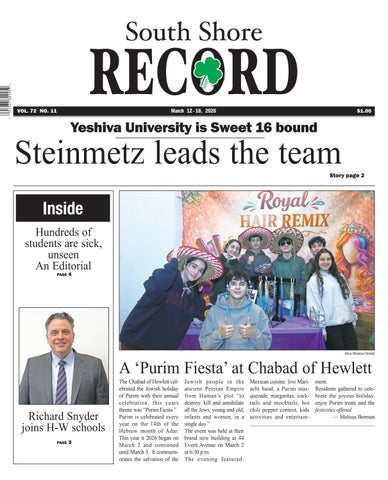
The Chabad of Hewlett celebrated the Jewish holiday of Purim with their annual celebration, this years theme was “Purim Fiesta.” Purim is celebrated every year on the 14th of the Hebrew month of Adar. This year it 2026 began on March 2 and continued until March 3. It commemorates the salvation of the
Jewish people in the ancient Persian Empire from Haman’s plot “to destroy, kill and annihilate all the Jews, young and old, infants and women, in a single day.”
The event was held at their brand new building at 44 Everit Avenue on March 2 at 6:30 p.m.
The evening featured:
Mexican cuisine, live Mariachi band, a Purim masquerade, margaritas, cocktails and mocktails, hot chili pepper contest, kids activities and entertainment.
Residents gathered to celebrate the joyous holiday, enjoy Purim treats and the festivities offered. — Melissa Berman
Y.U. and Steinmetz are Sweet 16 bound
By JEFFREY BESSEN jbessen@liherald.com
The Yeshiva University Maccabees led by Woodmere resident and head coach Elliot Steinmetz continued their hot streak and are headed to the NCAA D-III Sweet 16.
It’s Y.U.’s first trip to the Sweet 16 since 2020, when the Maccabees also won the first two games of the tournament but because of the Covid pandemic the remainder of the games were not played. At that time, the team had won 27 consecutive games on its way to a 50-game winning streak that stretched to December 2021.
Steinmetz’s team (22-8) boosted this season’s win streak to 16 by capturing the first two rounds of the D-3 tournament on Friday and Saturday.
The season didn’t begin as sweet as the Macs lost their first five games of the season and went 1-8 in non-conference contests.
“We’ve had people criticize why we schedule these teams because there is a high rate of failure and we didn’t have the sort of the gimmes that other teams have,” said Steinmetz, the Skyline Conference’s Coach of the Year. “But there are important lessons to be learned and a lot of opportunity to make your team better. You strategize what your team can handle and build to the post season.”

The Maccabees won a tight game defeating Bates College 71-69 on March 6 behind Zevi Samet’s 27 points and two free throws by Max Zakheim with .2 seconds left in regulation.
Samet earned Conference Player of the Year honors for the second consecutive season averaging nearly 23 points per game. His 568 total points led the Skyline and he was named to the conference’s first team.
In a night game on March 7, Yeshiva

found its stride early racing out to a 14-point lead at halftime and then running Maine-Farmington off the court in the second half, winning 92-69. Leading the Maccabees were Yoav Oselka with 24 points and 11 rebounds, and Samet scored 16. Oselka was named to the conference’s second team.
What Steinmetz called “leveling up,” playing tougher foes earlier in the season, has prepared his team for the tournament’s intensity and diversity. Several of
those teams are in the tournament.
“We lost some close games and some were not that close,” he said. “Good teams expose your mistakes. You make a mistake against a better team and the better team will take advantage of that mistake. That margin of error is what will cost you.”
That tougher schedule helped the Macs go 16-0 in the conference games with three more wins in the Skyline tournament to capture the automatic bid to the D-3 dance.
Despite the stark contrast between the two games this weekend, the team focuses on maintaining the same approach and level of play every time it takes the court.
“I thought we were fine from a consistency standpoint,” Steinmetz said. In the first game Max got hurt, his sitting was a big factor when executing the offense and Bates plays extremely defensively. [Saturday], we executed and hit our shots.”
Yeshiva’s next game is against No. 2 nationally ranked Emory University (243) in Atlanta on Friday at 1 p.m. Flying out to Georgia on Thursday, the Maccabees will seek a place in the Elite Eight.
Looking back six years, Steinmetz kidded about the social distancing during Covid, but then snapped to the present noting what playing in the Sweet 16 means to the team.
“Our goal is that we reach that point that it continues to be a pretty often occurrence,” he said.
HOUSE Job Fair!
Now Hiring Sales Professionals
Richner Communications is expanding our sales team and looking for motivated, competitive professionals ready to grow their careers.
Now Hiring:
We offer strong earning potential, established multimedia products, digital solutions, and a respected brand presence throughout the communities we serve.
If you have proven sales experience and the drive to succeed, we want to meet you


HERALD EDitoRiAL
Hundreds of students are sick, unseen
What if we told you that in every school district across Long Island, an average of 200 students are silently suffering from a condition that has left them barely able to get out of bed? That these children miss school at more than twice the rate of their peers? That they are twice as likely to struggle to learn, concentrate and remember? What if we told you that these students suffer from depression at three times the rate of their healthy schoolmates? That, unlike the flu, their illness doesn’t dissipate with rest and time, and in many cases gets worse? That it can take months or years for a family to find a doctor who understands the disorder — and that when they do, that doctor often has no treatment to offer?
If we told you a crisis of that scale was playing out in every Long Island school district, you would expect emergency meetings of school boards, action from Albany and, at minimum, that someone in a position of authority was paying attention. yet, tragically, this crisis is real, and almost no one is paying attention.
An estimated 25,000 children across Long Island are living with long Covid — the little-understood condition that develops when a Covid-19 infection does not fully resolve. Formally known as postacute sequelae of SARS-CoV-2, it is defined as symptoms that persist or newly arise more than three months after infection — and many of the 23 million Americans with long Covid have been suffering for over half a decade.
“Long haulers” experience a unique combination of more than 200 potential symptoms, including crushing fatigue, brain fog, heart palpitations, pain with no clear origin, and immune dysfunction
News literacy should be required in schools
To the Editor:
As a superintendent and a proud educator for over 25 years, I couldn’t agree more with the editorial in the Feb. 26-March 4 issue, “Long Island students need news literacy.” In fact, I believe it should be mandated in all K-12 school districts.
In today’s digital world, especially in the age of A.I., where fake images and misleading headlines often come across as “authentic,” developing strong news literacy skills is more important than ever. With a competitive 24-hour “breaking news” cycle coupled with the constant flow of social media feeds, the singu-
that standard blood tests cannot detect. The National Institutes of health’s RECOVER Initiative determined that roughly 4 percent of children who contracted Covid-19 later develop the condition — translating to 200 students per district in Long Island’s 125 school districts. And because Covid continues to circulate, new cases are being added every day.
harvard economists have estimated the total cost of long Covid to the United States at $3.7 trillion. For a family with a seriously affected child, navigating years of visits to specialists, lost parental income and insurance companies that routinely deny claims, the financial burden can easily reach six figures. This is not a minor post-pandemic inconvenience. It is one of the largest ongoing public health and economic crises in American history.
A situation of this magnitude should be impossible to miss. School boards should have data. Superintendents should have plans. Doctors should have answers. Instead, these children are largely invisible — and the reasons are worth understanding. Long Covid carries no definitive diagnostic test, its symptoms overlap with conditions doctors are quicker to define, and families often spend a year or more cycling through specialists without answers. Many of these families suffer quietly at home, unaware of others going through the same thing, with no community, no organized voice, no constituency demanding to be heard.
Parents describe a particular kind of helplessness. They watch a child who was active, engaged and social withdraw from everything that once defined them. They fight insurance companies, drain savings and search online late at night for anything that might help. They sometimes pursue
L E tt ER to t HE ED ito R
lar, more traditional news sources are long gone. Now audiences, including young and impressionable adolescents, often rely on media outlets and websites that may be unverified or deceptive.
The ability to critically analyze and question the information we encounter is no longer optional; it’s an essential life skill. This is why the Baldwin Union Free School District has implemented a robust news and media literacy curriculum for several years now. Beginning in sixth grade, news literacy skills are embedded into our middle and high school social studies and English coursework. Our high school seniors are also required to complete College Civics and News Literacy, a dual-credit course through our partnership with Stony Brook University’s Center for News Literacy. We even hosted a workshop to educate parents
ineffective — and dangerous — therapies offered by unscrupulous people preying on their desperation. More than anything, they wait for a return to normalcy that medicine has not yet figured out how to deliver.
Teachers watch capable students quietly disappear. The hand that was always first in the air goes still, and half-done work replaces finished assignments. Without the training to recognize the symptoms of long Covid, too many educators mistake it for disengagement or a behavioral problem. It is neither.
Children are being left behind in ways that cannot always be recovered — the reading level never reached, the travel team never made, the homecoming never attended, the college essay never written. Childhood has a timeline, and long Covid does not respect it.
If your child has been struggling since a Covid infection — however mild or even asymptomatic — long Covid may be the explanation no one has yet offered. Ask your pediatrician. Mount Sinai South Nassau hospital, Northwell health and Stony Brook University hospital all have long Covid clinics — world-class resources waiting to help, right in our backyard.
This Sunday, March 15, is Long Covid Awareness Day. But awareness without action is futile. So let’s commit to making this the year long Covid gets the recognition, coverage and funding it so sorely needs. Our children deserve nothing less.
Are you or your child suffering from long Covid? We want to hear your story, which we will keep anonymous. Email us at longcovid@liherald. com.
about misinformation, since becoming news-literate is important for everyone.
News literacy is much more than distinguishing between true and false. Students acquire skills to identify credible sources and misinformation, recognize bias, assess evidence and sources, and critically evaluate the influence of media on individuals and society, including online “trolls.” Teaching these skills in our classrooms prepares students not only for higher education and future careers but also to become thoughtful, informed citizens who are trusted sources of information.
ANThONy
MIgNELLA Superintendent, Baldwin Union Free School District


