Rockaway
JOURNAL Since 1883
www.liherald.com
DECEMBER 4 - 10, 2025
$1.00
City approves broad technology oversight The New York City Council approved a sweeping package of legislation late last month that creates the city’s first permanent oversight office for artificial intelligence and imposes enforceable standards on how agencies use automated decision systems. Lawmakers said the measures, known collectively as the GUARD Act, represent one of the most comprehensive municipal frameworks in the country aimed at ensuring accountability for technology that increasingly shapes residents’ lives. Councilwoman Jennifer Gutiérrez, who chairs the Committee on Technology, supported the package, formally titled Guaranteeing Unbiased Artificial Intelligence Regulation and Disclosure. The bills create a new era of mandatory supervision, replacing what lawmakers described as years of voluntary guidelines and fragmented policies. For much of the last decade, automated systems have influenced decisions about housing Jennifer access, police enforcement, Gutiérrez public benefits, and how residents interact with governCouncilwoman ment. But lawmakers argued that the Office of Technology and Innovation failed to establish meaningful guardrails, despite releasing an Artificial Intelligence Action Plan in 2023. The plan encouraged responsible use but did not require compliance, leaving agencies to decide for themselves how to evaluate, test, deploy, or disclose their systems. “City agencies have been operating in the dark without real standards,” Gutiérrez said in a news release. “We teach children right and wrong, and we hold doctors and engineers to professional codes. Until now, we had nothing comparable for artificial intelligence. The GUARD Act finally puts enforcement behind the principles everyone keeps talking about. We are governing technology before it governs us.” State Comptroller Thomas DiNapoli recently underscored that gap in a widely cited audit. The report found that agencies used digital decision tools with inconsistent practices and often without tracking outcomes, creating risks of biased or inaccurate results. Many tools were never disclosed, despite legal requirements under Local Law 35, which compels annual reporting of algorithmic systems. The Department of Education did not report its use of Teach to One 360, a digital learning program, and the Department of Buildings allowed private facade inspectors to use automated tools without oversight. Additional systems in pilot stages avoided disclosure entirely, raising questions about the city’s criteria and review procedures.
W
ith this vote, we are no longer patching holes.
Council.nyc.gov/district-34
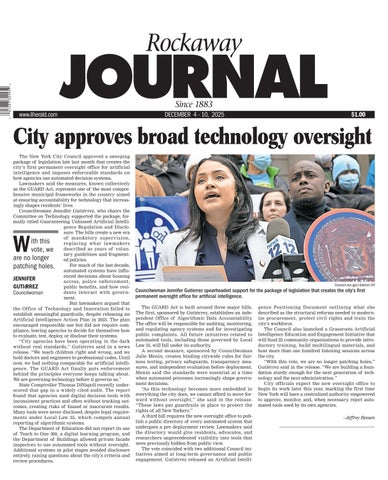
Councilwoman Jennifer Gutierrez spearheaded support for the package of legislation that creates the city’s first permanent oversight office for artificial intelligence. The GUARD Act is built around three major bills. The first, sponsored by Gutiérrez, establishes an independent Office of Algorithmic Data Accountability. The office will be responsible for auditing, monitoring, and regulating agency systems and for investigating public complaints. All future initiatives related to automated tools, including those governed by Local Law 35, will fall under its authority. A second measure, sponsored by Councilwoman Julie Menin, creates binding citywide rules for fairness testing, privacy safeguards, transparency measures, and independent evaluation before deployment. Menin said the standards were essential at a time when automated processes increasingly shape government decisions. “As this technology becomes more embedded in everything the city does, we cannot afford to move forward without oversight,” she said in the release. “These laws put guardrails in place to protect the rights of all New Yorkers.” A third bill requires the new oversight office to publish a public directory of every automated system that undergoes a pre deployment review. Lawmakers said the directory would give residents, advocates, and researchers unprecedented visibility into tools that were previously hidden from public view. The vote coincided with two additional Council initiatives aimed at long-term governance and public engagement. Gutiérrez released an Artificial Intelli-
gence Positioning Document outlining what she described as the structural reforms needed to modernize procurement, protect civil rights and train the city’s workforce. The Council also launched a Grassroots Artificial Intelligence Education and Engagement Initiative that will fund 22 community organizations to provide introductory training, build multilingual materials, and host more than one hundred listening sessions across the city. “With this vote, we are no longer patching holes,” Gutiérrez said in the release. “We are building a foundation sturdy enough for the next generation of technology and the next administration.” City officials expect the new oversight office to begin its work later this year, marking the first time New York will have a centralized authority empowered to approve, monitor, and, when necessary, reject automated tools used by its own agencies. –Jeffrey Bessen