Rockaway
JOURNAL Since 1883
www.liherald.com
FEBRUARY 26 - MARCH 4, 2026
$1.00
New York City expands protected time off In Maspeth, inside the warm hum of Angelo’s Deli, Mayor Zohran Mamdani stood shoulder to shoulder with workers, advocates, and city leaders to deliver a message that would ripple across all five boroughs: in New York City, no one should have to choose between their job and their life. Beside him was New York City Department of Consumer and Worker Protection Commissioner Sam Levine, and together they celebrated the expansion o f t h e c i t y ’s Protected Time Off Law — formerly known as the Paid Safe and Sick Leave Law—while announcing a s w e e p i n g enforcement effort that would reach Same LeviNei 56,000 employCommissioner T he Consumer and Worker e r s . moment was Protection both symbolic and practical: a promise backed by power. “New Yorkers shouldn’t have to choose between doing their job and caring for their family, protecting their safety, or keeping their housing secure,” Mamdani said in a news release. “When life happens, your job shouldn’t be the thing that falls apart.” Local Law 145 strengthens that promise. Employers must now provide an additional 32 hours of unpaid protected time off immediately upon hire — and again on the first day of each calendar year. No waiting period. No earning it hour by hour. Instant access. That single change carries enormous weight. A new hire facing a child care emergency in their first week no longer has to panic. A worker navigating a housing hearing in January does not have to fear discipline for using time they’ve earned. Parents can now use protected time off for school holidays and sudden child care disruptions. Workers caring for a family or household member with a disability are covered. Employees attend-
N
ew York City has some of the nation’s strongest protected time off laws.
Michael Appleton/Mayoral Photography Office
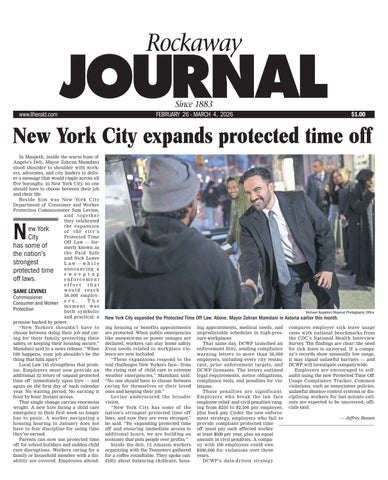
New York City expanded the Protected Time Off Law. Above. Mayor Zohran Mamdani in Astoria earlier this month. ing housing or benefits appointments are protected. When public emergencies like snowstorms or power outages are declared, workers can stay home safely. Even needs related to workplace violence are now included. “These expansions respond to the real challenges New Yorkers face—from the rising cost of child care to extreme weather emergencies,” Mamdani said. “No one should have to choose between caring for themselves or their loved ones and keeping their job.” Levine underscored the broader vision. “New York City has some of the nation’s strongest protected time off laws, and now they are even stronger,” he said. “By expanding protected time off and ensuring immediate access to additional hours, we are building an economy that puts people over profits.” Inside the deli, 12 Amazon workers organizing with the Teamsters gathered for a coffee roundtable. They spoke candidly about balancing childcare, hous-
ing appointments, medical needs, and unpredictable schedules in high-pressure workplaces That same day, DCWP launched an enforcement blitz, sending compliance warning letters to more than 56,000 employers, including every city restaurant, prior enforcement targets, and DCWP licensees. The letters outlined legal requirements, notice obligations, compliance tools, and penalties for violations. Those penalties are significant. Employers who break the law face employee relief and civil penalties ranging from $250 to $2,500 per employee, plus back pay. Under the new enforcement strategy, employers who fail to provide compliant protected time off must pay each affected worker at least $500 per year, plus an equal amount in civil penalties. A company with 100 employees could owe $300,000 for violations over three years. DCWP’s data-driven strategy
compares employer sick leave usage rates with national benchmarks from the CDC’s National Health Interview Survey. The findings are clear: the need for sick leave is universal. If a company’s records show unusually low usage, it may signal unlawful barriers — and DCWP will investigate companywide. Employers are encouraged to selfaudit using the new Protected Time Off Usage Compliance Tracker. Common violations, such as nonexistent policies, unlawful absence control systems or disciplining workers for last-minute callouts are expected to be uncovered, officials said. — Jeffrey Bessen