Rockaway
JOURNAL Since 1883
www.liherald.com
JANUARY 1- 7, 2026
$1.00
Elevating nurses, diabetes knowledge Episcopal Health Services marked the completion of the first cohort of its Nurse Residency Program, a yearlong transition-to-practice initiative that achieved a 90 percent retention rate among participating nurses. The program was created to support newly licensed nurses early in their careers and is structured as an accredited transition-to-practice model. It is supported through the New York City Nursing Project in partnership with Vizient and reflects EHS’ broader effort to strengthen the nursing workforce through evidence-based practice and leadership alignment. As part of the curriculum, nurse residents completed four evidence-based projects focused on reducing blood collection errors, improving identification of patient deterioration, preventing hospital-acquired infections related to indwelling Foley catheters, and enhancing the medication administration process by minimizing interruptions. “We see the Nurse Residency Program as a catalyst for the next chapter of nursing at EHS,” Dr. Donald Morrish, EHS’s CEO said in a news release. “By nurturing new talent and elevating the practice environment, we are laying the groundwork for long-term transformation in how we care for our patients and support our teams.” Executive leadership prioritized resources to support nurses at the point of care, including the placement of dedicated, unit-based nurse educators who provide mentorship and clinical guidance within each care setting. “Retention is a reflection of support,” Keisha-Ann Wisdom, senior vice president of patient services and chief nursing officer at EHS, said in the release. “When leadership invests in dedicated educators and creates space for learning at the bedside, nurses are better prepared, more confident, and more likely to build their careers here.” Denise Potts, assistant vice president of nursing professional development and practice at EHS, said the program reinforces the importance of structured support for new nurses. As the cohort concludes the program, EHS officials said the results highlight the impact of organizational commit-
Courtesy Episcopal Health Services
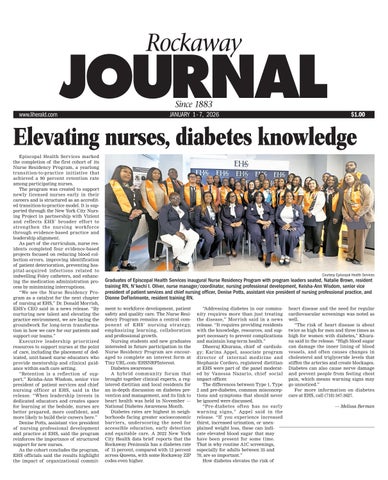
Graduates of Episcopal Health Services inaugural Nurse Residency Program with program leaders seated, Natalie Brown, resident training RN, N'kechi I. Oliver, nurse manager/coordinator, nursing professional development, Keisha-Ann Wisdom, senior vice president of patient services and chief nursing officer, Denise Potts, assistant vice president of nursing professional practice, and Dionne DeFlorimonte, resident training RN. ment to workforce development, patient safety and quality care. The Nurse Residency Program remains a central component of EHS’ nursing strate g y, emphasizing learning, collaboration and professional growth. Nursing students and new graduates interested in future participation in the Nurse Residency Program are encouraged to complete an interest form at Tiny URL.com/EHSNRPInterest. Diabetes awareness A hybrid community forum that brought together clinical experts, a registered dietitian and local residents for an in-depth discussion on diabetes prevention and management, and its link to heart health was held in November — National Diabetes Awareness Month. Diabetes rates are highest in neighborhoods facing greater socioeconomic barriers, underscoring the need for accessible education, early detection and equitable care. A 2022 New York City Health data brief reports that the Rockaway Peninsula has a diabetes rate of 15 percent, compared with 12 percent across Queens, with some Rockaway ZIP codes even higher.
“Addressing diabetes in our community requires more than just treating the disease,” Morrish said in a news release. “It requires providing residents with the knowledge, resources, and support necessary to prevent complications and maintain long-term health.” Dheeraj Khurana, chief of cardiology; Karina Appel, associate program director of inter nal medicine and Stephanie Cordero, registered dietitian at EHS were part of the panel moderated by Vanessa Nazario, chief social impact officer. The differences between Type 1, Type 2 and pre-diabetes, common misconceptions and symptoms that should never be ignored were discussed. “Pre-diabetes often has no early war ning signs,” Appel said in the release. “If you experience increased thirst, increased urination, or unexplained weight loss, these can indicate elevated blood sugar that may have been present for some time. That is why routine A1C screenings, especially for adults between 35 and 70, are so important.” How diabetes elevates the risk of
heart disease and the need for regular cardiovascular screenings was noted as well. “The risk of heart disease is about twice as high for men and three times as high for women with diabetes," Khurana said in the release. “High blood sugar can damage the inner lining of blood vessels, and often causes changes in cholesterol and triglyceride levels that stiffen the arteries and create blockages. Diabetes can also cause nerve damage and prevent people from feeling chest pain, which means warning signs may go unnoticed.” For more information on diabetes care at EHS, call (718) 347-3627. — Melissa Berman