Oyster Bay Herald 03–05-2026

Page 1


Teaching the next generation of doctors about neuroscience

More than 50 high school students from across Long Island gathered at the Donald and Barbara Zucker School of Medicine at Hofstra/Northwell for the annual Brain Bee competition last Saturday, studying real brain specimens, exploring neuroscience concepts and hearing from physicians and medical students working in the field.

Students moved through a series of educational stations in the school’s anatomy lab, where they examined skulls, spinal cords and preserved human brains while learning about the nervous system from medical students and neurologists. The two-part compe-

tition included a multiple-choice test on brain facts and the identification of anatomical structures and functions in real human brain specimens.

Among the participants was Locust Valley High School sophomore Daniyel Asim, who said he has been interested in medicine, and specifically neuroscience, for years, because both of his parents are physicians.

Before entering the lab, Asim said he was nervous about seeing real brain specimens for the first time. “I was mostly worried about it,” he said. “[But] I calmed myself down, and it was easy.”

Dr. Robert Hill, an associate professor of science education at Hofstra who helped Continued on page 9

Dr. Mason Pimsler, a specialist in internal medicine from Jericho who treats patients in the Bronx through New York City’s public hospital system, was honored by the city with a proclamation declaring Nov. 7, 2025, a day in his name.

The recognition acknowledged Pimsler’s work caring for underserved people across New York City, including the homeless and others who struggle to access medical treatment.

IPimsler grew up in Little Neck, Queens, before moving with his family to Jericho. He studied at Long Island University, and completed a fellowship in geriatrics from 2013 to 2014 at the SUNY Downstate, in Brooklyn.

didn’t become a doctor to be called ‘doctor.’
DR. MASoN PIMSlER

Jericho

Pimsler, 59, works at Lincoln Medical Center in the Bronx, which is part of the city’s Health + Hospitals Corporation. His focuses on internal medicine and geriatrics put him on the front lines of diagnosing and managing a wide range of conditions affecting adult patients.

“Internal medicine — it covers everything in adults 18 and over,” he explained. “That’s especially cardiovascular diabetes, prevention, treatment, hypertension.”

Pimsler treats common conditions such as diabetes, hypertension and heart disease, often in patients who face significant health care barriers. For the past several years he has treated people living in shelters through the hospital’s safety net services, which offer care to those who would otherwise go untreated.

“I treat the shelter community,” he said.

That effort grew out of earlier work helping migrants who were arriving in the city. Providing medical care to people who can’t afford treatment, Pimsler said, has become one of the most meaningful aspects of his work.

“I like treating the patient,” he said. “There are people in this life that need help, and that’s what the government’s Continued on page 11

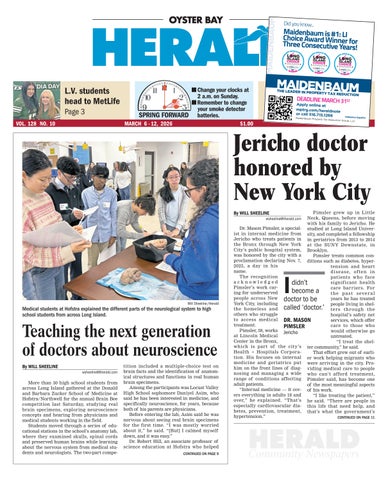
Will Sheeline/Herald Medical students at Hofstra explained the different parts of the neurological system to high school students from across Long island.

Highlighting the Hellfighters from Harlem

The North Shore Historical Museum honored the legacy of the Harlem Hellfighters, and the local effort that helped secure the unit a Congressional Gold Medal more than a century after their service in World War I, last weekend.

Capping off Black History Month on Feb. 28, the event served as a local homecoming, after the Hellfighters — members of the 369th Infantry Regiment in World War I — were formally honored in Washington and their descendants accepted the medal at a ceremony at the U.S. Capitol last September.

The guests included Rep. Tom Suozzi; Richard Harris, the John J. McMullen Professor of Humanities at Webb Institute and a co-chair of the Harlem Hellfighters Recognition Project; Fred Nielsen, a retired U.S. Marine Corps major and the other co-chair of the project; Kenny Jones, a descendant of the Fowler family, several members of which served in the 369th; and other descendants, including Gloria FowlerJones and Deborah Willett.

The event highlighted the role that Glen Cove residents played in advocating for national recognition for the Hellfighters, whose achievements were largely overlooked for decades.

“We’re a very young museum,” Georgie Connett, the facility’s president,

said. “But it’s a place where people can come and take a step back and look at what’s happened in the past that brought us all, from the North Shore, to where we are today.”

Connett noted that the museum’s exhibit on the Hellfighters, installed in 2018 — which includes one of the medals — helped spark broader recognition efforts. “Just from that humble beginning of that exhibit, we culminated in going to D.C. and received a Congressional Gold Medal,” she said. “And it’s still amazing that this happened.”

Harris described how researching local soldiers helped bring their stories to light. “What makes history fascinating is not just those facts, but to me, the lives of the people we can find out about,” he said.

Uncovering the Hellfighters’ stories, Harris said, helped drive the effort to secure national recognition for them. Harris also had a hand in designing the congressional medal, helped develop the medal’s imagery and symbolism.

“We were responsible for the design of the medal,” Harris said. “We wanted to be sure that it’s clear these weren’t just other soldiers — we wanted them to look like African-Americans.”

The design includes several historical symbols associated with the regiment’s service, including the French Croix de Guerre and the American and French flags. The medal also reflects the

cultural influence the soldiers had overseas, Harris added. One of the images is of a saxophone crisscrossed over a rifle.

“One of the things the 369th did was, they introduced jazz to the Europeans, to the French,” he said. “It was a revolution in European culture once they heard jazz, really for the first time.”

Nielsen said that learning about the Hellfighters was eye-opening.

“I’m a retired military officer,” he said. “I never heard the words ‘Harlem Hellfighter,’ ever.”

After discovering the unit’s history through Harris’s research, Nielsen said, they felt compelled to push for recognition. The effort began with a small group of local residents who believed the soldiers deserved national recognition.

Suozzi told the attendees that the effort to secure the medal began with local advocacy, and required years of work in Congress. The process, Suozzi explained, necessitated building bipartisan support in Washington. “To break through all the noise of Washington, D.C., to get people to pay attention to do something that’s only been done about 180 times in the history of America, is not an easy thing to do,” he said.

Descendant Kenny Jones detailed his connection to the Fowler family. “My great-grandfather fought in World War I as a Harlem Hellfighter in the 369th, and his brothers — six of them went to World War I,” Jones said. “And they all

Gold Medal honoring the Harlem Hellfighters.

managed to come back home safe and sound.”

Learning more about the regiment’s history, Jones added, deepened his appreciation for their sacrifices. “I knew about the Harlem Hellfighters, but I didn’t know to the extent of what these gentlemen [were] actually doing,” he said.

Roksana Amid/Herald Richard Harris, co-chair of the Harlem Hellfighters Recognition Project, explained the symbolism of the Congressional

HERALD SCHOOLS

Locust Valley flag football players visit MetLife

Ahead of its fifth season as a varsity program, the Locust Valley High School Falcons were represented at the New York Jets’ Third Annual High School Girls Flag Football Media Day on Feb. 20.

Team members Sophia Georgiopoulos and Morgan Sullivan and head coach Michael Gilbert ventured to MetLife Stadium, along with over 100 other New York and New Jersey programs, where they spoke with Sports New York’s

Jeane Coakley about their excitement for the upcoming season, struck a pose in individual photoshoots and toured Gang Green’s locker room.

The Falcons are scheduled to open the season on the road at Hempstead High School on Friday, March 20, at 5 p.m. They’ll return home for a matchup with Oceanside High School on Monday, March 23.

Photos courtesy Locust Valley Central School District
Morgan Sullivan, Sophia Georgiopoulos and Michael Gilbert joined members of over 100 other girls flag football programs from New York and New Jersey.
Morgan Sullivan, left, Sophia Georgiopoulos and Coach Michael Gilbert viewed concept jerseys from Nike.
Locust Valley High School student Sophia Georgiopoulos took part in a photoshoot with Jets team photographers.
Morgan Sullivan, left, and Sophia Georgiopoulos spoke with SNY’s Jeane Coakley about their experience.
Sophia Georgiopoulos, left. and Morgan Sullivan represented Locust Valley High School Falcons for the New York Jets’ Girls Flag Football Media Day.

THE GREAT BOOK GuRu

Family feud

Dear Great Book Guru, I was having a delicious breakfast with friends at Matt’s Deli here in Sea Cliff, when one of the group mentioned a book we might all enjoy - a family drama about a train wreck, business ethics, aging parents, and the dangers of medical googling. Needless to say - we were intrigued…

Book Lovers and Breakfasters

Dear Book Lovers and Breakfasters,

“Wreck” by Catherine Newman does indeed cover a myriad of subjects.

Rachel aka Rocky is the lead character and the novel opens with an inexplicable rash that she obsessively googles, with each piece of information offering a more dire diagnosis. Her husband Nick is a patient, loving mate and her recently widowed father is weighing his future housing options while staying with them.

Her anxiety ridden daughter Willa has returned home after finishing college and son Jaimie has taken on a new job in New York City. Everything seems normal except for the family members’ obsession with a train/car fatality that happens shortly before the book opens. Was it suicide …was it human error… or was it corporate malfeasance? We soon learn that Jaime’s new job involves representing the train company and as the story unfolds it appears there is a strong likelihood the company bears much blame. Throughout we see how every family member shoulders some guilt about this incident, but the question remains – how will they find absolution?

A complex ethical dilemma and highly recommended.

Would you like to ask the Great Book Guru for a book suggestion? Contact her at annmdipietro@gmail.com.

NEws BRiEf

How Giving Increases Wealth

Businesses wanted for TOB wellness fair

The Town of Oyster Bay invites local businesses to participate in an upcoming Health & Wellness Fair being held in conjunction with the 2026 Empire State Ride Long Island, taking place on the streets of Oyster Bay on June 13.

“The Empire State Ride is Long Island’s largest charitable cycling fundraiser to benefit cancer research, and this year the event will feature a Health & Wellness Fair on the streets of Oyster Bay,” said Town Councilman Andrew Monteleone. “This great event draws thousands of residents to our historic town, providing visitors with the opportunity to take part in interactive wellness stations, demonstrations and dis -

cussions. Interested vendors are encouraged to sign up to participate in this year’s event.”

Event coordinators, including the Town of Oyster Bay, Oyster Bay-East Norwich Chamber of Commerce and Empire State Ride Long Island, are inviting potential vendors who believe their company would benefit from participating in the program to reach out today. For additional information, or to request an application, interested businesses can contact the Town of Oyster Bay Special Events Division at (516) 797-4127 or email kludwig2@oysterbayny.gov.

Fax: (516) 622-7460

■ DISPlAY ADVERTISING: Ext. 249 E-mail: rglickman@liherald.com Fax: (516) 569-4643

■ PUBlIC NOTICES: Ext. 232 E-mail: legalnotices@liherald.com

oyster bay

CAMP & SCHOOL – A guide to programs and activities

Think you know camp? Think again

Camp has become a staple of the summer season. Each year, millions of children, youth and adults head to the hills, lakes, valleys, and parks to participate in the time-honored tradition of camp. And, while most people easily conjure up images of campfires and canoes, there is a lot more to the camp experience. Here are some things you may not have known about the camp experience, courtesy of American Camp Association.

Camp is older than dirt, almost literally Started in 1861, the camp experience turned an impressive 150 years young in 2011. The secret behind the longevity? “Camps are adapting to meet the needs of today’s campers,” says Tom Rosenberg, formr president/CEO of the American Camp Association.“At the same time, the impact camp has on campers, the lifechanging experience, has remained after all these years.”

Camp is worth its weight in gold, and then some!

The camp experience is life-changing –developing friendships and memories that last well beyond the final campfire. And, there is a camp for literally every budget. Often camps offer special pricing or financial assistance, and some camp experiences qualify for tax credits or for payment with preGreen is “zen.”

Research shows that first-hand experience with nature, like those at camp, reduce stress in children and help them better handle stress in

the future. In addition to teaching children how to be good stewards of the environment, camps are teaching children how to enjoy the world around them and take a minute to breathe deep and feel the nature, which ultimately teaches them how to de-stress the natural way.

Mommies and Daddies do it too.

Camp is not just for children and youth. There are family camp experiences, and camps for single adults, senior adults, and any adult that wants to relax and enjoy all camp has to offer. Adults benefit from the same sense of community, authentic relationships, and selfdiscovery that children do. Camp is an excellent vacation option, allowing adults to try a variety of new activities in a safe and fun environment.

Try this on for size!

Camp is a great place to try new activities and hobbies. Afraid of rock walls? According to ACA research, 74 percent of campers reported that they tried new activities at camp that they were afraid to do at first. And, those activities often leave lasting impressions. In the same survey, 63 percent of parents reported that their child continued new activities from camp after returning home.

Manners matter, and often linger.

The camp experience teaches more than just archery or lanyard making. The entire experience is made of teachable moments, perhaps one of the biggest is how to live with a group of people. Campers learn to pick up after themselves, respect each other’s property, and to say

“Please” and “Thank You.”

Camp gets those neurons pumping Education reform debate and concern over summer learning loss have pushed academic achievement into the spotlight. Research shows that participation in intentional programs, like camp, during summer months helps stem summer learning loss. In addition, camp provides ample opportunity for developmental growth, which is a precursor to academic achievement. And, because of the “hands-on” nature of camp, often children who struggle in traditional edu-

cation settings do well at camp.

Camp builds leaders for the 21st century and beyond Independence, resiliency, teamwork, problem-solving skills, and the ability to relate to other people these are the skills that tomorrow’s leaders will need, and the skills camp has been adept at building for 150 years.

Photo: Long after the final campfire fades, the skills and friendships built at camp continue to shine.

At the YMCA Summer Day Camp, we offer the best of Adventure, Aquatics, Creative Arts, Camp Traditions, Special Activities and Trips, and Summer Learning in a safe and welcoming environment. Step away from the school year, the screens, and the routine — and press play on a summer full of laughter, movement, and magic!

VARIETY OF CAMPS FOR AGES 3-15

March 28, 2026: 10:00-11:30am • April 18, 2026: Healthy Kids Day May 16, 2026: 10:00-11:30am • June 6, 2026: 10:00-11:30am YOUR BEST SUMMER IS ONE CLICK

Kiddie, New: 3-Day Kiddie Camp - Bay Shore Only (M, W, F), Youth, Pre-Teen, Teen, Sports Camp, Counselor-in-Training Program

DATES

CLOSEOUT WEEK | AUG 24-28, 2026*

* Not available in East Hampton. Huntington Closeout Week ends 8/27

REGISTER NOW!

CAMP & SCHOOL – A guide to programs and activities

Academic support Making tutoring work for busy families

The hours after school can feel like a sprint to bedtime. There are snacks to serve, carpools to manage, practices to attend and homework to complete all while academics remain the priority. For families whose children need extra academic support, adding tutoring to the mix can feel overwhelming.

Yet when approached thoughtfully, tutoring can become a powerful and positive investment in your child’s growth not just another obligation on an already crowded calendar.

Start With A Supportive Conversation

Before beginning the search for a tutor, talk openly with your child. Frame tutoring as support, not punishment. A simple, reassuring approach “Reading feels tricky sometimes, so we’re going to find someone who can help” emphasizes growth rather than deficiency.

Most children are aware when they’re struggling. While they may feel apprehensive, involving them in the decision fosters cooperation and reduces resistance. Encouragement and confidence from parents go a long way toward building buy-in.

The

Right Fit

There is no one-size-fits-all solution when it comes to tutoring. The right setting depends on your child’s needs, personality, schedule and budget.

Some families prefer one-on-one private tutoring. Others choose small-group instruction

at a learning center or opt for online services. When evaluating options, consider class size, location convenience and cost. Research shows that consistent, frequent sessions often yield stronger academic gains.

Recommendations from teachers, guidance counselors and other parents can help narrow your search. Be sure to check references and ask about measurable results, such as improved grades, stronger test performance or increased homework completion.

Set Goals — Together

Successful tutoring works best when everyone is aligned. Teachers, tutors, parents and students should collaborate on clear, realistic goals.

Parents remain an essential part of the learning process. After each session, ask what your child is expected to practice before the next one and provide gentle support at home.

Building Skills — and Confidence

One of the greatest benefits of tutoring is individualized attention. Whether a child needs help mastering multiplication facts, expanding vocabulary or strengthening study skills, oneon-one instruction allows lessons to be tailored to specific learning styles.

Tutoring isn’t only about catching up or getting ahead. It can also help students manage learning differences, organize assignments or gain confidence in challenging subjects.

Tutors may incorporate visual aids, discussion, hands-on activities or technology depending on what resonates most with your child.

Create A Supportive Environment

If you have other children at home, establish clear expectations during tutoring sessions. Institute “quiet Hours by encouraging quiet activities such as reading, homework or creative play. Turning off televisions and limiting device use can help maintain focus.

When possible, outdoor play or activities in another part of the house can give siblings space to burn off energy while preserving a calm learning environment indoors.

Coordinate breaks and boundaries. Children’s attention spans vary by age. Younger students may focus for 20 to 30 minutes before needing a short break; older students may manage 30 to 40 minutes. Work with your tutor to determine appropriate breaks, boundaries and incentives that suit your child. It’s often best for parents to step back during sessions. Hovering even with good intentions can disrupt concentration. Establish in advance where you’ll be during tutoring time, and allow your child to build independence.

Photo:Tutoring can become an opportunity for growth — not just extra homework.

Monday-Friday • 9am-4pm • extended day & lunch

The physical therapist with a mission to serve

Emilian Emeagwali has built a life rooted in service, driven by a deep, generational commitment to uplifting and supporting the community around her.

Born and raised in Onitsha, Nigeria, Emeagwali, 60, emigrated to the United States in 1992, where she faced a dramatic change of lifestyle. In Nigeria, she had been surrounded by support, with help raising a baby girl and managing her daily responsibilities. “Everybody was helping with the baby,” she said. “I was like a queen.”

In America there was no such support system, leaving her to adjust to life with just her husband and their daughter, and to take on a variety of responsibilities herself, from child care to cooking and cleaning.

Determined to adapt, Emeagwali immersed herself in American culture. She spent time watching movies, listening to the news and reading books to better understand her new environment. Even everyday things like food and weather required adjustment.

After moving from Nigeria, Emeagwali received her bachelor’s degree in psychology from Brooklyn College. In 2003 she enrolled at Stony Brook University, where she earned a doctorate degree in physical therapy. Balancing school and family life proved difficult, because she was commuting 50 miles from Elmont and now caring for two children.

Despite these challenges, Emeagwali remained focused on her goal of helping others. After finishing her degree, she was motivated to continue her education by a desire to make an impact.

Her psychology classes helped her understand how to approach and connect with people, but she ultimately felt she could make a greater difference through physical therapy. While working as a therapist’s assistant in hospital settings, she became dissatisfied with the fastpaced environment, in which she often treated multiple patients in a short period of time.

Wanting to provide more personalized care, Emeagwali decided to open her own practice. In 2007 she founded State of the Art PT OT, a clinic in Valley Stream that has now been serving patients for nearly two decades. Her approach centers on treating people with the same care and attention she would give her own family.

That philosophy, she said, stems from her upbringing. As a child, she watched her parents give money to people in need, ensuring that they had food to eat. That instilled in her a lasting commitment to helping others and giving back.

“That is how I was raised,” she said. “I think that was embedded in me when growing up.”

In 2009, Emeagwali expanded that mission by founding the nonprofit Giving Back to Community Corp., headquartered in Valley Stream. The organization, which is funded by fundraisers and donations, focuses

on providing food, educational resources and other support to underserved people in surrounding communities as well as in Nigeria.

Whether through her clinic or her nonprofit work, Emeagwali’s impact extends far beyond individual patients, strengthening entire communities and carrying forward the values that first inspired her to give back.

At South Nassau, a steady hand in cardiac care

As director of noninvasive cardiology at Mount Sinai South Nassau, Dr. Pilar Stevens-Haynes has built a career centered on precision, compassion and the belief that medicine can be both life-saving and lifechanging.

That sense of connection is what ultimately steered her toward cardiology. Born and raised in the Elmont/ Valley Stream area, Stevens-Haynes discovered her love of science in high school, drawn to biology and fascinated by a senior-year anatomy and physiology elective.

Though she once envisioned herself as a surgeon, clinical rotations changed her mind. “I thought I would just love surgery,” she said. “But I actually found I loved speaking to patients. In surgery, your patients are unconscious.”

Instead she chose a field that allows her to combine long-term patient relationships with moments of dramatic intervention. While many areas of internal medicine focus on managing chronic illness, StevensHaynes noted that cardiology allows physicians to intervene in acute, life-threatening situations — heart attacks, heart failure or dangerous arrhythmias — and dramatically improve outcomes.

“In cardiology, you can treat someone and sometimes give them back the life they had before,” she said. “I find true joy in taking care of people over time and watching them heal.”

A graduate of SUNY Geneseo, Stevens-Haynes completed her medical training in the Mount Sinai system before joining South Nassau over a decade ago. Her current role centers on cardiac imaging, from

electrocardiograms and echocardiograms to multiple forms of stress testing. Four days a week she oversees the lab, ensuring that the facility meets national accreditation standards.

“The lab has to do what it says it’s going to do,” Stevens-Haynes said. “We have to perform the studies accurately and meet the standards that are set.”

Patient care remains central to her. “I’ve got the best

of both worlds,” she said. “I get to practice medicine, but I also get to do a little bit of curative medicine.”

Throughout her career, she has also navigated the realities of being one of few women — and often the only woman of color — in the room. “You have to get very comfortable by being the one and only,” StevensHaynes said. Early on, she admitted, she was “very, very quiet and shy,” hesitant to draw attention to herself. Over time, however, she came to recognize the importance of representation.

“Patients will say how wonderful it is to see women physicians and to see people that look like them take care of them,” she said. “They trust me because I look like me.”

Mentorship has become one of the most meaningful aspects of Steven-Haynes’s work. She recalled sitting down with a tearful young physician who worried that starting a family would jeopardize her medical career. Stevens-Haynes encouraged her to do both. That physician is now a cardiology fellow.

“It’s important that women know they can have grand professional goals and personal goals — and achieve them,” she said.

Stevens-Haynes credits academic medicine with offering flexibility that has allowed her to balance professional growth with family life. She and her husband, Hector Luna, are raising four children in Baldwin. She remains driven by the passion that first led her into medicine, and by her belief that physicians can build meaningful careers without sacrificing the aspects of life that matter most.

“Even if it feels overwhelming or like an all-boys club, you can find your niche anywhere,” she said. “Chase your dreams. You don’t have to sacrifice.”

Courtesy Emilian Emeagwali Emilian Emeagwali, a physical therapist and the founder of the nonprofit Giving Back to Community Corp., is originally from Onitsha, Nigeria.
influential women on long island
Joan whitney Payson co-founder and owner new York Mets grace hartigan abstract expressionist painter
Courtesy Mount Sinai South Nassau
Dr. Pilar Stevens-Haynes, left, a Long Island native and the director of noninvasive cardiology at Mount Sinai South Nassau, examined an echocardiography image with lead echocardiographer Iris Cruz.

L.V. sophomore takes part in Brain Bee

organize the event, said the students had hands-on opportunities to study anatomy and see how the brain works.

“This station is about the bony anatomy associated with the nervous system,” Hill said while showing students models and specimens. “… These are just plastic models with the spinal cord inside, but most of the rest of these stations have actual brains that came from our body donors, either a whole brain or a brain that’s sliced in different ways to show deeper structures inside the brain.”

Each station was manned by medical students who guided their younger peers through the material and answered their questions. Hill added that a benefit of having medical students leading the exercises is that they remember what it felt like to be a high school student interested in medicine, and can better connect with them.

“Some of these students actually have to take their final exam on brain anatomy in . . . a couple of weeks,” Hill said, “so they see it as ‘I’m studying for this by being here at the Brain Bee.’”

Hill also emphasized the importance of treating the organs, given by donors, with respect, and teaching students to appreciate the donors’ generosity. The Oath of Gratitude, written by Hofstra graduate Dr. Brooke Milosh, along with other classmates who are members of the national Golden Humanism Honor

Society, is posted on a wall at the entrance to the lab: “We thank and honor you, our donors, with the understanding that your bodies will teach us lessons that cannot be taught in any book. We are humbled by your gracious gift, and we pledge to treat you with the utmost reverence as you help us learn and grow into compassionate, humanistic physicians.”

“Reflection is one of the core values of the medical school, and as we define it, it’s just taking time to think about and process the emotions that come with intense clinical experiences,” Hill said. “And even though, in this case, the patient is deceased already, students come to think of their body donor as their first patient, and taking time to reflect on that as an intense clinical experience is an important part of what we do.”

At another station, students learned about the meninges, the protective layers surrounding the brain and spinal cord, as well as the Circle of Willis, a network of arteries that supply blood to the brain.

Organizers explained how blockages in those arteries can cause strokes, and how an aneurysm forms when a blood vessel wall weakens and bulges.

Dr. Brian Emmert, an assistant professor of neurology at the Columbia Epilepsy Center and a graduate of the Zucker School, led a station focused on

epilepsy and seizures. Emmert, who took part in the Brain Bee as a medical student, said that introducing students to neuroscience early can spark a lasting interest in the field.

“I think it’s important to get people interested early,” he said, “and honestly, a lot of this stuff is really cool for them. How often do you get . . . to come into the lab to look at people’s brains and learn about neuroscience in a very safe and interesting environment?”

The demand for neurologists continues to grow, Emmert said, as the population ages.

“I think it really whets people’s appetite and stimulates people’s interest early, and that really helps develop the next generation,” he said. “We need people in those fields, because a lot as people age, neurodegenerative diseases are becoming more prevalent.”

Emmert said he was impressed by the high school students’ desire to learn and the breadth of their knowledge at such young ages. “You could tell that they came prepared,” he said. “. . . It always impresses me how well-prepared and interested the students who come to the session are.”

Asim, the Locust Valley High sophomore, said the experience expanded his understanding of neuroscience.

“Everything was very important to me,” he said. “I learned about the eye structure also, which was significant,

the high school students, who are interested in becoming doctors, got the chance to observe real human body parts, which organizers emphasized must be treated with respect.

because I thought, we’re going to mostly only cover the central nervous system, but we also covered peripheral and other systems.”

He also appreciated the chance to meet medical students and professionals working in the field he hopes to enter.

Will Sheeline/Herald

HERALD SCHOOLS

A few lucky students got to actively participate in the performance, where they got hands-on experience spinning plates and trying their own ribbon tricks.

Acrobat Li Liu dazzles Vernon school students

Students at James H. Vernon Elementary School were treated to a spectacular performance on March 2, when world-renowned acrobat Li Liu visited the school. A native of Shenyang, China, Liu wowed the audience with her extraordinary physical abilities while also weaving in lessons about Chinese language, geography and culture.

Vernon students watched as Liu demonstrated an array of skills, including hand balancing, plate spinning, ribbon dancing and diabolo. A few lucky students were even invited onstage, where they got hands-on experience spinning plates and trying their own ribbon tricks.

Liu began her training at age six and enrolled the following year at the Chinese National Circus School in Beijing, where she studied until age 16. She frequently performed alongside her sister, with her father serving as their coach. Her career took her around the globe with prestigious companies and productions, including the Liaoning Acrobatic Arts Troupe, Circus Knie and Zirkus Krone. She came to the United States in 2000 as a performer with Ringling Bros. and Barnum & Bailey Circus and has since appeared regularly with Princess Cruise Lines and at NBA halftime shows.

Photos courtesy Oyster Bay-East Norwich Central School District
Acrobat Li Liu showed off her skills to students at James H. Vernon Elementary School.
Liu began her training at age six and enrolled the following year at the Chinese National Circus School in Beijing, where she studied until age 16.
Liu came to the United States in 2000 as a performer with Ringling Bros. and Barnum & Bailey Circus.
Liu demonstrated an impressive array of skills, including hand balancing, plate spinning, ribbon dancing and diabolo.

Mason Pimsler works with those most at risk

for, you know.”

Health + Hospitals programs have allowed physicians like Pimsler to provide medications to those who otherwise might not be able to obtain them.

“So I’m able to do the type of work I want to do that I have the resources from Lincoln Hospital and Dr. Katz, Mitch Katz, where I can supply medications to the people,” he said, referring to Health + Hospital’s president and CEO. “Especially the patients in the shelters that would not be able to get these medications.

IThe ability to provide treatment regardless of a patient’s financial circumstances can have life-changing consequences, Pimsler said. In one case, he recalled, “I diagnosed a man that they said, ‘Stop.’ You know, if I went by the United States Preventive Task Force … they stop at, like, 65 or for prostate cancer. So I didn’t stop, and this man had no insurance, and we covered it at the hospital, and I found prostate cancer, and they had to take his prostate out and do chemo and radiation. He’s still living. He’s doing well.”

[about] their age. I don’t care if they’re in their 80s.”

The city’s proclamation honoring him came as a surprise last year. Pimsler said it was waiting for him at home when he returned from a trip. He had the document framed — at Long Island Picture Frame & Art Gallery in Oyster Bay.

’ve been recognized before. But this means a lot to me, because it’s a wider scope and it affects more people’s lives. Dr. Mason PIMsler Jericho

Pimsler said that prevention and early detection remain central to his work. “I am a huge believer in colonoscopies, mammograms, prostate, like clockwork,” he said. “I don’t care

Although there was an event at City Hall, Pimsler said his work schedule prevented him from attending.

The recognition had particular meaning for him because his father died on Nov. 21. “He had rectal cancer, and I was fighting for him non stop,” Pimsler recounted. “And I wish he was around for that (ceremony); he would get great joy out of it.”

“I’ve been recognized before,” he said of honors during his residency, and from colleagues. “But this means a lot to me, because it’s a wider scope and it affects more people’s lives.”

Looking ahead, Pimsler said he hopes to continue expanding his service to more patients who need it most, including potentially volunteering internationally. For now, he said, he remains focused on the work that led to the city’s recognition. “I didn’t become a doctor to be called ‘doctor,’” he emphasized. “I like to heal and make people feel good.”

Courtesy Dr. Mason Pimsler
d r. m ason p imsler was honored by the City of n ew York on n ov. 7 for his work with the homeless and others who lack access to health care.

An invisible threat in Long Island’s waters

Researchers study acidification and its potential effects on the future of oysters and clams

Third installment in a series about water.

For generations, the waters surrounding Long Island have defined its identity — from the wide-open waterfronts of the South Shore to the shellfish beds of the North Shore. But beneath the surface, a quieter transformation is underway.

Ocean acidification is often called climate change’s “evil twin,” and refers to the lowering of the water’s pH, the scale used to measure the concentration of hydrogen ions in the water. While global warming refers to rising temperatures, acidification describes a shift in seawater chemistry.

The science begins with carbon dioxide. As levels of carbon dioxide in the atmosphere increase — predominantly from the burning of fossil fuels — the ocean absorbs roughly 25 to 30 percent of it. When carbon dioxide dissolves in seawater, it forms carbonic acid, making the water more acidic, and lowering its pH.

farmers — industries that have experienced both revival and setbacks in recent decades — these chemical changes aren’t just theoretical. They are measurable, seasonal and, increasingly, part of daily operations.

The ‘evil twin’ of climate change

Adrienne Esposito, executive director of Citizens Campaign for the Environment, a nonprofit advocacy organization in New York and Connecticut, describes ocean acidification as a hidden but mounting crisis for Long Island’s waters — one intensified by warming temperatures, nitrogen pollution and poor circulation in local bays.

“It’s commonly understood that roughly a third of all carbon dioxide emissions released into the atmosphere are absorbed by the marine environment,” Esposito said. That absorption increases acidity levels in bays, estuaries and the open ocean.

RISING TIDES

The pH scale is logarithmic, meaning that even a small numerical drop represents a significant shift in chemistry. The ocean is naturally slightly alkaline, but since the Industrial Revolution, average ocean surface pH has dropped by about 0.1 units — roughly a 30 percent increase in acidity. That shift reduces the availability of carbonate ions, the building blocks shellfish such as oysters and clams need to form their calcium carbonate shells.

Ryan Wallace, assistant professor of environmental science at Adelphi University, explained that these acidity levels are not evenly distributed.

On Long Island, acidification is not driven by global carbon emissions alone. Local factors intensify the problem. Nitrogen discharged from wastewater, septic systems and fertilizer runoff flows into bays and harbors, fueling harmful algal blooms. When those blooms die and decompose, the process consumes oxygen and releases additional carbon dioxide in the water, further lowering pH.

The result is a compounding effect: global atmospheric carbon dioxide combined with local nitrogen pollution accelerates acidification in shallow, enclosed estuaries.

Warming waters add another layer of stress. As temperatures rise, marine organisms’ metabolic demands increase, but warmer water holds less dissolved oxygen. Together, warming and acidification can weaken shellfish during their most vulnerable larval stages, making it harder for them to survive and build shells.

For Long Island’s oyster and clam

Some bays and harbors on the North Shore are measured at 450 parts per million, close to the ideal level of roughly 300 ppm, while others, particularly in the western portion of Long Island Sound, measured as high as 2,000 ppm.

Wallace emphasized that while these may not sound like huge differences, even minor changes in CO2 levels can have a drastic impact.

“To put it into perspective, over the last 800,000 years or so, the carbon dioxide in the atmosphere was only about 300” parts per million, Wallace explained. “Two thousand is a lot more than that, so when you get to concentrations that are that high, this can have implications for, you know, organisms that are living in these ecosystems.”

While the data reflect a global pattern, the consequences are being felt at the regional level as well. As Esposito noted, Long Island’s problems do not exist in isolation.

“It’s being exacerbated by an increase in temperature of the waterways and more nutrient runoff, such as nitrogen, going into waterways,” she said. “All of that causes unfortunate degradation to our water bodies.”

While algae is an important part of a healthy ecosystem, excess nitrogen can fuel algal blooms that, when they die off, consume oxygen and further stress marine life — compounding the chemical impacts of acidification with biological ones.

In the South Shore’s Western Bays, limited water circulation compounds the problem. Research by Stony Brook

University has shown that it can take up to 180 days for water to fully flush out through an inlet into the Atlantic Ocean. Instead, Esposito said, the water “sloshes back and forth” before eventually reaching the ocean, trapping heat and pollutants in the process.

Coastal areas such as the western portion of the Sound are especially vulnerable because of limited circulation. Wallace stressed that scientists differentiate between open-ocean acidification and coastal-ocean acidification because of the unique challenges those areas face.

In Hempstead Harbor, the issue of acidification has been a focus for local environmental organizations for decades. The Coalition to Save Hempstead Harbor was formed in 1986 to address a range of environmental issues facing the area, including acidification.

Michelle Lapinel McAllister, the coalition’s programs director, explained that pH monitoring is one of the core services that the nonprofit provides for the harbor. Measuring occurs yearround, with particular emphasis from May to October, when the harbor, in

common with other waterways, sees annual spikes in nitrogen levels.

“Each season we will see periods of low dissolved oxygen, and whenever dissolved oxygen gets low, then we’ll see pH drop as well,” Lapinel McAllister said. “That will typically happen around the hottest part of the year.”

Another complication is the fact that enclosed waters respond more quickly to environmental stressors than the open ocean, meaning local ecosystems can feel the impacts sooner and more intensely.

“The more stagnant the water body is, the more these acidity levels build up,” Esposito said. “The more the temperature builds up, the more damage the increase in acidity levels can do.”

She described three primary consequences of ocean acidification: “reduced water quality, the impact on shellfish and finfish and the degradation of the overall habitat due to low oxygen.”

Shellfish such as oysters and clams struggle to build and maintain their shells in more acidic conditions, while

Joseph D’Alessandro/Herald
Peter Martin, the shellfish restoration manager of the Flax Pond Marine Laboratory, sterilizing a flask of algae with a blowtorch before exposing it to the air.
LONG ISLAND’S WATER BLUEPRINT

Rising acidity, rising stakes for coastal shellfish

finfish larvae have lower survival rates — threatening both the ecosystem and the region’s maritime economy.

“Acidification actually reduces the availability of carbonate ions that are needed for these organisms to build their shells, so that’s a major issue,” Wallace said. “Like shellfish aquaculture, it can impact fisheries, and then there’s this cascading effect that can influence things like recreational activities and tourism.”

This is especially relevant because shellfish play an important role in regulating nitrogen levels. An adult oyster can filter up to 50 gallons of water per day, depending on size and environmental conditions, while a clam can filter roughly half that.

Across Long Island, and across the country, local environmental organizations and governments are throwing their support behind shellfish hatcheries and protection programs, including the towns of Hempstead, Oyster Bay and Babylon. Lapinel McAllister explained that while these efforts serve an important role in safeguarding healthy ecosystems, they can’t singlehandedly save marine ecosystems.

“On their own, shellfish can’t improve the water quality to healthy levels,” she said, “but having a good, healthy, strong population is going to be part of that overall puzzle of maintaining the stability of pH over long term.”

While local efforts to restore wetlands, upgrade sewage-treatment plants and rebuild shellfish populations are making progress, Esposito said the root cause remains global. “The main culprit of ocean acidification is the burning of fossil fuels,” she said. “The only thing we can do is support more renewable energy so that we’re not pouring more carbon dioxide into the waterways.”

The wet work of marine scientists

Across Long Island, scientists are working together to find ways to improve the quality of local waters. A leading solution is all-organic: Restoring local populations of filter-feeders could, with careful management, bear the brunt of decontamination efforts.

The Flax Pond Marine Laboratory, in Old Field, is nestled in the marshes of the North Shore, overlooking the Long Island Sound. This laboratory is a research hatchery, working toward “improving local coastal water quality and replenishing natural shellfish populations,” according to its shellfish restoration manager, Peter Martin.

The facility’s current focus is the Ribbed Mussel Bioextraction Project, in which staff test what growth strategies lead to the healthiest shellfish that could be reintroduced to coastal waters to rejuvenate them.

“There’s a lot of coastal communities and little inlets and even out-of-use small pockets of water that are just polluted and are in need of cleaner water,” Martin said. “Fundamentally … shellfish are natural filters. All they do is filter feed, so they’re cleaning the water as they grow.”’

“One of the big pollutants that we’re focused on is nitrogen removal,” hatchery Research Specialist Ashley Lopez said. “Shellfish take in the bad form of nitrogen, process it in their body, and they still expel some nitrogen, but it’s a safe and more bioavailable kind of nitrogen.”

The ribbed mussel program is exploring new methods of shellfish cultivation; according to Lopez, there is no consensus in the field about growing large amounts of these shellfish. In their nascence, ribbed mussels have delicate health — a larva is as small as a grain of sand. The Citizens Campaign for the Environment staff regularly sterilize equipment and filter externally sourced seawater to minimize diseases and infections from plankton and bacteria.

The researchers grow eight different varieties of algae to feed adult ribbed mussels, which are kept in temperature-stabilized basins. This conditioning pro-

nonprofits like the Coalition to Save Hempstead Harbor play a vital role in the fight against acidification. Staff members such as michelle Lapinel mcAllister, right, programs director, and Carol diPaolo, water-monitoring coordinator, track pH levels and coordinate a shellfish restoration program to keep the harbor healthy.

Acidification, by the numbers

■ 30 percent of carbon dioxide that is released into the atmosphere is absorbed by the ocean.

■ From 2008 to 2017, fossil fuel burning and land use changes were responsible for 40 billion tons of emissions per year.

■ Surface waters are 30 percent more acidic than their pre-industrial levels.

■ While the ocean on average has seen a 0.06 decrease in pH units, meaning increasing acidity, since 1985, the Long Island Sound has seen a decrease of 0.04 per decade, according to UConn Marine Sciences.

■ In the past 25 years, the $6 billion clamming industry has seen a 93 percent reduction in harvests, according to the New York state Department of Environmental Conservation.

■ More than 12,000 acres of Long Island waterways have been closed to shellfishing due to algal blooms, according to the Suffolk County Health Department.

■ 76 percent of the nitrogen in the waters off Long Island — home to 40 percent of the state’s population — comes from faulty septic systems.

cess is meant to “ripen the gonads” of the mussels and help them reproduce as effectively as possible, according to Martin.

“What we’re doing is trying to find out the best way

to grow a lot of them from birth on and have them actually survive,” Lopez said. “And the starting point, we think, is the feeding regimens that we’re giving them. So that’s why we’re doing different diets — to see what kind of spawn they produce and see how the larvae survive after that.”

“This two-year project is Phase Two of a larger project,” Martin added. “Phase One was from ’23 to ’25. Each phase is getting further and further, doing more to figure out the best way to grow these things.”

In addition to ribbed mussel cultivation, CCE staff are involved with other restoration efforts, including a Community Aquaculture Restoration and Education program, in which scientists partner with community volunteers to sow “spat-on-shell” oysters into local estuaries, from which larvae will grow and mature into underwater custodians.

The Flax Pond hatchery works with groups ranging from the Cornell Cooperative Extension of Suffolk County and Stony Brook University to the state Department of Environmental Conservation and the New England Interstate Water Pollution Control Commission. It is one ecological collective of many working toward improving the quality of local waters from the east end of Long Island to the shores of Nassau County.

Setting course for a healthier future

Even as Long Island’s waterways face the threat of rising acidification, the experts emphasize that all is not lost. Thanks to the efforts of the Coalition to Save Hempstead Harbor and other environmental groups, the region’s waters have bounced back from near-toxic levels of acidity, not to mention numerous pollutionrelated threats of the 1980s.

According to Wallace, the efforts of scientists and local volunteers, from the South Shore to coastal Connecticut, to monitor and address these issues have already made an impact.

“There’s been a lot of positives,” he said, “but we can’t stop there. There’s more work to be done.”

Herald file photo

New ICE office in Woodbury sparks concerns

U.S. Immigration and Customs Enforcement is renting office space in Woodbury for what could be as many as 40 agency attorneys, Newsday has reported. The move is drawing concern from immigration advocates and prompting calls for transparency from local officials.

Last month, ICE began leasing offices in a four-story building at 88 Froehlich Farm Blvd., according to Craig J. Padover, president of the Hauppaugebased Aresco Management, which owns the property. The space, Padover said, is being used for legal offices, but he did not confirm the size or extent of the lease, nor could he verify how many ICE attorneys would ultimately work there.

He added that the space would not be used to house detained immigrants.

The expansion comes as controversy intensifies over President Trump’s deportation campaign. ICE received nearly $80 billion in funding through Trump’s “One Big Beautiful Bill,” passed last July, increasing the number of agents from roughly 10,000 to 22,000 this year, making it the largest-funded federal law enforcement agency.

ICE already maintains a presence at the federal courthouse in Central Islip and at the Nassau County Correctional Center in East Meadow, where detained

Luke Feeney/Herald

U.S. Immigration and Customs Enforcement is leasing office space at 88 Froehlich Farm Blvd. in Woodbury.

migrants are housed. Agents covering Long Island are based primarily in New York City offices.

“One of the most important things to remember is that the Department of Homeland Security and [Secretary] Kristi Noem has not been transparent about what’s going on,” Sylvia LivitsAyass, a partner at Livits Ayass Baskin PLLC and the immigration chair of the Nassau County Bar Association, said.

In Central Islip, marked and unmarked vans have been seen near district courts. Attorneys from ICE’s Office of the Principal Legal Advisor repre -

judge, and is often signed by an ICE officer or agency official. A judicial warrant, by contrast, must be signed by a U.S. District Court judge and typically identifies the court, the name and birth date of the subject of the warrant, and the address to be searched.

“Just because they have a warrant doesn’t mean they can go wherever they want,” Livits-Ayass said.

Because immigration court for downstate New York is at Federal Plaza in Manhattan, she added, the Woodbury lease is surprising. She suggested that it could signal expanded enforcement operations, but also noted that it could simply be cost-effective for ICE to house its attorneys on Long Island. “The bottom line is we don’t know,” she said, “because they’re not telling anybody.”

sent the Department of Homeland Security in immigration-removal proceedings, and can facilitate warrants and enforcement actions.

“My guess is that there will be a ramp-up in ICE presence in Nassau and Suffolk, and they’re probably going to try and facilitate these enforcement actions through warrants and by supporting these operations,” Livits-Ayass said, emphasizing that that remains speculation.

She explained that there are different types of warrants. An administrative warrant is not reviewed by a federal

In a letter to Noem, Rep. Tom Suozzi asked if the lease was accurate and how ICE has engaged with local governments.

In a statement to the Herald, Suozzi wrote, “Expanding deportation operations in safe communities creates fear and undermines trust in local enforcement, and would be a bad policy. Our focus should be on removing dangerous criminals while protecting families who contribute to our local economy and way of life.”

ICE offices in New York City did not respond to the Herald’s request for comment.

Nominate a student under 18 for the Sustainability Champion Award to recognize their efforts in driving sustainable change.

Submit a nomination of approximately 100 words or less describing the student’s leadership in promoting sustainability: What motivates them? What impact have they had?

Be sure to include a photo or an example of their work—whether it’s a community garden, an environmental campaign, or a creative solution to a sustainability challenge.

things to know daylight saving time

Clocks spring forward as debate over practice continues

bkacharaba@liherald.com

Daylight saving time returns during the early morning hours of March 8, when clocks across most of the United States move forward one hour at 2 a.m. The seasonal shift, designed to extend evening daylight, signals the unofficial start of longer spring days, while also renewing debate about its history, purpose and whether the practice should continue.

How a wartime measure became a yearly tradition

Daylight saving was first widely adopted during World War I as a way to conserve fuel and energy by making better use of natural daylight. Germany introduced the concept in 1916, and the United States soon followed. The practice ended after the war but returned during World War II before becoming standardized nationwide under the Uniform Time Act of 1966. Observance was not uniform, and for decades most of Indiana opted out, creating a confusing patchwork of time rules within the state until statewide adoption in 2006. Over time, the practice shifted from an energy-saving strategy into a widely observed lifestyle tradition, influencing commerce, recreation, daily routines, and cultural events, becoming an ingrained part of modern life.

Springing

forward can leave you a little sleep deprived

The spring transition to daylight saving time is often associated with sleep disruption and temporary fatigue, as people effectively lose one hour of rest overnight. Studies have linked the change to short-term increases in workplace accidents, traffic incidents and difficulty concentrating during the following days. However, supporters argue that extended evening daylight encourages outdoor activity, shopping and community events, benefiting local economies and public well-being. Schools, businesses and transportation systems must also adjust schedules twice each year, requiring coordination nationwide. Many health experts recommend gradually adjusting sleep routines before the change to reduce its impact on both children and adults alike.

Should daylight saving time become permanent?

In recent years, lawmakers at both the state and federal levels have debated whether daylight saving time should become permanent or be eliminated altogether. Supporters of permanent daylight saving time argue that later sunsets improve quality of life, reduce crime and boost economic activity. Critics counter that darker winter mornings can create safety concerns for students and commuters. Several states have passed legislation supporting year-round daylight saving time, but federal approval is required before changes can take effect nationwide. Public opinion remains divided, and despite repeated proposals in Congress, Americans continue to adjust their clocks twice a year while the debate remains unresolved.

STEP RIGHT UP

Ringling reinvents the Big Top

Get ready to cheer, dance and gasp — the legendary Ringling Bros. and Barnum & Bailey Circus is back, and it’s dazzling audiences in ways few could have imagined. The self-proclaimed “Greatest Show on Earth” has been boldly reimagined for a new generation, bringing a high-voltage spectacle to UBS Arena from March 6 through March 8.

This is not the circus of decades past. Gone are the traditional three rings and animal acts; in their place is a fast-paced, immersive experience that blends worldclass acrobatics, cutting-edge choreography, live music and vibrant storytelling. The arena transforms into a colorful celebration that feels as much like a concert and dance party as a circus performance.

The energy begins the moment everyone walks through the doors. An interactive pre-show sets the tone, introducing audiences to the dynamic Ringling Hype Crew — a lively cast of dancers and performers who invite everyone to move, clap and join in the fun. Before the first aerialist soars or the first stunt takes flight, the crowd is already part of the action.

At its heart are the performers.

• Friday March 6, 7 p.m.; Saturday and Sunday, March 7-8, 11 a.m., 3 p.m., 7 p.m.

• Tickets start at $39.35, $20 kids tickets for all performances; available at ticketmaster.com

• UBS Arena, 2400 Hempstead Tpke., Elmont

The 65-person cast, representing 17 countries, is a truly international ensemble that fuses time-honored circus traditions with bold, contemporary feats. Among the most buzzed-about moments is the crisscross trapeze act, in which elite aerialists launch themselves along intersecting flight paths, slicing through the air in breathtaking near-misses that leave audiences holding their collective breath.

The stars of this new incarnation of circus include 33-year-old trapeze artist Miles Postlethwait. He grew up in Florida, attending Ringling shows (and Disney on Ice). Caught up in the spectacle, he in love with trapeze at age 10. A trapeze performer for 10 years (six professionally), he landed at Ringling in November.

Recalling his early circus memories: “I remember going to see Ringling Bros when I was very young. Honestly, what I remember most was the toys (specifically the dragon sword) and the cotton candy. But my mom tells me I was enamored with the acrobats.”

That fascination stuck, leading him to his tour “home” and what’s now billed as “The Greatest Party On Earth,” according to the Ringling mantra.

“Who wouldn’t want to be a part of The Greatest Show On Earth? I saw the previous tour multiple times and loved the show. It’s nonstop fun because you’re part of the show the whole time, interacting with other performers and the audience,” Postlethwait says.

The vibe is fueled by today’s cultural influences — reimagined through the lens of pop culture, concerts and festivals.

Back to the aforementioned trapeze stunt, he points out that the crisscross rig is unique and requires intense precision, but years of training make the nearmisses almost instinctive.

“It keeps me on my toes, and the crowd’s reaction

STEPPING OUT

Jessie’s Girl

Drag out that neon once again and give your hair its best ‘80s ‘do. Those crazy days are back — as only Jessie’s Girl can pull off, on the Paramount stage. The band of NYC’s top rock/pop musicians and singers gets everyone into that “Back To The Eighties” vibe with the latest edition of their popular concert experience. With a lineup including four pop-rock vocalists dressing and performing as 80s icons, backed by a dynamic band, this is the definitive ‘80s experience. Jessie’s Girl’s primary line-up includes a team of NYC’s top rock and pop vocalists: Jenna O’Gara, Jerome Bell-Bastien, and Mark Rinzel. They are backed by one of the tightest bands in the city comprised of 20+ year veterans of the NYC music scene, each with dozens of credits performing with authentic ‘80s icons who made the music famous to begin with! Their motto: There’s no decade like the Eighties and no party like Back To The Eighties with Jessie’s Girl.

is incredible.”

The thrills keep on coming. Other highlights include the Double Wheel of Destiny, in which four daredevils leap and jump rope on spinning wheels.

A Chinese acrobatic bicycle act, created exclusively for Ringling, features gravity-defying human pyramids and fearless athleticism, with one acrobat running across the backs of nine moving bike riders. Salsa Colombia, a fiery dance and acrobatics troupe, brings the energy of Latin rhythms to the arena floor. And audiences are fascinated by Cam, a content creator and unicycle rider, who stacks up to 25 wheels towering nearly 35 feet high. Also watch out for Bailey the Robo Pup, a high-tech canine character and PT (Party Time), Ringling’s first-ever hype character, who keeps the crowd engaged and amplifies the celebratory atmosphere.

Giant LED screens and cameras capture acrobats from impossible angles, giving every seat the feel of front-row access.

Music powers the show. A DJ spins everything from hip-hop to Latin beats, driving the action from start to finish, with beat drops, live drumming and dance battles.

Those in the audience are not just spectators — they’re all in. Kids are drawn into onstage interactions, while the LED screens highlight stunts from content creator Cam, adding an extra layer of excitement. From split-second trapeze timing to jaw-dropping acrobatics, the spectacle keeps everyone on the edge of their seats while leaving lasting memories for all involved. The result is a full-on celebration with a festival-style energy that transforms classic circus elements.

Postlethwait sums it up simply: “It’s a super fun, energetic party. Families come and say everybody had a blast. It’s a show where kids aren’t just watching — they’re a part of the action.”

Perhaps most importantly, according to Postlethwait, the spectacle inspires young audiences to dream big.

“I hope they see that anything is possible. Circus acts show that humans’ limits go so much further than we think.”

Whether you’re in it for the stunts, the music or the interactive fun, this version of “The Greatest Show On Earth” promises something for everyone. Experience firsthand why Ringling Bros. has thrilled audiences for generations — now with a fresh, modern twist that makes the circus feel entirely new.

Friday, March 6, 8 p.m. The Paramount, 370 New York Ave., Huntington. Tickets available at ticketmaster.com or paramountny.com.

South Shore Symphony welcomes Jane Monheit

With a voice radiating warmth, refinement and emotional depth, jazz vocalist Jane Monheit brings her celebrated interpretations of Great American Songbook classics to the Madison Theatre in a special collaboration with the South Shore Symphony Orchestra. Renowned for breathing fresh life into beloved standards, she headlines an unforgettable afternoon, blending the intimacy of jazz with the grandeur of full orchestral sound. Under the baton of Music Director Adam Glaser, the South Shore Symphony accompanies her in a series of orchestral arrangements that highlight both her vocal artistry and the timeless beauty of these enduring songs. The program also offers audiences a more intimate jazz club feel, with Monheit backed by a trio, including Glaser on piano, for several selections.

Sunday, March 8, 3 p.m. Molloy University campus, 1000 Hempstead Ave., Rockville Centre. Tickets available at madisontheatreny.org or (516) 323-4444.

Photos courtesy Feld Entertainment
A 150-year tradition leaps into the future as the reimagined spectacle delivers fresh thrills, bold artistry and gravity-defying feats that redefine the modern circus.

Your Neighborhood CALENDAR

Mar

First Fridays: Through Stained Glass

Explore the extensive collection of medieval and renaissance stained glass at Planting Fields! During this walk and workshop for adults, participants will discover the travels and stories of a few of the 40-plus stained-glass panes that illuminate the historic housemuseum, the Main House. Guests are guided by Collections and Exhibitions Manager Emily Leger, and Archivist Marie Penny and have the opportunity to view the Corpus Vitrearum, an International scholarly compilation of historic glass windows. Also make your own faux stained glass to bring home and enjoy! $25.

• Where: Main House, 1395 Planting Fields Road, Oyster Bay

• Time: 2-3:30 p.m.

• Contact: plantingfields.org or call (516) 922-9210

Mar 15

Mar

7

Winter Forest Walk with Naturalist Virginia Danke

Join the Nassau County Museum of Art and naturalist Virginia Dankel for an educational stroll across museum grounds. The event is adults only. Tickets are $10 per museum member and $20 per nonmember. Registration is advance is required and can be done at NassauMuseum.org.

• Where: 1 Museum Drive, Roslyn Harbor

• Time: 11 a.m.

• Contact: info@nassaumuseum. org or call (516) 484-9338

Art explorations

Converse, collaborate and create with kids at Family Saturdays at Nassau County Museum of Art. Get inspired by the art and objects in the galleries and then join educators at the Manes Center to explore and discover different materials to create your own original artwork. Kids and adults connect while talking about and making art together. A new project is featured every week. $20 adult, $10 child. For ages 2-14. Registration required. $20, $10 child; members free.

• Where: 1 Museum Drive, Roslyn Harbor

• Time: Noon-3 p.m.

• Contact: nassaumuseum.org or (516) 484-9337

Celtic Woman

The Grammy-nominated global sensation returns to the stage with their highly anticipated new tour, Celtic Woman — A New Era. Featuring the mesmerizing talents of Mairéad Carlin, Muirgen O’Mahony, Ciara Ní Mhurchú, and the dynamic new addition Caitríona Sherlock, this production fuses the ensemble’s signature ethereal harmonies with innovative orchestrations, captivating stagecraft, and a contemporary energy that honors Ireland’s rich musical and cultural legacy while embracing Celtic Woman’s ongoing evolution. Audiences will be transported on a spellbinding journey through Irish music, from timeless classics to stirring original compositions. The evening promises breathtaking vocal performances, intricate instrumental mastery, and the rhythmic grace of traditional Irish dance. Accompanied by a full ensemble, the performers bring to life Celtic staples — including the bagpipe, bodhrán, tin whistles, and Uilleann pipes — creating a lush and immersive soundscape that resonates with both tradition and modernity. From evocative Irish ballads and contemporary favorites to classical masterpieces and fresh original songs, their tour celebrates the vibrancy of modern Ireland while paying tribute to centuries of musical heritage. It is a concert experience that blends elegance, passion, and cultural storytelling, offering audiences an unforgettable evening of artistry, energy and enchantment.

• Where: The Paramount, 370 New York Ave., Huntington

• Time: 8 p.m.

• Contact: ticketmaster.com or paramountny.com

Mar 10

Town Board meeting

Oyster Bay Town Board’s holds its next public meeting at Town Hall North. This is the first of two meetings in March. .

• Where: 54 Audrey Ave., Oyster Bay

• Time: 10 a.m., also March 24

• Contact: (516) 624-6380

Trivia Night

The Audrey Kitchen and Bar hosts another trivia night.

• Where: 30 Audrey Ave., Oyster Bay

• Time: 7:30 p.m., also March 17 March 24 and March 31

• Contact: theaudreyob.com or call (631) 358-3522

Mar 15

Hempstead House Tour

See the grand rooms inside the massive 50,000-square-foot Tudor-style mansion at Sands Point Preserve, the former summer residence of Howard Gould (1912-1917) and later Daniel and Florence Guggenheim (1917-1930). For adults, but children 5+ are allowed. $10 per person.

• Where: 127 Middle Neck Road, Sands Point

• Time: Noon and 1:30 p.m.; also March 29

• Contact: sandspointpreserveconservancy. org or call (516) 571-7901

Mar

19

Educator networking event

The Planting Fields Foundation holds a free networking event designed to connect local educators, share resources, and highlight the many ways Planting Fields supports student learning. Attendees can connect with fellow teachers and administrators from local schools, experience field trip offerings through hands-on demonstrations and activities, tour the Education Center and outdoor learning spaces and more. Includes light refreshments. Registration is required.

• Where: 1395 Planting Fields Road, Oyster Bay

• Time: 6 to 7 p.m.

• Contact: sconway@plantingfields.org

Mar

21

Children’s concert

The Northwinds Symphonic Band visits Hempstead House for an afternoon of music fun for families with children of all ages. Conductors Helen P. Bauer and Brandon Bromsey have put together a program designed to engage young listeners and aspiring young musicians. The program includes well-known selections from “The Sound of Music” and a medley of music from Disney movies. Band members introduce and demonstrate their instruments, and the children in attendance will be given the opportunity to take the podium as guest conductors! $10, $5 children.

• Where: Hempstead House, 127 Middle Neck Road, Sands Point

• Time: 1-2:30 p.m.

• Contact: sandspointpreserveconservancy. org or call (516) 571-7901

Mar 22

Ecotherapy Walk

Join certified guide Linda Lombardo on an Ecotherapy Walk at Sands Point Preserve.

Celebrating the Spring Equinox with balance, renewal and growth. Ecotherapy, also known as Forest Bathing, is not simply hiking in the woods, or a walk on a

beach. The focus is on connection and relationship, allowing the heart to open to the beauty of the natural world, and at the same time, understand our belonging in that world. Register for individual walks or a series of three. $135 for series of 3, $120 members; $49 per session, $44 members.

• Where: 127 Middle Neck Road, Sands Point

• Time: 2 p.m.

• Contact: sandspointpreserveconservancy.org or call (516) 571-7901

Mar

Special Olympics Polar Plunge

The Town of Oyster Bay hosts its annual Polar Plunge at Tobay Beach, benefiting Special Olympics of New York. The community is invited to participate with friends and family or with a group or organization. With vendors, games, special presentations and more.

• Where: Tobay Beach, Oyster Bay

• Time: 9 a.m.

• Contact: (516) 797-4121

Dune Day Grass Planting

The community is invited to join the Department of Environmental Resources at the beach. Plant dune grass to help preserve existing dune grass prior to the summer.

• Where: Tobay Beach, Oyster Bay

• Time: 10 a.m.

• Contact: (516) 677-5943

Sunday Brunch

Mar 29

Bayville Chamber of Commerce hosts Sunday brunch at the Crescent Beach Club. With Bingo with cash prizes, bottomless mimosas, Bloody Mary’s, Bellinis, wine and beer. Also a cash bar, and raffle tickets will be available for purchase. $100, $75 ages 12-16.

• Where: 333 Bayville Ave., Bayville

• Time: Noon

• Contact: eventbrite.com or (516) 628-300

Having an event?

Items on the Calendar page are listed free of charge. The Herald welcomes listings of upcoming events, community meetings and items of public interest. All submissions should include date, time and location of the event, cost, and a contact name and phone number. Submissions can be emailed to kbloom@ liherald.com.

Public Notices

LEGAL NOTICE

NOTICE OF VOTE/ ELECTION OF THE THE COLD SPRING HARBOR LIBRARY

NOTICE IS HEREBY GIVEN that a Vote/Election of the qualified voters of the COLD SPRING HARBOR CENTRAL SCHOOL DISTIRCT, TOWN OF HUNTINGTON, SUFFOLK COUNTY AND OYSTER BAY, NASSAU COUNTY, NEW YORK, will be held at the Cold Spring Harbor Library, 95 Harbor Road, Cold Spring Harbor, NY 11724 on April 14, 2026 at 9:30 AM, prevailing time, to vote upon the Annual Operating Budget of the Cold Spring Harbor Library for the 2026-27 year and to elect Trustees to vacancies on the Board of Trustees of the Cold Spring Harbor Library.

The proposition will appear on ballot in the following form:

“Shall the Board of Education contract with the Cold Spring Harbor Library pursuant to Education Law § 256 for the providing of library services to the residents of the School District and appropriate funds in the amount of $3,186,096 supporting the 2026-27 Operating Budget of the Cold Spring Harbor Library, with the requisite portion thereof to be raised by tax on the taxable property of the Cold Spring Harbor Central School District.”

AND FURTHER NOTICE

IS HEREBY GIVEN, that an election to elect three (3) Trustees to the Cold Spring Harbor Library to fill three-year terms commencing July 1, 2026 and ending June 30, 2029; AND FURTHER NOTICE

IS HEREBY GIVEN, that an election to elect one (1) trustee to the Cold Spring Harbor Library to fill a two (2) year remainder of an unexpired term commencing July 1, 2026 and ending June 30, 2028 will be conducted; AND FURTHER NOTICE

IS HEREBY GIVEN that voting at such meeting will be by paper ballots; polls will be open during the period commencing 9:30 AM to 9:00 PM on April 14, 2026; AND FURTHER NOTICE

IS HEREBY GIVEN that a Budget Information Meeting will be held on March 23, 2026 at 7:00 p.m., prevailing time; Library Trustees and

personnel will be present to provide information to the public; AND FURTHER NOTICE IS HEREBY GIVEN that a copy of the statement of the amount of money which will be required for the 2026-27 fiscal year for the Cold Spring Harbor Library purposes may be obtained by any resident of the District during the fourteen (14) days immediately preceding said Vote/Election except Sundays and holidays from the Library located at 95 Harbor Road, Cold Spring Harbor, NY 11724 during the operating hours of the Library; AND FURTHER NOTICE IS HEREBY GIVEN, that petitions nominating candidates for Office of the Trustee of the Cold Spring Harbor Library are to be filed in the office of the Director of the Library not later than 5:00 PM, prevailing time, on March 16, 2026. Each petition must be directed to the Director of the Library and must be signed by at least 25 qualified voters of the District, must state the residence of each signer and must state the name and residence of the candidate; AND FURTHER NOTICE IS HEREBY GIVEN, that personal voter registration is required either pursuant to Section 2014 of the Education Law or pursuant to Article 5 of the Election Law. If a voter has heretofore registered pursuant to Section 2014 of the Education Law and has voted at an annual or Special District meeting within the last four years, such voter is eligible to vote at this election/vote; if a voter is eligible to vote pursuant to Article 5 of the Election Law, such voter is also eligible to vote at this vote. All other persons who desire to vote must register. A voter may register within the offices of the Cold Spring Harbor Central School District, 75 Goose Hill Road, Cold Spring Harbor between the hours of 8:30 AM and 4:00 PM on school days provided that such registration is effective not later than five days prior to the Election of April 14, 2026; pursuant to § 2014 of the Education Law the Register of voters will be filed in the office of

the District Clerk of the School District immediately upon its completion and not less than five days prior to the time set for the Election at which it is to be utilized. Such register shall be open for inspection by any qualified voter of the District between the hours of 8:30 AM and 4:00 PM on each of the five days prior to the day set for the Election, except Saturdays and Sundays and between the hours of 8:30 AM and 4:00 PM on the day set for the Election. AND FURTHER NOTICE IS HEREBY GIVEN, that in accordance with Education Law § 2018-a absentee ballots for the election of Trustees of the Library and said Library Budget Vote may be obtained from the Election Clerk of the Cold Spring Harbor Library, 95 Harbor Road, Cold Spring Harbor, between the hours of 9:30 AM and 5:00 PM during those hours and days of operation of the office of Election Clerk. Such application must be received by the Election Clerk no later than 4:00 PM seven days prior to the vote/election if the ballot is to be mailed to the voter or by 4:00 PM on April 13, 2026, if the ballot is to be personally delivered to the voter. No absentee voter’s ballot shall be canvassed unless it shall have been received in the Office of the Election Clerk of the Library not later than 5:00 PM on the day of the vote/election. A list of persons to whom absentee ballots shall have been issued will be available in the Office of the Clerk of the School District between the hours of 10:00 AM to 4:00 PM on each of the five days prior to April 14, 2026 except Saturdays, Sundays and holidays. A list of persons to whom absentee ballots shall have been issued will be available in the Office of the Election Clerk of the Library between the hours of 9:30 AM to 5:00 PM on each of the five days prior to April 14, 2026 except Saturdays and Sundays.

Dated: Cold Spring Harbor, New York

February 3, 2026

BOARD OF TRUSTEES

COLD SPRING HARBOR

LIBRARY

95 Harbor Road

Cold Spring Harbor, NY

11724

David Berman, President 158493

LEGAL NOTICE

NOTICE OF SALE SUPREME COURT NASSAU COUNTY

SERVIS ONE, INC DBA

BSI FINANCIAL

SERVICES, Plaintiff against DINA SCOGNAMIGLIO, et al Defendant(s)

Attorney for Plaintiff(s) Stern & Eisenberg, P.C., 20 Commerce Drive, Suite 230, Cranford, NJ 07016 and 1131 Route 55, Suite 1, Lagrangeville, NY 12540.

Pursuant to a Judgment of Foreclosure and Sale entered September 13, 2023, I will sell at public auction to the highest bidder at North Side Steps of the Nassau County Supreme Court at 100 Supreme Court Drive, Mineola, NY 11501 on March 24, 2026 at 2:00 PM. Premises known as 5 Vivona Court, Bayville, NY 11709. Sec 28. Block 075 Lot 5. All that certain plot, piece or parcel of land, situate, lying and being in the Incorporated Village of Bayville, Town of Oyster Bay, County of Nassau, State of New York. Approximate Amount of Judgment is $744,869.75 plus interest, fees, and costs. Premises will be sold subject to provisions of filed Judgment Index No 610631/2019. For sale information, please visit www.Auction.com or call (800) 280-2832.

During the COVID-19 health emergency, Bidders are required to comply with all governmental health requirements in effect at the time of the sale including but not limited to wearing face coverings and maintaining social distancing (at least 6feet apart) during the auction, while tendering deposit and at any subsequent closing. Should a bidder fail to comply, the Referee may refuse to accept any bid, cancel the closing and hold the bidder in default. Bidders are also required to comply with the Foreclosure Auction Rules and COVID-19 Health Emergency Rules issued by the Supreme Court of this County in addition to the conditions set forth in the Terms of Sale. If proper social distancing

News briefs

Bringing art to the Oyster Bay community

Local artists and artisans from the Town of Oyster Bay are invited to participate in a day of creativity and community at Art in the Park. This year’s event will take place on May 30, at Theodore Roosevelt Memorial Park & Beach in Oyster Bay, offering a platform for talented individuals to display and sell their handcrafted creations. The deadline to apply is May 15.

“Art in the Park provides an incredible opportunity for local artists and artisans to showcase their best work, connect with the community, and gain recognition,” said Town Councilman Tom Hand. “Don’t miss this opportunity to showcase your creativity and be part of a vibrant community event, featuring live music, food trucks, and fun activities for kids.”

Artists and artisans must be 18 years or older and can only display and sell

original, handcrafted pieces. Commercial or mass-produced items will not be permitted. Participants are responsible for supplying their own 10x10 canopy and any additional equipment needed for their space. Full details, including associated costs, are outlined in the application available online.

Organized by the town’s department of community and youth services, cultural and performing arts division, Art in the Park celebrates a diverse range of handcrafted works, including ceramics, watercolors, glass, jewelry, wood, leather, sculptures, and more.

To apply, visit the Town’s website at OysterBayTown.com/capa or contact the Cultural and Performing Arts Division at (516) 797-7932 for more information.

A historic call for artists ar Raynham Hall

Raynham Hall Museum invites artists in all mediums to apply to exhibit in the We the People exhibition from April 23-August 20. A jury panel will select the artworks included in the show, and the opening reception will be held on April 23.

“We the People.” The three opening words of the Constitution place the power of the United States not in a monarch, nor even in individual states, but in its citizens. The original promise of those words was eloquent and evocative — yet from the start, that promise was only partly true. Women and people of color would have been disenfranchised from the political process, and those included among “the people” has expanded only through struggle and

hard-won legal change.

The story of the United States is one of continual redefinition, as people of many backgrounds have claimed their place and pushed the nation toward its ideals of a more just and equitable society.

Shifts in demographics continue to fuel ongoing debate over who may be recognized as a citizen. Artists are invited to respond to these tensions and possibilities, and to explore through their work what “We the People” means today.

For more information on entering artwork, visit their website at: RaynhamHallMuseum.org/exhibitions/. The deadline for entry is March 18.

cannot be maintained or there are other health or safety concerns, then the Court Appointed Referee shall cancel the foreclosure auction. Foreclosure Auctions will be held “Rain or Shine.”

Peter Kramer, Esq., Referee File # NY201900000595-1 (516) 510 - 4020 158491

NOTICE NOTICE IS HEREBY GIVEN that, on February 11, 2026, after a Public Hearing duly held by the Board of Trustees of the Incorporated Village of Laurel Hollow, the following local law was adopted by the Board

of Trustees: Local Law No. 4-2026

A LOCAL LAW authorizing the Board of Trustees, if necessary, to adopt a budget for the fiscal year commencing June 1, 2026 that requires a real property tax levy in excess of the amount otherwise prescribed in General Municipal Law §3c.

Copies of the local law, as adopted, are available at Village Hall for review. This local law was effective immediately upon filing in the office of the Secretary of State. By Order of the Board of Trustees Dated: February 25, 2026 Cathryn Hillmann Clerk-Treasurer 158739

L.I. pays the price for New York City’s failed leadership

Long Islanders work hard for what they have. Families here build their lives around safe neighborhoods, good schools and the ability to provide for their children. The suburban way of life exists because generations believed in responsibility, accountability and earning their success through hard work.

Increasingly, the policies shaping Long Island’s future are not coming from Long Island. They are coming from New York City. That reality became unmistakably clear on Feb. 11, during a public hearing in Albany. As ranking member of the Assembly Local Governments Committee, I was questioning New York City Mayor Zohran Mamdani in a televised hearing. My questions focused on public safety, antisemitism and the realworld consequences of the Mamdani administration’s decisions.

In the middle of my questioning, my microphone was turned off. The supporters of the mayor, who control the committee, silenced the ranking mem-

ber while he was performing his official duties. Other legislators were permitted to continue speaking freely. My questioning was stopped the moment it became uncomfortable for Mamdani.

That moment revealed everything Long Islanders need to understand. If the elected representative of suburban communities can be silenced while questioning the mayor of New York City, the voices of everyday Long Islanders are even easier to ignore.

IThis imbalance defines how Albany operates. Legislative priorities are driven by New York City’s political pressures. Housing policies punish property owners. Regulations expand government control. Tax burdens continue to rise. These policies may serve New York City’s political leadership, but they undermine the suburban communities that form the backbone of New York state.

across the state, including Long Island families.

Mamdani frequently speaks about working people. He has never lived the life of a working-class laborer. I have.

n the middle of my questioning of Mayor Mamdani, my mic was turned off.

I’m originally from Franklin Square, and I am a carpenter who has spent five decades swinging a hammer, building homes and working with my hands. I understand what it means to wake up early, work in the heat and cold, and earn every dollar through physical effort. Working people deserve leaders who understand their lives, not politicians who only talk about them.

ties like ours.

This issue is bigger than party labels. Long Islanders care about preserving their suburban way of life. Residents want safe streets, affordable living and leadership that respects the people who built these communities.

Nassau County Executive Bruce Blakeman has demonstrated that suburban communities can be protected and strengthened. His leadership has prioritized public safety, fiscal discipline and defending the interests of Long Island residents. He understands that Long Island is not an extension of New York City. Long Island is its own community, with its own values and its own identity.

Mamdani recently proposed raising New York City property taxes by nearly 10 percent while draining billions from reserve funds. That approach reflects a pattern of fiscal irresponsibility. When New York City mismanages its finances, Albany responds with policies that place additional pressure on taxpayers

Long Islanders live those values every day. Residents here prioritize safe communities, homeownership and fiscal responsibility. Families invest their savings in their homes and neighborhoods because they believe in stability and opportunity. These principles created the quality of life that makes Long Island one of the most desirable places to live.

New York City’s political leadership increasingly embraces a different model. Government expands. Taxes rise. Accountability disappears. The consequences spread far beyond city limits and reach suburban communi-

New York state needs leadership that understands that distinction. Long Island deserves a governor who will stand up for suburban communities, restore balance in Albany and ensure that our voices are never silenced or ignored.

The events of Feb. 11 were a reminder of what’s at stake. Long Islanders can’t afford to remain silent while decisions are made that shape our future without our input.

Long Island deserves to be heard, deserves to be respected and deserves leadership that will fight for its future.

Ari Brown represents the 20th Assembly District.

We’re finding out how expensive wind power really is

Ashort article appeared in Newsday last month, announcing that New York state had canceled new wind power bids. This was a big deal that required wider coverage. And then, two weeks later, another article appeared, with the headline that wind farms’ impact on average Long Island electric bills had increased near fivefold since 2019. This story spelled out what many of us had warned for years: The true cost of wind power is coming in at costs far higher than the initial low-balled estimates.

This is an enormous fall from grace for wind power, which was supposed to be the panacea for our costly energy needs.

Courts reversed President Trump’s decisions to halt wind projects that were already underway, and rightly so. But there was no such protection for newer projects.

These projects should have to rise

and fall on their own merits, and for too long they were propped up by misinformation and huge ratepayer and taxpayer subsidies. We have long argued that the public was not getting a transparent accounting of what these offshore wind projects were going to cost.

In fact, the woke, virtuesignaling politicians in Albany were just signing off on these projects without even knowing how much they would cost.

AWhen then Gov. Andrew Cuomo boasted at a 2019 press conference that these massive new windmills would cost about 73 cents per month per customer, he was clearly drifting in the wind. It is estimated that by 2028, the true cost will average $3.54 per month. This is in addition to fuel, delivery and other increases that will come about. The impact on commercial users will be even greater.

Imagine if we didn’t have adequate natural gas capacity as we weathered this brutally cold winter.

Here’s what our center wrote two years ago about these potential costs, after Newsday reported that officials were signing off on these projects having no idea of their true costs:

lbany was signing off on these projects without even knowing how much they’d cost.

“The head of the New York State Energy Research and Development Authority, which oversees offshore wind contracts and bidding, admitted that she did not know what the total cost will be of the project for the construction of wind turbines off Suffolk County.”

You can’t make this stuff up.

So many of these pols simply wanted to placate the burgeoning wind power cottage industries — which showered them with substantial donations — and repeat the mantra that wind was clean and cheap and would save the day from fossil fuels. But as we now know, wind power isn’t cheap, and it’s not reliable.

“When asked by a Newsday reporter how much the ballyhooed Sunrise wind project will cost, she stated: ‘The total cost of the project, I defer to Orstad.’” Orstad is the private company constructing the offshore wind turbines. When the spokesperson for that company was asked the cost, she had the temerity to state: “That’s something that publicly we do not share.”

Are you kidding us?

This isn’t to say that some wind projects could not be an important supple-

ment to an “all of the above” strategy. But our legislators were making dangerously foolish decisions to block natural gas pipelines and close down upstate nuclear power plants, all while banking on the idea that solar and wind were going to save the day. They wouldn’t, and they couldn’t.

When the true price of these windmills became known, people started clutching their pearls. These policies are partly responsible for our having seen a 50 percent increase in energy rates over the past five years in New York. See our center’s white paper on this subject at cenetrforcosteffectivegivernment.org.

Now the subsidies are gone, and wiser folks are saying “no more” until we can see that wind power is truly reliable and affordable. We can have more wind projects, but they must be costeffective, and they cannot, at the present time, replace natural gas, either in cost or reliability.

The fantasy has finally come to an end.

Steve Levy is executive director of the Center for Cost Effective Government, a fiscally conservative think tank. He has served as Suffolk County executive, as a state assemblyman and as host of the podcast “On the Right Side.” He can be reached at steve@commonsensestrategies.com.

luke Feeney Reporter

■ Rhonda Glickman

Vice President - Sales

■ oFFice

2 Endo Boulevard

Garden City, NY 11530

Phone: (516) 569-4000

Fax: (516) 569-4942

Web: oysterbay.liherald.com E-mail: wsheeline@liherald.com

Copyright

Sunshine week keeps democracy in the light

every March we observe Sunshine Week, a national initiative dedicated to one of democracy’s most powerful disinfectants: light. This year, Sunshine Week will be celebrated March 15 to 21, anchored by Freedom of Information Day on March 16, the birthday of James Madison. The timing is symbolic and significant. Sunshine Week reminds us that open government is not a luxury. It is a necessity.

Launched in 2005 and rooted in the pioneering 1972 Colorado Sunshine Act, Sunshine Week was created to raise awareness of the public’s right to know. At its core is a simple but profound idea: Democracy works best when the people can see what their government is doing. Transparency is not about satisfying curiosity, it’s about accountability, trust and ensuring that power remains where it belongs: with the citizens.

Sunshine Week’s foundation is the principle that government records and proceedings belong to the public. Taxpayer dollars fund government operations; therefore, the public has both a legal and moral right to understand how decisions are made and how money is spent.

Freedom of Information laws at the federal and state levels give citizens access to public documents, from village board minutes to federal agency communications. But these laws are only as strong as the public’s willingness to use them. Like muscles, transparency laws weaken without exercise. When citizens

stop requesting records, attending meetings and asking questions, secrecy grows stronger.

Open meetings and public records are not bureaucratic technicalities; they are the mechanisms that keep democracy breathing. Transparency reveals how taxpayers’ money is spent, how contracts are awarded and how policies are shaped. It enables watchdog groups, journalists and everyday citizens to trace decisions from proposal to outcome.

Without openness, the risk of waste, fraud and abuse increases. History repeatedly shows that secrecy breeds complacency and, at times, corruption. Open government, by contrast, ensures that decisions must withstand scrutiny. It does not weaken institutions — it strengthens them. Sunshine Week underscores a critical truth: When the public can see the process, officials are more likely to act responsibly.

In times of crisis — economic downturns, national security challenges or public health emergencies — secrecy often expands. Officials may argue that swift action requires less oversight. While emergencies can justify temporary discretion, they must never become permanent excuses for opacity.

Democracy demands vigilance. Sunshine Week serves as an annual reminder that transparency must be defended, especially when it feels inconvenient. Freedom of information cannot be indefinitely sidelined without eroding public trust.

Supporting Sunshine Week means protecting democracy itself. Openness prevents the concentration of unchecked power and ensures that elected officials remain responsive to citizens rather than to special interests.

Transparency helps parents question school board policies, residents examine zoning proposals and taxpayers track infrastructure spending. It provides communities with the tools to advocate for fair and effective governance.

It also allows us, as journalists, to do our jobs. We rely on open-records laws to uncover stories about misuse of funds, conflicts of interest and public safety failures. It’s why studies show that the presence of a local newspaper in a community mitigates waste, fraud and abuse.

Public trust in government is fragile. One of the most effective ways to build and sustain that trust is through transparency. When agencies proactively release information and conduct business in public view, suspicion diminishes.

Transparency does not guarantee agreement. Citizens, and government officials, may still debate policies and priorities. But openness fosters understanding, and understanding is the bedrock of trust.

So this Sunshine Week, take a moment to reflect on the importance of open meetings and public records. And vow to step up whenever someone tries to turn off the light of transparency.

It’s ‘the power of the state against the people of the nation’

To the Editor:

Re Peter King’s column, “There are better ways to resolve the immigration crisis,” in the Feb. 12-18 issue: Immigration is a problem, but Immigration and Customs Enforcement exemplifies the real, much larger crisis. Immigration is a longstanding issue, and many “better ways” have been proposed over the past 30 years, as Mr. King knows. In fact, one such proposal was on track for bipartisan approval last year until President Trump and his allies killed it. ICE has operated for decades with little notice. Violence was seldom used, citizens were not arrested, and habeas corpus was observed — until Trump. The Border Patrol previously confined its racist brutality close to the Mexican border, until Republicans expanded the “border” to a 100-mile-wide

opinions

What does ‘academic freedom’ mean?

while the accusations and demands of the federal government against Harvard, Columbia and other elite institutions garner national headlines, the administration’s Compact for Academic Excellence in Higher Education offered to other universities should give further pause. The compact would confer preferred access to federal research funds in exchange for agreeing to demands that would compromise academic freedom and institutional independence.

University leaders must protect these priorities embedded in state-awarded institutional charters and regionally accredited campus mission statements. They are supported by many agreements on academic freedom and tenure, dating to 1915.

Support is also found in Supreme Court Justice Felix Frankfurter’s 1957 concurring statement in Sweezy v. new Hampshire. In it, he said, “It is the business of a university to provide that atmosphere which is most conducive to speculation, experiment, and creation. It is an atmosphere in which there prevail ‘the four essential freedoms’ of a university — to determine for itself on

Letters

academic grounds who may teach, what may be taught, how it shall be taught, and who may be admitted to study.”

But what do we mean by academic freedom? This form of freedom is not freedom from responsibility to students, colleagues, institutional mission or society. Instead, it is freedom to inquire, i.e., interrogate assumptions and assertions to expose the questions hidden by answers, as James Baldwin said, and special interests in government, media and even institutions. It is the freedom to think independently, to have rights, and to consider consequences, both intended and not.

sleadership?

urprisingly few college trustees have any professional experience in higher education.

It also is the freedom to imagine — to consider what might be, and how humanity might develop its humaneness. It is the freedom to express ideas without fear of reprisal or censorship.

Finally, it is the freedom to innovate, to realize what is imagined in new forms and methods.

We know these priorities and principles. Do we know how to protect them? How do we prepare university trustees for their roles as fiduciaries and guardians of them? How do we prepare campus presidents for their duties as “chief purpose officers” responsible for ensuring that the principles guide decisionmaking? How do we prepare faculty for their responsibilities in governance and

zone. Even then, cities were not invaded — not even El Paso or Brownsville, much less Portland or Milwaukee — until Trump.

The Department of Homeland Security pursued its intended mission: defending against 9/11 or Beirut- and Benghazi-style attacks by foreign terrorists, seldom making the news. Then Trump decided that the homeland itself — Chicago, Los Angeles, Springfield, Ill. — was the “enemy within,” rife with “domestic terrorists” like Alex Pretti, who must be prevented from voting. Meanwhile, Trump allied himself with Saudi Arabian interests, the major sources of the 9/11 and other “homeland” assaults. Remember Jamal Khashoggi.

The FBI, formerly our premier law enforcement agency, is now Trumpified, refusing to investigate homicides by federal agents, interfering with state ballots, arresting journalists and charging members of Congress with sedition. In earlier times, Peter King himself might have been among those in such felonious jeopardy. The depth, breadth and pervasiveness of corruption in all of this is obvious, with beneficiaries openly paying well for more of this new form of republican government — modeled on ancient Rome’s republic of patricians and plebes, paterfamilias all. Our government is using the power of the state against the people of the nation. That is the crisis. Currently, the best — and perhaps only — way to resolve both the crisis and the problem is to end MAGA’s abuse of government, from Blakeman and Garbarino to Vance and Trump.

Boards of trustees are responsible for preserving academic freedom and free speech, which are necessary for teaching and scholarship that challenge assumptions and assertions. Furthermore, college and university boards have three legal duties like those of corporate boards, the duties of care, loyalty and obedience. Care means that board members must prepare diligently, participate actively and protect the institution through appropriate oversight, including guarding against external interference.

The duty of loyalty requires that board members act in good faith and in the institution’s best interests, not out of selfinterest or the interest of a particular constituency, including alumni or a governor. The duty of obedience means that boards must uphold the institution’s charter and mission, maintaining public trust through transparent stewardship.

Surprisingly, fewer than 15 percent of American college and university trustees have any professional experience in higher education. This underscores the need for rigorous orientation in academic governance, the meaning of mission and academic freedom and the highereducation landscape.

Campus presidents are too seldom

thought of as educators, the keepers of an institution’s mission and legacy for transformational teaching and learning as well as protectors of academic freedom. But they have the opportunity and responsibility to define how they fulfill their roles. Are they chief executive officers or chief mission officers?

Chief executive officers focus on size and scale, organization and delegation, short-term goals, the efficiency of means, money and markets, customers, personnel and labor. By contrast, chief mission officers focus on purpose, the long term, the integrity of ends and means, the quality of programs and services, student success, and faculty as partners in a moral enterprise. Both require balanced budgets.

The faculty is the guardian of academic standards. The curriculum is a covenant in fulfillment of the mission for student learning. This requires a focus on students, third-party quality reviews, and faculty as partners in governance and leadership. These roles require preparation and continued learning, not just memories of how mentors fulfilled their roles.

The three parties to academic governance constitute a system that is intended to support academic freedom — the freedom to inquire, imagine and innovate, in fulfillment of missions for teaching, research and service.

Dr. Robert A. Scott is president emeritus of Adelphi University and the author of “How University Boards Work.”

Celebrating the Year of the Fire Horse with a Lion Dance at Green Acres Mall — Valley Stream

Turn static files into dynamic content formats.

Create a flipbook