____________
Massapequa ___________
HERALD
CALL FOR OUR LOW PRICES
New Boiler Installatio ns Free Service Contra cts Available Same Day Deliveries Also serving Farmingdale, Massapequa, Massapequa Park and Plainedge
pOsT
Page 8 VOL. 74 NO. 50
Inspiring message for Chanukah Page 16 DECEMBER 10 - 16, 2025
With 100 - 300 Gallo n
this offer expires 12/24Purchase /25
6 31-264-8800 al cusfueloilandsons
.com
$1.00
Amityville SD faces $10.6M surplus after last year’s deficit By CAROLYN JAMES cjames@liherald.com
Mike Polansky/Herald
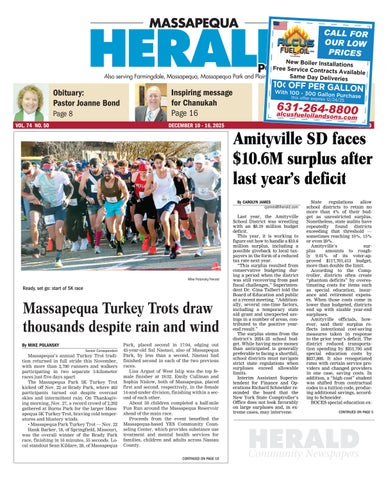
Ready, set go: start of 5K race
Massapequa Turkey Trots draw thousands despite rain and wind By MIKE POLANSKY Senioir Correspondent
Massapequa’s annual Turkey Trot tradition returned in full stride this November, with more than 2,700 runners and walkers participating in two separate 5-kilometer races just five days apart. The Massapequa Park 5K Turkey Trot kicked off Nov. 22 at Brady Park, where 463 participants turned out despite overcast skies and intermittent rain. On Thanksgiving morning, Nov. 27, a record crowd of 2,292 gathered at Burns Park for the larger Massapequa 5K Turkey Trot, braving cold temperatures and blustery winds. • Massapequa Park Turkey Trot — Nov. 22 Hank Barker, 18, of Springfield, Missouri, was the overall winner of the Brady Park race, finishing in 16 minutes, 55 seconds. Local standout Sean Kildare, 28, of Massapequa
Park, placed second in 17:04, edging out 45-year-old Sal Nastasi, also of Massapequa Park, by less than a second. Nastasi had finished second in each of the two previous races. Lisa Argast of West Islip was the top female finisher at 19:32. Emily Cullinan and Sophia Nislow, both of Massapequa, placed first and second, respectively, in the female 14-and-under division, finishing within a second of each other. About 50 children completed a half-mile Fun Run around the Massapequa Reservoir ahead of the main race. Proceeds from the event benefited the Massapequa-based YES Community Counseling Center, which provides substance use treatment and mental health services for families, children and adults across Nassau County. CONTINUED ON PAGE 10
1327247
Obituary: Pastor Joanne Bond
10¢ OFF PER GALLON
Last year, the Amityville School District was wrestling with an $8.19 million budget deficit. This year, it is working to figure out how to handle a $10.6 million surplus, including a possible giveback to local taxpayers in the form of a reduced tax rate next year. “This surplus resulted from conservative budgeting during a period when the district was still recovering from past fiscal challenges,” Superintendent Dr. Gina Talbert told the Board of Education and public at a recent meeting. “Additionally, several one-time factors, including a temporary state aid grant and unexpected savings in a number of areas, contributed to the positive yearend result.” The surplus stems from the district’s 2024–25 school budget. While having more money than anticipated is generally preferable to facing a shortfall, school districts must navigate strict state regulations when surpluses exceed allowable limits. Interim Assistant Superintendent for Finance and Operations Richard Schneider reminded the board that the New York State Comptroller’s Office does not look favorably on large surpluses and, in extreme cases, may intervene.
State regulations allow school districts to retain no more than 4% of their budget as unrestricted surplus. Nonetheless, state audits have repeatedly found districts exceeding that threshold — sometimes reaching 10%, 15% or even 20%. Amityville’s surplus amounts to roughly 9.01% of its voter-approved $117,701,413 budget, more than double the limit. According to the Comptroller, districts often create “phantom deficits” by overestimating costs for items such as special education, insurance and retirement expenses. When those costs come in lower than budgeted, districts end up with sizable year-end surpluses. Amityville officials, however, said their surplus reflects intentional cost-saving measures taken in response to the prior year’s deficit. The district reduced transportation spending by $251,795 and special education costs by $837,808. It also renegotiated rates with certain service providers and changed providers in one case, saving costs. In addition, a “high cost” student was shifted from contractual codes to a tuition code, producing additional savings, according to Schneider. BOCES special education exCONTINUED ON PAGE 5