INCORPORATING THE WEST HEMPSTEAD BEACON VOL. 76 No. 18
Second Class Postage paid at Post office at Hempstead, N.Y. 11550
April 30 - May 7, 2026
2 Endo Blvd, Garden City NY 11530
$1 per copy
Subscription $50
Refugees, rights and immigration changes
League of Women Voters briefs residents on evolving national policies and risks es to naturalization classes,” Sacasa e x p l a i n e d . T h e o r g a n i z at i o n f re quently par tners with community g roups such as the league to host The League of Women Voters of East Nassau invited legal experts for free educational events and le g al an in-depth look at evolving immi- clinics. S a c a s a a n d a n o t h e r p re s e n t e r, gration policies at a recent forum at Kate Churchill, a pro bono scholar the Levittown Public Library. T he lea gue re presents multiple a n d l e g a l i n t e r n a t C A R E C E N, communities, including East Mead- detailed several major immigration ow, Merrick, Bellmore, Wantagh, Sea- d e v e l o p m e n t s s i n c e e a rl y 2 0 2 5 , including changes to asylum processford and Hempstead. Residents spoke with experts, hop- ing, enforcement practices and federing to separate fact from misinfor- al legal rulings. m at i o n a m i d a r ap i d ly ch a n g i n g One of the most significant national landscape. The updates involved a tempoevent featured speakers rary pause on asylum from the Central Ameriapplications earlier this c a n R e f u g e e C e n t e r, year. While the pause has known as CARECEN, who been partially lifted, outlined major federal Churchill said that applip o l i cy s h i f t s a n d t h e i r cants from dozens of r e a l - w o rl d i m p a c t s o n countries designated as immigrant communities. “high risk” remain in Andrea Sacasa, a legal limbo. counsel with the Suffolk Another major concern C o u n t y O f f i c e o f N e w ANdREA SAcASA among the attendees was Americans and a re pre- Legal counsel, Suffolk increased immig ration sentative of CARECEN, County Office of New enforcement at courtsaid the goal of the pre- Americans houses. Sacasa described sentation was to provide how people attending clarity during a time of uncertainty. hearings were, in some cases, “We know that there’s a lot of mis- d e t a i n e d i m m e d i at e ly a f t e r w a rd . information, a lot of fear, and so our “They were leaving the courtrooms goal is to tackle that with straight- and getting detained right outside,” f o r w a r d f a c t s a n d i n f o r m a t i o n , ” she said. “T he judg es didn’ t even S a c a s a s a i d . S h e e x p l a i n e d t h a t know this was happening.” CARECEN, a Long Island-based nonThe forum also addressed leaderprofit, offers a range of services to ship changes in the U.S. Department i m m i g r a n t c o m m u n i t i e s b e yo n d of Justice, and their potential impact legal aid. on immigration courts, as well as the “We provide free le gal services, expiration of Temporary Protected but we also have community proCOntinued On Page 7 grams that range from English class-
By HUNTER FENOLLOL
hfenollol@liherald.com
Courtesy Stephen Sullivan
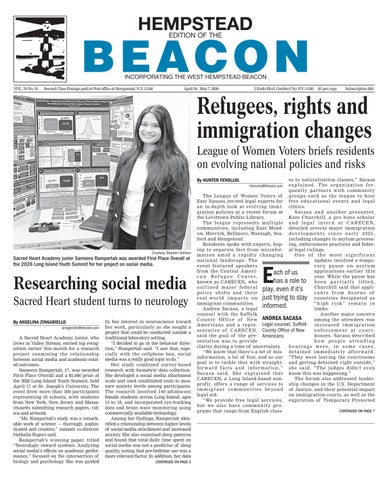
Sacred Heart academy junior Sameera Rampertab was awarded First Place Overall at the 2026 Long island Youth Summit for her project on social media.
Researching social media
Sacred Heart student turns to neurology By ANGELINA ZINGARIELLO azingariello@liherald.com
A Sacred Heart Academy junior, who livws in Valley Stream, earned top recognition earlier this month for a research project examining the relationship between social media and academic-related outcomes. Sameera Rampertab, 17, was awarded First Place Overall and a $1,000 prize at the 2026 Long Island Youth Summit, held April 17 at St. Joseph’s University. The event drew more than 300 participants representing 35 schools, with students from New York, New Jersey and Massachusetts submitting research papers, videos and artwork. “Ms. Rampertab’s study was a remarkable work of science — thorough, sophisticated and creative,” summit co-director Nathalia Rogers said. Rampertab’s winning paper, titled “Neurologic reward systems: Analyzing social media’s effects on academic performance,” focused on the intersection of biology and psychology. She was guided
by her interest in neuroscience toward her work, particularly as she sought a project that could be conducted outside a traditional laboratory setting. “I decided to go in the behavior direction,” Rampertab said. “I saw that, especially with the cellphone ban, social media was a really good topic to do.” Her study combined survey-based research with biometric data collection. She developed a social media attachment scale and used established tools to measure anxiety levels among participants. The research involved 140 adolescent female students across Long Island, ages 13 to 18, and incorporated eye-tracking data and brain wave monitoring using commercially available technology. Among her findings, Rampertab identified a relationship between higher levels of social media attachment and increased anxiety. She also examined sleep patterns and found that total daily time spent on social media was not a predictor of sleep quality, noting that pre-bedtime use was a more relevant factor. In addition, her data COntinued On Page 3
E
ach of us has a role to play, even if it’s just trying to stay informed.