
![]()


By ROKSANA AMID ramid@liherald.com
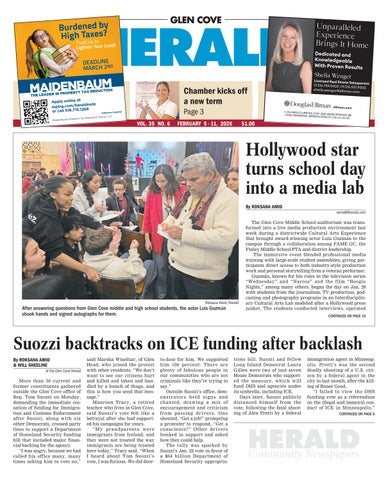
The Glen Cove Middle School auditorium was transformed into a live media production environment last week during a districtwide Cultural Arts Experience that brought award-winning actor Luis Guzmán to the campus through a collaboration among FAME GC, the Finley Middle School PTA and district leadership.
The immersive event blended professional media training with large-scale student assemblies, giving participants direct access to both industry-style production work and personal storytelling from a veteran performer.
Guzmán, known for his roles in the television series “Wednesday” and “Narcos” and the film “Boogie Nights,” among many others, began the day on Jan. 29 with students from the journalism, TV production, podcasting and photography programs in an Interdisciplinary Cultural Arts Lab modeled after a Hollywood press junket. The students conducted interviews, operated
By ROKSANA AMID & WILL SHEELINE of the Glen Cove Herald
More than 50 current and former constituents gathered outside the Glen Cove office of Rep. Tom Suozzi on Monday, demanding the immediate cessation of funding for Immigration and Customs Enforcement after Suozzi, along with six other Democrats, crossed party lines to support a Department of Homeland Security funding bill that included major financial backing for the agency.
“I was angry, because we had called his office many, many times asking him to vote no,”
said Marsha Wiseltiar, of Glen Head, who joined the protest with other residents. “We don’t want to see our citizens hurt and killed and taken and handled by a bunch of thugs, and this is how you send that message.”
Maureen Tracy, a retired teacher who lives in Glen Cove, said Suozzi’s vote felt like a betrayal after she had supported his campaigns for years.
“My grandparents were immigrants from Ireland, and they were not treated the way immigrants are being treated here today,” Tracy said. “When I heard about Tom Suozzi’s vote, I was furious. We did door-
to-door for him. We supported him 100 percent. There are plenty of fabulous people in our communities who are not criminals like they’re trying to say.”
Outside Suozzi’s office, demonstrators held signs and chanted, drawing a mix of encouragement and criticism from passing drivers. One shouted, “Get a job!” prompting a protester to respond, “Get a conscience!” Other drivers honked in support and asked how they could help.
The rally was sparked by Suozzi’s Jan. 22 vote in favor of a $64 billion Department of Homeland Security appropria-
tions bill. Suozzi and fellow Long Island Democrat Laura Gillen were two of just seven House Democrats who supported the measure, which will fund DHS and agencies under its umbrella, including ICE. Days later, Suozzi publicly distanced himself from the vote, following the fatal shooting of Alex Pretti by a federal
immigration agent in Minneapolis. Pretti’s was the second deadly shooting of a U.S. citizen by a federal agent in the city in last month, after the killing of Renee Good.
“I failed to view the DHS funding vote as a referendum on the illegal and immoral conduct of ICE in Minneapolis,”
In recognition of Black History Month, the Alzheimer’s Association is offering a free live webinar, “Alzheimer’s & Dementia: What You Need to Know” on Feb. 18 at 8 p.m.
The one-hour webinar will feature a dynamic panel of clinicians, researchers, caregivers and advocates representing the Divine Nine, exploring the intersection of dementia science, health equity, and lived experience. It will examine how Alzheimer’s and related dementias impact diverse communities, discuss participation in research and clinical trials, and share culturally responsive practices to improve awareness, engagement and outcomes.
Currently, more than 7 million Americans are living with Alzheimer’s disease. Black Americans are twice as likely to develop Alzheimer’s disease as older white Americans. Chronic health conditions associated with an increased risk of Alzheimer’s and other dementias, including cardiovascular disease and diabetes, disproportionately affect Black Americans.
According to the 2021 Alzheimer’s Association Facts and Figures report, nearly two-thirds of Black Americans, or 62 percent, believe that medical research is biased against people of
color. A history of exclusion from clinical trials and a lasting history of discrimination from the medical establishment contribute to high levels of mistrust of clinical trials among Black Americans.
“We know that Alzheimer’s disease disproportionately affects Black older Americans,” Dr. Carl V. Hill, chief diversity, equity and inclusion officer at the Alzheimer’s Association said. “We are committed to continue engaging underrepresented communities.”
Visit Alz-org.Zoom.us to register or call (800) 272-3900.
The Alzheimer’s Association is a worldwide voluntary health organization dedicated to Alzheimer’s care, support and research. Its mission is to lead the way to end Alzheimer’s and all other dementia — by accelerating global research, driving risk reduction and early detection, and maximizing quality care and support.
The association’s Long Island chapter is based in Melville. It runs education programs on Long Island, support groups, and offers other forms of virtual education. Annual efforts culminate in a fundraising walk, typically held in October in Eisenhower Park in East Meadow. Visit ALZ.org/LongIsland for more.
The Grenville Baker Boys & Girls Club will partner with Glen Cove Hospital to host a community discussion focused on youth heart health and the potential cardiac risks facing student athletes.
The event, titled “Cardiac Risk for Student Athletes: A Community Conversation,” will take place Tuesday, Feb. 10, at 6 p.m. at the Grenville Baker Boys & Girls Club in Locust Valley as part of the club’s Community Cares Conversation Series.
Led by telemetry physicians Dr. Brittney Grella and Dr. Sophie Golden, the session is designed for parents, coaches, educators, caregivers and community members who want to better understand how heart conditions can affect young athletes and what steps can be taken to reduce serious risks.
The discussion will explore a range of topics, including which students may be most vulnerable to cardiac issues, common and lesser-known warning signs that should never be ignored, and strategies to promote safer participation in school sports. Preventive measures such as education, emergency preparedness and proactive medical care will also be addressed.
A key component of the conversation will focus on cardiac screenings, including whether baseline heart testing should be mandatory for all student athletes before they participate in competitive sports. Organizers hope the dialogue will help families make informed decisions about their children’s health while encouraging schools and athletic programs to adopt best safety practices.
Drs. Grella and Golden bring handson experience in cardiac monitoring and patient care, giving them firsthand insight into how heart conditions can present in young people and how early detection can make a critical difference.
“The goal is to empower families and coaches with knowledge,” organizers said, “so warning signs are recognized early and student athletes can stay safe while enjoying the benefits of sports.”
The event is free and open to the public, and community members are encouraged to attend.
For more information or to RSVP, contact Tara Butler-Sahai at 516-7595437, Ext. 214, or email tara.butlersahai@gbbgc.org.


Following the death of its founder, Amy Peters, the Chamber formally assumed stewardship and operations of the Deep Roots Farmers Market to ensure its continuation as a community gathering space supporting local businesses and growers.
By ROKSANA AMID ramid@liherald.com
The Glen Cove Chamber of Commerce installed its 2026 board of directors during a swearing-in ceremony and networking dinner on Jan. 28, marking the start of a new term focused on business growth, community engagement and expanded programming.
Chamber President Dr. Maxine Meyris highlighted a year of increased membership, major community events and stronger support for local entrepreneurs, noting that the organization has grown to roughly 250 members while expanding initiatives that promote and sustain local businesses.
“Our decisions have stayed anchored to our mission — enhancing the health and profitability of our member businesses,” Meyris said, pointing to ribbon cuttings, scholarships, networking events and large-scale community programs as examples of the Chamber’s growing impact.
The Glen Cove Chamber of Commerce is led by President Dr. Maxine Meyris, with Vice Presidents Dr. Eve Lupenkoand Jamé Krauter, and Treasurer Thomas Bunger. Serving on the board are Past Presidents Matt Nartowicz and Mary Stanco, along with directors Sonya Lowe, Ylisa Kunze, Kate Alchermes, Ernie Feliciano, Gaitley Stevenson-Mathews, Matthew Rendell, Judith Rivera, and Danielle Vollkommer. The Chamber’s day-to-day operations are overseen by Executive Director Cliff Krauter.
Among its major efforts, the Chamber has taken over stewardship of the Deep Roots Farmers Market at Garvies Point, transforming it into a seasonal

community gathering space that supports local vendors and small businesses. The organization also continues to award the annual Dr. Glenn Howard Scholarship to graduating high school seniors and hosts its signature Culinary Delights event, one of the city’s most anticipated food showcases.
This year’s Culinary Delights will be held on May 18 from 6 to 9 p.m. at the Glen Cove Mansion, featuring dozens of local restaurants, beverage vendors and specialty businesses.
Executive Director Cliff Krauter reflected on the Chamber’s growth over the past several years and the relationships built within the business community.
“Glen Cove Chamber of Commerce means a great deal to me,” Krauter said. “Over the past five years, it has been an
honor to help grow the Chamber into one of the largest and most active on Long Island. The most important part of this work has been building real connections with local business owners and helping them succeed.”
Krauter added that working alongside the board has been a source of pride as the Chamber continues serving Glen Cove and neighboring communities.
First Vice President Dr. Eve Lupenko spoke about her long-term commitment to the city and the role strong businesses play in community stability.

of tasty
“My intention is to live permanently in Glen Cove, and I really want to help make it a thriving community — a place where my kids will want to stay, live and hopefully raise their families as well,” Lupenko said. “To have a viable, sustainable community, we need sustainable businesses.”
The evening also recognized recent accomplishments including joint networking events with neighboring chambers, sponsorship of Downtown Sounds, community festivals and charitable donations to local nonprofits.
With a new board officially sworn in, Chamber leaders said the coming year will focus on expanding programming, strengthening business advocacy and continuing high-profile events that connect residents with local entrepreneurs.


Dear Great Book Guru, It’s a very cold snowy day as I’m writing to you and I know more days like this lie ahead so please recommend a book that will totally absorb me. A mystery perhaps that will keep me guessing would be great.
Surrounded by Snow
Dear Surrounded by Snow, I have the perfect book for you: “The Widow” by John Grisham. Simon Latch is a small-town lawyer in rural Virginia when the case of a lifetime walks in the door of his rather shabby office.

Eleanor Barnett is an elderly widow who claims her husband amassed a fortune in Coca Cola and Walmart stocks. Dead ten years, he had two sons he was estranged from but aware of this possible windfall. The estate is very compli-


Please join attorney Michael Ettinger for a live webinar, “Four Advantages of Using Trusts,” on Wednesday February 11 at 6:30 p.m. Register in advance at trustlaw.com
by Susan Jeffers – Part Two
cated, and Simon offers to take it on with a hefty hourly rate built in. When Eleanor demands more and more of his time, he wonders if it is all worth it. Of course it is, he convinces himself –when she dies the payoff will be tremendous. Throughout the novel, we meet a cadre of fascinating characters - his law secretary Matilda, his estranged wife Paula, his gambling buddies, fellow lawyers all eager to cash in too, and, most troubling, the menacing stepsons.
When a very drunk Eleanor is involved in a car accident, Simon represents her and a multitude of problems arise including …. a murder charge. How will he extricate himself now?
Would you like to ask the Great Book Guru for a book suggestion? Contact her at annmdipietro@gmail.com.
A 40-year-old Glen Cove man was arrested on Feb. 2 on Landing Road and charged with aggravated unlicensed operation in the second degree, no side mirror, non-transparent windows and unlicensed operation.
A 43-year-old Glen Cove man was arrested on Jan. 31 on Herb Hill Road and charged with driving while intoxicated, aggravated unlicensed operation in the first degree and unsafe turn.
A 25-year-old Glen Cove woman was arrested on Jan. 30 at Kennedy Heights and charged with criminal contempt in the second degree and harassment in the second degree.
A 37-year-old Glen Cove man was arrested on Jan. 27 on Glen Street and charged with robbery and criminal possession of a controlled substance following a domestic incident.
People named in Crime Watch items as having been arrested and charged with violations or crimes are only suspected of committing those acts of which they are accused. They are all presumed to be innocent of those charges until and unless found guilty in a court of law.
■ WEB SITE: glencove.liherald.com
MAIN PHONE: (516) 569-4000
■ E-MAIl: Letters and other submissions: glencove-editor@liherald.com
■ EDITORIAl DEPARTMENT: Ext. 327 E-mail: glencove-editor@liherald.com
■ SUBSCRIPTIONS: Press ”7” E-mail: subscriptions@liherald.com Fax: (516) 569-4942
■ ClASSIFIED ADVERTISING: Ext. 286 E-mail: ereynolds@liherald.com Fax: (516) 622-7460
■ DISPlAY ADVERTISING: Ext. 249 E-mail: rglickman@liherald.com Fax: (516) 569-4643
■ PUBlIC NOTICES: Ext. 232 E-mail: legalnotices@liherald.com


Suozzi wrote in a statement. “I hear the anger from my constituents and I take responsibility for that.”
An employee of Suozzi’s office met with protesters during Monday’s rally, distributing comment sheets on which residents could write concerns and complaints for the congressman to review. In a follow-up statement after the protest, Suozzi condemned recent immigration enforcement tactics while reiterating support for border security.
“ICE’s illegal and immoral actions have dramatically affected all Americans and protestors today represent all of us who are demanding change,” he wrote. “The Trump administration is right to secure the border and deport violent criminals, but masked agents breaking car windows and dragging people out of their cars, assaulting protestors, conducting violent warrantless raids and killing people is outrageously wrong, un-American, and I will fight to stop them.”
Halle Brenner, a Huntington resident and a co-founder of Show Up Long Island, who organized the protest, said the group formed in 2017, during President Trump’s first term.
“We spend a lot of time holding Republican officials accountable because they’ve pushed these policies,” Brenner said. “But when a Democratic politician does something we don’t agree with, we have to be there, too. We’ve written postcards for Tom Suozzi, knocked on doors, made phone calls for his campaigns. That’s why this hurt.”
Brenner said that the group views ICE’s actions across the country as increasingly violent and unconstitutional. “They’re smashing car windows, dragging people out of vehicles, breaking down doors without warrants, separating families,” she said. “To keep funding this agency is astonishing. It’s un-American, and dangerous to all of us.”
While Brenner said she appreciated Suozzi acknowledging his mistake, she emphasized that future votes will matter more than statements. “Apologies are meaningless unless actions follow,” she said. “We’ll see what he does the next time funding comes up.”
Tracy echoed that sentiment, saying she was encouraged by Suozzi’s reversal but wanted to make sure he stuck to it. “I was thrilled to see a congressman


admit he was wrong,” she said, “but we’re here to remind him — and to make sure he does the right moral thing moving forward.”
Wiseltiar said that recent events have motivated residents who were previously less politically active.
“What’s happening now has really pushed people into action,” she said.

“We’re watching neighbors taken, communities destroyed. People can’t stay silent anymore.”
In a phone call to the Herald on Tuesday, a representative from Suozzi’s office confirmed that he personally responded to all of the comment forms submitted by protesters.
Organizers said they plan to continue
demonstrating if future congressional votes continue to fund ICE, stressing that Monday’s protest was only one step in a broader push for immigration reform and accountability.
“This isn’t going away,” Brenner said. “We still have time to stop what’s happening — but only if we keep showing up.”
By WILL SHEELINE wsheeline@liherald.com
Raynham Hall Museum will host a presentation exploring the exuberant history of the Lindy Hop and its roots in the Jazz Age when Celia Ipiotis appears as part of the museum’s Townsend Talks series.
The program, titled “Jazzing It Up: The Savoy Club Madness,” will feature film clips, historical context and commentary drawn from Ipiotis’ interviews with legendary Lindy Hop dancer and choreographer Frankie Manning. Ipiotis is the producer of the PBS series “Eye on Dance” and has spent decades documenting both concert and vernacular dance traditions.
Ipiotis said the Lindy Hop continues to resonate across generations, even among those who may only have a surface understanding of the dance.
“I think it represents abandoned joy,” she said. “And there’s not a person who doesn’t break out in smiles when they hear the words ‘Lindy Hop.’ That’s a good thing these days.”
Originating during the Jazz Age, the Lindy Hop developed out of earlier social dances like the Charleston and took shape in dance competitions during the teens, 1920s and 1930s. Ipiotis said the Savoy Ballroom in Harlem was central to its evolution, serving as both a cultural hub and an incubator for innovation.
“The Savoy Ballroom figures huge in the life of the Lindy Hop,” she added, “because that was where you had all the top dancers.”
The Savoy was notable not only for its scale and energy, but also for being one of the only racially integrated dance halls in New York City at the time. Its dance floor hosted some of the era’s most accomplished performers and attracted celebrities, musicians and everyday New Yorkers alike.


Lindy Hop became known for its speed, athleticism and acrobatic elements, including aerial steps that involved lifting and flipping partners in time with the music. Manning, whom Ipiotis interviewed in 1988, is widely credited with inventing the aerial step that came to define the dance.
“When dancers invented new steps, that would sort of create a different rhythm,” she said. “And the bands used to pick up on that and write music for the dancers.”
Ipiotis’ presentation will center on filmed conversations with Manning, who described life at the Savoy and the competitive dance battles that unfolded there. She said hearing dancers speak about the era provides insight not only into technique, but also into the spirit of the time.
“You get people from a particular era, and you hear them speak,” she said. “Even the rhythm of his voice, the way he spoke, the way he described things, it has a jazzy, upbeat feel.”
The event will also connect Lindy Hop to Raynham Hall’s own history through the story of Alice Delano Weekes, a professional concert and ballet dancer associated with the Townsend family and the Roosevelts. Ipiotis plans to highlight Weekes’ career and her performances alongside Josephine Baker during the 1930s as an example of how jazz era dance crossed social and cultural boundaries.
The presentation, also being held in honor of Black History Month, is part of the museum’s Townsend Talks series, which brings speakers from Long Island and beyond to explore topics related to history, art, architecture and culture connected to the site and its mission.
Ipiotis said the evening will move between video clips and live commentary, with opportunities for audience questions throughout.
The program will conclude with footage from the 1941 film “Hellzapoppin’,” which features Manning’s choreography and showcases the extreme athleticism of Lindy Hop dancers. Ipiotis noted that viewers often assume the footage is sped up, though it is not.
The talk will be held in the Raynham Hall Visitors’ Center. Tickets are $25 for nonmembers, $20 for members and $10 for students with identification. Light refreshments are included.


Experts explain what lies beneath the surface, and detail the threats to our crucial aquifers
By JORDAN VALLONE, WILL SHEELINE & ABIGAIL GRIECO of the Herald Community Newspapers
First installment in a series about water.
On Long Island, we’re not talking enough about water.
From the drops coming out of our taps to the waves breaking along both shores, myriad water-related issues have the potential to impact Long Islanders’ day-to-day lives.
The water system is not a single pipeline or policy, but a web of underground aquifers, aging infrastructure, coastal ecosystems — and policymakers — that together determine who has access to clean, affordable water — and who faces the greatest risk when that system begins to fail.
This series will break down how Long Island’s water system works, from aquifers to coastal bays, and clarify how policy, infrastructure and governance shape access to clean, affordable water. It will also examine the environmental pressures facing that system, from contamination and climate change to the health of bays, fisheries and drinking water supplies.
Through global reports that demonstrate the rapid growth of freshwater use over the past century, and interviews with environmental experts and regional advocates who connect these issues locally, this first installment examines what lies beneath the surface: the water we drink, and how contamination and access may disproportionately affect certain communities.
The sole source beneath Long Island
In order to understand Long Island’s relationship with drinking water, it’s essential to understand where the water comes from. The island relies on aquifers, underground layers of sand, gravel and clay that store billions of gallons of water accumulated over tens of millions of years. More specifically, Long Island relies on three: the Upper Glacial, the Magothy and the Lloyd (as well as a fourth, significantly smaller one, the Jameco).
These aquifers together are designated a single-source aquifer system by the Environmental Protection Agency, which means that “your groundwater supply is provided by an aquifer that serves at least 50 percent of your water needs,” according to Sarah Meyland, a former professor at New York Institute of Technology.
Meyland explained that both Nassau and Suffolk counties rely on this single aquifer system for 100 percent of our freshwater, whether it comes from a tap, shower or sprinkler. While this has meant that Long Islanders have had access to clean, easily accessed drinking water for decades, the aquifers, particularly in Nassau County, have one major downside.
“This aquifer needs to be particularly well protected, because if you damage it,

or if you ruin it, you don’t have any other source of water,” Meyland said. “And that’s exactly the situation Long Island is in. We don’t have a secondary backup source of water.”
Since the federal government began measuring water usage in Long Island’s aquifers in 1900, roughly 5 percent of drinkable water has been consumed or lost due to salinization, the process by which freshwater is turned into saltwater. It occurs in aquifers due to overpumping, as water is taken out faster than it is replaced, causing saltwater from the Long Island Sound and the ocean to fill in the missing volume.
tion of the aquifer system is already nonfunctional, Queens is barely better, and both now get their water from the New York City water system, which pumps freshwater in from upstate. Nassau is well on its way to following them; the difference is there is no municipal entity to bail Nassau out.
as of 2021, the United States withdraws the third-highest amount of freshwater from underground globally, roughly 444.4 billion cubic meters per year.
A key conclusion from the university’s report put the crisis in simple terms: “The world is already in the state of ‘water bankruptcy.’” In many basins and aquifers, long-term overuse and degradation, the report says, means that “hydrological and ecological baselines cannot realistically be restored.”
What areas are more affected?
If Long Island continues on the same path of aquifer depletion without any intervention from state authorities, such as the Department of Environmental Conservation, Meyland said, Nassau County will suffer more than Suffolk within the next 50 years.
“It’s about a third of the size of Suffolk with roughly the same number of people,” she said. “The Town of Brookhaven is the same size as the county of Nassau. So Nassau County will continue to experience saltwater intrusions. That’s going to put pressure on virtually all of the water suppliers along the north and south shore.”
Meyland singled out Long Beach as an area that would likely lose its entire local water supply because of saltwater intrusion to the Lloyd Aquifer, the only aquifer the city draws from.


The vast majority of the used water is consumed by private sprinklers and irrigation systems, many of which are automated to water yards and home gardens. According to Meyland, Long Island has the highest per-capita water use of any community from New York to North Carolina, and the vast majority of that use occurs from spring through fall, when sprinklers turn on and swimming pools fill up.


There is no known way to create new water, or to speed up the natural replenishment process. Desalination plants, which remove salt from water, are becoming more common globally, but they are expensive projects, according to Meyland.
“It’s like a bank account,” Meyland said. “The water, the money coming in, needs to be at least equal to the money going out.”
While a 5 percent loss may seem inconsequential, the real problem is there’s no way to efficiently and cheaply replenish that loss. And the damage is not evenly distributed: The vast majority of the loss takes place in Brooklyn, Queens and Nassau, which have not effectively stewarded their portions of the aquifers.
Suffolk, which has the lowest population density of the four counties, has proactively monitored and managed its water intake and outflow for years, leaving its portion of the aquifers “a system in balance,” as Meyland described it.
She pointed out that Brooklyn’s por-
The issues impacting drinking water supply are not unique to Long Island. According to a report released by the United Nations University last month, the world is entering an “era of global water bankruptcy” — a new, formal definition of a reality for billions of people. The report called for a “fundamental reset” of the global water agenda, as irreversible damage pushes sources of fresh drinking water beyond recovery.
“This report tells an uncomfortable truth: Many regions are living beyond their hydrological means, and many critical water systems are already bankrupt,” said the report’s lead author, Kaveh Madani, the director of the UN University’s Institute for Water, Environment and Health.
Numbers published by Our World In Data, a nonprofit publication that uses data to explain global issues like poverty, disease and climate change, showed that
“They will have already been forced to look for other sources of water, whether they make arrangements from New York City, or they make arrangements and buy water from some of their neighboring water suppliers,” Meyland explained. “I’m sure there will be a lot of pressure to desalinate water, but that will be very expensive.”
On the North Shore of Nassau County, she said, areas of the Great Neck and Manhasset peninsula, including Sands Point, are at risk of losing their supplies of water, also due to salinity. And their options are limited, she added, because some of these communities are already piping water from other parts of Long Island.
Water suppliers are aware of the risk the future holds, Meyland said, but it is unfair to put the burden on them to fix the situation. “They are not at fault for what is happening to the water supply for coastal communities,” she said. And water supplies are not only depleting on Long Island, but they are also contaminated.
The Environmental Working Group affiliated with Citizens Campaign for the Environment, a leading nonprofit organization dedicated to advocating for stronger environmental policies in New York and Connecticut, released a report in 2025 showing that a least 189 New York water systems — primarily serving residents of Long Island — detected high levels of toxic so-called “forever chemicals,” or PFAS, in tap water.
The report showed that 702,000 residents in Nassau County and 122,200 resi-
dents of Suffolk have elevated levels of PFAS in their water supplies. Some particularly vulnerable communities include those serviced by the Lynbrookbased Liberty Utilities, the Water Authority of Western Nassau and the Hempstead Town Water District.
What can be done?
According to Adrienne Esposito, executive director of Citizens Campaign for the Environment, geography and land use play a major role in why some Long Island communities experience more severe water quality issues than others.
“The biggest driver for water quality in the marine environment is land activity,” Esposito said, noting that polluted stormwater runoff, fertilizer use and marine debris all flow from developed areas into surrounding bays and waterways.
Highly populated and heavily developed regions — particularly along the South Shore — generate greater amounts of runoff, which carries excess nitrogen from lawn fertilizers, bacteria and debris into nearby bays. That nitrogen fuels algae growth, which depletes oxygen levels and can lead to fish kills and damage to shellfish populations.
Aging infrastructure in some coastal communities continues to pose challenges. Esposito pointed to the Long Beach’s sewage treatment plant, which discharg-
es roughly 5 million gallons of wastewater per day into Nassau County’s Western Bays. While the wastewater is treated, Esposito said the facility is old and in need of major repairs.
The Western Bays have been among the most degraded areas, in part due to decades of treated sewage discharges and runoff from surrounding communities. Marine debris, including plastic bottles, cigarette butts and food packaging, often originates farther inland, and makes its way through tributaries before washing into coastal waters, Esposito said.
On the North Shore, in areas that still rely on septic systems, groundwater contamination presents another challenge, as pollutants can leach directly into aquifers and nearby waterways.
result of years of advocacy and scientific review.
In addition to regulating water systems themselves, Esposito highlighted a first-of-its-kind state law, passed in 2019, that limited the amount of 1,4-dioxane allowed in common household and personal care products. The law was phased in over several years and was fully implemented in 2023, reducing the amount of chemicals entering wastewater systems in the first place.
to protect our waters and public health, sometimes you have to speak out
AdrIenne d’esposIto Executive director, Citizens Campaign for the Environment
Esposito pointed to several major policy changes that have reshaped how New York addresses water contamination, particularly by emerging chemicals like PFAS and 1,4-dioxane.
She noted that the state now has some of the nation’s strongest drinking water standards for these chemicals — standards that are fully implemented across Long Island’s public water systems, the


Esposito also emphasized the importance of preventing pollution at its source, rather than relying on expensive treatment systems after contamination occurs. Citizens Campaign has spent several years advocating for legislation aimed at reducing packaging waste, a significant contributor to marine debris found in Long Island’s bays and waterways.
One of the most significant steps underway is the long-awaited redirection of treated sewage from the South Shore Water Reclamation Facility, in Bay Park, away from the Western Bays and into the Cedar Creek ocean outfall pipe — a nearly $600 million project more than a decade in the making. The change is expected to dramatically improve

water quality in the Western Bays once the Bay Park Conveyance Project is completed.
At the local and state level, municipalities are also tapping into grant programs designed to reduce stormwater pollution. These initiatives fund upgrades to stormwater systems, filtration devices that remove nitrogen and bacteria before runoff reaches waterways. Environmental organizations, including Citizens Campaign, Operation SPLASH and the Nature Conservancy have played a key role in advocating for these measures through long-term collaboration and public pressure.
Looking ahead, Citizens Campaign plans to launch a new marine debris prevention campaign this spring, focused on public education and outreach, emphasizing that litter discarded anywhere on Long Island can ultimately end up in coastal waters. The organization is also continuing its push in Albany for legislation aimed at reducing packaging waste and monitoring contaminants entering waterways through wastewater systems.
Residents can make a difference, Esposito said, by limiting fertilizer use, properly disposing of trash and supporting redevelopment over construction on green spaces.
“We encourage people to get up, show up and speak up,” she said. “If you want to protect our waters and public health, sometimes you have to speak out.”


multi-camera setups, hosted red-carpetstyle podcast segments and captured professional portraits, effectively turning the school into a functioning media hub.
“This is exactly the kind of opportunity FAME GC was created to make possible,” said Maria Laino DeLuca, a vice president of FAME GC and co-president of the middle school PTA. “We are not only bringing an extraordinary artist to our students — we are demonstrating what’s possible when a community and its schools invest together in creativity, culture and real-world learning.”
DeLuca said that Guzmán’s visit grew out of longstanding industry relationships, noting her background in entertainment marketing and connections through the organization’s leadership. “Last year we had Daryl McDaniels, from Run DMC, come and talk to the kids about bullying and inspiring them,” DeLuca said. “We saw that Luis would be such a great fit given who he is, the role he has, how humble he is — and the fact that he is just an icon. We’re really looking to be innovative in our approach to teaching,” she added. “We realize that some things you can’t just learn in a classroom.”
After working with the media students, Guzmán shifted into large-scale Q&A assemblies, first addressing middle school students and later meeting with high school students. In each session he spoke candidly about perseverance, identity and staying connected to humanity.
Guzmán told the Herald that the personal interaction was central to why he participates in school visits. “It kind of humanizes me, to show young people that I’m approachable,” he said. “I think it’s also an inspiration to young people to see that, oh, wow, this guy really took the time to come down and not only let us interview him, but took pictures with us and spoke to us and answered our questions.”
Reflecting on the early years of his acting career when addressing the high school students, Guzmán encouraged students to reframe rejection. “I never looked at it as rejection,” he said. “I just looked at it as an opportunity to do something else.” If he missed out on a role, he explained, his mindset was that “there’s something better coming up,” adding that staying positive made it easier to bounce back.
Guzmán also said that before he became an actor he was a social worker in New York City — a job he described as the most meaningful of his life. “It was the best job I ever had because I was helping young people to help themselves,” he said, explaining that many of the youth he served came from families who had lived at the poverty level for generations. Expectations were low, he recalled, with 22 successful job placements in a year considered a strong outcome, but his first year produced far more. “Out of 75 young people, 67 were positive and happy,” he said. “So, yeah, I took a lot of pride in that.”
Much of his message centered on


compassion, humility and connection — values he said were shaped by his upbringing. Guzmán recalled how his mother would send him to share leftover food with people experiencing homelessness, which taught him that “helping the less fortunate was a good thing.”
He tied those lessons directly to why he makes time for students today. “That is my connection right here to my humanity,” he said. “I always took the time, like I’m taking the time, wanting to be here with you guys.”
He also spoke of his cultural pride in being Puerto Rican, telling students that he views himself as representing the

broader Latino community. “Being a Latino in my business, it’s like we gotta try like three, four times harder just to get to where we are,” he said. “But the most important thing was that I never gave up.”
Asked what he would focus on learning if he were in high school today, Guzmán emphasized empathy and critical thinking. “I would focus on learning how to try to make humanity better for people,” he said, expressing concern that constant reliance on technology can limit problem-solving and basic skills. He urged students to support one another, reject bullying and remember
that “everybody has a story.”
For many students, including eighthgrader Sieina Iovino, Guzmán’s visit made a powerful impression. “What really stuck out to me was confidence,” she said. “I found it comforting and I found it nice that he gave inspirational ideas, to trust in yourself, and it’s going to all work out.”
Another eighth-grader, Zoe Vann, said the experience made inspiration feel real. “I just feel like it’s very inspirational to know that somebody who is in the acting industry came to our school to inspire us,” Zoe said. “It really helped.”


By CAROLYN JAMES cjames@liherald.com
Valentine’s Day, celebrated each year on February 14, is a holiday recognized around the world as
1
Valentine’s Day has ancient roots that predate romantic love.
Although Valentine’s Day is now strongly associated with romance, its origins are much older and not originally about love. The holiday traces back to ancient Rome, where a festival called Lupercalia was celebrated in midFebruary. Lupercalia was linked to fertility, health, and the coming of spring. During this festival, rituals were performed to promote fertility and ward off evil spirits. When Christianity spread through the Roman Empire, many pagan festivals were adapted into Christian holidays. Over time, Lupercalia was replaced with a day honoring Saint Valentine, helping shift the holiday’s meaning from fertility rituals to something more symbolic and moral.
2
There was likely multiple “Saint Valentines.”
One interesting fact is that historians are not certain which Valentine the
a time to express love and affection. Its roots trace back centuries, blending religious tradition with cultural customs that have evolved
holiday refers to. There were at least two Christian martyrs named Valentine who lived during the 3rd century. One popular legend claims that a priest named Valentine secretly performed marriages for couples when marriage was banned by Emperor Claudius II. Another story suggests Valentine helped imprisoned Christians and signed letters “from your Valentine,” which may explain the phrase still used today. While these stories are difficult to confirm historically, they contributed to Valentine becoming associated with love, devotion, and kindness.
The holiday became romantic in the Middle Ages.
Valentine’s Day did not become strongly linked with romantic love until the Middle Ages, especially in England and France. During this time, people believed that birds began mating in midFebruary, which helped connect the date with romance. Famous writers such


over time.

From ancient legends to modern-day chocolates and cards, here are five things to know about the holiday and its traditions:
as Geoffrey Chaucer wrote poems that linked Valentine’s Day to love and courtship. This literary influence played a major role in shaping how people viewed the holiday, turning it into a day for expressing affection rather than simply honoring a saint.
Valentine’s Day cards—and chocolate— have a long history.
Exchanging Valentine’s messages has been popular for centuries. The oldest known Valentine’s card dates to 1415, when Charles, Duke of Orléans, wrote a poem to his wife while he was imprisoned. By the 18th and 19th centuries, printed Valentine’s cards became common, especially in Europe and the United States. Improvements in printing technology and cheaper postage helped make cards widely accessible. Today, Valentine’s Day is one of the most popular card-giving holidays, with millions exchanged each year.
Chocolate and Valentine’s Day are
also loosely connected, but this wasn’t always the case. In the 1800s, a chocolate maker named Richard Cadbury began selling chocolates in decorative, heartshaped boxes. These boxes were often kept as souvenirs after the chocolates were eaten. This idea helped turn chocolate into a classic Valentine’s Day gift, a tradition that continues today.
Valentine’s Day is celebrated differently around the world.
While many countries celebrate Valentine’s Day on February 14, traditions vary widely. In Japan, it is customary for girls to give chocolate to boys, while boys return the favor a month later White Day. In Finland and Estonia, the holiday focuses more on friendship than romance and is often called “Friend’s Day.” In some cultures, Valentine’s Day is less commercial or not widely celebrated at all. These differences show how the holiday has been adapted to fit local customs and values.


West Bank Wings Blazin’ Buffalo Potato Skins Sweet Chili Meatballs
Score from kickoff to crunch time
By Karen Bloom
It’s the biggest sports day of the year — and a perfect excuse to throw a bash that’s almost as exciting as the game itself. The Super Bowl on Sunday isn’t just about touchdowns, commercials and the halftime show: it’s about friends, fun and food that’s worth a victory dance.
Sure, the game on the big screen is the main event, but let’s be honest — some of the best plays happen around the snack table. Wings, dips, even desserts are all part of the strategy to keep your fans happy (and maybe even sneak a second helping before halftime). When it comes to dessert, fuss-free is the way to go. An array of cookies, brownies and dessert bars will satisfy the sweet tooth. You can take your dessert table to the next level by icing your treats in team colors. Here’s your playbook for scoring big with game-day treats that’ll make your party a championship-worthy hit.
No football party is complete without a generous serving of wings. Try these Asianinspired chicken wings, with a spicy Creole twist.
• 3 pounds chicken wing pieces
• 1 tablespoon oil
• 2 teaspoons Creole Seasoning
• 1/2 cup pineapple juice
• 1/4 cup cane syrup or molasses
• 1/4 cup ZATARAIN’S® Creole Mustard
• 1/4 cup sweet chili sauce
• 1 tablespoon minced fresh garlic
• 3/4 teaspoon crushed red pepper
• 1/2 teaspoon ground ginger
• Chopped fresh cilantro
• Sesame seeds
Preheat oven to 450°F. Toss chicken wings with oil and Creole Seasoning in large bowl. Arrange wings in single layer on foil-lined large shallow baking pan.
Bake 35 minutes or until wings are cooked through and skin is crisp.
Mix remaining ingredients, except cilantro and sesame seeds, in large skillet. Bring to boil on high heat. Reduce heat to low; simmer about 15 minutes or until sauce is reduced by a third and is a “syrup” consistency. Add wings; toss to coat with sauce. Transfer wings to serving
platter. Garnish with cilantro and sesame seeds. Serve immediately.
Here’s another zesty take on the footballwatching favorite.
• 2 1/2 pounds chicken wing pieces
• 1/2 cup any flavor Frank’s Red Hot Buffalo Wing Sauce
• 1/3 cup ketchup
• 2 tsp. Cajun seasoned spice blend
Bake wings in foil-lined pan at 500 °F on lowest oven rack for 20 to 25 minutes until crispy, turning once.
Mix Buffalo Wings Sauce, ketchup and spice blend.
Toss wings in sauce to coat.
Tip: You may substitute 1/2 cup Red Hot Sauce mixed with 1/3 cup melted butter for the Wings Sauce.
Alternate cooking directions: Deep-fry at 375°F for 10 minutes or broil 6-inches from heat 15 to 20 minutes turning once.
This the ideal game day snack! Seriously, it’s a crowd pleaser.
• 3 pounds small russet potatoes
• Olive oil cooking spray
• 1 cup shredded reduced-fat or regular Monterey Jack cheese
• 1 cup shredded rotisserie chicken
• 1/4 cup buffalo wing sauce
• 1/2 cup chopped Blue Diamond Smokehouse
• Almonds
• 1/2 cup light sour cream
• 1/4 cup sliced green onion tops
Preheat oven to 450 F and line baking sheet with foil.
Rinse potatoes and pat dry; pierce with fork or sharp knife. Place in large microwave-safe bowl; cover and microwave high for 15 minutes or until potatoes are soft when gently squeezed. Remove and let cool slightly.
Cut in half and scoop out potato leaving 1/4inch rim of potato inside skin. Place on prepared baking sheet and spray both sides of potato skins liberally with cooking spray; bake for 15 minutes to crisp.


Billy Stritch and Friends celebrate Judy Garland
Sprinkle equal amounts of cheese into each skin. Stir together chicken and wing sauce and spoon over cheese. Top with almonds and bake for 5 minutes more. Add dollop of sour cream to each and sprinkle with green onions. Serve with and additional wing sauce, if desired. Makes 6-8 servings.
Round out your lineup with this tasty addition to your game day spread.
• 1 pound lean ground turkey or ground beef
• 1/3 cup Japanese panko crumbs or bread crumbs
• ¼ cup cilantro, finely chopped
• 3 green onions, chopped
• 1 tablespoon fresh ginger, finely minced
• 1 large egg, beaten
• 1/2 teaspoon salt
• 12 ounces Frank’s RedHot Sweet Chili Sauce, divided
Preheat oven to 350° F.
Mix ground meat, panko crumbs, cilantro, green onion, ginger, egg, salt and 1/4 cup sweet chili sauce. Form into one-inch meatballs. Place meatballs on lightly greased baking sheets.
Bake 20 minutes, turning once halfway through. Put meatballs in slow cooker or Dutch oven to keep warm, pour remaining sweet chili sauce over meatballs. Gently stir to coat meatballs and serve.
Game day requires guacamole. Try a new twist on the must-have dip.
• 1 large avocado, peeled and mashed
• 1/2 tomato, seeded and chopped
• 1/3 cup Blue Diamond Jalapeno Smokehouse
• Almonds, chopped
• 1/4 cup diced red onion
• 3 strips cooked bacon, roughly chopped
• 2 tablespoons sour cream
• 1 teaspoon minced garlic
• Juice of 1/2 lime
• Salt and pepper, to taste
In small bowl, mix all ingredients. Serve with tortilla chips or other favorite dippers, such as carrots, bell peppers and broccoli.
Judy on TV! This concert shines a long-overdue spotlight on a unique chapter of Garland’s legendary career: her 1963–64 CBS television series. It’s a look at Garland’s iconic talent through the lens of her landmark 1963-64 weekly television broadcasts. Renowned entertainer and music director Billy Stritch leads this dazzling tribute that brings together a stellar lineup of jazz and Broadway favorites including acclaimed vocalists Gabrielle Stravelli and Nicolas King. The Judy Garland Show lasted only nine months and the star saw its cancellation as a devastating failure. Stritch sees it much differently, noting that the show’s 26 hours of concert material capture a crucial era of her life and legacy as one of the greatest entertainers of all time. These terrific performers revive the unforgettable music, intimate moments and sheer star power that defined the show.
Saturday, Feb. 7, 8 p.m. $58, $48, $38. Landmark on Main Street, 232 Main St., Port Washington. Tickets available at landmarkonmainstreet.org or (516) 767-6444.

The acclaimed dance company visits Hofstra University with a high-octane performance, Step Afrika! 101. Since its 1994 founding, Step Afrika! has been recognized as a cultural ambassador for this percussive dance tradition rooted in African American communities and historically linked to Black Greek-letter organizations. Their signature style fuses precise footwork and rhythmic movement with contemporary African dance, AfroBeats and popular music, in a powerful celebration of culture and community. Everyone is encouraged to clap, stomp, and join in calland-response moments that make the show feel as communal as it is electric. In keeping with Step Afrika!’s emphasis on service and community, it’s requested to bring non-perishable food items or basic toiletries to benefit the Hofstra Pantry and the Mary Brennan INN.
Sunday, Feb. 8, 3:30-5 p.m. Free admission. John Cranford Adams Playhouse, South Campus, Hempstead. For more information, visit hofstra.edu/academics/culturalcenter or call (516) 463-5669 or email hofculctr@hofstra.edu.
6
Explore the beauty and remarkable history of Planting Fields’ historic Camellia House. Join Sustainability Coordinator Rebecca Slagle and Archivist Marie Penny for a tour of a living legacy. Discover the Coe family’s passion for horticulture through a historic collection of more than 200 blooming camellias. Designed by the famed Olmsted Brothers Firm, the Camellia House stands as one of northeast’s most treasured architectural and horticultural gems. $25.
• Where: Camellia House. 1395 Planting Fields Road, Oyster Bay
• Time: 10-11 a.m.
• Contact: plantingfields.org or call (516) 922-9210
7

‘So don’t stop me
Join naturalist Virginal Dankel for an interactive winter stroll across the Nassau County Museum of Art grounds. During this seasonal walk, participants can expand their knowledge of the natural world and strengthen their powers of observation. Adults only. $20, $10 members. Registration required.
• Where: Manes Education Center, 1 Museum Drive, Roslyn Harbor
• Time: 11 a.m.-12:30 p.m.
• Contact: nassaumuseum.org or (516) 484-9337
The Tribute and Honor Foundation hosts its Fifth Annual Tribute and Honor Awards, an evening dedicated to supporting and honoring our veterans. Guests enjoy cocktails followed by an opening ceremony featuring a Color Guard. Sponsorship opportunities are available, and advance ticket purchase is required. $100 standard advance ticket; $90 discounted veteran advance ticket.
• Where: Crescent Beach Club, 333 Bayville Ave., Bayville
• Time: 6 p.m. (Cocktails 6-6:45 p.m.; ceremony following)
• Contact: TributeAndHonorFoundation.org
Princess Adventure
Families can step into a real-life storybook on a journey through the castle at Sands Point Preserve on a magical adventure! Your little royal will be welcomed by two of their favorite princesses
tour. Examine the preserve’s unique physical features and wildlife, as well as critical conservation issues and helpful practices to create a healthy, sustainable environment.
Environmental educator Hildur Palsdottir engages as participants on a guided winter walk to explore the quiet but active life of the season. Look for animal tracks, signs of winter survival, and the subtle movements that reveal how wildlife stays active even in the coldest months. Bring your Valentine — whether that’s a partner, family member, friend, your four-legged walking companion, or simply yourself! Perfect for all ages, this walk offers a refreshing, engaging way to connect with nature and experience the hidden heartbeat of winter. Meet at Castle Gould’s Clock Tower. $15, $10 members; children $5, free for members.
• Where: 127 Middle Neck Road, Sands Point
• Time: 10-11:30 a.m.
• Contact: sandspointpreserveconservancy. org or call (516) 571-7901
• Where: The Paramount, 370 New York Ave., Huntington
• Time: 8 p.m.
• Contact: ticketmaster.com or paramountny.com
Queen-mania rolls on. Almost Queen returns to the Paramount stage with their homage to the beloved band. They don’t just pay tribute to the legendary band, Almost Queen transports you back in time to experience the magic and essence of Queen themselves. The band — featuring Joseph Russo as Freddie Mercury, Steve Leonard as Brian May, Randy Gregg as John Deacon, and John Cappadona as Roger Taylor — is “guaranteed to blow your mind” with iconic four-part harmonies and expertly executed musical interludes. The band’s authenticity shines through in their impeccable attention to detail and genuine costumes, while their live energy and precision captivates fans of all ages with an unforgettable concert experience. Almost Queen’s concerts are a true testament to the band’s love for Queen’s music. The carefully curated setlist featuring Queen’s best-loved songs, like “Somebody to Love,” “Don’t Stop Me Now,” “Fat Bottomed Girls,” and “Radio Ga Ga,” along with lesser known tracks. And of course, no Queen tribute concert would be complete without classics like “Bohemian Rhapsody,” “We Will Rock You” and “We Are the Champions!” It’s no wonder fans keep coming back for more.
and begin their quest by creating a sparkling friendship bracelet. Next, venture into the castle library, where Princess Beauty and her Prince will challenge your storybook knowledge with a lively and interactive guessing game. Continue onward to the grand ballroom, where Rapunzel and Eugene will lead you in the enchanting Kingdom Dance. The adventure concludes with the Snow Sisters where you will “Let It Go” and make magical snow fall inside and build a snowman to take home. Tickets are limited. $70 per child.
• Where: 127 Middle Neck Road, Sands Point
• Time: Session One, 11:30 a.m.; Session Two, 11:4 5a.m.; Session Three, noon; Session Four, 12:15 p.m.
• Contact: sandspointpreserveconservancy. org or call (516) 571-7901
Glen Cove City Council Meeting
The Glen Cove City Council holds its regular meeting to discuss city business and community matters.
• Where: Glen Cove City Hall, 9 Glen St.
• Time: 7:30 p.m.
11
Glen Cove BOE meets The Board of Education holds its next meeting. An Executive Session may be held prior to the public session.
• Where: Glen Cove High School, 100 Manhasset Ave.
• Time: Executive Session (if needed) at 6 p.m.; Public Session at 7 p.m.
FEB
14
Valentine’s Evening with Jimmy Webb
Nassau County Museum of Art hosts a special benefit concert. Renowned songwritercomposer-singer Jimmy Webb warms everyone up with a performance of his legendary hits, followed by a champagne and dessert reception, also exclusive evening access to the magnificent” Real, Surreal, Photoreal” exhibit. Limited availability, RSVP soon. $250 per person.
• Where: 1 Museum Drive, Roslyn Harbor
• Time: 8-10 p.m.
• Contact: nassaumuseum.org or (516) 484-9337
Camillia Festival
Planting Fields welcomes all to its annual winter festival. Experience the season’s most enchanting sight: over 200 camellia varieties in full bloom! Long celebrated for their elegance and color, these stunning flowers offer the perfect escape from the winter blues. This multi-sensory festival spans both the Main House and Camellia Greenhouse, with something for every visitor. Talented poets craft personalized, one-of-a-kind poems. View the Coe Family camellia plate display: Explore the historic dining room adorned with the family’s rare and exquisite camellia plates, a glimpse into the estate-era elegance, with curated tea tastings, workshops and more. Plus guided tours of the Camillia Greenhouse. Don’t miss this joyful celebration of winter’s most elegant bloom. Come for the flowers, stay for the experience! Tickets required.
• Where: Main House and Camillia Greenhouse, 1395 Planting Fields Road, Oyster Bay
• Time: 10 a.m.-1 p.m. and 1-4 p.m.; also Feb. 15
• Contact: plantingfields.org or call (516) 922-9210
Winter’s Heartbeat
Explore Sands Point Preserve’s natural environment on a guided
21
Black History Month Gala/ Legacy Awards
I Am My Sister invites all to an elegant black-tie evening celebrating culture, leadership and community impact at its annual gala. This year’s theme, “Our Stories, Our Strength: A Legacy of Power,” sets the tone for a night of inspiration, recognition and fundraising in support of the organization’s youth leadership and empowerment programs. Enjoy a cocktail hour followed by dinner, dancing, raffles, a silent auction, live performances; also the presentation of Legacy Awards honoring local trailblazers who have made lasting contributions to Glen Cove and the surrounding community.
• Where: The Metropolitan Caterers, 3 Pratt Blvd.
• Time: 6 p.m. cocktail hour; program begins at 7 p.m.
• Contact: iammysister.org or call (516) 528-4989
an event?


Notice is hereby given that I shall, commencing on February 17, 2026, sell at public on-line auction the tax liens on real estate herein-after described, unless the owner, mortgagee, occupant of or any other party-ininterest in such real estate shall pay to the County Treasurer by February 12, 2026 the total amount of such unpaid taxes or assessments with the interest, penalties and other expenses and charges, against the property. Such tax liens will be sold at the lowest rate of interest, not exceeding 10 per cent per six month’s period, for which any person or persons shall offer to take the total amount of such unpaid taxes as defined in section 5-37.0 of the Nassau County Administrative Code. Effective with the February 17, 2026 lien sale, Ordinance No. 175-2015 requires a $175.00 per day registration fee for each person who intends to bid at the tax lien sale. Ordinance No. 175-2015 also requires that upon the issuance of the Lien Certificate there is due from the lien buyer a Tax Certificate Issue Fee of $20.00 per lien purchased.
Pursuant to the provisions of the Nassau County Administrative Code at the discretion of the Nassau County Treasurer the auction will be conducted online. Further information concerning the procedures for the auction is available at the website of the Nassau County Treasurer at: https://www.nassaucountyny. gov/526/County-Treasurer
Should the Treasurer determine that an in-person auction shall be held, same will commence on the 17th day of February, 2026 at the Office of The County Treasurer 1 West Street, Mineola or at some other location to be determined by the Treasurer.
The liens are for arrears of School District taxes for the year 2024 - 2025 and/or County, Town, and Special District taxes for the year 2025. The following is a partial listing of the real estate located in school district number(s) 24, 5 in the Town of Oyster Bay, City of Glen Cove only, upon which tax liens are to be sold, with a brief description of the same by reference to the County Land and Tax Map, the name of the owner or occupant as the same appears on the 2024/2025 tentative assessment roll, and the total amount of such unpaid taxes.
THE NAMES OF OWNERS SHOWN ON THIS LIST MAY NOT NECESSARILY BE THE NAMES OF THE PERSONS OWNING THE PROPERTY AT THE TIME OF THIS ADVERTISEMENT. SUCH NAMES HAVE BEEN TAKEN FROM THE 2024/2025 TENTATIVE ASSESSMENT ROLLS AND MAY DIFFER FROM THE NAMES OF THE OWNERS AT THE TIME OF PUBLICATION OF THIS NOTICE. IT MAY ALSO BE THAT SUCH OWNERS ARE NOMINAL ONLY AND ANOTHER PERSON IS ACTUALLY THE BENEFICIAL OWNER.
TOwN OF OYSTER BAY SChOOL:24 SEA CLIFF
SCHOOL DOSORIS INC 3,131.47 23005 00230
SCHOOL STREET REALTY LLC 1,247.40 23005 00260
VILLELLA GIOVANNI & IDA 1,136.11 23006 00500
MCCALLA DEBRA TRUST 1,538.67 23008 00220
MCCALLA DEBRA TRUST 326.53 23008 00460
4 COSGROVE DRIVE CORP 2,707.77 23008 07230 151 PROPERTIES INC 769.50 23011 01260
GRELA ANGELO & CONSTANTINO MINA 1,067.43 23023 00280
RAINONE FRANK & JANICE 1,582.71 23024 01020
BORROUGHS CAROL A 1,123.11 23026 00710
CAPOBIANCO GIUSEPPE & CARMELINA 1,415.26 23027 00050
BENTI HOLDING CORP 1,675.53 23037 00130
VEDO REALTY CORP 2,310.60 23037 00250
BUDRAITIS FLORENCE M 1,309.56 23048 00200
FAMIGLIETTI ARCANGELO LE 756.31 23050 00840 84,86
CANARICK SUSAN (TRUST ) 1,090.35 23051 00220
PEREZ PEDRO & CELIA LIFE ESTATE 660.23 23055 00400
STARK SAMANTHA THORNDIKE 968.10 23056 00490
ERMMARINO GABRIEL & PETULLA ROS 808.70 23057 00080
GULLO VINCENT W & ROSA VONCELES 1,417.50 23058 00220
DURSO JOSEPH & LISA 1,793.39 23065 00070
SUJESKI HERBERT A JR 1,489.28
30 D0300210
QU GUOQIONG & GU JIANPIN 4,332.41
30035 00270
MONTIEL-MAGANA MIGUEL A & CANO 805.43
30039 01040
ZAGLODINA MARGARITA 1,870.76
30041 01170
ZAHLODINA MARGARITA 1,989.71
30042 01220
KESTNER DARRELL & MARGARET 339.31
30042 05820 582-583
PERONE PAUL M & NAN 893.86
30051 00120
KC & LC LLC 364.58
30064 00840
CARTON SYBIL 1,158.05
30090 00130
PAUL TRUST 362.84
30090 00220
BREWSTER USA LLC 3,601.62
31 F 10700
MCDAVID KIRK OLIVER 344.74
31 F 1079UCA03060 UNIT 401 MIGC LLC 2,625.30
31 J 24470
DOXEY CHARLES 331.43
31002 01280 128,131
BEDELL CALVIN L 1,380.86
31003 00120
STARK ROBERTO ALFREDO 909.15
31004 00280
PAULICH LIBERO & THERESA LIFE E 744.30
31005 02090 209-210
PERRUCCI MICHAEL JOHN (JR) TRUS 878.57
31008 00020 2-4-6-8-10
CALIXTO RAFAEL & GABRIELA 765.04
31008 03490 349-350
KLE JAMES 748.67
31013 04340 434-436
SINGH GINA & SINGH BRIAN 1,365.87
31021 00400 40-42
YEE KATHLEEN TRUST 1,280.62
31022 00180
VIEYRA JAMES 733.39
31036 03180 318-319
CARRUCCI PASQUALE & ANN 1,105.59
31036 03470
YATAURO BERNARD & DIANE 1,489.24
31047 04080 408
31047 04100
US BANK TRUST NATIONAL ASSN 1,323.24 31049 06360
Such tax liens shall be sold subject to any and all superior tax liens of sovereignties and other municipalities and to all claims of record which the County may have thereon and subject to the provisions of the Federal and State Soldier’s and Sailors’ Civil Relief Acts.
However, such tax liens shall have priority over the County’s Differential Interest Lien, representing the excess, if any, of the interest and penalty borne at the maximum rate over the interest and penalty borne at the rate at which the lien is purchased.
The Purchaser acknowledges that the tax lien(s) sold pursuant to these Terms of Sale may be subject to pending bankruptcy proceedings and/or may become subject to such proceedings which may be commenced during the period in which a lien is held by a successful bidder or the assignee of same, which may modify a Purchaser’s rights with respect to the lien(s) the property securing same. Such bankruptcy proceedings shall not affect the validity of the tax lien. In addition to being subject to pending bankruptcy proceedings and/ or the Federal and State Soldiers’ and Sailors’ Civil Relief Acts, said purchaser’s right of foreclosure may be affected by the Financial Institutions Reform, Recovery and Enforcement Act (FIRREA), 12 U.S.C. ss 1811 et. seq., with regard to real property under Federal Deposit Insurance Corporation (FDIC) receivership.
The County Treasurer reserves the right, without further notice and at any time, to withdraw from sale any of the parcels of land or premises herein listed.
The rate of interest and penalty which any person purchases the tax lien shall be established by his bid. Each purchaser, immediately after the sale thereof, shall pay to the County Treasurer ten percent of the amount from which the tax liens have been sold and the remaining ninety percent within thirty days after such sale. If the purchaser at the tax sale shall fail to pay the remaining ninety percent within ten days after he has been notified by the County Treasurer that the certificates of sale are ready for delivery, then all deposited with the County Treasurer including but not limited to the ten percent theretofore paid by him shall, without further notice or demand, be irrevocably forfeited by the purchaser and shall be retained by the County Treasurer as liquidated damages and the agreement to purchase be of no further effect.
Time is of the essence in this sale. This sale is held pursuant to the Nassau County Administrative Code and interested parties are referred to such Code for additional information as to terms of sale, rights of purchasers, maximum rates of interest and other legal incidents of the sale.
Furthermore, as to the bidding,
1.The bidder(s) agree that they will not work with any other bidder(s) to increase, maintain or stabilize interest rates or collaborate with any other bidder(s) to gain an unfair competitive advantage in the random number generator in the event of a tie bid(s) on a tax certificate. Bidder(s) further agree not to employ any bidding strategy designed to create an unfair competitive advantage in the tiebreaking process in the upcoming tax sale nor work with any other bidder(s) to engage in any bidding strategy that will result in a rotational award of tax certificates.
2.The tax certificate(s) the Bidder will bid upon, and the interest rate(s) bid, will be arrived at independently and without direct or indirect consultation, communication or agreement with any other bidder and that the tax certificate(s) the Bidder will bid upon, and the interest rate(s) to be bid, have not been disclosed, directly or indirectly, to any other bidder, and will not be disclosed, directly or indirectly, to any other bidder prior to the close of bidding. No attempt has been made or will be made to, directly or indirectly, induce any other bidder to refrain from bidding on any tax certificate, to submit complementary bids, or to submit bids at specific interest rates.

Continued from previous page
3.The bids to be placed by the Bidder will be made in good faith and not pursuant to any direct or indirect, agreement or discussion with, or inducement from, any other bidder to submit a complementary or other noncompetitive bid.
4.If it is determined that the bidder(s) have violated any of these bid requirements then their bid shall be voided and if they were the successful bidder the lien and any deposits made, in connection with, said bid shall be forfeited.
This list includes only tax liens on real estate located in Town of Hempstead. Such other tax liens on real estate are advertised as follows:
Town of HempsTead Dist 1001
HEMPSTEAD BEACON, NASSAU COUNTY WEBSITE
NEW YORK TREND
NEW YORK POST
UNIONDALE BEACON Dist 1002
HEMPSTEAD BEACON, NASSAU COUNTY WEBSITE
NEW YORK POST
UNIONDALE BEACON Dist 1003
EAST MEADOW HERALD
NASSAU COUNTY WEBSITE
NEIGHBOR NEWSPAPERS
NEW YORK POST Dist 1004
BELLMORE HERALD
MERRICK/BELLMORE TRIBUNE
NASSAU COUNTY WEBSITE
NEIGHBOR NEWSPAPERS
NEW YORK POST Dist 1005
NASSAU COUNTY WEBSITE
NEIGHBOR NEWSPAPERS
NEW YORK POST
THE NASSAU OBSERVER Dist 1006
NASSAU COUNTY WEBSITE
NEW YORK POST
SEAFORD HERALD CITIZEN
WANTAGH HERALD CITIZEN Dist 1007
BELLMORE HERALD
MERRICK/BELLMORE TRIBUNE
NASSAU COUNTY WEBSITE
NEW YORK POST Dist 1008
BALDWIN HERALD
HEMPSTEAD BEACON, NASSAU COUNTY WEBSITE
NEW YORK POST Dist 1009
FREEPORT HERALD
NASSAU COUNTY WEBSITE
NEW YORK POST Dist 1010
BALDWIN HERALD
NASSAU COUNTY WEBSITE
NEW YORK POST Dist 1011
NASSAU COUNTY WEBSITE
NEW YORK POST
OCEANSIDE TRIBUNE
OCEANSIDE/ISLAND PARK HERALD Dist 1012
MALVERNE/WEST HEMPSTEAD HERALD
NASSAU COUNTY WEBSITE
NEW YORK POST
VALLEY STREAM/MALVERN TRIBUNE Dist 1013
NASSAU COUNTY WEBSITE
NEW YORK POST
VALLEY STREAM HERALD
VALLEY STREAM/MALVERN TRIBUNE Dist 1014
FIVE TOWNS JEWISH TIMES
FIVE TOWNS TRIBUNE
NASSAU COUNTY WEBSITE
NASSAU HERALD (FIVE TOWNS)
NEW YORK POST Dist 1015
FIVE TOWNS JEWISH TIMES
FIVE TOWNS TRIBUNE
JEWISH STAR
NASSAU COUNTY WEBSITE
NEW YORK POST
FRANKLIN SQ/ELMONT HERALD
NASSAU COUNTY WEBSITE
NASSAU ILLUSTRATED NEWS
NEW HYDE PARK FLORAL PARK HERALD COURIER
Dist 1018
Dist 1019
Dist 1020
Dist 1021
Dist 1022
NEW YORK POST
GARDEN CITY NEWS
GARDEN CITY TRIBUNE
NASSAU COUNTY WEBSITE
NASSAU ILLUSTRATED NEWS
NEW YORK POST
EAST ROCKAWAY TRIBUNE
LYNBROOK/EAST ROCKAWAY HERALD
NASSAU COUNTY WEBSITE
NEW YORK POST
ROCKAWAY JOURNAL
EAST ROCKAWAY TRIBUNE
LYNBROOK/EAST ROCKAWAY HERALD
NASSAU COUNTY WEBSITE
NEW YORK POST
ROCKVILLE CENTRE HERALD
NASSAU COUNTY WEBSITE
NEW YORK POST
ROCKVILLE CENTRE HERALD
ROCKVILLE CENTRE TRIBUNE
NASSAU COUNTY WEBSITE
NEW HYDE PARK FLORAL PARK HERALD COURIER
Dist 1023
Dist 1024
Dist 1025
Dist 1026
Dist 1027
Dist 1028
Dist 1029
Dist 1030
Dist 1031
NEW YORK POST
NASSAU COUNTY WEBSITE
NEW YORK POST
SEAFORD HERALD CITIZEN
WANTAGH HERALD CITIZEN
NASSAU COUNTY WEBSITE
NEW YORK POST
VALLEY STREAM HERALD
VALLEY STREAM/MALVERN TRIBUNE
MERRICK HERALD
MERRICK/BELLMORE TRIBUNE
NASSAU COUNTY WEBSITE
NEW YORK POST
NASSAU COUNTY WEBSITE
NEW YORK POST
THE NASSAU OBSERVER
MALVERNE/WEST HEMPSTEAD HERALD
NASSAU COUNTY WEBSITE
NEW YORK POST
LONG BEACH HERALD
LONG BEACH TRIBUNE
NASSAU COUNTY WEBSITE
NEW YORK POST
MERRICK HERALD
MERRICK/BELLMORE TRIBUNE
NASSAU COUNTY WEBSITE
NEW YORK POST
NASSAU COUNTY WEBSITE
NEW YORK POST
VALLEY STREAM HERALD
VALLEY STREAM/MALVERN TRIBUNE
ISLAND PARK TRIBUNE
NASSAU COUNTY WEBSITE
NEW YORK POST
OCEANSIDE/ISLAND PARK HERALD
Dist 2004
Dist 2005
NEW HYDE
Dist 2006
Dist 2007
Dist 2009
Dist 2010
Dist 2011
Dist 2122
MANHASSET PRESS
NASSAU COUNTY WEBSITE
NEW YORK POST
PORT WASHINGTON NEWS
NASSAU COUNTY WEBSITE
NASSAU ILLUSTRATED NEWS
PARK FLORAL PARK HERALD COURIER
NEW YORK POST
MANHASSET PRESS
NASSAU COUNTY WEBSITE
NEW YORK POST
PORT WASHINGTON NEWS
GREAT NECK NEWS RECORD
JEWISH STAR
NASSAU COUNTY WEBSITE
NEW YORK POST
MINEOLA WILLISTON TIMES
NASSAU COUNTY WEBSITE
NASSAU ILLUSTRATED NEWS
NEW YORK POST
MINEOLA WILLISTON TIMES
NASSAU COUNTY WEBSITE
NASSAU ILLUSTRATED NEWS
NEW YORK POST
NASSAU COUNTY WEBSITE
NASSAU ILLUSTRATED NEWS
NEW YORK POST
NASSAU COUNTY WEBSITE
NASSAU ILLUSTRATED NEWS
NEW HYDE PARK FLORAL PARK HERALD COURIER
Dist 2301
Dist 2315
NEW YORK POST
GLEN COVE OYSTER BAY RECORD PILOT
NASSAU COUNTY WEBSITE
NEW YORK POST
THE NORTH SHORE LEADER
JERICHO NEWS JOURNAL
NASSAU COUNTY WEBSITE
NEW YORK POST
SYOSSET JERICHO TRIBUNE
Town of oysTer Bay
Dist 3001
GLEN COVE OYSTER BAY RECORD PILOT
NASSAU COUNTY WEBSITE
NEW YORK POST
THE NORTH SHORE LEADER
Dist 3002
GLEN COVE OYSTER BAY RECORD PILOT
NASSAU COUNTY WEBSITE
NEW YORK POST
SEA CLIFF - GLEN HEAD HERALD
THE NORTH SHORE LEADER
Dist 3003
Dist 3004
Dist 3006
Dist 1201
Dist 1205
NEW YORK POST
SYOSSET JERICHO TRIBUNE
Dist 3015
JERICHO NEWS JOURNAL
NASSAU COUNTY WEBSITE
NEW YORK POST
SYOSSET JERICHO TRIBUNE Dist 3017
HICKSVILLE/LEVITTOWN TRIBUNE
NASSAU COUNTY WEBSITE
NEW YORK POST THE NASSAU OBSERVER Dist 3018
BETHPAGE NEWSGRAM
MASSAPEQUA POST
COUNTY WEBSITE
BETHPAGE NEWSGRAM
JERICHO NEWS JOURNAL
NASSAU COUNTY WEBSITE
NEW YORK POST
SYOSSET JERICHO TRIBUNE
LONG ISLAND PRESS
NASSAU COUNTY WEBSITE
NEW YORK POST
THE NORTH SHORE LEADER
LONG ISLAND PRESS
NASSAU COUNTY WEBSITE
NEW YORK POST
THE NORTH SHORE LEADER
Dist 3008
EAST MEADOW HERALD
NASSAU COUNTY WEBSITE
NASSAU ILLUSTRATED NEWS
NEW YORK POST
MALVERNE/WEST HEMPSTEAD HERALD
NASSAU COUNTY WEBSITE
NASSAU ILLUSTRATED NEWS
NEW HYDE PARK FLORAL PARK HERALD COURIER
NEW YORK POST
Town of norTH HempsTead
Dist 2001
Dist 2002
1016
FRANKLIN SQ/ELMONT HERALD
NASSAU COUNTY WEBSITE NEW YORK POST
Dist 2003
NASSAU COUNTY WEBSITE
NASSAU ILLUSTRATED NEWS
NEW YORK POST
MINEOLA WILLISTON TIMES
NASSAU COUNTY WEBSITE
NASSAU ILLUSTRATED NEWS
NEW YORK POST
BNH
MANHASSET PRESS
NASSAU COUNTY WEBSITE
NEW YORK POST
ROSLYN NEWS TIMES
Dist 3009
GLEN COVE OYSTER BAY RECORD PILOT
NASSAU COUNTY WEBSITE
NEW YORK POST
OYSTER BAY GUARDIAN
GLEN COVE OYSTER BAY RECORD PILOT
NASSAU COUNTY WEBSITE
NEW YORK POST
OYSTER BAY GUARDIAN
Dist 3011
Dist 3012
Dist 3013
Dist 3014
NASSAU COUNTY WEBSITE
NEW YORK POST
SYOSSET ADVANCE
NASSAU COUNTY WEBSITE
NEW YORK POST
SYOSSET ADVANCE
SYOSSET JERICHO TRIBUNE
NASSAU COUNTY WEBSITE
NEW YORK POST
SYOSSET ADVANCE
SYOSSET JERICHO TRIBUNE
JERICHO NEWS JOURNAL
NASSAU COUNTY WEBSITE
Nassau County does not discriminate on the basis of disability in admission to or access to, or treatment or employment in, its services, programs, or activities. Upon request, accommodations such as those required by the Americans With Disabilities Act (ADA) will be provided to enable individuals with disabilities to participate in all services, programs, activities and public hearings and events conducted by the Treasurer’s Office. Upon request, information can be made available in braille, large print, audio tape other alternative formats. For additional information, please call (516) 571-2090 ext. 13715.
Dated: February 05, 2026 THE NASSAU COUNTY TREASURER
By JORDAN VALLONE jvallone@liherald.com
Over a year has passed since former leadership at Nassau University Medical Center filed a lawsuit against New York state, alleging a decades-long Medicaid scam that deprived the largest safety-net hospital on Long Island of as much of $1 billion in aid.
Following a turbulent year at NUMC, in which its board and leadership was ousted and replaced by mostly state appointments, the federal Committee on Oversight and Government Reform is investigating the same reports, according to a Jan. 16 letter sent to Dr. Mehmet Oz, the administrator for the Centers for Medicare & Medical Services within the U.S. Department of Health and Human Services.
The alleged Medicaid scheme
RMedicaid programs authorized under the Social Security Act. In order to receive payments from the federal government, states — in NUMC’s case, New York — must contribute their assigned share, commonly referred to as the state share or non-federal share, to hospital funding.
Typically, the state share matches the federal contribution.
According to the notice-of-claims documents, in 2024, NUMC was due to receive DSH payments totaling roughly $100.2 million. The federal share of the DSH payments was half of that total, around $50.1 million, which was transferred to the State Department of Health for distribution.
eports on this scheme indicate that the state has engaged in this behavior for more than 20
years
In late 2024, Nassau University Medical Center and its parent public-benefit corporation, the Nassau Health Care Corporation, accused the state of withholding $1.06 billion, plus interest, in Medicaid payments that the hospital said it was entitled to receive.
U.S. REP.
JAMES COMER Chair, House Oversight Committee
According to notice-of-claims documents distributed to reporters at a November 2024 press conference in the lobby of the East Meadow hospital, a disproportionately large share of patients served by NUMC are eligible for Medicaid. NUMC is one of three public hospitals in New York that serve all patients, regardless of their ability to pay for medical care.
Because of the large number of Medicaid patients, the hospital receives federal funding through the Disproportionate Share Hospital program and the Upper Payment Limit program — both

LEGAL NOTICE
The documents alleged that the state orchestrated a ruse to mislead the federal government by requiring NUMC to front the state’s contractual share of the DSH funds from its own operating account. As a result, NUMC received only half of the DSH payments it was entitled to, because the state required the hospital to fund its own non-federal share.
The hospital alleged that it had been a victim of similar schemes since at least 2001.
Throughout 2025, a restructured board was implemented at the Nassau Health Care Corporation and NUMC, due to provisions that passed in the state’s budget in May. These changes ousted former leadership who brought allegations against the state. Gov. Kathy Hochul appointed a new chairman of the board, Stuart Rabinowitz, a former president at Hofstra University. The hospital also welcomed Thomas Stokes as its new chief executive earlier this month.
On Jan. 15, the hospital announced it
NOTICE OF SALE
SUPREME COURT COUNTY OF NASSAU
HSBC Bank USA, N.A., as trustee for the registered holders of the Renaissance Home Equity Loan AssetBacked Certificates, Series 2004-4, Plaintiff AGAINST John Kerry Webber, Jr.; et al., Defendant(s) Pursuant to a Judgment of Foreclosure and Sale duly entered October 31, 2024, I, the undersigned Referee,
will sell at public auction at the North Side Steps of the Nassau County Supreme Court at 100 Supreme Court Drive, Mineola, NY 11501 on March 9,2026 at 2:00PM, premises known as 99 A Forest Avenue, Glen Cove, NY 11542. All that certain plot piece or parcel of land, situate, lying and being in the City of Glen Cove, County of Nassau and State of New York, Section 30 Block D-00 Lot 86.
Approximate amount of judgment $668,600.09 plus interest and costs. Premises will be sold subject to provisions of filed Judgment Index# 004249/2015. The auction will be conducted pursuant to the COVID-19 Policies Concerning Public Auctions of Foreclosed Property established by the 10th Judicial District. Foreclosure Auctions will be held “Rain or Shine.” Rita Solomon, Esq.,

Herald file
An alleged Medicaid fraud scheme at Nassau University Medical Center re-surfaced in a letter by the House Oversight Committee. The committee is investigating allegations made against the state and requesting clarification for how funds from certain federal programs should be distributed.
had received $109.6 million in funding from state leadership.
In a Jan. 16 letter to Oz, U.S. Rep. James Comer, a Republican from Kentucky, and chair of the House Oversight Committee, said the committee is “investigating reports that the State of New York has been failing to abide by current law and properly match federal Medicaid funds.”
Comer stated that the committee is concerned that the state, and potentially other states, are failing to follow federal law by “misrepresenting the source of the non-federal share that the state is responsible for providing to trigger federal dollars under the Medicaid DSH program.”
Citing articles on the alleged Medicaid scheme by both the Herald and the New York Post, Comer said “reports on this scheme indicate that the state has engaged in this behavior for more than 20 years, costing taxpayers over $1 billion for one hospital alone, Nassau University Medical Center.”
ters for Medicare & Medicaid Services Stephanie Carlton and “requested clarification on the obligation of states, including New York, to ensure timely and complete DSH payments to NUMC and other eligible hospitals.” They also requested a review of the situation that occurred at NUMC to determine if the state’s actions follow federal statutes and regulations.
Comer requested a briefing to assist in the investigation, as well as the issuing of a “formal clarification regarding the proper sourcing of non-federal share funds for the Medicaid DSH program.”
State’s response
State officials have long said the takeover at NUMC was necessary, citing a storied history of mismanagement that they say put the hospital into financial distress.
December 29,
The committee, he said, initiated an investigation in July of last year by sending a letter to Hochul and the state’s Executive Chamber, and has received some, but “nowhere near all” of the requested documents and communications.
Comer wrote that four members of Congress from New York wrote to U.S. Department of Health and Human Services Secretary Robert Kennedy, Jr. and the Acting Administrator for the Cen-
A spokesperson for the governor told the New York Post, covering the same matter at the hospital: “NUMC’s previous leadership left the hospital in a deep financial hole because of years of mismanagement and an outright refusal to meet the state’s basic oversight requirements, putting patient care at risk.”
The money provided to the hospital earlier this month, according to a release shared with the Herald, reflects the state’s “recognition of the hospital’s progress under new leadership and its commitment to stabilizing operations while preserving access to essential health care services for Long Island residents.”


Something’s wrong. It’s hard to put a finger on it. We live in a political world, and something about the way that world slides between the foreground and the background of daily life just seems off — not dramatic, not mysterious, just persistently wrong.
That unease has a source.

Contemporary politics now functions within what can fairly be called a political distraction industry. Large, highprofile controversies generate a media fog that draws our attention toward whatever is loudest or most immediate, while steadily pulling our focus away from decisions that more directly shape our lives.
In any given week, we may be urged to fixate on the latest scandal, to listen to conflicting stories about exploding motorboats off the coast of South America, to dissect executive orders that change little in practice, to scroll through a flood of presidential social media posts, or to follow lawsuits filed theatrically against judges and officials with no realistic chance of success.
Each story is framed as urgent. Each demands our attention. It’s hard to keep up, and it’s harder to see through the fog of information to discern things that may be far more important.
This isn’t an accident. Distraction has become a strategy.
The incentives aren’t difficult to see. Media outlets compete in an overcrowded attention economy. Social media platforms reward speed, outrage and repetition. Political fundraising thrives on alarm. Issues and decisions are boiled down to simplistic either/or choices. Complexity doesn’t travel well. The most consequential changes tend to arrive quietly, already dressed as routine.
W here every problem is a ‘crisis,’ and every disagreement ‘unprecedented.’
The result is a loss of perspective. Minor controversies swell into national emergencies, while decisions affecting housing costs, public education, health care access, environmental protections and local governance are made quietly. We debate the tone of a speech while overlooking the budget it obscures. We argue about personalities while the machinery of government is adjusted — often in ways that prove difficult to reverse.
It’s no secret: a distracted public is easier to manage than an attentive one. Constant motion prevents sustained
scrutiny. Constant conflict fragments potential coalitions. Attention jumps from flare to flare, rarely lingering long enough for consideration of the most basic questions: What has actually changed? Who benefits? What precedent has just been set? Distraction works in part because it enlists us. We share the clips, repost the provocations, argue over headlines designed to provoke argument. It feels like engagement, but reaction isn’t the same as agency, and outrage — however understandable — doesn’t substitute for influence. Even our political vocabulary has been thinned by overuse. Everything is a “crisis.” Every disagreement is “unprecedented.” When every day is framed as an emergency, real emergencies become harder to recognize. Fatigue follows. People disengage — not because they don’t care, but because constant alarm is mentally exhausting. There is no need to tune out — but there is a need to slow down. When a story breaks, a few stubborn questions help restore a sense of scale: Does this materially change how power is exercised? Does it affect people’s rights, safety, or economic security? Will it still matter a year from now? If not, it may be worth keeping an eye on — but not
chasing. The normalization of continuous distraction carries a cost most of us have experienced without quite naming it. The news and social media flood the airwaves with stories and endless commentary about the latest nasty thing the president has said about a celebrity — who insulted whom, who clapped back. Meanwhile, we hear only a sidebar about a court decision that permits the administration to empower ICE agents to arrest U.S. citizens as though they were undocumented immigrants, the decision mentioned only briefly before disappearing from coverage. One story dominates our attention for days; the other slips past almost unnoticed. Again, the imbalance is not accidental.
Distraction isn’t merely noise, but leverage. The point is not to stop us from seeing anything at all, but to keep us looking in the wrong direction long enough for other, potentially more consequential, decisions to settle into place. By the time our attention shifts back, the argument is over, the paperwork is filed and the change is treated as a fact rather than a choice. What is lost is not awareness, but the chance to intervene at the moment when our scrutiny might have made a difference.
Michael Blitz is professor emeritus of interdisciplinary studies at the City University of New York’s John Jay College of Criminal Justice.

In recent years, we’ve seen stories on the news of everyday heroes who have saved the lives of choking children. There have been incidents all over Long Island, from Elmont to East Setauket, yet New York does not currently require cafeteria monitors to be certified in first aid, cardiopulmonary resuscitation and the Heimlich maneuver.
ALEXIS WEIK
My new bill, SS6127A, known as Stella’s Law, would correct this oversight. The legislation is named in honor of Stella Tsimis, a teacher’s aide in the Connetquot school district who, in February 2023, saved the life of a 7-year-old boy in the school cafeteria by performing the Heimlich maneuver on him while he
was choking.
Tsimis received the New York State Liberty Medal for saving the boy’s life.
The Liberty Medal is the highest civilian honor awarded by New York state, and is presented only for extraordinary, heroic and life-saving acts.
STsimis’s actions that day highlighted the need for all adult cafeteria monitors in school cafeterias to be trained in and hold current certifications for first aid, CPR and the Heimlich maneuver, to help ensure the safety of the children who eat there. Requiring the First Aid for Choking poster to be displayed in all school eating areas further supports this goal by providing clear, life-saving instructions that can be followed in an emergency.
such posters, but it’s important for teachers, monitors and staff to be able to successfully intervene in an emergency.
taffs need to be trained in first aid for choking and the Heimlich maneuver.
Many rescuers have learned the Heimlich maneuver in school health classes, workplace training or even from
Stella’s Law would ensure that personnel are trained, and that informative posters showing the Heimlich maneuver are displayed where students are at the greatest risk of choking. The instructional posters help make sure students are not fearful or afraid if a choking emergency occurs, because they understand this life-saving technique.
There are many resources available in your community. Organizations like the American Red Cross and the American Heart Association hold classes to help people be prepared for such emergencies. We hosted our first CPR-Heimlich maneuver training in cooperation with the West Babylon Fire Department on Jan. 24.
In 2024, a Patchogue-Medford math
teacher, Chris Schiefer, came to the rescue of one of his students. Schiefer noticed the student choking on a gumball and quickly went into action, performing the Heimlich maneuver and helping to dislodge the obstruction. After making sure the student saw the nurse to confirm he was all right, Schiefer turned the incident into a learning opportunity by teaching his students about the Heimlich maneuver and pointing out a chart on the wall demonstrating how to handle a choking incident.
This was a great effort made by a responsible educator, but we should have standard training in place, as well as step-by-step signage for school staff, so they can be frontline administrators of these life-saving techniques.
Please contact your local school district, state senator or Assembly member and encourage them to support Stella’s Law, and to make our schools safer.
Alexis Weik represents the 8th State Senate District.
continuous dishave it. the aircommenthe celebrity — back. sidebar permits the agents they the before story the accidental. but us keep long conplace. back, paperwork is fact is not intervene might of UniCollege February 5, 2026
Glen Cove
Established 1991
Incorporating the Gold Coast Gazette in 2016
Roksana amid
Editor
■ Julia Capitelli
Reporter
■ RHonda GliCkman
Vice President - Sales
■ offiCe
2 Endo Boulevard Garden City, NY 11530
Phone: (516) 569-4000
Fax: (516) 569-4942
Web: glencove.liherald.com
E-mail: glencove-editor@liherald.com
Twitter: @NSHeraldGazette
Copyright © 2026 Richner Communications, Inc.
COMMUNITY NEWSPAPERS
ast week, for the first time in three years, Long Island was forcefully reminded that winter isn’t just a suggestion. The Jan. 25 snowstorm dumped more than a foot of snow, whipped it around with high winds and then sealed it in place with a deep freeze, making it the most significant storm in these parts since Jan. 29, 2022. For a region that had grown used to mild winters and more rain than snow, it was a rude, icy wake-up call.
Within hours, schools and businesses were closed, and familiar streets transformed from wet pavement to skating rinks masquerading as thoroughfares. Snow shovels were unearthed from garages, boots were rediscovered in the backs of closets and many residents wondered, “Wait, how do we do this again?”
The storm highlighted the dedication of emergency workers and the importance of preparation, but it also revealed something else: After a few relatively snow-free winters, Long Island was a little out of practice.
Emergency crews, plow drivers, sanitation workers, police officers, EMS personnel and other essential workers put in long hours in harsh and dangerous conditions. Their efforts kept major roadways passable and ensured that critical services remained available. These people don’t get snow days, and Long Island is better off because of it.
Elected officials also moved quickly. Roads were treated with pre-storm brine to prevent ice from bonding to
Our foreign policy ‘is heading in the wrong direction’
To the Editor:
I read Peter King’s opinion piece last week, “What did Trump gain by badmouthing Denmark?” about the administration’s various foreign policy accomplishments and failures during the first year of President Trump’s second term. I agree that the approach that’s being taken in regard to Greenland is not wise. Our current treaty with Denmark gives the United States great leeway for the use of Greenland’s territory for U.S. bases in the defense of the U.S. and our NATO allies.
I feel that our foreign policy in general is heading in the wrong direction. The “America First” policy that’s being promoted by the administration is doing great damage to our peaceful relationships around the world. We may have the greatest military in modern history, but we live in a complex world. We need to preserve NATO and make sure that treaties established at the end of World War II remain
pavement. Hundreds of plows were deployed across towns and villages. Gov. Kathy Hochul sent more than 100 members of the National Guard to assist with snow removal, including on major parkways that thousands of drivers rely on every day.
County Executives Bruce Blakeman and Ed Romaine, in Nassau and Suffolk, respectively, declared states of emergency, helping streamline coordination and resources.
Many residents noticed and appreciated responders’ efforts. Social media was filled with thank-yous to plow drivers and sanitation crews, often described as “the backbone of the operation.” Credit where it’s due: Without their efforts, the storm’s aftermath would have been far worse.
Still, once the snow stopped falling, patience began to melt, unlike the ice. Complaints poured in about side streets that weren’t plowed quickly enough, leaving cars stuck and neighbors frustrated as snow hardened and became virtually unmovable. In some areas, plows managed little more than a single narrow lane, pushing snow into piles that quickly froze into what might as well have been concrete barriers.
The storm’s heavy mix of snow and sleet didn’t help. Parked cars made matters worse. Town officials, including in Oyster Bay, pointed to vehicles left on streets despite parking restrictions as a major obstacle to proper plowing. And then there was the Long Island tradition of shoveling snow into the street
— illegal, counterproductive and, in Nassau County, potentially a $200 mistake.
All of this slowed cleanup, especially when you consider the scale of the task. The Town of Hempstead alone is responsible for clearing roughly 1,200 miles of roadway. That’s not a quick lap around the block — it’s a marathon in snow boots.
Snow removal is a team sport. Municipalities can plan routes, deploy equipment and send alerts, but residents have to do their part, moving vehicles, following restrictions, staying informed and resisting the urge to dump snow where plows just cleared it.
After three quiet winters, Long Island’s collective snow-day muscle memory had weakened. The key takeaway from Jan. 25 is that the storm exposed gaps while providing a muchneeded refresher. Main roads were cleared. Most neighborhoods were eventually serviced. Emergency operations held up under pressure. With better coordination, clearer communication and stronger public cooperation, the next response can be even smoother. Snowstorms on Long Island are inevitable, and we should be ready for them. If everyone — from county and state governments to towns, villages, businesses and residents — gets back in practice, the next big storm can be met not with surprise and frustration, but with confidence, coordination and maybe even a little less slip-sliding around.

For many New Yorkers, Gov. Kathy Hochul’s State of the State address felt less like a progress report and more like an SOS — a distress signal from a state buckling under the crushing weight of an affordability crisis.

Responses to my recent constituent survey told the same sad story: New York has become wildly unaffordable for almost everyone. Over and over, respondents complained about soaring housing costs, escalating school taxes, over-the-top utility bills and the never-ending list of state fees as the reasons they’re falling behind.
Yet our detached governor spoke about this crisis as though it mysteriously fell from thin air — an economic disaster with no one to blame, rather than the result of years of poor policy decisions made by her administration and Albany Democrats. What’s worse, her so-called “solutions” actually double down on those bad ideas. Her latest proposals would pile on more costs while conveniently sidestepping her very policies that make
strong. We need cooperation, not condemnation of friends.
I agree that we need secure and safe borders, and those who illegally entered our country should be dealt with through our justice system. But I hope that the constant rhetoric we see daily in our news media starts to abate, and that cooler heads prevail. We need the direction of our politics, and our policies, to return to a sense of normalcy.
JEROME I. ROSEN Hewlett
everyday life here so expensive to begin with.
I read these surveys and could feel the frustration. New Yorkers are at a breaking point. Rising costs are pushing families to the edge, and the anxiety is real, widespread and impossible to ignore.
Unfortunately, Hochul is engaging in a highstakes shell game, shuffling the financial burden from one group of residents to another. Some get a giveaway, and everyone else gets the bill.
ITake her child care proposal. Under the current plan, the state would fully fund the first two years of New York City’s child care program for 2-year-olds and expand funding for the city’s 3-K program, while families across the rest of the state get nothing. That doesn’t fix affordability statewide. It tilts the scales toward the city and forces families from Buffalo to Brookhaven to pay for benefits their children will never see.
and are somehow stuck subsidizing tax breaks for vehicles they don’t own. How is that fair?
What is glaringly absent is any proposal to lower taxes and energy costs for all New Yorkers. We could start by rolling back costly green energy mandates and eliminating the energy delivery fees and taxes that drive up utility bills. That would be an equitable first step that delivers the greatest benefit to the most New Yorkers, but it would also ruffle some special-interest feathers.
f the governor wants to talk about affordability, it can’t just be lip service.
And even when viable solutions are within reach, they are intentionally stalled for far too long. Take for example the much-heralded no-tax-ontips. While I’m glad Hochul embraced the idea, I proposed this common-sense bill 16 months ago, because our serviceindustry workers needed immediate, tangible relief. If it’s good policy now, why wasn’t it good policy then? What took so long?
For New Yorkers, it’s death by a thousand cuts. It’s not one bill that breaks a family budget, but the dozens that pile up month after month: utility fees and delivery charges; auto and homeowners’ insurance hikes; fare hikes on the Long Island Rail Road; higher subway and bus fares; rising bridge and tunnel tolls; congestion pricing in Manhattan; DMV vehicle and registration fees; and permits and licensing fees for small businesses. And don’t forget that every vendor, contractor and business has to charge you more because the state is charging them more. Unfortunately, it appears we’re all on the governor’s hamster wheel together, and you can’t get off unless you move to another state — and New Yorkers are moving out of state in historic numbers.
The state plays the same charade with its energy policies. Keeping the gas tax in place while eliminating the sales tax on electric-vehicle charging helps just a narrow sliver of New Yorkers. Millions of drivers who rely on gaspowered vehicles get no relief at all,
You get the playbook by now. Dump the burden on middle-class households and ask them to pay more to prop up state-funded programs that offer them nothing in return. Tell taxpayers it’s to save the planet, erase traffic or cure the common cold, and then vilify anyone who dares to complain.
We’re not asking for a handout — we’re demanding a fair shot, free from the bureaucracy that makes everyday life so expensive. If Hochul wants to talk about affordability, it can’t just be lip service. It means getting government out of the way. Real reform means lower monthly bills, higher paychecks and enough breathing room to cover life’s basics. Because for countless families across New York, there’s no wiggle room. They’re already at the breaking point.
Jack Martins represents the 7th State Senate District.


1st Place Damian

2nd Place

3rd Place Myla


Damian


Vivian