Glen Cove Herald 01-29-2026

Page 1


Locals weather a weekend blizzard in a variety of ways

After a fierce winter storm swept across Long Island on Sunday, dumping heavy snow, followed by sleet and ice, Glen Cove and much of the North Shore were left digging out from roughly 18 inches of accumulation as dangerously cold temperatures settled in.

Gov. Kathy Hochul declared a statewide State of Emergency ahead of the storm, mobilizing emergency resources as conditions rapidly deteriorated across the region.

In Glen Cove, Department of Public Works crews began preparing days in

advance, inspecting plows, outfitting them with new rubber blades and ensuring that salt spreaders were fully operational. When snowfall intensified Sunday morning — at times falling at a rate of 2 to 3 inches per hour — crews were deployed, and worked continuously through Monday afternoon to clear roadways and treat icy surfaces.

“It was a group effort,” Ralph Comitino, president of the Glen Cove Civil Service Employees Association, said on Monday afternoon. “The men prepared all week. They fixed the plows, put the rubbers on, maintained all the equipment and made sure the spreaders and the salt were working.

CONTINUED ON PAGE 12

hope

The halls of the Holocaust Memorial and Tolerance Center of Nassau County filled with an unusual mix of voices last week: Jewish educators, Arab peace-builders and young leaders from across the Middle East. The occasion was a dialogue with Sharaka, a nonprofit organization that emerged in the wake of the Abraham Accords, which normalized diplomatic relations between Israel and several Arab nations in 2020.

We

have

voices

from the region who are devoted to make sure that history doesn’t repeat itself

ALYSSA ANNIS

The event, on Jan. 24, had a particular resonance at HMTC, which was built to preserve the testimony of Holocaust survivors and to educate future generations about hatred and moral courage. The Sharaka delegation, made up of leaders from Morocco, Bahrain, Israel and the United States, came not only to share their stories but also to demonstrate the power of unlikely partnerships.

education,

Alyssa Annis, who manages Holocaust education in Sharaka, opened the evening by recalling how she found the organization amid despair following Hamas’s attacks on Israel on Oct. 7, 2023. “If you would have told me on Oct. 8 that an organization existed like Sharaka,” she said, “I wouldn’t have believed you.” Annis’s work — bridging Holocaust memory with contemporary Arab engagement — developed into a mission to fight Holocaust denial and antisemitism in communities where it persists. “We have voices from the region who are devoted to make sure that history doesn’t repeat itself,” she said.

Youssef Elazhari, from Morocco, described a deep historical connection between Jews and Muslims in North Africa, stretching back over two millennia — yet he spoke candidly about how modern propaganda and mistrust had CONTINUED ON PAGE 6

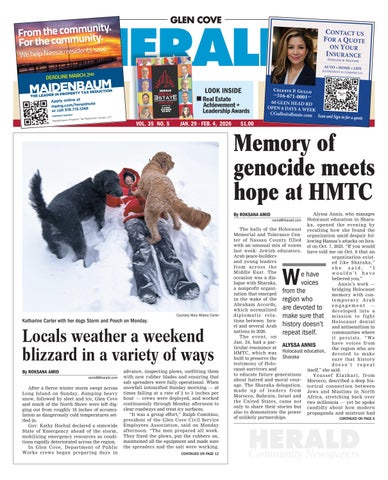
Courtesy Mary Milano Carter
Katharine Carter with her dogs Storm and Pooch on Monday.

NEWS BRIEFS

Free workshops on filing tax grievances

Minority Leader Delia DeRiggiWhitton is partnering with the Nassau County Assessment Review Commission (ARC) to offer two free online community assessment grievance workshops designed to help homeowners challenge the assessed value of their property.

The virtual workshops will walk residents through the assessment grievance process, which allows property owners who believe their assessment is inaccurate to file an appeal. During the sessions, ARC representatives will give step-by-step guidance on how to use Nassau County’s online grievance system, explain required documentation, and review common errors that can lead to rejected applications. Participants will also be able to submit questions through the chat function. Questions not addressed during the presentation will receive direct follow-up from ARC staff.

DeRiggi-Whitton said the workshops are especially important while the county’s tax rolls remain frozen, meaning an incorrect assessment can follow a homeowner from year to year unless a grievance is filed.

“With Nassau’s tax rolls still frozen, it is essential for homeowners to pro-

tect their families from over-taxation caused by an inaccurate assessment,” she said. “If you believe your assessment is incorrect, I encourage you to attend one of my office’s workshops, where Assessment Review Commission experts will take you step-by-step through the grievance process and make it easy to exercise your rights without hiring an outside service.”

The sessions will be held online through Microsoft Teams, and residents are encouraged to familiarize themselves with the platform beforehand to ensure easy access on the day of the workshop.

The workshops are scheduled for noon to 2 p.m. on Wednesday, Jan. 28, 2026, and 7 to 9 p.m. on Wednesday, Feb. 11. Attendance is free and open to all Nassau County homeowners.

For more information, contact DeRiggi-Whitton’s office at 516-571-6211 or email dderiggiwhitton@nassaucountyny.gov.

Residents are encouraged to bring relevant property tax documents to make the most of the workshop.

– Roksana Amid

Nearly $90,000 in NYSCA Grants

Nearly $90,000 in state grant funding has been awarded to arts and cultural organizations in New York’s 13th Assembly District, Assemblymember Charles Lavine (D–North Shore) announced. The funding, totaling $89,500, was secured through the New York State Council on the Arts (NYSCA) and is part of a broader $161 million statewide investment in the arts included in the Fiscal Year 2026 state budget passed last year.

The grants will support a range of institutions dedicated to visual arts, music, cultural preservation, and education across Nassau County. According to Lavine, the funding reflects the vital role arts and culture play in strengthening local communities.

“As a longtime patron of the arts, I feel tremendous pride in having secured tens of thousands of dollars for these organizations,” Lavine said.

“This funding will further enhance the already vibrant arts and cultural programs that connect, educate, and inspire residents and visitors to Nassau County.”

Among the grant recipients, Westbury Arts Inc. received the largest award at $49,500 to support its ongoing programming and community out -

reach initiatives. The Nassau County Museum of Art was awarded $10,000 to help advance its exhibitions and educational offerings. The Latvian Concert Choir, Inc. received $20,000 to continue promoting choral music and cultural heritage through performances and community engagement.

The Holocaust Memorial & Tolerance Center of Nassau County, Inc. was also awarded $10,000, supporting its mission to educate the public about the Holocaust, promote tolerance, and combat hatred and bigotry through educational programs and exhibits.

NYSCA funding is designed to ensure broad access to the arts throughout New York State, supporting organizations that enrich local economies, foster creativity, and preserve cultural history. Lavine emphasized that continued investment in the arts remains essential to community vitality and education.

“These organizations serve as cultural anchors for our region,” he said, “and this funding helps ensure they can continue their important work for years to come.”

Myhan is first executive director at Nosh

As NOSH Delivers! continues to expand its reach across the North Shore, the Glen Cove-based food pantry has created a new executive leadership role, appointing longtime nonprofit and corporate executive Margaret Myhan as its first executive director.

Without those volunteers, we would be nowhere.

MARGARET MYHAN executive director, NOSH

Christine Rice, chairwoman of NOSH Delivers!’ board of directors, announced that the position was established in response to the pantry’s rapid growth and increasing operational demands. Myhan will oversee the organization’s management, operations and donor relations, responsibilities previously handled by board members. She will work closely with a 10-member board of directors, along with NOSH cofounder and director of youth and community engagement Courtney Callahan and Linda Eastman, the organization’s director of operations.

Founded in March 2020 at the onset of the COVID-19 pandemic, NOSH Delivers! now serves roughly 750 families each week across Glen Cove, Bayville, Roslyn, Locust Valley and Sea Cliff. , “Without those volunteers, we would be nowhere,” Myhan said. “Their kindness and their eagerness to jump in and help is just overwhelming.”

The pantry relies on food from LI Cares and Island Harvest, along with donations from supermarkets, bakeries, farm stands and community members. More than 370 volunteers prepare grocery bags, stock shelves, deliver food to homes and assist walk-in recipients at the VFW Hall in Glen Cove.

Myhan, a Garden City resident who grew up on Long Island, said she discovered NOSH Delivers! after the closure of Our Lady of Mercy Academy in Syosset, where she served as president and CEO for 12 years.

“I was googling not-for-profits, came across NOSH Delivers! and said, ‘This sounds interesting,’” she said. “I was very impressed with the short life of NOSH — the level of outreach and accomplishments certainly intrigued me.”

She said a lifelong emphasis on service made the role a natural fit.

“My parents were always very active in volunteerism, and that was inbred in us from the time we were kids to give back and get involved in the community,” Myhan said.

Before leading Our Lady of Mercy Academy, Myhan held senior executive roles at Rockefeller Group Business Centers, OgilvyOne, Rapp Collins Worldwide and Grey Direct Marketing. Although Myhan was coy about her age,

in 2012 she served as the general manager for Rockefeller Group Business Centers.

One of the programs she now helps oversee is NOSH’s Kids Food Independence Program, or KFIP, which provides take-home meals for children who rely on school food programs during the week.

“We’re going through about a thousand bags a week,” Callahan said. “That’s a tremendous amount, and it shows how much the need is there.”

Callahan said Myhan’s leadership has already strengthened the organization.

“She has really inspired me to be better at my job,” Callahan said. “The way she leads is kind, professional and empowering — it makes you feel supported and confident in what you’re doing.”

Callahan added that the KFIP program has become a unifying force within the community.

“It’s brought these kids together — kids who aren’t facing food insecurity but are so dedicated to helping families who are,” she said. “It makes everyone at NOSH go to bed at night knowing that children will have lunches over the weekend.”

Now working full time at the pantry, Myhan said she is focused on strengthening funding, supporting volunteers and ensuring NOSH can keep pace with rising food insecurity across Nassau County.

“They truly are the backbone of NOSH,” she said.

Photos courtesy Courtney Callahan
Margaret Myhan, Lee Moore, and Jennifer Argenti pave the way for youth involvement to combat food insecurity.
Margaret Myhan and Janet Goldberg work with youth groups to help combat food insecurity on the North Shore through school-wide enrichment programs which helps connect community gardens with Nosh.

CRIME WATCH

ARRESTS

A 23-year-old Glen Cove man was arrested on Jan 10 and charged with assault, criminal possession of a weapon, and criminal mischief on Cedar Swamp Road.

A 49-year-old Glen Cove woman was arrested on Jan. 11 and charged with criminal obstruction of breathing, criminal mischief and harassment on Carpenter Street.

A 48-year-old Glen Cove man was arrested on Jan. 13 and charged with aggravated unlicensed operation, circumventing an interlock device, unlicensed operation, unsafe lane change and obstructed vision on Brewster Street.

A 50-year-old man from Jackson Heights was arrested on Jan. 14 and charged with driving while intoxicated, drinking alcohol in a motor vehicle, unsafe lane change and failure to signal on Glen Cove Avenue.

A 50-year-old Glen Cove man was arrested on Jan. 16 and charged with trespassing on Glen Street.

A 58-year-old man from the Bronx was arrested on Jan. 18 and charged

with criminal trespassing on Pipping Rock Road.

A 28-year-old Glen Cove man was arrested on Jan. 20 and charged with aggravated unlicensed operation, failure to stop at a stop sign and unlicensed operation on Capobianco Street.

A 58-year-old man was arrested on Jan. 21 and charged with aggravated unlicensed operation, criminal possession of a controlled substance, unlicensed operation, no license plate and obstructed view on Shore Road.

A 25-year-old Glen Cove man was arrested on Jan. 22 and charged with assault and criminal obstruction of breathing on Bridge Street.

A 48-year-old Glen Cove man was arrested on Jan. 24 and charged with aggravated unlicensed operation, operating an unregistered vehicle, suspended registration and leaving the scene of a motor vehicle accident on Bridge Street.

A 47-year-old Glen Cove man was arrested on Jan. 27 and charged with robbery and criminal possession of a controlled substance on Glen Street.

People named in Crime Watch items as having been arrested and charged with violations or crimes are only suspected of committing those acts of which they are accused. They are all presumed to be innocent of those charges until and unless found guilty in a court of law.

NEWS BRIEF

N.S. library consortium heart health

The North Shore Programming Consortium will host a virtual adult program titled Functional Heart Health: Supporting Your Heart Beyond the Basics on Feb. 3, from 7 to 8 p.m., presented via Zoom and hosted by the Locust Valley Library.

Registered dietitian Amanda Reichardt will lead the online session, focusing on a holistic approach to cardiovascular health. Rather than concentrating solely on traditional lab results and medical numbers, Reichardt will explore how nutrition, lifestyle choices, stress management and targeted well -

ness strategies work together to support a strong and healthy heart. The program is open the Bayville, Glen Cove, Gold Coast, Locust Valley, Oyster Bay and Sea Cliff. The initiative allows the libraries to provide a broader variety of adult educational programming in a cost-effective format.

Zoom login details will be emailed to registered participants prior to the event. Advance registration is required. To register contact the Glen Cove Public Library at (516) 676-2130.

Ext. 286 E-mail: ereynolds@liherald.com Fax: (516) 622-7460

■ DISPlAY ADVERTISING: Ext. 249 E-mail: rglickman@liherald.com Fax: (516) 569-4643

■ PUBlIC NOTICES: Ext. 232 E-mail: legalnotices@liherald.com

–Roksana Amid

Acts of kindness, and the hardy hit

These guys did a great job.”

Comitino said that 18 workers were clearing snow during the storm, battling the rapid accumulation and plunging temperatures, which created treacherous conditions.

“They were here from six o’clock in the morning through the next day, still trying to make sure people could drive safely,” he said, “because once it freezes overnight it becomes really dangerous.”

By Tuesday morning, cleanup operations had moved into the assessment and finishing phases. In a statement by Mayor Pamela Panzenbeck’s office on Tuesday, residents were advised that DPW crews were continuing to address remaining trouble spots and sanding areas that needed additional treatment.

“Please be patient as this work continues,” the statement read. “Do not throw or plow snow into the roadway. Snow must be placed on your lawn or kept within the confines of your business property.”

While city crews worked around the clock, many residents relied on neighbors and other community members when the volume of snow became overwhelming.

On a Glen Cove community Facebook survey, Lionel Galindo described being trapped at home. “My wife had to

work no matter what, my son is sick so I couldn’t leave him alone and go outside to shovel,” Galindo wrote. “Couldn’t get my truck out of the driveway. We were snowed in. Tammy Lanham’s son [Dylan] came over today and helped save the day. He was a gentleman and got things done quickly.”

For Robert Batchelor, the storm became a reminder of how neighbors often step up when help is needed most.

“I’m 85 so I stayed in my house until it was over,” Batchelor wrote. “My neighbor had a Bob Cat and cleaned the end of my driveway. Then he plowed the street in front of my house.

Next his wife and another neighbor cleaned my steps and sidewalks plus a path down my drive to the street.”

I

ing members of the Baby Seals 365 Swim Club, a group of Glen Cove coldwater swimmers who gather every day at Pryibil Beach.

Founded during the coronavirus pandemic, the club has grown into a year-round community of swimmers who plunge into Long Island Sound for the benefit of their physical and mental wellness. Sunday’s blizzard pushed even the most dedicated members to their limits.

n the past, I was the one helping my neighbors.

ROBERT BATCHELOR

Glen Cove

Batchelor said that after clearing his car and finishing the remaining snow with his blower, he reflected on how roles had reversed.

“I’m not used to receiving help,” he wrote. “I’ve been shoveling snow here since I was 14. In the past I was the one helping my neighbors.”

While many residents focused on staying warm and clearing snow, others had more unique priorities — includ -

“That day was really brutal at the beach,” said Lawrence Stone, a club organizer. “The wind was blowing sideways that people couldn’t even see, some sand was pelting us, the waves were huge, and the beach was barely sand anymore — it was ice.”

Seven members showed up during the storm, Stone said, and just two entered the water. “Which never happens,” he said. “If we go down, we usually all go in, but the conditions were really intense. You couldn’t even walk forward — I had to walk backwards into the wind.”

With gusts reaching roughly 30 miles per hour and a wind chill below zero, Stone emphasized that cold plunging in such conditions can be dangerous even

for experienced swimmers.

“It’s not really the temperature — it’s the wind,” he said. “The wind whips the heat away from you and you lose dexterity in your hands. That’s when dangerous things can happen. It’s not something anyone should just try in the middle of a blizzard.”

Stone explained that swimmers follow strict protocols, including keeping cars running and warm; wearing protective boots, gloves and hats; and carefully managing how they warm up afterward to avoid medical risks such as severe shivering and hypothermia.

“There are so many factors you have to plan for,” he said. “How you’re going to get dressed, how you’re going to warm up — your mind kind of goes to sleep in that cold. You have to know what you’re doing.”

Despite the risks, Stone said, the mental benefits of pushing through extreme conditions have been lifechanging for him.

“When you survive something as crazy as this, you come out the other side feeling like there’s nothing in the world that can stop you,” he said. “If you were doubting yourself or feeling low, you just did something superhuman. It gives you strength to keep moving forward.”

Stone’s guide to polar plunging can be found at stonefireice.com.

Future doctors learn pain, addiction care

Third-year medical students at the Donald and Barbara Zucker School of Medicine at Hofstra/Northwell gained skills that many physicians do not learn until well into their careers during Pain and Addiction Care Prevention Week Jan. 13-16.

In more than 25 hours of intensive instruction, students were trained to address pain, substance-use and alcohol-use disorders using harm-reduction strategies, non-opioid alternatives and patient-centered care.

Beyond clinical techniques, students were taught to listen more closely to patients’ experiences and approach treatment with empathy, a skill educators said is critical to addressing the ongoing substanceuse crisis.

“While opioids certainly have a place in medicine, historically doctors weren’t adequately trained in judicious prescribing practices,” said Dr. Sandeep Kapoor, assistant professor of medicine, emergency medicine, psychiatry and science education at the Zucker School.

Kapoor, who is also vice president of emergency medicine addiction services and director of screening, brief intervention and referral to treatment at Northwell Health, added, “Ensuring the next generation of physicians is equipped to approach complex conditions like pain and substance-use disorders will undoubtedly drive positive change in patient and community health,” he added.

PACE Week builds on instruction students receive during their first two years of medical school. In total, Zucker students complete more than 30 hours of patient-centered education focused on pain and substance use — more than at any other U.S. medical school — addressing a topic many clinicians find

uncomfortable or difficult to discuss.

The program also fulfills a federal requirement mandating that clinicians seeking or maintaining DEA registration complete at least eight hours of training in treating pain and opioid or other substance-use disorders.

Each day of PACE Week began with first-person accounts from people in recovery, family members affected by addiction, medical residents and Zucker alumni. Among them were two physicians in recovery, who shared the challenges of seeking help while navi-

gating professional expectations and fear of judgment.

Family members described the emotional, financial and personal toll substance use disorders can have, emphasizing the need for compassion, strong support systems and recovery resources not only for patients, but also for those who care for them.

Students took part in workshops covering medications for opioid-use disorder, medicinal cannabis and multimodal pain care. One component focused on femoral nerve blocks, a non-opioid pain management technique that interrupts pain signals at their source using ultrasound-guided injections.

“Adding this level of training means our students are starting their careers with skills many clinicians only learn later,” said Dr. Simone Rudnin, a Northwell Health Emergency Department physician. “They’re prepared from day one to treat pain differently than we did even a decade ago.”

Kapoor said that such interventions could reduce reliance on opioid medications and lower the risk of future substance use disorder. “Students are learning practical interventions that can offer equal or better pain relief while reducing long-term risks of patients,” he said.

PACE Week concluded with student capstone presentations for Northwell executives and Hofstra leaders. Students made “elevator pitches,” debated ethical scenarios, shared public-service announcements and offered narrative reflections on addiction and care.

“Hearing physicians and family members speak openly about their lived experiences with addiction was profoundly impactful,” Alexandra Boubour, a third-year medical student, said. “Their vulnerability challenged stigma and reinforced the importance of empathy, transparency and community in both healing and medical culture.”

Courtesy Zucker School of Medicine at Hofstra/Northwell Medical students at the Zucker School of Medicine at Hofstra/Northwell practiced femoral nerve blocks, a pain management technique, during PACE Week, Jan. 13-16.

From a home kitchen to community hub

Jonelle Watson never set out to open a restaurant. What she wanted was a way to share the Caribbeaninspired food she had spent years perfecting — without the crushing overhead that comes with owning a brick-and-mortar business.

Instead, the 37-year-old entrepreneur built Ms. Sauce Plates Culinary Horizon, a Glen Cove–based catering company rooted in culture, community and a newly licensed commercial kitchen at the North Country Reform Temple that is now opening doors for other aspiring chefs as well.

Watson moved to Glen Cove 10 years ago to be closer to her father and to reconnect with the strong sense of family she grew up with — something she said reminded her of her grandfather, John Watson Sr., whom she described as the heart of their family.

Her cooking reflects a blend of influences from the American South, Curaçao — an island off the coast of Venezuela — and Haitian cuisine, which she was introduced to by her mother-in-law, Maryse Thermidor.

“She showed me things I had never seen before, from marinades to how they even clean their meat,” Watson said. “I had never tasted food like that or cooked the way she did. From there, I just wanted to learn everything.”

Her children became her first critics and biggest cheerleaders, urging her to open a food truck or restaurant. Watson wasn’t ready for that leap — but she was ready to build something sustainable.

After forming her LLC and completing multiple food safety and food service manager certifications, Watson ran into a major hurdle: finding a commercial kitchen. Many were located in Manhattan or were already booked solid on Long Island.

That’s when Glen Cove Chamber of Commerce President Maxine Cappell Mayreis connected Watson to NCRT a space that had never been licensed as a full commercial food facility.

What followed was a six-month process that included multiple Department of Health inspections, detailed kitchen schematics, equipment documenta-

tion and required upgrades. Mayreis’ husband, Dean, helped photograph equipment and collect serial numbers needed by inspectors.

“She was preparing so much for the Department of Health and it felt like an unending process,” Mayreis said.

By March of last year, Watson received a full food establishment permit — the same type issued to restaurants — allowing her to cook on-site, cater private events and transport food throughout Long Island.

The achievement didn’t just benefit her business. The temple’s kitchen was officially converted into a state-of-the-art commercial facility, making it available for other chefs and culinary entrepreneurs to rent without navigating the lengthy approval process Watson completed.

“It helped me and it helped them at the same time,” Watson said.

Watson holds a bachelor’s degree in sociology from Queens College and spent most of her career working with underserved populations through organizations such as the Developmental Disability Institute and SCO Family of Services. She has worked with children with autism and developmental disabilities, families in shelters and individuals with hearing impairments,

including serving as a caretaker for a deaf man with special needs after studying sign language at Suffolk County Community College.

That commitment to service continues through her catering business. Watson regularly partners with nonprofit fundraisers, donates food at community events and supports causes focused on education and disability services.

At a recent Martin Luther King Jr. celebration, where she also serves on the board of the commission, Watson donated dozens of homemade desserts to give back while introducing her food to new customers.

For Mayreis, Watson’s experience reflects the Chamber’s mission to guide small businesses through complicated regulatory processes.

“Our first order of business is to uplift and take care of our businesses and find out what they need,” Mayreis said. “If people understood upfront what these steps looked like, they could prepare and move forward with confidence.”

For Watson, the commercial kitchen represents more than a workspace — it represents possibility.

“It gives me the freedom to live out my dreams without restaurant overhead,” she said. “And it opens the door for others to do the same.”

Photos courtesy Jonelle Watson
Watson shared samples of her food at the Queens Centers for Progress luncheon last year.
Watson catered the Back the Blue BBQ at Showcase Kitchens in Manhasset.

Power Smarter Energy Decisions with PSEG Long Island

January 30th • 10:00am

Lower and manage energy costs for your household or business

Understand outage response & reliability priorities that impact homes and local businesses

Use smart meters & Time-of-Day rates to better manage when and how you use energy

Learn what makes PSEG Long Island #1 for Small Business Electric Service in the East, and how those service improvements

Connecting Glen Cove to the Persian Gulf

eroded that coexistence. Visiting Israel, Elazhari said, transformed his perceptions. “I unlocked a feeling — to be loved by the people you are supposed to hate,” he said. That realization compelled him to found Sharaka’s Moroccan branch, to “tell the Moroccans a reality that they are not used to.”

Fatima Al Harbi, director of Sharaka’s Persian Gulf affairs, recalled a similar awakening. Growing up in Bahrain, she was taught hostility toward Israel even though she lived among Jewish and Christian neighbors. Her first visit to Tel Aviv after the Abraham Accords shattered stereotypes she learned about Jewish people and their character.

“If you had told me 10 years ago that I’d be welcomed by a Jewish stranger in the middle of Tel Aviv’s streets, I wouldn’t have believed it,” Al Harbi said. Despite online harassment and death threats, she continues her outreach, often bringing delegations of Bahrainis to meet Israelis face to face. “Interactions like these can change a person in two hours,” she said. “Hate can dissolve over a single dinner.”

Their stories illustrated Sharaka’s underlying belief: that personal relationships and shared learning — particularly about the Holocaust — are central to reshaping narratives in the Middle East. Elazhari emphasized that Holocaust education is essential for Arabs to

understand why Israel exists.

“It’s not about comparing miseries,” he said, “but about understanding history. Without Holocaust education, Israel will never make sense to them.”

The discussion was particularly fitting at HMTC, where Holocaust history meets the moral urgency of modern tolerance education. Donna Rosenblum, the center’s director of education, told the panel how inspired she was by their resilience despite the hostility they face online. “How do you persevere?” she asked, noting how much strength it must take to keep going when people tell you to “go die” or that “you don’t deserve to wear your hijab.”

Elazhari described refueling his spir-

it with encounters in the United States. “I meet with Jews in America — they hug me, they give me energy, and then I go back home to fight back,” he said.

Al Harbi explained that her motivation comes from faith and support. “An imam once told me, ‘You’re actually walking in the footsteps of the Prophet, peace be upon him, because he always chose peace over conflict,’” she said. “That reminder keeps me going.”

Rosenblum later reflected on how HMTC’s educational mission has only intensified since Oct. 7. “Our work has grown, not diminished,” she said during the program’s closing. “Every student who walks through our doors is changed. It might only be for five min-

utes, but they are changed.” For her, partnerships like Sharaka reaffirm that Holocaust education remains vital, not only to remember but to inspire action against hate today.

HMTC’s executive director, Bali Lerner, highlighted that connection. Education, she said, must always reach young audiences who face a flood of misinformation online. “At the end of the day, until we teach the kids — because they’re on TikTok all day long and believe the propaganda — some of them may only hear the facts when they’re here,” Lerner said. She pressed the panel on whether Abraham Accord countries are reforming their school systems to reflect new values of coexistence. Al Harbi responded that Bahrain, the United Arab Emirates, Morocco and even Saudi Arabia have begun updating curriculums to remove antisemitic content and emphasize tolerance.

After the event, Lerner reflected on the courage underlying Sharaka’s mission. In a message to the Herald, she wrote, “On the outside, they are very personable and genuine and appear so easygoing, but the truth is that what they are doing is extremely difficult. They get a lot of backlash every time they return home. It is amazing how some people find a way to do right — even though they were raised with hate and lies. They are truly remarkable and so admirable.”

Roksana Amid/Herald
Rachel Brynien, far left, Fatima Al Harbi, Youssef Elazhari and Alyssa Annis shared their experiences promoting coexistence through Sharaka in a panel discussion at the Holocaust Memorial & Tolerance Center.

BUSINESS EXPO & WORKSHOPS

SC resident judges second Westminster Dog Show WITH DENISE FLAIM

History and asking “why?” are at the heart of Denise Flaim’s dog judging journey. The Sea Cliff resident and journalist will judge her second Westminster Kennel Club Dog Show on Feb. 2 and 3. This year marks the show’s 150th anniversary.

Flaim grew up in Queens and moved to Sea Cliff in 1993 after covering a story for Newsday that brought her to the village for the first time. She had a mixed breed dog growing up but wanted a medium-large dog with a short coat after moving to Sea Cliff. She got her first show dog, a Rhodesian Ridgeback named Blitz, from a breeder in New Jersey. She later got a female named Diva and began breeding Rhodesian Ridgebacks herself in the late 1990s.

Q: How did journalism and writing and dogs get tied together for you?

A: “A lot of judges come to judging because they were really heavily involved breeders, and having very large and successful breeding programs was a very big goal of theirs. I had a very small breed program, bred my fair share of champions, but I was more intrigued with the history of the breeds and their cultural connections, and how that history translated into what they look like, how they moved, how they acted. So I see purebred dogs as literally an embodiment of history, because every breed comes from a specific place and time, and all the cultural implications of that place and time are reflected in almost every aspect of the dog, from what its

coat is like, to its size, to its behavior, because all these dogs had jobs, and certain jobs require certain physical and temperamental characteristics. So, I see judging dogs as really a way to catapult back into history and to look at how these dogs evolved, who evolved them, what they were used for. In that respect, for me as a journalist, as someone who’s always asking ‘Why?’ it becomes this amazing process of exploration that literally never ends, because every day you can learn something new.”

Q:How do you feel about this being your second assignment with Westminster?

A: “Especially on that significant 150-year anniversary it’s such a huge honor to be judging my own breed at Westminster. All breeds are important to me, and I love them all. But there’s a special place in your heart for the breed you live with. Your own breed is sort of like your own house -you know every creek in the step, you know that spot in the kitchen where the sun hits just so. It’s a very familiar sensation to be judging a breed that you’ve lived a good part of your life with and have so many connections with.”

Q:What’s next for you and your dog judging journey?

A: ”I’m very fortunate to have judged at some prestigious shows, both here and abroad. I’m going to continue judging because there’s never a stopping point. What’s next is the next show. What’s next is the next dog and then just growing your experience and your fluency in these breeds, because each breed is its own country, with its own language is its own country, with its own language, its own customs, its own priorities. Every time I judge, every time I talk to a breeder, every time I

have the opportunity to learn, it adds to my fluency in a breed. You’re never going to be 100 percent. You’re never going to know everything, and that’s the wonderful part, because I think the problem that we have now is nobody asks ‘Why?’ anymore. Nobody says, ‘Well, why does that dog have that coat? Why is that foot shaped that way? Why does the standard make that a disqualification? That must be really important; where does that come from? If the standard doesn’t want that particular trait, why? Where did it come from? What impact does that have on the dog, if the dog has it?’ ” Flaim will be judging in Sweden later this month and in the Dominican Republic in April.

Courtesy Denise Flaim
Denise Flaim began showing and breeding Rhodesian Ridgebacks roughly 30 years ago.

STEPPING OUT

‘Metamorphosis’ unleashed

South Shore Symphony reinvents familiar melodies — and itself

When the South Shore Symphony takes the stage on Jan. 31 at their Madison Theatre home, on the Molloy University campus, the evening represents more than a single stop in its season. It reflects the orchestra’s artistic transformation under the leadership of esteemed conductor Adam Glaser, now in his third year as music director.

Since he took the helm of the South Shore Symphony (from former Music Director Scott Jackson Wiley) he’s continued to foster connections with its musicians and shape a shared artistic identity. He describes his group as “a community of friends and musicians who are always striving for excellence,” and says the experience has been both energizing and collaborative.

expanded to include a full orchestra — involving winds, brass and percussion.

Pete Correale

As Glaser explains, the passacaglia is a type of continuous variation built over a repeating bass line, a form that dates back centuries.

“Among the many musical interests I enjoy exploring over lunch with my colleague Jim Millar, the Brahms symphonies constantly rise to the top, particularly the final movement of the Fourth Symphony, an orchestral passacaglia. When accepting Jim’s commission for a new work to be performed by the highly advanced orchestra he leads in beautiful Tenafly, I chose the passacaglia form for inspiration and structure,” he continues.

Glaser adds that his time with the South Shore Symphony inspired him to revisit the piece, allowing him to reimagine its full expressive possibilities.

After opening for Sebastian Maniscalco on his massive “It Ain’t Right” arena tour, Pete Correale is now doing his own. Be prepared for the laughs when he brings his “As I Was Saying” tour to the Paramount stage. The Long Island-born comedian-actor-writer, best known for his conversational, reality-based humor, is one busy guy. He co-hosts co-host of the “Pete and Sebastian Show,” a podcast with comedian Sebastian Maniscalco, that’s of the most popular comedy podcasts on air today, consistently growing in audience eight years after its launch. His comedy is reflective of his life and the experiences he’s been through. Being married for over 20 years and having a young daughter, Pete’s never at a loss for material. With a conversational delivery and his trademark disarming regular guy attitude, Pete makes you feel like you’re listening to the funniest guy at a party as opposed to just another comedian on a stage.

Friday, Jan. 30, 9 p.m., doors open 8 p.m. The Paramount, 370 New York Ave., Huntington. Tickets available at ticketmaster.com or paramountny.com.

• Saturday, January 31, 7:30 p.m.

• Madison Theatre, 1000 Hempstead Ave., Rockville Centre

• Tickets available at madisontheatreny.org

An established composer, Glaser — whose prolific career includes roles as Music Director of the professional-caliber Juilliard Pre-College Orchestras and Director of Orchestras and Associate Professor of Music at Hofstra University — brings his keen musicality to this concert, titled “Metamorphosis.” Programmed around the time-honored musical form of “theme and variations,” the repertoire highlights how composers begin with a simple musical idea and reshape it in inventive, surprising and often dazzling ways.

“[They] are all unique in their own way, but they are presented together because they all share a common theme,” Glaser says.

This fascinating program unites four works from the 19th and 20th centuries, each offering its own take on the theme and variations form. It opens with the “Wedding March” from Karl Goldmark’s Rustic Wedding Symphony.

“While I would rarely excerpt one movement from a symphony, in this case, it is just brilliant as its own piece,” Glaser explains.

The concert’s centerpiece is a world premiere: the full orchestral version of Glaser’s own “Passacaglia.”

Originally written in 2018 for a high school string orchestra in New Jersey, the piece has now been

“Since 2018, I have often felt that the string orchestra version of Passacaglia packed a lot of material into a relatively compact canvas, and wondered if the underlying composition might warrant an expansion that embraces all instrument families. Inspired by my new “musical family,” I am pleased to dedicate this new version to my friends in the orchestra and honored to conduct the premiere. This new version makes a few subtle references to a five-note musical signature derived from Rockville Centre’s zip code, 11570.”

Glaser acknowledges that conducting works by other composers presents its own challenges, requiring a balance between honoring the composer’s intentions and bringing his own interpretive insight to the music.

“Our job [as the conductor] is to be an advocate for the composer, but we only have notes on a page,” he says.

The evening’s second half celebrates musical reinvention with Korngold’s “Theme and Variations, Op. 42.” In seven short minutes, it delivers the sweeping melodies and lavish orchestration that earned Korngold his reputation for “Hollywood sound.”

“[Theme and Variations] takes it to the highest level possible,” Glaser says, pointing out that audiences will recognize the Hollywood influence in the brief composition.

The concert closes with Hindemith’s “Symphonic Metamorphosis of Themes” by Carl Maria von Weber, a piece that literally transforms Weber’s melodies into a bold, rhythmically vibrant orchestral adventure — bringing the program’s title of “Metamorphosis” full circle.

“[Symphonic Metamophosis] is such a brilliant example of how a composer can take a small amount of material and spin so many wonderful variations from it,” Glaser enthuses.

Beyond the individual works, he sees “Metamorphosis” as a symbol of the South Shore Symphony’s evolving journey.

This concert offers the audience both familiarity and discovery: beloved repertoire alongside a brand-new works, all connected by a single unifying idea. For Glaser, it is an opportunity to begin shaping the orchestra’s future while honoring its past.

The season continues with a trio of exciting performances in the months ahead. Jazz vocalist Jane Monheit joins the South Shore Symphony on March 8 for an evening of rich, lyrical storytelling. Later that month, on March 28, the orchestra tackles Stravinsky’s “The Rite of Spring,” promising a thrilling display of rhythm and energy. The season concludes on May 29 with their annual concert at St. Agnes Cathedral, uniting powerful voices and orchestra for Beethoven’s monumental “Ninth Symphony.

With “Metamorphosis,” the orchestra invites concertgoers to experience music as a living, evolving art form — where familiar melodies are reborn, new works take flight and the orchestra’s journey of transformation continues under Glaser’s inspired leadership.

‘Madness takes its toll’ Fasten your garter belt and come up to the lab and see what’s on the slab: It’s The Rocky Horror Picture Show! Do the Time Warp in celebration of 50 years of Richard O’Brien’s legendary cult classic musical on the big screen! In this legendary comedyhorror cult classic, sweethearts Brad (Barry Bostwick) and Janet (Susan Sarandon), stuck with a flat tire during a storm, discover the eerie mansion of Dr. Frank-N-Furter (Tim Curry), a self-proclaimed “sweet transvestite” scientist. As their innocence is lost, Brad and Janet meet a houseful of wild characters, including a rocking biker (Meat Loaf) and a creepy butler (Richard O’Brien). Through elaborate dances and rock songs, Frank-N-Furter unveils his latest creation: a muscular man named “Rocky.” Nothing beats a Rocky Horror screening where you can jump up and dance to the Time Warp in this live, interactive experience. Get into it and dress to impress!

Friday, Jan. 30, 8 p.m. $25. Jeanne Rimsky Theater at Landmark on Main Street, 232 Main St., Port Washington. Tickets available at landmarkonmainstreet.org or (516) 767-6444.

Photo courtesy Rachel Papo
Music Director Adam Glaser conducts the Juilliard Pre College Orchestra at Alice Tully Hall in Manhattan.

YOUR NEIGHBORHOOD CALENDAR

JAN

Lunar New Year Celebration

Families are invited to vibrant celebration of art and music when Nassau County Museum of Art ushers in the Lunar New Year, honoring the rich creative contributions of Chinese culture. Activities include a Year of the Horse craft at the Manes Center. Before or after art making, head to the mansion to enjoy cultural performances. $20, $10 child; members free. Registration required.

• Where: 1 Museum Drive, Roslyn Harbor

• Time: 11 a.m.-12:30 p.m. and 1- 2:30 p.m.

• Contact: nassaumuseum.org or (516) 484-9337

Bilingual Socialization for 0–17 Months

Babies and caregivers are invited to a bilingual storytime and socialization program led by Vianna Calderone at Glen Cove Library. The 45-minute session includes bilingual stories, nursery sing-alongs, parachute play, bubble time and open play designed to encourage early social interaction. No Spanish experience is required; caregivers are welcome to learn along with their child. Registration required; limited to Glen Cove cardholders only.

• Where: 4 Glen Cove Ave.

• Time: 11 a.m.-noon

• Contact: glencovelibrary.org

Talking art

Michael Carbonaro

enchanting Kingdom Dance. The adventure concludes with the Snow Sisters where you will “Let It Go” and make magical snow fall inside and build your very own snowman to take home. Tickets are limited. $70 per child.

• Where: 127 Middle Neck Road, Sands Point

• Time: Session One, 11:30 a.m.; Session Two, 11:4 5a.m.; Session Three, noon; Session Four, 12:15 p.m.

• Contact: sandspointpreserveconservancy. org or call (516) 571-7901

FEB

10

Glen Cove City Council Meeting

1

Nassau County Museum of Art welcomes Christian White. He discusses his work and artistic process rooted in the tradition of Realism. A descendant of a storied lineage of American artists, White continues to honor and expand this legacy through his detailed, perceptive paintings that capture the beauty and truth of everyday life.. $20, $15 seniors, $10 students (members free). Limited seating, register in advance.

• Where: 1 Museum Drive, Roslyn Harbor

• Time: 3 p.m.

• Contact: nassaumuseum.org or (516) 484-9337 FEB

Winter In The Woods Walking Tour

Explore Sands Point Preserve’s natural environment on a guided tour. Examine the preserve’s unique physical features and wildlife, as well as critical conservation issues and helpful practices to create a healthy, sustainable environment. Environmental educator Hildur Palsdottir engages everyone in hands-on nature discovery activities as participants observe the changing season. Meet at Castle Gould’s Clock Tower.15, $10 members;

children $5, free for members.

• Where: 127 Middle Neck Road, Sands Point

• Time: 10-11:30 a.m.

• Contact: sandspointpreserveconservancy. org or call (516) 571-7901

3

• Where: The Paramount, 370 New York Ave., Huntington

• Time: 7:30 p.m.

• Contact: ticketmaster.com or paramountny.com

Actor-magician-comedian Michael Carbonaro has built a career turning the ordinary into the extraordinary. Best known as the star of the hit truTV series “The Carbonaro Effect,” he’s made millions laugh in astonishment by blending quick-witted comedy with jaw-dropping illusions in everyday settings. On stage, Carbonaro has headlined two hit national tours, with a live show that mixes theatrical magic, sly improv, gleeful trickery, and playful audience participation. Now, he’s delighting audiences with his newest adventure, Michael Carbonaro: Wonderboy — a tour where audiences discover him as the Hero of Mischief, in a world where magic is the superpower and laughter is the sidekick. An accomplished actor, he’s appeared in “Law & Order: SVU,” “CSI: Miami,” and “Grey’s Anatomy,” among other projects. As a magician, he’s been named Magician of the Year by the Academy of Magical Arts and is the sole recipient of the Copperfield Prize, awarded for elevating the art of magic itself. A performing magician since his youth, Carbonaro studied experimental theater at New York University with the aspirations of entertaining audiences through a variety of theatrical mediums, including hidden-camera magic, which he later showcased frequently on “The Tonight Show with Jay Leno.” Following Carbonaro’s frequent late-night appearances, Michael was presented with the opportunity to launch his hit comedic series, “The Carbonaro Effect.” A trickster at heart, Michael performs inventive tricks on unsuspecting members of the public who are unaware that he is a magician. Bringing wonder, mischief and magic to the stage — reality doesn’t stand a chance.

Slagle and Archivist Marie Penny for a tour of a living legacy. Discover the Coe family’s passion for horticulture through a historic collection of more than 200 blooming camellias. Designed by the famed Olmsted Brothers Firm, the Camellia House stands as one of northeast’s most treasured architectural and horticultural gems.. $25.

The Glen Cove City Council holds its regular meeting to discuss city business and community matters.

• Where: Glen Cove City Hall, 9 Glen St., Glen Cove

• Time: 7:30 p.m.

FEB

11

Glen Cove BOE meets

The Board of Education holds its next meeting. An Executive Session may be held prior to the public session.

• Where: Glen Cove High School, 100 Manhasset Ave., Glen Cove

• Time: Executive Session (if anticipated) 6 p.m..; Public Session reconvenes 7 p.m.

FEB

14

Valentine’s Evening with Jimmy Webb

Glen Cove City Pre-Council Meeting

The Glen Cove City Council holds its precouncil meeting to discuss upcoming agenda items.

• Where: Glen Cove City Hall, 9 Glen St.

• Time: 6:30 p.m. FEB

Glen Cove City Planning Board meets

The planning board holds a meeting to discuss agenda items.

• Where: Glen Cove City Hall, 9 Glen St.

• Time: 6:30 p.m.

First Friday: Under Glass

Explore the beauty and remarkable history of Planting Fields historic Camellia House. Join Sustainability Coordinator Rebecca FEB

6

• Where: Camellia House. 1395 Planting Fields Road, Oyster Bay

• Time: 10-11 a.m.

• Contact: plantingfields.org or call (516) 922-9210

FEB

7

Winter Forest Walk

Join naturalist Virginal Dankel for an interactive winter stroll across the Nassau County Museum of Art grounds. During this seasonal walk, participants can expand their knowledge of the natural world and strengthen their powers of observation. Adults only. $20, $10 members. Registration required.

• Where: Manes Education Center, 1 Museum Drive, Roslyn Harbor

• Time: 11 a.m.-12:30 p.m.

• Contact: nassaumuseum.org or (516) 484-9337

hosts its Fifth Annual Tribute and Honor Awards, an evening dedicated to supporting and honoring our veterans. Guests enjoy cocktails followed by an opening ceremony featuring a Color Guard. Sponsorship opportunities are available, and advance ticket purchase is required. $100 standard advance ticket; $90 discounted veteran advance ticket.

• Where: Crescent Beach Club, 333 Bayville Ave., Bayville

• Time: 6 p.m. (Cocktails 6-6:45 p.m.; ceremony begins at 6:45 p.m.)

• Contact: TributeAndHonorFoundation.org

Princess Adventure

Families can step into a real-life storybook on a journey through the castle at Sands Point Preserve on a magical adventure! Your little royal will be welcomed by two of their favorite princesses and begin their quest by creating a sparkling friendship bracelet. Next, venture into the castle library, where Princess Beauty and her Prince will challenge your storybook knowledge with a lively and interactive guessing game. Continue onward to the grand ballroom, where Rapunzel and Eugene will lead you in the

Nassau County Museum of Art hosts a special benefit concert. Renowned songwriter-composersinger Jimmy Webb warms everyone up with a performance of his legendary hits, followed by a champagne and dessert reception, also exclusive evening access to the magnificent” Real, Surreal, Photoreal” exhibit. Limited availability, RSVP soon. $250 per person.

• Where: 1 Museum Drive, Roslyn Harbor

• Time: 8-10 p.m.

• Contact: nassaumuseum.org or (516) 484-9337

Having an event?

Items on the Calendar page are listed free of charge. The Herald welcomes listings of upcoming events, community meetings and items of public interest. All submissions should include date, time and location of the event, cost, and a contact name and phone number. Submissions can be emailed to kbloom@liherald.com.

THINGS TO KNOW ABOUT PUNXSUTAWNEY PHIL

America’s most-known groundhog

azingariello@liherald.com

The mammal, the myth, the legend — Punxsutawney Phil headlines Groundhog Day on Feb. 2 each year in Punxsutawney, Pennsylvania, as thousands gather for his traditional weather signal through centuries of seasonal lore.

n Phil’s “birthday” and origins

Phil does not have an actual, documented birth date recognized by zoological or veterinary records. No scientific or reliable registry shows the exact date this specific groundhog was born.

Instead, the day that Phil appears each year, Feb. 2, is symbolically treated as his “birthday” because that is Groundhog Day, the annual event when he is presented to the public to make his traditional weather signal.

The idea that the same animal has been making predictions since the late 19th century comes from folklore maintained by the Punxsutawney Groundhog Club, which plays up the legend that Phil is “immortal” and survives by drinking a mythical “elixir of life.”

n Phil’s diet and what groundhogs eat

There are no official records documenting a unique favorite food for Phil himself; the Groundhog Club does not publish a food preference list for him.

What scientists and wildlife experts do know is that groundhogs are primarily herbivores. In nature, they eat a wide range of vegetation, including grasses, clover, leaves, vegetables, fruits and other plant matter, and build up fat before hibernation.

Groundhogs may occasionally ingest small invertebrates such as insects or snail larvae, but this is rare and incidental; their diet is overwhelmingly plant-based. Because the species’ eating habits are documented across North America, it can be inferred that Phil, as a groundhog, feeds on the same sorts of plants and greens.

n

Why he is the “official” groundhog

Phil is known as the official Groundhog Day groundhog because of a long-standing regional tradition that began in Punxsutawney.

The Groundhog Day tradition was formally established in 1887, when members of the Punxsutawney Groundhog Club held an official ceremony at Gobbler’s Knob and designated a local groundhog as the community’s seasonal weather forecaster. The event’s roots trace back to older European traditions associated with Candlemas Day, where seeing a shadow on Feb. 2 was linked to continued winter weather.

German immigrants in Pennsylvania adapted this practice to use the locally common groundhog. Each year, Phil emerges before sunrise before a crowd and “predicts” weather by whether he sees his shadow; the Inner Circle of the Groundhog Club then reads a scroll announcing either six more weeks of winter or an early spring.

Our experts handpicked this highly acclaimed collection to pair perfectly with your favorite dishes from Omaha Steaks. Uncork 12 bottles with bonus gifts for just $79.99 (plus shipping and tax) as your introduction to the Omaha Steaks Wine Club – saving you $155. Then, look forward to 12 new selections every three months and enjoy a $30 Omaha Steaks E-Reward Card with each future club case. You’ll also save 10% on every 12+ bottle purchase and get free delivery every time you order. There’s no commitment to continue and every bottle comes with our 100% guarantee.

Nominate a student under 18 for the Sustainability Champion Award to recognize their efforts in driving sustainable change.

Submit a nomination of approximately 100 words or less describing the student’s leadership in promoting sustainability: What motivates them? What impact have they had?

Be sure to include a photo or an example of their work—whether it’s a community garden, an environmental campaign, or a creative solution to a sustainability challenge.

Public Notices

LEGAL NOTICE

PUBLIC NOTICE OF NASSAU COUNTY

TREASURER’S

SALE OF TAX LIENS ON REAL ESTATE

Notice is hereby given that commencing on February 17th, 2026, will sell at public online auction the tax liens on certain real estate, unless the owner, mortgagee, occupant of or any other party in interest in such real estate shall have paid to the County Treasurer by February 12th, 2026 the total amount of such unpaid taxes or assessments with the interest, penalties and other expenses and charges against the property. Such tax liens will be sold at the lowest rate of interest, not exceeding 10 percent per six-month period, for which any person or persons shall offer to take the total amount of such unpaid taxes as defined in Section 5-37.0 of the Nassau County Administrative Code.

Effective with the February 2019 lien sale Ordinance No.

175-2015 requires a $175.00 per day registration fee for each person who intends to bid at the tax lien sale.

Ordinance No. 175-2015 also requires that upon the issuance of the Lien Certificate there is due from the lien buyer a Tax Certificate Issue Fee of $20.00 per lien purchased. Pursuant to the provisions of the Nassau County Administrative Code at the discretion of the Nassau County Treasurer the auction will be conducted online. Further information concerning the procedures for the auction is available at the website of the Nassau County Treasurer at:

https://www.nassaucou ntyny.gov/526/CountyTreasurer

Should the Treasurer determine that an inperson auction shall be held, same will commence on the 17th day of February 2026 at the Office of The County Treasurer 1 West Street, Mineola or at some other location to be determined by the Treasurer.

A list of all real estate in Nassau County on which tax liens are to be sold is available at the website of the Nassau County Treasurer at:

https://www.nassaucou ntyny.gov/527/AnnualTax-Lien-Sale

A list of local properties upon which tax liens are to be sold will be advertised in this publication on or before February 05th, 2026.

Nassau County does not discriminate on the basis of disability in admission to or access to, or treatment or employment in, its services, programs, or activities. Upon request, accommodations such as those required by the Americans with Disabilities Act (ADA) will be provided to enable individuals with disabilities to participate in all services, programs, activities and public hearings and events conducted by the Treasurer’s Office. Upon request, information can be made available in Braille, large print, audio-tape or other alternative formats. For additional information, please call (516) 571-2090 ext. 1-3715.

Dated: January 22, 2026

THE NASSAU COUNTY TREASURER

Mineola, New York

TERMS OF SALE

Such tax liens shall be sold subject to any and all superior tax liens of sovereignties and other municipalities and to all claims of record which the County may have thereon and subject to the provisions of the Federal and State Soldiers’ and Sailors’ Civil Relief Acts. However, such tax liens shall have priority over the County’s Differential Interest Lien, representing the excess, if any, of the interest and penalty borne at the maximum rate over the interest and penalty borne at the rate at which the lien is purchased.

The Purchaser acknowledges that the tax lien(s) sold pursuant to these Terms of Sale may be subject to pending bankruptcy proceedings and/or may become subject to such proceedings which may be commenced during the period in which a tax lien is held by a successful bidder or the assignee of same, which may modify a Purchaser’s rights with respect to the lien(s)

and the property securing same. Such bankruptcy proceedings shall not affect the validity of the tax lien. In addition to being subject to pending bankruptcy proceedings and/or the Federal and State Soldiers’ and Sailors’ Civil Relief Acts, said purchaser’s right of foreclosure may be affected by the Financial Institutions Reform, Recovery and Enforcement Act (FIRREA),12 U.S.C. ss 1811 et seq., with regard to real property under Federal Deposit Insurance Corporation (FDIC) receivership. The County Treasurer reserves the right, without further notice and at any time, to withdraw from sale any of the parcels of land or premises herein listed. The Nassau County Treasurer reserves the right to intervene in any bankruptcy case/litigation where the property affected by the tax liens sold by the Treasurer is part of the bankruptcy estate. However, it is the sole responsibility of all tax lien purchasers to protect their legal interests in any bankruptcy case affecting their purchased tax lien, including but not limited to the filing of a proof of claim on their behalf, covering their investment in said tax lien. The Nassau County Treasurer and Nassau County and its agencies, assumes no responsibility for any legal representation of any tax lien purchaser in any legal proceeding including but not limited to a bankruptcy case where the purchased tax lien is at risk. The rate of interest and penalty at which any person purchases the tax lien shall be established by his bid. Each purchaser, immediately after the sale thereof, shall pay to the County Treasurer ten per cent of the amount for which the tax liens have been sold and the remaining ninety per cent within thirty days after such sale. If the purchaser at the tax sale shall fail to pay the remaining ninety per cent within ten days after he has been notified by the County Treasurer that the certificates of sale are ready for delivery, then all amounts deposited with the County Treasurer

including but not limited to the ten per cent theretofore paid by him shall, without further notice or demand, be irrevocably forfeited by the purchaser and shall be retained by the County Treasurer as liquidated damages and the agreement to purchase shall be of no further effect. Time is of the essence in this sale.

This sale is held pursuant to the Nassau County Administrative Code and interested parties are referred to such Code for additional information as to terms of the sale, rights of purchasers, maximum rates of interest and other legal incidents of the sale. Furthermore, as to the bidding,

1. The bidder(s) agree that they will not work with any other bidder(s) to increase, maintain or stabilize interest rates or collaborate with any other bidder(s) to gain an unfair competitive advantage in the random number generator in the event of a tie bid(s) on a tax certificate. Bidder(s) further agree not to employ any bidding strategy designed to create an unfair competitive advantage in the tiebreaking process in the upcoming tax sale nor work with any other bidder(s) to engage in any bidding strategy that will result in a rotational award of tax certificates.

2. The tax certificate(s) the Bidder will bid upon, and the interest rate(s) bid, will be arrived at independently and without direct or indirect consultation, communication or agreement with any other bidder and that the tax certificate(s) the Bidder will bid upon, and the interest rate(s) to be bid, have not been disclosed, directly or indirectly, to any other bidder, and will not be disclosed, directly or indirectly, to any other bidder prior to the close of bidding. No attempt has been made or will be made to, directly or indirectly, induce any other bidder to refrain from bidding on any tax certificate, to submit complementary bids, or to submit bids at specific interest rates.

3. The bids to be placed by the Bidder will be made in good faith and not pursuant to any direct or

THE GREAT BOOK GURU

Estate in disarray

Dear Great Book Guru, It’s a very cold snowy day as I’m writing to you and I know more days like this lie ahead so please recommend a book that will totally absorb me. A mystery perhaps that will keep me guessing would be great.

Surrounded by Snow

Dear Surrounded by Snow, I have the perfect book for you: “The Widow” by John Grisham. Simon Latch is a small-town lawyer in rural Virginia when the case of a lifetime walks in the door of his rather shabby office.

Simon offers to take it on with a hefty hourly rate built in. When Eleanor demands more and more of his time, he wonders if it is all worth it. Of course it is, he convinces himself – when she dies the payoff will be tremendous.

ANN DIPIETRO

Eleanor Barnett is an elderly widow who claims her husband amassed a fortune in Coca Cola and Walmart stocks. Dead ten years, he had two sons he was estranged from but aware of this possible windfall.

The estate is very complicated, and

Throughout the novel, we meet a cadre of fascinating characters - his law secretary Matilda, his estranged wife Paula, his gambling buddies, fellow lawyers all eager to cash in too, and, most troubling, the menacing stepsons.

When a very drunk Eleanor is involved in a car accident, Simon represents her and a multitude of problems arise including …. a murder charge. How will he extricate himself now?

Would you like to ask the Great Book Guru for a book suggestion? Contact her at annmdipietro@gmail.com.

NEWS BRIEF

Library to host infant storytime program

The Glen Cove Public Library will host an in-person Infant Storytime program for children ages 3 to 17 months on Wednesday, Feb. 11, from 11 to 11:30 a.m. in the Children’s Room at the library, located at 4 Glen Cove Ave.

Designed for the library’s youngest patrons, the half-hour session will introduce infants to early literacy through board books, sensory toys and soft music in a relaxed, interactive setting. The program aims to encourage language development, listening skills and a love of books at an early age, while also giving caregivers an opportunity to engage with their children in a shared learning experience.

Registration is required for participating children, though caregivers do not need to sign up. Space is limited, and the program is open exclusively to Glen Cove Library cardholders.

Library staff encourage families with infants to take advantage of the free program as part of the library’s ongoing efforts to support early childhood education and community engagement.

For more information or to register, contact the Glen Cove Public Library at (516) 676-2130 or visit the library in person.

indirect, agreement or discussion with, or inducement from, any other bidder to submit a complementary or other noncompetitive bid.

4. If it is determined that the bidder(s) have violated any of these bid requirements then their bid shall be

voided and if they were the successful bidder the lien and any deposits made in connection with said bid shall be forfeited.

Dated: January 22, 2026THE NASSAU COUNTY TREASURER Mineola, New

–Roksana Amid

OPINIONS

We must protect our veterans — from themselves

As a staunch advocate for the health and well-being of New York’s veterans, Gov. Kathy Hochul signed legislation in 2021 to prevent veteran suicides. Regardless of which side of the political aisle you’re on, we can all agree this is a worthy endeavor. With these suicides continuing at an alarming rate, however, it’s become necessary to expand on that effort in order to prevent as many needless tragedies as possible. Veteran suicide is a significant public health crisis in New York. With nearly 600,000 veterans, we have one of the largest populations of any state. Although New York’s overall suicide rate is lower than the national average, veterans in the state die by suicide at nearly twice the rate of nonveterans. Younger veterans, ages 18 to 34, are particularly at risk, having the highest suicide rates. Nationally, more than 6,400 veterans died by suicide in 2022, underscoring the urgency of targeted and sustained prevention efforts. New York state has already committed, as a matter of policy, to addressing

this epidemic through participation in federal veteran-suicide prevention and mortality-review initiatives led by the U.S. Department of Veterans Affairs and the Substance Abuse and Mental Health Services Administration. New York has formally joined the Governor’s Challenge to Prevent Veteran Suicide, and has convened stakeholder meetings and implementation discussions to develop a Veteran Suicide Mortality Review process.

Veterans in New York state die by suicide at nearly twice the rate of non-veterans.

Despite these commitments, however, the review board has not been fully implemented or operationalized, because it lacks a clear statutory framework requiring interagency cooperation, data sharing and coordinated review. As is the case with other mortality review efforts, the absence of statutory authority has resulted in fragmented and incomplete implementation.

Under current law, state agencies are not mandated to share information, participate in reviews or align their efforts in a unified manner. As a result, data remains fragmented across the Department of Health, the Office of Mental Health, the Division of Veterans’ Services, medical examiners and federal partners, undermining the state’s ability to

Tconduct comprehensive reviews, identify systemic failures and make effective policy recommendations. Without clear statutory direction, participation remains discretionary, reviews are inconsistent and the state is unable to fully analyze the circumstances surrounding veteran suicide deaths or identify systemic gaps in care, services and transitions. This lack of coordination significantly limits the state’s ability to develop evidence-based recommendations to prevent future deaths.

With this in mind, I am sponsoring a bill establishing the statutory structure necessary to implement existing state policy as intended. It does not create a new program or duplicate existing efforts. Rather, it codifies and formalizes the Veteran Suicide Mortality Review Board within the Department of Health, ensuring that the work already underway is conducted in a coordinated, multidisciplinary and nonfragmented manner. The board has already identified funding streams, and intends to operate within the existing Department of Health infrastructure. This legislation simply provides the legal authority required to mandate interagency participation, protect confi-

dentiality and ensure consistent review and reporting.

By placing the Veteran Suicide Mortality Review Board in statute, this bill ensures accountability, durability and effectiveness. A statutory mandate is the only mechanism that will allow New York state to fully implement its existing commitments, eliminate silos between agencies and carry out meaningful, data-driven suicide-prevention work for veterans across the state.

I lost high school classmates in Vietnam and had a cousin killed in the World War II, so the plight of those who have fought for our country after returning home is especially important to me. This is why I’m also sponsoring a bill to create a Suicide Awareness and Remembrance Flag, to remember and honor those who have fallen victim to this epidemic and to raise awareness and break the stigma of suicide, which are key to preventing this unnecessary loss of life.

Veterans face unique risk factors that generic suicide-prevention structures alone cannot address. We must meet such challenges head on in order to protect those who risked their lives to protect our democracy from perhaps their worst and most powerful enemy — themselves.

Charles Lavine represents the 13th Assembly District.

Health care reform is a failure from top to bottom

here are very few things that scare me. Black cats coming my way are a nuisance. Bumps on an airliner are expected, and I don’t panic. Those crazy e-bike drivers who can kill you in a heartbeat are dangerous, but I’m constantly on the lookout for them. Odd-looking people on the street can be frightening, but I cross fast to avoid them.

So what scares me? It’s the American health care system, which can frighten people to death, no pun intended. A month ago I wasn’t feeling peppy, and was sleepy in the middle of the day. It felt like a hangover, but I’m not a drinker, so that wasn’t it. I decided to go to an emergency room, fearing some malady that I didn’t recognize. It turned out that I had a pulse of 38, which is dangerously low unless you’re, say, a professional triathlete.

I arrived at the ER (of a purposely unnamed hospital) on a Friday, which

means you’re destined to stay in the hospital over the weekend. In fairness, if you’re having a heart attack or a stroke, you’ll get immediate attention, but all other symptoms get lesser treatment. Once I saw some physicians, they gave swift attention to the issue and how to resolve it. I spent a total of four nights at the hospital, and a few weeks later I learned that the bill was $249,892.

TFortunately, I have coverage for the claim, which eventually was reduced to $13,405, which was paid by my insurer. The size of the original statement is typical in hospitals all over the country, which tend to inflate their charges to astronomical numbers in order to get to a fair settlement. For the better part of my life, I have seen dozens of bills that list crazy charges, all in the effort to get to a livable amount.

alive.

Let’s start with the hospitals. In 23 years in Albany, I heard countless stories about the hospital lobby and the steps it takes to protect its turf. Periodically, legislation is introduced that would correct a flaw in the delivery system, but if it doesn’t meet with the approval of the hospital industry, it dies a silent death.

he clock will continue to tick, and many more patients will face $250,000 bills.

Last year the health care industry spent $653 million on issues involving Congress. Hospitals are a part of that mammoth number, but there’s a heated competition among all types of providers. And the major blame is on Congress and the presidents.

— in 2020. House Speaker Mike Johnson said he had a bipartisan bill ready for action, but in the end he passed a onehouse, partisan bill that is going nowhere. Over in the Senate they had a “great bill” three weeks ago, and it crashed and burned. At this moment, a bipartisan group of senators say they are “making progress” on a bill, but I’ll get many haircuts before their dream comes true.

Two presidents have come and one is gone since Obamacare was passed. No bill has come from a White House occupant or Congress, so what should health care providers do? Year after year goes by, and there are no changes to existing law. Obamacare patients are getting hit with horrifying increases. Congress is in a state of continuous gridlock.

Are the hospitals the major culprit? No, it’s the entire system. There’s a massive game going on all over America, played by health care providers, insurers and Congress, which makes the system the mess that it is. Each one has to use all the gimmicks it knows to stay

Waiting for Congress to come up with a health care bill that satisfies all of the parties is an impossible dream. Part of the reason there’s never any compromise solution is the role of the president. The Obama administration passed a major bill that everyone agrees is in need of tweaking. But who’s going to tweak it?

President Trump promised to come up with a new bill “ within two weeks”

The clock will continue to tick, and there will be many more patients dealing with $250,000 bills. Congress’s failure to find a solution is an indictment of our elected officials from top to bottom.

Jerry Kremer was a state assemblyman for 23 years, and chaired the Assembly’s Ways and Means Committee for 12 years. He currently chairs the Capitol Insight Group, a government relations firm. Comments? jkremer@liherald.com.

CHARLES LAVINE
JERRY KREMER

History’s lessons demand lifelong vigilance

Though this month’s Martin Luther King Jr. Day and International Holocaust Remembrance Day have passed, the lessons we can take from both are lifelong.

On Jan. 19, the nation commemorated the Rev. Dr. Martin Luther King Jr. and the civil rights movement. MLK Day isn’t just a celebration of one man’s achievements; it is a call to examine the enduring struggle for racial justice, equality and human dignity. King’s life and legacy remind us that progress is neither automatic nor permanent. It must be protected through vigilance, education and moral courage.

Eight days later was Holocaust Remembrance Day — another solemn day of commemoration. Each year on Jan. 27 — the date of the liberation of the Auschwitz-Birkenau concentration camp in 1945 — we pause to reflect on one of history’s darkest chapters and reaffirm our responsibility to remember.

The day commemorates the 6 million Jewish men, women and children murdered by the Nazi regime during World War II, along with millions of others, including Roma, people with disabilities, political dissidents, members of sexual minorities and others who were targeted and killed.

Remembrance days such as these are often accompanied by moments of

silence, educational programs, survivor testimonies, memorial ceremonies, museum exhibits and classroom discussions across the globe. These observances are intentional acts of learning and reflection, meant to ensure that history is not forgotten, distorted or repeated.

What unites the remembrance of the Holocaust, MLK Day and similar historical observances is their shared warning: injustice thrives in silence, ignorance and apathy.

In our era, which is experiencing rising antisemitism, racism, xenophobia and political polarization, these lessons are more urgent than ever. Misinformation spreads quickly, and historical facts are sometimes questioned or deliberately distorted. Remembrance days serve as anchors of truth. They remind us that these events are not abstract or distant; they happened to real people, within living memory, and their consequences still shape our world today.

Education is the most powerful antidote to hate. Learning about the Holocaust helps people understand where intolerance can lead when fear and conspiracy replace empathy and critical thinking. Studying the civil rights movement reveals how ordinary people, from students to clergy to workers, can challenge unjust systems through collective action, nonviolence and moral clarity.

These stories empower new generations to recognize injustice and believe that change is possible.

Importantly, remembrance is not about assigning guilt to those alive today, but about assigning responsibility. Responsibility to speak out against hate, to protect democratic values, to stand with marginalized communities and to recognize early warning signs of injustice. When we remember, we honor the victims by committing ourselves to a more humane future.

These observances also create space for empathy. Survivor testimonies and historical narratives humanize events that can otherwise feel overwhelming or distant. They remind us that behind every statistic is a person with dreams, family and dignity. This human connection is essential in countering the tendency to reduce others to labels or stereotypes.

Remembering is not passive. It is an active commitment to learning, teaching and acting. By honoring the lessons of the Holocaust, King’s legacy and other pivotal moments in history, we affirm the shared values of dignity, justice and humanity. In doing so, we help ensure that “Never again” and “Justice for all” aren’t empty phrases, but guiding principles for the present and the future.

New Yorkers deserve more retirement investment options

As the cost of living continues to rise across New York — from housing and energy to groceries and health care — many families and small-business owners, especially those from historically underserved communities, are being forced to make painful tradeoffs that leave little room to save for retirement.

To build a more resilient financial future, workers with 401(k) plans should have more opportunities to diversify their nest eggs. That’s why we need to ensure that private-sector employees have access to the same options long enjoyed by publicsector pension holders.

Today, that parity does not exist. While public pension systems have long been able to invest in private-market assets such as private equity, real estate and infrastructure — which can generate outsized long-term growth — the vast majority of 401(k) plans remain confined to traditional public stocks and bonds. This leaves millions of privatesector workers — including a dispropor-

tionate share of African American employees — with fewer tools to grow their retirement savings in an increasingly expensive economy.

There is some good news: the U.S. Department of Labor has taken initial steps to implement rulemaking that would expand access to private-market investments, creating a path toward closing this gap. Critically, the proposal also aims to protect employers from speculative lawsuits for offering employees more options to invest.

in 2025, and generated an impressive 11.9 percent return on investment. Private-sector workers of every stripe should be allowed the same retirement opportunities as public-sector workers.

PA clear majority of voters favor allowing access to these assets, according to a recent poll by the Council for a Safe & Secure Retirement. Support is broad and bipartisan, with 62 percent of Black voters, 69 percent of Hispanic voters, and majorities of both workingclass and middle-class voters — no matter whom they voted for in the last election — backing the inclusion of private markets and more diverse investment options in 401(k) plans.

Beyond New York, private assets have been outperforming public stocks for years. From 2002 to 2022, the average annual returns for private-equity investments were estimated to be 14.75 percent, compared with 9.25 percent for the S&P 500 and 8.84 percent for the Dow Jones Industrial Average.

model can and should be emulated with 401(k) plans by enabling them to offer private-market investments for privatesector employees.

Unlocking these investments for private-sector workers can also strengthen local economies, build wealth and create a cycle of opportunity and prosperity. A whopping 85 percent of private-equitybacked businesses are small companies. By investing in private-equity funds that support local entrepreneurs, retirees won’t just enhance their returns; they can nurture economic growth in their own communities.

FRAMEWORK by Patrick Baker

rivatesector employees don’t have publicsector pension holders’

For decades, public pension plans have enjoyed access to these investments, while those working for Main Street businesses missed out. In fact, infrastructure made up a total of $9.1 billion of New York City pension plans

choices.

Private investment also helps drive capital to minority-owned businesses. Earlier this year, the New York City Employees’ Retirement System reported a total of $26.5 billion allocated to minority- and women-owned investment managers, representing 14.6 percent of the fund’s U.S.-based actively managed assets. These allocations not only expand opportunities for diverse firms, but also demonstrate that investing with minority, women and emerging managers can deliver competitive returns, with privatemarket portfolios outperforming publicmarket equivalents by roughly 7 percent.

New York’s pension funds illustrate how private markets can generate wealth while promoting inclusion. This

By moving forward with formal rulemaking to clarify how private-market investments can be included in 401(k) plans, the Labor Department can provide plan fiduciaries with the certainty needed to diversify investment options and help our historically underserved communities grow long-term wealth. Acting decisively would ensure that retirement security and inclusive investing aren’t just goals for public funds, but for private-sector workers as well. All of our communities deserve the same opportunity to invest and build a more secure future.

Phil Andrews is president of the Long Island African American Chamber of Commerce and founding president of the New York City Minority Small Business Chamber of Commerce.

Any snowstorm coverage? — East Rockaway

Turn static files into dynamic content formats.

Create a flipbook
Glen Cove Herald 01-29-2026 by Richner Communications, Inc - Issuu