
BY SAMANTHA KENNEDY
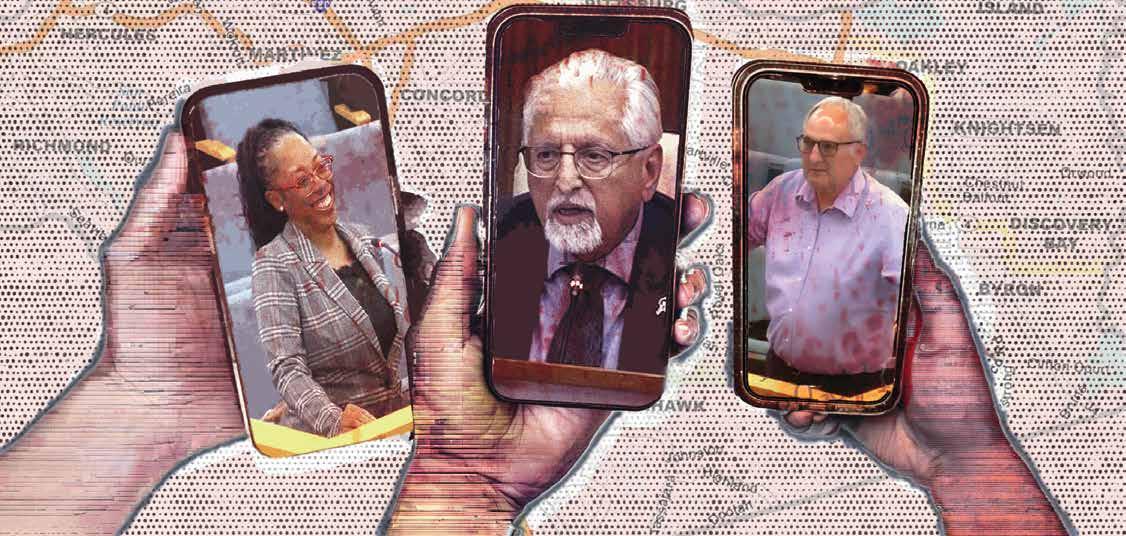
In both East and West Contra Costa County, social media posts by public officials have triggered backlash, defense and debate.
Over the past year, posts shared by officials have tested how communities respond when harm is acknowledged, but consequences remain uncertain.
Porshe Taylor, the current chair of the Antioch Police Oversight Commission, and Joe Mitchell, a former commissioner, were two of three public officials in Contra Costa County who have reposted conspiracy theories, misinformation or other content some considered controversial. Richmond Mayor Eduardo Martinez was the third.
All three ultimately avoided formal consequences.
Taylor was reappointed. Mitchell successfully defended himself against claims. Martinez dodged a censure but, in his current bid for reelection, failed to gain the endorsement of his local progressive group, which may have taken the posts into consideration.
For some, those outcomes feel appropriate. For others, they raise a deeper question: Should public officials face consequences for spreading
CONTACT US
Have questions, comments, or want to get involved? Contact us at:
conspiracy theories on their personal social media accounts?'
A few months before his appointment, Mitchell shared a video that claims the media pushed the deaths of George Floyd, Trayvon Martin, Breonna Taylor and Michael Brown as “racial hoaxes” meant to “drive a narrative to make you hate America …”
The video also falsely claimed Floyd died from a fentanyl overdose and said Martin “was about that life” and “effed around and found out” that George Zimmerman was armed.
Mitchell said he viewed the video as commentary on media bias.
“It almost seems as though there’s a lot of agendas out there,” Mitchell said.
Taylor said she didn’t agree with the views in that video and that they were biased toward several groups of people.
“I think the goal of the vetting for them was to have people in place that represented all different types,” she said.
“I do believe that people should have their choices in regards to their health care decisions, but I also believe that in any kind of professional setting, there should be a level of decorum,” she said.
Since 2020, Taylor has reposted videos and articles that spread misinformation
info@ccpulse.org www.ccpulse.org ABOUT US
The Contra Costa Pulse is a community media project focusing on local and health news coverage in West and East Contra Costa County. The project is supported by STRONG Collaborative Fund.
about the COVID-19 pandemic and vaccines.
“If you or your kids are putting these shots in your body, you need to detox,” states one video that advertises a heavy metal detox claiming to remove the supposed effects of vaccines and autism.
“Injecting foreign things in kids (sic) arms is not building immunity, it’s compromised it,” the caption on the video states.
“None of those things are true,” said Dr. John Swartzberg, professor emeritus of UC Berkeley School of Public Health’s Infectious Disease division.
Ahead of his appointment last year, Mitchell was accused of sharing racist, anti-immigrant, homophobic and antivaccine content on Facebook. He told Antioch City Council members those claims were “not true.”
In 2023, several Antioch police officers were found to have shared racist text messages, spurring indictments and calls for reform. The oversight commission was created as part of those reforms.
Council members did not respond to requests to comment on posts shared by Taylor or Mitchell but reappointed Taylor last month.
Cameron McEllhiney, executive director
of the National Association of Civilian Law Enforcement Oversight, said social media complicates expectations that commissioners remain unbiased.
“Because it is nearly impossible to disassociate yourself in your personal life from the work that you’re doing as a volunteer board member,” she said.
The organization’s Code of Ethics does not define what constitutes a violation, leaving that responsibility to local agencies.
Under Antioch’s ordinance, commissioners can be removed for “violations” of the Code of Ethics, but the ordinance does not define what that means.
An early draft of a local code of conduct calls for prohibiting commissioners from using social media to “undermine the City or Commission’s work, retaliate, or disparage individuals or the City.”
Policies on public officials’ social media use often raise First Amendment concerns.
Swartzberg said public officials have a responsibility to share accurate information.
“There’s greater obligation on people who have a position of authority to be sure they’re quoting what’s known as



Publisher Malcolm Marshall
Editor Danielle Parenteau-Decker
Denis Perez-Bravo
Joe Porrello
Samantha Kennedy
Arianna Caramagno
Emily Tenorio Molina
Jasmine Ford
Zoe Meyer
Vernon Whitmore
Sandy Close
Michael J. Fitzgerald
The Contra Costa Pulse is a community media project founded by New America Media, focusing on local and health news coverage in West and East Contra Costa County.
The project is supported by The California Endowment and the STRONG Collaborative Fund.
Have questions, comments, or want to get involved?
Contact The Contra Costa Pulse at
info@ccpulse.org
www.ccpulse..org
BY SAMANTHA KENNEDY
Flock cameras in Richmond are coming back online, at least for now.
City Council members on March 17 narrowly approved extending its contract with the company, despite concerns over privacy breaches that could make immigrant data open to federal immigration agencies.
The meeting was a continuation of a March 3 discussion that asked the council to decide between doing away with the Flock system or keeping Flock automatic license plate reader cameras for the remainder of the year and possibly later moving to another provider.
Vice Mayor Doria Robinson and council members Cesar Zepeda, Jamelia Brown and Soheila Bana voted to extend Flock’s contract through the end of the year. Richmond Progressive Alliancealigned members Mayor Eduardo Martinez and council members Claudia Jimenez and Sue Wilson voted against the extension.
The cameras have been shut off since last fall after Police Chief Tim Simmons discovered that a national lookup feature had been enabled. The feature allowed other agencies, including federal agencies, to potentially access the data. Simmons said there had been no evidence yet of any of the data being accessed.
Then, the contract expired at the end of February, leaving council members to decide how to proceed with a company that has faced backlash — and a growing number of cities parting ways with the company — because of privacy concerns amid the Trump administration’s increase
in immigration enforcement.
Robinson said that while she found it “deeply offensive” that the feature was enabled without warning, making Flock untrustworthy, she also questioned whether the removal of the cameras would be beneficial.
“When I try to think about what it is we’re talking about here, it’s hard for me to understand how having a blackout space in Richmond — where people are traveling, using all of these different systems — provides true security from this kind of surveillance,” said Robinson.
Multiple Bay Area law enforcement agencies contract with Flock, including the El Cerrito and Hercules police departments and the Contra Costa County Sheriff’s Office, and still have their own cameras that could capture the information of Richmond residents traveling in their jurisdictions.
Jimenez said that the problem she had wasn’t with the automatic license plate cameras but Flock itself. She said that the company’s actions put the city at risk of liability because the Flock system potentially gave access to federal authorities, violating the city’s sanctuary city ordinance.
After Simmons informed the City Council of the potential data breach in the fall, Jimenez said she hoped that an alternative to Flock would have been brought forward.
“We cannot be trusting another company that tricked you and wasn’t really upfront,” Jimenez said to Simmons at the meeting. “We want to have safety, but the safety of our community is not contracting with Flock.”
Brown said that the issue was “sort of pitting communities against one another” because she felt that immigrant safety, which Jimenez had referred to in her comments, was also part of public safety. Fear too, Brown said, is not isolated to the immigrant community.
“Protecting one community while leaving others vulnerable is not public safety, it’s negligence,” said Brown.
The cameras have aided in 274 arrests since 2023, according to Simmons. Once the cameras came off, vehicle thefts jumped by 33%.
Wilson questioned the increase in thefts. In a year-over-year analysis of data in the months of November 2024 to November 2025, Wilson said there was a 50% increase in vehicle thefts with Flock cameras still on.
“It just seems to me, sometimes year-toyear, things fluctuate,” said Wilson. “We can’t just pick them and make a story.”
After the last City Council meeting, Simmons issued a request for proposal for another automatic license plate reader vendor, which will close March 27. Reimagine Richmond, which advocates for reforms to public safety in the city, said after the meeting that the decision jeopardizes “the security and privacy of our residents under the guise of public safety.”
“Because of tonight’s decision, immigrant families in Richmond will continue to be threatened by the misuse of Flock cameras by federal agencies like ICE and DHS,” the organization said, referring to Immigration and Customs Enforcement and the Department of Homeland Security. •
BY JASMINE FORD
Grace N’ Grub is the newest food popup in Antioch, drawing long lines with its smash burgers, wings and loaded fries.
The pop-up is set up at 2515 Somersville Road on Wednesdays and Fridays in the parking lot shared by the former 99 Cents Only store and Savers. Its mission, according to the team, is to feed the people, and give thanks to God for the opportunity.
Grace N’ Grub was founded by Diego Chavez Marquez, who recently turned 18. Though the pop-up has only been operating for about five months, he said balancing school and running a food business can be challenging.
“Getting out of school, I have to prepare everything for the same day,” he said.
He runs it alongside his two brothers, Alfredo and German, with help from a group of friends.
“It’s Diego, and then I’m the older brother, and then my other brother is 15,” said Alfredo, 20. “And then, of course, we have like five more of our close friends with us.”
Despite the demands, the turnout has been steady. Diego encourages customers to arrive early, saying that long lines are part of the experience.
“Having people come and support you know, from starting the business five months ago, it’s crazy how many people
come and show love and support,” he said.
The name Grace N’ Grub reflects the group’s Christian faith.
“We believe in Christ. We’re Christian. We surrender our life to God,” Alfredo said. “With the grace that God has given us, we wanted to implement that into what we’re doing. That’s how the name came up, and ever since, we just ran with it.”
Fittingly, the pop-up’s location is also the site of services for their church.
“Our pastor owns the property, and that’s why we’re able to sell there,” he said. “Our home church is Legendary Church, also known as Legendary Movement Church.”
The team said the business took off after videos started circulating online.
“We didn’t expect this at all,” Alfredo said. “The first two months were pretty rough. We went from like 100 followers to 300, but we didn’t have consistent people until the video got out. Social media is a big thing for us.”
The business now has an estimated 11,000 followers on Instagram and nearly 3,500 on TikTok, both under the handle @gracengrub_.
Recently, however, places like Grace N’ Grub came under scrutiny after the manager of a local business reportedly raised concerns about food vendors at a City Council meeting. Police later showed up at the group’s usual location outside their church but ultimately did not issue any citations. Grace N’ Grub responded
by informing followers that they would continue operating at a different location.
“We had a situation today. We didn’t know what was going to happen or even if we would set up today,” said Diego. “We let our customers know where we’re going to be, and, all glory to God, they came to support us.”
They returned to the Somersville Road location the following Friday, where Diego said city leaders showed their support.
“We had the mayor and some City Council [members] there to support us,” said Alfredo “We’re working on getting our permits, but we’re able to sell there. The city has been helpful.”
The menu includes a smash burger combo with fries, smash fries, chicken wings with various sauces, onion rings and mozzarella sticks. Prices range from $5-$20.
“What’s going viral right now is the smash fries,” said Diego. “People think it looks really good.”
The $20 dish features steak fries topped with chopped hamburger and bacon, caramelized onions and shredded cheese and ranch and buffalo ranch dipping sauces on the side.
Looking forward, Diego says he hopes to grow Grace N’ Grub by partnering with other businesses to bring food and grace to the community. The group has been organizing what it calls the Daily Bread Market, which it was planning to officially open in March. Pop-up events will feature 25-30 other East Bay food
BY DENIS PEREZ-BRAVO
Five months after Yolanda Ramirez’s death, her family said the recent release of police footage — long after a state-mandated deadline — forced them to relive the trauma and restart their grieving process.
“It was important for us to see it, but it did not need to take this long, because now, we’re starting our grieving process all over again,” Yolanda’s daughter, Becky Ramirez Alcantar, said at a press conference outside Brentwood City Hall on Feb. 27.
Family members, residents and community advocates had been calling for the release of the footage for months after the city did not release it within the 45-day timeframe outlined in Assembly Bill 748, a state law requiring the release of records in critical incidents involving police.
The city of Brentwood said Jan. 6 that it would release the footage by Feb. 28.
The Police Department compiled footage from officers’ body cameras, patrol car cameras and 911 audio. The 47-minute video was shown to the Ramirez family before being released to the public.
By then, the family had conducted a private investigation into the events of the day and obtained a second independent autopsy report, which classified her death as a homicide, citing multiple blunt-force injuries to her head and torso, as well as asphyxiation caused by police restraint. The autopsy by the county coroner attributed her death to natural causes.
“I did not want to watch it because I know that it would just bring everything back after all this time that we’ve been trying to come to terms with what happened,” Ramirez Alcantar said.
On Sept. 26, 2025, Brentwood Police Officers Aaron Peachman and Danielle Tjhia responded to a family dispute between Yolanda Ramirez and her sister on Broderick Drive in Brentwood.
The footage opens with a 911 call from Ramirez’s sister, who asks officers to remove Ramirez from the property. The sister also refused to let their brother leave the house to meet her.
After officers arrived, Ramirez was accused of intentionally knocking over a coffee mug on the front porch. Her sister then asked that Ramirez be arrested for vandalism, and Peachman said she would need to make a citizen’s arrest.
While Peachman spoke with the sister, Tjhia questioned Ramirez, who had moved to the passenger seat of her SUV. After providing her name and age, Ramirez became upset with further questions and told Tjhia she was leaving. Ramirez got up and began walking toward the driver’s seat.
Tjhia called for Peachman, and the footage shows both officers standing close to Ramirez outside the passenger door while telling her she was not free to go. Peachman ordered her to sit on the curb, with Tjhia holding Ramirez’s left wrist.
“Why am I going to be arrested?”
Ramirez asked. “Because I want to see my brother?”
Peachman said she was impeding an investigation.
“There are allegations of crimes that have happened,” he said. “Go sit down now, or you will get arrested.”
The footage shows both officers holding Ramirez by the arms and blocking her path. Tjhia then asked, “Do you want handcuffs, Yolanda?”
Ramirez pulled away as the officers maintained their hold. Peachman issued a final warning that she would be arrested. Seconds later, Yolanda exclaimed, “Stop. Don’t do this,” before she was handcuffed.
“It was horrific. It was damaging to my soul to watch my wife being treated the way she was,” Yolanda’s husband, Rudy Ramirez, said at the press conference.
“They ended up killing her over a coffee cup,” he said.
Ramirez and the family said the footage confirms their independent autopsy that classified her death as a homicide.
The footage shows Ramirez resisting as officers attempted to place her into the back seat of a police cruiser. As Tjhia and Peachman tried to get Ramirez inside the vehicle, she fell to her knees.
“Let me call my husband, and I will get in the car,” Ramirez said to Peachman, still on her knees.
About two minutes passed before Peachman and Tjhia appeared to lifting Ramirez by her feet and placing her into the back seat of the cruiser headfirst.
Ramirez’s left leg extended past the seat and out of the left passenger door. Peachman closed the door, pushing Ramirez’s feet and the rest of her body into the car.
Ramirez’s head hit the right passenger door as Peachman closed the left passenger door completely.
As Ramirez struggled to sit up, the
footage shows her breathing heavily while fidgeting with the handcuffs put on her at 11:06 a.m.
At 11:12 a.m., she asked for water and was denied by Peachman, while he was looking for citizen’s arrest paperwork for her sister.
At 11:18 a.m., a third police officer opened the cruiser door and found Ramirez with her head tilted to the left side and appearing to suffer a medical emergency.
At 11:21 a.m., after insisting that Ramirez get out of the car and questioning whether her medical distress was real, Tjhia and the third officer called for an ambulance. Ramirez appeared conscious but not responsive.
At 11:23 a.m., officers removed Ramirez’s handcuffs and began to check on her.
Toward the end of the video, Ramirez sat in the back of the cruiser and moved one hand as if punching in numbers or scrolling on a phone, while the left side of her body appeared limp.
At 11:32 a.m., Peachman told paramedics officers were releasing Ramirez to them. It is unclear from the footage whether officers informed paramedics that she had apparently suffered a head injury.
The video cuts there.
“The police have put out a statement saying that they followed protocol. I see none of that in the video,” Yolanda’s son Francisco Ramirez said.
He urged the public to contact the Contra Costa District Attorney’s Office to request a coroner’s inquest and possible criminal prosecution of the officers involved.
Family members and their attorney, Melissa Nold, also addressed reporters at the press conference.
Nold expressed confidence that despite the pushback Contra Costa District Attorney Diana Becton might face for filing criminal charges against a police officer, there is enough evidence in the footage to prosecute Peachman.
“It is time for her to do her job,” Nold said.
The District Attorney’s Office is conducting an independent investigation into the circumstances surrounding Ramirez’s death and is reviewing police camera footage, medical records and other evidence. The investigation remains ongoing. •

BY SAMANTHA KENNEDY
Anew project is coming to the city of Oakley, but it looks a little different than originally proposed.
City Council members on March 10 approved the 164-acre Bridgehead Industrial Project, which is slated to include logistics buildings — but only after removing the possibility of artificial intelligence data centers from the project. Council member George Fuller was the lone vote against the project after dozens of public comments that lasted for hours.
The project, located by the Big Break Regional Shoreline at the site of the Cline Family Cellars vineyards, is expected to bring in up to a $1.4 million surplus annually to the city’s general fund after being completed in as few as six years. But some residents have for weeks pushed back on the issue of environmental problems associated with A.I. data centers.
Data centers were removed from the project after a request by Jason Bennett, a principal for JB2 Partners LLC, which is the developer and partner of applicant Oxfoot Oakley LLC.
“We have heard your concerns as a City Council, and we have certainly heard the concerns of the community, and — in line with the fact that it was never our principal strategy to develop data centers,” said Bennett, “I respectfully request to modify our application to remove data centers.”
Both Oxfoot Oakley and the vineyards are owned by Fred Cline.
The move drew applause from residents in the room. Council member Shannon Shaw later said that the change allowed her to support the project.
“I was not in any way ready to support this project with a data center in it. It wasn’t anything that my constituents were going to support,” said Shaw.
Stephany Salgado, who grew up in the city, said council members should consider a complete ban on data centers as residents said that the potential of housing any data center could mean high water and energy consumption.
“I get off the freeway, you see gas stations, storage places, property that’s untouched, the recycling center that’s empty and just boarded up,” said Salgado. “Is this what we really want to do to our city?”
Residents’ opposition to the project was contrasted by support from labor representatives and their workers.
Citing the availability of nearby jobs that would cut their commutes down, union members said that the project would allow them to spend more time with their families and also benefit the industry.
Ramon Amaral, a field representative of the North Coast State’s Carpenters Union, said that over 300 carpenters live in Oakley.
“There are other people that would kill to work close to home,” said Amaral. Like other East County cities, Oakley has some of the worst commutes in the state.
Project opponents, many also noting their long commutes, said that jobs and commute times shouldn’t be a reason to lend support.
“How can you justify approving a project that will have a long-lasting, permanent, negative effect on all of us

PHOTO ESSAY • JOE PORRELLO
What if I told you that some of the best pizza in Contra Costa County is being made and served out of the back of a pickup truck in the parking lot of a tire shop in El Sobrante?
Well, it’s true.
I come from a town famous for its pizza: New Haven, Connecticut. Little did I know that about 3,000 miles from my hometown and just three-tenths of a mile from where I live now, I would find pizza so good — once I finally gave it a chance.
I drove by the unassuming lit up tent on my way home several times, not knowing what food was being made there or when it was open, and never thought of trying it when I was going out for a meal. Big mistake.
I admit it wasn’t until months later — when I saw bigger groups of customers lined up — that I was intrigued enough to check out Felix Pizzas. Let me tell you, it was love at first bite.
The crust was airy, the sauce rich, and the pepperoni pizza I ordered came with a flavorful hot sauce for dipping. I quickly realized I should have ordered two pies instead of one.
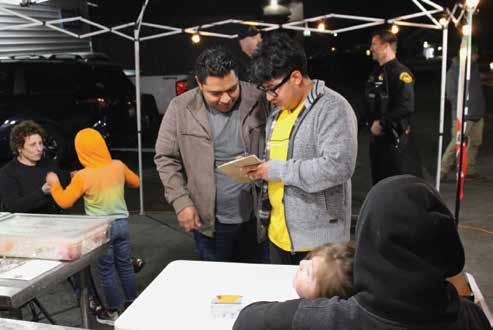
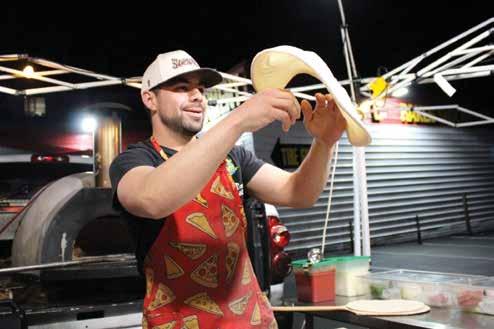
Before the lights were even on one recent evening, customers started lining up in the parking lot. All walks of life ordered many different pizza topping combinations, and the oven sitting in the bed of the truck was never empty. Married couple Krissy and Ernesto Felix, who own and operate the spot at 5050 Appian Way, say business has grown ever since it opened in October.
Krissy credits the increase in customers to word-ofmouth recommendations, while Ernesto pointed to quality and consistency being at the root of their early success.
“We always show up and we’re never late; they can rely on us when they’re hungry,” he said.
One of the main draws is their use of fresh and healthy ingredients. But Krissy says it’s more than just the ingredients — a theory I can surely get behind after tasting their food.
“You can honestly taste the love and effort he puts into it; everything is made by hand,” she said. “We even have
people coming all the way from San Francisco.”
Pizza-making flows through Ernesto’s veins. He was born in the Bay Area before moving to Mexico at age 2 with his family when his father was deported. There, his father owned and ran a pizzeria where Ernesto, now 25 years old, started making slices when he was 12.
Krissy was raised in West Contra Costa County and has lived in El Sobrante for over a decade. She takes care of logistics and orders for the business, making sure everything runs smoothly. So far, they said the community has given them lots of positive feedback and support.
“I’ve heard from a few customers how it’s great to have something like this in El Sobrante; they love it,” said Krissy. “People say, ‘I saw you on the way to Little Caesars and wanted to try a local vendor instead.’”
Many others are as surprised as I was to find pizza — let alone such good pizza — in such an unlikely locale.
“A lot of people say they thought it was a taco truck and that they’ve never seen a pizza truck before,” said Ernesto.
As equally surprising as their business was the pair’s meeting — at a wedding neither were invited to, while unable to speak each other’s language.
“He asked me to dance, and I just remember dropping my heels and booking it to the dance floor,” said Krissy. “For the first six months of our relationship, we actually used Google Translate to communicate.”
That was about a year after Ernesto came back to the Bay Area at age 18 by himself in 2018. After six years together, they each speak both languages with one another — and customers — fluently.
The inspiration for their business came from a trip Ernesto took to visit family in Mexico last year. He was unhappy with his own job, and Krissy had left her position as a medical assistant to take care of their two children — 5-year-old Ernesto and 3-year-old Catalina — along with her recently widowed and ailing grandmother. Then, Ernesto’s brother encouraged them to carry on the family legacy stateside.
“He came home with this idea to make pizzas, and ever since, we’ve just been slowly getting supplies,” said Krissy.
They started with an oven a fraction of the size they
have now, and in a bold attempt, first set up shop in the parking lot on Appian Way where Little Caesars is located.
“We got kicked out because we didn’t have permission to be there; the guy didn’t even let me offer to pay him rent,” said Ernesto. “But I’m not going to quit just because someone tells me to.”
The next day, he started looking for new locations nearby and when it came down to a liquor store parking lot or the tire shop lot, they chose the latter for a more family-friendly atmosphere along with ample parking.
“I went down there the next day and signed a deal with them, so we only had to close for one night,” Ernesto said.
Starting by selling an average of five to 15 pizzas per night, the couple now makes anywhere from 20 to 45 an evening.
Next, they would like to continue improving their equipment — like a food truck with a built-in, bigger oven — and get more certifications and permits, all of which would enable them to be present at more locations and events. And perhaps someday, open a brick-and-mortar version of Felix Pizzas.
Connected first through the universal language of dance, the couple is now connecting with the community through the universal language of food.
Seeing all those happy customers was an illustration, to me, of how more similar businesses would serve El Sobrante well.
One thing is for sure, that nearly addictive combination of cheese, dough and sauce will keep me coming back again and again. The personal pies are served in one size with up to four toppings included for $15. The topping choices are pepperoni, salami, ham, bacon, spinach, mushrooms, pineapple, cherries, olives, jalapeños, garlic, onions, bell pepper and barbecue sauce.
Felix Pizzas is open every week Thursday to Sunday from 7-11 p.m., or until supplies last. Orders can be placed starting at 6:30 p.m. by calling (707) 209-9616 or through Instagram: @felix_pizzas1 •.


BY ZOE MEYER
When most people look at historic buildings, they don’t often envision earrings modeled after them.
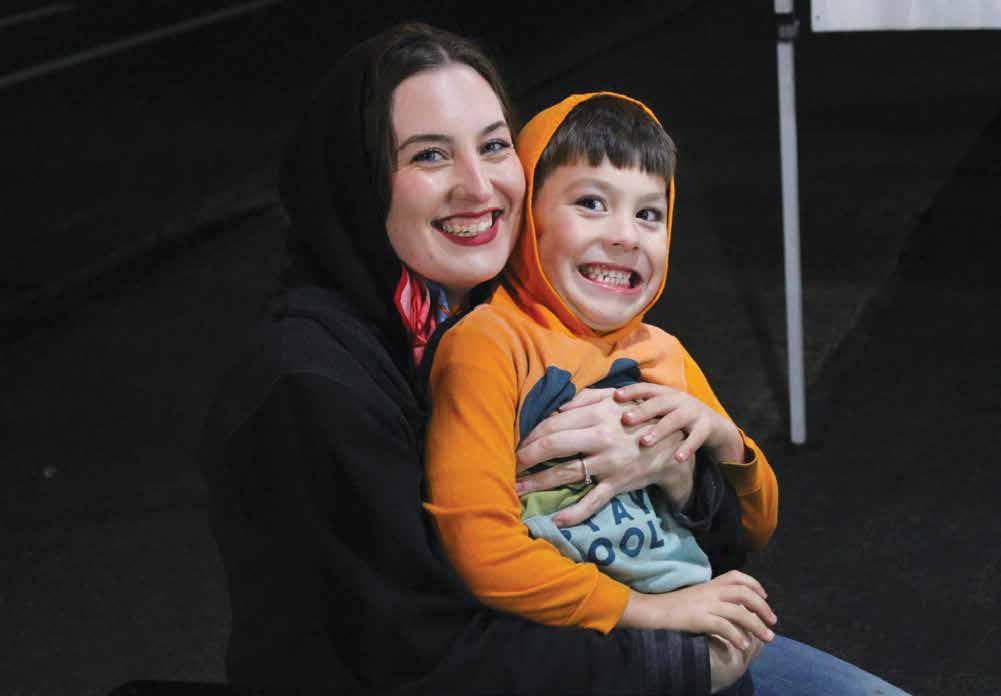
Then again, most people aren’t Sara Pisheh.
For her most recent art exhibit that was displayed at the San Pablo Community Center from mid-January through March 3, Pisheh drew inspiration from historical buildings in the Richmond and San Pablo areas — many of which are no longer standing. Pulling from historical photos, she chose 12 buildings from the early to mid-20th century to model her art after, paying homage to places that brought and continue to bring people together.
Pisheh said that she loved how her vision slowly came into focus as she tinkered. At the beginning of her creative process, she “looks at something in a fog.” Over time, it dissipates, revealing her product.
The Carnegie Library, built in 1910 and now home to the Richmond History Museum at Fourth Street and Nevin Avenue, and the Municipal Natatorium, built in 1926 and now known as the Richmond Plunge, were among the structures that inspired her work.
One pair of earrings replicates the decorative molding around the Carnegie Library’s windows. Another reflects the round stone cutouts above the windows of the Municipal Natatorium.
In total, she designed 12 pairs of earrings modeled after each historical site — all featured in the exhibit.
She describes the pieces as “wearable art” — history you can carry with you, dangling from your earlobes.
In addition to the earrings, the exhibit consisted of two other artistic expressions of the buildings: portraits made from velvet fabric and 3D sculpture models.
“The scale is intentionally altered and playful,” Pisheh said. “The artwork invites viewers to look closely, move around it, and recognize both familiar and unfamiliar buildings that have connected people across generations.”
One Contra Costa resident who visited the exhibit later wrote to Pisheh that they instantly “fell in love” with her work and “the way the light plays on the fabrics.”




Pisheh was born in Iran and developed an early passion for set design. She attended Tehran University and earned a degree in the field. After her undergraduate studies, she was hungry for more. But, to her chagrin, there was no school in Iran offering a master’s program in set design. So, in 2007, she moved to the United States where she attended UC Irvine, ultimately earning a Master of Fine Arts in set design.
Today, Pisheh sees the world in shapes, angles and stories. For her, the biggest thrills stem from watching her sets come to life through theatre, television, and film.
“If I were born over and over, I’d just want to be a set designer,” Pisheh said.
Pisheh found that words were too constricting for expression, especially when her English wasn’t as strong. And set design became a way for Pisheh to communicate beyond language.
Pisheh first got her start in professional set design in 2013, working on the reality show, “America’s Best Cook.” Currently, she works as a set designer and art director in New York City. Pisheh splits her time evenly between there and Pinole where her parents live. Their garage doubles as her studio.
Her credits include Broadway productions such as “Tootsie” and “Meteor Shower” and the feature film “Insidious: The Red Door,” as well as television series like “FBI” and “Law & Order.” She just wrapped up work on the second season of “The Hunting Party.”
But work hasn’t always been steady. During the pandemic, work in the entertainment industry ceased.
Continued from page 3
just for temporary jobs?” said resident Jasper Willowbrook.
In explaining his opposition to the project, Fuller referred to concerns about air quality.
“[The other council members] are creating an environmental cesspool and forcing it onto the residents of Oakley,” said Fuller.
Planning commissioners gave the project, then with data centers, the initial approval it needed to go before the City Council back in January, but asked that additional requirements be added if a data center was later proposed. •
Continued from page 2
vendors and look to create a lively, block-party-like atmosphere.
Their mindset has always been about putting in the work and staying focused once they decide to pursue something.
“If it’s in God’s will, I would like a food truck or a trailer,” said Diego. “The [goal] is to do like a ‘foodieland’ just to bring the community together and to make Antioch a better place.” •
To keep pace with the bills, she started two businesses: a jewelry brand and set decoration for kids’ birthday parties and events.
For Nowruz, the Persian New Year’s Day and first day of spring, Pisheh built a traditional and playful Haft-sin, an arrangement of symbolic items representing health, renewal and prosperity, for young children at the Limoo Photography studio in Santa Clara.
Pisheh also recently planned a 3-year-old’s Cinderella cartoon-themed birthday party. Everything from the table settings to cake display to floral arrangements was intentional.
Her mind, and body, never rest. In her spare time, she applies for art shows such as Into the Streets in San Francisco and Taste of Richmond, which just recently invited artists to show their work.
“I’m in the process of learning how to run a business,” Pisheh said.
She’s very much enjoying studying up on the art of self-promotion. Unlike union work in New York, where jobs come on a regular basis, her independent businesses require constant self-promotion, something she has begun to embrace.
“Most of the time, I just want to surprise people with my work. And this surprise is not always the same,” Pisheh said. “If you expect things, let me show you something else.”
Her jewelry and party designs can both be found on Instagram. Visit her website to view all her art in one place. •
Continued from page 1
opposed to what they believe,” he said.
WEST COUNTY
Martinez faced widespread backlash for reposts on LinkedIn that several called antisemitic.
Late last year, the mayor shared a post that claimed the Bondi Beach, Australia, attack was a “false flag” and that Israel’s actions are the “root cause” of antisemitism.
Prompted, in part, by calls from the Jewish Community Relations Council, dozens showed up at City Council meetings and called for Martinez’s resignation.
Martinez did not respond to requests for comment. At a March 16 mayoral candidate forum, he said he should have been “more circumspect.”
“I should have realized that the people who are spreading hate is not me but the ones who don’t take the time to actually listen to what I said,” he said.
Jewish Voice for Peace Bay Area said his posts were hurtful but opposed censure or resignation.
Several Martinez supporters, including council members Sue Wilson and Claudia Jimenez, who are part of the Richmond Progressive Alliance, defended him while saying the posts were a “misstep” or “missed the mark.”
“One misstep does not erase all the good you have done for Richmond nor does it warrant a resignation,” wrote one

Youth Voices
the race. Jimenez said the backlash could have played a role.
As debates over social media, free speech and public trust continue, the question remains: When officials post controversial or misleading content, who decides what accountability looks like? •
BY DIANA LAMBERT | EDSOURCE
Thousands of California school employees have received preliminary pink slips in recent weeks as districts scrabble to close budget gaps caused by falling enrollment and rising costs. Most went to school administrators and classified school staff, such as clerks, administrative assistants and paraeducators.
Districts were complying with a state law that requires them to send preliminary pink slips by March 15 to any employee who could potentially lose their job before the beginning of the next school year. Many of the notices are withdrawn by May 15 — the last day final layoff notices can be given — as districts make decisions about seniority.
This year the layoffs have taken a dramatic turn as district leaders increasingly target classified and central office staff to balance budgets.
School districts have lost both average daily attendance funding, due to declining enrollment, and federal Covid dollars. At the same time, districts are paying more for pensions, health care supplies and special education.
“You have some large school districts and even some mid-sized and smaller school districts that are in complete financial crisis right now, and on the verge of insolvency or going into receivership,” said Troy Flint, chief information officer for the California School Boards Association. “When the deficit is so great you almost have to make hatchet-type cuts.”
District offices in the crosshairs District staff are being targeted by some districts. In Sacramento City Unified, everyone working in the district office, including the interim superintendent, was issued a pink slip. Los Angeles Unified and Oakland Unified are also planning to make major cuts to their central offices.
“The board directive, ever since we declared the deficit, has been pretty clear: Whatever cuts we have to make, keep them as far away from the classroom as possible,” said Brian Heap, Sacramento City Unified’s chief communications officer.
District officials can’t say how many employees at the Serna Center – Sacramento City Unified’s headquarters –will ultimately lose their jobs until they complete a plan to restructure the office, Heap said.
“We have to have somebody running payroll. We have to have somebody in the business office. We have to have somebody in our academic office,” Heap said. “But what does that look like? That’s what we’re trying to figure out.”
Sacramento City Unified officials have announced they will send layoff notices to 800 employees, most who are classified employees, to help reduce a $134 million budget deficit.
“I’m certainly nervous,” said Heap, who also received a pink slip. “I mean, I’d be lying if I said I wasn’t.”
The Los Angeles Unified school board voted in February to issue 3,200 layoff notices, including 657 to central office staff and other centrally funded classified positions. The layoffs, expected to actually result in 650 lost jobs, are estimated to save the district about $250 million. The district is facing an $877 million deficit next school year and $443 million the following school year, according to board materials.
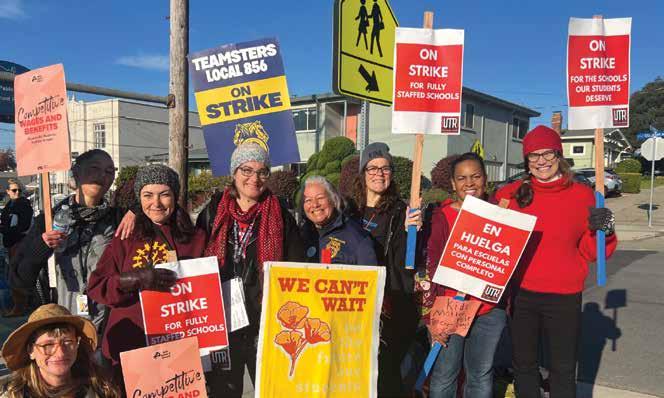
Oakland Unified could cut up to two-thirds of its central office staff along with counselors, case managers, attendance clerks, community school managers and other support staff to make up $21 million of an estimated $103 million deficit, according to media reports. The district planned to issue a total of 421 preliminary layoff notices and reduce the hours of 144 employees, according to Oaklandside.
Nonteaching jobs often cut first Classified staff are often targeted for layoffs for practical and political reasons, Flint said.
“They [districts] try to concentrate layoffs among classified staff and administrative personnel simply because teachers have the most direct impact on student experience and academic achievement, and because teachers — as the school employees who are most well known to parents and the community — generally are the most sympathetic profession in the education field,” Flint said.
The California School Employees Association, which represents about 240,000 of the state’s K-12 classified school support staff, reported that at least 2,700 pink slips had been issued to its members by the state’s March 15 deadline. An additional 519 members received notices that their hours would be reduced and another 254, with jobs funded by federal dollars, were given 60-day layoff notices, according to a union report issued on March 6. Districts should make sure they have cut every possible expense before they start removing staff from school campuses, said CSEA President Adam Weinberger, who works in the Perris Union High School District in Riverside County.
“When classified employees are laid off, students lose more than services; they lose trusted adults in their lives — bus drivers, educators, custodians and office staff who build relationships with our students. And those connections are essential to a safe and supported learning environment,” Weinberger said.
California school boards also approved layoff notices for administrative staff and workers represented by other unions, including members of the Service Employees International Union, which represents about 50,000 classified school employees in California districts including Sacramento City Unified. SEIU officials could not be reached to provide information about the number of members who received layoff notices.
Teachers did not get off unscathed
Even with efforts to shield teachers from layoffs, more than 1,900 pink slips were sent to members of the
California Teachers Association by March 13, according to the union. The union represents teachers, librarians, school healthcare workers and school counselors. Last year, about 2,000 teachers received notices.
The pink slips are being issued at the same time that many bargaining units of the CTA and other unions are negotiating with their school districts for new contracts, most asking for higher salaries and improved benefits.
San Diego Unified approved a contract with its teachers early this year that prohibits the district from laying off teachers or other certificated staff for the 2026-27 school year. Instead, the district sent layoff notices to 133 classified school support staff, according to the CSEA.
San Diego Unified board member Sabrina Bazzo said she is proud of the decision not to cut teachers, saying it’s not what is best for students.
There are still many districts laying off large numbers of teachers, as well as classified support staff.
According to the CSEA, Long Beach Unified officials planned to send pink slips to 515 teachers and other credentialed staff, 15 to managers and 54 to support staff. Santa Clara Unified planned to send pink slips to 113 credentialed staff and 49 to classified workers. Antioch Unified approved a resolution reducing its credentialed staff by 104 positions and its classified staff by at least 193 positions, according to a union report.
Pasadena Unified indicated it had also issued 161 pink slips to its credentialed employees and 240 to classified school support staff.
“The reductions are significant and affect every school and department in our district,” said Pasadena Superintendent Elizabeth Blanco in a statement. “We are living within our fiscal reality, as difficult as it is, to protect student learning, the district’s long-term ability to serve future generations, and local control.”
Annual ritual causes anxiety
Many have called the annual ritual disruptive to schools and demoralizing to the employees who receive them.
“Our members are working paycheck to paycheck, and they’re looking for stability,” Weinberger said. “I know we have many members that get one every year and, then they’re rescinded and that creates instability in their lives.”
Eventually, those employees begin to look for other, more stable, jobs to ensure they can provide for their families, he said.
Ed Source reporter Mallika Seshadri contributed to this report. •
Editor’s note: Spoken word artist Donté Clark’s latest project is “Blú Honey,” a 19-minute short film about self-discovery and a young Black man growing up in North Richmond. Blending poetry, community voices and visual storytelling, the film explores identity, resilience and life in “Narf,” as locals call it. The film premiered Feb. 26 at the El Cerrito High School Theatre. Clark recently spoke with The Pulse about the project and the inspiration behind it.
Contra Costa Pulse: What motivated you to create “Blú Honey,” and how does this project connect to your spoken word work and community activism?
Donté Clark: The idea for Blú Honey stemmed from a fellowship I received in 2022 through BAYCAT for TV/ film script development. Over the course of a couple moments in spring, I was brainstorming titles for my then-TV show idea, and I wanted something that represents the Black experience in Richmond — the hardships as well as the ingenuity and immeasurable talent that exist. I landed on “Blú Honey.”
Blue for the experience of Black people, Black males specifically, and honey for the goals, dreams, aspirations and our pursuit towards rest and abundance peace. Fast forward, I wanted to continue to develop the concept once the fellowship with BAYCAT had ended, so I applied for another grant through Yerba Buena facilitated through creative corps (Richmond Arts Council and BE Imaginative) in 2023. I altered the idea to fit into a short film and poetic experience, and we have finally reached the next phase.
I feel “Blú Honey” embodies the essence of the origins of my work in spoken word poetry and how I experience the world around me. The film shows the complexities of boyhood in “Narf” Richmond and how hardships can turn the sweetness of life bitter. I infuse poetry throughout the film and it’s almost biographical. Not only showing the environment through symbolism but recalling it through vivid wordplay. Much to chew on for the viewer. Plenty of teaching moments for educators.
Contra Costa Pulse: The title “Blú Honey” is evocative. What does it signify in the context of the film, and how did you arrive at that name?
Donté Clark: Blue represents the struggles. The nights of using the stove for extra heat or carrying “17 caskets on your back,” the weight of grief and death all around you. The honey represents culture. The ways in which we resist the systems that are designed to oppress us. Our poetry, our music, our heads held high. God’s presence over our lives that sustains us. His anointing oil, our honey.
How did I arrive at that name? It was heavenly sent.
Contra Costa Pulse: Can you walk us through your creative process for this film from idea to finished product? What were some key decisions you made along the way?
BY SAMANTHA KENNEDY
C
ontra Costa voters will decide this June whether or not to increase sales taxes to mitigate federal cuts to healthcare. The tax could generate around $150 million annually, according to officials.
County supervisors voted 4-1 on March 3, with Candace Andersen voting against, to place a five-year 0.625% sales tax on the June 2 ballot.
If the measure passes, revenue from the tax would go into the budget’s general fund, which would allow it to be used for things outside of healthcare. A simple
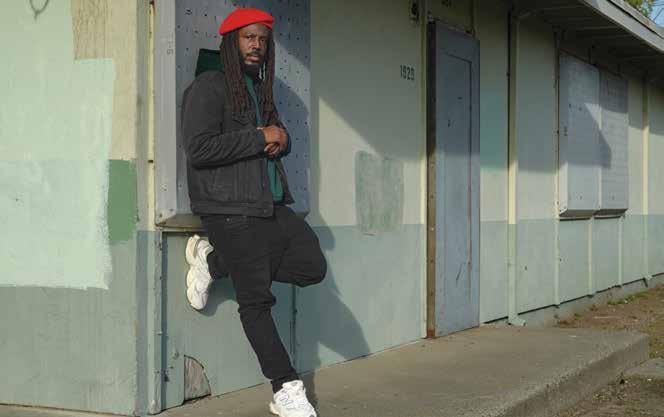
Donté Clark: My creative process is a journey of discovery. Peeking through the scars and seeing what’s there. First, I started with poetic lines that I have in my catalog. “Sweet Songs” is a haiku poem that I came up with while driving: “Life sings me sweet songs, if live to dance but I’m afraid of my feet.” I thought what if while you hear a voice saying this off screen, and you see a Black man running through the woods and he falls down [while] something eerie seems to be lurking close by.
From there, I just keep imagining. Using poems that felt like they told a story, and I piece together connections, then place a visual representation on script for filming. A lot of brainstorming, but the writing only took a day to assemble. Once I began filming, the script took a turn. Some people drop out, some scenes get cut, and you have to work on the fly. So a TV idea about how to maintain healthy living in a food desert and poor environment turned into a poetic journaling of scrap pieces assembled after the editing. I feel like the cut of “Blú Honey” that we have opens the door for me to dive deeper into my original idea and explore even more creatively than I originally thought to.
One key decision I made was to step up and assert myself in every aspect of filmmaking. Not only writing and directing the vision but protecting the integrity while editing. Sometimes, not every [collaborator] sees your vision or is as invested to see it through as you are, so knowing when to step back and allow creativity to flow and step up when the vision calls for it. I wanted to film the school scene in a traditional classroom, but when access was denied, I decided to film in “Narf” Richmond’s housing projects. I felt that was more compelling and poetic and allowed for more creativity and nuance to live within the piece. I’m proud of that decision.
Contra Costa Pulse: How does the film reflect your personal experiences, especially as someone rooted in North Richmond?
Donté Clark: “Blú Honey” is basically my upbringing. A little boy keeping all of these experiences inside of
majority of voters, 50% plus one, would need to approve the measure for it to pass.
“We have unfunded mandates from the federal government and the state government that we have no choice but to make sure that we take care of. That’s what this looks like right now,” said Supervisor Shanelle Scales-Preston.
H.R. 1, also known as the “One Big Beautiful Bill,” cuts healthcare and social safety programs like CalFresh, the state’s version of food stamps, over 10 years. Contra Costa projects a more than $1 billion deficit by 2031 because of the cuts. Reductions to healthcare will total around $500 million through 2031, according to Contra Costa Health’s interim chief financial officer Brian Buchanan.
But those healthcare reductions were not the amount that Andersen, who supported the tax at previous meetings, said the county shared in some of its information. She said it was irresponsible to move forward with the tax at this time.
“The fact that we had to change the resolution today, that we have posted incorrect information on the website, is very, very disconcerting,” said Andersen. “To me, it’s just basic, good government [to do so].”
my heart and finding solace in poetry. Going to school, not being heard or understood, processing the pain of a killed loved one or wanting to cry but can’t. Every line or scene in the film is based on my life, and I imagine others from my community can certainly relate.
Contra Costa Pulse: What response or reaction are you hoping to inspire in audiences, both locally and beyond?
Donté Clark: Any response is cool for me. I really wanted to overcome a fear of rejection or wondering “Am I really good as they say I am?” Being afraid to make mistakes publicly. The fear of not being good enough. Once I decided that I’m writing and doing my art for my own experience and I only get better the more I work, any response is a good response. Because I speak honestly, from experience and observation. I’m very thoughtful of my art, so I can almost predict what the reactions will be, so I’m not looking for anything in particular. Because as long as you engage with the art, it lets me know that there’s one thing there worth noticing.
Contra Costa Pulse: Spoken word and film are different mediums. What do you learn about storytelling through that’s different from your poetry?
Donté Clark: I feel that spoken word and film are one and the same. Both when done with care, are best received from the perspective of “show me, don’t tell me.” Spoken work is a visual language. As is filmmaking. Spoken work is observational, and when done with this intention, a poem is a movie, a scene, or the backbone to any good story or dialogue in any script. So I plan to be more intentional about infusing filmmaking through the lens of poetry.
A screening of “Blú Honey” is planned at Richmond High School in April. For updates, follow Donté Clark on Instagram at @donblak. For screenings or bookings, contact him at donteclark@ymail.com. •
In the county’s initial resolution placing the tax on the ballot, the county stated that federal funding cuts and rising costs were projected to exceed over $300 million in annual revenue losses by 2029. Andersen said some information said $307 million in revenue loss.
Thomas L. Geiger, county counsel, told board members that the amount needed to be changed to “cumulative losses of an estimated $239 million by 2029.”
Dr. Grant Colfax, director of Contra Costa Health, acknowledged the error.
“But I will just be very clear here, lives are at risk, and our entire healthcare system is at risk,” said Colfax.
Michael Arata, a member of the Contra Costa Taxpayers Association, told members that the measure needed to be pushed back.
“Now, you’re changing the game. You’re going to 2031 and have done it so late that we responders are also on the fly. This needs to be considered much more thoroughly,” said Arata.
Contra Costa is not the first to consider a sales tax to cover costs associated with federal funding cuts and the state’s deficit. In Santa Clara County last year, voters approved a similar tax that would help fund programs affected by the cuts.•
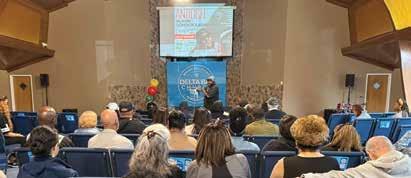
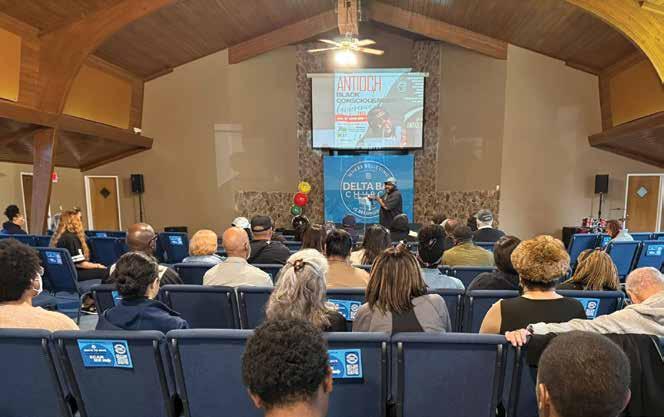
The first Antioch Black Consciousness Conference and Concert brought members of Antioch’s Black community together to discuss representation, healing and collective action.
Held at 40 Voices African American Holistic Wellness and Resource Hub at Delta Bay Church on Feb. 27, the gathering aimed to inform and encourage Black-owned businesses, community leaders and residents to organize and strategize about representation within the city.
Throughout the day, participants addressed a variety of issues affecting Antioch’s Black community, including mental health, education, policing, political representation, economic opportunity and faith leadership. Organizers said the conversations were intended to begin shaping a unified citywide Black agenda.
The conference began in the church sanctuary. The Rev. Lamont A. Francies Sr. and co-host Girared ”Gigi” Crowder spoke about the importance of representation within the community, and opened the floor up for questions and comments.
Some spoke about losing a family member, while others suggested that they would be willing to represent the community with help and assistance from churches and local Black businesses.
One moment that moved me was learning more about Antioch’s history. The topic of Antioch once functioning as a de facto sundown town was raised, a term used for communities where people of color were discouraged or prevented from living or even visiting after dark. Over the last few decades, demographic changes have reshaped the city and shifted the legacy of exclusion in the area. Today, Antioch is home to about 22,000 Black residents, making it the largest Black population in Contra Costa County.
Despite Antioch’s growing Black population, many residents say they rarely see that reality reflected in citysponsored events, leadership spaces or decision-making tables.
I believe some churches have, at times, turned their backs on each other in the name of defending what they believe is holy and right. Difference in doctrine and approach have created divisions that make it difficult for faith communities to unite and work together.
Meanwhile, a real crisis continues to unfold right in front of us, one that affects youth, families, and the broader community. Issues such as violence, economic
hardship, and the need for stronger support systems require collective action, empathy and compassion. Moments like this gathering remind us that the church has the opportunity and responsibility to rise above internal disagreements. By coming together, faith communities can recognize that the well-being of our city is shared and can’t be addressed in isolation. So where does the representation of the Black community begin? That is why gatherings like this are important. To be seen, to feel heard, and to walk away inspired to inform the Black community that work is starting to be done.
During the conference, I also learned more about challenges facing the community that I am a part of.
About 8.5% of Black people in Antioch are unemployed; amongst that number are teens who have the highest unemployment rate.
Antioch has two Black women on the City Council, Monica Wilson and Tamisha Torres-Walker. Even still, we lack the representation and response to the issues we face in Antioch today.
Mental health was also a major topic of discussion.
Crowder, executive director of the National Alliance on Mental Illness of Contra Costa County, offered mental health resources for attendees.
Black residents across the East Bay toil with racial trauma and discrimination, Crowder said, so creating safe spaces to talk about those experiences is important.
Another concern raised during the conference was the limited number of Black residents consistently speaking out against violence and advocating for recognition and change. With only a small group carrying that responsibility, burnout can quickly set in and slow the momentum of community efforts.
Participants also discussed how many events in Antioch are organized by people outside the Black

community, which can make it harder to cultivate the sense of authenticity and cultural grounding that many local Black residents seek.
Part of the purpose of the gathering was to find out if there was a possibility to control these events; having a safe space for us to communicate, gather, and understand each other, without the overhead of control from the city.
Later in the event, we went into breakout groups. Black men and women were separated and brought into breakout dwellings.
I took part in a presentation by Lucretia Clark who said Black women and women of color were not just tired, but “HERstorically exhausted” from laboring in caregiving. Clark approached the presentation by speaking about how, as Black women, we can be exhausted from taking care of others and encouraged us to take care of ourselves.
At that moment, I felt seen.
Like many women, I have felt like I have had to take care of others first through communication, affection, prayer, and more.
“Caregiving can be exhausting. Being exhausted means that you are depressed,” Clark said.
She also discussed microaggressions in the workplace or daily life and scenarios to interpret that, as well as informed women that over-functioning in life is a survival pattern or strategy that we use to keep us going. Overall, attendees at the conference were able to come together and fellowship, reflect, and encourage one another to get involved in the Antioch community, for the betterment of the Black community.
I was personally empowered to positively advocate for Antioch by giving voice to the voiceless and giving hope to those who have none. •

BY EDWARD HENDERSON CALIFORNIA BLACK MEDIA
A meeting of the California Civic Media Program Advisory Board was briefly disrupted last month when an unknown participant hijacked the Zoom chat and repeatedly posted the racial slur “I HATE N—!” before moderators removed the messages. The incident underscored a troubling reality highlighted in a new statewide report: anti-Black hate remains persistent in California, and Black residents continue to experience the highest rates of hate incidents.
Days later, the California Commission on the State of Hate released its 2024–2025 Annual Report on Feb. 24, warning that hate activity remains elevated statewide and that Black Californians continue to face disproportionate harm.
The findings come as California prepares to close its Stop the Hate program on June 30, 2026, after investing $250 million in public awareness, prevention and grassroots anti-hate work.
Assemblymember Dr. Corey Jackson, D-Moreno Valley, says combating hate across the state requires cross-community alliances, particularly for Black Californians who experience the highest number of hate incidents.
“One of the critical things about hate is that in many cases, when hate arises against one group, that community is often left on its own to organize and defend itself. They’re left trying to fend off the attacks and educate others about their own humanity,” said Jackson, who spoke at a Feb. 24 informational hearing titled “State of Hate in California: Progress on Addressing Hate in California.”
Lawmakers organized that event just one day after the report’s release.
“We know that the best protection against hate — the best way to fight it — is solidarity,” Jackson continued. “It’s especially important for groups who are not being targeted at that moment to speak up for those who are.”

For nearly five years, California’s Stop the Hate program has funded community organizations across the state to prevent and respond to hate incidents and crimes. They have also supported the state’s non-emergency 2-1-1 network for the past 3 years to coordinate care through California vs. Hate, a multilingual hotline and online reporting system designed to support victims of bias and discrimination.
“California vs. Hate has been a lifeline for Californians targeted by bias and discrimination,” said Maribel Marín, executive director of 211LA. “The program was originally funded with limited-term dollars and is not currently slated for renewal. Without action during the budget process, the program could sunset on June 30, 2026.”
Marín said the need for the service remains urgent. Data from the UCLA Center for Health Policy Research show nearly 3.1 million Californians experienced a hate act last year, and many reported unmet support needs — meaning they wanted help but didn’t know where to turn.
Through California vs. Hate, 2-1-1 operators provide a safe, confidential place for people to report incidents and connect them with services such as legal aid, counseling and financial assistance. In 2024, the program received nearly 1,200 reports, with about two-thirds of callers requesting ongoing support.
“If eliminated, victims would lose a trusted place to turn, and California would lose a valuable tool for tracking hate trends — at a critical time when hate continues to rise across the state,” Marín said.
The report includes updated trend analysis, implementation progress and 23 interim policy

recommendations aimed at strengthening California’s anti-hate infrastructure. While it does not include a new statewide prevalence survey this year, commissioners reaffirm that the most recent representative data show about 14% of Black adults in California experienced at least one act of hate within a one-year period — nearly double the statewide average.
Brian Levin, chair of the California Commission on the State of Hate, says hate has risen dramatically over the last decade, but California is leading the nation in responding to the surge.
“Our state has built up local support networks, we’re investing in increased safety for nonprofits, and we’re bringing together experts from all walks of life to help us put a stop to hate,” Levin said.
Key recommendations in the report include sustained funding for community-based organizations providing culturally competent victim services, requiring law enforcement agencies to designate hate crime coordinators, expanding culturally responsive mental health services, strengthening school curricula addressing online hate and bullying, and increasing public awareness campaigns ahead of major events such as elections.
“This report provides an important roadmap for how we can continue to meaningfully take action against hate,” said Civil Rights Department Director Kevin Kish. The Civil Rights Department provides administrative and technical support to the commission and operates the state’s hate reporting hotline and resource network. “People across California continue to come together to support their neighbors and help build a state where everyone feels safe and welcome,” Kish added. •




BY EMILY TENORIO MOLINA
D
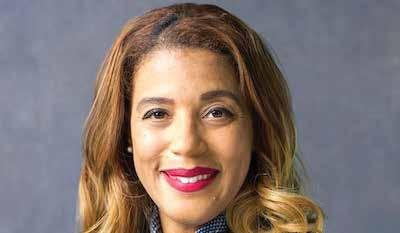
ionne Adams stepped in as mayor of Pittsburg in December after three years on the City Council, assuming the role as the city advances recreation, transportation and economic development projects.
In Pittsburg, the mayor and vice mayor are not directly elected by the public but chosen from and by the City Council members. Adams and Angelica Lopez were unanimously selected Dec. 1 as the next mayor and vice mayor, respectively. Each serves a one-year term in the position. Adams previously served as vice mayor.
She is a fourth-generation Pittsburg resident whose great-grandparents migrated to the city after World War II, when many Black families left the South for economic opportunities. For her, the city she now leads has always been close-knit and diverse, something she says shaped her identity and values.
“Growing up here is one of the things that I cherish,” she said. “Pittsburg has always been…very much a village.”
Adams credits the city for building her confidence to pursue a career in community-focused work. She remembers how much easier it was for her family to spend quality time together because her mother had a job in town. That meant less commuting and more family time during Adams’ upbringing, an important memory that would later shape her life enrichment goals.
After graduating from Pittsburg High School, she went to Diablo Valley College, transferring to San Francisco State University for her bachelor’s in business administration and later earning her master’s in public administration from Golden Gate University. For two decades, she worked for PG&E in Oakland, where she
BY ARIANNA CARAMAGNO
J
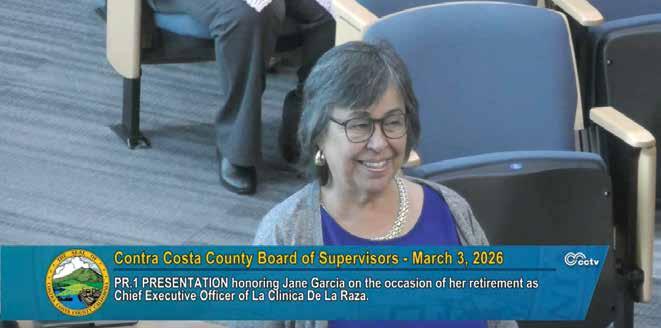
ane Garcia, the soon-to-retire CEO of La Clínica, was honored March 3 by the Contra Costa County Board of Supervisors for her decades of work expanding access to health care in the Bay Area.
La Clínica, formally known as La Clínica de La Raza, was first established in 1971 by a group of UC Berkeley students who sought to provide culturally appropriate and affordable health care access to low-income communities. Over the past five decades, La Clínica has grown from a small community clinic to an organization that has become one of the largest community-based health care providers in the Bay Area.
Garcia has served as the organization’s CEO for 44 years. During that time, she helped expand La Clínica from a $2 million startup into a $170 million health care network serving thousands of patients across the region.
District 1 Supervisor John Gioia and District 4 Supervisor Ken Carlson led the presentation honoring Garcia. Both supervisors commended Garcia for her efforts to bring affordable health care to East Bay residents.
Gioia also noted that Garcia’s interest in health care access was shaped, in part, by her experiences growing up without access to affordable health care.
“We’re truly honoring a health care giant,” said Gioia. “I think for those who don’t have health care when they grow up, they understand even more importance of why everybody should have health care.”
La Clínica serves about 85,000 patients across nearly 35 different sites around the Bay Area, offering a variety of health and dental services to those in need regardless
led belonging and diversity programming. While she studied and worked in other, more urban cities, she saw the recreational amenities and job opportunities that Pittsburg could one day have.
When Adams returned home, she started her civic engagement by joining city commissions to use her public policy background.
“People were pushing me to help in different places,” she said. “It made me think, ‘Wow, I can contribute.’ ”
Then, she ran for City Council, taking office in 2022. After three years on the council, Adams remains focused on her vision for the city.
“My commitment is to lead Pittsburg better than I found it when I first sat in the seat, ” she said.
As mayor, she says her priorities include welcoming new residents and strengthening infrastructure, including road conditions and accessible transit that is “affordable and clean.” The current work plan from the City Council is to reduce long commutes, create local
jobs and improve families’ quality of life.
The city is also exploring the development of a data center in Pittsburg, which she says could support business growth and jobs. She also hopes to attract additional development to bring in companies, jobs and tourism.
Other priorities include working with the Police Department to understand crime citywide and focusing on being financially solvent as a city.
“This is a great time for Pittsburg, we have reinvented ourselves through the years,” Adams said. “We were a fishing town, then to mining, and steel, and now we are technology and sustainability. The common thread throughout all of that is the community.”
By the end of her term, Adams said she hopes Pittsburg will have more lodging options, sports facilities and stronger infrastructure to support local businesses.
“That will translate over time to more jobs and improve the quality of life.” •
of their ability to pay, Carlson said at the meeting.
District 2 Supervisor Candace Andersen also praised the organization’s impact particularly on residents in Contra Costa County who historically lacked access to health care that was both affordable and culturally responsive.
Andersen said that, in the past, residents within the county have not always had access to medical care where they could simultaneously feel seen, heard and represented.
“It’s so impressive the void that La Clínica filled, particularly when health care was not available to all of our residents in Contra Costa County,” said Andersen.
Both Gioia and Carlson said that Garcia’s work at La Clínica will remain important as the region navigates ongoing changes to health care funding and policy.
County officials say Contra Costa has been projected to lose over $300 million in health care funding through 2029, with an estimated 93,000 residents to be affected by new eligibility rules put in place by the Trump administration under the “One Big Beautiful Bill Act” that could disrupt Medi-Cal access for roughly half of the enrollees.
“With what has happened with the Affordable Care
Act, immigration reforms and enforcement, she has truly been a partner with all of us and our county’s CBOs [community-based organizations] to really be a driving force,” said Carlson.
After the presentation, Garcia spoke. She acknowledged the difficulties providing health care across counties but remained optimistic about the future of health care in the Bay Area. Garcia also said that the current problems facing the health care system are not something that the county hasn’t dealt with before in the past and that community health centers such as La Clínica will continue to fight back against such difficulties.
“We’re in difficult situations right now. But this is what makes us stronger,” said Garcia.
Though Garcia is retiring from her role as CEO, she said her commitment to serving the Bay Area is far from over.
“You know, this has been a life commitment for me. It’s in my DNA,” said Garcia. “So I may be retiring, but I ain’t going nowhere.”
La Clínica has yet to announce who will replace
as CEO once she officially steps down. •